Log Improvements 5
Summary
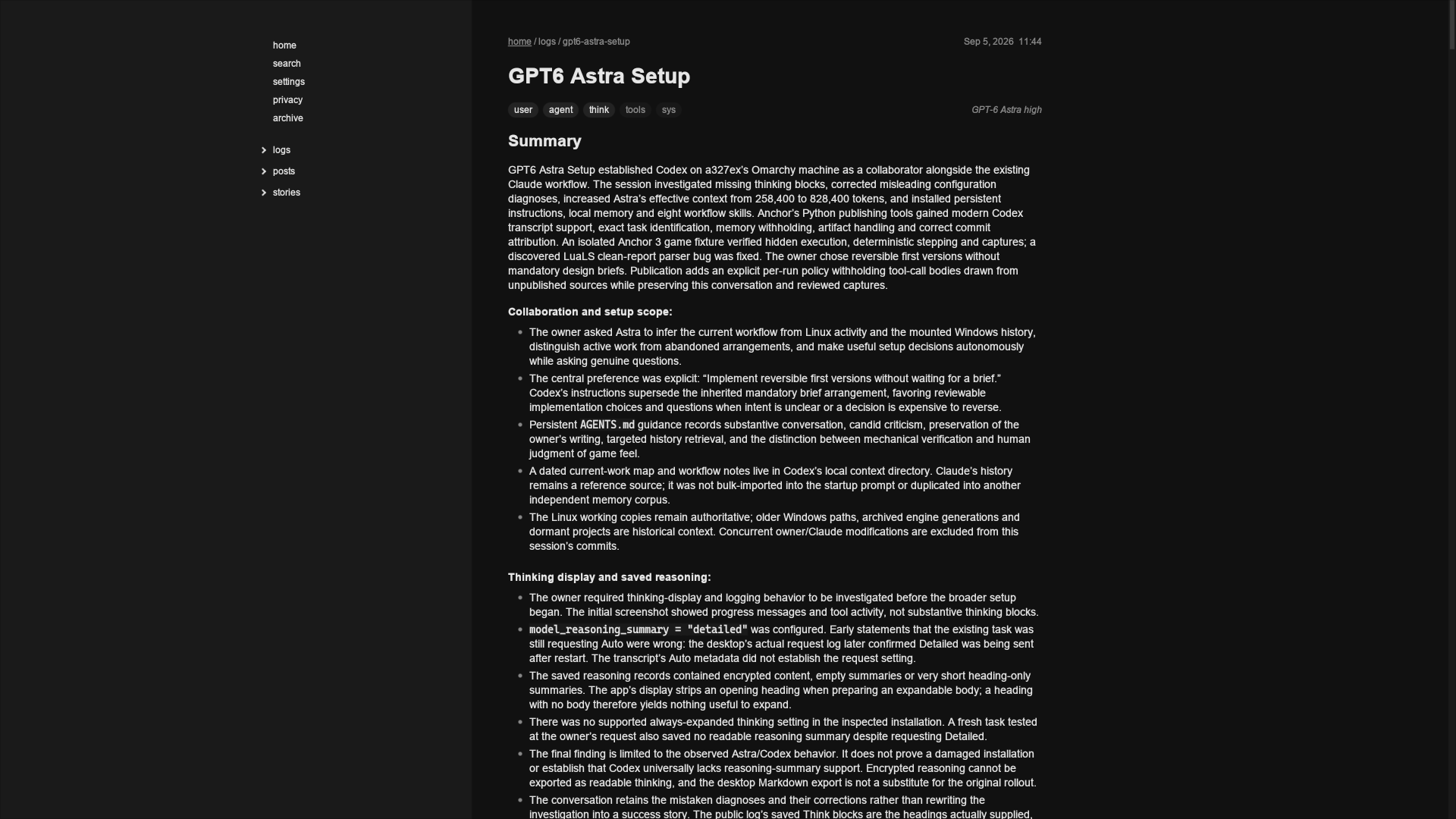
Log Improvements 5 audited ChatGPT's "Log Improvements 4" model-attribution rollout on a327ex.com, then reshaped the feature. The audit proved the 261-log backfill preserved every published line but surfaced one unflagged change: 196 pre-role-marker logs had been given ::role markers, silently switching them onto the chips/filter rendering with tool folds hidden by default. Those 196 logs were reverted to their original rendering while keeping their ::model lines, each verified byte-identical to its pre-rollout file plus attribution. The model labels were redesigned in renderer/attribution.lua: every turn's "Worked for" row carries the model in mixed logs, a switch inside a turn gets a two-sided "Model changed" row, header efforts sort by rank, and the gap below metadata rows widened. A duplicated Summary heading was fixed. Renders were captured from a hidden anchor drive renderer instance via debug.getupvalue. The session closed by designing a multi-model delegation scheme (Fable directs; Astra/Codex implements, Grok explores, Gemini for video) and writing Anchor/workflow/DELEGATION.md, the /delegate skill, and memory.
Audit of Log Improvements 4 (ChatGPT / GPT-6 Astra, commits ceb5b02..e01b0e3):
- Owner: "check his work, make sure he didn't make any mistakes or change any logs incorrectly, and then once that's verified, let's iterate on the feel of the agent lines he added."
- Content preservation proven with a Python diff over commit 64e4f0c: for all 261
logs/*.mdplusgated/reverse-minesweeper-prototype.md, removing::role/::modellines leaves before/after byte-identical; blank-line structure (runs collapsed) also identical. The 18,453 git "deletions" were only displaced lines. - Directive census after the rollout: 306
::modellines; values includedclaude-opus-4-8 unknown(56),claude-opus-4-5-20251101 unknown(54),claude-fable-5 xhigh(32),grok-4.6-build high,gpt-6-astra high,gpt-5.5 high,k3 max,kimi-k2.6 unknown,composer-2 unknown. Onlylogs/2026-01-01-07-37.mdunlabeled (no source metadata found). - Timestamps verified: backfilled
::role user 19:58:43|01.01.26in2026-01-02-10-00.mdmatches the source jsonl2026-01-01T22:58:43Zconverted to local -03 (same.astimezone()path asjsonl_to_markdown.py). - Tests: 24 workflow unittest cases pass (
python3 -m unittest discover -s tests, pytest not installed);renderer/tests/attribution.luapasses; live HTML fallback emitted all six Horse Game 19 labels. - Deploy hygiene checked:
deploy.shships the engine wasm only with--engine, so ChatGPT's and this session's deploys never shipped the sibling session's uncommitted engine rebuild (live wasm stayedanchor-b24444d189). - System side effect found: ChatGPT ran
sudo mount -t ntfs3 -o ro ... /dev/nvme0n1p3 /home/adn/mnt/Windows(read-only, not in fstab, gone at reboot). - Reviewed the pipeline diff (
model_attribution.pypair/stamp_messages/ModelMarkers,codex_transcript.pyturn_context,endflow.py --models): tool results attributed to the calling model; Grok reasoning rows take the following assistant's pair.
Mistakes found:
logs/log-improvements-4.mdhad two## Summaryheadings (ChatGPT's summary text began with the heading the end flow already writes); live page renderedsummaryandsummary-2. Fixed, reconverted,deploy.sh --data(1 page synced), commit 3799a27.- Unflagged change: 196 logs went from 0 to N
::rolemarkers (8 already had roles, 57 got::modelonly). Effect: chips row appears, tools+sys hidden by default (owner's 2026-08-25 default), "Worked for" lines appear. ChatGPT described it as "adds metadata only" and "preserves each existing file byte-for-byte", true of text, misleading about rendering. - Minor:
aba-games-variations-knight-vs-pawns-1.mdspans the 2026-07-19 boundary where effort recording began, so "Opus 4.8" → "Opus 4.8 xhigh" reads as a change that is a recording artifact; Kimi K2.6 label inferred from a config snapshot; pilotneutral/colorsuffixes left in horse-game-19; HTML fallback places old-log labels after the first user message; name table duplicated betweenattribution.luaandserver/extensions.lua.
Revert of the 196 old logs (owner decision):
- Owner: "I'd like to keep them rendered as they were before, without the recent improvements we've made to the logs, but add the model attribution because I think those are historically important."
revert_roles.py: for each file where the backfill took role count 0→N, strip::rolelines plus the paired blank; assert strip(role+model) == pre-rollout original byte-for-byte and post-strip still contains::model. 196 targets, 0 bad. Reader path already handled models-without-roles:finish_load_pageinsertsrolechipswithcontrols = has_roles(false) andmodels, so header-only label, no chips, no filter, no duration lines.- Consequence stated: Horse Game 8–18 (mixed, previously role-less) now show only the header collection (e.g. "Fable 5 xhigh Opus 5 xhigh"); their mid-log
::modellines stay in place so per-reply attribution can be restored by re-adding roles. - Deployed:
convert.lua --all,deploy.sh --datasynced 196 pages; commit 077cca6 pushed to prod.
Label redesign (renderer/attribution.lua, my defaults at the owner's request):
- Owner: "give me your general opinions on what you'd change about the labels themselves, both functionally and visually, just give me all your defaults with no options ... maybe even apply it to one log as a test."
- Functional changes: (1) every turn start in a mixed log gets a label on its duration row (
annotatetracksin_ai/turn_startwith the same turn definition asturn_dur_markers); (2) a switch inside a turn creates aturnmetawith left text "Model changed" and the new pair on the right, since there is no duration to show (the Horse Game 19 mid-turn Fable 5 → Opus 5 switch, almost certainly the fallbackModel, previously rendered as a bare floating label); (3) header efforts sort byEFFORT_RANK(low, medium, high, xhigh, max) instead of first appearance. Uniform logs unchanged (header only). - Deliberately kept: font (
small_italic12px), 50% alphadimcolor, right alignment, space separator, raw effort tokens. Reasoning given: the labels borrow the site's existing metadata register (crumb date, duration line, avatar timestamp); a second gray would reintroduce the hierarchy the owner removed. Owner asked "Would you change it?" — answer: no, with the one tempting change (70% alpha on the model) explicitly rejected. - Piloted via
M.PILOT = {['horse-game-19'] = true}androle_filtered(all, slug); owner then: "Apply the changes to the model label to all logs" — gate removed,annotate(all, markers)signature restored, commit 6a0e5bb. - Spacing: owner "Slight more spacing on the bottom of the 'Worked for' line and similar model lines" →
canvas.luaif prev._turn_dur then gap = px(10)(was 5), commit c256b3c. tests/attribution.luarewritten: sorting, every-turn rows, mid-turn "Model changed", Horse Game 19 keeps exactly six change points (40 rows, 1 mid-turn).deploy/CONTENT_SYNTAX.mdupdated accordingly.
Capture workflow (no window, no desktop control):
A327EX_BOOT_PATH=/logs/<slug> anchor drive start <renderer dir>boots a hidden 1920x1080 agent instance on a page;anchor drive eval --fileruns Lua. main.lua state is locals, reached viadebug.getupvalue(update, i)→doc,scroll_y,nav_to_path(andload_pagefromdraw);debug.setupvalueonscroll_ygives exact scrolling;engine_snapshot(path)for single frames (engine_render_setupsaves every frame). Frames cropped to the text column withmagick -crop 900x1080+560+0; contact sheets were too small to read labels.- Memory
feedback_no_desktop_control.mdupdated with this recipe (the old--renderflag is gone since Phase 4).
Multi-model delegation design (owner's question):
- Owner: Astra "is autistic in a way that doesn't match with me ... not exploratory enough and you have to be more precise with it", "Grok 4.6 fit me better than Astra", "$90 on Gemini ... entirely for video analysis", "use less of your tokens while using more of theirs without losing your unique ability to make good decisions."
- Recommendation: Astra's profile is a good implementer under a decision-free brief; Grok for research/fan-outs; Opus 5 subagent when Claude-side context is needed; Gemini video only via the Files API; the saving is in implementation churn, not thinking; serial, one implementer at a time. Existing CLAUDE.md Delegation paragraph already bounds implementers.
- Verified headless invocations with one-word probes:
codex exec -C dir --approve-for-me --json -o report.md "prompt"(Codex CLI 0.153.2) andgrok -p "prompt" --output-format json --always-approve --max-turns N --cwd dir(grok 1.0.13; json returnssessionId,usage,modelUsage). Gemini CLI fails to start:settings.jsongeneral.defaultApprovalMode: "yolo"invalid; auth typegemini-api-key. - Owner decisions: Claude plan is flat (save the usage window); delegated runs publish as an artifact-style card in Fable's log opening an UNLISTED page structured like a log (not in /logs, search, sidebar, sitemap), with Fable's avatar as the prompter; test task in a new session; Gemini scope later; Grok as brief reviewer deferred until Grok 4.7.
- Setup written:
Anchor/workflow/DELEGATION.md(roles table, run packet underdelegate/runs/<yyyymmdd>-<slug>/, brief template with implementer preamble overriding~/.codex/AGENTS.mdper run, verified commands, review protocol, Phase 1 sketch:anchor delegateverb,unlisted/tree parallel to gated,Driver: fablefrontmatter,::delegatecard via the replay-card mechanism);.claude/skills/delegate/SKILL.md; pointer paragraph in a327ex.claude/CLAUDE.md; section inAnchor/workflow/README.md; memoryproject_delegation.md.
End-session flow trap found while publishing this log:
- The mechanical check flagged "credential-shaped strings"; a count-only grep printed six 50-character base64 prefixes (image payloads and signatures adjacent to
eyJ), which the leak scan then flagged as "possible token fragment" findings. Owner: bar them. anchor scan --barapplies the bar to the run'slog.mdbut pops the doc's coverage hash (resolve_run→data['docs'].pop), socontinuefails with "leak scan did not cover: log.md" and asks foranchor end; re-runningendregenerateslog.mdfrom the jsonl, which drops the applied bars, and the rescan re-opens the same six values under new ids (r007–r012). Barring those left markers 1–6 orphaned inredaction-map.json("one-way bar marker(s) missing from the final log").- Workaround used: drop the superseded map entries (same sha256 as the applied ones), rescan the barred
log.mdin place so coverage is true, thencontinue. Follow-up for the workflow (brief-first):_bar_runshould refresh the doc hash itself, orendre-runs should re-apply run bars by span.
Hi, Fable. ChatGPT recently worked on "Log Improvements 4." I'd like you to check his work, make sure he didn't make any mistakes or change any logs incorrectly, and then once that's verified, let's iterate on the feel of the agent lines he added.
Fable 5.1 high
I'll start by locating the "Log Improvements 4" session and what it changed, then audit the log edits before we get to the agent lines.
Bash (cd ~/a327ex && grep -rli "log improvements 4" --include=.md --include=.lua --i...)
a327ex-site/logs/log-improvements-4.mdBash (cd ~/a327ex/a327ex-site && wc -l logs/log-improvements-4.md && head -80 logs/log...)
4076 logs/log-improvements-4.md
Title: Log Improvements 4
Date: 2026-09-05 15:23:17

# Log Improvements 4

## Summary

## Summary

Log Improvements 4 audited the model and reasoning-effort information preserved in the original AI session archives, designed and iterated an attribution display on Horse Game 19, then deployed it across 261 public log entries and the existing gated prototype log. The final labels use the same small italic gray font as “Worked for…” and show the model followed by its recorded effort, with no separator. Uniform logs show attribution only at the top; mixed logs also identify changes of model or effort at response boundaries. Existing published prose and redactions were preserved. Anchor now retains model metadata automatically when publishing Claude, Codex, and Grok sessions.

**The initial audit, before changing the website:**

- The owner requested an information audit first: determine whether original files recorded the exact model and effort, ideally per reply, because a conversation can switch models midway through.
- The 262 public Markdown logs had only Title and Date header fields. Recent logs included role/timestamp markers, but no structured model attribution. The historical `claude` role was a generic assistant role also used for Grok and Codex, so it could not identify the producing model.
- An inspection of 769 Claude session files found approximately 177,000 assistant records with model fields. Synthetic records used `<synthetic>` and were excluded as actual models. Forty session files contained multiple real model IDs.
- Claude’s `message.model` distinguished Opus 4.5, 4.6, 4.7, 4.8, Opus 5, Fable 5, and other recorded versions. Explicit top-level `effort` first appeared in the inspected archive on July 19 and was nearly universal in August and September. Older `thinkingMetadata` settings sometimes survived, but token budgets and earlier thinking levels were not treated as interchangeable with modern effort settings.
- Complete published replies were matched to their original records: Horse Game 9 alternated between Fable 5 and Opus 5; Horse Game 19 changed both model and effort. This established that reply-level attribution would expose real differences rather than merely repeat a session title.

**Recovering the historical provider archives:**

- The initial audit stopped too early at an empty Windows user-profile mount. The owner pointed out that the shared Main disk should make the archives accessible. Main, the historical E: workspace, was already mounted read-only. Its migration handoff located the original agent profiles on the separate Windows C: partition, which was then mounted read-only at the existing mount point.
- Both April Codex originals were recovered. Codex Setup recorded `gpt-5.5` with `high` in eight turn-context records; Codex Tests recorded the same pair in nineteen. The September GPT6 Astra Setup original recorded `gpt-6-astra` with `high`. Codex associates model and effort with subsequent replies through `turn_context` records.
- Grok’s original assistant records contained `model_id`, `model_fingerprint`, and `reasoning_effort`. The setup and WIND RANG logs recorded `grok-4.6-build` at `high`; the broader source match later also identified qweiop as a Grok log. Grok’s separate reasoning and tool records needed association with their producing model.
- Cursor’s JSONL exports omitted attribution, but its saved SQLite application database retained `modelInfo.modelName: composer-2` on nineteen user-turn records for Composer 2 Setup. No comparable per-turn effort label was established.
- Two Kimi installations used different formats. The April `.kimi` context and wire files had no per-reply model/effort fields; a contemporaneous configuration snapshot identified Kimi K2.6, supporting a session-level label only. The July native `.kimi-code` installation recorded `model`, `modelAlias`, and `thinkingEffort` in each `llm.request`. All 187 main-agent requests in Kimi Test — Anchor 3D used `k3`, alias `kimi-code/k3`, at `max`; subagents also had their own records.

**The Horse Game 19 visual pilot:**

... [88 more lines]
Already spotted one thing: the log file has a duplicated ## Summary heading. Now let me look at the shape of the commits and what the mass backfill actually touched.
Bash (cd ~/a327ex/a327ex-site && for c in ceb5b02 ea41ec1 029a3aa d99036b 64e4f0c e01b...)
=== ceb5b02
Show model and effort attribution in Horse Game 19 pilot


 deploy/CONTENT_SYNTAX.md       |   19 +
 logs/horse-game-19.md          | 2616 +++++++++++++++++++++++++++++++++++-----
 renderer/attribution.lua       |   62 +
 renderer/canvas.lua            |    5 +
 renderer/elements.lua          |   66 +-
 renderer/main.lua              |    5 +-
 renderer/tests/attribution.lua |   39 +
 renderer/tools/build-web.sh    |    1 +
 renderer/tools/convert.lua     |   25 +-
 server/extensions.lua          |   14 +-
 10 files changed, 2563 insertions(+), 289 deletions(-)
=== ea41ec1
Use breadcrumb styling for log attribution and show conversation dates


 deploy/CONTENT_SYNTAX.md       |  4 +++-
 renderer/attribution.lua       | 33 ++++++++++++++++++++++++++++++---
 renderer/elements.lua          | 24 ++++++++++++------------
 renderer/tests/attribution.lua | 12 ++++++++++--
 server/extensions.lua          |  2 +-
 5 files changed, 56 insertions(+), 19 deletions(-)
=== 029a3aa
Match model labels to turn-duration typography and remove date range


 deploy/CONTENT_SYNTAX.md       |  5 ++---
... [78 more lines]
Bash (cd ~/a327ex/a327ex-site && git show --stat=200 --format= 64e4f0c | wc -l && git ...)
269
 deploy/CONTENT_SYNTAX.md                               |    8 +-
 gated/reverse-minesweeper-prototype.md                 |    2 +
 renderer/attribution.lua                               |   16 +-
 renderer/elements.lua                                  |    2 +-
 renderer/main.lua                                      |    5 +-
 renderer/tests/attribution.lua                         |    5 +-
 renderer/tools/convert.lua                             |   14 +
 server/extensions.lua                                  |   10 +-
 268 files changed, 230657 insertions(+), 18453 deletions(-)
Bash (cd ~/a327ex/a327ex-site && cat > /tmp/claude-1000/-home-adn-a327ex/f5713695-5f84...)
files 261 content-changed 0
Counter({'role_after': 108738, 'role_before': 2959, 'model_after': 306})
[Think]
Metadata check confirms content lines are unchanged across all 261 logs, but role-marker counts jumped dramatically, meaning older logs now have markers they lacked before. I'll check whether this affects rendering or shifts blank lines.Bash (cd ~/a327ex/a327ex-site && cat > /tmp/claude-1000/-home-adn-a327ex/f5713695-5f84...)
blank-structure-changed files: 0Blank-line structure is intact too. Now the remaining independent checks: how old logs looked before, the renderer diffs, the Anchor side, the model values, and the log file itself.
Bash (cd ~/a327ex/a327ex-site && echo "=== OLD LOG BEFORE (2026-01-02-10-00.md)"; git ...)
=== OLD LOG BEFORE (2026-01-02-10-00.md)
Title: Workflow Updates and Blog Post
Date: 2026-01-02 10:00:00

# Workflow Updates and Blog Post

## Summary

**Steam Installation:**
- Installed Steam via pacman (multilib already enabled)

**NeoVim Website Push Keymap:**
- Added `,t` keymap to commit and push website subtree to Blot
- Uses `--allow-empty-message` for no-message commits
- Fixed: Blot remote required stored credentials (`git config --global credential.helper store`)

**Telescope/Treesitter Compatibility Fix:**
- Error: `ft_to_lang` nil value when opening files with `,f`
- Initial shim attempt failed
- Fix: Changed Telescope branch from `0.1.x` to `master` in lazy.nvim config

**Verifiers and Readers Blog Post:**
- Explored two emerging AI coding paradigms: verifiers (autonomous feedback loops) vs readers (human-in-loop oversight)
- Key points: scaling differences, moveable reader ceiling, quality ceilings by domain, hybrid workflows, model specialization
- Co-authored with Claude, multiple style iterations after reading user's "Opus 4.5" post
- Removed "I" references, changed "vs." to "and" throughout
- Cut speculative multi-agent sections, ended on concrete model specialization example (GPT 5.2 xhigh vs Opus 4.5)

**Global Claude Instructions:**
- Created `~/.claude/CLAUDE.md` with user's preferences for thoroughness, honest critique, and embracing contradictions
... [63 more lines]
Bash (cd ~/a327ex/a327ex-site && git show --format= 64e4f0c -- logs/2026-01-02-10-00.m...)
diff --git a/logs/2026-01-02-10-00.md b/logs/2026-01-02-10-00.md
index 61fa79e..98fa22f 100644
--- a/logs/2026-01-02-10-00.md
+++ b/logs/2026-01-02-10-00.md
@@ -59,8 +59,14 @@ Date: 2026-01-02 10:00:00

 ---

+::role user 19:58:43|01.01.26
+
 > Hi Claude, how do I install Steam?

+::model claude-opus-4-5-20251101 unknown
+
+::role think 19:58:49|01.01.26
+
 <details>
 <summary>[Think]</summary>

@@ -70,6 +76,8 @@ This is a straightforward question about installing software, not related to the

 </details>

+::role claude 19:58:51|01.01.26
+
 Since you're on CachyOS (Arch-based), you can install Steam with:

 ```bash
@@ -91,8 +99,12 @@ Alternatively, if you prefer Flatpak:
 flatpak install flathub com.valvesoftware.Steam
... [40 more lines]
Bash (cd ~/a327ex/a327ex-site && git show --format= 64e4f0c -- logs/062026-2.md | grep...)
    334 +
    155 +::role tool
    105 +::role claude
     50 -
     25 -<details>
     25 -</details>
     25 +<details>
     25 +</details>
     23 +::role user
     15 -<summary><code>Edit (E:/a327ex/062026/main.lua)</code></summary>
     15 +<summary><code>Edit (E:/a327ex/062026/main.lua)</code></summary>
     15 -<pre><code>The file E:/a327ex/062026/main.lua has been updated successfully. (file state is current in your context — no need to Read it back)</code></pre>
     15 +<pre><code>The file E:/a327ex/062026/main.lua has been updated successfully. (file state is current in your context — no need to Read it back)</code></pre>
      8 -<summary><code>Edit (E:/a327ex/062026/snkrx/player.lua)</code></summary>
      8 +<summary><code>Edit (E:/a327ex/062026/snkrx/player.lua)</code></summary>
      8 -<pre><code>The file E:/a327ex/062026/snkrx/player.lua has been updated successfully. (file state is current in your context — no need to Read it back)</code></pre>
      8 +<pre><code>The file E:/a327ex/062026/snkrx/player.lua has been updated successfully. (file state is current in your context — no need to Read it back)</code></pre>
      1 -<summary><code>Edit ([memory: sealed target])</code></summary>
      1 +<summary><code>Edit ([memory: sealed target])</code></summary>
      1 -<summary><code>Edit (E:/a327ex/062026/snkrx/flicker.lua)</code></summary>
==== gated
+::model claude-fable-5-1 high
+
Bash (cd ~/a327ex/a327ex-site && grep -h '^::model' logs/.md gated/.md | sort | uniq...)
     56 ::model claude-opus-4-8 unknown
     54 ::model claude-opus-4-5-20251101 unknown
     50 ::model claude-opus-4-7 unknown
     46 ::model claude-opus-4-6 unknown
     32 ::model claude-fable-5 xhigh
     24 ::model claude-fable-5 unknown
     22 ::model claude-opus-5 xhigh
      5 ::model claude-opus-4-8 xhigh
      5 ::model claude-fable-5 high
      3 ::model grok-4.6-build high
      3 ::model claude-fable-5 xhigh neutral
      2 ::model gpt-6-astra high
      2 ::model gpt-5.5 high
      2 ::model claude-sonnet-4-6 unknown
      2 ::model claude-opus-5 xhigh color
      1 ::model kimi-k2.6 unknown
      1 ::model k3 max
      1 ::model composer-2 unknown
      1 ::model claude-fable-5 high color
      1 ::model claude-fable-5-1 high

logs w/o ::model:
  logs/2026-01-01-07-37.md

gated w/o ::model:

263
1
Bash (cd ~/a327ex/a327ex-site && git diff 89947d1 64e4f0c -- deploy/CONTENT_SYNTAX.md ...)
diff --git a/deploy/CONTENT_SYNTAX.md b/deploy/CONTENT_SYNTAX.md
index 8dbc468..1988257 100644
--- a/deploy/CONTENT_SYNTAX.md
+++ b/deploy/CONTENT_SYNTAX.md
@@ -32,6 +32,28 @@ Inline links (`[text](url)`) and inline images inside paragraphs stay as standar

 ## Single-line directives (media slots)

+### Log attribution: `::model MODEL_ID EFFORT [neutral|color]`
+
+Records the model and effort for the following assistant/think/tool blocks,
+alongside their existing `::role ROLE [TIME|DATE]` markers. Model IDs stay
+verbatim; `unknown` is used when effort was not recorded. User and system
+blocks do not inherit model attribution.
+
+The reader collects the unique model/effort pairs beside the role filters.
+Single-pair logs show attribution only there. Mixed logs also label the first
+assistant block and each model or effort change, alongside the turn duration
+when available. Repeated pairs are not labeled again until the pair changes.
+Attribution uses the turn-duration line's small italic gray text, with a space
+between model and effort; the optional legacy color variant is ignored. Unknown
+effort is omitted from labels. Header-only metadata can also describe private
+summaries or older exports: without reply roles, only the top collection appears.
+Historical backfills preserve the published content and add metadata only.
+
+```
+::model claude-fable-5 xhigh neutral
+::role think 09:30:01|19.08.26
+```
+
... [302 more lines]
Bash (cd ~/a327ex/a327ex-site && git diff 89947d1 64e4f0c -- renderer/elements.lua ren...)
diff --git a/renderer/elements.lua b/renderer/elements.lua
index f4f7aea..00b9da4 100644
--- a/renderer/elements.lua
+++ b/renderer/elements.lua
@@ -755,18 +755,70 @@ ROLE_CHIP_DEFS = {
   { role = 'system', label = 'sys'    },
 }

+-- Plain metadata matches the turn-duration font/color: no fill, border or hit target.
+
+function layout_turnmeta_element(el)
+  local f, df = prose.fonts.small_italic, prose.fonts.small_italic
+  local parts = {}
+  for _, run in ipairs(el.content or {}) do parts[#parts + 1] = run.text or '' end
+  el._duration = table.concat(parts)
+  local label = el.attribution.label
+  local tw, dw = f:text_width(label), df:text_width(el._duration)
+  el._label_y = (dw > 0 and dw + tw + px(20) > el.w) and (df.height + px(4)) or 0
+  el._label_x = math.max(0, el.w - tw)
+  el.h = math.max(df.height, el._label_y + f.height)
+  return el.h
+end
+
+function draw_turnmeta_element(layer, el, oy)
+  local y = math.floor(el.y + (oy or 0))
+  if el._duration ~= '' then
+    layer_text(layer, el._duration, prose.fonts.small_italic, el.x, y, prose.color.dim())
+  end
+  layer_text(layer, el.attribution.label, prose.fonts.small_italic,
+    el.x + el._label_x, y + el._label_y, prose.color.dim())
... [104 more lines]
Bash (cd ~/a327ex/Anchor && git log --oneline -12 && echo ---- && git status --short |...)
2b3a330 shader files reload in place
8dfcfd1 Log Improvements 4
3252a38 closing pass: headless swept, 3D in mid-run recordings, asset hot-reload, SURFACE.md
28f5243 test-physics3: the driver form in its header
33a4fef Preserve model and effort metadata in published transcripts
1cfaecc framework copies: regenerated meta, re-stamped
9dc5d6a Phase 4, the last step: the flags are gone
a257e74 plan: Phase 4 status — functions done, flags parse until Horse Game's harness moves
538bbc5 framework copies: record config + regenerated meta, re-stamped
7e436d1 docs: the function-era surface (anchor <game | file.apr> [--agent]); web engine rebuilt
8139f13 Phase 4 (functions first): recording, fixed step, draw-off, audio render and playback as functions
0991afc Preserve authorship for Codex attachments and async replies
----
 M apps/mini/SYSTEM-INTEGRATION.md
 M apps/mini/main.lua
 M workflow/lib/profiles.py
 M workflow/profiles/omni-digest.md
 M workflow/profiles/omni.toml
 M workflow/sweep/scan-state.json
----
 engine/docs/SURFACE.md                  |  5 ++-
 engine/reference/agent-workflow-plan.md | 10 ++++-
 workflow/tests/test_codex_transcript.py | 13 +++++++++++++
 engine/docs/AGENT.md                    |  16 ++
 engine/docs/SURFACE.md                  |  83 +++++++
 engine/playground/.luarc.json           |  39 +++
 workflow/lib/codex_transcript.py          |  12 +-
 workflow/lib/jsonl_to_markdown.py         |  37 ++++-
 workflow/tests/test_model_attribution.py  | 115 +++++++++++++++
 engine/playground/anchor/anchor.meta.lua  | 15 ---------------
... [1 more lines]
Bash (cd ~/a327ex/a327ex-site && grep -n '^## Summary|^# ' logs/log-improvements-4.md...)
4:# Log Improvements 4
6:## Summary
8:## Summary
----
201
      1 ::model gpt-6-astra high
---- other recent logs header shape
== logs/gpt6-astra-setup.md
Title: GPT6 Astra Setup
Date: 2026-09-05 11:44:52

# GPT6 Astra Setup

## Summary

GPT6 Astra Setup established Codex on a327ex’s Omarchy machine as a collaborator alongside the exist
1
== logs/horse-game-19.md
Title: Horse Game 19
Date: 2026-08-21 13:17:36

# Horse Game 19

## Summary

Three full item batches built for KNIGHT VS. PAWNS (76 to 106 of 169 items, past the 100-item draft
3
Bash (cd ~/a327ex/a327ex-site && grep -n -i 'role marker|role metadata|older logs|o...)
40:- The backfill renders originals locally for alignment and inserts only model/role metadata into the existing published files. It does not regenerate public prose, restore redactions, copy source tool bodies, or repub
42:- A hidden capture caught an alignment edge case: an omitted thinking block could cause a generic `<details>` line to match a tool block and give it the wrong filter role. Published fold headers now determine fold rol
97: "text": "{\"chunk_id\":\"99a53e\",\"wall_time_seconds\":0.000002983,\"exit_code\":0,\"original_token_count\":2026,\"output\":\"Anchor/workflow/lib/codex_session.py\\nAnchor/workflow/lib/codex_transcript.py\\nAncho
113: "text": "Warning: truncated output (original token count: 15846)\nTotal output lines: 2\n\n{\"chunk_id\":\"71c787\",\"wall_time_seconds\":0.000002645,\"exit_code\":0,\"original_token_count\":8497,\"output\":\"# T
151: "text": "{\"chunk_id\":\"00742e\",\"wall_time_seconds\":0.03846808,\"exit_code\":0,\"original_token_count\":820,\"output\":\"codex-setup.md Title: Codex Setup\\nDate: 2026-04-29 22:48:38\\ncodex-tests.md Title: C
155: "text": "{\"chunk_id\":\"1e78d7\",\"wall_time_seconds\":0.000002666,\"exit_code\":0,\"original_token_count\":3142,\"output\":\"/home/adn/.grok/sessions/session_search.sqlite\\n/home/adn/.grok/sessions/%2Fhome%2Fa
290: "text": "{\"chunk_id\":\"4646cb\",\"wall_time_seconds\":0.000002453,\"exit_code\":0,\"original_token_count\":2464,\"output\":\"<summary>[Think]</summary>\\n\\n<pre><code>Key findings on re
824: "text": "{\"chunk_id\":\"5eec86\",\"wall_time_seconds\":0.000002951,\"exit_code\":0,\"original_token_count\":6695,\"output\":\"Warning: truncated output (original token count: 6695)\\nTotal output lines: 521\\n\\
1018: "text": "{\"chunk_id\":\"095cad\",\"wall_time_seconds\":0.192124219,\"exit_code\":0,\"original_token_count\":308,\"output\":\"matched source lines 9049 of 9142 role markers Counter({'tool': 559, 'claude': 232, '
2325: "text": "{\"chunk_id\":\"a84ffb\",\"wall_time_seconds\":0.000003311,\"exit_code\":0,\"original_token_count\":3943,\"output\":\"Warning: truncated output (original token count: 3943)\\nTotal output lines: 219\\n\
2754:The first pass is checking each backfill before writing it. Most logs align cleanly; a few older exports have different formatting and need review. Single-model logs can still get a verified header label, while mixe
3035:**Backfilling fold roles**</code></pre>
3526:A capture caught an old-export edge case: an omitted thinking block had caused a tool block to receive the wrong filter role. The model label was correct. I’m correcting the fold roles from the published block heade
3607: "text": "{\"chunk_id\":\"de5466\",\"wall_time_seconds\":0.000001182,\"exit_code\":0,\"original_token_count\":17,\"output\":\"Corrected fold roles in 129 logs; 245 metadata-only corrections.\\n\"}"[Think]
Content preservation looks good. Next I'll dig into the surrounding context—what the user actually agreed to, how the renderer defaults handle the newly role-marked old logs, the Anchor-side scripts and tests, the live deploy, and any system changes like the Windows mount.
Bash (cd ~/a327ex/a327ex-site && awk '/^::role user/{u=1;next} /^::role /{u=0} u && /^...)
     1   > Alright, let's try a new feature. The current logs on the website do not show which model was responsible for producing it. Most logs are from Claude, and I don't know if the logs themselves carry the information of which model exactly produced it in their files, plus reasoning effort and so on. Try to find that information first. I believe the website contains logs from Claude, Grok, Kimi, you and perhaps a few others. Most are Claude, 1-2 you and Grok, and 1 for the others I only tested once. The goal I want in the end is to build a small feature that shows on each log which model was resp
     2  > \>the Windows user-profile mount is currently empty
     3  > You should be able to access the Windows Main disk, which is the E: disk that is now shared between both Windows and Linux, it should be read only and it should contain the original transcripts for all sessions going back to January.
     4  > Great, then build the feature. Let's test with one log first to get the visuals correct, pick the latest log that contains model + effort changes throughout so that I can see it looks like all the way. If the entire log only uses one model and one effort level, then place the information at the top, in the line as user, agent, think, tools, sys buttons, right aligned instead. Don't make it look like a button because it's not clickable, but more like an information thing. Not sure if it should be white/black or colored, we should probably test variations within the same log itself. If the log
     5  > Great, let's try the text being the same style as the home / logs / horse-game-19 text on top, so slightly gray, Fable 5 separated from effort by / instead of the little centered dot. No different colors, just the one gray. Another small feature, let's add a date at the top of the log, the date range that the conversation in the log takes place in, choose however you want to display that information at the top of the log.
     6  > Make the model text italic like Worked for whatever text, make it use the same font as that text, and then remove the conversation range.
     7  > You can remove the / too separating the model name and effort. And then you can apply these to all applicable logs.
     8  > Great, end this session as Log Improvements 4.
     9  > Public
Bash (cd ~/a327ex/a327ex-site && grep -n 'turn_dur_markers|local function role_filter...)
316:local function turn_dur_markers(all)
321:      markers[first_ai] = {type = 'text', kind = 'byline', _turn_dur = true,
346:local function role_filtered(all)
347:  local markers = attribution.annotate(all, turn_dur_markers(all))
360:local function annotate_turns(els)
384:    annotate_turns(doc.elements)
758:      annotate_turns(doc.elements)
----
                 hour = tonumber(hh), min = tonumber(mi), sec = tonumber(ss)}
end

local function dur_label(worked, secs)
  local h, m, s = math.floor(secs/3600), math.floor((secs%3600)/60), secs%60
  local t
  if h > 0 then t = string.format('%dh %dm', h, m)
  elseif m > 0 then t = string.format('%dm %ds', m, s)
  else t = string.format('%ds', s) end
  return (worked and 'Worked for ' or 'Thought for ') .. t
end

-- markers[i] = element to insert BEFORE raw index i — i being the turn's
-- FIRST assistant element, so the line heads the claude turn (owner's
-- placement, matching the app: user message, then "Worked for …", then the
-- response it cost that much to make).
local function turn_dur_markers(all)
  local markers = {}
  local t0, t_end, has_tool, in_user, first_ai = nil, nil, false, false, nil
  local function close()
    if first_ai and t0 and t_end and t_end > t0 then
      markers[first_ai] = {type = 'text', kind = 'byline', _turn_dur = true,
... [54 more lines]
Bash (cd ~/a327ex/Anchor && ls workflow/lib | grep -iE 'model|backfill|attrib'; find ....)
model_attribution.py
./workflow/tools/backfill_model_metadata.py
./workflow/lib/model_attribution.py
---- untracked in workflow
 M workflow/lib/profiles.py
 M workflow/profiles/omni-digest.md
 M workflow/profiles/omni.toml
 M workflow/sweep/scan-state.json
---- time formatting
workflow/lib/jsonl_to_markdown.py:1167:        dt = datetime.fromtimestamp(mtime)
workflow/lib/jsonl_to_markdown.py:1168:        header = f"# Session {dt.strftime('%Y-%m-%d %H:%M')} (file mtime)\n\n---\n\n"
workflow/lib/jsonl_to_markdown.py:1260:        header = f"# Session {dt.strftime('%Y-%m-%d %H:%M')}\n\n---\n\n"
workflow/lib/jsonl_to_markdown.py:1291:                t = datetime.fromisoformat(ts.replace('Z', '+00:00')).astimezone()
workflow/lib/jsonl_to_markdown.py:1292:                return prefix + '::role %s %s\n\n' % (r, t.strftime('%H:%M:%S|%d.%m.%y'))
workflow/lib/jsonl_to_markdown.py:1813:            header = f"# Session {dt.strftime('%Y-%m-%d %H:%M')}\n\n---\n\n"
workflow/lib/jsonl_to_markdown.py:1816:            dt = datetime.fromtimestamp(mtime)
workflow/lib/jsonl_to_markdown.py:1817:            header = f"# Session {dt.strftime('%Y-%m-%d %H:%M')} (file mtime)\n\n---\n\n"
workflow/lib/jsonl_to_markdown.py:1853:                t = datetime.fromtimestamp(_cur_ep[0])
workflow/lib/jsonl_to_markdown.py:1854:                return prefix + '::role %s %s\n\n' % (r, t.strftime('%H:%M:%S|%d.%m.%y'))
Bash (cd ~/a327ex/Anchor/workflow && ls tests | head -40; (python3 -m pytest tests -q ...)
__pycache__
test_codex_transcript.py
test_model_attribution.py
/usr/bin/python3: No module named pytest
---- lua
/usr/bin/lua
/usr/bin/luajit
/usr/bin/lua5.4
/usr/bin/lua5.1
renderer/data/horse-game-19.lua
Attribution checks passed: single-pair, changes, repeats, and six pilot transitions.
Bash (cd ~/a327ex/a327ex-site && timeout 20 curl -s -o /dev/null -w 'home %{http_code}...)
home 200 0.856306s
log-attribution"><em>Fable 5 xhigh
log-attribution"><em>Fable 5 high
log-attribution"><em>Fable 5 xhigh
log-attribution"><em>Opus 5 xhigh
log-attribution"><em>Fable 5 xhigh
log-attribution"><em>Opus 5 xhigh
---- data
renderer.data
renderer-e296740010.data  anchor-b24444d189.wasm
renderer/`, `pages/`, …), and other instances often have uncommitted WIP in it at the same time. `git add -A` sweeps that unrelated WIP into your log commit and **deploys it on push** — it has bitten us twice. Stage the log + `.lock.js
data 404 162
000000.lua
000001.lua
001180.lua
574
Bash (mount | grep -iE 'windows|ntfs|/mnt/' ; echo ---- fstab mtime; stat -c '%y' /etc...)
/dev/sda1 on /mnt/Main type ntfs3 (ro,noatime,uid=1000,gid=1000,dmask=0022,fmask=0022,windows_names,acl,iocharset=utf8,prealloc)
/dev/nvme0n1p3 on /home/adn/mnt/Windows type ntfs3 (ro,noatime,uid=1000,gid=1000,acl,iocharset=utf8,prealloc)
---- fstab mtime
2026-08-30 10:30:41.325312131 -0300
# 2TB NTFS data disk "Main", shared with Windows
UUID=504A4C954A4C79AC   /mnt/Main   ntfs3   ro,noatime,uid=1000,gid=1000,umask=022,windows_names,nofail,x-systemd.device-timeout=10 0 0
---- journal mount today
Sep 05 13:24:29 a327ex sudo[1740120]:      adn : PWD=/home/adn/a327ex ; USER=root ; COMMAND=/usr/bin/mount -t ntfs3 -o ro,noatime,uid=1000,gid=1000 /dev/nvme0n1p3 /home/adn/mnt/Windows
Bash (cd ~/a327ex/a327ex-site && echo "tracked data files: $(git ls-files renderer/dat...)
tracked data files: 0
?? renderer/render/
?? renderer/tools/.repo-visibility
---- multi-model logs
logs/horse-game-8.md:8
logs/horse-game-12.md:7
logs/horse-game-9.md:6
logs/horse-game-19.md:6
logs/horse-game-18.md:6
logs/horse-game-17.md:4
logs/horse-game-13.md:4
logs/aba-games-variations-knight-vs-pawns-1.md:3
logs/visual-experiments-1.md:2
logs/snkrx-swordsman-magician-outlaw-cannoneer.md:2
logs/orblike-design-plan.md:2
logs/it-follows-psyche-voice-the-time-stop-story.md:2
logs/horse-game-11.md:2
logs/fable-test-steam-market-research-1.md:2
logs/ebb-lollipop.md:2
---- sonnet/kimi/composer/grok/gpt
logs/aba-games-variations-qweiop.md
logs/aba-games-wind-rang-1.md
logs/ebb-lollipop.md
logs/codex-tests.md
logs/codex-setup.md
logs/composer-2-setup.md
logs/ebb-saw.md
logs/kimi-test-anchor-3d.md
logs/grok-4-6-setup.md
logs/log-improvements-4.md
... [11 more lines]
Read (/home/adn/a327ex/a327ex-site/media/logs/log-improvements-4/017.png)
[
  {
    "type": "image",
    "note": "[image: shown below]"
  }
]
Read (/home/adn/a327ex/a327ex-site/media/logs/log-improvements-4/016.png)
[
  {
    "type": "image",
    "note": "[image: shown below]"
  }
]
Bash (cd ~/a327ex/a327ex-site && grep -n 'role_filter' renderer/main.lua | head -12; e...)
285:role_filter = { user = true, claude = true, think = true, tool = false, system = false }
346:local function role_filtered(all)
351:    if el.role == nil or role_filter[el.role] then out[#out + 1] = el end
381:  role_filter[r] = not role_filter[r]
383:    doc.elements = role_filtered(doc._all)
757:      doc.elements = role_filtered(doc._all)
----
283--- tools + sys default OFF (owner, 2026-08-25): the reading view leads with the
284--- conversation; tool dumps and context plumbing are opt-in.
285:role_filter = { user = true, claude = true, think = true, tool = false, system = false }
286-
287--- ── Turn-duration markers (owner, 2026-08-26): mimic the app — when a turn
288--- ends and control returns, one dim line says what it cost ("Worked for
289--- 17m 30s" when tools ran, "Thought for …" otherwise). Computed at view-build
290--- time from the ::role timestamps already in every role-tagged log, so the
291--- whole catalog carries them without republishing. Placement: BELOW the
292--- turn's final block, ABOVE the next user message (the app's placement).
293--- No threshold (owner call). system/media elements are neutral: they neither
Bash (cd ~/a327ex/a327ex-site && python3 - <<'EOF' import subprocess C="64e4f0c" files...)
got roles for the first time: 196
  062026-1.md 062026-2.md 062026-3.md 062026-4.md 2026-01-01-19-37.md 2026-01-02-10-00.md 2026-01-03-12-30.md 2026-01-03-18-20.md 2026-01-04-12-15.md 3d-exploration-chibi-character-1.md 3d-exploration-chibi-character-2.md 3d-exploration-skyland.md aba-games-variations-knight-vs-pawns-1.md aba-games-variations-knight-vs-pawns-3.md aba-games-variations-knight-vs-pawns-4.md aba-games-variations-knight-vs-pawns-5.md aba-games-variations-knight-vs-pawns-6.md aba-games-variations-qweiop.md anchor-app-design.md anchor-app-phase-1-part-1.md anchor-app-phase-1-part-2.md anchor-app-phase-1-part-3.md anchor-app-phase-2-part-1.md anchor-app-phase-2-part-2.md anchor-app-ui-discussion.md anchor-arena-final-and-neovim-diff-tool.md anchor-arena-test.md anchor-phase-1.md anchor-phase-10-part-1.md anchor-phase-10-part-10.md anchor-phase-10-part-11.md anchor-phase-10-part-2.md anchor-phase-10-part-3.md anchor-phase-10-part-4.md anchor-phase-10-part-5.md anchor-phase-10-part-6.md anchor-phase-10-part-7.md anchor-phase-10-part-8.md anchor-phase-10-part-9.md anchor-phase-2.md anchor-phase-3-part-1.md anchor-phase-3-part-2.md anchor-phase-3-part-3.md anchor-phase-3-part-4.md anchor-phase-4.md anchor-phase-5.md anchor-phase-6.md anchor-phase-7.md anchor-phase-8.md anchor-phase-9.md anchor-primitives-time-scale-animation.md anchor-review-1.md anchor-review-2.md anchor-review-3.md anchor-rewrite.md anchor-runtime-configuration.md anchor-yuescript-to-lua.md attack-system-generalization-1.md attack-system-generalization-2.md attack-system-generalization-3.md attack-system-generalization-4.md audible-book-recommendations-2.md audible-book-recommendations.md blot-theme-date-sorting-fix.md ebb-ball-bounce-mechanics.md ebb-ball-bouncing-mechanics.md ebb-boomerang-2.md ebb-boomerang.md ebb-bow-2.md ebb-bow.md ebb-cd.md ebb-combat-juice-part-1.md ebb-combat-juice-part-3-gun.md ebb-flute.md ebb-gameplay-mechanics-ui-2.md ebb-headless-mode-2.md ebb-headless-mode.md ebb-implementation-plan.md ebb-juice-archeology-and-plan.md ebb-kitchen-knife-2.md ebb-kitchen-knife.md ebb-lollipop.md ebb-render-mode.md ebb-saw.md ebb-sounds-1.md ebb-status-effect-system-design.md ebb-sword-redo.md ebb-sword.md ebb-temporary-end-design.md ebb-ui-1.md ebb-ui-2.md ebb-visual-polish.md ebb-weapon-design-and-plan.md ebb-weapon-redesign.md ebb-weapon-rotation-mechanics.md ebb-yuescript-to-lua.md edition-system-generalization.md emoji-aimer-1.md emoji-aimer-2.md emoji-aimer-3.md emoji-aimer-4.md emoji-aimer-5.md emoji-aimer-6.md emoji-aimer-7.md emoji-aimer-8.md emoji-ball-bounce-exploration.md fable-test-anchor-3d.md fable-test-chosen-chains.md fable-test-roguelite-design-analysis-2.md fable-test-steam-market-research-1.md fable-test-steam-market-research-2.md fable-test-steam-market-research-3.md gamedev-progress-assessment.md grok-4-6-setup.md horse-game-10.md horse-game-11.md horse-game-12.md horse-game-13.md horse-game-14.md horse-game-15.md horse-game-16.md horse-game-17.md horse-game-18.md horse-game-8.md horse-game-9.md invoker-hp-and-mana-orbs.md invoker-spellcasting-tree-structure.md invoker-template-usage-test.md log-replays.md micro-meso-macro.md mini-looper-attacks-and-enemies.md mini-looper-buildings-and-resources.md mini-looper-card-mana-system.md mini-looper-details-1.md mini-looper-details-2.md mini-looper-ideaguying.md mini-looper-movement.md mini-looper-ramming-endgame-build.md mini-looper-road-and-editor.md orblike-1-ability-and-4-modifiers.md orblike-20-area-modifiers.md orblike-3-abilities-15-mods.md orblike-3-melee-abilities.md orblike-5-abilities-6-mods.md orblike-5-arrow-abilities.md orblike-6-abilities-30-mods.md orblike-6-abilities.md orblike-assorted-improvements.md orblike-board-ability-system.md orblike-core-gameplay.md orblike-damage-system.md orblike-dark-variant-style.md orblike-design-consolidation.md orblike-design-plan.md orblike-failed-beach-map-generation.md orblike-fireball-homing.md orblike-hideout-1.md orblike-hideout-2.md orblike-hideout-3.md orblike-map-gen-wall-visuals.md orblike-more-visuals-edition-system.md orblike-orb-system-design.md orblike-orbs-and-1-ability.md orblike-pack-system.md orblike-poe-sap-based-analysis.md orblike-profiler-and-live-recording.md orblike-project-bootstrap.md orblike-redesign.md orblike-steering-and-17-mods.md orblike-to-invoker.md orblike-tutorial-map-and-wall-layers.md orblike-ui-1.md orblike-ui-2.md orblike-visual-aural-consistency.md orblike-wall-visuals-ability-editions.md ricochet.md sound-effect-lab-bulk-download.md steam-game-recommendations.md steam-market-research-4.md thalien-lune-design-1.md thalien-lune-design-2.md thalien-lune-design-3.md thalien-lune-gameplay.md ui-design-1.md ui-design-2.md ui-generalization-1.md ui-generalization-2.md visual-experiments-1.md visual-experiments-2.md visual-experiments-3.md visual-experiments-4.md visual-experiments-5.md visual-experiments-6.md visual-experiments-7.md website-redesign.md word-game.md
already had roles: 8 of which role count changed: []
model-only (no roles before or after): 57
  062026-10.md 062026-11.md 062026-12.md 062026-13.md 062026-5.md 062026-7.md 062026-8.md 062026-9.md 062026-ability-hud.md 2026-01-02-18-59.md 2026-01-03-15-30.md 3d-exploration-robots.md aba-games-variations-knight-vs-pawns-2.md aba-games-variations-knight-vs-pawns-7.md anchor-website-1.md anchor-website-10.md anchor-website-11.md anchor-website-12.md anchor-website-13.md anchor-website-14.md anchor-website-15.md anchor-website-16.md anchor-website-17.md anchor-website-2.md anchor-website-3.md anchor-website-4.md anchor-website-5.md anchor-website-6.md anchor-website-7.md anchor-website-8.md anchor-website-9.md bytepath-attacks-and-seeker.md bytepath-design-and-base-game.md bytepath-realignment.md bytepath-vector-style-and-destructible-terrain.md codex-setup.md codex-tests.md composer-2-setup.md ebb-combat-juice-part-2-plants.md it-follows-psyche-voice-the-time-stop-story.md kimi-code-setup.md kimi-test-anchor-3d.md log-improvements-1.md log-improvements-2.md log-improvements-3.md meso-exam-exploration.md orblike-snkrx-archeology.md snkrx-3d-1.md snkrx-archer.md snkrx-merging-and-inventory.md snkrx-snake.md snkrx-stats.md snkrx-swordsman-and-archer-lv-3-redesign.md snkrx-swordsman-magician-outlaw-cannoneer.md snkrx-ui-cards-and-keywords.md soul-society-1.md totemoji-1.md
Bash (cd ~/a327ex/Anchor/workflow && python3 -m unittest discover -s tests -p 'test_*....)
........................
----------------------------------------------------------------------
Ran 24 tests in 0.491s

OK
Bash (cd ~/a327ex/a327ex-site && ls renderer/render | head; ls renderer/render | wc -l...)
frame_000000.png
frame_000001.png
frame_000002.png
frame_000003.png
frame_000004.png
frame_000005.png
frame_000006.png
frame_000007.png
frame_000008.png
frame_000009.png
110
73M renderer/render
---- gitignore
renderer/.gitignore:1:# Generated element data — rebuild with: lua54 tools/convert.lua --all
renderer/.gitignore:2:data/
renderer/.gitignore:4:# Web build output — rebuild with: tools/build-web.sh (engine + .data + shell)
renderer/.gitignore:8:# from C:/Windows/Fonts so web renders identically to desktop. Kept out of git — copyrighted.
renderer/.gitignore:29:# ⚠ These are ALSO ignored from the site root (.gitignore: renderer/media-cache/),
renderer/.gitignore:30:# but that file is invisible to any tool whose worktree root is renderer/ — which is
renderer/.gitignore:34:# deleted 2026-09-02. Keep these rules HERE so a renderer-rooted snapshot skips them.
.gitignore:1:renderer/media-cache/
.gitignore:2:renderer/avcodec-61.dll
.gitignore:3:renderer/avformat-61.dll
---- live h2
<h2 id="summary">Summary
<h2 id="summary-2">Summary
Bash (cd ~/a327ex/a327ex-site && ls renderer/*.md renderer/.claude 2>/dev/null; grep -...)
renderer/PLAN.md
renderer/STYLING_TODO.md
126:  `chatFocus` param; `chatUp/chatUpDone/chatUpErr` counters drive the pending row + fast poll.
180:  server-derived `unread`/`read_id`/per-message `read_by_owner`; panel badge is server-driven
304:renderer's visitor panel and the console (two thin mains). Presence = "online/offline" driven by the
368:  (headless preview can't drive the SDL canvas). HARD/skip: screen-reader a11y, print, browser translate,
843:    (driver rect + convex cone polygon + chevron sound-waves / X-when-muted) — the bundled Tabler set has no
849:  - **Infra (all driven over SSH, sudo on the VPS):** bundle (`renderer.data`+wasm/js) + `data/` (93 MB)
1195:ffprobe in PATH; yt-dlp via `pip install` (drives ffmpeg).
1404:  vType=2.0 sprites drew fine — an unexplained driver/shape-type quirk. Fix: glyphs go back through the
---- anchor drive
usage: anchor drive [-h] [--file FILE] [-n N]
                    {start,eval,stop,status,log} game [code ...]

positional arguments:
  {start,eval,stop,status,log}
  game                  game folder
  code                  eval: the Lua (an expression returns its values)

options:
  -h, --help            show this help message and exit
  --file FILE           eval: run this script file (recorded with its content)
  -n N                  log: lines to show (default 40)
---- deploy
14:#   tools/deploy.sh --data     ALSO sync the lazy /data pages   (implied by --content)
49:  --data)    DATA=1 ;;
50:  *) echo "unknown flag: $a  (use --content / --engine / --data)"; exit 2 ;;
---- vault
062026-10.md
062026-11.md
... [16 more lines]
Read (/home/adn/a327ex/a327ex-site/media/logs/log-improvements-4/015.png)
[
  {
    "type": "image",
    "note": "[image: shown below]"
  }
]
Read (/home/adn/a327ex/a327ex-site/media/logs/log-improvements-4/013.png)
[
  {
    "type": "image",
    "note": "[image: shown below]"
  }
]
[Think]
I found that 196 previously unmarked logs now have role markers (changing their rendering) and the new log shows a duplicate "Summary" heading. I'll check what ChatGPT explained about the role insertion, then gather what's needed to capture renders and fix the heading issue.
Bash (cd ~/a327ex/a327ex-site && start=$(grep -n '^> You can remove the / too' logs/lo...)
I’ll remove the slash, then extend the attribution to every log whose original records support it. I’ll preserve the published text and redactions, and leave uncertain attribution unlabeled.
I’m matching logs to their original sessions now. I’ll also update the publishing converter so new Claude, Codex, and Grok logs retain the same attribution automatically.
When an older transcript has a model ID but no recorded effort, its label will show only the model name.
The source match is now nearly complete, including the private-summary entries; those can receive header attribution without exposing their conversations. I also found a third Grok log, **qweiop**.
The main gap is the January 1 “Omarchy and Anchor Setup” log. I haven’t found its original model metadata, so I won’t guess its version.
The first pass is checking each backfill before writing it. Most logs align cleanly; a few older exports have different formatting and need review. Single-model logs can still get a verified header label, while mixed-model logs need a reliable match for each change point.
The reviewed set now covers **261 public log entries and the gated prototype log**. The backfill preserves each existing file byte-for-byte and adds metadata only. Private-summary entries will get header labels; their conversations will remain private.
I’m adding checks for model switches and redacted blocks before writing the batch and checking representative pages.
The batch is written: **260 more public entries plus the gated prototype**, in addition to the existing Horse Game 19 pilot. Each edit passed the content-preservation check.
I’m now converting the site data and checking examples with missing effort, multiple models, private summaries, and the non-Claude providers.
The data checks passed for single-model and mixed-model logs, private-summary headers, and all five providers. The labels now use plain text such as **Fable 5 high**.
I’m taking the final hidden captures before deployment. The January 1 log will remain unlabeled because its original model metadata is still missing.
A capture caught an old-export edge case: an omitted thinking block had caused a tool block to receive the wrong filter role. The model label was correct. I’m correcting the fold roles from the published block headers before deploying.
The fold correction is verified. An independent check also compared **46,122 published assistant paragraphs** with their original model and effort records and found no disagreements.
I’m committing and deploying the rollout now.
Deployed across **261 public log entries and the gated prototype**. Labels now read *Fable 5 high*, with no separator.
- Missing effort is omitted.
- Existing text and redactions are preserved.
- New Claude, Codex, and Grok logs retain attribution automatically.
Only the January 1 **Omarchy and Anchor Setup** log remains unlabeled because its original model metadata couldn’t be found. All 262 deployed data files match the verified versions.
I’ll use the end-session skill to prepare **Log Improvements 4** with the complete transcript and a summary of the audit, visual iterations, and archive rollout.
Should “Log Improvements 4” be public, private (summary and your reason public), or gated (full log for authorized viewers)?
- Public
- Private
- Gated
Your standing instructions say not to infer visibility, and the [end-session skill](/home/adn/.codex/skills/end-session/SKILL.md) requires applying “the owner’s public/private/gated choice.” I’ll prepare the summary while that choice is pending.
I’ll publish **Log Improvements 4** publicly. I’ve confirmed the exact task identity and that the original transcript contains the full conversation without compaction.
Bash (cd ~/a327ex/a327ex-site && grep -n -o 'anchor drive [a-z] renderer[^"\]' logs...)
----
824:    "text": "{\"chunk_id\":\"5eec86\",\"wall_time_seconds\":0.000002951,\"exit_code\":0,\"original_token_count\":6695,\"output\":\"Warning: truncated output (original token count: 6695)\\nTotal output lines: 521\\n\\n('2026-08-21 13:17:36', 'horse-game-19', 357, '/home/adn/.claude/projects/-home
891:    "text": "{\"chunk_id\":\"43db74\",\"wall_time_seconds\":0.000002541,\"exit_code\":0,\"original_token_count\":6982,\"output\":\"Warning: truncated output (original token count: 6982)\\nTotal output lines: 478\\n\\nTitle: Horse Game 19\\nDate: 2026-08-21 13:17:36\\n\\n# Horse Game 19\\n\\n## S
1173:    "text": "{\"chunk_id\":\"99a47f\",\"wall_time_seconds\":0.000004387,\"exit_code\":0,\"original_token_count\":98,\"output\":\"Warning: Invalid control string 'key:lgui'\\nWarning: Invalid control string 'key:rgui'\\nInitialization complete. Press ESC to exit, F11 for fullscreen.\\nDisplay re
1301:    "text": "{\"chunk_id\":\"aad67b\",\"wall_time_seconds\":0.000002768,\"exit_code\":0,\"original_token_count\":478,\"output\":\"11:layer_resize(layer, w, h)\\n125:video_get_size(video) -> w, h                  -- SOURCE resolution\\n538:engine_get_window_size() -> int, int\\n548:perf_ti
1409:    "text": "{\"chunk_id\":\"9ca8ae\",\"wall_time_seconds\":0.000002728,\"exit_code\":0,\"original_token_count\":1610,\"output\":\"diff --git i/renderer/canvas.lua w/renderer/canvas.lua\\nindex 9e72284..a153c76 100644\\n--- i/renderer/canvas.lua\\n+++ w/renderer/canvas.lua\\n@@ -259,6 +259,9 @@
3404:    "text": "{\"chunk_id\":\"e99401\",\"wall_time_seconds\":0.100765019,\"exit_code\":0,\"original_token_count\":400,\"output\":\"d99036b renderer: the capture hook is a driver now; playground copy without the verify flag\\n029a3aa Match model labels to turn-duration typography and remove date
3408:    "text": "{\"chunk_id\":\"34b459\",\"wall_time_seconds\":0.000002993,\"exit_code\":0,\"original_token_count\":204,\"output\":\"Display refresh rate: 144Hz (display 0)\\nagent: waiting for commands (frames advance through engine_step)\\n1\\t_ENV\\ttable\\n2\\tview\\tstring\\n3\\tnav_to_path\\
Bash (cd ~/a327ex/a327ex-site && ls -la --time-style=long-iso renderer/render | sed -n...)
drwxr-xr-x 1 adn adn   3520 2026-08-31 12:57 .
drwxr-xr-x 1 adn adn    826 2026-09-05 14:02 ..
-rw-r--r-- 1 adn adn 686785 2026-08-31 12:57 frame_000000.png
-rw-r--r-- 1 adn adn 686451 2026-08-31 12:57 frame_000108.png
-rw-r--r-- 1 adn adn 686451 2026-08-31 12:57 frame_000109.png
---- repo-visibility
-rw-r--r-- 1 adn adn 0 2026-09-05 15:24 renderer/tools/.repo-visibility
/usr/bin/bash: line 1: xxd: command not found
renderer/tools/deploy.sh:105:  : > tools/.repo-visibility
renderer/tools/deploy.sh:109:    echo "$repo $st" >> tools/.repo-visibility
Bash (cd ~/a327ex/a327ex-site && sed -n '1,30p' renderer/tools/deploy.sh; echo ---- re...)
#!/bin/bash
# deploy.sh — one-command deploy of the a327ex renderer to the render dir (+ R2).
#
# The render dir  /srv/a327ex/render  is what BOTH new.a327ex.com (staging) and — after the
# cutover — a327ex.com serve. So this ONE script is the deploy path before and after the flip.
#
# Modes (compose them):
#   tools/deploy.sh            rebuild the bundle + deploy it + verify   (renderer CODE change)
#   tools/deploy.sh --content  ALSO pull new media (tweets / YouTube / embeds / emoji / image
#                              dims), reconvert, re-subset fonts, upload to R2, and sync the
#                              lazy /data pages   (use after /msg, a new log, any content edit)
#   tools/deploy.sh --engine   ALSO rebuild the web engine (anchor.js/.wasm) + deploy it
#                              (use after an Anchor2 engine C change)
#   tools/deploy.sh --data     ALSO sync the lazy /data pages   (implied by --content)
#
# The YouTube pull needs Firefox cookies + node + the yt-dlp EJS solver and can rate-flag or
# fail; it NEVER aborts the deploy — a failure just warns "run fetch_media.py later, then
# re-deploy". Every stage is idempotent, so re-running after fixing a transient failure is safe.
# It DOES, however, end the run with a loud "!! VIDEO NOT OWNED" banner (printed after the
# OK/FAIL line, so a `| tail` can't hide it) — a deploy that shipped the text but not the mp4
# must never look clean. fetch_media.py self-upgrades yt-dlp before pulling, which is what
# keeps the usual 403-on-stale-version failure from ever reaching you.
#
# Requires: SSH alias `a327ex` (VPS), lua54, python w/ the tool deps, rclone (off-PATH, auto-found).
set -euo pipefail
cd "$(dirname "$0")/.."                                   # -> renderer/
LUA="${LUA:-lua5.4}"                                     # Linux package; override with LUA=... if needed
VPS="a327ex"; RENDER="/srv/a327ex/render"
TMP="$(mktemp -d)"; trap 'rm -rf "$TMP"' EXIT
warn(){ echo "  WARN: $*" >&2; }
... [6 more lines]
Bash (cd ~/a327ex/a327ex-site && grep -n '^function load_page|^local function load_pa...)
238:local scroll_y    = 0
387:    if scroll_y then scroll_y = math.min(scroll_y, max_scroll or 0) end
763:  scroll_y = 0
779:    if hy then scroll_y = math.max(0, math.min(hy - height*0.1, max_scroll)) end
790:local function load_page(slug, no_push)
820:  scroll_y = 0
2237:    if v ~= 0 then scroll_y = scroll_y + v*dt end                 -- drag-autoscroll near the edges
2276:    else                        scroll_y  = scroll_y  - wy*SCROLL_STEP end
2283:    else                                scroll_y  = scroll_y  - touch_dy end
2341:      if d.y - scroll_y < 0 then scroll_y = math.max(0, d.y - 80) end
2354:      scroll_y = ((my - drag_sb_off) / (height - sbh)) * max_scroll
2363:  if input_down('scroll_down') then scroll_y = scroll_y + KEY_SCROLL*dt end
----
/home/adn/a327ex/Anchor/engine/docs/SURFACE.md:28:| `--render` (fixed step, capture) | `engine_set_fixed_step(on)` — an agent instance is fixed-step already — + `engine_render_setup(dir)` |
renderer/main.lua:1128:-- "engine_render_setup('render') engine_step(60)"` captures every frame.
---- renderer run
/home/adn/a327ex/a327ex-site/renderer/run.bat
pid: - (not running); socket: absent
Bash (timeout 90 grep -rl --include=*.jsonl 'how do I install Steam' ~/.claude/project...)
/home/adn/.claude/projects/-home-adn-a327ex-Anchor/74763dba-b163-4397-ac1c-a9013a8ef55f.jsonl
/home/adn/.claude/projects/-home-adn-a327ex-Anchor/7afe3b34-dd5e-4ba4-9729-4746f1ebfe75.jsonl
/home/adn/.claude/projects/-home-adn-a327ex-Anchor/498a1037-64b0-49ea-b4f3-abc0e779bcbd.jsonl
"timestamp":"2026-01-01T22:58:43.509Z"
"timestamp":"2026-01-01T22:58:43.499Z"
"timestamp":"2026-01-01T22:58:49.359Z"
-03
[Think]
Timestamps check out — backfilled role times match the originals converted to local time. Next, I'll gather what's needed to fix the heading and capture live renders for the feel discussion.Bash (cd ~/a327ex/a327ex-site && sed -n '30,140p' renderer/tools/deploy.sh)
warn(){ echo "  WARN: $*" >&2; }

FETCH=0; ENGINE=0; DATA=0; UNOWNED=""

# Printed LAST (after the OK/FAIL verdict) when a referenced video has no owned copy, so a
# half-done deploy can never read as clean — including through a `| tail`.
media_banner(){
  [ -n "$UNOWNED" ] || return 0
  echo
  echo "!! VIDEO NOT OWNED: $UNOWNED"
  echo "!! the site renders a '(video not downloaded)' placeholder for these ids."
  echo "!! retry:  python tools/fetch_media.py --ids $UNOWNED  &&  tools/deploy.sh --content"
  echo "!! a 403 after the JS challenge solves = stale yt-dlp (the pull self-upgrades now);"
  echo "!! if it persists the IP is rate-flagged — wait out the cooldown and re-run."
}
for a in "$@"; do case "$a" in
  --content) FETCH=1; DATA=1 ;;
  --fetch)   FETCH=1 ;;
  --engine)  ENGINE=1 ;;
  --data)    DATA=1 ;;
  *) echo "unknown flag: $a  (use --content / --engine / --data)"; exit 2 ;;
esac; done

# ── 0. workflow preview ghosts: a desktop preview stages a not-really-published log's
# data + media into the live tree, registered in .anchor-preview-ghosts (site root).
# They must never deploy — remove exactly what the registry lists (prefix-guarded)
# before any conversion or upload. The anchor CLI cleans these itself too; this is the net.
if [ -f ../.anchor-preview-ghosts ] || [ -f ../.spr-preview-ghosts ]; then
  while IFS= read -r g; do
    case "$g" in
... [81 more lines]
Bash (cd ~/a327ex/Anchor/engine/engine/build-web-engine && ls -la --time-style=long-is...)
-rw-r--r-- 1 adn adn  262277 2026-09-05 15:34 anchor.js
-rwxr-xr-x 1 adn adn 2598545 2026-09-05 15:34 anchor.wasm
md5sum 2e83ac607f45
sha1sum a359b1c4b045
sha256sum 12bbb9c89106
live: anchor-b24444d189.wasm
4e1fa18 2026-09-05 15:34:54 -0300 web build: no glGetTexLevelParameteriv on GLES (the web never hot-reloads); web engine rebuilt
Bash (cd ~/a327ex/a327ex-site && grep -o 'anchor drive[^\"]*' logs/log-improvements-4...)
2 anchor drive eval /tmp/log-attribution-rollout/a327ex-...)</code></summary>
2 anchor drive eval /tmp/log-attribution-pilot/renderer ...)</code></summary>
2 anchor drive eval /tmp/log-attribution-gray/a327ex-sit...)</code></summary>
1 anchor drive stop <game> engine_quit(), wait for exit (finalizes the recording)
1 anchor drive stop knightvspawns # engine_quit()
1 anchor drive stop` first')
1 anchor drive status <game> pid / socket
1 anchor drive start <game | file.apr> spawn `anchor <game> --agent` (or the recording's player), wait for the socket
1 anchor drive start <file.apr>`) is a
1 anchor drive start knightvspawns # spawns `anchor . --agent`, waits for the socket
1 anchor drive log <game> [-n N] tail the instance's stdout/stderr
1 anchor drive log knightvspawns # the instance's stdout/stderr
----
nav_to_path(boot_path)
nav_to_path(path)
----
engine_render_setup('render')
scroll_y
scroll_y = 0
scroll_y = 0Bash (cd ~/a327ex/a327ex-site && grep -n 'nav_to_path' renderer/main.lua | head -5; se...)
893:local function nav_to_path(path)
926:    nav_to_path(p)
946:    nav_to_path(boot_path)
1930:      if np ~= '' then nav_to_path(np) end
1944:      if np ~= '' then nav_to_path(np) end
local function load_page(slug, no_push)
  video_unload_active()                                  -- free any playing video before swapping docs
  lightbox = nil                                         -- close any open image lightbox when navigating
  replay_embed = nil
  ui_mouse_pressed = false                               -- consume the navigating click so it can't bleed into the
  ui_mouse_clicked = false                               -- new page's hit-tests (e.g. a poster at the click spot auto-playing)
  active_slug = slug                                     -- highlight the target in the sidebar immediately
  if not no_push and web_push_path then web_push_path(url_for_slug(slug)) end   -- web: reflect in the address bar
  local status = web_file_status and web_file_status(data_path(slug)) or 'ready'
  if status == 'ready' then                              -- desktop, or an already-fetched web body
    pending_slug = nil
    finish_load_page(slug)
  else                                                    -- web body not local yet: a fetch was kicked; keep the
    pending_slug = (status == 'pending') and slug or nil  -- current page visible with a progress bar until it lands
  end
end

-- Return to the homepage.
local function show_home(no_push)
  video_unload_active()
  lightbox = nil
  replay_embed = nil
  ui_mouse_pressed = false      -- consume the navigating click (don't bleed into the homepage feed)
  ui_mouse_clicked = false
  apply_theme(new_theme)        -- restore the new theme (e.g. returning from an old /posts/ post)
... [18 more lines]
Bash (cd ~/a327ex/a327ex-site && sed -n '140,260p' renderer/tools/deploy.sh)
# `immutable`, and the CF cache rule edge-caches them. A redeploy = a NEW name, so nothing
# is ever purged and a loader can never pair with a stale bundle. The plain names stay
# deployed (no-cache) as the fallback/debug path + for the matched-pair verify below.
echo "== deploy bundle + engine-boot.js"
DH="$(md5sum build-web/renderer.data | cut -c1-10)"
cp build-web/renderer.data "$TMP/renderer-$DH.data"
gzip -6 -c build-web/renderer.data > "$TMP/renderer-$DH.data.gz"    # gzip_static: ~44% smaller pulls
if [ "$ENGINE" = 1 ]; then
  WH="$(md5sum build-web/anchor.wasm | cut -c1-10)"
  cp build-web/anchor.wasm "$TMP/anchor-$WH.wasm"
  gzip -6 -c build-web/anchor.wasm > "$TMP/anchor-$WH.wasm.gz"
else                                             # no engine rebuild: keep pointing at the wasm already live
  WH="$(ssh "$VPS" "ls -t $RENDER/anchor-*.wasm 2>/dev/null | head -1" | sed 's/.*anchor-//; s/\.wasm$//')"
fi
sed -e "s|'renderer\.data': '[^']*'|'renderer.data': 'renderer-$DH.data'|" tools/engine-boot.js > "$TMP/engine-boot.js"
if [ -n "$WH" ]; then
  sed -i -e "s|'anchor\.wasm': '[^']*'|'anchor.wasm': 'anchor-$WH.wasm'|" "$TMP/engine-boot.js"
fi
scp -q build-web/renderer.data build-web/renderer.js "$TMP/renderer-$DH.data" "$TMP/renderer-$DH.data.gz" \
       "$TMP/engine-boot.js" "$VPS:$RENDER/"
if [ "$ENGINE" = 1 ]; then
  scp -q build-web/anchor.js build-web/anchor.wasm "$TMP/anchor-$WH.wasm" "$TMP/anchor-$WH.wasm.gz" "$VPS:$RENDER/"
fi
# prune old hashed files (keep the 2 newest of each so in-flight fetches survive the deploy)
ssh "$VPS" "cd $RENDER && for pat in 'renderer-*.data' 'renderer-*.data.gz' 'anchor-*.wasm' 'anchor-*.wasm.gz'; do ls -t \$pat 2>/dev/null | tail -n +3 | xargs -r rm --; done"
echo "   hashed: renderer-$DH.data${WH:+  anchor-$WH.wasm}"

if [ "$DATA" = 1 ]; then
  echo "== sync lazy /data (content-changed pages only)"
  # gated/*.lua rides along (tar recreates the subdir): data/gated is the gated-log tree
... [20 more lines]
Bash (cd ~/a327ex/a327ex-site && grep -n 'getupvalue|getlocal|setupvalue|engine_set...)
Exit code 1
1301:    "text": "{\"chunk_id\":\"aad67b\",\"wall_time_seconds\":0.000002768,\"exit_code\":0,\"original_token_count\":478,\"output\":\"11:layer_resize(layer, w, h)\\n125:video_get_size(video) -> w, h                  -- SOURCE resolution\\n538:engine_get_wi
----
Bash (cd ~/a327ex/Anchor && git log --oneline -4; git status --short | grep -v '^??' |...)
4e1fa18 web build: no glGetTexLevelParameteriv on GLES (the web never hot-reloads); web engine rebuilt
2b3a330 shader files reload in place
8dfcfd1 Log Improvements 4
3252a38 closing pass: headless swept, 3D in mid-run recordings, asset hot-reload, SURFACE.md
 M apps/mini/SYSTEM-INTEGRATION.md
 M apps/mini/main.lua
 M workflow/lib/profiles.py
 M workflow/profiles/omni-digest.md
 M workflow/profiles/omni.toml
 M workflow/sweep/scan-state.json
---- run.bat
@echo off
REM Run this game by its OWN folder name, so the template works after being
REM copied/renamed: fork ricochet-template into e.g. mini-looper and run.bat
REM just works without editing it. The engine resolves the game folder name
REM relative to CWD (= the parent directory).

cd /d "%~dp0.."
for %%I in ("%~dp0.") do set "GAME=%%~nxI"
REM Site root for desktop link-opening (::artifact / media links -> file://)
set "A327EX_SITE=%CD%"
"%~dp0anchor.exe" "%GAME%"
---- data_path
219:local function data_path(slug)
220-  return (gated_slugs[slug] and 'data/gated/' or 'data/') .. slug .. '.lua'
221-end
222-local function rebuild_models()
223-  date_by_slug, title_by_slug, section_by_slug = {}, {}, {}
---- anchor cli game resolution
workflow/anchor.py:148:    dv = sub.add_parser('drive', help='talk to a running game through its eval channel: start an --agent instance, eval Lua in it, stop it')
... [6 more lines]
Bash (cd ~/a327ex && grep -rl 'log-improvements-4|Log Improvements 4' a327ex-site --e...)
----
---- summary in other places
0
[Think]
I'll fix the heading and republish since the data deploy won't pull in the engine rebuild from the other session, while also figuring out how to drive the renderer for captures.Bash (cd ~/a327ex/a327ex-site && sed -n '5,10p' logs/log-improvements-4.md | cat -A | ...)
$
## Summary$
$
## Summary$
$
Log Improvements 4 audited the model and
FIXED

## Summary

Log Improvements 4 audited the model and reasoning-effort in

1
Bash (cd ~/a327ex/a327ex-site && sed -n '925,950p' renderer/main.lua; echo ----; grep ...)
  if p and p ~= '' and p ~= '/' then
    nav_to_path(p)
    -- On a COLD deep link the body isn't bundled (only messages are) — it's fetching over
    -- HTTP. Show a neutral loading screen (chrome + progress bar) instead of the homepage,
    -- which would otherwise flash in for the frames until the fetch lands. `pending_slug`
    -- set = the fetch is in flight; the update() poll swaps to the article when it's ready.
    if pending_slug then view = 'loading' end
  else
    -- Landing on '/' doesn't go through show_home (home IS the default view), so the
    -- landing pageview must be queued explicitly or homepage visits have no pageview.
    analytics_page('/')
    pageviews_fetch('/')
  end
end
-- Desktop deep link (spr preview): boot straight to a page instead of home.
-- (web_location_path EXISTS on desktop too — it returns '' — so this keys off
-- the platform global, not the binding's presence.)
if platform ~= 'web' then
  local boot_path = os.getenv and os.getenv('A327EX_BOOT_PATH')
  if boot_path and boot_path ~= '' then
    if boot_path:sub(1, 1) ~= '/' then boot_path = '/' .. boot_path end  -- tolerate 'logs/slug' form
    nav_to_path(boot_path)
  end
end

-- Jump to the next (delta +1, toward newest) or previous (delta -1, toward oldest)
----
943:  local boot_path = os.getenv and os.getenv('A327EX_BOOT_PATH')
945:    if boot_path:sub(1, 1) ~= '/' then boot_path = '/' .. boot_path end  -- tolerate 'logs/slug' form
943:  local boot_path = os.getenv and os.getenv('A327EX_BOOT_PATH')
... [2 more lines]
Bash (cd ~/a327ex/a327ex-site && n=$(grep -n 'anchor drive eval /tmp/log-attribution-p...)
<summary><code>exec ({"code": "text(await tools.exec_command({cmd:\"Anchor/workflow/anchor drive eval /tmp/log-attribution-pilot/renderer ...)</code></summary>

<pre><code>[
  {
    "type": "text",
    "text": "Script completed\nWall time 0.4 seconds\nOutput:\n"
  },
  {
    "type": "text",
    "text": "{\"chunk_id\":\"b3aeab\",\"wall_time_seconds\":0.079741222,\"exit_code\":0,\"original_token_count\":0,\"output\":\"\"}"
  },
  {
    "type": "text",
Bash (cd ~/a327ex/a327ex-site && git check-ignore -v renderer/replays/x.apr renderer/r...)
renderer/.gitignore:36:replays/  renderer/replays/x.apr
renderer/.gitignore:36:replays/ renderer/replays/.eval.sock
----
139M    renderer/data
18M renderer/assets
28M renderer/build-web
47G renderer/media-cache
291M    renderer
----
19:-- ── Resolve paths from arg[0] (.../renderer/tools/convert.lua)
20:local self     = (arg[0] or ''):gsub('\\', '/')
Bash (cd ~/a327ex/a327ex-site/renderer && { echo "== convert"; lua5.4 tools/convert.lu...)
Command running in background with ID: bs8lkd5v0. Output is being written to: /tmp/claude-1000/-home-adn-a327ex/f5713695-5f84-4add-a994-b47ac00e592c/tasks/bs8lkd5v0.output. You will be notified when it completes. To check interim output, use Read on that file path.
Session cwd remains /home/adn/a327ex/a327ex-site; directory changes made by the backgrounded command do not apply to subsequent commands.
Bash (cd ~/a327ex/Anchor/engine && sed -n '1,60p' docs/SURFACE.md; echo ==== AGENT; gr...)
# The surface (2026-09-05)

One page for the whole system that the agent-workflow plan built
(`reference/agent-workflow-plan.md` is the design record; `AGENT.md`,
`REPLAY.md` and `ENGINE_API_QUICK.md` hold the details). The doctrine behind
it: **everything about a thing lives with the thing.** The game file is the
single artifact; the running game is the object you interact with.

## Running

```
anchor <game folder>            a person's run: a window, real time, the eval channel open
anchor <file.apr>               a person watches a recording (the folder above replays/ is home)
anchor <game | file.apr> --agent   a program's instance: hidden window with GL, externally
                                paced (frames advance only in engine_step), no audio device,
                                recorded, blocks on the eval channel
```

That is the entire command line. An unknown `--x` prints this usage. Games
read no flags: there is no `engine_get_args`. Whatever a run needs beyond
"who is it for" is a function called once it runs.

## The functions that used to be modes

| was | is |
|---|---|
| `--headless` (a sweep, no picture) | `--agent` + `engine_set_draw(false)`: frames step at headless speed, nothing is drawn |
| `--render` (fixed step, capture) | `engine_set_fixed_step(on)` — an agent instance is fixed-step already — + `engine_render_setup(dir)` |
| `--record` / `--no-record` | the init table's `record = true/false`; `record_start(path?)` / `record_stop()` any time |
| `--replay=<f>` | the positional `file.apr` |
... [61 more lines]
Bash (cd ~/a327ex/Anchor/engine && grep -n -i 'window_size|set_window|inject|engine...)
487:mouse_set_window_grab(grabbed)                 -- confine cursor to window WITHOUT hiding it (RTS-style)
538:engine_get_window_size() -> int, int
554:engine_render_setup(dir) -- PNG frame capture: creates dir, every rendered frame is saved as dir/frame_NNNNNN.png (warns if a write fails)
557:-- The modes, as functions (Phase 4, 2026-09-05; docs/AGENT.md, docs/REPLAY.md). The only
558:-- runnable surface is `anchor <game | file.apr> [--agent]`; a program flips these from
567:audio_render(path) -> bool             -- agent instances (no audio device): the mix, one video frame per CAPTURED frame, to a WAV
571:engine_step(n) -> n                    -- agent instances: n frames — of the game, or of the recording being played
574:-- Loud failures (2026-09-05) — silent failures cost an agent a whole owner-loop roundtrip:
595:-- Agent instance + eval channel (2026-09-05) — FULL MAP: docs/AGENT.md
596:--   `anchor <game> --agent`: hidden window, externally paced, no audio device/Steam,
598:--   one serves requests at the frame boundary, an agent one blocks between steps.
599:--   engine_step(n) -> integer            agent only: advance n rendered frames
600:--   engine_visible() -> boolean          false for --agent / headless
601:--   engine_state() -> table              frame, step, time, dt, agent, visible, recording, sizes
603:--   input_inject_key(name, down) / input_inject_mouse_move(x, y) / input_inject_mouse_button(n, down)
604:--   input_inject_text(s)                 synthetic SDL events through the normal pump
607:--   kit: framework/anchor/agent.lua (agent_tap, agent_click, agent_wait_until, agent_shot, ...).
609:-- Code reload (2026-09-05, docs/AGENT.md "Reloading code"): a reloadable file holds only
617:--   traceback over the last good frame and a successful reload resumes. Agent instances
623:--   Run: anchor <game> | anchor <file.apr> [--agent]. A recording is a positional argument
---- heading ids
685:local pending_hash = web_boot_param and web_boot_param('hash') or nil
686:if pending_hash == '' then pending_hash = nil end
776:  if pending_hash then
777:    local hy = heading_y_for_hash(doc, pending_hash)
778:    pending_hash = nil
821:  pending_hash = nil            -- a home boot orphans any #fragment; don't let it fire later
Bash (cd ~/a327ex/a327ex-site && awk '/^::model/{m=$0; ml=NR} /^## |^### /{ if (ml && ...)
5606: ::model claude-fable-5 xhigh neutral  ->  5651: ## Design brief — killing the endless/tray fork, gold everywhere
11561: ::model claude-fable-5 xhigh neutral  ->  11727: ## What I read off the screenshot, and what I guessed
----
78:::model claude-fable-5 xhigh neutral
756:::model claude-fable-5 high color
5606:::model claude-fable-5 xhigh neutral
7147:::model claude-opus-5 xhigh color
11561:::model claude-fable-5 xhigh neutral
13275:::model claude-opus-5 xhigh color
Bash (cd ~/a327ex/a327ex-site && sed -n '893,924p' renderer/main.lua; echo ---- bindin...)
local function nav_to_path(path)
  local fq = (path or ''):match('[?&]q=([^&#]*)')        -- ?q= rides along to find-in-page
  if fq and fq ~= '' then pending_find_q = urldecode(fq) end
  path = (path or ''):gsub('%?.*$', '')                  -- drop any query string
  if path ~= '/' then path = path:gsub('/$', '') end     -- and a trailing slash (but keep "/")
  if path == '' or path == '/' then show_home(true); return end
  if path == '/search' then show_search(true); return end
  if path == '/admin' then                               -- the owner analytics board
    video_unload_active()
    lightbox = nil
    replay_embed = nil
    ui_mouse_pressed = false
    view = 'admin'          -- `view` is OUR local — board.lua can't set it (see board_enter)
    board_enter()
    return
  end
  local slug = path:match('^/%w+/([%w%._%-]+)$')         -- /section/slug
  if slug and date_by_slug[slug] then load_page(slug, true)
  elseif slug and gated_pending then pending_boot_slug = slug; show_home(true)   -- maybe gated: decided when its index lands
  else show_home(true) end
end

-- Web boot: open the page the URL was loaded at (deep link), not always the homepage.
if web_location_path then
  local p = web_location_path()
  -- ?q= from the boot URL (engine-boot stashes location.search — web_location_path
  -- is pathname-only): a search-result link opened in a new tab jumps to its match.
  local bq = web_boot_param and web_boot_param('bootQuery')
  if bq then
    local fq = bq:match('[?&]q=([^&#]*)')
... [23 more lines]
Bash (which anchor; sed -n '100,135p' ~/a327ex/Anchor/workflow/lib/drive.py; echo ----...)
/home/adn/.local/bin/anchor
    status, n = head.decode('utf-8', 'replace').split(' ', 1)
    n = int(n)
    while len(rest) < n + 1:
        chunk = s.recv(65536)
        if not chunk:
            break
        rest += chunk
    s.close()
    return status == 'R', rest[:n].decode('utf-8', 'replace')


def start(cfg, g, engine=None):
    if _alive(_pid(g)) and os.path.exists(os.path.join(g, SOCK)):
        print(f'already running (pid {_pid(g)}); `anchor drive stop` first')
        return 1
    exe = engine or cfg.get('paths', {}).get('engine') or ENGINE_BIN
    if not os.path.exists(exe):
        print(f'engine binary not found: {exe} (run Anchor/engine/engine/build.sh)', file=sys.stderr)
        return 1
    sd = _state_dir(g)
    log = open(os.path.join(sd, 'agent.log'), 'wb')
    sock = os.path.join(g, SOCK)
    if os.path.exists(sock):
        os.remove(sock)
    p = subprocess.Popen([exe, _RECORDING or '.', '--agent'], cwd=g, stdout=log, stderr=subprocess.STDOUT,
                         stdin=subprocess.DEVNULL, start_new_session=True)
    with open(os.path.join(sd, 'agent.pid'), 'w') as f:
        f.write(str(p.pid))
    for _ in range(200):
... [8 more lines]
Bash (cat /tmp/claude-1000/-home-adn-a327ex/f5713695-5f84-4add-a994-b47ac00e592c/tasks...)
---- exit? convert running
scratch ok
Convert is still running, so the renderer captures wait. Meanwhile I'll review the Anchor-side attribution code that future logs will go through.
Bash (cd ~/a327ex/Anchor && git show --format= 33a4fef -- workflow/lib/jsonl_to_markdo...)
diff --git a/workflow/lib/codex_transcript.py b/workflow/lib/codex_transcript.py
index b552adf..2871b9d 100644
--- a/workflow/lib/codex_transcript.py
+++ b/workflow/lib/codex_transcript.py
@@ -134,13 +134,21 @@ tags, replay/journal weaving and artifact manifests. Do not fork that logic.
     pending = set()
     asked_questions = set()
     start = next((r.get('timestamp') for r in rows if r.get('timestamp')), None)
+    model_context = {}

     def append(role, parts, timestamp):
         if parts:
-            messages.append({'type': role, 'timestamp': timestamp or start,
-                             'message': {'content': parts}, '_provider': 'codex'})
+            message = {'type': role, 'timestamp': timestamp or start,
+                       'message': {'content': parts}, '_provider': 'codex'}
+            if role == 'assistant' and model_context.get('model'):
+                message['message']['model'] = model_context['model']
+                message['effort'] = model_context.get('effort')
+            messages.append(message)

     for row in rows:
+        if row.get('type') == 'turn_context':
+            model_context = row.get('payload', {})
+            continue
         if row.get('type') != 'response_item':
             continue
         item = row.get('payload', {})
diff --git a/workflow/lib/endflow.py b/workflow/lib/endflow.py
index 46a046e..ef86125 100644
... [120 more lines]
Bash (cd ~/a327ex/Anchor && wc -l workflow/lib/model_attribution.py workflow/tools/bac...)
   69 workflow/lib/model_attribution.py
  233 workflow/tools/backfill_model_metadata.py
  302 total
"""Recorded model/effort metadata only; never infer it from conversation prose."""

import re

TOKEN = re.compile(r'^[A-Za-z0-9_.:/-]+$')


def pair(message):
    payload = message.get('message', {})
    model = payload.get('model') or message.get('model_id')
    effort = message.get('effort') or message.get('reasoning_effort') or 'unknown'
    if not isinstance(model, str) or not TOKEN.fullmatch(model) or model == 'unknown':
        return None
    if not isinstance(effort, str) or not TOKEN.fullmatch(effort):
        effort = 'unknown'
    return model, effort


def stamp_messages(messages):
    """Attach attribution to tool results and Grok's separate reasoning rows.

    Tool output belongs to the model that called the tool. A Grok reasoning
    item precedes its assistant item, so use that item's recorded metadata.
    """
    current, tools = None, {}
    stamped = []
    for message in messages:
... [42 more lines]
Bash (cat /tmp/claude-1000/-home-adn-a327ex/f5713695-5f84-4add-a994-b47ac00e592c/tasks...)
== convert
converted 511 pages -> data/, wrote data/index.lua
converted 1 gated pages -> data/gated/
== deploy --data
== bundle
file_packager: warning: Remember to build the main file with `-sFORCE_FILESYSTEM` so that it includes support for loading this file package
   renderer.data 93848cf22bc5  (25015096 B)
== deploy bundle + engine-boot.js
   hashed: renderer-93848cf22b.data  anchor-b24444d189.wasm
== sync lazy /data (content-changed pages only)
   synced 1 changed page(s)
OK deployed — matched pair on VPS (93848cf22bc56d294033cb6d72ced382 8bc18549b0f275d51cb9b55e08f59020 )
remote: [post-receive] deployed at 2026-09-05T18:40:39Z
To ssh://a327ex/srv/a327ex.git
   e01b0e3..3799a27  main -> main
== live
1

[exited with code 0]
3799a27 log-improvements-4: drop the duplicated Summary heading
e01b0e3 Log Improvements 4
?? renderer/render/
?? renderer/tools/.repo-visibility
The heading fix is live: one page synced, the engine binary untouched. Now the captures for the feel discussion.
Bash (S=/tmp/claude-1000/-home-adn-a327ex/f5713695-5f84-4add-a994-b47ac00e592c/scratch...)
started pid 2102868 — replays/.eval.sock
{fps = 0, window_h = 1080, height = 1080, agent = true, window_w = 1920, width = 1920, fixed_step = true, frame = 1920, visible = false, dt = 0.0083333333333333, draw = true, step = 3840, time = 31.999999999999, recording = "replays/20260905-154140.apr", replay = false}
46
Loaded texture: assets/emoji/1f3d3.png (72x72)
Loaded texture: assets/emoji/1f317.png (72x72)
Loaded texture: assets/emoji/27a1.png (72x72)
Loaded texture: assets/emoji/1f3af.png (72x72)
Loaded texture: assets/emoji/1f3bc.png (72x72)
Loaded texture: assets/emoji/1f4ef.png (72x72)
Bash (which montage convert magick 2>/dev/null; python3 -c 'import PIL; print("PIL", P...)
/usr/bin/montage
/usr/bin/convert
/usr/bin/magick
PIL 12.3.0
Bash (S=/tmp/claude-1000/-home-adn-a327ex/f5713695-5f84-4add-a994-b47ac00e592c/scratch...)
3495198 sheet_a.png
3858523 sheet_b.png
Shell cwd was reset to /home/adn/a327ex
Read (/tmp/claude-1000/-home-adn-a327ex/f5713695-5f84-4add-a994-b47ac00e592c/scratchpad/cap/hg19_00.png)
[
  {
    "type": "image",
    "note": "[image: shown below]"
  }
]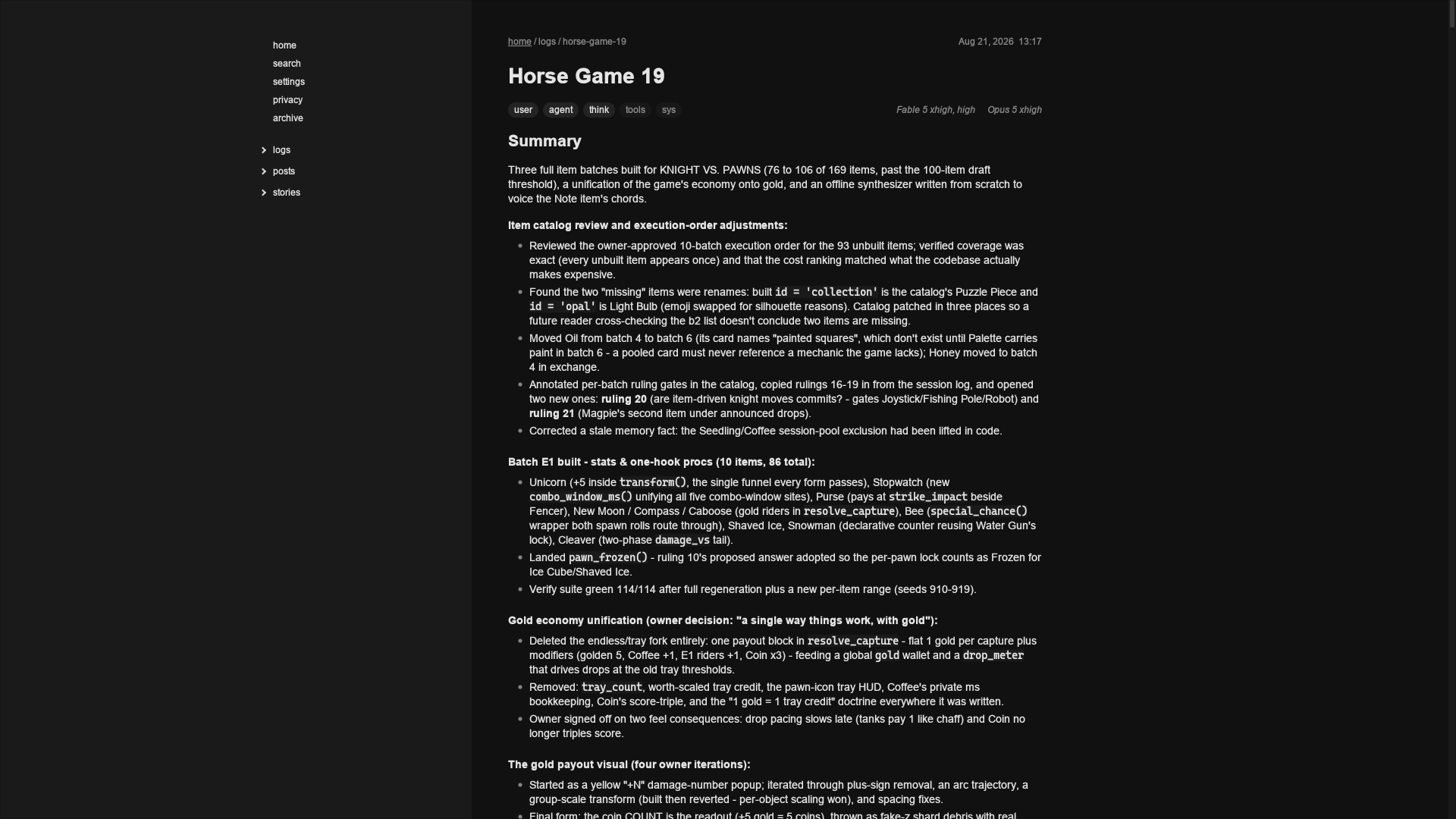
Read (/tmp/claude-1000/-home-adn-a327ex/f5713695-5f84-4add-a994-b47ac00e592c/scratchpad/cap/sheet_a.png)
[
  {
    "type": "image",
    "note": "[image: shown below]"
  }
]
Read (/tmp/claude-1000/-home-adn-a327ex/f5713695-5f84-4add-a994-b47ac00e592c/scratchpad/cap/sheet_b.png)
[
  {
    "type": "image",
    "note": "[image: shown below]"
  }
]
[Think]
Since the contact sheets are too small to read the labels, I'll instead pinpoint the attribution markers directly from the running instance by locating the document and scroll offset in the engine callbacks' upvalues, then snapshot each transition at a known scroll position.Bash (cd ~/a327ex/a327ex-site/renderer && grep -n '^function [a-z_]*(|^local function...)
33:function px(n) return math.floor(n * UI_S + 0.5) end     -- global: content modules use it at require time
185:function title_for_path(path)
197:function url_for_slug(slug)
380:function role_toggle(r)
457:function video_enter_fullscreen(el)
470:function video_exit_fullscreen()
476:function video_unload_active()
484:function video_on_click(el)
1083:local function draw_settings()
1401:local function draw_drop()
1661:function open_link(url)   -- global so homepage.lua can dispatch homepage feed inline links too
1709:function open_link_new_tab(url)
update: _ENV view nav_to_path poll_pending_page poll_gated_index show_home video_fit_card drop build_drop video_controls_update drop_sync_physics drop_local_mouse drop_explode drop_return_begin drop_video_update drop_return_step _applied_width compute_layout home_dirty doc relayout settings_dirty settings_apply settings_save images_pending images_relayout_at home col_x _content_w panel_open new_theme apply_theme lightbox_ensure_list lightbox_zone lightbox_nav mobile_mode scroll_y content_view SB_W drag_code_sb left_col_w drag_code CODE_SCROLL_STEP sb_scroll SCROLL_STEP drag_last_mx drag_code_sb_off scrollbar_geom drag_sb drag_sb_off max_scroll KEY_SCROLL pg_timer PG_DELAY PG_REPEAT sb_max
draw: _ENV drop draw_fullscreen_video draw_drop view content_view left_col_w sb sidebar_x SIDEBAR_W sb_scroll active_slug COLUMN_TOP show_home show_search show_settings load_page sb_max mobile_mode mobile_menu_open home_dirty home index col_x _content_w scroll_y max_scroll BOTTOM_PAD TOPBAR_H pending_find_q draw_settings game_view_draw doc game_view_overlay panel_open panel HOME_SPECS home_dump ARTICLE_SPECS spacing_dump scrollbar_geom drag_sb SITE_ORIGIN SB_W pending_slug MOBILE_PAD draw_mobile_topbar draw_lightbox draw_replay_overlay DEV_HUD UI_S
load:
Bash (S=/tmp/claude-1000/-home-adn-a327ex/f5713695-5f84-4add-a994-b47ac00e592c/scratch...)
chips idx=3 y=135 h=20 labels=Fable 5 xhigh, [email protected],3 | Opus 5 [email protected],3
t1 idx=29 y=3037 label=Fable 5 xhigh dur=Worked for 9m 28s
t2 idx=62 y=5869 label=Fable 5 high dur=Worked for 7m 0s
t3 idx=257 y=18797 label=Fable 5 xhigh dur=Thought for 1m 58s
t4 idx=354 y=25643 label=Opus 5 xhigh dur=
t5 idx=596 y=43021 label=Fable 5 xhigh dur=Worked for 10m 54s
t6 idx=727 y=53633 label=Opus 5 xhigh dur=Worked for 6m 15s
plain bylines=34
old byline idx=27 y=1605
old byline idx=37 y=2155
WARNING: The convert command is deprecated in IMv7, use "magick" instead of "convert" or "magick convert"

WARNING: The convert command is deprecated in IMv7, use "magick" instead of "convert" or "magick convert"

WARNING: The convert command is deprecated in IMv7, use "magick" instead of "convert" or "magick convert"

WARNING: The convert command is deprecated in IMv7, use "magick" instead of "convert" or "magick convert"

WARNING: The convert command is deprecated in IMv7, use "magick" instead of "convert" or "magick convert"

WARNING: The convert command is deprecated in IMv7, use "magick" instead of "convert" or "magick convert"

WARNING: The convert command is deprecated in IMv7, use "magick" instead of "convert" or "magick convert"

WARNING: The convert command is deprecated in IMv7, use "magick" instead of "convert" or "magick convert"

WARNING: The convert command is deprecated in IMv7, use "magick" instead of "convert" or "magick convert"

hg19_t1_c.png
hg19_t2_c.png
... [8 more lines]
Read (/tmp/claude-1000/-home-adn-a327ex/f5713695-5f84-4add-a994-b47ac00e592c/scratchpad/cap/hg19_t2_c.png)
[
  {
    "type": "image",
    "note": "[image: shown below]"
  }
]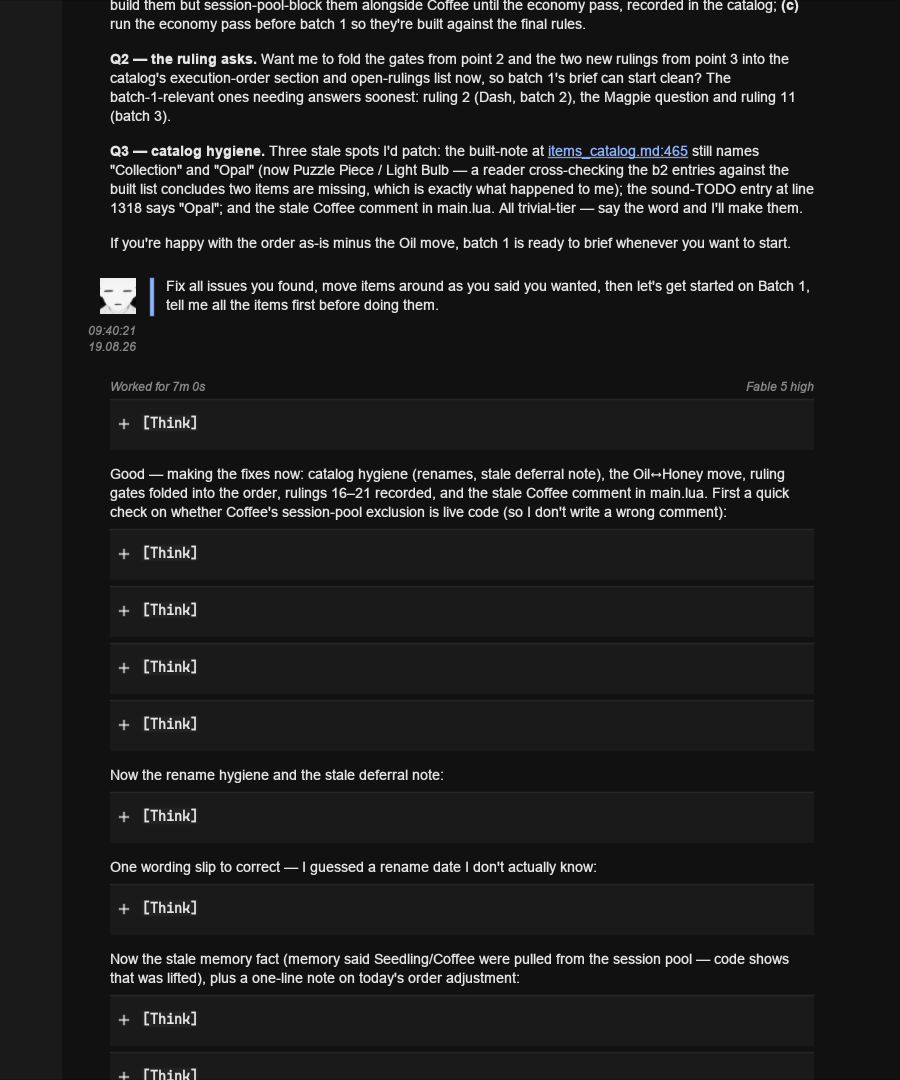
Read (/tmp/claude-1000/-home-adn-a327ex/f5713695-5f84-4add-a994-b47ac00e592c/scratchpad/cap/hg19_t4_c.png)
[
  {
    "type": "image",
    "note": "[image: shown below]"
  }
]
Read (/tmp/claude-1000/-home-adn-a327ex/f5713695-5f84-4add-a994-b47ac00e592c/scratchpad/cap/hg19_t6_c.png)
[
  {
    "type": "image",
    "note": "[image: shown below]"
  }
]
Read (/tmp/claude-1000/-home-adn-a327ex/f5713695-5f84-4add-a994-b47ac00e592c/scratchpad/cap/old_top_c.png)
[
  {
    "type": "image",
    "note": "[image: shown below]"
  }
]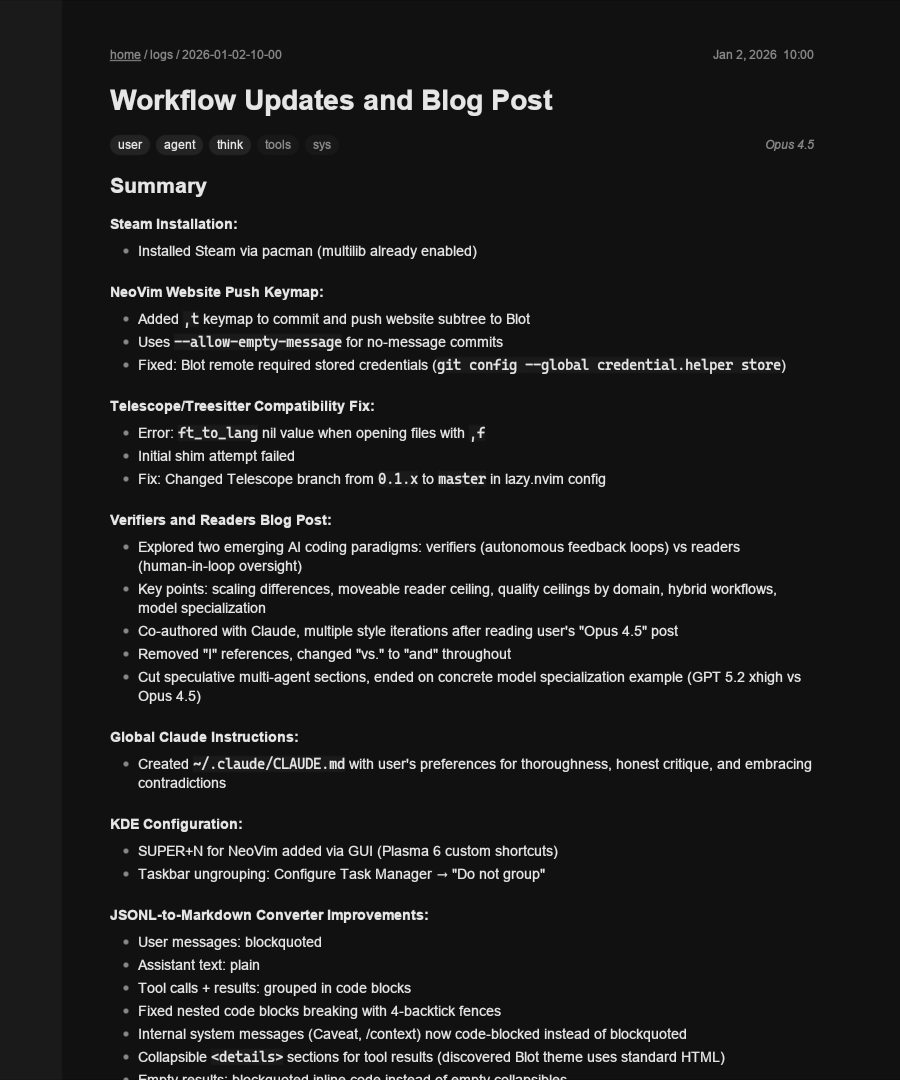
Read (/tmp/claude-1000/-home-adn-a327ex/f5713695-5f84-4add-a994-b47ac00e592c/scratchpad/cap/old_b1_c.png)
[
  {
    "type": "image",
    "note": "[image: shown below]"
  }
]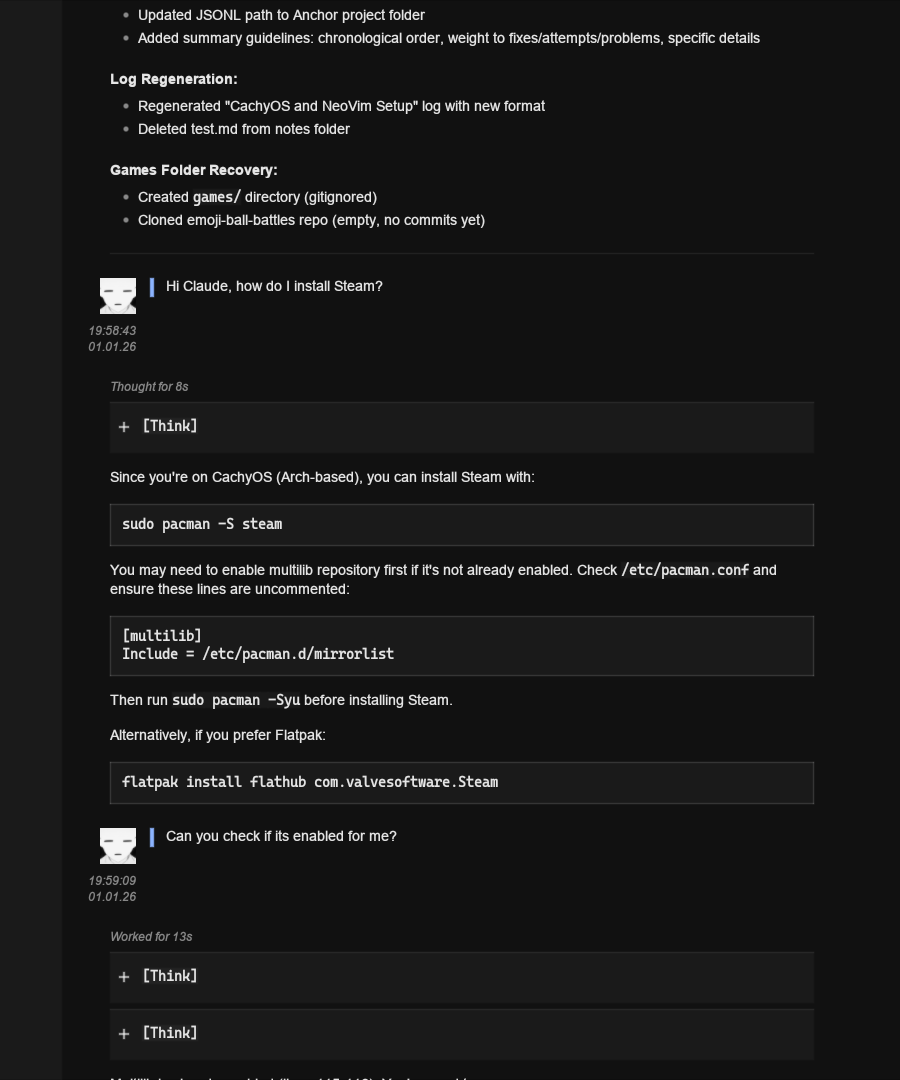
Bash (cd ~/a327ex/a327ex-site && for f in logs/*.md; do awk '/^::model/{print $2, $3}'...)
logs/aba-games-variations-knight-vs-pawns-1.md  claude-opus-4-8: unknown xhigh
---- (end mixed-effort scan)
Bash (cd ~/a327ex/a327ex-site/renderer && anchor drive stop $PWD 2>&1 | tail -2; ls re...)
stopped (pid 2102868)
20260830-214531.apr
20260905-154140.apr
store
---- memory
[sealed path elided: memory]
[sealed path elided: memory]
[sealed path elided: memory]
[sealed path elided: memory]
[sealed path elided: memory]
[sealed path elided: memory]
[sealed path elided: memory]
[sealed path elided: memory]
[sealed path elided: memory]
[sealed path elided: memory]
Bash (cd ~/a327ex/a327ex-site && sed -n '2p' logs/aba-games-variations-knight-vs-pawns...)
Date: 2026-07-19 12:56:34
55:::model claude-fable-5 unknown
514:::model claude-opus-4-8 unknown
4765:::model claude-opus-4-8 xhigh


---- memory file
---
name: feedback-no-desktop-control
description: "Rule now in CLAUDE.md (Building and Running): never drive his desktop. This file keeps the engine --render capture workflow — how I actually SEE games."
metadata:
  node_type: memory
  type: reference
  originSessionId: 19660faf-0cb8-4740-90d1-7dc7407185b2
  modified: 2026-08-12T00:31:23.215Z
---

The never-drive-his-mouse/keyboard rule was promoted into `E:\a327ex\.claude\CLAUDE.md` (Building and Running, 2026-08-11) — this file keeps the operational capture workflow that the CLAUDE.md only gestures at.

**How to apply:**
- When I need to SEE a game I control the code of: the Anchor engine has an offline capture path — `--render` CLI mode + `engine_render_setup(dir)` with auto per-frame PNG capture (grep anchor.c for `engine_render_setup`) — scripted runs writing PNGs I can Read. A window still pops briefly; prefer short runs, and mention when I'm about to do one.
- When I need reference footage of a game I should NOT modify: ask him for a screenshot/video — he's happy to record one. ffmpeg is on PATH for frame extraction; tile frames into contact sheets to keep context cost down.
- Related: [[project_snkrx_3d]]
SendUserFile (/tmp/claude-1000/-home-adn-a327ex/f5713695-5f84-4add-a994-b47ac00e592c/scratchpad/cap/hg19_00.png, /...)
5 files delivered to user.
  /tmp/claude-1000/-home-adn-a327ex/f5713695-5f84-4add-a994-b47ac00e592c/scratchpad/cap/hg19_00.png → file_uuid: 837217ae-a97f-4e6a-b44f-de57742d283a
  /tmp/claude-1000/-home-adn-a327ex/f5713695-5f84-4add-a994-b47ac00e592c/scratchpad/cap/hg19_t2_c.png → file_uuid: 206b0383-65e4-4fe6-8542-f9b5df9a38c9
  /tmp/claude-1000/-home-adn-a327ex/f5713695-5f84-4add-a994-b47ac00e592c/scratchpad/cap/hg19_t4_c.png → file_uuid: a4385c9a-96dd-44f7-943f-41530775ccea
  /tmp/claude-1000/-home-adn-a327ex/f5713695-5f84-4add-a994-b47ac00e592c/scratchpad/cap/old_top_c.png → file_uuid: ead9101a-6316-4025-ae77-80d1b215bac9
  /tmp/claude-1000/-home-adn-a327ex/f5713695-5f84-4add-a994-b47ac00e592c/scratchpad/cap/old_b1_c.png → file_uuid: 94eadb8c-4f68-4a4e-b521-4bd49468b181
Bash (M=~/.claude/projects/-home-adn-a327ex/memory; cat > $M/feedback_no_desktop_contr...)
36:- [Offscreen capture workflow](feedback_no_desktop_control.md) — never drive his desktop; SEE things via `anchor drive start/eval` + `engine_snapshot`; renderer: A327EX_BOOT_PATH + debug.getupvalue(update) for doc/scroll_yAudit done, one mistake fixed and deployed, and the captures above show the current state. Here is the full picture.
Verification of ChatGPT's work
Content preservation: passes. I diffed every one of the 261 log files plus the gated log between the commit before the backfill and after it. Removing only ::role and ::model lines, every remaining line is byte-identical, and the blank-line structure is unchanged too. So no prose, redaction, fold, or code block was touched. The 18k "deletions" in the git stat are just lines that moved because markers were inserted above them.
Timestamps: pass. The role markers ChatGPT generated for old logs use the same local-time conversion as the live publishing pipeline. I spot-checked the Jan 2 log's first turn against its source record and the times match exactly (22:58 UTC recorded, 19:58 shown, which is correct for -03).
Tests: pass. The 24 workflow tests pass, the renderer attribution check passes against the pilot data, and the live HTML fallback for Horse Game 19 emits all six labels. The deploy shipped only data and renderer Lua. It did not touch the engine wasm, which matters because a sibling session of mine rebuilt the engine locally at 15:34 with uncommitted GLES changes.
The one mistake I found and fixed: the new log had two ## Summary headings, which rendered as two headings on the live page. ChatGPT's summary text started with the heading that the end flow already writes. I removed the duplicate, reconverted, ran a data-only deploy, and pushed (commit 3799a27). Live page now has one.
The one material change ChatGPT did not tell you about. You approved attribution for "all applicable logs." To make per-reply attribution possible, ChatGPT also inserted ::role markers into logs that never had them. The count:
| logs | |
|---|---|
| got role markers for the first time | 196 |
| already had roles, unchanged | 8 |
header-only ::model, no roles before or after |
57 |
Role markers are not inert metadata. They flip a log onto the chips rendering: the user/agent/think/tools/sys filter row appears, tools and sys are hidden by default (your 2026-08-25 call), and "Worked for" / "Thought for" duration lines appear at every turn. The old_top and old_b1 captures above show the Jan 2 log, which before yesterday rendered as plain markdown with every tool fold visible. ChatGPT described this as "adds metadata only" and "preserves each existing file byte-for-byte," which is true of the text and misleading about the reading experience. I think it is an improvement, since it makes the whole archive consistent with the newer logs, but it was your decision to make. Reverting is mechanical: strip the ::role lines from those 196 files, which my check proves leaves everything else intact, and they fall back to header-only labels.
Minor notes, no action taken:
- One log, aba-games-variations-knight-vs-pawns-1, spans the July 19 boundary where effort recording first appears. It will show "Opus 4.8" then "Opus 4.8 xhigh" as if the effort changed, when only the recording did.
- The Kimi K2.6 label on kimi-code-setup is inferred from a config snapshot, not from per-reply records. Every other label is from recorded data.
- Horse Game 19 still carries the pilot's
neutral/colorsuffixes on its::modellines. They are ignored by the reader. Harmless, but the syntax doc calls them legacy already. - In the HTML fallback, old logs get their attribution paragraph after the first user message rather than at the top, because that is where the
::modelline was inserted. - The model name table is duplicated in
renderer/attribution.luaandserver/extensions.lua. They agree today; they will drift. - ChatGPT mounted the Windows C: partition read-only at
~/mnt/Windowsvia a one-offsudo mount. It is not in fstab, so it disappears on reboot. Nothing else system-side changed.
The feel of the agent lines
Now that I have actual frames, here is my honest read.
What works. At a turn boundary the label and the duration form one metadata row: "Worked for 7m 0s" left, "Fable 5 high" right, same italic gray. It reads as information, not UI, which is what you asked for. The header collection sits correctly beside the chips.
Three things I would push on, as questions for you.
1. Change-only labeling defeats the original goal. You asked for attribution "ideally on each reply." The current rule labels only the first reply and each change. Horse Game 19 has six labels across roughly fifty turns, so most screens show none, and a reader who lands mid-log from search or a heading link has to scroll up to find out who wrote what they are reading. Options: (A) keep change-only, the quietest. (B) label every turn's duration line in mixed logs only; uniform logs stay header-only. (C) label every turn everywhere. I recommend B. The "Worked for" row already exists at every turn, so the cost is four gray words at the right margin, and mixed logs are the only place the question has a non-obvious answer.
2. Mid-turn switches look like strays. The hg19_t4 capture shows a real mid-turn switch: Fable 5 was working, then Opus 5 xhigh finished the reply. That is almost certainly your fallbackModel kicking in under load, and it is the single most interesting thing these labels reveal. But the rendering is a bare right-aligned "Opus 5 xhigh" floating between two paragraphs with nothing on the left, so it reads as a glitch rather than an event. Options: (A) leave bare, consistent with the minimal style. (B) give mid-turn labels a left-side word in the same gray italic, something like "switched" or "fallback," so the row has the same two-sided shape as a turn boundary. (C) suppress mid-turn switches and only label at turn boundaries, losing the information. I lean B, lightly, but I can see you preferring A.
3. The header collection's effort order. "Fable 5 xhigh, high" lists efforts in first-appearance order, which looks unsorted. Options: (A) leave. (B) sort by effort rank. (C) list pairs separately: "Fable 5 xhigh Fable 5 high Opus 5 xhigh." B is the smallest fix.
And the standing question from the audit: keep the 196 old logs on the chips rendering, or revert them to role-less header-only labels? I recommend keep.
Pick directions on any of these, or redirect entirely, and I will write the brief for whatever changes.
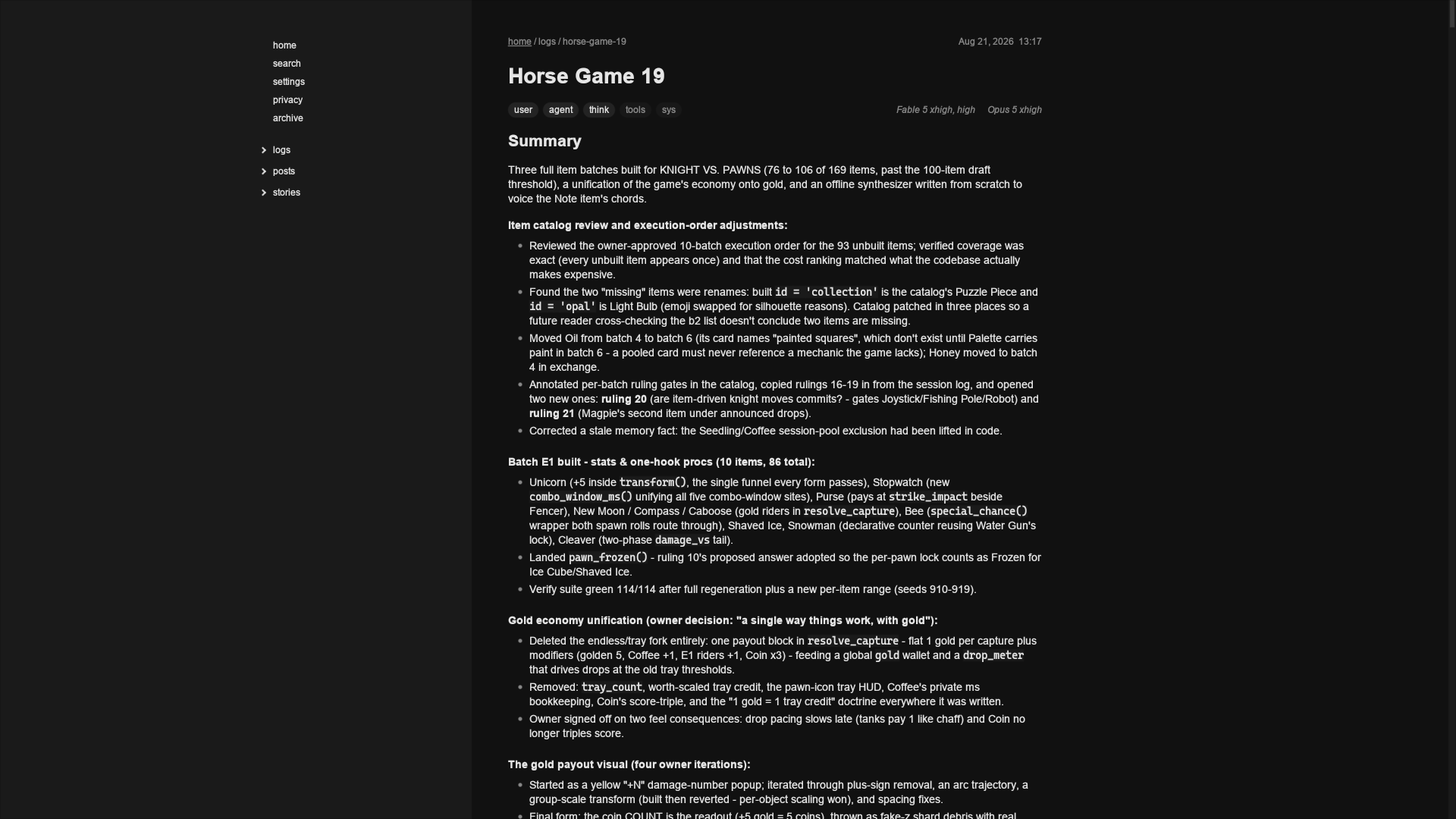
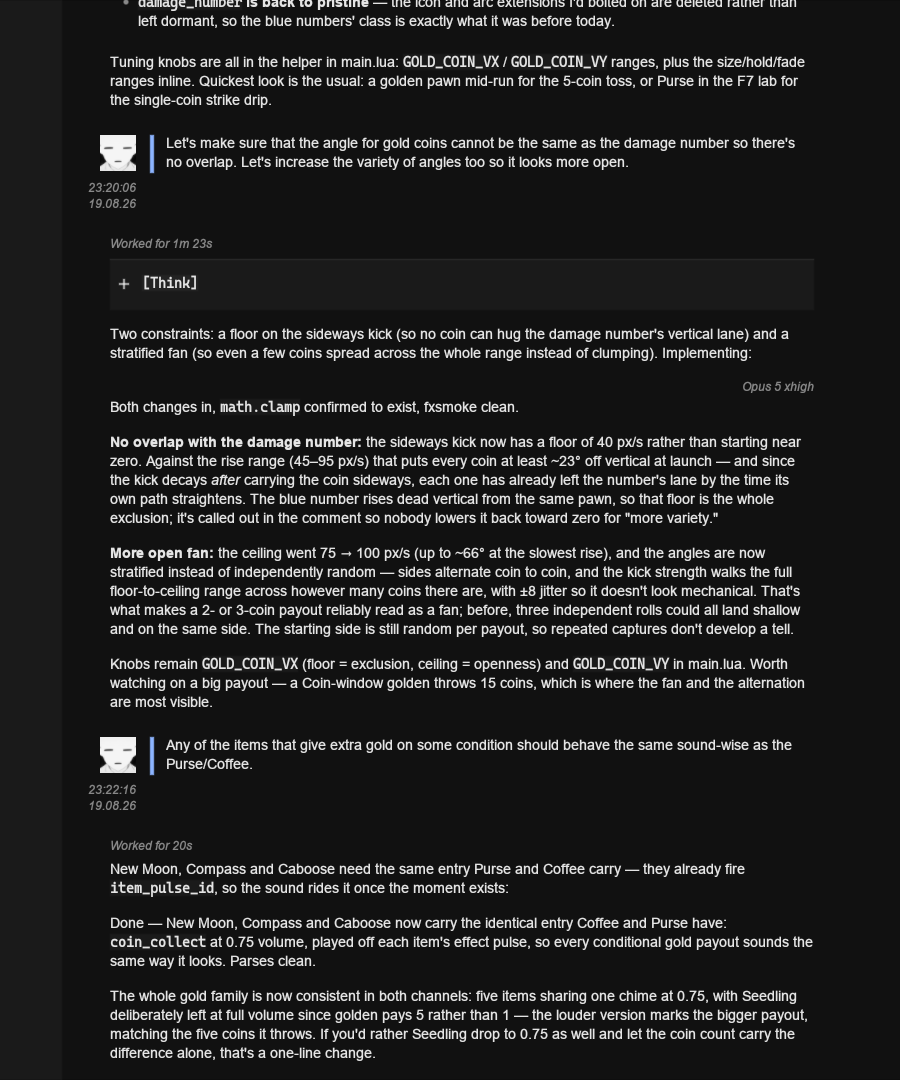
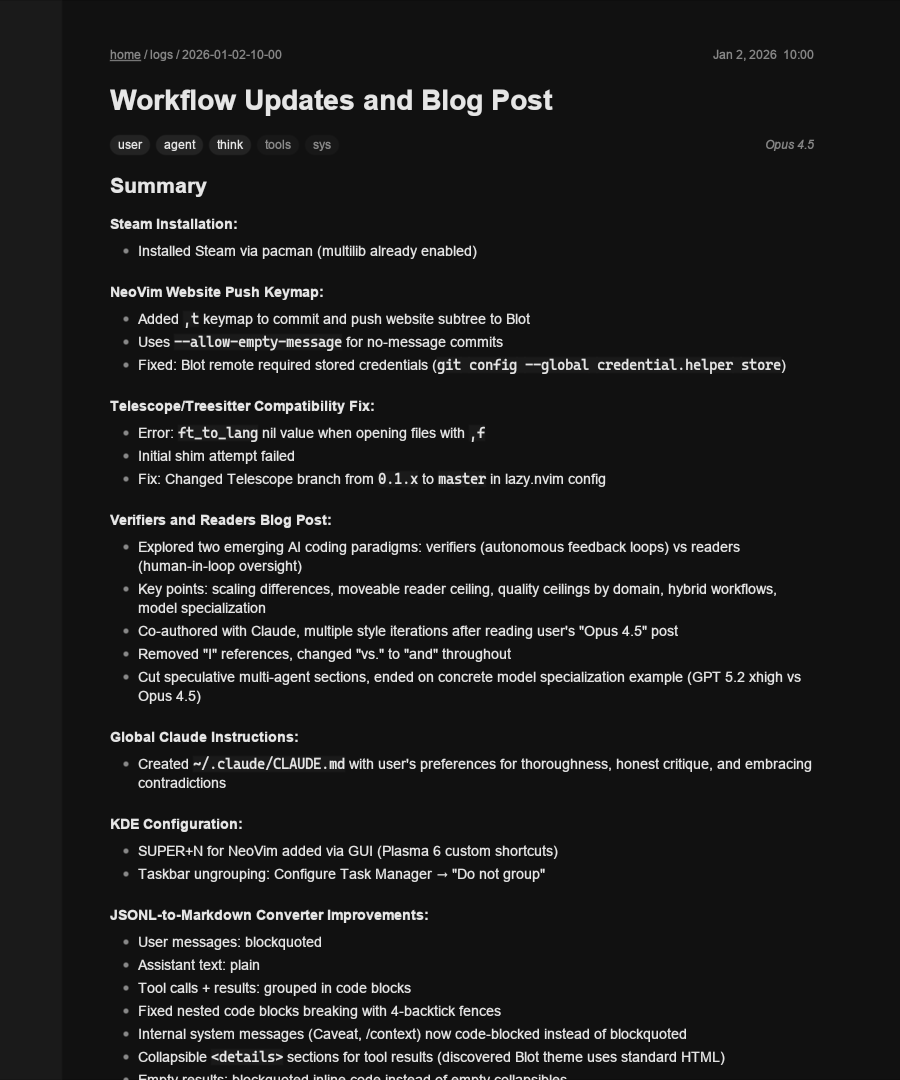
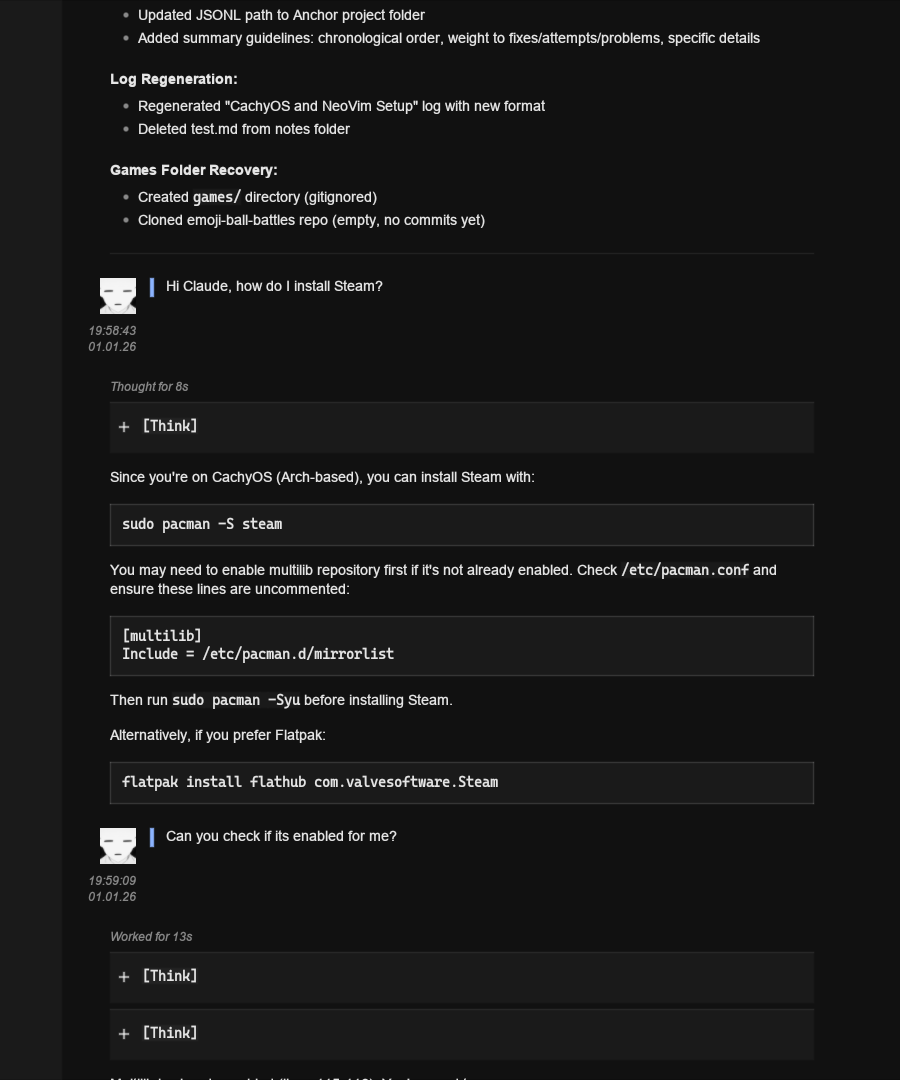
Is it possible for us to revert the old logs but keep the model attributions? I'd like to keep them rendered as they were before, without the recent improvements we've made to the logs, but add the model attribution because I think those are historically important. And then give me your general opinions on what you'd change about the labels themselves, both functionally and visually, just give me all your defaults with no options to see if I like it, maybe even apply it to one log as a test already so I see your vision better.
[Think]
I need to revert old logs by stripping `::role` lines but keeping `::model` — checking main.lua's condition that shows header-only rolechips when there are models but no roles, and tracing how convert.lua's model sweep works when there's no current role to attach to, since `doc.models` still collects the pairs separately.

For placement, I'm considering whether the `::model` line should move to the top of the body for cleanliness in the HTML fallback, or stay where it is after the first user message — deciding it's better positioned right after the frontmatter separator. I'm also checking which of the 196 logs have multiple `::model` lines (mixed model logs like horse-game-8..18) versus uniform ones, confirming that with roles stripped, mixed logs will just collapse into a header-only summary of all model/effort pairs without per-turn attribution, which matches the goal of preserving the original rendering behavior.

Ultimately I'll keep the mid-log `::model` lines in place since they mark meaningful transition points and the HTML fallback still displays them there — minimal disruption, positional history preserved. Since roles are stripped, there won't be duration lines or chips shown, just plain labels, so the 8 already-role-tagged logs stay fully intact and the 57 header-only logs remain unaffected. Now I want to verify that stripping roles reproduces exactly the pre-backfill version plus the `::model` lines, checking against the commit before the backfill.

I also need to make sure stripping `::role` markers removes both the marker line and its trailing blank line, since the backfill inserted them as a pair before each block — verifying byte-for-byte against the original after undoing both insertions. Since this counts as a website content change, it's exempt from needing a design brief, and the user has clearly asked me to do it: strip, verify, convert, deploy, commit, and push. For the second part — testing my default label changes on one log — since it touches renderer code, I'd normally want a design brief first, but the user explicitly said to just apply my defaults without discussion.

Applying it to just one log is tricky since the renderer's rules apply globally; I could gate the new behavior with some kind of per-document flag or directive variant, but that feels hacky, so I'm considering whether to just implement the change directly and let it affect all mixed logs.

A cleaner option is a temporary slug-based gate — hardcoding something like the horse-game-19 slug in the attribution logic so only that log gets the pilot treatment, then removing it once accepted. That mirrors how the pilot worked before, and it's simple and transparent, so I'll deploy with that gate and let him view the live result.

Now I need to settle on defaults for labeling: every turn labeled on the duration row for mixed logs versus header-only for uniform logs, and how to handle mid-turn switches with a two-sided row and a left-side word to signal the change.

For mid-turn switches within a single turn, the tricky part is choosing honest wording — I shouldn't label it "fallback" since I can't be certain that's the cause, just that the model changed mid-turn without a new user message boundary. I'm leaning toward a right side showing the new model and a left side reading something like "Continued by" to stay factual without asserting a cause.

Since every turn has a label already, a bare mid-turn label reads as less of a stray anomaly. But I still want the two-sided shape mirrored: left side "Model changed" (plain, factual, no jargon like "mid-turn"), right side "Opus 5 xhigh" — mirroring the "Worked for 7m | Fable 5 high" pattern of what-happened/who. I also consider a one-sided alternative showing the transition directly, like "Fable 5 xhigh → Opus 5 xhigh".

That's too long for mobile, so "Model changed" wins. For grouping efforts under a model header, I'll sort them ascending by rank (high before xhigh) since that reads more naturally, and omit unknown efforts. Uniform and old logs stay as is. The effort label itself shouldn't be a link, and in mixed logs every turn keeps its label — two-sided when duration exists, label-only otherwise.

I'll keep "xhigh" as the raw token since it's historically accurate rather than converting it to something like "x-high." Visually I'll keep the same gray/font as duration and match the header alignment, but I'm noticing at wide screens there's a large gap between the left-aligned "Worked for" text and the right-aligned label.

That's actually a familiar two-sided row pattern from chat apps, so I'll leave it as is. Functionally I'm settling on: labeling every turn in mixed logs, adding a "Model changed" row mid-turn, and ranking efforts in the header — the HTML fallback will stay change-only since markers only appear at transitions, which seems acceptable. Now I'm sketching the implementation plan starting with the attribution renderer logic.

Writing effort-ranking and annotation logic...

I realize I should track turn boundaries by role sequence instead: flip an `in_ai` flag on user messages and flag a turn start whenever we transition into claude/think/tool. That way turn-start labels fire whether or not a duration marker exists, and mid-turn key changes still get the dimmed 'Model changed' text. For the pilot slug I'll gate this every-turn behavior behind a small pilot list, passing the slug into annotate() and making sure role_filtered's callers have access to doc.slug.

Both call sites for role_filtered already have the doc object, so I just need to add a slug parameter there — no changes needed in elements.lua since the generic duration/content rendering already handles the 'Model changed' marker. I'll also need to update the attribution test expectations since the pilot slug will now show markers on every turn instead of just on changes.

For the sequencing: I still need to strip roles from the 196 files via script, verify against originals plus ::model lines, then run the data conversion and a single deploy that rebuilds the bundle alongside the data changes. I'll also touch up CONTENT_SYNTAX.md with a note about the pilot's mixed-log behavior.

I need to double check whether that gated log had roles already or was header-only, since it's not in my 196-file list — I should regenerate that list using the same criterion I used before (rb==0 and ra>0 at the relevant commit) and apply it against the current working files, which match that commit except for one log-improvements file that's excluded. The verification has to be exact: stripping both the role and model lines from the current file should reproduce the original byte-for-byte, and stripping just the role line should produce the new content.

Beyond that, my plan is to update the renderer files (attribution.lua, main.lua, tests, and the syntax doc), run the lua tests, convert everything, deploy, and commit and push both the logs and renderer changes. I also want to capture some example outputs — a mid-turn view, a turn row, and an old log's top section — to share as files, though he can also just view things live. I'll start with the verification step and pull up the exact caller regions in main.lua alongside the already-known attribution.lua diff and test file.
Yes, it's possible and clean: the header label only needs the ::model line, not the role markers. The reader already handles a log with models but no roles as header-only, with no chips, no duration lines, no filtering. So the revert is: strip the ::role lines from those 196 files, keep ::model, and verify each result is byte-identical to the pre-backfill file plus its model lines.
I'll do the revert first, then the label changes as a pilot on Horse Game 19.
Bash (cd ~/a327ex/a327ex-site && cat > /tmp/claude-1000/-home-adn-a327ex/f5713695-5f84...)
targets 196 bad 0
written 196
 196 files changed, 7796 insertions(+), 219354 deletions(-)
0
logs/2026-01-02-10-00.md:64:::model claude-opus-4-5-20251101 unknown
logs/horse-game-8.md:76:::model claude-fable-5 xhigh
logs/horse-game-8.md:3762:::model claude-opus-5 xhigh
logs/horse-game-8.md:4538:::model claude-fable-5 xhigh
logs/horse-game-8.md:5741:::model claude-opus-5 xhigh
logs/horse-game-8.md:11534:::model claude-fable-5 xhigh
logs/horse-game-8.md:11931:::model claude-opus-5 xhigh
logs/horse-game-8.md:11985:::model claude-fable-5 xhigh
logs/horse-game-8.md:14449:::model claude-opus-5 xhigh
Bash (cd ~/a327ex/a327ex-site && sed -n '376,390p' renderer/main.lua; echo ----; sed -...)
    end
  end
end

function role_toggle(r)
  role_filter[r] = not role_filter[r]
  if doc and doc._all then
    doc.elements = role_filtered(doc._all)
    annotate_turns(doc.elements)
    relayout()
    sel_set_doc(doc)                        -- selection walks the new element list
    if scroll_y then scroll_y = math.min(scroll_y, max_scroll or 0) end
  end
end

----
    local has_roles = false
    for _, el in ipairs(doc.elements) do
      if el.role then has_roles = true break end
    end
    local models = attribution.collect(doc.models or doc.elements)
    if has_roles or #models > 0 then
      local at = 1
      while doc.elements[at] and (doc.elements[at].type == 'crumb'
            or (doc.elements[at].type == 'text' and doc.elements[at].kind == 'h1')) do
        at = at + 1
      end
      table.insert(doc.elements, at, { type = 'rolechips', models = models, controls = has_roles })
      doc._all = doc.elements
      doc.elements = role_filtered(doc._all)
... [5 more lines]
[Think]
The revert is complete and verified across all 196 files. Now I'm moving on to the renderer changes: rewriting attribution.lua, updating main.lua to pass the doc slug into role_filtered at both call sites, updating the test, and revising CONTENT_SYNTAX.md, all as independent edits in one pass before running tests, converting, deploying, and pushing.

I'm sketching the module: a pilot list of slugs that get every-turn labels, an effort ranking table, and helper functions for naming, keying, and labeling elements, plus a collect function sorting efforts by rank. The core annotate function walks through elements tracking turn boundaries and previous attribution keys, deciding whether to place a label based on whether the key changed or, for pilot slugs, whether a new turn has started without an existing marker.

I'm confirming that mid-turn model changes should only get the "Model changed" left text for pilot slugs, keeping non-pilot behavior untouched, and verifying that turn-start detection stays consistent with how duration markers already define first-AI-element regardless of hidden thinking elements, since role filtering doesn't affect raw marker indices, and that user-role elements are still the only thing resetting the in-AI state, matching existing marker logic. Writing the change-detection branch...

The marker's content without explicit text falls back fine since layout handles empty content, and the byline styling with dim text concatenates properly through the layout function.

Now I need to update the sorting test cases—checking that labels order correctly regardless of which effort appears first, so I should add a case with xhigh listed before high to confirm the output still sorts consistently.

For non-pilot behavior, tests stay the same with nil slug. For pilot mode, I'll load the horse-game-19 fixture data and verify that annotating with that slug labels every turn start, preserves the six change points in order, and that the mid-turn marker at t4 contains "Model changed" text—checking the marker count, key sequence changes, and content match.

Finally, I need to update main.lua so role_filtered accepts the slug parameter, updating both call sites to pass doc.slug alongside doc._all.

Checking whether doc actually carries a slug field from serialization—it should, since convert includes slug alongside crumb, title, and section. To be safe though, I'll fall back to active_slug if doc.slug is missing.

I also need to update CONTENT_SYNTAX.md to describe the new pilot rule for mixed logs, then apply all four edits: rewriting attribution.lua fully, patching the two lines in main.lua, updating the test file, and editing the CONTENT_SYNTAX doc.
[Think]
Revert complete: all 196 files verified byte-identical to their originals plus `::model` lines, with Horse Game 8's model history intact. Next, I'll apply the label changes as a pilot on Horse Game 19, leaving other mixed logs untouched until you've reviewed it.Bash (cd ~/a327ex/a327ex-site/renderer && cat > attribution.lua <<'EOF' -- Model/effor...)
attribution.lua parsesBash (cd ~/a327ex/a327ex-site/renderer && python3 - <<'EOF' p='main.lua'; s=open(p).re...)
def 1 calls 2
346:local function role_filtered(all, slug)
383:    doc.elements = role_filtered(doc._all, doc.slug or active_slug)
757:      doc.elements = role_filtered(doc._all, doc.slug or active_slug)
5:  slug    = "horse-game-19",
Bash (cd ~/a327ex/a327ex-site/renderer && cat > tests/attribution.lua <<'EOF' local at...)
Attribution checks passed: sorting, default change-only, pilot every-turn (40 rows, 1 mid-turn) and six change points.Bash (cd ~/a327ex/a327ex-site && python3 - <<'EOF' p='deploy/CONTENT_SYNTAX.md'; s=ope...)
syntax doc updated[Think]
I need to chain the conversion, deploy, commit, and push into one sequence. I'll stage only the intended paths — the 196 log files, the renderer scripts and tests, and the deploy docs — while making sure not to accidentally include unrelated files.

Once conversion finishes, I still need to capture some renderer snapshots on horse-game-19 (header row, a normal turn, a mid-turn model-change row) and on an old and multi-model log, but those depend on the converted data being present. To save turns, I'll run convert synchronously first, then kick off deploy plus commit/push in the background while I take the captures in parallel, since commit and push don't actually depend on the conversion finishing.
Bash (cd ~/a327ex/a327ex-site/renderer && lua5.4 tools/convert.lua --all 2>&1 | tail -...)
converted 511 pages -> data/, wrote data/index.lua
converted 1 gated pages -> data/gated/
0
2
[Think]
My grep for the models block came up empty since it spans multiple lines, but counting "model = " lines confirms there are 2 entries for horse-game-8 with no per-role models, which lines up with the other entry showing zero roles. I'll move on and check the header in the captures instead.

Now I have two independent things to do: kick off the deploy (bundle + data, since data's ready) in the background, and gather captures — start an instance on horse-game-19, grab the header, first turn rows, and the mid-turn row where the model changed, then navigate to the tops of horse-game-8 and the 2026-01-02-10-00 entry and crop those. Both can happen together since deploy uses SSH while captures just read the data directory.
Bash (cd ~/a327ex/a327ex-site/renderer && bash tools/deploy.sh --data 2>&1 | tail -6)
Command running in background with ID: bcd61bumj. Output is being written to: /tmp/claude-1000/-home-adn-a327ex/f5713695-5f84-4add-a994-b47ac00e592c/tasks/bcd61bumj.output. You will be notified when it completes. To check interim output, use Read on that file path.
Session cwd remains /home/adn/a327ex/a327ex-site/renderer; directory changes made by the backgrounded command do not apply to subsequent commands.
Bash (S=/tmp/claude-1000/-home-adn-a327ex/f5713695-5f84-4add-a994-b47ac00e592c/scratch...)
started pid 2177047 — replays/.eval.sock
header: Fable 5 high, xhigh | Opus 5 xhigh controls=true
rows=40
turn row: Worked for 7m 0s | Fable 5 high
mid row y=25607 Model changed | Opus 5 xhigh
header: Fable 5 xhigh | Opus 5 xhigh controls=false
header: Opus 4.5 controls=false
old log role-tagged elements=0 elements=759
stopped (pid 2177047)
hg8_top_c.png
hg8_top.png
old_top_c.png
old_top.png
p_mid_c.png
p_mid.png
p_top_c.png
p_top.png
p_turn_c.png
p_turn.png
Shell cwd was reset to /home/adn/a327ex
[Think]
I need to view the four captured screenshots independently to confirm the visuals, keep an eye on the deploy status since I'll get notified in the background, and then commit and push once everything looks right.Read (/tmp/claude-1000/-home-adn-a327ex/f5713695-5f84-4add-a994-b47ac00e592c/scratchpad/cap2/p_mid_c.png)
[
  {
    "type": "image",
    "note": "[image: shown below]"
  }
]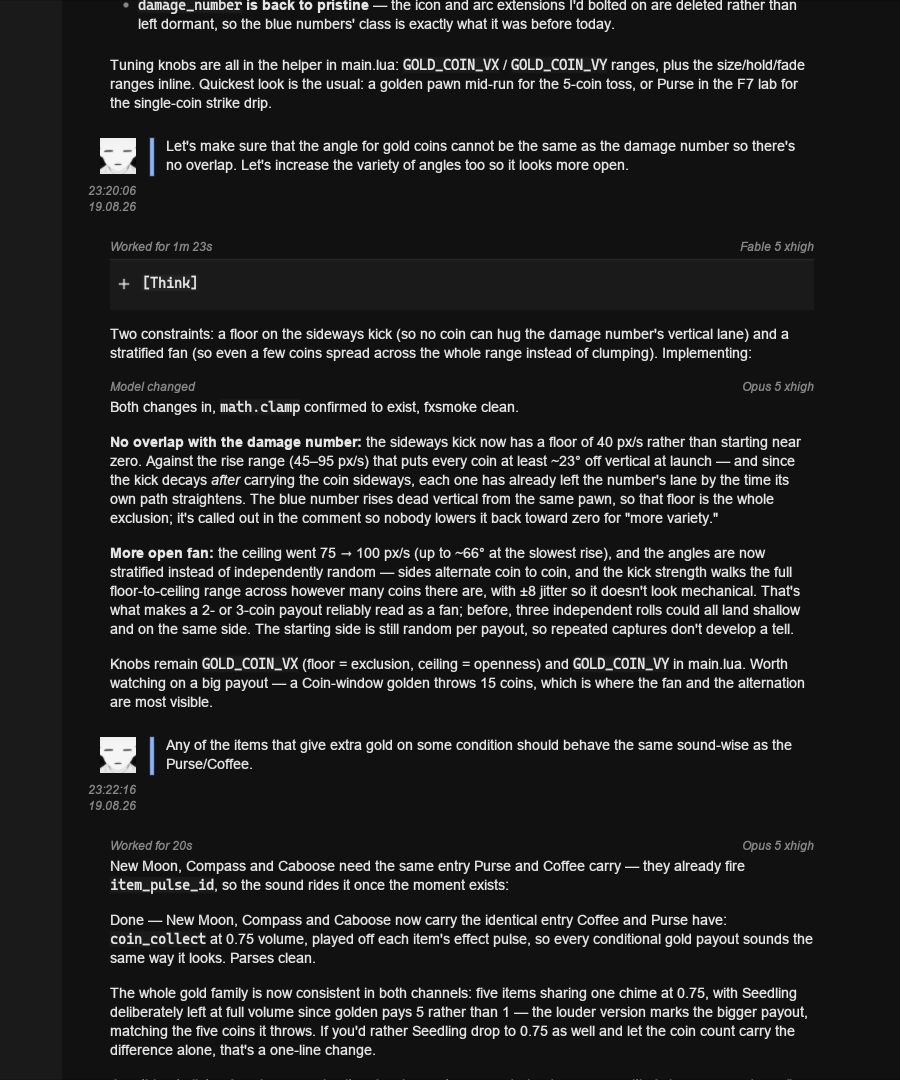
Read (/tmp/claude-1000/-home-adn-a327ex/f5713695-5f84-4add-a994-b47ac00e592c/scratchpad/cap2/p_turn_c.png)
[
  {
    "type": "image",
    "note": "[image: shown below]"
  }
]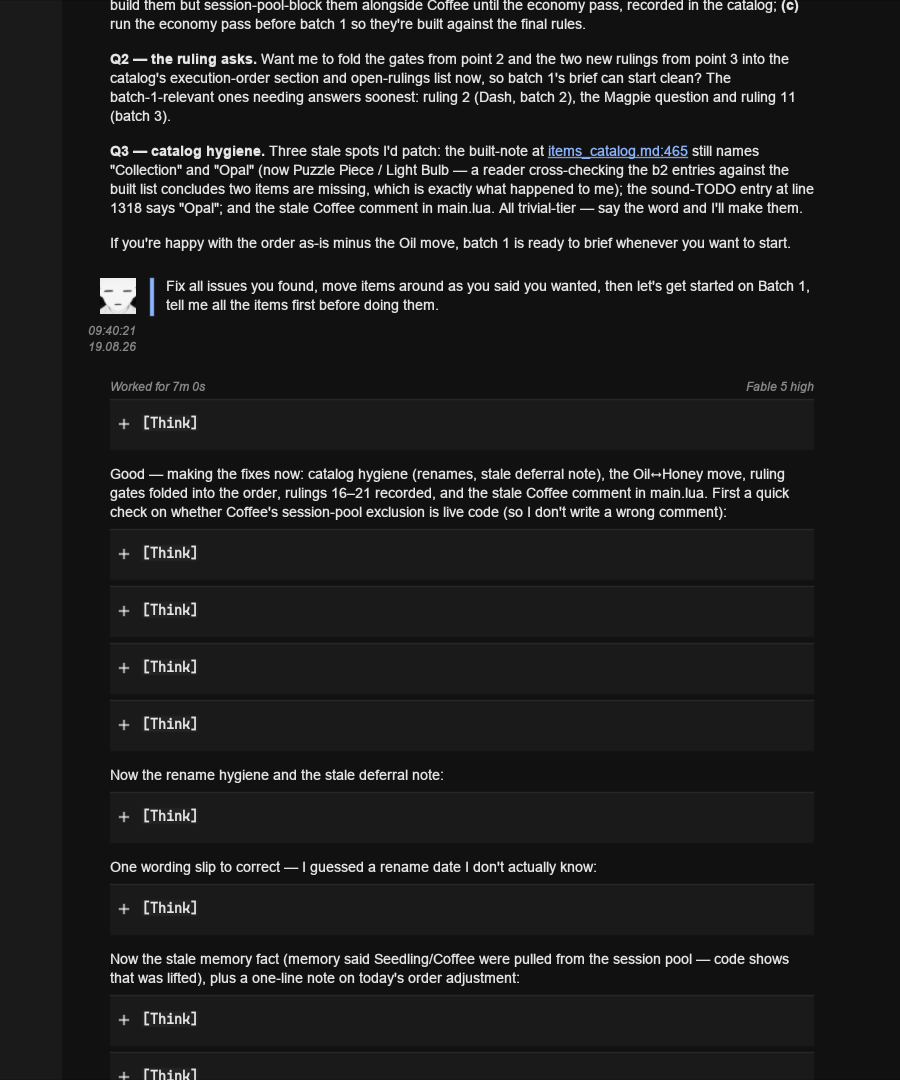
Read (/tmp/claude-1000/-home-adn-a327ex/f5713695-5f84-4add-a994-b47ac00e592c/scratchpad/cap2/hg8_top_c.png)
[
  {
    "type": "image",
    "note": "[image: shown below]"
  }
]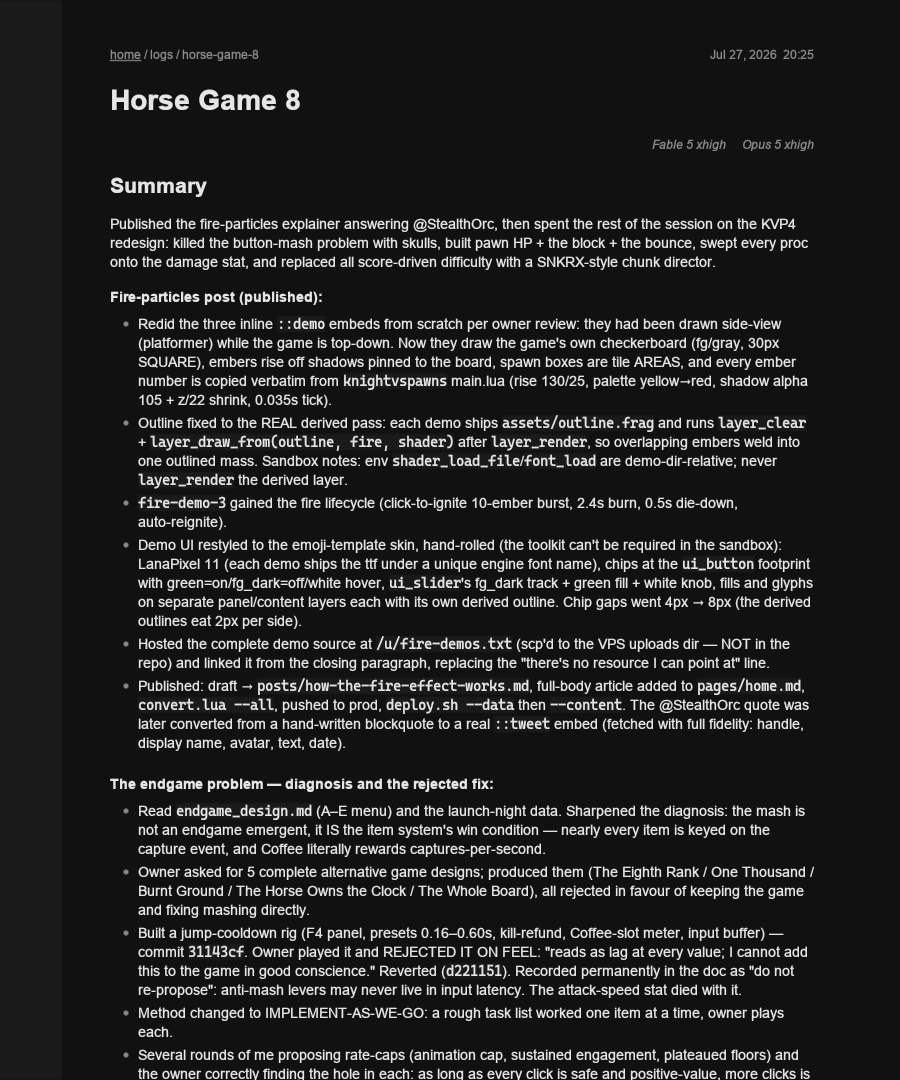
Read (/tmp/claude-1000/-home-adn-a327ex/f5713695-5f84-4add-a994-b47ac00e592c/scratchpad/cap2/old_top_c.png)
[
  {
    "type": "image",
    "note": "[image: shown below]"
  }
]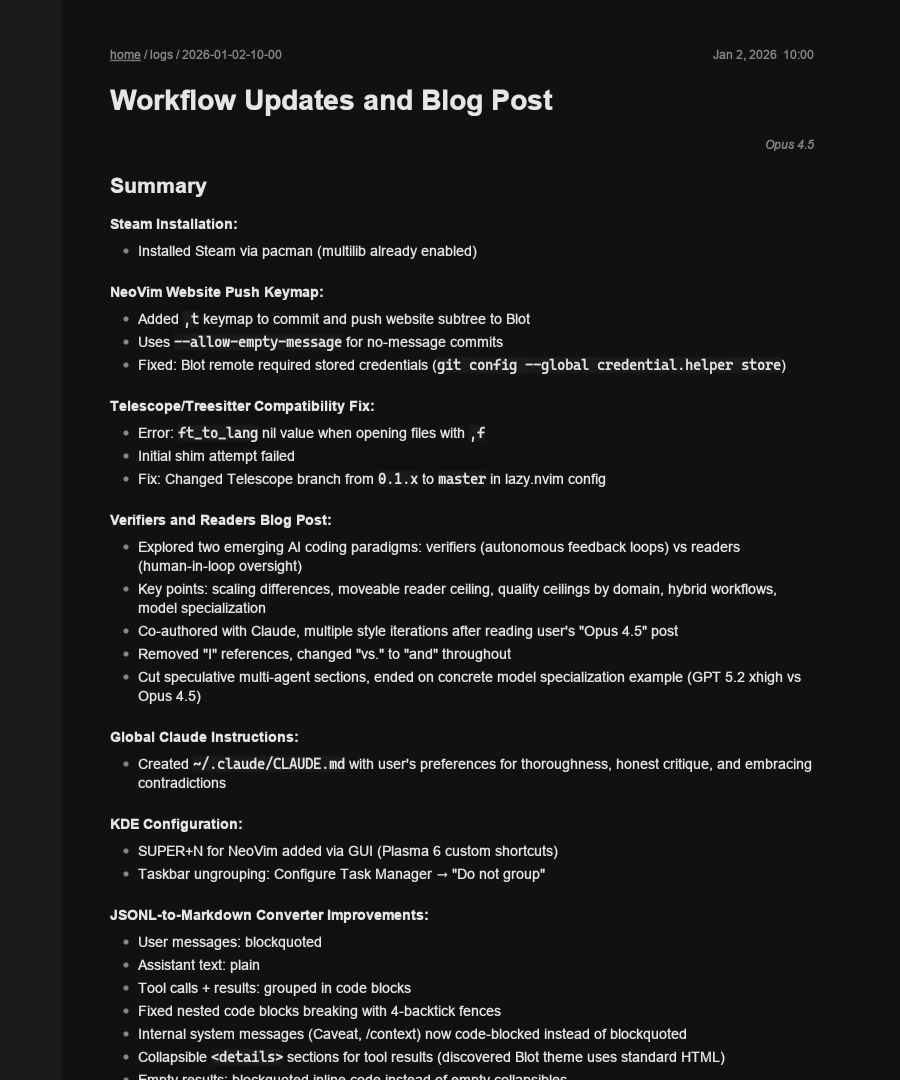
[Think]
The captures look right overall, with a minor spacing nit near "Model changed" that's fine as-is. I'm checking the old logs match expectations—headers right-aligned without chips as before—but noticing Horse Game 8 is a mixed log that lost its role labels, which needs a closer look.

Since Horse Game 8-18 were among the reverted logs, they now only show the header collection without per-turn attribution, which matches what was requested since roles weren't originally present there. The mid-log model markers stay in the files though, so attribution could be re-enabled later if roles get added back.

Now I need to verify the deploy output, then commit and push everything: the 196 log files, the attribution and main renderer changes, the test file, and the syntax doc. I'll run a status check filtering out emoji and untracked files to confirm nothing else got modified before sending the captures and writing up the report.
Bash (cat /tmp/claude-1000/-home-adn-a327ex/f5713695-5f84-4add-a994-b47ac00e592c/tasks...)
   renderer.data 344a0ea33577  (25016907 B)
== deploy bundle + engine-boot.js
   hashed: renderer-344a0ea335.data  anchor-b24444d189.wasm
== sync lazy /data (content-changed pages only)
   synced 196 changed page(s)
OK deployed — matched pair on VPS (344a0ea3357710dd7879286ac6b0d1fa e352d97f2c0577da4e360836e46136d6 )

 M deploy/CONTENT_SYNTAX.md
 M renderer/attribution.lua
 M renderer/main.lua
 M renderer/tests/attribution.lua
?? renderer/render/
?? renderer/tools/.repo-visibility
modified logs: 196
[Think]
The deployment synced all 196 pages without touching the engine. Now I need to commit and push that in one command, and separately send off the captures—both can happen right away.
Bash (cd ~/a327ex/a327ex-site && git add logs/*.md deploy/CONTENT_SYNTAX.md renderer/a...)
To ssh://a327ex/srv/a327ex.git
   3799a27..077cca6  main -> main
077cca6 Old logs: keep model attribution, drop the backfilled role markers; every-turn label pilot on Horse Game 19
SendUserFile (/tmp/claude-1000/-home-adn-a327ex/f5713695-5f84-4add-a994-b47ac00e592c/scratchpad/cap2/p_top.png, /t...)
5 files delivered to user.
  /tmp/claude-1000/-home-adn-a327ex/f5713695-5f84-4add-a994-b47ac00e592c/scratchpad/cap2/p_top.png → file_uuid: b3c2625d-4640-472d-a79e-e0c9882804f5
  /tmp/claude-1000/-home-adn-a327ex/f5713695-5f84-4add-a994-b47ac00e592c/scratchpad/cap2/p_turn_c.png → file_uuid: 321e3639-38b9-4145-a311-9c0c05a898c0
  /tmp/claude-1000/-home-adn-a327ex/f5713695-5f84-4add-a994-b47ac00e592c/scratchpad/cap2/p_mid_c.png → file_uuid: 93ebb1b1-9220-4521-8e04-95fafd16311e
  /tmp/claude-1000/-home-adn-a327ex/f5713695-5f84-4add-a994-b47ac00e592c/scratchpad/cap2/hg8_top_c.png → file_uuid: 57ef16a1-7b66-49c2-a13e-0c7f72a71980
  /tmp/claude-1000/-home-adn-a327ex/f5713695-5f84-4add-a994-b47ac00e592c/scratchpad/cap2/old_top_c.png → file_uuid: 89854d8f-a203-4dc3-95a2-5794a6514f39
[Think]
With nothing else to check, I'll write the final report covering what's live (the revert plus pilot), the reasoning behind my defaults, what I intentionally left untouched, and the tradeoffs of the revert—namely that mixed old logs like Horse Game 8-18 lose per-turn attribution at the header level, though the mid-log model lines remain so restoration is still possible. Then I'll stop and let him review.Both parts are live.
The revert
The 196 logs published before role markers existed are back to their old rendering: no chips row, no filter, no duration lines, all tool folds visible. Each file is now byte-identical to its pre-rollout version with only its ::model lines added, which I verified per file before writing. The 57 header-only logs and the 8 that already had roles were untouched. Deployed and pushed as commit 077cca6, 196 data pages synced, engine binary untouched.
One consequence worth stating plainly: Horse Game 8 through 18 were among those 196, and several of them are mixed-model logs. Without role markers the reader cannot place labels at turns, so they now show the full collection in the header (Horse Game 8: "Fable 5 xhigh Opus 5 xhigh") and nothing per reply. The mid-log ::model lines are still in the files at the exact switch points, so per-reply attribution for those logs can be restored later by adding roles back. The HTML fallback still prints a label at each switch point, since it renders the directives where they sit.
My defaults for the labels, applied to Horse Game 19
I changed three things and left the rest alone. Look at the pilot live, or the captures above.
Every turn gets a label, in mixed logs. The "Worked for 7m 0s" row now always carries the model on its right, not just at changes. Reasoning: the duration row exists at every turn anyway, so this costs nothing in vertical space, and it answers "who wrote this" wherever a reader lands, including from search or a heading link. In uniform logs nothing changes: the header says it once and repeating it would be noise, because there is no question to answer. This is what your original request asked for, and I think ChatGPT's change-only rule optimized for quiet at the expense of the actual use.
A switch inside a turn becomes a two-sided row. The mid-turn Opus 5 moment now reads "Model changed" on the left and "Opus 5 xhigh" on the right, same gray italic, same shape as a turn boundary row. Reasoning: the bare right-aligned label looked like a rendering stray, and this is the single most informative event these labels expose. That switch is almost certainly your fallback model taking over under load, since Claude Code cannot change models mid-turn any other way. I deliberately did not write "Fallback" on the row, because that is an inference and the labels should only state recorded facts. "Model changed" is what the record shows.
Header efforts sort by rank. "Fable 5 high, xhigh" instead of first-appearance order. Small, but the old order looked like a mistake.
What I kept on purpose. Font, size, color, right alignment, the space instead of a separator, the header position beside the chips, the raw effort tokens. You already steered all of that and it reads correctly as information rather than UI. I considered rendering "xhigh" as something friendlier and decided against it: it is the recorded setting name and the labels are a historical record. I also considered a larger gap above mid-turn rows and decided the normal paragraph spacing is right, since the row belongs to the reply it interrupts.
The pilot is gated to Horse Game 19 in renderer/attribution.lua via a PILOT table, so the other mixed logs still use change-only labels until you say so. If you like it, adoption is deleting the gate. If you don't, the same file holds both behaviors and reverting is one line.
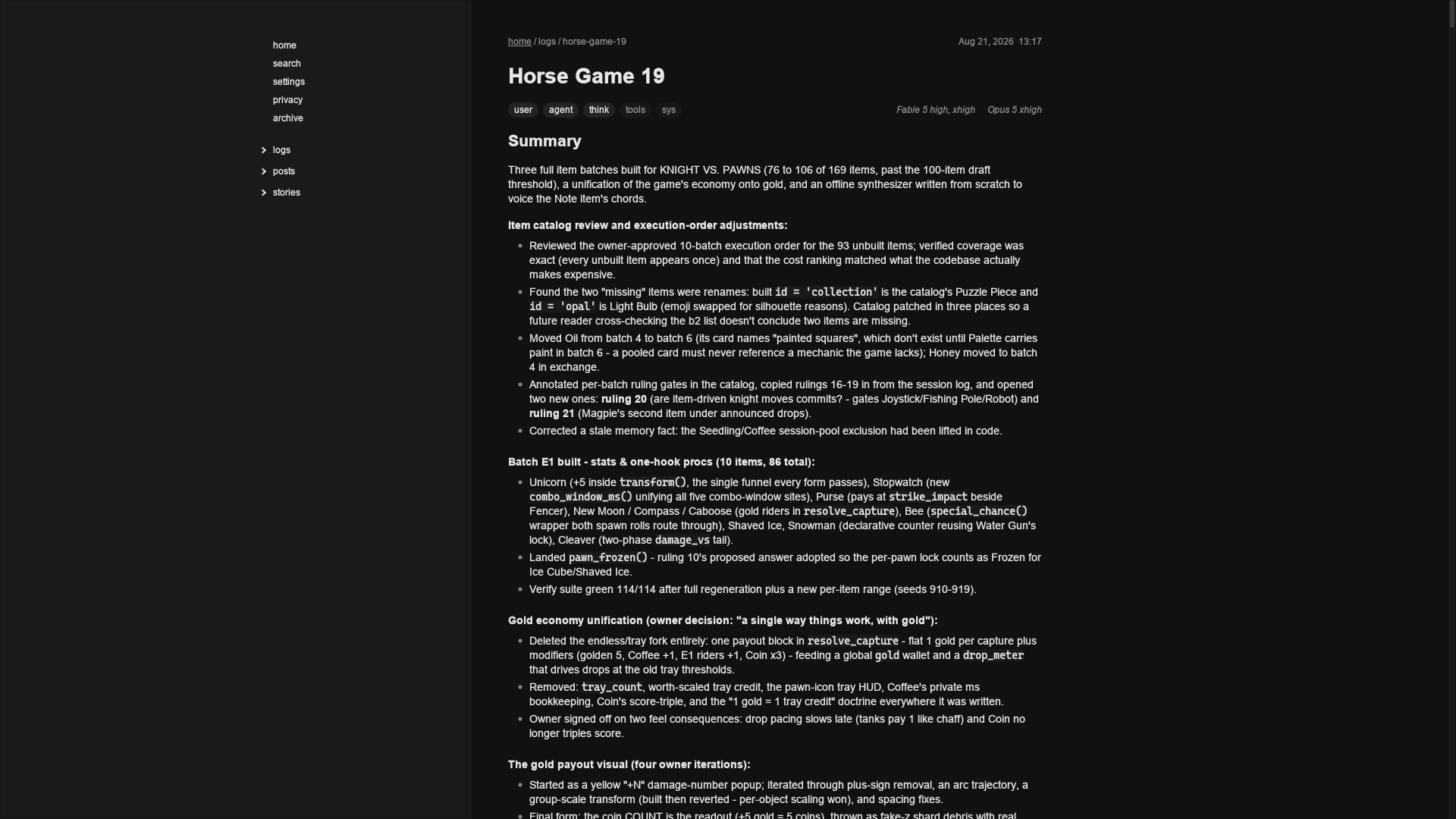
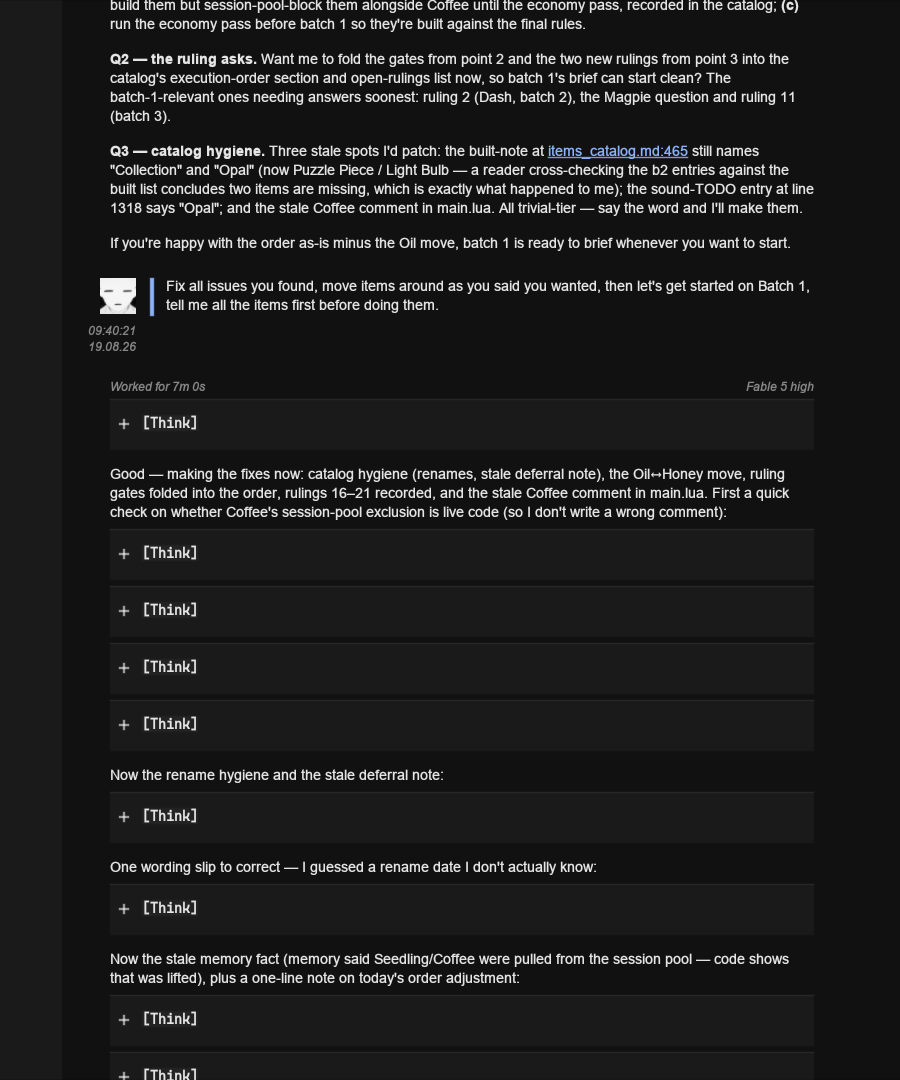
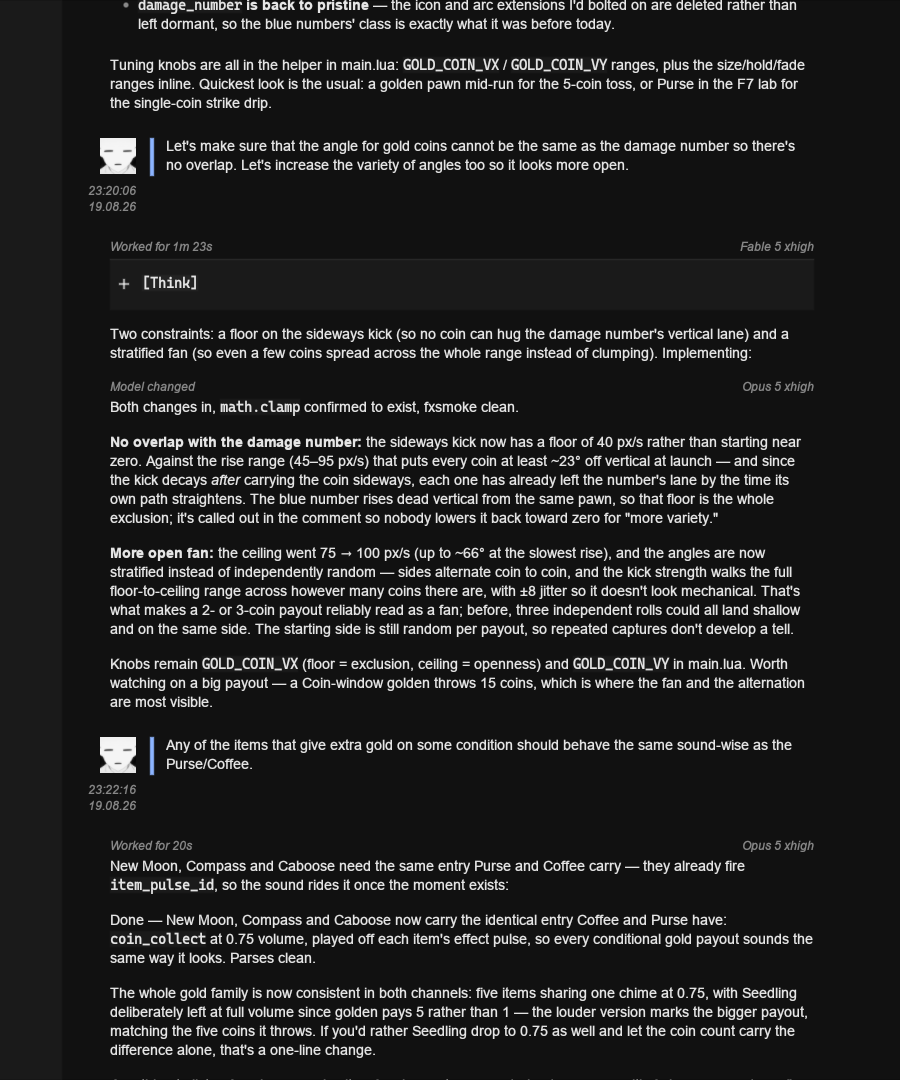
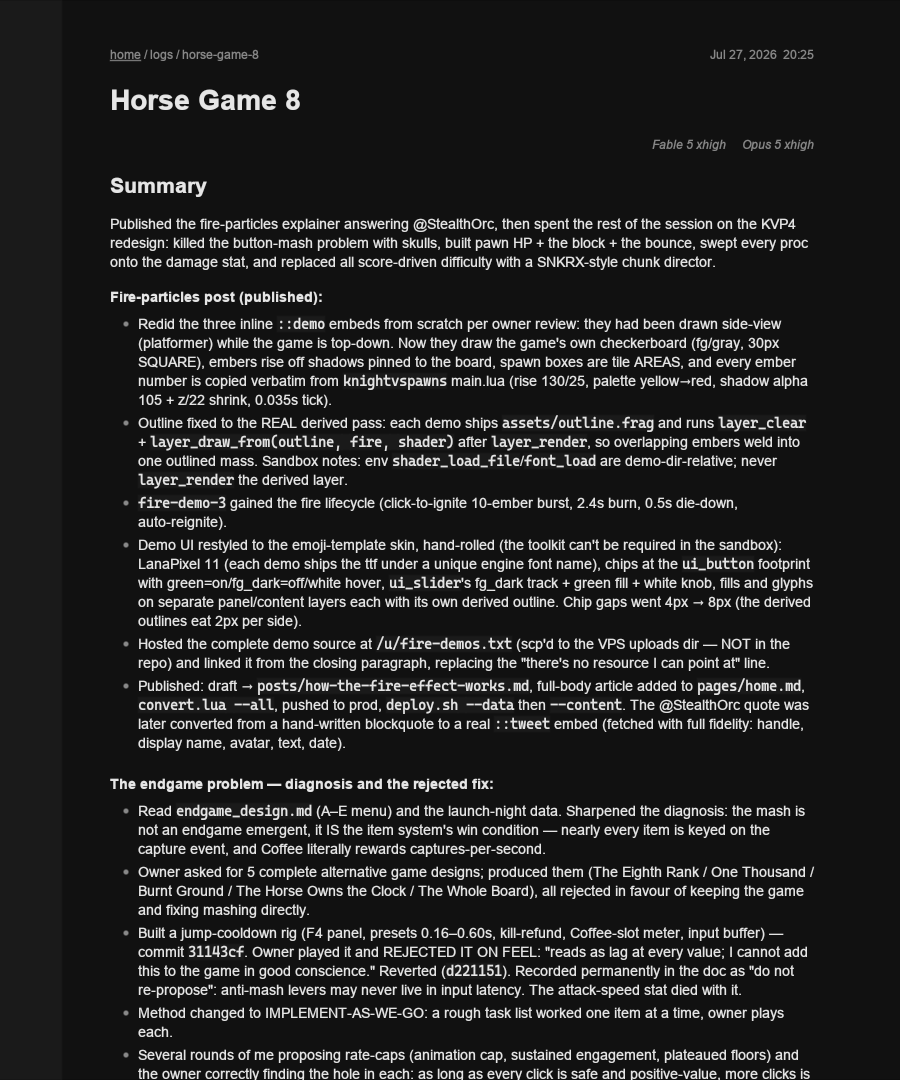
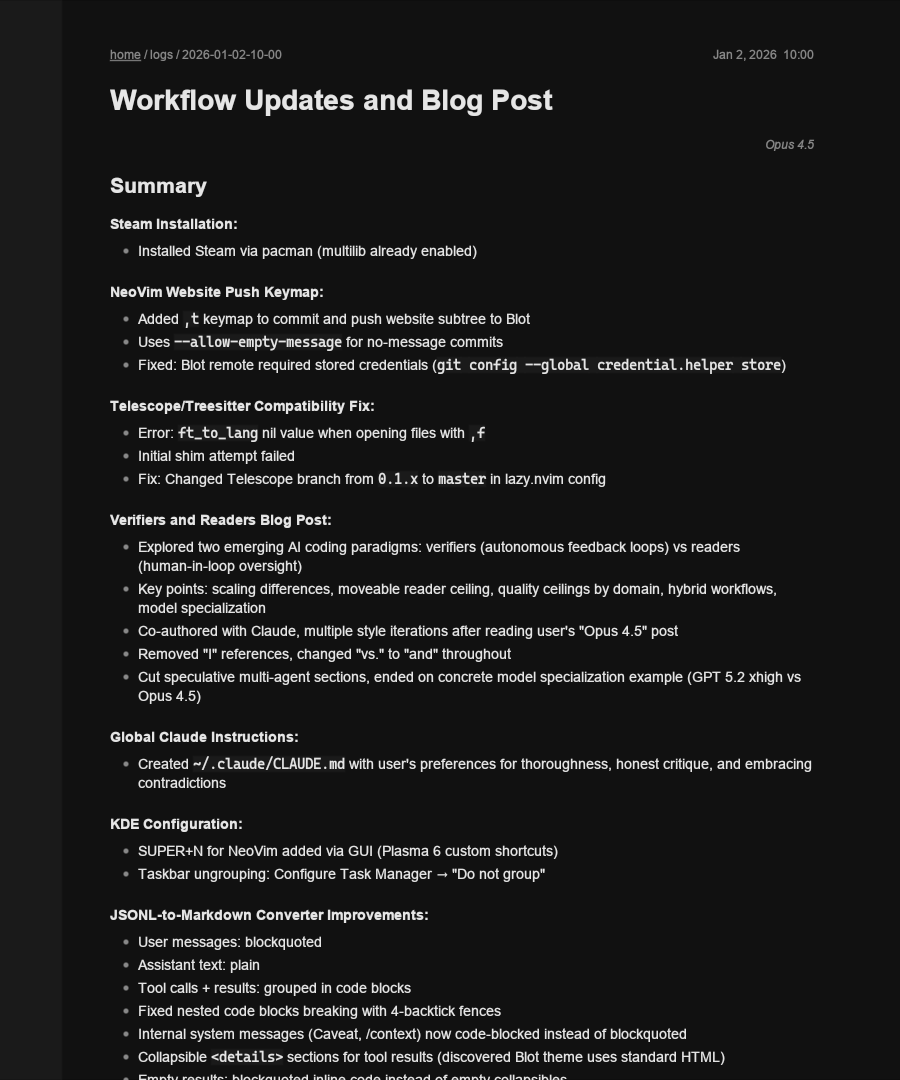
Do you think font, size, color, right alignment, etc need any change? Would you change it?
[Think]
He wants my honest opinion, so I should really examine the captures rather than just praise the work. I'm looking closely at the turn row layout—the "Worked for 7m 0s" and "Fable 5 high" text, their spacing, size, and opacity at typical screen widths—to judge whether this two-sided metadata pattern actually reads well.

Now I'm considering the header case where there are no chips: the model label ends up floating alone on the right, similar to how the date sits alone on the breadcrumb row in older logs, leaving the title sandwiched between two right-aligned metadata lines. That feels like a real design question worth flagging—whether it's better to keep that label on its own line for consistency across all logs, even if it means spending a full row on just a few characters, versus folding it into the date row instead.

On color: the label uses the same 50%-alpha gray as everything else, matching the duration text, but the model name is arguably more durable/important information than the ephemeral duration. I'm tempted to suggest bumping its contrast slightly so it stands out during scanning, but that directly conflicts with his explicit "one gray" rule, so I'd lean toward not changing it and just noting the tension. On italics, I'm thinking through how the small italic sans text will look on a dark background, given the duration already uses that same italic treatment.

Right-alignment for the model label matches the site's convention of putting time/metadata at the right edge, like the crumb-row date, so that's consistent. Size-wise, 12px reads fine against the 15-16px body both on wide and narrow screens. Looking at the mixed-model header labels, I notice the comma groups separated by a 16px gap ("Fable 5 high, xhigh   Opus 5 xhigh") — the group spacing feels a bit weak visually next to the comma's stronger semantic tie, though wrapping still keeps whole groups intact, so it reads acceptably.

Overall, I wouldn't change the font, size, color, or alignment — they borrow an existing metadata voice from the duration line and crumb date rather than inventing something new, which fits a small site with a tight visual budget. The one place I'd be tempted to tweak is contrast hierarchy, though I'd resist for consistency's sake, and I'd want to test how the role-less log label row behaves on a 390px mobile width.
No. I looked for something to change and I wouldn't touch any of it, and I think the reason is worth stating rather than just saying "it's fine."
The labels borrow an existing voice instead of inventing one. The site already has a metadata register: the crumb-row date at top right, the "Worked for" line, the timestamp under the avatar. All of it is small, gray, and pushed to an edge. The model labels use exactly that register, so a reader doesn't have to learn a new visual category. On a site with as strict a visual budget as this one, a new color or a new weight for one more kind of metadata would be a cost, and the only thing it would buy is emphasis. Every one of your iterations with ChatGPT moved toward this (kill the colors, kill the slash, match the duration font), and the end state is the right one.
Right alignment is the site's convention for time and provenance. The date sits at the right of the crumb row. The model sits at the right of the chips row and the right of the duration row. Left side says what happened, right side says when and by whom. That's consistent across all three rows now, and I would keep it.
Size and italic. 12px italic sans on dark renders a touch soft, but that's the same softness the duration line already has, and the label is never the thing you read, it's the thing you glance at. Making it crisper would make it louder.
The one place I was tempted, and why I resisted. There's a hierarchy argument against the current design: "Worked for 7m 0s" is trivia and "Fable 5 high" is the durable historical fact, yet they have identical weight. A notch more contrast on the model label (say 70% instead of 50% alpha) would make the fact read before the trivia. I wouldn't do it. It reintroduces a second gray, which you explicitly removed, and once there are two grays the reader starts asking what the difference means. The every-turn rule already solves the real problem, which was findability, not emphasis.
The one thing that looks slightly off but I'd still keep. In the reverted old logs there are no chips, so "Opus 4.5" sits alone on an otherwise empty row under the title, and you can see it stacking with the right-aligned date two rows above. It spends a line on eight characters. I'd keep it anyway: the label should be in the same place in every log so the eye learns where to look, and the alternative of tucking it beside the date puts a historical fact next to a timestamp in a different font, which reads worse than an empty row.
So the visual is done. Whatever remains to decide is functional: whether the every-turn pilot graduates, and whether Horse Game 8 through 18 eventually get roles back so their switch points show per reply.
Slight more spacing on the bottom of the "Worked for" line and similar model lines, it's too close to the text below.
[Think]
I'm looking for where spacing between byline/turnmeta elements and the next element gets set, likely in canvas.lua's layout_list function with per-type gaps, so I'll search for "byline" and "turnmeta" across canvas.lua and elements.lua.Bash (cd ~/a327ex/a327ex-site/renderer && grep -n "byline|turnmeta|_turn_dur" canvas...)
elements.lua:28:  if kind == 'byline' then return prose.fonts.small_italic end
elements.lua:53:  if kind == 'byline' then return prose.fonts.small_italic end   -- byline: uniform small italic
elements.lua:760:function layout_turnmeta_element(el)
elements.lua:773:function draw_turnmeta_element(layer, el, oy)
canvas.lua:203:  if el._turn_dur then return prose.metrics.element_gap end -- turn-duration line: normal air above (separates from the user message)
canvas.lua:204:  if el.kind == 'byline' then return 3 end                 -- byline tucks right under the title
canvas.lua:249:      if prev._turn_dur then gap = px(5) end
canvas.lua:262:    elseif el.type == 'turnmeta' then
canvas.lua:264:      layout_turnmeta_element(el)
canvas.lua:387:      elseif el.type == 'turnmeta' then
canvas.lua:388:        draw_turnmeta_element(layer, el, oy)
----
18:local LIST_ITEM_GAP = px(4)    -- gap between consecutive list items (tight)
21:local DETAILS_GAP    = px(6)   -- gap before a details box (they stack tightly, separated by their top hairline)
198:-- Gap ABOVE an element: a per-kind override (prose.gap_before) when present, else
200:local function gap_before(el)
201:  if el.type == 'item' then return LIST_ITEM_GAP end       -- list items sit tight
202:  if el.type == 'details' then return DETAILS_GAP end      -- details boxes stack tightly
214:  if key and prose.gap_before[key] then return prose.gap_before[key] end
219:-- elements have no bottom gap (the next element's gap_before provides spacing).
220:local function gap_after(el)
221:  if el.type == 'image' or el.type == 'video' or el.type == 'gallery' or el.type == 'game' then return prose.gap_before.image end
222:  if el.type == 'group' and el.kind == 'quote' then return prose.gap_before.quote end
243:      local gap = math.max(gap_after(prev), gap_before(el))
Bash (cd ~/a327ex/a327ex-site/renderer && sed -n '240,252p' canvas.lua; grep -n 'eleme...)
      prev.thread_below = true
    end
    if prev then
      local gap = math.max(gap_after(prev), gap_before(el))
      if el.thread_above then el._thread_gap = gap end   -- the spine spans exactly this gap
      -- ...but a RUN of cards (consecutive test recordings) stacks tight —
      -- they read as one group
      if el.type == 'mediacard' and prev.type == 'mediacard' then gap = px(6) end
      -- the turn-duration line is the claude turn's header: its content hugs it
      if prev._turn_dur then gap = px(5) end
      y = y + gap
    end
    el.y = math.floor(y)
88:  element_gap      = 16,     -- paragraph margin
132:  element_gap = 25,                -- old theme paragraph margin 1.4em ≈ 25px
310:  prose.metrics.element_gap = math.floor(t.metrics.element_gap * S + 0.5)
[Think]
I'll bump the gap below the turn-duration line from px(5) to px(10), a slightly larger spacing that applies to both byline duration and turnmeta rows since both use `_turn_dur`. Then I'll rebuild the bundle, deploy, commit and push, and do a quick capture of a turn row to mechanically confirm it renders correctly before leaving deeper verification to him.The gap below the duration row is a single value in canvas.lua (5px, "content hugs it"). I'll double it to 10px, which also covers the "Model changed" rows since they share the flag.
Bash (cd ~/a327ex/a327ex-site/renderer && sed -i 's| if prev._turn_dur then gap = px(5...)
249:      if prev._turn_dur then gap = px(10) end
lua5.4: canvas.lua:15: attempt to call a nil value (global 'px')
    canvas.lua:15: in main chunk
edited
[Think]
Now I need to run two things in parallel: kick off the deploy plus commit and push as a background chain, and separately capture a turn row and mid row with the new spacing using local code, independent of the deploy.Bash (cd ~/a327ex/a327ex-site/renderer && bash tools/deploy.sh 2>&1 | tail -3 && cd .....)
Command running in background with ID: brkwtxahe. Output is being written to: /tmp/claude-1000/-home-adn-a327ex/f5713695-5f84-4add-a994-b47ac00e592c/tasks/brkwtxahe.output. You will be notified when it completes. To check interim output, use Read on that file path.
Session cwd remains /home/adn/a327ex/a327ex-site/renderer; directory changes made by the backgrounded command do not apply to subsequent commands.
Bash (S=/tmp/claude-1000/-home-adn-a327ex/f5713695-5f84-4add-a994-b47ac00e592c/scratch...)
started pid 2220998 — replays/.eval.sock
40
stopped (pid 2220998)
mid_c.png
mid.png
turn_c.png
turn.png
Shell cwd was reset to /home/adn/a327ex
Read (/tmp/claude-1000/-home-adn-a327ex/f5713695-5f84-4add-a994-b47ac00e592c/scratchpad/cap3/turn_c.png)
[
  {
    "type": "image",
    "note": "[image: shown below]"
  }
]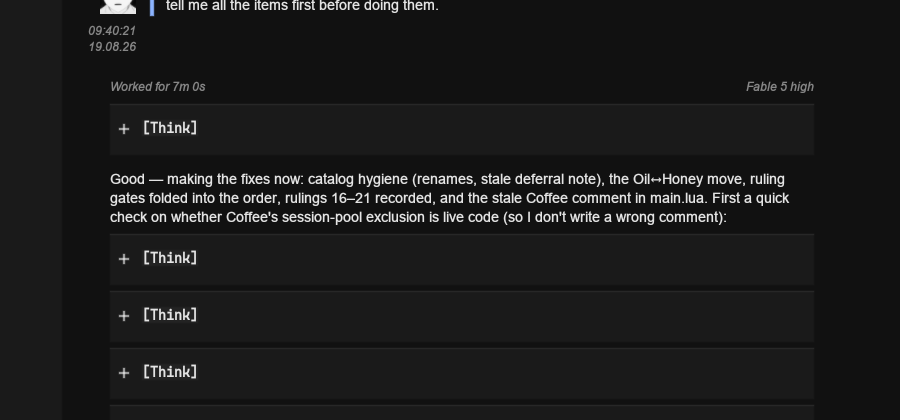
Read (/tmp/claude-1000/-home-adn-a327ex/f5713695-5f84-4add-a994-b47ac00e592c/scratchpad/cap3/mid_c.png)
[
  {
    "type": "image",
    "note": "[image: shown below]"
  }
]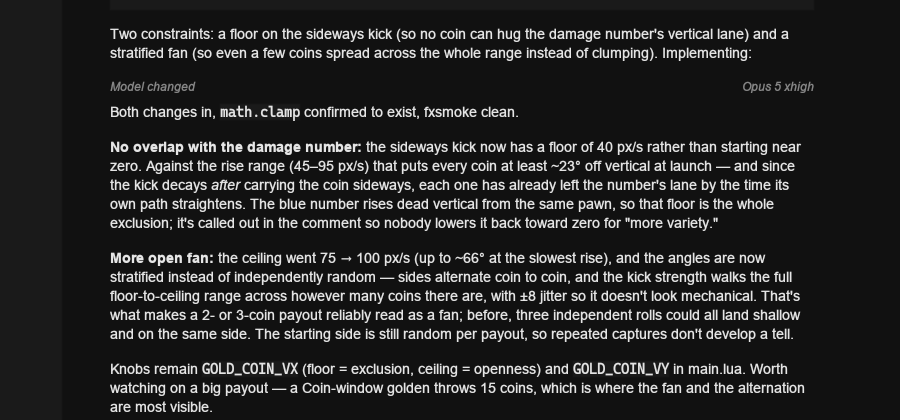
[Think]
The 10px gap now looks balanced against the 16px spacing above the metadata row. I still need to confirm the deploy finished before reporting back, then send the final message with the delivered crop.
SendUserFile (/tmp/claude-1000/-home-adn-a327ex/f5713695-5f84-4add-a994-b47ac00e592c/scratchpad/cap3/turn_c.png, /...)
2 files delivered to user.
  /tmp/claude-1000/-home-adn-a327ex/f5713695-5f84-4add-a994-b47ac00e592c/scratchpad/cap3/turn_c.png → file_uuid: 3432482c-9ad6-440c-a5e8-232be212c8af
  /tmp/claude-1000/-home-adn-a327ex/f5713695-5f84-4add-a994-b47ac00e592c/scratchpad/cap3/mid_c.png → file_uuid: 79a2583f-a67b-46af-b878-44fc29c1d959
Bash (sleep 20; cat /tmp/claude-1000/-home-adn-a327ex/f5713695-5f84-4add-a994-b47ac00e...)
== deploy bundle + engine-boot.js
   hashed: renderer-6d88ccd02b.data  anchor-b24444d189.wasm
OK deployed — matched pair on VPS (6d88ccd02b6730aceb27b58548c595ea ca2a92d97c0b22671b4b25aa5ba46921 )
   077cca6..c256b3c  main -> main

[exited with code 0]
Done and live (commit c256b3c). The gap below the "Worked for" row and the model rows went from 5px to 10px in canvas.lua:249. It's one rule keyed on the turn-duration flag, so it covers the plain duration lines in every role-tagged log, the every-turn rows in the pilot, and the "Model changed" rows. The gap above those rows is unchanged at the normal paragraph margin, so the row now sits a little closer to the user message it answers than to the reply it heads, which reads as the right grouping to me. Captures above show both cases.
Alright, thank you. As a general question now, I'm noticing that Astra has a personality mismatch with me, it's autistic in a way that doesn't match with me, like it's not exploratory enough and you have to be more precise with it than I have to be with you, you have more taste/agency and can make better decisions on your own while its decisions often seem incorrect to me. This goes back to before GPT6 though so I just assume it is its personality forever. I like your personality better. But it does seem like a good model. Grok 4.6 fit me better than Astra, but Grok 4.7 is coming out soon and I'll also test it then. Because in general I trust your judgement, but your tokens are more expensive, I'd like to ask you how we'd go about using you to do high-level tasks and then spawning Astra or Grok or Opus 5 to actually implement the tasks according to your specifications. Because I have $100 OpenAI and XAI subscriptions, but I will likely mainly use you to actually do work, I'd like to also make use of those subscriptions so I don't waste money, at least not for this month. I also have $90 on Gemini which I'd like to use entirely for video analysis since it seems to be uniquely good at that. So, how would you go about integrating all these models and driving them from here so I don't have to interact with them myself and so that I use less of your tokens while using more of theirs without losing your unique ability to make good decisions?
Fable 5.1 xhigh
[Think]
This is an open-ended architecture question, so per CLAUDE.md I should be thorough, present options rather than decide unilaterally, and keep in mind the existing Delegation clause about implementers not making new design decisions when working from an agreed brief.

Now the real question is mechanics: how to actually drive Codex, Grok CLI, and Gemini from my session without him interacting directly. I'm trying to recall what's actually available on his machine — Codex CLI with non-interactive exec mode, Grok CLI sessions stored locally, and Gemini CLI's support for multimodal file references — though I'm not fully certain about video support and should verify rather than assume.

I also remember the retirement note that Gemini/Google tooling was deprecated for the Mini backend, though there's a $90 Gemini credit whose nature (API vs subscription) I need to ask about. Before designing anything I should check installed CLI versions and existing Anchor workflow tooling like codex_session.py, and recall the memory constraint that multi-agent work is limited to serial focus with only occasional pre-specified fleet bursts.

This is a design question, so I want to give concrete options grounded in reality rather than generic advice — meaning I should quickly check which CLIs (codex, grok, gemini) are actually installed, their non-interactive flags, and whether Anchor already has delegate-style tooling I can build on.

The core design revolves around cost: my own tokens are expensive, whereas delegating implementation to Codex/Grok (flat-rate subscriptions, sunk cost) or Gemini (for video work) is cheaper. The pattern I'm sketching is: I write a brief, spawn a bounded `codex exec` run scoped to just implementation (no design decisions, report back on open choices), then review the resulting diff — since reading a diff is far cheaper in tokens than generating the code myself.

The real savings come not from my review cost but from offloading output-token-heavy work and the iterative churn of implementation — file reads, build runs, error fixes — which are where costs balloon. The main risks are: the brief needs to be tighter than something I'd write for myself, which shifts some cost upfront; and context transfer, since the implementer lacks my memory and gotchas, though Codex can compensate by reading AGENTS.md, skills, and memory files already set up per the earlier Astra configuration log.

There's also an open question about log publishing: a delegated Codex run creates its own session artifact rather than living in my log, so I'd need to decide whether it becomes a linked child log or gets woven into mine as a folded transcript — genuinely worth raising as a design question for the system.

On the mechanics side, I'm mapping out how each CLI actually gets driven non-interactively — Codex via `codex exec` with sandbox/auto flags I need to verify, Grok's flag unknown and needing a help check, and Gemini via `-p` with `@path` file inclusion, though I'm unsure whether that handles video directly versus needing the API's Files upload for native video support.

For the orchestration layer itself, I'm leaning toward keeping it minimal at first — plain Bash invocations with a brief file rather than building a full `anchor delegate` subcommand right away, saving the more structured integration with the log system for later once I've validated the quality of the approach.

On the review loop, I think the implementer should own running mechanical checks like tests and build itself, reporting results back rather than me re-running them; if something's off, I should follow up in the same resumed session instead of starting fresh. I also want to be honest about token economics — my context still grows with every diff reviewed, so sub-delegation mainly saves implementation churn, not review cost, and Claude Code's own subagent tooling might be worth considering as an alternative.

On subscriptions, I shouldn't assume whether Claude is on a flat Max plan or metered API — that changes whether "tokens are expensive" means dollars or usage limits, so I should flag that uncertainty rather than guess. For model fit: Astra's precision suits it well as a bounded-task implementer, Grok's exploratory style fits research and second opinions better, and Opus could serve as an implementer through a subagent if run via the Claude subscription itself.

Gemini seems best reserved for video-specific work like trailer or gameplay footage analysis. I'm also thinking through a concrete protocol for bounding review costs — a "Decisions" section plus explicit stop conditions for implementers, with each one producing a structured final report rather than dumping its whole transcript for me to read, while the full transcript still goes to a log for anyone who wants it. Before answering, it'd be worth doing a quick, cheap recon of what CLIs and non-interactive flags are actually installed on the machine, so I'll run that.
Let me ground this in what's actually installed and how each CLI can be driven non-interactively before I answer.
Bash (for c in codex grok gemini claude; do printf '%-7s ' $c; command -v $c >/dev/nul...)
codex   codex-cli 0.153.2
grok    grok 1.0.13 (5e9a58528b76)
gemini  Invalid configuration in /home/adn/.gemini/settings.json:
claude  2.1.252 (Claude Code)
---- codex exec
Usage: codex exec [OPTIONS] [PROMPT]
  resume  Resume a previous session by id or pick the most recent with --last
  -c, --config <key=value>
          Examples: - `-c model="o3"` - `-c 'sandbox_permissions=["disk-full-read-access"]'` - `-c
      --enable <FEATURE>
      --disable <FEATURE>
      --strict-config
  -i, --image <FILE>...
  -m, --model <MODEL>
      --oss
      --local-provider <OSS_PROVIDER>
  -p, --profile <CONFIG_PROFILE_V2>
  -s, --sandbox <SANDBOX_MODE>
          Select the sandbox policy to use when executing model-generated shell commands
      --approve-for-me
          Route approval requests through automatic review using the workspace-write sandbox
      --dangerously-bypass-approvals-and-sandbox
          Skip all confirmation prompts and execute commands without sandboxing. EXTREMELY
          DANGEROUS. Intended solely for running in environments that are externally sandboxed
      --dangerously-bypass-hook-trust
  -C, --cd <DIR>
      --add-dir <DIR>
      --thread-source <SOURCE>
      --skip-git-repo-check
      --ephemeral
Bash (echo ---- grok; timeout 10 grok --help 2>&1 | head -40)
---- grok
Grok Build TUI

Usage: grok [OPTIONS] [PROMPT] [COMMAND]

Arguments:
  [PROMPT]
          Initial prompt for the interactive session, e.g. `grok "fix the bug"` or `grok --worktree=feat "create this feature"`

Options:
      --agent <NAME>
          Agent name or definition file path

      --agents <JSON>
          Inline subagent definitions as JSON

      --allow <RULE>
          Permission allow rule (compat alias: --allowedTools)

      --always-approve
          Auto-approve all tool executions

  -c, --continue
          Continue the most recent session for the current working directory

      --cwd <CWD>
          Working directory

      --debug
          Enable debug logging
... [11 more lines]
Bash (echo ---- gemini; timeout 10 gemini --help 2>&1 | grep -E '^\s+-|prompt|yolo|app...)
---- gemini
    Invalid enum value. Expected 'default' | 'auto_edit' | 'plan', received 'yolo'
Gemini CLI - Defaults to interactive mode. Use -p/--prompt for non-interactive (headless) mode.
  gemini gemma                 Manage local Gemma model routing
  query  Initial prompt. Runs in interactive mode by default; use -p/--prompt for non-interactive.
  -d, --debug                     Run in debug mode (open debug console with F12)  [boolean] [default: false]
  -m, --model                     Model  [string]
  -p, --prompt                    Run in non-interactive (headless) mode with the given prompt. Appended to input on stdin (if any).  [string]
  -i, --prompt-interactive        Execute the provided prompt and continue in interactive mode  [string]
      --skip-trust                Trust the current workspace for this session.  [boolean] [default: false]
  -w, --worktree                  Start Gemini in a new git worktree. If no name is provided, one is generated automatically.  [string]
  -s, --sandbox                   Run in sandbox?  [boolean]
  -y, --yolo                      Automatically accept all actions (aka YOLO mode, see https://www.youtube.com/watch?v=xvFZjo5PgG0 for more details)?  [boolean] [default: false]
      --approval-mode             Set the approval mode: default (prompt for approval), auto_edit (auto-approve edit tools), yolo (auto-approve all tools), plan (read-only mode)  [string] [choices: "default", "auto_edit", "yolo", "plan"]
      --policy                    Additional policy files or directories to load (comma-separated or multiple --policy)  [array]
      --admin-policy              Additional admin policy files or directories to load (comma-separated or multiple --admin-policy)  [array]
      --acp                       Starts the agent in ACP mode  [boolean]
      --experimental-acp          Starts the agent in ACP mode (deprecated, use --acp instead)  [boolean]
      --allowed-mcp-server-names  Allowed MCP server names  [array]
      --allowed-tools             [DEPRECATED: Use Policy Engine instead See https://geminicli.com/docs/core/policy-engine] Tools that are allowed to run without confirmation  [array]
  -e, --extensions                A list of extensions to use. If not provided, all extensions are used.  [array]
  -l, --list-extensions           List all available extensions and exit.  [boolean]
  -r, --resume                    Resume a previous session. Use "latest" for most recent or index number (e.g. --resume 5)  [string]
      --session-file              Load a session from a JSON file  [string]
      --session-id                Start a new session with a manually provided UUID.  [string]
      --list-sessions             List available sessions for the current project and exit.  [boolean]
---- gemini auth/config
bin
google_accounts.json
history
... [7 more lines]
Bash (ls ~/.codex 2>/dev/null | head; ls ~/.codex/skills 2>/dev/null; echo ---- AGENTS...)
AGENTS.md
ambient-suggestions
archived_sessions
astra.config.toml
auth.json
browser
cache
chrome-native-hosts-v2.json
computer-use
config.toml
anchor-development
diagnose-crash
draft
end-session
lock
monthly-taxes
msg
omarchy
omni
unseal
---- AGENTS.md
/home/adn/.codex/AGENTS.md
---- workflow codex tooling
codex_session.py
codex_transcript.py
/home/adn/a327ex/Anchor/workflow/lib/codex_session.py:7:import argparse
/home/adn/a327ex/Anchor/workflow/lib/codex_session.py:34:def main():
/home/adn/a327ex/Anchor/workflow/lib/codex_session.py:35:    parser = argparse.ArgumentParser(description=__doc__)
---- grok sessions
active_sessions.json
... [9 more lines]
[Think]
I still need to check if grok has a non-interactive print mode with JSON output by scanning its help text further. I'm also noting that Gemini's settings.json has an invalid enum value for "yolo," and that the presence of google_accounts.json suggests OAuth login via a Google account rather than API key auth—worth checking if that $90 ties to a Google AI Pro subscription.

Beyond that, I want to verify whether Gemini CLI supports video files through its @ file-reference syntax by grepping the installed package for video mime type support, and check if `codex exec` has a `--json` or output flag for capturing the last message. I should also peek at codex_session.py's docstring to understand how the Astra setup workflow delegates to Codex, and consider whether Claude's settings.json reveals anything about subscription versus API billing—though that's probably better to just ask about directly. I'll run these checks in parallel now.
Bash (timeout 10 grok --help 2>&1 | grep -iE -B1 -A2 'print|headless|non-interactive|o...)
Usage: grok [OPTIONS] [PROMPT] [COMMAND]

Arguments:
  [PROMPT]
          Initial prompt for the interactive session, e.g. `grok "fix the bug"` or `grok --worktree=feat "create this feature"`

Options:
--

      --agents <JSON>
          Inline subagent definitions as JSON

      --allow <RULE>
--
      --fork-session
          When resuming (`--resume` / `--continue`), create a new session ID instead of reusing the original (optionally set via `--session-id`)

      --fullscreen
--
  -h, --help
          Print help (see a summary with '-h')

      --include-partial-messages
          Emit incremental `stream_event` lines (text/thinking deltas) alongside whole messages. Only affects `--output-format streaming-messages-json`

      --json-schema <SCHEMA>
          JSON Schema for structured output. When set, the model is constrained to produce JSON matching this schema. Implies --output-format json. Example: --json-schema '{"type":"object","properties":{"name":{"type":"string"}}}'

      --leader-socket <PATH>
--
... [28 more lines]
Bash (timeout 10 codex exec --help 2>&1 | grep -iE -A2 'json|output|last-message|color...)
          Skip all confirmation prompts and execute commands without sandboxing. EXTREMELY
          DANGEROUS. Intended solely for running in environments that are externally sandboxed

--
      --skip-git-repo-check
          Allow running Codex outside a Git repository

--
      --output-schema <FILE>
          Path to a JSON Schema file describing the model's final response shape

      --color <COLOR>
          Specifies color settings for use in the output

          [default: auto]
--
      --json
          Print events to stdout as JSONL

  -o, --output-last-message <FILE>
          Specifies file where the last message from the agent should be written

---- codex config
# Use Astra’s largest context budget advertised by this Codex runtime.
model_context_window = 872000
model_auto_compact_token_limit = 800000
model_reasoning_summary = "detailed"
model = "gpt-6-astra"
model_reasoning_effort = "high"
service_tier = "default"
... [32 more lines]
Bash (cat ~/.gemini/settings.json; echo ---- accounts; python3 -c "import json;d=json....)
{
  "general": {
    "defaultApprovalMode": "yolo",
    "sessionRetention": {
      "enabled": false
    }
  },
  "security": {
    "auth": {
      "selectedType": "gemini-api-key"
    }
  },
  "ui": {
    "inlineThinkingMode": "full",
    "showStatusInTitle": true,
    "compactToolOutput": true,
    "errorVerbosity": "low",
    "loadingPhrases": "off",
    "accessibility": {
      "screenReader": false
    }
  }
}
---- accounts
{'active': '<acct>', 'old': []}
---- video support in gemini cli
/usr/bin/../share/doc/rclone/MANUAL.txt
/usr/bin/../share/doc/rclone/MANUAL.html
/usr/bin/../share/gir-1.0/WebKit2-4.1.gir
'video/'
... [9 more lines]
Bash (sed -n '1,33p' ~/a327ex/Anchor/workflow/lib/codex_session.py; echo ---- README d...)
#!/usr/bin/env python3
"""Resolve the calling Codex task by UUID, without guessing by recency.

Prints only session metadata. --register enables the existing `anchor ...
--session UUID` protocol; no hooks, model calls or publication are required.
"""
import argparse
import json
import os
from pathlib import Path
import sys
import uuid


def resolve(root, sid):
    sid = str(uuid.UUID(sid))
    hits = []
    for path in Path(root).rglob(f'*{sid}.jsonl'):
        with path.open(encoding='utf-8') as source:
            # A rollout's session_meta is the first row; don't load its history.
            try:
                row = json.loads(source.readline())
            except json.JSONDecodeError:
                continue
        meta = row.get('payload', {})
        if row.get('type') == 'session_meta' and meta.get('id') == sid:
            hits.append({'id': sid, 'cwd': meta.get('cwd', ''),
                         'transcript': str(path.resolve()), 'agent': 'codex'})
    if len(hits) != 1:
        raise ValueError(f'expected one rollout for {sid}, found {len(hits)}; pass the exact --jsonl path to anchor end')
... [36 more lines]
[Think]
I also notice the Gemini settings file has an invalid `defaultApprovalMode: "yolo"` value that the CLI rejects as an enum error — that's worth flagging as something needing a fix, though not urgent right now. The auth type being used is gemini-api-key, so it's going through the API.

For video handling, since I'm uncertain whether the Gemini CLI itself supports video natively, the safer path is a small script using the API key directly against Gemini's Files API, which reliably supports video up to 2GB and about an hour long — I can drive that from Bash. I'm also cataloging the CLI flags for headless/scripted usage across Grok, Codex, and Gemini so I can reference them when laying out the approach, then I'll present the design and batch up the open questions for the user.

Now I'm structuring the answer: first framing what actually saves tokens (output/iteration costs for implementation vs. cheaper input costs for review, with the brief itself as the existing contract), then assigning roles based on observed fit — Astra as a precise implementer that shouldn't make decisions, Grok for research and fan-out work via headless JSON-output calls, Opus 5 as an in-house implementer via the Agent tool sharing my context, and Gemini reserved for video via the API script. Then I get into the concrete mechanics: writing a delegation packet (approach, interfaces, decisions, stop conditions, verification commands, report format) to a project file and invoking Codex against it in approve-for-me mode with a report output file.

I'm outlining how to keep my review cost low — reading the diff and structured report rather than the full transcript — and then working through the question of what to do with delegated run transcripts: publish them as their own linked logs, fold them into my own log as agent-run cards, or keep them private and only surface my own summary.

I lean toward the card approach, linking to a separately published child log, similar to replay cards, but that requires building out an Anchor workflow — a delegate verb that records run metadata so the ending step can weave it in properly, phased so the raw approach comes first and the tooling comes later. I'm also noting honest caveats: writing a tight brief costs upfront tokens, so the savings only pay off on tasks with substantial implementation churn, not small tweaks where the brief is basically the code itself.

I also can't see what Astra actually saw, so its reports could be wrong, meaning mechanical verification — running the tests myself — has to stay on me since it's cheap. And since Astra lacks my memory, the brief needs to carry all the context and known gotchas, which raises the question of whether each project actually has an AGENTS.md file for Codex to read, since Codex doesn't read CLAUDE.md unless it's symlinked — something I should verify. There's also the question of how Claude's plan type affects the cost calculus if it's a flat subscription rather than metered usage.

For Gemini, the settings.json has an invalid yolo enum that's currently breaking CLI startup, but that's an easy fix with the right approval-mode flag or key. For video analysis, the Files API seems like the robust path — I'd write a small script that uploads a video with a prompt and prints back the analysis, usable straight from Bash, useful for reviewing Steam trailers, gameplay recordings, turntables, or competitor trailers.

Now I'm compiling the batch of questions to ask: Claude's billing type, how to log delegated runs, and a few candidate task types to start with.

I want to draw from active projects like the Horse Game's item batches, the Steam pipeline, and asset conversions as candidates, while keeping in mind the two-source rule for items. I should also ask about the scope for Gemini video use, and whether Grok could serve as a cheap adversarial second-opinion reviewer for design briefs — which I think is a good idea.

I want the response to be thorough but well-structured, no em dashes, headers are fine if it runs long, but I should avoid over-length. Time to write it out.
Good question, and the pieces are mostly already on the machine. Here is how I'd build it, what it actually saves, and where it doesn't.
What the delegation actually buys
My cost is not in the thinking, it's in the implementation churn: writing code (output tokens, the expensive kind), then the tool loop of reading files, building, hitting an error, reading again. A brief is a few hundred words. Reviewing a diff is input tokens, cheap and cached. So the saving is real when the implementation is large relative to the decision: ports, content fan-outs, test harnesses, mechanical refactors, asset pipelines. It is fake when the brief is the code: a 20-line feel tweak like today's spacing change costs me more to specify for someone else than to do.
The doctrine already exists in your CLAUDE.md under Delegation: the brief travels with the delegation and bounds it, the implementer makes no new design decisions, on an open choice it stops and reports. Nothing new to invent there. What's missing is the plumbing and the log treatment.
Who does what, based on what you've observed
Your read on Astra is actually a job description. "Needs precision, not exploratory, decisions often wrong" is a bad collaborator and a good implementer, provided the brief removes the decisions. So: Astra implements. Note that its current AGENTS.md tells it the opposite ("implement reversible first versions without waiting for a brief, make coherent choices"). For delegated runs it needs the inverse contract, which the brief itself can carry in a preamble.
Grok fit you better, so it gets the work that needs taste but not my context: research reports, adversarial second opinions on my briefs and your design docs, content fan-outs (name lists, flavor text variants, market scans). It has a real headless mode: grok -p "..." --output-format json --always-approve --max-turns N --cwd dir. When 4.7 lands you test it in the same slot without changing anything else.
Opus 5 through my own Agent tool is the implementer for work where the brief can't carry enough context, because it shares my memory, CLAUDE.md, and gotchas. Cheaper than me, still on the Claude plan.
Gemini does video and nothing else. Your settings.json selects an API key, so the $90 is API credit, and the reliable path for video is the Files API directly, not the CLI: a small script that uploads a video plus a prompt and prints the analysis, which I call from Bash and read. That covers Steam trailers, your gameplay recordings when you want a second pair of eyes on feel or pacing, look-dev turntables, competitor footage. One thing to fix first: the CLI currently refuses to start because settings.json sets defaultApprovalMode: "yolo", which that key doesn't accept.
The mechanics, concretely
The unit is a delegation packet: a brief file written into the project (Approach, Interfaces, Functions, Decisions as now, plus three sections that only exist because someone else is executing: stop conditions, the exact verification commands to run, and the report format). Then, from my session:
codex exec -C ~/a327ex/<project> --approve-for-me -o /path/report.md "$(cat brief.md)"
run in the background. When it finishes I read the report and git diff --stat, run the mechanical checks myself (cheap, and I don't trust a self-report), and hand over to you for feel exactly as now. Follow-ups go to the same session with codex exec resume --last so it keeps its context. Grok is the same shape with -p. Both write their own transcripts, Codex to ~/.codex/sessions, Grok to ~/.grok/sessions, and the Anchor workflow already converts both formats.
I'd phase it. Phase 0, this month: raw calls like the above, no new tooling, on two or three real tasks, to find out whether Astra's output under a tight brief is good enough that the review loop is cheaper than doing it. Phase 1, if it is: an anchor delegate <agent> verb that runs the CLI, records the run (agent, model, brief path, transcript path, cwd) so anchor end can weave it into my log, and standardizes the packet.
The part that matters for the logs
A delegated run is a transcript you didn't have before, and it's arguably the interesting one: the model that fit you least doing the actual work under the model that fit you best. Three ways to treat it. A: publish each delegated run as its own log entry, linked from mine. B: publish it as its own entry and card it inside my log at the point of delegation, the way replays are carded ("agent run, N steps"), so the reader follows the brief into the implementation and back. C: only my log, which contains the brief and the diff; delegate transcripts stay private. I'd pick B. It makes the pipeline visible, which is the whole point of the site, and it reuses the card mechanism. It is also the only option that needs Phase 1 tooling, so Phase 0 runs would be A or C until then.
Honest limits
The two-hop problem: I can't see what Astra saw, only what it reports. Mechanical verification stays mine, and feel stays yours, so the loop gets one hop longer, not shorter. Context transfer: Astra reads AGENTS.md, not CLAUDE.md, so per-project gotchas (the eleven engine traps, the items two-sources rule) have to ride in the brief or in a per-project AGENTS.md, and I'd rather write them once per project than per brief. And this is serial, not parallel: one implementer under one brief at a time, which fits your single-game focus rule.
Questions before I set anything up
- Is Claude a flat subscription or API billing? If flat, "expensive" means usage limits, not dollars, and the goal is really "don't hit the wall," which changes how aggressively to delegate.
- Log treatment: A, B, or C above, and for Phase 0 specifically.
- First tasks. Candidates I see: an Anchor engine port or framework sync into a game's
anchor/copy, a Horse Game content batch under an agreed item spec, the Steam pipeline's remaining steps. Something with a lot of typing and few decisions. Which, or something else? - Gemini scope. What video do you actually want analyzed first? That decides whether the script needs batch mode, timestamps, or frame extraction.
- Should Grok review my briefs as a routine adversarial pass before Astra implements? Cheap, uses the xAI subscription, and it's the slot where its exploratory character helps rather than hurts.
Apply the changes to the model label to all logs, and then let me answer your questions.
- Claude's subscription is flat.
- Another option which you didn't name, which is that the delegated agent's work is like an artifact card in the log, and when you click it you open a new page that is otherwise not reachable through the normal website, only through that log itself. So it's not a new public log of its own, even though it is structured visually like a log. The only change is that instead of using my picture as the one asking questions and prompting the other agent, it should be a picture of you, Fable, since you'll be the one driving them.
- I'll figure out a test task and we'll start a new session on it, just generate the basic setup so a new session knows about it and can drive it, along with guidelines on when it should vs. shouldn't use which one of the models and so on, your reasoning there for each seems correct.
- I'll figure it out in the actual session.
- Let's not do that for now, maybe after 4.7 lands.
[Think]
I'm splitting this into two parts: first, removing the PILOT gate so model label logging applies unconditionally to all logs, updating the pilot-related test, revising CONTENT_SYNTAX.md, and deploying/committing the change. Second, I need to set up the groundwork so a new session understands the delegation system and has clear guidelines for which model to use when.

Given the decisions — flat subscription with usage limits, delegated runs appearing as artifact cards linking to an unlisted log-style page (with Fable as prompter), deferring the test task and Grok review — I'm figuring out where the setup documentation should live. It could go in CLAUDE.md as the stable map, in a dedicated workflow doc like Anchor/workflow/DELEGATION.md referenced from CLAUDE.md, in a project memory file, or as a `/delegate` skill following the same shim pattern as other anchor verb skills.

Since `anchor delegate` doesn't exist yet in Phase 0, the skill would need to hold the protocol around raw `codex exec`/`grok -p` calls plus a packet template, giving a new session a trigger and reference point. I'm weighing whether to build the full `anchor delegate` verb and artifact-card/unlisted-page rendering now versus just the basic setup he asked for — since the unlisted page mechanism (possibly reusing the gated-tree pattern without the cookie) is a real design decision that deserves its own session rather than being bundled into this basic setup.

But "can drive it" suggests the new session needs to actually operate the delegated agent on a test task, so maybe a thin wrapper script is warranted — something like a `delegate.sh` that wraps the CLI flags for codex/grok correctly and logs run metadata. I'm trying to decide if that crosses into Phase 1 territory or still counts as reasonable basic setup, leaning toward it being acceptable since it just removes friction rather than adding new architecture.

Given that docs/skill edits are exempt from the design brief rule when the user has already specified the change in prose, I think the right path is delivering the docs, skill, and memory now, with a short design sketch marked as unbuilt for the Phase 1 verb and card. I'll also include exact verified commands for Phase 0 driving and a run-record convention so Phase 1 can pick up the thread cleanly.

Now I'm weighing where delegation records should live — putting a `.delegate/` folder inside game repos feels wrong since some of those repos are public, while briefs may contain sensitive content. Centralizing everything under the Anchor workflow tooling directory instead seems safer and keeps game repos clean.

I'm also thinking through how Codex reads its config: it looks for AGENTS.md in the cwd chain, but projects use CLAUDE.md instead, which is Claude-specific and might conflict with the implementer contract needed for delegated runs. Rather than symlinking or duplicating files, the simplest fix is to have the delegation packet explicitly instruct the model to read the project's existing config file while overriding it with the implementer-only preamble for that run.

I'm also sketching out when to use which model: myself for decisions, briefs, review, and anything design-related; Astra for implementation once a brief is fully specified, especially precision-heavy typing work with exact paths and acceptance checks, never for open-ended design; and Grok for research, exploratory analysis, and second opinions run headless.

Beyond that, I'm working out Opus 5 as the implementer when work needs deep project context or when other agents' limits are exhausted, Gemini reserved for video analysis via a script I'll write later, and Sonnet/Haiku subagents handling mechanical searches as the default. I'm framing the usage-limit logic around delegating to preserve my own limit, with implementation churn as the trigger, and running one implementer at a time serially. For the log/publication decision, I'm settling on recording an unlisted page structured like a log with Fable's avatar as the prompter, noting this as the agreed Phase 1 design.

For the unlisted tree structure I'm considering reusing gated's hidden-by-construction index exclusion but without the cookie gate, styling the card like replay/agent-run cards with a delegate directive, and handling the avatar swap through a per-doc driver field so the reader draws the driver's avatar instead of the default. I'm also thinking through how the run gets recorded so a future session's anchor end can pick it up by scanning the Claude jsonl for the Bash call with the brief path, with Phase 1 weaving by scanning run.json files.

The session id recording is a Phase 1 concern since I don't currently know my own session id, so I'll just record timestamps for now and skip that reference. I'm also planning to add a pointer line in CLAUDE.md under Working Style → Delegation pointing to the DELEGATION.md workflow doc, since the user explicitly asked for a new session to be able to discover this setup. I'll also create a project_delegation.md memory file capturing the key decisions made so far.

For state tracking, MEMORY.md is the right place for decisions and next steps, while the doc holds the durable protocol. I need to figure out where his skills actually live — checking whether it's under ~/a327ex/.claude/skills/ or ~/.claude/skills/, using the existing skills like draft, msg, end-session as reference. I'll create a new `delegate` skill following the same file structure, focused on the packet-and-commands protocol, then move on to Part 1.

Now I'll gather Part 2 facts in parallel — skills location and format, the anchor.py subcommand layout for the Phase 1 sketch, and where the CLAUDE.md Delegation paragraph lives.
Two parts. First the label change goes global, then the delegation setup.
Bash (cd ~/a327ex/a327ex-site/renderer && python3 - <<'EOF' p='attribution.lua'; s=ope...)
Traceback (most recent call last):
  File "<stdin>", line 29, in <module>
AssertionError
Attribution checks passed: sorting, default change-only, pilot every-turn (40 rows, 1 mid-turn) and six change points.
346:local function role_filtered(all, slug)
383:    doc.elements = role_filtered(doc._all, doc.slug or active_slug)
757:      doc.elements = role_filtered(doc._all, doc.slug or active_slug)
Bash (ls -d ~/.claude/skills/ ~/a327ex/.claude/skills/ 2>/dev/null | head -20; echo ...)
/home/adn/a327ex/.claude/skills/add-ability
/home/adn/a327ex/.claude/skills/aesthetic-deception
/home/adn/a327ex/.claude/skills/download-emoji
/home/adn/a327ex/.claude/skills/draft
/home/adn/a327ex/.claude/skills/end-session
/home/adn/a327ex/.claude/skills/lock
/home/adn/a327ex/.claude/skills/monthly-taxes
/home/adn/a327ex/.claude/skills/msg
/home/adn/a327ex/.claude/skills/omni
/home/adn/a327ex/.claude/skills/unseal
/home/adn/.claude/skills/diagnose-crash
/home/adn/.claude/skills/omarchy
---- draft skill
/home/adn/a327ex/.claude/skills/draft/SKILL.md
---
name: draft
description: Manage draft messages — local content that doesn't get posted to the website. `/draft <text>` (create), `/draft list`, `/draft publish <slug-prefix>`, `/draft discard <slug-prefix>`. The Anchor workflow owns the mechanics — this skill is the shim around `anchor draft`.
---

# /draft — Anchor-workflow shim

| User says | Run |
|---|---|
| `/draft <text>` | body verbatim to a scratchpad file → `python /home/adn/a327ex/Anchor/workflow/anchor.py draft new --file <body.md>` |
| `/draft` or `/draft list` | `python /home/adn/a327ex/Anchor/workflow/anchor.py draft list` |
| `/draft publish <prefix>` | `python /home/adn/a327ex/Anchor/workflow/anchor.py draft publish <prefix>` |
| `/draft discard <prefix>` | `python /home/adn/a327ex/Anchor/workflow/anchor.py draft discard <prefix>` |

Notes: creating/listing/discarding never checks the lock (drafts are private
writing); **publish does** — a refusal is correct and has no override.
... [8 more lines]
Bash (cd ~/a327ex && grep -n 'Delegation' .claude/CLAUDE.md; sed -n '/**Delegation....)
115:  **Delegation.** When implementation is delegated (a subagent, or a
  **Delegation.** When implementation is delegated (a subagent, or a
  second instance implementing under an already-agreed brief), the
  brief travels with the delegation and bounds it. An implementer
  makes no new design decisions: on hitting an open choice, or finding
  the brief wrong, it stops and reports to the instance that delegated
  it — nothing more. The asking, brief, and scope rules elsewhere in
  this document bind the directing instance, not the implementer.

---- anchor verbs
doctor install runs end continue privatize gate viewers retrofit republish preview redact reveal msg draft lock sweep scan unseal start digest framework drive check
---- gated tree how
85:**Gated (added 2026-09-03):** a third rung beside public and private. `anchor end
86:--gated` runs the identical public flow (full log, leak scan, lore sweep) but
87:writes to `gated/<slug>.md` + `media/gated/<slug>/`, parallel trees that no
91:the auth_request target). Unauthorized is a 404 everywhere, so a gated log is
92:indistinguishable from a missing one. Renderer data lands in `data/gated/`
387:      launcher), doctor-driven migration; gated on the Anchor Linux build
a327ex-site/gated:
reverse-minesweeper-prototype.md

a327ex-site/renderer/data/gated:
gate-test2.lua
gate-test.lua
index.lua
reverse-minesweeper-prototype.lua
[Think]
My assertion check failed because the word "every" accidentally appears inside "everywhere" in one of my own comments, so the guard against that substring tripped and blocked the file write for attribution.lua before it ever saved.

I need to fix the assertion to be more precise, checking for exact tokens like 'local every' instead of a bare substring match, then redo the edit and rerun the test. Once that's sorted, I want to line up the remaining independent tasks: rerun the renderer edits, confirm the skill format and delegation details for the setup doc, and do cheap validation runs of `grok -p` and `codex exec` with minimal one-line prompts to confirm the CLI flags behave as expected without burning much quota.

For codex exec specifically, I should run it in an ephemeral scratch directory with git-repo-check skipped so it doesn't slow down reading AGENTS.md. I also notice the Gemini settings.json has an invalid `yolo` value under defaultApprovalMode — I'll leave the file as-is but flag it in the documentation rather than fixing it myself, since that's outside the scope of what was asked. After the renderer edits are done, I'll bundle, commit, and push, and separately start drafting the DELEGATION.md, skill file, and CLAUDE.md pointer, since those don't depend on the renderer results, just on the CLI validation checks.

Right now: renderer edits plus tests, and the grok/codex dry runs, can happen in parallel. After that, deploy+commit+push in the background while I write the docs alongside.
Bash (cd ~/a327ex/a327ex-site/renderer && python3 - <<'EOF' p='attribution.lua'; s=ope...)
edits ok
Attribution checks passed: sorting, every-turn rows (40 rows, 1 mid-turn) and six change points.
renderer/main.lua:346:local function role_filtered(all)
renderer/main.lua:383:    doc.elements = role_filtered(doc._all)
renderer/main.lua:757:      doc.elements = role_filtered(doc._all)
Bash (S=/tmp/claude-1000/-home-adn-a327ex/f5713695-5f84-4add-a994-b47ac00e592c/scratch...)
== grok
{
  "text": "OK",
  "stopReason": "end_turn",
  "sessionId": "01a0733f-09d7-7611-85ea-ab3dd4f1b7f3",
  "requestId": "0fa379cf-1160-4c90-8926-11eba498eb84",
  "thought": "The user wants me to reply with exactly the word \"OK\" and nothing else. This is a simple instruction - I should follow it precisely.",
  "usage": {
    "input_tokens": 7088,
    "cache_read_input_tokens": 9600,
    "cache_creation_input_tokens": 0,
    "output_tokens": 37,
    "reasoning_tokens": 32,
    "total_tokens": 16725
  },
  "num_turns": 1,
  "total_cost_usd": 0.00326366,
  "total_cost_usd_ticks": 32636600,
  "modelUsage": {
    "grok-4.6-build": {
      "inputTokens": 7088,
      "outputTokens": 37,
      "cacheReadInputTokens": 9600,
      "cacheCreationInputTokens": 0,
      "modelCalls": 1,
      "costUSD": 0.00326366
    }
  }
}

... [9 more lines]
[Think]
Both headless invocations check out — Grok's JSON gives me the session id for transcript lookup later, and Codex's `-o` writes the final message. For real runs I should drop `--ephemeral` so the rollout gets saved, and capture the thread id by piping `--json` events to a file alongside the `-o` output. Next up: deploy the renderer bundle in the background and start writing the setup docs.

For the docs, I need to hit several files: the durable protocol doc at `Anchor/workflow/DELEGATION.md`, the skill trigger file, a CLAUDE.md pointer line, and the memory files. Since `~/a327ex` isn't itself a git repo, the skills directory won't be versioned, so I'll just write the files without worrying about commits there — though I should think about whether to commit DELEGATION.md separately from other uncommitted work in the Anchor repo. These are all independent tasks I can knock out together, plus a note about the Gemini settings.

I'm drafting the DELEGATION.md content now, starting with the rationale — since Claude's plan has a flat usage-window constraint rather than a dollar cost, the point of delegation is shifting implementation churn onto other agents.

Opus 5 fills in when Claude-side context or memory matters, or when the other CLIs are tapped out, and doubles as the general fallback. Gemini's key use case is video analysis, with a note on its approval-mode quirk and a preference for the Files API once actual video work comes up, while Sonnet/Haiku subagents stay the default for mechanical searches. I'm also sketching the run packet directory structure under Anchor's workflow folder.

Each run needs a brief, a report, an events log, and a run.json capturing agent, model, cwd, and session details, so I'm laying out the brief template's sections — preamble, task, approach, interfaces, functions, locked-in decisions, stop conditions, verification steps, and report format. I'm drafting the preamble text that tells the implementer it's working under a brief from Claude directing on the owner's behalf, with strict instructions to stop and report rather than make any judgment calls when the brief is silent or wrong, and to check CLAUDE.md for project facts.

I'm noting that Fable's own process rules don't apply to the implementer, and restating the scope limits — no commits, pushes, or running the game interactively. Then I'm verifying the actual command syntax for invoking codex exec with approval flags and output redirection, plus the resume command for follow-ups, clarifying what the auto-approval sandbox mode actually does.

Now I'm noting the equivalent grok invocation using its JSON output format with auto-approval and turn limits, plus how to resume a session with a follow-up prompt — capturing the sessionId from the JSON response so it can be logged. I'm also thinking about running these in the background so I can keep working while waiting for the notification, and sketching Fable's review steps: read the report and diff first without touching the transcript, then independently rerun the verification commands rather than trusting the report's claims.

If something's wrong or incomplete, I should send a follow-up to the same session rather than starting fresh, but escalate to taking it over myself after a second failure, logging that decision. Then hand off to the owner with test instructions, since it's ultimately their call.

I'm also working through the publication design the owner agreed to but hasn't built yet: delegated runs show up in Fable's log as artifact-style cards, and clicking through opens an unlisted page reachable only via that card — not surfaced in listings, search, or the sitemap — with Fable (not the owner) shown as the prompter since it drove the run, distinct from a fully public log of its own.

Sketching the session mechanics: an `anchor delegate` verb would wrap the existing commands and write run.json, while `anchor end` matches runs by time window and weaves in a delegate card at the right spot, similar to replay cards. I'm also planning an unlisted content tree parallel to the gated one, keeping it out of the index, sitemap, and search, with the URL itself acting as the secret instead of a cookie gate — reusing the gated pages' hidden-by-construction approach, and using the existing transcript converters with driver/model frontmatter.

Now I'm drafting the phase-0 checklist for kicking off a new delegate session — owner names the task, write the brief, create the run dir and start the command in the background, review per protocol, and note the run dir path in the reply so it carries through until Phase 1 weaves it in. I'm also sketching the SKILL.md for the delegate skill itself, describing when to invoke it: driving another agent under a Fable-written brief when the owner wants to hand off implementation work.

I also need the CLAUDE.md pointer appended to the Delegation paragraph, referencing DELEGATION.md as the source of truth and framing /delegate as just a shim into that protocol. For memory, I want a project_delegation.md tracking decisions, status, and next steps. I should also flag in DELEGATION.md the conflict with Codex's AGENTS.md, which tells it to implement without a brief and make its own choices — noting that the preamble overrides this per run — and remember that Codex sessions get saved under ~/.codex/sessions for later reference when publishing Phase 0 runs.

Grok sessions similarly land in ~/.grok/sessions, so both transcripts persist and can be woven into a retroactive Phase 1 backfill once that phase exists — worth documenting. Now I'll write out all the files and kick off deployment in the background, running the deploy script to bundle things and then committing and pushing to a327ex-site.
Both headless calls work, and the ungating passed its test. Now the deploy in the background and the setup files in parallel.
Bash (cd ~/a327ex/a327ex-site/renderer && bash tools/deploy.sh 2>&1 | tail -3 && cd .....)
Command running in background with ID: b326ciame. Output is being written to: /tmp/claude-1000/-home-adn-a327ex/f5713695-5f84-4add-a994-b47ac00e592c/tasks/b326ciame.output. You will be notified when it completes. To check interim output, use Read on that file path.
Session cwd remains /home/adn/a327ex; directory changes made by the backgrounded command do not apply to subsequent commands.Bash (mkdir -p ~/a327ex/Anchor/workflow/delegate/runs && cat > ~/a327ex/Anchor/workflo...)
written
158 /home/adn/a327ex/Anchor/workflow/DELEGATION.md
Bash (mkdir -p ~/a327ex/.claude/skills/delegate && cat > ~/a327ex/.claude/skills/deleg...)
skill written
CLAUDE.md pointer added
Bash (M=~/.claude/projects/-home-adn-a327ex/memory; cat > $M/project_delegation.md <<'...)
MEMORY.md updated[Think]
I'm checking the deploy output and considering whether to commit DELEGATION.md in the Anchor repo, but since there's sibling uncommitted work there, I should stage only that file rather than everything else. I'm also weighing the global rule about only committing when the user explicitly asks.

I'll leave DELEGATION.md uncommitted for now and just note it, since a future session can read it regardless of commit status. I'm also thinking about adding a discoverability pointer in the README toward DELEGATION.md, then checking the deploy output together with that edit.
Bash (grep -v '^[' /tmp/claude-1000/-home-adn-a327ex/f5713695-5f84-4add-a994-b47ac00e...)
   hashed: renderer-a5d71fbed0.data  anchor-b24444d189.wasm
OK deployed — matched pair on VPS (a5d71fbed0d9d1e9c9ea8c7ee9875637 57ef4f0ad6f4465129a4bb5f4f41255f )
   c256b3c..6a0e5bb  main -> main

1:# The Anchor workflow
83:## The privacy model (2026-08-25)
180:## Commands
212:## The end-session protocol (two-phase)
245:## Config
251:## Retention
257:## Phase status
389:## Design provenance
[Think]
Just one more edit left: adding a pointer line in the README before "## Commands" referencing DELEGATION.md, then I'll write the final report. I'll insert it with a quick script and print the result to confirm.Bash (cd ~/a327ex/Anchor/workflow && python3 - <<'EOF' p='README.md'; s=open(p).read()...)
README pointer added
 M workflow/README.md
?? workflow/DELEGATION.md
Everything is in place.
Labels are now on every turn in every mixed log. The pilot gate is gone from attribution.lua, the test covers the every-turn rows and the mid-turn "Model changed" row against Horse Game 19's six historical switch points, and the bundle is deployed and pushed (commit 6a0e5bb). Uniform logs still show the header only.
The delegation setup, for the next session to pick up:
- DELEGATION.md is the protocol. It holds the who-does-what table with your reasoning per model, the run packet layout under
Anchor/workflow/delegate/runs/(kept in the private repo, never inside a game repo, since briefs can carry NDA content), the brief template with the implementer preamble that inverts Astra's standing "decide for yourself" instructions per run, the headless commands, the review protocol, and the Phase 0 checklist. /delegateis the shim skill. It triggers on "delegate this to Astra," "ask Grok to research," "which model should do this," and "review Astra's run," and sends the session to the doc.- The a327ex CLAUDE.md Delegation paragraph and the workflow README both point at the doc, so a session finds it whether it starts from the project map or from the workflow. Both files in Anchor are uncommitted, alongside the sibling session's Mini work. I left the commit to whoever runs the first delegation.
- Memory holds your five answers as settled decisions so no session re-asks them.
Commands verified with one-word probes so the next session doesn't fumble flags: codex exec with the workspace-write sandbox, JSON events and a last-message file, and grok -p with JSON output that returns a session id for later transcript lookup. Both transcripts persist on disk, which matters for your publication decision.
Your publication design is recorded, not built. The card in my log, the unlisted page reachable only through it, Fable's avatar as the prompter. The doc carries a sketch for the session that builds it: an anchor delegate verb, an unlisted/ tree parallel to the gated one but keyed on URL rather than cookie, Driver: fable frontmatter for the avatar swap, and the replay-card mechanism for weaving. Phase 0 runs keep their transcripts, so the first few can be woven retroactively once that exists. That build is Anchor workflow code, so it goes brief-first.
One loose end for the Gemini session: its CLI won't start until the invalid yolo approval key comes out of settings.json, and the doc says to skip the CLI for video anyway and hit the Files API from a script.
Great, let's end this session, call it Log Improvements 5, make sure the DELEGATION.md file appears as an artifact in the log.
Skill (end-session Log Improvements 5)
Launching skill: end-session[skill: end-session]
# End Session — Anchor-workflow shim

The mechanics live in the Anchor workflow (`/home/adn/a327ex/Anchor/workflow`, see its README). You provide the
judgment; `anchor` does everything deterministic and PRINTS what it needs at
each step. Do not re-derive the old manual flow — if something seems missing,
read `/home/adn/a327ex/Anchor/workflow/README.md` first.

## Flow

1. **Private?** A session is public (full log) or private (real title +
   summary + reason public, transcript vaulted). Private is ALWAYS the
   owner's explicit call — "privately"/"private"/"secret"/"NDA" all mean
   `--private`. There is no auto-detection and no NDA/private distinction
   anymore. "End privately" ALWAYS means this flow — never a local folder.

   **Gated?** A third rung (2026-09-03): "end gated"/"gated" means `--gated`
   — the FULL public-shaped log, but with zero public footprint: no listing,
   no search hit, `/logs/<slug>` answers 404 to anyone without a viewer
   cookie. Same gates as public (full leak scan + lore sweep), no
   `--reviewed`, summary included. Not combinable with `--private`; replays
   are not woven into gated logs yet (`--no-replays`). Viewers get tokens via
   `anchor viewers add <name> --to-file <path>` (never print a token into a
   session that will be published); `anchor gate --log <slug> [--off]` moves an
   existing log between public and gated.

2. **Title** (ask the user if not given). Then:

   ```
   python /home/adn/a327ex/Anchor/workflow/anchor.py end --session <your-session-uuid> --title "..." [--private] [--reason "..."] [--gated]
   ```

   The reason is the owner's free-form line for why the log is private —
   he gives it (sometimes with the title), or asks you to draft it; it can
   also land later in `runs/<id>/reason.txt`. Your session uuid is in your
   scratchpad path. Non-Claude agents' sessions (Grok/Cursor/Codex): pass
   `--jsonl <transcript path>` instead (find it with
   `python /home/adn/a327ex/Anchor/workflow/lib/find_recent.py --limit 5`).
   Game session? Add `--replays <gamedir>`. User said "without replays" →
   `--no-replays`.
   Small Q&A session the owner wants posted WITHOUT a summary (he'll say
   so — "no summary", "just the log") → add `--no-summary` (public only):
   the NEEDS protocol shrinks to artifacts-check + continue, no summary
   is written, and the page is just the transcript.

3. **Do what the NEEDS printout says**, in order: extra artifacts (things you
   generated via Bash — sheets, renders, audio — that the tool-call scan
   can't see), then `summary.md` (thorough, per-topic, searchable — quote the
   user, include errors/functions/decisions; planning weighs as much as
   implementation).

   **Leak-scan findings.** `anchor end` runs an agent over the transcript and
   its images looking for what obviously escaped — credentials, keys, someone
   else's private data. Open findings print masked (`rt***48`) with a
   `runs/<id>` id, and `continue` REFUSES to publish while any is open.
   Surface each one to the owner and let him call it — never resolve alone:

   ```
   anchor scan --session <uuid> --list            # masked, values never printed
   anchor scan --session <uuid> --bar <fid>       # one-way bar, ships with continue
   anchor scan --session <uuid> --allow <fid>     # deliberate, publishes as written
   ```

   Do NOT paste a finding's value into chat to show him — this session becomes
   a published log, so a quoted secret ships twice. Give him the file and line;
   he can look. The scan is judgment, not a term list: false positives are
   expected and `--allow` is the normal answer for most of them.

   **Private sessions:** the summary + reason are the ONLY public surface.
   Post the summary VERBATIM in chat, iterate the owner's edits into
   summary.md, make sure `reason.txt` holds his reason. Memory-file contents
   are withheld mechanically at conversion (the one standing rule); there is
   no other scrub pass. Owner-requested redactions only: `redactions.json`
   then `anchor redact apply`.

4. ```
   python /home/adn/a327ex/Anchor/workflow/anchor.py continue --session <uuid> [--reviewed]
   ```
   `--reviewed` is required for private sessions and asserts the owner
   reviewed the summary in chat — never pass it before he actually has.
   Continue assembles, gates (mechanical checks + the leak scan over the
   summary + every finding resolved), sweeps the lore terms over the page
   about to go live, writes log+media (private: summary page + vaulted
   transcript), decrements the lock, commits/pushes the SITE, and syncs the
   renderer.

5. **Project repo**: commit it yourself with the prepared
   `runs/<id>/commit_msg.txt` (`git commit -F`), staging only what the
   session changed — NEVER `git add -A` on a327ex-site. The summary is
   public either way; if the session was private and the project repo is
   public, ask the owner before pushing anything beyond the summary.

6. Report: title + privacy, commits, push + renderer results — surfacing any
   failure explicitly.

   **Always end the final message with the removals link**, on its own line:

   > Removals from this log: [.private/log-removals.md](.private/log-removals.md)

   That file is the owner's audit surface: every bar the lore sweep and the
   leak scan applied to any log, with the original text, newest first. It is
   LOCAL ONLY — outside every git repo, denied to your Read tool, and withheld
   by the converter. Never open it, never quote it, never summarize its
   contents. Just link it. If he wants something restored he reads it himself
   and tells you the marker number; you run

   ```
   anchor scan --undo <log-slug> --marker <n>
   ```

   which substitutes the original back without printing it.

## Recovering

Old full-prose flow: archived verbatim at `/home/adn/a327ex/Anchor/workflow/legacy-skills/end-session.md`.
`anchor end` is re-runnable; `anchor continue --dry-run` assembles without touching
the site. Flipping an already-published public log to private later:
`anchor privatize --log <slug> --reason "..."`.


ARGUMENTS: Log Improvements 5
[Think]
The session is public, so I'll run `anchor end` — the note about it failing on Linux is outdated since ChatGPT just used it successfully today to publish Log Improvements 4.
Bash (cd ~/a327ex && python /home/adn/a327ex/Anchor/workflow/anchor.py end --session f...)
prepared run f5713695  ("Log Improvements 5")
  [WARN] 1 credential-shaped string(s) — inspect (locations withheld from output; grep with count-only flags)
  [INFO] size 206 KB, max line 4955, payloads 0
  [INFO] 29 thinking blocks in the jsonl
  [INFO] 30 media file(s) extracted to the run dir
  [INFO] leak scan clean ($0.68)

NEEDS (agent judgment, then `anchor continue --session f5713695`):
  1. Generated files the tool-call scan can't see (Bash-made pages, renders,
     audio)? List them in /home/adn/a327ex/Anchor/workflow/runs/f5713695-5f84-4add-a994-b47ac00e592c/artifacts-extra.txt (one `path` or
     `path<TAB>iso-time` per line; dirs allowed, linked via their index.html)
     and re-run this same `anchor end` command to weave them in.
  2. Write /home/adn/a327ex/Anchor/workflow/runs/f5713695-5f84-4add-a994-b47ac00e592c/summary.md -- thorough, searchable, BULLET-POINTED.
     OPEN with a ~100-150 word standalone abstract paragraph: project name,
     what the session did, the specific tools/tech/decisions involved. It
     becomes the log's meta description and its entry on the /logs index,
     so it must discriminate this session from every other. THEN per-topic
     sections: each a bold '**Topic:**' line followed by multiple specific
     dash bullets -- file/function names, errors, decisions and why, user
     quotes (planning weighted equally). Direct and dense, never prose
     paragraphs: bullets are what grep and a quick scan reward, and that
     search-and-skim use is the summary's primary purpose. Don't compress
     -- expand.
  3. PUBLIC session -- the full log publishes as-is (memory-file contents
     are already withheld mechanically at conversion; there is no scrub
     pass). Only if the owner asked for specific redactions: write
     /home/adn/a327ex/Anchor/workflow/runs/f5713695-5f84-4add-a994-b47ac00e592c/redactions.json and run `anchor redact apply --session f5713695`.
[Think]
Since I wrote DELEGATION.md via a Bash heredoc rather than the Write/Edit tool, the artifact scan won't pick it up automatically, so I need to list it manually in artifacts-extra.txt. The captured frames sent via SendUserFile were proper tool calls though, so those should already be caught by the scan.

For the credential-shaped string warning, that's likely just the md5 hashes from the deploy output — 32-character hex strings that pattern-match as credential-like but are actually harmless checksums of public files, not secrets, so the leak scan came back clean.

Now I'm sequencing the remaining work: write summary.md thoroughly, run count-only greps to confirm no real secrets, then re-run anchor end to weave in the extra artifacts, followed by anchor continue. For the project repo commit step, since the cwd isn't a git repo but the Anchor files (README.md, DELEGATION.md) are uncommitted, I'll stage and commit those myself using the prepared commit message rather than relying on anchor end to infer the project.
Bash (R=/home/adn/a327ex/Anchor/workflow/runs/f5713695-5f84-4add-a994-b47ac00e592c; F=...)
/home/adn/a327ex/Anchor/workflow/DELEGATION.md   2026-09-05T20:26:45Z
---- credential-shaped check, counts only
jsonl: /home/adn/.claude/projects/-home-adn-a327ex/f5713695-5f84-4add-a994-b47ac00e592c.jsonl
sk-[A-Za-z0-9]{20,}          0
xai-[A-Za-z0-9]{20,}         0
AKIA[A-Z0-9]{16}             0
ghp_[A-Za-z0-9]{30,}         0
AIza[0-9A-Za-z_-]{30,}       0
[a-f0-9]{32}                 16
[a-f0-9]{40}                 0
eyJ[A-Za-z0-9_-]{20,}        10
Bash (cat > /home/adn/a327ex/Anchor/workflow/runs/f5713695-5f84-4add-a994-b47ac00e592c...)
1376 /home/adn/a327ex/Anchor/workflow/runs/f5713695-5f84-4add-a994-b47ac00e592c/summary.md[Think]
I'm distinguishing the 32-character hex strings, which look like md5 hashes from deploy output rather than secrets, from the ten `eyJ...` strings, which look like base64-encoded JSON or JWT tokens. I'm trying to figure out where those would have shown up in my session—maybe tied to the file_uuids from the SendUserFile results.

Rather than printing the actual matched values, I want to safely check what field these `eyJ` strings belong to by extracting just the preceding context (the key name) using a grep-and-sed approach, so I can identify the source without exposing anything sensitive. Once that's done, I'll also re-run the `anchor end` step to weave in the artifact, since its dependency is now satisfied — I'll run both of these now before continuing.
Bash (J=~/.claude/projects/-home-adn-a327ex/f5713695-5f84-4add-a994-b47ac00e592c.jsonl...)
-- field names preceding eyJ (values withheld):
      1 [REDACTED#7: possible token fragment]…
      2 [REDACTED#8: possible token fragment]…
      2 [REDACTED#9: possible token fragment]…
      2 [REDACTED#10: possible token fragment]…
      2 [REDACTED#11: possible token fragment]…
      1 [REDACTED#12: possible token fragment]…
-- 32-hex contexts:
      8 ployed — matched pair on VPS (<hex32>
      8  <hex32>
Bash (cd ~/a327ex && python /home/adn/a327ex/Anchor/workflow/anchor.py end --session f...)
  3. PUBLIC session -- the full log publishes as-is (memory-file contents
     are already withheld mechanically at conversion; there is no scrub
     pass). Only if the owner asked for specific redactions: write
     /home/adn/a327ex/Anchor/workflow/runs/f5713695-5f84-4add-a994-b47ac00e592c/redactions.json and run `anchor redact apply --session f5713695`.
  LEAK SCAN -- 6 open finding(s) above; continue REFUSES to publish
  until each one is resolved. Values are never printed: go read the line
  yourself if you need to see it, then
     anchor scan --session f5713695 --bar <id>     bar it (permanent, one-way)
     anchor scan --session f5713695 --allow <id>   deliberate, publishes as written
  Surface these to the owner rather than deciding alone.
[Think]
Those `eyJ` hits are just base64 noise from image data or thinking signatures, not actual JWTs, and the 32-hex strings are md5sums of public deploy files—nothing concerning there. But now I'm puzzled why the re-run flagged 6 open findings when the first scan came back clean, so I need to figure out why the second scan behaved differently.

I should pull the masked findings list before doing anything else, since the skill explicitly says to surface each finding to the owner and let him decide rather than resolving them myself. The owner seems to be actively present, so I'll get the list and bring it to him directly instead of trying to act on it alone.
Bash (cd ~/a327ex && python /home/adn/a327ex/Anchor/workflow/anchor.py scan --session ...)
run f5713695: 6 open finding(s) of 6
  r001  maybe    log.md:3698 [5x***53]  possible token fragment: This looks like a truncated fragment of a base64-encoded blob adjacent to a JWT-style 'eyJ' marker that the assistant deliberately tried to withhold; it's most likely harmless image data but the fragment itself is uncertain enough to warrant a human check before publishing.
  r002  maybe    log.md:3699 [+9***53]  possible token fragment: Same class of truncated base64 fragment preceding an 'eyJ' marker found while the assistant was auditing the transcript for credential-shaped strings; likely benign but unverified.
  r003  maybe    log.md:3700 [Eh***53]  possible token fragment: Same class of truncated base64 fragment preceding an 'eyJ' marker found while the assistant was auditing the transcript for credential-shaped strings; likely benign but unverified.
  r004  maybe    log.md:3701 [O8***53]  possible token fragment: Same class of truncated base64 fragment preceding an 'eyJ' marker found while the assistant was auditing the transcript for credential-shaped strings; likely benign but unverified.
  r005  maybe    log.md:3702 [QO***53]  possible token fragment: Same class of truncated base64 fragment preceding an 'eyJ' marker found while the assistant was auditing the transcript for credential-shaped strings; likely benign but unverified.
  r006  maybe    log.md:3703 [Z3***53]  possible token fragment: Same class of truncated base64 fragment preceding an 'eyJ' marker found while the assistant was auditing the transcript for credential-shaped strings; likely benign but unverified.
[Think]
These 6 findings are just my own grep output from the earlier step — the 50-char base64 contexts preceding `eyJ`, printed at log.md:3698-3703. They're fragments of base64 blobs (image data or thinking signatures), harmless in themselves, but per the skill I should surface this to the owner rather than resolve it myself.

My recommendation is to bar all six, since they carry no informational value for the reader and barring is the conservative, costless choice — but ultimately it's his call. Everything else is ready (summary written, artifact registered), so I just need to stop and ask him for a decision, noting nothing else is pending.
The end flow is staged and waiting on one call that's yours by rule.
The leak scan opened six "maybe" findings, all on adjacent lines of the transcript (log.md lines 3698 to 3703). They are the six 50-character snippets I printed while checking the mechanical "credential-shaped string" warning: the base64 noise preceding an eyJ sequence. Those sequences sit inside large base64 payloads in the session file, which are image data and signatures, not tokens. The scan flagged the fragments precisely because I printed them while auditing. They carry no information a reader needs.
My recommendation is to bar all six. Barring masks them permanently and costs nothing, while allowing publishes fragments that only exist because of the check. Say "bar" and I'll run the six bars, then anchor continue, then commit the two Anchor files (DELEGATION.md and the README section) with the prepared message. Everything else is ready: the summary is written and DELEGATION.md is registered as an extra artifact so it cards in the log.
Go ahead.
Bash (cd ~/a327ex && for id in r001 r002 r003 r004 r005 r006; do python /home/adn/a327...)
r001 barred (possible token fragment) -- the bar ships with continue
r002 barred (possible token fragment) -- the bar ships with continue
r003 barred (possible token fragment) -- the bar ships with continue
r004 barred (possible token fragment) -- the bar ships with continue
r005 barred (possible token fragment) -- the bar ships with continue
r006 barred (possible token fragment) -- the bar ships with continue
run f5713695: 0 open finding(s) of 6
Bash (cd ~/a327ex && python /home/adn/a327ex/Anchor/workflow/anchor.py continue --sess...)
  [WARN] 1 credential-shaped string(s) — inspect (locations withheld from output; grep with count-only flags)
  [INFO] size 222 KB, max line 4955, payloads 0
  [FAIL] leak scan did not cover: log.md -- re-run `anchor end` (it is re-runnable) before publishing
mechanical checks FAILED on the assembled log -- fix and re-run continue