Halumi
Summary
Halumi is a game idea taken from the owner's Densen Suzume post through research, a two-model design discussion, a full one-day AI build, and a play test that killed it. Fable researched photography games (Pokemon Snap, Fatal Frame, Umurangi, TOEM, Click!), discussed designs with Astra (Codex, gpt-6-astra xhigh) across five turns, then the owner redirected to a Click!-style cryptozoologist dungeon and had Astra build the whole first pass on Anchor 3: a point-light extension to the engine's 3D layer, a first-person levitating photographer, an authored masonry-and-rock cave with a sunlit lake, five creature species with an ecology, a Dross-like talking catalogue with an offline robotic voice, film, hearts, a PNG album and a results screen. The owner played it and rejected the fundamentals ("not entertaining to walk around and take photos"), tried an abstract capture-box sketch, retired the thread, and asked whether to publish. Along the way a CLAUDE.md rule for high-level brainstorming was written after two models over-specified an unbuilt game.
Origin and research:
- Owner's post 2026-09-13 on Densen Suzume (yuyyai): photograph birds on power lines, 3 shots per stage, exposure hold, pick 1 of 3 upgrades; "the fundamental action of 'encapsulating objects within a border' is some kind of instinctual drive"; "it gave me a game idea".
- The idea: 3D, PS1/retro look, photograph Pokemon-like non-humanoid creatures, Densen Suzume rules with a different power-distribution mode than pick-1-of-3, a character who starts as a child (free movement) and ages into immobility over the run. Reason: "I kind of want to make a 3D game, but I don't want to have to spend time doing animations/effects for a combat-oriented game".
- Context pulled:
son_of_a_serpent.md(frontloaded power distribution, Nov-Dec 2023 tweets),2026-05-21-163053.md(draft vs choose-1-of-3 as the optionality/commitment arc: "the draft is actually the arc of growing up"), RDA2's 21 axes (Choice Timing, Distribution Timing, Growth Shape, Identity Formation) and its Hypothetical Designs (Manifest, Summit, Eventide, Ferment, Almanac). - Four Sonnet research agents (photo scoring, objective-based photo games, photo-as-combat plus photo roguelites, aging mechanics). Findings: Pokemon Snap's formula (Special + Size + Pose x Technique + same-species, one photo per species submitted, 60 shots per course, on rails); New Pokemon Snap's two layers (points vs 1-4 star behavior rarity); Afrika's A-D client grades to money; Fatal Frame's capture circle charge, focus points, Shutter Chance, Fatal Frame window, film tiers as ammo, lens economy; Dead Rising's genre tags and live PP percentage while framing; Gekibo's film earned back; TOEM's developer-confirmed object tagging with focus checks; the genre is almost entirely failure-free; photography plus roguelike is nearly empty (Click! by caranha, 7DRL 2026, is the one real relative: 3x3 camera, best shot per creature, group multiplier, dungeon, death). Aging precedents: Passage, Hero Must Die (peak to decay), Wildermyth (Tenacity rises as stats fall), Undying (player chooses each degeneration symptom, some grant skills); no theory literature on decline curves.
- Fable's first analysis mapped the aging arc onto the movement axis of shipped games (child = Afrika/TOEM free roam, adult = Pokemon Snap on rails, elder = Densen Suzume fixed) and onto the owner's own draft-as-growing-up argument; proposed designs A album-as-build (unified source), B chosen decline (Undying), C planted garden (Almanac), D childhood draft.
Astra discussion (run 20260914-photo-creatures-astra, 6 turns):
- Astra's base answer converged on: protect "several valuable creatures in one rectangle"; the habitat-as-build design is where aging does work; aging must be fewer relocations, never slower walking; keep one late relocation; without a timer waiting must not generate free offers, so bounded populations and a shutter that changes the situation; creatures designed by photographic role (occluder, tall-narrow, glider, burrower, social/solitary).
- Turn 1 (owner's wider framings floated): encapsulation verbs beyond photos (corral, Qix loop, lantern cone, bell radius, net) and buying creatures for a garden. Astra: the boundary must make the group worth more than its members one by one; corral and gate is the preparation layer to try first; a shop is not necessarily a catalog (finite stock in youth vs a fresh shop every three photos); ownership does not imply obedience; ranked the purchased garden first for a gray-box, page-limited album second, corral third.
- Turn 2: same species in wild and garden; submit-or-sell per photo, assigned irreversibly before the next shot, accepted as worth the stronger snowball; exposure as a committed window that locks position/direction/zoom and auto-fires at max (Astra proposed 0.2-0.9 s; Fable objected that is a reaction window, not a decision, and asked for a two-band test against ~2 s); camera trap as the second test, placed while mobile, group-conditioned, sharing the film budget; film strip, microphone and census deferred; a five-role roster (Gatherer, Follower, Sleeper, Glider, Scarer) and ten-minute gray-box evidence criteria, including "if photographing feels like a payout step the owner has a ranch game".
- Turn 3 closing: Astra's one-paragraph gray-box statement; disagreements listed; changes of mind (purchased creatures over habitat objects, page filling over an adulthood commit screen, submit-or-sell over aligned incentives, exposure duration to an open comparison, one roster to a default); the underrated risk: a familiar garden becomes a solved source of points, worst exactly where the aging arc bites.
The owner's guideline correction and the CLAUDE.md rule:
- Owner: liked the direction-level rounds, not the first: "here you focused on the high level ideas that matter when discussing a design, before you went down discussing unverifiable details as though they were settled".
- Fable's diagnosis: the reference class changed (taxonomy and hypothetical designs vs Click! and Recettear, built things whose properties are checkable); spec questions ("how long is the window, give me a roster") got spec answers; two models converge on a spec because each turn must add something and detail is the cheapest addition; Fable misread "depends entirely on how the details of the mechanics come out" as license to produce them.
- Owner supplied the content in prose; Fable wrote "Design Discussion and Brainstorming" into
Anchor/workflow/claude/CLAUDE.md(symlinked as the root CLAUDE.md), before Pacing: nothing built = implementation details irrelevant, a mechanic may be named when it carries a direction claim but never its parameters, an unbuilt mechanic is a hypothesis; portions built = use them, focus stays high-level; low-level consequences only when they alter the high-level design (tuning vs identity test); follow his frame and mark unproved assumptions; the exit is a direction statement and a first thing to run, never a spec; binds Astra/Grok packets and turn prompts too. Fable wrote "must not rest on them" where the owner said "shouldn't rely on them too much" and flagged the stricter wording.
Redirect to Click! and the direction discussion:
- Owner: "Let's focus on Click by Caranha... cryptozoologist is cool... dungeons is cool... take pictures to gain money framing... immediately adds stakes and possible failure... a kind of stealth non combat oriented game... extend it the way Recettear extends its gameplay with the division between shop and dungeon, although in our case the shop might not necessarily be a shop." Explicitly: high-level only, do not overindex on prior ideas.
- Fable's read: non-combat extraction roguelite (photos banked only on exit, perish loses the film); stealth changes what 3D is for (line of sight both ways; "the shot that scores is the shot that alerts"); Recettear's other half must be a game with its own clock, not a menu; risks: stealth AI, readable authored spaces, legible death, the camera must not become a weapon.
- Astra agreed ("the cryptozoologist has a reason to enter danger, pay attention to it, and leave without defeating it"; identity "curiosity under threat"; "a good place to observe an animal may be a bad place to remain unnoticed by it") and corrected Fable four ways: flash reactions alone make "security guards with different alarms"; committing above ground does not require a dungeon that offers nothing (Click! has chests); fog is atmosphere not readability, so author the first dungeon; scaring with the camera is survival, not combat. Second half: a body of evidence about how the creatures live (two ordinary photos together establish nesting), backed by limited research funding with commitments; add it only after the trip-and-encounter test passes.
Kickoff decisions (owner):
- Anchor 3 with point lights added to the 3D shader first (option C); first person; instant photos; flash available but the dungeon built so it is not always needed (dark passages vs a sunlit lake room with openings above); authored dungeon, never procedural; levitating paraplegic light mage who floats up wall faces (option A); limited film, no pickups (option C); exit through the same entrance, photos banked on exit, results screen (A); discrete hearts, one lethal-by-attack monster, others dangerous indirectly (A); grades at exit only (A); desktop only; full handover at the end with questions allowed meanwhile; Astra xhigh implements, Fable verifies, minimal churn; stop when the owner's Astra budget nears 75% remaining.
- Lore: light-magic kingdom, low-magic world; Halumi a prodigy fighter who lost his body and developed a faint hidden telekinesis (Shin Sekai Yori logic), sits on a floating slab, legs folded to one side, gem on the forehead takes the pictures; long hair, thin silky robes, twinky, "less of angelic image and more of a broken down angelic image"; the companion is a Dross (Cradle book 5, Ghostwater; the class is a Presence). Title provisional: owner "Halumi the Lightless"; Fable offered the Still, the Overexposed, the Unmoved, the Fixed, the Latent, the Seated; repo named
halumi, private. - Voice: Windows SAPI is the only offline TTS on the machine (David, Zira). Nine variants sent; owner picked "cute3a" (David, SSML pitch +45%, ffmpeg asetrate 1.25, tremolo 24 Hz, bandpass 250-6000, 11-bit crush). Pipeline
halumi/tools/voice/{tts.ps1,render.sh,lines.txt}->assets/voice/<id>.ogg. Piper named as the next step up if cuter is wanted. - Orientation reads found the Simple Retro 3D character set (Cup, Wisp, Ripple, Gulp, Nib, Boot, Fold, Longhead) and PS1 Worlds environments are Three.js, authored by Astra, never ported to Anchor; the engine has one directional light plus ambient, no point/spot lights, no shadows, no positional audio, no skeletal import, but FPS mouse look, kinematic bodies plus raycasts,
engine_snapshotfor photos, ogg playback, jitter/affine/fog/sky.
The build (run 20260914-halumi-first-pass, Astra xhigh, 6 turns, packet at halumi/reference/first-pass-packet.md):
- M0 stopped correctly on a wrong packet claim: the engine's lighting is per-fragment, not per-vertex. Fable resolved: per-fragment point lights added to the existing term, no opt-in mode. Result:
layer3_set_point_light(l3, index, x, y, z, packed_color, radius)andlayer3_clear_lights(l3), 16 per layer, cubic falloff, APR replay format v9 -> v10 (light block recorded per layer3 render; v9 files load with zero lights), playground F2 scene, GPU pixel tests. Fable rebuilt (build.batclean),replay-test/check.sh160/160 identical, regenerated declarations withscripts/gen_api.py(build.bat does not), committed to Anchor as02499c2, refreshed Horse Game'sanchor.exe. Web engine build impossible: no emsdk on the machine. - M1
2547fb9: hover controller (kinematic capsule plus raycasts, wall-float on sloped faces, sheer/overhang limits, lift fails over deep water), 320x180 3D layer under 960x540 UI, jitter/affine/palette quantization, box blockout of an entrance, lake room, west vantage, alcove. Fable drove an export and delivered 3 snapshots; concerns: too small, one room cannot test dark-vs-sunlit, the lake room read as a dim pool. - Owner added: the dungeon should be a mix of regular (built by an ancient civilization) and irregular (cave rock sticking through, more in some places, less in others).
- M2
7bc542f: five species / 13 individuals with an ecology: Cupcap grazer x5 (carries Glarebell pollen), Slatejaw x1 (sole attacker, hunts Cupcaps, opens jaws before lunging), Spoolmite x3 (follows grazers, eats unused film, flees Slatejaw), Glarebell x3 (glare draws the Slatejaw, closes when you look away, flashing it is "an invitation"), Veilfin x1 uncatalogued (the surprise; the construct: "I... do not have an entry for this one."). Tools: pebbles, five food portions, steady light. Construct floats at his side, aim + Q. Astra's sandbox could not run SAPI; Fable rendered the five lines. - M3
6649d8e: instant photos with frustum plus raycast visibility, 18 film leaves, 3 hearts, three Slatejaw hits kill, flash records the pose then disturbs, per-run PNG album withmanifest.tsv, results screen "SOCIETY / FIXED LIGHT" (best plate per species paid, group multiplier, crowns), death clears the album, same entrance exits,tests/{smoke,hazards,exploration}.lua. Fable ran smoke on the working tree: 763 crowns from 3 plates. - Geometry rework
23f3b47: the "reclaimed sanctuary", ~48x60 m, dressed courses, lintels, capitals, shore colonnade, steps; rock intrusions, rubble, stalactites sharing point sets between render faces and Box3D hulls; open lake roof with local sunlight and bounce lights, ambient 0.12 -> 0.075; west archive, east cistern, dark gallery, northern chamber holding the unknown; extraction only at the original threshold. - M4
43e8772: warm masonry, muted green rock, pale paving, blue-green water; creature poses (hollow cap, hinged jaw with warning markings, spool shell, opening petals, folding fins); ten sound ids wired with synthesized placeholders andreference/sounds.mdlisting what the owner should pick; recorded playback 60/60 identical. Fable's handover checks:anchor checkclean, smoke and hazards pass, five final snapshots delivered. Fable dropped the test voice line (826210f). - Noted but left: APR records sound starts, not later volume/pitch; SAPI unavailable in the sandbox; emsdk missing.
- f.lux tangent: F11 already is SDL borderless fullscreen (
SDL_WINDOW_FULLSCREEN_DESKTOP,anchor.c:21536); f.lux drops out because of its own "Disable for full-screen apps" option and Windows fullscreen optimizations, both the owner's to change.
Verdict and pivots:
- Owner after playing: "This just doesn't quite work." Then: "Let's try a literal clone of Densen Suzume, except instead of power lines and birds it's something else." Fable offered fireflies and a jar (recommended), cats on walls, frogs on lily pads, ghosts in a facade's windows, ducks at a pier; asked what had failed.
- Owner: "something more abstract. Top-down, entities move around, you have a rectangle/square and try to capture them... pure abstract shapes that move around in a juicy way". New private project
captureviaanchor new. Round 1 (Fable, direct, ~300 lines): 16 shapes with drift/dart/orbit/bounce personalities, squash-stretch springs, trails, a lagging tilting box, click = hitstop, trauma shake, box springs and flash, per-shape particle bursts and rings, neighbours flinch, "+n" popup, counter bounce, respawn from edges, a miss dips the box. - Round 2 per owner: one unit type drawn as the SNKRX seeker (14x6 rounded rectangle,
snkrx_red216,70,84 on bg 34,40,46, facing its velocity), closed board with static walls, Box2D dynamic bodies colliding with each other and the walls, slower movement, four drifting gathering spots with group-or-alone targeting and retargeting, hitstop throughset_time_scalewith the box onunscaled_dt. Bugs fixed: dying units queried a destroyed body; stale spot references;random_bool(chance)takes a PERCENT (0.7 meant under 1%), added to the gotchas memory as trap 12. - Owner: "Hmmm, this is not very good. Let's retire this entire thread." On Halumi: "it's just not particularly entertaining to walk around and take photos, the kind of idea that was way better in my head. I don't think it's an implementation issue either, it could be made better but I think the fundamentals of the idea don't appeal to me."
- Publish question: Fable recommended publishing publicly: a complete honest instance of the long-run pipeline the 2026-09-09 post argued for, ending in a working game rejected on fundamentals; the closed loop on the Densen Suzume post; a visible failure of Fable's and the rule it produced; the delegation run with its stop-and-correct. Title options Halumi (recommended), Densen Suzume Idea, Creature Photography, Better in My Head. Owner: "Halumi it is, end the session."
State left behind:
halumi/: 8 commits, retired.capture/: 3 commits, retired. Both repos were made PUBLIC on 2026-09-16 after publishing, so the log's code cards open; the log was republished the same day with capture's replays woven (the end flow had taken one game dir;--replaysnow repeats) and capture's journal rebuilt so its first round is carded (anchor newnow writes the journal baseline at scaffold time). Anchor: point lights committed; other workflow dirty files predate this session. Memory:project_halumi.md,project_capture.mdmarked retired with the owner's reasons;reference_anchor_gotchas.mdgained trap 12; the brainstorming rule lives in CLAUDE.md.
This is a design exploration session. I wrote a post about Densen Suzume, read it. In it I describe the game as well as the fact that I had an idea while making it, I will now describe the idea. In my recent explorations with Astra, as well as previous explorations with you on Skyland and Lookdev, we settled on the fact that I like the PS1/Retro 3D style. Both you and Astra were capable of making some nice looking non-humanoid characters. Astra's reminded me a little of Pokemon, in fact. The idea is simple: a 3D game where you take pictures of Pokemon-like creatures (the non-humanoid characters both of you made, but we'll design many different ones and select them better) following the general rules of Densen Suzume, except using other mechanics instead of pick 1 out of 3 for power distribution, this is something I mention often, regarding how different modes of power distribution are needed for roguelites, if you start this as an Omni session you can probably get some context on that. Additionally I had the idea that the character could start as a child and have the ability to move around initially to get better pictures, but as a run progresses the character gets older and can move less, which makes it harder to get good pictures, although if this will work or not depends entirely on how the details of the mechanics come out. What I'd like you to do is research similar games, because I remember that there are some picture-taking games that exist already, see what they do, how they handle scoring/success/failure, and then tie that to our idea, proposing some initial designs. The reason this idea works is because I kind of want to make a 3D game, but I don't want to have to spend time doing animations/effects for a combat-oriented game, and this idea makes use of 3D space in a way that a 2D game can't, while also making use of what you models can now do somewhat well, which is generate and animate non-humanoid characters in a consistent style.
Fable 5.1 high
[Think]
I need to find the post about Densen Suzume the user wrote, likely somewhere in the site or game folder structure.
I'll start by finding and reading the Densen Suzume post, then pull the roguelite power-distribution context you mentioned, then research the photography games.
Bash (grep -ril "densen" --include=".md" --include=".txt" --include="*.lua" . 2>/dev...)
Bash (cat ./a327ex-site/posts/2026-09-13-183612.md; echo ----; grep -n -i "densen|pow...)
[Think]
I should pull up the omni digest context around power distribution at those specific line locations, and also search his posts directly for "power distribution" to see how he's actually written about it.
Bash (sed -n 780,830p Anchor/workflow/profiles/omni-digest.md; echo =====; sed -n 1440...)
[Think]
I want to locate his actual post on frontloaded power distribution and the RDA2 doc to get first-hand context on the "different modes of power distribution" idea, so I'll search his posts.
Bash (cd a327ex-site && grep -ril "frontloaded power|power distribution" posts/ | hea...)
Bash (cd C:/Users/a327e/Desktop/a327ex/a327ex-site && grep -n -i -B3 -A25 "frontloaded...)
[Think]
The child-to-adult aging mechanic actually maps perfectly onto his desired power distribution—committal, draft-like, frontloaded, with a growing-up arc: full optionality early through movement, then increasing commitment as the character ages. I want to pull up the RDA2 taxonomy so I can cite specific axes and ground this in that framework.

I'm mapping out a research plan: pull the axis headings from the roguelite-design-analysis-2 doc, revisit the Son of a Serpent section on frontloaded power distribution, and then branch into researching photography games broadly—Pokemon Snap, Umurangi Generation, TOEM, Fatal Frame's combat-photography scoring, Pupperazzi, Beasts of Maravilla Island, Lushfoil Photography Sim, and others—to see how different titles handle photo scoring and mechanics like pose, framing, and technique.

I'm also recalling other examples: Dead Rising's PP scoring system tags photos by genre plus subject count and composition, and I'm thinking of horror/photography hybrids like Fatal Frame and lesser-known titles like Spirit Camera, Gekibo, and various photo-scoring roguelites that use similar mechanics.

Beyond photography specifically, I'm drawing on structural inspirations for the roguelite loop -- scoring systems like Balatro and Peglin, plus games with aging/time-passage mechanics like Passage and The Longing that could inform how the game's core progression feels.

Other aging examples come to mind too—Massive Chalice, Crusader Kings, Wildermyth with heroes retiring over a campaign. Then a bigger insight strikes me: the mobility spectrum itself maps onto this arc, from free-roam games like TOEM and Umurangi, through on-rails experiences like Pokemon Snap where the vehicle moves for you, down to fixed-position games like Densen Suzume—the run essentially travels along that same gradient of diminishing agency.

For research, I'll delegate web searches to subagent models per the doctrine, spawning a few to look into photography games in parallel and report back on scoring and success/failure patterns while I dig into RDA2 axes and the Son of a Serpent material myself. I also want to check if there's a lookdev folder covering Astra's recent PS1-style non-humanoid character explorations the user mentioned.

I'll split the research across agents: one covering Pokemon Snap, New Pokemon Snap, Afrika, Penko Park, and Pupperazzi in detail — exact scoring criteria, point values, star systems, and run structure — and another covering Umurangi Generation, TOEM, Beasts of Maravilla Island, and Alekon.

I should also cover games like Season, Lushfoil, Nuts, Shashingo, and Toripon, focusing on how their objectives and bounties work when there's no explicit score, plus how photography functions as a combat/timing mechanic in Fatal Frame, Dead Rising, Michigan, and Spirit Camera. It's worth also searching for photography roguelikes on itch/Steam and checking Densen Suzume's page, and possibly adding a group on aging-as-mechanic games.

I'll fold Passage, Wildermyth's aging system, Undying, and other games with declining capability over a run into a small fourth research agent, alongside 3D games with movement-restriction progression. I'll run these with the sonnet model in the background while I read through the RDA posts.
Delegated run: Research Snap-style photo scoring (to Claude, 1 turn)
Agent (Research Snap-style photo scoring)
Read the post and your frontloaded-power post. Now launching the rest of the research in parallel while I read the RDA2 axes.
Delegated run: Research objective-based photo games (to Claude, 1 turn)
Agent (Research objective-based photo games)
Delegated run: Research photo-as-combat and photo roguelites (to Claude, 1 turn)
Agent (Research photo-as-combat and photo roguelites)
Delegated run: Research aging-as-mechanic games (to Claude, 1 turn)
Agent (Research aging-as-mechanic games)
[Think]
While those run, I'll look at RDA2's axis list and the Son of a Serpent section on frontloaded power distribution, and check memory for Astra's PS1 creature work.
Bash (cd C:/Users/a327e/Desktop/a327ex/a327ex-site && grep -n "^#" posts/roguelite-des...)
[Think]
I should also skim the RDA2 axes—Choice Timing, Distribution Timing, Growth Shape, Identity Formation—and the Hypothetical Designs section to connect the aging concept to the taxonomy, plus check memory for any Astra/PS1 creature context, since none of this depends on the agent results.
Bash ([memory: sealed target])
[Think]
While waiting on the four research agents, I want to check the 3D exploration and lookdev notes for how the non-humanoid characters like the Robots and Skyland were designed, so I can reference them accurately.
Bash ([memory: sealed target])
[Think]
I've gathered the relevant context and kicked off four research agents covering photo-game scoring, objective-based photo games, photo-as-combat/roguelites, and aging mechanics. Now waiting for their results before continuing.
Bash (echo waiting)
[Think]
I can't poll for progress, so I'll just pause and let the background agents notify me automatically once they finish rather than making further tool calls.
Waiting on the four research agents now. I'll assemble the comparative analysis and the initial designs as soon as their reports land.
[task notification]
First report is in (Snap / New Snap / Afrika / Penko Park / Pupperazzi). Three still running.
[task notification]
Second report in (Umurangi / TOEM / Maravilla / Alekon / Season and the rest). Two left: photo-as-combat plus photo roguelites, and aging mechanics.
[task notification]
Aging report in as well. Waiting only on the photo-as-combat and photo-roguelite sweep, then I'll write the full analysis.
[task notification]
[Think]
All four reports are in, so I'll deliver the full analysis directly in chat per CLAUDE.md—thorough, object-level, critiquing freely. Since he asked for proposals rather than just questions, I'll propose initial designs and flag open decisions with labeled options at the end, noting that the Densen Suzume agent's read of the itch page conflicts with the owner's own description of the game.

I'm mapping out the genre landscape along two axes: movement freedom and scoring type, drawing on the various scoring systems studied (Snap's formula, New Snap's rarity/points split, Afrika's grade-to-money, Penko's stars, Fatal Frame's layered charge/focus/shutter mechanics, Dead Rising's tag+PP system, Gekibo's film-earned-back loop, Michigan's ending-routing meters) alongside games that succeed without traditional scoring (TOEM, Umurangi, Maravilla, Season). The most striking pattern across all of it is that fail states are essentially absent from the entire genre — that's the biggest throughline.

That absence points to a real gap: shipped photography games are cozy collection experiences, and nobody has genuinely subjected photography to roguelite-style pressure aside from Densen Suzume and some 7DRL jam entries, which makes the market opening real but also unproven beyond jam scale. I'm also noticing the movement spectrum runs from free-roam (Afrika, Umurangi, TOEM, Pupperazzi) to on-rails (Snap, New Snap, Penko, Monster Snap) to fixed position (Densen Suzume, Gekibo), and realizing that an aging mechanic could literally traverse this spectrum within a single run — childhood as free-roam, adulthood as on-rails, old age as fixed-position — with each mode already proven fun by a shipped game, which is the strongest case for the aging concept. From there I start pulling in aging-mechanic precedents like Passage's shrinking view, Hero Must Die's decay arc, Wildermyth's compensating stat curves, and Undying's chosen-degeneration-with-compensating-skills design.

Now I'm thinking about what mechanisms are actually worth stealing for our design: Fatal Frame's charge circle maps onto Densen Suzume's exposure system, but I want to make the reward scale with hold time instead of being a fixed delay, turning exposure into a genuine risk/reward choice — release early for less, hold longer for more — rather than just a penalty to minimize, since Densen Suzume's own instant-exposure upgrade reportedly stripped out the tension by making things too easy.

Focus points, where multiple markers per creature line up into a multiplier, translate naturally into 3D as visible "features" — eyes, tail, crest — where score depends on how many are visible from your current angle, which is really the core argument for going 3D: pose, direction, angle, and occlusion all matter in ways a 2D game simply can't replicate.

I'm also noting New Snap's two-layer scoring split between points (size, centering, direction) and star rarity (behavior triggered by items, lures, or timing), since separating execution from rarity means the build can hook into either layer, and Dead Rising's live percentage readout before the shutter click is a strong example of legibility — showing the current shot's value while you're still framing it.

Other useful patterns: Snap's "one photo per species" rule as a collection constraint (best-per-species only, like a limited-page photo album), Gekibo's film-earned-back mechanic treating film as a renewable resource tied to performance, and Michigan's meters where photo content routes the ending — genre tags shaping run direction the way Dead Rising's five photo categories might map onto build "types" like crowd shots, close-ups, action shots, or rare behaviors. TOEM's tag validation also feels practical to implement — object tagging plus focus checks — which for us could mean screen-space bounding box coverage, centroid offset, facing dot product, and occlusion checks via a few raycasts.

Then the core mechanic clicks into place: a run as a life, with stages as ages — child to adult to elder — where movement budget declines while camera/knowledge grows. This directly mirrors the frontloaded/draft arc he described in his May post: starting young with full optionality before eventually committing. The aging mechanic literally embodies that design philosophy — the child has full mobility but a cheap camera and no knowledge, the elder can't move but has built something real. I want to point out that the game concept and his design philosophy are the same object, and that power distribution should follow the same draft-like frontloading.

For alternatives to a simple 1-of-3 power system, I'm thinking of proposing something like a photo album mechanic, similar to Balatro or Snap's one-per-species rule, where the photos taken become the upgrades themselves — each species photographed grants a passive tied to it, with limited album pages forcing choice about what to keep. This ties score and build progression to the same core verb, addressing what looks like a completely empty cell in RDA2: no existing game unifies its scoring source with its power source this way.

Other options include a frontloaded gear draft at the start of the run (Artifact-style, locked-in choices that pay off as the run unfolds, possibly scheduled by age), or making aging itself the distribution mechanism — an Undying-style system where each age transition forces you to choose which faculty declines in exchange for a compensating gain, like an elder losing mobility but gaining patience for longer exposures.

I'm also drawn to an Eventide-style spatial build where adults choose spots rather than roam, elders are placed by earlier choices, and childhood investment (planting lures/feeders across the map) pays off in old age — explaining mechanically why the elder still scores despite reduced mobility.

For scoring, I'm sketching a Balatro-shaped system: base value from creature rarity and visibility, multiplied by behavior state, composition bonuses, and exposure, with rising stage thresholds and fixed film per stage, live score shown in the viewfinder. Creature design centers on behavior state machines (idle, feed, call, flee) as the actual content.

Lures trigger these states, and this approach is cheap to produce—many non-humanoid creatures with a handful of procedural animations each, no combat means no hit reactions or VFX needed. I'm justifying 3D as essential since angle, occlusion, depth, and distance are the scoring dimensions themselves, unlike a 2D game's flat inside/outside rectangle.

Now I'm mapping the aging arc onto run structure—ages as acts, starting with Age 1 as a child using a cheap short-lens camera that forces close approach while creatures flee if rushed.

In Age 2, movement shifts to fixed hides or fast-travel points with a better lens, and Age 3 (elder) restricts to one spot per stage with only turning allowed, but grants the longest lens and exposure time. I'm weighing whether this decline in mobility should be a genuine loss rather than something fully offset by better gear—the compensation should come from what the player built while young (lures, hides, knowledge), so an elder who didn't prepare simply fails, making the young phase the point where you author your own elder experience.

I'm also flagging risks: pushing photography into fail states might clash with the genre's cozy fantasy, though Densen Suzume shows a 30-minute per-stage threshold can work. There's a "two games" problem since the child exploration/planting phase and elder sniping phase feel like separate games that both need to be fun, mitigated by sharing the camera verb throughout. Legibility is another concern—3D scoring is harder to parse than a flat rectangle, so I need live score display and feature markers in the viewfinder—and the "hold to expose" mechanic risks being brutal in 3D since creatures can wander out of frame, requiring some tracking allowance.

Densen Suzume solves legibility by constraining birds to power lines, a 1D arrangement that makes counting easy; in 3D I'd need equivalent structure like feeding spots, perches, or watering holes where creatures gather, with perches serving as the "power lines" and doubling as where the elder sits. The aging theme is heavy—Passage and Hero Must Die lean melancholy—but a bright PS1 style could give "a life spent photographing creatures" warmth, ending on a last photo without over-narrating. The Pokemon Snap comparison also means creature designs need to stand fully on their own.

For the open questions I'm laying out labeled options: on power distribution I'd recommend using album-as-build as the spine with chosen decline as the age-transition mechanism and planted lures giving movement decline meaning, since childhood draft feels least novel. For scoring I'd lean toward a chips-times-multiplier system with visibility as chips and behavior/composition as multiplier, rather than Snap's additive or two-layer models. For movement decline shape I'm weighing continuous speed drops against discrete roam-hide-fixed modes against a budgeted-steps approach.

I'd recommend discrete modes since each has precedent as a proven game mechanic, and for exposure I'd favor a hold-to-charge risk dial over a fixed delay. For the first prototype I'm thinking a minimal gray-box test: one clearing, three creature types with behaviors, a camera scoring readout, three shots, and a threshold, deliberately leaving out aging until the core photo-scoring loop proves fun on its own. I'm also noting the delegation doctrine that research gets handed to Sonnet agents, and reminding myself to keep the response thorough per CLAUDE.md while avoiding em-dashes since he doesn't use them.

For structure, I'll allow myself up to three headers even though CLAUDE.md favors thoroughness over rigid structure, and I'll include a comparison table with careful attention to keeping numbers consistent throughout.
All four research reports are in. Here is the full analysis, with the designs at the end.
What the existing photography games do
The genre splits cleanly along two axes: how much you can move, and whether a photo is scored or merely validated. Every shipped game sits at a fixed point on both axes, and that is the first useful finding, because your aging idea is a run that travels along the movement axis.
| Game | Movement | Limiting resource | What a good photo is | Fail state |
|---|---|---|---|---|
| Afrika (2008) | free roam | money for lenses | distance, angle, clarity, subject centered; graded A to D by a client | none |
| Umurangi Generation | free roam per level | film, soft | subject present in frame, blur irrelevant; time bonus | none |
| TOEM | free roam | none | photo carries the right object tag; snail icon confirms before the shutter | none |
| Pupperazzi | free roam | followers | no per-photo score at all, social feedback | none |
| Pokémon Snap (N64) | on rails | 60 shots per course | Special + Size + Pose × Technique + same-species bonus; one photo per species submitted | none |
| New Pokémon Snap | on rails | film, research level | points (pose, size, direction, placement, others, background) plus a separate 1 to 4 star behavior rarity | none |
| Penko Park | on rails | course length | size in frame and centering, 1 to 3 stars | none |
| Gekibo / Polaroid Pete | fixed, scrolling | film, earned back by shooting hazards | zoom and centering, doubled when zoomed | point goals per stage |
| Fatal Frame | free roam, but combat is aim-locked | film tiers as ammo | charge circle held on target, focus points in frame, shutter chance, fatal frame window | death |
| Dead Rising | free roam | camera battery | five genre tags, subject count, live percentage readout while framing | none for photos |
| Densen Suzume | fixed | 3 shots per stage | birds inside the rectangle, held through exposure | stage threshold |
Two things stand out. First, the genre is almost entirely failure-free. Snap, TOEM, Umurangi, Afrika, Season, Alekon, Maravilla: none of them can be lost. Photography games as shipped are collection games with a camera. The only ones with real pressure are the ones where the camera is a weapon (Fatal Frame) or the ones that are arcade at heart (Gekibo, Densen Suzume). The photo-roguelite intersection is nearly empty: itch's photography plus roguelike tag returns one entry, a 2026 PICO-8 seven-day jam game called Click!, plus a 2020 jam prototype of photographing goblins in a dungeon. Nobody has put photography inside a run structure with thresholds and a build and shipped it beyond a jam. That is a gap, and also a warning that nobody has proven the combination holds past thirty minutes. Densen Suzume is the best evidence it does, at exactly that length.
Second, the mechanisms that produce tension in these games are few and recurring, and they transfer directly:
- Hold to charge, from Fatal Frame. The reticle is a gauge. Keep the ghost inside it and damage accumulates; fire early for less. Densen Suzume's exposure is the same action with the reward removed: a fixed delay you suffer, which is why the upgrade that makes it instant "makes everything easier" and flattens the game. Turning exposure into a charge, where score grows with hold time and the creature may leave at any moment, makes it a decision instead of a penalty. That is the single best borrowing available.
- Focus points, from Fatal Frame. Each spirit has two or three marked points; lining more of them up multiplies damage. In 3D this becomes features on a creature (face, eyes, crest, tail) that are visible or occluded depending on your angle. This is the thing a 2D rectangle cannot do, and it is the honest reason the game should be 3D: angle, facing, occlusion and distance are the scoring dimensions, and only 3D has them.
- Two scoring layers, from New Pokémon Snap. Points measure execution (size, centering, facing). Stars measure behavior rarity (idle versus a rare pose you triggered with a fruit or a melody). Keeping the layers separate means the build can touch either one without collapsing them into a single number, and it makes creatures the content: a species is a mesh plus a small behavior machine, and the rare behaviors are what lures and items unlock.
- Live value readout, from Dead Rising. The viewfinder shows the current photo's worth as a percentage while you frame, before you commit. Balatro shows the hand score before you play it. In a 3D scoring game this is not optional; without it the scoring is illegible.
- One photo per species counts, from Snap. You shoot sixty, you submit one per species, and a better one destroys the old one. It converts a pile of photos into a curated album with a page limit. Worth keeping as the collection structure.
- Film earned back by performance, from Gekibo. Shots regained by hitting things converts film from a fixed budget into a flow you can sustain by playing well.
- Photo content routes the run, from Michigan and Dead Rising's genre tags. What you photograph accumulates into categories (crowds, close-ups, rare poses), and the category with the most weight steers what you get. This is a way to make the build emerge from play rather than from a menu.
- Gathering points, from Densen Suzume's power lines. The wires constrain birds to a line, which is why "how many are in the rectangle" is legible. 3D creatures scatter, so the world needs perches, feeding spots and watering holes that gather them. Those spots become the places an old photographer sits.
On implementation, TOEM's developers are the only ones who described their detection: photos carry object tags, and they had to add a check for what the camera was focused on, because players' photos "always came out incorrectly" when only frustum presence was tested. For us the practical version is screen-space bounding box area for size, centroid offset for placement, a dot product of the creature's forward vector against the camera for direction, and a handful of raycasts to feature points for occlusion. All cheap in Anchor 3.
The aging arc is your draft arc
Your May post says it directly: the draft "is actually the arc of growing up," full optionality at the start, then a forced commitment, and the pick-one-of-three "happens to you instead." The child who can run anywhere but knows nothing and owns a cheap camera, and the elder who cannot walk but reaps what he prepared, is that sentence turned into a body. The game idea and the design philosophy are the same object, which is a strong sign the idea is yours rather than borrowed.
It also matches the movement axis of the table above. A child's stages are Afrika and TOEM: free roam, get close, short lens. An adult's stages are Pokémon Snap: you move between fixed hides or along a path, you cannot chase. An elder's stages are Densen Suzume: one spot, turn in place, long lens, long patience. Each age is a photography mode that a shipped game already proved is fun on its own. The run travels through three proven games. That is the best argument I can give for the aging mechanic being sound rather than a gimmick.
The precedents for decline over a run are thin and instructive. Passage shrinks the view ahead and slows you. Hero Must Die starts you at peak and strips spells over five days; its designer modeled it on his father's illness. Wildermyth drops every stat with age except Tenacity, which rises: wisdom compensating for frailty as a numeric fact. Undying is the closest to a mechanic you can use: each day the player chooses which degeneration symptom the mother suffers next, and some symptoms grant compensating abilities. Choosing your own decline. My research found no theory writing on decline curves at all; the space is unwritten.
Your caveat is right, though: whether the decline works depends on whether it is a real loss. If age automatically hands you a telephoto lens in exchange for your legs, that is a mode switch, not aging, and the tension evaporates. The loss must be real and the compensation must come from what you built while young. An elder who spent his youth running after creatures without preparing anything should struggle. An elder who planted feeders and learned where the flocks land should be sitting in exactly the right spot. That is frontloaded power distribution with the payoff deferred by a lifetime.
Initial designs
Common spine for all of them: a run is one life of twelve stages in three ages, three shots of film per stage, a rising point threshold per stage, bright PS1 creatures with four to six procedural behaviors each, the viewfinder showing live value and feature markers, and exposure as a hold-to-charge. Score per photo shaped like Balatro: the base is the sum over creatures in frame of species value times visibility (features seen, size in frame), and the multiplier comes from behavior state, composition (all bodies inside the frame, same-species groups, centering) and exposure charge. What differs between designs is where power comes from.
Design A, the album is the build. Photos are the upgrades. Each species carries a passive tied to its nature: a skittish species grants faster charge, a flocking species grants crowd multipliers, a nocturnal one extends the stage's dusk. Your album has a page limit; the first photo of a species adds its passive, a better photo of the same species overwrites and strengthens it. Power arrives through the game's one verb, and what you chose to shoot is who you become. In RDA2 terms this is unified source, the cell that scored zero out of twenty-three real games, with discovery as the trigger and found agency. No menu ever appears. The risk is that it fuses score and build into one act, so a player never faces the "score now or invest" tension unless the album page limit is tight enough to force overwrites and abandonments.
Design B, choose your decline. Undying's mechanism. At each age transition the game offers the faculties you will lose: legs, eyes, steadiness, hearing, and you pick one. Each loss carries a gain: lose the legs and gain patience (a longer maximum charge), lose the eyes and gain the long lens, lose steadiness and the creatures stop fearing you. The transitions are the run's only power decisions, three of them, each irreversible and each a subtraction. This is the design that makes the aging premise mechanical instead of thematic. It is committal in exactly your sense, and it is negatives-as-power, a value the taxonomy barely stocks. The risk is a small decision count, so the offers must be rich and the consequences visible for whole acts.
Design C, the planted garden. The child cannot buy power; he can only place things: feeders, perches, hides, salt licks, scattered across the map with freely roaming legs. Placements do nothing now. As an adult he can move only between his own hides. As an elder he sits in one. The creatures that gather at a feeder years later are the payoff of a placement made in stage two. This is Almanac and Ferment from your hypothetical designs, planted ahead of yourself, and it is your "tend your garden" quote made literal. It is also what gives the movement decline meaning: legs are the resource you spend on the future while you have them. The risk is legibility; the player needs to see, at placement time, what a feeder will attract and when, or the childhood is blind guessing.
Design D, the childhood draft. Before the run, or across the first age, you draft a kit from packs Artifact-style: lenses, film stocks, lures, a few picks, locked for life, with the heavier lenses scheduled to arrive at adulthood and old age. Pure frontloaded choice with scheduled distribution, your original 2023 proposal in its plainest form. It is the least novel of the four and the easiest to build, and it does not by itself use the aging premise for anything.
My recommendation is a spine of A with B as the age transitions and C as the spatial layer: the album grants species passives, the three transitions are chosen declines, and placements made young decide where the old sit. D I would drop, or keep only as a starting kit for run variance. That combination is a lot for a first prototype, so I would not start there.
The first prototype should test the verb alone: one gray-box clearing with perches, three creature species with behavior machines, a camera with live value readout and feature markers, hold-to-charge exposure, three shots, one threshold. No aging, no build. If encapsulating a few wandering creatures in a 3D frame and holding the charge while they drift is fun for ten minutes, everything above has a floor to stand on. If it is not, the aging arc cannot save it.
Things I would push back on or watch. The frontloaded structure is two games by your own account, and here the child's exploration-and-planting and the elder's sniping are genuinely different games sharing one verb; both have to be fun, and the shared camera is what keeps them one game. 3D scoring is harder to read than a rectangle, so the readout and markers are load-bearing, not polish. Holding a charge while a 3D creature wanders out of frame will feel brutal without some forgiveness, either a tracking allowance or a charge that decays rather than resets. And the tone: Passage and Hero Must Die are melancholy, and a life that ends on a final photo will pull that way whether you want it or not; the bright PS1 look can hold it warmly, but it should be a decision, not an accident.
Open choices, batched:
- Power model. A album-as-build, B chosen decline, C planted garden, D childhood draft, or a combination. I recommend A + B + C, with D dropped.
- Decline shape. Discrete modes per age (roam, then hides, then fixed), a continuous speed drop per stage, or a shrinking step budget per stage. I recommend discrete modes, because each mode is a proven game and the transitions become events.
- Exposure. Fixed delay as in Densen Suzume, or hold-to-charge as in Fatal Frame. I recommend the charge.
- Score shape. Balatro chips times mult, Snap's additive sum, or New Snap's two independent layers shown side by side. I recommend chips times mult with behavior rarity in the multiplier.
- First prototype scope. The verb-only gray-box above, or something that includes one age transition from the start. I recommend verb-only.
Spawn an Astra xhigh subagent with the exact prompt I gave you at the start, read its response, then discuss with it for 3 turns at most, talking to it about your ideas, reading its ideas and considering things. In your replies, introduce concepts that might be variations on taking photos as well. Based on what I said, the fundamental mechanic is "encapsulating objects within a border" which photos do well, but that other things might also do well, like say you have a ranch and you have to somehow capture these creatures in borders of one kind. Another possibility your options don't mention is you buying the creatures over time as well. So let's say you have a garden, at childhood the garden has few creatures, but as you take pictures and make more money, you can buy more of them and can build your garden over time so that creatures within them will generate better photos or whatever the action happens to be, with their varied behaviors and stats. Just float these ideas on your first reply to his reply (after he replies from the exact first prompt) so that the discussion takes a wider path.
[Think]
Since the owner named Astra (Codex) specifically, I need to follow the delegation doctrine and spawn it via `anchor delegate` or the /delegate skill. Let me load the delegate skill to see the proper invocation.
The owner named Astra, so I'll load the delegation protocol first to spawn it the right way.
Skill (delegate astra xhigh discussion, 3 turns)
[skill: delegate]
Bash (cd C:/Users/a327e/Desktop/a327ex && grep -n -i "codex|astra|followup|--effort...)
Bash (cd C:/Users/a327e/Desktop/a327ex && sed -n 84,120p Anchor/workflow/DELEGATION.md...)
[Think]
The config settings look right, so now I'm drafting the brief file with the owner's exact prompt, using the workspace root since there's no dedicated project folder, and planning for Astra to read the Densen Suzume post as instructed.

I'll keep the owner's prompt verbatim in the packet and add a minimal preamble giving Astra the post's file path plus pointers to related posts (son_of_a_serpent.md, 2026-05-21-163053.md, roguelite-design-analysis-2.md) as context substitute since it can't run an Omni session. Then I'll write the brief to the scratchpad and launch the delegate run in the background, ready for followups afterward.
Codex is already pinned to gpt-6-astra at xhigh in its config. Writing the packet with your prompt verbatim, plus the file paths Astra cannot know, and launching.
Bash (mkdir -p "C:/Users/a327e/AppData/Local/Temp/claude/C--Users-a327e-Desktop-a327ex...)
Delegated run: Creature photography roguelite: Astra's take, 3 discussion turns (to Astra, 6 turns)
[Think]
I'll wait for Astra's first reply, mentally drafting my response in the meantime, but there's nothing else to do right now.
Astra is running at xhigh in the background. Its research pass on the same prompt will take a few minutes. When its report lands I'll read it, then open the discussion with my designs plus the wider framings you asked for: encapsulation as the root verb beyond photos (ranch, borders, corrals), and buying creatures for a garden that you build across the run.
[task notification]
Bash (cat "C:/Users/a327e/AppData/Local/Temp/claude/C--Users-a327e-Desktop-a327ex/9d73...)
[Think]
Astra's report largely aligns with mine, converging on three designs and ultimately picking the habitat build. It surfaced Click! by caranha with its 3x3 camera and group multiplier, plus concerns about waiting-without-timer bounded populations, arguments against scoring, and arrangement-over-portrait evaluation approaches.

Now I'm planning my first discussion turn: per the owner's instruction, I'll float the broader idea of encapsulation as the root concept beyond photos alone -- ranch, corrals, borders -- along with buying creatures over time to build a garden that starts small in childhood and grows richer with better photo variety as you earn money. I'll also share my own ideas like album-as-build and chosen decline, while inviting Astra's take.

I'm drafting the follow-up message now: substantive but concise, highlighting where we agree (habitat build, arrangement over portrait, the waiting problem, aging via fewer relocations, one late relocation) and introducing new elements Astra hadn't covered, like a hold-to-charge exposure mechanic inspired by Fatal Frame's charge circle. Then I'll send it through the delegate followup command in the background.

I should check which alternatives keep the "several valuables in one rectangle" core and could coexist with the photo mechanic, like a corral as the garden layer with photo as the score layer.

Another path: buying creatures with the garden population as the build, photos as extraction — essentially Zoo-Tycoon-in-miniature. I want to raise concerns about whether purchasing collapses into catalog-choice, whether it fights the 3-shots-per-stage scarcity, and whether owning creatures removes the hunt since they wouldn't flee.

I also want to ask Astra about shutter disturbance as a mechanism, which border variants survive, whether purchasing becomes a shop, whether the owned garden kills the hunt, and its take on hold-to-charge with chosen decline. Time to write the file and launch the followup — this is turn 1 of 3.
[Think]
Astra's report aligns with mine on the habitat-as-build design but adds new points: the no-timer waiting issue, scoring arrangements over portraits, and a close jam relative (Click!, a 3x3 camera roguelike). Sending the first of three discussion turns now, incorporating your two wider framings.
Bash (S="C:/Users/a327e/AppData/Local/Temp/claude/C--Users-a327e-Desktop-a327ex/9d73ea...)
Turn 1 is out. While Astra thinks, here is the substance of its first report so you can follow the thread without opening the run folder.
Where Astra landed on the base prompt. It protects the same core I did: several valuable creatures in one rectangle, not "a game about photographing cute creatures." It found the same games plus two I missed. Click! by caranha is a small roguelike with a 3x3 camera area, group multipliers, behavior-based value and a best-shot-per-creature rule, so the closest mechanical relative already exists as a jam game. NUTS shows that preparing a viewpoint sustains play without operating the shutter. It also pulled a developer argument from Beasts of Maravilla Island against scoring at all, on the grounds that a grade invalidates photos the player likes, and answered it the way I would: keep the score, but let it describe the rules satisfied rather than judge beauty.
Its three designs are a fully visible equipment draft with a delivery calendar (your Manifest), childhood photos qualifying a set of practices with one commit at adulthood (Summit's gather then choose), and the habitat as the build with placements that mature across ages (Almanac). It ranks the habitat design as the most distinctive and the one where aging does the most work, and warns it has the highest production risk unless the habitat objects and creature responses stay a bounded set.
Its sharpest additions. Without a round timer, waiting must not keep generating better offers, so each situation needs a bounded population with short readable cycles and the shutter must change the situation. Aging should be a shrinking travel allowance or fewer reachable viewpoints, never slower walking. Fully stationary old age would remove the spatial manipulation that justifies 3D, so keep one consequential relocation. Creatures should be designed by photographic role: a low broad occluder, a tall narrow one others stay visible around, a glider that crosses depth, a burrower that alternates silhouettes, social versus solitary.
My turn 1 asked it to pick a commitment point between its design 2 and my album-as-build, to react to hold-to-charge exposure, focus points and chosen decline, and then floated your two framings: encapsulation as the root verb with the ranch, corral, Qix loop, lantern cone and net as variations, and buying creatures to build a garden whose population is the build. I asked whether purchasing collapses back into choose-from-a-list, whether owning the creatures kills the hunt, and whether a growing economy fights three-shot scarcity, then for a ranking by likely fun in a first gray-box rather than by novelty.
[task notification]
Bash (R=C:/Users/a327e/Desktop/a327ex/Anchor/workflow/delegate/runs/20260914-photo-cre...)
[Think]
Astra's reply looks solid to me: ranking the purchased garden first for gray-box testing, treating album commitment as page-filling with designated research exposure, and locking the exposure window so position, direction, and zoom freeze with only qualifying creatures at that instant counting. I like that focus points stay subordinate, decline is tested as pure subtraction separately, corrals serve as a preparation layer building on existing pens with gates, and the shop isn't necessarily a full catalog but has finite stock tied to youth.

Moving into turn two of three now, I want to push on the strongest points and introduce fresh variations as instructed, since the plural "replies" implies building across multiple turns. I'm considering camera-trap placement as an elder-stage verb — the elder can't move but can set remote traps that fire on triggers, inverting the usual dynamic where the world places the border. There's also the idea of a film-strip sequence where a whole behavior arc across multiple frames scores as a unit, and possibly sound recording via microphone as another sensory variation to explore.

Other directions I'm weighing: audio chorus capture with multiple creatures singing simultaneously, a painting/sketching mechanic where the border fills slowly over an exposure window, mirror reflections adding a depth plane in 3D, and the garden itself functioning as a giant slow-exposure frame that performs nightly census shots on whatever creatures remain inside — tying the garden mechanic directly into the encapsulation theme as fast camera vs. slow garden.

I also want to push back on a couple of points: locking the frame during a committed exposure window works for stationary subjects like birds on a wire, but with wandering 3D creatures a fully locked position likely loses too many subjects, so maybe allow a slow pan with a decaying multiplier, or shorten the window instead. And on the purchased-garden-first idea, I agree with the general shape but still have questions about how the "hunt" mechanic factors in.

There's also a compelling aging arc forming here: a child roams the wild to earn money funding the garden, while the elder mostly stays put photographing what he's built — the world shrinking to the garden over a lifetime feels worth floating as a strong framing device. Beyond that, I'm considering an economic snowball where quotas or income scale with garden value, and questioning whether the album and garden systems should compete as separate mechanics or collapse into one, where buying essentially becomes populating the album page.

I'm also weighing a genuine invest-vs-score tension: what if money and score were divergent functions of a photo, so each shot could either be submitted toward quota or sold for cash — a real choice each time, unlike systems where points are the only currency. For turn two, I want to nail down concrete specs like a five-creature roster with roles and responses, garden size, and stage count, while keeping the core points focused on the wild-to-garden aging arc and this submit-or-sell tension.

I'm also planning to raise exposure lock concerns and pitch new border framing ideas — camera trap, film strip sequence, chorus microphone, garden-as-census-frame — then close by requesting that roster and gray-box spec. Turn three can then converge everything into a final ask for their recommendation and any disagreements. Since I only need to send turn two right now, without waiting on anything else, I'll go ahead and do that.
[Think]
Astra revised its ranking, now favoring the purchased garden over its own habitat design for the gray-box. I'm sending turn 2 of 3 with pushback on its exposure lock, a submit-or-sell split for each photo, the wild-to-garden aging arc, and four more border variations.
Bash (S="C:/Users/a327e/AppData/Local/Temp/claude/C--Users-a327e-Desktop-a327ex/9d73ea...)
Turn 2 is out. What Astra said in turn 1, in substance, since it changed the picture:
- The purchased garden goes first. Buying a creature and seeing it change the next photo is a short legible loop. Trees maturing across a lifetime may be better eventually but need more game around them before anyone can judge. Its new view is that purchased creatures may be a better first expression of "the habitat is the build" than habitat objects, because the same creature is chosen, changes other creatures, and gets photographed.
- The album commits by filling pages. With three species slots, the third photo closes options; the camera is how you choose. Same-species overwrite improves a commitment, species swap would allow a build change, so allow the first and forbid the second. The trap it found: a group shot could fill your remaining pages with species you did not want, so opening a new page should be an explicit research exposure where you designate the species beforehand.
- A capped charge meter does not fix waiting. You charge to max and hold until the ideal group forms. Its fix is a committed exposure window: starting it spends the film and locks position, direction and zoom, the multiplier rises during the window, the camera fires automatically at the end, and only creatures still qualifying at that instant count. A creature starting to leave becomes a real decision.
- Focus points stay subordinate. One animal with six exposed markers should not beat four animals with two each. Face and eyes are correlated, so counting them separately reintroduces the frontal-portrait bias.
- Chosen decline as pure subtraction. The compensating gain risks turning it back into picking the best upgrade package. It also noted the structural conflict: if you can sacrifice eyes and hearing while keeping legs, aging no longer produces the mobility arc, which is a different hypothesis, so test it separately.
- Enclosure verbs. The shared requirement it stated: the boundary must make capturing the group worth more than collecting its members one by one, otherwise a lantern sweeps and a net picks individually. Corral and gate is the pairing to investigate first as the preparation layer, using existing pens before free fence building. Lantern and bell are supporting verbs (attract, synchronize, startle). The net is a credible separate game it would not combine with the camera yet.
- On buying. A shop is not necessarily a catalog: a freshly randomized shop after every three photos would be the old pattern, a finite stock in youth under a shared budget is a concentrated commitment. Ownership does not imply obedience; what disappears is the search for an unknown species, what remains is the search for the advantageous moment among known ones. The snowball risk (better photos buy more animals buy better photos) needs a fixed income component per stage.
The answer to turn 2 will settle the exposure window, the submit-or-sell split, the wild-to-garden arc, and the four extra border variations, and it should give a five-creature roster and the gray-box evidence criteria.
[task notification]
Bash (cat C:/Users/a327e/Desktop/a327ex/Anchor/workflow/delegate/runs/20260914-photo-c...)
[Think]
For turn 3, the final one, I should converge things: ask for its closing position, lay out where we still disagree, and offer another variation per the instructions. I want to push back on its 0.2–0.9s window idea, since that reads more like a reaction-time minigame than a real decision, whereas Densen's longer exposure builds actual dread — I'll argue for a middle ground.

I agree with several of its other points: the assignment happening after seeing a photo but before the next, the wild-access-versus-garden-movement contrast, and the deferred film strip. Its point about photographing feeling like a payout step, turning the ranch into "the game," is strong too.

For a new variation, I'm considering flipping the census idea, or making the frame itself the stage, or introducing a creature whose natural display forms a frame around others being photographed.

This connects composition to 3D geometry — natural frames like hollow logs, arches, or gaps between trees that the garden could include, tying purchasable objects (frames, not just creatures) back into the mechanics. I'm also weighing exclusion as the inverse of framing (a shot only scores if something is kept out) and a scale/macro variation, where the elder's camera shrinks the world down to arm's reach and the roster shifts to tiny creatures — a nice contrast to a child's telephoto view of the horizon. I want to briefly present all three: buyable frames-within-frames, exclusion, and scale/macro.

Then I need to ask for a one-paragraph design statement on the first gray-box ready to hand to an implementer, a list of where I've been wrong or changed my mind across the three turns, and a risk the owner might be underrating — keeping it concise. After that reply, since report.md already exists, no separate delegate-finish step is needed for the codex run since it's registered by the codex command, and I should write the final synthesis to the owner in chat.
[Think]
Astra's second reply confirms the species match, accepts submit-or-sell with irreversible pre-shot assignment, specifies a short exposure window, one camera trap for the second test, and a five-role roster. I'm sending the final turn now with three last variations, my disagreements, and a request for Astra's closing statement.
Bash (S="C:/Users/a327e/AppData/Local/Temp/claude/C--Users-a327e-Desktop-a327ex/9d73ea...)
Final turn is running. Astra's turn 2 answers, in substance:
- One roster, two places. Wild and garden use the same species and the same photo rules; access and population control are the only differences. Childhood teaches: you meet a creature in a wild group, learn its behavior, later buy one because you want that behavior at home. A separate wild roster would break that transfer and double the content burden. It distinguishes losing access to the wild from losing movement inside the garden, and would keep several garden viewpoints into old age before testing a fixed seat.
- Submit or sell: yes, and it worsens the snowball, and it is still worth testing. The decision only exists if each photo is assigned after you see it and before the next shot, irreversibly; letting you distribute all three afterwards turns it into a small allocation puzzle with full information. Only two protections at first: enough starting residents that the first sale improves a working garden, and early quotas two ordinary photos can clear. No subsidies or loans until the failure mode is observed. The worst outcome is a player grinding through a foregone loss, so if a bad early stage reliably kills you later, make the death arrive sooner.
- Exposure window under a second. It proposes a window of roughly 0.2 to 0.9 seconds with auto-fire at the top, lock kept, no credit for creatures that left. I disagreed in turn 3: that is a reaction window, not a decision, and I asked for a two-band test against a two-second version.
- Camera trap earns the second test, placed while still mobile at physical positions with committed framing, firing on a group condition ("at least three qualifying creatures visible") after a short delay, and sharing the three-exposure budget so it is a real allocation. Film strip deferred as an indivisible three-shot submission. Microphone reduced to "calling as a visible creature state." Census reserved for the ranch direction and never scored alongside photos, since that rewards the population twice.
- The roster: Gatherer (calls, pulls Followers into a group that then relocates), Follower (settles near callers and Sleepers, extends a Sleeper's rest), Sleeper (broad or narrow silhouette by state, changes what is visible behind it), Glider (perch to perch, freezes Followers under its route, so one flight yields an airborne subject and a still ground group), Scarer (telegraphed frill display that disperses Followers and launches Gliders, exposing an obscured Sleeper). All reactions happen after the photo is scored. Start with two Followers and one Sleeper and money for one purchase.
- Evidence in ten minutes. Positive: an unprompted stated intention followed by an attempt ("if I shoot that one now the group moves to the other perch, I'll take the next from over there"), and recovering from a mediocre photo through a changed decision. Negative: standing still waiting for the readout to max, purchases that only add bodies, one purchase order working everywhere, and especially enjoying the population-building while finding the photograph an obligatory payout step, which would mean you have a ranch game.
[task notification]
Bash (cat C:/Users/a327e/Desktop/a327ex/Anchor/workflow/delegate/runs/20260914-photo-c...)
[Think]
With the discussion wrapped after three turns, I don't need to call finish since that's only for Agent-tool subagents, not codex runs—the wrapper handles the report itself. Now I need to deliver a thorough synthesis to the owner in chat, starting with where the discussion converged on the gray-box 1 design.

I'm structuring the message: what each side changed its mind on, remaining disagreements, verdicts on the broader framings (encapsulation verbs, buying creatures, ranch, frames, exclusion, scale), the flagged risk plus my own critique, and finally open questions for the owner with labeled options, like whether to go with the ranch or photo path, how to express aging, exposure bands, and who implements it since the owner needs to name someone per doctrine. I should also mention the run gets logged at the delegate runs path and woven into the anchor log, keep em-dashes out, and cap headers at three before writing this up.
The three turns are done and the run is recorded at Anchor/workflow/delegate/runs/20260914-photo-creatures-astra (report.md plus report-2 through report-4), so it will be woven into this log at end-session. Here is where the discussion landed, in full.
Where the discussion converged
Astra's base-prompt answer and mine agreed on the core before we spoke: protect "several valuable creatures in one border," score arrangements over portraits, aging must be fewer reachable viewpoints and never slower walking, and the habitat-as-build design is where aging does real work. Over three turns the picture moved in ways neither of us started with.
The purchased garden became the first gray-box, and both of us ended there. Your framing did it: a purchase visibly changes the very next photograph, where a planted tree pays off stages later and needs the whole game around it to be judged. Astra's closing statement of the first test, condensed: a small 3D garden with several useful viewpoints; five creature roles (Gatherer, Follower, Sleeper, Glider, Scarer); start with two Followers, one Sleeper and money for one purchase; three short stages with rising quotas and three exposures each; score clearly visible creatures with grouping and behavior bonuses, visibility markers on inspection; starting an exposure spends the film and locks position, direction and zoom, release captures, max charge fires automatically; two exposure bands compared, about 0.9 and 2 seconds; after each photo the garden pauses and the player irreversibly submits it toward quota or sells it for money; shutter responses apply when play resumes; limited purchases between stages; film exhausted below quota ends the run. Childhood, aging, album powers, traps and other capture verbs all stay out. The question the test answers is whether choosing creatures, anticipating their interactions, changing viewpoint and spending exposures form one enjoyable activity.
The wild-to-garden arc is how aging enters later. The child roams the wild and photographs what it finds; the money buys creatures for a garden at home. Adulthood loses the wild, the garden carries the quota. Old age sits in the garden the youth funded. Astra accepted this with one reservation worth keeping: childhood must influence old age without making adulthood the execution of a result already decided, so the garden needs enough photographic latitude to use an imperfect population well. Same species in both places, same rules, so the wild teaches you what to buy. It also separated two losses: losing access to the wild versus losing movement inside the garden, and would keep several garden viewpoints into old age before testing a fixed seat.
Submit or sell is the invest-versus-score tension. Each of the three photos goes to one pile, assigned after you see it and before the next shot, irreversibly. Astra conceded it worsens the snowball and still wants it tested, with only two protections: enough starting residents that the first sale improves a functioning garden, and early quotas two ordinary photos can clear. If one bad stage reliably kills you five stages later, make the death arrive sooner rather than adding loans.
The roster is designed by photographic role, not by species. Gatherer calls and pulls Followers into a group that then relocates. Follower settles near callers and Sleepers and extends a Sleeper's rest. Sleeper alternates a broad and a narrow silhouette, changing what is visible behind it. Glider crosses perch to perch and freezes the Followers under its route, so one flight gives an airborne subject and a still ground group at once. Scarer telegraphs a frill display that disperses Followers and launches Gliders, exposing a hidden Sleeper at the cost of breaking a crowd. All reactions happen after the photo is scored, and they use a few shared actions: approach, stop, turn, settle, relocate, launch. No food chain.
The wider framings, with verdicts
Astra restated the root requirement more precisely than "encapsulation": the border must make capturing the group worth more than collecting its members one at a time, otherwise a lantern sweeps and a net picks individually and the simultaneous enclosure disappears. Against that test:
- Corral and gate. Preserves group enclosure strongly if capacity, escape routes and herd behavior make closing the gate consequential. The strongest preparation layer for the camera, and a credible game by itself. Use existing pens with gates before free fence building. Astra's sharpest point: if the corral can cram every valuable animal into a tiny pen for the camera, preparation eliminates the photograph, so pens need elevations and obstructions and overcrowding must occlude.
- Walked fence loop (Qix). Preserves enclosure, but adds a second full execution game and uses 3D less well than the camera.
- Lantern and bell. Supporting verbs only: attract, synchronize, startle. Redundant as a second aiming-and-scoring device.
- Thrown net. A credible alternative game; not to be combined with the camera yet, since both become scarce attempts at the same grouping.
- Camera trap. Earns the second test. Placed while still mobile at physical positions with committed framing, fires on a group condition ("three qualifying creatures visible") after a short delay, shares the three-exposure budget. Not a replacement for relocation: it trades a correction made now for a placement decided earlier. Freely placing remote cameras in old age would give back the freedom aging removed.
- Film strip (three shots of one scene scored as a behavior arc). Later, as one indivisible submission. Fails if it becomes a memorized firing schedule; interesting once another creature can interrupt the sequence.
- Microphone. Reduced to "calling as a visible creature state." A separate recording verb earns a place only when listening changes which group you try to capture.
- Garden census as a slow photograph. Not automatically one: with fixed fences and owned animals it evaluates what you bought. It becomes a game only if gates, pen movement and a consequential census time make occupancy differ from ownership. Never score census and photos together; that rewards the population twice.
- Frames within the frame. One fixed root arch or hollow log as ordinary geometry in the first test, a through-the-arch bonus added later to see what changes. The Scarer's opened frill framing the group behind it is the best version, since foreground behavior changes the value of a background arrangement; keep it as a creature-design target, not a first-spec rule. Not yet a reason for a second purchase category.
- Exclusion. Astra disagreed with my "forces a viewpoint change": the player can also wait, zoom or crop. Use it inside a specific opportunity, a pure-species bonus that a mixed group does not get, so a smaller pure group weighs against a larger mixed one. Never make the Scarer's body universally spoil photos; that turns a purchase into permanent cleanup.
- Scale, macro in old age. Astra relaxed its single-roster rule here: a tiny population changes distances, obstructions and viewpoints enough to earn the extra content, and it makes old age a different photography rather than a worse one, with a step around a flowerbed still significant. Its condition: the tiny creatures exist earlier and are shaped by your purchases (a Sleeper shelters them, a Gatherer draws activity to certain plants), so the macro phase reveals consequences of familiar choices at a new scale rather than disconnecting the ending from the garden.
On buying creatures: a shop is not necessarily a catalog. A fresh random shop after every three photos is the old pattern; a finite stock in youth under a shared budget, or two acquisition windows per run, is a concentrated commitment. For the first test an ordinary purchase interface is fine, because the question is whether owned combinations change photography at all. Ownership does not imply obedience: owned animals still flee, hide and return; what disappears is the search for an unknown species, what remains is the search for the advantageous moment among known ones, which is exactly what Densen Suzume already does with familiar birds.
Disagreements, changes of mind, and the risk
Astra changed its mind on five things and said so: purchased creatures over habitat objects; page-filling over its adulthood commitment screen for the album variant (same-species overwrite allowed, species swap forbidden, and a new page opened by a designated research exposure so a group shot cannot accidentally fill your pages); submit-or-sell over aligned incentives; the exposure duration from a fixed short window to a two-band comparison; one roster from requirement to default.
I changed mine on: hold-to-charge as a free meter (Astra was right that a capped charge you can hold indefinitely reinstates free waiting, so the window must commit the film and lock the frame); chosen decline (pure subtraction, tested separately, and it noted that letting the player sacrifice eyes while keeping legs is a different hypothesis from the mobility arc); and "unified source" as an argument (an empty cell in the survey is a lead, not evidence of fun).
Still open between us: the window length. Astra holds that choosing when to begin the exposure is already a decision and anticipated departures are legitimate material; I hold that under a second is a reaction window and the dread of Densen's several-second exposure is the thing worth keeping. Both bands go in the test, and Astra added the right observation criterion: watch whether the hold itself is enjoyable, not only whether releases happen for visible reasons.
The risk Astra thinks you are underrating, and I agree: how quickly a familiar garden becomes a solved source of points. Discovering that a Gatherer pulls Followers is fun once; after that the camera can become the button that collects the expected return. More creatures postpone this without solving it. It is worst exactly where the aging arc bites, because we remove access to new situations at the moment the remaining environment is most familiar and the preparations most effective. A successful build could delete the activity that made the opening fun. The gray-box must let a tester understand a combination, use it, and then keep playing with it, because what they want to do after the discovery wears off is the real evidence.
Astra's last negative sign is the one I would watch hardest: if a tester enjoys assembling the population and finds the photograph an obligatory payout step, you have a ranch game whose natural scoring action is a gate closing or a census, and the shutter should not be treated as already decided.
My own addition to the critique: the design now has three scarce things per stage (three exposures, the quota, money) and two commitment mechanisms (the exposure lock, the irreversible pile assignment). That is a lot of pressure for a game whose genre is failure-free, and it is why keeping the first test to three stages with no aging is right. If the pressure reads as anxiety rather than dread, drop submit-or-sell before dropping the lock.
Choices for you
- First gray-box. A: Astra's statement as written (garden, five roles, two exposure bands, submit-or-sell, three stages, nothing else). B: the same minus submit-or-sell, to test the verb alone first. C: my earlier verb-only clearing with wild creatures and no garden. I recommend A; it tests build and verb together and both of us landed there independently.
- Aging's eventual expression. A: the shrinking seat (wild lost, then viewpoints lost). B: camera traps placed in youth as the elder's substitute for relocation. C: macro, the world shrinking to arm's reach with a tiny population shaped by the garden. Compare A against B or C rather than stacking them; I lean C for the reason Astra gave, that old age becomes a different photography instead of a worse one, and it is the most legible in a bright PS1 look.
- The ranch fork. Whether to build the corral-and-gate as a parallel gray-box now, or only if the photo test shows the payout-step failure. I recommend only-if, to keep the single-game focus you asked for.
- Who implements the gray-box. By the doctrine it goes to one Opus 5 subagent under a brief; Astra has the whole thread in context and could take it if you name it. Your call, since only you can summon Astra for implementation.
Let's focus on Click by Caranha, if you read the itch description for it you should get a pretty clear description of the game. The fact that the framing makes you a cryptozoologist is cool and the fact that it has dungeons is cool. If we do something similar, the take pictures to gain money framing of it makes sense, and it immediately adds stakes and possible failure to the game, plus if we so it right it makes the game a kind of stealth non combat oriented game. Additionally, if we get the dungeon part right, we can extend it the way Recettear extends its gameplay with the division between shop and dungeon, although in our case the shop might not necessarily be a shop. What do you think? Talk if over with Astra, including my full answer here quoted. Do not overindex on the ideas and solutions you guys previously generated, it occurs to me most of it is useless without actually building it out so discussing designs that haven't been coded in too much detail is not useful, keep to a higher level direction discussion just like I just did with this reply.
[Think]
I should actually read the Click! itch page myself before discussing with Astra, since the owner wants a high-level direction conversation rather than detailed design. Let me fetch caranha.itch.io/click to get familiar with the game first.
I'll read the Click! itch page myself first, then take your answer to Astra verbatim.
ToolSearch (select:WebFetch)
WebFetch (https://caranha.itch.io/click)
[Think]
I'm processing the owner's pitch: a cryptozoologist exploring dungeons, snapping photos for money, with real stakes and stealth-based non-combat gameplay, structured Recettear-style between dungeon runs and a hub for selling photos and funding. He wants to discuss high-level direction rather than mechanics, so I'm forming my own initial thoughts before responding to Astra.

The dungeon reintroduces the hunt that the garden lacked — a fail state with real consequence, a reason to move, and a clean economic loop where photos equal money. Stealth works because the camera is the only verb and the flash is both weapon and risk, which justifies 3D for line-of-sight in both directions rather than just composition angles, and lets creature behavior focus on idle/alert/hunt/flee states instead of combat animations. I'm also thinking through how Recettear's shop-dungeon division — economy and debt deadlines against loot runs — might map onto this structure.

PS1-style level generation with fog would keep dungeon spaces readable while avoiding overcomplicating danger — creatures chase, you flee, HP tracks survival, closer to Amnesia/Alien Isolation than combat. The aging concept probably doesn't fit this frame and could just live at the meta/expedition level rather than being forced in. The cryptozoologist framing works well since unknown creatures restore that sense of discovery, and varied creature reactions to flash (flee, attack, freeze, approach) naturally builds out the stealth grammar; losing film/photos on death ties failure back into the money loop like Recettear does.

Now I'm sketching the extraction-shooter shape but non-violent — "extract with your photos" as the core tension, banking rewards only on successful exit, framing this as a non-combat extraction roguelite. I want to write to Astra with his full answer quoted, share my high-level read, and ask for his take on what the dungeon frame changes, what stealth-as-photography implies, what the Recettear half should look like, where the risk lies, and what a first prototype might be — maybe one floor with three creature reaction types — while keeping the conversation at the direction level rather than diving into mechanics.

The owner just said to talk it over with Astra without specifying how long, so I'll plan on one exchange with him, possibly a brief second round if something worth pushing comes up, capping it at two turns total.
[Think]
This is a peaceful dungeon game about a cryptozoologist photographing creatures with a 3x3 camera—value depends on creature behavior, best shot per creature counts, multi-creature shots get multipliers, and chests hold film, scrolls, and meat; runs end on clearing levels or dying. I'll send this summary to Astra along with my high-level read.
Bash (S="C:/Users/a327e/AppData/Local/Temp/claude/C--Users-a327e-Desktop-a327ex/9d73ea...)
Sent. My own read, before Astra's comes back, since this is the part where I should commit rather than relay.
I think the Click! frame is the better direction, and the reason is simple: the dungeon gives back the two things the garden discussion quietly lost. It gives back the hunt, because the creatures are unknown and you have to find them, and it gives back a body that can die, which no photography game except Fatal Frame has. Astra's strongest warning about the garden was that a familiar population becomes a solved source of points and the camera becomes a payout button. A dungeon you descend into is unfamiliar by construction.
The shape it suggests is a non-combat extraction roguelite. You go down, you photograph, and the photos are worth nothing until you come back up. Perishing loses the film. That is where the stakes live, more than in the money itself, and it is a shape players already know from extraction shooters without anyone having done it without guns. The money framing then does its job above ground.
Stealth changes what the 3D is for, and I think for the better. In the garden the 3D argument was compositional: angle, occlusion, depth for scoring. That is real but subtle, and hard to read. In a dungeon the 3D is for line of sight in both directions: cover, corners, elevation, light. Everyone understands that instantly. The flash is the trade at the center: the shot that scores is the shot that alerts. How each creature reacts to the flash (flee, freeze, charge, approach, wake the others) is at once the stealth grammar and the creature-design brief, and it needs idle, alert, hunt and flee states rather than combat animations, which keeps your production reason intact. The one line to hold is that the camera must never become a weapon, or it drifts into Fatal Frame.
On Recettear, the thing to copy is not the shop, it is that the shop is a game with its own clock. The debt gives the above-ground half decisions and pressure, and the dungeon feeds it. Our above-ground half could be an expedition office, a journal or society that buys photographs, a museum whose halls fill with what you documented, or the garden from before as where the documented creatures end up. Which fiction matters less than whether that half has decisions of its own. And it is the natural home for your frontloaded power distribution: you choose the kit and the destination above ground, and the dungeon offers nothing mid-run. Recettear already has that structure, which is a good sign the two ideas want each other.
Risks at this altitude: stealth perception AI is more work than garden behavior; generated 3D dungeons must stay readable, where PS1 fog and short draw distance actually help; and death in a non-combat game has to feel fair, so the danger must be legible before it kills you. The aging idea becomes a meta question at most, expeditions costing years, and does not need deciding now.
What I would want running first, at this altitude: one hand-built floor, a handful of creatures with distinct flash reactions, film, an exit, and death. Not a scoring system, not a hub. Whether sneaking up on something in 3D to photograph it, and then getting out, is tense and fun for ten minutes.
[task notification]
Bash (cat C:/Users/a327e/Desktop/a327ex/Anchor/workflow/delegate/runs/20260914-photo-c...)
[Think]
Astra's reply agrees with the direction but pushes back on flash-reaction-only creature design, treating "pure execution mid-run" as fine for chests, fog solving readability, and camera-affecting creatures as weapons. It proposes researching enterprise/museum as the second half where photographs remain specific things with lasting uses, and suggests the first trial run should include an encounter worth photographing even if it makes the trip riskier. I'm now weighing whether to take another turn since the owner mentioned something about talking.
[Think]
Astra prefers this direction but flagged four points of disagreement with me. I'll do one more short round focused on the key question deciding the second half's viability: whether the photographs remain specific objects after the trip or get converted to cash.
Bash (S="C:/Users/a327e/AppData/Local/Temp/claude/C--Users-a327e-Desktop-a327ex/9d73ea...)
Astra's first answer on the direction, while the closing turn runs:
- It prefers the direction, for a reason it stated better than I did: the cryptozoologist has a reason to enter danger, pay attention to it, and leave without defeating it. The garden made us responsible for manufacturing interesting situations; a dungeon can contain something worth discovering beyond the player's control, and the photograph becomes evidence of an encounter you managed to have.
- On extraction stakes, it likes returning with photographs you could still lose, because a good shot changes your attitude toward the rest of the trip: now you have something to protect. It wants the exact loss rules left unsettled and "dangerous photographic expedition" kept as the direction.
- Stealth tension, in its words: a good place to observe an animal may be a bad place to remain unnoticed by it. Photography gives you a reason to expose yourself where ordinary stealth rewards passing safely.
- Four disagreements with me. Flash reactions must not be the whole creature brief or you get security guards with different alarms; the creatures need lives and relationships. Committing above ground does not require a dungeon that offers nothing, since Click! itself has chests, and the commitment argument should not be extended until the dungeon is only a test of whether the plan was right. Fog and draw distance are atmosphere, not readability, so the first dungeon should be authored, not generated. And affecting a creature with the camera is not automatically a weapon; the real line is whether success comes from documenting and navigating or from overpowering.
- On Recettear, it agrees the second half must be an actual activity and says choosing kit and destination does not make one. Its provisional candidate is a research or collection enterprise, a museum or cryptozoological society, where photographs remain specific things with uses after the trip and several ordinary photographs become valuable together as documentation. If photos all become cash and equipment is the only decision, we have an expedition game with preparation between trips and should call it that.
- Identity statement: curiosity under threat. First thing to run: one short trip in and back containing an encounter you want to photograph even though doing so makes the trip less safe. Positive evidence is a player voluntarily pursuing a better photograph and then caring about getting it home; negative is photography feeling like a required button press inside otherwise enjoyable sneaking.
- Aging and the garden: leave both aside entirely rather than find them a place.
[task notification]
Bash (cat C:/Users/a327e/Desktop/a327ex/Anchor/workflow/delegate/runs/20260914-photo-c...)
[Think]
Now that I've worked through the Astra discussion, I should report back to the owner with a direction-level synthesis, stating my own view clearly, flagging any disagreements, and suggesting what to tackle first. I'll present this as labeled options for them to choose from, keeping things at the strategic level rather than diving into mechanics.
The exchange is finished: two turns on the new direction, both recorded in the run folder. Astra agrees with you, and the discussion sharpened the direction in a few places worth having.
Where we all land. The cryptozoologist dungeon is the better direction than anything we generated before, and the reason is not the framing being cool, although it is. The dungeon gives back what the garden had quietly removed: the hunt, since the creatures are unknown and have to be found, and a body that can die. Astra put it best: the cryptozoologist has a reason to enter danger, pay attention to it, and leave without defeating it. Exploration, photography and survival share one purpose before any progression system exists. The photograph becomes evidence of an encounter you managed to have, rather than a payout from a population you assembled.
The stakes are the return, more than the money. Photographs are worth nothing until you come back out. Perish and the film is lost. That makes it a non-combat extraction game in shape, which nobody has done, and it changes the player's attitude mid-trip: one good shot and you now have something to protect. Money then does its work above ground as the reason to go back down. Both of us want the exact loss rules left open; "dangerous photographic expedition" is the direction.
Stealth as photography. The tension in one sentence, Astra's: a good place to observe an animal may be a bad place to remain unnoticed by it. Ordinary stealth rewards passing safely; photography gives you a reason to expose yourself. The 3D justification shifts from composition, which is subtle, to line of sight in both directions, which every player reads instantly: cover, corners, elevation, light. The identity statement we kept is curiosity under threat: you want a closer look or a more revealing behavior while knowing you are the intruder. Appealing strange creatures without being harmless, dangerous ones without every encounter becoming horror.
Where Astra corrected me, and I think rightly. Flash reactions must not be the whole creature brief, or you get security guards with different alarms; cryptozoology promises creatures with lives and relationships, and their ordinary activity should produce both the opportunity and the danger. Committing your kit and destination above ground does not require a dungeon that offers nothing mid-run, since Click! itself has chests, and the commitment argument should not be pushed until the dungeon is only a test of whether the plan was right. Fog and short draw distance are atmosphere, not readability, so the first dungeon should be authored, not generated. And scaring something off with the camera is survival, not combat; the line to hold is that success comes from documenting and navigating rather than overpowering.
The Recettear half. Here the discussion produced the one genuinely new direction-level claim. Choosing equipment between trips is not a second game. Recettear's shop is a game because it has its own activity and its own clock, the debt, and the dungeon feeds it. For our second half to be a game, photographs have to remain specific things above ground rather than becoming cash. Astra's candidate is a body of evidence about how the dungeon's creatures live: two ordinary photographs, one of a creature carrying food and one of where it went, are each nothing and together establish nesting behavior. The player decides which investigations to develop and which gaps justify another expedition, so the same discoveries can support different research directions, and choosing among them changes both the institution and the next trip. The pressure standing in for the debt is limited backing with commitments to produce results: you cannot chase every lead, and following an unexpected discovery may mean leaving another investigation unfinished. That also gives familiar creatures continuing interest without ever rarer subjects or prettier portraits, which was the garden's unsolved problem. The test Astra set is the right one: if photographs arrive home feeling like interchangeable loot, no research interface will make them evidence; if they arrive as particular discoveries the player remembers, the second game has its material. Your "the shop might not be a shop" instinct is exactly this. The society or museum is a fiction; the activity is deciding what the evidence establishes.
My own view, committal. I would take this direction over the garden and not look back, and I would drop aging and the garden entirely rather than find them a role, as Astra also said. The one thing I would hold onto from the earlier discussion is the encapsulation core from your post: Click!'s multiplier for many creatures in one picture and its best-shot-per-creature rule already carry it, and a stealth game where the good shot means getting several wary things in one frame at once is a harder and better stealth problem than photographing one. The risk I rate highest is that stealth perception and creature behavior are real work, more than garden behavior was, and the production saving is specific: no attack, impact or combat feedback, but the encounters still have to be trustworthy or death feels unfair.
What to run first. Both of us independently arrived at the same thing: one short trip into an authored dungeon and back out, containing an encounter you want to photograph even though photographing it makes the trip less safe. Enough creature activity to invite watching, enough space to choose an approach, film, an exit, death. No economy, no hub, no scoring beyond recognizing what you brought home. The evidence is whether you voluntarily go for the better shot and then care about getting it out. If photography feels like a button inserted into otherwise fun sneaking, the identity is not there yet.
Choices for you:
- Commit to the direction. A: yes, cryptozoologist dungeon, extraction stakes, curiosity under threat, aging and garden dropped. B: keep the direction but hold the garden as the eventual above-ground half where documented creatures end up. I recommend A.
- First playable. A: the single trip-and-encounter test described above, authored floor, no hub. B: the same plus a minimal "what you brought home" screen so the return has weight. I lean B, since the return is half the stake, but only if it stays a screen and not a system.
- Where it starts. This is a new Anchor project, so it begins with
anchor newat the visibility you name, on your say-so; I will not scaffold anything until you do. The prototype packet is small enough that by the doctrine it goes to one Opus 5 subagent, unless you name Astra for it.
First, I like both your outputs this time rather than the first, here you focused on the high level ideas that matter when discussing a design, before you went down discussing unverifiable details as though they were settled. What changed and how would you create a guideline so that whenever we're discussing design like this and brainstorming you and Astra discuss things more like this than like before?
[Think]
He's asking me to reflect on what changed and propose how a guideline might be formed—this is a discussion, not yet a directive to edit CLAUDE.md, since he hasn't specified content, just wants my proposal first.

Looking back, his second prompt explicitly set the altitude—"higher level direction," "don't overindex"—while his first prompt's framing about mechanics depending on details actually meant the opposite of what I took it as: details are unknowable until built, not license to invent numbers. We produced settled-sounding specs (timing windows, rosters, protections) for a game that doesn't exist yet, which is the classic failure of two LLMs iterating together—each turn rewards more specificity, so we spiral into fake precision.

The second discussion also had something real to anchor to (a shipped game, a real comparison point), whereas the first leaned on an abstract taxonomy and imagined systems—verifiable references versus hypothetical ones made all the difference, along with the shift toward genuinely directional questions instead of premature implementation choices.

That gives me a proposed guideline: brainstorming should stay at the level of direction—identity, tension, reference games, structural shape, what to test first—not numbers or specs. And any claim about something unbuilt should be framed as a testable hypothesis with clear evidence to settle it, not stated as a decision.

I'm also thinking about anchoring claims in shipped, checkable work rather than hypothetical taxonomies, stopping discussion before it drifts into second-order rule-specification, keeping designs to one paragraph so a reader grasps the concept rather than the implementation, and prioritizing disagreement and mind-changing evidence over adding elaborative detail. Each turn in a design discussion should be structured around answering what's actually being decided.

Placement-wise, I'm thinking this belongs in CLAUDE.md's Working Style section as a new subsection, with the /delegate skill's Astra packet including a standard discussion preamble, and possibly touching the /iterate skill too.

I should propose this text in chat rather than write it directly into CLAUDE.md, since he hasn't specified the content himself—just asked how I'd approach creating the guideline. The scoping matters here: this applies to brainstorming and exploration before a commitment is made, while the post-commitment design brief stays detailed as before. There's a real tension though, since sometimes the "direction" claim actually lives in a specific detail rather than being separate from it.

The rule I'll propose is that a mechanic can be named when it carries a direction claim, but its parameters shouldn't be. I also want to acknowledge the first output wasn't worthless—the research was genuinely what he asked for. The real failure was the "initial designs" section presenting itself as settled, and the Astra turns going straight into rosters. I'll write the reply now: no em-dashes, moderate length, minimal headers, using bold leads instead.
What changed is mostly that you set the altitude, and the rest follows from that. But there is a structural reason the first round went where it went, and the guideline has to address that rather than just say "stay high level."
What actually changed between the two rounds.
The reference class changed. The first round was anchored to your taxonomy and its hypothetical designs, which are unbuilt, and to my own proposals, which are unbuilt. Once the anchors are imaginary, every claim about them is equally unverifiable, and there is nothing to stop the conversation except running out of detail to add. The second round was anchored to Click! and Recettear, two shipped games whose properties are checkable. A claim like "Recettear's shop is a game because it has its own clock" can be wrong in a way that "the exposure window should be 0.9 seconds" cannot, because there is no game for the second claim to be wrong about. Direction discussions work when the things being compared exist.
The questions changed. In round one I asked Astra "which commitment point, how long is the window, give me a roster." Those are spec questions, and a capable model answers a spec question with a spec. In round two I asked "what does this frame get right, what does stealth imply for the identity, what has to be true for the second half to be a game, what would you run first, where do you disagree." Those questions cannot be answered with numbers.
The failure mode itself is worth naming, because it is specific to two models talking. Each turn has to add something, and the cheapest thing to add is another level of detail, which reads as fluent progress. Two capable models converge on a full spec in three turns because neither has a reason to stop. Astra's own trait, focusing on the task at hand, made it worse, and my taxonomy pulled toward filling axes. Your intervention broke it. The first round also misread your own sentence: "whether this works depends entirely on how the details of the mechanics come out" was a statement that details are unknowable until built, and I took it as license to produce them.
The research half of the first round was what you asked for and I would not change it. The failure was the "initial designs" section presenting five-role rosters and two protections against a snowball as if they were findings, and then three Astra turns doing more of the same.
The guideline I would write. Scoped to brainstorming and design exploration before you have committed to a direction; the design brief after commitment stays detailed as it is now.
Discuss at the altitude of direction. What the game is about in a sentence, what a frame gets right and wrong, what the core tension is, what shape the loop has, what to build first. A mechanic may be named when it carries a direction claim ("the shot that scores is the shot that alerts"); its parameters never (durations, counts, formulas, rosters, protections, interface).
An unbuilt mechanic is a hypothesis, not a decision. Say what would be tested and what evidence would settle it, or leave it out. "The window length is a test" is allowed; "0.2 to 0.9 seconds" is not.
Anchor to built things. Shipped games, your own shipped games, prototypes that ran. Taxonomies and hypothetical designs are leads, not evidence, and are cited as such.
Knock down before refining. Each turn names disagreements and what would change one's mind. Adding detail to a claim is not a contribution; contesting it is.
Depth stop. When a reply starts specifying a rule about a rule, it has left the discussion and should return to the direction question.
The exit is a direction statement and a first thing to run, never a spec. The spec is the brief, and it comes after you commit.
Bind both sides. Astra sees only its packet, so the discussion preamble carries these rules verbatim every time, and my turn prompts ask direction questions, not spec questions.
Where it lands. Two places. A short "Design discussion and brainstorming" subsection in CLAUDE.md under Working Style, next to "When to Ask," so it binds every session. And a standard discussion preamble in the delegate skill for Astra and Grok packets, so the rule reaches the other side of the conversation. The /iterate skill is adjacent but covers a different thing, converging on feel through concrete attempts, and should stay separate.
One tension I would flag rather than hide. The rule can be over-applied. Sometimes a single mechanical detail is where the direction lives, and a discussion that refuses all mechanics becomes vague in the other direction. The test I would use is whether the detail changes what the game is or only how it is tuned. "Photos are banked only when you exit" changes what the game is. "Three shots per stage" is tuning. The guideline should say that, so the rule is about which details carry identity, not about detail as such.
If you agree with the content, tell me the placement and I will write both pieces as specified. If you want different content, say what, and I will write that.
That guideline you wrote feels too abstract? Something more along the lines of, when brainstorming designs, the user prefers high-level discussions that set direction instead of going down on unverifiable details. If the game in question has nothing about it built it, implementation details are irrelevant and the discussion shouldn't rely on them too much. If the game in question already has portions of it built, then the discussion may use those portions and what the user has said about them to build upon them in further design discussions, but primary focus should still remain high-level. In this mode, low-level consequences of the design should only matter and be discussed if they actually alter the high-level design in important ways. And then follow the user's frame, if he says that he wants to brainstorm archetypes for a specific build-heavy game whose design is unbuilt but otherwise solid, you may need to go down into the details of items/passives to actually do the archetypes properly, and this naturally requires assuming low-level details you're unsure about, in this case, that's fine, but you should always try to explain when you've assumed gameplay mechanics that you cannot prove will or won't be fun, it should be clear that those are unproved assumptions you're building on.
This is what I care about, you may rephrase this along with your conclusions from this discussion so far for CLAUDE.md in whatever way you prefer.
[Think]
Since he specified this as prose content rather than a brief-style task, it's exempt from the usual brief format—I'll write it directly into CLAUDE.md under Working Style. He'd mentioned two places earlier (CLAUDE.md and the delegate skill preamble), but now he's asking specifically for CLAUDE.md, so I'll focus there and just note the delegate preamble as a possible follow-up.

I'll fold the traveling-rule line into the CLAUDE.md section itself so it binds both sides, matching his register and avoiding em dashes even though CLAUDE.md already uses them elsewhere. The right spot is between "When to Ask" and "Pacing."
He specified the content, so this is a direct CLAUDE.md edit. Placing it under Working Style, right after "When to Ask."
Bash (cd C:/Users/a327e/Desktop/a327ex && grep -n "^### " .claude/CLAUDE.md | head -20)
Bash (cd C:/Users/a327e/Desktop/a327ex && python - <<'EOF' p = '.claude/CLAUDE.md' s =...)
[Think]
CLAUDE.md is actually a symlink into the Anchor repo's workflow/claude/CLAUDE.md file, so writing through it should update the target file normally unless the symlink got replaced. I should verify the target file still has the new section and the symlink is intact, then check git status in Anchor to confirm the diff looks right.
Bash (cd C:/Users/a327e/Desktop/a327ex && ls -la .claude/CLAUDE.md && grep -c "Design ...)
The section is in. It lives at CLAUDE.md:54, which is a symlink into Anchor/workflow/claude/CLAUDE.md, so the change sits in the Anchor repo as an uncommitted edit alongside the other uncommitted workflow changes from earlier sessions. I did not commit.
What I wrote, and how it maps to your prose:
- Your core statement is the opening paragraph nearly verbatim: high-level discussion that sets direction, not unverifiable details, with the unit of discussion spelled out and claims anchored to things that exist.
- Nothing built / portions built are the first two bullets, as you phrased them, plus one addition from this session: a mechanic may be named when it carries a direction claim, its parameters never, and an unbuilt mechanic is stated as a hypothesis with what would settle it.
- Low-level consequences only when they alter the high-level design, with the tuning-versus-identity test as the way to tell ("three shots per stage" against "photos are worth nothing until you extract").
- Follow his frame is your archetypes example, with the requirement that assumed mechanics be marked as unproved.
- The exit is my conclusion: a brainstorm ends in a direction statement and a first thing to run, and the spec belongs to the design brief after you commit.
- The Why records what happened today in two sentences, and binds the other side: when Astra or Grok join a brainstorm, their packet carries the gist and the turn prompts ask direction questions, not spec questions. I put that binding in CLAUDE.md rather than editing the delegate skill, since the skill points at DELEGATION.md and this is a session rule, not a command.
One thing I left out on purpose. Your prose says the discussion "shouldn't rely on them too much" for unbuilt games; I wrote "must not rest on them," which is stricter. Today's evidence supported the stricter version, but if you want the softer wording back, say so and I will change that one line.
Let's do a first pass of the game. This will be the first attempt at doing a big portion of a game that I will go for, I mentioned this in a recent post on the blog, about how I should do AI to do these 10+ hours runs or similar instead of trying to care too much about details initially. Still, I will describe the game in some detail, and before we actually start, I'll want to settle some things that may still be unclear as I write this all out.
For this portion, we'll build the dungeon, photo-taking, a few monsters with their behaviors, and the full loop of going inside a dungeon, taking pictures, and going out. The game should happen in a first person perspective to avoid having to do player animations. Photo-taking should be instant for now. Flash should be available but the dungeon should be built such that it isn't necessary at all times. I'm imagining some places might benefit from places, like dark portions of a cave, while others, let's say, an open portion of a cave that has a shallow lake in the middle but some openings above from which sunlight rays illuminate everything, in such a room, flash should mostly not be necessary, but in others it might. The dungeon should be built with purpose and should not be procedurally generated. Build a specific dungeon for this test, taking into account the behaviors of existing monsters as well as geometry for where the player might have to go take photos. The aforementioned open cave with a lake in the middle, for instance, could have side walls the player can run up or climb, and then take pictures from above to capture a wide area with lots of monsters behaving naturally. The way up there might have other monsters that are dangerous that the player might have to remove in one way, here we may add mechanics for altering monster behavior in one way or another, like making noise elsewhere, throwing food, etc. I'm thinking the player should be a paraplegic magic user who moves by levitating. He can levitate with his magic but not too far from the ground. So it should be essentially like walking except like a soft floating. Otherwise his movements should be constrained, and he takes photos with a circular gem type object that's attached to his forehead. This is a weird design and idea, but because the player is not visible it doesn't matter much for this implementation, however I'm giving you context anyway. What else, the game should have a Pokedex-like entity, can also think of it like a Presence from Soul Society or the object that accompanies the protagonist of Cradle, he gets it in Book 5 I believe, I don't remember what those constructs are called anymore. In any case, you can point this construct at monsters, and if the monster is catalogued, it will tell you about its behavior. There should be voice acting for this, and it should be a robotic voice like the Pokedex is. For this first dungeon, all monsters will be catalogued and you'll have information on all of them, except one that is the goal of the dungeon, taking a picture of the uncatalogued monster. Although this "goal" should be a surprise and not an explicit goal. There should be a few dangerous monsters that are dangerous in multiple ways, but only one dangerous monster (other than the uncatalogued one) that can kill you by direct attack. The others might be dangerous in other ways that may lead to your death or may not, how this happens depends on what mechanics you decide to add. Taking pictures of monsters is graded on quantity, behaviors captured, monsters rarity, etc, assuming the cryptozoologist framing and that we're taking pictures about them in their natural habitat to understand how they behave. The game should follow the art style defined in Lookdev/PS1 worlds, that PS1/Retro 3D style. Monsters should follow the designs of Lookdev and PS1/Retro 3D characters that Astra generated based on Lookdev as well. The exact log is Simple Retro 3D, the characters set at the end of that log, which follows the style of Lookdev designs as well. You may also add some Pokemon inspiration in there. I'm going to leave the size of the dungeon, exact number of different monsters, movement/damage/etc mechanics, dungeon type, etc, all to you and Astra. The implementation should be done by an Astra xhigh agent, and you should verify his work, although avoid too much churn between you two to save your tokens specifically. I think this is what comes to mind, you may (and should probably) ask me questions before starting. I expect this full thing to be built, and I don't care how long it takes, well, at least until the 75% of tokens left on Astra are still there.
[Think]
This is a substantial kickoff request. I'm thinking through what the owner wants: a first-person photo game with an authored dungeon (not procedural), instant photography with optional flash, purposeful geometry like caves with lakes and climbable walls, and monsters with behaviors that photography can alter.

The player is a paraplegic levitating mage who takes photos through a forehead gem, invisible in first person so only felt through context. There's a Pokedex-like device with robotic TTS voice acting that reveals monster behavior once catalogued, with one uncatalogued monster serving as a surprise final goal. One monster is directly lethal; others pose indirect threats, and grading covers quantity, behaviors, and rarity of captures.

For art direction I need to find the existing Lookdev PS1 retro assets and the "Simple Retro 3D" character set log referenced for style. I also need to map out what the engine already supports—3D layers, physics, first-person camera, model loading, audio playback for the TTS voice lines—and figure out a practical way to generate robotic-sounding speech offline, whether through Windows SAPI, espeak, or Piper, before handing this off to Astra to implement while I verify and keep churn low.

Rather than digging through everything myself, I should delegate the orientation work to a few parallel checks: one to locate and summarize the Simple Retro 3D log's character set and style rules along with the Lookdev PS1 recipe, another to pull together what the 3D API offers for movement, raycasting, camera, fog, textures, and audio, and a third to quickly check what TTS tools are available on this machine. Once I have that grounded, I can draft the right questions to ask before starting.

I'm anticipating the design decisions he'll want to weigh in on: what to name the project and its visibility, how the run structurally ends (same entrance vs. dedicated exit, what death costs you), whether there's a results screen showing what you brought back, when photo grading happens (at extraction versus live per shot), and whether film is limited by a countable resource in chests or unlimited.

I'm also thinking through flash mechanics as a stealth trade-off affecting monster awareness, what player death actually means in terms of hits versus instant kill, and what indirect environmental hazards might exist beyond the main threat. And I'm puzzling over the levitation/climbing contradiction — he mentioned running or climbing side walls but also staying close to the ground, so I need to figure out whether levitation lets you slowly rise along walls or if that's handled through ramps and ledges instead.

Beyond that, there's the Pokedex voice question — whether a robotic Windows SAPI voice offline is acceptable versus something like an AI TTS service that would need an API key — plus smaller open items like monster count being left to us, how the rare uncatalogued monster should behave, and whether the game targets a PS1-style low resolution.

For session structure, I'm thinking one long Astra run with checkpoint verification via anchor drive and snapshots, though the token budget rule about stopping around 75% remaining is ambiguous and I should flag it as a question since I can't directly see Astra's usage. Controller input is mouse and keyboard, and audio scope is minimal — no music, light sfx only.

Project location is Desktop/a327ex/<name>. I noticed a blog post about long AI runs and pipeline maximalism but don't think I need it for framing right now. I'll kick off orientation agents on Sonnet, check TTS availability myself, and do a quick grep for "Simple Retro 3D" before composing my questions.
Before the questions I need to orient on three things I cannot answer from memory: where the "Simple Retro 3D" character set and the Lookdev PS1 recipe live on disk, what the engine's 3D side offers a first-person build, and what robotic text-to-speech is available offline on this machine. Kicking those off now.
Bash (cd C:/Users/a327e/Desktop/a327ex && grep -rli "simple retro 3d" --include="*.md"...)
[Think]
I found the relevant logs and character-lookdev folders with ITERATION.md, plus confirmed TTS voices and ffmpeg are available. Now I'm planning to spawn parallel Sonnet agents, starting with one to read the logs and iteration notes to summarize the style recipe being used.
[Think]
I've located the two logs (character-exploration-simple-retro-3d and environment-exploration-ps1-worlds), the character-lookdev folder on the Desktop, lookdev on Z:, plus two offline SAPI voices and ffmpeg for robotic processing. Now I'll run two orientation reads.
Delegated run: Summarize PS1 style and character set (to Claude, 1 turn)
Agent (Summarize PS1 style and character set)
Delegated run: Summarize engine 3D capabilities (to Claude, 1 turn)
Agent (Summarize engine 3D capabilities)
[Think]
While things run in the background, I want to grep the recent blog post about 10+ hour pipeline runs to get his framing right, and also run a quick SAPI voice test to confirm the pipeline works end-to-end (SAPI → wav → ffmpeg robot effect). That's mechanical verification I can knock out now without needing the game, so let me jot results to the scratchpad and check the anchor command too.
Bash (cd C:/Users/a327e/Desktop/a327ex && grep -l -i "10 hour|ten hour|10+ hour|lon...)
[Think]
Since I can't judge sound quality myself, I should send him the sample file so he can hear it and make that call — that fits our usual division where he picks sounds and I handle conversion. I might also glance at his recent post for framing on long runs.
[Think]
I've built the robotic voice using Windows' offline David voice run through an ffmpeg chain (pitch drop, chorus, band-pass, 8-bit crush) — here's the sample for you to judge.
SendUserFile (C:/Users/a327e/AppData/Local/Temp/claude/C--Users-a327e-Desktop-a327ex/9d73eaac-ffb0-4035-90e5-c1edd...)
[Think]
I need to wait for both agent results to come back before I can draft the questions—there's nothing else to do independently right now.
Waiting on the two orientation reads (the style and character set, and the engine's 3D capabilities). The questions for you depend on both, since some of what you described (flash as a light, climbing walls while levitating, saving photos) hinges on what the engine can already do.
Test line for the catalogue construct: Windows SAPI "David" with a robotic ffmpeg chain. Fully offline, generated per line at build time.
[task notification]
[Think]
I'm realizing the lookdev characters and environments are actually Three.js in browser, built by Astra, not on Anchor — though there's an old Anchor port from Claude's round 4 that does carry the Anchor recipe with its jitter/affine/fog/sky/sun layers, alpha cutoff, and boot-time texture painting. This raises a key question for the owner about which engine to commit to.

CLAUDE.md is firm that Anchor is the default engine for every project, yet Astra's entire character pipeline lives in Three.js and Astra knows that tooling well. Porting means Astra would need to re-author the characters as Lua procedural meshes using the same primitives-plus-curve-animation approach, which is mechanical but requires learning Anchor's Lua API — versus staying in Three.js, which is faster for Astra and could still be embedded on the site as an iframe alongside the Anchor wasm games. I'm leaning toward recommending Anchor given its replay system, agent-drive harness, and existing PS1 features, but I want to check what Anchor's 3D lighting can do before finalizing my questions for the owner.
The style read is back, and it changes one question. The Simple Retro 3D character set (Cup, Wisp, Ripple, Gulp, Nib, Boot, Fold, Longhead) and the PS1 Worlds environments were all built by Astra in Three.js in the browser, not on Anchor; nothing from either exploration has been ported to the engine. The only PS1 recipe that ever ran inside Anchor is the older bright-PS1 meadow port on Z:. So engine choice is a real question for you rather than a given. Waiting on the engine capability read to finish before I put the full question list together.
[task notification]
[Think]
I only have one directional light plus ambient, no point or spot lights, so I'll need to fake effects like darkness, light shafts, and flashes—using fog color and low ambient for dark caves, additive billboards for sunlight rays, and a brief global brightening or per-mesh distance-based tinting to simulate a flash or point light.

Since there's no skeletal import, procedural rigid parts built from primitives (box, cylinder, mesh arrays) will need to be re-authored in Lua, mirroring the earlier Three.js primitive-based character approach. I'll also need engine_snapshot for photo capture with frustum and raycast line-of-sight checks, manual volume computation since audio isn't positional, and I should flag the 8-layer max plus web GLSL constraints if targeting browsers.

Weighing Anchor against Three.js: doctrine favors Anchor since it's the site's default engine with replay recording, agent-driven verification, and reload support, but it costs re-authoring characters in Lua and losing point lights (needing faked lighting via instance color). Three.js is faster since Astra is fluent and characters/lights already exist, but it sits outside the replay/drive workflow — I want to present this honestly as a real tradeoff and let the decision be made with recommended options laid out.

Beyond engine choice, I still need to ask about the project name (should stay his call, maybe I offer a placeholder but won't push a name), and how to handle levitation/verticality — comparing simple ramps-only movement versus a wall-climbing float mechanic versus a stamina-gated vertical boost. The wall-climbing option feels right given the "paraplegic mage" concept: he can't grip with hands, so floating up along surfaces fits the character better than literal climbing.

I'm also weighing how film/photo-taking should work as a resource — limited film with pickups to encourage exploration, versus unlimited shots where only danger limits you, versus strictly limited film with no refills. Leaning toward the pickup version since it ties exploration to the extraction stakes, and thinking through how death and looping back to the entrance should work with a results screen grading the photos collected.

For health, comparing a multi-hit monster with a visible health bar and no regen against instant death or slow regen, and I'm leaning toward the multi-hit version for tension without being too punishing. For the flash mechanic, since the engine lacks dynamic lighting, I'm planning to fake it with a brightening cone effect using instance color, paired with darkness via low brightness and fog, and sun shafts as additive billboards — though real point-light shadows would require an engine extension touching the wasm layer, so I need to check if that tradeoff is acceptable.

For the extension question, I'm weighing faking it in Lua versus building real point lights into the engine, and I'd recommend starting with the Lua fake for the first pass. For the construct's voice, I'm considering SAPI David piped through ffmpeg versus other processing versus a paid AI TTS, leaning toward the sample-based robot voice chain with lines pre-generated at build time, and recommending the construct only speaks on-demand rather than commenting proactively. For danger scope, I'm sketching one lethal monster plus other indirect threats like something that steals or eats film and something that extinguishes light sources.

Then I'm outlining more threats: something that blinds you with glare so others can approach, something that lures you into deep water where levitation fails and you drown, and something that alerts the killer to your location -- treating these as settled decisions rather than open questions. For photo grading, I'm deciding between showing scores live versus only at exit, and recommending an exit-only reveal with a live "subjects in frame" marker during the viewfinder. For the web build question, I'm recommending desktop-only for this pass to sidestep the WebGL/GLSL complications, and I'm starting to think through how to track the remaining token budget.

For quota tracking, I'll have him report in as he notices rather than asking directly, and for the run structure I'm planning one long delegated exec run with the full packet followed by milestone checkpoints to avoid timeout issues. I'm laying out four milestones for his approval: engine skeleton with hover controller and dungeon blockout, then creatures and Pokedex systems, then the photo/grading loop, then the final art and sound pass -- verifying progress with snapshots at each stage.

I still need to figure out whether he wants milestone check-ins or just an end-of-run handover, since his "10+ hour runs" comment suggests he prefers minimal interruption, so I'll propose one handover after M3 plus a final review. I also need to include in the packet pointers to the Anchor docs, gotchas, and the delegate constraints (no outside network access, no writes beyond the project, no engine changes without pausing). I'll keep the whole message organized with a short numbered list of questions and options, front-loading the key facts that inform them.
Both reads are back. The facts that shape the questions first, then the questions.
What the reads found. The Simple Retro 3D character set (Cup, Wisp, Ripple, Gulp, Nib, Boot, Fold, Longhead) and the PS1 Worlds environments are Three.js in the browser, authored by Astra procedurally from primitives with curve-driven motion, no Blender, no OBJ. Nothing has been ported to Anchor; the character log itself says the Anchor verification never happened. On the engine side, Anchor's 3D layer has the PS1 features (vertex jitter, affine textures, fog, sky, low-res layer under a 2D UI layer), FPS mouse look, kinematic bodies plus raycasts for a hover controller and line of sight, frame capture to PNG for the album, and ogg playback. It has no point or spot lights and no shadows, only one directional light plus ambient, no positional audio, and no skeletal import, so characters are rigid parts moved procedurally, which is how Astra built them anyway. The site's wasm builds from this engine, and the web shaders for the PS1 effects are unverified in WebGL.
Questions, with my recommendation first in each:
Engine. A: Anchor 3, as the doctrine says. Darkness, sunlight shafts and flash get faked: per-instance brightness by region and distance, additive billboards for the rays, a brief cone brightening plus the behavioral effect for the flash. Astra re-authors the creatures in Lua using the same primitive-and-curve approach. Cost: Astra learns the API from the docs, and the lighting is fake. Gain: replay recording, my verification through
anchor drive, hot reload, site publishing, one engine. B: Three.js in the browser, where Astra is fluent and the characters already exist, with real point lights and shadows. Materially faster for a first pass, but outside every part of the workflow, and I cannot drive or record it. C: Extend Anchor's 3D shader with a few point lights first. That is an engine C change reaching the site's wasm. I recommend A. If the fake lighting bothers you when you see it, C is the follow-up.Project name and visibility. It starts with
anchor new <path> --public|--private|--localon your say-so. I need the name and the flag. I will not scaffold until you give them.Levitation and verticality. A: float up along wall faces you touch at reduced speed, so cliffs are climbable unless overhanging or sheer, which gives your "run up the side walls" and makes vertical geometry matter. B: levitation is smooth walking only, and height comes from ramps and ledges the dungeon provides. C: a short vertical boost with a mana cost. I recommend A, with sheer or overhung faces as the designed limit.
Film. A: limited film with pickups in the dungeon, as in Click!, so film is a reason to explore and part of the extraction stake. B: unlimited shots, best shot per creature counts, danger is the only limit. C: limited film, no pickups. I recommend A.
The loop's shape. A: enter at the entrance, exit through the same entrance, so the way back through a dungeon you have disturbed is part of the tension; photos are banked only on exit; death loses them; a results screen at exit grades the photos and totals the money. B: a one-way dungeon with the exit deeper. I recommend A.
Health. A: a health bar with no regeneration; the one lethal monster kills in two or three hits, so a mistake is survivable once. B: one hit kills, escape is the only defense. I recommend A.
Photo grading visibility. A: grades appear only at exit, on the results screen, and the viewfinder shows only which subjects are in frame. B: a live score while framing. C: nothing live at all. I recommend A; it keeps the "evidence you brought home" direction and stays legible.
The construct's voice. A: the sample I sent, Windows David through the robotic chain, lines generated at build time by a script. B: same voice, different processing, tell me what to change. C: an AI TTS, which needs a key. And: the construct speaks only when you aim it at a creature and press the key, never on its own. I recommend A and on-demand only.
Handover cadence. A: one handover when the full loop runs (dungeon, creatures, photos, enter and exit, death, results), then a final one after the art and sound pass. B: only at the very end. C: at every milestone. I recommend A, since your feel test is the scarce resource and the loop is the first moment it is worth spending.
Web build. A: desktop only for this pass. B: also a web build for the site. I recommend A, because of the WebGL caveat.
Decisions I am making unless you object: no music, minimal sound effects (shutter, hover hum, creature calls, the construct's voice); mouse and keyboard only; the dungeon is one authored cave complex with the sunlit lake room as its centerpiece and vantage; monster count and danger types left to Astra and me, with one lethal attacker, the uncatalogued surprise, and the rest dangerous indirectly (film-eating, blinding glare, luring into deep water where levitation fails, calling the attacker are the kinds I have in mind). Astra runs as one anchor delegate codex run with milestone follow-ups in the same thread, its packet carries the frame (no writes outside the project, no engine C changes without stopping and reporting, docs read before code), and I verify each milestone through anchor drive snapshots, not by running the game. On your Astra token budget: I cannot see it, so I will ask you at each milestone whether we are still above the line, and stop when you say so.
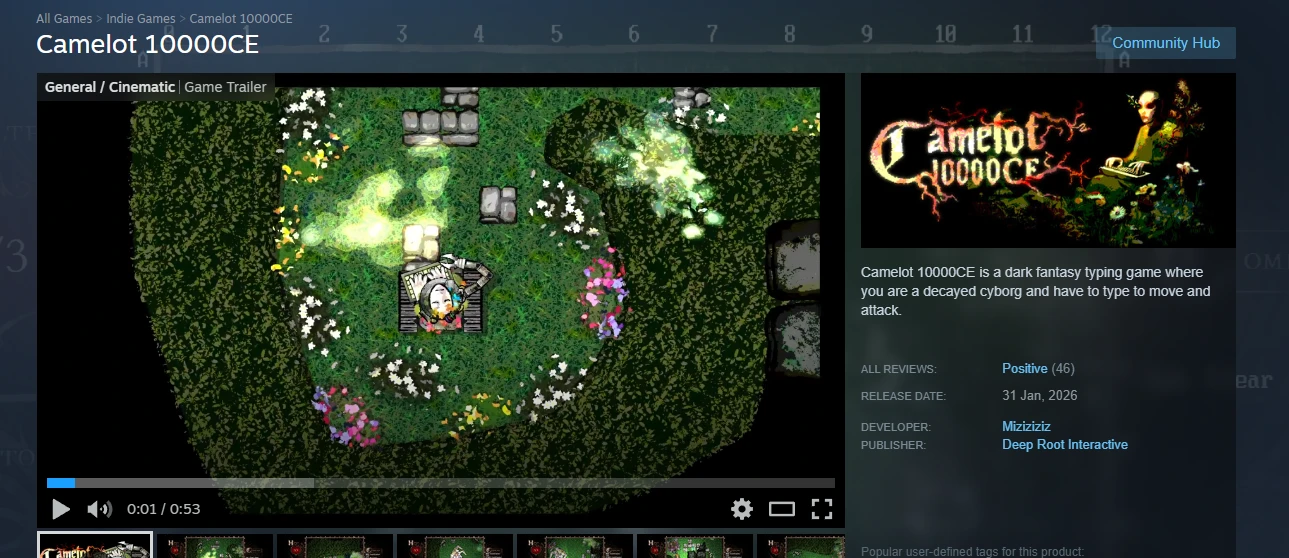
@"" 1. Anchor 3, C, extend the 3D shader first. 2. This is the hardest question, I'll get back to it. 3. A. 4. C, we can add pickups later if it feels bad. 5. A. 6. A, discrete health too, like hearts, not 100/100. 7. A. 8. Let's discuss this a bit, I actually wanted to say, is there a way to make him a bit cuter? We might be able to use some of the work we did in the Go Forth, My Unstoppable Machine, since we trained some voices there, although those are Japanese, but maybe we can learn something. I think that would be too far probably, we can probably go simpler, but I do want him to be a bit cuter, we can iterate on this. 9. A, Full handover at the end, but you may ask me questions and iterate (like with the voice) while Astra builds too, I'm going to be on the computer doing other tasks so it's fine to ask me questions. 10. Desktop only for now.
Now for the name... This perhaps requires a little lore discussion. I'm imagining the main character as a fair-skinned, long-haired (very long), perhaps brown or yellow long hair, gem in the middle of his forehead, construct always floating by his side. He wears long robes, perhaps thin, silky, he should be twinky. Picture is a good reference, but the robes should be more revealing/silky and covering less of his body. Less of angelic image and more of a, broken down angelic image, the way to imagine his pose is like sitting with one leg crossed behind the other and both legs to the same side, as though he were waiting for someone on a bed, that's how his body stays as he can't move most of it and must use telekinesis to move the piece of whatever material he stands on as he floats. Inspiration is VERY LIGHTLY the character from this game, very lightly, just the concept itself of a paraplegic main character seems cool to me. As for the lore... There should be some well developed magic system in Z: for a story we were working on, it was a detective story and the mana system there was a bit involved, I don't think we need to use it. What I want for this game is that there perhaps are types of magic, the magic of his kingdom is light magic, which allows them to manipulate light in various ways, which is why he can take pictures with the gem. For one reason or another, he lost the ability to move, maybe he was a prodigy fighter and got into an accident, whatever the case may be, as soon as that happened, he started developing a light form of telekinesis. This is extremely uncommon and unheard of in his world, because if everyone had magic like this and developed it they could kill each other easily (Shin Sekai Yori premise), so his form is very light indeed, which also makes sense because if it was strong he could just defend himself from monsters easily, but he can't. In general it's possible I want this to be a low magic world, where magic exists and the world is ordered around it, but where the feats people can achieve with it are in general lower than what happens in most stories, I don't know. In any case, do you remember the Cradle reference? What were the LLM-like companions that the main character gets in Book 5 called? I want his Pokedex-like companion to be something like that.
[Think]
I'm recalling that in Ghostwater, Book 5 of Cradle, Lindon acquires Dross, the mind-spirit companion — distinct from "Presences," which are the constructs held by higher-tier figures like Sages, Heralds, and Monarchs.

For the cuter voice question, I'm thinking about practical options: SAPI voices like Zira pitched up, David with softer processing, or trying to install Piper TTS locally for better neural voices, then lightly robotizing the output. Rather than pursuing a full fine-tuning pipeline, I'll just generate a few quick variants now for him to react to and iterate on while other work runs in parallel.

For the anchor decision, extending the 3D shader with point lights is really an engine-level change, which means it falls under the engine's own governance and needs a proper design brief since it's non-trivial and touches both the site's wasm build and the Horse Game's tracked executable. The question is who implements it — following the usual doctrine of brief-then-implement, I'm considering whether this should be folded in as an early milestone of Astra's run rather than a separate track.

Given the emphasis on long autonomous runs and not sweating details, I'll write a compact packet covering direction, fixed decisions, milestone plan, and framing, leaving specifics to Astra, then share that outline for review before launching—including the point-light engine change. Separately, he wants a lore discussion around the companion character, so I should engage on the name and aesthetic details he described.

I'm thinking through the world's premise: a reverse Shin Sekai Yori setup where telekinesis is nearly nonexistent and his character's is unusually weak, set in a light-magic kingdom. I'm connecting light magic to photography as a concept—illusions, signal-lenses, and "fixing" light onto surfaces—and tying that into how cryptozoology might work in this world, where capturing an unseen creature's image becomes a kind of magical act.

I'm sketching why he ventures into dungeons despite being a former combat prodigy who lost his fighting ability, now reduced to only "fixing light," alongside a Dross-like floating construct made of the same magic that catalogues everything and acts as a chatty companion. I'm also weighing whether his telekinesis would make him feared if discovered, and whether he disguises it as ordinary light-magic levitation to stay hidden.

Now I'm brainstorming names tied to light, fixing, and evidence — testing options like Fixlight, Lightfast, Afterimage, Daguerre, and Halation, leaning toward Lightfast or Halation for their double meaning of photographic fixing and something angelic or broken.

I'm also considering Camera Lucida, Lucida, and Heliograph (from Niépce's early "sun-writing" photography), which fits a light-magic kingdom especially well. I'll present a shortlist — probably Halation, Heliograph, Lightfast, and Lucida — with reasoning, letting him pick.

Separately, for the constructs question, I'm fairly confident the answer is Dross, tied to the "Presence" class in Cradle from Ghostwater.

I'm also noting the discrete-hearts point and the limited-film constraint, then planning to draft the point-light engine extension brief for Astra as part of my reply — sketching an API for setting up to eight point lights with position, color, and radius parameters to reduce back-and-forth.

Per-vertex Gouraud lighting fits the PS1 aesthetic better than per-fragment, so flash effects become transient point lights at the camera position with radius falloff, layered on top of the existing directional light. For dark/lit contrast, I'm thinking low global ambient plus localized point lights plus sun-shaft billboards, while directional light stays global for sunlit rooms versus dark corridors.

I'll cap point lights at 16, letting the game pick the nearest per frame — sufficient for a dungeon scene. I need to touch anchor.c's layer3 shader, uniforms, and Lua bindings, then update 3D_API.md and ENGINE_API_QUICK docs, verify with build.bat and check.sh, and refresh anchor.exe for Horse Game; also need to keep shaders GLSL ES compatible since they compile at runtime on web. I'll present this as the brief and let him veto before proceeding.

Before composing that reply though, I should generate the voice variants first — one with Zira pitched up with light chorus and a wider bandpass filter, one with David pitched higher for a chipmunk-robot tremolo effect, and one with Zira using subtle vibrato and echo for a softer Pokedex-like tone, using SSML prosody tags to control pitch via SpeakSsml.
Answers logged: Anchor 3 with the shader extension first, wall-float levitation, limited film with no pickups, same-entrance exit with photos banked on exit, hearts, grades at exit only, desktop only, full handover at the end with questions in between. Two things to answer now and one to discuss: the Cradle name, cuter voice variants, and the lore and title.
The Cradle companion is Dross. Book 5 is Ghostwater, and that is where Lindon picks him up: a mind-spirit born from a failed construct in Northstrider's research facility, who lives in Lindon's head, talks constantly, remembers everything, runs simulations, and is anxious and vain and funny. The general class in that world is a Presence, which every Sage and Monarch has, an artificial mind that answers questions and manages knowledge, and Dross is the one that came out with a personality. Your instinct is exactly the Dross half, not the Presence half: a catalogue that is also a character, a little pleased with itself, occasionally wrong, and attached to him.
Let me make some cuter voice variants before the lore, so you can listen while reading.
Bash (S="C:/Users/a327e/AppData/Local/Temp/claude/C--Users-a327e-Desktop-a327ex/9d73ea...)
SendUserFile (C:/Users/a327e/AppData/Local/Temp/claude/C--Users-a327e-Desktop-a327ex/9d73eaac-ffb0-4035-90e5-c1edd...)
[Think]
I'm pulling together the lore/name discussion, the point-light engine brief, and the packet outline into my reply. On voice, I want to note that the two SAPI voices are the current ceiling, and if that stays too flat, Piper (offline neural TTS with many voices, installable at Desktop/tools/piper) is the natural next step up—while the Unstoppable Machine voices are too much of a stretch for now.

Diving into the lore itself: framing the photograph as "fixed light" makes sense in a low-magic world where capturing light is a craft rather than magic, and the buyers become an academy of natural philosophers seeking evidence of creatures nobody dares approach. For the prodigy-fighter-turned-telekinetic, I want to tie his accident directly to light magic's ceiling—he broke himself pushing past it, which explains both his weak, hidden telekinesis and why his floating slab passes off as an enchanted litter rather than exposed magic, echoing that Shin Sekai Yori tension where revealing his power would shatter the kingdom's order. And the reason a crippled man does this dangerous job is simple: fighters scare the creatures away and scholars die trying, so a silent, floating man who can't fight becomes the only viable option.

The construct itself I'm framing as a light-magic archive, basically the kingdom's catalogue made portable and given to him since he can't carry books—it doubles as the only voice in the dungeon and can signal danger by going quiet when it encounters something uncatalogued. For naming, I'm proposing Halation as the recommendation alongside Heliograph, Lightfast, Latent, and Lucida, letting him choose since the repo basename will follow suit. After this I need to lay out the engine extension brief for point lights and the Astra packet outline, then close by asking for his name choice and approval on both, keeping the whole message organized with no more than three headers despite its length.
On the voice: the two SAPI voices are the ceiling of what Windows ships, and the three variants are what processing can do with them. If none is cute enough, the next step that is not "too far" is Piper, a free offline neural TTS with dozens of English voices, installed under Desktop/tools/piper, then the same robot chain on top. The Unstoppable Machine voices are Japanese and fine-tuned for a different thing; what transfers from that work is the pipeline shape, lines in a text file, a script that renders them, not the voices. Tell me which of the three is closest and what is wrong with it and I will iterate while Astra builds.
Lore and title
Your setup already has the load-bearing piece: light magic is why a gem can take a picture. In a low-magic world, "fixing light onto a surface" is a craft the kingdom has, not a miracle, and that is what makes the money framing honest. Someone pays for fixed light of creatures because nobody else can get close enough to draw them. A natural-philosophy academy or a royal bestiary office buys evidence of behavior, and the price rises with what the picture shows. That is Recettear's other half in seed form and needs no more than a results screen for now.
The accident and the telekinesis fit together if the accident is the ceiling of light magic itself: a prodigy who pushed past what the magic is supposed to do and paid with his body, and what came back with him is the thing the world says cannot exist. Shin Sekai Yori's premise then gives the lore its tension for free. If anyone learned that his light can move matter, the order of the kingdom breaks, so the floating slab passes as an enchanted litter, a rich invalid's conveyance, and only the construct knows. The game never has to say this out loud; it explains why his levitation is weak, why he cannot fight, and why he hides. It also answers the question a player will ask, why a man who cannot move does the most dangerous job: fighters scare the creatures and scholars die, and a silent floating thing that cannot threaten anything is the only one the creatures ignore long enough. His old life as a fighter is why he can read them.
The construct is the kingdom's catalogue made portable, given to him because he cannot carry books, and it is a Dross: it talks, it remembers, it is a little proud of what it knows and audibly unsettled by what it does not. That last part is how the uncatalogued monster becomes a surprise without a quest marker. The one voice in the dungeon goes quiet.
Titles, all photographic terms that read as something else, since the game is about fixed light:
- Halation. The glow that bleeds around bright areas in a photograph, from halo. A broken angelic image in one word, and a real term nobody uses as a title. My recommendation.
- Heliograph. Niépce's name for the first photographs, "sun writing." Strong for a light-magic kingdom, a little formal.
- Lightfast. A pigment's resistance to fading; also reads as fixed light and as a fast made of light. Plainer, very clean.
- Latent. The latent image, the picture that exists on the film before it is developed. Fits a hidden power. Generic as a word.
- Lucida. From camera lucida, the "lit chamber" artists drew through. Pretty, soft, less specific.
The repo basename is the name, so this decides the anchor new path too. Visibility is yours as well; given the shape of the work I would guess private, but I will not assume.
The engine extension, as a brief
Point lights in the 3D layer, before anything else, since darkness, sunlit patches and the flash all depend on it.
Approach. The 3D layer gains a small array of point lights that add to the existing directional-plus-ambient Lambert term. Each light is a position, a color and a radius, with a smooth falloff to zero at the radius. Lighting stays per-vertex, which is what the PS1 did and which keeps the chunky look consistent with the jitter and affine warp; per-fragment would look too modern next to them. A cap of sixteen lights per layer; the game sets the nearest ones each frame, so a dungeon can hold more than sixteen sources. The flash is nothing special at the engine level: a bright short-lived point light at the camera that the game fades over a few frames. Dark corridors are low ambient with no lights nearby; the lake room is a few large warm lights under the openings, with additive billboards for the visible rays.
Interfaces. Two bindings on the layer, one to set a light by index (position, color, radius) and one to clear them, plus the uniform arrays in the layer's mesh shader and a count uniform. Billboards and lines are not lit and stay as they are. Docs updated in 3D_API.md and ENGINE_API_QUICK.md, with the per-vertex choice stated.
Verification. Desktop build, the replay byte-compare, and a scene in the playground with a handful of lights so the orientation and falloff can be seen in a snapshot. Then refresh Horse Game's tracked executable, per the standing note. The GLSL stays ES-compatible so the web build does not break, even though we are not shipping web now.
Decisions. Per-vertex over per-fragment, for the reasons above. No spot lights: the flash and every dungeon source work as points, and a cone would only matter for a hand torch we do not have. No shadows. Sixteen as the cap, chosen as more than one room needs and cheap enough per vertex.
The packet, in outline
If you approve the brief above and give me a name, the packet for Astra carries: the direction statement from this session; the fixed decisions from your list; the engine extension as milestone zero under the engine's own rules; then the game in three milestones, the hover controller and PS1 layer with an authored blockout of the cave, the creatures with behaviors and the construct with its voice, and the photo system with grading, film, the entrance-to-entrance loop, hearts, death and the results screen; then an art and sound pass that re-authors the creature construction approach from the Simple Retro 3D set in Lua. It carries the frame: read SURFACE.md, 3D_API.md and the gotchas before code, no writes outside the project and the engine's 3D files, stop and report on any high-level choice the packet did not make, no network use beyond the docs, and the voice lines rendered by a script from a text file so we can swap the voice later without touching the game. It states that creature count, danger types, dungeon size and all tuning are Astra's to decide and report. My verification at each milestone is through the agent instance and snapshots. The full feel test is yours at the end.
What I need from you: a name and visibility, a yes or changes on the point-light brief, and a word on which voice variant is closest. Everything else is ready to launch.
Three cuter takes. 1: Zira pitched up, soft tremolo, tiny echo. 2: Zira faster and chirpier with chorus shimmer. 3: David pushed into a small-robot register with a ring-mod buzz. All offline SAPI plus ffmpeg.
dex_cute3 is the best, variations on that would be nice to hear.
"Halumi the Lightless"? will probably think of something better later. Perhaps you can think of something better than the Lightless, but I like "name the adjective" structure.
[Think]
I'm thinking through two directions: generating voice variants on cute3 with different pitch, tremolo, crush, and echo settings, plus SSML pitch/rate experiments. Separately, I'm considering the title "Halumi the Lightless" and brainstorming alternative epithets that tie more directly into his backstory as a light mage who lost his magic.

My favorites are "the Still" (photographic stillness, physical stillness, the lake) and "the Overexposed" (photography metaphor plus the burnout of a prodigy who pushed too far). I'm also noting the repo basename should stay simple like `halumi`, and that visibility and brief approval are both still pending since he hasn't responded yet. I'll generate the variants first.
Bash (S="C:/Users/a327e/AppData/Local/Temp/claude/C--Users-a327e-Desktop-a327ex/9d73ea...)
SendUserFile (C:/Users/a327e/AppData/Local/Temp/claude/C--Users-a327e-Desktop-a327ex/9d73eaac-ffb0-4035-90e5-c1edd...)
Five variations sent, all in the cute3 register.
On the title. "Halumi the Lightless" has the right shape, but the epithet says the wrong thing about him: he did not lose light, light is the one thing he kept. He lost the body. Epithets that say that, in the "name the adjective" structure, and the ones that double as photographic terms are the strongest:
- Halumi the Still. A still is a photograph; a still man; the still lake at the center of the cave. Three readings, one syllable, nothing to explain. My recommendation.
- Halumi the Overexposed. The prodigy who pushed past the ceiling and burned out. Photographic, and it tells the accident in one word. Longer, but the best joke in the set.
- Halumi the Unmoved. Both senses: cannot move, cannot be moved. Slightly stern for a twink.
- Halumi the Fixed. Fixed light and fixed in place. It also reads as "neutered," which may be a feature or a problem depending on how much you want to lean into him.
- Halumi the Latent. The image that exists before it is developed; the power he hides. Quieter.
- Halumi the Seated. Literal, oddly dignified, like a title from a court.
If none of these beat "the Lightless" for you, keep yours; the game can be named later, and the repo does not need the epithet. The basename only needs the name, so the path would be halumi either way.
Still needed to launch: visibility for anchor new (public, private or local), and a yes or changes on the point-light brief from my last message.
Five variations on cute3. a: cleaner and rounder, less buzz. b: higher and smaller. c: faster talker with a tiny echo. d: a touch deeper with a heavier machine buzz. e: soft vibrato instead of buzz, sing-song.
Yea, just name it halumi for now. cute3a wins, you may proceed with everything else.
[Think]
He named the project "halumi" but didn't specify visibility, and the rule requires me to use the visibility he explicitly names — I shouldn't assume one. Since he's available right now, it seems better to just ask him quickly rather than guess or block silently.
One gating item before I scaffold: the visibility flag for anchor new, which I am not allowed to pick for you.
AskUserQuestion (Visibility for anchor new halumi?)
Visibility for anchor new halumi?
- Private (Recommended): github.com/a327ex/halumi created private and pushed. Matches emojunky's setup; can be flipped public later on GitHub.
- Public: github.com/a327ex/halumi created public and pushed from the first commit.
- Local: No GitHub repo at all; git init only. Journal cards still work locally.
Private (Recommended)
[Think]
I need to scaffold the new project with `anchor new halumi --private` from the workspace root, checking that gh is available first. Then I'll write a small voice pipeline script that renders lines from a text file through the cute3a chain — straightforward enough that I can write it myself.

I'll write the actual rendering script directly into halumi/tools/voice/ after scaffolding, using a simple lines.txt format and a render.sh calling PowerShell TTS plus ffmpeg to produce ogg files, which becomes part of the frame handed off to Astra. I also need to draft the Astra packet covering direction, decisions, milestones, engine brief, and verification steps, including key paths like the character lookdev rounds and the meadow-anchor recipe reference, while confirming whether Astra's sandbox can read outside its working directory.

For the engine work, I'm figuring out that Astra's cwd needs to be the workspace root so it can write to both halumi/ and Anchor/engine/, using --cwd with the trusted root and letting the sandbox skip the git-repo check since it isn't a repo; the frame must explicitly restrict writes to only halumi/, the engine source, docs, and playground. I'm also noting the build and replay-check commands, and trying to recall where Horse Game's tracked anchor.exe lives so it can be refreshed after engine changes.

I'm also thinking through how the game gets launched — via `anchor halumi` or `anchor halumi --agent` — and how Astra verifies things through an agent instance without ever popping a visible window on the user's desktop, since the "never run interactively" rule for Fable likely extends here too. The known sound voice leak across the 512 agent slots seems like a non-issue. Finally, I'm considering that the `anchor delegate codex` command auto-registers, and since a codex run could take hours, I need to launch it in the background — checking whether background commands are exempt from the 10-minute bash timeout since they persist across turns.

I'll monitor the wrapper's events.jsonl and watch for report.md and run.json to update. I should verify how to invoke anchor from PowerShell, likely via python calling the script directly, and redirect output to a log in the scratchpad. I'll also break the run into milestones, asking Astra to stop after milestone 0 so I can verify progress before continuing.

Next steps: scaffold the directory structure, locate the Horse Game's anchor.exe path, confirm the PowerShell invocation pattern, and check that the character-lookdev paths exist before writing the voice tool and packet and launching the run.
[Think]
Setting up the scaffolding, and now tracking down three missing details: Horse Game's tracked executable location, how to invoke the delegate wrapper as a detached process (since a multi-hour run can't sit inside a tool timeout), and the exact character-lookdev files Astra needs to read.
Bash (cd C:/Users/a327e/Desktop/a327ex && ./Anchor/workflow/anchor new halumi --privat...)
Bash (cd C:/Users/a327e/Desktop/a327ex && echo ===== HORSE; find ABAgames -maxdepth 3 ...)
[Think]
I'm planning to write the voice tool into the tools directory with a render script and lines file format, then build the packet and launch it detached—should be straightforward since the chain's already tested. I'm also double-checking whether the `anchor <game>` command used by the engine is the same as the workflow CLI, since the surface spec shows it accepting a game or file with an optional agent flag—likely the CLI just dispatches to it.

I'll commit the voice tool myself once written, since this project's normal flow expects commits at milestones even though the general rule is to only commit when asked—this feels like an exception given the scaffolded build process. For the packet, I'll draft it in the scratchpad but also keep a persistent copy in the reference folder for the project record, since the delegate wrapper only copies the brief into the run directory.

The packet needs to cover the delegation frame (stop conditions, network/write restrictions, no engine changes beyond the stated extension), the direction statement, fixed decisions, brief lore for naming and lines, the Milestone 0 engine lighting brief with its verification step, then M1 through M4 with required contents and per-milestone commits, plus style guidance on internal resolution and character construction, the voice pipeline usage (editing lines.txt and running render), and the photo capture and scoring system—leaving the deeper scoring details to Astra.

I also need to spell out the creature spec at a direction level (relationships, flash reactions, the one lethal attacker, uncatalogued surprise, indirect dangers, and the lake room centerpiece), plus verification requirements: an anchor check, a smoke-test script that boots the game, scripts player movement, takes photos, and confirms album files and the results screen work. Then I should add reporting format expectations and a token budget note so the owner can track progress.

One thing I'm unsure about is whether spawning an anchor-drive process with a localhost socket is even permitted in this sandbox—workspace-write allows process spawning, but network access to a local socket might still get blocked.

I'll just tell Astra to try `anchor drive` first, and if the sandbox blocks the socket, note it in the report and run the drive checks myself while Astra relies on `anchor check` plus code review — that's good enough. I should also flag the sound slot leak in agent instances, confirm the hot-reload structure (main.lua for definitions, boot.lua for one-time setup, extra files required in from main), and let Astra decide the internal resolution scaling for that chunky PS1 look, rendering the 3D layer low-res and upscaling while keeping UI sharper.

For launching detached, I'll use PowerShell's Start-Process to run the Anchor delegate command with the codex tool, redirecting stdout/stderr to log files, then poll for report.md to appear — I'll look up the Monitor tool for that polling loop later. Now I'm moving on to writing the voice tool and packet files.
[Think]
Scaffold is set up: `halumi/` created, private repo pushed to github.com/a327ex/halumi, first commit made, and the journal registered. Next I'll build the voice tool myself since I've tested the chain, then move on to the packet and launch.
Bash (cd C:/Users/a327e/Desktop/a327ex/halumi && mkdir -p tools/voice assets/voice ref...)
[Think]
I'll write the packet to halumi/reference/first-pass-packet.md as a project record and brief, then launch it detached via PowerShell and load the Monitor tool to watch for report.md. I want the packet well-structured for Astra—substantial in content but not bloated.
Voice tool works and is committed. Now the packet; it doubles as the project's record at halumi/reference/first-pass-packet.md.
Write (C:\Users\a327e\Desktop\a327ex\halumi\reference\first-pass-packet.md)
[Think]
I'll commit the packet into halumi and launch the detached codex delegate process via PowerShell in the same Bash call, then separately search for a monitor tool to watch for report.md.
Bash (cd C:/Users/a327e/Desktop/a327ex/halumi && git add reference/first-pass-packet.m...)
[Think]
The issue is that Start-Process's ArgumentList joins array elements with spaces without preserving quoting, so the title with spaces got split apart. I need to wrap the title in escaped double quotes within the argument string and retry, while also loading the Monitor tool in parallel.
Delegated run: halumi first pass: dungeon, creatures, camera, loop (to Astra, 4 turns)
Bash (cd C:/Users/a327e/Desktop/a327ex && S="C:/Users/a327e/AppData/Local/Temp/claude/...)
[Think]
The run is live now with Astra reading the scaffold, so I should set up monitoring for report.md to appear as the M0 stop signal. I also want to capture memory notes about this new halumi project since the run details, decisions, and voice pick aren't derivable from the repo alone — I'll write a memory file and add a MEMORY.md line while searching for the Monitor tool.
Astra's run is live and reading the scaffold. Two independent things now: a watch on the run folder for the milestone 0 report, and a memory note for the new project.
ToolSearch (select:Monitor)
[Think]
Rather than a single notification, I should use a background Bash process with a wait loop checking for report.md, since background commands persist across turns and can re-invoke me on exit. I'll set up a Monitor with a 30 minute window that re-arms if it expires, since foreground timeouts cap around 10 minutes but background tasks have run closer to 5 minutes safely before.

Every 30 seconds it'll check if report.md exists (print and exit) or if the codex process has died via ps -W checking for codex.exe, printing "codex process gone" if neither condition holds. I also need to write the memory file alongside this monitor setup.
Monitor ({"command": "R=\"C:/Users/a327e/Desktop/a327ex/Anchor/workflow/delegate/runs/20260914-halumi-first-pass\"; while true...)
Write ([memory: sealed target])
Bash ([memory: sealed target])
Everything is launched and recorded. Status for you:
- Project:
halumi/scaffolded withanchor new --private, repo at github.com/a327ex/halumi, journal registered. Two commits on top of the scaffold: the voice pipeline and the packet. - Voice: render.sh renders lines.txt into
assets/voice/*.oggwith the cute3a chain (David, pitch +45%, the tremolo and crush settings you chose). Astra writes the lines and runs the script; the chain itself is locked to your pick. - Packet: first-pass-packet.md. The frame (what it may write, no visible windows, stop-and-report conditions), the direction, all of today's fixed decisions, the lore in a short form for the construct's lines, and five milestones: M0 the engine point lights (then it stops so I can verify, commit the engine, and refresh Horse Game's executable), M1 the hover body and the lit blockout of the cave, M2 the creatures and the construct, M3 the camera and the enter-to-exit loop with a smoke test I can run too, M4 the art and sound pass.
- Astra: running now at xhigh as run
20260914-halumi-first-pass, detached from this session so it can go for hours. It began by reading the scaffold. A watch on the run folder tells me when the milestone 0 report lands or if the process dies; I re-arm it every half hour.
While it builds, the only thing I need from you is the budget signal: tell me when your Astra usage approaches the line and I will stop it at the next milestone. I will also come back with questions as they arise, the way the voice went.
[task notification]
Bash (cd C:/Users/a327e/Desktop/a327ex && cat Anchor/workflow/delegate/runs/20260914-h...)
[Think]
I notice a contradiction: I described the lighting as per-vertex, but the actual engine uses per-fragment Lambert plus ambient. This is a small correction I can make myself since it only affects visual style, not the existing games' shading, so I'll adjust toward per-fragment point lights.

Going with per-fragment lighting, consistent with the existing pipeline, since the low internal resolution already gives it a chunky PS1-like look without needing true per-vertex authenticity. I'll note this as a one-line delta to the owner rather than stopping work, then send a detached follow-up to Astra to continue M0 implementation with per-fragment lighting, and re-arm the monitor to watch for report-2.md.
[Think]
Astra correctly flagged that the engine's lighting is per-fragment, not per-vertex as the brief assumed, so I'll add point lights per-fragment to the existing term rather than mixing pipelines—relying on low internal resolution and jitter for the PS1 look. Sending this follow-up and re-arming the watch.
Bash (cd C:/Users/a327e/Desktop/a327ex && S="C:/Users/a327e/AppData/Local/Temp/claude/...)
Monitor ({"command": "R=\"C:/Users/a327e/Desktop/a327ex/Anchor/workflow/delegate/runs/20260914-halumi-first-pass\"; while true...)
Milestone 0 is back in progress under the corrected instruction. One decision of mine to flag for your veto: the point lights are per-fragment, matching the engine's existing lighting, instead of the per-vertex I had written in the brief. The engine was never per-vertex; my brief was wrong, and per-vertex would have meant either a mixed pipeline or a change to how every existing game renders. The PS1 chunkiness comes from the low-res layer and the jitter anyway.
Nothing else needs you right now. I'm watching the run folder for the retry report, and when it lands I will build the engine, run the replay check, look at the snapshot, commit, refresh Horse Game's executable, and release Astra into milestone 1.
[task notification]
Bash (cd C:/Users/a327e/Desktop/a327ex && cat Anchor/workflow/delegate/runs/20260914-h...)
[Think]
I should follow protocol here: check the report, review diff --stat, inspect the named files, then verify myself. Astra's bump of the APR replay format to v10 for lights is a bigger change than it sounds—it's a format version bump, not just a feature add, and I recall v7 established a content-addressed store with legacy packages frozen. I need to check the replay docs' versioning rules to see if this bump is acceptable, given older recordings apparently load fine with zero lights, and confirm whether determinism requirements are satisfied since lights are render-only.

The key question is whether replays record Lua state and re-execute it deterministically, or whether they capture the render command stream itself—the "160/160 frames identical" byte-compare and the note about moving lights recorded mid-run both point toward the replay capturing draw commands rather than replaying Lua, which would make the version bump necessary for correctness. I want to skim REPLAY.md to confirm the versioning is handled properly, check the anchor.c diff (107 lines) and the snapshot image, then do my own build/check.sh run to mechanically verify what Astra already tested.
Bash (cd C:/Users/a327e/Desktop/a327ex/Anchor && git diff -- engine/engine/src/anchor....)
[Think]
The diff looks solid overall, and bumping the replay format from v9 to v10 makes sense since render state per layer3 render needs recording, with backward compatibility handled properly. I'm checking one edge case: whether the rim_light change behaves correctly when there are no point lights, making sure diffuse still replicates the old banding behavior correctly.

Since the byte-compare is passing, I should run the build and verification myself rather than relying on Astra's earlier run — I'll kick off build.bat plus check.sh in the background since the VS 2026 build takes time, and view the snapshot image in parallel. After that I need to commit only the engine files (not the dirty workflow files), copy the fresh anchor.exe into Horse Game's anchor.exe location, send the "proceed M1" followup, and re-arm the monitor. For the untracked m0 test logs in playground, I'll move them into the run directory rather than committing them or leaving them as clutter, keeping tests/ and point_lights.lua as-is.
[Think]
The diff checks out: zero lights reduces to the original math, the replay format bump is needed since render state is recorded per frame, and old recordings still load fine with zero lights. Now running two independent checks — my own build plus a replay byte-compare — alongside the snapshot.
Bash (cd C:/Users/a327e/Desktop/a327ex/Anchor/engine/engine && ./build.bat 2>&1 | tail...)
Read (C:\Users\a327e\Desktop\a327ex\Anchor\engine\playground\replays\m0-overview-v3.png)
[Think]
The point lights look right in the snapshot—orange, blue, green falloffs overlapping nicely with rings. Since I touched anchor.c, the engine's CLAUDE.md says I should run the web build script, though I recall the emsdk build hasn't been verified on Windows since the move; still, the owner mentioned desktop only for now, so I'm weighing whether the web rebuild is actually necessary here.

I'll queue that web build in the background anyway to satisfy the rule, even if it fails due to emsdk setup issues. I also need to verify whether build.bat regenerates anchor.meta.lua and the API bindings the way build.sh does on Linux—if not, I'll need to manually run the gen_api.py script so the new declarations are visible to anchor check. Right now I'm prioritizing the grep check on build.bat and kicking off the web build in parallel, while the main build+check result is still pending; once that's done I'll handle committing engine files, copying the binary over, and following up with Astra.
[Think]
The snapshot matches the brief: three colored lights with overlapping falloff and radius rings visible. While the rebuild runs, I'll check two things separately—whether the Windows build regenerates the Lua declarations needed for `anchor check`, and whether the web engine build is required after changes to anchor.c.
Bash (cd C:/Users/a327e/Desktop/a327ex/Anchor/engine && grep -n -i "gen_api|meta.lua...)
[Think]
I notice build.bat isn't regenerating anchor.meta.lua/ENGINE_BINDINGS.md for the new binding, and the meta file is stale from September. Also there's no emcc available on this machine, so the web build can't run — I should flag that as a known issue. Next I need to run scripts/gen_api.py manually to regenerate the declarations, checking its usage first.
[Think]
The Windows build didn't regenerate declarations (new bindings missing from anchor.meta.lua), and the web engine build can't run since emsdk isn't installed on this machine—still an open item. I'll regenerate the declarations now while the rebuild finishes.
Bash (cd C:/Users/a327e/Desktop/a327ex/Anchor/engine && head -30 scripts/gen_api.py | ...)
Declarations regenerated; both new bindings are documented. Now waiting only on my own build and replay check before committing.
Bash (cat "C:/Users/a327e/AppData/Local/Temp/claude/C--Users-a327e-Desktop-a327ex/9d73...)
[Think]
Build succeeded with 160/160 matching on my side as well. Now I need to move the two m0 logs out of playground into the run directory, then commit the engine files with explicit paths covering the anchor source, docs, meta.lua, and playground main files.

I also need to check whether replays/ is gitignored and confirm the playground's anchor/ copy doesn't need the meta.lua since anchor check relies on framework's generated declarations. Then I should refresh Horse Game's anchor.exe by copying it into ABAgames/knightvspawns, and consider whether to let Astra proceed through M1-M3 with periodic reports rather than pausing for authorization at each step to reduce token churn.

I'll go with letting Astra run M1 through M3 sequentially, committing and writing report notes at each milestone, and I'll monitor progress via halumi's git commits plus report-3.md rather than requiring a stop at every stage. Time to execute steps 1-3 in one Bash call, then monitor.
[Think]
The rebuild passed with all 160 replay frames matching exactly. I'll commit the engine change, refresh Horse Game's executable, then run milestones 1-3 back to back for Astra, committing at each stop, halting only if a packet issue arises.
Bash (cd C:/Users/a327e/Desktop/a327ex/Anchor && R=workflow/delegate/runs/20260914-hal...)
Monitor ({"command": "R=\"C:/Users/a327e/Desktop/a327ex/Anchor/workflow/delegate/runs/20260914-halumi-first-pass\"; H=\"C:/Use...)
Milestone 0 is done and verified on both sides. Where things stand:
- Engine: point lights are in, committed to Anchor as one commit, per-fragment, sixteen per layer, with the replay format bumped to v10 so recordings carry the light state. Build clean, replay byte-compare identical on all 160 frames on my rebuild, the playground snapshot shows three colored lights with correct overlapping falloff. Astra's report claimed all of this and my run reproduced it. Declarations regenerated (the Windows build script does not run that step; noted). Horse Game's tracked executable refreshed.
- Not done, known: the web engine build cannot run on this machine because emsdk is not installed, which was already an open item from the move. Desktop only for this pass anyway.
- Astra: released into milestones 1 through 3 back to back, committing in
halumi/at each and reporting together at the end of milestone 3, stopping only on a packet stop condition. A watch reports each commit as it lands and the final report; I re-arm it every half hour.
Nothing needed from you now. When the M1 commit lands I will drive the blockout myself and take snapshots so you can see the cave before the creatures exist.
[task notification]
[Think]
With M1 committed, I need to be careful about drive conflicts—if Astra still has agent instances running during M1-M3, starting my own drive session on halumi could clash over the shared .drive directory, since Astra's stop-all-instances message only applied at M0.

To stay safe, I'll export the halumi tree at the M1 commit into a scratch directory and drive that isolated copy instead of the live one, making sure the scratch copy can still find the engine executable. Then I'll peek at the boot/main files from that export to find the player position variables and snapshot function so I can position the camera correctly before taking screenshots.
M1 landed. I'll drive it from an exported copy of that commit rather than the working tree, so I don't collide with Astra's own agent instances or catch it mid-edit.
Bash (cd C:/Users/a327e/Desktop/a327ex/halumi && git show --stat 2547fb9 | head -30 &&...)
[Think]
247 lines seems awfully small for a "hover controller and authored cave blockout" milestone, so I want to check the actual files—world.lua, controller.lua, tests/m1.lua, reference/milestones.md, and verification.lua—to see what's really there before I start driving it, since I'll need the API details for snapshot positions.
Bash (S="C:/Users/a327e/AppData/Local/Temp/claude/C--Users-a327e-Desktop-a327ex/9d73ea...)
[Think]
This is a small M1 blockout — an entrance passage, a lake room with shallows and a deep basin, a ramp up to a west vantage, and an alcove for the surprise moment. It's minimal though, missing the dark passages the brief called for since there's really just one entrance route.

Since the owner left the scale open, I'll flag this and revisit expansion at M3 review rather than guess now. Next step is to drive the scratch copy: start it, run the M1 test file which writes snapshots into the replay shots folder, then stop — all as one sequential command, followed by reading the resulting images.
[Think]
I've blocked out the level: an entrance passage, the lake room with shallows and a deep basin, a sloped west wall leading to a vantage point, and a screened alcove for the surprise element. Now I'll run Astra's M1 test on the exported copy to capture the three snapshots.
Bash (cd C:/Users/a327e/Desktop/a327ex && G="C:/Users/a327e/AppData/Local/Temp/claude/...)
Read (C:\Users\a327e\AppData\Local\Temp\claude\C--Users-a327e-Desktop-a327ex\9d73eaac-ffb0-4035-90e5-c1edd98799f9\scratchpad\halumi-m1\replays\shots\m1-entrance.png)
Read (C:\Users\a327e\AppData\Local\Temp\claude\C--Users-a327e-Desktop-a327ex\9d73eaac-ffb0-4035-90e5-c1edd98799f9\scratchpad\halumi-m1\replays\shots\m1-lake.png)
Read (C:\Users\a327e\AppData\Local\Temp\claude\C--Users-a327e-Desktop-a327ex\9d73eaac-ffb0-4035-90e5-c1edd97799f9\scratchpad\halumi-m1\replays\shots\m1-vantage.png)
Typo in the path; reading the vantage snapshot now.
Read (C:\Users\a327e\AppData\Local\Temp\claude\C--Users-a327e-Desktop-a327ex\9d73eaac-ffb0-4035-90e5-c1edd98799f9\scratchpad\halumi-m1\replays\shots\m1-vantage.png)
[Think]
Looking at the snapshots, the render stack seems solid overall—the PS1 look, jitter, palette quantization, fog, point lights, water texture, and faint sun shafts all read reasonably well for a blockout. My main concern is that the scene feels too dark, so the intended "sunlit lake room" mood isn't quite landing yet.

The dungeon itself also feels too small—just one corridor, one room, and an alcove—which won't let us properly test both dark passages (where flash matters) and the sunlit room the owner described. Since Codex followups are turn-based and I can't inject feedback mid-turn, I'll hold this note and raise it with Astra after M3, suggesting we expand the dungeon with darker branching passages.

For now there's nothing to do until the M1-M3 report lands; the monitor is armed with a 30-minute expiry and will re-arm. I'll deliver the frozen snapshot shots to the owner with a caption and my assessment, then wait.
The M1 blockout runs and passes its own test on my side. Sending you the three snapshots with my read.
SendUserFile (C:/Users/a327e/AppData/Local/Temp/claude/C--Users-a327e-Desktop-a327ex/9d73eaac-ffb0-4035-90e5-c1edd...)
My read of milestone 1, for you to react to or ignore while it builds:
- What works. The render stack is the right kind of thing: 320x180 3D under a 960x540 UI, jitter, affine warp, palette quantization, fog, and the new point lights doing real work as the warm lamps. The hover controller passes its own test through the real input path: entrance to lake, up the sloped west wall to a vantage six meters up, blocked by the sheer wall, and lift failing over the deep basin. Code is dense and clean, about 250 lines.
- Two concerns I will send after the M3 report, since the thread cannot take a message mid-turn. First, the dungeon is small: one passage, one room, one screened alcove. Your description had dark portions where flash matters and the sunlit room where it does not; one room cannot test both, so I will ask for at least a dark branch or two. Second, the lake room is not sunlit yet; it reads as a dim indoor pool, and the light shafts are faint rectangles. That is partly a milestone 4 art matter, but the room's brightness is a design fact (flash unnecessary there), so it needs to be true before creatures are placed under it.
Neither needs your answer now. The watch is armed for the next commit and the M1 to M3 report; I re-arm it every half hour.
Milestone 1 blockout, driven from the M1 commit: the entrance passage, the lake room from the near shore, and the lake from the west vantage after the controller floated up the sloped wall. Placeholder creature is the sphere-and-box on the shore.
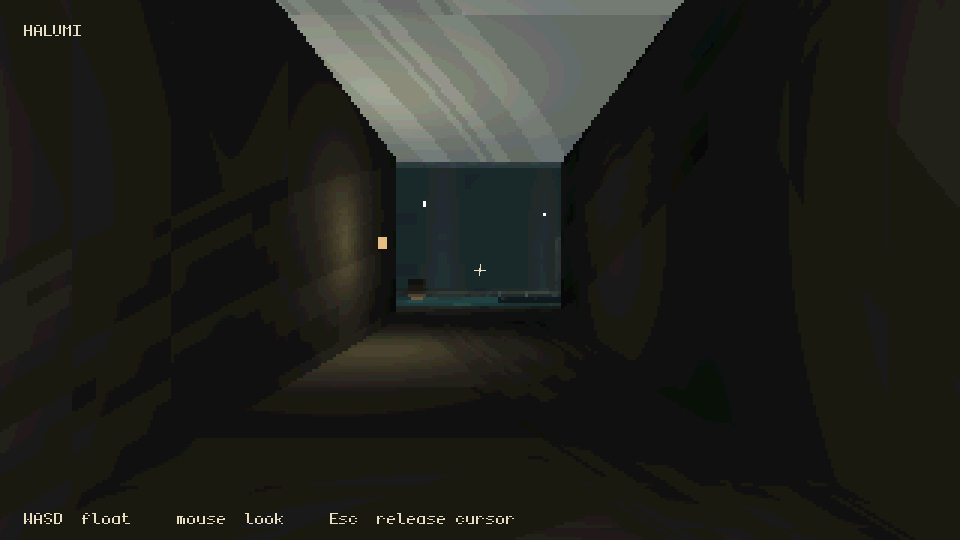
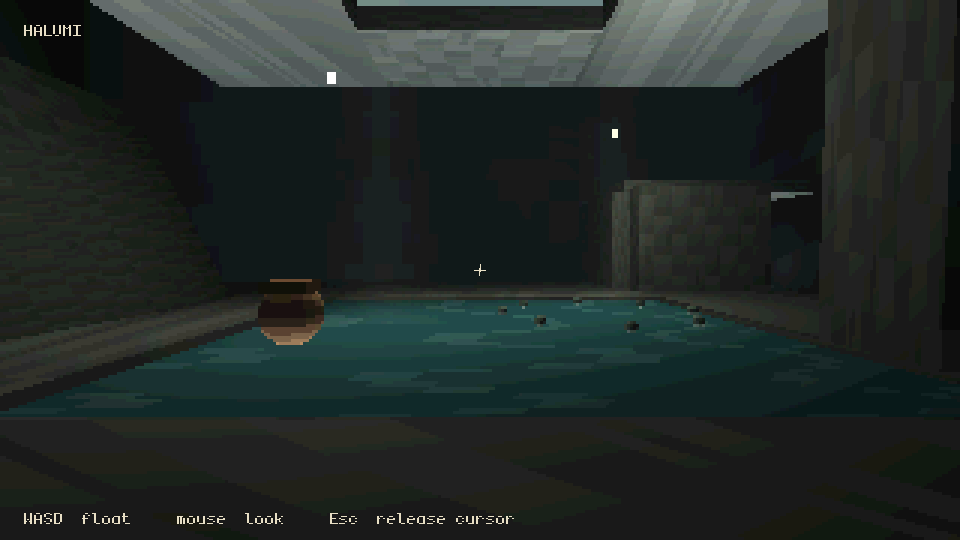
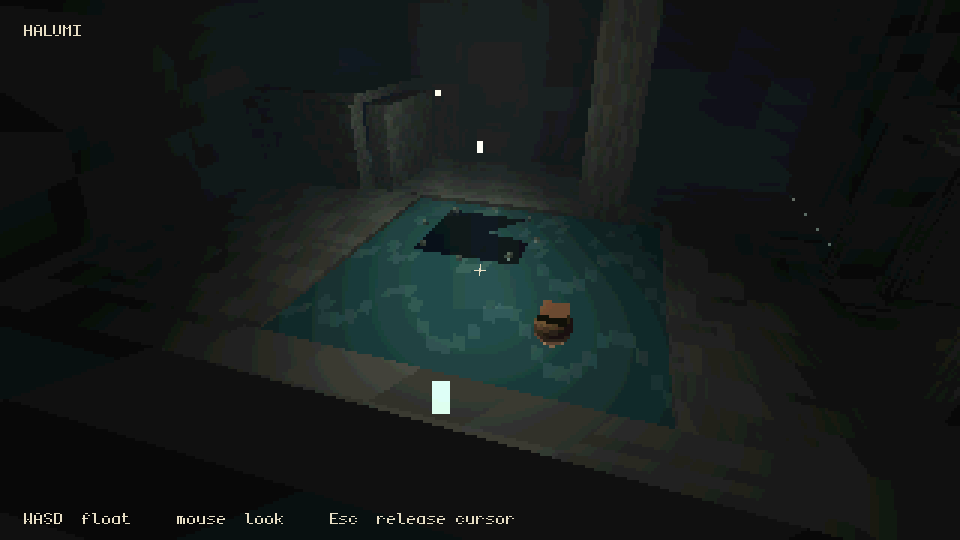
Code: halumi-old @ 9c19b73760 (11 files, +271 -61)
On top of your concerns, I would like the "dungeon" to be more natural looking and not so square.
[Think]
Noted the owner's request for a more natural, less square dungeon layout — I'll fold that into the post-M3 message. For achieving that organically, I'm thinking mesh3_create could generate irregular cave walls procedurally from authored control points, using noise-displaced walls or lathe-style tunnels with hull colliders, though I'll leave the specific approach up to Astra's judgment. I'll keep my reply brief.
Noted, and queued with the other two for the message after the M3 report: the cave should read as rock, not boxes. Irregular walls and floors built from control points with noise displacement, tunnel cross-sections that vary, stalactites and rubble breaking the silhouettes, with the physics hulls following the visible shape closely enough that the wall-float and line-of-sight stay honest. The engine supports it (arbitrary meshes from vertex arrays plus hull colliders); the box blockout was the fast path, and I will make the natural look a requirement rather than a polish item.
Nothing needed from you now. The watch is on the next commit and the M1 to M3 report.
Code: halumi-old @ 550dc1c19b (4 files, +318 -0)
Perhaps a mix of irregular and regular places would be nice, with the regular pieces being the actual dungeon that was built by an ancient civilization, and the rocks the portions of the cave that stick out, in some places more, in others less.
That is a better brief than "make it natural," and it fixes the lore too: an ancient built structure that the cave has grown back over. Masonry where the builders worked, stone where the mountain pushed through, the ratio varying room to room. Queued as the requirement for after the M3 report, worded so the built parts stay rectilinear on purpose (dressed blocks, steps, doorways, the alcove as a chamber someone made) and the rock is what breaks them, more in some places and less in others, with the lake room somewhere in between since it is where the builders' floor meets the water.
It also gives the flash and the creatures a natural pattern: the built corridors are the dark places, the collapsed ones are where the light gets in.
Still waiting on the run; nothing needed from you.
Code: halumi-old @ 2064aae4d5 (7 files, +53 -4)
[task notification]
[Think]
M2 is committed, and driving it now would give the owner an early look at creature designs, which is what he cares about most. Since the churn concern was about avoiding back-and-forth with Astra rather than with the game itself, I'll do a lighter verification: check milestones.md for M2 notes, look at the creature file names, and run its test to view a snapshot or two.
M2 landed: creatures, behavior tools and the construct. Exporting that commit and running its test for snapshots, keeping it lean.
Bash (cd C:/Users/a327e/Desktop/a327ex/halumi && git show --stat 7bc542f | sed -n 5,30...)
[Think]
I need to view the three snapshots with independent reads, then handle rendering the voice lines myself since SAPI failed in Astra's sandbox — I'll render into her working tree's assets/voice folder, since it should be fine to write there while she only reads them. I should also check the .gitignore change to see if it's excluding assets/voice or tools/.

Running render.sh in halumi/ now shouldn't conflict even if Astra's mid-commit, since adding untracked files won't break anything. I'll proceed with all four calls — three Reads plus the Bash render — since they're independent.
Bash (cd C:/Users/a327e/Desktop/a327ex/halumi && cat .gitignore && ./tools/voice/rende...)
Read (C:\Users\a327e\AppData\Local\Temp\claude\C--Users-a327e-Desktop-a327ex\9d73eaac-ffb0-4035-90e5-c1edd98799f9\scratchpad\halumi-m2\replays\shots\m2-lake-group.png)
Read (C:\Users\a327e\AppData\Local\Temp\claude\C--Users-a327e-Desktop-a327ex\9d73eaac-ffb0-4035-90e5-c1edd98799f9\scratchpad\halumi-m2\replays\shots\m2-construct.png)
Read (C:\Users\a327e\AppData\Local\Temp\claude\C--Users-a327e-Desktop-a327ex\9d73eaac-ffb0-4035-90e5-c1edd98799f9\scratchpad\halumi-m2\replays\shots\m2-feeding.png)
[Think]
I'm confirming the five creatures match the pack's ecology concept—grazer, attacker, mite that steals film, glarebell drawing attention, and the still-mysterious veilfin—though they're small and dim, so the art pass still needs work.

Room still reads too boxy; I'll flag that in my queued follow-up message, but the construct box itself is fine. For voice, the owner already picked a register, so I'll send one sample line (slatejaw) alongside the group snapshot—keeping deliverables lean with just one image and one audio file. Since the sandbox can't run SAPI, I'll note that Astra will draft more lines for M4 and render them at the end. Now I'm waiting on the M3 report, watching the monitor's arming window (it expires 30 minutes after start, so I may need to re-arm it soon), and delivering the current files.
SendUserFile (C:/Users/a327e/AppData/Local/Temp/claude/C--Users-a327e-Desktop-a327ex/9d73eaac-ffb0-4035-90e5-c1edd...)
Milestone 2 in brief:
- Roster, five species and thirteen individuals, with an ecology rather than a list. Cupcap, a solemn little grazer that carries Glarebell pollen (five of them). Slatejaw, the one attacker, hunts Cupcaps and opens its jaws before it lunges, so the kill is telegraphed. Spoolmite follows the grazers, flees the Slatejaw, and eats unused film, the first indirect danger. Glarebell's glare draws the Slatejaw and its light closes when you look away; flashing it is "an invitation." Veilfin is the uncatalogued one, hidden in the alcove, watching the mites and echoing the nearby bell; the construct's only line for it is "I... do not have an entry for this one."
- Tools: pebbles for noise, five food portions to throw, a steady light you can toggle. Flash, noise, food and approach reactions exist for every species; the film theft and hearts connect in M3.
- Verified on my side: its test passes on the exported commit (population counts, aimed consultation, thrown food landing, every flash reaction), three snapshots.
- Voice: Astra's sandbox could not reach Windows speech, so I rendered the five lines here. They are in
assets/voice/, untracked so far; the game loads them by id.
The three queued notes stand, and the snapshots confirm them: the scene is too dark to read the creatures, the room is a box, and the sunlit room is not sunlit. All three go in the message after the M3 report, together with your built-versus-rock brief.
Milestone 2: the lake group (Cupcaps grazing, Glarebells on the shore, the Slatejaw at left, a Spoolmite by the pillar) and the construct's Slatejaw line in the chosen voice.
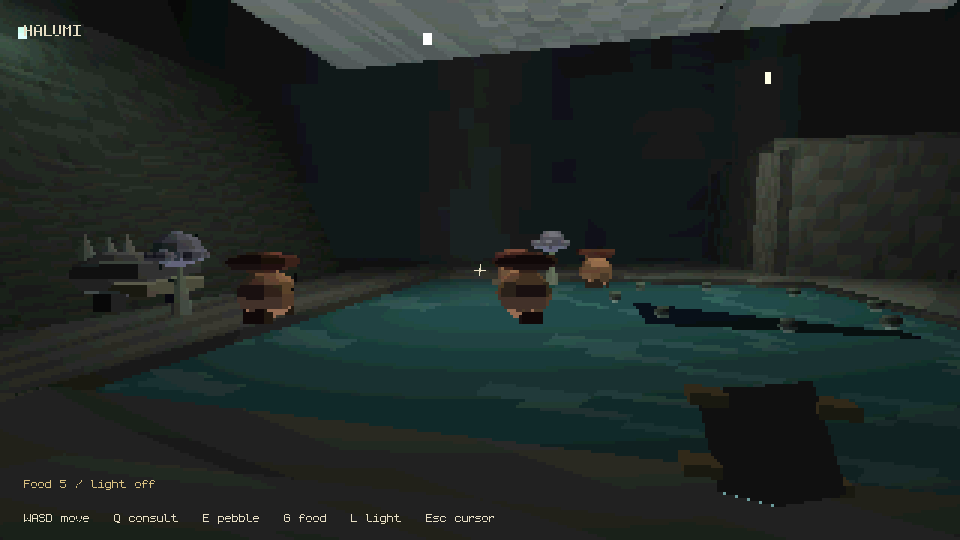
Code: halumi-old @ f72a5e9248 (5 files, +0 -0)
[task notification]
Monitor ({"command": "R=\"C:/Users/a327e/Desktop/a327ex/Anchor/workflow/delegate/runs/20260914-halumi-first-pass\"; H=\"C:/Use...)
Watch re-armed for the M3 commit and the report. Astra is in milestone 3, the camera and the loop. Nothing needed from you.
[task notification]
M3 is committed; the report should follow within the same turn. I'll wait for it before driving the loop, so I review the code and the report together.
Code: halumi-old @ 010cbaeac3 (1 file, +56 -0)
[task notification]
Bash (cd C:/Users/a327e/Desktop/a327ex && cat Anchor/workflow/delegate/runs/20260914-h...)
[Think]
The loop's done now, and with the working tree clean and Astra's turn over, I can actually run the smoke test directly — executing smoke.lua and checking results.png alongside an album photo. Then I need to draft the M4 follow-up covering the queued notes: a larger dungeon with dark branches, the built-vs-rock brief, the sunlit lake room, brightness/readability concerns, plus the M4 art items.

I should decide whether to skim camera_game.lua too, but 197 lines feels like too much token spend when the report is already coherent and tests are passing — I'll just trust the smoke test output and look at the results screenshot instead.
[Think]
The loop's finished: 18 film leaves, 3 hearts, instant photos with frustum/raycast visibility, PNG albums, grades applied only at extraction, and album clearing on death. Now I'll run the smoke test myself on the working tree since Astra's turn is done.
Bash (cd C:/Users/a327e/Desktop/a327ex && ./Anchor/workflow/anchor drive start halumi ...)
Read (C:\Users\a327e\Desktop\a327ex\halumi\albums\20260914-211652-002\results.png)
Read (C:\Users\a327e\Desktop\a327ex\halumi\albums\20260914-211652-002\plate-03.png)
[Think]
The loop is working end-to-end now, with the results screen showing crowns, best plate per species, and group multiplier. I'm shifting to draft the M4 follow-up, starting with direction-level notes on expanding the dungeon—making it larger with dark branches where flash matters, a genuinely sunlit lake room, and a brief establishing it as built by an ancient civilization.

Beyond that I'm laying out priorities: readability fixes so creatures pop against the PS1 palette even in dark corridors, lighting treated as part of the art pass, and pushing creature/construct art and sound up to Simple Retro 3D quality since they're currently dim blobs. I want to keep Astra writing dialogue lines to lines.txt while I handle rendering, keep the test loop intact while extending smoke tests to cover new geometry, and preserve the same stop conditions with a final report — while noting a title screen wasn't actually requested.

On sounds specifically: the rule against Astra picking sound files is really about not sourcing from packs, not about synthesis. So I'll direct Astra to avoid downloaded audio entirely — either generate simple placeholder tones procedurally if the engine allows it, or wire sound call sites with clear placeholder IDs and log the needed assets in a reference file for the owner to fill in later.

Next I need to send the follow-up write command detached, re-arm the monitor for report-4 right after (since it depends on that launch), and separately deliver the results screen with the M3 status update to the owner. I'll do all three now.
[Think]
The full loop works end-to-end: entrance, lake, flash and food, wall climb, vantage photo, and exit, with grading producing 763 crowns from three plates. Next up is M4 — covering the built-vs-rock dungeon, size/dark branches, real sunlight in the lake room, readability, then art and sound.
Bash (cd C:/Users/a327e/Desktop/a327ex && S="C:/Users/a327e/AppData/Local/Temp/claude/...)
Monitor ({"command": "R=\"C:/Users/a327e/Desktop/a327ex/Anchor/workflow/delegate/runs/20260914-halumi-first-pass\"; H=\"C:/Use...)
SendUserFile (C:/Users/a327e/Desktop/a327ex/halumi/albums/20260914-211652-002/results.png)
Milestone 3 verified and the final leg is running. Status:
- The loop is real. From my own drive of the working tree: eighteen film leaves, three hearts, instant photos with frustum plus raycast visibility, each plate saved as a PNG with a manifest of who is in it and what they were doing, flash consuming film and disturbing the room, the wall climb to the vantage, the same entrance as exit, and a results screen that pays only the best plate per species with a group multiplier. Astra's hazard tests cover the three-hit death, the album loss on death, film theft by the mites, the warned drowning, the alcove discovery, photographing the unknown, glare recovery and film exhaustion. Its recorded playback was byte-identical on 60 frames.
- Sent to Astra as the last leg, in this order: the dungeon as a built place the cave grew back over (masonry rectilinear on purpose, rock intruding more in some places and less in others, hulls following the visible shape), a bigger layout with two or three dark branches off the route and the entrance as the only exit, the lake room genuinely sunlit and everything readable in the palette without raising ambient everywhere, then the art pass on creatures, textures, the construct and the shafts. Sounds are wired by id with a list for you to pick in
reference/sounds.md, and any placeholders it synthesizes are marked as such; no downloads. New voice lines go tolines.txtand I render them. - Watch armed for the two commits (geometry, then art) and the final report.
When the report lands I will drive it, take the snapshots, render any new lines, run anchor check, and hand over with test instructions. That is the full handover you asked for.
Milestone 3: the results screen after my own smoke run. Three plates, best plate per species paid, a group multiplier on the seven-subject plate, 763 crowns banked.
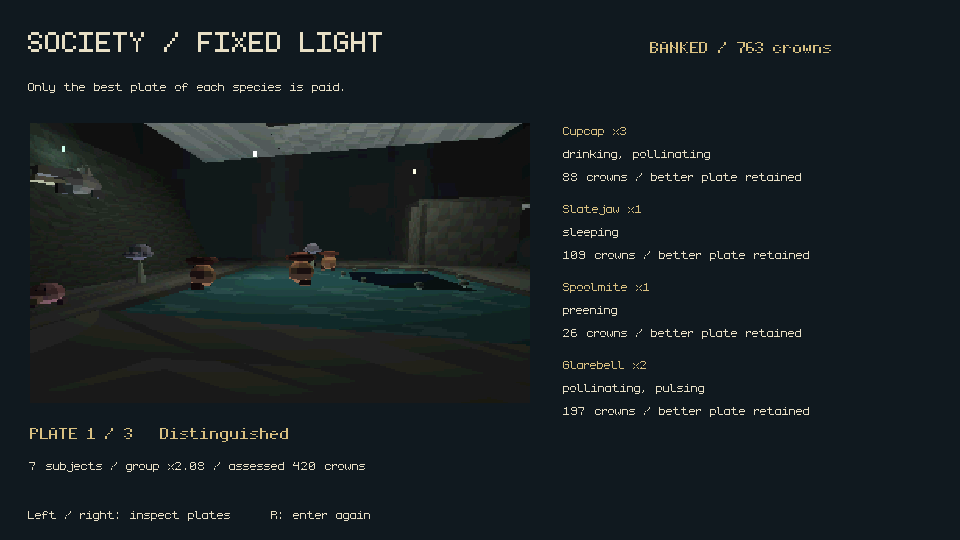
[task notification]
[Think]
With the geometry rework committed, I'm considering pulling a couple of quick snapshots from the smoke test to verify the built-vs-rock, sunlit direction before the art pass spends tokens on potentially wrong geometry. Since the thread is occupied with the art pass and I can't redirect Astra until report-4 anyway, checking now would only inform me rather than let me course-correct mid-turn, but it still seems worth doing as prep.
Geometry rework landed. Astra is already into the art pass and the thread cannot take a message mid-turn, but a look now tells me whether the geometry direction is right before the final report. Lean check: export, smoke, two snapshots.
Bash (cd C:/Users/a327e/Desktop/a327ex/halumi && git show --stat 23f3b47 | sed -n 5,20...)
Read (C:\Users\a327e\AppData\Local\Temp\claude\C--Users-a327e-Desktop-a327ex\9d73eaac-ffb0-4035-90e5-c1edd98799f9\scratchpad\halumi-g\replays\shots\m4-lake-shore.png)
Read (C:\Users\a327e\AppData\Local\Temp\claude\C--Users-a327e-Desktop-a327ex\9d73eaac-ffb0-4035-90e5-c1edd98799f9\scratchpad\halumi-g\replays\shots\m4-dark-branch.png)
Read (C:\Users\a327e\AppData\Local\Temp\claude\C--Users-a327e-Desktop-a327ex\9d73eaac-ffb0-4035-90e5-c1edd98799f9\scratchpad\halumi-g\albums\20260914-213237-002\vantage.png)
Bash (cat "C:/Users/a327e/AppData/Local/Temp/claude/C--Users-a327e-Desktop-a327ex/9d73...)
[Think]
This geometry rework feels like a solid improvement—the sunlit lake room now has a colonnade, doorway, rock intrusions, a beam, tiled floor, and readable creatures, with the dark branch feeling appropriately dim with its sconce and the vantage point looking great. The 48x60m layout with archive, cistern, lower chamber, dark gallery, and northern chamber is coming together well, so I'll move forward with delivering the lake-shore and vantage sections.

I should send those snapshots to the owner as progress, then wait for the final report, keeping in mind the results screen will update with the new art and that the export's album folder is disposable.
[Think]
This is a strong step forward — masonry, lintels, a colonnade, a doorway with rock breaking through, a beam over light-filled voids, tiled flooring meeting the water, and the creatures now clearly visible. Sending two frames.
SendUserFile (C:/Users/a327e/AppData/Local/Temp/claude/C--Users-a327e-Desktop-a327ex/9d73eaac-ffb0-4035-90e5-c1edd...)
The rework does what your brief asked: the built parts are rectilinear on purpose, the rock intrudes unevenly, the lake room is lit from above, and the dark archive branch is dark with a single sconce and the gem's short reading light. Smoke still passes on my drive of that commit, through the archive, the lake, the vantage and the same entrance. Astra is in the art and sound pass now; the watch will report its commit and the final report, and then I run the handover checks.
Geometry rework, before the art pass: the sunlit lake room from the shore (Slatejaw center, Cupcaps drinking, a Glarebell at left, the construct floating at right) and the same room from the west vantage. Sanctuary is now about 48 by 60 meters with an archive, a cistern, a dark gallery and a northern chamber off the spine.
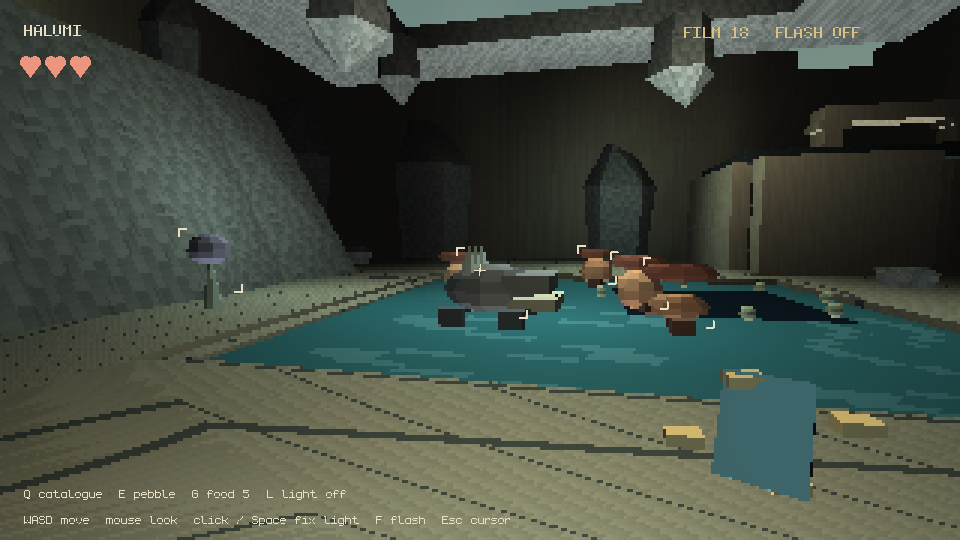
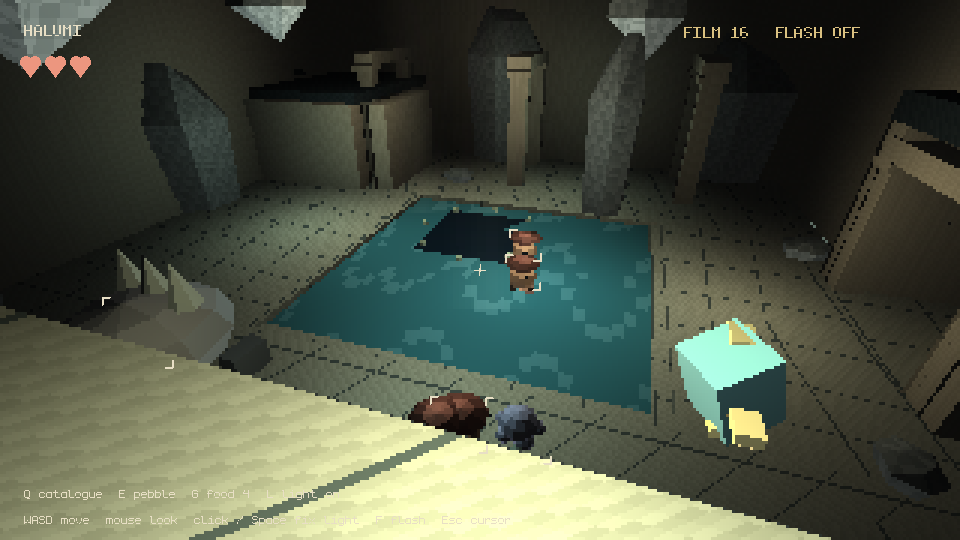
[task notification]
Monitor ({"command": "R=\"C:/Users/a327e/Desktop/a327ex/Anchor/workflow/delegate/runs/20260914-halumi-first-pass\"; H=\"C:/Use...)
Watch re-armed. Astra is still in the art and sound pass; nothing to do until its commit and report arrive.
Code: halumi-old @ b78819281d (19 files, +320 -0)
[task notification]
M4 committed. The report should close the turn shortly; I'll do the handover checks against the report and the final tree together.
[task notification]
Bash (cd C:/Users/a327e/Desktop/a327ex && cat Anchor/workflow/delegate/runs/20260914-h...)
[Think]
I need to do final handover checks on the tree: verify anchors, run a smoke test, and review the final snapshots (entrance, dark branch, lake shore, lake vantage, results). I should also clean up the leftover test_drake.ogg file by deleting and committing it, and confirm how the owner runs things via run.bat in halumi before pushing.

Since this is a desktop game and "end privately = seal + push" marks the end-session, I won't push right now — I'll just run the anchor check and smoke test on the working tree, then review the five snapshots.
Final report is in, the tree is clean with seven commits. Handover checks now: my own anchor check, my own smoke run on the final tree, then the final snapshots.
Recorded run: halumi-old, 20260914-220033
Bash (cd C:/Users/a327e/Desktop/a327ex && ./Anchor/workflow/anchor check halumi 2>&1 |...)
Read (C:\Users\a327e\Desktop\a327ex\halumi\replays\shots\m4-final-20260914-215252\sunlit-lake-shore.png)
Read (C:\Users\a327e\Desktop\a327ex\halumi\replays\shots\m4-final-20260914-215252\sunlit-lake-vantage.png)
Read (C:\Users\a327e\Desktop\a327ex\halumi\replays\shots\m4-final-20260914-215252\dark-branch.png)
Read (C:\Users\a327e\Desktop\a327ex\halumi\replays\shots\m4-final-20260914-215252\entrance.png)
Read (C:\Users\a327e\Desktop\a327ex\halumi\replays\shots\m4-final-20260914-215252\results.png)
[Think]
The final art pass looks solid now—sunlit shafts, readable creatures, the floating construct with its gold and blue lens, hearts, film count, warm masonry all in place. It's handover time, so I need to update the project memory noting first pass done and next steps as owner feel test and sound picks, then deliver the frozen final snapshots to the owner.

For the handover message itself, I'll cover test instructions, decisions made, known limitations, and what's left—mainly picking sounds from the reference doc and finalizing a title—while noting commits stay local since GitHub only has the scaffold, no push needed. I'll knock out the memory update and delivery together first, then write the handover message.
[Think]
Everything checks out—static check is clean, smoke and hazards pass on the final tree, and the art pass reads as intended. I'll deliver the final frames, update the project memory, and hand things over.
SendUserFile (C:/Users/a327e/Desktop/a327ex/halumi/replays/shots/m4-final-20260914-215252/entrance.png, C:/Users/a...)
Bash ([memory: sealed target])
The first pass is built, verified on my side, and ready for your feel test.
What exists. Run it with run.bat in halumi/. WASD floats, mouse looks, click or Space fixes light, F toggles flash, Q asks the construct about whatever you are aiming at, E throws a pebble for noise, G throws food, L toggles the steady reading light, Esc releases the cursor. You start on the entrance threshold with eighteen film leaves and three hearts; the same pale threshold is the only place plates bank and the run ends with the results screen. Die and the album is cleared. R on the results screen enters again.
The place. A sanctuary roughly 48 by 60 meters that an old civilization built and the cave grew back over: dressed courses, lintels, a shore colonnade and paving where they worked, rock intrusions, rubble and stalactites where the mountain came through, more in some places and less in others. From the entrance spine, a dark archive opens west and a cistern east; the lake room is the centerpiece with an open roof, light shafts and the west wall you float up to the vantage; beyond it a lower chamber and a dark gallery lead to a northern chamber. Ambient is low, so the dark branches are dark and the flash matters there; the lake room needs none.
The creatures. Five species, thirteen individuals, with an ecology rather than a list. Cupcaps graze, drink, sleep and carry Glarebell pollen. The Slatejaw hunts them and is the only thing that kills you, three hits, jaws opening as the warning. Spoolmites follow feeding sites and eat your unused film. Glarebells pulse, dazzle, and their glare draws the Slatejaw; flashing one is an invitation. The uncatalogued one lives in the northern chamber, watches the mites, echoes the bells, and folds when disturbed; the construct's only line for it is "I... do not have an entry for this one." Every species reacts to flash, noise, food and your approach.
Scoring. Plates are graded only at extraction: subjects in frame, behavior, rarity, framing and exposure, a group multiplier, and only the best plate per species is paid. Each run's plates are saved as PNGs with a manifest under albums/.
Verified mechanically, never by feel. Static check clean. Astra's smoke, hazards, exploration, geometry and milestone tests all pass on my own drives of the final tree, through the archive, the lake, the vantage and the exit, including the three-hit death, album loss, film theft, the warned drowning, glare recovery and film exhaustion. Recorded playback was byte-identical. The engine change is committed to Anchor and Horse Game's executable is refreshed.
What is yours to decide next.
- The ten sounds. Every cue is a synthesized placeholder, marked as such, and sounds.md lists each id with a one-line description of what is needed. You pick, I convert, per the standing rule.
- The title epithet, still "the Lightless" or one of mine; the repo stays
halumieither way. - Push. Seven commits are local; GitHub has only the scaffold until the end-session flow pushes.
Known limits, stated plainly. The construct's voice cannot be rendered inside Astra's sandbox, so any new lines go through me. No web build exists because emsdk is not installed. Replay recordings carry sound starts but not later volume changes, so the byte-compare proves pictures, not audio. Creature art is a first construction pass at the Simple Retro 3D approach, not a finished cast.
Session record. The whole Astra run, six turns from the packet through the point-light stop to the final art pass, is at Anchor/workflow/delegate/runs/20260914-halumi-first-pass and will be woven into this log at end-session.
First pass, final: the entrance spine, the sunlit lake from the shore and from the vantage, the dark archive branch with the construct in view, and the results screen after Astra's own final smoke run.
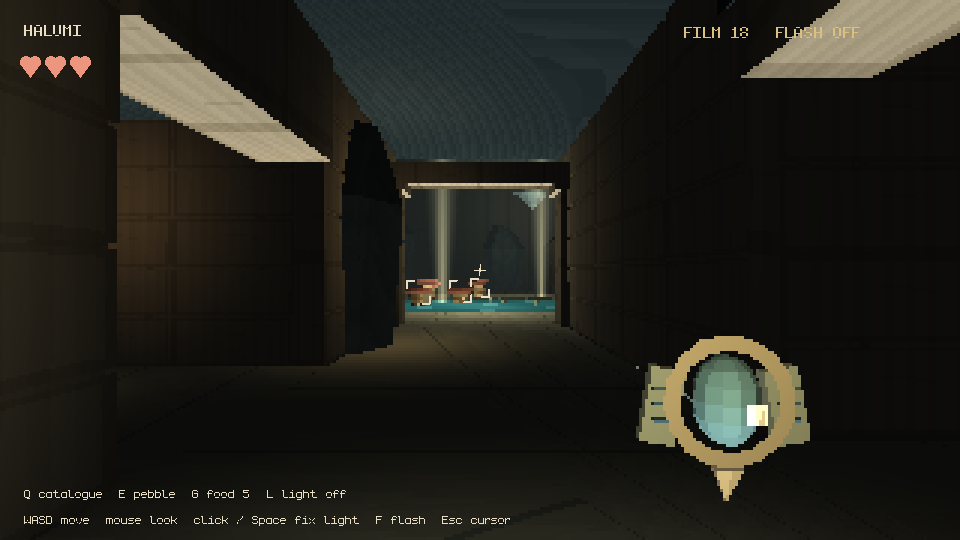
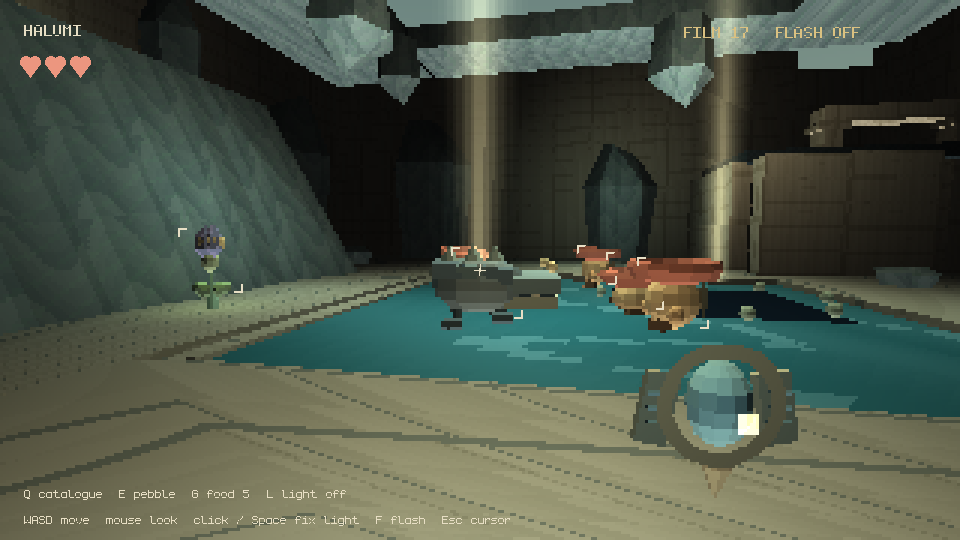
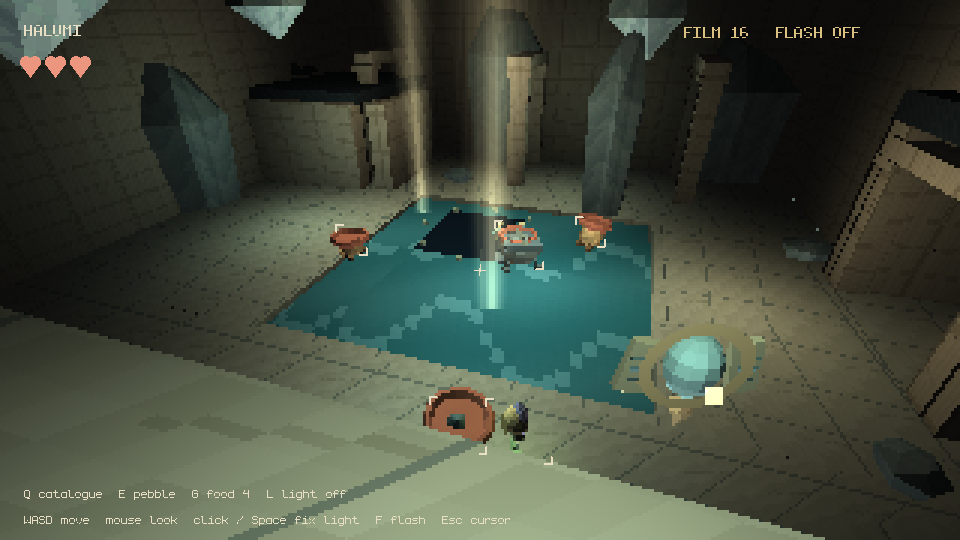
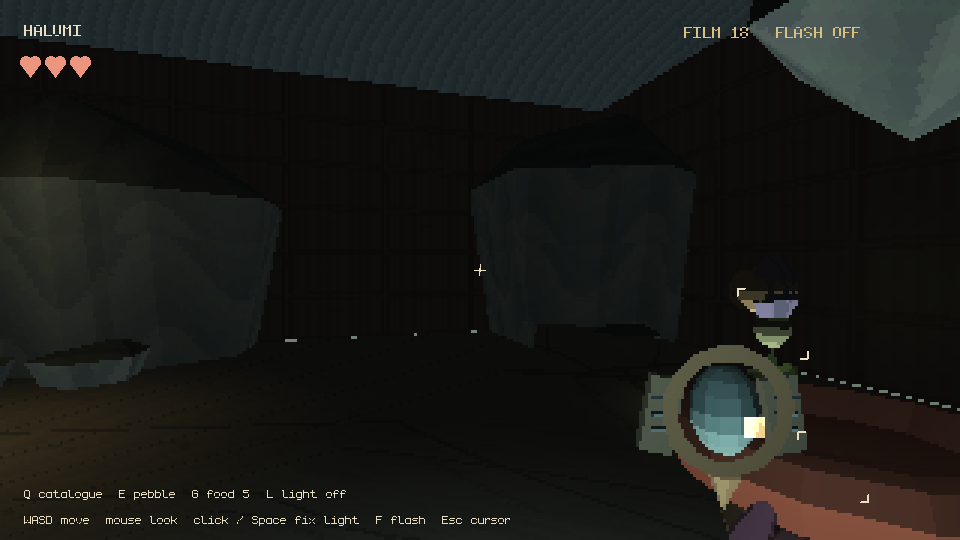
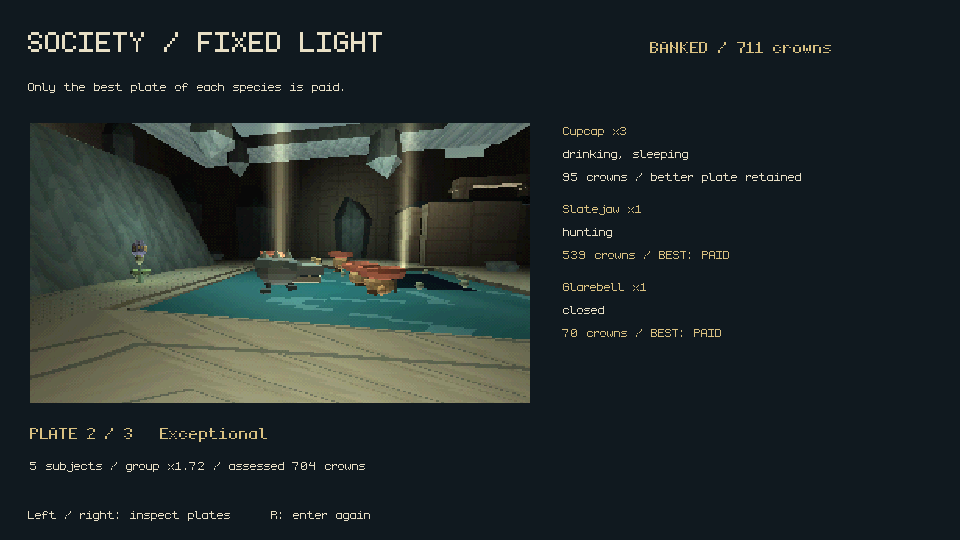
Code: halumi-old @ 40ba1cb116 (1 file, +0 -0)
Recorded run: halumi-old, 20260914-220629
Fullscreening turns f.lux off, I believe there should be a borderless fullscreen option that shouldn't do that, I want that when I press F11 so I can play it fullscreened.
[Think]
I want F11 to toggle borderless fullscreen instead of exclusive fullscreen, so I should check how the engine currently binds fullscreen in anchor.c and see if there's a window function I can hook F11 to in halumi.
Checking what the engine exposes for fullscreen before wiring F11.
Bash (cd C:/Users/a327e/Desktop/a327ex/Anchor/engine && grep -n -i "fullscreen" docs/E...)
Bash (cd C:/Users/a327e/Desktop/a327ex/Anchor/engine && sed -n 21525,21545p engine/src...)
[Think]
I'm realizing F11 already gives borderless fullscreen, so the f.lux shutoff isn't about exclusive mode—f.lux just treats any screen-covering window as fullscreen and disables itself by default whenever that "Disable for full-screen apps" option is checked.

My honest answer here is that this is really f.lux's own setting fighting the engine rather than a bug in the game: the fixes are unchecking that f.lux option, disabling Windows fullscreen optimizations for the executable via its Compatibility tab, or as a hacky workaround leaving a 1px gap so the window doesn't fully cover the screen. Since I can't modify system settings myself, I'll just walk him through doing it.
F11 already is borderless fullscreen in the engine: the toggle at anchor.c:21536 uses SDL_WINDOW_FULLSCREEN_DESKTOP, which is SDL's borderless mode (a window sized to the desktop, no display-mode change), and Alt+Enter does the same. There is no exclusive fullscreen path in Anchor at all, so nothing in the game or engine needs to change for this.
The reason f.lux turns off anyway is on f.lux's side and Windows' side, not the window mode:
- f.lux has its own switch for this. In f.lux's options there is a "Disable for full-screen apps" checkbox, on by default. It fires on any window that covers the whole screen, borderless included. Unticking it keeps the color shift on over the game.
- Windows "fullscreen optimizations" can also promote a borderless window that covers the screen into an exclusive-style flip mode, which is what f.lux is reacting to when it does detect the game. If unticking the f.lux option is not enough, right-click
Anchor/engine/engine/build/anchor.exe, Properties, Compatibility, tick "Disable fullscreen optimizations." Halumi'srun.batlaunches that executable, so the setting applies to the game. This one is a per-executable Windows setting, so it is yours to set; I am not going to change system settings from here.
Try the f.lux option first; it is the one that actually addresses the cause. If f.lux still drops out after both, tell me and I will look at whether SDL's flag on this build behaves differently from what the source says.
Recorded run: halumi-old, 20260914-221109
This just doesn't quite work. Let's try a literal clone of Densen Suzume, except instead of power lines and birds it's something else, otherwise it will be the same game. What are your ideas?
[Think]
He's saying his first pass doesn't work, so he wants a pivot: essentially a literal clone of Densen Suzume but swapping in a different subject in place of power lines and birds. I should acknowledge what didn't land before jumping to ideas, treating both the Densen Suzume reference and his built attempt as concrete data points to reason from.

Breaking down Densen Suzume's core loop — fixed 2D viewpoint, birds gathering along lines, a rectangle framing tool, exposure hold, three shots per stage, dispersal after capture, points thresholds, upgrade picks — the point is that the essential mechanic is "things accumulate along perches, you frame and capture, they scatter." I'm brainstorming subject reskins that preserve that exact skeleton: fish gathering at feeding spots in a pond with a net standing in for the camera, or fireflies gathering over some nighttime scene instead of birds on wires.

More options: butterflies over a flower bed caught with a net, frogs singing on lily pads that dive after a splash (lily pads as discrete perch points, echoing the chorus idea), bubbles or balloons, monsters peeking from darkness caught with a flash, or flipping the concept into a bird-catcher role. What really makes the birds-on-a-line idea work is that the line gives a natural alignment for multiple subjects, they come and go rhythmically, scatter when disturbed, are inherently charming, and the fixed sunset street scene sells the atmosphere immediately.

A replacement subject needs the same core ingredients: some perching structure (lines, pads, ledges, windows), a rhythm of arrival and departure, cuteness, a believable reason for framing it in a rectangle, and a moment of dispersal. Ranking candidates: cats along rooftops or fences at dusk keep the warm sunset silhouette but move less, though they can still flee if spooked; fireflies swarming around jars or lanterns turn the "lines" into light sources, with the jar as the capture mechanism and a scattering effect that reads beautifully at night; frogs on lily pads work well as a pond scene with croaking and a splash-triggered dispersal; and ghosts appearing in the windows of a building facade, where the window grid itself becomes the perch structure.

I'm also weighing whether to keep this in 3D or switch to 2D — since he mentioned the 3D version didn't quite work and wanted something literal, a 2D or fixed-camera 2.5D approach might be faster and clearer to execute. I should also figure out what specifically failed before — the stealth mechanic, the movement feel, or the scale of things — since that will shape which direction to recommend.

For the concept itself, fireflies feel like a strong fit: they connect to the light/lore theme from halumi, they're visually simple to render well in almost any art style, and the "capturing light in a jar" mechanic gives a satisfying core loop. I'll keep my response short — a couple of clarifying questions plus a concrete recommendation, rather than overloading him with options.

I'll lay out each candidate's mapping for what replaces the lines, birds, camera, and dispersal mechanic, then pick a favorite and ask which direction to pursue.
Noted, and I take the verdict as data: the first-person stealth version did not earn the 3D. A literal clone tests the thing your post identified, the rectangle around gathered things, without anything else in the way. Before ideas, one question I want answered when you reply, because it decides what the clone must avoid: what did not work, the photographing itself, the moving around in 3D, or the pacing of finding things?
What Densen Suzume's subject does structurally: birds land on lines, so they align and a rectangle can hold many; they come and go on a rhythm; the shot scatters them; they are cute; a sunset street reads instantly. A replacement needs all five: a perching structure, come-and-go, dispersal on capture, cuteness, and a scene that reads at a glance. Candidates that map one to one:
- Fireflies and a jar. Lanterns, flowers or a tree stand in for the lines: fireflies gather around them. The rectangle is the jar's mouth, exposure is the lid closing, the swarm scatters when it shuts. Upgrades add lanterns (Densen's "add a power line"), slow the scatter, widen the jar. Points of light are the cheapest thing to draw in any style and look good in all of them, and it keeps the light theme you gave Halumi. My first pick.
- Cats on walls and rooftops at dusk. Walls and fences are the lines, cats sit along them and leave when the shutter clicks. Photography stays as the verb. Cats sit still, which loosens the exposure tension, so the hold would need to be about them noticing you rather than about them leaving.
- Frogs on lily pads. Pads are discrete perches, frogs sing in groups, a splash from the capture sends them under, they resurface elsewhere. Net or camera. The chorus gives a free scoring layer if wanted (a plate of singers is worth more), but the base clone does not need it.
- Ghosts in the windows of a facade. The window grid replaces the lines, ghosts appear and fade, the flash captures and dispels. Spooky-cute, and the flash-as-capture already exists in what Halumi built. The strongest visual of the five and the most different in tone.
- Boats or ducks at a pier. Moorings and pilings as perches, a harbor at sunset; the shot startles ducks off the water. Closest to the original in mood, least different.
Two things I would keep from the original without change: the fixed viewpoint and the three shots per stage. Two things I would decide now rather than inherit: whether this is 2D or a fixed-camera 3D scene (I would go 2D, the literal clone is fastest there and 3D was the part just judged), and the style (emoji like emojunky, the bright PS1 as flat sprites, or pixel art).
My recommendation is fireflies and a jar, 2D, and I would build it as a small sketch first so the verb itself can be judged in an evening.
Let's try something more abstract. Top-down, entities move around, you have a rectangle/square and try to capture them. Let's start with this only. No theme needed, just pure abstract shapes that move around in a juicy way, pressing click with the rectangle feels juicy, and so on.
[Think]
This sounds like a fast-mode game sketch: an abstract top-down scene with juicy shapes moving around, a mouse-placed rectangle, and click-to-capture interaction. I'm figuring out where this should actually live given the sketches folder situation and needing to decide on project setup without overcomplicating things.

This is feel-adjacent juice work, not mechanical, so I'll write the sketch myself rather than delegate — small, ~300 line Lua file in 2D Anchor. But first I need to nail down where it lives: I'll ask him quickly with options like a new private project, a new local project, or nested inside halumi's sketches folder, since he wants speed above all.
This is feel iteration, so I'll build it myself, fast, no brief. One thing first: where it lives, since a new project needs your visibility flag.
AskUserQuestion (Where does the abstract capture sketch live?)
Where does the abstract capture sketch live?
- New project, private (Recommended): anchor new
--private. Its own repo and journal, separate from halumi. Tell me the name in Other if you don't want 'capture'. - New project, local only: anchor new
--local. No GitHub repo; journal still works. - Inside halumi: A sketch/ folder in the halumi repo, since it is the same idea's exploration. No new repo.
New project, private (Recommended)
[Think]
Since no name was given, I'll default to "capture" and scaffold it as a private project. Before writing the sketch, I want to check the framework's 2D API quick reference for drawing shapes, handling mouse input, layers, springs, timers, and camera shake to make sure I use the right calls.
Bash (cd C:/Users/a327e/Desktop/a327ex && ./Anchor/workflow/anchor new capture --priva...)
Bash (cd C:/Users/a327e/Desktop/a327ex/Anchor/engine/docs && grep -n -E "^(layer_draw_...)
[Think]
I need to check where layer_rectangle draws from—centered or top-left origin—and confirm the draw origins note for textures versus text. I should also verify how mouse click input binds work and how the game layer scaffold is set up so I can implement against it properly.

I'll also grep the framework's math helpers like lerp, clamp, remap, and smoothstep to see what's available for easing, along with looking at the canonical playground main.lua style for structure guidance.
Scaffold is up at capture/ (private). A few more signatures before writing: rectangle origin, mouse binding, math helpers, and camera shake without a camera.
Bash (cd C:/Users/a327e/Desktop/a327ex/Anchor/engine/docs && sed -n 8,30p ENGINE_API_Q...)
[Think]
I'm unsure whether layer_rectangle's origin is top-left or center-based, so I should check ENGINE_API.md for that detail—this is the classic "draw origins" trap. I'm also noting set_time_scale is available for slowmo juice effects, and considering whether to use the scaffold's default rough filter at 480x270 scale 2, or switch to a smoother filter with a larger resolution like 960x540 for crisper abstract shapes.

After weighing options, I'll settle on 640x360 at scale 2 with smooth filtering, since low-res combined with juicy motion tends to make jitter more noticeable. Before writing any code, I need to grep for the exact signatures of layer_rectangle, set_time_scale, and layer_rectangle_line to confirm their behavior.
Bash (cd C:/Users/a327e/Desktop/a327ex/Anchor/engine/docs && grep -n -A6 "^### layer_r...)
[Think]
I'm sketching out an abstract capture scene at 640x360 with about 14 shapes, each assigned a movement personality like drifting, darting, orbiting, or bouncing, plus varied colors and squash/stretch effects.

The mouse-controlled capture rectangle springs and idles gently, and clicking triggers a satisfying snap: captured entities pop with particles and score text, nearby ones get startled, and I add hitstop, screen shake, and a bouncy count display that scales with combo size. Entities respawn from the edges to keep the field lively, and I'm keeping extra inputs like resizing minimal for now, focusing on the core capture loop.

I'll add fading trail buffers behind entities for visual juice, and implement my own hitstop by scaling dt manually rather than relying on the engine's global time scale, keeping the rectangle responsive while everything else slows. For input, I'm binding the mouse click to a capture action and pulling position via the game's coordinate system, then building my own screen shake using a decaying random offset applied through a layer push, and using the framework's color and layer drawing calls to render everything.

Now I'm working out how to draw entities rotated and squashed using layer push transforms, and setting up springs for scale animation—I need to check the exact field access pattern for reading spring values before I can write the update logic, so I'm grepping the framework reference for that accessor.
Bash (cd C:/Users/a327e/Desktop/a327ex/Anchor/engine/docs && sed -n 600,625p FRAMEWORK...)
[Think]
I'm planning the sketch structure with capture/main.lua and boot.lua, then verifying it runs cleanly with anchor check and a driver script that steps frames and snapshots a click interaction. Now I'm writing the actual layer drawing code using the framework's color and shape functions...

Writing boot.lua setup...

Now I'm sketching main.lua's entity system: constants for screen size and palette, then entities with distinct personalities (drift, dart, orbit, bounce) each carrying position, size, color, spring-based scale/squash state, angle, and trail history, with squash-and-stretch rendering that scales and rotates shapes along their velocity direction.

The lasso box lags slightly behind the mouse for a weighty feel, with a dashed border and tilt based on mouse velocity for extra juiciness. On click, I capture entities inside the box, spawn colored particle bursts and shrinking rings for each, then kill and shrink them out before scheduling a respawn.

Nearby uncaptured entities get a startle impulse pushing them away, while the box itself squashes and flashes white briefly. I add hitstop (slowing time when something's captured), screen shake scaled by trauma, and a spring-scaled "+n" score popup at the box center.

Misses get their own dull feedback -- grey particles and a dimmed border -- so every action feels responsive. I'm sketching out particle, ring, and trail systems (fading squares, expanding circles, short position trails), plus a dark navy background with a faint grid for visual reference, and defining the field size, entity count, and a global slow-motion time factor for respawning entities from random edges.

Now I'm writing both game files, matching his compact coding style (tight `*`, spaced `+`, snake_case), copying the font over, and setting up a test drive: start, step forward, move the mouse onto an entity, inject a click, step again, and snapshot to confirm no errors. I still need to check the exact mouse injection function names in agent.lua before wiring that up.
Now writing the sketch. Two files plus the font, then a static check and a driven click with a snapshot.
Write (C:\Users\a327e\Desktop\a327ex\capture\boot.lua)
Write (C:\Users\a327e\Desktop\a327ex\capture\main.lua)
Bash (cd C:/Users/a327e/Desktop/a327ex && mkdir -p capture/assets && cp halumi/assets/...)
Recorded run: capture, 20260914-235017
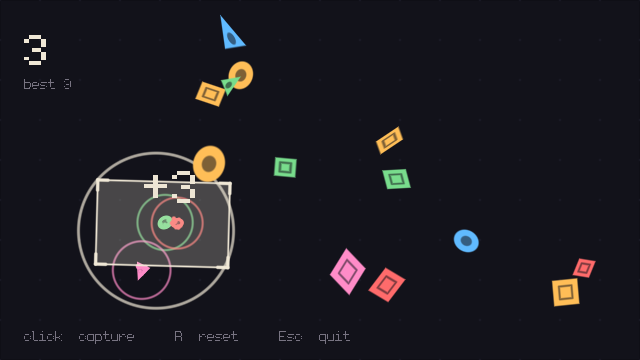
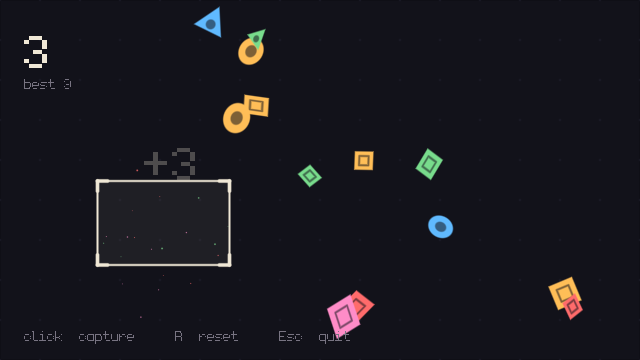
Bash (cd C:/Users/a327e/Desktop/a327ex && ./Anchor/workflow/anchor check capture 2>&1 ...)
Read (C:\Users\a327e\Desktop\a327ex\capture\replays\shots\capture-hit.png)
Read (C:\Users\a327e\Desktop\a327ex\capture\replays\shots\capture-after.png)
[Think]
The click interaction works well—entities captured, rings, particles, and the popup all display correctly, with only minor cosmetic quirks like slight text offset that are fine for a sketch. I'll commit this and prepare test instructions along with a memory update.
[Think]
The test worked as expected—clicks registered, particles burst, and the score counter updated properly. I'll commit this now, update memory, and prepare the handover.
Bash (cd C:/Users/a327e/Desktop/a327ex/capture && git add -A && git commit -q -m "Abst...)
Bash ([memory: sealed target])
The sketch is ready. Run run.bat in capture/.
What it is. Sixteen abstract shapes (circles, squares, triangles) drift on a dark field, each with one of four movement personalities: drifters wander on slow sine curves, darters pause and then dash, orbiters circle a wandering anchor, bouncers travel straight and rebound. Every shape squashes along its motion, bounces off walls with a squash, and leaves a short trail. A box follows the mouse with a little lag and tilts with your hand's speed. Left click captures whatever is inside.
What a click does. The world freezes for a tenth of a second while the box does not, the box snaps inward and its border thickens and flashes, each caught shape bursts into particles of its own color with an expanding ring, a larger ring leaves the box, the screen shakes in proportion to the count, nearby shapes flinch away, a "+n" pops above the box (bigger font from three up), and the total in the corner bounces. Caught shapes come back in from the edges after a second or two. A miss still answers the hand: a small dip of the box and a few grey motes. R resets, Esc quits.
Verified mechanically: static check clean, a driven click over a shape cluster caught three and left the world consistent (13 shapes alive, 20 particles, total 3). Feel is yours.
Things I would want your read on, in the order I think they matter: whether the hitstop length and the shake are too much or too little; whether the box lag makes it feel weighty or sluggish; whether the darters make the field feel alive or chaotic; and whether the box size feels right for a field this dense. All are single values at the top of main.lua and reload on save while the game runs.
One question I still owe you from before, whenever you feel like answering it: what did not work in Halumi? It stays parked either way; the answer shapes what this sketch should grow into.
Code: capture @ 0f587a59eb (3 files, +343 -35)
[task notification]
Recorded run: capture, 20260915-154642
Make the units simpler, let's start with just 1 type, make them look more like seekers from the SNKRX style. The board should be closed on the sides so they can't leave/collide against walls. They also collide against each other, so you can use Box2D if you need. They also should in general move less. They should settle into groups, sometimes alone, etc.
[Think]
I'm thinking through simplifying to a single unit type styled like SNKRX's seeker enemy—a small colored square—within a closed, walled board where units collide via Box2D physics, move more slowly, and tend to cluster into groups while occasionally staying solitary.

For behavior, I'm thinking of a flocking-lite approach: seekers pick either a shared gathering point (group, ~75% probability) or a solo random spot, drifting toward it with damping and re-picking every few seconds so attractors slowly relocate over time. Using Box2D circle bodies with low restitution and high linear damping should naturally create clustering and jostling with minimal seek force. Since this is fast mode without design briefs, I'll keep working directly and check the collider API and SNKRX seeker drawing code as needed.
Two lookups before I rewrite: the framework's 2D physics API, and the actual seeker drawing in the SNKRX template so the look is right rather than remembered.
Bash (cd C:/Users/a327e/Desktop/a327ex/Anchor/engine/docs && grep -n -E "^(physics_|co...)
[Think]
The snkrx-template path isn't where I expected, so I should check under from-hdd instead, and I still need to find the collider API section in the framework doc around lines 406-460. I'll also search Z: drive directories for anything matching snkrx as a separate check.
Bash (cd C:/Users/a327e/Desktop/a327ex/Anchor/engine/docs && sed -n 400,470p FRAMEWORK...)
Bash (ls -d Z:/2025-2026/code//snkrx Z:/2025-2026/code//from-hdd/snkrx Z:/2025-202...)
[Think]
I still need the remaining collider API details—forces, damping, restitution around lines 470-520—plus the SNKRX seeker draw code, which I can find by searching the template's snkrx directory for "seeker". These are independent lookups, so I'll run a search for each.
Bash (cd C:/Users/a327e/Desktop/a327ex/Anchor/engine/docs && sed -n 470,530p FRAMEWORK...)
Bash (T="Z:/2025-2026/code/a327ex-hdd-2026-08/snkrx-template"; ls "$T" "$T/snkrx" | he...)
Bash (T="Z:/2025-2026/code/a327ex-hdd-2026-08/snkrx-template/snkrx"; grep -n -i "draw...)
[Think]
I've settled on the seeker design: a small red rounded rectangle that rotates to face its velocity direction, set against the background color, with physics-based movement. Now I'm setting up the physics world with zero gravity and defining collision tags between units and walls, enabling unit-unit collisions.

I need to figure out how the collider system associates an owner instance with its physics body — checking whether `collider(owner, ...)` requires an entity registry via `user_data` lookup, since I want to confirm self-referencing works without extra registration. I'm also planning the walls as static box colliders on the four screen edges, and the units as 18 dynamic seekers with damping, low friction, and slight restitution, rotating visually toward their velocity rather than relying on physics rotation.

For behavior, I'm sketching gathering spots that drift slowly, with each unit alternating between heading to a shared spot or its own solo point, using arrive steering with small max speed and force, plus jittered offsets so units cluster loosely instead of stacking. Visually I'm keeping the seekers as plain rounded rectangles in the SNKRX red palette, dropping trails, and reusing the capture/spawn effects like rings and particles; for capture detection I'm considering iterating units directly rather than using an AABB query.

Now I'm working through capture mechanics and respawn logic: destroying the collider on capture, respawning at a wall edge with a spring pop-in after a delay, and applying a startle impulse. I need to verify how the collider module ties owner position to the physics body -- checking whether construction reads owner.x/y directly and whether sync() correctly copies body position back to the owner.
Bash (cd C:/Users/a327e/Desktop/a327ex/capture/anchor && grep -n "user_data|owner.x|...)
Bash (cd C:/Users/a327e/Desktop/a327ex/capture/anchor && sed -n 35,60p collider.lua; e...)
[Think]
I have what I need now: bodies get created at origin then repositioned, physics steps happen before update, and entity ownership is optional with `physics_init()` handled in boot. I'll rewrite main.lua and boot.lua next, then verify with the check, drive, and snapshot steps.
[Think]
I've confirmed the collider positioning, physics/update order, and SNKRX seeker's shape (14x6 rounded rectangle oriented to velocity). Now rewriting the sketch to match.
Write (C:\Users\a327e\Desktop\a327ex\capture\boot.lua)
Write (C:\Users\a327e\Desktop\a327ex\capture\main.lua)
[Think]
I realize scaling time globally would double-slow things since my dt is already scaled, so I should use unscaled_dt for the box/UI logic and let the engine's time scale handle world physics separately—or just drop the global time scale approach entirely.

Better plan: keep set_time_scale but split variables—rdt (unscaled) drives hitstop timer, box, springs, and popups, while wdt (scaled dt) drives the world/particles/spots. Now I'll make these edits and run the check plus drive/snapshot sequence.
[Think]
I need to fix the box/UI update to use unscaled dt instead of the hitstop-scaled dt, so they don't slow down along with physics.
Edit (C:\Users\a327e\Desktop\a327ex\capture\main.lua)
Recorded run: capture, 20260915-160248
Bash (cd C:/Users/a327e/Desktop/a327ex && ./Anchor/workflow/anchor check capture 2>&1 ...)
[Think]
Found the bug: after capture I destroy the collider, but unit_draw still tries to call get_velocity() on it for dying units, causing an invalid body error. I'll fix this by skipping velocity lookup when the unit isn't alive and just using zero stretch instead, then rerun the same drive test.
The click works but a dying unit still asks its destroyed collider for velocity when drawn. Fixing that, then rerunning the same drive.
Edit (C:\Users\a327e\Desktop\a327ex\capture\main.lua)
Recorded run: capture, 20260915-160351
Bash (cd C:/Users/a327e/Desktop/a327ex && ./Anchor/workflow/anchor drive start capture...)
[Think]
I see the actual bug: units keep a reference to the old spot table, which gets replaced when its timer expires, so their `u.spot` never matches anything in the current `spots` list. I should fix this by having spots_update reassign any units pointing at an expiring spot to a new target when it gets replaced.
[Think]
Found the bug: units keep referencing stale gathering spots after they're replaced instead of re-picking a new one. Fixing that logic now and rerunning.
Edit (C:\Users\a327e\Desktop\a327ex\capture\main.lua)
Recorded run: capture, 20260915-160430
Bash (cd C:/Users/a327e/Desktop/a327ex && ./Anchor/workflow/anchor drive start capture...)
[Think]
Still getting nil, so I'm questioning whether units and spots are the globals I think they are, tracing through world_reset and spot initialization to see if spots gets properly populated with SPOT_COUNT entries before the group chance logic kicks in.

Wait — I bet random_bool treats chance as a percentage, not a fraction, so passing 0.7 gets interpreted as 0.7% instead of 70%, meaning almost no units ever join a spot. I should verify this against the API docs while also running a debug eval that counts how many units actually have a spot assigned, doing both checks together.
Recorded run: capture, 20260915-160453
Bash (cd C:/Users/a327e/Desktop/a327ex && grep -n -A6 "^### random_bool" Anchor/engine...)
[Think]
Right, random_bool takes a percentage, so I need GROUP_CHANCE set to 70 and the particle chance set to 50 to match the intended probabilities. I'll fix both values now and then rerun the drive.
random_bool takes a percentage, so 0.7 meant under one percent and every unit went solo. Two value fixes.
Edit (C:\Users\a327e\Desktop\a327ex\capture\main.lua)
Edit (C:\Users\a327e\Desktop\a327ex\capture\main.lua)
Recorded run: capture, 20260915-160526
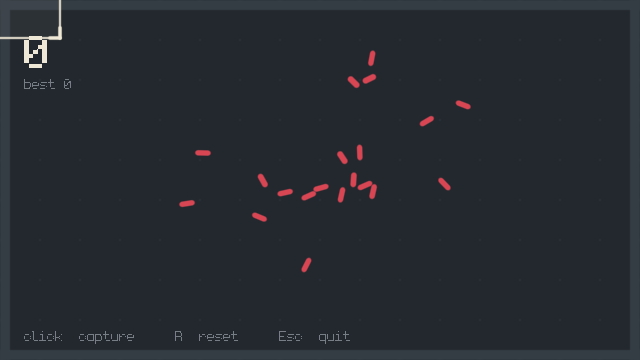
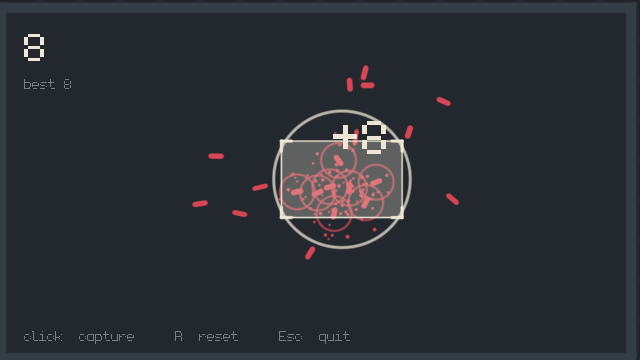
Bash (cd C:/Users/a327e/Desktop/a327ex && ./Anchor/workflow/anchor drive start capture...)
Read (C:\Users\a327e\Desktop\a327ex\capture\replays\shots\seekers-settled.png)
Read (C:\Users\a327e\Desktop\a327ex\capture\replays\shots\seekers-hit.png)
[Think]
The seekers cluster tightly with a few outliers, matching the SNKRX behavior I expected, and the click caught 8 of them. I'll commit this and note the random_bool percentage quirk as a gotcha worth remembering for future work.
Works: after ten seconds the seekers had gathered into one large cluster with a few loners, and a click on it caught eight. Committing and recording the percentage trap for next time.
Bash (cd C:/Users/a327e/Desktop/a327ex/capture && git add -A && git commit -q -m "Seek...)
Bash ([memory: sealed target])
Done. Run run.bat in capture/; it reloads on save if you want to touch the values.
What changed.
- One unit type, SNKRX seeker. A 14 by 6 rounded rectangle in the SNKRX red on the SNKRX background, turned to face the way it moves, with a slow idle wobble when still and a squash along its motion when it does move.
- Closed board. Four static walls, drawn as a thin frame. Units are Box2D dynamic boxes with high damping, low restitution, and they collide with the walls and with each other, so a group piles up and jostles instead of overlapping.
- Less movement, groups and loners. Four gathering spots drift slowly around the board and jump somewhere new every six to fourteen seconds. Each unit picks a spot seven times out of ten, with its own small offset so a group spreads rather than stacks, or picks a place of its own; it reconsiders every five to twelve seconds, and when a spot moves on its units re-pick. Travel is slow (max speed 34, arrive steering with a settle radius), so most of the time the board is mostly still with a few units wandering between groups.
- Capture is as before, now with the hitstop applied through the engine's time scale so the physics freezes too, while the box, popups and rings run on the unscaled step.
Verified mechanically: static check clean; ten simulated seconds produced a cluster of nine on one spot and several loners; a click on that cluster caught eight, and ten units were still moving afterward. Two bugs found and fixed on the way: dying units asked their destroyed body for velocity, and random_bool takes a percentage, so my 0.7 was under one percent and everyone went solo. That one is now in the gotchas list.
Values worth your hand, all at the top of main.lua: SPOT_COUNT and GROUP_CHANCE decide how clumpy the board is; UNIT_SPEED and the retarget window (5 to 12 seconds, in unit_pick_target) decide how alive it feels; BOX_W, BOX_H decide how many a good click can take.
Code: capture @ 0aa778f752 (2 files, +187 -171)
Recorded run: capture, 20260915-174127
Hmmm, this is not very good. Let's retire this entire thread. You asked me what didn't work about Halumi, it's just not particularly entertaining to walk around and take photos, the kind of idea that was way better in my head. I don't think it's an implementation issue either, it could be made better but I think the fundamentals of the idea don't appeal to me. Now, question, what do you think I should do with this log? Do you think I should publish it or not?
[Think]
With the thread closed, the verdict is that just walking around taking photos isn't inherently entertaining. I'm weighing whether to publish this log anyway — the site values honesty and showing process including failures, and this connects to earlier threads about undiscovered game ideas, so documenting how the idea fell apart still feels like worthwhile content.

On balance, I lean toward publishing: it's a clean example of the site's thesis about AI pipelines producing a working result that still gets rejected on fundamentals. Against that is length and some personal lore content, but nothing confidential — the repos being private just means code stays private while the log itself, summarized, seems fine to share.

So my recommendation is to publish publicly, since it closes the loop on the "discovered game gave an idea, idea didn't survive contact" thread and is consistent with his stated preference for honest critique over waste-signaling.

One caveat: the log itself is unwieldy, but he can't edit logs, so the summary needs to carry the valuable parts — the design turns and the final verdict. The halumi and capture repos stay private regardless of the log's visibility.

I should also update memory now — mark halumi and capture as retired with reasons — before giving a direct, appropriately thorough answer.
Updating the two project memories with the verdict first, then the answer.
Bash ([memory: sealed target])
Thread retired and recorded that way in memory, with your reason quoted so nobody builds on the idea again by accident.
Publish it. Here is why, and the one thing I would weigh against it.
The case for publishing is that this log is a complete, honest instance of the thing your recent posts are about. Your September 9 post argued for letting AI do long runs and working backwards from volume. This log is what that looks like end to end: a design idea from a game you found on Japanese Twitter, a research pass, a discussion between two models, a full first pass built by Astra in one day (an engine extension, an authored dungeon, five creatures with an ecology, a working loop with tests), and then you played it and the fundamentals did not hold. That last step is the part nobody publishes. Everyone shows the pipeline producing something; almost nobody shows the pipeline producing a working game the designer then rejects in an evening, and what that costs and teaches. It is also the second half of the Densen Suzume post: that post said the game gave you a clear idea, and this log is where the idea went. Readers who follow the play-and-write-up experiment get the closed loop, including the concession you made about undiscovered games and what one of them was actually worth to you.
The log also carries two things that are useful independent of the game. One is a visible failure of mine and the rule that came out of it: two models with no built object converged on a full spec in three turns, you caught it, and the brainstorming section in CLAUDE.md exists because of this session. The other is the delegation run itself, the packet, the stop on the wrong per-vertex claim, the milestone reports; people building their own agent workflows learn more from a run that had to stop and correct than from one that did not.
What I would weigh against it: it is long, and the strongest material sits in the middle, between the Click! discussion and the halumi verdict, with a fair amount of monitoring and tooling around it. That is a cost to the reader, not a reason to hide it. And the halumi and capture repos are private, so the log shows snapshots, names and reports but not the code; that is consistent with what you chose at scaffold time, and the summary can say so.
Nothing in it needs sealing. The lore you gave for the character is design context you offered for the record, the Astra run pages will appear as unlisted children the way every delegated run does, and there is no NDA material. So: publish, public, under the normal end-session flow. If you want the reader spared the tooling stretches, the summary is where to say what the log is about, which is a design idea that was better in the head than in the hand, and what it cost to find out.
What do you think it should be called?
[Think]
His log titles are usually plain, project-name style, like "Anchor Website 3" or "Character Exploration." I should suggest a few options in that vein—something like "Densen Suzume Idea" or "Creature Photography"—and lean toward one as a recommendation rather than drafting full prose.
Plain and named after the thing, the way your other logs are. Options:
- Halumi. The project's name, the way logs usually carry one. Honest about what most of the log is, and it stays searchable next to the repo. My recommendation, and if the thread ever gets a second look the number just increments.
- Densen Suzume Idea. Names the origin instead of the project, and pairs with the post that promised the idea. Slightly weaker because two thirds of the log is not about Densen Suzume anymore.
- Creature Photography. The idea rather than either name. Fine, but generic next to your other titles.
- Better in My Head. Says the verdict. It is the most memorable, and also the one that reads as a joke about the log before the reader has opened it, which your titles do not otherwise do.
I would go with Halumi and let the summary carry the verdict.
Recorded run: capture, 20260916-142427
Halumi it is, end the session.