This explains the point about attention I left for another post in #595. A common mistake people make right now when modeling other humans has to do with attention. On social media attention is all that matters, so people extend that to games, "now that games are easy to make, attention is all that matters, you need to be an influencer and market your game, that's the only thing that matters!" It's true that solid marketing strategies matter more now than before, but attention is not the most important resource to focus on.
In the infinite scroll of short-form content, attention is all that matters. Getting people to watch, grabbing their attention, locking them in, is what makes the algorithm judge your video as good and recommend it to others. Something like this happens with games, the more people buy and play a game, the more Valve's algorithm recommends it, I posted this graph in #24:
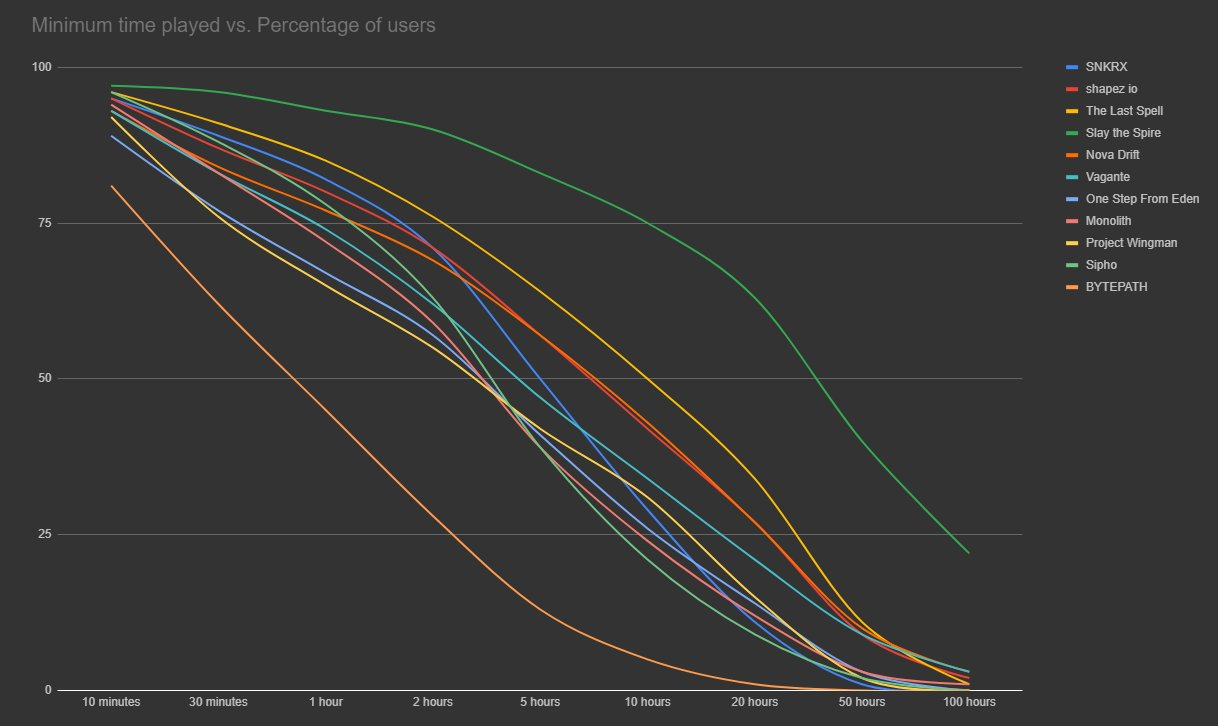
I don't think this has changed. The problem with concluding from it that attention is all that matters is that you still have to get people to actually buy and play the game. Buying and playing are actions that require activation energy, and that activation energy collapses neatly into a resource called INTEREST. Is the game interesting enough to the viewer that he will buy it and play it?
Interest is an infinite resource, it isn't capped by the hours in a day the way attention is, as most people are not deeply interested in anything, they passively watch online content and nothing truly evokes their imagination and compels them to act, anything that does has passed a certain threshold and has generated interest. Interest being both scarce (hard to generate) and infinite (once you can generate it, your ceiling is every human being alive) is a defense against the slopification of an industry, so I predict that the artistic industries that demand more activation energy from the user will be less affected by AI, games and books are likely fine, music and short-form content likely aren't.
This ties into #626's point about art generated on the fly. That may happen for music, and perhaps a little for movies, but it likely won't for books or games, because anything that requires activation energy from the user has to interest him, and something you can completely imagine and steer yourself, something that never quite surprises you, is not going to pass that threshold. There's also the fact that most people are not very imaginative, so whatever they can come up with themselves will be worse than what they can get from superior minds like mine. One could argue that the AI is, in some ways, already good at coming up with surprising things itself and this will only get better in the future, which is true. But then there's an additional argument against personal art generation, as mentioned in #595, most people don't engage with art on its own terms, they don't judge the artifact as an object, they take into account the artist, other people's opinions, what other people are doing, who's playing this game, is this cringe, oh my god, the Undertale fanbase is so cringe, I can't like this game anymore, and so on. I don't do this myself, but it's clear to me that most people do, and ultimately this is what "saves" art, because it makes art a collective experience rather than a solo one.
The new Malfoid meme is a great example of how AI will actually work, it's an existing IP people can coalesce around and then status (and eventually money) is distributed around this IP by people generating good things with it. The IPs that benefit the most will be open ones, because it's just smart, for instance, for JK Rowling to let the Malfoid thing be free instead of clamping down on it. So ultimately not a lot changes, the community aspect of art remains, because people want to discuss these artifacts and the ideas contained within with others.