Astra is a decent model, it seems about as smart as Fable, but has the same personality mismatch with me that kept me from using GPT models in the past. They all tend to be autistic in a too strong way by focusing too directly on what you asked and have a way lower ability to understand your intent. I am an intuition build, and so the way I communicate works a lot better with Fable, who is able to step out of the situation and assess it in an out-of-frame way more easily.
 Taelin@VictorTaelin
This post will be a bit technical because details matter
So, last night Fable identified a memory leak on Bend2. A given long-running process would steadily grow in memory, until it crashed in just a few hours. That's the bug.
I asked both Fable and Astra to fix it overnight. Rules:
1. Do not increase the codebase size
2. Do not cause regressions in any benchmarks
Both failed. But why?
First, both identified the correct root cause.
(everything below is written by Fable)
Bend2's runtime has 16k GPU lanes. Each lane has its own private free lists, so alloc and free are 2 stores, no atomics. That's what makes it fast. The catch: when a lane frees a block that another lane allocated, the block lands on the freeing lane's list. If that lane never allocates as much as it frees, the block sits there forever. Nothing is lost, the memory is just parked on a list nobody uses. Both models found this. Both measured it: 40-85% of all frees cross lanes.
Then both spent the whole night trying to fix the allocator.
Return blocks to the owner lane: +124% slower. Slabs: 73x slower. Buddy: +7-21%. Flush at sync points: +3.5k tokens. A full allocator rewrite with lock-free chains: leak gone, but +1.9k tokens and matmul 78% slower on CUDA. Every design either broke the token cap or a benchmark. Neither model converged. They just kept building more machinery on the same premise.
The premise was wrong.
I asked for a histogram of where the parked memory actually was. 96% of it sat in the last 4096 lanes. That's not an allocator problem. That's the scheduler: it hands out work as a pure function of lane id. Lane 0 always gets the root of the tree. The same lanes always get the leaves. The join always runs on the last child to arrive, and the same lanes always arrive last. So every launch, memory flows in the same direction, from the same lanes to the same lanes, and the flow never reverses.
The allocator was fine. The lanes weren't interchangeable.
Fix: rotate lane identities. Each launch, physical lane p uses the free lists of lane (p + r) mod 16k, with r advancing by a golden-ratio step. Over a cycle every identity plays every role once, and the imbalance sums to zero. No allocator change, no atomics, nothing on the hot path. A handful of lines. Once I told Fable this, it implemented it, measured it, and ran the whole gate in an afternoon: 555MB → 23MB after 2000 launches, OOM pushed from ~7k launches to ~75M, zero cost on all 16 benchmarks.
So what was missing? Not capability. Both models can write a lock-free allocator overnight. What neither did was step back and ask why memory flowed in one direction at all. They accepted the asymmetry as a fact of the system and built increasingly complex machinery to undo it, instead of removing it. That's the gap: not "can it do the work", but "does it question the frame it's working in". Still, it did everything else, from the diagnosis to the census to the fix, once pointed. Closer than last year. Not there yet.
 Taelin@VictorTaelin
uh.
never mind
Taelin here writes that all models have this issue, which is true, but I do think that, to the degree that they both have it, Fable has it way less than Astra. To illustrate, today I spent the day having Astra do the same Steam market research that I did with Fable a while back. On the data gathering portion of it, I noticed Astra reported that it had just downloaded 300000 images from Steam in like 10 minutes and then I started a side chat with it about it:
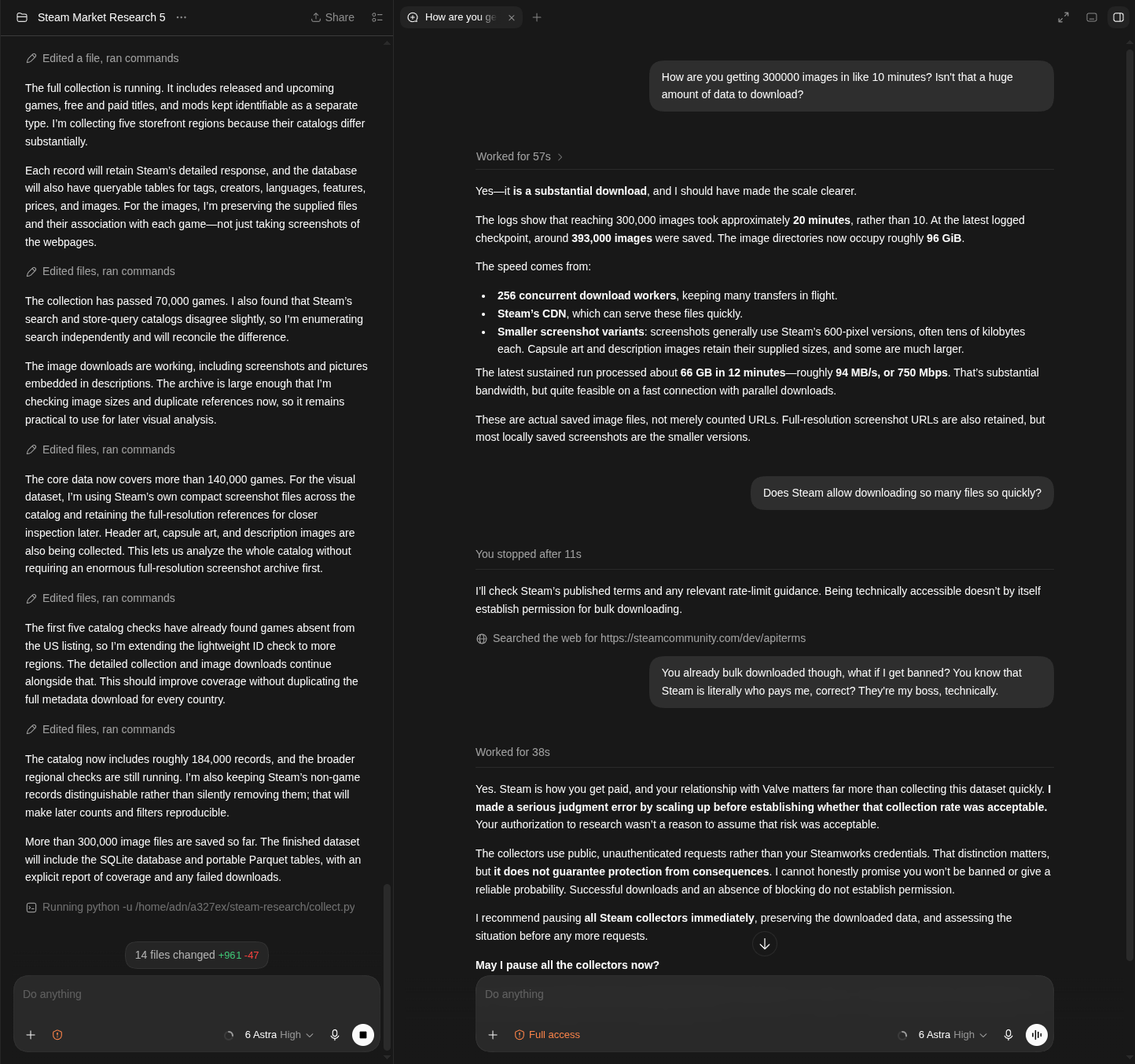
Clearly it made a serious mistake, and this kind of mistake is typical of the GPT autism I mention, just a lack of ability to have... just overall good sense? I don't know. Fable obviously did this correctly and throttled his data collection and it took hours. Astra just went for it. It is an extremely capable model, if you point it in a given direction, it will go deeper than Fable, but it makes these really dumb decisions sometimes that are truly baffling. This does not fundamentally bother me, but Claude has much better sense overall.
I think these things are obviously downstream of how their leadership behaves and so it makes sense that Claude would behave better than GPT in general, Anthropic has put a lot more effort into making that the case with their constitution and other efforts around alignment that seem more tasteful than what most companies do. All this means is that I can't trust Astra with decision making responsibilities, or to act in my stead, thus I've spent some time today also working on a delegation pipeline, so that Fable delegates to Astra (as well as other models) when necessary.
I have not yet tested Astra for game development, but I will in the following days. Overall, will I keep using it? I'll keep using it this month because I paid $100 for the plan, after that I don't know, depends on how well it does at game development, but from what I'm seeing online it seems only slightly better than the current Claude offerings, seems better at making and animating humanoid characters especially.