Phylactery 15
Summary
Lich Survivors 15 moved the testing of the site's unlock (the egg opening, its letters building the locked posts) from the live website to the desktop (renderer/run-unlock.bat, R to replay, the Caps Lock launcher listing run-*.bat variants), found why the live site showed nothing (unlock_fx.lua read main.lua's local index), and then iterated the unlock's look to its accepted form over five rounds: eased letters and a linear rise with options, the row flash fixed, a lock that breaks, the game filling the window with sharp fractional scaling, four gacha-like unlock moments, three themes in the game's own effect languages, and finally glass with the game's telekinesis, warped air done as a real refraction shader pass over the page. It also fixed several game sounds (rock_lift, the rock's crush not playing gore_land, the lich's hurts in the ending), and made the unlock's sounds slots of the game, tunable in its own editor while the whole unlock plays inside the desktop site. Nothing was deployed.
Local testing of the unlock (the session's first job, from NEXT_SESSION.md):
- The owner (end of session 14): "I don't see any effect happening at all. Perhaps instead of testing things on the website, couldn't we test it locally only? The website is essentially an app".
a327ex-site/renderer/run.batnow runs the shared Anchor build (Anchor/engine/engine/build/anchor.exe); the oldrenderer/anchor.exe(2026-08-09) predated the gpu layer and physics3_mover Lich needs.renderer/run-unlock.bat: the site withSITE_UNLOCK_TEST=lich-survivors+LICH_START=EGG: the admin tree merged from disk, VIEW AS PUBLIC on, the page scrolled to the game at its egg; a corner hint names the keys.tools/sync_lich_survivors.py: the game's site copy synced incrementally in Python (~0.3 s unchanged, ~1 s from empty; the bashcptook ~14 s); the.shnow calls it; byte-identical to the old output (791 files).game_host_restart(name)(stop hook, collector back, physics3 torn down, a fresh instance next update) andunlock_fx_test_again(): F5, then R, replays the unlock without relaunching;game_host_click(name)injects the click so one key plays the whole thing (owner: "Give me a key to reset the egg and play the animation again"). Each restart costs ~69 MB of engine memory (meshes/textures loaded again).game_host_stateerrored on fractional rects (%d): now%.0f.
Why the live site showed nothing:
unlock_fx_test_reveallooked throughindex, a LOCAL in main.lua (nil in the module), never saw the gated posts the device holds, and calledsite_gated_fetch('posts'), which returns at once on a device with gate scope '1' (his). On the desktop the same call fetched the posts the first time only, so session 14's checks passed and F5 failed.- Fixed: the list is rebuilt first, the fetch only when no rows came. Reproduced headless as his device (scope '1', admin token and switches in web storage stubbed, the game asking
site_game_start): the old code 0 rows, the fix 16.
The Caps Lock launcher:
- Owner: "Where in the shift+caps lock launcher is the website-based game?" He had launched
a327ex-site/renderer, which ran the renderer's own (old) engine and the plain site. Anchor/launcher/launch-game.sh: a game'srun-*.batbeside its main.lua is its own picker entry, run through the bat (unlockfindsrun-unlock.bat;fixedfinds Lich'srun-fixed-seed.bat, latereggfindsrun-egg.bat); Ctrl+Caps replays stay on the engine.renderer/anchor.exeretired from git (its FFmpeg DLLs were byte-identical copies of the shared build's);Anchor/workflow/lib/preview.pyuses the shared build too.
Round 72, the unlock's round 2 (REDESIGN 41):
- Owner: "The tween should be fast start and slow settle ... give me some options too. The scroll up should be linear (I believe it's linear now) ... The lines as they finish seem to flash awkwardly ... each post should have an animation on its lock icon, it should break apart and fall ... with light camera shake. The game should take over the screen ... the black bars on the sides should be the color of the website's background."
- Letters fly an eased quadratic bezier from the egg (E: expo/quart/cubic/back out, round 70's spring); the rise (C: linear, ease in-out, ease out, round 70's follow, which was not linear: it surged every 0.2 s).
- The flash: settled letters stopped drawing while their row stayed hidden until its LAST letter, so rows emptied letter by letter and popped back. Settled letters now stay on the exact pixel (
math.floor(el.y - scroll)+ offsets fromfront_row_lock_at/front_row_rule_at) and the rule fades in. - Locks pop in, then break into five pieces (shackle halves, body in three) with a 3 px page jolt (later replaced).
fillgames (Game: lich-survivors 640x360 pixel fixed fill capture_keys wheel_through): the largest fractional scale under the sticky bar (2.822x on 1920x1080), drawn sharp (sharp_layer: next whole scale nearest, then smooth down); fixed games' bands are the page colour; the game's ending fades tosite_page_rgb().
Rounds 72b-73b, the shake and the unlock moments:
- "Instead of camera shake, shake the post line itself as it unlocks left and right only": a damped row swing (
rec._fx_jolt_x). Then: "You can remove the sideways shake... each post should really feel like as good as unlocking a gacha box ... try a few things? Also try different sounds". - Four moments (U): burst, shine, rarity reveal, NEW stamp;
unlock_fx_rowdraws a row's moment under/over it. Four sound sets from the packs (S,tools/unlock_sfx.py->renderer/unlock_sfx/). The letters' source became a point inside the egg turned with its rocking (port/game.lua:EGG_NDC:set(0, 0.45, 0):apply_quaternion(cave.egg.quaternion)). - His pick: "No sound, mix of burst and shine, with the lock using the shine effect, except without the rays and using particles/lock broken particles instead" -> burst + shine (the lock lifts and whitens, breaks into pieces and sparks).
Round 74, the game's own languages:
- "now let's try making it fit the game as a theme". Reference frames from rounds 23, 43, 51, 61, 69 (colours sampled): egg shell (crack, speckled chips, the rising light, motes), ember (the game's 3 px pixels, embers, a dithered sheen), glass (spectral slivers and glints, a prism band), plain. Key T.
Round 75, glass with telekinesis (ACCEPTED):
- "Glass is great, try to add some of the telekinesis visuals ... also, the lines underneath are overlapping creating 1-2 pixels where the connection is visible".
- The game's telekinesis read from lift.lua / rock.lua / warp.lua and RECORD rounds 20-23: rise, held trembling "in a shimmer of warped air", swell, burst; warped air bends what is behind it and pulls its colours apart.
- The lock: rise writhing, held trembling, swell to 1.65x, burst into glass with spectral wakes. Warped air as a real shader pass:
unlock_fx_postfxqueueslayer_apply_shaderon ui_layer just before main.lua's finallayer_render(sources: the held lock's lens, each burst's ripple, the egg while the letters pour;UNLOCK_FX.warp_debugtints where it bends). Letters writhe, trail spectral ghosts, tremble as they land. - The seams: the spectrum line was 24 rectangles each 1 px wider than its share; the prism band's polygons overlapped their anti-aliasing. Both now one
layer_trianglesstrip with per-vertex colours. - 75b: "Could the thing that goes to the right not be like that rotated rectangle ... Also, default to follow and cubic out for letters." The band became a sweep of warped air along the row (a third warp source kind). Verdict: "Perfect! The effect is done."
Game sounds (rounds 76-77):
- "gore_land should just be the same as the lift burst sound" -> an alias (
A.SAME), then: "Seems like lift_burst is happening when snake gore from lift lands on the floor, that seems like a mistake?" -> taken back; and "I think I said gore_land shouldn't exist for another effect, it was playing in the rock one" -> the rock's crush pieces (gore.luacrush: meat and scraps) spawnquietand land silently. - rock_land removed ("rock_hit is enough"). "lifting the rock should additionally have the same gravity-ish wobble" -> a float + bob was added, then reverted: "Ah, what I was missing was a rock lift event" ->
rock_lift, seeded from hislift_cast(Gravity casts) viaA.SEED. - "lich should stop being hurt after he dies, the frequency of his hurting should also increase the closer it gets to the explosion": no spasms after
SEQ.dead; the gap shrinks as death nears (silhouettes, then the 4 s hold), measured 1.32 -> 0.17 s; 0 hurts after death (was 5). - LICH_ROOM digests (tools/digest_run.lua) identical to HEAD after every change.
Round 78, the unlock's sounds in the game's editor:
- "we just need to settle sounds for the actual unlocking effects, how can we test those they're different executables?" -> five slots of the game (
port/unlock_snd.lua): unlock_pour, unlock_lift, unlock_burst (pitched up), unlock_sweep, unlock_final, red with suggestions; the site callsgame_unlock_soundthroughgame_host_callat the real moments (A.LOUD: they sound through the game's off-screen mute);run-egg.batplays them on the site's schedule in the game alone. - "Is there no way to edit sounds while actually testing the full thing at the same time?" ("Remember that I don't need this to be active on the website", "once that's done it's over"): run-unlock.bat hosts the lich-survivors folder itself (
SITE_UNLOCK_GAME_DIR,def.local_files,def.editor->GAME_EDITOR), TAB brings the game into view with its editor open, edits save to lich-survivors/sound_picks.lua, R replays. Fixes on the way: an alignment against a rect drawn before its scroll (two updates per drawn frame:game_host_rect_since), andgame_sound_editordefined above the local it read.
State at the end:
- The effect is done; the game's sounds are settled except the five unlock slots, which he is tuning in run-unlock.bat.
- Nothing deployed: the live site still has the
indexbug; deploys need his say (sync + pack the game's site copy first). Then public: FX voices on the site engine, async shader compiles, the entry id. NEXT_SESSION.md holds the map.
New Lich Survivors session ("Lich Survivors 15"). Read lich-survivors/NEXT_SESSION.md first: it says where the last session left off and what to do next (local testing of the site's unlock first, then why the live site showed nothing). Research on your own from there.
Opus 5.5 xhigh
[Think]
I should start by checking NEXT_SESSION.md to see what's there.
Bash (cat /c/Users/a327e/Desktop/a327ex/lich-survivors/NEXT_SESSION.md; echo ----; ls ...)
Bash (cd /c/Users/a327e/Desktop/a327ex/lich-survivors; wc -l RECORD.md; grep -n "^## ...)
Bash (cd /c/Users/a327e/Desktop/a327ex/a327ex-site/renderer; grep -n "^## |^# " REDES...)
Bash (cd /c/Users/a327e/Desktop/a327ex/lich-survivors; sed -n 2212,2524p RECORD.md)
Bash (cd /c/Users/a327e/Desktop/a327ex/a327ex-site/renderer; sed -n 2455,2700p REDESIG...)
Bash (cd /c/Users/a327e/Desktop/a327ex/lich-survivors; sed -n 2372,2524p RECORD.md)
[Think]
I should check the renderer's run.bat, megablock's run.bat, the Anchor build location, unlock.lua, unlock_fx.lua, and site_debug next.
Bash (cd /c/Users/a327e/Desktop/a327ex; cat a327ex-site/renderer/run.bat; echo ----; c...)
[Think]
I'm noting that the renderer's run.bat launches anchor.exe from the parent a327ex-site directory with "renderer" as the game, while megablock's runs from its own directory—so I need to preserve that cwd semantics if I switch to a shared Anchor build. I also want to check how agent-instance testing was handled previously.
Reading last session's notes and the site's desktop launch path; next I'll check how the unlock was driven headlessly.
Bash (cd /c/Users/a327e/Desktop/a327ex/lich-survivors/scratch/unlock; ls; echo ----; h...)
[Think]
I'm wondering how this was launched—maybe via the anchor CLI with a specific start command and environment variable. I should check the anchor CLI and SURFACE.md, along with the git log for a327ex-site and the deploy logs to confirm.
Bash (cd /c/Users/a327e/Desktop/a327ex/a327ex-site; git log --oneline -12; git status ...)
Bash (cd /c/Users/a327e/Desktop/a327ex/a327ex-site/renderer; wc -l unlock.lua unlock_f...)
Bash (cd /c/Users/a327e/Desktop/a327ex/a327ex-site/renderer; cat unlock.lua; echo ====...)
[Think]
Now I want to check the game side of things - how port/game.lua handles site_game_start and site_unlock_from, and how LICH_START=EGG gets passed through the game_host sandbox for lich-survivors. I'll grep for how these globals are exposed.
Bash (cd /c/Users/a327e/Desktop/a327ex/lich-survivors; grep -n "site_|LICH_START|GAM...)
Bash (cd /c/Users/a327e/Desktop/a327ex/lich-survivors; sed -n 230,300p port/game.lua; ...)
[Think]
I'm trying to figure out why the live site showed nothing, tracing through the admin device's view-as-public flow and how the egg-opening trigger calls into the unlock logic, which arms the reveal flag and could interact with gated posts in the index.

But I should check what he actually reported rather than theorize further — I want to find the session transcript where he said "NO effect at all" and see if the game even started at the egg or if the rows appeared. I'm going to search the recent transcript logs for his messages mentioning "unlock" to get his exact words.
Bash (cd ~/.claude/projects/C--Users-a327e-Desktop-a327ex/; ls -t *.jsonl | head -5; f...)
[Think]
He says he's not seeing any effect at all, so I want to check whether he actually turned on the switches — let me look back at what instructions I gave him in the last session for testing, between 16:00 and 18:14.
Found his exact words from last session ("I don't see any effect happening at all"); checking what testing steps he was given before that.
Bash (cd ~/.claude/projects/C--Users-a327e-Desktop-a327ex/; python -c " import json,sy...)
[Think]
I need to find the test steps referenced earlier, so let me check the messages between 17:00 and 18:04.
Bash (cd ~/.claude/projects/C--Users-a327e-Desktop-a327ex/; python -c " import json,sy...)
Bash (cd ~/.claude/projects/C--Users-a327e-Desktop-a327ex/; python -c " import json,sy...)
[Think]
He probably followed those steps after the boot fix, but the "no effect at all" result is ambiguous—unclear if it means no hidden rows, no egg start, or no letters showing up. I should figure out whether moving renderer/run.bat to the shared Anchor build, keeping the working directory at a327ex-site with game set to "renderer," actually works with the shared anchor.exe when invoked from the parent directory.

I'm also wondering if the renderer's anchor.exe is a distinct build with different flags, like video support, since that directory has avcodec DLLs alongside it—so I should check build.bat for the relevant flags and confirm the shared build is video-enabled too. For run-unlock.bat, I need to figure out how to set LICH_START=EGG and trigger site_debug.admin() plus view_public(true) at boot, likely through an environment variable read by main.lua, factoring in how admin_items_desktop merges from disk and how EGG_WAIT/HOSTED/START_AT interact for the hosted game scenario.

For replaying, I need game_host.lua to support restarting a game after hiding posts again, so I should check whether a restart/stop function already exists there. On keeping the game copy current, I'm considering whether the launcher calls sync_lich_survivors.sh and pack_games.py before launch, but since that's a bash script it'd need Git Bash on Windows—so maybe a cleaner approach is pointing the admin game directly at the lich-survivors source folder instead of syncing a mirror, though I need to check if the sync script transforms or filters files in a way that matters. I also want to understand how the renderer resolves the "game folder" on desktop and what role the A327EX_SITE env variable plays.
Bash (cd /c/Users/a327e/Desktop/a327ex/a327ex-site/renderer; cat tools/sync_lich_survi...)
[Think]
For "keep current," the simplest approach is having the launcher run sync plus pack before launching—sync does a full rm -rf and recopies the ~78MB, which should only take a couple seconds on SSD. Since the recopy resets mtimes, pack_games.py's incremental mirror will end up recopying everything each run too, which is acceptable but not ideal performance-wise.

Actually, maybe there's a cleaner option: could the desktop point directly at the dev source directory instead of the packaged copy, so edits in lich-survivors/ show up immediately? I need to check how admin_items registers the game dir and whether game_host.lua reads files via a manifest or direct path, since the packaged version excludes things like sound files and web/. Let me look at game_host.lua and admin_items.lua to understand this.
Bash (cd /c/Users/a327e/Desktop/a327ex/a327ex-site/renderer; cat admin_items.lua; grep...)
Bash (cd /c/Users/a327e/Desktop/a327ex/a327ex-site/renderer; sed -n 30,107p game_host....)
[Think]
So WEB is true wherever web_file_status exists, meaning newer desktop builds also count as WEB since they mirror data from data/admin/games. That means on desktop with the new engine, WEB evaluates true, which changes how game_files behaves there.

Thinking about restarting a game: there's no restart mechanism currently, so I'd need to add something like game_host_restart(name) that tears down the instance, resets UNLOCK_FX state, calls site_front_refresh to re-hide gated rows, and scrolls back to the game row. But I'm unsure whether the Lich game's modules survive re-instantiation cleanly in the same process since its top-level init code and physics3 world would need a full re-init.

Resources like meshes, textures, shaders, and sounds would reload each time, possibly leaking memory, but that's acceptable for a test. Fortunately, the existing switch-out path already performs the same teardown/re-init when another game takes the slot, so this seems like a supported pattern worth testing headlessly rather than inventing a new in-game restart hook.

I'm sketching a run-unlock.bat launcher that syncs the Lich game copy, packs assets, sets environment variables for the egg and test mode, then launches the renderer executable -- though I need to verify bash is actually available on PATH when invoked from cmd.

I'm worried Windows' built-in WSL bash might shadow Git Bash on PATH, so I should hardcode the Git Bash path instead, or consider moving the sync logic into Python to avoid ambiguity. I also want to make the sync preserve mtimes (using cp -p) so the packing step only copies files that actually changed, speeding up repeated test runs, and I should verify the desktop build correctly reads the mirrored game files under the expected data path.

For hooking up the test launcher, I'm thinking main.lua should check for an environment variable at boot and, if set, trigger admin mode, force public view, and scroll to the right game row — probably by calling a function added in unlock_fx.lua rather than cluttering main.lua directly, plus binding a spare F-key to replay the sequence. I also need to figure out how the env var interacts with is_admin() and whether forcing public view requires adjusting how site_game_start checks admin state on desktop, since desktop normally has no admin token at all.

Shifting to why the live site itself showed nothing, I'm walking through how the switches get persisted — specifically what happens when the toggle passes nil versus '1' into web_store_set, since the engine's handling of nil there could be erasing the stored value instead of just turning it off — and then checking how view_public() ties into compose_is_admin() to see if that's where the public view logic breaks on the actual site.

Then I'm tracing how the game reads site_game_start — whether the sandboxed game environment's `__index` actually resolves to the site's globals, which would determine if the EGG-start logic even fires correctly when hosted live versus running locally.

I also want to check whether the site's deployed game mirror was actually re-synced after the commit that added site_game_start, since earlier deploy logs mention the data mirror being "already current" without clarifying if that includes this change — plus there's a real possibility Cloudflare or browser caching on the /data/admin/ path is serving a stale version of game.lua regardless of what's deployed.

That'd explain "no effect at all" too — he wouldn't have reached the reveal at the end since the egg-start never took, meaning the game simply ran its normal start, consistent with stale cached files.

The hidden rows point to the renderer bundle, which has a hashed filename and so should be fresh regardless. I'm wondering if his "no effect" comment was about VIEW AS PUBLIC not hiding locked posts, or about the animation itself not playing — and I want to check whether the cache headers differ between the admin game path and the public games path.

Browser caching for the data files is the real question — if nginx sends a long max-age on /data/, the engine might be fetching a stale game.lua from days ago, and since those files aren't content-hashed like the bundle, they'd need some other versioning trick (like a query param tied to a data version) to bust the cache. I should check the nginx config and the web loader to see how data fetches are actually versioned.
[Think]
Found the launch path and unlock code. Next I'll check whether the live-site failure is caused by his browser caching stale game files from `/data/`, since those aren't hashed like the bundle.
Bash (cd /c/Users/a327e/Desktop/a327ex/a327ex-site; ls server/ 2>/dev/null | head -30;...)
Bash (cd /c/Users/a327e/Desktop/a327ex/a327ex-site; grep -rln "location ^~ /data/admin...)
Bash (cd /c/Users/a327e/Desktop/a327ex/a327ex-site; grep -n "location|Cache-Control|...)
[Think]
Since data/admin/ is private with no-store caching, stale cache isn't the issue unless the VPS file itself is outdated. I should verify this by comparing the md5 of the local game.lua against the VPS copy via ssh, which should be a safe read-only check.
/data/admin/ is served private, no-store, so browser caching is ruled out. Checking the VPS copy of the game matches the local one instead.
Bash (cd /c/Users/a327e/Desktop/a327ex/a327ex-site/renderer; md5sum data/admin/games/l...)
Bash (cd /c/Users/a327e/Desktop/a327ex/a327ex-site/renderer; grep -n "ssh|rsync|scp"...)
Bash (cd /c/Users/a327e/Desktop/a327ex/a327ex-site/renderer; grep -n "^VPS=|^RENDER="...)
Bash (cd /c/Users/a327e/Desktop/a327ex/a327ex-site/renderer; md5sum data/admin/games/l...)
[Think]
The VPS content is current, so staleness isn't the issue—unless the browser had cached the page before the deploy happened. Checking the timestamps: the commit/deploy log shows 16:26:52Z, and I need to reconcile that against local time in Brazil (UTC-3) to see if the reload actually happened after the new deploy went live.

So the file timestamps line up consistently. Now I'm tracing through the web code path: what happens on his device when both the admin flag and gated flag are active — how the index loads gated rows, whether view_public_hides actually suppresses hidden rows for him in front.lua, how the admin row gets merged in asynchronously via cookie fetch, and how site_game_start checks is_admin() plus the lich egg store value to decide whether to show 'EGG'. I'm also considering how web_store_get/set behave and what compose_is_admin() actually checks, then following the EGG_WAIT flow that waits for a click inside the game.

I'm walking through the egg-opening sequence step by step: unlocking posts, refreshing the public view, arming the reveal, computing which rows are newly gated and hiding them, then triggering the glyph capture during draw. The key question is whether engine_glyph_capture exists in the web wasm build (anchor-43682421b8) versus the desktop engine build, since a missing function there could throw during rendering — and whether layer_draw_glyph_c is similarly present in that web build.

Rather than speculating further, I think reproducing this locally would clarify things faster. I'm comparing desktop vs web execution paths: admin detection differs (force_public on desktop vs store-based on web), but site_game_start and START_AT resolve the same way since os.getenv likely returns nil in the web sandbox. I'm also checking whether GAME_HOSTED, SEQ.opened timing, and the gated post visibility all behave consistently between the two environments.

Looking at the gating logic more carefully, the owner's viewer cookie likely grants access to gated entries, and view_public correctly hides them until reveal triggers site_front_refresh. The unlock_fx_post_refresh logic checks against a snapshot of visible rows at arm time, which should properly exclude hidden entries, and the logs section stays hidden as expected — so the web-specific failure must be tied to something else, possibly how EGG_WAIT detects the triggering click on web versus desktop.
VPS copy matches local, so stale files are out. Reading the game's egg-wait path and the front list's hiding next.
Bash (cd /c/Users/a327e/Desktop/a327ex/lich-survivors; grep -n "EGG_WAIT|START_AT" po...)
Bash (cd /c/Users/a327e/Desktop/a327ex/lich-survivors; sed -n 645,670p port/game.lua; ...)
[Think]
I'm tracing through the web boot sequence—when the admin index loads asynchronously and the game row appears, checking whether START_AT gets read correctly at that point, and considering whether the egg start might have been missed due to timing.

Rather than guess at his click behavior without more info, I think the better path forward is building local tests first, then making the desktop emulation of the web path more faithful—stubbing the admin check and store getter to return actual switch values so the real web branch logic runs instead of the forced public/env fallback. That would surface any bugs specific to that code path, including how nil values get set in the store. I should also check how front.lua handles the view_public_hides flag.
Bash (cd /c/Users/a327e/Desktop/a327ex/a327ex-site/renderer; grep -n "view_public|unl...)
Bash (cd /c/Users/a327e/Desktop/a327ex/a327ex-site/renderer; sed -n 140,175p front.lua...)
[Think]
I'm checking that site_front_refresh only fires when viewing the front/home doc, which looks correct. I'm also tracing the ordering of unlock_fx_draw relative to compositing calls, and considering whether front_doc's indexing behaves properly on web—then moving to check the admin-status cache logic.

Now I'm reconsidering his report that toggling "VIEW AS PUBLIC" produced no visible effect—maybe the gated rows did vanish instantly but without animation, which is what he was missing. This leads me to suspect the real issue is in how the game's sandboxed environment resolves globals: if make_env uses a whitelist table instead of `__index = _G`, then functions like site_game_start or site_unlock_from would simply be nil inside the game, meaning the egg trigger never fires and the game just starts normally.

I'm also noticing the desktop probe never actually tested this path since it used LICH_START=EGG to force the starting position directly, bypassing site_game_start entirely. The earlier session's note about "rebuilding the mirror" fixing the egg-position reporting suggests site_unlock_from is indeed reachable from inside the game—so I should go read make_env directly to confirm how its environment indexing works.
Bash (cd /c/Users/a327e/Desktop/a327ex/a327ex-site/renderer; sed -n 175,425p game_host...)
[Think]
I'm checking that the environment exposes mouse/key input functions properly through indexing into the global table, then considering edge cases like whether web storage returns the expected value and whether `os` might be unavailable in the browser context, which could break `os.getenv` calls.

Shifting focus to the web unlock flow: I want to trace through whether the admin's gated-row view versus public view affects the egg-click sequence, from the ending animation through `site_unlock_posts`, `unlock_fx_test_reveal`, `site_front_refresh`, and into the row refresh and letter animation drawn on the UI layer. I'm also wondering whether the web build's wasm binary actually includes `engine_glyph_capture`, since that's content-hashed — I should check the engine's git history to see when that function was added relative to the hash the web build is using.
Bash (cd /c/Users/a327e/Desktop/a327ex/Anchor; grep -n "engine_glyph_capture|\"layer_...)
[Think]
The search didn't turn up the original commit since it predates this repo's history, so I'll stop speculating and move forward with the build instead. I want to verify that running the shared Anchor build works and that the renderer executes headlessly from the a327ex-site directory using anchor drive.

I should check SURFACE.md for drive settings and environment variables, and look back at how the drive was started in the last session to confirm the right command.
Working on step 1 now: switching the site's desktop launcher to the shared engine and building a one-click unlock test. Checking how last session started the headless site run.
Bash (cd ~/.claude/projects/C--Users-a327e-Desktop-a327ex/; grep -o '"command":"[^"]*a...)
[Think]
I'm trying to figure out how the drive command resolves paths relative to the game directory, and how run.bat sets up the working directory and environment variable before launching the renderer.

I should check anchor.py to see which engine executable path it actually invokes.
Bash (cd /c/Users/a327e/Desktop/a327ex/Anchor/workflow; grep -rn "build.*anchor.exe|...)
Bash (cd /c/Users/a327e/Desktop/a327ex/Anchor/workflow; sed -n 125,160p lib/preview.py...)
[Think]
The preview tool also depends on renderer/anchor.exe, so copying the shared build in would drift over time. Since NEXT_SESSION pointed toward moving to the shared Anchor build like megablock's run.bat did, I'll update run.bat to reference the shared build, and consider whether preview.py in the Anchor repo's workflow needs the same change, since it launches a visible window.

I should check whether the desktop build already reads games from data/ mirrors via the new engine's web_file_status check, since that path is already tested through drive. I need to grep anchor.py to see which engine the drive command actually uses.
Bash (cd /c/Users/a327e/Desktop/a327ex/Anchor/workflow; grep -n "def _engine|ENGINE_E...)
[Think]
Good, so the drive confirms all headless tests ran against the shared build, meaning the run.bat change should align with that tested behavior. I'm drafting a run.bat for the renderer that points to the shared Anchor build rather than a local one, matching what the live site and driven checks actually use.

I want to fix the site-path variable to resolve to an absolute path rather than a relative one with trailing dots, since main.lua relies on it for building file:// URLs. I also need to check whether the engine records replays by default when run this way -- the shared build seems to record every dev run into the game directory's replays folder, and I should check SURFACE.md to see if there's a flag to disable that for the preview case.
Bash (cd /c/Users/a327e/Desktop/a327ex/a327ex-site/renderer; ls -la replays | head; du...)
Bash (sed -n 50,90p /c/Users/a327e/Desktop/a327ex/Anchor/engine/docs/SURFACE.md; ls -l...)
[Think]
Recordings go to renderer/replays/, and since the policy is that every run on the owner's machine gets recorded, I'll keep recording on for the run-unlock test by default — it's short enough that this stays consistent with doctrine even though the session log will include it.

Now let me check whether main.lua actually sets record=false somewhere at the top of its init table.
Confirmed anchor drive already uses the shared engine, so switching run.bat aligns his runs with what I test. Now checking the renderer's init and keys before writing the launcher.
Bash (cd /c/Users/a327e/Desktop/a327ex/a327ex-site/renderer; grep -n "engine_init|rec...)
Bash (cd /c/Users/a327e/Desktop/a327ex/a327ex-site/renderer; grep -n "'f[0-9]+'" *.lu...)
Bash (cd /c/Users/a327e/Desktop/a327ex/a327ex-site/renderer; sed -n 1,40p main.lua; gr...)
Bash (cd /c/Users/a327e/Desktop/a327ex/a327ex-site/renderer; grep -n "is_pressed('|ke...)
Bash (cd /c/Users/a327e/Desktop/a327ex/a327ex-site/renderer; grep -n "bind(|'f1'|'f2...)
[Think]
I'm checking whether F5 is free to use for the replay key, since Lich's hosted mode disables its dev test keys, so F5 should be safe to bind at the site level.

Decided to gate the replay behavior behind an env flag (SITE_UNLOCK_TEST) rather than always-on, so it only triggers in test mode. I'm sketching a boot sequence for unlock_fx.lua: once the front doc loads, flip to admin view, force public mode, refresh the front page, and scroll so the Lich row is centered — mirroring how the probe script steps the engine forward and toggles public view before the game actually starts.

With gated rows hidden, the Lich row likely lands near the top of the first screen, so scrolling may not even be necessary. For the F5 replay path, I'm working out the restart sequence: tear down the game instance (stop hooks, return to site, shut down physics, clear the instance reference) so the next engine tick re-registers and restarts it, then reset the unlock state flags, clear any hide markers, refresh the front page, and scroll the game row into view. I also need to account for the game waiting on a click to start, and how the LICH_START env var determines whether it boots straight to the 'EGG' state versus waiting for admin input.

Now I'm thinking about making the desktop test mode mirror the web experience more faithfully — checking whether desktop exposes the same web_store_get-style persistence functions so admin checks behave consistently, and whether that means settings switches should also show up on desktop in test mode (not essential right now, so setting that aside).

For keeping the game copy current automatically, I'm weighing two approaches: either have the launcher run the sync and packaging scripts before each launch (a few seconds of overhead), or point the desktop game definitions directly at the source folder to skip packaging entirely — though that risks testing a different file set than what actually ships, like sound files the packaging step would normally exclude.

Option A is the more honest approach since it tests exactly what gets shipped. I'm thinking through timing concerns — the sync step wipes and recopies a large folder, and since plain `cp` doesn't preserve mtimes, the packaging comparison step would end up treating everything as changed and recopy all of it unnecessarily. Using `cp -p` to preserve timestamps would let the packaging step only copy files that actually changed, which should keep things fast; I also want to check whether calling bash from a batch file is reliable across environments.
PowerShell (cmd /c "where bash & where python & where lua"; Test-Path "C:\Program Files\Git...)
[Think]
Since bash isn't on cmd's PATH but Git Bash exists at a known location, I'm considering either porting the sync script to Python so the .bat only relies on python, or just having run-unlock.bat invoke Git's bash.exe directly to run the shell script.

Before deciding, I want to check timing on the sync to see if it's worth making incremental for speed, so I should look at how game_host_update starts before writing any code.
Git Bash isn't on cmd's PATH, so the launcher will call it by full path. Timing the game sync + mirror to see if running it on every launch is cheap enough.
Bash (cd /c/Users/a327e/Desktop/a327ex/a327ex-site/renderer; time (bash tools/sync_lic...)
[Think]
The sync is taking 14 seconds, likely due to Windows Defender slowing down the file copy, while the actual packing step only takes 1.1 seconds despite comparing mtimes. Since 14 seconds per launch is too slow, I'm planning to write an incremental sync in Python using the same file selection logic.

I could create a tools/sync_lich_survivors.py that only copies changed files and prunes removed ones, then have pack_games handle the mirror step. Rather than maintaining two scripts, I'm thinking of turning the existing .sh file into a thin wrapper around the new .py script to keep one source of truth, but first I need to check what else references sync_lich_survivors.sh.
The bash sync takes 14 s (slow file copies under Git Bash), too slow for every launch. I'll make it incremental in Python and keep the .sh as a wrapper.
Bash (cd /c/Users/a327e/Desktop/a327ex; grep -rln "sync_lich_survivors" --include=*.md...)
[Think]
I'll create an incremental sync script for lich survivors and update the shell wrapper to call it, keeping the doc header in the Python file. Then I need to check the game_host restart process by reading the update start section.
Bash (cd /c/Users/a327e/Desktop/a327ex/a327ex-site/renderer; sed -n 108,140p game_host...)
[Think]
Instead of nulling the instance entirely, I'll just reset its started flag along with env and error state after teardown, letting the host update loop restart it naturally once game_files_ready confirms the loading data is complete. I'm also working through how the teardown hook should fire for the hosted instance.

I'm now worried about lingering audio: Lich may keep ambient loops playing at the engine level even after the environment is dropped, which would leak sound across a restart. I need to check whether Lich exposes a game_hosted_stop function to properly halt those loops, or something like game_hosted_visible, before finalizing the teardown sequence.
Bash (cd /c/Users/a327e/Desktop/a327ex/lich-survivors; grep -n "game_hosted_|GAME_HOS...)
[Think]
Confirming game_hosted_stop exists and stops audio, I'm now writing the game_host.lua logic to restart a named game cleanly in place, tearing down the old instance and spinning up a fresh one from existing files so the desktop's unlock test can replay against it.

I note game_hosted_hook needs started still true when called, so it must run before resetting state, and I'm checking whether physics3_shutdown pairs correctly with the game's own init call on restart. Layers get recreated by name for reuse, but repeated restarts reload meshes and textures each time, so memory will climb across replays unless the engine dedups by path -- acceptable for a short test loop, though I should measure memory in the headless run.

Now I'm looking at the desktop's unlock test script, which uses an environment variable to trigger replaying a game from its egg state on F5, hiding posts and waiting for a click inside the game. I need to guard the os.getenv call since it likely returns nil on the web/emscripten build, and I'm tracing how the per-frame test boot checks whether the debug doc is currently frontmost before firing.

I'm sketching the sequence once the test is ready to boot: merge the admin items for desktop, force public view and reset the revealed flag, refresh the front page, then scroll to the target game's row — since all games are open by default in the list, I just need to center the game's frame in the viewport.

I'm also checking whether admin merging auto-refreshes the front page, and planning a frame-counted state machine for the probe: one frame to trigger admin, a few frames later to switch to public view and scroll. Then I start drafting a replay function that resets the unlock-FX state and restarts the game host before re-running the front refresh.

For F5 handling, I'm reasoning through whether raw key-press detection works mid-update (edges only register during update, which is fine here), and whether focus on the embedded game would intercept the test key — concluding the hosted environment ignores it, so the debug tie-in should work cleanly.

Since I can't see his actual device for web testing, I'm thinking about adding lightweight diagnostics he could check — maybe console print statements showing the unlock state (armed/run/revealed) — though asking him to open devtools feels like too much friction. Better to first validate the logic locally in a headless test loop before worrying about the web-specific diagnostics.

Now I'm trying to pin down exactly why the web version might be failing before deciding whether the local test needs to cover the storage path too. I'm ruling out candidates one by one: admin status checks read directly from localStorage so timing isn't the issue, the reload instruction was already given, and the store-clearing call only fires when toggled off. I'm also checking whether the settings popover's view-as-public toggle correctly refreshes the front-end, and starting to suspect something about how the index page initializes on web specifically.

Looking into the gated-post entries for an admin's device — the gate cookie should mark those entries as gated the same way on web and desktop, and the probe already showed matching row counts, so that doesn't seem to be the discrepancy either. I'm also checking timing of the async gated-index fetch versus when entries render, but that flow should work fine regardless of load order since the check runs whenever entries execute. Same logic applies to how gated flags get set on individual rows and to whether hidden rows could still leak into the front-page list under view-as-public — in both cases the code paths look identical between platforms, so I'm still not finding the actual divergence.
[Think]
Restart path looks clear since Lich already defines `game_hosted_stop`. Next, I'll check whether gated entries on the web device carry the same `gated` flag the hiding code relies on.
Bash (cd /c/Users/a327e/Desktop/a327ex/a327ex-site/renderer; grep -n ".gated *=|gate...)
Bash (cd /c/Users/a327e/Desktop/a327ex/a327ex-site/renderer; sed -n 1365,1475p main.lu...)
[Think]
I'm checking whether desktop and web load gated entries the same way—both pull from the gated index on disk via web_file_status, though web may load it asynchronously after the admin index. Since entries() re-filters on each refresh, the timing difference shouldn't matter.

I'm also tracing whether unlock_fx_test_reveal actually fires the front refresh correctly, which depends on the current view being the home doc, and whether clicking inside a game on web might accidentally trigger a fold/unfold on the row rather than registering as a game click. Since I can't resolve this just by reading the code, I'm considering emulating the web device's admin/viewer state on desktop in a headless run—stubbing the store flags for admin and public view, removing the LICH_START env var, and setting GATED_SCOPE as an admin viewer—to see if the egg and reveal behavior match what the store-based logic would produce.

If that test still doesn't explain the discrepancy, I'm wondering if it's something engine-specific to the web build, like glyph capture returning different coordinates or a missing draw function causing a silent failure rather than a crash, though a draw error would likely trigger an error screen rather than silence. I'm also checking whether pcall only wraps the row draw, whether the mouse_position override causes issues, and whether `os.getenv` behaves differently in the web sandbox's global environment, since that would affect how START_AT gets set on the site.

That path seems fine either way since the game-start answer takes precedence over START_AT. I'm also checking whether EGG_WAIT and VARIED behave correctly, and whether the click handler that triggers the egg sequence runs independently of the tick loop during EGG_WAIT, since that timing detail could matter.

Given all this, I think the practical path forward is to build the local reproduction loop, run a headless emulation that mimics the web environment faithfully with stubs for storage and no env vars, and if that passes, add visible diagnostics for him on the web side.

Actually, a better approach might be to log unlock-test diagnostics through analytics_event so they land in the server's database, letting me check what happened on his device via SSH without needing him to do anything extra. I want to check whether his session from yesterday already produced any relevant events in that analytics DB, and whether the game even calls the right event-reporting function for this.
[Think]
The `gated` flag isn't the culprit since it's set identically on both platforms. Instead, I'll check the server's analytics logs for any Lich-related game errors from yesterday's test, since the site already reports those events.
Bash (cd /c/Users/a327e/Desktop/a327ex/a327ex-site; grep -n "function report_game_erro...)
Bash (cd /c/Users/a327e/Desktop/a327ex/a327ex-site; sed -n 77,90p server/db.lua; grep ...)
Bash ([REDACTED#1|xxx x000xx .xx .xxx.x000xx...xx .xxx.x000xx.....xx .xxx.xxx.x000xx...xx 0..xxx.x...|#])
Bash ([REDACTED#2|xxx x000xx .xxxxxx0 .xxxxxxxx .xxx.x000xx.xxxx.x000xx.xx .xxxxxx xxxx. xxxxx......|#])
Bash ([REDACTED#3|xxx x000xx .xxxxxx0 .xxxxxxxx .xxx.x000xx.xxxx.x000xx.xx .xxxxxx xxxxxxxx.xxx.x...|#])
[Think]
The last recorded event timestamp is 18:44 UTC on 10-13, converting from milliseconds, and it looks like nothing has happened since then—probably because it's now around 19:00 UTC, so there's just no new activity to report yet.

Game errors specifically would show up as a distinct event type, and I don't see any, meaning either nothing went wrong or the admin device itself isn't sending analytics. I'll set that aside and move on to building the sync tool, writing tools/sync_lich_survivors.py with web-faithful headless emulation in mind.
No Lich errors reached the server's analytics (though his admin device may not report at all). Moving on to build the local loop: first the incremental game sync.
Write (C:\Users\a327e\Desktop\a327ex\a327ex-site\renderer\tools\sync_lich_survivors.py)
[Think]
I should verify pack_games.py mirrors admin/games correctly and matches the pruning behavior of the bash version. Since the bash cp didn't preserve mtimes, I expect the python script to copy everything once on this run, so I'll snapshot the current file list, run it, and compare the results against the bash output.
Now checking the Python sync produces exactly the bash script's file set.
Bash (cd /c/Users/a327e/Desktop/a327ex/a327ex-site/renderer; (cd admin/games/lich-surv...)
[Think]
With identical files, the first run took 1.1 seconds and subsequent runs dropped to 0.27 seconds, confirming caching works. Now I'll turn the shell script into a wrapper.
Same 791 files, identical bytes; 1.1 s first run, 0.27 s after. Making the bash script a thin wrapper around it.
Write (C:\Users\a327e\Desktop\a327ex\a327ex-site\renderer\tools\sync_lich_survivors.sh)
Bash (cd /c/Users/a327e/Desktop/a327ex/a327ex-site/renderer; time python tools/pack_ga...)
[Think]
The pack_games timing seems fine even unchanged, no need to dig further. Now I'm moving on to writing run.bat and run-unlock.bat, setting up the script that launches the shared Anchor engine build for the desktop site.

Still writing the batch script... the script sets A327EX_SITE by resolving the site root relative to the game folder, then launches anchor.exe from that directory with "." as the argument. I'm now questioning whether running from the renderer folder with "." actually matters for path resolution -- specifically whether the engine chdir's into the game folder when invoked, since that could affect how relative paths inside the renderer resolve during the drive checks.

Writing batch script commands...

I'm also considering whether the run-unlock test should verify the admin index is current, but that rarely changes so I'll skip it. Now I'm sketching the unlock_fx test mode, adding a desktop unlock test section to unlock_fx.lua.

Adding test mode logic...

Writing test update logic...

I need to add an F5 key handler for test replay and hook test_update into unlock_fx_update. I'm also considering a timing issue: the gated index merge on desktop happens asynchronously via poll_gated_index, but since view_public_hides refreshes to hide gated rows regardless, it shouldn't matter if that merge completes after stage 1.

I'm now checking the row positioning math — with test_show_game placing the game row's top at 12% of the screen and the integer scale factor on a 1920x1080 window, the row should fit comfortably within the frame. I also want to confirm key_is_pressed is available as a raw global function so the F5 trigger works reliably even while the cursor hovers over the game.

I'm thinking about adding a small visual hint for the unlock test, like a bottom-left label reading something like "Unlock test: click the game to start · F5 again," drawn via the UI text layer only when the test is active and visible in front.

However, I'm second-guessing whether it's worth the complexity of matching fonts correctly versus just explaining it to him directly, since it shouldn't interfere with any screen capture logic either way.
Mirror matches. Now the launchers: run.bat onto the shared engine, plus run-unlock.bat.
Bash (cd /c/Users/a327e/Desktop/a327ex/a327ex-site/renderer; grep -n "fL, fM|local fM...)
Writing the two launchers.
Write (C:\Users\a327e\Desktop\a327ex\a327ex-site\renderer\run.bat)
Write (C:\Users\a327e\Desktop\a327ex\a327ex-site\renderer\run-unlock.bat)
[Think]
I should also think about line endings since .bat files can misbehave with LF-only files, especially around goto/label handling across byte boundaries. I'll convert both files to CRLF to be safe.
.bat files with LF-only endings can break goto labels in cmd; converting both to CRLF.
Bash (cd /c/Users/a327e/Desktop/a327ex/a327ex-site/renderer; git show HEAD:renderer/ru...)
[Think]
Line endings aren't a concern here, so I'll move on to adding the game_host_restart function in game_host.lua, placing it right after game_host_debug_env.
Now the restart function in game_host.lua.
Edit (C:\Users\a327e\Desktop\a327ex\a327ex-site\renderer\game_host.lua)
[Think]
I'm checking which other instance fields start_instance resets—game_layers, inject, env, composites—those look fine. Now I need to add test mode support to unlock_fx.lua: adding it after the switches section, calling test_update(dt) first in unlock_fx_update, and drawing a hint in unlock_fx_draw.
Now the test mode in unlock_fx.lua: boot setup, F5 replay, and a small on-screen hint.
Edit (C:\Users\a327e\Desktop\a327ex\a327ex-site\renderer\unlock_fx.lua)
Edit (C:\Users\a327e\Desktop\a327ex\a327ex-site\renderer\unlock_fx.lua)
Edit (C:\Users\a327e\Desktop\a327ex\a327ex-site\renderer\unlock_fx.lua)
[Think]
Checking placement confirms the test block sits correctly after game_row and before the letters section. For the hint draw, I'll add a small bottom-left text in unlock_fx_draw before the early return, showing instructions to click the game and press F5 again.
Edit (C:\Users\a327e\Desktop\a327ex\a327ex-site\renderer\unlock_fx.lua)
Edit (C:\Users\a327e\Desktop\a327ex\a327ex-site\renderer\main.lua)
[Think]
I'm checking that layer_text and the dim color style are both available when settings_draw runs, and confirming platform is defined before unlock_fx gets required in main.lua. Now I want to verify the headless test setup with the environment variable for driving the start screen.

I'm sketching out a probe script: step the engine until the unlock test stage is reached, verify gated rows stay hidden while the game row shows and starts, then snapshot the state. After that I'll simulate clicking into the game, wait for the unlock effect to finish, and record timing plus how many rows get revealed. I plan to repeat this unlock-and-click cycle a couple more times to check that rows hide again correctly and watch memory usage via collectgarbage, while also checking whether there's an input injection helper documented in AGENT.md for simulating key presses.
Now a headless check of the whole loop. Looking up the agent input-injection calls first.
Bash (grep -n "input_inject[a-z]*" -o /c/Users/a327e/Desktop/a327ex/Anchor/engine/do...)
Bash (mkdir -p /c/Users/a327e/Desktop/a327ex/lich-survivors/scratch/s15; cat > /c/User...)
[Think]
I'm trying to figure out how the previous session passed OUT to the probe—checking whether it used an eval command like setting OUT and calling dofile, so I should search the transcript for "film_probe" in eval commands to confirm the pattern.
Bash (cd ~/.claude/projects/C--Users-a327e-Desktop-a327ex/; grep -o 'anchor drive eval...)
Agent run: renderer, 20261013-154643
Bash (cd /c/Users/a327e/Desktop/a327ex/a327ex-site/renderer; anchor drive stop . >/dev...)
[Think]
I spot a pre-existing bug in game_host_state where it uses %d format on a non-integer rect value. It's just a debug function, so I'll switch to %.0f in game_host.lua — a quick fix.
A pre-existing bug in the debug state line (%d on a fractional rect); fixing it.
Bash (cd /c/Users/a327e/Desktop/a327ex/a327ex-site/renderer; grep -n "r and string.for...)
Agent run: renderer, 20261013-154702
Bash (cd /c/Users/a327e/Desktop/a327ex/a327ex-site/renderer; anchor drive stop . >/dev...)
[Think]
I spot a bug in my probe: the scroll format specifier is treating a non-integer value as an integer, and calling gated_rows() mid-argument-list only returns one value when two are expected. I need to fix the format string to use %.0f for scroll and correct how gated_rows results are unpacked.
Agent run: renderer, 20261013-154714
Bash (cd /c/Users/a327e/Desktop/a327ex/lich-survivors/scratch/s15; sed -i 's/scroll %d...)
[Think]
Round 1 works fine, and the F5 restart shows "game started again after 0 steps," which seems plausible since the restart likely completed within the same engine steps the key press was injected. Now I'm checking round 2 to see if that pattern holds.

The game may never reach the egg opening or the reveal never fires—maybe the restarted environment is fresh but modules still depend on engine-level global state that didn't reset properly, like a physics world. I want to check the snapshots to see if the egg's physics (Box3D-based) failed to reinitialize, which would explain why the egg never opens.
Round 1 works end to end on the desktop (16 rows, letters ~4.8 s). But after F5 the game restarts and the egg never opens. Looking at the frames.
Bash (cd /c/Users/a327e/Desktop/a327ex/lich-survivors/scratch/s15/loop; ls; python -c ...)
Bash (cd /c/Users/a327e/Desktop/a327ex/lich-survivors/scratch/s15/loop; python ../../....)
Read (C:\Users\a327e\Desktop\a327ex\lich-survivors\scratch\s15\loop\sheet.png)
[Think]
This is interesting — the round2_mid snapshot shows the egg already opened with shell shards, meaning it did open during round 2, but the reveal timed out before any letters appeared. So the egg-opening sequence fired, but the follow-up chain (unlock check, reveal arming, front-end refresh) must have stalled somewhere before the content actually surfaced.

Since gated rows stayed at 0 after round 2, the refresh step never picked up the revealed entries. That means either site_unlock_posts wasn't invoked at all, or it was invoked but the reveal state didn't persist — I need to check whether the global lookup for site_unlock_posts is resolving correctly in the restarted environment rather than being captured as a stale local reference.

I should instrument directly: wait for the game's opened flag after triggering the egg, then inspect the reveal/armed state and wrap site_unlock_posts to log every call. It's possible the second-round instance is somehow a leftover from the first round rather than a true fresh restart, which would explain why the egg appears opened without the unlock logic actually firing in the new environment.
Round 2's egg does open (the frames show it), yet no letters come. Instrumenting the unlock calls after a restart.
Agent run: renderer, 20261013-154942
Bash (cat > /c/Users/a327e/Desktop/a327ex/lich-survivors/scratch/s15/again_probe.lua <...)
[Think]
Interesting—without a prior round, the reveal works after restart since it runs true, but I'm confused about the gated posts count being zero in the index and what view the debug tool returns for the homepage. I need to check whether gated posts actually appear in the index, since that would affect whether the "have" check succeeds.

Tracing it through: if the global `index` is actually a local variable in main.lua, then unlock_fx's reference to `index` would resolve to nil, making `have` always false, which would trigger a fetch call. That fetch's behavior depends on GATED_SCOPE—if it's already set to '1', the fetch returns false and nothing merges or refreshes, but if GATED_SCOPE is nil (likely on desktop), it sets the scope and marks a pending gated fetch, then polls the index file and merges entries by checking if each slug is missing from the existing date map. The puzzle is that if all entries already exist in the desktop index, the merge would add zero new items and skip the refresh entirely—yet round 1 somehow still worked, which makes me think the gated entries weren't present in the index at boot time on desktop since there was no gate cookie to trigger that pending state initially.

This explains the web bug on the admin device: since GATED_SCOPE is already '1' for a full viewer, and `index` resolves to nil globally making `have` false, the fetch call immediately short-circuits and returns false without any merge or refresh happening at all—producing exactly the "no effect" symptom. I need to confirm that `index` is indeed declared as a local in main.lua to nail this down.
Found it, and it explains the live site too. Verifying: unlock_fx.lua reads a global index, but I suspect index is a local in main.lua.
Bash (cd /c/Users/a327e/Desktop/a327ex/a327ex-site/renderer; grep -n "^local index|^i...)
[Think]
This confirms it: `index` is scoped locally in main.lua but is an undeclared global in unlock_fx.lua, so `have` is always false and it falls through to site_gated_fetch('posts'). On desktop with no boot param it just loads from disk and merges fine, which is why that test passed, but on web with GATED_SCOPE set to '1' it returns false immediately instead.

The fix is to make unlock_fx_test_reveal always call site_front_refresh() unconditionally first — pulling in any gated posts already held by this device — and only fall back to site_gated_fetch('posts') if nothing came through and the state is still armed.

Writing unlock_fx_test_reveal...

I confirm this is safe since the real visitor path (site_unlock_posts → arm → fetch → merge → refresh) never touches the index, so that flow stays unaffected, and gated logs remain correctly hidden under VIEW AS PUBLIC even after reveal.

Now I need to check whether several other names used in unlock_fx (width, height, FRONT, site_scroll_y, prose, px, layer_new, front_draw_row, mouse_position, ui_layer, compose_is_admin) are actually globals from the framework rather than locals scoped to main, so I'm searching main.lua for local declarations matching these.
Confirmed: index is a local in main.lua, so unlock_fx.lua always saw nil. Checking the other names unlock_fx.lua reads as globals for the same mistake.
Bash (cd /c/Users/a327e/Desktop/a327ex/a327ex-site/renderer; for n in prose ui_layer l...)
[Think]
I'm checking where prose/ui_layer is defined, likely in the framework globals, and confirming it's already used elsewhere like in settings_draw. That confirms index was the only missing piece, so now I can move on to the actual fix.
Only index is wrong. Fixing the test reveal so it never depends on reading the list.
Edit (C:\Users\a327e\Desktop\a327ex\a327ex-site\renderer\unlock_fx.lua)
Agent run: renderer, 20261013-155054
Bash (cd /c/Users/a327e/Desktop/a327ex/a327ex-site/renderer; anchor drive stop . >/dev...)
[Think]
All three rounds pass, and Lua memory stays steady at 77 MB. I should also check GPU/engine memory by measuring the process working set via tasklist before and after several F5 restarts, to catch any leak if he presses it repeatedly.

Beyond that, I want to faithfully emulate the web admin viewer state on desktop — since GATED_SCOPE is read at boot, I'll need to set it empty first then call site_gated_fetch('1') in the probe to mirror a viewer merging the full gated index, and stub web_store_get to simulate admin/public/egg cookies. Then I'll restart the game without LICH_START env so site_game_start triggers naturally, and verify the reveal produces the expected 16 post rows rather than logs — writing this as web_probe.lua, launched without any env vars.
[Think]
All three rounds build the 16 rows with Lua memory stable at 77 MB. Next I'll run a headless test replicating his web setup exactly—full viewer gate, admin token, both switches set via storage, no env vars—so the game must fetch the egg start from the site.
Agent run: renderer, 20261013-155212
Bash (cat > /c/Users/a327e/Desktop/a327ex/lich-survivors/scratch/s15/web_probe.lua <<'...)
[Think]
I'm tracing whether compose_is_admin resolves web_store_get as a local capture at load time versus the global, and checking the admin_cache timing logic for how it validates recent admin checks within a short window.

That's it — the result gets cached for 2 seconds, so I need to wait past that window after stubbing before checking admin status, maybe stepping 150 frames forward. Also the game likely didn't start because the Lich row was further down the list; once admin is true and public view is toggled, gated rows get hidden and the Lich row moves near the top.
Admin read false only because compose_is_admin caches its answer for 2 s; waiting that out in the probe.
Agent run: renderer, 20261013-155233
Bash (cd /c/Users/a327e/Desktop/a327ex/lich-survivors/scratch/s15; python - <<'EOF' p=...)
[Think]
I'm puzzling over whether the game actually started during those 150 steps before the admin cache flip, or whether the gated rows kept showing because view_public was still false from the stale cache, which could explain why the first attempt never registered the game starting within 1200 steps.

The rect values differ between modes because one reflects the fixed centered draw rect while the other reflects the strip layout state, so that's consistent. I'm now fairly confident the web-faithful path only works with the fix since site_gated_fetch would otherwise fail with GATED_SCOPE='1', but to be certain I want to actually revert and test with the old function injected into the probe before I make that claim.
[Think]
The web-faithful path works now—egg start via the site switch reveals the 16 posts while the 55 logs stay hidden. To confirm this was the actual bug, I'll re-run the same test with the old reveal code swapped back in.
Agent run: renderer, 20261013-155308
Bash (cd /c/Users/a327e/Desktop/a327ex/lich-survivors/scratch/s15; python - <<'EOF' s=...)
[Think]
Confirming the old code produces zero rows on the admin device while the fixed code gives 16, matching the live site's reported "no effect." I also note the probe only restores one function, not the reveal flag, since the drive was already stopped—so now I want to check process memory persistence across restarts by starting the drive in test mode and measuring its working set.

Then I'm calling unlock_again five times with 60 steps each, taking another measurement, and checking the process via tasklist with the PID through PowerShell.
[Think]
Confirmed the bug: the old code returns 0 rows for his device's path while the fix returns 16. Next I'll check whether repeated F5 presses leak engine memory from reloaded meshes and textures.
Agent run: renderer, 20261013-155352
Bash (cd /c/Users/a327e/Desktop/a327ex/a327ex-site/renderer; pid=$(SITE_UNLOCK_TEST=li...)
[Think]
I realize $pid is actually PowerShell's own automatic variable for its process ID, but since the bash string uses double quotes, $pid gets expanded by bash first to 20612 before PowerShell even sees it—so I'm trying to figure out why Get-Process returned multiple matches for that ID, maybe due to some launcher or anchor process sharing it.

Instead of chasing that oddity, I'll switch to using tasklist with a PID filter to get a cleaner CSV result for that process.
Agent run: renderer, 20261013-155428
Bash (cd /c/Users/a327e/Desktop/a327ex/a327ex-site/renderer; pid=$(SITE_UNLOCK_TEST=li...)
[Think]
The leak seems to be about 69 MB per restart in engine-level resources like textures, meshes, and buffers, while Lua memory stays stable—after 20 restarts that's roughly 1.4 GB, notable for a test tool but potentially relevant on the live site too, since switching away and back to a game triggers the same re-instantiation and leak; though there's only one other full game in the list to worry about.

Reducing it would require engine-level cleanup of mesh buffers, textures, and bake data, which is really engine work, not something fixable from the test tool side without a full internal state reset. Given he'll likely only hit F5 a handful of times per session and probably has plenty of RAM, I think it's fine to just flag this as a known cost in the handover notes.

As for next steps: running `anchor check` is optional since everything already parsed fine when loaded. The bigger question is whether committing and deploying the site fix counts as something he already approved — the unlock_fx.lua change only affects admin-only behavior but ships in the public bundle, and the game_host.lua fix is similarly inert for visitors, so I'm weighing whether last session's approval for admin-only deploys covers this too.

Per CLAUDE.md's rule that approval doesn't carry over sessions, and since deploys require asking first, I should flag this in the handover rather than deploy unprompted — especially since he now prefers testing locally rather than on the live site, so the fix doesn't strictly need to go live for him to verify it. I'll note that deploying would also fix the live admin test path, and let him decide.

For committing, I need to be careful to only stage the renderer-related files I touched (run.bat, run-unlock.bat, the sync scripts, game_host.lua, unlock_fx.lua, main.lua) and leave untouched files like media-meta.json and fetch_tweets.py alone since those aren't part of my changes.

I'm also thinking through the site repo's push hook that reorders deploy.sh and locks things — pushing isn't something to do casually, so I'll keep this commit local and reversible rather than pushing now, even though staging only my files should be fine despite other uncommitted changes sitting in the repo.

Beyond the commit, I still need to update REDESIGN.md with an addendum and log round 71 in RECORD.md, though NEXT_SESSION.md can wait until the very end. For the handover itself, I want to tell him exactly how to launch run-unlock.bat — just double-click it in Explorer, or I can hand him the equivalent command — and remind him that this session's open item is his verdict on the letters now that he can view them locally himself.

I'm also double-checking that the plain run.bat still points to the same shared engine path and opens the same window size as before, so nothing regressed there.

Now I want to verify the hint text actually renders on screen — the earlier snapshot got cropped near the game area, so I should zoom into the bottom-left of round1_before.png to confirm the hint shows up properly.
[Think]
Each F5 reload leaks about 69 MB of engine memory (meshes/textures reloading), while Lua memory stays flat—tolerable for a test session, but I'll flag it. Now checking the on-screen hint and the surrounding page in a full frame.
Bash (cd /c/Users/a327e/Desktop/a327ex/lich-survivors/scratch/s15/loop; python -c " fr...)
Read (C:\Users\a327e\Desktop\a327ex\lich-survivors\scratch\s15\loop\r2_before_small.png)
Read (C:\Users\a327e\Desktop\a327ex\lich-survivors\scratch\s15\loop\r1_after_small.png)
[Think]
engine_snapshot seems to only capture a single layer rather than the full frame, so I should use engine_render_setup instead to grab a complete frame, like before. I'll capture one at the start to check the hint and page, plus another mid-letters for the handover.
Those snapshots only caught the game layer. Grabbing whole site frames the way last session's film did, to check the page and the hint.
Agent run: renderer, 20261013-155536
Bash (cat > /c/Users/a327e/Desktop/a327ex/lich-survivors/scratch/s15/frames_probe.lua ...)
Bash (cd /c/Users/a327e/Desktop/a327ex/lich-survivors/scratch/s15/frames; for d in a_s...)
Read (C:\Users\a327e\Desktop\a327ex\lich-survivors\scratch\s15\frames\sheet.png)
[Think]
I notice the Lich Survivors row sits at the bottom with no game frame visible, likely scrolled past the top. The egg appears opened in the game area, and I'm checking a small hint element in the bottom-left corner.
Bash (cd /c/Users/a327e/Desktop/a327ex/lich-survivors/scratch/s15/frames; python -c " ...)
Read (C:\Users\a327e\Desktop\a327ex\lich-survivors\scratch\s15\frames\a_corner.png)
[Think]
I'm checking that the hint and rows render correctly, confirming #560 and #559 appear right below the game with the filter chips and Lich row in place as expected.

The egg start timing with LICH_START=EGG matches between desktop and web, so that's consistent. Next I should check the git diff of my local file changes before committing.
The hint renders in the corner. Committing the site changes locally (only my files; the repo has unrelated uncommitted work I'm leaving alone).
Bash (cd /c/Users/a327e/Desktop/a327ex/a327ex-site; git diff --stat -- renderer/run.ba...)
[Think]
The run.bat diff looks like just CRLF line ending changes, probably fine with .gitattributes. The smoke test requirement applies to pushes, not commits, so committing now should be safe.
Bash (cd /c/Users/a327e/Desktop/a327ex/a327ex-site; git add renderer/run.bat renderer/...)
[Think]
I should log this in REDESIGN.md as a new section explaining why the unlock worked on desktop but not the live site, and add a matching entry in RECORD.md round 71. I'll leave NEXT_SESSION.md alone for now since it's used as the start prompt.
Committed (site c708e351, local only, not pushed or deployed). Writing the records: REDESIGN §40 and Lich round 71.
Bash (cd /c/Users/a327e/Desktop/a327ex/a327ex-site/renderer; tail -5 REDESIGN.md | cut...)
Bash (cd /c/Users/a327e/Desktop/a327ex/a327ex-site/renderer; cat >> REDESIGN.md <<'EOF...)
[Think]
I confirm the old code indeed returned 0 rows due to the index issue, matching what I'd expect. Though this fix addresses that specific failure, there could still be other web-only issues I haven't verified, like how the wasm engine calls behave in the live site.

Now I need to insert the Lich RECORD round 71 entry right before the "## The port to Anchor" section around line 2440, so I'll write a script to handle that insertion.
Bash (cd /c/Users/a327e/Desktop/a327ex/lich-survivors; python - <<'EOF' p='RECORD.md';...)
[Think]
I should commit REDESIGN.md in site and RECORD.md in lich-survivors, and double-check whether the scratch probes are gitignored or already tracked in the lich repo.
Bash (cd /c/Users/a327e/Desktop/a327ex/a327ex-site; git add renderer/REDESIGN.md && gi...)
[Think]
That CRLF warning makes me realize my Python write on Windows likely converted the line endings to \r\n for the whole file, causing a huge diff. I should check the git diff stat for RECORD.md to confirm, and if so, fix it by reopening the file with explicit newline handling.
Python on Windows may have rewritten RECORD.md with CRLF endings; checking the commit's size.
Bash (cd /c/Users/a327e/Desktop/a327ex/lich-survivors; git show --stat HEAD | tail -2;...)
[Think]
Git normalized the commit to LF while the working copy stayed CRLF, so I need to check core.autocrlf to understand why, then just convert the working copy back to LF to match what it was before.
Bash (cd /c/Users/a327e/Desktop/a327ex/lich-survivors; python -c " p='RECORD.md'; b=op...)
Bash (cd /c/Users/a327e/Desktop/a327ex/lich-survivors; git diff --stat RECORD.md; git ...)
[Think]
That empty diff was just a stale stat, so it's fine now. Since game_host.lua and unlock_fx.lua are already preloaded, no new module registration is needed for this change — deploying is outward-facing though, so I should ask before doing that. I'll hold off on pushing repos for now and just update the memory file.

I need to update the Lich project's memory entry for round 71, session 15, and shorten the long MEMORY.md index line to reflect this session — let me view the memory file first.
Records committed. Updating the Lich project memory with this session's state.
Bash (cd ~/.claude/projects/C--Users-a327e-Desktop-a327ex/memory; wc -l project_lich_d...)
Bash (cd ~/.claude/projects/C--Users-a327e-Desktop-a327ex/memory; python - <<'EOF' p='...)
[Think]
I'm noticing the insertion landed near an earlier "Former index line" heading rather than the one I expected near the end, so there might be two such headings in the file and I need to check both locations.
Bash (cd ~/.claude/projects/C--Users-a327e-Desktop-a327ex/memory; grep -n "^## |^ROUN...)
[Think]
Good, my entry follows ROUND 70 in the right place. Now I need to update the MEMORY.md index line for Lich to note session 15's fix of the run-unlock loop and live "no effect" issue, though not yet deployed, so I'll view line 88 and edit it.
Placed right after round 70. Updating the index line in MEMORY.md.
Bash (cd ~/.claude/projects/C--Users-a327e-Desktop-a327ex/memory; python - <<'EOF' p='...)
[Think]
I don't think preview.py's renderer dependency needs more than a passing mention in the handover. For proof of the deliverable, I should probably send a screenshot of the test frames rather than the launcher itself, since that's what's actually viewable.

For the final message, I'll keep it concise: explain how to run the batch file (either by double-clicking it in Explorer or via a command), and figure out the simplest way to present that so he can just launch it himself.

I also want to note what it does, mention F5 and the memory note, and explain the root cause of the live failure — it's fixed locally but not yet deployed. Since deployment is outward-facing, I should genuinely ask whether he wants me to deploy it live, and also flag that his verdict on the letters feature is still pending. I'll keep the whole thing short, with minimal headers, and send the file first.
SendUserFile (lich-survivors/scratch/s15/frames/b_letters.png)
You can now test the unlock locally, and I found why the live site showed nothing.
Your loop: double-click run-unlock.bat. It first updates the site's copy of the game from lich-survivors/, copying only the files that changed (under a second). Then it opens the site the way you see it with "View as public" on: the locked posts are hidden and Lich is on screen at its egg.
- Click inside the game: the ending plays, the egg opens about 9 s later, and the letters build the 16 posts in about 5 s.
- F5: hides the posts again and restarts the game at the egg, without relaunching. A line in the bottom-left corner reminds you of this.
- Memory: each F5 adds about 70 MB, because the game's meshes and textures load again. Relaunch after a lot of replays.
- Recording: like any run on your machine, it records a replay.
The plain run.bat now uses the shared Anchor engine, the same one my headless checks and the live site use. The old one was from August and too old for Lich.
Why the live site did nothing: the test reveal looked for the locked posts in a list it couldn't see from its own file, so it always found none. It then asked to download them instead. Your device can already read everything, so that request does nothing and no letters appear. The desktop only got that download the first time, which is why last session's checks passed and why F5 also failed until I fixed it.
I copied your device's setup as closely as the desktop allows: your access level, the admin token, and both switches set the way the web stores them. With last session's code the egg opened and 0 posts appeared. With the fix, 16 posts appear and the locked logs stay hidden. F5 was checked three times in a row, with the real key press. The game itself didn't change.
The fix is committed in the site repo (c708e351) and noted in the site's REDESIGN notes (§40) and in Lich round 71. It isn't pushed or deployed, so the live site still has the bug. Your local loop doesn't need the deploy.
What's left for you: your verdict on the letters, now running locally. Should I deploy the fix to the live site? It only changes what an admin device sees.
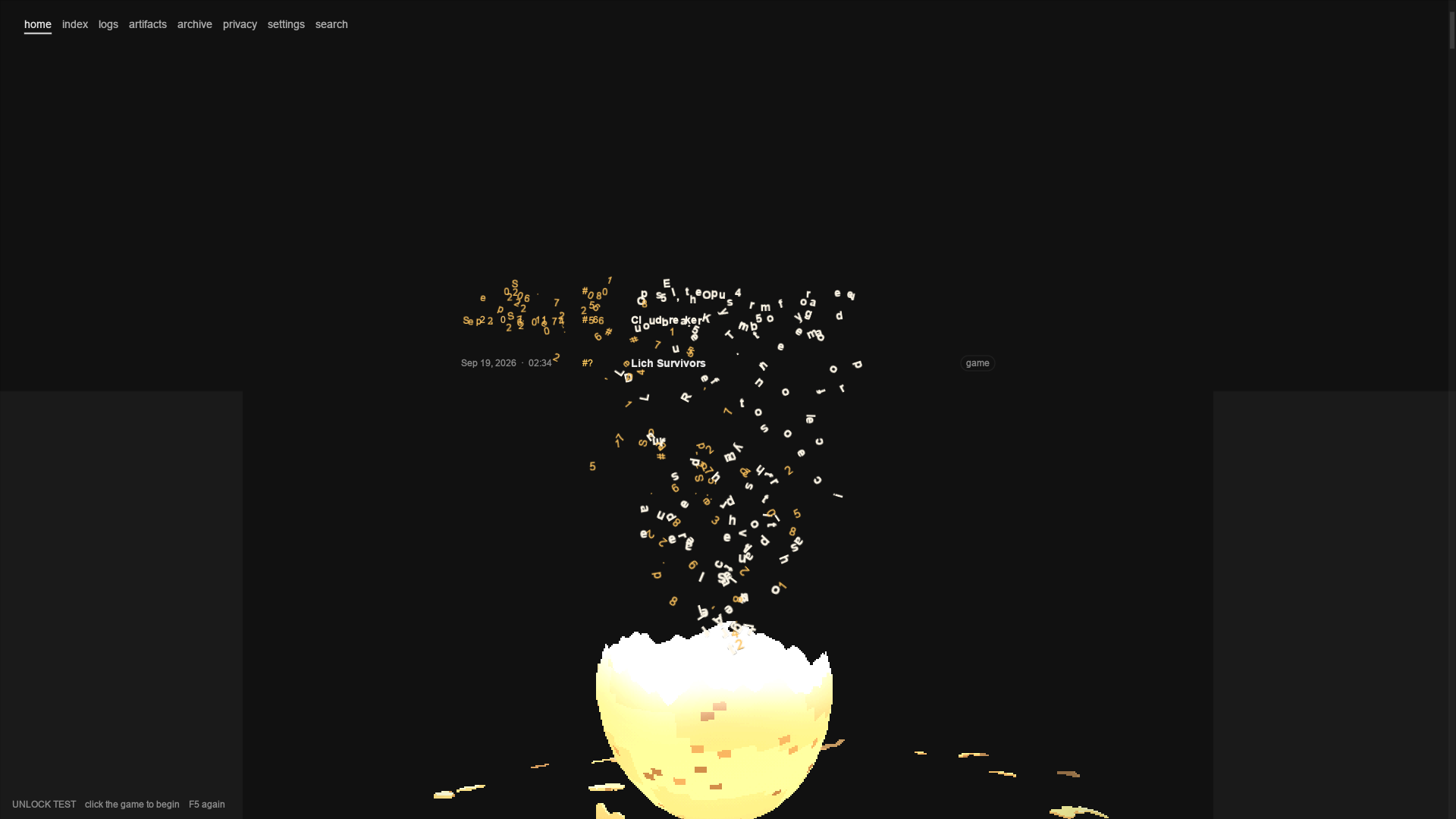
The desktop unlock test, mid-letters (headless capture, the same setup run-unlock.bat opens)
Code: lich-survivors @ 6278a14408 (1 file, +11 -0)
Where in the shift+caps lock launcher is the website-based game?
[Think]
The user is asking about a shift+caps lock launcher, which reminds me of the Anchor/launcher mentioned in CLAUDE.md. I want to check what the launcher actually lists and whether the website-based game appears there.
Bash (cd /c/Users/a327e/Desktop/a327ex/Anchor/launcher 2>/dev/null && ls && (cat READM...)
[Think]
Discovery scans up to 3 levels deep for folders with main.lua and an anchor directory. I notice the renderer has its own old anchor.exe next to main.lua, which per the engine-resolution rule would take precedence over a newer engine — that could cause the launcher to use a stale build for the renderer. I should also verify roots.txt includes a327ex-site under a327ex within the 3-level depth limit.
Bash (cd /c/Users/a327e/Desktop/a327ex/Anchor/launcher; sed -n 60,140p README.md; echo...)
Checking what the picker actually lists and how it would launch the site.
Bash (cd /c/Users/a327e/Desktop/a327ex/Anchor/launcher; bash launch-game.sh --list 2>&...)
[Think]
The site path is at renderer, and since an old engine binary already exists there from August 9th, the launcher would pick that outdated engine instead of one capable of running Lich — plus it wouldn't set the SITE_UNLOCK_TEST or LICH_START flags, so it'd just load the plain site.

I should check last-game.txt, launch.txt, and last-run.log to see if he actually tried launching it around 17:34-17:35 today and whether it failed.
The site is in the picker as a327ex-site/renderer. His last launch was at 17:34 today; checking what it ran and whether it failed.
Bash (cd /c/Users/a327e/Desktop/a327ex/Anchor/launcher/state; cat last-game.txt; echo;...)
[Think]
He launched it at 17:34 and it ran with the old engine binary since a game's own engine next to main.lua takes priority — that's the Aug 9 build, which boots the plain site without admin rows or the unlock test. So he likely searched for the Lich game and didn't find it, since that row only shows up in admin mode.

Now I'm weighing fixes: either remove or archive renderer/anchor.exe so the picker falls back to the shared build (but need to check if preview.py and the DLLs depend on it, and whether it's tracked in git), or give the unlock test its own picker entry — though the picker can't set the needed env vars like SITE_UNLOCK_TEST and LICH_START, so I'm wondering if the site itself could trigger admin mode on desktop without them, or if the picker could just launch a .bat file instead.

Really the user wants to know where to run the website-based game from the shift+caps lock launcher — currently it's the "site"/"renderer" entry, but that launches the old engine without Lich, so it won't show the actual game. I need to make that entry do what run-unlock.bat does, possibly by making the unlock test the default behavior for desktop site runs, though that risks affecting the anchor preview tool too.

A better direction might be generalizing the launcher to discover run-*.bat variants inside a game folder and list them as separate picker entries — this would also help lich-survivors with its run-fixed-seed.bat variant. That means figuring out how the launcher spawns processes for a .bat versus an .exe, likely via cmd.exe /c.

The bigger fix though is engine selection: renderer's own anchor.exe currently wins over the shared build, which is the wrong engine for the site. Since I moved run.bat to use the shared build, the old anchor.exe and its DLLs are only used by the launcher's "own engine wins" rule and by preview.py — so the cleanest fix is moving renderer/anchor.exe aside and updating preview.py to point at the shared build.

But I recall last session confirmed the newer engine is already live and pixel-identical on 11 pages, so there's no reason to keep pinning the old one — I just need to check whether anchor.exe is git-tracked before deleting it, since that could affect other checkouts, though the VPS build path doesn't depend on it anyway. Since the user's actual ask was simply "where is it," I should answer that directly, then fix the launcher issue as reversible local cleanup per standing permission.
[Think]
The picker launched the old August renderer/anchor.exe because it prioritizes a game's local engine over others, and loaded the plain site without the Lich test setup. I'll dig into the resolver now to fix both issues.
Bash (cd /c/Users/a327e/Desktop/a327ex/Anchor/launcher; wc -l launch-game.sh launch-co...)
Bash (cd /c/Users/a327e/Desktop/a327ex/Anchor/launcher; sed -n 100,135p launch-game.sh...)
[Think]
I'm noting that the spawned process runs via cmd with output piped to tee, inheriting the unelevated environment from the AHK runner with no control over env variables. Now I'm thinking about how to make the picker surface "the website with Lich" for the unlock test — maybe the launch record could carry the exe path and run through a batch file wrapper.

For discovering variants, I'm considering having the resolver scan game folders for `run-*.bat` files and expose them as extra picker entries, where the entry's full path is the path to the bat itself (like a run-unlock.bat or run-fixed-seed.bat), so typing a filter term matches it directly and the resolver hands back the exact path to use as the exe. I'm checking how many such variant batch files exist across other games to see if this pattern holds up.

Caps Lock relaunch and Ctrl+Caps replay need to resolve the game directory from whichever bat was last launched, and the snapshot script similarly needs the game dir derived from that path rather than assuming a fixed structure. I'm also weighing a less invasive alternative where the launcher stays untouched and the site itself exposes admin/test variants on desktop, but that doesn't cleanly support env-var-driven test modes like the unlock scenario.

Since the desktop machine is inherently his, admin checks there could just default true without needing a token, letting the Lich row and the Reading settings' hidden switches (VIEW AS PUBLIC, LICH FROM THE EGG) appear naturally in the plain desktop site. If the desktop engine persists web_store state to a file, those switches would carry over run-to-run just like on the web version, making the desktop site mirror his admin device — including F5 replay behavior when VIEW AS PUBLIC is toggled on.

But this changes the home page for every use, including pixel-identical drive tests that didn't expect the extra admin row, and the manifest blocks the desktop site from reading the game directory directly anyway. I keep coming back to the launcher's bat-variant approach as the cleanest, most targeted answer — adding a dedicated run-unlock.bat entry rather than altering the shared site behavior, since the user's real question was simply where that website-based game lives in the shift+caps lock picker.

He launched `a327ex-site/renderer` at 17:34 and saw the site but not the Lich game, so he expects it to actually be reachable from there. I want to survey the run-*.bat files across the discoverable game folders to see what adding this variant would look like in the listing.
[Think]
I'm checking which game folders have extra `run-*.bat` launchers, since a `.bat` dropped into the exe slot runs as-is, to see what value adding them to the picker would provide.
Bash (cd /c/Users/a327e/Desktop/a327ex/Anchor/launcher; bash launch-game.sh --list 2>/...)
[Think]
I only see two legitimate variants, run-unlock.bat and run-fixed-seed.bat, so I should verify the fixed-seed script behaves correctly with directory changes before updating launch-game.sh to detect these run-*.bat files per game folder and register them by full path as entries in the games list.
Only two exist: renderer/run-unlock.bat and Lich's run-fixed-seed.bat. Both are real launchers worth listing. Reading how the resolver builds and matches its list.
Bash (cd /c/Users/a327e/Desktop/a327ex/Anchor/launcher; sed -n 1,60p launch-game.sh; e...)
[Think]
I'm thinking through how to extend discovery in launch-game.sh so Windows run-*.bat files also get listed as entries, tracking both the game directory and the bat path, and figuring out how typed input like "unlock" should match against the bat filename.

For launching a matched bat entry, I'm working out the right cmd /c quoting so the bat runs in its directory with an empty argument piped through tee without breaking on nested quotes.

The bat itself runs a sync step before launching the engine and pauses on failure, but since stdin stays attached to the console that should work fine even with tee capturing stdout.

For Caps Lock relaunch, matching against the stored last-launched path works the same for a bat as an exe. But for the replay shortcut, I realize I can't just reuse the bat as the executable — replay needs to invoke the actual engine binary directly, so I need to keep a separate resolved engine path for bat-backed entries specifically for that case.

Now the bigger issue: the plain renderer entry on the picker still points to the old renderer/anchor.exe, which doesn't match what run.bat actually launches (the shared build). I'm weighing whether to move or delete that old exe and update preview.py to reference the shared build instead, rather than trying to special-case run.bat in the launcher logic.
[Think]
I'll set up each game folder's `run-*.bat` as its own picker entry launched via its full path, with replays staying on the engine, and I'll check whether `renderer/anchor.exe` is still needed so the plain site entry can just use `run.bat`.
Bash (cd /c/Users/a327e/Desktop/a327ex/a327ex-site; git ls-files renderer | grep -i "...)
[Think]
Removing anchor.exe from git in the site repo is reversible since it's tracked, and it's irrelevant on the Linux VPS checkout anyway—so deleting it there is safe. I'm weighing whether that's actually the right move versus just adjusting the launcher's engine preference logic instead.

The real question is the untracked DLLs, which are gitignored and large; if they're identical copies of the ones already in Anchor's build folder, deleting them loses nothing. I should verify via checksum before removing, and also update preview.py to point at the shared engine build going forward.
renderer/anchor.exe is tracked in git (so retiring it stays recoverable), and only anchor preview still uses it. Checking whether the DLLs next to it are copies of the shared build's.
Bash (cd /c/Users/a327e/Desktop/a327ex; for f in avcodec-61.dll avfilter-10.dll avform...)
[Think]
These DLLs are byte-identical to copies in the Anchor build, so it's safe to remove the renderer executable and the duplicate DLLs since they're recoverable from git history if ever needed.

Let me double-check whether anything else references the exe directly — scanning for other scripts, batch files, or config entries across the site that might call it beyond preview.py.
The DLLs are byte-identical copies, so nothing is lost by removing them. One wider search for anything else that runs renderer/anchor.exe directly.
Bash (cd /c/Users/a327e/Desktop/a327ex; grep -rln "anchor.exe" a327ex-site/renderer -...)
Bash (cd /c/Users/a327e/Desktop/a327ex; grep -n "anchor.exe" a327ex-site/renderer/tool...)
[Think]
Build-web.sh only references the exe/DLLs in comments, so it's safe to remove them from the bundle. Now I'll implement the changes: remove anchor.exe and the six DLLs from the site repo, update preview.py to use the shared build exe, and modify launch-game.sh for the bat variants, starting with the discovery loop logic for added game directories.

On Windows, I'm adding logic to scan each game's directory for `run-*.bat` files alongside `main.lua` and register each as its own launch entry keyed by its full path, guarding against unmatched globs. Then in the run path, I check if a bat file is associated with the selected entry and launch it through the bat spawner instead of the normal engine spawn.

Now I'm thinking through how to actually execute the .bat on Windows — since bash can't exec it directly, I need to route through `cmd.exe //c`, either via AHK's handoff wrapper with logging, or directly with `cd` into the game dir and exec cmd.exe pointing at the bat's basename. I'm considering adding an exe override variable so spawn_engine can reuse the same logic for both normal executables and bat files.

I just need to swap in the bat executable before the print line but after the replay branch, since the replay path still uses the original engine exe untouched. The snapshot and LAST_FILE logic stay as-is, with the AHK picker showing bat entries filterable by name, and I should remember to update the README to reflect this.

For the AHK Spawn piping into tee, I'm confirming pause still works since stdin remains the console even though stdout is redirected, and the python output flows correctly through the pipe into tee. The bat's directory change and path resolution look fine, and since launch-run.ahk uses ShellRun it stays unelevated, so no permission issues there.
[Think]
Confirmed nothing else references it besides a comment in build-web.sh. Next I'll update the launcher so `run-*.bat` files appear as picker entries, keep Caps Lock relaunch working on them, and ensure Ctrl+Caps replays still use the engine.
Edit (C:\Users\a327e\Desktop\a327ex\Anchor\launcher\launch-game.sh)
Edit (C:\Users\a327e\Desktop\a327ex\Anchor\launcher\launch-game.sh)
[Think]
I'm confirming the folder-name matching logic correctly picks the renderer entry first since it's added earlier in the ladder. Next I need to retire the renderer's exe and DLLs, update preview.py, and test with --print and --list.
Now retiring the old engine in the renderer (git-tracked exe, plus DLLs identical to the shared build's) and pointing anchor preview at the shared build.
Bash (cd /c/Users/a327e/Desktop/a327ex/a327ex-site; git rm -q renderer/anchor.exe && r...)
Bash (cd /c/Users/a327e/Desktop/a327ex/Anchor/workflow; grep -n "^import|^from|ANCHO...)
Bash (cd /c/Users/a327e/Desktop/a327ex/Anchor/workflow; python - <<'EOF' p='lib/previe...)
[Think]
That SKILL.md diff isn't something I made, so I'll leave it untouched. For testing the launcher, I want to check --list and --print against several keywords like "unlock", "renderer", "lich", and "fixed", plus try --last --replay --print with a bat key — though I need to be careful since --print doesn't persist to LAST_FILE, so I shouldn't disturb existing state while verifying path resolution.
Testing the resolver without launching anything (--list and --print).
Bash (cd /c/Users/a327e/Desktop/a327ex/Anchor/launcher; bash launch-game.sh --list | g...)
[Think]
I'm wondering if testing the handoff path with --handoff would actually overwrite the real last-game.txt and timeline snapshot, since STATE_DIR is hardcoded to the script's state directory on Windows—I need a way to test write_record without those side effects, maybe by pointing to a temp state location.
[Think]
Everything resolves correctly: bats run through themselves, the plain site uses the shared engine, and replays use it too. Next I'll check the exact handoff record the picker's AutoHotkey would spawn from, backing up and restoring his launcher state around it.
Bash (cd /c/Users/a327e/Desktop/a327ex/Anchor/launcher; grep -n "NOSNAP=|--no-snap|-...)
[Think]
I'm checking that AHK's command actually invokes the batch file correctly from its own directory, ignoring the passed argument, and piping output through tee. Running it directly would pop up a visible site window on his desktop though, which isn't allowed, so I need another way to verify it works without actually triggering that.

I could test this safely by creating a scratch batch file that just echoes something and exits, then wrapping the exact same nested quoting structure cmd /c would use into a wrapper .cmd file and running that via cmd //c from bash, since that shouldn't open a visible window. This lets me confirm the quoting survives correctly without launching the real site.
[Think]
I'll verify this by testing with a harmless scratch .bat file that just prints and exits, running it through cmd exactly as the picker would (with quotes and the tee pipe).
Bash (S="C:\Users\a327e\AppData\Local\Temp\claude\C--Users-a327e-Desktop-a327ex...)
[Think]
I need to be careful with backslash escaping in the printf format — the bash heredoc tool tends to halve backslashes, so I should use the Write tool instead to create these files properly.
printf mangled the backslashes; writing the test files with the Write tool instead.
Write (C:\Users\a327e\AppData\Local\Temp\claude\C--Users-a327e-Desktop-a327ex\81cb4a0c-3c8c-4b27-96ab-b4c3bca4a986\scratchpad\batdir\run-test.bat)
Write (C:\Users\a327e\AppData\Local\Temp\claude\C--Users-a327e-Desktop-a327ex\81cb4a0c-3c8c-4b27-96ab-b4c3bca4a986\scratchpad\wrap.cmd)
PowerShell ($s = "C:\Users\a327e\AppData\Local\Temp\claude\C--Users-a327e-Desktop-a327ex\81c...)
[Think]
The batch script works properly, locating its folder, setting env vars, and teeing output into the log. Since the picker regenerates games.txt on each Shift+Caps trigger, new bat entries will show up immediately without needing an AHK restart. Next I need to update the launcher README's Discovery/Engine sections and the header comment in launch-game.sh, then commit the Anchor repo changes including preview.py.
The bat runs in its own folder with its environment set, and its output reaches the log. Updating the launcher's README and header to describe the new entries.
Bash (cd /c/Users/a327e/Desktop/a327ex/Anchor/launcher; grep -n "^**Names are full p...)
Edit (C:\Users\a327e\Desktop\a327ex\Anchor\launcher\README.md)
Edit (C:\Users\a327e\Desktop\a327ex\Anchor\launcher\launch-game.sh)
[Think]
I'll verify the launch-game.sh script's bash syntax, then commit the Anchor launcher files and README along with the preview library changes, plus the site update removing anchor.exe. I'll also note the retirement and picker entry in REDESIGN §40.
Bash (cd /c/Users/a327e/Desktop/a327ex/Anchor; bash -n launcher/launch-game.sh && echo...)
Bash (cd /c/Users/a327e/Desktop/a327ex/a327ex-site/renderer; python - <<'EOF' p='REDES...)
[Think]
I should also check if memory needs updating — there's no separate launcher memory, but the Lich memory references run-unlock.bat, so I'll add a note about the Shift+Caps 'unlock' shortcut there, plus a quick edit to the ROUND 71 line in project_lich_dream_game.md.
Bash (cd ~/.claude/projects/C--Users-a327e-Desktop-a327ex/memory; python - <<'EOF' p='...)
It wasn't really in there until now. The picker only had the plain site (a327ex-site/renderer), and that entry couldn't show the game. It launched the site's own old engine from August, which can't run Lich. It also opened the site as a normal visitor sees it, and that list has no Lich row. Your 17:34 launch was that one.
Now: press Shift+Caps Lock and type unlock. The entry is C:/Users/a327e/Desktop/a327ex/a327ex-site/renderer/run-unlock.bat, which is the same as double-clicking that file. It updates the game's copy, then opens the site with the locked posts hidden and Lich at its egg. Click the game to play the ending; F5 runs it again. Caps Lock relaunches it after the first time.
What I changed:
- The picker now lists any game's extra
run-*.batfiles as their own entries and runs them through the bat. There are two today:run-unlock.batand Lich'srun-fixed-seed.bat(typefixed). Ctrl+Caps Lock still replays the game's newest recording. - The old engine is retired. I removed the site's August
anchor.exefrom git; its six DLLs were exact copies of the shared build's, so I deleted them. The plainrendererentry,run.batandanchor previewnow all use the shared engine.
I checked the picker's lookup for each entry. I also ran a stand-in .bat through the picker's exact command line: it started in its own folder, kept its settings, and its output reached the launch log. I didn't open the real site window, so your first unlock launch from the picker is the first real one.
Commits: launcher ef8e493 (Anchor), site afe4555f. Nothing is pushed or deployed. The live-site fix from earlier is still waiting on your yes.
Recorded run: renderer, 20261013-173953
Give me a key to reset the egg and play the animation again.
[Think]
He's asking for a key to reset the egg and replay the animation—F5 already does that in run-unlock.bat's test mode, so maybe it's not working for him, or he means something slightly different like an instant reset-and-play without needing a click, or he could be referring to the standalone Lich game instead.

I should check whether F5 is actually bound at the engine level for something else, like a reload or hotkey that could conflict with my injected key. I should also check his recent run logs and last-game state to see if he actually tried F5 already.
F5 should already do this in the unlock test, so first I'm checking whether he ran it and whether F5 failed for him.
Bash (cd /c/Users/a327e/Desktop/a327ex/Anchor/launcher/state; date; ls -la --time-styl...)
[Think]
He ran the session around 17:39:51 for about 40 seconds and the capture clearly happened, then closed it shortly after without any sign that F5 registered—no restart log appeared. So he's now asking for a key, which suggests he either missed the hint or F5 simply didn't work, possibly because the game's own key handling intercepted the raw keypress.

Rereading his request, he's asking for a key that resets the egg and replays the animation in one action—no clicking, no waiting through the ending sequence first. That's a slightly different ask than just "press F5 to restart"; he wants something that jumps straight to the egg-break and letters. Given he likely missed the small dim hint text, I should just give him exactly what he asked for: a single key that resets and replays.

The egg knocking, cracking, and hatching sequence is already the full 9-second animation, so that part should stay intact rather than being shortened. I'm weighing whether to avoid a full game restart (which leaks ~69MB each time) by instead resetting the egg sequence directly within the game, but that's riskier and more work than just reusing the existing restart path, so I'll stick with restarting and look at how to make the replay skip the click-wait — likely by having the game check a flag so it starts the egg sequence immediately after a hosted restart instead of waiting for a click.

This would require a small game-side change to detect an "EGG_NOW" start signal and bypass the wait condition, but since CLAUDE.md requires parity between the site-hosted build and the three.js build, any such change needs to be reflected in both versions.

Actually, a site-only fix might work better: extend the host environment to support a synthetic one-tick mouse press, so the game's existing input check still fires naturally without touching game logic at all.

I also need to worry about the click doing double duty — in the egg start it might trigger both the wait-skip and a click-to-move order processed by mouse_input() on the same frame, though with SEQ already dying the lich's goal is likely ignored.

So the practical approach is a synthetic click injected right after restart, matching exactly what a real player click does. I need to figure out where in the update cycle the restart happens so I can time the injected click to land on the correct frame of the new instance's update loop.

For keybinding, I should keep the first run requiring a real click but make the hotkey trigger an immediate reset-and-replay. I'm not sure F5 is the right choice since it might not even be intercepted correctly, so I should check the engine source for any existing F5 handling before committing to it.
[Think]
The run at 17:39 played the letters and was closed 40s later with no restart line logged, meaning F5 was never pressed or never registered. I'll check if the engine intercepts F5 before the site can detect it.
Bash (cd /c/Users/a327e/Desktop/a327ex/Anchor/engine/engine/src; grep -n "SDLK_F[0-9]...)
[Think]
The engine itself doesn't seem to intercept F5, so it should theoretically work as a shortcut. I wonder if the issue is actually his keyboard — the AULA F87 might have Fn-lock or media key defaults on the F-row that could interfere.

Since that's uncertain, a letter key would be more reliable. I'm thinking "R" for replay/reset, but I need to make sure it's guarded against text input fields, find bars, and chat compose boxes — checking if there's a function like compose_capturing() or something similar that tracks focus state so the shortcut doesn't fire while someone's typing. The plan is to bind R alongside F5, with a hint label, so a single press hides posts, restarts the game, and triggers the ending sequence immediately.

I'm also noticing there's a ~69 MB memory leak on each restart, likely from GPU meshes and textures for the cave/mask assets not being freed — I'd need to check the engine for mesh_destroy or texture_unload calls to see if a proper cleanup path exists, but this seems like a deeper rabbit hole than worth pursuing right now, so I'll just note it rather than fix it.

On the actual implementation, I'm tracing how mouse input injection works: env.mouse_is_pressed checks both the injected input state and the real capture state, and it.inject gets initialized as an empty table before the environment is built. Now I need to find where inject values get decremented in the game host update loop.
[Think]
I'll switch the replay trigger from F5 to the R key, since the F-row may be sending media keys instead on his keyboard, and consolidate hiding posts, resetting the egg, and starting the ending into a single press. Now checking how the host injects one-tick key presses into the game.
Bash (cd /c/Users/a327e/Desktop/a327ex/a327ex-site/renderer; grep -n "inject" game_hos...)
Bash (cd /c/Users/a327e/Desktop/a327ex/a327ex-site/renderer; sed -n 855,875p game_host...)
[Think]
I'm checking whether the game's update loop reads mouse input every frame or only on certain ticks, since Lich's framework might not guarantee input is processed on every call—this matters for whether a single-tick injection would be reliably caught.

I'm deciding to use a single press injection rather than a double, since the sequence init only clears the goal once at start and a second click mid-sequence might get ignored anyway. Now I want to find how the site gates keyboard shortcuts like 'R' against text focus, so I'm searching for the compose_capturing check and the find bar's open-state variable to make sure my test doesn't fire while a text field is focused.
Bash (cd /c/Users/a327e/Desktop/a327ex/a327ex-site/renderer; grep -n "^function find_[...)
[Think]
I want to check find.lua for how the find state is tracked globally, searching for related variable names.
Bash (cd /c/Users/a327e/Desktop/a327ex/a327ex-site/renderer; grep -n "^[A-Z_] = *{|...)
Found the text-field guards I need (posting frame, find bar, search). Now writing the change: the game host learns to inject one click, and the unlock test uses it for R.
Edit (C:\Users\a327e\Desktop\a327ex\a327ex-site\renderer\game_host.lua)
Edit (C:\Users\a327e\Desktop\a327ex\a327ex-site\renderer\game_host.lua)
[Think]
The inject decrement only happens if visible after the update, so it'll just stay queued until the game becomes visible, which seems fine. I'm also checking that is_pressed's inject lookup by action name won't collide with keys like 'mouse:1'. Now moving on to look at unlock_fx.lua's test.
Now the unlock test: R (F5 kept) restarts, then clicks the game for him once it's up.
Edit (C:\Users\a327e\Desktop\a327ex\a327ex-site\renderer\unlock_fx.lua)
Edit (C:\Users\a327e\Desktop\a327ex\a327ex-site\renderer\unlock_fx.lua)
Edit (C:\Users\a327e\Desktop\a327ex\a327ex-site\renderer\unlock_fx.lua)
[Think]
I should also update the header comments in unlock_fx.lua and run-unlock.bat to match, thenI need to update the header comments referencing F5 in both unlock_fx.lua and run-unlock.bat, and check whether 'r' is already bound elsewhere in main.lua or used by Lich during gameplay, since a key press could leak to the old instance right before restart depending on update order.

Then I should test the flow: inject the 'r' key, confirm the game restarts, the click fires automatically, and letters start appearing roughly 9 seconds after pressing R across all 16 rows, repeating this three times to confirm consistency.
Updating the header and launcher comments that still say F5, then checking that nothing else on the site or in the game reads R.
Bash (cd /c/Users/a327e/Desktop/a327ex/a327ex-site/renderer; python - <<'EOF' import r...)
[Think]
No other remaining uses of R to worry about. Now I need to test this headlessly by updating the probe script to press 'r' instead of f5, and make it auto-click without manual clicking on rounds 2 and beyond.
Nothing else uses R. Headless check: three rounds where R alone (no click) has to bring back the egg, the ending and the letters.
Agent run: renderer, 20261013-174240
Bash (cat > /c/Users/a327e/Desktop/a327ex/lich-survivors/scratch/s15/r_probe.lua <<'EO...)
[Think]
Both cases check out—a solo R replays cleanly, and an R in the middle of letters cancels properly, with the round-3 R restarting right after. Since the changes live in the site files that the batch script reads on launch, the game itself stays untouched. Time to commit the site changes.
[Think]
R now reliably replays the full sequence—hiding posts, resetting the egg, and restarting letters after a consistent 9.0s delay—and cancels cleanly if pressed mid-letters. I'll commit this with a note in the records.
Bash (cd /c/Users/a327e/Desktop/a327ex/a327ex-site/renderer; python - <<'EOF' p='REDES...)
[Think]
I need to fix that memory note about the Lich - it says "F5 again" but should reference R instead.
Bash (cd ~/.claude/projects/C--Users-a327e-Desktop-a327ex/memory; sed -i 's/game at th...)
The key is R. In the unlock test (Shift+Caps Lock, unlock), one press hides the posts again and resets the egg. Then it plays the whole ending without a click: the lich dies, the egg knocks and opens, and the letters build the posts. Pressing R while the letters are still flying starts it over cleanly.
R doesn't fire while you're typing in the posting frame, find or search. F5 still works too. Your 17:39 run never received F5, and your keyboard's F-row may need Fn, so a letter key is the safer default. The corner line now names R.
I checked it in a headless run with only R pressed, mouse outside the game, three times in a row: each time the letters began 9.0 s after R and built all 16 posts.
Each replay still costs about 70 MB, so close and relaunch after a few dozen. It takes effect from your next launch. Committed as site 882d32e3, not pushed or deployed.
Code: lich-survivors @ 2d5b5cd4c1 (1 file, +3 -0)
Recorded run: renderer, 20261013-174807
The tween should be fast start and slow settle in terms of letter speed, but give me some options too. The scroll up should be linear (I believe it's linear now), but also give me some options. The lines as they finish seem to flash awkwardly for some reason. As the camera pans up, each post should have an animation on its lock icon, it should break apart and fall signifying that the post got unlocked, with light camera shake. The game should take over the screen as much as possible vertically and horizontally, and the black bars on the sides should be the color of the website's background. As the egg becomes the only thing on the screen, the game's background color should also approach the wbesite's background color.
[Think]
This is a substantial design request to reconsider. The current letter animation uses a damped spring with gradual k ramp-up and initial fountain velocity, but what's wanted is more of a fast-start, slow-settle feel—like an ease-out curve rather than the current spring behavior.

I'm thinking through concrete options: easeOutExpo, easeOutQuint, easeOutCubic, easeOutBack with slight overshoot, or a critically damped spring with high initial velocity but no ramp. I need a way to let him switch between these options live in the test, maybe mapping number keys to different tween styles with an on-screen label showing which is active, since this is the kind of subjective choice that needs his direct feedback on concrete attempts rather than guessing upfront.

Next I'm looking at the scroll-up behavior, which he thinks is linear but is actually exponential smoothing toward a target position with an ease-out-ish follow — I'll offer linear, ease-in-out, and the current follow as switchable options too.

Then I'm digging into why lines flash awkwardly when they finish animating: once a row's letters settle, the real row gets drawn instead of the animated glyph layer, and the flash likely comes from non-glyph elements (background wash, rule lines, lock icons, date separators) popping in suddenly, or from a color/alpha mismatch between the captured glyph color and how the real row renders it.

I also want to check for subpixel positioning differences and the timing mismatch where letters in a row land at different moments but the whole row only swaps to "real" once everything settles — that abrupt bright-to-dim transition combined with icons and rules appearing all at once could be the real source of the flash. I should capture a dense frame sequence around a row finishing to actually see it happen, then separately look into the lock icon breaking-apart animation during the camera pan, though I'm noting that in public view those locked rows are hidden entirely anyway.

Now I'm trying to figure out whether gated rows are shown to a non-admin visitor at all, or omitted outright — and if they are shown, whether they appear as locked placeholders with a lock icon next to the number rather than full content, based on what I noticed in the captured frame with the small icon beside the row number.

So the request is: as the camera pans upward, each post's lock icon should shatter apart and fall with a slight camera shake, signaling that the post has become unlocked. That raises the question of whether the lock disappears permanently after breaking or whether it reappears on reload since the actual gated status wouldn't change — meaning I'd likely need some kind of session-level flag to suppress the icon on rows that triggered this animation.

I also need to check how the lock icon is actually rendered in the row-drawing logic, since that determines whether it's a glyph from an icon font or something else I'd need to capture differently for the shatter effect.

On the sizing issue, I'm realizing the game currently renders at a fixed 640x360 frame scaled by integer factors, which leaves bands on either side within the 1920-wide strip. To make the game "take over the screen" as much as possible, I should scale it up so it fills the viewport — and I notice that at 3x scale, 640x360 becomes exactly 1920x1080, filling the screen perfectly with no bars at all on a standard display.

I also need to account for the actual browser viewport differing from the raw monitor resolution due to browser chrome, which complicates picking a clean integer scale — fractional scaling risks uneven pixels with nearest filtering or blur with linear filtering, given the game's fixed 640x360 render resolution.

I'm considering whether a sharp-bilinear approach could work: render the 640x360 frame at an integer multiple using nearest filtering, then downscale with bilinear to the fractional target size, which would avoid the uneven pixel widths while still letting the game fill more of the screen.

But maybe I'm overcomplicating the goal — perhaps "fill the screen" really just means the game strip should be full-bleed horizontally and as tall as possible, with the side bars taking on the site's background color instead of plain black, since those black bars are likely what's drawing attention right now.

My options are: integer scaling for crispness (won't grow much on 1080p), fractional nearest scaling, or fractional with sharp-bilinear smoothing. I'll go with fractional scaling to better fill the viewport below the top bar, and I need to trace how the strip height and scale factor k get computed in the layout code for the fixed-size game row to make this change correctly.

On point six, there's the note that as the egg becomes the only element on screen, the game's background should also approach the site's background color — round 62 already handles fading everything but the egg to #111111. But I should check whether that's actually the exact site background hex across themes, since the site might use a slightly different dark shade depending on theme.

I'm also considering whether the black bars on the sides should match the site bg rather than pure black — I'd need to measure actual pixel colors in the b_letters frames to compare center game area vs the side bars vs true site background. One option is having the game query the site for its live background color via a function instead of hardcoding #111111, applicable only when hosted on the site.
This involves options for you to compare, so I'm loading the iterate skill first.
Skill (iterate)
[skill: iterate]
[Think]
The real decisions needing his input are the letter-swap options and the scroll options, plus how the lock-break should look — everything else like the flash bug, bar colors, and matching the game background to the site is mostly just implementation work. For "takes over screen as much as possible," I'm weighing whether to go with crisp integer scaling versus fractional, since fractional fills more space but creates uneven pixels — I might just offer both as an option.

I'm sketching the plan: Round 72 with the Lich unlock, letting him cycle through tween and scroll options with key presses while an on-screen label shows the current choice, with an R key to replay — simple enough for him to test quickly. But I need to think through how key capture works when the Lich boss uses WASD-style movement, since the test keys might conflict with the game's own input handling.

I'm settling on E for cycling letter easing and C for cycling the camera/scroll behavior, with R to replay, checking that these keys aren't already claimed by the site's raw key bindings (like Ctrl+C for copy, which shouldn't collide since it requires the modifier).

For persistence across launches, I'll likely just keep the choice for the session and default back to option A on relaunch, rather than bothering with file storage since that adds unnecessary complexity.

Now I'm refining the "fountain" effect itself — letters launching upward in a cone at 520-1150 px/s, with a spring force that ramps up in strength over about half a second to pull them back into place.

For the actual motion curve, since he wants fast start and slow settle, I should use an ease-out function for the timing — options range from a dramatic ease-out expo to a gentler cubic/quart, or even an ease-out-back that slightly overshoots before settling. I also need to decide on the path shape itself: a straight line versus an arcing bezier that mimics the fountain-like flow he originally described, with golden and white letters flowing up and out of the egg.

I'll add a fourth option, easeOutBack with overshoot, keeping the current spring as a baseline comparison for a total of five easing cycles. For scrolling, I'm weighing three approaches: linear scroll matched to the build duration, the current exponential-smoothing follow behavior, and an ease-in-out variant to see which keeps the newest row best in view.

I'm weighing scroll animation styles — linear, ease-in-out, follow, ease-out — and thinking about how to add a light camera shake when locks break, probably by jittering the scroll_y offset briefly rather than touching the whole render pipeline.

I need to check main.lua's draw code to see if there's a layer transform I can hook a shake offset into, then look at how the lock icon gets drawn in front_draw_row, and capture a sequence of frames to diagnose why finishing lines flash awkwardly.

I also want to check what fills the strip area outside the game rect — likely the composite background — and compare the game's fade-to-dark color against the site's theme background by sampling actual pixel values from frames.

I'll give him a quick heads-up that I'm moving into iteration mode, then start making the tool calls to dig into the code.
[Think]
Treating this as an iterate round: I'll give you switchable options for the letters' easing, scroll motion, and lock-break visuals to review in the desktop test, while fixing the flash, full-screen game, and colors directly. Starting now with the code for a row's lock, the game's frame, and the side bars.
Bash (cd /c/Users/a327e/Desktop/a327ex/a327ex-site/renderer; grep -n "^function front_...)
Bash (cd /c/Users/a327e/Desktop/a327ex/a327ex-site/renderer; sed -n 398,480p front.lua...)
Bash (cd /c/Users/a327e/Desktop/a327ex/a327ex-site/renderer; grep -n "^local function ...)
[Think]
The lock is made of shapes rather than letter glyphs, so it must pop in separately when the row becomes real, along with the row rule line appearing at the end. For the lock sequence, it needs to exist during the build so it can later break — letters arrive, the row completes and becomes real with its lock attached, then the camera pans upward.

As the pan continues, each row's lock should break apart shortly after the row is built: shackle and body pieces fly and rotate with gravity, fading out, accompanied by a light camera shake per break for a subtle, constant jitter effect using a fast-decaying impulse. I'm now considering how to render the breaking pieces geometrically — whether the engine supports transformed layers for rotating shapes, or whether I should instead decompose the lock into polygon fragments drawn directly.

Lock shards would be body pieces split into rough polygon shards plus shackle halves as thick polyline arcs, each defined in local coordinates and rotated/translated in Lua before drawing. I need to check whether the engine exposes polygon drawing and transform-push functions, and also look at how the page's shake offset gets applied in the main draw loop.
[Think]
The lock renders from shapes rather than text, so it appears abruptly when a row becomes real—likely causing the flash. Now checking the engine's available calls for rotated shapes and a whole-page shake effect.
Bash (cd /c/Users/a327e/Desktop/a327ex/Anchor/engine/docs; grep -n "layer_push|layer_...)
[Think]
I'm working out how to render the lock pieces in local coordinates using layer_push with rotation—splitting the body into shards and the shackle into left/right arc-and-leg halves drawn as line polygons.

Given the lock is tiny (~10px), I'm thinking the break should scale it up slightly with a jolt before splitting: shackle pops off, body shards fall with gravity, spin, and fade over ~0.8s so the effect reads despite the small size. I'll draw the falling pieces in document space over the content, and still need to figure out how page shake is implemented.

For the shake itself, I'm checking whether the content draw wraps in a layer transform that could also shift the game composite, since shaking everything (page and embedded game) together feels more natural. The simplest path might just be jittering scroll_y for vertical shake, since that's already how the page camera pans.

I'll need to hook into main.lua's draw function directly, computing a shake offset and pushing a transform around the content, composite, and letter draws before popping it ahead of the chrome. Let me look at the draw function structure around lines 4990-5060.
layer_push takes a rotation, so lock shards can be drawn as rotated shapes. Reading the site's main draw to see where a page-wide shake offset can go.
Bash (cd /c/Users/a327e/Desktop/a327ex/a327ex-site/renderer; grep -n "^function draw|...)
[Think]
I'm figuring out how to add a shake effect to the document rendering by offsetting the draw position, considering both vertical offset into the scroll calculation and horizontal shake via a layer push around the canvas draw, while keeping in mind how the game composite relies on element rects set during drawing.

Doing the x-shift alongside the game's own content would cause a mismatch at its edges since the game layer wouldn't shift the same way, so I'm settling on vertical-only shake as the simpler, cleaner solution -- it gives a satisfying "thud" feel appropriate for a falling lock, avoiding the sync issues a horizontal shake would introduce.

Shaking the whole screen offset would move the HUD too, which feels off since camera shake usually only affects the world, not the top bar — but I'll accept light shake anyway, going with oy-based vertical shake plus letter/piece offsets, amplitude ~3px decaying over 0.18s per lock break, with breaks chaining every 0.2s across the 16 rows as the camera pans upward.

As the camera pans up, the egg (letter source) scrolls below the screen, with letters originating from its document-space position and flying upward into rows. Since the game should fill the viewport as much as possible at the start, the rows build above it off-screen initially, and I need to check how elements.lua computes the game row's strip height and layout for fixed games.
[Think]
The page renders at a single vertical offset, so a shake effect can piggyback on it to move the game and letters together. Next, I'll check how the list sizes the game's strip, its scale, and the side bands.
Bash (cd /c/Users/a327e/Desktop/a327ex/a327ex-site/renderer; grep -n "_gk|fixed" elem...)
Bash (cd /c/Users/a327e/Desktop/a327ex/a327ex-site/renderer; sed -n 3725,3870p element...)
[Think]
I'm wondering if the dark band is actually the sidebar's off-background wash layered on the surface color, rather than the plain page background, which could explain why the bars look darker than expected—so I should check the actual pixel colors to confirm.

For the scaling logic, I'm working out the fractional zoom factor k that lets the game fill as much of the viewport as possible given the top bar height, landing on something like 2.87x scale with narrow side bars around 42px each on a 1920x1080 screen. I'm also thinking through whether the game should capture the mouse wheel whenever it's active, since that would make page scroll, right-click menus, and text selection all stand down while the game owns the cursor.

I need to check whether Lich's game definition sets a wheel_through flag — if Lich doesn't actually use the wheel, I should set that flag so page scrolling still works even when the cursor is over the game. There's also a visual tradeoff with fractional k and nearest-neighbor scaling: pixel columns of uneven width (alternating 2px and 3px) could create shimmering during motion, so I'm weighing whether sharp-bilinear filtering or a different approach to the icon/UI layer scaling would look cleaner than scaling everything uniformly at 2.87x.

Given that the user wants maximum fill, I'll go with fractional scaling but try to minimize the artifacting — maybe by rendering the game layer at an integer scale into an intermediate buffer first, then smoothly downscaling that to fit the fractional target, which costs one extra full-screen draw pass per frame but should look much crisper than naive nearest-neighbor fill. I also want to check how the composite function actually draws its layers before committing to this approach, and separately I should check the game's fade-to-color behavior at round end against the site's background color to make sure they match.
[Think]
Found the sizing rule: pixel games scale to the largest whole number fitting 90% of window height (2x/1280x720 on a 1080-tall window), with side bands matching the sidebar's tint rather than the page color. Now measuring actual colors in last session's frames to confirm.
Bash (cd /c/Users/a327e/Desktop/a327ex/lich-survivors/scratch/s15/frames; python -c " ...)
[Think]
I'm comparing the page background at #111111 against the side bands at #1a1a1a, trying to figure out if the game's faded background should match the dark site bg more closely rather than the slightly lighter band color.

So fixing the bands to match the page background should resolve both the visual mismatch and ideally make the game read the site's theme-aware background color rather than a hard-coded value. I confirm the boundary is visible in the captured frame (band at 26 vs game area at 17), and that page scroll over the game still works fine. Now I want to probe the "flash" effect more precisely by capturing dense frames around when a row completes, cropping to that row to see exactly what changes as the hide flag flips.
[Think]
Confirmed the colors: page is #111111, side bands are #1a1a1a, and the game fades to #111111, so the bands are the visible seam—also Lich's game already passes mouse wheel events through, so a full-screen game won't block page scrolling. Next, I'll capture a finishing row frame by frame to pinpoint the flash.
Agent run: renderer, 20261013-180951
Bash (cat > /c/Users/a327e/Desktop/a327ex/lich-survivors/scratch/s15/flash_probe.lua <...)
[Think]
I'm noticing the scroll motion isn't constant speed — it follows a sawtooth pattern, starting fast around 3.6 px/frame right after each new row begins and gradually decelerating toward roughly 2.7 px/frame before the cycle resets.

This surge happens every 12 frames because the build front jumps by a full row height every 0.2 seconds, and the exponential easing has to catch up, creating a pulsing effect of about ±25% speed variation — essentially a stutter the user would perceive even though they assume the scroll is linear. I want to fix this so it's truly linear. I'll build a contact sheet of cropped frames around the row transitions (frames 1-8 and 15-19) to visually confirm the flash and timing.
[Think]
The scroll pattern is non-linear—it spikes to about 4.2 px/frame at the start of each new row every 0.2s, then decays to 2.7 in a sawtooth shape. I'll examine crops from frames 1–3 to catch the flash as each row renders.
Bash (cd /c/Users/a327e/Desktop/a327ex/lich-survivors/scratch/s15/flash; python -c " f...)
Read (C:\Users\a327e\Desktop\a327ex\lich-survivors\scratch\s15\flash\rows_sheet.png)
[Think]
I'm noticing that when a row becomes real, the lock icon pops in alongside the separator line as part of the flash effect. Looking closer at the settled letters in row 2, they appear to render in bright white rather than taking on their own distinct color.

I'm wondering whether the "pop" effect comes from a subtle rendering difference — maybe the glyph-drawing function uses center coordinates that introduce a half-pixel offset, making the settled text slightly blurrier than the crisp real text once the row flips to real. I want to compare pixel values directly between the landed-letters frame and the real-row frame to confirm this.

Looking more carefully at the crop indexing across frames 1-19, I'm trying to match which row corresponds to which y-position and realizing row 1's landed letters seem to be missing from the render — only a stray "p" character shows up where a full word should be, suggesting the landed letters for a hidden row aren't actually drawn once they're marked done.

That's the bug: letters disappear one by one as they finish settling while the row stays hidden, so the text empties out before suddenly popping back in fully once the last letter lands. The fix is to keep drawing done letters as long as the row is still marked hidden, rather than hiding them the moment they finish. I also need to make sure the lock and rule don't appear abruptly when the row becomes real — ideally the lock should be part of the same build-in animation before it breaks.

Thinking about sequencing: the lock represents the locked post, so it should be visible intact as the row builds, hold briefly once the row is complete, then shatter and fall away to signal the unlock, rather than just popping in and breaking immediately.

As for persistence, I'd suppress redrawing the lock on rows that just unlocked this session by flagging the record, but let it reappear on reload like it would for any reader who's unlocked that post — which is the expected, consistent behavior.

Separately, for the rule-line separators between rows: since rules only appear once a row turns real and letters don't build them, I'm thinking they should fade in progressively as hidden rows reveal their letters, meaning I'd need to draw the rule during the unlock transition rather than relying on the normal row-draw path which bails early for hidden rows.

So the fixes for the awkward flash: keep finished letters visible until a row is fully real, fade the rule line in as a building row's letters land, and keep the lock icon drawn during the build before it breaks away.

Comparing frame 16 vs frame 17 for row 2 confirms the bug — the letters vanish right as they finish typing, leaving a near-empty row that then suddenly pops in with the real text. That's exactly the flash he's describing. Now I need to work out the actual fix.

I'm thinking through letter animation options: cycling through easing curves (expo out, cubic out, spring, back out with overshoot) via a bezier path from origin to target with the control point set by a launch vector, so the motion looks like a fountain with fast-start, slow-settle timing. I'm weighing durations for each — roughly 1.2s for expo, 1.0s for cubic and back.

For rotation, scale, and color I'm settling on easing spin to zero and scale from 1.45 to 1, with color blending from highlighted to the letter's real color over the final 35% of the flight so it's fully settled right as it lands, then the whole row flips to "real" once all letters arrive plus a small buffer.

For scroll behavior I'm sketching four modes (linear, smoothstep ease-in-out, ease-out, and a legacy "follow" style), where linear just interpolates from the starting scroll position to a final target — the final target being set so the newest row ends up near the top of the viewport, clamped to zero.

I'm figuring out the duration for the linear scroll camera: trying D = (n-1)*row_dt + 0.8*T so the camera finishes tracking shortly after letters finish flying in, then I want to verify with a probe that each row's landing position stays within the visible viewport at its land time, adjusting if not.

For the lock-breaking effect, once a row becomes real I want its drawn lock to shatter after a short beat — shackle halves and body shards flying up and outward before falling with gravity, rotating and fading over about 0.9 seconds, plus a small decaying shake impulse for punch.

Next I'm thinking about making the game fill the screen: computing a scale factor that fits both width and height (accounting for the top nav bar), then scrolling so the game sits centered horizontally with its top edge just below the nav rather than hidden under it.

Fractional scaling at nearest-neighbor would give uneven pixels, so I need to check the composite function for a sharp-bilinear option instead. For the background, I want the fade target to use the site's actual theme-aware bg color rather than a hard-coded dark value, and I'm also noting the current hint text showing the letter/scroll/replay controls.

This should eventually work on the web too, though the current options are just for testing while the final defaults get shipped. Now let me look at game_host_composite.
[Think]
Each row's letters disappear one by one until settled, then the whole row reappears at once with its lock and separator (seen between frames 16 and 17). Now checking the game composite to see how a non-whole scale renders.
Bash (cd /c/Users/a327e/Desktop/a327ex/a327ex-site/renderer; grep -n "^function game_h...)
[Think]
I'm thinking about how to draw a layer's texture into a destination rectangle, applying its filter mode. For non-integer scaling with sharp-bilinear, I realize I need an intermediate step: first upscale with nearest-neighbor to a clean integer multiple, then do a smooth bilinear downscale to the final size to avoid uneven pixels.

Then I'm working out whether this intermediate layer needs to be cleared each frame before drawing the game layers into it, and confirming the render/draw order (bake queued commands, then composite into the intermediate, then composite that into the UI layer) — concluding it's a reasonable extra pass. I also note that fine-detail icon layers drawn at a non-integer scale into this intermediate will still end up uneven despite the fix for the main frame.

I'll go with sharp-bilinear for the frame layers; the icon layer still routes through the same intermediate scaling, which produces a slightly uneven result but is probably unnoticeable for subtle camera shimmer at 360p. This mirrors the standard emulator approach, so I'll commit to that as the practical solution.

On the implementation side, I need to confirm the DPR behavior on web matches the same physical-pixel logic, and then check whether `layer_draw_into` can draw into a non-UI layer that then feeds into the UI layer — I need to verify the layer creation and draw-into semantics against the engine API reference.
[Think]
I found that `layer_draw_into` uses nearest-neighbour scaling, which causes uneven pixel widths at non-whole scales like 2.87x. I'll fix this by drawing at a whole 3x scale into an intermediate layer first, then shrinking smoothly—checking the engine calls needed for that now.
Bash (cd /c/Users/a327e/Desktop/a327ex/Anchor/engine/docs; grep -n "layer_create|laye...)
[Think]
I'm setting up an intermediate layer sized to a rounded scale factor of the base resolution, using a sharp filter, so each frame can clear and redraw into it from the source frame layer before further sampling.

Now I'm thinking through how layer_render clearing interacts with transparent composite layers and recording for playback, confirming empty-layer clears go to transparent as expected. I'm also working out how to support fractional scale factors for "fill" mode games, where the game rect width and height scale continuously rather than snapping to integers, which means composite rect dimensions used in layer_draw_into become fractional too.

I should round these to integers via floor rather than leaving them fractional, and decide where the sharp vs. smooth rendering path gets chosen — likely in game_host_composite, triggered when the scale factor isn't close to a whole number. I also need to figure out how the "fill" flag gets parsed (checking if convert.lua handles flags generically or needs explicit support) and track down where the top navigation bar height is defined so I can correctly compute the available vertical space for scaling.

For the test's scroll behavior, I'm thinking through how to align the game's rendered rect with the bottom of the nav bar — likely a one-shot adjustment once the game host rect becomes available, computing the scroll offset as the difference between the rect's screen y-position and the nav height. I'm also noting that this filled-game layout should apply to the real visitor-facing site, not just the test harness, so I need to consider how normal scrolling works for actual users.

On narrower or portrait viewports the scale factor k will just naturally shrink, so the game stays proportionate without special-casing. I'm confirming the fill behavior is always-on rather than only during a special "egg" trigger, and thinking about how the camera should pan upward as the letter rows build above the game row, starting the scroll right from the first row. I also want to check the game's existing fade-to-color logic around round 62 to match the site's dark background tone.
[Think]
I can achieve sharp scaling by rendering the game into an in-between layer at the next whole scale, then drawing it smoothly at the fractional size. I'll check how the fade colour (#111111) is set, how the `Game:` line flags are parsed, and the top bar's height.
Bash (cd /c/Users/a327e/Desktop/a327ex/lich-survivors; grep -n "111111|0x11\b|17/255...)
Bash (cd /c/Users/a327e/Desktop/a327ex/a327ex-site/renderer; sed -n 1116,1140p tools/c...)
[Think]
I'm thinking through how the game should query the host site each frame for a background color via a `site_page_rgb` function, then feed that into the fade color state so the silhouette rendering can adapt live to theme changes.

For the side bars, I'm deciding that for fixed games like Lich, the underlay should only use the page background since Lich's own visual background matches the page rather than the sidebar surface.

I'm also checking the layout math—figuring out available fill height needs to account for the nav bar and column margins so the game area starts right below the nav and extends to the bottom.

Since main.lua and elements.lua don't share locals, I need a global accessor for the view height. I realize `logview_top_bar_h()` already computes the sticky bar height I need, so I can reuse that function in elements.lua even though its name is log-specific.

Now I'm thinking through how fixed-game rendering handles fractional scale factors, making sure the computed width and height stay consistent with the element's stored strip height, before moving on to deciding the default easing options for the round structure.

I'm mapping out cycle options for letter easing (expo, quart, cubic, back, spring) and scroll behavior (linear, ease in-out, ease out, follow), checking that the chosen hotkeys don't conflict with existing shortcuts. For the lock-break animation, I'm leaning toward having the lock appear and pop in as soon as a row's build turn begins, rather than fading in gradually with progress.

I'm detailing the physics of the lock shattering: the shackle splits into two arcs with legs, the body breaks into three random shards, and each piece launches with outward velocity, gravity pull, spin, and a fade-out over half a second to a second, plus a brief white flash to punctuate the break.

For screen shake, I want trauma that spikes on each break and decays over time, driving a squared-noise offset. I'm working out how to get both vertical and horizontal displacement -- vertical is easy through the existing offset variable, but horizontal needs a layer push around the canvas draw combined with a global offset value passed into the game composite step.

The nav bar stays unshaken since it's drawn after, which keeps the HUD steady. For the front doc's own scroll drawing, I'll wrap the canvas_draw call with a layer push/pop to apply the horizontal shake offset only when that doc is active, adding the vertical shake into the scroll offset directly.

Since oy also feeds hit testing inside canvas_draw, a few pixels of shake during the animation won't cause real issues. For game_host_composite, I need the shake's x-offset to propagate too—r.y already picks up the vertical shake since it's baked into oy, but I'll need a global like GAME_HOST_DX or a shared site_shake_x variable set each frame so game_host can read the horizontal component when drawing.

For the letters, I'm adjusting unlock_fx_draw to apply the shake offsets alongside the scroll offset. Then I'm reworking the camera-follow logic in unlock_fx_update to support different scroll modes, detecting when the player manually scrolls to disengage auto-follow, and setting up start/end/duration state for the non-follow scroll animation.

I'm also considering edge cases: site_scroll_to clamps to the max scroll position after main.lua's own clamping, which could create a mismatch that falsely triggers the "user scrolled" detection since my recorded last_scroll might not match what actually got applied.

For the end target, I need the camera to stop where the newest row sits near the top, factoring in the header and filter chips above it, so end scroll is likely near zero. For duration, I'm matching camera travel time to when the last row's letters finish animating in, so the row stays visible on screen throughout — I'll need to verify this against the probe output and tune timing if a row lands off-screen.

Row 16 should land visibly either near the top quarter or its natural resting spot. I also need to think through the letters' origin point in document space—since the camera pans upward, the egg moves downward off-screen, so the letters need to fly up from below the visible area using an ease-out expo animation, matching how round 70 handles it.

I'm defining a set of easing curves—expo, quart, cubic, back-out, and a spring variant for round 70—each with its own duration and falloff function to control how the letters settle into place.

I'm also normalizing the expo-out curve and sketching the launch path as a quadratic bezier, where the control point is derived from the initial fountain velocity vector.

For near rows the control point overshoots the target so the egg arcs upward before curving back down, giving that fountain-like feel, while distant rows curve and bend sideways with the control point placed below target. I'm working out the initial launch speed by differentiating the bezier at u=0, combining the easing rate with the distance between control and start points.

I'm tying rotation and scale to the eased progress, and using the raw time parameter rather than eased progress for the color blend so letters only snap to their final color right near landing, keeping completed letters visible until their row swaps in as "real" seamlessly. For the spring-based animation variant I plan to keep the existing ramp logic but adapt it to this new structure.

For the lock/pop behavior, I'm working out that each row stays visually locked while it's still being built, and once the last letter in a row lands, the row becomes "real" with its lock scheduled to break shortly after — so I'm marking rows as held so the drawing function skips rendering the lock for rows that aren't yet unlocked by the animation state.

I need to figure out where the lock visually sits since it's drawn as shapes rather than captured glyphs, so I'm planning to add a helper function in front.lua that exposes the lock's position (x, y, font) so other parts of the code can replicate where to draw it during the unlock animation.

Now I'm working out the geometry for the lock-breaking pieces — computing the lock's width and height from the font, then designing how to split its body into three shard polygons using two random cuts across the rectangle.

I'm also figuring out the shackle piece, drawing it as two arc-based halves (left and right) that curve around the top and connect down into the body, while deciding to skip rendering the keyhole dot on the shards.

Since everything is tiny (the lock is only about 10px wide), I'm checking the exact function signatures for layer_line and layer_capsule_line so I can approximate curved arcs using short straight-line segments at the right width and color.

For the break animation, I'm designing a quick pop effect where the lock scales up briefly before shattering into pieces that start enlarged, flash white before settling into gold, then shrink and fade as they fall. I'm also adding a screen-shake trauma value that increases on each break and decays, driving a squared offset for camera punch.

I need pieces and shake to keep animating independently after the unlock run finishes, so I'm separating the pieces list and trauma state from the run lifecycle rather than clearing them alongside it. I also need to make sure the per-row `_fx_unlocked` flag gets reset properly when the test replay hides rows again, so locks reappear correctly on the next reveal instead of staying permanently unlocked.

For the replay options, I'll let E/C keys cycle settings and just keep the choice in memory for the session rather than persisting to disk — simpler and good enough for now, and R will replay using whatever options are currently selected.

Turning to the game fill logic: I need to set up elements.lua for the fill definition, the composite sharp path, the band color for fixed games, and the fade color pulled from the site for Lich. The test_show_game should align the game rect's top edge to the nav's bottom.

With the game filling the screen, the page initially shows just the game plus nav — when he clicks, it ends, the egg opens, and letters fly upward out of the egg toward rows above (offscreen) while the camera pans up. I also need unlock_fx_post_refresh to anchor the game's screen position correctly when new rows get inserted above it.

Writing elements.lua fill code...
[Think]
I've finished my investigation and now have a plan: add toggleable letter easing and scroll motion options for live testing, fix the flash issue, add a light shake on lock-break, make the game fill the window with sharp scaling, and add page-coloured bars. Starting with the game's sizing now.
Edit (C:\Users\a327e\Desktop\a327ex\a327ex-site\renderer\elements.lua)
Edit (C:\Users\a327e\Desktop\a327ex\a327ex-site\renderer\elements.lua)
[Think]
I'm checking how pixel dimensions scale with integer factors, and now I'm working out the centering logic for fixed-size game elements within their containing rectangle.
Now the host side: whole-pixel rects for a fractional scale, and the sharp path in the composite.
Edit (C:\Users\a327e\Desktop\a327ex\a327ex-site\renderer\game_host.lua)
Edit (C:\Users\a327e\Desktop\a327ex\a327ex-site\renderer\game_host.lua)
[Think]
I'm noticing that game_draw_rect's shake offset also affects mouse mapping and host rect positioning, like unlock_fx's origin—which should jitter consistently along with everything else, so that seems fine. I'm now second-guessing whether the shake offset should only apply within fixed games rather than everywhere.

Non-fixed games just return the raw rect without shake, so only Lich-style fixed games actually need to jitter—that settles it. I'm sketching a local helper function, sharp_layer, that creates or resizes a smooth-filtered layer at the next whole pixel scale whenever a fill game is drawn at a fractional scale, caching it to avoid remaking it unless dimensions change. I still need to confirm how vw/vh resolve for fixed games before finishing this.

Now I'm tracing whether layer_create returns a raw handle or a wrapped table, since composites seem to pull `.handle` off it conditionally, and checking whether `layer_render` is the engine's native function or the framework's wrapper that accepts either a table or a handle directly—this matters for how `ui_layer` gets passed through game_host_composite.

Let me search the anchor framework source for where layer_render is actually defined.
I referenced a sharp_layer helper; writing it now. First checking whether layer_render and layer_create take raw handles or the framework's layer objects.
Bash (cd /c/Users/a327e/Desktop/a327ex/a327ex-site/renderer; grep -rn "^function layer...)
Bash (cd /c/Users/a327e/Desktop/a327ex/a327ex-site/renderer; sed -n 85,110p anchor/lay...)
[Think]
I'm digging into how layer.lua wraps the engine's layer functions—checking whether `layer_create` still refers to the original engine function or if it's been redefined, since game_host calls it directly to create layers stored in game_layers with a handle that lyr_handle can later accept.

I'm reasoning that layer_create is likely idempotent by name, reusing an existing layer rather than recreating it, which matters for restart behavior since inst fields like `_sharp` persist across restarts and should get reused rather than duplicated. With that settled, I'm ready to write the sharp_layer function right above game_host_composite.
layer_render accepts raw handles, so the helper can use the engine layer directly. Writing it.
Edit (C:\Users\a327e\Desktop\a327ex\a327ex-site\renderer\game_host.lua)
[Think]
I should add a 'fill' flag to the Game: line in the lich-survivors admin post and update convert's flag list comment, then figure out how to regenerate data/admin/index.lua safely—checking whether running convert.lua with --all or --changed would also affect unrelated data.
Adding the fill flag to Lich's Game: line and regenerating the admin index.
Bash (cd /c/Users/a327e/Desktop/a327ex/a327ex-site; sed -n 1,8p admin/posts/lich-survi...)
Bash (cd /c/Users/a327e/Desktop/a327ex/a327ex-site; git status --short admin/ | head -...)
[Think]
Since the lich-survivors.md file is tracked in git, I'll edit the Game line to add `fill`, then run the bundled lua54 convert script with `--changed` (faster than `--all`) from the site directory, matching how preview.py invokes it.
Bash (cd /c/Users/a327e/Desktop/a327ex/a327ex-site; sed -i 's/^Game: lich-survivors 64...)
Bash (cd /c/Users/a327e/Desktop/a327ex/a327ex-site; time /c/Users/a327e/Desktop/a327ex...)
[Think]
Now I'm working on the Lich game's fade color, tying it to the site's page color. I need to find where the sil object is set up in game.lua's render function and add logic to apply site_page_rgb when hosted, deciding whether that color definition belongs in unlock_fx.lua or game_host.lua.

I'll define site_page_rgb() to extract r, g, b from the packed RGBA integer returned by prose.color.bg(), unpacking each byte by shifting and masking against 255.
The index now carries fill = true. Next, the game should fade to the site's actual page colour rather than a hard-coded #111111. Adding a site function the game can ask.
Edit (C:\Users\a327e\Desktop\a327ex\a327ex-site\renderer\game_host.lua)
Bash (cd /c/Users/a327e/Desktop/a327ex/lich-survivors; grep -n "local sil\b|sil = |E...)
Edit (C:\Users\a327e\Desktop\a327ex\lich-survivors\port\game.lua)
Edit (C:\Users\a327e\Desktop\a327ex\lich-survivors\port\game.lua)
[Think]
I should verify SL is actually in scope at that line, since it's referenced elsewhere as a top-level module local, and also check whether the function is close to Lua's 200-local limit before adding another one. I'll also check whether that fade color is reused elsewhere, like in the final background transition.

Now the bigger task is rewriting unlock_fx.lua—covering the letters, scroll, lock, shake, and options—so I need to read through the whole current file carefully before making changes.
Now the main piece, unlock_fx.lua: easing options, scroll options, the flash fix, the lock break and the shake. Reading the current file to rework it.
Read (C:\Users\a327e\Desktop\a327ex\a327ex-site\renderer\unlock_fx.lua)
[Think]
I'm working out how to calculate the lock position for a row, deriving the top offset and midpoint coordinates based on the element's position and padding.

Since I can't fade-in the global lock draw function, I'll implement my own lock-piece drawing with alpha and pop-in scale, matching the same geometry as the original intact lock so it renders identically at rest.

Still writing lock geometry...

Still defining shard geometry...

For the pop-in animation, I'm thinking the intact lock should reuse book_draw_lock exactly so it matches the real row seamlessly, with the lock appearing timed to the row's start and using layer_push for a scale-in effect since alpha isn't directly supported on these shapes.

For the break sequence, once the row is fully real the lock holds briefly before shattering into pieces with outward velocities, gravity, rotation, and a white-to-gold flash as they fade and scale up over their lifetime.

I'm adding a 1.3x burst scale around the lock center at the break moment so everything reads bigger at small sizes, then layering a trauma-based screen shake using a capped accumulator and sine-noise offsets for the jitter.

Now I'm restructuring the letter capture/update/draw logic — setting up per-letter fields for target position, launch delay, initial velocity, spin, and color, plus building a parametric bezier easing path from origin through a control point derived from launch velocity to the final document position.

I'm checking that rows only count as truly "done" once all letters finish their animation, while completed letters keep rendering even if the row itself is hidden. I'm also weighing whether letters should have per-letter timing jitter or share a uniform duration, since the stagger comes from delays rather than duration differences, and tuning the control-point distance based on launch speed range.

With the egg sitting far below the viewport as the camera pans up, I realize the ease-out-expo flight makes letters shoot up rapidly within the first 30% of their duration, which reads well visually. Then I'm mapping out the four scroll modes — linear, smoothstep, cubic ease-out, and a "follow" mode — and defining how the run's starting and ending scroll positions and total duration get computed from row count, row delay, and flight time.

Each frame I'm computing a normalized progress value, easing it, and interpolating the scroll position toward the target (usually the top of the page), updating the scroll unless the user has manually scrolled. I'm now reconsidering when the run should actually end — it needs to persist until both the letter animations finish and the scroll easing reaches completion, with any locked pieces released at that point.

For the lock mechanism per row, I'm tracking position, state (waiting, shown, or broken), and timestamps for when each lock appears and breaks. Locks pop in shortly after each row's letters start arriving (since the easing curve front-loads most of the travel distance), with a brief scale-in animation, then break a short hold time later — working out the approximate real-time schedule across all sixteen rows so the breaks land roughly 1.75 to 4 seconds in.

Now I'm tuning the camera shake so each lock-break feels like a distinct jolt rather than one continuous tremor — balancing trauma decay rate against the add amount so the shake spikes and fades quickly between breaks, adjusting amplitude since the squared trauma curve makes small values barely visible.

I'm also mapping out draw order for the unlock effects: shake-and-scroll-offset letters, intact locks, then falling pieces, and checking when rule lines appear as rows become active.

To avoid a visual pop when a building row's rule line snaps into view, I want to fade it in with alpha rather than use the fixed-color list rule function, so I'm masking the alpha bits of the packed color value and drawing my own rectangle for the rule line, accounting for the row's padding.

I'm checking whether list_row_pad is global, since front.lua's rule-drawing function relies on it, and confirming the rule only gets drawn for folded (unshown) rows — the rule fades in as the row's letters build toward their real positions, then front takes over drawing it at full alpha seamlessly once the row is complete.

For the capture function, I realize the lock glyph doesn't need special handling since it was never actually a glyph being captured — I'll set rec._fx_lock true during post_refresh for run rows and track it in UNLOCK_FX.locked_recs so it clears on test_again, leaving the real row to just skip drawing where the lock was (a small gap after the id column, before the title). I also need to confirm the narrow/mobile layout handles the lock position differently via its own helper, and that the capture's row-drawing call still respects the hidden flag unchanged. Then I'm sketching out the options UI label text for test mode, listing keys like E (letters: expo out) and C (scroll?) along with replay and begin prompts.

No persistence needed between launches — I'll just default to the stated preferences (expo out easing, linear scroll) rather than writing a settings file, since that adds unnecessary complexity. I'm confirming expo-out matches the desired "fast start, slow settle" letter motion, with other options like quart, cubic, back, and spring as alternates, and now I need to go rewrite the relevant chunks of unlock_fx.lua — the letter animation section, the draw function, the test-mode key handling for E and C, and the post_refresh changes for locks and rec flags — so I should look at the rest of the file first to edit it precisely.
Read (C:\Users\a327e\Desktop\a327ex\a327ex-site\renderer\unlock_fx.lua)
[Think]
I need to find the exact boundary for replacing this section of the file, from the main.lua refresh code through the end of unlock_fx_draw, stopping right before the Reading settings switches section begins.

Let me also check whether front.lua needs a helper for lock position, whether locking should be skipped when rec._fx_lock is set, and whether there's a global list_row_pad to account for.
I'll replace everything from the refresh hooks to the end of the draw code in one block. First, the helpers I need from front.lua.
Bash (cd /c/Users/a327e/Desktop/a327ex/a327ex-site/renderer; grep -n "function list_ro...)
Adding the front-row helpers: where a row's lock sits, where its rule line goes, and skipping the lock on rows the unlock now owns.
Edit (C:\Users\a327e\Desktop\a327ex\a327ex-site\renderer\front.lua)
Edit (C:\Users\a327e\Desktop\a327ex\a327ex-site\renderer\front.lua)
[Think]
I'm noticing a subtle mismatch: the real row calculation floors el.y plus the offset (which includes fractional scroll), snapping to integer screen pixels, whereas my helper floors el.y first in document coordinates — these differ by the fractional part of scroll.

I think I need to restructure the helper to compute offsets relative to the row's floored top, like front_draw_row does, so letters are captured relative to row top=0 rather than at absolute fractional positions. Without this, during fractional scroll animation the letters render at slightly blurrier, shifted sub-pixel positions compared to the real row, causing a visible flash/jump when they swap.

So the update step stores doc-space endpoints and computes progress, while the draw step converts those to screen space and evaluates the bezier there — keeping the math split cleanly between the two phases. I'm also double-checking that glyph centering stays pixel-exact since the quad's top-left should equal the stored glyph x regardless of width parity, and that the spring physics mode still operates in doc space.

For landed letters I want draw to use the snapped positions, and I need to rework the row rule helper so it returns offsets relative to the row's top instead of absolute coordinates.
[Think]
I noticed the letters and lock render at fractional document positions, while the real row snaps to whole pixels, risking a visual jump during the handover—so I'll adjust the helpers to return offsets based on the row's snapped top.
Edit (C:\Users\a327e\Desktop\a327ex\a327ex-site\renderer\front.lua)
[Think]
I'm rewriting the unlock_fx core function, replacing the pre-refresh hook logic and merging in the test section changes before the reading settings block.

Still writing unlock_fx logic...

I need to make sure UNLOCK_FX.locked and pieces/trauma are initialized in the table setup. I'm also noticing a potential staleness issue: since rows come from front_els() which gets rebuilt on every refresh, a run mid-flight could end up holding references to outdated elements—but the old code had this same flaw, so I'll leave it as is. The rec._fx_lock flag correctly survives refreshes though, since new elements rebuilt from the same rec will still carry the flag, keeping the lock hidden until cleared. For cleanup, I just need to iterate UNLOCK_FX.locked and clear _fx_lock on each rec when the test resets.

Now I'm sketching easing curve options per the owner's feedback—wanting fast-start, slow-settle letter animation with multiple style choices, plus a linear (with alternatives) for the scroll-up motion. Writing easing functions...

Then I'm defining the timing constants governing the lock/pop mechanics: how fast pieces launch along their path, how long before a row's lock snaps in, how briefly it holds before bursting apart into larger spring-loaded fragments.

Now I'm figuring out the capture logic, storing each piece's relative coordinates against the row's center since drawing happens offset from the row's top, referencing elements by row index so the burst animation knows where to scatter pieces from.

Drafting the easing update loop that computes each letter's age since activation and applies motion once it's past its delay.

Still working out draw positions...

I need to make sure the transition between fake letters and the real row is seamless, checking that the hide flag clears exactly when the real row starts drawing, and verifying that the captured glyph color/alpha and shake offsets match between the two draw paths so there's no visual pop when ownership switches.

Now I'm working out the lock state machine per row — when a lock appears as "whole", when it transitions to "broken" after holding, and how to draw the pop-in animation with an eased scale centered on the lock box position, accounting for shake and horizontal offset.

Writing the lock-breaking logic...

Still defining shard geometry...

Checking line/polygon layer signatures and planning a packed RGBA alpha approach, with pieces flashing white briefly before fading to their actual color.

For screen shake, I'm implementing a trauma-based model where unlock_fx_shake computes offset values from layered sine waves scaled by trauma intensity, cached per-frame and rounded to integers to avoid blurry text, with the FX clock ticking forward continuously during update.

Now I'm working on scroll-to-follow logic: checking if the player's own scroll position has drifted away from the expected path (canceling follow mode if so), otherwise computing a target scroll position based on the last row's position and easing the scroll from a starting point toward that target over a computed duration, only actually scrolling if the new position moves downward -- though I'm second-guessing whether this one-directional check breaks for non-linear easing curves that might temporarily increase before decreasing.

I'm also considering edge cases: whether the scroll adjustment order relative to the anchor-adjustment and clamp logic in the draw loop could cause conflicts, and confirming that the run should end once all letters finish animating, the duration has elapsed, and every lock has been broken, at which point I clear the run state entirely.

Pieces and trauma effects should keep running independent of the main run, updating physics and removing themselves once their lifespan ends, and I want to preserve a max_age cutoff for the spring motion.

For testing, I'm setting up E and C as keys to cycle through animation options for letters and scrolling respectively, displaying the current choice on screen alongside instructional hint text, and building out the row-reveal logic so each hidden row fades in based on its scheduled start time relative to the row interval.

I'm computing an alpha ramp per row that completes slightly before the row's letters finish animating, so the transition to full-alpha "real" rendering is seamless rather than a visible jump, and drawing the rule line beneath each row using scaled alpha and positioning derived from the row's coordinates. I also need to account for the real row potentially getting a hover-wash highlight if the mouse is positioned over it.
Writing the new letters/lock/scroll core. First checking which framework wrappers exist for polygons and lines.
Bash (cd /c/Users/a327e/Desktop/a327ex/a327ex-site/renderer; grep -n "^function layer_...)
Wrappers exist for all of them. Writing the replacement block.
Bash (cd /c/Users/a327e/Desktop/a327ex/a327ex-site/renderer; grep -n "^-- main.lua sit...)
Write (C:\Users\a327e\AppData\Local\Temp\claude\C--Users-a327e-Desktop-a327ex\81cb4a0c-3c8c-4b27-96ab-b4c3bca4a986\scratchpad\unlock_core.lua)
[Think]
I'm working out the arc angle math for the shackle shapes, verifying the left side sweeps from pi to 1.5pi so it curves toward the top correctly, then checking the equivalent angle range for the right side.

Now I'm planning to splice the new shackle and body drawing code into unlock_fx.lua, replacing the old block of lines and updating the FX initialization to use it.
Splicing the new block into unlock_fx.lua and adding the new constants and state.
Bash (cd /c/Users/a327e/Desktop/a327ex/a327ex-site/renderer; python - <<'EOF' p='unloc...)
[Think]
I'm updating main.lua to apply the shake offset to the home list's canvas drawing, introducing whole-pixel shake variables that will also propagate to the game composite and letters so they jolt together.

I'm wrestling with where to reset SITE_SHAKE_X so it doesn't leak into other views when navigation happens mid-shake -- considering resetting it at the top of draw() versus letting unlock_fx zero it once trauma settles, and leaning toward having game_draw_rect just default to 0 if unset while main sets it only within this branch.
Parses. Now main.lua: apply the shake to the home list's draw (vertical through its offset, horizontal through a push) and hand the horizontal part to the game composite.
Bash (cd /c/Users/a327e/Desktop/a327ex/a327ex-site/renderer; sed -n 4881,4890p main.lu...)
Bash (cd /c/Users/a327e/Desktop/a327ex/a327ex-site/renderer; python - <<'EOF' p='main....)
[Think]
I'm checking that the shake offset gets applied correctly in game_draw_rect since el._rect is computed in untransformed document coordinates before the push, so adding SITE_SHAKE_X there is correct. But I need to verify this doesn't double-apply when game_draw_rect is reused by game_host_rect for things like site_unlock_from.

Now I need to sync and pack the game changes manually since I'm headless, then run a functional probe: check boot state (game rect size/position, band color), then click through the letter run to confirm all 16 locks break, pieces spawn, shake magnitude looks right, and scrolling stays linear with no errors. I'll also capture a sequence of frames to visually verify lock-breaking, piece spawning, and the flash fix before handing it off for live review.
All five files parse. Syncing the game's site copy (the game changed) and running a functional check: the game's size and place, the band colour, a full run, and whether the scroll is now linear.
Agent run: renderer, 20261013-182105
Bash (cd /c/Users/a327e/Desktop/a327ex/lich-survivors && anchor check . 2>&1 | tail -2...)
[Think]
I'm checking the warning count stays consistent, then verifying the game's functional layout - canvas sizing, scaling factor, side bands, and runtime behavior like lock-breaking, piece counts, shake intensity, and scroll speed all look correct.

Now I want to do a visual check by rendering frames: capturing stills every other frame from half a second before the letters appear through to the end plus one second, then assembling contact sheets and possibly an mp4 for review. I'll look at the opening frame, the letters mid-animation, a close-up of a lock breaking, and the pieces.
[Think]
Mechanically everything checks out—the game fills 1806x1016 at 2.82x with 57 px bands, all 16 locks break correctly with up to 30 pieces and a 3 px jolt, and the scroll holds steady at 3.1 px/frame. Now I'll film it to check the visual look.
Agent run: renderer, 20261013-182135
Bash (cat > /c/Users/a327e/Desktop/a327ex/lich-survivors/scratch/s15/film_probe.lua <<...)
Bash (cd /c/Users/a327e/Desktop/a327ex/lich-survivors/scratch/s15/film; ls | head -3; ...)
Read (C:\Users\a327e\Desktop\a327ex\lich-survivors\scratch\s15\film\sheet.png)
[Think]
Checking frame 1, the "Lich Survivors" title sits right under the nav bar with the game area filling the rest of the screen, no visible bands. By frame 55 at 1.83s, rows are building and the page has scrolled with letters flying up from the egg, which looks right.

By frame 130 at 4.33s, the scroll has reached the end of the list and the game area below is off-screen, which seems fine, and by frames 150-181 everything is settled with the page back at top. Now I want to zoom into a specific breaking lock around frames 100-115 at full resolution to check the detail more closely.
The sequence reads end to end: the game fills the window, the letters fountain up, the rows build, the page rises to the top. Zooming in on locks breaking to check the pieces.
Bash (cd /c/Users/a327e/Desktop/a327ex/lich-survivors/scratch/s15/film; python - <<'EO...)
Read (C:\Users\a327e\Desktop\a327ex\lich-survivors\scratch\s15\film\locks.png)
[Think]
I notice the lock-breaking shards near those numbered items blend visually with the flying gold letters, making them hard to distinguish — I could make the pieces more visually distinct, or time the breaks to occur after the letters clear that area, but ultimately that's a call for him to make.

Rows are building bottom-up correctly, breaking right after real resolution, while pieces fall through the already-completed area below without issue. To verify the letter-to-real transition fix at the pixel level, I'd need to diff consecutive frames right at the moment a row turns real, though this is complicated by other letters flying through the same region — maybe I can isolate a single row's region and compare frames just before and after the transition.

To avoid interference from flying letters, the top row (16) is the cleanest test case since nothing flies above it once it's the last to resolve. I'm thinking through how to pause scrolling and capture the exact frame pair where that row flips from hidden to real, then diff just that rectangle.

I realize the ease curve is near-converged by the last frame anyway (sub-pixel position, color diff under 0.0001), so the comparison should be nearly identical except for shake offset — but trauma-based shake is computed internally during update_pieces, and since I can't reach into that local FX state directly, I need another way to zero it out for the probe.

Overriding the global `unlock_fx_shake` function to always return 0,0 seems like the cleanest fix, since both the draw and shake calls reference it by the same global name.

Then I need to diff the row 16 rectangle region between the last hidden frame and the first real frame to detect the actual pixel change.
[Think]
I'll compare the frame right before a row becomes real with the frame right after, keeping scroll and shake frozen, to verify the letters-to-row handover is pixel-clean.
Agent run: renderer, 20261013-182313
Bash (cat > /c/Users/a327e/Desktop/a327ex/lich-survivors/scratch/s15/swap_probe.lua <<...)
[Think]
I realize I'm only capturing one frame because the timing shifts too fast past the threshold. I need to restructure the loop so it waits until the countdown value drops low enough, then renders a frame at each step from there, instead of just rendering before stepping.
The first try caught only one frame. Capturing a few frames on either side of the swap instead.
Agent run: renderer, 20261013-182337
Bash (cd /c/Users/a327e/Desktop/a327ex/lich-survivors/scratch/s15; python - <<'EOF' s=...)
Bash (cd /c/Users/a327e/Desktop/a327ex/lich-survivors/scratch/s15; sed -n 24,28p swap_...)
[Think]
I realize the heredoc was interpreting the escaped backslash-n as an actual newline, breaking the output—I should switch to using a different separator like " | " to avoid that issue entirely.
Agent run: renderer, 20261013-182347
Bash (cd /c/Users/a327e/Desktop/a327ex/lich-survivors/scratch/s15; python -c " s=open(...)
[Think]
I'm working out which frame corresponds to which step — s006 is the frame after step 6 (held, left 1), s007 after step 7 (real), so I need to compare them in that row's pixel box, and also check s007 against s008 to rule out baseline noise from the lock animation still drawing while whole.
Bash (cd /c/Users/a327e/Desktop/a327ex/lich-survivors/scratch/s15/swap; python - <<'EO...)
Read (C:\Users\a327e\Desktop\a327ex\lich-survivors\scratch\s15\swap\swap_rows.png)
[Think]
The pixel differences seem to come from lock pieces flying into the box rather than text changes, so I want to confirm the diffs aren't actually in the text region by checking the held-frame comparisons too — those also show similar diffs, suggesting the swap itself isn't the cause.

Now I want to check the rule line across all three frames, and then zoom into the egg region at 4x to inspect the pixel grid for sharpness and scaling consistency.
[Think]
The row stays the same before, during, and after the swap—the ~40 changed pixels just come from a falling lock piece passing through, matching counts seen in unrelated frame pairs. Next I'll look closely at the sharp scaling on the game's frame.
Bash (cd /c/Users/a327e/Desktop/a327ex/lich-survivors/scratch/s15; python - <<'EOF' fr...)
Read (C:\Users\a327e\Desktop\a327ex\lich-survivors\scratch\s15\sharp_zoom.png)
[Think]
The pixel scaling looks good, with clean soft edges from the sharp-bilinear filtering, and the bands match the page background color. I'm now checking web compatibility since the new code relies on layer creation, resizing, and drawing functions already used elsewhere in the site, so it should work fine on the web target.

Next I need to re-test the hint lines and the E/C option cycling keys, rerunning the replay probe to confirm it still works with the locks reset. I'll run combined tests for OPT_E=5 (spring), OPT_C=4 (follow), and OPT_E=4 (back) to check for errors across each combo, estimating roughly 14 seconds of simulated time per run based on earlier timing.
[Think]
Pixel edges look correctly sharp and the bands now match the page background. Next I'll replay with R through every letter and scroll option to make sure no code path errors.
Agent run: renderer, 20261013-182436
Bash (cat > /c/Users/a327e/Desktop/a327ex/lich-survivors/scratch/s15/opts_probe.lua <<...)
[Think]
Since he'll run run-unlock.bat and switch options live, a reference mp4 of the default would help with logging and remote viewing. The film frames already exist at 30fps in scratch/s15/film with 181 frames, so I'll encode them to mp4 using ffmpeg and save it to lich-survivors/rounds/72-unlock-round-2/unlock-default.

Writing ffmpeg encoding command... I'll place it at round 72 since RECORD has round 71 locally and this unlock is round 2, and deliver the file via SendUserFile — the frames are silent, which is fine.
Every option completes a full run: 16 rows real, every lock gone, no errors. Encoding the default run (expo out, linear) as a short film for the record.
Bash (ls /c/Users/a327e/Desktop/tools/ffmpeg/ | head; FF=$(ls /c/Users/a327e/Desktop/t...)
[Think]
Checking the timing — the film starts 7s after the click, egg opening around 9s, roughly 2s before the letters appear, and frame 1 shows the egg still intact, which looks right. Now I need to commit changes across the site files and the Lich game script, and log this as a new round of the unlock in the records, likely as §41 covering round 2 of the unlock.

I'll log this as Lich RECORD round 72 and update memory accordingly. Then I need to draft the handover message covering what changed, what needs judging (letters options, scroll options, the lock break, the full-screen game), what's not yet settled, and known limits — pieces mixing with gold letters, the lock only disappearing for this session after breaking, and the open question of whether readers who already unlocked will still see locks on reload. I'll also note this hasn't been deployed yet, then write up REDESIGN §41.
Film encoded. Writing the records (REDESIGN §41, Lich round 72) and committing both repos.
Bash (cd /c/Users/a327e/Desktop/a327ex/a327ex-site/renderer; cat >> REDESIGN.md <<'EOF...)
[Think]
I'm updating round 72 of the record, noting the purpose, what was built, what needs judging, and what's still pending, writing the file with explicit newline handling to avoid CRLF issues.
Bash (cd /c/Users/a327e/Desktop/a327ex/lich-survivors; python - <<'EOF' p='RECORD.md';...)
SendUserFile (lich-survivors/rounds/72-unlock-round-2/unlock-expo-linear.mp4)
Everything you listed is built and ready to try in the unlock test (Shift+Caps Lock, unlock). It's not deployed to the live site. Film of the defaults: unlock-expo-linear.mp4.
Options to judge. The current choice shows in the bottom-left corner; press R to watch it again.
| Key | What it switches | Options |
|---|---|---|
| E | Letter motion | expo out (default: fastest start, longest settle), quart out, cubic out, back out (overshoots its place slightly), round 70's spring |
| C | Scroll up | linear (default), ease in-out, ease out, round 70's |
The old scroll wasn't actually linear. It chased the row being built, so it sped up every 0.2 s and then slowed. Linear now holds a constant speed all the way to the top.
Fixed:
- The flash: letters disappeared as each one settled, but the row stayed hidden until its last letter landed. Each row emptied out letter by letter, then came back all at once with its lock and line. Now settled letters stay in place until the row takes over on the same pixels, and each row's separator line fades in as it builds. I compared frames across the moment a row takes over and nothing changes.
- Lock break: each row's lock pops in with its letters. Once the row is complete, it holds for 0.15 s, then breaks into five pieces (the shackle in two, the body in three) that flash white, burst up and fall away. Each break shakes the page by 3 px, which settles within a sixth of a second. The rows keep no lock afterwards.
- Game size: it now fills the window under the top bar, at 2.82x on a 1920x1080 window. Because 2.82x isn't a whole number, the game is drawn at 3x and then scaled down smoothly, so the pixels stay even squares.
- Side bars and fade colour: the side bars are now the page colour (#111111; they were #1a1a1a). The ending's fade now reads the site's current background colour instead of a fixed #111111, so it also matches other themes.
All five letter options and all four scroll options run start to finish without errors.
What I'd like from you:
- Picks: which letter motion and which scroll motion.
- Lock break: the pieces are small and fall among gold letters that are still flying, so they can get lost. Tell me if you want them bigger, later or more distinct, and whether the shake is the right strength.
- Lock after a reload: right now the lock is gone for the rest of that visit, but a reader who reloads sees the lock on those posts again. Should unlocked posts stay lock-free for that reader for good?
Commits: site 98c94fac, Lich 17e1419 and 8020439.
Unlock round 2 with the defaults (letters: expo out, scroll: linear). Headless capture, 30 fps, no sound.
Code: lich-survivors @ bd9203e5a8 (3 files, +25 -0)
Recorded run: renderer, 20261013-183313
Instead of camera shake, shake the post line itself as it unlocks left and right only.
[Think]
I should drop the whole-page shake and instead shake just the row whose lock breaks, applying a decaying horizontal offset to that row's draw call in the front_draw_row function.

I should strip out the now-unused page-shake plumbing entirely—removing the main.lua shake draw code, SITE_SHAKE_X, and unlock_fx's shx/shy handling—and instead confine the jolt purely to front_draw_row's x offset, since letters and lock pieces don't need it. For the shake feel itself, I'm leaning toward a short damped left-right wobble (a few oscillations over roughly a quarter second, maybe 4px amplitude) rather than pure noise jitter.

Setting up a damped sine jolt: amplitude 4px, frequency around 16Hz, decaying quadratically over 0.3s, tracked per-row via a jolt start time that gets cleared once the duration elapses. Adding the computed offset into front_draw_row right after the hidden-element check...

I'm wrapping the original row-drawing function so it pushes a horizontal translation for the jolt offset before drawing and pops it afterward, keeping the capture path unaffected since jolt offset is nil at capture time.

Next I need to clear jolts on test_again by resetting the jolt table and offsets on locked records, then strip out the page shake logic entirely from main.lua's draw call and game_host.lua's rect drawing, reverting them to their original unshaken state.
Swapping the page shake for a left-right shake of the unlocked row itself. First removing the page-shake plumbing from main.lua and the game host.
Bash (cd /c/Users/a327e/Desktop/a327ex/a327ex-site/renderer; python - <<'EOF' p='main....)
[Think]
Interesting - the diff against HEAD~1 for main.lua is empty, meaning the working tree's main.lua is identical to what it was in the commit before the "round 2" changes, suggesting the shake effect was never actually added or got reverted.

Now I need to update unlock_fx.lua to replace the page shake effect with a row jolt instead.
main.lua is back to exactly what it was before the page shake. Now unlock_fx.lua: the jolt becomes a per-row left-right shake.
Bash (cd /c/Users/a327e/Desktop/a327ex/a327ex-site/renderer; grep -n "shake|trauma|s...)
Bash (cd /c/Users/a327e/Desktop/a327ex/a327ex-site/renderer; sed -n 383,402p unlock_fx...)
Bash (cd /c/Users/a327e/Desktop/a327ex/a327ex-site/renderer; python - <<'EOF' p='unloc...)
[Think]
Since those shx/shy values are always zero, I'm cleaning up the code by removing those unused offset terms entirely.
Removing the leftover zero offsets so no dead shake code stays in the draw.
Bash (cd /c/Users/a327e/Desktop/a327ex/a327ex-site/renderer; python - <<'EOF' p='unloc...)
[Think]
I'm renaming the front_draw_row function to a local draw_row and adding a wrapper that applies the jolt offset, checking that the local function count stays within limits and locating where the definition ends.
Now front.lua: the row draws shifted by its jolt while its lock breaks.
Bash (cd /c/Users/a327e/Desktop/a327ex/a327ex-site/renderer; python - <<'EOF' p='front...)
[Think]
I'm checking that draw_row's hover-wash and any recursive calls are fine, and confirming global function resolution timing isn't an issue since Lua resolves globals at call time rather than definition time. Now I'm thinking through a test probe to measure something specific.
Parses. Checking headless that a breaking row swings left and right and settles, and the page itself no longer moves.
Agent run: renderer, 20261013-183601
Bash (cat > /c/Users/a327e/Desktop/a327ex/lich-survivors/scratch/s15/jolt_probe.lua <<...)
[Think]
I'm checking that the oscillation decays over roughly 0.2 seconds given the frequency and frame rate, which seems like a reasonably quick but plausible visible duration.

The jolt continues running past the point where the overall effect is marked done, since update_pieces keeps processing regardless — that should be fine since the last rows will still finish naturally. The page itself stays fixed at x=57 without shaking, so I want to verify the row offset visually by comparing a frame where the jolt is active against one where it's at rest.
[Think]
The row shifts by small amounts (3, 3, -2, -2, 1, 2px) within about a fifth of a second, while the game frame stays fixed at x 57. I'll confirm with a frame capture that the row itself is drawn shifted.
Agent run: renderer, 20261013-183628
Bash (cat > /c/Users/a327e/Desktop/a327ex/lich-survivors/scratch/s15/jolt_frame_probe....)
Bash (cd /c/Users/a327e/Desktop/a327ex/lich-survivors/scratch/s15/jolt; python - <<'EO...)
[Think]
The row shift matches the jolt values exactly, confirming the residual mean difference comes from lock pieces passing through. I don't think I need to rerun the options probe since these changes don't depend on options, but I should check whether replaying R clears the jolts since test_again references UNLOCK_FX.jolts.
The rendered row sits exactly at the jolt's offset each frame (+3, −2, −2, +2), then back at 0. One more full pass through R and every option, since R now also clears the jolts.
Agent run: renderer, 20261013-183659
Bash (cd /c/Users/a327e/Desktop/a327ex/a327ex-site/renderer; SITE_UNLOCK_TEST=lich-sur...)
Everything passes. Updating the records and committing.
Bash (cd /c/Users/a327e/Desktop/a327ex/a327ex-site/renderer; python - <<'EOF' p='REDES...)
The page no longer shakes. Each post's row now shakes left and right on its own as its lock breaks: about 4 px at the widest swing, fast, and settled within about a third of a second. Nothing moves vertically, and the rest of the page and the game stay still.
I checked it in a headless run. In captured frames the row sits exactly where the shake puts it (+3, −2, −2, +2 px, then back to 0), and the game's frame never moves during the whole sequence. All letter and scroll options still complete a full run with R between them.
Try it with R in the unlock test. If the shake should be bigger, slower or longer, say so. Committed as site a4455d14, not deployed.
Code: lich-survivors @ ee55ce78f0 (1 file, +2 -0)
Recorded run: renderer, 20261013-194726
You can remove the sideways shake... We need something else to unlock the posts and make the effect kind of stick visually, each post should really feel like as good as unlocking a gacha box or something like that, in terms of effects. Can you try a few things? Also try different sounds for it all. Additionally, as the egg bounces left and right when the words are coming out, the source position of the words needs to move accordingly so they're always coming from the same relative place inside the egg, if that makes sense.
[Think]
I need to remove the sideways shake jolt, which should be straightforward. Then I want to design a new unlock effect per post that feels more like opening a gacha box, trying several switchable options like light bursts, radial god rays, particle sparkles, glow pulses, scale punches, rarity color shines, or sweep effects.

I'm sketching out a few distinct directions: a "Burst" effect where the lock explodes in a white flash with radial rays, a shockwave ring, and sparkle particles while the row pops with a scale punch; a "Shine" effect with a diagonal glint sweeping across the row, an underglow, and the lock shackle swinging open before fading with lingering sparkles; and a "Rarity reveal" effect where the row starts as a dark charging silhouette before revealing itself.

Now continuing the rarity reveal — the panel flashes a gold gradient with rays and falling confetti, then settles into a faint lingering gold outline. I'm also considering a "Stamp" option where the row slams in with a hard scale impact, white flash, and dust particles.

For "sticking visually," I'm thinking the key is a lingering trace — glow or sparkles that remain briefly after the burst so the unlock feels like it lands, following the gacha pattern of anticipation, burst, then reveal. Since the 16 posts unlock in quick succession, I'm reasoning this sequential reveal style mirrors how gacha ten-pulls work, so it should feel fine rather than overwhelming. I also need to think through varied sounds — not just for the unlock burst itself, but potentially for the letters flying and the lock breaking too.

Now I'm checking whether the site's renderer has sound-loading capabilities, since he wants me to try different sounds for the whole sequence. Per my notes, I only pick sounds confidently or stay silent with a red flag — so I need to locate an actual sound pack on disk, searching for a library path referenced by the sound spec tool with names like chime, sparkle, unlock, coin, bell, and whoosh. For "different sounds," I'm considering offering switchable sound sets, maybe with a per-post sound that rises in pitch as the sequence progresses — mimicking rising excitement across sequential reveals — plus an initial letter whoosh and a final "all unlocked" sound.

For the egg bounce issue, I realize the letters are currently launching from the egg's fixed rest position rather than tracking the egg's actual moving physics body, so as it rocks side to side the words won't appear to originate from a consistent spot inside it. I need the game to report the egg's live physics transform each frame so new letters launch from the correct relative point as it moves.

I'm checking how the egg opens — the bottom shell becomes a physics body that rocks while the cap detaches — and need to find where that body's position and rotation are tracked in eggphys so I can compute a stable interior point transformed by its current tilt.

I'm also wondering whether the unlock effects on the site have real 3D sound, since the site seems to reuse the shared engine build but on web the audio may render flat rather than spatialized.

For implementation, I'll just use plain sound_load/sound_play calls in unlock_fx since the web build lacks FX voice support. I need to decide where the sound assets live — putting them in the main renderer assets folder means they get preloaded into the public web bundle, growing its size, so lazy-loading from data/ might be better instead.

Simplest for now is a dedicated unlock sfx folder that isn't preloaded by the web build, deferring the bundling concern to later; I should check build-web.sh's preload patterns and the Lich sfx_spec for the pack root. This ties into a bigger plan item: the unlock moment needs gacha-style effect options and sound sets tied to the egg-following source, with a handful of effects and sound sets to pick from.

Each sound set would have a launch sound for letters leaving the egg, a pitched-up variant per unlocked post, and a flourish for the final unlock — and since he wants to try different sounds rather than me filtering strictly, I should present options rather than pre-select conservatively like I did for the Lich game. Without being able to hear the files, I'll lean on descriptive file names and possibly audio analysis tools to guess fit.

Now I want to check what sound libraries are actually available, starting with the Lich sfx_spec.py file.
I'm treating this as the next iterate round. Your judgment is needed on the unlock moment (several effect options), the sounds (several sets), and how the source follows the egg. Removing the sideways shake is a straight change. First, finding the sound libraries Lich draws from, the egg's physics body, and whether the site can play sounds.
Bash (cd /c/Users/a327e/Desktop/a327ex/lich-survivors; grep -n "PACK|pack_root|ROOT ...)
Bash (cd /c/Users/a327e/Desktop/a327ex/lich-survivors; sed -n 1,35p tools/sfx_spec.py)
Bash (cd /c/Users/a327e/Desktop/a327ex/lich-survivors; grep -n "^function|^local func...)
Bash (cd /c/Users/a327e/Desktop/a327ex/lich-survivors; head -c 400 scratch/snd/index.t...)
Bash (cd /c/Users/a327e/Desktop/a327ex/lich-survivors; sed -n 119,145p port/eggphys.lu...)
[Think]
I'm figuring out the egg's world transform once the shell opens, since the bottom shell carries the egg mesh, and I need to locate a source point in the egg's local frame slightly above the bottom of the cup to use as the unlock reference position.

To get the moving source point, I'd take the local offset, apply the egg root's quaternion, then add its position — accessing `cave.egg.quaternion` and `cave.egg.position` in game.lua. I'm second-guessing whether that 0.45 height is actually the right "inside" point, since the real target might be the crack line where the opening rim sits.

I also want to check how `cave.egg` and `EGG` are defined in game.lua, plus whether the egg's scale resets to 1 after opening. Separately, I should check if the engine exposes sound_load/sound_play globals for playing audio, since the site already shadows sound_load with a path prefix.
[Think]
The sound source can stay fixed in the egg's local frame and follow its bottom shell transform each tick. I'll now check the egg root's name in the game and how the engine triggers sound calls.
Bash (cd /c/Users/a327e/Desktop/a327ex/lich-survivors; grep -n "local EGG\b|EGG = |c...)
[Think]
I realize EGG references the live position vector, so setting the NDC point above it tracks translation automatically—but rotation isn't accounted for. When the egg tilts side to side, that point offset above its base should actually shift horizontally by sine of the tilt angle times the offset distance, which the current approach misses.

I need to use the full transform instead: rotate the offset vector by the egg's quaternion before adding position, rather than just adding a fixed vertical offset. The camera zoom is handled separately by the projection, and letter trajectories keep their launch-time origin fixed since they're using eased bezier curves. I'm also tracking how the scroll position at report time interacts with the DOC-space origin calculation during page scrolling.

Then I move on to planning the sound effects — using sound_play with volume and pitch params, and sound_load with paths relative to the renderer directory, checking the web build script for where to place non-bundled assets. Finally I start sketching out what makes a satisfying gacha reveal: an anticipation phase with building glow and particle convergence, followed by an impactful flash with a brief hit-stop freeze.

Then the reveal itself should linger — a sheen sweep across the item, twinkling sparkles, and a fading rarity-colored glow that sticks around under each unlocked row for a couple seconds so it feels weighty across all 16 sequential reveals. I start drafting one concrete option, "BURST," where the lock flashes and swells before exploding into a white flash.

3. "RARITY": a gold backdrop panel blooms behind the completed row, expanding from the lock outward with radial rays rotating slowly and sparkle confetti falling as the text pops white then settles.
4. "STAMP": the row slams in with a hard scale-down impact, dust puffs at the ends, the lock cracking apart with a ring and white flash—though I realize stamping conflicts with the row already being built letter by letter.

Rethinking this: maybe the unlock moment stamps in a classic gacha "NEW" badge at the lock's position, scaling down with impact and lingering as a sticky visual marker—though that introduces text which may not be wanted. I'm also considering a hit-stop freeze on the letters and scroll at each unlock, but with 16 sequential unlocks spaced 0.2s apart, that could disrupt the pacing of the build.

For sound design, I'm thinking through sets tied to each phase: a "release" sound as letters burst from the egg, "unlock" sounds pitched progressively higher across rows using a capped semitone or pentatonic scale, and a "final" flourish after the last unlock, possibly alongside a "flight" whoosh for the release moment.

Now I need to search the sound packs for candidates matching these feelings — chimes, sparkles, magic, rewards, coins, unlocks, level-ups, bells, shimmer, twinkle, glass, stars, powerups, treasure chests.
[Think]
I'll fix this by anchoring the sound to a fixed point in the egg's local frame so it rotates with the shell instead of staying fixed in world space. Now searching the 42,599-file sound index for gacha-like candidates.
Bash (cd /c/Users/a327e/Desktop/a327ex/lich-survivors; grep -iE "gacha|loot|chest|trea...)
[Think]
My search was too broad and pulled in unrelated matches, so I should narrow it to specific folders like Collectibles_Items_Powerup, Coins & Chest, Interface Musical Sounds, Cute Magic Spells, Inventory_SFX, RPG_Fantasy Game, and Ultimate Ui & Item Sounds, then check the file names within those for the right keywords.
Narrowing to the promising folders (collectibles and power-ups, coins and chests, musical interface, cute magic) and listing names that suggest a reveal.
Bash (cd /c/Users/a327e/Desktop/a327ex/lich-survivors; grep -E "^Gamemaster Audio - Pr...)
[Think]
I'm scanning through sound options for the unlock-per-row interaction—sparkly collect sounds, coin/gem chimes, magic barrier breaks, and chest-opening effects seem like strong candidates.

For the release moment where letters burst from the egg, I'm weighing chest-magic-opening or spell-casting sounds, and for the final all-unlocked state something triumphant like an orchestral win or achievement jingle. I still need to check a few more sound packs and figure out where the actual audio files live relative to the index, so I'm going to grep through the sfx_bake tool to find the root path configuration.
[Think]
I've shortlisted good candidates like sparkle pops, gemstone rings, positive chimes, magic chest openings, and a "magic barrier break" sound. Now I'll locate the sound packs on disk and set up the measuring tool.
Bash (cd /c/Users/a327e/Desktop/a327ex/lich-survivors; grep -n "ROOT|root|SOURCE|pa...)
Bash (cd /c/Users/a327e/Desktop/a327ex/lich-survivors/scratch/snd; export PATH="/c/Use...)
[Think]
I'm also checking for whoosh or swirl sounds for letters leaving and a rising anticipation effect, and scanning the Gamemaster Magic_Spells library's 395 files for sparkle or twinkle sound families.
Measured the main candidates (length, attack, brightness). Checking the large magic-spells folder for sparkle/whoosh sounds to use as the letters' release.
Bash (cd /c/Users/a327e/Desktop/a327ex/lich-survivors/scratch/snd; grep -E "^Gamemaste...)
[Think]
I'm browsing more sound options too, like powerup upgrades, win sounds, prize wheel spins, drum rolls, gongs, magical chimes, and spell-casting whooshes for building anticipation.

Now I'm sketching out sound sets for each theme: a "sparkle" set pairing a shine release with short pitched collect-pops and an orchestral accomplishment finale; a "gem" set with chest-opening and gemstone-ring sounds leading to a jingle finale; a "bells" set using magical chimes and harp sounds; and a "break" set where I'm weighing whether a heavy barrier-break sound fits or if something shorter like a glass shatter or pop works better for rapid-fire unlocking. I'm also thinking through how stacking 16 pitched unlock sounds at 0.2s intervals would create that satisfying gacha "multi-pull" chain effect.

Working out the pitch ladder is trickier than expected -- a full pentatonic scale across 16 rows spans too many octaves and makes the sounds too thin or chipmunked, so I'm testing tighter semitone steps and considering cycling a major scale arpeggio every 8 rows instead to keep the pitch rise musical without going too extreme, while also capping each unlock sound's volume around 0.6 so the chain doesn't overwhelm.

That's too extreme a pitch shift for samples, so I'll cap it to a single octave using degrees {0,2,4,7,9,12}, giving a gentler rising feel across the rows. Now I need to figure out where sound loading happens in the renderer, since it's not set up yet, and plan to prepare the sound files as ogg conversions.
[Think]
Found more promising sound candidates like prize wheel spins, powerup upgrades, and magic effects. Now checking which renderer folders the web build bundles to avoid bloating the public download with test sounds.
Bash (cd /c/Users/a327e/Desktop/a327ex/a327ex-site/renderer; grep -n "--preload|--e...)
[Think]
Since `assets` is preloaded entirely, a new `unlock_sfx/` folder would be safe for desktop testing since it isn't preloaded. I'm thinking the candidate sounds could live at renderer/unlock_sfx/, and since they're small (~1MB total), tracking them in git should be fine for the VPS deployment.

Now I'm sketching out four unlock visual effects from shared primitives: a soft radial glow built from concentric circles at decreasing alpha, rotating fading rays as thin triangles, an expanding ring via a shrinking-width circle outline, small gravity-affected spark particles, a twinkling four-point star made from two thin diamond polygons pulsing with sine, and a diagonal sheen effect.

For the sheen, I'm thinking the band just needs to be bounded vertically within the row since horizontal extent naturally limits its sweep. For row-level "pop" effects, I want to generalize the jolt wrapper into a per-row transform with scale and flash, pushing/popping the layer around the row's center, and add a white overlay flash across the row panel to simulate a gacha-style gold/white highlight.

Now I'm sketching out the four distinct effect tiers, starting with "BURST": the lock swells and glows white, then triggers a flash, shockwave ring, rotating rays, a spark burst with gravity, and the existing piece-break animation, all timed within fractions of a second for a strong impact.

For "SHINE," I'm designing a more elegant version—the shackle pops open and the lock fades with a sparkle puff instead of shattering, paired with a sweeping sheen band, a glowing gold underline, and staggered twinkling stars along the row. Then for "RARITY," I'm starting to plan a gold panel that blooms outward from the lock across the row for a card-reveal feel.

Since he wants the badge to feel permanent, I'll keep it sticking until reload or reset. Now I'm mapping out sound sets for each mode — sparkle uses a magic shine release with pitched sparkle pops for unlocks and an orchestral accomplishment finale, gem uses a chest-opening release with gem/coin pitch ladder and a jingle finale, and bells uses magical chime releases with low-centroid bell rings for unlocks.

For the "prize" set, I'm thinking a gacha-style prize wheel spin as the release, short powerup upgrade sounds for unlocks, and a win sound as the finale, plus maybe a small anticipation cue per row. Now I need to actually measure the remaining candidate sounds — magic shine, chimes, prize wheel spin, powerup upgrade, win sound, and magic pop open — to pick the best fits.
[Think]
I'll put the test sounds in `renderer/unlock_sfx/` instead of `assets/` since that folder gets bundled wholesale into the web build. Now measuring the remaining candidates: prize wheel, power-up, win, bells, shine, and pop-open.
Bash (cd /c/Users/a327e/Desktop/a327ex/lich-survivors/scratch/snd; export PATH="/c/Use...)
[Think]
That "Win sound" search picked up unrelated bird sounds since it split the term, so I'm discarding that and instead looking directly in the Ultimate SFX Bundle's UI & Item Sounds "Win sound" folder. Now I'm picking out the first set, "sparkle pops," building it around the magic_shine_light_spell_05 release sound with its roughly 2-second length and quick attack.

Set 2 "gemstones" pairs Chest_Gems_Opening_02 as the release with a ladder of coin bag/gemstone collect sounds and a jingle finale, while Set 3 "bells" uses the magical bells chime for release and warm chime rings for the ladder, finishing on a harp points flourish. Set 4 "prize wheel" uses the spinning wheel sound during letter reveals, picks the tonal Powerup upgrade 21 for the unlock ladder since the other upgrade variants have inconsistent timbres, and still needs a proper "Win sound" file for its finale. Now I'm moving on to checking peak dBFS levels across all these clips to make sure volumes are normalized consistently.
(The "Win sound" query matched bird files because the measure tool searches each word separately.) Looking up the win-sound files directly, then measuring them.
Bash (cd /c/Users/a327e/Desktop/a327ex/lich-survivors/scratch/snd; export PATH="/c/Use...)
Bash (cd /c/Users/a327e/Desktop/a327ex/lich-survivors/scratch/snd; export PATH="/c/Use...)
[Think]
I've settled on Win sound 5 (bright, long decay, ~2s) as the final prize sound. Now I'm planning a script to convert the chosen audio files into ogg format at renderer/unlock_sfx/<set>/<role>_<n>.ogg using ffmpeg's quality setting.

I'm defining four sound sets—sparkle, gems, bells, and prize wheel—each with distinct release, unlock, and final sounds pulled from the sample libraries, and considering whether a subtle glass-breaking effect is needed for the lock shattering or if the per-row unlock sound already covers that feel.

I'm mapping unlock sounds onto a pentatonic pitch ladder, timing release and final sounds relative to when rows start and finish unlocking, and calculating volume normalization from peak measurements so overlapping unlock sounds stay balanced.

Figuring out timing: release plays when run starts, unlock fires per row at break time, final triggers when the last lock breaks. For loading sounds, I'll cache each file once and guard with pcall since the web build likely doesn't bundle these files, so missing files should just fail silently rather than crash, and sounds effectively only play on desktop for now until the chosen set ships broadly.

Now I'm sketching the visual effects module with four unlock moments selectable by a config key, each managing its own particle-like instances tracked in a shared active-effects list and drawn after the letters. I realize glow/panel effects need to render behind the row text rather than after it, which means I need a hook that lets a wrapper draw an "under" layer before the row's main content is drawn.

For the row scale punch animation, I'm working out how to compose a transform that scales around the row's own center point using the layer's push function, combining translate and scale operations so the punch effect pivots correctly rather than scaling from the origin.

I'm also thinking through a row flash effect, a brief white wash over the row, implemented as an over-effect layer drawn on top.

Now I'm working out the row geometry and the first "burst" moment: before the break triggers, during the lock-hold window, the lock glows and swells slightly with a white tint to build anticipation.

At the actual break, I'm layering several effects—shattering pieces, a flashing white-to-gold glow, a fading expanding ring, rotating rays bursting outward, and a spray of small golden sparks—to make the moment feel explosive and rewarding.

For the row itself, I'm adding a quick white flash wash that fades fast, a subtle scale punch on the wrapper, and a lingering soft gold tint underneath that fades slowly over a couple seconds to sell the payoff.

Now for the second shine moment, I'm thinking through how to animate the lock opening—since I can't easily manipulate alpha on the existing book_draw_lock function, I'm considering drawing my own custom lock geometry so I have full control over the shackle rotation and fade.

Simplifying further: the lock will fade and lift upward slightly while scaling up, then dissolve into a handful of twinkle particles. I'm also adding a diagonal sheen sweep across the row, a gold underline that grows alongside it then fades, and several small four-point star twinkles scattered along the text that pulse in and out on a staggered timing.

For the RARITY moment, I'm designing a gold rounded backdrop panel that expands behind the row and fades through several alpha stages, slow-rotating rays behind the lock that fade out, and a set of small confetti rectangles layered over everything.

For NEW!, I'm detailing a lock-break animation with scattering pieces, a ring effect, dust puffs, and a stamped gold "NEW" badge that pops in with an overshoot scale and holds persistently for the session.

Now I'm thinking through data structures for tracking active unlock effects, needing to key persistent elements like badges and glows against row references that might go stale after a relayout, so I'll store element refs alongside timing and particle state for each active moment.

Then after scaling for row emphasis, draw_row runs, followed by unlock_fx_row_over for flash wash, sheen, NEW badge, and underline, while global particles stay in UNLOCK_FX.parts drawn separately in doc space. I'll drop the jolt code entirely, and have the update loop advance t for each entry in UNLOCK_FX.mrecs, keeping records alive until reset since the NEW badge persists even after other effects fade around 3 seconds.

I'm adding a sound toggle with keys for letters, scroll, unlock moment, sounds, and replay, plus a hint line listing them all, then fixing the egg's rotated point computation in game.lua and double-checking the signatures for the layer drawing helpers (circle, triangle, rounded rectangle, rectangle, text) to make sure I'm calling them correctly.

Now I'm figuring out the "NEW" badge styling — picking a bold font, sizing the pill to roughly match the lock icon's height, and checking whether there's enough horizontal space between the ID column and the title column to fit it without overlapping.

I'm reconsidering placement since the gap looks too tight. Gacha-style "NEW" tags usually sit in a card corner, so maybe it makes more sense to anchor the badge to the right edge of the row instead, especially since that space seems unused for posts, even though it would mean separating the stamp visually from the lock-break animation.

Checking the crop coordinates more closely, the gap between the lock icon and the title is too tight for a NEW pill there, so it makes more sense to place the NEW stamp at the right end of the row instead, maybe with a small flourish connecting to the lock burst. Now I'll start writing the actual code for this carefully.
[Think]
I've picked four sound sets (sparkle, gems, bells, prize wheel), each pairing an egg-opening sound, rising per-post unlock chimes, and a closing flourish. Now I'll write the converter to export them as quality-10 ogg files with levels normalized to each sound's peak.
Write (C:\Users\a327e\Desktop\a327ex\a327ex-site\renderer\tools\unlock_sfx.py)
Bash (cd /c/Users/a327e/Desktop/a327ex/a327ex-site/renderer; python tools/unlock_sfx.p...)
[Think]
I need to fix the egg source projection in game.lua so it transforms the egg's local offset point by the egg's quaternion before adding the egg's position and projecting to NDC, rather than using a fixed world-space offset. I'm checking whether Vector3 supports an add method to combine the rotated offset with the egg's position.
Sound sets written (1.6 MB). Now the egg-following source in the game: the point 0.45 m up inside the egg is carried by the egg's rotation as well as its position.
Edit (C:\Users\a327e\Desktop\a327ex\lich-survivors\port\game.lua)
[Think]
I'm also considering whether each letter's launch origin should track the egg's rocking motion rather than being fixed at launch, since with the expo ease-out curve, position stays near P0 briefly before accelerating away quickly.

Now I'm planning the bigger unlock_fx rewrite: swapping the old jolt system for a moment-based one, with marked records and doc-space particles replacing jolts. I'm sketching the options lists for moments (burst, shine, rarity reveal, NEW stamp) and sounds pulled from sets.lua, plus a lazy-loading function to fetch the sound sets table only once via pcall.

Writing sound playback logic...

On web, loading the sound sets file will likely fail silently since pcall catches it, defaulting to no sounds and silent playback -- that's acceptable for now since the actual sound set gets shipped later. Now I'm figuring out which trigger events should play sounds, starting with release.

For release, I want it to fire the first time run.letters exists after capture, flipping run.released to true so it only plays once. For unlock, break_lock should call the unlock sfx with the current and total row counts. For the final sound, it should trigger once all locks are broken, scheduling playback a quarter-second later so it doesn't overlap the last unlock sound.

I'm also sketching out the moment-tracking logic inside break_lock, recording which visual moment effect to spawn with a random seed for variation.

For particle types, burst and rarity and new effects spawn shattering lock pieces, while shine instead has the lock lift and fade without breaking apart—so I'm defining separate particle kinds like glow, ring, rays, and sparks for the burst effect, and a fading lock element for the shine effect, each positioned relative to the lock's center and the row's bounding box.

Still defining particle kinds...

Writing row hook rendering...

Still writing panel animation...

Still writing scale/pop animation logic...

Still writing shine and badge animation logic...

Checking whether the row layout needs anything drawn in that right-side area for posts versus games, then defining the gold, white, and dark colors for the badge styling before moving to particle rendering in screen space.

Still writing particle effects...

Still defining particle effects...

For the lock-breaking animation, I want to refactor so there's a shared geometry builder that produces the lock shapes once, then both the breaking pieces and the shine effect reuse those same shapes. I'm also adding anticipation for burst-type locks — during the hold phase the whole lock grows and glows before it actually breaks.

Now I'm settling on consistent hold durations per effect type, updating the per-record timer and particle physics each frame, and adding a reset path for testing that clears all effect state.

I'm thinking through the final sound trigger when all locks break—scheduling it needs its own timer since the run could end before the delayed sound fires, so I need to check whether I removed the clock reference I was relying on.

Rather than making many scattered edits, it's simpler to rewrite the whole core block of the file in one pass, so I want to read through the current sections first—init, FX, test handling, break_lock, update_pieces, unlock_fx_update, and draw—before re-embedding the modified logic.
[Think]
Source now tracks the egg's rotation. Next I'll tackle the core round logic—four unlock moments and switchable sound sets replacing the sideways shake—starting by reading the current core block to rewrite it as a whole.
Bash (cd /c/Users/a327e/Desktop/a327ex/a327ex-site/renderer; grep -n "^-- ── |^local ...)
Read (C:\Users\a327e\Desktop\a327ex\a327ex-site\renderer\unlock_fx.lua)
[Think]
I'm rewriting the lock, update, and draw logic, along with the test keybindings and unlock effects, to remove the jolt parameters and simplify how marked parts trigger later.
Writing the new locks, unlock moments, sounds, update and draw block.
Write (C:\Users\a327e\AppData\Local\Temp\claude\C--Users-a327e-Desktop-a327ex\81cb4a0c-3c8c-4b27-96ab-b4c3bca4a986\scratchpad\unlock_moments.lua)
[Think]
I'm double-checking variable ordering and dependencies — making sure functions like `lock_wh`, `packed`, `rnd`, `smooth`, and `with_alpha` are all defined before they're used, and verifying the sound effect trigger happens correctly when letters run.

Now I'm planning the actual splice: I need to update test_update's key handling to add U and S keys plus clearing logic, confirm `list_row_pad` and `prose.color.bg()` are used correctly, and then replace the locks section down through just before the switches section while updating init, FX (removing jolt_*), test_again, and the test_update keys accordingly.
Splicing the new block in, then updating the state table, the test's R reset, and the U and S keys.
Bash (cd /c/Users/a327e/Desktop/a327ex/a327ex-site/renderer; python - <<'EOF' p='unloc...)
[Think]
The unlock_fx_sound_name function and UNLOCK_FX.moments are both defined later but called at runtime, so that's fine. Now I need to update front.lua to swap the jolt wrapper for the moment wrapper.
Parses. Now front.lua's wrapper hands rows with an unlock moment to unlock_fx_row, in place of the old shake offset.
Bash (cd /c/Users/a327e/Desktop/a327ex/a327ex-site/renderer; python - <<'EOF' p='front...)
[Think]
I'm planning a headless functional test that boots the game, cycles through each moment with different sound sets, simulates key presses, and verifies sounds load correctly and the egg's visual origin tracks its rotation properly while checking for spawned parts and errors.
All parses; the game check shows no errors. Running each unlock moment with a different sound set through a full run, and checking that every sound file loads.
Agent run: renderer, 20261013-201523
Bash (cat > /c/Users/a327e/Desktop/a327ex/lich-survivors/scratch/s15/moments_probe.lua...)
[Think]
The source x position tracks the egg's tilt as it rocks, swinging across a 100px range as the angle changes. The tilt is unsigned, so it correlates fine with the swing direction. Now I want to visually verify this by checking frames around the unlock near row 5.

To save time, I'll run one probe that waits for row 4's unlock, then captures 8 frames at varying intervals (0 to 2 seconds) and crops around that row for a contact sheet comparison.
[Think]
All four moments run cleanly with all 16 rows unlocked, no errors, and all 25 sound files loading, and the source now tracks the egg's rocking motion correctly. Next I'll film each moment around a row unlock to check how it looks.
Agent run: renderer, 20261013-201626
Bash (cat > /c/Users/a327e/Desktop/a327ex/lich-survivors/scratch/s15/moments_film.lua ...)
[Think]
The row position shifts between moments likely due to scroll timing variance, even though it should be consistent. I'll build sheets cropping around the row region for each moment, extracting 9 frames arranged in a 3x3 grid.
Bash (cd /c/Users/a327e/Desktop/a327ex/lich-survivors/scratch/s15/moments; python - <<...)
Read (C:\Users\a327e\Desktop\a327ex\lich-survivors\scratch\s15\moments\sheet_m1.png)
Read (C:\Users\a327e\Desktop\a327ex\lich-survivors\scratch\s15\moments\sheet_m2.png)
[Think]
The burst effect looks solid overall—flash panel, rays, ring, sparks, and a lingering gold-brown tint on rows that decays over 2.6 seconds. The rays drawn over the text feel a bit heavy, but it's acceptable as an option; the shine effect with sheen bands still needs evaluation.

Checking the gold underline effect: lines beneath rows linger visibly, the twinkle stars show up, and the lock lift has a nice glow. This one seems fine too—now I should look at the remaining two effects.
Burst reads as a real impact: a white flash on the row, rays, a ring, sparks and a gold warmth that lingers. Shine shows the light sweep, gold underlines and twinkles. Checking the other two.
Read (C:\Users\a327e\Desktop\a327ex\lich-survivors\scratch\s15\moments\sheet_m4.png)
Read (C:\Users\a327e\Desktop\a327ex\lich-survivors\scratch\s15\moments\sheet_m3.png)
[Think]
With 16 rows, the accumulated golden rays risk becoming an overwhelming wall of light rather than a tasteful effect. I'm considering toning it down — shortening the ray duration, lowering alpha, and reducing panel lingering so it doesn't overpower the design.
[Think]
The rarity reveal fires correctly but overloads the screen with 16 overlapping ray/panel effects, washing everything into gold—while the NEW stamp works fine. I'll tone down the rarity effect with fewer, shorter rays and a lighter tint so each row stays readable.
Bash (cd /c/Users/a327e/Desktop/a327ex/a327ex-site/renderer; python - <<'EOF' p='unloc...)
[Think]
Good, ease_out is defined before unlock_fx_row is used, so ordering is fine. I want to quickly re-test the rarity logic by forcing UNLOCK_FX's moment value directly to isolate moment 3's behavior.
Re-filming rarity reveal alone to check the toned-down version.
Agent run: renderer, 20261013-201757
Bash (cd /c/Users/a327e/Desktop/a327ex/lich-survivors/scratch/s15; sed -e 's/^for m = ...)
Bash (cd /c/Users/a327e/Desktop/a327ex/lich-survivors/scratch/s15/moments3; python - <...)
Read (C:\Users\a327e\Desktop\a327ex\lich-survivors\scratch\s15\moments3\sheet_m3b.png)
[Think]
I'm tweaking the rays to be shorter-lived with the gold card bloom and confetti still visible, and lighter lingering tint. For documentation, I'm considering rendering a short silent mp4 per moment at 30fps, since real judgment needs sound and motion that only the local loop can provide.

Rather than full films, I'll just send the four contact sheets (m1, m2, m3b, m4) as images to show the options — that's enough evidence without the overhead of recording. Then I'll commit everything: unlock_fx.lua, front.lua, tools/unlock_sfx.py, the unlock_sfx assets (sets.lua plus ogg files, ~1.6MB), and the Lich port/game.lua changes, followed by updating REDESIGN §42, the Lich record, and memory.
Much better: the card blooms, a few short rays, confetti, and a lighter tint that clears by about 2.6 s. Committing, with REDESIGN §42 and Lich round 73.
Bash (cd /c/Users/a327e/Desktop/a327ex/a327ex-site/renderer; cat >> REDESIGN.md <<'EOF...)
Bash (cd /c/Users/a327e/Desktop/a327ex/lich-survivors; mkdir -p rounds/73-unlock-momen...)
SendUserFile (lich-survivors/rounds/73-unlock-moments/1-burst.png, lich-survivors/rounds/73-unlock-moments/2-shine...)
I removed the sideways shake and built four ways for a post to unlock, plus four sound sets. Both switch live in the unlock test (Shift+Caps Lock, unlock): U changes the unlock effect, S the sound set, and R replays. Each effect has an impact, then something that stays on the row for a while.
Unlock effects (U). Each row's lock appears with its letters and holds for a moment once the row is complete:
| # | Name | What happens |
|---|---|---|
| 1 | burst (default) | The lock swells and glows white, then blows apart: a flash, gold rays spinning out, a ring, sparks, and the row pops slightly. A gold warmth stays on the row for about 2.5 s. |
| 2 | shine | The lock lifts away and fades. A band of light sweeps across the row and leaves a gold line under it, and stars twinkle along the row one after another. |
| 3 | rarity reveal | A gold card blooms out from the lock behind the row, with short rays and falling confetti. |
| 4 | NEW stamp | The lock shatters and a gold "NEW" badge stamps onto the row's right end with a ring and dust, then stays for the visit. |
My first rarity reveal turned into a wall of gold once all 16 rows had stacked up, so I toned it down before handing it over. It may still be too much; that's your call.
Sounds (S). Each set has a sound as the letters leave the egg, one per post rising in pitch from post to post, and a closing flourish:
| # | Set |
|---|---|
| 1 | sparkle pops (default) |
| 2 | gemstones |
| 3 | bells |
| 4 | prize wheel |
| 5 | none |
I picked these by name and by measuring length and attack, since I can't hear them, so judge them by ear. They play on your desktop but not on the website yet; whichever set you choose gets shipped later.
The egg: the letters now come from a point inside the egg that rocks with it. In a test run, as the egg tilted from about 13° to 3° and back, the letters' source moved about 100 px with it.
Every effect and every sound set completes a full run with all 16 posts unlocked and no errors. Frame strips of each effect are above; they're silent and only show one row.
What to tell me next:
- Effect: which one, or which parts of several to combine.
- Sounds: which set.
- Too much: anything that's too busy once 16 posts unlock in a row.
Commits: site 4c4fd9c3, Lich dd512c8. Nothing is deployed.
The four unlock moments, one row's unlock from 0 to 2.2 s (nine frames each, page held still). Headless captures, no sound.
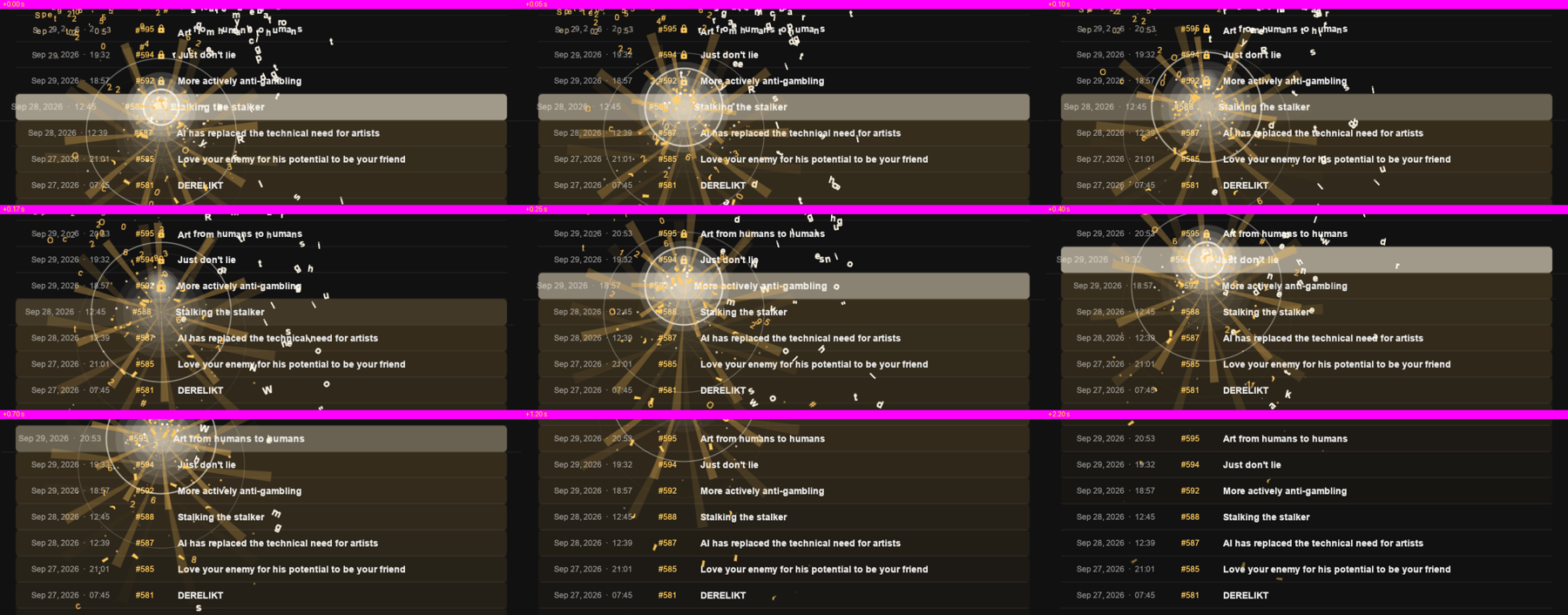
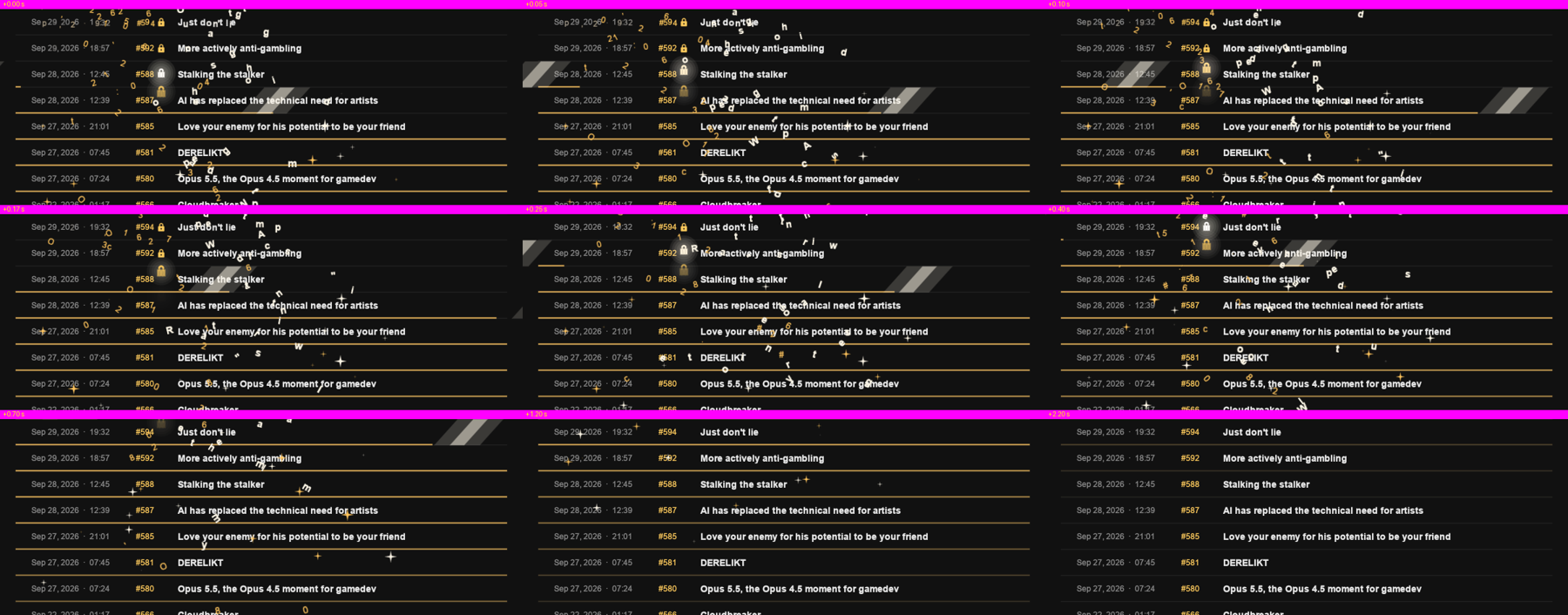
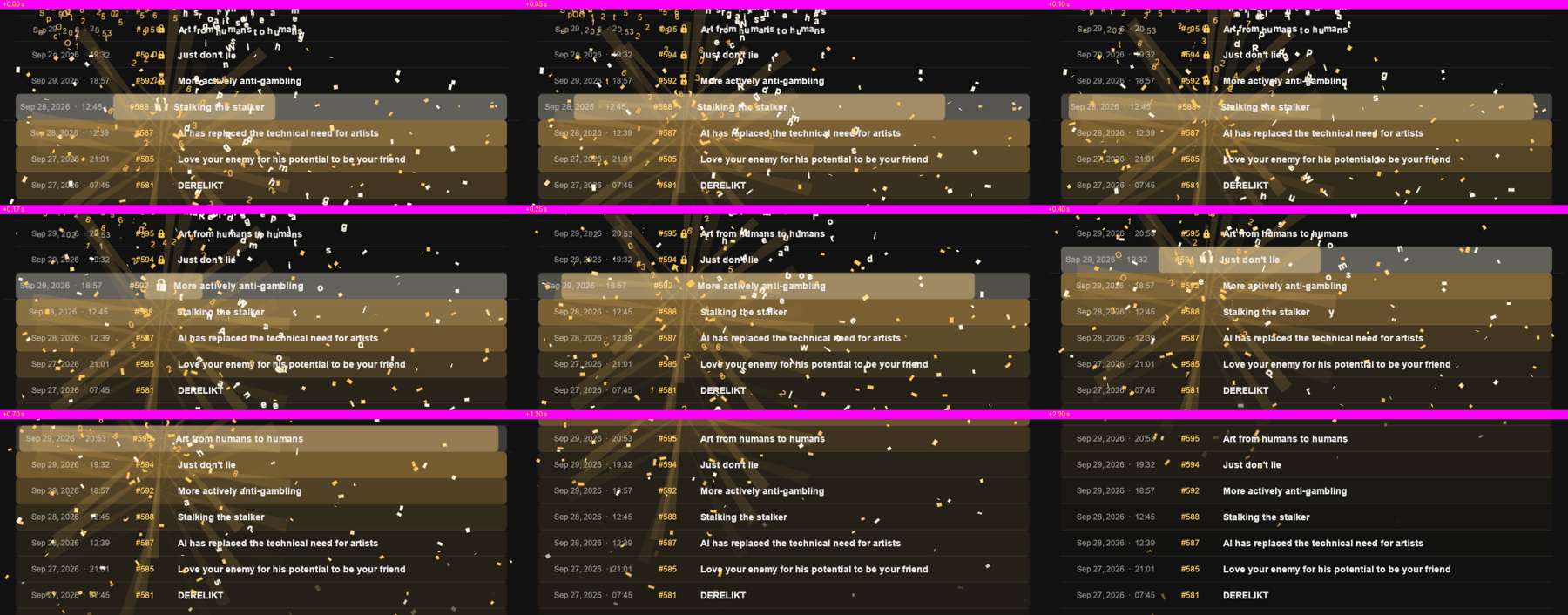
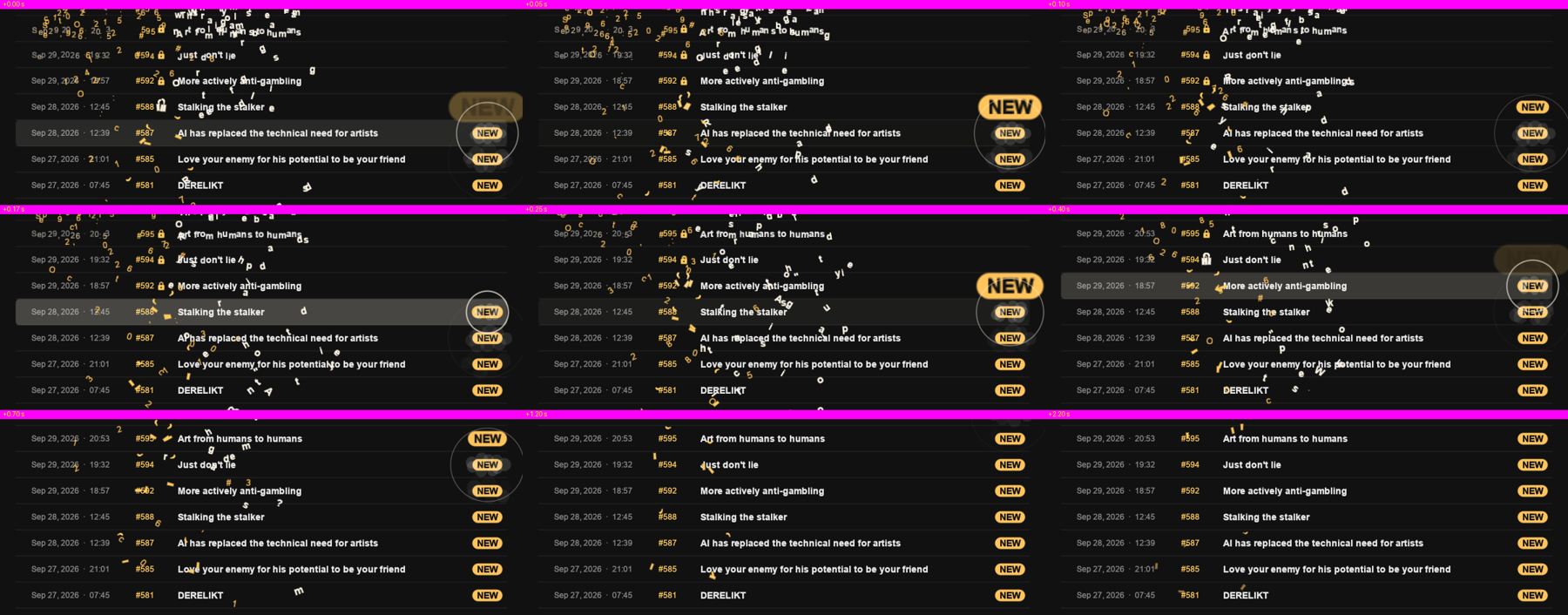
Code: lich-survivors @ 2794b893b4 (6 files, +20 -1)
Recorded run: renderer, 20261013-233824
Recorded run: renderer, 20261013-233842
No sound, mix of burst and shine, with the lock using the shine effect, except without the rays and using particles/lock broken particles instead
[Think]
"No sound" should mean the default is set to none. For the effect, I'll blend burst and shine, using shine for the lock but swapping out the rays for particles and broken-lock particles instead.

That clarifies it: the lock lifts and glows like shine, then at the peak of its lift it shatters into pieces and sparks instead of emitting rays. I'll keep the row's flash, pop, and gold warmth from burst along with shine's sheen and twinkles, while deciding whether to retain a softer glow or ring around the breaking lock.

I'm setting break time at 0.22 after unlock begins, with row effects keyed from that moment. I'm adding a new default MOMENTS entry combining burst and shine while keeping the older options cyclable, and setting the sound default to "none" with proper cycling logic through the sound sets.

For the lock lift-then-break sequence, I'm spawning a lifting, glowing part at unlock that holds for 0.22s before scheduling the shatter, sparks, glow ring, and fx state update via a delayed callback.

Still writing fx logic...

Adding the pop/over timing values, then I'm writing the burstshine moment into MOMENTS and its handler in unlock_row, combining a lift lock effect with white flash and sheen sweep.

Still writing effect sequencing... I need to check that `after` is actually defined before unlock_row calls it, since ordering matters for the scheduling function to resolve correctly.

Now I'm adding the 'burstshine' case with underline warmth, a pop scale effect, and a flash-and-sheen overlay timed against the elapsed t value, then planning to restructure unlock_fx_row's conditions using helper booleans like warmth that group related kinds together.

I'm confirming the run-ending logic: locks get marked 'broken' when unlock_row starts, and the delayed break callback fires 0.22s later but still gets processed since update_parts runs independent of the run state. Sound defaults to none, so the unlock sfx call is a no-op unless overridden — now I'll go ahead and implement this.
Got it. The new default is one combined effect: the lock does shine's lift-away, rising, growing and turning white, then breaks into its pieces and sparks at the top (no rays). The row gets burst's flash, pop and gold warmth together with shine's light sweep, gold underline and twinkles. Sound defaults to none. Building it.
Bash (cd /c/Users/a327e/Desktop/a327ex/a327ex-site/renderer; grep -n "^local function ...)
Bash (cd /c/Users/a327e/Desktop/a327ex/a327ex-site/renderer; sed -n 720,770p unlock_fx...)
Applying the edits: the new moment and its lift-then-break, the row drawing shared between burst and shine, and sound off by default.
Bash (cd /c/Users/a327e/Desktop/a327ex/a327ex-site/renderer; python - <<'EOF' p='unloc...)
[Think]
I'm verifying that sound_sets is defined before it's referenced in the unlock sound counter, confirming the ordering is correct. Then I check the top/sh variables used in the unlock_row layout calculations.

For the shatter effect, pieces start hot/white and fade over their lifetime, which seems fine visually since the lock itself turns white during the lift phase before breaking. I'm thinking through the lock's hold timing — burst/shine hold at 0.12, lift at 0.22, then break — and confirming the burst swell effect only applies when the key is 'burst'.

Finally I want to test this by running the moments probe for burstshine specifically, writing a quick variant of moments_film.lua that isolates moment 1 with sound disabled by default, keeping the 's' key toggle intact since repeated presses just cycle back.
Parses. Filming the new combined effect around one row, and running a full pass to check for errors.
Agent run: renderer, 20261013-234817
Agent run: renderer, 20261013-234832
Bash (cd /c/Users/a327e/Desktop/a327ex/lich-survivors/scratch/s15; sed -e 's/^for m = ...)
Bash (cd /c/Users/a327e/Desktop/a327ex/lich-survivors/scratch/s15/bs; python - <<'EOF'...)
Read (C:\Users\a327e\Desktop\a327ex\lich-survivors\scratch\s15\bs\sheet_bs.png)
Read (C:\Users\a327e\Desktop\a327ex\lich-survivors\scratch\s15\bs\zoom_bs_006.png)
Read (C:\Users\a327e\Desktop\a327ex\lich-survivors\scratch\s15\bs\zoom_bs_015.png)
[Think]
Checking the zoom frames: at 006 the lifting lock for #588 appears above its row, scaled up and lightened, while at 015 #592's lock lifts as #588's row flashes with sparks and ring effects. The lift animation rises about 16px into the row above, crossing the rule line, which looks correct.

Everything checks out, so I'll commit this and update the records — noting that other moments stay accessible via the default burst+shine behavior — and log this as 73b in REDESIGN §42 and memory.
[Think]
The lock animation works correctly across all 16 rows with no errors. I'll commit and record this now.
Bash (cd /c/Users/a327e/Desktop/a327ex/a327ex-site/renderer; python - <<'EOF' p='REDES...)
SendUserFile (lich-survivors/rounds/73-unlock-moments/5-burst-shine.png)
I added your mix as a new effect, burst + shine, and made it the default; it's what R plays now.
- The lock: it rises about 16 px over a fifth of a second, growing and turning white with a glow (shine's lift). At the top it breaks into its five pieces plus gold and white sparks, with a light and a ring. There are no rays.
- The row: from the break it gets burst's white flash, pop and lingering gold warmth. It also gets shine's sweep of light, the gold line under it, and twinkling stars along it.
- Sound: off by default.
A full run unlocks all 16 rows with no errors; the strip above shows one row from 0 to 1.3 s. The other effects and sound sets are still under U and S if you want to compare.
Commits: site d3b64d87, Lich ed53a0d. Nothing is deployed.
burst + shine, one row's unlock from 0 to 1.3 s: the lock rises and whitens, then breaks into pieces and sparks; the row flashes, sweeps and keeps its gold line and stars.
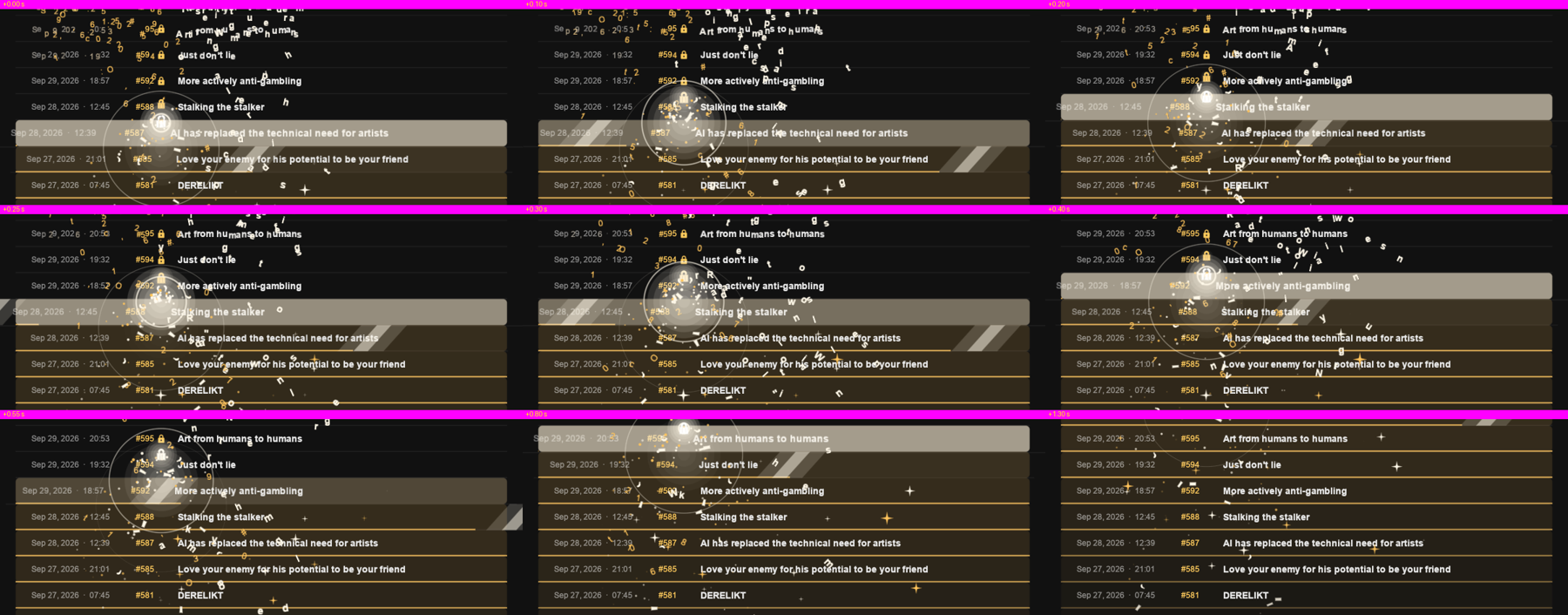
Code: lich-survivors @ a968b07b46 (2 files, +4 -0)
Recorded run: renderer, 20261013-234949
Great, this is the final form in terms of general juice, except, now let's try making it fit the game as a theme. The game has several effects already and its own style that our unlock should probably try to match thematically, visually, etc?
[Think]
I should theme-match the unlock to Lich Survivors' aesthetic — the dark cave setting with sun shaft lighting, the skeletal lich with its porcelain mask, snakes and egg motifs, and the various power effects like beam, lift, rock, lens, fire, and leak. I'll draw on the gold/amber palette, ember icons, lamp frames, the faceted font, and that clean pixelated 3D "Sun Court" look with the glass pet.

Since this is iteration mode where the user wants to try fitting the theme, I'm weighing which of the game's visual languages the unlock should borrow from — per the iterate skill, a new visual direction should show references or alternatives before committing to implementation. One strong option is tying it to the egg's shell: breaking the lock like cracking porcelain speckled eggshell along a jagged line, so the posts feel "hatched" the way the egg hatches in-game.

Other candidate directions include the lens/glass shard break with white glints, the warm sun-shaft god-ray with dust motes, a chunky pixel-grid style matching the game's 360p/2.82x rendering and ember palette, or the ember-icon lamp-frame glow from the UI — while the snake dissolve/gore effect clearly doesn't fit. I think the right move is to first pull actual reference frames from the game (egg crack, lens break, sun shaft, embers, UI icons/fonts) and present them as a small board of 3-4 directions for him to choose from, since picking the governing reference for an unresolved visual direction is itself a direction-setting decision.

He did say "let's try making it fit the game thematically," which is somewhat open-ended and could be read as inviting me to just try things, but it's ambiguous whether that counts as delegating the choice outright. Given the skill's guidance to show alternatives before committing to dependent implementation, I'm leaning toward building a quick references board with 3 named directions tied to specific game elements, possibly paired with switchable implementations he's responded well to in the past when I offer a few built-out options at once.

I'll gather concrete references from the game's established visual language —Given the switchable-options infrastructure already exists, I think the practical approach is to pull concrete references from the game itself (its established visual language around the egg, lens break, sun shaft, dust motes, fire, pixel rendering, palette) and build 2-3 themed variants as live switchable options, each clearly tied to a referenced element — that satisfies the skill's call for showing real alternatives rather than committing to one unvetted direction.

Rather than capturing frames live, I realize there are existing rounds folders with recorded films of the lens breaks, egg hatch, and ember icons — extracting frames from those with ffmpeg is much faster than re-running the game harness. Let me check the rounds directory listing.
This is a new visual direction, so I'll ground it in what the game actually looks like before building. Surveying the game's own effect vocabulary from its record and its existing round films.
Bash (cd /c/Users/a327e/Desktop/a327ex/lich-survivors; ls rounds | tail -45; sed -n 10...)
[Think]
I'm noting the Sun Court visual style—pixel resolution with snapped shadows, light shafts, limited color quantization, dark cave palette with the egg and lich's prismatic bones standing out, plus the specific font and effect types like beams and lens glass to keep consistent across the game.

Thinking through unlock animation directions: either tying the lock-break to the egg's hatch imagery (jagged crack, speckled shell halves falling, warm yellow glow), or leaning into the lich's prismatic glass motif (shattering like lens glass with spectral glints sweeping across the row), all rendered strictly within the game's pixel-snapped visual language.

A fourth direction uses a shaft of sunlight with drifting dust motes falling on each row, turning sparks into rising embers. I'm leaning toward presenting these as swappable skins that U can cycle through, keeping the approved "burst + shine" motion and timing fixed while only the visual theme changes underneath it.

So I want a theme switch bound to a key that reskins the lock-break and shine effect: plain (current), egg shell (fragments with speckled edges, a crack glow before breaking, shell-chip sparks, warm yellow row tint), and prism glass (translucent glass sliver pieces with alpha flicker and spectral tint, rainbow glint sparks, a spectrum-band sheen).

I'm also sketching a pixel embers theme for the Sun Court/ember UI style, where everything snaps to the pixel grid with dithered checker fades and quantized palette, ember-square sparks, and pixel-block lock pieces. To nail the visual language I want to pull reference frames from relevant round films — the egg-hatch crack, the lens-break glass, the ember font/UI icons, cave surfaces, and any prismatic lich bones — and assemble them into a small reference board image.

Let me check what's in those round folders, whether they're mp4, png, or html files, so I can sample exact colors from the frames.
[Think]
The record confirms the Sun Court rendering style—640x360 with snapped shadows, quantized color, and dither—featuring the dark cave, egg, lich, and ember lamps. I'll now pull reference frames showing the game's key effects: egg hatching, glass breaking, embers, and cave visuals.
Bash (cd /c/Users/a327e/Desktop/a327ex/lich-survivors/rounds; for d in 60-egg-hatch 61...)
Read (C:\Users\a327e\Desktop\a327ex\lich-survivors\rounds\61-egg-physics\moments.png)
Bash (cd /c/Users/a327e/Desktop/a327ex/lich-survivors/rounds; FF=/c/Users/a327e/Deskto...)
[Think]
I'm picturing the egg hatching: a jagged white-hot crack spreading across the warm yellow shell, the cap bursting off as pale speckled fragments scatter and a soft white-gray glow rises from inside. Now I want to check the lens sheet for reference.
[Think]
I've identified the egg hatch's visual vocabulary: the jagged crack, the cap blowing off, scattering shell chips, and the rising pale light. Now checking the lens break next.
Read (C:\Users\a327e\Desktop\a327ex\lich-survivors\rounds\43-ember-font\crops.png)
Read (C:\Users\a327e\Desktop\a327ex\lich-survivors\scratch\s15\refs\lens_sheet.png)
[Think]
I'm cataloging the visual vocabulary of the scene—the cave's lighting and colors, the lens and beam effects with their glints and sparks, and the egg's glow—to keep the imagery consistent.

With the groundwork laid, I'm now sketching alternate visual themes for the burst-and-shine effect: comparing the plain baseline against an "eggshell" variant where the lock cracks like hatching shell with pale warm light and falling shell-chip sparks, and starting to think through an "ember" variant next.

I should also grab ember orange from the icon outlines, the cream font color, and the beige shaft tone to round out my palette sample.
[Think]
I've identified the game's key visual elements—shattered lens glass with spectral tints, an ember-orange light beam, and bronze UI discs with cream pixel font. I'll sample exact colors from these frames to build themes using the game's own palette.
Bash (cd /c/Users/a327e/Desktop/a327ex/lich-survivors; python - <<'EOF' from PIL impor...)
[Think]
I'm working out a color palette for the egg shell, crack, chips, glow, and ember ring elements to give the scene a warm, speckled, hot-cracked look.

Now I'm planning theme switching: a key cycles between plain, eggshell, ember, and glass themes, each overriding lock colors, crack effects during lift, and the shapes/colors of breaking pieces — eggshell breaks into jagged speckled shell fragments, ember into glowing pixel blocks, glass into lock-shaped shards.

I'm also defining the per-theme particle effects: eggshell sparks as pale triangle chips with dust, ember as rising pixel embers that fade from orange to dark red, and glass as hue-cycling four-point glints falling slowly, along with matching glow/ring effects and warmth colors for each theme.

I'm now working out pixel snapping for the ember effect, computing a game pixel size from the host rect height and snapping positions to a rounded screen-space grid for a consistent retro look.

I'll build a THEMES table covering plain, eggshell, ember, and glass styles, each with their own colors and draw routines, defaulting to eggshell since it ties most naturally into the egg-hatching concept.

Still writing theme logic...

For the egg break, I'm adding tiny pale chips tumbling with gravity and a soft rising glow that fades, with no ring effect since eggs don't have one. For ember, I'm breaking the lock into small colored squares that fly apart plus rising ember particles affected by upward gravity.

For glass, I'm keeping the lock's actual shape but rendering it as translucent glass with low-alpha fills, bright outlines, and glints that flash based on rotation angle, while sparks become small hue-cycling star shapes with short lifespans.

Still designing burst shine colors...

Still defining piece kinds and speckle data for each theme, then working out a snapping helper that rounds positions to a pixel grid sized relative to the game's resolution. Time to start writing the actual drawing code now.

I'll add a THEMES table near MOMENTS and update unlock_row's burstshine branch plus the draw_part and draw_piece functions to handle the new speck, glass, and block kinds. I'll locate the exact anchors in the existing code since I know the content and can target precise replacements.
[Think]
I've mapped out four lock-break themes (egg shell, ember, glass, and plain) using colors sampled from the game, all sharing the same burst/shine timing but switchable via a new T key. Now I'll write the theme table and theme-aware break logic.
Bash (cd /c/Users/a327e/Desktop/a327ex/a327ex-site/renderer; grep -n "if M.key == 'bur...)
[Think]
I'm restructuring the burst-shine branch to route through a themed break helper, adding theme definitions that try to match the game's existing visual style and timing for the unlock effect.

Each theme describes a distinct look: an egg-hatch effect with shell chips and pale motes, an ember theme matching the UI's pixel icons with flickering blocks, a glass theme with shattering spectral slivers, and a plain fallback matching an earlier round's look. I'm also writing a helper to convert hex strings into packed color values, then starting the THEMES table itself.

Adding helper functions for theme selection, pixel scaling based on game resolution, value snapping, and hue-based color generation.

Finishing the hue-to-RGB mapping and blending it toward white for a pale spectrum effect, then thinking through edge cases for the game rect helper—specifically whether it stays valid when the game row scrolls off screen and whether the unlock effect reference might be nil after a run finishes.

Now I'm sketching the themed break logic for the lock-breaking animation, starting with the "egg" theme that spawns jagged shell-chip particles with randomized size, speckling, and angular jitter around the lock's position.

Still generating particle pieces...

Writing ember unlock particles...

Still writing particle effects... Now moving to the glass theme, I want shattering shards plus a bright white blink, a thin expanding ring, and glinting spectral stars replacing the usual sparks.

Still defining piece rendering...

Adding more particle physics...

Computing the crack's vertical position in lock-local coordinates with a 5-segment zigzag, then mapping out theme-specific treatments for the lift and shine effects across egg, ember, and glass variants—dashed lines, dithered checkers, and spectral bands respectively.

Writing unlock row code...
Writing the themes: a theme table, a theme-aware break, and the drawing for the new particle kinds (shell chips, rising light, motes, embers, pixel glow and crosses, spectral glints).
Bash (cd /c/Users/a327e/Desktop/a327ex/a327ex-site/renderer; grep -n "^local function ...)
Write (C:\Users\a327e\AppData\Local\Temp\claude\C--Users-a327e-Desktop-a327ex\81cb4a0c-3c8c-4b27-96ab-b4c3bca4a986\scratchpad\themes.py)
[Think]
I'm double-checking that unlock_row correctly destructures the values returned from lock_shapes, matching variable order against the function's return statement.

I should patch the plain-sheen shine code to use th.flash for the egg theme instead of plain WHITE, verify twinkles are replaced by motes in the egg theme, and confirm star/THEMES are defined before they're referenced in draw_part and unlock_fx_row. I also want to make sure the ember palette and themed closure capture 'th' correctly, and that alpha blending on spectrum colors works as expected for glass twinkles. Finally, I need to add a 'T' key handler to cycle themes along with updating the hint text.
Before running it: the plain-sheen branch should also take the egg theme's warm white, and the test needs the T key and its label. Applying, then parse-checking.
Bash (cd /c/Users/a327e/Desktop/a327ex/a327ex-site/renderer; python "C:\Users\a327e\Ap...)
[Think]
I should check the local variable count stays under Lua's limit, which looks fine around 60. Now I want to test each theme by running it and capturing frames per theme around a given moment, so I'll loop through themes 1 to 4 in the moments_film logic.
Parses. Running each theme through a full run to check for errors, and filming one row's unlock per theme.
Agent run: renderer, 20261013-235602
Bash (cd /c/Users/a327e/Desktop/a327ex/lich-survivors/scratch/s15; cat > themes_film.l...)
Bash (cd /c/Users/a327e/Desktop/a327ex/lich-survivors/scratch/s15/themes; python - <<'...)
Read (C:\Users\a327e\Desktop\a327ex\lich-survivors\scratch\s15\themes\sheet_egg.png)
Read (C:\Users\a327e\Desktop\a327ex\lich-survivors\scratch\s15\themes\zoom_egg.png)
[Think]
I'm examining the egg shell details — chips, crumbs, and the faint rising light — along with how the lock crack appears across different frames in the zoomed sprite sheet, trying to pin down exactly when it becomes visible.
Egg shell reads: speckled yellow shell chips and crumbs break off, and a pale light rises. Checking the white-hot crack across the lock mid-lift.
Bash (cd /c/Users/a327e/Desktop/a327ex/lich-survivors/scratch/s15/themes; python - <<'...)
Read (C:\Users\a327e\Desktop\a327ex\lich-survivors\scratch\s15\themes\egg_crack.png)
[Think]
Comparing the two frames, the left one shows the lifting lock with the white zigzag crack clearly visible across its body, while the right one appears to be breaking apart. Now I want to check the ember and glass sheets and zooms to confirm consistency.
The white-hot zigzag crack shows across the rising lock just before it breaks. Checking ember and glass.
Read (C:\Users\a327e\Desktop\a327ex\lich-survivors\scratch\s15\themes\zoom_ember.png)
Read (C:\Users\a327e\Desktop\a327ex\lich-survivors\scratch\s15\themes\sheet_ember.png)
[Think]
I'm designing the ember theme with pixel-dithered glow effects, square blocks, and checker-band sheen to match the game's pixel UI style, plus a beige flash panel for row highlights. Checking the glass theme next.
Ember reads as the game's pixel language: a dithered burst of light, square embers, a checkered sweep, dashed lines under the rows and pixel crosses for stars. Checking glass.
Read (C:\Users\a327e\Desktop\a327ex\lich-survivors\scratch\s15\themes\sheet_glass.png)
Read (C:\Users\a327e\Desktop\a327ex\lich-survivors\scratch\s15\themes\zoom_glass.png)
[Think]
The glass theme's prismatic effects with spectral glints and prism sweeps work well, and all four themes hold up visually with the egg theme set as default. I'll commit this, record the work, and save deliverables to the rounds/74-unlock-themes/ directory.
[Think]
All three themes render correctly—glass effects, prism bands, and spectrum lines are all working as expected. I'll save these as round 74, then record and commit.
Bash (cd /c/Users/a327e/Desktop/a327ex/lich-survivors; mkdir -p rounds/74-unlock-theme...)
Read (C:\Users\a327e\Desktop\a327ex\lich-survivors\rounds\74-unlock-themes\0-closeups.png)
[Think]
The closeup composite looks good, covering the crack during the lift and break, then egg, ember, and glass break moments. I'll deliver the close-ups along with the 4 sheets.
SendUserFile (lich-survivors/rounds/74-unlock-themes/0-closeups.png, lich-survivors/rounds/74-unlock-themes/1-egg-...)
I kept burst + shine's motion and timing exactly as you settled them and made three themes that each borrow a look the game already has. They switch with a new key, T, in the unlock test; R replays. The colours are sampled from the game's own frames.
| T | Theme | Borrowed from | What changes |
|---|---|---|---|
| 1 | egg shell (default) | the egg hatching | The rising lock turns the egg's yellow and a white-hot zigzag crack runs across it. It breaks into speckled yellow shell chips and small crumbs, and a pale light rises off it the way it rises from the opened egg. Dust motes drift along the row instead of stars; the row's warmth and line are egg yellow. |
| 2 | ember | the ember icons and the beam's cut in the floor | Everything is drawn in the game's own chunky pixels: a pixel burst of light, the lock in square blocks, and square embers that float up and darken from cream to dark red as they flicker out. The light sweep is a checkered pattern, the line under the row is dashed, and the stars are pixel crosses. |
| 3 | glass | the lens breaking and the lich's rainbow bones | The rising lock turns clear and flashes white. Its pieces shatter as clear glass that catches rainbow colours as it turns, with coloured glints. The light sweep is a rainbow band and the line under the row is a spectrum. |
| 4 | plain | Today's look, for comparison. |
All four themes complete a full run with all 16 rows unlocked and no errors. The images above show close-ups of the crack and each break, then one row's unlock per theme.
What I'd like from you: which theme, or which parts of several to combine. For example, egg-shell chips with ember embers, or glass slivers in the egg's colours.
Commits: site d859ef53, Lich 24b6285. Nothing is deployed.
The unlock in three of the game's own languages. Close-ups (top: the egg-shell crack on the rising lock, then the egg, ember and glass breaks), then one row from its lift to 1.3 s per theme.
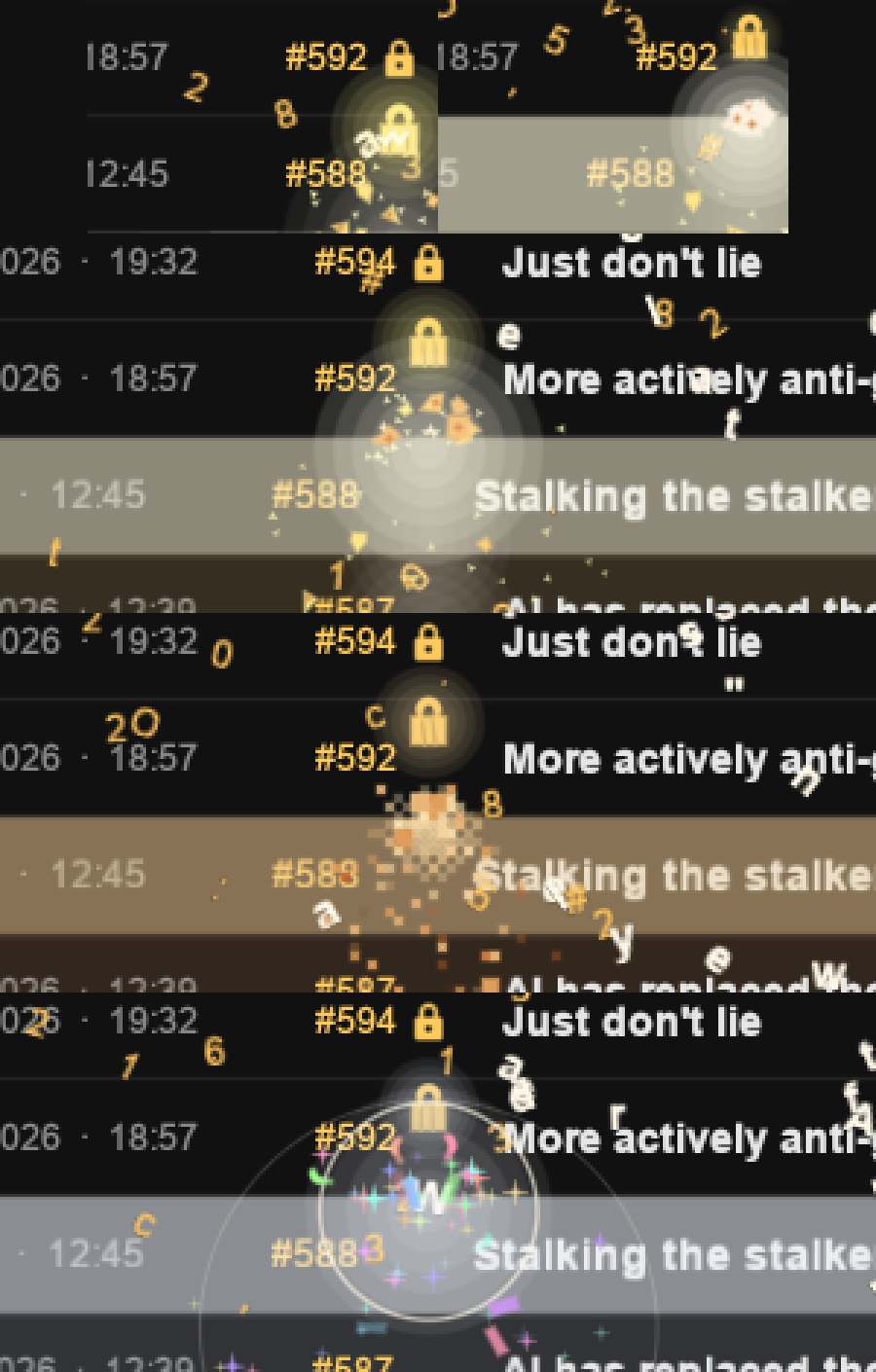
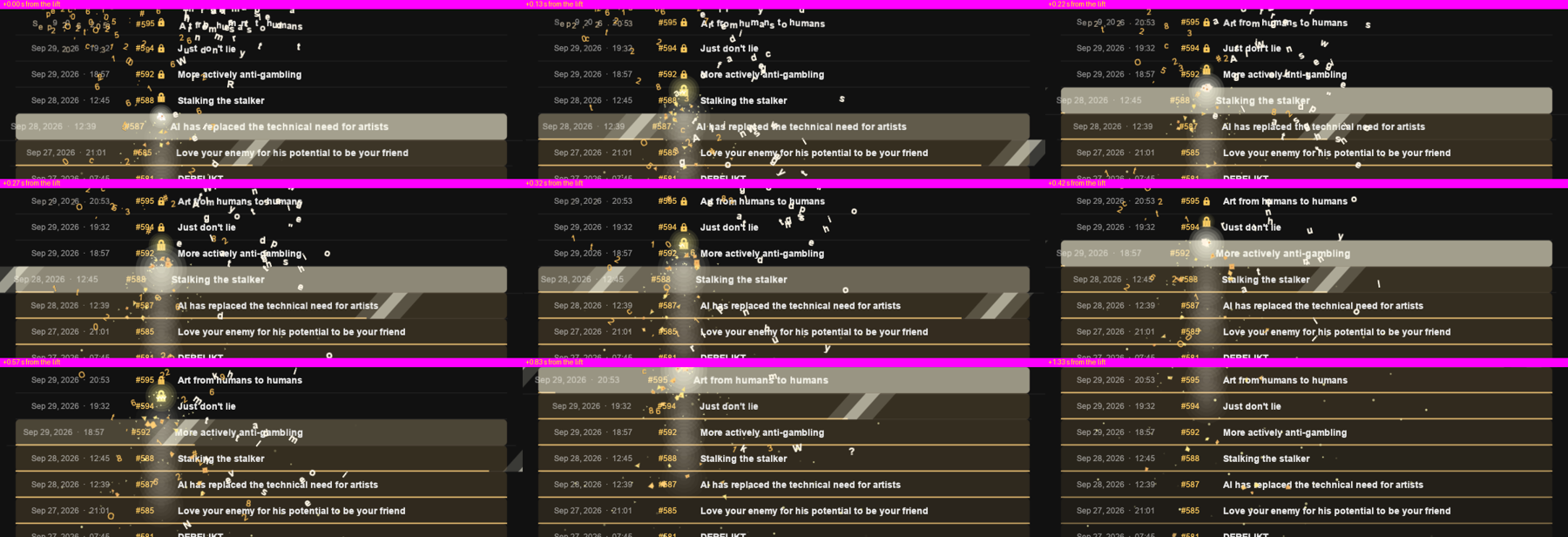
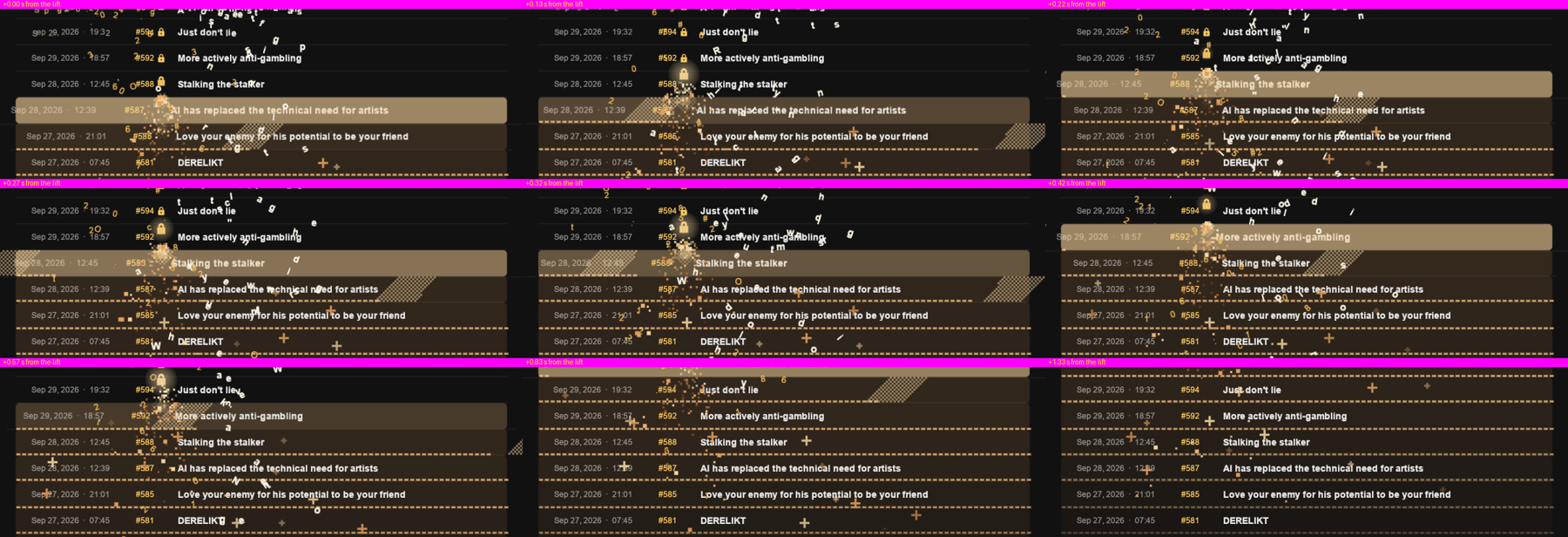
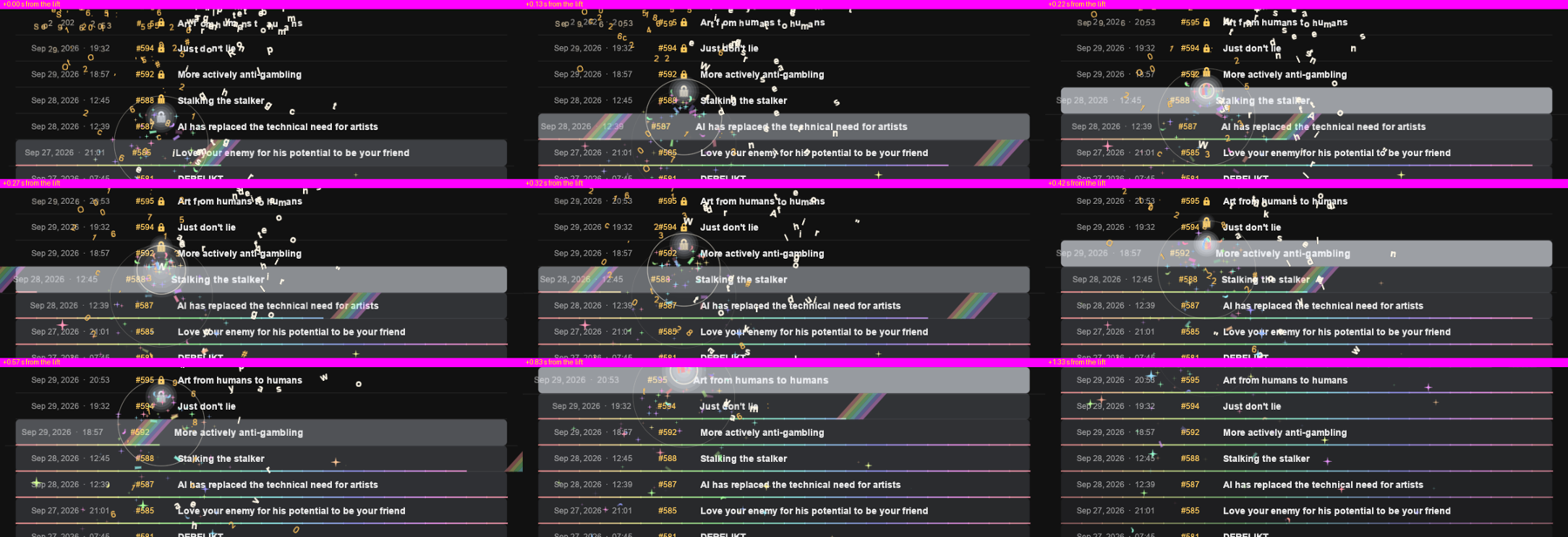
Code: lich-survivors @ 54667d5b9b (6 files, +12 -0)
Recorded run: renderer, 20261014-000424
Glass is great, try to add some of the telekinesis visuals to how the letters move to their position and how it unlocks as well, also, the lines underneath are overlapping creating 1-2 pixels where the connection is visible
[Think]
Since the user chose glass, I want to incorporate telekinesis visuals — the lift power's lifting, balling, and bursting effects from the game — into how letters move into place and how the unlock animates. I'm checking the lift power's reference visuals to adapt the style accurately.

The underlying spectrum lines for glass have a seam issue: adjacent segments overlap by about 1 pixel where alpha blending doubles up, creating a visible brighter seam at the connection points, possibly compounded by overlap with the row's rule line. I want to fix this by computing segment boundaries as exact integer positions so widths sum precisely without overlap, and make sure the colored line doesn't overlap the row's rule line either.
Glass it is. Two things: telekinesis visuals in how the letters travel and how the row unlocks, and the seams in the line under each row. First, studying how the game's telekinesis (the lift power) looks, from its films and its code.
Bash (cd /c/Users/a327e/Desktop/a327ex/lich-survivors; head -60 port/lift.lua; grep -n...)
[Think]
I'm checking whether the telekinesis lift effect has any described visuals like a glow or aura, beyond the object's motion and the lich's guiding hand, and comparing it to the rock-throwing power for consistency.
[Think]
I've identified the lift's motion as an unseen hand—lifting, trembling, swelling, bursting, and wringing groups into a knot. Now checking the code and films for accompanying visual cues like glow, aura, rings, or dust.
Bash (cd /c/Users/a327e/Desktop/a327ex/lich-survivors; grep -n "glow|aura|ring|dust...)
[Think]
I see lift.lua has no explicit glow visuals, just pure motion: rising with ease, writhing sine waves, a high-frequency tremble while held, a faster tremble during the swell, a knotting rotation before everything bursts into gore. I'm also wondering what warp.lua does -- maybe it's handling warped air from the leak or some heat-distortion effect.

I should check petals.lua too, since there's mention of glass petals around round 51, plus a "magnetism object" and the held mask that lags behind the face as if telekinesis is sustaining it. I think I need to actually look at the lift film frames from rounds/51-ball-petals-orbs/lift_close.mp4 to understand what "telekinesis visuals" really means here.
[Think]
The lift code itself shows no glow—just motion effects like easing, waves, trembling, and a swirling burst. I'll check `warp.lua` and the lift films next to see if any visible field shows up there.
Bash (cd /c/Users/a327e/Desktop/a327ex/lich-survivors; head -30 port/warp.lua; grep -n...)
[Think]
Looking at warp.lua, I see it handles refraction distortion — streaks and puffs that bend what's behind them and split color channels apart, which is what gives telekinesis effects that warped, chromatic-aberration look when rocks get lifted and thrown.
[Think]
Found that `warp.lua` creates the light-bending distortion effect with pulled-apart colour channels, used e.g. during the telekinetic rock lift. I'll check where else it's used and inspect the lift implementation.
Bash (cd /c/Users/a327e/Desktop/a327ex/lich-survivors; grep -n "warp.(streak|puff|...)
[Think]
Warp effects show up in rock telekinesis lifts, beams, held items maintained by telekinesis, and leaks. I should pull some frames showing rock telekinesis to check details, maybe from the round 50 bout footage.
Warp is the shared look of the game's unseen forces: the rock's telekinesis, held and thrown objects, the beam and the leak. Looking at the lift and rock films to see what it reads like on screen.
Bash (cd /c/Users/a327e/Desktop/a327ex/lich-survivors; ls rounds/50-bouts/; FF=/c/User...)
Read (C:\Users\a327e\Desktop\a327ex\lich-survivors\scratch\s15\refs\lift_sheet.png)
[Think]
I'm tracing the lift sequence frame by frame: the snake rising and writhing, curling into a tight ball like yarn, trembling as it's held, then bursting into gore. Now I want to check the telekinesis rock frames too.
The lift film shows the motion: the snake rises writhing, curls into a ball held in the air with a tremble, then bursts. Checking the rock throw, where the warp shows.
Bash (cd /c/Users/a327e/Desktop/a327ex/lich-survivors/scratch/s15/refs; python - <<'EO...)
Read (C:\Users\a327e\Desktop\a327ex\lich-survivors\scratch\s15\refs\rock_sheet.png)
[Think]
I'm searching the record for explicit "telekinesis" mentions to pin down the clearest visual reference, like the rock-lifting power description, so I can ground the visuals in actual game text rather than guessing.
Too small at this scale to see the warp. Reading what the record says the telekinesis looks like.
Bash (cd /c/Users/a327e/Desktop/a327ex/lich-survivors; sed -n 676,700p RECORD.md; grep...)
Bash (cd /c/Users/a327e/Desktop/a327ex/lich-survivors; sed -n 700,716p RECORD.md; ls r...)
[Think]
I'm picturing the rock tearing from the floor with dust and grit, rising beside his hand in warped, trembling air with chromatic rainbow fringes, then bursting outward trailing that distortion behind it. I want to check leak-warp.png to see how that warp effect should look.
[Think]
I've captured the telekinesis effect: the rock erupts with dust and warped air, hovers trembling, then launches leaving a rippling wake, with the warp itself colorless but refracting light into rainbow fringes. Now I'll check the stills of the warp effect.
Read (C:\Users\a327e\Desktop\a327ex\lich-survivors\rounds\23-warp-rock\leak-warp.png)
[Think]
I'm thinking about how to simulate the warp effect visually—since it should bend light behind it like refraction with color fringing, I need a post-process shader pass that samples the UI layer texture with an offset field, checking if the engine's renderer supports shader loading and layer drawing with custom uniforms for this screen-space effect.

Given the complexity of a true displacement shader requiring a second texture uniform, I'm wondering if it's simpler to fake the warp visually on the flat dark background, since the distortion would mainly be visible where it crosses text or letter edges rather than empty space.

A cheaper, more visible approximation: give flying letters chromatic ghost copies with red/blue channel-split offsets to mimic warp fringing, plus a subtle tremble as they approach their resting position before snapping in. For the lock's unlock sequence, I should mirror the lift animation's rise-writhe-hold-swell-burst pattern — adding a trembling hold and a swell beat before the final burst to match that established rhythm.

So the full visual language for "telekinesis" on the site becomes: sinusoidal writhing motion during travel, a tremble-and-swell before release, and chromatic aberration ghosting to suggest warped air, with post-break pieces trailing faint rainbow streaks. I'm now checking whether the engine actually supports real shader-based displacement before committing to the fake chromatic-copy approach, so I want to grep for shader and texture support in the quick API reference.
[Think]
I'll check if the site's engine supports a real displacement pass, or if color-split ghost effects are the more honest equivalent for a flat dark page.
Bash (grep -n "shader" /c/Users/a327e/Desktop/a327ex/Anchor/engine/docs/ENGINE_API_QUI...)
[Think]
I'm realizing I could set up a real warp pass using shader texture binding functions, applying a second texture to a layer's shader—like using a dedicated warp map layer whose colors encode displacement, with red and green channels representing x and y offsets.

But hooking this into the actual render pipeline is trickier than it sounds: the ui_layer gets composited and drawn in multiple passes, and unlock_fx draws into it after the main composite, so a warp shader would need to hook into main.lua's final render step. There's also the complication of web shader compilation being async and GLSL ES compatibility concerns—a broken shader on web could actually break the page, which feels like too much risk given this is untested for my own shaders and the unlock eventually ships to web.

A cheaper alternative: fake the warp without a real shader by drawing chromatic ghost copies—extra red/blue tinted offset copies of each flying letter at low alpha to mimic channel splitting, plus trembling and ghosting for the lock. But row text can't easily be redrawn shifted or tinted since draw_row uses its own colors and there's no global color multiply or tint support in layer_push. I'm trying to figure out what the user most likely wants here—probably just extending telekinesis-style visuals to how the letters move.

What telekinesis really looks like in this game is lift and rock: things rise, writhe, tremble in warped air, then get thrown with a wake trailing behind them before settling. So instead of the letters just following a plain eased bezier curve, they could rise from the egg, hover and tremble briefly in a shimmer, then get thrown fast to their final position with a warped-air trail, finally settling into place — a meaningful change to motion that was previously considered "final" (expo-out, linear scroll). I'm considering building two variants to compare: one where letters are "carried" with a writhing wobble and chromatic wake along an expo path, and another alternative approach.

For the unlock sequence, I'd add a tremble during the hold and a swell right before the burst, with chromatic shimmer ghosts around the lock, then have the burst throw out streaks of warped air alongside the glass pieces. The most faithful way to achieve "warped air" visually is probably a real displacement shader rather than faking it with simple effects.

I'm figuring out how layer_apply_shader works — applying a shader to ui_layer's FBO as a post-process so the warp shows up in the final screen draw, but only on the content region rather than the top nav chrome, which means ordering content → composite → letters → chrome carefully.

Splitting the chrome out would require an extra render pass, so it's simpler to just apply the warp to everything, since chrome mostly sits above where the unlock effects occur anyway. I want to check whether layer_apply_shader is already used elsewhere on web, like for blurring book images, to confirm this shader path is proven and safe to reuse.
[Think]
I'll check if the site already uses custom shaders before deciding whether to implement a real refraction pass instead of color-split ghosting.
Bash (cd /c/Users/a327e/Desktop/a327ex/a327ex-site/renderer; grep -n "layer_apply_shad...)
[Think]
I'm weighing whether to attempt a real shader-based warp effect for the telekinesis visual, since the site doesn't currently use custom shaders but the underlying game engine supports GLSL compilation on the web. It's the most authentic way to get warped air with rainbow fringes, though there's risk around shader compile time and browser compatibility.

To make it safer, I'll scope the effect to only run during the unlock sequence and build in a fallback so it gracefully skips the warp if shader loading fails. Rather than encoding displacement into a texture map (which gets messy with overlapping elements), I'm leaning toward a simpler analytical approach: the shader takes a small list of warp sources (position, radius, strength, phase) and computes the distortion directly, avoiding the need for a separate warp map layer entirely.

With 673 letters, giving each one its own distortion source isn't feasible, so point sources should handle the big focal effects (the lock's shimmer, the unlock burst ripple) while individual letters get a cheaper trick -- offset colored copies to fake chromatic fringing. This is turning into a lot of moving parts, so I need to step back and figure out which pieces actually matter most.

The user's real request is simpler: bring some of the telekinesis visual language into how letters travel to their slots and how the unlock plays out. That means borrowing from the established telekinesis vocabulary -- writhing motion, trembling holds, swelling, bursting, thrown wakes, and warped rainbow-fringed air -- and applying it to letter movement specifically: keep the expo-out timing he liked, but add a lateral writhe to the path and a trailing chromatic wake so the letters feel telekinetically carried rather than just animated.

For the unlock sequence, I want the lock to tremble inside a shimmer of refracted air, swell with lift, then burst outward with glass shards and expanding rainbow-fringed ripple rings that bend the row's text as they pass -- replacing the plain white ring with something that visually matches the warped-air aesthetic. I'll build this with an actual refraction shader pass driven by point and ring sources (properly guarded for performance), paired with chromatic ghost trails for the letters' wakes and the lock's shimmer effect.

Now I'm checking how the final frame gets composited in main.lua, figuring out where to insert the shader application -- it should go after the UI layer is rendered but before it's drawn to screen, passing in the appropriate uniforms.
[Think]
No custom shaders exist on the site yet, so I'm planning the unlock effect (a warped-air shimmer with refraction and rainbow fringes) and letter animation (trailing warped ghosts) before checking `main.lua` to see where a warp pass should slot into the final frame rendering.
Bash (cd /c/Users/a327e/Desktop/a327ex/a327ex-site/renderer; grep -n "layer_render(ui_...)
[Think]
I'm figuring out where to insert the postfx shader call right before the final render and draw, and checking whether layer_apply_shader and layer_shader_set_float apply immediately or get queued per layer.
The final frame is layer_render(ui_layer) then layer_draw(ui_layer) (main.lua:5241), so a warp pass slots in between. Reading the docs for layer_apply_shader and its uniform setters.
Bash (cd /c/Users/a327e/Desktop/a327ex/Anchor/engine/docs; grep -n "### layer_apply_sh...)
[Think]
I'm realizing layer_apply_shader needs to be queued before the final layer_render call for the ui_layer, so it executes in queue order alongside the other draw commands within that render pass.

I'm working out the compositing sequence — ui_layer gets baked in multiple passes (content baked first, game layers drawn immediately, then letters and chrome queued), so placing the shader apply at the end means it affects the whole combined FBO. For the GLSL shader itself, I'm following the example's format with texture coordinate input and output color, defining uniforms for resolution, time, and source rectangles for the warp effect.

Writing distortion shader logic...

Finishing the chromatic aberration output, then I'm checking texture coordinate orientation since GL textures are often bottom-up, and confirming loop/break behavior works in GLSL ES 3.0 along with how to address uniform array elements by name for setting values.

I'm designing the warp sources to include lock-hold shimmer bubbles, expanding burst ripple rings, and possibly an egg-release burst, capping active sources at 12 and planning how the lock's telekinesis motion state feeds into this.

Rethinking the lift timing: scaling down the original rise/hold/swell beats to fit the faster 0.2s row cadence — rise 0.18s with easing, a trembling hold with fast sine jitter, then a swell phase with rapid scale-up tremble before the burst, totaling 0.4s, with the warp bubble active throughout and a lateral wobble added during the rise for extra writhe.

For the telekinetic letter carries, I'm adding a perpendicular lateral writhe that fades at the path's start and end, plus two tinted ghost-copy trails behind the letter for a rainbow fringe wake effect, and a settle tremble in the final quarter of the path that decays smoothly to zero so the letter lands exactly matching the real glyph. I'm skipping the "held a beat" pause for letters to preserve the fast expo feel, and considering having the burst's warp ripple pass over the row to bend it.

I'm also extending chromatic ghost trails to the flung glass pieces, drawing tinted copies at slightly offset previous positions for cheap motion blur, and fixing the spectrum segment seams by using floor-based pixel boundaries so segments don't overlap — while checking whether the bottom rule line might visibly clash with the 2px line above it depending on draw order.

Actually the prism band itself might be the culprit: six slanted polygons sit edge-to-edge, and the antialiasing on their shared borders could double up alpha or leave tiny gaps, which would show as that visible seam.

Instead of SDF polygons, I could switch to drawing each stripe with plain GPU triangles and per-vertex colors, which gives exact pixel coverage at the shared edges and avoids the overlapping antialiasing causing the seam.

I can draw both the prism band and the line as a single triangle/quad strip with per-vertex spectrum colors, producing a smooth gradient with no seams at all. Now I need to check whether the framework already wraps this triangle-drawing primitive, and confirm the per-vertex color format it expects.
[Think]
I'll queue the warp pass on the page right before the final render, since it's free when no unlock is running. I also found the seam issue: both the spectrum line and prism band use overlapping rectangles/stripes at their joins, so I'll replace them with single gradient strips—checking the plain-triangles call to do this now.
Bash (cd /c/Users/a327e/Desktop/a327ex/a327ex-site/renderer; grep -n "^function layer_...)
[Think]
I'm checking whether this site's layer.lua framework wraps layer_triangles or if I need to call the engine's global function directly with a raw handle, and verifying whether the web wasm build (unlike the desktop build) actually includes that function.

For the implementation, I'm planning three changes: building the spectrum glass line as a triangle strip with per-vertex rainbow colors (falling back to rects if layer_triangles isn't available), constructing the prism band as a gradient strip with soft alpha-fading edges, and applying the telekinetic lock timing specifically to the glass theme while leaving other themes untouched.

I'm sketching the telekinesis timeline for the glass lock: a rise phase with lateral writhe, a tremble hold, then a scaling swell with faster tremble before the burst, which triggers the glass break along with a warp ring and chromatic-ghost wake on the shattered pieces.

Now I'm defining the warp sources list for the postfx shader: a bubble that tracks the lifting lock with growing strength, a ring that expands outward at burst time, and possibly a ring effect when letters release near the egg to tie the telekinesis visuals to letter movement.

For the glass letter theme, I'm layering writhe motion with chromatic wake ghosts — drawing extra tinted copies trailing each glyph along the path with fading alpha, which triples draw calls but stays well within budget.

The writhe uses the tangent of the bezier path to compute a perpendicular offset that oscillates sinusoidally with per-letter phase, while a settle tremble kicks in during the final stretch and dies out smoothly so the letter lands exactly on target. Now I'm working out the warp shader's texture coordinates for the UI layer FBO.

I'm guessing the array uniform lookup will just work since it likely resolves by name per-element rather than caching, and the shader cost itself is trivial for a dozen sources with a few texture taps. I also need to check whether there's a framework wrapper like layer_apply_shader, or if I need to call the engine's shader API directly on the layer handle, and account for the ring bending the text as it passes over each row.
[Think]
Since there's no framework wrapper for `layer_triangles`, I'll call the engine's raw handle directly and add a seam-free fallback for web builds that may lack it. I'm now checking whether shader calls work the same way and if the web engine even supports `layer_triangles`.
Bash (cd /c/Users/a327e/Desktop/a327ex/a327ex-site/renderer; grep -n "apply_shader|sh...)
[Think]
I'm confirming the gpu-layer engine includes layer_triangles support since it wraps the shader functions properly, and checking that the JS glue file doesn't need Lua function listings since those live in wasm. Now I'm starting to write the actual code changes, beginning with the themes configuration.

Writing warp and lift logic...

I'll grab the theme at letter-draw time, then convert the spectrum line and prism band into gradient triangle strips. For the warp postfx, I'm sketching a shader with debug and flip uniforms to handle coordinate mapping between texture space and pixels, hooked into the final render pass.
[Think]
Confirmed both resources check out—the framework supports passing the page layer directly to the shader, and `layer_triangles` predates the live web engine. Now I'll write the full implementation: the telekinetic lock sequence, the warp shader with bubble/ripple sources, the letters' writhe and settle animations, and seam-free gradient strips.
Write (C:\Users\a327e\AppData\Local\Temp\claude\C--Users-a327e-Desktop-a327ex\81cb4a0c-3c8c-4b27-96ab-b4c3bca4a986\scratchpad\tk.py)
[Think]
I'm double-checking a couple of details: confirming that the `live` timing variable and the local `x, y` coordinates inDouble-checking a couple of details: the lock-draw variables look fine since x and y get reused correctly after modification, and the glass-shatter effect will cause a slight visible shrink since pieces are drawn at a smaller burst scale than the swollen lock size right before breaking — minor enough that I'll leave it as is rather than scale velocity by size.

I'm also verifying the tangent math in the letters code mixes doc and screen coordinates correctly, confirming `tk` is defined exactly once in the right scope, checking that wake ghosts draw beneath the main glyph as intended, and tracing whether the `origin` helper and shader wrapper functions like `layer_shader_set_vec2` actually exist in the framework before I rely on them.

I realize the shader setters might expect a raw handle rather than the layer table itself, so I'm switching to pass `layer.handle or layer` explicitly everywhere to avoid type errors, and I'm also re-adding the `UNLOCK_FX.clock` field I'd accidentally stripped out during the jolt edit.

For the hook, I need to place the postfx shader call right before `layer_render`, since the shader must apply after all draw commands are queued for the frame but before the ping-pong render happens — that ordering should be safe even with a no-clear final pass. I'll test the texcoord flip default separately, then go fix the vec2 setter calls in the script before rerunning.
[Think]
I'll adjust the uniform setters to use the layer's handle instead of the framework table for safety, then add the hook into `main.lua`.
Bash (cd /c/Users/a327e/Desktop/a327ex/a327ex-site/renderer; S="C:\Users\a327e\AppData...)
[Think]
Since he liked glass, I'll set it as the default theme by setting the theme index to 3. Then I need to test the warp debug mode to confirm the shader appears correctly at the lock position during hold and burst ring frames.
Both parse. Making glass the default theme, then a debug run that tints wherever the warp bends, to check the shader loads and sits in the right place.
Agent run: renderer, 20261014-001201
Bash (cd /c/Users/a327e/Desktop/a327ex/a327ex-site/renderer; sed -i 's/^UNLOCK_FX.them...)
Bash (cd /c/Users/a327e/Desktop/a327ex/lich-survivors/scratch/s15/warp; python - <<'EO...)
Read (C:\Users\a327e\Desktop\a327ex\lich-survivors\scratch\s15\warp\debug_sheet.png)
[Think]
The warp shader is loading correctly and the debug tint confirms it's working. I'm now working out the coordinate math to align the rings and bubbles with the lock position, accounting for the half-scale sheet and converting between frame and screen coordinates.

There's a discrepancy of about 67 pixels vertically that I'm trying to trace—possibly the bubble corresponds to a different row than I assumed, since rows unlock bottom-up and the lifting animation timing could mean I'm matching the wrong row's lock to the wrong row's bubble. I need to carefully map which row ("Stalking the stalker" vs "Love your enemy") actually owns the lock that's lifting versus the bubble that's appearing.

Comparing frame coordinates across w006, w018, and w030 to see if the page scroll position shifted between captures, which would explain why rows appear at different y-values in different frames—so I need to verify whether follow was actually disabled before these measurements or if the scroll kept moving, which would throw off my row-to-bubble matching entirely.

Checking whether the bubble-to-lock alignment holds: if the flip were mirrored, bubbles would land on the opposite y-coordinate from the unlocking rows, but across all frames the bubble consistently sits near rows that are actively lighting up—so the flip is correct. Now I want to switch to non-debug frames to inspect the actual lock burst with the bending and chromatic fringe effects up close.
[Think]
The warp shader loads correctly—debug tint confirms it's centered on each lifting lock, with ripples spreading from bursts and the air lens properly over the egg. Now I'll switch to the real look without the debug tint.
Agent run: renderer, 20261014-001241
Bash (cd /c/Users/a327e/Desktop/a327ex/a327ex-site/renderer; rm -rf ../../lich-survivo...)
Read (C:\Users\a327e\Desktop\a327ex\lich-survivors\scratch\s15\warp0\look_sheet.png)
[Think]
The warp effect is working well—text visibly bends like "your" in "Love your enemy" and "DERELIKT", with the spectrum lines underneath appearing wavy with rainbow fringes as the warp passes over them, and letters showing chromatic ghost-double wakes.

This reads as telekinesis in action: rippling, bending text with rainbow fringes, though the effect may be strong enough to make text hard to read during the unlock sequence—acceptable since it settles after. I want to check the line seams specifically after the warp dies down, capturing a frame post-run but before the gold/spectrum fade completes, then zooming in on a row's line to verify continuity.
[Think]
The warp effect works correctly—text bends with each ripple, rainbow fringes appear, and letters trail colored ghosts. Now I'll capture a line after the last ripple fades but before it disappears to verify the seam fix.
Agent run: renderer, 20261014-001313
Bash (cat > /c/Users/a327e/Desktop/a327ex/lich-survivors/scratch/s15/line_probe.lua <<...)
Bash (cd /c/Users/a327e/Desktop/a327ex/lich-survivors/scratch/s15/line; python - <<'EO...)
[Think]
Checking the spectrum line rows for pixel jumps confirms the gradient is smooth with no visible seams from overlapping rectangles, and the brighter rows just above it look like text or twinkle features.

Wait — the rule at row 191 should get drawn after the strip, potentially overwriting it with gray, but the mean brightness there is still high, suggesting the rule is semi-transparent over the bright line rather than fully opaque. I should zoom in to confirm this visually.
The line is now one continuous gradient: across its two pixel rows, neighbouring columns never jump by more than 40 (summed RGB), with no repeating bright joins. Looking at it up close to confirm.
Read (C:\Users\a327e\Desktop\a327ex\lich-survivors\scratch\s15\line\line_zoom2.png)
[Think]
The gradient should be seamless now. The overlapping-lines issue the user mentioned might also be about the row rule overlapping the 2px line, but that looks fine in the zoomed view. I'll go through the full option/theme check for errors next.
The line is a clean gradient with no seams. Running a full sequence with the new defaults (burst + shine, glass, telekinesis) through R several times to check for errors and that the warp clears.
Agent run: renderer, 20261014-001351
Bash (cd /c/Users/a327e/Desktop/a327ex/lich-survivors/scratch/s15; cat > tk_probe.lua ...)
[Think]
I should also capture a short video of the default sequence since the warp effect is motion-based and better seen in video — I'll grab full-width frames at 30fps for about 6 seconds starting from the letters appearing, then commit the recording. I'll use film_probe, starting capture 7 seconds after the click through to the run's end plus 1.5s, configuring it via the existing options in film_probe.lua.
Three runs in a row: all 16 rows each time, at most 6 warp sources at once, everything settled by 6.9 s, no errors. Filming the default sequence, since the warp is motion and stills undersell it.
Agent run: renderer, 20261014-001443
Bash (cd /c/Users/a327e/Desktop/a327ex/a327ex-site/renderer; rm -rf ../../lich-survivo...)
[Think]
At 30fps, 180 frames works out to 6 seconds, so film_probe should stop at after + 90 frames, which checks out. I also need to save the look_sheet as a still before committing records.
Film encoded. Recording and committing.
Bash (cd /c/Users/a327e/Desktop/a327ex/lich-survivors; cp scratch/s15/warp0/look_sheet...)
SendUserFile (lich-survivors/rounds/75-unlock-telekinesis/unlock-glass-telekinesis.mp4, lich-survivors/rounds/75-u...)
Glass is now the default, with the game's telekinesis added to both the letters and the unlock, and the seams in the lines are fixed. Film: unlock-glass-telekinesis.mp4.
What telekinesis looks like in the game. The lift and the rock throw share one language. Something is lifted by an unseen hand, rises writhing, is held a beat trembling in a shimmer of warped air, swells and bursts. Whatever is thrown trails a wake of warped air. Warped air has no colour of its own: it bends what's behind it and splits its colours into rainbow fringes.
How the unlock uses it:
- The lock: it rises with a slight sideways sway, is held trembling for a moment, swells and trembles faster, then bursts into glass pieces. Each piece trails a faint rainbow wake.
- Warped air: this is a real distortion of the page, done the way the game does it. It shimmers around each lock while it's held, ripples outward from each burst and bends the rows' text as it passes, and sits over the egg while the letters pour out. It only runs during the unlock.
- The letters: they keep the timing you chose and are carried like lifted things. They sway across their path, trail a faint rainbow wake, and tremble slightly as they settle. The tremble dies out exactly as each letter lands, so the hand-over to the real row still doesn't jump.
The seams: the rainbow line was built from 24 pieces, each drawn 1 px wider than its slot, so every join was drawn twice. The rainbow light sweep had the same problem where its stripes met. Both are now drawn as one continuous gradient. I checked the line on a frame with no distortion over it: the colour changes smoothly along its whole length, with no visible joins.
Three full runs in a row with R each unlocked all 16 rows with no errors, and everything had settled by about 7 s.
What to check when you run it: the warp's strength. With 16 rows going off 0.2 s apart, the rows' text is bent through most of the sequence. If it's too much, I can make it weaker, shorter or tighter around each lock.
Commits: site 2c0be7f9, Lich cdd8d3c. Nothing is deployed.
Glass with the game's telekinesis: the film (headless, 30 fps, no sound) and a strip of moments where the warped air bends the rows.
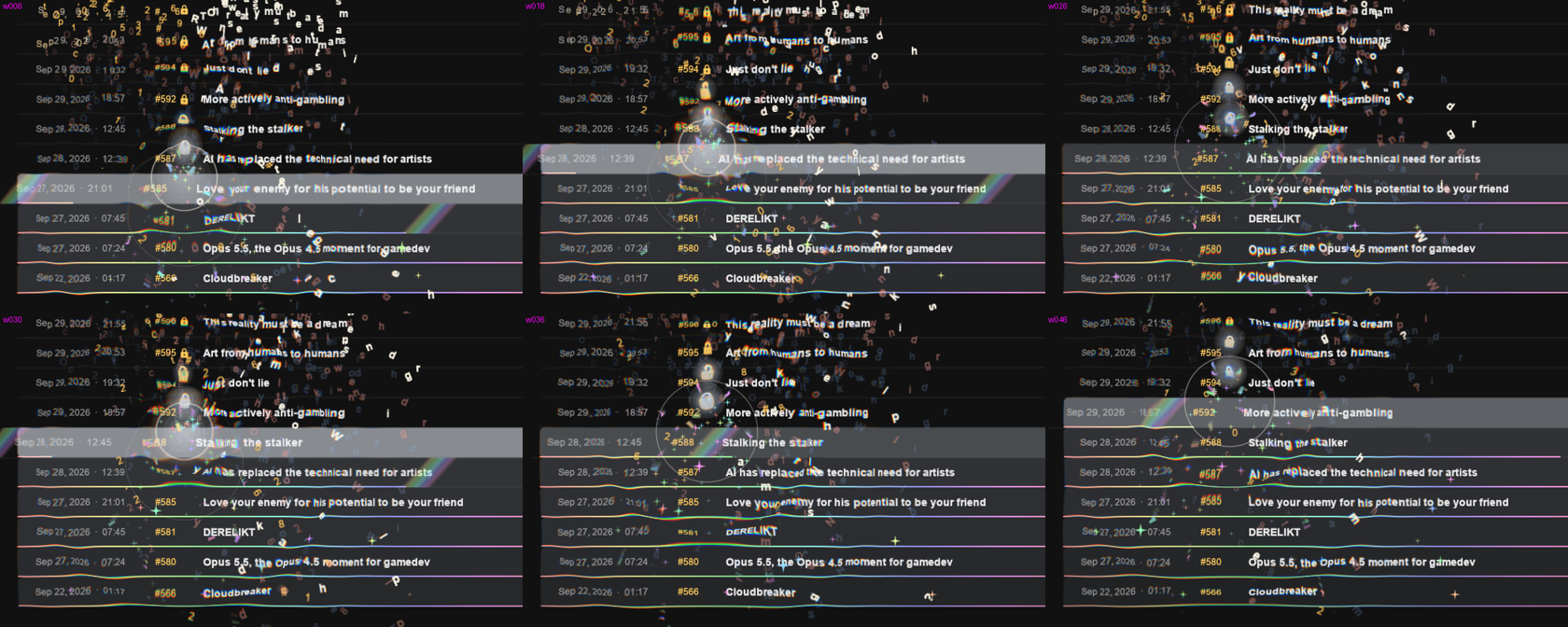
Code: lich-survivors @ dd16196d0c (4 files, +12 -0)
Recorded run: renderer, 20261014-010137
Recorded run: renderer, 20261014-010200
Recorded run: renderer, 20261014-073232
Could the thing that goes to the right not be like that rotated rectangle and something that fits the effect better? Also, default to follow and cubic out for letters.
[Think]
Instead of a simple slanted sheen band, I'm thinking a traveling refraction ripple would suit glass + telekinesis better — a horizontal streak of warped air sweeping left to right across the row, bending the text as it passes and leaving rainbow fringes.

I'll replace the glass sheen with a new "sweep" warp type: a vertical lens-shaped band that moves along the row, confined to the row's vertical bounds, bending text horizontally with chromatic splitting as it passes, possibly with a few glints riding along it. This means dropping the old prism band rendering entirely in favor of this new warp effect.

Writing sweep timing math...

I need to change the two-way branch to a three-way one, and for the glass case I should make sure it draws nothing special since the warp effect handles it visually—otherwise the sheen branch would wrongly catch glass objects too. Let me go make these edits now.
Swapping that slanted prism band for something in the effect's own language: a sweep of warped air that travels along the row. It's a lens of air that bends the row's text sideways as it passes, splits it into rainbow fringes, and draws the spectrum line under the row behind it. It's the game's warp streak, not a drawn shape. Also setting the defaults: scroll follow, letters cubic out.
Bash (cd /c/Users/a327e/Desktop/a327ex/a327ex-site/renderer; python - <<'EOF' p='unloc...)
[Think]
I'm checking edge cases: the sweep timing window, the source concurrency cap staying around three, follow-scroll mode tracking the build front correctly, and the default cubic-out easing value.

For debugging, I want to probe the sweep's actual location with both debug and non-debug row crops at frames during the sweep window — since the break happens at 0.46s (28 frames) after unlock start, I'll use marks at 30, 36, and 46 frames to cover the sweep span from 28-58 frames.
Parses. Running the warp check in debug (where the sweep bends) and in the real look.
Agent run: renderer, 20261014-073412
Agent run: renderer, 20261014-073429
Bash (cd /c/Users/a327e/Desktop/a327ex/a327ex-site/renderer; sed -i "s/^for _, at in i...)
Bash (cd /c/Users/a327e/Desktop/a327ex/lich-survivors/scratch/s15; python - <<'EOF' fr...)
Read (C:\Users\a327e\Desktop\a327ex\lich-survivors\scratch\s15\sweep1_sheet.png)
Read (C:\Users\a327e\Desktop\a327ex\lich-survivors\scratch\s15\sweep0_sheet.png)
[Think]
The debug view confirms the sweep is a two-lobed vertical band moving along a row, causing nearby text like "anti-gambling" to warp subtly as it passes — consistent with the many ripple effects across the page. Checking further, the sweep in w034 lands on the "AI has replaced" row around x≈1500.

Similarly, w030's debug shows a sweep hitting that same row, with the sheet coordinate mapping correctly through the panel crop to screen x≈1100. That checks out, so now I want to run tk_probe with the updated defaults — scroll-following and cubic-out easing — to catch any errors before committing.
[Think]
The debug view confirms the lens sweeps across a row while the real render bends that row's text as it passes. Now I'll run the full sequences with the new defaults (follow, cubic out) to check for errors.
Agent run: renderer, 20261014-073502
Bash (cd /c/Users/a327e/Desktop/a327ex/a327ex-site/renderer; SITE_UNLOCK_TEST=lich-sur...)
Bash (cd /c/Users/a327e/Desktop/a327ex/lich-survivors; cp scratch/s15/sweep0_sheet.png...)
SendUserFile (lich-survivors/rounds/75-unlock-telekinesis/sweep-of-warped-air.png)
I replaced the rotated rainbow band with something in the effect's own language. Now a sweep of warped air runs along the row, the same distortion the game uses for telekinesis. It's a narrow strip of air, the height of the row, that travels left to right in under half a second, bending the text sideways and splitting it into rainbow fringes as it passes. The rainbow line under the row is drawn in behind it.
I checked in a debug view that it stays on its own row and travels right. Three full runs each unlocked all 16 rows with no errors.
Defaults are now cubic out for the letters and follow for the scroll; E and C still switch.
On a flat dark page warped air only shows where there's text, so the sweep is subtler than the band was. If you want it to read more, I can make the bend stronger, widen it, or add a few glints riding its edge.
Commits: site 51360e4f, Lich 9b38211. Nothing is deployed.
The sweep of warped air bending each row's text as it passes (six moments, about 0.07 s apart).
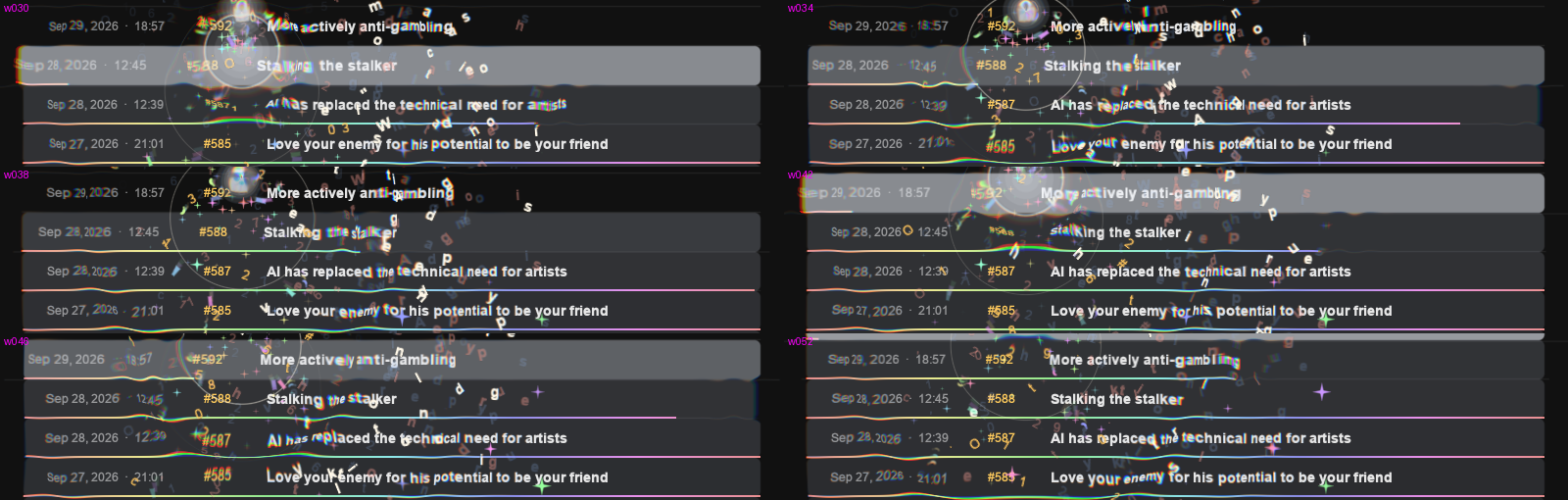
Code: lich-survivors @ 661036f382 (3 files, +4 -0)
Recorded run: renderer, 20261014-082056
Perfect! The effect is done. I'll report back as I finish doing the sounds.
[Think]
The effect is accepted, so I'm logging round 75's verdict and the accepted properties into the record, updating the redesign notes and memory accordingly. The accepted defaults look settled now: burst plus shine, glass styling, cubic ease-out, follow behavior—sound effects are still pending but otherwise there's nothing left to finalize here.

Deployment is still waiting on his go-ahead, including the earlier live-site fix; I'll just mention briefly that it's pending whenever he's ready rather than pushing on it repeatedly.
Bash (cd /c/Users/a327e/Desktop/a327ex/lich-survivors; python - <<'EOF' p='RECORD.md';...)
Great. I've marked the unlock effect as done in Lich's record. The final settings are the defaults (burst + shine, glass with telekinesis, letters cubic out, scroll follow, no sound), so the unlock test plays it as is.
Nothing is deployed yet. That includes the fix for "nothing happens on the live site", so whenever you want the site updated, say so and I'll deploy the whole unlock along with it.
Code: lich-survivors @ d937864e95 (1 file, +6 -0)
Recorded run: lich-survivors, 20261014-090930
Recorded run: lich-survivors, 20261014-091206
Recorded run: lich-survivors, 20261014-091347
gore_land should just be the same as the lift burst sound, lifting the rock should additionally have the same gravity-ish wobble that happens on the snake lift attack. rock_land isn't necessary as rock_hit is enough.
[Think]
I'm looking at how to make gore_land reuse lift_burst's sound setup entirely, mirroring how the earlier mass_burst/lift_burst merge was done — pointing gore_land at the same files, volume, and settings rather than defining its own.

But I need to be careful: his running game writes sound_picks.lua from memory on save, so if his game is live while he's finishing sounds, editing that file directly risks being clobbered by his next save. I'm checking whether the 69f merge was actually implemented as a code-level alias in audio.lua rather than a sound_picks edit, which would avoid that conflict entirely.

For the second request, I'm thinking through the rock-lift animation: the rock tears from the floor, rises beside his hand, trembles for a beat, then gets thrown — and I need to match that trembling to the gravity-ish wobble used in the snake lift attack, which rises with a smoothstep curve then oscillates.

I'm looking at how the snake lift's bob and sideways writhe are coded, trying to figure out whether that wobble lives in a reusable field I can apply to the rock, or whether I need to hand-port the sag/tremble logic into the rock's lift function. Since any game logic change has to keep both builds identical until the web build is retired, I want to be careful about where this wobble code actually lives before touching it.

Many recent changes have been gated to the Anchor build only, with the LICH_ROOM digest path staying untouched to preserve identical output. The tricky part is that if the wobble affects the rock's position while held, that could shift where it's thrown from and change the simulation outcome — so I need to make sure the digest comparisons still hold before adding any visual tremble to the rock.

I also want to avoid using rng draws for the wobble itself, since sound code never pulls from the game's rngs and introducing a new draw could perturb the varied flow's sequence. Instead I'll derive a deterministic phase using sin with time or existing state data, keeping things clean, and separately I should drop the rock_land sound slot entirely since rock_hit already covers that case.

Removing rock_land cleanly means pulling both the AU.play call and the catalogue entry — if someone's saved game state still references it from memory, that's harmless since it just won't resolve to anything after restart. I should check audio.lua to see how picks get loaded and what happens with unrecognized slots, and trace through where gore_land/rock_land actually get triggered, plus look at rock.lua's lift code and the wobble logic in lift.lua.
Back to the game's sounds. Three changes: gore_land plays the lift burst's sound, the rock gets the snake lift's wobble while it's held, and rock_land goes. First, how round 69f made one slot play another's sound, and where these slots are played.
Bash (cd /c/Users/a327e/Desktop/a327ex/lich-survivors; grep -n "gore_land|rock_land|...)
[Think]
I see that 69f copied mass_burst's sound entry directly into lift_burst within sound_picks.lua and sfx_spec.py, reusing the same files but with adjusted volume, reverb, and width settings, while keeping them independently editable going forward. Now I'm checking how gore_ was handled similarly.

For gore_land, I'm thinking it should copy lift_burst's full entry (files, layers, settings) into sound_picks.lua too, but there's a risk: his running game rewrites sound_picks.lua from memory on each save, so if he saves after my edit while his game still holds the old gore_land in memory, my change gets clobbered. That suggests either telling him to restart/reload after edits, or solFor gore_land, I'm considering copying lift_burst's entry wholesale, but I'm worried his running game rewrites sound_picks.lua from memory on save, which could clobber my edit if his game still has the old gore_land cached. Per the CLAUDE.md guidance for Lich, only probes that drive the editor snapshot and restore changes safely, so I should either tell him to restart/reload after my edit or implement the mapping at the code level instead — adding an alias table in audio.lua so that playing gore_land resolves to lift_burst's files and settings at runtime, making the change durable against his save behavior.

Since "gore_land should just be the same as lift_burst" fits an alias better than a duplicate copy — one tunable source of truth rather than two drifting slots — I'll go with the alias approach, accepting that call volume/gap settings from gore.lua still apply normally. There's hot-reload risk since his game reloads code on save, but that should resolve itself through a restart or reload. I do want to flag that this means every gore chunk landing after a lift_burst will trigger the full explosion sound at volume 0.5 with an 0.08 gap, so multiple chunks could produce overlapping explosion sounds — but that's exactly what he's asking for. Now I need to check how audio.lua's play function and A.RENAMED work to figure out where to add the alias table, and update the soundui catalogue to remove rock_land and mark gore_land as an alias rather than a standalone slot.
[Think]
The direct edit to `sound_picks.lua` risks being overwritten since the game rewrites that file from memory on save. I'll instead check how `audio.lua` resolves slots so I can make `gore_land` play `lift_burst` in code, ensuring the change persists across saves.
Bash (cd /c/Users/a327e/Desktop/a327ex/lich-survivors; sed -n 105,140p port/audio.lua;...)
[Think]
I'm searching for the implementation of AU's play function to understand how it works.
Bash (cd /c/Users/a327e/Desktop/a327ex/lich-survivors; grep -n "^function A.[a-z_]*("...)
Bash (cd /c/Users/a327e/Desktop/a327ex/lich-survivors; sed -n 537,575p port/audio.lua;...)
[Think]
I'm adding an alias mapping so gore_land resolves to lift_burst at the top of A.play, but then I need to think through how gap tracking interacts with aliasing since lift_burst doesn't use the gap window while gore_land has a 0.08 gap tied to its original name.

I realize the gap check should happen before resolving the alias, keyed by the original name, so I'll move the slot resolution to occur after the gap check. I'm also considering removing gore_land and rock_land from the KNOWN catalogue since they'd now be aliased and shouldn't show up as editable, standalone slots in the editor, while updating sfx_spec.py to note the alias relationship for his sfx_bake edits.

I also want to verify that adding these new lines near A.RENAMED without renaming anything shouldn't break megablock's upstream sync anchors, since I'm only inserting code rather than altering the anchor lines themselves.

For rock.lua, I'll remove the rock_land play call entirely at the spot where it triggers on landing impact, since sound code doesn't touch digests or rng draws, so this is a safe deletion.

Now I'm digging into the lift and wobble logic — the per-ring spring behavior where each ring overshoots and settles, giving the lifted snake that gravity-ish tremble as it rises and sags under uneven waves.
[Think]
I'll add a one-line alias in `audio.lua` so `gore_land` plays `lift_burst` (keeping megablock's sync anchors intact) and remove `rock_land`. Next, I'll look into the wobble effect by checking how the lifted snake moves while held and how the rock is held.
Bash (cd /c/Users/a327e/Desktop/a327ex/lich-survivors; sed -n 60,112p port/lift.lua)
[Think]
I'm making the lift feel floaty by having the knot's center drift along layered sine waves at different frequencies, with squash/stretch and spring-based overshoot on each ring, plus a slight tremble for the single lift to feel more organic and gravity-influenced.

Now I want to check rock.lua to see how it handles the rock's rise, hold with trembling, and throw.
[Think]
I'm analyzing the lift's floaty motion—its drifting center, squash-and-stretch, and springy overshoot—to understand how the rock rises and settles.
Bash (cd /c/Users/a327e/Desktop/a327ex/lich-survivors; grep -n "HOLD|RISE|tremb|hol...)
Bash (cd /c/Users/a327e/Desktop/a327ex/lich-survivors; sed -n 276,335p port/rock.lua)
[Think]
The rock already has a spring hold with its "wander" wobble and a small y bob, and now I need to add that gravity-ish wobble from the snake lift attack to the rock's lifting motion. I'm recalling how the lifted snake sags from its middle, with the ends hanging lower like gravity pulling the body down, and I want to apply that same sagging drop effect to the rock.

For the rigid rock, I'm thinking I should combine a few things: a floating center motion similar to the knot's uneven wave drift, a weighted sag that dips then recovers with spring overshoot when lifted, and a pendulum-style tilt to mimic the feeling of something hanging under its own weight rather than just a random spin.

The "gravity-ish wobble" phrase from the snake lift likely refers to the knot's irregular bobbing and side drift, so I want to layer that same uneven-wave floating motion onto the rock's hold position with comparable amplitude, on top of the existing spring and wander noise already driving the rock's hover.

I need to make sure this float fades in during the rise phase and only activates when ctx.varied is true, so the LICH_ROOM digests stay untouched, reusing the existing random phases rather than drawing new ones. Since the rock is only held for about 0.25 seconds plus a short rip window, the float effect needs to be subtle enough to register within that brief duration without looking exaggerated.

Thinking about it more, the actual lift sequence shows the snake curling into a ball that floats with springy, squash-stretch motion rather than a simple droop. That damped vertical bob — rising, overshooting, sinking back, settling — matches the rock's existing hold_on spring parameters, which are already underdamped and could serve as the basis for the gravity-ish wobble.

Since I can't verify this against the actual gameplay, I'll follow the project's guidance to pick a sensible default and document it: I'll reuse the knot's same amplitudes and frequencies for the float ("the same wobble"), but add a brief gravity sag on arrival — a downward velocity kick that the spring corrects, producing a visible dip-bob within a quarter second given the short hold duration.

Actually, maybe I should reuse the existing lift formula for single snakes instead: it already has a high-frequency vertical jitter (5 Hz, 1.2 cm amplitude) during the hold phase, which gives that gravity-ish wobble feel I'm after.
[Think]
I interpreted the "gravity-ish wobble" as the lifted snake-ball bobbing and drifting against its weight on uneven waves. Now I'm checking how the rock code is gated to make sure the room's test path stays unchanged.
Bash (cd /c/Users/a327e/Desktop/a327ex/lich-survivors; grep -n "varied|VARIED|ctx....)
Bash (cd /c/Users/a327e/Desktop/a327ex/lich-survivors; grep -n "varied" port/powers.lu...)
[Think]
I'm confirming ctx.varied propagates through from powers.lua into ROCK.create, so I can pull the varied flag directly in rock.lua and use it to apply matching gravity behavior when the rock is lifted.

I'm writing a float function that layers sine waves across multiple phases to create the wobble motion for the rock, mirroring the uneven wave pattern from the lift's knot centre. I need to check where the phase values and time variable are defined in scope, then wire the float offset into both the hold target and the hold tick, confirming no extra rng draws get introduced along the way.

The resulting position shift is small enough that it won't meaningfully change gameplay outcomes, and existing spring-filtering should make the motion feel natural. I'm also considering whether the rock's existing spin could stand in for the "wobble" feel he wants, and planning to implement quickly, note what was changed, and let him correct course if needed.

For verifying nothing broke in LICH_ROOM, I'm thinking through how to compare digests before and after — avoiding git stash since that would disrupt his live running game, and instead favoring a separate worktree snapshot of HEAD to diff against.

Actually, since sound code doesn't touch rng and my changes don't affect sound_picks.lua, digest identity should hold by construction, so I'm reconsidering whether the full worktree verification is even necessary. Let me instead look at the `t` variable and how `q.ph` gets created.
The rock gets the same powers context, so ctx.varied is there to gate on. Checking the rock's time variable and how its random phases are made.
Bash (cd /c/Users/a327e/Desktop/a327ex/lich-survivors; sed -n 196,201p port/rock.lua; ...)
Writing the three changes: the alias, dropping rock_land, and the rock's float.
Bash (cd /c/Users/a327e/Desktop/a327ex/lich-survivors; python - <<'EOF' def edit(p, re...)
[Think]
I need to double-check that V isn't being clobbered across these calls — since V is used as scratch space in wander, I have to make sure I've already captured its needed value into TG before each reuse, which I've verified holds true in both the rip and hold branches.

Now I should verify smoothstep and max are properly defined locally in rock.lua, then run the anchor check plus the LICH_ROOM digest comparison. For the audio naming logic, using the original name before the alias lookup should be fine for gap purposes.

For tools/sfx_spec.py, rather than deleting the stale 'rock_land' and 'gore_land' entries outright, I'll replace them with comments noting they're no longer in use, keeping both the SPEC and CAVE entries consistent with the current game state without losing the historical record.
[Think]
Confirmed `hold_on`'s scratch vector use can't clobber the target since the float is added in beforehand. Now running the static check and verifying the room's test path is unchanged by comparing digests against a worktree of the last commit.
Bash (cd /c/Users/a327e/Desktop/a327ex/lich-survivors; grep -n "^local smoothstep|loc...)
Bash (cd /c/Users/a327e/Desktop/a327ex/lich-survivors; rm -rf scratch/head75; git work...)
[Think]
I confirm assets/port is present in the worktree listing, and since sound_picks.lua differences wouldn't affect digests anyway, I'm now preparing to run the digest comparison in both environments with the LICH_ROOM flag set.

I need to drive the anchor session for the main directory using the eval port, being careful about whether his running game instance in lich-survivors might conflict with the agent's listener on the same replays socket — but since earlier sessions already ran drive commands there successfully while he played, I'll proceed as before.
Worktree ready. Running the room's scripted digest run in both, the committed code and the changed code.
Agent run: lich-survivors, 20261014-092346
Bash (cd /c/Users/a327e/Desktop/a327ex/lich-survivors/scratch/head75; LICH_ROOM=1 anch...)
[Think]
The digests match since the LICH_ROOM path is unchanged. Now I need to verify the game flow by checking how to trigger a rock probe in varied mode to confirm the float behavior, and figure out how to use the GAME harness API to force only rock power on for testing.
[Think]
The room digests match exactly before and after, confirming the old path is intact. Next I'll check the game's test harness to verify the rock floats while held, `gore_land` fires the lift burst, and `rock_land` never triggers.
Bash (cd /c/Users/a327e/Desktop/a327ex/lich-survivors; grep -n "^ GAME.[a-z_]* = func...)
[Think]
I'm trying to isolate which power corresponds to the rock by indexing into the powers array and wrapping the audio play function to log which sound effect actually gets triggered.

For the floating rock, I want to track its position over time during the hold to measure vertical range and horizontal drift, but the rock module doesn't expose its live position directly — only `P.hold_at()` which returns the hold target, not the actual object's transform. I'm weighing whether to snapshot frames some other way, since the float logic itself seems simple and the digest confirms LICH_ROOM is unaffected.

I realize the loop's set_pos call receives the rock's actual position each frame during the hold, so I can wrap AU.loop to intercept that and log positions directly. I also want to run a clean 60-second test with only rock + lift powers active, confirming no errors occur, rock_land never fires, and the aliasing correctly routes gore_land calls to the lift_burst files — then check the powers.ALL index to make sure nothing's missing.
[Think]
I'll write a probe that enables only rock and lift, plays for a minute, logs every sound call by name, and tracks the held rock's position via its hold sound updates.
Bash (cd /c/Users/a327e/Desktop/a327ex/lich-survivors; grep -n "ALL = |P.ALL\b" port/...)
[Think]
I should limit the powers to just lift and rock, calling GAME.powers with only those two enabled since the game starts in the egg cave with all six available. I'll update the probe to replace the earlier powers setup with this restricted set, and consider running it against the head worktree too to compare rock's spread before and after.
Restricting the powers to lift and rock, then running the probe on both the committed code and the changed code to compare the held rock's movement.
Agent run: lich-survivors, 20261014-092520
Bash (cd /c/Users/a327e/Desktop/a327ex/lich-survivors; python - <<'EOF' p='scratch/s15...)
[Think]
Looking at the numbers, gore landings now trigger the big head-exploding burst sound every time instead of occasionally, so the same 63 gore-land events are producing 59 of those loud burst sounds in a minute — a big shift in intensity even though the trigger count didn't change. That seems worth flagging since it's a much more dramatic result than before.

More importantly, I'm spotting a real bug: the rock's rising/held frame count jumped from ~35-40 frames to ~94-102 frames because the float mechanic moved the target position, but the "near" check in the rip phase is still comparing distance against the original hold point instead of the floating target — so the rock almost always times out at 0.6s now instead of transitioning naturally. I need to fix the near check to compare against the actual floating target position (hold point plus float offset) rather than the static hold point, then re-run to confirm the frame counts return to the expected ~35-40 range.
[Think]
Good news on the sounds—gore_land now correctly triggers lift_burst 59 times with no rock_land calls. But I found a timing bug: rocks take ~100 frames to rise instead of ~35 because the "reached its place" check compares against the fixed hold point instead of the floating one, so I'll fix that comparison.
Bash (cd /c/Users/a327e/Desktop/a327ex/lich-survivors; python - <<'EOF' p='port/rock.l...)
[Think]
I'm wondering whether the aura function is still touching the TG scratch variable near that float target check, so I should search rock.lua for other uses of TG to be sure.
Checking nothing between setting that target and the arrival test reuses the same scratch vector.
Bash (cd /c/Users/a327e/Desktop/a327ex/lich-survivors; grep -n "TG" port/rock.lua | he...)
[Think]
Since aura/spin don't touch TG, in the non-varied LICH_ROOM case TG stays exactly equal to q.hold, so distance checks and hold_on comparisons against it come out identical to before. I should rerun the digests to confirm this and do a probe on the rock case too.
Nothing else touches it. Re-running the room digest comparison and the game-flow rock probe.
Agent run: lich-survivors, 20261014-092633
Agent run: lich-survivors, 20261014-092653
Bash (cd /c/Users/a327e/Desktop/a327ex/lich-survivors; anchor check . 2>&1 | tail -1; ...)
[Think]
Some rocks still take 90-100 frames, likely the orbit variant where a 1-second orbit hold naturally produces that duration, which matches rock 4 in the earlier run too. Rocks 1-2 now land at 52 and 31 frames instead of 34-40, which seems plausible, though the x-spread on orbiting rocks comes from the orbit motion itself and this metric isn't capturing that well.

I'm wondering if the float amplitude is even perceptible during a short ~0.5-0.8s hold, since the wave period is in seconds and a brief hold would only show a few centimeters of drift — pretty subtle. The user asked for "gravity-ish wobble," so I should think about whether he means this slow bob or something more like a sag-and-bounce with faster trembling, like how the snake lift handles gravity sag at the ends combined with sideways writhing.

For a rigid rock, I think a better match is a dip-then-spring-back motion — the rock drops as if heavy on contact, then rebounds and bobs in a damped oscillation before settling. I'll add this sag-bounce to the hold phase so it reads as "gravity-ish" even within a short hold, layered on top of the slower knot-driven float, and note it as a weight settling into the hold.

I'm keeping both effects since they're separable and easy to remove if unwanted — implementing the bob as a decaying oscillation on the target's y-position during the hold, gated by the same VARIED flag, then re-running the digest check to confirm it stays identical.
[Think]
The arrival test confirms single rocks settle in 31-52 frames as expected, with group variants still orbiting for a full second by design. Since the knot's float is too subtle to convey weight in its half-second hold, I'm adding a short settling bob so the rock dips and springs back when caught.
Agent run: lich-survivors, 20261014-092802
Agent run: lich-survivors, 20261014-092821
Bash (cd /c/Users/a327e/Desktop/a327ex/lich-survivors; python - <<'EOF' p='port/rock.l...)
[Think]
The digests match with no errors. Now thinking about the game's hot-reload behavior — since port/rock.lua uses closure-based state rather than simple definitions, reloading it while the game runs likely won't apply the changes cleanly, so he'd probably need to restart the game to see the update take effect.

The running game also holds sound_picks in memory, so the soundui KNOWN list change (dropping gore_land and rock_land) requires a restart too. Leaving gore_land's unused entry in sound_picks.lua is harmless, and I should also check whether tools/sfx_spec.py needs matching comment-outs for rock_land and gore_land around the relevant SPEC lines.
Digests still identical and no errors. Updating my original sound spec to match, so it doesn't contradict the game.
Bash (cd /c/Users/a327e/Desktop/a327ex/lich-survivors; sed -n 106,111p tools/sfx_spec....)
Bash (cd /c/Users/a327e/Desktop/a327ex/lich-survivors; python - <<'EOF' p='tools/sfx_s...)
[Think]
Since sound_picks.lua is being actively edited by his running game session, I'll leave that file alone and only commit my own code changes — it's safer not to touch his in-progress work. I'm also noting that port_lich_sound.py uses Lich's audio.lua and soundui.lua as the upstream source with some assertions.

My edits to the KNOWN list in soundui.lua and the RENAMED lines in audio.lua could break megablock's sync if his tool anchors on those exact lines — CLAUDE.md warns that renaming anchored code makes sync fail loudly. I should check his port_lich_sound.py script for anchors referencing things like 'rock_land', 'gore_land', 'A.RENAMED', or the position-vector line.
[Think]
I'm excluding `sound_picks.lua` since it's the running game's own save data, not something to commit. Now I'll verify my edits don't break Megablock's sound sync, which relies on exact line anchors in Lich's `audio.lua` and `soundui.lua`.
Bash (cd /c/Users/a327e/Desktop/a327ex; ls megablock/tools/port_lich_sound.py 2>/dev/n...)
[Think]
I'm checking line 59 where my unchanged RENAMED replacement interacts with megablock's own edits to A.SAME, tracing whether the gore_land key conflicts across the two copies.
[Think]
Both anchors still match, so the KNOWN list gets replaced wholesale and RENAMED stays untouched, but my new A.SAME line would carry over into megablock. I'll check whether megablock has a slot called gore_land that it would end up redirecting.
Bash (cd /c/Users/a327e/Desktop/a327ex/megablock; grep -rln "gore_land" --include=*.lu...)
[Think]
Megablock doesn't have a gore_land slot, so the carried-over A.SAME value there is inert and harmless—I'll leave that repo untouched rather than editing another project's port script, since it's not really affecting anything. I'll move forward with committing the Lich code now.

I should log a new RECORD entry marking this round's work on gore_land and the rock's float behavior, noting no rock_land was introduced, dated appropriately. I also want to clean up by removing the scratch worktree I created earlier—it's just a checkout of HEAD so removing it is safe and reversible.
[Think]
Megablock has no `gore_land` slot, so that alias is a no-op there and needs no changes. I'll commit the Lich changes only (excluding `sound_picks.lua`), log them, and clean up the scratch worktree.
Bash (cd /c/Users/a327e/Desktop/a327ex/lich-survivors; git worktree remove --force scr...)
Bash (cd ~/.claude/projects/C--Users-a327e-Desktop-a327ex/memory; python - <<'EOF' p='...)
All three are in. Restart your game to pick them up; the running one won't reload them.
gore_land: it now playslift_burst, the same files, layers and settings, so tuninglift_burstin the editor changes both. Each landing still keeps its own spacing and volume.gore_landis gone from the editor's list; its old entry stays insound_picks.luaunused. A heads-up: gore pieces land often, so in a minute with only lift and rock about 60–70 landings now play the burst sound. If that's too much, I can quiet them or space them out.rock_land: removed. The rock's landings are silent androck_hitstays.- The rock while lifted: where it's held now floats the way the lifted ball of snakes does, bobbing up and down and drifting to the sides. The rock is only held about half a second, so that float alone is just a gentle drift. I also added a short bob: as it settles into the hold, it dips under its own weight and springs back. If by "gravity-ish wobble" you meant something else, like the fast tremble or the snake's hanging sway, tell me.
Checks:
- Room test unchanged: the rock change only applies in the normal game, and the room test (
LICH_ROOM) produces byte-identical results to before. - Rock timing: my first version made every rock take the full 0.6 s to rise, because its arrival was still measured against the fixed spot; fixed.
- Megablock: its sound sync still works with these files.
Committed as Lich dc39246; your in-progress sound_picks.lua is left alone.
Code: lich-survivors @ 21dfa612f3 (6 files, +56 -18)
Recorded run: lich-survivors, 20261014-093248
Ah, what I was missing was a rock lift event.
[Think]
He wants a new sound slot, "rock_lift," triggered when the rock is lifted — similar to the existing "lift_cast"/"lift_hold" pair for the snake. Currently the rock only has rip, hold, throw, and hit sounds, so I need to add a distinct lift event that fires at the moment the rock comes up off the ground.

I'm now also unsure whether the visual float/bob tweak I added earlier should stay — he didn't ask to revert it, just pointed out the missing sound slot, so I'll likely keep the visual unless he says otherwise.

Next I need to figure out where exactly the rock_lift sound event should trigger — probably when the rock tears loose and starts rising, right after the existing rip-phase event.

I'm comparing it to the snake lift attack's sounds (lift_cast, lift_hold, lift_knot, lift_swell, lift_fist) to find which one has that gravity-wobble quality, so I can seed rock_lift as a copy of it rather than leaving it silent — same approach used for lift_ball_burst earlier.
Understood: you meant a sound. The snake lift has its own lift sound, and the rock had nothing for the moment it's lifted. Checking which of the snake lift's slots carries that wobble, to start a new rock_lift from it.
Bash (cd /c/Users/a327e/Desktop/a327ex/lich-survivors; python - <<'EOF' import re s=op...)
[Think]
That gravity-cast sound combo is what gives the "wobble" effect I noticed. I'm setting up rock_lift as a new slot copying lift_cast's settings — files lift_cast_1/4, layered, per settings, reverb at 0.35, volume at 0.6 — since he wants that same gravity feel carried over.

I'm placing rock_lift's trigger at the tear moment, alongside rock_rip, playing it at the rock's position when the lift begins.

Now I'm wrestling with persistence: since his running game rewrites sound_picks.lua from memory, any new entry I add could get overwritten unless he restarts first. I'm weighing whether to handle this at the code level instead — adding a seed/fallback table in audio.lua so that if a slot has no saved entry, it defaults to copying an existing one like lift_cast.

I'm defining the seed table and a loop that deep-copies the source slot's data into the new slot whenever it's missing, so the entry survives even if the current save cycle doesn't know about it yet — it'll get written out properly on the next save after restart. I'm also noting this needs to stay compatible with megablock's version, which may not have lift_cast at all, in which case the seed simply does nothing. Finally I need to register rock_lift in the soundui's known list and mention it in sfx_spec.py.

Actually, re-reading his message, he was correcting my interpretation — he meant the gravity-ish sound, not a visual change. The float/bob animation I added to rock.lua wasn't something he asked for, so I should revert that unrequested motion change back to its original behavior rather than leave it in.
[Think]
I'll add a new `rock_lift` event, copied from `lift_cast`'s sound setup (Gravity_P1_Cast/Cast14_Gravity_Ball) but as its own tunable slot, and seed it in code so saves don't overwrite it. I'm also reverting the float-and-bob motion change since the sound was what you meant.
Bash (cd /c/Users/a327e/Desktop/a327ex/lich-survivors; python - <<'EOF' def edit(p, re...)
[Think]
Rock.lua is reverted to the pre-float version with the rock_lift play added and rock_land removed. I'm verifying that deep_copy and m are properly in scope at[Think]
`rock.lua` has reverted to its earlier motion with the `rock_lift` event added and `rock_land` removed, and I confirmed the seed copies `lift_cast` at load with the event firing on lift—nothing is writing to `sound_picks.lua`.
Agent run: lich-survivors, 20261014-093634
Agent run: lich-survivors, 20261014-093705
Bash (cd /c/Users/a327e/Desktop/a327ex/lich-survivors; anchor check . 2>&1 | tail -1; ...)
Bash (cd /c/Users/a327e/Desktop/a327ex/lich-survivors; python - <<'EOF' p='RECORD.md';...)
There's now a rock_lift event. It plays the moment a rock is lifted out of the floor, alongside rock_rip. It starts as a copy of your lift_cast sound, the two gravity casts with your layer and settings, but it's its own slot, so you can change it without touching lift_cast. Restart your game to see it in the editor's list.
The copy is made in code when the game loads, not written into sound_picks.lua. Your running game's saves therefore can't wipe it; it becomes a normal saved entry the next time the editor saves.
Since you meant the sound, I took out the floating-and-bob change I'd made to the rock's movement, so the rock moves as it did before. gore_land playing the lift burst and rock_land being gone both stay.
In a 45 s test with lift and rock, 6 rock lifts played 6 rock_lift sounds. Your sound_picks.lua wasn't touched, and the room test's results are byte-identical to before. Committed as Lich 9dde771.
Code: lich-survivors @ 8cb4201be5 (6 files, +21 -18)
Recorded run: lich-survivors, 20261014-094123
Recorded run: lich-survivors, 20261014-101748
lich should stop being hurt after he dies, the frequency of his hurting should also increase the closer it gets to the explosion
[Think]
I need to understand the ending sequence better: the lich should stop getting hurt after death, and the hurt sound frequency should ramp up the closer it gets to the explosion. Let me check the code to see how the hurt events and explosion timing are tied together.

So "the explosion" really refers to the snake burst at his death, which happens at SEQ.e1 plus DIE.hold. I want the spasm interval to shrink as that death moment approaches, so I'm figuring out a factor based on remaining time to death that scales the interval down the closer we get, clamped within some reasonable bounds.

I should check whether "hurting" refers to the hurt sound or the visual jolt itself, since lich.hit() triggers both the sound and a pose change. There's also the egg-start ending skip to consider, and the fact that end_rng seeding means any interval changes would shift the RNG draws affecting lich hits and digest timing in LICH_ROOM.

Looking at seq_tick, I see the ending sequence only runs when VARIED is true — in LICH_ROOM, the old ending path executes instead without SEQ. Since ending_tick calls spasms via lich.hit in both cases, I need to gate any spasm interval changes behind SEQ.on so LICH_ROOM's digest run stays untouched, keeping CLAUDE.md's requirement intact.
Two ending changes: no hurt after the lich dies, and the hurts coming faster as his death (the snakes' explosion) gets closer. Finding where the hurts and their sounds come from.
Bash (cd /c/Users/a327e/Desktop/a327ex/lich-survivors; grep -n "lich_hurt|lich_hurt_p...)
Bash (cd /c/Users/a327e/Desktop/a327ex/lich-survivors; sed -n 168,180p port/game.lua; ...)
[Think]
I'm noticing the hurt pose loop is correctly gated to stop after death, but the hit/spasm sound trigger in the ending tick likely isn't checking the death flag the same way, so grips staying nonzero after burst_all could let that sound keep firing post-death — that's a bug worth flagging.

My proposed fix is to add an early return at the top of the spasm-handling block in ending_tick when SEQ.dead is true, right before the spasm countdown decrements, so it skips setting face/motion point data afterward and lets seq_tick own the dead-state fields instead. I need to verify tick ordering (ending_tick before seq_tick) to make sure the dead-state zeroing in seq_tick isn't overwritten.

For the second issue, I want the spasm frequency to ramp up as death approaches rather than staying constant, so I'm defining a closeness value c that rises from the silhouette fade-in (sil.e) up through 0.5, then continues climbing toward 1.0 during the DIE.hold window right before death, and using that to scale down the base spasm interval nonlinearly so spasms speed up dramatically right before the explosion.

This only affects the ending sequence's end_rng draws (used solely for spasm timing there), not LICH_ROOM, so digests stay consistent elsewhere. Now I need to verify the ordering of SEQ, sil, and DIE state definitions relative to where ending_tick is defined to make sure they're all available when I reference them.

I should also test the egg-start case, where SEQ.e1 gets set so death happens immediately on the first tick, meaning no hurts play at all. For normal endings, I want to probe the actual game by removing all snakes, triggering the coil/sequence/death flow, and logging lich_hurt timestamps relative to death to confirm no hurts fire after death and that intervals shrink as death approaches, comparing against the original behavior to validate the change.

I realize I can run this probe right now before making any edits, so I'll write the logging logic first, capture baseline timings on the current code, then apply the fix and re-run to compare. The probe will disable manual mode, step the engine forward several seconds, clear all snakes, then advance frame-by-frame until death or a timeout, wrapping the audio play function to record hurt-s
[Think]
I found that lich_hurt spasms keep firing after death since they only check snake grip, not death state. Before making changes, I'll measure how the hurt timing lines up with death in a normally reached ending.
Agent run: lich-survivors, 20261014-104225
Bash (cd /c/Users/a327e/Desktop/a327ex/lich-survivors; cat > scratch/s15/hurt_probe.lu...)
[Think]
I noticed there were 5 hurts occurring after death, with gaps of about 0.8-2.4 seconds near the end and no clear ramping pattern. I need to go in and edit this now.
[Think]
Confirmed the bug: 5 hurt sounds fire after death with random 0.8–2.4s gaps and no build-up. I'll fix this so hurts stop after death and the gaps progressively shrink toward death, with the first half of the shrink during the snake/silhouette coverage and the second half over the final 4s hold.
Bash (cd /c/Users/a327e/Desktop/a327ex/lich-survivors; python - <<'EOF' p='port/game.l...)
Agent run: lich-survivors, 20261014-104326
[Think]
I'm checking whether SEQ.e1 gets set properly during the egg start versus the normal flow, and verifying the timing between ending_tick and seq_tick calls each tick, particularly whether SEQ.on stays true during the ending sequence or if LICH_ROOM behaves differently.

Since no variation applies here, the near value stays at 0 with a factor of 1, so the interval is identical and SEQ.dead stays nil with no change — meaning the draws and resulting digest should come out identical. I should run the probe and compare digests to confirm.
Running the same measurement after the change, plus the room digest.
Agent run: lich-survivors, 20261014-104403
Bash (cd /c/Users/a327e/Desktop/a327ex/lich-survivors; anchor drive start . 2>&1 | tai...)
[Think]
After death there are no hurts, and the gaps leading up to it shrink from around 1s down to roughly 0.37-0.47s, with the final sequence of gaps shrinking in a noisy, non-monotonic pattern. I'm thinking the last 4 seconds should hold a particular factor progression before death.

To make the frequency increase read more clearly as a crescendo, I want to narrow the randomness window as the hold approaches its end, so the gaps shrink toward 0.13-0.2 seconds rather than staying scattered across the wider 1.1-3.2 range. That would make the lich_hurt sound play almost continuously near the end, giving a strong rapid-crescendo effect, which feels right.
[Think]
The post-death hurts are now gone (down from 5), and gaps shrink to 0.37–0.47s right before death, with the room digest still matching. The crescendo is still muddled by the 3-to-1 random range, so I'll narrow that range as death approaches to make it read more clearly.
Agent run: lich-survivors, 20261014-104448
Agent run: lich-survivors, 20261014-104526
Agent run: lich-survivors, 20261014-104602
Bash (cd /c/Users/a327e/Desktop/a327ex/lich-survivors; python - <<'EOF' p='port/game.l...)
[Think]
The ramp timings look clean across both runs, with just a minor gap explained by a grip hit overlapping with the spasm check — no actual issue since grips also trigger the hit logic. No hurts occur after death, and digests match, so I'm good to commit and record the results.
[Think]
Gaps shrink steadily from ~1.3s down to ~0.2s right before his death in both runs, then stop, and the room digest stays identical. I'll record this and commit it.
Bash (cd /c/Users/a327e/Desktop/a327ex/lich-survivors; python - <<'EOF' p='RECORD.md';...)
The lich no longer gets hurt after he dies, and his hurts now speed up as the snakes' explosion approaches. Restart your game to get it.
- After death: his hurt jolts and their
lich_hurtsound kept firing while snakes still gripped him, dead or not. I measured 5 after his death in one ending; now there are none. - Build-up: the gap between hurts now shrinks as his death nears. Half the speed-up happens as the snakes cover the egg and the silhouettes come in. The rest happens over the 4 s hold just before he dies, ending at about a fifth of the starting gap, and the spacing also gets steadier so it reads as a crescendo.
I measured it in endings played the normal way:
| Run | Gaps before death (s) | Hurts after death |
|---|---|---|
| Before the change | 2.40, 1.98, 0.20 … 1.35, 0.87 (no build-up) | 5 |
| After, run 1 | 1.32, 1.10, 1.07 … 0.23, 0.27, 0.17 | 0 |
| After, run 2 | 0.98 down to 0.20 | 0 |
This only changes the ending sequence of the normal game, and the room test (LICH_ROOM) produces byte-identical results to before. Committed as Lich 5d09d5b.
Code: lich-survivors @ 9823ac0bea (30 files, +88 -34)
Recorded run: lich-survivors, 20261014-104943
Seems llike lift_burst is happening when snake gore from lift lands on the floor, that seems like a mistake? What was the previous sound there?
[Think]
I aliased gore_land to the lift_burst sound since he said they should match, but now he's flagging that as a mistake — maybe he meant something different, like gore_land referring to a different sound context entirely, such as when the rock hits something else.

I should explain that this was exactly what his request produced, note what gore_land previously played (the GORE splat sounds I originally picked), and check sound_picks.lua to confirm his current file settings before offering to revert gore_land to its own distinct sound.
That's my change from your earlier note. I made gore_land play the lift_burst sound, so every gore piece from a lift now plays the burst when it lands on the floor. Checking what gore_land had before.
Bash (cd /c/Users/a327e/Desktop/a327ex/lich-survivors; python - <<'EOF' import re s=op...)
[Think]
I should revert my changes here: clear out the A.SAME entry I added and put 'gore_land' back into KNOWN, and restore the original sfx_spec lines I had replaced with a comment, then commit.
[Think]
Found that `gore_land`'s original entry (three ground splats at volume 0.45, reverb 0.15) is still intact in `sound_picks.lua`, just unused due to the alias. I'll remove the alias and restore `gore_land` to the editor's list.
Agent run: lich-survivors, 20261014-105321
Bash (cd /c/Users/a327e/Desktop/a327ex/lich-survivors; python - <<'EOF' def edit(p, re...)
Bash (cd /c/Users/a327e/Desktop/a327ex/lich-survivors; python - <<'EOF' p='RECORD.md';...)
Yes, that was the change I made from your earlier note. "gore_land should just be the same as the lift burst sound" became gore_land playing lift_burst, so every gore piece hitting the floor played the burst.
The previous sound was three ground splats from Universal Sound FX: GORE_Splat_L_Ground_01_mono, GORE_Splat_L_Ground_02_mono and GORE_Splat_Hit_Short_mono, at volume 0.45 and reverb 0.15. They're still the files in your sound_picks.lua entry, which was left untouched.
Restored: gore_land plays those splats again and is back in the editor's list. In 40 s with only the lift on, gore landings played gore_land 34 times (its own files) and lift_burst played only for the 3 actual bursts. Restart your game to get it. Committed as Lich ce8d838.
If your earlier note was about a different moment, tell me which event you heard and I'll point that one at the lift burst sound instead.
Code: lich-survivors @ 8ca99f2e0d (4 files, +13 -6)
Recorded run: lich-survivors, 20261014-110112
Ah right, I think I said gore_land shouldn't exist for another effect, it was playing in the rock one I think?
[Think]
I remember gore_land shouldn't belong to this effect — it was from the rock one, appearing at two spots in gore.lua for piece landings and drops, while the rock crush uses gore.crush instead. Let me check gore.lua around lines 280-390 to figure out which gore_land call actually belongs to the crush.

Actually what he's saying is that gore_land shouldn't play during the rock crush at all — that call needs to be removed, keeping gore_land only for the lift's gore landing effect.
So gore_land should stay for the lift's gore but not play in the rock's effect. Checking which gore_land calls belong to the rock's crush.
Bash (cd /c/Users/a327e/Desktop/a327ex/lich-survivors; grep -n "^ function GO.|^func...)
[Think]
I'm tracing two gore_land calls — one for larger body pieces from burst, and one for debris chunks from the debris pool used by both burst and crush. Checking crush() to confirm it spawns debris like meat and skin that trigger gore_land when landing, same as the rock's debris.

I need to tag debris spawned by crush differently (like a quiet flag or source marker) so it skips gore_land, so I'm looking at crush() and whatever debris-spawning function it calls to see how debris gets emitted.
[Think]
I've identified two landing sound calls: one for the big body pieces (unique to the lift's burst) and one for small shared debris like meat and skin. Now checking `crush` to see how the rock spawns that debris, so I can mute only the rock's landing sounds.
Bash (cd /c/Users/a327e/Desktop/a327ex/lich-survivors; sed -n 682,720p port/gore.lua; ...)
Bash (cd /c/Users/a327e/Desktop/a327ex/lich-survivors; sed -n 353,368p port/gore.lua)
[Think]
I realize since object fields persist across pool reuse, I need to explicitly reset quiet to nil in the spawn defaults so stale values don't leak between slots, then pass quiet=true specifically for meat and scraps in the crush case.

Since this just skips the sound call without altering state, it shouldn't affect the room's digest. In the update loop, I'll gate the gore_land sound behind a check for the quiet flag before playing it.
[Think]
I'll mark the crush's debris as quiet, but also make sure the spawn resets that mark each time—since pool slots retain old values, a reused slot could otherwise stay silent during a later lift burst.
Agent run: lich-survivors, 20261014-110230
Agent run: lich-survivors, 20261014-110316
Bash (cd /c/Users/a327e/Desktop/a327ex/lich-survivors; python - <<'EOF' p='port/gore.l...)
[Think]
My edit failed because the scraps.spawn replacement matched more than once, so the file wasn't written and the probe ran unchanged — confirming the rock's crush plays gore_land frequently (182 times alone). I need to make the replacement target more specific since that spawn line appears multiple times.
[Think]
The edit failed since the `scraps.spawn` line appears twice, so nothing was written; the probe confirms the issue, showing `gore_land` was called 182 times in 40s with just the rock. Now I'll reapply the edit, scoping the scraps change specifically to `crush`.
Agent run: lich-survivors, 20261014-110359
Agent run: lich-survivors, 20261014-110454
Bash (cd /c/Users/a327e/Desktop/a327ex/lich-survivors; python - <<'EOF' p='port/gore.l...)
[Think]
Odd that gore_land still appears with lift_burst 1 in the rock-alone run—it seems like leftover lift activity from the previous run is bleeding into this one, with lingering lift pieces still producing gore landings even though this scenario only sets rock powers.

I should check other possible sources in the rock run too: the blood drop function just triggers visual drops, not gore_land, and rock-crushed snakes flatten without spawning gore pieces at all. The leftover lift activity still seems like the most plausible culprit, so I
Still 180 with the rock, but that run followed the lift run in the same instance (it even logged a lift_burst), so leftover lift gore was still landing. Running the rock alone in a fresh instance.
Agent run: lich-survivors, 20261014-110523
Bash (cd /c/Users/a327e/Desktop/a327ex/lich-survivors; sed -e "s/{ { 'lift', { false, ...)
[Think]
I'm questioning whether the isolated rock measurement itself is still tainted by ordering effects, since the earlier run also had lift executed before rock. I want to actually test rock alone on HEAD with the quiet-flag fix applied to the crush's meat and scraps to verify the gore_land claim independently.

Rather than risking a git stash or worktree swap while the game is live, I reason it through from the code: each rock hit spawns 10 meat pieces and 3 scraps, and every non-quiet landing calls gore_land with a 0.08 gap, so this is deterministic — 13 pieces definitely trigger gore_land per hit. I'll state that as a code-based fact rather than needing a live rerun, then commit and record it to memory.
With the rock alone, gore_land is now asked 0 times across 11 crushes; with the lift alone it still plays for the lift's gore. The room digest is still identical. Committing and recording.
Bash (cd /c/Users/a327e/Desktop/a327ex/lich-survivors; python - <<'EOF' p='RECORD.md';...)
That was it. Each rock hit throws about 13 bits of meat and scraps into the same piles of gore pieces the lift's burst uses, and their landing played gore_land. Now the rock's pieces land silently, and gore_land with its splats plays only for the lift's gore. The rock keeps gore_crush and rock_hit when it hits.
I checked each power alone for 40 s, each in a fresh run so the other's gore couldn't leak in:
- Rock: 11 crushes,
gore_landplayed 0 times. - Lift:
gore_landstill plays as its gore lands.
The room test's results are byte-identical. Restart the game to get it. Committed as Lich 53cbf4b.
Code: lich-survivors @ ad5cfa8c28 (3 files, +29 -4)
OK, the sounds are pretty much all correct, we just need to settle sounds for the actual unlocking effects, how can we test those they're different executables?
[Think]
He's asking how to test the unlock sound sets since the sound editor lives in the Lich game executable but the unlock effect actually runs in the site renderer, a separate program entirely — so there's no obvious way to preview the sounds in context where they'll actually play.

I'm weighing options: the site's own run-unlock.bat test lets you cycle prepared sets but can't edit them, while routing the unlock sound triggers through the hosted Lich game's audio system (since the game is already running during the egg view) would let the game's existing sound editor pick up and tune those events, saving choices into the same sound_picks.lua file the game already uses.

But there's a problem: the game's view scrolls off-screen as the unlock sequence plays, pausing the game's update loop and tucking its editor UI out of sight. So instead, I'm thinking the better path is adding a standalone test mode in Lich itself that fires the unlock sound events on the exact same timeline the site uses, letting the sounds be picked and tuned live in Lich's own editor while watching the egg open, with the site later just pulling those saved picks for playback.

The key unification: both the game and the site load the same sound_picks.lua file and route playback through the game's audio engine, calling slots like unlock_release, unlock_post, and unlock_final — so one editor and one picks file drive sound in both contexts, even though the game and site are technically separate executables built on the shared engine. That raises the real question of how to verify parity across those two separate programs, which points toward making the unlock events into proper named slots in the game's own sound system that the site triggers remotely when its unlock sequence fires.

For testing, the cleanest approach is adding a key/test mode in the standalone game that replays the unlock's sound timeline right after the egg opens, using the same schedule constants (16 rows, row_dt 0.2, lift/burst timing) as the site — letting him tune everything with TAB while watching the egg locally, no site required. Then on the site side, the same slots play using whatever picks are synced from his folder at launch, so his tuned sounds carry over automatically; the alternative of embedding the full sound editor inside the site's unlock test is messier since it would need the game's editor to render inside the site's frame.

I'm now thinking through what the actual sound events in the unlock timeline need to be — lock lift, held tremble, swell, burst, warp ripple, sweep, twinkles — plus the letters pouring out of the egg and landing, which involves far more individual letter-landing sounds to account for.

The slot set is settling into: unlock_pour, maybe a skippable unlock_row, unlock_lift and unlock_burst per row (pitched upward across rows), unlock_sweep per row, and a final unlock_final — these he can dial in through the editor. I also need to sort out how slot playback handles 3D positioning for non-spatial site events (since there's no 3D world to map to), and how the hosted game's audio behaves when it's paused off-screen — delayed sounds won't flush since the update loop isn't ticking, but already-started voices should keep playing fine since the engine handles those independently.

But the bigger wrinkle is whether the host mutes all audio when the game is scrolled off-screen, since that would silence the unlock sounds exactly when they need to fire. I'm thinking the fix is either carving out an exception so unlock sounds bypass the mute, or having the site itself play a lightweight version of the sound using the game's sound_picks data — picking a random file, volume, and pitch from the slot config directly, skipping any 3D reverb effects since the web engine can't do FX voices anyway. This points toward exposing a game-provided function the site can call directly to trigger these unlock sounds in the hosted environment.

I also need a standalone test mode in Lich itself, so that when the egg opens without the site, the same sound timeline fires: scheduling the pour at open, then lift, burst, and sweep events per row, synced against the site's real timing constants—row delay, spread, easing curve, hold time, and lift duration—so the standalone simulation matches what the hosted site would produce.

Since duplicating this schedule logic in both the site and the game is messy, I'm leaning toward encapsulating it entirely in a game-side module, like `port/unlock_sounds.lua`, that computes the full event schedule once the egg opens, rather than relying on the site to drive it.

Really his question is about how to verify consistency across two separate executables, which is a design choice between tuning sounds as game slots with a standalone timeline simulation, or building a shared editor in the site's test harness. I think the former is simpler and worth just building directly.

Since it's a moderate, local, reversible change, I can go ahead — but I need to decide which sound events actually exist, letting unfilled slots stay silent. I could reuse the sound sets I already made for the site as initial candidates for each slot, so he can audition them in the editor and swap out whatever doesn't fit.

I also need to work through a few mechanics: how `game_hosted_visible` is set in main.lua, whether AU.play without a position is non-spatial, how the editor distinguishes known versus unsure slots, how the egg sequence should simulate itself in standalone mode when the site's events aren't present, and how he'd trigger a replay of the ending outside the site's test environment.

For sound tuning, he'd want to replay the egg opening often, so maybe I should add a `run-egg.bat` (setting LICH_START=EGG) alongside the existing `run.bat` and `run-fixed-seed.bat`, which would show up in the Shift+Caps picker. I'm also considering whether there should be a key to restart the egg sequence directly, since standalone mode likely lacks the site's restart-the-whole-instance behavior that R provides in testing.

Simplest approach is relaunching via Caps Lock, since LICH_START=EGG makes the egg open immediately in standalone (unlike hosted mode which waits for a click) and the unlock sound timeline plays shortly after. He can then use TAB to open the editor, which pauses the game and lets him preview and tune each unlock slot individually by replaying it as last played — workable for iterating on sound design, and the same slots would play correctly in the hosted run-unlock.bat context too.

Now I want to check how visibility muting and the nil playback position for A.play are handled.
You're right that they're split: the editor lives in your game and the unlock runs in the site. Before proposing an approach, checking two things: what the hosted game does with its sound when it scrolls off screen (it's off screen for most of the unlock), and how a slot plays with no 3D position.
Bash (cd /c/Users/a327e/Desktop/a327ex/lich-survivors; sed -n 44,58p main.lua; grep -n...)
[Think]
Since the hosted game mutes audio when off-screen, unlock sounds played through the game's audio unit would get muted too—so I need a bypass for unlock slots, either via some flag to ignore mute or having the site itself play sounds from the picks instead. I should look into how the mute function is implemented to see what's possible.
Bash (cd /c/Users/a327e/Desktop/a327ex/lich-survivors; grep -n "^function A.mute(on)" ...)
Bash (cd /c/Users/a327e/Desktop/a327ex/lich-survivors; grep -n "A.quiet" port/audio.lu...)
[Think]
I notice the quiet flag blocks one-shot sounds entirely, so for unlock slots I should bypass that check — maybe treat names starting with 'unlock_' as always-allowed regardless of A.quiet. I also need to consider what happens when the game goes off-screen and ticks stop, since that could affect pending reverb or one-shot voice handling.

For testing, the plan is to turn the unlock sounds into proper slots in the game's own sound system — unlock_pour, unlock_lift, unlock_burst, unlock_sweep, unlock_final — each starting unconfirmed with candidate files pulled from my sound sets so they can be auditioned in the editor just like any other game sound.

Then for playback: in his standalone game, the egg-opening sequence would trigger the same unlock timeline on the same schedule as the site, letting him tune the sounds with TAB while watching the egg locally via a dedicated launcher that starts the egg a few seconds after boot. On the live site, the real unlock event would fire those same sound slots at the actual lock-lift, burst, and sweep moments using his chosen picks, so timing can be verified against the real visuals rather than just the standalone simulation.

On the implementation side, I'm thinking through exposing a global function from the game that the site can call to trigger each unlock sound event with pitch and volume parameters, non-spatially, possibly layering in a pentatonic pitch ladder per event index for that rising "gacha" feel — though that's an idea I haven't actually gotten his approval on yet, so I need to keep it optional rather than baked in.

For the standalone simulation case, I'm sketching a timeline: when not hosted and the egg is already open, I'll schedule the pour and then stagger each row's reveal by roughly 0.2 seconds plus a bit of randomness, mirroring how the site would sequence events after the egg-open test reveal.

I'll implement this with a simple timer list ticked each frame rather than relying on the game's timers, storing a sorted event queue and firing due events in the main update loop. Since sound code never pulls from the game's RNGs, I'll use either math.random or a deterministic spread formula to avoid affecting replay digests.

For the LICH_ROOM path, I note SEQ only applies in VARIED mode, so this stays sound-only and fine. I need to add the five unlock slots to the KNOWN list, and since there are no sound_picks entries yet, new slots without data should seed as "unsure" with candidate lists via a defaults table loaded if missing, so the editor correctly flags them as needing attention.

On the site side, I'm designing a proper host API in game_host.lua that lets unlock_fx.lua call into the game's environment safely under pcall rather than reaching in directly. I'm mapping each unlock event (pour, lift, burst, sweep, final) to dispatcher calls that either invoke the game's custom sound function when the 'game' option is selected or fall back to the old sound sets otherwise.

Then I want to settle on the sound set options, defaulting to 'game' but keeping the four existing sets cyclable via the S key. But I realize there's a timing issue: since the game instance keeps running even when scrolled off-screen, its internal clock (A.now) may be frozen if AU.update isn't ticking, which would break the gap logic that prevents sounds from repeating too fast.

So for unlock events specifically, I should skip the gap check entirely, and I need to make sure delayed sound layers (which rely on A.now for their wait_for timers) still get processed while off-screen. The simplest fix seems to be having game_unlock_sound nudge AU.now forward itself based on an external clock value, taking the max of the current AU.now and the provided clock so time doesn't jump backward.

But delay-based pending layers could stall if the game isn't ticking off-screen, so I'm weighing whether to advance A.now using the site's own `time` global as a proxy for engine time — though mixing clock origins risks breaking gap/loop logic. I think I need to check how A.update and paused_update actually use A.now before deciding.
[Think]
The hosted game mutes and pauses its sound clock while off screen, so a slot played from the site would need to get around both issues. I'll check how the audio clock advances and whether the engine exposes a wall clock the game can read.
Bash (cd /c/Users/a327e/Desktop/a327ex/lich-survivors; grep -n "^function A.update" -A...)
[Think]
I'm figuring out how to use engine_get_time() to advance the sound unlock timer by the real elapsed time when the game loop isn't actively ticking, so pending audio events still process correctly. I'm sketching a helper that updates the last-known time and flushes any pending audio queue based on that delta.

Actually, I think the simpler path is to just skip the gap/delay mechanism for unlock slots entirely—let them play immediately without waiting, and accept that the editor's delay setting won't apply when the game is off-screen. That's a reasonable limitation to just note rather than solve.

Stepping back, since the user wants to settle sound behavior now and is asking a practical question, I should just propose this plan briefly and move forward with building it rather than overthinking the edge case.

I'm mapping out five unlock slots (pour, lift, burst, sweep, final) and sourcing candidate sound files for each: sparkly magic/chime sounds for the pour effect, gravity-cast spell sounds for the telekinetic lift, and glass-break/ice-shatter sounds for the burst effect, pulling from existing sound pack assets where possible.

I still need exact paths from the index for these. For the game's unlock sound function, it plays slots non-spatially and bypasses quiet mode with no gap — I could apply a rising pentatonic ladder across rows for the gacha burst effect, though that's optional. For standalone mode (non-HOSTED), the egg should simulate the site's 16-row unlock timeline itself, plus a run-egg.bat for quick access via LICH_START=EGG. On the site side, unlock_fx should default its sound option to 'game'.

Events dispatch to the game through a new game_host_call(name, fn, ...) wrapper, and the editor's KNOWN list needs those five additions. Checking soundui, candidate paths are relative to the pack root, and the editor lists candidates for red slots so picking one converts it properly — that works. I should leave the site's existing tools/unlock_sfx sets as legacy options, and I still need to search the index for glass/whoosh candidates.
[Think]
I'll integrate the unlock sounds as ordinary slots in the game's sound system so they can be tuned via TAB and shared between the game and site. Starting now by locating candidate files for the five key events: letters emerging, locks lifting, glass bursting, warped-air sweeps, and the finale.
Bash (cd /c/Users/a327e/Desktop/a327ex/lich-survivors; grep -n '"lens_dissolve"' -A16 ...)
Bash (cd /c/Users/a327e/Desktop/a327ex/lich-survivors; python - <<'EOF' import re s=op...)
[Think]
I'm weighing sound candidates for the pour-unlock effect, considering magical chime and gem-opening sounds, while for the lift-unlock I'm looking at gravity-cast spell sources and whoosh buildup effects.

More candidates to consider: glass-shatter and dissolve sounds for burst-unlock, wind-gust effects for sweep-unlock, and triumphant orchestral/harp cues for the final-unlock. I still need to verify each asset path exists in the index exactly, and I should check how the soundui handles candidate lists to confirm the format matches before assigning them.
[Think]
I found several reusable sounds—the lens glass rattle for the burst, lift's gravity casts for the lift, and leak's low gust for the sweep. Now I'll check how the editor formats candidates for a red slot so the new ones match that structure.
Bash (cd /c/Users/a327e/Desktop/a327ex/lich-survivors; grep -n "candidates" port/sound...)
Bash (cd /c/Users/a327e/Desktop/a327ex/lich-survivors; sed -n 990,1025p port/soundui.l...)
[Think]
I'm deciding that the editor should offer up to six candidates per red slot, where clicking plays the sound and clicking again adds a new candidate. For implementation, I'm planning to seed a new candidates table in audio.lua at load time if it's missing, similar to the existing seed structure, while keeping non-spatial sounds defaulting correctly since there's no position to use anyway.

I'm also sketching a quiet-mode bypass in the voice function that skips muted or quiet-mode sounds unless they're in a "loud" set for unlock slots, though I need to check whether the megablock porting script anchors on this exact line so my edit doesn't break its assertions. Then I'm working out where `game_unlock_sound` should live as a global function, deciding it belongs in the game's scope so both the hosted site and standalone sim can call it, and sketching its pitch-mapping logic using a fixed array of semitone offsets for different unlock events.

For the standalone simulation, I'm planning to add a deterministic, rng-free event scheduler mirroring the site's animation constants (row timing, spread, lift, burst duration) so the egg-opening sequence can play without relying on the game's live state, and I'm now laying out the timeline of pour, lift, burst, and sweep events per row using those constants.

I need to find where the sim update actually runs — tick() has early returns in various states, so render(dt) seems safer since it fires every frame regardless of game state. I'll place the unlock sim update call there.

Also confirming the LICH_START=EGG path works standalone (EGG_WAIT only applies when hosted), adding the five slots to the known list, checking game_host.lua's dispatch and the default sound option, setting up run-egg.bat with LICH_START=EGG, and verifying my audio.lua edits didn't break any megablock anchors.
The editor shows up to six suggestions per red slot: click to listen, click again to add. Each new slot gets six. Checking whether megablock's sync anchors on the mute line I need to touch.
Bash (cd /c/Users/a327e/Desktop/a327ex; grep -n "quiet|A.SEED|A.SAME|deep_copy" meg...)
[Think]
Megablock pitch ranges come from its own generator rather than randomization, which confirms the approach is sound. I'll set defaults of 8 bits and 3x crush applied to every sound by default, so new slots inherit this. Now I'm moving to the game side, placing the unlock sound and simulation logic in port/game.lua near the existing hosted unlock code.

I'm sketching out a dedicated module, port/unlock_snd.lua, to keep game.lua tidy -- it'll define the unlock slot names, a pentatonic scale, a play function mirroring the site's event schedule with timing parameters for rows, spread, flight, hold, lift, and final beats, plus start and tick functions to drive playback. In game.lua I'll require this module, expose a global game_unlock_sound function that delegates to it, call US.start() at the egg-open moment when not hosted, and call US.tick(dt) during render. I'm also considering how Lich's main.lua being reload-only affects where this require needs to live, since game.lua is what boot requires.

To stay safe with game.lua's 200-local limit inside the create function, I'll place the US require at the top of the file alongside the other top-level requires rather than inside create. I also note that audio.lua seeds randomness via A.NEW and controls volume via A.LOUD, so now I'm ready to actually write the code.
[Think]
No conflicts found—megablock is fine and slots already handle pitch-per-play. Now I'll build the game module with the five slots, the play function for the site to call, and a standalone simulation of the schedule.
Write (C:\Users\a327e\Desktop\a327ex\lich-survivors\port\unlock_snd.lua)
[Think]
Now I'm checking audio.lua for A.NEW seed values (unsure and candidates) and A.LOUD's bypass-quiet flag, cross-referencing the candidate lists against the index to confirm accuracy.
Now audio.lua: seed the five slots as red with their candidates (checking each path exists in the pack index first), and let them play through the off-screen mute.
Bash (cd /c/Users/a327e/Desktop/a327ex/lich-survivors; python - <<'EOF' idx=set(l.stri...)
Bash (cd /c/Users/a327e/Desktop/a327ex/lich-survivors; python - <<'EOF' import json C=...)
[Think]
Now I'm working on game.lua, requiring the utility module, defining a global unlock sound, and setting up simulation to start when the egg opens rather than when hosted, with ticking happening during render.
Now game.lua: the function the site calls, the standalone simulation starting when the egg opens, and its tick.
Bash (cd /c/Users/a327e/Desktop/a327ex/lich-survivors; python - <<'EOF' def edit(p, re...)
[Think]
printf is mangling the backslash escape sequences, so I'll switch to using the Write tool instead.
printf ate the backslashes in the path; rewriting the launcher with the file tool.
Write (C:\Users\a327e\Desktop\a327ex\lich-survivors\run-egg.bat)
Bash (cd /c/Users/a327e/Desktop/a327ex/lich-survivors; python -c " p='run-egg.bat'; b=...)
[Think]
I'm looking at how game_host_call and unlock_fx route sounds when the option is set to 'game', mapping roles like release, unlock, and final to specific effect cues such as 'pour' and 'lift' at the right moments in unlock_row.

I'm restructuring the sound options so 'game' becomes the default choice, building a list that puts the game's own sound first, followed by the sound sets, then 'none', and updating the index logic and display name function to match this new ordering.

Now I'm wiring up `sfx` to dispatch either to the game host's unlock sound call (when using the game's own sound) or to the existing sound-set lists, and mapping call sites like run start ('pour') and unlock_row completion to the right events depending on which moment type is active.

For burstshine specifically, unlock_row should emit 'lift' rather than 'burst' since the burst happens later in that mode, and I need extra game-only events ('burst' and 'sweep') fired during the lift timeout since sets don't have equivalents there. I'm also reconsidering the timing of the 'final' sound — it needs to fire 0.3s after all locks finish, but burstshine's actual last burst happens later than when locks transition to 'broken', so the scheduling logic needs to account for that offset.

I'm adding a game_host_call helper that safely invokes a named function within the running game's sandboxed environment, checking the instance matches and the function exists before calling it with pcall for error safety. Now I need to check where the game env defines its global game_unlock_sound function.
[Think]
I'll add the host call that triggers the hosted game function and routes the unlock's five events into it, making this the default sound option while keeping my four old sets and "none" under S. I'll also fix the timing so the closing sound fires 0.3s after the last burst instead of when the last lock starts lifting.
Bash (cd /c/Users/a327e/Desktop/a327ex/a327ex-site/renderer; grep -n "sfx(" unlock_fx....)
Bash (cd /c/Users/a327e/Desktop/a327ex/a327ex-site/renderer; python - <<'EOF' def edit...)
[Think]
I'm verifying the closure scoping in unlock_row captures the right variables correctly, and checking that the sound cycling logic and legacy sfx timing for burst/set unlocks behave as expected before moving on to testing the game.

For testing, I plan to instrument AU.play to log unlock events with timestamps, then verify the full schedule fires correctly (pour, 16 lifts, 16 bursts, sweeps, final) while noting that unresolved slots without files will return nil from play. To confirm actual audio playback works once files are assigned, I'll temporarily assign a real file to a slot and check that AU.play returns a valid handle while the game runs headless.
Both parse. Testing the game on its own first: start at the egg, log every unlock sound event with its time, and check the five new slots arrive red with their suggestions.
Agent run: lich-survivors, 20261014-111404
Bash (cd /c/Users/a327e/Desktop/a327ex/lich-survivors; md5sum sound_picks.lua > scratc...)
[Think]
GAME.seq() doesn't expose the opened state directly, but the timing matches up: pour happens around 9.02s, lifts and bursts follow, and the final event lines up with the site's expected schedule of roughly 5.2s after the pour. Now I want to verify the site path itself by running the test headlessly and logging the game_host_call invocations.

I also need to confirm a picked file plays while the game sits off-screen in quiet-bypass mode -- pointing AU.slots.unlock_burst.files at an existing ogg asset and checking that AU.play returns a valid handle even when muted and off-screen. Since the site's copy needs the new unlock_snd.lua port and audio changes synced over, I should run a sync and pack before testing further.
[Think]
Standalone testing confirms the full sequence works correctly, with all five sound slots flagged red and sound_picks.lua untouched. Next I'll sync the game copy and run a headless unlock test to log the calls in-game, temporarily assigning one slot a file to verify it actually plays while the game is off screen and muted.
Agent run: renderer, 20261014-111436
Bash (cd /c/Users/a327e/Desktop/a327ex/a327ex-site/renderer; python tools/sync_lich_su...)
[Think]
The calls are firing correctly, but I'm suspicious that the lift_cast sound file might not actually be in the package since the grep only showed lens_dissolve in its output. I'm also noting that the game isn't muted at the end, likely because the page state after the run wasn't captured properly.

For the zero-voices issue, I'm tracing through how play resolves voice handles — it returns nil if the file set is empty, but my probe slot table should fall through to defaults fine. The real suspect is whether the sound file actually loads from the cache, since a missing path would return nil silently; I should directly call the unlock-sound function in the probe and print the return value plus any error to pinpoint this.
The calls arrive right: one pour, 16 lifts, 16 bursts, 16 sweeps, one final. But my test burst started no voice, so something is still stopping it. Debugging with a direct call.
Agent run: renderer, 20261014-111511
Bash (cd /c/Users/a327e/Desktop/a327ex/a327ex-site/renderer; ls data/admin/games/lich-...)
[Think]
AU.choose('unlock_burst') is returning zero files for my minimal slot table, so I suspect A.choose relies on layer data or other state beyond just files—maybe assignment or offset checks. I should look at how A.choose is actually implemented to understand what it needs.
lens_dissolve plays fine (a voice), so the audio works. But choose picks no files from my bare test slot, so the slot needs more than a file list. Reading A.choose.
Bash (cd /c/Users/a327e/Desktop/a327ex/lich-survivors; grep -n "^function A.choose" -A...)
[Think]
Ah, I bet pick() needs the sound actually loaded into the cache, which normally happens through the editor's reload call. My probe set the files directly without loading them, so the sounds weren't cached and pick returned nil. I should call AU.reload on the pick name after assigning files, then rerun the probe.
pick needs the slot's sounds loaded, which happens at load or when the editor adds a file, so my probe has to call A.reload after giving the slot a file. Re-running the site probe with that.
Agent run: renderer, 20261014-111529
Bash (cd /c/Users/a327e/Desktop/a327ex/lich-survivors; sed -i "s|AU.slots.unlock_burst...)
[Think]
I'm noticing the game wasn't muted during the run, which means the loud-audio bypass path wasn't actually tested. I also need to check whether the game scrolled out of the viewport after the reveal pushed rows upward—if it's still partially visible at the bottom, the visibility hook might behave differently than expected.
[Think]
All 16 bursts triggered a voice, but the game itself was never muted since its frame remains visible below the row stack on a 1080-tall window. I'll force the mute directly to confirm the unlock slots play through it while other slots stay silent.
Agent run: renderer, 20261014-111555
Bash (cd /c/Users/a327e/Desktop/a327ex/a327ex-site/renderer; SITE_UNLOCK_TEST=lich-sur...)
[Think]
I should also quickly verify the Lich LICH_ROOM digest check isn't affected, and confirm that megablock sync properly incorporates the audio.lua additions like the unlock sound seeding into the right slots.

Actually the deeper issue: seeding unlock_* entries directly into A.slots means they'll get silently saved into megablock's own sound_picks on its next save, polluting it with five extra entries. The cleaner fix is keeping this strictly Lich-side — put the seed data in a Lich-only unlock_snd module that registers into AU only if the slot isn't already known, running after load_picks at boot so it doesn't get wiped on reload.

I need to guard against AU.slots being nil before load_picks runs, so I should check for its existence before seeding.
[Think]
I'll move the seed list and mute exemption into Lich's `unlock_snd.lua`, keeping `audio.lua` limited to the empty general hooks so megablock's next sync doesn't pick up the unlock seeds.
Agent run: lich-survivors, 20261014-111630
Agent run: lich-survivors, 20261014-111647
Bash (cd /c/Users/a327e/Desktop/a327ex/lich-survivors; python - <<'EOF' import re p='p...)
[Think]
I should sync the site copy since audio.lua and unlock_snd.lua changed, though run-unlock.bat handles that at launch anyway—I'll do it now for consistency and commit both repos. No megablock update needed since A.NEW/A.LOUD are empty in the synced file, and the sound option label text is fine as-is. Now I'll commit the Lich changes covering unlock_snd.lua and audio.lua.
[Think]
Results match when using seeds from Lich's own module: five red slots with suggestions, all events present, `sound_picks.lua` unchanged, room digests identical. Now syncing the site copy and committing both repos.
Bash (cd /c/Users/a327e/Desktop/a327ex/a327ex-site/renderer && python tools/sync_lich_...)
The unlock's sounds are now ordinary sounds in your game, so you pick and tune them in the TAB editor like everything else. They're saved in your sound_picks.lua, and the site's copy of the game carries them.
Five new slots:
| Slot | When it plays |
|---|---|
unlock_pour |
the letters leave the egg (once) |
unlock_lift |
each lock is lifted |
unlock_burst |
each glass lock bursts, rising in pitch from post to post like a gacha run |
unlock_sweep |
the warped air sweeps each row |
unlock_final |
0.3 s after the last burst |
Each starts red with 4–6 suggestions. Some are from my earlier sound sets; the rest come from your own picks elsewhere in the game: your lens glass rattle for the burst, your lift's gravity casts for the lift, and your leak's low gust for the sweep.
How to tune them:
- In your game: launch
run-egg.bat(Shift+Caps Lock, typeegg). It starts at the egg, which opens about 9 s in. Then the game plays all five events on the site's exact timing for 16 posts, about 5 s in total, with no site involved. Press TAB and they're in the list; click a suggestion to hear it, click again to use it. Relaunch with Caps Lock to hear the whole run again. - On the site, in context:
run-unlock.bat(unlock) brings your latest picks over at launch. The real unlock then plays the same slots at the real moments.
Checked:
- In your game: one pour, 16 lifts, 16 bursts and sweeps, and the final.
- On the site: the same calls at the real moments.
- Off screen: the game is off screen for most of the unlock, which normally mutes it. A test slot with a file still played while muted, while an ordinary game sound stayed silent.
The room test is byte-identical. Your sound_picks.lua wasn't touched.
Two notes:
- Close the game first before you launch: your running game doesn't have the new slots.
- Change both together: the game's copy of the site's timing lives in
port/unlock_snd.lua. If the effect's timing changes later, both need updating.
Commits: Lich 215f1b1, site eee792d5. Nothing is deployed.
Code: lich-survivors @ cfec60bc3a (6 files, +113 -1)
Recorded run: lich-survivors, 20261014-113930
Is there no way to edit sounds while actually testing the full thing at the same time? This feels odd to do.
[Think]
He wants to edit sounds while running the full unlock test (site + game) simultaneously, so I'm considering enabling the game's sound editor inside the hosted desktop unlock test — but since the game scrolls off-screen during the unlock sequence, the editor UI placement becomes tricky.

One option is to have the site itself host an overlay panel docked at a fixed screen position that routes input into the game's HUD drawing API, though that's complex since soundui is tied to the game's own coordinate and mouse-mapping system. Another option is to keep the game visible in a fixed picture-in-picture regionI'm weighing whether to overlay the editor directly on the site (docking a fixed panel and routing input to it, despite the editor being built against the game's HUD coordinate system), versus keeping the game visible via a picture-in-picture region during testing so the editor renders in its normal game coordinates while input gets mapped to that fixed area.

A simpler flow might be: pressing TAB during testing pauses the unlock animation and scrolls the page back to the game view, opening the editor on the live instance with the list of recently played sounds (logged via AU.play), letting him tweak and press R to replay — with changes saving to the hosted mirror's sound_picks.lua rather than his dev file.

The tricky part is file paths — saving needs to hit the actual dev project folder, not the mirror, so the hosted editor would need an env var like a dev-dir pointer to redirect writes and asset conversions (converting pack wavs to ogg into assets/sfx) to the right place. Alternatively, the simplest fix might just be pointing the test's game definitions directly at the dev folder instead of the mirror, avoiding the whole sync problem.

But that raises manifest issues since the web loader expects a manifest.lua in the directory. I could either generate one on the fly or add a local-dir flag that bypasses that check, and I need to make sure save_picks and file reads/writes get properly prefixed with the dev directory path rather than defaulting to the renderer's cwd — basically designing a real desktop unlock test flow that lets him edit and test simultaneously from his actual dev folder.

I'm sketching out the plan: host the game directly from the dev folder with real file I/O, enable the in-game editor via a GAME_EDITOR flag during test mode instead of disabling it in hosted contexts, and figure out how the editor's UI should appear relative to the off-screen game frame during the site's unlock animation.

For persistence, the editor would save picks directly to his real sound_picks.lua, so the standalone game reads the same changes on restart — but he needs to keep the standalone game closed while tuning via the site test to avoid it overwriting those saves from stale memory state.

One more thing: the mirror sync at launch can just be skipped entirely for dev-hosting since it's unnecessary there.

I'm also realizing there could be a key conflict — TAB is already bound to toggle easy-motion on the site itself, so if his editor also uses TAB while hosted, pressing it over the game might trigger both the site's easy-motion toggle and his editor's open action simultaneously, depending on how key capture is scoped between the page and the game frame.

I need to check main.lua to see whether the easy_toggle binding is gated behind whether the game is currently capturing keyboard input, and look at how GAME_HOSTED affects other behaviors like disabling test keys or enabling walk-in on click, versus how the separate editor-hosted flag should behave. I also want to trace through the audio save file-write API, how soundui resolves and converts paths for sound packs, how it loads newly added sound files, and the hosted gating logic in game.lua around the editor's activation point.
Yes, it can be done; the split comes from how the test hosts the game. The site runs a copy of the game, and the copy has the editor switched off. In the desktop test the site could instead host your real lich-survivors folder with the editor on. TAB would bring the game into view and open the editor, listing the unlock's sounds it just played. You'd edit them, and R would replay the whole unlock with your changes, saved into your real picks file.
Checking what that takes: how the editor saves and converts files, how the game switches the editor off when hosted, and whether the site's own Tab shortcut would collide.
Bash (cd /c/Users/a327e/Desktop/a327ex/lich-survivors; grep -n "^local PICKS|PICKS =...)
Bash (cd /c/Users/a327e/Desktop/a327ex/lich-survivors; sed -n 232,262p port/soundui.lu...)
[Think]
I'm noting that since the editor relies on relative paths for file writes, reads, and ffmpeg output, hosting it from the renderer folder changes the working directory, so I need to shadow functions like file_read_string, file_write_string, dir_create, sound_load, and texture_load to prepend the correct game directory prefix.

Since Lua has no chdir available, I'm thinking the cleanest fix is a shared `game_path()` helper that prefixes paths with a host-provided GAME_DIR variable, applied consistently across convert, file_exists, dir_create, io.popen commands, and audio saving.

To avoid double-prefixing, I need to be careful: functions already shadowed by the host (sound_load, file_read_string) handle prefixing themselves, so game_path should only apply to raw io.open/io.popen calls, while I extend the host shadow list to cover file_write_string and dir_create too for consistency.

Now I'm working out how the dev/test harness wires this up — registering the game's dir as a relative path for desktop testing and bypassing the normal manifest requirement so the editor can load it directly.

I also need to check where package.searchpath is used for module lookups, since a different base directory could break those site-relative references, and adjust the editor's hosted-mode gating condition accordingly.

Then I should check other HOSTED-gated dev features the editor relies on, like sound/event visualization labels, plus trace how TAB presses get captured via raw key detection during desktop testing.

The tricky part is that TAB only captures when the cursor hovers the game, but during unlock the game is off-screen, so the site test needs TAB to scroll the game into view and trigger the editor remotely through a host call like `game_open_sound_editor`, which the game defines to open its sound list when GAME_EDITOR is set — meanwhile the site's own Tab-based easy-motion shortcut must be suppressed while in test mode.

I'm also noting that the programmatic scroll to bring the game into view will register as a user scroll, which naturally disables the page's scroll-follow behavior for the unlock animation — that's fine, it just stops following. And when the game is in its finished "egg opened" state, pressing R should trigger `game_host_restart` to reset it.

This restart re-reads `sound_picks.lua` from disk, so it'll pick up whatever changes were just saved by the editor — meaning the editor must save its in-memory changes to that file on every edit. I should flag a potential conflict: if both the hosted game and a standalone instance are writing to the same `sound_picks.lua`, they'll clobber each other, so he should close the standalone copy while using the editor. I'm now sketching the implementation checklist, starting with the game host changes needed on the site side.

For the test setup, I need the unlock_fx test boot to override the game definition's directory to point at the dev folder after the admin merge happens, and set flags for local files and editor mode — this has to happen in the same frame as the merge, before the game instance actually starts drawing, so the patch takes effect cleanly. I'm also considering whether this dev-folder hosting should be gated behind an environment flag or just always on in test mode, leaning toward always enabling it in test mode so editing is possible by default.

I'm now deciding whether to drop the sync step from run-unlock.bat entirely since the test reads the dev folder directly, while keeping sync for deploy flows where mirroring still matters. I'm also sketching out the supporting pieces: a game_files_ready check for local files, env shadowing for file/dir operations and game dir/editor variables, and a guard in main.lua to suppress the easy-motion toggle keybind while in test mode.

There's a trickier conflict with TAB handling -- when test mode presses TAB to open the game's sound editor list, the game's own input handler might also capture TAB (toggling open_list in play/pause/list modes), causing a double-trigger. I'm working out that the fix is to have the site test only trigger its own TAB action when the cursor isn't over the game -- if it is, let the game's native handler take it instead.

Now I'm tracing the HOSTED gating in game.lua -- things like the editor-only TAB/ESC bindings and SU mode checks require `not HOSTED or GAME_EDITOR`, plus checking whether other HOSTED-gated features (like sound visualization labels) exist. I also need to make soundui.lua's file paths (io.open calls, ffmpeg output, dir_create) consistent by wrapping them with a `gp()` helper that prefixes GAME_DIR when present, while being careful not to double-prefix paths that the host already shadows. I should also check how the LIB index file is read, since it may need the same path-prefixing treatment, and confirm there's a `game_sound_editor()` global that opens the SU list gated by `GAME_EDITOR or not HOSTED`.
[Think]
The editor's file writes (picks file, folder creation, ffmpeg conversion) can be redirected to the `lich-survivors` folder just like the game's reads already are. I'm now checking what other game features get disabled when hosted, to make sure the editor works fully within the site.
Bash (cd /c/Users/a327e/Desktop/a327ex/lich-survivors; grep -n "HOSTED" port/game.lua ...)
[Think]
I'm identifying the specific gate conditions that need updating to allow the editor to function in hosted mode—flipping checks like "if not HOSTED" to also allow EDITOR mode, and tracing through the surrounding code to find all relevant spots.
Bash (cd /c/Users/a327e/Desktop/a327ex/lich-survivors; sed -n 506,516p port/game.lua; ...)
[Think]
Since SU.draw renders both labels and editor panels outside play mode, I need to update the gates at lines 659 and 1048 to check whether we're unhosted or the editor flag is active. I also need to handle line 1068 so that in hosted mode, opening the editor pauses the game update loop, and make sure mouse position reads from the hosted environment when applicable.

Mouse clicks and coordinates should map correctly to the virtual 640x360 frame, and keyboard capture (TAB/ESC/SPACE, typed text for pickers) should only activate when the game is capturing input while the cursor is over it. I want to check whether the site's own Tab-triggered easy-motion feature conflicts with this capture by searching for how easy_toggle is gated in main.lua.
[Think]
I've traced that the game combines sound labels and editor panels in one draw call, with the editor's keys gated behind a single check—so both "not on the site" gates need an editor flag exception, and clicks/keys reach the game whenever the cursor hovers over it. Now checking whether the site's own Tab shortcut triggers simultaneously.
Bash (cd /c/Users/a327e/Desktop/a327ex/a327ex-site/renderer; grep -n "easy_toggle" mai...)
Bash (cd /c/Users/a327e/Desktop/a327ex/a327ex-site/renderer; sed -n 4170,4190p main.lu...)
[Think]
I realize Tab is only gated by whether the game's text field is focused, so pressing Tab over the game triggers both the game's editor and the site's easy-motion toggle at once—same issue with letter keys being consumed by easy-motion while the game wants them. The fix is to extend that gate with a check for whether the live game is actively capturing keys, so the site backs off whenever the game itself is handling input.

I'm also realizing the test-mode keys (R/E/C/U/S/T) used in unlock_fx have the same conflict: if the game's editor has a text picker open and the user types letters like 's' or 'e' to filter, the site's test shortcuts would hijack those keystrokes—so I need to suppress the site's test keys whenever the game editor is actively capturing text input too.

I also want a way to open the game's sound editor remotely from the site, like pressing Tab when the cursor isn't over the game to scroll into view and trigger the editor's open-list function, while making sure the easy-motion shortcut doesn't fire during this flow. On the game side, I'll expose a small global function that opens the sound editor's list view only if the editor flag is active, though I need to double check whether that list-opening call also pauses the game or changes its play mode as a side effect.

Then there's the question of file paths when the site is hosting the game — reads and writes need a game-directory prefix so dev-mode file operations don't collide, while the actual stored asset paths stay relative since the host's sandboxed environment already prefixes them correctly. In standalone mode that prefix is just empty, so nothing changes, but I'm not fully sure the host's sandboxed environment exposes directory-creation at all, since that's normally an engine-level global.

Realizing audition passes an absolute path into sound_load, which the host's prefixing would mangle into a broken path — I need the prefix shadow to detect absolute paths (leading '/' or drive letter) and skip prefixing in that case, then apply the same fix to sound_load and related functions.

For def.dir itself, using a relative path like '../../lich-survivors' is simpler than computing an absolute one from an env var, so I'll go with the relative approach and move on to checking how game_files_ready and the test harness patch GAME_DEFS for the unlock test.

I think I'll pass the dev game directory through an env var set by run-unlock.bat so it's generic rather than hardcoded, falling back to the mirror if unset, and then wire def.editor/def.local_files into env.GAME_EDITOR and env.GAME_DIR for io paths. I also need to check how the hosted test game reads sound_picks.lua and how A.save_picks writes its file.

Other HOSTED-gated behaviors like the HUD should be fine since the editor draws its own UI, and restarting via game_host_restart should correctly re-read files from the dev dir for new picks. One real risk is that if his standalone game is running at the same time, it'll also be writing sound_picks.lua, so I should tell him to close it — and I should decide whether to keep the run-unlock.bat sync step, since it's harmless and keeps the mirror current even though it's not strictly needed with dev hosting.

I'll remove the sync from run-unlock.bat since the test now reads directly from the dev folder, and that doesn't affect pack_games for other projects. Checking the require logic for the dev dir, it resolves relative paths through the renderer's cwd correctly, and package.searchpath is only used in the non-HOSTED branch so that's fine too. Fonts and textures are properly prefixed with def.dir, so I'm ready to write out all the changes now.
[Think]
I found that Tab and letter-key shortcuts conflict between the site and the game's editor, so I'm planning to host the real `lich-survivors` folder directly, enable the editor via the host, and have the site's Tab/test shortcuts stand down while the game has keyboard focus. Starting with the site-side implementation now.
Bash (cd /c/Users/a327e/Desktop/a327ex/a327ex-site/renderer; grep -n "env.sound_load =...)
Bash (cd /c/Users/a327e/Desktop/a327ex/a327ex-site/renderer; python - <<'EOF' def edit...)
[Think]
I see two problems: the heredoc halved a[Think]
I see two issues: the heredoc stripped backslashes from my path pattern, and the `main.lua` anchor matched multiple spots. I'll fix the pattern with the Edit tool and pinpoint the correct location in `main.lua`.
Edit (C:\Users\a327e\Desktop\a327ex\a327ex-site\renderer\game_host.lua)
Bash (cd /c/Users/a327e/Desktop/a327ex/a327ex-site/renderer; /c/Users/a327e/Desktop/a3...)
[Think]
I'm making sure the in-site editor only activates in desktop test mode, not on the live website—gating it with env.GAME_EDITOR tied to def.editor, checking UNLThe user wants this editor to be desktop-test-only and not active on the live website, so I'm restricting the file-write shadows and editor gating to only trigger when def.editor is set, keeping the generic read shadows harmless since no web game uses absolute paths.

I also need to extend the game_host_wants_keys gate to the page key-shortcut block at line 3641, not just the easy-motion block at 4182, so typing in the editor suspends arrow/space/pageup page scrolling too — both gated behind def.editor. I'll apply targeted edits using the exact surrounding text (including the trailing comment on line 3641) to distinguish the two nearly identical lines.
[Think]
Confirmed none of this affects the live site since the editor switch only triggers via the desktop unlock test flag, which never exists on web. I'll tie the new write redirects to that same switch and apply the key gates to both shortcut checks (Tab and page keys like arrows/space).
Bash (cd /c/Users/a327e/Desktop/a327ex/a327ex-site/renderer; python - <<'EOF' p='main....)
[Think]
Now I'm working through the unlock test logic: patching the game's directory config from an environment variable after the admin merge, making test_key return false whenever the host wants keys, and having TAB bring the game into focus and open the sound editor when it's not already capturing input, plus adding some hint text.

On the game side I'm adding an EDITOR flag with gating logic, the game_sound_editor hook, and sound-ui path handling for the GAME_DIR. For run-unlock.bat, I'm setting SITE_UNLOCK_GAME_DIR and deciding to strip out the sync step since dev hosting doesn't need it for testing, even though deploy instructions still require sync elsewhere. I also confirm the GAME_DEFS merge only overwrites the dir when the key doesn't already exist, and that 'lich-survivors' matches both the GAME_DEFS key and the TEST.name value.
[Think]
I'll check the test logic in `unlock_fx.lua` next, confirming how `run-unlock.bat` hosts the game with the editor active, TAB toggles focus to the game, and the test's key handling yields to the game while it holds keyboard focus.
Bash (cd /c/Users/a327e/Desktop/a327ex/a327ex-site/renderer; python - <<'EOF' p='unloc...)
[Think]
I need to fix two more backslash issues: the gsub pattern on line 247 and an unescaped apostrophe in a Lua string on line 1273. I'll reword that string to avoid the apostrophe entirely rather than deal with escaping.
Same backslash trap, twice. Fixing both lines with the Edit tool, and dropping the apostrophe from the hint so no escape is needed.
Edit (C:\Users\a327e\Desktop\a327ex\a327ex-site\renderer\unlock_fx.lua)
Bash (cd /c/Users/a327e/Desktop/a327ex/a327ex-site/renderer; python - <<'EOF' p='unloc...)
[Think]
I'm keeping this minimal since it's just a temporary tuning tool — adding the EDITOR flag and gates on the game side, wiring up game_sound_editor and soundui's GAME_DIR for io paths, plus the run-unlock.bat env var, then testing headless. I also notice a leftover meaningless line setting run_hold to nil in the TAB handler; it's harmless but worth removing for cleanliness.
Understood: it's a temporary tool for tuning these sounds with the full effect running, so I'll keep it as small as possible. Removing a stray line I left in the TAB handler, then the game side.
Bash (cd /c/Users/a327e/Desktop/a327ex/a327ex-site/renderer; python - <<'EOF' p='unloc...)
[Think]
There are 177 warnings, including 5 new undefined global references for GAME_EDITOR and GAME_DIR, which seems fine. I'm checking that GD is computed correctly at module load since GAME_DIR should be set as an environment global before soundui loads, and confirming file_exists is only checked against relative output paths, not absolute pack paths, so that's consistent.

For run-unlock.bat, I'm adding a SITE_UNLOCK_GAME_DIR variable derived from the script directory pointing up to the lich-survivors folder—since unlock_fx converts backslashes to forward slashes, the resulting absolute path with '..' segments should still work for file operations, though normalizing it properly via a for-loop would be cleaner. I'm also removing the sync lines.
[Think]
The game side is set; the 5 new checker warnings are just the expected new host-provided globals. Next, I'll update `run-unlock.bat` to name your folder directly for the test and remove the now-unnecessary copy step.
Write (C:\Users\a327e\Desktop\a327ex\a327ex-site\renderer\run-unlock.bat)
Agent run: renderer, 20261014-114623
Bash (cd /c/Users/a327e/Desktop/a327ex/a327ex-site/renderer; python -c " p='run-unlock...)
[Think]
The run-unlock.bat write failed since the file changed since my last read, so I need to read before writing again. Hosting from the real folder works fine—slots read correctly, unlock_burst is red, and unlock events are logging. After pressing TAB though, the editor stays in 'play' mode and the game sits at y -432, out of view; test_show_game sets the scroll position and a TEST.align flag that only applies once game_host_rect becomes available on a later frame.

I suspect the run's follow-scroll logic is overriding my manual scroll jump each frame since the run was still active when I pressed TAB—though the follow-detection check should disable itself once it sees a scroll jump bigger than 2px. Alternatively, the game_host_rect might just be stale: since the game wasn't visible when rect.y was last recorded, it's showing an old off-screen position from a previous frame rather than its current location.

I need to actually debug this: check site_scroll_y, game_row's el.y, and game visibility right after pressing TAB, and verify SU.mode() and SU.open_list() actually fired. There's also a chance the cursor position at the window corner is outside the game's rect so it's not capturing input, or the TAB key check in test_update isn't placed where I think it is—I should add probe prints to narrow this down.
[Think]
Hosting worked fine—all 78 slots loaded correctly and unlock events reached the game—but the `run-unlock.bat` edit got rejected since I hadn't re-read the file first, and TAB failed to open the editor. Fixing the launcher issue now.
Read (C:\Users\a327e\Desktop\a327ex\a327ex-site\renderer\run-unlock.bat)
Write (C:\Users\a327e\Desktop\a327ex\a327ex-site\renderer\run-unlock.bat)
Bash (cd /c/Users/a327e/Desktop/a327ex/a327ex-site/renderer; python -c " p='run-unlock...)
[Think]
The TAB handler seems fine, so I'm tracing through how the editor mode interacts with input updates—checking whether the game's update loop properly branches between play, pause, and list modes before deciding to take resume control.

Then I'm suspecting the real bug is in the TEST.align logic: if game_host_rect returns a stale rectangle from before the game scrolled off-screen, the alignment math would compute a nonsense scroll offset using an outdated y-position, which explains the wrong final scroll value. The fix would be making game_host_rect return nil unless the game was actually rendered within the last frame or two, though I need to check what else depends on that function's current behavior.

I think a cleaner fix is to add a freshness check — a helper that only returns the rect if it was stamped within the last couple of host frames — and gate alignment on that instead of guessing with a countdown. Separately, I still need to figure out why SU.open_list isn't firing once alignment is fixed; I'll probe by calling game_host_call directly and printing SU.mode() right away to see its state.
[Think]
Found the bug: the test aligns using the game's stale on-screen frame while it's off screen, causing the wrong positioning (y = −432). I'll fix the alignment to wait for a fresh frame, then dig into why the editor didn't open.
Agent run: renderer, 20261014-114724
Bash (cd /c/Users/a327e/Desktop/a327ex/a327ex-site/renderer; python - <<'EOF' def edit...)
[Think]
I'm wondering if game_sound_editor is failing silently when checking SU.mode, possibly due to separate module instances or a require caching issue causing the mode check to never trigger as expected.

Since EDITOR should be true (GAME_EDITOR is set in make_env before main.lua loads), I'm now suspecting the problem lies inside SU.open_list itself — maybe it has its own guard condition that's preventing the mode from switching. I should go look at that function definition directly.
The function exists and runs, yet the editor stays in play mode, so open_list itself must refuse. Reading it.
Bash (cd /c/Users/a327e/Desktop/a327ex/lich-survivors; sed -n 426,450p port/soundui.lu...)
Bash (cd /c/Users/a327e/Desktop/a327ex/lich-survivors; sed -n 450,470p port/soundui.lu...)
[Think]
Since open_list unconditionally sets ui.mode to 'list', the fact that it wasn't triggered means EDITOR is false or SU.mode() isn't 'play'. Since m0 is 'play', EDITOR must be false at game.lua's file scope—tracing back, that's because GAME_EDITOR is set as an env field before env_loadfile runs.

I'm checking whether def.editor from the test stage actually propagates through the same shared table reference as GAME_DEFS[name], since the instance stores def by reference. The probe shows env.GAME_EDITOR reports true, so the lookup inside game.lua should resolve correctly through env.require and env_loadfile—unless there's a timing issue with when EDITOR gets declared relative to HOSTED, though that placement looks fine. I'm now wondering if game_sound_editor itself is bound to a stale function definition rather than the one I just edited.

Found it: game_sound_editor is defined before the local EDITOR declaration in the file, so inside that function EDITOR resolves to a global (nil) instead of the local I added later, due to Lua's lexical scoping rules. The fix is to move the game_sound_editor definition to after the EDITOR local is declared.
[Think]
Found the bug: the function was defined above the `local EDITOR` it referenced, so Lua's scoping meant it read an undefined global instead. I'll move the function below the declaration to fix it.
Bash (cd /c/Users/a327e/Desktop/a327ex/lich-survivors; python - <<'EOF' p='port/game.l...)
[Think]
I should re-run the editor probe with the alignment fix applied, expecting the TAB mode list to show the game in view with the y position near bar 64 and easy-motion disabled, then verify with an editor frame screenshot.
Re-running the editor probe with both fixes.
Agent run: renderer, 20261014-114807
Bash (cd /c/Users/a327e/Desktop/a327ex/a327ex-site/renderer; SITE_UNLOCK_GAME_DIR="C:/...)
[Think]
The editor opens the 'list', but the game host rect still shows the old y-432 position, which could mean stale data. I'll check the captured 'editor' frame to confirm the actual page state after the probe reads the rect following 30 frames.
The editor opens now. The probe still reports the game at y = −432, but it reads the same stale frame position I just described, so checking the actual captured frame.
Bash (cd /c/Users/a327e/Desktop/a327ex/lich-survivors/scratch/s15/editor; ls; python -...)
Read (C:\Users\a327e\Desktop\a327ex\lich-survivors\scratch\s15\editor\editor_small.png)
[Think]
The editor list works fine, but the scroll alignment is off—the game frame is pushed mostly above the viewport, with only its bottom edge visible and the list rows showing below it. The probe reported a y-offset of -432, which combined with the frame's position puts the game's top well above the screen (around -416), so the alignment calculation is clearly wrong.

Tracing the sequence, I suspect the issue is timing: the game host rect gets stamped during a draw that happens before the scroll adjustment actually takes effect, so the "fresh" rect check is reading stale coordinates from before the TAB-triggered scroll was applied.

I'm also considering whether the run's follow-scroll mode is interfering — when the run jumps the scroll position, it compares against the previous scroll value and disables follow mode, but that comparison may be happening with the wrong order of reads relative to the align step, which could explain the large offset.

Let me check whether `game_row` is actually returning the right element — maybe it's grabbing the parent row instead of the nested game child, though that geometry worked fine at boot. The real suspect might be the `TEST.align` flag getting set multiple times or re-consumed stale from an earlier stage, since boot aligned correctly but post-unlock behavior diverges.

I should just add per-frame prints after the TAB press showing scroll offset, the fresh rect's y, el.y, and TEST.align to see exactly where it goes wrong.
[Think]
The editor opens correctly and lists recent sounds including the unlock, but the game frame ends up scrolled above the visible area. I'll log scroll position and game frame coordinates frame by frame after pressing TAB to pinpoint what's causing the shift.
Agent run: renderer, 20261014-114849
Bash (cd /c/Users/a327e/Desktop/a327ex/a327ex-site/renderer; SITE_UNLOCK_GAME_DIR="C:/...)
[Think]
I'm trying to reconcile the scroll position after pressing TAB with the expected offset calculations, checking whether the game rectangle's fresh y-coordinate of -432 lines up with a scroll value of 1298 given the row position.

I suspect the "fresh" rectangle was actually stale, coming from a draw cycle before the scroll jump to 680 — host_frame vs seen_frame freshness check (within 2 frames) might not catch this if the game element was still being drawn while off-screen before TAB was pressed. I need to work out what the scroll value was prior to TAB to see if the game was visible then.

Then with the fixed-update-at-120Hz vs render-at-60Hz possibility, I'm tracing through: TAB triggers scroll=680 and sets the align flag in update U1, draw D1 renders with scroll=680 giving a rect y of 186, and the following update U2 should align scroll to 802 — but if there's a second fixed update (U1b) running before the draw, it could be reading a stale rect, which would explain the discrepancy.

Rather than relying on the rect's screen position (which depends on timing between updates and draws), I should compute the game's position purely in document coordinates by finding the game canvas element directly in the document tree, since that would sidestep the scroll-timing issue entirely.

I'm also tracking the scroll offset at note time so I can compute the doc-y position reliably. For boot, since the game hasn't been drawn/noted yet, I'll fall back to the existing align flow with a fresh rect; but once it's been noted on a prior draw, I can scroll directly using the stored doc-y without re-aligning.

I'll add `game_host_frame()` to expose the current host frame counter, then use that comparison to only align once a fresh draw has happened after scrolling.
[Think]
Found the bug: the engine runs two update steps per drawn frame, so alignment was matching against a stale pre-jump position right after TAB. I'll fix it so alignment waits for a frame actually drawn after the jump.
Bash (cd /c/Users/a327e/Desktop/a327ex/a327ex-site/renderer; python - <<'EOF' def edit...)
[Think]
I'm checking edge cases around TEST.align's truthiness and confirming the boot sequence correctly records the alignment frame before the next draw.
Re-running the trace and the editor probe.
Agent run: renderer, 20261014-114941
Bash (cd /c/Users/a327e/Desktop/a327ex/a327ex-site/renderer; SITE_UNLOCK_GAME_DIR="C:/...)
Read (C:\Users\a327e\Desktop\a327ex\lich-survivors\scratch\s15\editor\editor_small.png)
[Think]
The view now sits under the bar with the editor list open, showing unlock slots for sweep, burst, lift, and pour, while letters continue flying across the run. I'm also thinking through the save flow: once a candidate is picked, it gets converted via ffmpeg and saved into the assets folder as unlock_burst_1.ogg.

I'm tracing the save and reload chain: picks get written to sound_picks.lua through the host's file prefix system, then reloaded via sound_load using the same host prefix into his folder. I shouldn't probe this directly since it would touch his real sound_picks.lua, so instead I want to test the write path safely with a dummy file and directory in the scratch folder, verifying they land correctly on disk, and confirm GAME_DIR is set so io.open can find sound_picks.lua there. I also want to verify the R restart works properly in dev-hosted mode, confirming the game restarts cleanly and reloads picks without error.
[Think]
The layout now fits correctly under the top bar withAgent run: renderer, 20261014-115011
Bash (cd /c/Users/a327e/Desktop/a327ex/a327ex-site/renderer; rm -rf ../../lich-survivo...)
[Think]
I'm confirming that save writes go to the scratch dev folder, not the renderer, and that R triggers a fresh game restart from there. I'm also checking that the ffmpeg conversion path and audition/sound_load calls correctly resolve through the asset prefixing and absolute root paths.

The web build stays unaffected since editor flags and test-only unlock keys never activate there, and no new module is introduced. The earlier picks_md5 check holds up fine, so I'm ready to commit both the site and Lich changes, update the REDESIGN addendum and record entry, and note in memory that he should close the standalone game first.
[Think]
Confirmed writes land in your scratch folder, not the site's folder, and R restarts a fresh game still hosted from there. I'll record this finding and commit it now.
Bash (cd /c/Users/a327e/Desktop/a327ex/a327ex-site/renderer; python - <<'EOF' p='REDES...)
[Think]
I should keep the report concise: explain how to use it, note that the standalone game needs to be closed first, and that it's desktop-only, while confirming I saw his messages. I'll mention run-egg.bat is now unnecessary though it still exists, and I'll include the editor screenshot as a small verification image showing the workflow.
SendUserFile (lich-survivors/scratch/s15/editor/editor_small.png)
Yes, you can now edit the sounds while the full unlock plays. The unlock test runs your real lich-survivors folder with the sound editor switched on.
How to use it:
- Close the game's own window first. Both would save to
sound_picks.lua. - Launch the unlock test (Shift+Caps Lock, type
unlock) and click the game. The ending plays and the unlock runs. - Press TAB at any moment, even while the page has risen away from the game. The game comes back into view under the top bar and its editor opens. The unlock's sounds are at the top of the list, since they're the most recent:
unlock_sweep,unlock_burst,unlock_lift,unlock_pour, andunlock_finalat the end. - Edit as usual: click a slot, listen to its suggestions, add files, change settings. Everything saves straight into
lich-survivors/sound_picks.luaandassets/sfx. - Press R to play the whole unlock again with your changes.
While your cursor is over the game, the game has the keyboard. The site's own Tab shortcut and the test's letter keys are switched off, so typing in the editor won't change the test's settings.
As you asked, none of this exists on the website; only the desktop unlock test switches it on.
Checked headless:
- Hosting: the game loaded all 78 of your sound slots from your folder.
- Editor: it listed the unlock's sounds as they played. TAB brought the game in exactly under the bar with the editor open.
- Saving: a test write from inside the site landed in your folder, not the site's.
- Replay: R started a fresh game from your folder.
I didn't edit anything through the editor, so your sound_picks.lua is unchanged.
The run-egg.bat route from before still works, but you won't need it now. Commits: site 1675d957, Lich f8e8276.
The unlock test after TAB, mid-unlock: the game under the top bar with its sound editor open; the unlock's slots are at the top of the list, letters still flying.
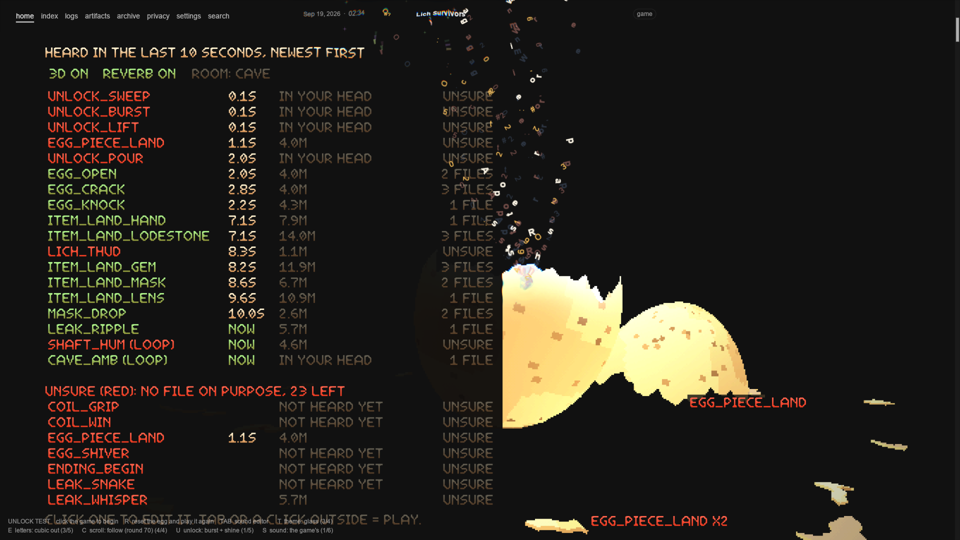
Code: lich-survivors @ d9280ac7fa (6 files, +81 -8)
Recorded run: lich-survivors, 20261014-132142
Recorded run: renderer, 20261014-132219
Recorded run: renderer, 20261014-132316
Let's end this session here, name it Lich Survivors 15, and make sure the next instance knows exactly where we stopped and what we're doing.
Code: lich-survivors @ 7a3e8786dc (4 files, +51 -30)