Website Redesign 1
Summary
a327ex.com redesign, session one: an omni discussion of why the site's chronological feed feels incoherent and how to present books Kindle-like with games beside them, turned into a full build in the Anchor-engine renderer. Fable and Astra (Codex, gpt-6-astra) argued the design in two rounds, then Astra generated 51 mockups over two rounds with Fable reviewing each batch, codified the chosen dark theme into a Ricochet-style UI kit (THEME.md plus eight sheets), and three Opus 5 implementers at extra effort built it: the opt-in "Reading" theme (site_next) with top-line navigation, a paginated reader (pages as windows onto the single-column layout, 252 pages of It Follows in ~300 ms), and the collections (front door, work homes, a paged notebook with months as chapters, essays by year, an experiments grid, a month-by-series logs matrix, the log series frame, grouped search). Along the way: the anchor delegate wrapper gained followup/register/finish verbs, another session's publish deployed the half-built tree and broke the live site, the deploy script gained a dirty-renderer guard, and the site was restored with the redesign gated to desktop and admin devices.
The problem and the diagnosis:
- User: "currently the website is a feed ... it mixes videos, tweets, my thoughts, AI logs, the occasional big essay, etc. I think I want instead something that feels more organized and purposeful"; books "like how Kindle presents theirs, you have vertical pages, two, and then you click to go to the next ... vertical mimics scrolling behavior too much which I want to avoid"; "each page having its own home".
- Started as an omni session (
anchor start omni); the 2026-09-09 digest read in full; site content tabulated: 537 items (274 logs, 260 posts, 2 prototypes, 1 story); ~90 posts under 50 words (bare tweet/YouTube shares), ~120 takes, ~50 essays of 2k-10k words, logs of 10k-230k words; weight on screen inverse to weight as work. - Diagnosis: the 2026-09-11/12 "a message is a post" + "no cut" moves unified the DATA (right) and let the PRESENTATION inherit the feed's shape (wrong). Robin Sloan's stock and flow named it: ~90% stock by bytes, 100% flow by shape.
- Renderer map (Sonnet Explore subagent): five views (home/article/search/admin/game), hand-written
nav_to_path, single vertical column viacanvas_layout/layout_list, elements orientation-agnostic, selection/find over an ordered text stream, server HTML for crawlers with the engine taking over; no paging concept anywhere;MOBILE_BP768. - Outside research (Sonnet subagent): Craig Mod (formless vs definite, "no pagination beats pagination done poorly", edges vs digital apnea), Homestuck, epub.js spreads, Matuschak's stacked panes, gwern sidenotes, Ciechanowski, Device 6, 80 Days/Sorcery!, Her Story, Tufte CSS, the cautionary class (Bruno Simon, Poolsuite, Windows93), a location-recall study on scroll vs pages. Links delivered later on request; Are.na's channels-in-channels explained with a live example.
Fable's first position:
- Principle "flow scrolls, stock pages"; the reader: two pages from ~1400 px, ~520 px pages, no curl (instant cut), wheel flick = one page, edge zones, block anchors not page numbers (reflow makes page numbers viewport-dependent), reflow for prose and fixed plates for playable/diagram pages; why build it = the future books need a container where prose and a running game share one renderer (triple use).
- Front door = a hub of homes (works, essays, logs, the stream) with the ARTIFACTS list as the seed; logs keep scroll with a series frame; the "daily broadsheet" option for the stream; decisions offered as labeled options.
Astra's rounds (same prompt, then critique):
- Round 1 (exact opening prompt): "separate choosing from experiencing"; library / periodical / spatial studio; library plus notebook preferred; the feed's coherence "records your attention" and is legible only after you know him; references Robin Sloan's homepage and Fish, BlueSuburbia, Tetrageddon.
- Round 2 disagreements (Fable conceded four): "flow scrolls, stock pages" is the wrong governing rule (choosing / reading sequentially / consulting instead); the broadsheet fails (a day is an arbitrary layout budget); the page-stack cue was overclaimed; the implementation estimate was optimistic (selection hit-testing depends on line geometry; find wants a vertical scroll); block ordinals shift on edit so citations need persistent ids; input settled too early (click halves conflict with selection/links/games). Joint conclusions listed; open items left to the owner (notebook form, first-screen balance, homes as catalog vs shelf, gestures, how much authored composition).
- Fable's residual difference: the page-as-commitment reading is what makes the reader more than a Kindle imitation.
Mockup round one (21 images, Astra image_gen):
- Discussion of a 22-item list, Astra's merges/adds; generated with real titles, no invented prose; a detached
gen.shbecause generation outlasts the 10-minute tool limit; a Monitor watched the folder. Files ina327ex-site/renderer/reference/redesign-2026-09-12/with index.md; the boardgallery.htmlbuilt bybuild_gallery.pyand published as an artifact (JPEG web copies later, to fit the 64 MB artifact cap). - Owner picks: front door 5 (works + notebook column, no sidebar, smaller text), reader 7 ("all the readers are lacking in ways I can't easily explain"), notebook 12 (paginated; "this format being the same as the reader format could also work"), work homes 15 and 16, logs 17, replay 21; the dark theme of 5/7 is the one he wants; "do not over-index on the actual details of how Astra is generating these images".
Mockup round two (30 functional variations, 22-51):
- Astra's list of 30 in five groups of six, with corrections (no rails since no sidebar, Status addicts for the link-preview study, Horse Game 21 for replays, #529 has no links); the loop: Fable reviews each group, sends fix specs, Astra regenerates (superseded files kept as
-v1). - Revisions: 23 (monospaced prose, invented essay titles), 28 (empty pages; the moderation refusal), 35 (header repeated per page). One moderation refusal: a full page of It Follows chapter 1 rendered as text was refused as "illicit"; rule: essay text fills reader pages, It Follows only as title, chapter names and the opening paragraphs (the first nine, all driving, passed on retry).
- The reader "lacking" resolved: round-one pages were EMPTY; real text at a book measure in the same chrome reads as a book (28 v2, 29-33, 39).
- Notebook group: 34 (reader's chrome, months as chapters), 35, 36 (every entry form on one spread), 37 (permalink), 38 (phone); homes 40-45 (41 the game open in its home; 45 the months-by-projects matrix); logs/replays 46-49; 50 grouped search; 51 expanded media. Board republished with all 51 and a round filter.
Assessment of the delegation setup (owner asked):
- Astra's critique round was the highest-value turn; its image tool and its meticulous THEME.md are strengths; it needed QC (3 of 30 revisions) and halted a whole group on one refusal because the rule said so, where Opus, given a wrong brief, chose sensibly and reported: the argument for Opus as the default implementer.
- Thirty variations were more than the decision needed (fifteen would do); the wrapper failed twice (non-git cwd; no follow-up command); flagged that Astra read the omni digest (personal material) through OpenAI's servers, a deliberate decision to make.
Theme codification (Astra, thread turn 13):
- Exemplar: the Ricochet reference sheets + design.md copied from Z: into
renderer/reference/ricochet-exemplar/. Eight sheets (art direction, UI elements, typography, color, content objects, layout and spacing, states and motion, templates) at 1536x1024 inrenderer/reference/site-theme-2026-09-13/, plus THEME.md: token table mapped to theme.lua keys with L/R/I provenance, type scale (16/24 prose, 14/20 UI, 12/16 meta, Segoe semibold section label, Cascadia ids), reader geometry (624 pages, 528 measure, spread from 1120), components, states, motion, twelve deviations from the live site (gold restricted to ids/current/progress; artifact links blue; scrolling articles keep 704).
Theme build (Opus 5 xhigh, run 20260913-site-theme-build):
THEMES.site_nextwith own FONTS/METRICS/GAP/TREAT tables; fourteen new color keys in every theme;theme_owns_layout/theme_needs_relayout; top-line navNAV.draw_barwith section popovers (no/logscatalog route exists in the engine, the brief was wrong); three-way stepper Dark / Light / Reading; F2 cycles;A327EX_THEMEenv;site_debugglobals; shared chip control; hover-only underlines; mediacard file row; tweet panel; recess code;canvas_theme_sync(quote 1 / role bar 3); Lua's 200-local ceiling hit in main.lua (state moved into tables).- Verified headlessly through
anchor drive start/eval/stop a327ex-site/renderer+engine_snapshot(Fable probed the path first); 16 snapshots; settings.lua restored.
Reader build (Opus 5 xhigh, run 20260913-site-reader):
- Brief's architecture: pages are windows onto the single-column layout with computed breaks; no second layout engine.
renderer/reader.lua(~640 lines): atoms (one per text line, one per non-text element), greedy fill with widow/orphan control and heading-keeps-two-lines, clipping by culling (band test on line midpoints; the stencil is one global flag), oversized atoms scaled through the layer transform (video/games cut), chapter strip, contents overlay, ending block reserving 112 px, running heads, page numbers, keys/wheel (40 px, 250 ms dead time)/edge zones/mobile swipe, position memory{e,l}inpositions.lua/ web store,#fragmentand?q=resolve to pages,site_debug.reader()with a realbreaks_okcheck. It Follows: 252 pages, 6143 atoms, ~310 ms; status_addicts 18 pages; luck 4. - Brief error found: the three verification docs are all old-Blot (
Theme: old); resolved so paged docs render in site_next, old skin elsewhere. Selection/find/layout_text_element/theme.lua untouched. Fable applied the two follow-ups:reader.luain build-web.sh's preload list; positions.lua gitignored.
Collections build (Opus 5 xhigh, run 20260913-site-collections):
works.lua(WORKS table seeded: It Follows, SNKRX, BYTEPATH, Horse Game with series {'Horse Game','ABA Games Variations — KNIGHT VS. PAWNS'}, Skyland; EXPERIMENT_SERIES; series = title minus trailing number; session ORDINALS, "Horse Game 22" = session 14 of 14),collections.lua(front door 38/62 with Continue band and modules, work homes, essays by year with ~N min read, experiments grid with chips, logs month x series matrix with expandable cells),notebook.lua(182 untitled posts as one paged document, months marked_chapter, Dates overlay), routes/works /works/<slug> /notebook /essays /experiments /logs, log series frame with Previous/Next session and "Part of", grouped search. - Brief error found:
tools/convert.luanever wroteuntitled; stamped back at load (the one change visible under other themes: untitled posts no longer repeat their first sentence as an h1). The game could not be hosted inside a work home (paints over the whole window; game_host out of scope); Play opens the prototype page. 20 snapshots; front door 44 ms first frame; notebook 1.4 s to load 182 docs.
Delegate wrapper fixes (Anchor/workflow, owner asked):
_codex_bin()finds the Codex app binary off PATH;--skip-git-repo-checkadded automatically for a non-repo cwd;anchor delegate followup <run> --message <file|-> [--write] [--fork](report-N/events-N/stderr-N, resume with automatic fork on "active writer");anchor delegate register --slug --title --agent-id --brieffor Agent-tool subagents;anchor delegate finish <run> --report <file|->(the harness blocks subagents from writing into the run dir). Tested: register/finish on a throwaway; followup on the real Astra thread ("OK"). DELEGATION.md, the/delegateshim and the delegation memory updated; the Bash tool's long-heredoc failure recorded (write files with the Write tool).
Incident: the live site broken by another session's publish:
- Another session's
anchor msgran deploy.sh from the working tree with the uncommitted renderer; the bundle requiredworks.luawithout preloading it; the plainrenderer.dataand the unhashedrenderer.jswere overwritten, so the old bundle could not simply be re-pointed. - Actions: snapshot of every uncommitted change into the phase B run dir; last-good bundle, bootdata and wasm copied to
/srv/a327ex/render/keep/;deploy.shgained a dirty-renderer guard (--allow-dirty/ALLOW_DIRTY=1override; tested, exits 3); works/collections/notebook added to the preload list. Owner: wait for phase B, then "Restore the website, make sure that the in-work website can't be seen by users".
Restore, gate, commit, deploy:
- Commits on a327ex-site:
be030a7(the build-out),5cb6fba(the gate:theme_gate_open()true on desktop or with the admin token; otherwise the cycle/stepper hold Dark/Light and a persisted site_next is clamped; proven headlessly withplatform='web'),2dd743b(reference material: THEME.md, sheets, board, JPEG copies; mockup PNGs, snapshots and the exemplar sheets gitignored), then REDESIGN.md + a PLAN.md pointer. - Web bundle built and booted locally (serve-web.py, console clean);
deploy.sh --contentdeployedrenderer-43dd67784c.data; live site verified in the browser (engine boots, homepage renders, settings stepper offers Dark/Light only). renderer/REDESIGN.mdwritten: where everything is, the design conclusions with rationale, each run's decisions, the gate, how to see it, mechanical verification, what to do next (server routes for the new paths, the converter'suntitledflag, the hosted game, mobile hamburger, cover art, shipping = remove the web condition intheme_gate_open).
Memory: project_site_redesign_2026_09.md (state, picks, conclusions, gotchas, the incident) plus the delegation memory's wrapper-verbs note; MEMORY.md index updated.
Hi, we need to do some slight redesign on the website. I've been doing some changes but I'd like some more direction. I want to solve several problems. One, currently the website is a feed, that's fine, people can scroll and read things, but maybe it feels like all the content on the feed is too... it's not cohesive, it mixes videos, tweets, my thoughts, AI logs, the occasional big essay, etc. I think I want instead something that feels more organized and purposeful. This aligns with my goals of mixing books and games and how I want to present my books, which I want to be like how i.e. Kindle presents theirs, you have vertical pages, two, and then you click to go to the next. We could try something not exactly like this, but something like this, where it's more horizontal instead of vertical, vertical mimics scrolling behavior too much which I want to avoid. Each page having its own "home", so to speak, that a user clicks to read, might also allow me segment things better. But this is just one idea. Perhaps start this session as an Omni session, so that you can see my future goals regarding [REDACTED#2: lore] and other plans more clearly, and then let's discuss how we might approach things. You may also research other websites like this to see the kinds of wacky things they do, although there are few websites I think that have the flexibility of being able to render anything anywhere because they're built with a game engine... so there are some unique things we can do that most other people can't. In any case, this is a discussion session.
Fable 5.1 high
[Think]
The user wants to start an Omni session, so I should invoke the /omni skill first.
I'll start by loading the omni session context, then look at the site's current state and do some research before we discuss.
Skill (omni)
[skill: omni]
Bash (python Anchor/workflow/anchor.py start omni --session c396140b-04bf-4cd3-9bde-54...)
Bash (python Anchor/workflow/anchor.py start omni --session c396140b-04bf-4cd3-9bde-54...)
Bash (cat "C:/Users/a327e/.claude/projects/C--Users-a327e-Desktop-a327ex/c396140b-04bf...)
Read (C:\Users\a327e.claude\projects\C--Users-a327e-Desktop-a327ex\c396140b-04bf-4cd3-9bde-54b689712b57\tool-results\blk1vx9uo.txt)
[Think]
This file is lengthy, so I should keep reading the remaining sections which likely cover [REDACTED#2: lore] and the site details.
Read (C:\Users\a327e.claude\projects\C--Users-a327e-Desktop-a327ex\c396140b-04bf-4cd3-9bde-54b689712b57\tool-results\blk1vx9uo.txt)
[Think]
The output got truncated around 800 lines, so I need to find the digest file directly and read the remaining sections—[REDACTED#2: lore], the site, and current project state—plus check the site's git log to see what changes have been made recently. I'll do these in parallel.
Still loading context. The omni output was cut at section 3, so I'm reading the rest of the digest from its file directly, plus the site's recent changes and the renderer plan, in parallel.
Bash (ls Anchor/workflow/profiles/; grep -n "^## " Anchor/workflow/profiles/omni*.md |...)
Bash (sed -n '1200,1650p' Anchor/workflow/profiles/omni-digest.md)
Bash (sed -n '1650,2100p' Anchor/workflow/profiles/omni-digest.md)
[Think]
With the omni context in hand, I still need to check the site's current state — the a327ex-site structure, the renderer PLAN.md, recent git activity, and how the site looks live — plus research other sites with unconventional reading or navigation patterns like book-style or horizontal paging layouts. I'm planning to run these checks in parallel: git log, directory listing, and the plan file.

Beyond that I want an agent to summarize how the renderer's feed/pages/navigation currently function, another to research unusual website designs like Kindle-style paging, horizontal sites, game-engine-built sites, and spatial/canvas experiences, and I want to browse the live a327ex.com site directly. I'll bundle all of these into one response.
Context loaded. Now I need three things in parallel: the site's recent changes and renderer architecture, a look at the live site, and outside research on unusual reading/navigation designs.
Bash (cd a327ex-site && git log --oneline -25 && echo ---- && git status --short | hea...)
[Think]
I want to check the three most recent commits to understand his current direction—unified feed, message as a post, etc.—and get a sense of the site's overall page structure like the home feed, /logs, /posts, and radio/chat. I'll need the full commit messages with diffstats, plus a look at homepage.lua and sidebar.lua to see how things connect.

I also want a subagent to research unconventional website designs—paged/horizontal reading, book-like layouts, game-engine-built sites, spatial canvases—and to check CONTENT_SYNTAX.md for available widgets like demo and game. On the browser side, I should screenshot a327ex.com's homepage and a post page to see the live design.
Bash (cd C:/Users/a327e/Desktop/a327ex/a327ex-site && git log -3 --format='%n=== %h %a...)
[Think]
I'm planning to launch a subagent to explore the renderer's structure—routes, layout model, sidebar/canvas/board components, and available widgets—so I can understand how pages and docs are currently organized.

Alongside that, I want another subagent researching unconventional website designs: paged and book-like reading experiences, horizontal navigation, canvas/game-engine-based sites, spatial interfaces, and notable creative examples like Homestuck's page-by-page comic format, which stands out as a strong precedent for paged navigation on the web.

Then I'll have the browser take screenshots of a327ex.com's home page, scrolling behavior, a sample post, and the /logs page — and I'll issue all of these tasks together in one response.
Delegated run: Map the site renderer's structure (to Claude, 1 turn)
Agent (Map the site renderer's structure)
Delegated run: Research unusual reading/navigation websites (to Claude, 1 turn)
Agent (Research unusual reading/navigation websites)
Meanwhile, I'll look at the live site myself.
mcpClaude_Browserpreview_start ({"url": "https://a327ex.com"})
mcpClaude_Browsercomputer ({"action": "screenshot"})
[Think]
The browser pane is too small at 800x450, so I should resize it to a desktop size and capture several screenshots while scrolling down the page.
mcpClaude_Browserbrowser_batch ({"actions": [{"name": "resize_window", "input": {"width": 1400, "height": 900}}, {"name": "computer", "input": {"acti...)
mcpClaude_Browserbrowser_batch ({"actions": [{"name": "computer", "input": {"action": "screenshot"}}, {"name": "computer", "input": {"action": "scrol...)
Fable 5.1 xhigh
[Think]
The scroll attempt didn't seem to register, likely because the canvas intercepts wheel events differently. I'll try a keyboard approach or dispatch a wheel event via JavaScript instead—but I've already seen enough of the homepage layout to map out the structure: a left sidebar with navigation and content trees, and a main column with header links.

I don't strictly need more screenshots since the subagent will cover the architecture, but it'd help to see the feed further down for the mixing issue and check a log page. I'll try Page Down or End key once, take one more screenshot, and then move on without spending too much more time—resetting the viewport before finishing up.
mcpClaude_Browserbrowser_batch ({"actions": [{"name": "computer", "input": {"action": "left_click", "coordinate": [400, 400]}}, {"name": "computer", ...)
[Think]
Scrolling isn't reaching the canvas here, probably a focus or event handling issue with the engine's own wheel handler, so I'll stop fighting it and reset the viewport while waiting on the subagents. Instead, I'll curl the homepage HTML directly to see the feed's actual content mix and item titles for the newest entries, plus check /logs for the catalog—cheaper than fighting the browser.
mcpClaude_Browserresize_window ({"preset": "desktop"})
[Think]
While the renderer map and outside research subagents run, I'm pulling the feed's actual content mix from the server HTML and index to make the "not cohesive" issue concrete.
Bash (cd C:/Users/a327e/Desktop/a327ex/a327ex-site && ls renderer/data | head -30; ech...)
[Think]
My frontmatter parser didn't work, likely because the format differs from what I expected. Let me check the actual head of a post file and a log file to see what's really there.
Bash (cd C:/Users/a327e/Desktop/a327ex/a327ex-site && head -8 posts/2026-05-03-16-14-5...)
Bash (cd C:/Users/a327e/Desktop/a327ex/a327ex-site && python - <<'EOF' import re,glob,...)
[Think]
I have a solid picture of the feed now, so I'll wait on the two subagents while thinking through design directions. I'm avoiding the [REDACTED#2: lore] overview since the rule is never to read those files in a publishing session—the digest's transmedia notes are enough. I should also check memory for the website project file for anything relevant.
Bash ([memory: sealed target])
[Think]
That memory file is too large to read in full, so I'll grep it for design-relevant terms like "place", "omega", "book", "page", "kindle", "spatial", and "canvas" instead.
Bash ([memory: sealed target])
[Think]
I should check the omega app memory file for the "spatial infinite canvas" and "named modes" concepts, since the site represents that app's public face. I'll grep it briefly for relevant design notes, then wait on the subagents—the discussion itself is the real deliverable here.
[Think]
One more check before writing: I'll review the Anchor app memory, since it underpins the site's spatial canvas/named modes structure that any redesign must fit within.
Bash ([memory: sealed target])
[Think]
I have enough context now, so I'm just waiting on the two subagents to finish rather than idle-polling — their notifications will re-invoke me once ready.Both subagents are still running (the renderer map and the outside research). I have everything else I need, so I'll write the discussion once their reports land.
[task notification]
[Think]
With the renderer map done, I'm now waiting on the research subagent to finish before I can draft the final message that depends on its findings.
The renderer map landed. Still waiting on the outside research report before I write the discussion.
[task notification]
[Think]
Both reports are done, so now I need to write the discussion, following the guidance to be thorough, direct, and object-level, with labeled options for open decisions where the user wants to weigh in. Before drafting, I want to really think through the design problem itself, starting with how the feed mixes videos, tweets, and other content types.

Looking at the data breakdown—537 items split across logs, posts, prototypes, and one story—it's clear a third of the "posts" are essentially bare embed shares with almost no text, while logs run enormous, some over 200k words. The current feed treats all of these the same way, showing inline bodies without a cutoff, which doesn't match how differently sized and purposed these items actually are.

I'm thinking through Robin Sloan's stock-and-flow distinction here: tweets and quick shares are "flow," while essays, games, and logs are "stock" meant to endure. The current feed format, being flow-oriented by nature, buries the stock content, which conflicts with ideas like keeping things "spacious," committing to meaning over optionality, and writing content that will remain legible to future readers and machines alike. I'm also weighing Craig Mod's pagination arguments, but recognizing they're rooted in an engineering-cost logic that doesn't really apply when someone fully owns their own rendering pipeline.

There's also research on spatial memory in paged reading versus scrolling, which matters for something like a 400KB novel read on the web — paging gives a real progress signal, like stack thickness, that ties into mechanics like a minimum reading time or gaze tracking. Looking at the architecture, I see five hand-routed views (home, article, search, admin, game) using History API navigation while keeping server-rendered URLs for crawlers, with a single-column layout system stacking orientation-agnostic elements — no page concept yet.

Mobile is already handled (touch, DPR, hamburger menu, visualViewport), and there are rich widgets like in-doc games, replays, and embedded tweets/YouTube cards, plus a server-rendered SEO fallback with reclaimed text selection and find. So a paged reader would mean adding a new layout mode: instead of stacking elements into one scrolling column, lay them into a sequence of page rects, breaking between elements and even within text at line boundaries, with oversized elements like images or games pushed to the next page — and a "spread" would be two such pages side by side.

But page numbers are viewport-dependent, so URLs like ?p=37 aren't stable addresses — the real stable anchor has to be a heading or paragraph slug, with page number derived from that, similar to how Kindle uses "locations" instead of fixed pages. This raises a real design choice between author-fixed, definite layouts (like a real book, scaled for small screens) versus reflowed, formless pages that adapt to viewport — Craig Mod's Formless vs Definite distinction — where a plain novel favors reflow but a book-with-embedded-game might need something more fixed.

Now I'm stepping back to the larger question of what the site actually is: right now it's a feed with a sidebar tree of logs/posts/stories, an artifacts list (It Follows, SNKRX, BYTEPATH), and chips, but what's being asked for is something more organized and purposeful, with clear sections and a home, presenting books Kindle-style and blending books with games. I'm trying to define what the real content categories are and what each needs — starting with "artifacts," the small, finished, high-value works like It Follows, SNKRX, BYTEPATH, and future projects like the [REDACTED#2: lore] book/game series, which are really the long-term point of the whole transmedia project.

Beyond artifacts, I'm sorting out essays (roughly fifty substantial posts on things like luck, status, and soul society, meant for a small audience and future AI readers, but currently buried in a slug-based post tree) and logs (274 of them, largely machine-facing AI session records serialized by project, which the current feed format hides even though they naturally form series).

Then there's messages (roughly 200 short ambient posts, tweets and hot takes), curated fragment posts acting as a commonplace book, plus radio, chat, search, and admin. His recent flattening moves — treating a message as a post, showing everything inline without cuts — unified the data model correctly but left the result feeling incohesive, which is the honest critique to sit with.

The real issue is that the feed shows a two-word share with equal visual weight to a 700-word argument, or a 230k-word log reduced to a single row, so screen weight ends up inversely related to actual work. The fix isn't removing the flow — it has real value as his public presence and revision process — but rather containing it as one room rather than the whole house.

This leads to a paged-reader idea: books, essays, and logs get the page-turn treatment since that verb matches committed reading, while the feed stays a scroll since that verb matches ambient presence — scroll for flow, page for stock, giving stock its edges back the way a book has a definite end but a feed doesn't. I'm now weighing objections, particularly around desktop layout: his current single column is 704px, so a two-page spread would need to fit within roughly 1400px total.

Since page counts vary by device with reflow, citations need to point to stable anchors rather than page numbers, especially given how much he numbers things — so I'd suggest chapter-and-paragraph indices as the real address, with the page number as pure display. On the page-turn itself, I agree skeuomorphic curl is wrong; it should be a fast cut or slide like an e-ink refresh rather than a paper simulation, and the physics-of-paper direction the research agent floated is the wrong kind of ambitious.

The genuinely valuable game-engine affordances instead are embedding playable segments directly in the prose using the same renderer, and treating replays as chapters — this is basically the [REDACTED#2: lore] transmedia idea, and the Kindle reader becomes the container for it. That reframes the whole project: not a website redesign but the prototype of the book-format his seven-book series will actually need, satisfying dev-environment, shipped-work, and website uses simultaneously — which clears his own triple-use gate. Though I'm weighing this against his no-new-big-projects rule, since the website is treated as exempt from that infra-procrastination gate because he works on it daily.

Sizing this honestly, the paginated reader itself is a bounded, delegable feature, while the bigger "site as spatial hub with shader map" idea is the thing to avoid building right now. So I'm starting to sketch what home could look like — not a chronological feed but a small set of intentional doors, like a library-style home showing artifacts (books, games, prototypes) as paired shelf items, with the blog feed relegated to a secondary "notes" section.

I'm weighing three structural options: a library-style home with sections for Books, Games, Essays, Logs, Feed, and Radio; a version that keeps the feed as home but demotes it, splitting titled posts from untitled "message" posts into separate presentational rooms without touching the underlying data model; or a hand-curated index page in the style of gwern or a Wikipedia portal, which fits well with his stance on writing for future AI readers and his numbered-citation habit. My leaning is toward treating home as a hub of rooms, with the feed becoming just one room among several, each stock type getting its own room, and the paginated reader serving as the entry point into one of those rooms.

Beyond that, I'm thinking about how each individual artifact—a book, a game—could get its own dedicated page bundling its cover, blurb, reader/player entry, and related logs and posts together, rather than scattering them across a chronological feed. This mirrors how something like [REDACTED#2: lore] combines novel, audiobook, and game into one presented unit, and how SNKRX could similarly cluster its game entry with its dev logs and status updates—organizing content around artifacts rather than around time.

I realize clusters could actually derive themselves without manual curation, since dev logs already follow series naming patterns and posts carry tags, so a project page could be generated from a series prefix plus tag plus a small frontmatter list, which fits his existing preference for frontmatter over separate plan files.

Then I shift to the reader design itself, thinking through spread layout: two pages side by side on wide screens versus one on narrow, sizing each page's column width so it reads well at the current type size, and checking how that maps onto both a 1400px viewport and his ultrawide monitor.

Now I'm working through page-turning interactions — click zones, arrow keys, spacebar, swipe, and especially how wheel scrolling should behave. I lean toward quantized wheel scrolling, where a flick turns exactly one page rather than continuous scroll, since that preserves the natural scroll reflex while avoiding a true scrolling reading experience, and I want to present that middle-ground option as a decision point for him.

For pagination, I'm thinking through greedy line-filling with widow/orphan control, and how unsplittable elements like images or embedded cards get pushed to the next page or scaled down, with special full-page "plate" treatment for larger elements — echoing an idea I want to reference carefully without leaking specific lore details, since I need to keep certain naming and details out of anything that ends up public even if the session itself stays private.

For progress indicators, I'm leaning toward showing chapter name plus "page X of Y" alongside subtle page-stack edge lines on the spread, similar to how e-readers show location and percentage. For addressing, I'm working out URL structure with chapter and paragraph-level anchors so specific blocks of text can be linked directly.

Selection, find, and copy should still work fine since the existing text-stream architecture with positioned pieces just needs pages layered on top as another positioning scheme — that's a reassuring realization. Mobile naturally maps to one-page-per-screen with tap/swipe navigation, matching what's already been solved for viewport handling, and I'm noting that reading position and settings already persist per device, with continuous scroll available as a toggleable fallback.

As for logs specifically, they're huge chat transcripts meant for skimming and searching rather than linear reading, so they probably belong in scroll mode but organized into a series/chapter structure with prev/next navigation — though I'd frame this as a decision to offer rather than a final call. That leads me to the feed itself, which represents his presence, and I'm thinking through renaming or relocating it to something like "desk," "stream," or "notes."

Splitting the front door from the feed feels like the bigger structural decision worth surfacing directly. From the game-engine research pile, most items are gimmicks, but two stand out: making a chapter page literally playable using the existing game engine, and turning a chapter into a replay that hands control back to the reader.

A shelf-as-scene idea has appeal but risks the "Bruno Simon problem" — nothing deep-linkable and too much learning cost — so I'd keep it 2D with real URLs rather than walkable 3D. The stronger moves are the global chat on the main menu (already committed, already built) fitting his "place" doctrine better than a feed, and treating the reader as the default text surface so posts and book chapters become one unified form.

Worth noting: none of this changes the machine-facing side — markdown and llms-*.txt mirrors stay, crawlers still get scroll HTML — so this redesign is really about the human copy, which lowers the stakes and makes it taste work rather than infrastructure. I'm also questioning his instinct to avoid scrolling since it "mimics scrolling behavior too much" — is that because scroll reads as a feed reflex inviting doomscrolling, or is it more of an aesthetic preference?

If it's the feed-reflex worry, the real fix might be bounding the feed itself rather than the books — paging it by day or week, like a daily broadsheet, giving flow natural edges. That's actually appealing: one spread per day, turn back to go earlier, big entries as headlines and small shares as minor items on the same page, composed almost like a newspaper layout.

Mechanically this is doable: the current renderer already treats layout as stream-to-positions with orientation-agnostic elements, so pagination is just a new layout function plus a page view, input handling, and URL anchors — a modest addition to the existing canvas code, maybe a few sessions of implementation work. The harder part is the content/design decision about restructuring the hub itself, which is his call, not an engineering one. Days with wildly uneven content (empty vs. huge) is the main risk, so paging by a fixed item count could be an alternative to float alongside paging by day.

Line width is another point worth flagging — at full measure the text runs unusually wide for prose, while splitting into two narrower pages would land in a much more comfortable reading range, which favors a two-page layout. I also need to be careful not to draft any of the actual home-page content myself, since that's his writing to do — I can only describe what the home needs structurally. That leads me toward laying out the key open decisions as a short, labeled list with a recommendation for each, starting with how the front door should work: full hub of rooms, feed-as-front-door with a shelf, or some hybrid.

Given his own leaning toward segmenting things and keeping things organized, I'll recommend the hub-of-rooms approach, kept simple rather than reintroducing a mixed feed. Then the next decision is what the reader section should actually cover — books only, books plus essays, or books plus essays plus logs — and I'd lean toward including essays as titled posts alongside books.

For page-turning, since he explicitly wants a click-to-advance model, I'll recommend disallowing continuous scroll and instead quantizing the wheel so a flick moves exactly one page — preserving the familiar reflex while avoiding the drifting motion he wants to avoid.

For the flow room, I'm weighing the current scroll feed against a bold "paged by day" newspaper-spread approach versus a cheap middle ground of scroll grouped by day headers. I'd suggest building the day-paged version properly, but only once the reader's pagination engine exists to reuse, treating the day-grouped scroll as the interim solution rather than a permanent compromise.

Now I'm turning to how artifact homes should be organized — whether they're generated from frontmatter fields like a Project tag and series prefix, or built as hand-written pages.

For the actual recommendation, I'm leaning toward a hand-written home page per artifact paired with a generated cluster of related content below it, noting the "made pages" directory already exists as a foundation for this. On book pagination, I favor reflowed pages using anchors as addresses, reserving fixed spreads only for specifically authored plates like game pages. I also want to flag that this counts as site work exempt from the brief-gating rule, though it's still a meaningful chunk of sessions worth acknowledging against his no-new-big-projects rule — this being ongoing daily work rather than a new project. And I want to give him an honest, fair critique that his recent moves — inlining the whole body without cuts, treating the message as a post — didn't cause the incoherence he's sensing so much as expose it.

The data unification itself is sound and should stay: one ID space, one frontmatter structure. It's the presentation layer that inherited the feed's shape rather than the site's own structure. I'm also noting that the ARTIFACTS list already sitting at the top of the home page is essentially the seed of the hub he needs, so I should point that out directly.

On length and register, I'm weighing the tension between CLAUDE.md's push for thoroughness and the system's preference for short sentences and limited headers — I'll aim for plain prose with occasional lists, somewhere around 1800-2500 words, direct and committal without metaphor or ornamentation, avoiding em dashes and parentheticals throughout.

For citations, I'm working out which research points to bring in: Sloan's stock and flow, Craig Mod's three points, Matuschak's stacked panes for horizontal reading trails, Device 6's text-as-map approach, Her Story's search-as-navigation for logs, Homestuck's one-page-per-beat structure, and the location-recall research, while setting aside less relevant references like Bruno Simon's 3D worlds and Poolsuite.

I should note that the engine's stream-based text keeps selection, find, and copy working across pagination — a real advantage over canvas-based sites that lose these, and the server-side fallback preserves SEO. That means the two big weaknesses of game-engine sites are already solved here, making the more experimental UI choices cheap for him but costly for others to replicate. Worth tying this back to his "2.8 program" idea that standard-kit UI is dead — the current site UI is exactly that kind of standard-kit interface, which is the tension worth naming.

Now I want to sketch what a diegetic direction would actually look like applied to this site: a reader as a page stack, a hub as a shelf, a daily feed as a broadsheet — applying his own doctrine to his own site. And the "place" doctrine pairs with this: the hub becomes where chat and radio live as ambient presence, distinct from the feed itself.

Time to write it up with this structure: open with what I loaded and the two-paragraph diagnosis with the numbers table, then the reframing of scroll-as-flow versus page-as-stock and why the Kindle idea fits certain content as a book container for the series, then the concrete reader design with the renderer facts and Craig Mod's cautions, then the hub concept.

I'll cover which wacky ideas are worth pursuing and which aren't, then close with batched, labeled decisions and recommendations — keeping numbers confined to a small table for content composition rather than scattered through the prose.
Context is loaded: the omni digest, the renderer's architecture, the site's actual content mix, and an outside survey of paged, spatial, and engine-rendered sites. Here is the discussion.
The diagnosis
The incoherence you're feeling is measurable. The site has 537 items in one chronological stream, and their weight on screen is roughly the inverse of their weight as work:
| class | count | typical size | how the feed shows it |
|---|---|---|---|
| bare shares (a tweet or YouTube link, a line or two) | ~90 posts | under 50 words | full card, inline |
| takes and short arguments | ~120 posts | 50 to 1500 words | full body, inline |
| essays | ~50 posts | 2k to 10k words | one title row |
| logs | 274 | 10k to 230k words | one title row |
| the novel, the games | 4 | years of work | one line at the top |
Last week's two moves made this visible rather than causing it. Unifying the data was right: one Id space, one frontmatter contract, a message and a post being the same file type. But the presentation inherited the feed's shape, and then "no cut, whole body inline" removed the last thing that distinguished a 2-word YouTube share from a 700-word argument. Data unity was correct. Presentation unity was the wrong inference from it.
The cleanest vocabulary for this is Robin Sloan's stock and flow, from 2010. Flow is the stream: ambient presence, timely, disposable. Stock is the durable work people find by search years later. His point is that a chronological feed structurally privileges flow and buries stock, and that the trick is a site that holds both without collapsing them. Your site is about 90 percent stock by bytes and 100 percent flow by shape. That is the whole problem in one sentence, and it also says what not to do: don't delete the feed. The messages are where your doctrine gets revised in public, which the digest shows is your actual method. The feed is a room. It is just the wrong front door.
Scroll is the verb for flow, the page is the verb for stock
Your instinct that vertical pages "mimic scrolling too much" is right, and I'd make the reason explicit, because it decides a lot downstream. A scroll is continuous optionality: you can always take a little more without committing. A page turn is a discrete commitment with an edge. Craig Mod's essay on unbinding argues exactly this: a bound book's edges, the felt beginning and end, are what give reading its "rounded experience," and the edgeless scroll produces what he calls digital apnea. This is the same argument as your commitment-over-optionality program, applied to the reading surface. So the principle I'd adopt is: flow scrolls, stock pages. The messages keep the scroll because a stream is what they are. Books and essays get pages because bounded objects should have edges. That is not a compromise between two UIs. Each content class gets the verb that matches it.
There is also a real, non-aesthetic reason to page long text. Reading research finds that location recall is worse under scroll than under fixed pages, because scroll removes the spatial cue of "that was near the top of a right-hand page, two thirds through." Percent bars don't restore it because they're abstract. For a 400 KB novel read on a screen, that matters. And an engine can restore the cue directly: draw the page stack's edges getting thinner on the right and thicker on the left as you read. That is the cheapest honest progress signal there is, and no HTML reader does it.
Two of Mod's cautions apply and are worth answering rather than ignoring. First, "no pagination is vastly superior to pagination done poorly." That is an engineering-cost argument about small publishers stitching CSS columns together, and it doesn't transfer to someone who owns the renderer. But the "done poorly" half still bites: resize reflow, deep links, find-in-page, and text selection all have to survive page boundaries, or the reader is worse than the scroll it replaced. Second, he thinks the page-curl metaphor feels forced. I agree. No paper simulation, no curl. The turn should be an instant cut or a fast slide, the way an e-ink Kindle turns. The research agent's suggestion of "real page-turn physics" is exactly the wrong use of the engine.
The renderer is better positioned for this than I expected. Layout today is one function that stacks elements into one column with a scroll offset, and every element type is a layout/draw pair that doesn't care about orientation. Text elements are already laid out as lines, so they can split across pages at line granularity. Selection and find already work over a stream of text pieces in reading order, so pages are just a different positioning of the same stream, and copy and Ctrl+F keep working. The server HTML stays a scroll for crawlers, and the markdown mirror stays the machine copy, so the two things game-engine sites always lose, search indexing and quotability, are already solved here. Mobile input, DPR, and the visual-viewport fight are already fought. What's new is a paginate function in canvas.lua, a reader view in main.lua's view switch, page-turn input, and paragraph anchors on the server side. That is a bounded feature, a few sessions with an Opus implementer, not a rewrite.
Three design facts about the reader itself that you should decide with eyes open:
- Page numbers can't be addresses. Reflowed pages depend on the viewport, so page 37 on your ultrawide is page 61 on a phone. Kindle invented "locations" for this reason. The stable address should be chapter plus block index, an anchor like
#p417, with the page derived from it on load. The server already stamps heading anchors, so this extends an existing scheme. - Reflow versus fixed. Mod splits content into formless (reflowable prose) and definite (layout carries meaning). Prose chapters should reflow. A page that is a playable segment, a diagram, or a full-bleed image is definite and should be authored as a fixed plate that takes a whole page or spread and scales down on small screens. This is the book-to-plate transition you already designed for the crystal-book form, arriving early as a website feature.
- The measure improves. The current text column is 704 px, which is 90 to 100 characters per line, wide for prose. Two pages at roughly 520 px each fit a 1400 px viewport with a gutter and give 65 to 70 characters per line, which is the classic book measure. Cap at two pages on the ultrawide. One page per screen under the mobile breakpoint.
The strongest argument for building the reader is not the website at all. Each future story is a novel plus a companion game with embedded playable segments in the digital text. That needs a container in which prose and a running game are drawn by the same renderer, with no iframe seam, and in which a chapter can hand control to the player and take it back. The reader is that container. It passes your triple-use test: the site gets it now, the books ship through it later, and the ::game element you already have becomes a page type instead of a card in a scroll. It also satisfies your own UI rule from May: a page stack, a shelf, and a reader are not things a standard UI kit gives you. The current sidebar and chips are.
The front door and the homes
The ARTIFACTS list already at the top of the home is the seed of the answer. Right now it is three lines above a feed. Turned around, the site's front door becomes a small set of homes, and the feed becomes one of them:
- Works. One home per artifact: the novel, each game, each future book-and-game pair. A cover, your own text about it, the reader entry, the game entry, and below that the cluster that already exists in the data: the log series that made it (Horse Game 1 through 22 is a serialized making-of by title prefix), and the tagged posts around it. SNKRX's home would hold the game, the launch log, the status and community essays, and the sales post. Nothing here is a new data model. A
Project:frontmatter field plus the series prefix generates the cluster. The one thing that isn't generated is the home's own text, which you write. - Essays. The titled posts, read through the reader. A message and an essay are the same file, which is right, but they are not the same reading act. The reader is where the "message is a post" unification pays off in the right direction: unify at the reading form, not at the feed.
- Logs. These should stay scroll. A transcript is a stream, and humans skim or search them rather than reading linearly. What they lack is a frame: "Horse Game, session 22 of 22" with previous and next at the ends, so a project reads as chapters. Her Story's search-as-navigation is the honest model for a 274-log archive, and you already have search.
- The stream. The current feed, one click from the front door, with the shares and takes as they are. This is where radio and chat also belong, because ambient presence is what flow is, and your "place" doctrine plus the global-chat commitment point at this room, not at the reading rooms.
There is one bolder version of the stream worth naming because it is only possible on an engine. Page the flow by day. One spread per day, turned to go back in time, laid out like a broadsheet: a log that day is a headline row, a two-word YouTube share is a small item in a column, a 500-word take is a column of body text. That gives flow edges without pretending it is stock, and the composition problem, fitting variable items onto a fixed page, is exactly the kind of layout HTML can't do and a game renderer can. It shares all its machinery with the reader, since a day is just a document to paginate, so it is a second use of the same feature, not a second feature. I would not start there. I'd build the reader for the novel and the essays first and try the daily page as a prototype once the pagination exists.
On the survey: most of the "wacky" sites are the cautionary class. Bruno Simon's drivable island and Poolsuite's fake desktop are memorable and have no URL for anything, so visitors spend their first minute learning controls and search engines see nothing. You have already paid to keep URLs, selection, and crawlable text, so the rule for the engine's freedom should be: anything goes inside a page, and the address bar stays boring. The examples that actually transfer are Device 6, where the text's position on the page is the map and the prose turns corners with the character, which is the plate idea at chapter scale; Andy Matuschak's stacked panes, where each clicked link opens a new pane to the right and earlier panes collapse to spines, a horizontal reading trail that would suit the cluster of logs and posts around a work; and Homestuck, one URL per beat with a single next link, which proves the page-as-unit model at half a million words. The engine-only things I'd actually want are three: a page that is the game, a page that is a replay playing itself and then handing over control, and a works shelf drawn by the engine where the book and its game sit next to each other as objects, kept flat and clickable rather than walkable.
Decisions
These are the open choices. My recommendation is first in each. Pick, or redirect entirely.
- Front door. (A) A hub of homes, with the stream one click away. (B) The stream stays the front door with a real works shelf above it. (C) A single hand-curated index page in the gwern or Wikipedia-portal style. I recommend A. It is what "organized and purposeful" means, and the ARTIFACTS list is already half of it.
- What the reader covers. (A) The novel and the titled essays. (B) The novel only. (C) Everything including logs. I recommend A. Logs get the series frame and keep scroll.
- Page-turn input. (A) Click or tap the page halves, arrow keys, space, swipe on mobile, and the mouse wheel turns exactly one page per flick, never continuous. (B) Wheel does nothing, pure codex. (C) A per-document continuous-scroll toggle as Kindle offers. I recommend A. The thing to avoid is continuous motion, not the wheel itself, and a wheel that does nothing reads as broken on desktop.
- Addressing. (A) Block anchors, chapter plus paragraph index, page number derived and never in the URL. (B) Authored fixed pages with stable numbers, scaled on small screens. I recommend A for prose and B only for plates.
- The stream's shape. (A) Keep the scroll now, prototype the daily broadsheet after the reader exists. (B) Daily broadsheet first. (C) Scroll with day headers, nothing more. I recommend A.
- Homes for works. (A) A hand-written home page per work plus a generated cluster from a
Project:field and the log series prefix. (B) Fully generated from tags. I recommend A. The cluster is free; the home's own text is yours.
Can you link me to live examples of the things you mentioned so I can see them?
[Think]
He wants direct links to the sites I referenced, so I'll compile them grouped by what they showcase, noting what to check out on each. The agent confirmed the URLs, so I'll trust those, though for secondary sources like Wikipedia's Poolsuite entry, Killscreen on Windows93, and MakeUseOf's neal.fun coverage, I should flag them as such.

For a few I want to double-check status directly with quick HEAD requests, since some sites block curl and might return misleading 403s that actually mean the site is live but restricting bots.
I'll verify the links are live first, then hand them over grouped by what each one demonstrates.
Bash (for u in \ https://craigmod.com/journal/ipad_and_books/ \ https://craigmod.com/j...)
[Think]
Both sites are confirmed live, with the 403s just being bot-blocking rather than real errors. Now I'll organize the list by what each example demonstrates, including a quick pointer on what to actually do on the page to see the mechanic in action.
All of them respond. Two return 403 to a script but load fine in a browser. Grouped by what each one shows you:
Paged reading, the reader model
- epub.js two-page spread demo. The closest live thing to what you described: two vertical pages side by side, arrows to turn, text reflowed into pages. Resize the window to see the reflow problem I flagged: page numbers change with viewport.
- Kindle Cloud Reader. Needs an Amazon login, but it's the reference for the tap-halves, one-page-per-flick, continuous-scroll-toggle behavior.
- Homestuck and the MSPA reader. One URL per beat, one "next" link. Click through ten pages to feel what page-as-unit does at scale.
- Craig Mod, Subcompact Publishing for "no pagination beats pagination done poorly," Unbindings and Edges for the edges argument, and Books in the Age of the iPad for formless versus definite content.
- The location-recall study, scroll versus page and where you remember things being.
Stock and flow
- Robin Sloan, Stock and Flow. Short. The vocabulary for the whole problem.
Horizontal and spatial reading
- Andy Matuschak's notes. Click any link inside a note. The new note opens as a pane to the right, and after three or four clicks the earlier panes collapse into spines. This is the one I'd most want you to try.
- gwern.net sidenotes. Widen the window: footnotes move into the margin. Hover any internal link: a preview popup instead of a navigation.
- Bartosz Ciechanowski, Gears. Drag any diagram. Prose with live physics inline, done without an engine, so it's the ceiling for plain web.
- Bret Victor, Explorable Explanations. Drag the numbers in the first section.
- Nicky Case, Parable of the Polygons. A single explorable that is a complete home for one idea.
- Maggie Appleton's garden. Notes navigated by topic rather than date.
- Tufte CSS. Book typography on the web, sidenotes in the margin.
- Kinopio, Are.na, Muse, mmm.page. Spatial and collection-first tools. Are.na's channels-inside-channels is the data-model idea; the others are canvases.
Sites rendered as scenes, the cautionary class
- Bruno Simon. Drive the car into the signs. Note that nothing you reach has a URL.
- Jesse Zhou's ramen shop. Same pattern, smaller.
- Robby Leonardi's interactive resume. Scroll-driven 2D platformer. Closest to what a 2D engine does cheaply.
- Poolsuite and Windows93. Desktop metaphors done with total commitment.
- neal.fun, and specifically The Deep Sea. Each toy is a complete disposable idea.
Book and game together
- Device 6. iOS only, so the page has trailers. Watch one: the text turns corners with the character, and the page is the map.
- 80 Days and Sorcery!. Choices spliced into the sentence, and a hand-drawn map as the book's index.
- Her Story. Search box as the only navigation. The model for the log archive.
What is arena's channels-inside-channels idea? I can't see it. Also, spawn an Astra agent on xhigh with the exact same prompt as the one I started this session with, see its reply, then discuss its reply with your ideas, and iterate until you both have reached useful, general conclusions given what I said. However don't iterate infinitely to not waste too many tokens.
[Think]
I'm thinking about Are.na's nested channel structure: blocks live in channels, and a channel itself can be connected into another channel where it appears as a clickable card, meaning the same collection can exist inside many parents with no fixed hierarchy. This maps onto a work's home being a channel that contains the reader, the game, and a channel of logs.

I want to give a concrete live example since a static homepage isn't enough — maybe checking a well-known public channel to confirm nesting before moving on to spawning the Astra agent task.

For the Astra delegation, I'm checking the DELEGATION.md protocol and the /delegate skill to figure out how to run Astra at xhigh with the exact opening prompt verbatim. The catch is that prompt asks to start as an omni session, but Astra won't automatically know how to bootstrap that without reading the omni-digest file in the workspace — so I need to think through whether passing the prompt as-is will actually work.

Since the digest contains the [REDACTED#2: lore] summary, and this is happening on the owner's machine with his own named tool, having Astra read it seems fine as long as the resulting session stays private like other omni sessions. I still need to work out the iteration loop — running Astra's reply back through my own analysis and going back and forth until we converge on something useful.

I'm planning three rounds: first round gives Astra the raw prompt, second round shares my analysis alongside its reply asking for disagreement and synthesis, and a possible third round to finalize — capping things there so we don't loop forever. I should check whether Codex CLI can resume a session for multi-turn exchanges, so let me look at the delegate skill and DELEGATION.md to see how that's handled.
Two threads here. First the Are.na clarification, then the Astra run. Let me load the delegation protocol so the Astra run goes through the proper channel.
Skill (delegate)
[skill: delegate]
Bash (cat C:/Users/a327e/Desktop/a327ex/Anchor/workflow/DELEGATION.md)
[Think]
I'm figuring out that since he wants the exact same opening prompt verbatim, brief.md should just be his message as-is without adding the preamble, even though Astra can't literally invoke a slash command and will need to interpret it as starting an Omni session.

I'm considering whether to set the working directory to the workspace root so Astra can discover the omni skill and digest files, and checking whether there's an AGENTS.md that would help it find context. I also need to check the delegate wrapper's options for setting the model reasoning effort to xhigh via config flags.

For the iteration plan, I'll cap it at three Astra turns total: an initial round, a resume with critique/synthesis, and a third only if convergence isn't reached. For the are.na task, I want to find a live public channel with nested channels inside it, so I'm planning to fetch a few candidate pages in parallel to locate one, along with checking the docs for confirmation that channels can contain other channels.
Bash (cd C:/Users/a327e/Desktop/a327ex && grep -n "codex|effort|model" Anchor/workfl...)
[Think]
Good, the config already defaults to gpt-6-astra with xhigh, so the wrapper's plain `codex exec` call will pick that up. Now I need to write the brief.md with the owner's exact prompt, using slug 20260912-site-redesign-astra-opinion and title "Site redesign: Astra's take", setting cwd to the workspace root so it can locate the omni skill and digest.

But I'm worried Desktop/a327ex isn't a trusted git repo, which could make codex exec balk unless I add `--skip-git-repo-check` — the wrapper doesn't include that flag by default. I'm weighing whether to instead point cwd at a327ex-site since it's a proper git repo, but then Astra wouldn't be able to find the omni digest under ../Anchor/workflow/profiles/ from that location. I should check the config.toml for trusted projects, and if the workspace root isn't listed, I may need to run the raw command myself with the skip-check flag and register the run manually.

I'm also thinking about the prompt fidelity issue: the owner's prompt mentions starting an "Omni session," but Astra doesn't have that concept natively. If I pass it verbatim with cwd at the workspace root, Astra might still discover the skill file describing how to start an omni session via the anchor.py script, and since sandbox permissions allow running python, it could actually execute that itself — which would make round 1 meaningfully informative rather than a wasted context-free attempt.

For the Are.na question, I want to pull up WebFetch and check the about page for language on nested channels to find a concrete live example. I'll run several independent steps in parallel: searching for the WebFetch tool, reading the relevant lines of delegate.py alongside the config.toml projects, and drafting brief.md — then launch everything on the next turn.
Bash (cd C:/Users/a327e/Desktop/a327ex && sed -n 270,330p Anchor/workflow/lib/delegate...)
[Think]
The workspace is trusted, so I'll write brief.md with his exact prompt and launch the delegate command in the background in one step, then pull in WebFetch and web search tools too.
Bash (cd C:/Users/a327e/Desktop/a327ex && mkdir -p Anchor/workflow/delegate/runs/20260...)
Bash (cd C:/Users/a327e/Desktop/a327ex && export PATH="$PATH:/c/Users/a327e/AppData/Lo...)
Astra is running on your exact prompt in the background. While it works, I'm pinning down the Are.na thing with a live example.
ToolSearch (select:WebFetch)
Bash (cd C:/Users/a327e/Desktop/a327ex && cat "C:/Users/a327e/AppData/Local/Temp/claud...)
[Think]
I see two problems: codex mentions reading extra stdin despite the DEVNULL setting, and more importantly it's refusing to run because the workspace root isn't a git repo, triggering the trust check even though it's a trusted entry. I'll just run the command directly with --skip-git-repo-check and manually patch run.json afterward with the session_id and finished status.

While that runs in the background, I'll go fetch the are.na about page to find a nested-channel example — these two tasks are independent of each other.
[Think]
The workspace isn't a git repo, so the wrapper's codex call was refused. I'll run the raw command with the skip flag, register the run manually afterward, and fetch the Are.na page in parallel.
Bash (cd C:/Users/a327e/Desktop/a327ex && export PATH="$PATH:/c/Users/a327e/AppData/Lo...)
Delegated run: Site redesign: Astra's take on the same prompt (to Astra, 13 turns)
WebFetch (https://www.are.na/about)
[Think]
I need a real example of a channel containing channels. I'm thinking Are.na's blog channel or help documentation might reference this "connecting channels" feature, so I want to check help.are.na for something concrete to point to.
WebFetch (https://help.are.na/)
WebFetch (https://help.are.na/docs/getting-started/connections.md)
[Think]
I'm trying to recall a specific example of a live Are.na channel with nested sub-channels, considering options like Charles Broskoski's index page, though I'm not certain of the exact URL, so I should just try fetching the Are.na explore page directly.
Astra is still running. One more fetch to find a live Are.na channel that contains other channels, so you can click into it rather than take my word for it.
WebFetch (https://www.are.na/explore/channels)
WebFetch (https://www.are.na/explore)
[Think]
I'm not confident of a specific real channel URL, so I'll use the browser to navigate to are.na/explore and look for actual channel links to open one with nested channels.
mcpClaude_Browserbrowser_batch ({"actions": [{"name": "navigate", "input": {"url": "https://www.are.na/explore"}}, {"name": "computer", "input": {"ac...)
[Think]
"Latent Space Lounge" with 588 blocks seems promising for finding channels, so I'll click into it and pull the page text and URL to check.
mcpClaude_Browserbrowser_batch ({"actions": [{"name": "find", "input": {"query": "Latent Space Lounge"}}, {"name": "computer", "input": {"action": "s...)
mcpClaude_Browserbrowser_batch ({"actions": [{"name": "computer", "input": {"action": "left_click", "ref": "ref_63"}}, {"name": "computer", "input": ...)
[Think]
I'll instead run a quick script to pull all anchor hrefs on the explore page that resemble channel links, so I can grab one and navigate straight to it.
mcpClaude_Browserjavascript_tool ({"action": "javascript_exec", "text": "[...document.querySelectorAll('a[href]')].map(a=>a.getAttribute('href')).filte...)
[Think]
I'll navigate to the latent-space-lounge page and check for channel blocks, then also peek at the events file's size and last entry to gauge Astra's progress without touching the output file itself.
Checking the Are.na channel and Astra's progress in parallel.
mcpClaude_Browserbrowser_batch ({"actions": [{"name": "navigate", "input": {"url": "https://www.are.na/nathan-sidney/latent-space-lounge"}}, {"name":...)
[Think]
This channel shows it appears within two other channels, "music of the mind" and "No clue wtf is going on" — so I want to grab the hrefs for those parent channels to trace the nesting further, then check on Astra's progress in parallel.
mcpClaude_Browserjavascript_tool ({"action": "javascript_exec", "text": "[...document.querySelectorAll('a[href]')].filter(a=>/music of the mind|No clue...)
Bash (cd C:/Users/a327e/Desktop/a327ex && R=Anchor/workflow/delegate/runs/20260912-sit...)
[Think]
Astra is still running in the background, so there's nothing to do but wait on that. Meanwhile I should go ahead and answer the Are.na question now so the user isn't blocked, then circle back to the iteration once Astra finishes.
On Are.na: what I called channels-inside-channels is their "connect a channel to a channel" feature, and you can't see it on the marketing page because it only shows on actual channel pages. Their docs say it in one line: "You can also connect channels to other channels," via the Connect button on a channel thumbnail or the "This channel appears in" section of a channel's header. A channel is a collection of blocks; connecting a channel into another channel makes it appear there as one block, a card showing its title and block count. The same channel can appear in any number of parent channels, so there is no tree and no root, just collections that can contain collections.
A live example, picked off their explore page just now: Latent Space Lounge. Its header reads "This channel appears in: music of the mind, No clue wtf is going on." Open either parent, music of the mind or No clue wtf is going on, and Latent Space Lounge sits inside it as a block among the images and links.
Why I brought it up for your site: a work's home is a channel that contains the reader, the game, a channel of its logs, and a channel of its posts. A single log can then appear in "Horse Game" and in "Anchor engine" without living in two places, and a message can appear in the stream and in the essay cluster it sparked. That is the data shape I meant by "collections as the primitive, not posts."
Astra is running on your exact prompt now. It found the site renderer and is reading homepage.lua and the reader code. I'll relay its reply when it lands, then run the back-and-forth.
[task notification]
Bash (cd C:/Users/a327e/Desktop/a327ex && R=Anchor/workflow/delegate/runs/20260912-sit...)
[Think]
Astra's reply is in, so now I need to send back a follow-up for round two, resuming the thread via codex exec with the appropriate flags since the workspace isn't a git repo. I'm drafting my response summarizing my diagnosis and numbers for Astra to critique.

I want to lay out my position clearly for Astra — the scroll-versus-page distinction, reader specifics like block anchors instead of page numbers, the hub-of-homes concept, the log/series frame, and the daily broadsheet option — then ask Astra to push back where it disagrees, flag what I might have missed, answer its own closing question from the owner's perspective given his emphasis on organization and purpose, and converge on shared conclusions versus open disagreements, all with a request for concision so I can decide if a third round is warranted.

I'm also noting which of Astra's points seem strongest to build on: the separation of choosing from experiencing, the diagnosis that the feed only becomes legible once you already know the person, and its naming of a "Periodical" homepage direction that matches my own daily broadsheet idea.

Several other points from Astra land well too — the idea that not every fragment needs a closed cover, the notion of a real ending that doesn't dump you into unrelated content, and its framing of flowing text versus composed scenes that mirrors my own formless/definite distinction. Its experiment proposal — testing one essay in both a quiet two-page reader and a composed sequence of screens to isolate whether the appeal comes from the book form, the horizontal motion, or the room itself — strikes me as a solid, falsifiable way to move forward, and I want to adopt it along with checking that its reference links (Sloan's Fish essay, BlueSuburbia, Tetrageddon) are still live. Its qualification about shared engine machinery between site and work matches my thinking too, and its closing question about whether the work should be a stable object or a continually growing daily activity feels tied to the owner's stated preference for writing toward a future AI reader and using numbered messages.

Where I'd push back on Astra: it doesn't engage with the logs specifically, the machine-audience angle, the addressing/citation scheme, or the mobile single-page case, and while its "experiment first" instinct is right, the actual homepage reorganization is still content work only the owner can do. I'll verify those three URLs with curl while resuming the session in parallel, then draft my follow-up response to file before running the resume command in the background.
Astra's report is in. Now round two: I'm sending Astra my analysis and asking for disagreements and a synthesis, and verifying its three new links in parallel.
Bash (cd C:/Users/a327e/Desktop/a327ex && R=Anchor/workflow/delegate/runs/20260912-sit...)
Bash (for u in https://www.robinsloan.com/ https://www.robinsloan.com/fish/ https://bl...)
[Think]
All four links are live now, so there's nothing else independent to request. I'll wait for Astra's round-two reply notification.
Astra's round-two reply is in progress. Its three new references all load, so they go in the final relay. I'll write up both rounds together when it lands.
[task notification]
Bash (cd C:/Users/a327e/Desktop/a327ex && R=Anchor/workflow/delegate/runs/20260912-sit...)
[Think]
Astra's second round raises real disagreements worth weighing. Her point about stock/flow versus pagination is a fair correction—the real governing distinction should be about choosing, reading sequentially, and consulting, not the scroll/page split itself. Logs are stock but consulted, which shows my earlier framing that treated them as scroll was inconsistent.

On her point about bytes and significance, she's right that publication frequency and inline length drive the experience more than any essay/message distinction, and that the renderer really just distinguishes titled from untitled content—I should concede this too.

But on scrolling and the notebook, I'm less convinced; Astra wants horizontal navigation to escape scrolling generally, not just for book-length material, and I need to test that claim against everyday use cases rather than accept it as settled.

Actually her paginated notebook variant—dividing into sections with as many pages as needed, using a day/week/month as section boundaries—is a genuinely better horizontal design than my daily broadsheet idea, since the broadsheet's fixed daily layout is arbitrary and conflicts with the whole-bodies decision. I'll recommend trying both but lean toward her paginated notebook over my broadsheet. I also overstated the page-stack graphic as engine-exclusive; it's fair to concede that edges only show relative progress and reflow breaks within-page stability.

On input, I settled controls too early—click-to-turn conflicts with drag-select, links, and embedded games. Kindle's tap zones work well because it lacks those conflicts, but a site with links and selectable text needs care: a plain click on non-interactive area should turn the page, while an active game or link must capture the interaction first. I still think tap zones plus edge swipes suit mobile, and arrows or wheel scrolling suit desktop, provided controls yield to active content.

Implementation is trickier than I assumed too: selection hit-testing depends on line geometry, find needs scroll positioning, and nested groups, details elements, oversized content, and text crossing page boundaries all need fragmentation rules. I should scope the reader as prose-first for the novel and essays rather than promise full mixed-content fidelity.

Block indices also shift on edit, so I need persistent block IDs to support his citation habit—that's a correct and important requirement given how he cites messages.

A content-hash anchor works for surviving insertions but breaks under editing of that paragraph, so I'll fall back to nearest-match; the real conclusion is that there are two distinct address types, an ephemeral position for the reader's own place and a persistent citation ID for public reference. On logs, I agree scroll matters and machine readership doesn't, but explicit project membership should govern grouping rather than title prefix—so I'll use an explicit project field with prefix only as a migration heuristic. Finally, the closing question resolves with works as primary and the notebook as a substantial space with its own home, possibly with horizontal navigation.

On the first experiment, Astra's version is better than mine: the hub can be tested with existing titles and no new prose, then one complete visit—hub to work to ending to return—using something like It Follows or an existing essay. We've converged enough that I'm weighing whether a third round is needed, or whether I should just draft a final joint statement summarizing where we agree and diverge.

I'll present those residual tensions rather than force resolution, matching the value of honesty about disagreement. The follow-up thread should get picked up automatically in publishing since it shares the same session id, so no extra registration needed there — and committing the packet to the Anchor repo can wait until end-of-session per DELEGATION.md. Now I need to draft the final message: relaying Astra's round-one reply, laying out the round-two disagreements with my verdict on each (concede or hold), and the residual tensions.
Two rounds were enough. Astra's second reply moved us to agreement on most things and left a short list that is yours, so I stopped there rather than spend a third round polishing. Here is what happened and where it landed. The run is registered under the delegation runs, so both of Astra's replies will appear as an unlisted child page in this session's log.
Astra's first reply, on your exact prompt
It started omni on its own, read the renderer and the live homepage, and arrived at the same split I did from a different angle. Its diagnosis of the feed is better phrased than mine: the feed does have a coherence, it records your attention, but that coherence is only legible to someone who already knows you. A newcomer meets constant changes in what they're being asked to do: read an argument, watch something, inspect a process, enter a story. Its structural move is "separate choosing something from experiencing it," which makes the redesign two independent problems: what the front door presents, and what happens after you enter.
For the front door it laid out three directions: a library of works with a current notebook beside it, a periodical of finite editions, or a spatial studio. It preferred the library plus notebook, restrained, no wooden shelves. For the reader it wanted two facing pages on wide screens and one on narrow, a recognizable identity per work, an overview you can return to, remembered position, and a real ending, meaning finishing a chapter does not deposit you in unrelated material. It drew the same line I did between text flowing into pages and pages composed as scenes, and it made the same argument that the future books are the real reason to build the reader: a page can contain a scene, entering expands it into play, returning restores the spread. Its proposed first build was to compare two ways of entering one existing essay, a quiet two-page reader versus a composed sequence of screens, to learn whether the appeal is the book form, the horizontal movement, or each piece finally having room.
It also added three references I had not found, all live: Robin Sloan's homepage as an explicit directory holding novels, essays, apps and music, Fish, his tap essay where the argument advances one tap at a time, BlueSuburbia, poetry explored through environments, originally Flash, and Tetrageddon, a site that is itself an unruly interactive artwork and stays coherent through sensibility rather than uniform presentation.
Round two: where it disagreed with me, and my verdict on each
I sent it my full position and asked for concrete disagreements. It gave six. I concede four, hold one partially, and one is genuinely yours.
- "Flow scrolls, stock pages" is the wrong governing rule. Conceded. Stock and flow describe durability, not the reading act. My own treatment of logs already broke the rule: logs are stock and I kept them scrolling. Astra's replacement is more general and correct: the governing distinction is the activity, choosing, reading sequentially, or consulting, and the presentation serves each. The hub is for choosing, the reader for sequential reading, logs plus search for consulting. Stock and flow stays useful only as the diagnosis of prominence on the front door.
- The diagnosis table overstates. Conceded on the detail. The renderer distinguishes titled from untitled, not essays from messages, so an untitled 1600-word argument already occupies the feed in full. The real finding is that a visitor's experience is dominated by publication frequency and inline length, not by what the work is.
- Don't settle the notebook as a scroll. This is the live one. Astra's point is that you asked for horizontal to escape scrolling in general, and that I derived the notebook's scroll from your commitment doctrine rather than from what you said. It is right that the inference was mine. It also killed my daily broadsheet cleanly: a day is a date boundary but an arbitrary layout budget, one day holds a sentence and another holds three logs and four videos, so one spread per day forces truncation, which contradicts the whole-bodies decision you made last week. Its alternative is better: a paginated notebook, where a day or a week starts a section that runs as many pages as it needs. That keeps adjacency, keeps whole bodies, and is horizontal. It is also nearly free once the reader exists, because the notebook is just a document made of entries. I hold only that the scroll version should stay available so you can compare them on real material.
- The page-stack progress cue is overclaimed. Conceded. The location-recall research supports pagination under its conditions, but reflow removes the within-page stability that produces the memory, and drawing thinning edges is not engine-exclusive, CSS can do it. What survives: on one device with a remembered position, the pages are stable in practice, so the cue works per device.
- Input was settled too early. Half conceded. Click-on-page-halves conflicts with text selection, links, and an embedded game that wants clicks and arrow keys. The general rule we agreed on: page navigation has explicit, discoverable controls, edge zones rather than page halves, and it yields input to active content while that content is focused. The exact gestures belong to the prototype, not to this discussion.
- My implementation estimate was optimistic. Conceded, and it re-read the code to say why: selection's logical stream is reusable but its hit-testing depends on current line geometry, find asks for a vertical scroll position, and nested groups, expandable details, oversized elements and text crossing a page boundary all need explicit fragmentation rules. So the sizing splits in two. A prose-first reader for the novel and the essays is a bounded feature. Preserving every mixed-content behavior of the current renderer inside pages is a broader one, and it should not inherit the small estimate.
One more point it raised that I had missed entirely: a block ordinal like #p417 is stable across viewports but shifts the moment you insert a paragraph. Your reading position can use ordinals. Public citations, which you clearly care about given every message carries an Id, need persistent block identifiers that survive edits. Two kinds of address, one ephemeral and one durable.
It also answered its own closing question the way I would have: the works become the stable destinations, the notebook stays a substantial collection with its own home and possibly its own horizontal reader, but your numbered messages and your habit of writing for future AI readers make observations addressable and preservation valuable without implying the daily activity should dominate the human entrance.
What we both hold, and what is yours
Joint conclusions, in order of how much they decide:
- The front door presents recognizable works and collections with lasting homes. The current ARTIFACTS list is the seed.
- Choosing a work and experiencing it are separate design problems and get separate solutions.
- A book and its game belong to one work. Medium categories are not mandatory destinations.
- Reflowing prose and deliberately composed pages coexist. Most content paginates automatically; a few authored plates carry a scene, a diagram, a playable segment.
- Stable links, selection, find, remembered position, and a real ending are part of the experience, not extras. Position addresses and citation addresses are different things.
- Logs are consulted more than read through. They keep the scroll for now, get explicit project membership and series navigation, and pagination stays available later without becoming a requirement.
- Small observations stay grouped. Not every item gets a cover.
- Anchor's real advantage is shared machinery and state between the site and the work, not rendering freedom. The address bar stays boring.
- The first build is one complete visit: a minimal hub from existing titles, a prose-first reader, one real work read to its ending, and the return. No new prose is needed to judge the structure. Composed pages come after the quiet reader works, so navigation isn't confounded with the quality of individual compositions.
Yours to decide, and neither of us can settle them from the prompt:
- The notebook's form. (A) A paginated notebook, sections by day or week running as many pages as needed. (B) The current scroll. (C) Build the reader first and compare both on the real feed. I now recommend C, with A as the likely winner. The broadsheet is dropped.
- How much of the first screen belongs to current activity versus established works. Astra leaned works-first with the notebook prominent. I agree. Whether the notebook's latest entries appear on the front door at all is the open detail.
- Whether the homes are a flat catalog, a shelf, or something more spatial. We both say flat and clickable first.
- The reader's typography, transitions and gestures, which are feel and belong to you in front of a prototype.
- How much deliberate composition you want to author beyond ordinary prose. Every composed page is work you do per page.
The one place I still differ from Astra: it wants to avoid deriving any interface from your philosophy, and I think the page-as-commitment reading is what makes the reader more than a Kindle imitation, because it says why a turn should be a cut rather than a curl and why a chapter should end rather than flow into the next thing. That difference doesn't change any decision above.
Let's try many variations of all these ideas, but ask Astra to use its image gen abilities, to create these variations visually. You can discuss among each other the variations first and then have them generated. Go for variety, in some (but not all) of the examples use the website's theme and variations of it that are more tasteful when appropriate.
[Think]
The owner wants many visual variations generated with Astra's image generation abilities, discussing options first before generating, with variety spanning the current dark theme and tasteful alternatives. I'm checking whether Codex CLI actually has image generation capabilities built in, since that's what would be needed to fulfill this request.

I'll keep this a single round for generation too. Then I need to figure out where the images should actually live — the run directory under delegate/runs would bloat the private Anchor repo with PNGs, so I'm considering whether the site repo's notes/ or a similar unpublished folder makes more sense, weighing the existing directory structure (drafts, gated, media, notes, pages, etc.) to find something appropriate for exempt, unpublished site work.

I also need to sort out sandboxing — image generation likely requires both file writes and possibly network access if the API is called via script rather than a built-in tool, so I need to check the sandbox config for network access settings before running the generation step. After the images are created, I'll review them before moving forward.

Since the owner wants discussion first, I'm treating this as a collaborative round between me and Astra to settle on the variation set — drafting a proposed list that spans front door/hub variants, reader variants, notebook variants, work-home variants, log frame variants, and a few playful engine-only concepts, with some options styled in the site's existing dark theme.

I want Astra to pull the actual colors and fonts from theme.lua so the mockups match the real palette rather than guessing. My draft list aims for around sixteen images (with room for Astra to add a few more), starting with hub concepts like a flat catalog layout with title rows, cover thumbnails, and grouped collections for notebook, logs, and essays.

I'm also sketching alternates: a shelf-style hub mixing book spines and game boxes as clickable objects, a Sloan-style typographic directory, a spatial map version for the wilder engine-rendered idea, and a works-first variant leading with the notebook's latest entries. Then moving into reader concepts -- a two-page dark-theme spread for an It Follows chapter with page stacking and margin controls, plus a lighter cream-paper Kindle-like variant of the same layout.

For the reader I'm also considering a composed plate pairing prose with a live embedded game like Horse Game, a mobile single-page swipe version, a thumbnail/contents overlay for returning to the overview, and a deliberate "real ending" screen with no auto-flow, just options to go home or advance chapters. For the notebook, I'm weighing a paginated version grouped by day with mixed media entries against the current scrolling version with day headers for comparison. Then for the work home page, I'm imagining a Horse Game-specific layout with cover art, his text, play/read entry points, and a log series.

Now I'm sketching out further variations: a generic work home for a future novel+audiobook+game bundle, a log page framed as part of a session series with prev/next navigation, a Matuschak-style stacked-panes reading trail in the site's own theme, a Device-6-style chapter where text follows a winding path, a replay-as-page format with a timeline and a "take control" option, and a works shelf where each book's background adopts its paired game's color palette.

That's twenty total ideas, which feels like a lot for image generation costs, so I'm thinking I'll propose fifteen through twenty and let Astra decide what to trim or add, factoring in that each image takes roughly thirty to sixty seconds to generate. For the visual direction, I want Astra to pull from the renderer's dark and light theme palettes and fonts for "site theme" variants, while nudging "tasteful variation" options toward warm paper-and-ink tones with a muted gold accent reminiscent of the quote border styling, leaving final judgment to Astra. I'm also noting aspect ratios — 16:10 for desktop and 9:19.5 for mobile.

Before going further, I should check what image generation capabilities and sandbox network settings are actually available, so I'm planning to look at the codex help output for image-related flags, scan the config for network permissions, confirm an API key is present without printing it, and check what's in the renderer's reference directory.
Before I write the discussion round, I need to know how Astra can actually produce images from the CLI, and where to put them.
Bash (cd C:/Users/a327e/Desktop/a327ex && export PATH="$PATH:/c/Users/a327e/AppData/Lo...)
[Think]
There's no OPENAI_API_KEY in the environment, but codex has a bundled app-tools plugin that might include image generation through the ChatGPT account. Since the owner claims Astra has image generation abilities, I'll assume the bundled tools support this in headless exec mode—if not, Astra can just report that limitation and I'll adapt from there.

For sandboxing, if the tool writes images to disk or needs to fetch URLs, I should grant workspace-write with network access enabled so it can save files or curl downloads if needed—this is within scope since it's his account and his request. I'll plan to store output in the renderer reference directory under the redesign folder, then draft the Round A discussion message with my proposed image variations, theme facts, and a request for Astra to critique and finalize a numbered list with per-image specs (composition, aspect ratio, real content from the site), plus confirm whether it can actually generate images from this CLI session.

I want to keep this to one bounded discussion round before moving to generation, and point Astra to theme.lua directly for font names rather than extracting them myself. I'll write the followup message and run it in the background with a read-only sandbox for now, saving the mkdir for the images directory until the actual generation round.
[Think]
I found the bundled app-tools plugin but no API key set in the environment, so I'll ask Astra to confirm its image generation path directly rather than assume. Sending the variation list now.
Bash (cd C:/Users/a327e/Desktop/a327ex && R=Anchor/workflow/delegate/runs/20260912-sit...)
[Think]
Nothing else to do independently right now — this round hinges on Astra's reply, so I'll just wait for that notification.
The discussion round is running: Astra is critiquing the 22-image list and confirming its generation path. Once it replies, I'll reconcile the final list, then launch the generation round with write access so the images land in the renderer's reference folder.
[task notification]
Bash (cd C:/Users/a327e/Desktop/a327ex && R=Anchor/workflow/delegate/runs/20260912-sit...)
[Think]
Astra's list looks solid, and the font correction is fine. On file location, I'm leaning toward a path under renderer/reference rather than a top-level design/ directory, though Astra's design/rounds suggestion would also work—just weighing which fits the repo structure better.

For Horse Game, existing screenshots in media/ should work as references. The bigger worry is timing: 21 image calls at several minutes each could take over an hour, but my Bash timeout maxes out at 10 minutes even in background mode. I need to detach the process fully—maybe via nohup or PowerShell Start-Process writing to log files—so it survives past the tool's timeout, then poll periodically, or alternatively split the work into smaller batches per call to stay under the limit.

I'm now considering using PowerShell's Start-Process with hidden window and redirected output, but passing a long multi-line prompt as a quoted argument is risky. It seems cleaner to feed the follow-up prompt via stdin instead, redirecting a file into codex exec resume, since codex exec appears to support reading input from stdin when no argument is given.

I could also write a small wrapper script that runs the codex command with stdin from the prompt file, launch it detached and hidden, then figure out how to poll for the report file's existence afterward.

I should check if there's a Monitor tool available via ToolSearch that lets me wait on a condition like a file appearing. To be safe with stdin handling, I'll pass the prompt content as an argument via command substitution in the bash script and redirect stdin from /dev/null, avoiding any blocking issues.

Reviewing Astra's plan against mine, the differences are minor: storage location, keeping the composed plate as prose beside the play, and dropping my palette-pickup item — all fine to accept. I'll add one instruction: after each image, verify the file exists, don't retry more than once on failure, note any deviations, and write an index.md documenting number, filename, spec, and deviations.

Next I need to load the Monitor tool independently, then write the generation packet (followup-3.md), create the target directory, and launch a detached process to wait and poll for completion — keeping the instructions concise: approved 21-item list, target directory, filenames, index.md requirements, and guidance to use short real excerpts rather than long prose since the generator garbles text.

I'm putting together a bash launcher script that sets the environment path, moves into the project directory, and resumes the Codex session with sandbox and no-git-check flags to run the generation.

Then I plan to detach the process using PowerShell's Start-Process with hidden window style, so I'll run this through the PowerShell tool.
[Think]
I'll adjust file locations and the operating frame from Astra's list, then run the 21 generations as a detached background process and poll for completion, since the full job would exceed the 10-minute tool call limit.
ToolSearch (select:Monitor)
[Think]
I need to set up the generation packet and launcher script, create the target directory, then launch it detached via PowerShell so I can monitor the output folder for new images and a completion marker afterward.
Bash (cd C:/Users/a327e/Desktop/a327ex && R=Anchor/workflow/delegate/runs/20260912-sit...)
PowerShell (Start-Process -FilePath "C:\Program Files\Git\bin\bash.exe" -ArgumentList "C:/Us...)
[Think]
With the run going, I'll set up a monitor that watches for new PNGs in the target folder and picks up on the "done" signal, using a generous timeout since the batch could run over an hour, and loop it so it re-arms until completion.
The generation process is up. I'll arm a watcher that reports each finished image and the batch end, then stop.
Monitor ({"command": "cd /c/Users/a327e/Desktop/a327ex; D=a327ex-site/renderer/reference/redesign-2026-09-12; S=Anchor/workflo...)
[Think]
Everything else is blocked until the images arrive, so I'll give the owner a quick status update and wait for monitor events.
Generation is running. Where things stand:
- Astra confirmed it can generate from the CLI with its built-in image tool, no key needed, one call per image, several minutes each. It has no size or aspect parameter, so the ratios are requested compositions, not guaranteed.
- We settled on 21 images across the six problems: five front doors, five reader states, three notebooks, two work homes, one series-framed log, and five engine-only or wild ones. Astra corrected one theme fact I had wrong: the current site fonts are Arial and Cascadia Code, not the Source Sans pair, which belongs to the old posts theme. Its paper palette is cream, warm black and muted gold.
- Files land in
a327ex-site/renderer/reference/redesign-2026-09-12/as they finish, numbered, with an index.md describing each and noting deviations. A watcher reports each image as it lands and the batch end. I'll review them as they arrive and hand over the set with my read on each once the batch is done.
[task notification]
[Think]
The first image is in — let me check it now so I can catch any quality issues early before generating the rest.
First image landed. I'll check it now so a systematic problem gets caught before twenty more are generated.
Read (C:\Users\a327e\Desktop\a327ex\a327ex-site\renderer\reference\redesign-2026-09-12\01-flat-library.png)
[Think]
The image quality looks good overall—legible text, faithful sidebar, real titles—with just a couple of minor hallucinated labels that are fine for a mockup. No intervention needed here; I'll just wait for more images to arrive and give a brief note to the user.
The generator handles dense UI text well: the sidebar, section label, real titles and dates are all legible, and it kept the site's dark theme faithfully. It invented two small labels (a top-right nav strip and a bottom-left tagline), which is the kind of thing to ignore in mockups. No systematic problem, so the batch continues. I'll review the rest as they land and hand over the full set at the end.
[task notification]
[Think]
A second image just came in. I don't need to react to each one individually—I'll batch my review every few images to save context, so I'll just wait for more before responding in depth.
Second image is in. I'll review them in batches rather than one at a time and report when the set is complete.
[task notification]
Three of 21 done. Waiting for more before reviewing.
[task notification]
Four in. Continuing to wait.
[task notification]
[Think]
All five front-door images are done, so I'll review them together and send this batch to the owner as a partial delivery while the rest continue generating.
The front-door group is complete (images 1 to 5). Reviewing those now and handing them over as a batch while the reader group generates.
Read (C:\Users\a327e\Desktop\a327ex\a327ex-site\renderer\reference\redesign-2026-09-12\02-typographic-directory.png)
Read (C:\Users\a327e\Desktop\a327ex\a327ex-site\renderer\reference\redesign-2026-09-12\03-shelf-of-distinct-objects.png)
Read (C:\Users\a327e\Desktop\a327ex\a327ex-site\renderer\reference\redesign-2026-09-12\04-spatial-atlas.png)
Read (C:\Users\a327e\Desktop\a327ex\a327ex-site\renderer\reference\redesign-2026-09-12\05-works-and-current-activity.png)
[Think]
I'll send the five front-door images to the owner using SendUserFile along with a caption and my assessment—these files are stable so there's no need to freeze anything first.
SendUserFile (C:/Users/a327e/Desktop/a327ex/a327ex-site/renderer/reference/redesign-2026-09-12/01-flat-library.png...)
The front-door group is done and delivered above. My read on the five, in the order they'd be worth your time:
- Works plus notebook (5) is the most useful single image because it answers the front-screen question directly: works on the left as stable objects, the notebook on the right with real entries #528 to #530. The two columns read as one site. The notebook column is legibly a different kind of thing without being demoted.
- Flat library (1) is the smallest departure and looks like your site already. The three works as generous rows and the four collection entrances below is the structure both Astra and I converged on. It also shows the cost: a first screen with no current activity feels finished rather than alive.
- Typographic directory (2) is the Robin Sloan model. Four headed columns, hierarchy from type alone, gold rules as the one accent. It is the cheapest to build and the one that would age best, but it gives the works no more presence than the essays.
- Shelf (3) is the paper variation. The generator invented covers, which is fine for a mockup, but note what it shows about proportion: the book, the two game cases and the slim numbered volumes read as different kinds of object at a glance, which a list cannot do. The Horse Game box as a "1 to 22" carton is a nice accident.
- Spatial atlas (4) is the Bruno Simon direction made 2D. It is charming and it is the one I would not build: every destination needs art, and the map has to be redrawn whenever a work is added.
Reader group (6 to 11) is generating now. I'll deliver it the same way when it completes.
Front-door variations, 1 to 5: flat library (site dark), typographic directory (site light), shelf of objects (paper), spatial atlas (wild), works plus notebook column (site dark).
[task notification]
Image 6 (the horizontal poster index, the last front-door one) is in. I'll fold it into the reader batch delivery.
[task notification]
Seven of 21. Waiting for the rest of the reader group.
[task notification]
Eight in. Continuing to wait.
[task notification]
Nine in. Two more for the reader group.
[task notification]
Ten in. One more before the reader batch is complete.
[task notification]
The reader group (6 to 11) is complete. Reviewing the six now.
Read (C:\Users\a327e\Desktop\a327ex\a327ex-site\renderer\reference\redesign-2026-09-12\06-horizontal-poster-index.png)
Read (C:\Users\a327e\Desktop\a327ex\a327ex-site\renderer\reference\redesign-2026-09-12\07-quiet-dark-reader.png)
[Think]
Images 8, 9, 10, and 11 are independent, so I can request all four in a single batch.
Read (C:\Users\a327e\Desktop\a327ex\a327ex-site\renderer\reference\redesign-2026-09-12\08-quiet-paper-reader.png)
Read (C:\Users\a327e\Desktop\a327ex\a327ex-site\renderer\reference\redesign-2026-09-12\09-phone-reader.png)
Read (C:\Users\a327e\Desktop\a327ex\a327ex-site\renderer\reference\redesign-2026-09-12\10-book-overview.png)
Read (C:\Users\a327e\Desktop\a327ex\a327ex-site\renderer\reference\redesign-2026-09-12\11-chapter-ending.png)
SendUserFile (C:/Users/a327e/Desktop/a327ex/a327ex-site/renderer/reference/redesign-2026-09-12/06-horizontal-poste...)
[Think]
Images 6 through 11 are delivered, so now I'll share my impression of the reader group while the rest continue generating in the background.
Reader group delivered above. My read:
- Dark and paper spreads (7 and 8) are the direct comparison Astra wanted, same excerpt, same type, same composition, only the surface changed. Both use real opening text from It Follows and a chapter progress line at the bottom, with the page stack as a thin gold-marked rail at the right. Judgement on which surface reads better is yours, but note one thing both got right by accident: the page measure is about 60 characters, narrower than the current 704 px column, and the prose looks better for it.
- Phone (9) is the one to check against your own phone. A single full-height page, Contents at the top, Previous and Next at the bottom, "swipe to turn" as the hint. It's the Kindle model with nothing added, which is the point.
- Contents overlay (10) is the strongest new idea in the batch. Chapters on the left, page thumbnails for the current chapter on the right, a bookmark distinct from the current page. This is the "overview you can return to" that Astra argued a book needs and a feed lacks. Note the generator invented chapter titles past the real ones; ignore the names, keep the structure.
- Chapter ending (11) shows the "real ending" argument better than words did: the last paragraph, then empty space, then only Contents and Next. No recommendations, no next post flowing in. Compare it mentally to what the bottom of any page on the current site does.
- Poster index (6) is the wild front door, a 21:9 strip of oversized panels with a thumbnail rail below so it never becomes an invisible carousel. It's the most magazine-like image of the set and the least like you, but it demonstrates that a horizontal front door can work if every work has strong cover art, which right now none of them has.
Notebook, work-home, log and wild groups (12 to 21) are still generating. I'll deliver those when they complete, then close with the whole-batch comparison and Astra's report.
Images 6 to 11: the horizontal poster index (last front door, wild), then the reader group: quiet dark spread, quiet paper spread, phone page, contents overlay, chapter ending.
[task notification]
Twelve in. Waiting for the rest of the notebook group.
[task notification]
Thirteen in. Continuing to wait.
[task notification]
Notebook group (12 to 14) complete. Reviewing.
Read (C:\Users\a327e\Desktop\a327ex\a327ex-site\renderer\reference\redesign-2026-09-12\12-paginated-daily-notebook.png)
Read (C:\Users\a327e\Desktop\a327ex\a327ex-site\renderer\reference\redesign-2026-09-12\13-scrolling-daily-notebook.png)
Read (C:\Users\a327e\Desktop\a327ex\a327ex-site\renderer\reference\redesign-2026-09-12\14-collected-fragments-on-a-desk.png)
SendUserFile (C:/Users/a327e/Desktop/a327ex/a327ex-site/renderer/reference/redesign-2026-09-12/12-paginated-daily-...)
[Think]
Nothing else to request now while the remaining 7 images finish generating; I'll check the notebook group and wait.
Notebook group delivered. This is the pair that settles the one open question between Astra and me, so look at 12 and 13 side by side:
- Paginated (12) puts September 10's three entries on a spread: two on the left page, one on the right that runs over with "continued on next page," a day label on each page, dots for the pages within the day at the bottom. The entries keep their whole bodies and their #ids. What the image shows that the argument didn't: a day with a video in every entry fills a spread with two videos, and the page boundary falls through an entry. That is the cost of pagination on this material, and it's visible here rather than theoretical.
- Scrolled (13) is the same three entries under one day heading, whole bodies, which is roughly what the site does today with a header added. It reads as calmer for this content. Astra's point stands: whether the notebook wants pages is only answerable by looking at these two, and my earlier "flow scrolls" was an inference, not an observation.
- Desk of cards (14) is the wild one, and it accidentally makes a real argument: the numbered fragment posts (000000, 022022, 739712) are the one class of content on the site that actually is a card, one found sentence each, and a spatial pile with a date index suits them in a way it suits nothing else. Note the generator put fabricated excerpts on the cards and wrong dates; the structure is what's worth looking at.
Seven images remain: the two work homes, the series-framed log, and the four engine-only ones. I'll deliver them together with Astra's batch report and a closing comparison across all 21.
Notebook group, 12 to 14: the same September 10 entries paginated and scrolled (the controlled comparison), then the wild desk of index cards.
[task notification]
Fifteen in. Six remain.
[task notification]
Sixteen in. Five remain.
[task notification]
Seventeen in. Four remain, all engine-only ones.
[task notification]
Eighteen in. Three remain.
[task notification]
Nineteen in. Two remain.
[task notification]
Twenty in. One remains, then Astra's report.
[task notification]
All 21 images are on disk. Reviewing the last seven while Astra writes its report.
Read (C:\Users\a327e\Desktop\a327ex\a327ex-site\renderer\reference\redesign-2026-09-12\15-horse-game-home.png)
Read (C:\Users\a327e\Desktop\a327ex\a327ex-site\renderer\reference\redesign-2026-09-12\16-snkrx-home.png)
Read (C:\Users\a327e\Desktop\a327ex\a327ex-site\renderer\reference\redesign-2026-09-12\17-series-framed-transcript.png)
Read (C:\Users\a327e\Desktop\a327ex\a327ex-site\renderer\reference\redesign-2026-09-12\18-prose-beside-play.png)
[Think]
I still need to pull up images 19, 20, and 21, plus check whether Astra's report-4.md or gen-status file exists — these are all independent, so I'll request them together.
Read (C:\Users\a327e\Desktop\a327ex\a327ex-site\renderer\reference\redesign-2026-09-12\19-horizontal-reading-trail.png)
Read (C:\Users\a327e\Desktop\a327ex\a327ex-site\renderer\reference\redesign-2026-09-12\20-text-as-navigable-space.png)
Read (C:\Users\a327e\Desktop\a327ex\a327ex-site\renderer\reference\redesign-2026-09-12\21-replay-as-a-page.png)
Bash (cd C:/Users/a327e/Desktop/a327ex && R=Anchor/workflow/delegate/runs/20260912-sit...)
[Think]
I notice image 01 was actually regenerated by Astra to remove the footer slogan, so the version on disk is newer than what I sent — I should mention this and resend it if changed. Astra's final report also isn't ready yet, so I'm still waiting on that.

My plan now: deliver images 15-21 to the owner, check 01's current file size against what I sent, and if it differs, queue it for resending later, while waiting on the report completion event. I'll run the delivery and the size check in parallel.
Bash (cd C:/Users/a327e/Desktop/a327ex && ls -la a327ex-site/renderer/reference/redesi...)
SendUserFile (C:/Users/a327e/Desktop/a327ex/a327ex-site/renderer/reference/redesign-2026-09-12/15-horse-game-home....)
[Think]
Image 01 got regenerated at a larger file size after I already delivered the earlier version, so the monitor only saw the first one. I need to read the new 01 and resend it, while keeping an eye out for Astra's final report which the monitor will notify me about.
Read (C:\Users\a327e\Desktop\a327ex\a327ex-site\renderer\reference\redesign-2026-09-12\01-flat-library.png)
[Think]
I need to resend the regenerated 01 independently, and give my read on 15-21 now, then hold off on the closing comparison until Astra's final report comes in from the monitor.
SendUserFile (C:/Users/a327e/Desktop/a327ex/a327ex-site/renderer/reference/redesign-2026-09-12/01-flat-library.png)
[Think]
Everything else is now dependent on Astra's pending report through the monitor. I'll just give my read on items 15 through 21 and hold off on the final wrap-up until that report comes in.
All 21 are delivered. My read on the last seven:
- Horse Game home (15) is the work-home idea proved on the project with the most material. The prototype at the top with Play, the 22 sessions as a numbered grid on the right, the joke title under the real one, tags below. This is the page the Horse Game logs have needed since session 1, and every element in it exists in the data already except the layout.
- SNKRX home (16) shows the cluster idea for a shipped game: the game area, then Development History and Related Essays as two labeled columns. The generator put a fake end-run screen in the game area; the structure under it is the point. Astra used SNKRX's own palette on warm black rather than the site theme, which is the "tasteful variation" you asked for and it reads as SNKRX's room, not the site's.
- Series-framed log (17) is the smallest change in the batch and possibly the highest value per hour: the transcript scrolls exactly as today, but with a session rail on the left, "Session 22 of 22" and Previous/Next at the top, breadcrumb through Works, and find-in-session. Nothing about the log itself moves.
- Prose beside play (18) is the composed plate: development notes on the left page, a playable board on the right with Play and "Return to reading." This is the container the future books need, shown on material you already have. The gold Play button is the one thing I'd cut; the plate should look like a page, not a store.
- Reading trail (19) is Matuschak's stacked panes in your theme: three essays open left to right, the fragment post collapsed to a spine at the far left, blue curves showing which link opened which pane. It suits the essays, which cite each other, better than anything else on the site.
- Text as navigable space (20) is the Device 6 idea and it's the one wild image I'd take seriously: the driving passage laid along a street diagram, the text turning corners, a minimap bottom-right. It only works for a passage that is about moving through space, which It Follows has in abundance.
- Replay as a page (21) shows a recorded session as one page of a work, with a timeline, the session excerpt beside it, and "Take control" marked as proposed. The replay system already produces the file; this is what its page could look like.
Astra is finishing its index and batch report now. When it lands I'll close with the cross-batch comparison and what I'd take from all 21 into the first build.
Images 15 to 21: Horse Game home, SNKRX home, the series-framed log, then the engine-only set: prose beside a playable plate, the stacked-panes reading trail, text as navigable space, replay as a page.
Image 1 again: Astra retried it after my first delivery to remove an invented footer slogan and nav strip. This is the version on disk.
[task notification]
Bash (cd C:/Users/a327e/Desktop/a327ex && R=Anchor/workflow/delegate/runs/20260912-sit...)
[Think]
The batch and monitor are finished now, so I should wrap up with the cross-batch comparison and what carries into the first build, plus a concise note on Astra's deviation list and file locations. I also want to flag that the 29 MB folder is sitting uncommitted in the site repo — since that repo pushes to prod, committing that many PNGs into git history carries a real cost, so I should raise that concern and suggest an alternative.

Site work doesn't require asking permission, but committing 29 MB of mockups is a judgment call best left to him, so I'll keep them uncommitted and note that explicitly. I'll also confirm the run registration — run.json updated, four turns threaded, weaving in as an unlisted child page — before laying out what the cross-batch images actually taught: the site-dark theme holds up across every structural variant, meaning the redesign is structural rather than visual, which makes "slight redesign" an honest framing; the reader images form a resolved system aside from a dark/paper toggle; and the notebook comparison favors scroll for dense video content, though paginated-by-section remains a viable, undecided option.

I'm now noting that the work-home layouts are cheap wins since they're mostly existing data, the series frame is a low-cost change with outsized impact across 274 items, and among the more experimental concepts, the text-as-space idea is worth keeping as a future authored plate while the trail concept is a genuine feature for essays and a few others serve as cautionary examples. I want to lay out a first build recommendation — a complete visit combining the hub, reader, series frame, and one work-home page, without touching notebook pagination yet — followed by the concrete decisions he needs to make: front door choice, reader surface, notebook approach, and whether to commit the mockups. I'll keep the whole thing tight, using bullets instead of headers to stay readable despite the length.
Astra's batch report is in, the run is registered with all four turns in one thread, and the watcher has closed. Everything is on disk at a327ex-site/renderer/reference/redesign-2026-09-12/ with Astra's index.md describing each image, its real pixel size, and its deviations from spec. The folder is 29 MB and I have not committed it. Committing 21 mockup PNGs into the site repo's history is your call, since that repo deploys to production and the images are reference, not content.
Astra's own deviation list, the parts that matter: long body text is placeholder lines everywhere, so none of these show how a densely typeset page feels; small dates and statistics are unreliable (image 5 has wrong dates on two entries, image 16 changes a number in the fake end screen); the game images were re-rendered rather than preserved, so image 18's board proportions are off; image 20's text follows drawn streets rather than forming them. No image failed. Its useful observation for a second batch: titles and quoted excerpts render cleanly, inherited metadata and small numerals do not.
What the 21 images taught that the argument didn't:
- The theme is not the problem. Images 1, 5, 7, 11, 12, 15, 17 and 19 all use the current dark theme and read as one site despite being six different structures. So "slight redesign" was the right phrase: the visual identity stays, the structure changes underneath it.
- The reader is a finished system. Images 7 through 11 together cover spread, phone, contents, and ending, and nothing in them is unresolved except dark versus paper, which is a toggle rather than a decision.
- The notebook pair argues against paging that material, at least at its current density of video. Image 12's page boundary falls through an entry and stacks two players on one spread. Image 13 is calmer. The paginated-by-section version stays viable and cheap once the reader exists, so this is a comparison you can run on the real feed later rather than decide now.
- Work homes are almost entirely existing data. Image 15 needs nothing new except a layout and a Project field. Image 17, the series frame on logs, is the smallest change in the set and touches 274 items.
- Of the wild ones, keep two. Image 20, text as navigable space, is a real future plate for It Follows specifically, because the book is about moving through streets. Image 19, the reading trail, is a real feature for the essays, which cite each other. Images 4, 6 and 14 are the cautionary class: every one needs art per destination and none of them has a URL for anything.
So the first build, now with pictures attached: the hub as image 1 or image 5, the reader as images 7 to 11 on It Follows, the series frame as image 17, and one work home as image 15. That is Astra's "one complete visit" with every screen in it already sketched. Decisions that are yours before any of it becomes a brief:
- Front door: image 1 (works only), image 5 (works plus notebook column), or image 2 (typographic directory). I recommend 5.
- Reader surface: image 7 (dark), image 8 (paper), or both behind the existing F2 toggle. I recommend both, since the site already has the light and dark pair.
- Notebook: image 13 now, image 12 as a later comparison on the real feed. I recommend exactly that.
- The 29 MB folder: commit to the site repo, keep it uncommitted as local reference, or move it to the private Anchor repo beside the run packet. I recommend the third, so the mockups live with the run that made them.
Can you create an HTML artifact so I can view all of them at once?
[Think]
I need to load the artifact-design skill first before building this, and since 21 PNGs total around 29MB, that's too large for data URIs but fits within the files map's 64MB per-version limit, so I'll reference the images by relative path instead of embedding them.
Bash ([memory: sealed target])
[Think]
I need to load the artifact-design skill first, and separately parse index.md into structured data with number, filename, spec, notes, and size for the gallery captions—these two can happen independently before I write the gallery.html file, publish it with the files map, and share the relative link.
Skill (artifact-design)
[skill: artifact-design]
Bash (cd C:/Users/a327e/Desktop/a327ex/a327ex-site/renderer/reference/redesign-2026-09...)
[Think]
I'm planning a review gallery for 21 mockups of the a327ex.com redesign, designed so all options can be compared at once before clicking into a larger view. I want to stay true to the site's existing design system, keeping the dark and light theme color palettes and typography consistent.

I'm structuring the layout as a contact-sheet grid grouped by problem area, with each mockup shown as a labeled figure that opens into a lightbox with notes and keyboard navigation. I'm also thinking about adding theme chips that toggle visibility, mirroring the site's own chip interaction style, and keeping the overall grid simple with responsive columns.

For type and color, I'm sticking with system-honoring choices: Arial for body text, a Cascadia Code monospace fallback stack for metadata, and separate dark/light color tokens (background, foreground, dim text, hairlines, and accent link/gold colors) matching the site's palette. I'm mapping the 21 gallery items into their groups—front door, reader, notebook, work homes, logs, engine-only—and deriving titles and theme tags from the filenames and spec text so the captions stay data-driven rather than hardcoded.

I'm settling on "a327ex Redesign Board" as the title, and packaging all 21 PNGs (well under the size limits) alongside a gallery.html that references them relatively so it works both when published and opened locally. I'm building a lightbox overlay in vanilla JS with prev/next navigation, arrow key and Escape support, and captions showing the item's number, title, theme, dimensions, spec, and notes.

For delivery, I'll publish through the Artifact tool since it cards properly in the log, giving a relative-path link, and I'll note to list the deliverable at end-session. Now I'm writing a small script that reads the gallery data JSON and generates gallery.html with that data inlined.

Writing HTML template...

I'm also drafting nicer hand-written titles for each of the 21 gallery items, replacing the raw slugs with descriptive names covering things like a flat library, typographic directory, spatial atlas, various reader modes, home screens, and transcript layouts.

For theming, I'm mapping each mockup's variant name to a theme tag (site dark, site light, paper, wild, or variation), then building the page header with a title, subtitle explaining how the mockups were generated, and a chips row showing theme filters with their respective counts.

I'm considering how to do one visual check before publishing — maybe try a file:// preview in the browser pane, but if that doesn't work I'll just write the file first and look at it via the artifact preview.
[Think]
I'll style this as a page of a327ex.com using theme.lua tokens (colors, fonts, hairlines), laying out a contact sheet grouped by the six problems with clickable full-size views (spec, notes, keyboard nav) and filterable theme chips. Building it now.
Bash (cd C:/Users/a327e/Desktop/a327ex/a327ex-site/renderer/reference/redesign-2026-09...)
[Think]
I'm debugging the heredoc syntax error, suspecting the quoted terminator 'PYEOF' isn't matching properly, possibly due to how it's opened versus closed.

To be safe, I'll skip the heredoc entirely and just write the Python script to a file using the Write tool, then execute it separately.
Write (C:\Users\a327e\Desktop\a327ex\a327ex-site\renderer\reference\redesign-2026-09-12\build_gallery.py)
[Think]
The build script needs to run first since checking the rendered page and publishing both depend on it, so I'll start with the build now.
Bash (cd C:/Users/a327e/Desktop/a327ex/a327ex-site/renderer/reference/redesign-2026-09...)
[Think]
I want to quickly check the rendered page — the file is local, so I'll try navigating to its file:// path and grabbing a screenshot, even though it lacks html/body tags since browsers usually render fragments fine. If that access is blocked, I'll just skip the visual check and move to publishing.
Gallery built. One look at it locally before publishing.
mcpClaude_Browserbrowser_batch ({"actions": [{"name": "navigate", "input": {"url": "file:///C:/Users/a327e/Desktop/a327ex/a327ex-site/renderer/refere...)
[Think]
The snapshot preview shows relative images not loading since it's a data URL, but that's expected — the layout itself (header, intro, chips, grid with captions) looks correct and images will resolve once published with the actual files. I'll now publish the artifact with the 21 PNGs as supporting files, using the folder as root and mapping filenames directly, with a 🖼 favicon.
The layout renders correctly (the static snapshot can't load relative images, which is expected; the published artifact carries them as supporting files). Publishing now.
Artifact ({"file_path": "C:\Users\a327e\Desktop\a327ex\a327ex-site\renderer\reference\redesign-2026-09-12\gallery.html...)
The board is live: gallery.html, also published at https://claude.ai/code/artifact/ae22db87-bae8-41c8-92ca-6fe56a7a1eb0 with the 21 images carried alongside it.
What it does:
- All 21 at once, grouped by the problem each answers: front door, reader, notebook, work homes, logs, engine-only. Each figure shows its number, name, theme chip and real pixel size, and light-themed mockups sit on a paper-colored frame so they don't glare against the dark grid.
- Click any image for the full-size view with Astra's spec on the right and its noted deviations underneath, so you can see what was intended and where the generator drifted without reading index.md. Left and right arrows move through the set, Esc closes.
- Theme chips at the top hide a theme the way the site's own filter chips do, so you can look at only the site-dark ones or only the wild ones.
- It uses the site's tokens directly, so it renders in both light and dark and looks like a page of a327ex.com rather than a generic gallery.
The local file works on its own too, since the images sit next to it in the same folder. The generator script and the extracted data stay beside it in case you want the board rebuilt after a second batch.
Let me explain which images I like and why. Out of the homepage ones, image 5 is the best, I like it better than 1 because it contains more information, I also quite like the way the text + video looks on the notebook section. I also like how it is separated between notebook, experiments, AI logs, essays, seems to make sense to me. The sidebar is not necessary, however, and the text can be a bit smaller, but those details should be dealt with on actual implementation I think. Out of the readers, I like image 7 the most, although all the readers are lacking in ways I can't easily explain, so probably more deliberation is needed, but the theme itself being the dark one used for image 5 (and 7) is the one that attracts me the most across all images. Notebook format image 12 is the best, this format being the same as the reader format could also work because both are horizontal instead of vertical and each post gets a really nice amount of space (details of spacing left to actual implementation). Both work home ideas look good, logs separated by time vs. projects is also a good idea, so image 17 is nice there. And then out of engine only the only thing that attracts me is the replay one. Out of all of these, the theme Astra generated is the dark site one, but it used other fonts and so on. In some instances some decisions look better than the website does currently, in others, for practical reasons, we'll have to change as we implement. So do not over-index on the actual details of how Astra is generating these images.
Now, within these images I liked, I'd like another round of variation on them, not in terms of theme, but functionality, different ways things could be laid out and work, so I can see more possibilities. I don't know the exact direction these should go in, but perhaps they should think about more details of how the website works, how it'll look, how users will have to click, what different types of pages with different kinds of content look like, etc, basically as much variation as possible that shows me the widest set of functional possibilities manageable, if time allows, differences in theme in terms of font used, types of buttons, etc, could also make their way into all the variations. As before, discuss things with Astra. I trust your design sense more than Astra's, so whatever he generates, if you don't think it looks up to par, make sure to make him regenerate it with better specifications and fixes.
[Think]
Given the feedback on round one, I'm planning round two: exploring functional variations on the favored images (5, 7, 12, 15/16, 17, 21), focusing on different layouts, interaction models, page types, and content while keeping the dark theme consistent, with some flexibility in fonts and buttons. I want to talk this through with Astra before generating anything, then QC each result myself and send back any that fall short for regeneration.

For process, I'm thinking a discussion round with Astra first — passing along the owner's feedback plus my own proposed list of functional variations, since he trusts my design instincts. Then for generation, I'll work in sub-batches of six or seven images per call so I can review and request fixes as I go, using a parameterized script to handle detached generation runs within the time limit.

Now I'm working through what "functional variation" actually means for each liked image — starting with the front door design (image 5, with its work column and notebook column layout) and brainstorming alternate structures like a sidebar-free horizontal row of covers.

Then I'm exploring further front door variants — a dashboard-style version pulling recent entries from every section, a flipped layout making the notebook the primary column, a paginated mini-reader treatment for the notebook, a "today" view with a date strip, and how the whole thing collapses on mobile. I'm settling on keeping four or five of these front-door options before moving on to think through the reader design.

For the reader, I'm sketching several functional variants: a persistent contents rail on the left like an open book spine, margin sidenotes with hover-preview link cards in the gwern/Tufte style, visualized edge-zone page turns with peeking next-page text, a single wide page instead of a two-page spread to test whether the spread is even necessary, applying the reader to an essay with mixed content like blockquotes and tweet cards, and a full-bleed plate page for images or embedded demos.

I'm also considering chapter-start title pages with epigraphs and reading time, a selection-based citation affordance like "cite #p417" with copy support, and richer book-like chrome such as running heads, page numbers, or a drop cap since the current pages feel too empty and card-like — showing progress as a stacked page-edge visual rather than a plain bar.

For a denser, more realistic version, I'm thinking Astra should fill the reader pages with actual text pulled from an existing file (like the It Follows chapter) rather than placeholder lines, since using real source text avoids the "no invented prose" concern even if the generator's rendering of long text isn't perfectly accurate — good enough to judge feel.

I'm also sketching Notebook variations: one where it shares the same paginated chrome as the reader (with a calendar-style contents overlay), and another comparing one large entry per page versus multiple entries per page.

Beyond that, I want to test how mixed content types (tweet cards, video posters, short one-line shares) sit together on a single Notebook spread, how entries with embedded cards or demo widgets expand or link out, what navigation like date strips and permalink pages should look like, and how the whole thing collapses into a swipeable one-entry-per-screen view on mobile.

Then I'm moving into Work homes — thinking through variations like a novel's home with cover, blurb, and reading time; a game home with the game running inline versus a Play button; tabbed layouts (Play/Development/Notes/Replays) versus two-column layouts; and a work-in-progress home showing status, latest session, and progress counts.

Beyond that, I'm sketching an Experiments home as a grid of small playable prototypes, and an Essays home listing pieces by year with reading time. Then for Logs, I'm considering an archive page organized along two axes — by month and by project — and whether individual log pages should use the same paginated reader as the notebook.

For Replay, I'm weighing whether it stays inline as an expanded card within a log turn, or gets its own page synced so the transcript scrolls alongside the playing replay, or surfaces as a "watch the latest session" module on the work home. That's roughly thirty candidate directions, which is far too many to carry forward.

Given the ask for maximum functional variety within a manageable scope, I want to size the batch around 24-28 (about 40 minutes plus regenerations), proposing 26 and letting Astra trim down. I'll also let font and button styling vary across the set — different sans for UI, maybe a serif for book text, mixing text links, outlined pills, and filled buttons — while keeping the dark theme constant, and I'll set up a QC pass where I flag specific fixes for anything that doesn't meet a "legible and functional" bar for Astra to regenerate.

For "par," I'm defining it as: clear functional mockup, no invented UI clutter, consistent dark theme, real text where specified, undistorted game images, correct aspect ratios, and plausible (even slightly smaller) text sizes per the owner's notes. I also want to fold in his other feedback — dropping sidebars from all front doors, using smaller text, keeping the dark theme consistent with images 5/7, adding more real text into reader mockups, and not letting Astra over-rely on its own font defaults.

Now I'm drafting the round-5 message to Astra: passing along the owner's feedback verbatim, my proposed batch size and constraints, and asking for critique plus a final list with specs — including using the same data layout for the index file and reviewing in sub-batches of six.

I'm also planning to pull real reader text from the actual story and essay markdown files, and to set up a second index for batch two, continuing the file numbering in the same folder while marking it as a "Round 2" division on the board. I need to update the generation script to accept arguments, then draft and launch the discussion follow-up — mindful that it may run close to the foreground time limit based on how long the last round took.
The feedback is clear enough to turn into a second brief. Before sending it to Astra I want my own list of functional variations on the six images you picked, so the discussion starts from a design position rather than a blank ask. Then a generation loop in sub-batches, with me reviewing each one and sending back fix specs for anything below par.
Bash (cd C:/Users/a327e/Desktop/a327ex && R=Anchor/workflow/delegate/runs/20260912-sit...)
[Think]
While Astra deliberates, I can independently prepare the gen2.sh launcher script for sub-batches, taking a follow-up file and report suffix. I could also prep the gallery builder to accept a second batch, though that depends on the index format so I'll leave it for later. Writing gen2.sh now.
While Astra works on the list, I'll prepare the parameterized launcher for the sub-batch loop so each generation round is one command.
Write (C:\Users\a327e\Desktop\a327ex\Anchor\workflow\delegate\runs\20260912-site-redesign-astra-opinion\gen2.sh)
Bash (cd C:/Users/a327e/Desktop/a327ex && R=Anchor/workflow/delegate/runs/20260912-sit...)
[Think]
The heredoc is still failing with the same EOF error at line 20, right in the middle of the owner's quoted feedback with apostrophes. I suspect the Bash tool is pre-parsing the command for cd permission checks and getting tripped up by the quotes inside the heredoc body.

I'll switch approach: use the Write tool to create followup-4.md directly instead of fighting with heredocs, then run Bash separately afterward since that step depends on the file existing.
The heredoc broke on the quoted feedback text. I'll write the file with the Write tool instead and relaunch.
Write (C:\Users\a327e\Desktop\a327ex\Anchor\workflow\delegate\runs\20260912-site-redesign-astra-opinion\followup-4.md)
[Think]
I just need to kick off the round-five resume, and a read-only sandbox works fine for this discussion — that's the only item to handle.
Bash (cd C:/Users/a327e/Desktop/a327ex && R=Anchor/workflow/delegate/runs/20260912-sit...)
[Think]
I could extend build_gallery.py to also handle index-2.md for a "Round 2" section, but since I don't know that file's exact format yet, I'll wait until Astra confirms it follows the same structure as index.md before extending the builder. Nothing else to do independently right now.
Round five is running. Nothing else to do until Astra's list lands; I'll extend the board builder for the second batch once its index format is on disk.
[task notification]
Bash (cd C:/Users/a327e/Desktop/a327ex && R=Anchor/workflow/delegate/runs/20260912-sit...)
[Think]
Astra's list looks solid overall—30 images across five groups of six, with good corrections like removing rails and merging chapter opening into novel home, merging latest replay into replays, and adding useful elements like resume band, reading settings, site search, and expanded media. Before generating, I'm just double-checking small details like image aspect ratios and font style choices for the book.

On revisions, I'll simplify Astra's versioning scheme so the canonical name always points to the latest version, with superseded files marked as -v1, -v2, etc. I want the index-2.md format to match index.md's structure but with an added "Variation:" line so my builder can parse it consistently.

Now I need to write the approval and sub-batch instructions file, launch the generation script for group 1 detached via PowerShell, and then monitor for the resulting images.

I can also update build_gallery.py right now to handle the index-2 format and version suffixes, taking the canonical name when multiple -vN files exist -- this doesn't depend on Astra finishing first.
[Think]
Astra's plan checks out — 30 images across five groups of six with the correct links, replay locations, and post IDs. I'll approve it with two process tweaks, start on group one, and extend the board builder to read the second batch in parallel.
Write (C:\Users\a327e\Desktop\a327ex\Anchor\workflow\delegate\runs\20260912-site-redesign-astra-opinion\followup-g1.md)
Bash (cd C:/Users/a327e/Desktop/a327ex/a327ex-site/renderer/reference/redesign-2026-09...)
[Think]
The patch failed because the assertion check didn't match, so build_gallery.py stayed unchanged and the rebuild used the old 21-item script. Instead of patching further, I'll just rewrite the whole file directly using the Write tool since I already know its full intended content.

Now I should launch group one detached via PowerShell, rewrite the builder script fully, and arm the monitor for group-one images in parallel — the monitor checking for codex.exe processes won't misfire since other codex processes already exist from the desktop app. I'll do all three simultaneously.
PowerShell (Start-Process -FilePath "C:\Program Files\Git\bin\bash.exe" -ArgumentList "C:/Us...)
Write (C:\Users\a327e\Desktop\a327ex\a327ex-site\renderer\reference\redesign-2026-09-12\build_gallery.py)
Monitor ({"command": "cd /c/Users/a327e/Desktop/a327ex; D=a327ex-site/renderer/reference/redesign-2026-09-12; S=Anchor/workflo...)
[Think]
I should quickly verify the rewritten builder still produces the full 21-item board before moving on, then wait for the first group's results.
Bash (cd C:/Users/a327e/Desktop/a327ex/a327ex-site/renderer/reference/redesign-2026-09...)
Group one (images 22 to 27) is generating, and the board builder now reads both batches, keeps the latest version of any revised image, and adds a round filter. Here is where the second round stands:
- The list. Astra kept 26 of my 28 ideas, merged two, and added four functions I had missed: resuming unfinished reading from the front door, reading settings that reflow in place, a site-wide search across collections, and expanding media with a clear way back. Its corrections were factual and correct: no rails anywhere since you said no sidebar, the link-preview study uses Status addicts because Luck isn't real has no prose links, the replay studies use Horse Game 21 because 22 has no recording woven in, and the permalink study won't invent related-work cards because #529 references nothing.
- The loop. Five groups of six, in this order: front door (22 to 27), reader (28 to 33), notebook and settings (34 to 39), homes and collections (40 to 45), logs, replays and cross-site (46 to 51). After each group Astra stops. I review every image against the spec and against my own eye, send fix specs for anything below par, it regenerates those first, then continues. Superseded versions are kept with a
-v1suffix so nothing is lost. - What "below par" means for this round. The functional idea has to be readable from the screenshot alone. Real text has to fill the reading areas. No sidebar, no invented chrome, dark theme held, game images not distorted, text a notch smaller than round one.
I'll deliver each group as it passes review, with the board republished at the end.
[task notification]
[Think]
Starting on the first image of group one - I'll save context and mostly review at the end, but let me do a quick early check on image 22 to catch any systematic issue like a lingering sidebar or text sizing problem.
First image of group one is in. A quick look to catch anything systematic before five more follow.
Read (C:\Users\a327e\Desktop\a327ex\a327ex-site\renderer\reference\redesign-2026-09-12\22-cover-row-above-notebook.png)
[Think]
Image 22 looks good overall — no sidebar, top nav, cover row, notebook with real text and video treatment. There's a small date typo (2025 instead of 2026) and text size is about the same as round one, but that's a minor implementation detail rather than a systemic issue, so I'll note it for the full group review rather than flag it now.
Image 22 passes: no sidebar, the cover row, the notebook below with real entries and the text-plus-video treatment kept. One small date slip under the Notebook heading, the kind to ignore. No systematic problem, so I'll review the rest as a group when it lands.
[task notification]
Image 23 in. Waiting for the rest of group one.
[task notification]
Image 24 in. Three more in this group.
[task notification]
Image 25 in. Two more.
[task notification]
Astra retried image 25 on its own (the first attempt was kept as v1). Waiting for the replacement and the last two.
[task notification]
Image 26 in. One more, then the group report.
[task notification]
All six of group one are on disk. Reviewing 23 to 27 now (22 already passed).
Read (C:\Users\a327e\Desktop\a327ex\a327ex-site\renderer\reference\redesign-2026-09-12\23-homepage-sampling-every-collection.png)
Read (C:\Users\a327e\Desktop\a327ex\a327ex-site\renderer\reference\redesign-2026-09-12\24-notebook-primary-homepage.png)
Read (C:\Users\a327e\Desktop\a327ex\a327ex-site\renderer\reference\redesign-2026-09-12\25-homepage-with-a-paginated-notebook.png)
[Think]
Images 23-25 all look solid: the dashboard with essay thumbnails, though I'm unsure if one of the post titles is real or invented; the notebook-first design with real text; and the paginated notebook layout with the works rail and date tabs.

Next I need to check images 26 and 27, along with Astra's group report and the gen-g1 status — these are all independent, so I'll request them together.
Read (C:\Users\a327e\Desktop\a327ex\a327ex-site\renderer\reference\redesign-2026-09-12\27-homepage-with-remembered-places.png)
Read (C:\Users\a327e\Desktop\a327ex\a327ex-site\renderer\reference\redesign-2026-09-12\26-homepage-on-a-phone.png)
Bash (cd C:/Users/a327e/Desktop/a327ex && R=Anchor/workflow/delegate/runs/20260912-sit...)
[Think]
Item 22 passes fine. Item 23 mostly passes too, but I'm noting the notebook prose rendered in monospace when it should be sans-serif, and the essay titles/thumbnails look invented rather than pulled from real content—I should flag these as fixes needed, suggesting genuine titles like "What predicts indie success" instead.

Items 24, 26, and 27 all pass cleanly, and 25's v2 resolves the earlier sidebar-like works rail concern—it's now a proper content module. So group one nets out to one fix needed (23). Since the run hasn't posted a "finished" event yet, I'll go ahead and send the owner images 22-27 now with a note about 23's pending revision, and simultaneously draft the followup covering both the 23 fix and group two, launching it once the thread frees up.
SendUserFile (C:/Users/a327e/Desktop/a327ex/a327ex-site/renderer/reference/redesign-2026-09-12/22-cover-row-above-...)
Write (C:\Users\a327e\Desktop\a327ex\Anchor\workflow\delegate\runs\20260912-site-redesign-astra-opinion\followup-g2.md)
[Think]
I need to launch group two plus the fix for item 23, but only once group one's run has finished, since the monitor will signal that completion. Until that signal comes, there's nothing else to do independently, so I'll give the owner the group-one read and wait.
Group one delivered above. My read:
- 22, cover row above notebook passes and is the cleanest of the six. The nav moved to the top line, the three works sit in one row, the notebook takes the full width below with the text-plus-video treatment you liked.
- 23, sampling every collection shows the dashboard idea well, with the newest essay, experiment and log each getting a preview, but the notebook prose came out monospaced and two essay titles are invented, so it goes back for a revision before it counts.
- 24, notebook-first is the opposite prominence, with #536 running as the main column and the works as a compact rail on the right. It answers the question cleanly: the notebook can carry the page, and the works stay visible without being the point.
- 25, paginated notebook on the front door is the one to look at longest. The notebook is a two-page spread right on the home page with September 10 and 11 as tabs, and the works sit as a column beside it. This is the "front door already has the horizontal verb" idea, and it works better than I expected.
- 26, phone collapses the same structure honestly: a swipeable cover row with dots, then the notebook.
- 27, remembered places adds a Continue band above the works and notebook: resume It Follows at chapter 3, a saved passage in an essay, the notebook at #529. This is what a site with edges can offer that a feed cannot.
When Astra's run closes I'll send the revision for 23 and start group two, the six reader variations.
Round 2, group one (front door, from image 5): cover row above the notebook, sampling every collection, notebook-first, a paginated notebook on the front door, the phone, remembered places. Image 23 is going back for a revision (monospaced prose, invented essay titles).
[task notification]
Group one's run has closed. Launching the revision of 23 plus group two, and arming the watcher for 28 to 33.
PowerShell (Start-Process -FilePath "C:\Program Files\Git\bin\bash.exe" -ArgumentList "C:/Us...)
Monitor ({"command": "cd /c/Users/a327e/Desktop/a327ex; D=a327ex-site/renderer/reference/redesign-2026-09-12; S=Anchor/workflo...)
[Think]
The new monitor will immediately flag the existing files 23-27 as "new" since it starts with an empty seen set, but that's just a harmless burst of noise at startup. Nothing more to do now but wait for events.
Group two is running with the 23 revision first. The watcher will list the existing group-one files once on startup (harmless), then report each new image. I'll review the group when it lands.
[task notification]
Startup noise from the watcher (existing files). Waiting for the 23 revision and 28 onward.
[task notification]
Still the startup listing. Waiting.
[task notification]
Startup listing complete. The next events will be real.
[task notification]
Astra has moved the old 23 to v1; the revision is generating.
[task notification]
The 23 revision is in. Checking it now so the fix loop has a verdict before group two lands.
Read (C:\Users\a327e\Desktop\a327ex\a327ex-site\renderer\reference\redesign-2026-09-12\23-homepage-sampling-every-collection.png)
[Think]
All 23 v2 fixes check out—notebook prose in sans, essays with proper titles/dates, no thumbnails on essays. Nothing more to do until the second batch of images comes in.
The 23 revision passes: the notebook prose is in the page's sans, the essays are real titles with real dates and no invented thumbnails, everything else kept. Group two (the reader variations) is generating now.
[task notification]
[Think]
The run finished only about 8 minutes in, having produced just the one revision with images 28-33 unreported — something must have stopped it early, maybe an error or Astra halting after that revision. I should check report-g2.md, stderr, and the folder listing to find out what happened.
The run closed after only the 23 revision, with no group-two images reported. Checking what Astra said.
Bash (cd C:/Users/a327e/Desktop/a327ex && R=Anchor/workflow/delegate/runs/20260912-sit...)
[Think]
I'm wondering if image 28 got flagged because the It Follows chapter text involves stalking themes—following strangers and cars—which the moderation system likely read as "illicit" content, even though earlier reader images using opening paragraphs passed fine.

The fix is to lean on the benign essay passages for most reader-study body text, and limit It Follows appearances to just titles and chapter names plus the same three opening paragraphs that already passed moderation in round one, since it's the rendered output text itself that's being flagged.

I should update the batch instruction so a moderation refusal triggers a substitution and retry instead of a full stop, then write out the revised guidance covering this text rule before generating the next batch and reporting results.
[Think]
Image 28 was rejected by moderation for containing a full page of It Follows chapter 1 text, unlike round one's shorter excerpt that passed. I'll add a text rule for the reader group and update the stop rule so future moderation refusals trigger a substitution instead of halting the batch.
Write (C:\Users\a327e\Desktop\a327ex\Anchor\workflow\delegate\runs\20260912-site-redesign-astra-opinion\followup-g2b.md)
PowerShell (Start-Sleep -Seconds 1; "ready")
[Think]
I noticed one sentence got garbled — it should clarify that the chapter-strip image uses only three paragraphs, leaving the rest of the page as honest space. I'll fix that wording with an edit before launching gen2.sh g2b and Monitor, since the edit needs to happen first.
Edit (C:\Users\a327e\Desktop\a327ex\Anchor\workflow\delegate\runs\20260912-site-redesign-astra-opinion\followup-g2b.md)
PowerShell (Start-Process -FilePath "C:\Program Files\Git\bin\bash.exe" -ArgumentList "C:/Us...)
Monitor ({"command": "cd /c/Users/a327e/Desktop/a327ex; D=a327ex-site/renderer/reference/redesign-2026-09-12; S=Anchor/workflo...)
Group two is relaunched with the new text rule: essay text fills the reader pages, It Follows appears only as title, chapter names and the three opening paragraphs that already passed moderation, and a refusal now substitutes and continues instead of halting. Nothing else to do until images land.
[task notification]
Image 28 passed moderation this time. Since the readers are the group you said were lacking, I'll check this first one now rather than wait.
Read (C:\Users\a327e\Desktop\a327ex\a327ex-site\renderer\reference\redesign-2026-09-12\28-reader-with-horizontal-chapter-navigation.png)
[Think]
Image 28's chapter strip looks clear with 8 chapters and progress bars, but the pages are mostly empty, fitting the "lacking" pattern. I'm noticing the chapter names past chapter 3 seem invented rather than matching the real It Follows chapter titles.

I should verify by grepping the actual headings in the story file rather than guessing — Astra mentioned real chapters like "The Snake" and "The Park" in round one, so those could be legitimate. As for the sparse-page issue my own rule created, I'm weighing whether to use larger type to fill the page more like a large-print edition, rather than risk pulling in more novel text that previously triggered moderation.

I'll check the chapter headings and read the first several paragraphs of the It Follows story file to find a benign passage set, maybe paragraphs 1-8, and use that for a v2 attempt. If it still gets refused, I'll fall back to keeping v1 rather than breaking the story's framing.
Bash (cd C:/Users/a327e/Desktop/a327ex/a327ex-site && grep -n "^#" stories/it_follows....)
[Think]
The chapter titles check out as genuine. The opening section of chapter 1 describes following cars, which reads as hobby-level rather than genuinely alarming, so I suspect the concerning content is elsewhere—maybe the confrontation scene or later paragraphs about rude drivers.

My plan for image 28: propose v2 using paragraphs 1-9, which stops before the more questionable content, and retry once. If that's still refused, I'll fall back to v1. For now, I'll wait on images 29-33, review them, then send this fix along with the next group of three.
The chapter names in 28 are all real (I checked the story's headings), and the chapter strip does its job. The pages are sparse because my rule limited the book to three paragraphs. The opening nine paragraphs of chapter 1 stay on driving and following cars, so the revision request for 28 will allow those, with a fallback to the current version if moderation refuses again. I'll batch that with the rest of the group's review once 29 to 33 land.
[task notification]
Image 29 in. Waiting for 30 to 33.
[task notification]
Image 30 in. Three more.
[task notification]
Image 31 in. Two more.
[task notification]
Image 32 in. One more.
[task notification]
Group two is complete. Reviewing 29 to 33.
Read (C:\Users\a327e\Desktop\a327ex\a327ex-site\renderer\reference\redesign-2026-09-12\29-single-page-desktop-reader.png)
Read (C:\Users\a327e\Desktop\a327ex\a327ex-site\renderer\reference\redesign-2026-09-12\30-references-without-losing-the-essay.png)
Read (C:\Users\a327e\Desktop\a327ex\a327ex-site\renderer\reference\redesign-2026-09-12\31-mixed-content-essay-spread.png)
[Think]
Pages 29, 30, and 31 all pass — dense real text with the Single/Spread control, a clear link preview card, and genuine tweet cards from the essay giving it an authentic paginated feel. Now I want to check pages 32 and 33, plus verify Astra's report-g2b and generation status independently, so I'll request all three at once.
Read (C:\Users\a327e\Desktop\a327ex\a327ex-site\renderer\reference\redesign-2026-09-12\32-selecting-and-citing-a-passage.png)
Read (C:\Users\a327e\Desktop\a327ex\a327ex-site\renderer\reference\redesign-2026-09-12\33-page-turn-preview.png)
Bash (cd C:/Users/a327e/Desktop/a327ex && R=Anchor/workflow/delegate/runs/20260912-sit...)
[Think]
Screens 32 and 33 both pass, showing dense real content with the toolbar/address bar and the edge zone with next-page peek. So the group two verdict is that 29-33 all pass, while 28 needs a denser v2 version covering chapter 1 paragraphs 1-9; Astra's run report is still pending.

What's next: deliver images 28-33 to the owner now, then write followup-g3.md covering the 28 v2 fallback rule and group three (34-39) planning, both of which I can do independent of the run finishing. Launching group three itself has to wait until the run completes, so for now I'll just handle the delivery and the followup doc.
SendUserFile (C:/Users/a327e/Desktop/a327ex/a327ex-site/renderer/reference/redesign-2026-09-12/28-reader-with-hori...)
Write (C:\Users\a327e\Desktop\a327ex\Anchor\workflow\delegate\runs\20260912-site-redesign-astra-opinion\followup-g3.md)
[Think]
Launching g3 depends on group two's run finishing first, and that completion event hasn't fired yet, so there's nothing else independent to do — I'll hand off the group-two read and wait for the finish signal.
Group two delivered above. This is the group that answers your "lacking in ways I can't explain" about the round-one readers, and I think the answer is now visible: the round-one readers were empty. Pages that are mostly grey placeholder lines with three paragraphs of text read as cards, not as book pages. Filled with real text at a book measure, the same chrome reads as a reader.
- 29, single wide page is the one I'd look at first. One tall page of Status addicts in a serif, a Single page / Spread control at the top, horizontal Previous and Next at the bottom. It tests whether the two-page spread is even wanted on desktop, and on this evidence a single page with a book measure is a real contender.
- 30, link preview shows the essay's real link to the SNKRX post-release log with a preview card open beside it: title, path, first sentence, Open or Dismiss. The essay stays visible. This is gwern's popup idea on your pages.
- 31, mixed content is Status addicts with its two real tweet cards paginated as blocks: a tweet card sits whole on the facing page and the prose fills around it. This is the answer to "how do non-prose blocks sit on pages."
- 32, selecting and citing shows a selected passage in Luck isn't real with Copy text, Copy link, and the address it would copy, in the form of essay slug plus block id. The address form is the point, and it's the persistent-citation requirement Astra raised in round two made concrete.
- 33, page-turn edge shows the right edge zone lit under the pointer with the next page's real first line peeking, and the arrow-key and Space hints. Turning without buttons.
- 28, chapter strip has the right navigation, eight real chapter names with progress marks, but empty pages because my moderation workaround limited the book text to three paragraphs. It's going back with permission to use the first nine paragraphs of chapter 1, which stay on driving.
Group three, the notebook variations, starts as soon as Astra's run closes.
Round 2, group two (reader, from image 7): chapter strip, single page with a Single/Spread control, link preview, mixed content on pages, selecting and citing, the page-turn edge. Plus the revised 23. Image 28 goes back once more for denser pages.
[task notification]
Group two's run closed. Launching the 28 revision and group three.
PowerShell (Start-Process -FilePath "C:\Program Files\Git\bin\bash.exe" -ArgumentList "C:/Us...)
Monitor ({"command": "cd /c/Users/a327e/Desktop/a327ex; D=a327ex-site/renderer/reference/redesign-2026-09-12; S=Anchor/workflo...)
Group three is running (the 28 revision first, then the six notebook variations). The watcher now skips its startup listing. I'll review when they land.
[task notification]
The old 28 is now v1; the denser version is generating.
[task notification]
The 28 revision landed and is much larger, which suggests full pages. Checking it.
Read (C:\Users\a327e\Desktop\a327ex\a327ex-site\renderer\reference\redesign-2026-09-12\28-reader-with-horizontal-chapter-navigation.png)
[Think]
Good, page 28 v2 passed with full nine paragraphs and the chapter strip intact, and moderation cleared it. Nothing more to do here—now I'll wait for pages 34-39.
The 28 revision passes: both pages full of real chapter 1 text, the chapter strip unchanged, and it cleared moderation. That settles what the round-one readers were missing. Group three's six notebook images are generating now.
[task notification]
Image 34 in. Waiting for 35 to 39.
[task notification]
Image 35 in. Four more.
[task notification]
Image 36 in. Three more.
[task notification]
Image 37 in. Two more.
[task notification]
Image 38 in. One more.
[task notification]
Group three complete. Reviewing 34 to 39.
Read (C:\Users\a327e\Desktop\a327ex\a327ex-site\renderer\reference\redesign-2026-09-12\34-notebook-with-the-readers-navigation.png)
Read (C:\Users\a327e\Desktop\a327ex\a327ex-site\renderer\reference\redesign-2026-09-12\35-one-notebook-entry-per-page.png)
Read (C:\Users\a327e\Desktop\a327ex\a327ex-site\renderer\reference\redesign-2026-09-12\36-different-entry-forms-within-one-notebook.png)
[Think]
I notice each page repeats its own full header ("a327ex Notebook Dates Aa"), making the spread look like two separate windows rather than one continuous notebook — that's a real design flaw misrepresenting the function, so I want to flag it for a v2 with a single unified header across both pages.

Entry forms across the spread pass (tweet card, video, link, text variants); the gold header styling is a minor nitpick. Now I need to move on to reading items 37, 38, 39 and checking report-g3, all of which are independent, so I'll request them together.
Read (C:\Users\a327e\Desktop\a327ex\a327ex-site\renderer\reference\redesign-2026-09-12\37-message-permalink-in-the-paginated-site.png)
Read (C:\Users\a327e\Desktop\a327ex\a327ex-site\renderer\reference\redesign-2026-09-12\38-notebook-on-a-phone.png)
Read (C:\Users\a327e\Desktop\a327ex\a327ex-site\renderer\reference\redesign-2026-09-12\39-reading-settings-with-immediate-reflow.png)
Bash (cd C:/Users/a327e/Desktop/a327ex && R=Anchor/workflow/delegate/runs/20260912-sit...)
[Think]
Going through group three, most items pass cleanly - 34, 36, 37, 38, and 39 all look good, though 35 needs a v2 with a single header spanning across rather than repeating per page. Next I need to deliver group three (34-39) plus the 28 v2 to the owner.

I'll also write a separate followup doc covering the 35 v2 fix and group four (40-45), which can proceed independently, while launching group four itself will have to wait until the current run finishes.
SendUserFile (C:/Users/a327e/Desktop/a327ex/a327ex-site/renderer/reference/redesign-2026-09-12/28-reader-with-hori...)
Write (C:\Users\a327e\Desktop\a327ex\Anchor\workflow\delegate\runs\20260912-site-redesign-astra-opinion\followup-g4.md)
[Think]
Launching g4 depends on the g3 run completing, which hasn't signaled yet, so I'll hand off the group-three read and wait for that finish event before proceeding.
Group three delivered above, with the revised 28. My read:
- 28 v2 is the reader answer: two full pages of real chapter text under the chapter strip. Compare it with the round-one image 7 and the "lacking" becomes nameable: density and running text, not chrome.
- 34, notebook in the reader's chrome is the image that tests your own idea that notebook and reader could share a format. The month strip replaces the chapter strip, the Dates overlay lists days with their entry ids, the pages are the same geometry. It holds. A notebook is a book whose chapters are months.
- 35, one entry per page shows #529 alone on the left and #530's short text and video alone on the right. It goes back once because each page repeated the whole header and the spread reads as two windows; the function itself is clear, and the honest emptiness under #530 is the real cost of one-per-page.
- 36, entry forms on one spread is the most informative of the six: a video share, a short text-and-video, a tweet card drawn as the site's own card, and a long take with a link, all as pages. Every form has a page shape, and none of them needs a cut.
- 37, the permalink page is a single message alone on a dark page with previous and next by id and Return to notebook. It's the smallest page on the site and it's right.
- 38, phone adds a day strip across the top and one entry per screen.
- 39, reading settings shows a popover with typeface, size, spacing and single-or-spread, with "reading position kept" underneath. This is the practical half of the reader that Kindle users expect and that a paged design needs to survive reflow.
Group four, the work homes and collection pages, starts when Astra's run closes.
Round 2, group three (notebook, from image 12) plus the revised 28: notebook in the reader's chrome with a month strip and dates overlay, one entry per page, every entry form on one spread, a message permalink, the phone, reading settings. Image 35 goes back for a single header across the spread.
[task notification]
Group three's run closed. Launching the 35 revision and group four.
PowerShell (Start-Process -FilePath "C:\Program Files\Git\bin\bash.exe" -ArgumentList "C:/Us...)
Monitor ({"command": "cd /c/Users/a327e/Desktop/a327ex; D=a327ex-site/renderer/reference/redesign-2026-09-12; S=Anchor/workflo...)
Group four is running: the 35 revision first, then the novel home, the game open in its home, the Replays tab, the Experiments and Essays collections, and the logs matrix. I'll review when they land.
[task notification]
The old 35 is now v1; its revision is generating.
[task notification]
The 35 revision is in. Checking it.
Read (C:\Users\a327e\Desktop\a327ex\a327ex-site\renderer\reference\redesign-2026-09-12\35-one-notebook-entry-per-page.png)
The 35 revision passes: one header and month strip across the top, two pages beneath, controls once at the bottom. Group four's six images are generating now.
[task notification]
Image 40 in. Waiting for 41 to 45.
[task notification]
Image 41 in. Four more.
[task notification]
Image 42 in. Three more.
[task notification]
Image 43 in. Two more.
[task notification]
Image 44 in. One more.
[task notification]
Group four complete. Reviewing 40 to 45.
Read (C:\Users\a327e\Desktop\a327ex\a327ex-site\renderer\reference\redesign-2026-09-12\40-novel-home-and-chapter-entrance.png)
Read (C:\Users\a327e\Desktop\a327ex\a327ex-site\renderer\reference\redesign-2026-09-12\41-work-home-with-the-game-already-open.png)
Read (C:\Users\a327e\Desktop\a327ex\a327ex-site\renderer\reference\redesign-2026-09-12\42-work-home-with-replays-selected.png)
[Think]
Tests 40, 41, and 42 all pass — the larger undistorted board with Focus/Pause/Return controls, the replays tab showing real .apr names and the Horse Game 21 summary, and the novel home with Read/Resume, contents, and opening preview. Now I want to check tests 43, 44, and 45 along with the report-g4/gen-g4 status, since these are all independent, so I'll request them together.
Read (C:\Users\a327e\Desktop\a327ex\a327ex-site\renderer\reference\redesign-2026-09-12\44-essays-by-year.png)
Read (C:\Users\a327e\Desktop\a327ex\a327ex-site\renderer\reference\redesign-2026-09-12\43-experiments-collection.png)
Read (C:\Users\a327e\Desktop\a327ex\a327ex-site\renderer\reference\redesign-2026-09-12\45-logs-across-time-and-projects.png)
Bash (cd C:/Users/a327e/Desktop/a327ex && R=Anchor/workflow/delegate/runs/20260912-sit...)
[Think]
Items 40 through 42 pass. For 43, the Experiments grid uses AI-generated placeholder thumbnails instead of real captures, and the Skyland tile only shows a title card rather than actual gameplay, but the core function with Play/View and filter chips works, so I'll pass it as a known deviation.

44 passes too—real essay titles, dates, and accurate opening lines, including the correct byline on the indie success post. 45's session matrix also checks out with plausible dates, so group four is fully passed with no revisions needed.

Next up is group five (46-51). I need to deliver group four plus the 35 v2 fix to the owner, write the followup doc for group five, and hold off launching g5 until the g4 run finishes—starting with the first two tasks now since they're independent.
SendUserFile (C:/Users/a327e/Desktop/a327ex/a327ex-site/renderer/reference/redesign-2026-09-12/35-one-notebook-ent...)
Write (C:\Users\a327e\Desktop\a327ex\Anchor\workflow\delegate\runs\20260912-site-redesign-astra-opinion\followup-g5.md)
[Think]
Launching g5 depends on g4 finishing, so I'll check on that run and wait for its completion before proceeding.
Group four delivered above, with the revised 35. All six passed without revision. My read:
- 41, the game open in its home is the best image in this group and one of the best of both rounds. The board runs at the top of the page at a real size, with Focus game, Pause and Return to page making the input ownership explicit, and the development history below it. This is the home the Horse Game prototype should have had in July instead of a post with a web build.
- 45, months by projects is the logs archive as a matrix: months down the side, projects across the top, sessions plotted in the cells with "+N more," and a selected cell expanding below. Time and project on one page, which is what you said you liked about 17, made into the archive itself.
- 42, the Replays tab shows the tabbed home with real recording names from Horse Game 21 and the session's real summary beside the player. This is where the replay system's output finally has a place to live.
- 40, the novel home has Read and Resume with a saved place, the real minimum-reading-time line, the real chapter list with a bookmark, and the opening as a preview. No synopsis, which is right.
- 44, essays by year lists real titles with real dates, reading times and real opening sentences. It's the plainest image in the round and possibly the one you'd ship first.
- 43, the Experiments grid gets the Play versus View distinction and the filter chips right. Two of its thumbnails are illustrations rather than captures, which I've had Astra record in the index.
Group five, the last, starts when the run closes: a log in the reader, a log built for consulting, a replay inside a turn, a replay linked to its transcript, site-wide search, and expanded media with a way back.
Round 2, group four (homes and collections) plus the revised 35: the novel home, the game open in its home, the Replays tab, the Experiments grid, Essays by year, and the logs matrix of months by projects. All six pass without revision.
[task notification]
Group four's run closed. Launching the final group.
PowerShell (Start-Process -FilePath "C:\Program Files\Git\bin\bash.exe" -ArgumentList "C:/Us...)
Monitor ({"command": "cd /c/Users/a327e/Desktop/a327ex; D=a327ex-site/renderer/reference/redesign-2026-09-12; S=Anchor/workflo...)
Group five is generating. When it lands I'll review it, rebuild and republish the board with all 51 images, and close with the round-two summary.
[task notification]
Image 46 in. Waiting for the rest.
[task notification]
Image 47 in. Four more.
[task notification]
Image 48 in. Three more.
[task notification]
Image 49 in. Two more.
[task notification]
Image 50 in. One more.
[task notification]
All 30 round-two images are on disk. Reviewing the final six.
Read (C:\Users\a327e\Desktop\a327ex\a327ex-site\renderer\reference\redesign-2026-09-12\46-log-in-the-reader.png)
Read (C:\Users\a327e\Desktop\a327ex\a327ex-site\renderer\reference\redesign-2026-09-12\47-log-designed-for-consultation.png)
Read (C:\Users\a327e\Desktop\a327ex\a327ex-site\renderer\reference\redesign-2026-09-12\48-replay-expanded-inside-a-turn.png)
[Think]
Good, 46, 47, and 48 all pass — 46 has dense real transcript text in the reader chrome, 47 shows summary, attachments, and the find panel, and 48 has replay expanded inline. Now I want to check 49, 50, and 51 independently, plus the report-g5 generation status, requesting all four at once.
Read (C:\Users\a327e\Desktop\a327ex\a327ex-site\renderer\reference\redesign-2026-09-12\50-search-across-the-whole-site.png)
Read (C:\Users\a327e\Desktop\a327ex\a327ex-site\renderer\reference\redesign-2026-09-12\49-replay-linked-to-transcript-position.png)
Read (C:\Users\a327e\Desktop\a327ex\a327ex-site\renderer\reference\redesign-2026-09-12\51-expanded-media-with-a-clear-return.png)
Bash (cd C:/Users/a327e/Desktop/a327ex && R=Anchor/workflow/delegate/runs/20260912-sit...)
[Think]
All of group five passes and index-2.md has its full 30 entries, with Astra's report still pending. Now I need to deliver 46-51 to the owner, rebuild the board independently since I have everything I need from the PNGs, and then republish the artifact with the new files once the rebuilt HTML is ready.

But I'm realizing there's a size problem: round two's roughly 30 images add ~45 MB on top of round one's 29 MB, totaling ~74 MB — over the 64 MB per-version publish limit. I'm weighing options: publish round two as a separate artifact under its own board, or downscale images to JPEG at quality 85 to shrink the total to around 10 MB, keeping local PNGs but creating web-optimized copies for the published artifact.

Rather than risk repointing the published URL to a different file path, I'll simplify by just having gallery.html reference JPEG copies everywhere, both locally and in the published version, while keeping the original PNGs around for lightbox/archival purposes. For conversion I'll check if PIL is available, and fall back to ffmpeg otherwise.

Next steps: finish sending files 46-51, then convert the PNGs to JPEGs into the web folder, patch the builder to reference those JPEGs, and rebuild — these can all happen in one pass before publishing on the next turn, once the report run finishes.
SendUserFile (C:/Users/a327e/Desktop/a327ex/a327ex-site/renderer/reference/redesign-2026-09-12/46-log-in-the-reade...)
Bash (cd C:/Users/a327e/Desktop/a327ex/a327ex-site/renderer/reference/redesign-2026-09...)
[Think]
I still need to patch build_gallery.py so image sources point to the JPEG versions while keeping the PNG name in captions, then rebuild. After that, I should publish the artifact with the 51 JPEGs mapped in place and strip the 21 PNGs out entirely to cut down on size.

I'll do step one first using a straightforward string replacement to swap the file reference to the web-optimized path in both the figure rendering and the JS lightbox logic, adding a 'web' key to the data as needed.
Bash (cd C:/Users/a327e/Desktop/a327ex/a327ex-site/renderer/reference/redesign-2026-09...)
[Think]
The third check failed since the img src string didn't match exactly due to line-spanning differences, so nothing actually got written before the assertion stopped it — the rebuild still used the old builder with PNG sources. I need to grep the exact fig() lines and patch them with a proper regex instead.
Bash (cd C:/Users/a327e/Desktop/a327ex/a327ex-site/renderer/reference/redesign-2026-09...)
Bash (cd C:/Users/a327e/Desktop/a327ex/a327ex-site/renderer/reference/redesign-2026-09...)
[Think]
With the board rebuilt around 51 JPEGs, I'll publish the file map for those images while removing the 21 previously published PNGs to keep the total under 64 MB — the JPEGs come to 12 MB total. I'll kick off that publish along with checking Astra's report at the same time, since they're independent.
Artifact ({"file_path": "C:\Users\a327e\Desktop\a327ex\a327ex-site\renderer\reference\redesign-2026-09-12\gallery.html...)
Bash (cd C:/Users/a327e/Desktop/a327ex && R=Anchor/workflow/delegate/runs/20260912-sit...)
[Think]
With all 51 items republished, the only remaining dependency is Astra's report-g5 finishing so I can update the run.json note. Since the substance is already complete and the report is just a formality, I'll proceed to deliver the round-two closing message now rather than wait.
The board is republished with all 51 images: gallery.html, same URL as before, https://claude.ai/code/artifact/ae22db87-bae8-41c8-92ca-6fe56a7a1eb0. It now has a round filter beside the theme filter, and each round-two image's viewer panel shows the type and button treatment Astra used. The published copy carries JPEG versions in a web/ subfolder to fit the artifact size limit; the PNG originals stay beside them on disk with the superseded -v1 files.
Round two is complete: 30 images, three revisions (23, 28, 35), one moderation refusal handled by a text rule, no failures. Astra's final report is still being written and will be folded into the run registration when it lands. My read of the round as a whole:
- The reader question is answered. Every round-one reader looked lacking because the pages were empty. Round two's readers (28 v2, 29, 30, 31, 32, 33, 39) fill the pages with real text at a book measure and the same chrome reads as a book. The single-page variant (29) is a real contender against the spread on desktop.
- Notebook and reader can share one format. 34 puts the notebook inside the reader's chrome with months as chapters, and 12, 25, 35 and 36 show the same spread holding every entry kind. The notebook is a book whose chapters are months and whose pages hold entries.
- The homes are mostly existing data. 40, 41, 42, 43, 44 and 45 need layouts, a Project field, and your own text for each work. Nothing else new.
- Logs consult better than they read, but 46 proves they can be paged too, and 47, 48 and 49 give the replay system a place inside the log rather than beside it.
If I had to name the five images that would define the first build, from both rounds: 25 (the front door with the paged notebook beside the works), 28 v2 (the reader), 34 (the notebook in the reader's chrome), 41 (the game open in its home), and 45 (the logs matrix). The rest are refinements of those.
Round 2, group five (logs, replays, across the site): a log in the reader, a log built for consulting, a replay expanded inside a turn, a replay linked to its transcript, site-wide search, and expanded media with a clear return. All six pass.
[task notification]
Bash (cd C:/Users/a327e/Desktop/a327ex && R=Anchor/workflow/delegate/runs/20260912-sit...)
Astra's final report is in and the run registration is finalized. The whole delegation was one Codex thread across twelve turns, from your opening prompt to the last image, and it will publish as one unlisted child page of this session's log.
Astra's closing notes on the last group, the ones worth knowing: the "Page 8 of 9" in image 46 is an invented total, the player frames in 48 and 49 are representative rather than extracted from the recording, 49's synchronization is a proposed capability, and every search match and excerpt in 50 is verified against the real content. It confirmed all 30 round-two entries are recorded in index-2.md.
The folder now holds 55 PNGs (51 canonical plus 4 superseded versions), 12 MB of JPEG copies for the board, and both indexes, 92 MB in total, still uncommitted. That leaves the same choice as before: commit it to the site repo, keep it as local reference, or move it beside the run packet in the private Anchor repo. My recommendation is unchanged, the third.
Lots of good ideas, and we'll use those later, but for now let's finish this session by having Astra generate cohesive guidelines for the theme, because I like this one. Look at how the ricochet-template theme was generated, they were 8 images or so creating the whole set, this should be in Z: so you can point Astra there. Have him generate similar images for this theme so we can codify it, and then have an Opus 5 agent actually build it out so we can see it on the renderer that we will use on the website. I'm going to sleep now so only return to me when the final task of having the theme build out in reality is done. Your message should also tell me how to test things exactly if necessary.
[Think]
The owner wants three things: have Astra generate cohesive theme guideline images referencing the ricochet-template archive on Z:, have an Opus 5 agent build the theme out for real on the site's renderer so it's visible, and only report back once that build-out is complete along with exact testing instructions.

Since the owner is going to sleep, I need to work autonomously. CLAUDE.md exempts website changes from needing a design brief or permission first, and delegation doctrine says anything with a brief goes to an Opus subagent — but website work skips that ask step entirely. My plan is to first locate the ricochet-template reference, checking both the renderer's local `ricochet/` directory and the Z: archive drive, to find its ~8 theme images and any accompanying documentation. Then I'll have Astra use that as an exemplar to produce a similar codification set — covering typography, color tokens, spacing, and navigation chrome — for the dark site theme.

Beyond the images, Astra should also write a THEME.md spec with concrete token values (hex codes, pixel sizes, font weights, spacing units) derived from those images and the existing theme.lua, since the Opus implementer needs a precise written contract rather than just visual inspiration. For the actual build step, I'm thinking the implementer would add a new theme variant into theme.lua — something like `site_next` — that encodes the palette, type scale, and spacing from the codified spec so it can be seen live on the renderer.

The theme system itself is just plain spec data: colors, fonts, metrics, gaps, and treatments, where color changes swap freely but font/metric changes require relayout. Structural changes like removing the sidebar or adding a paged reader are layout features, not theming, and are a much bigger job spanning several sessions — so the ask here is really about implementing the restyled theme (colors, type, metrics, chip/button/card treatments) as a selectable option in theme.lua, toggleable via settings or a flag, so it can be viewed across existing surfaces like the homepage feed, articles, logs, chips, and cards.

The scope is bounded to a new theme entry plus any element-draw tweaks needed for pill chips, button styles, hairlines, and gold accents — a top nav could reuse the existing mobile sidebar-collapse-to-top-bar logic, but I should treat that as an optional stretch rather than core scope. I'm also noting that "the renderer we'll use on the website" refers to the existing a327ex-site renderer.

For testing, the owner would run run.bat locally, toggle themes with F2 or via the settings page, and verify visually himself — I shouldn't run it interactively since that judgment call is his. Mechanically I can lean on the existing lua54 homepage harness and headless snapshot tests to verify the implementation doesn't break anything.

My plan is to first locate the ricochet theme reference material, then study theme.lua's structure alongside settings.lua's theme selection logic, and finally check how the renderer supports headless driving for snapshot capture so I can visually confirm the theme change without needing the owner to test manually.

I'll also spawn the Explore agent to dig into theme.lua, settings, and the harness setup.
Understood. I'll run this to completion and report only at the end with test instructions. Orienting first: the ricochet theme's codification set on Z:, the local renderer/ricochet folder, and how the renderer's theme system and headless checks work.
Bash (ls /z/ 2>/dev/null | head; echo ====; ls "/z/2025-2026/code/a327ex-linux-2026-09...)
[Think]
I need to check the ricochet-template reference directory for its images and docs, then explore the renderer's theme.lua structure to understand how it handles settings, theme switching, prose elements, and whether there's a headless testing harness available.
Bash (RT="/z/2025-2026/code/a327ex-linux-2026-09/from-hdd/ricochet-template"; ls "$RT"...)
Delegated run: Map renderer theme system and harness (to Claude, 1 turn)
Agent (Map renderer theme system and harness)
[Think]
I'm scanning the ricochet-template repo structure to find where the eight theme images live, likely in assets/images or lab, and planning to check the README and CLAUDE.md for descriptions of the theme.
Bash (RT="/z/2025-2026/code/a327ex-linux-2026-09/from-hdd/ricochet-template"; echo "==...)
[Think]
The theme images aren't actually in the template itself — CLAUDE.md points to Ricochet/design.md for the visual identity details like palette, dotted motif, typography, and motion principles. The "8 images" set is probably in the Ricochet game folder itself, maybe in a reference or design subfolder with style-guide images the owner generated separately.
Bash (RC="/z/2025-2026/code/a327ex-linux-2026-09/from-hdd/Ricochet"; ls "$RC"; echo ==...)
[Think]
I found Ricochet/reference/ with a numbered set covering art direction, general UI elements, typography, color and texture, game objects, and templates and usage, with design.md codifying it all as the exemplar to follow. Now I want to dig into the actual contents of these reference files.

I should look at two or three of the reference images to understand the format, read through the head of design.md to see how the codification doc is structured, and copy the reference set plus design.md into the working tree under a327ex-site/renderer/reference/ricochet-exemplar/ so it's accessible without touching the archive drive directly. These three steps can happen independently while I wait on the Explore agent to finish.
Bash (RC="/z/2025-2026/code/a327ex-linux-2026-09/from-hdd/Ricochet"; D="C:/Users/a327e...)
Read (Z:\2025-2026\code\a327ex-linux-2026-09\from-hdd\Ricochet\reference\02 - GENERAL UI ELEMENTS .png)
Read (Z:\2025-2026\code\a327ex-linux-2026-09\from-hdd\Ricochet\reference\03 - TYPOGRAPHY.png)
[Think]
Now I understand the exemplar format: numbered UI kit slides covering art direction, UI elements, typography, color, game objects, and templates, followed by a design.md that codifies the values. I still need the results from the pending Explore agent to move forward.

I want to read the remaining design.md sections covering typography, shape language, and motion, so I can see the written codification format and use it as a model for Astra's THEME.md. Then I'll draft Astra's brief for the site theme sheets — mirroring the game's structure but for the site: art direction (voice/principles), UI elements (nav, cards, buttons, controls), typography (hierarchy, sizes, tracking), color tokens (backgrounds, text tiers, accent colors, states), and page/content objects analogous to game objects (notebook entries, essay rows, work covers).

I'm also planning sheets for templates and layout usage (front door, reader spread, notebook spread, work home, log page), spacing/grid, and states/motion (hover, focus, transitions, page-turn timing) — eight sheets total, followed by a THEME.md written like ricochet's "Visual design" section: an executable summary with hex values, sizes, and rules an implementer can build from directly. Crucially, the theme has to be codified against the actual renderer, so I want Astra to check theme.lua's existing tokens and its own round-two images for consistency, and produce THEME.md with a token table mapped to theme.lua's real key names wherever they already exist.

For fonts, I'm noting the site currently uses Arial plus Cascadia Code, which matches Astra's images, but introducing a serif for book prose would mean bundling a new TTF font file (something like Source Serif or Literata) — a real design decision I need to flag rather than assume, since the reader UI doesn't exist yet.

For the implementation scope, I'm thinking the guideline should mark serif-for-prose as a future slot while the implementer focuses on the sans/mono theme now. Then the Opus packet needs to define the actual theme.lua changes — colors, tighter UI metrics, type scale, pill-style chips with counts, hairline rules, gold accents for ids, and whether to build a top nav instead of a sidebar, which I'd frame as optional pending what the Explore agent finds about the existing mobile top-bar path.

I'll scope the desktop top nav as its own item: since round-two images consistently show it as part of the theme's look, I'll include a top bar with section links (logs, posts, stories, search, settings) replacing the sidebar when the theme is active, while mobile keeps its hamburger menu — with a stop condition if the work balloons in complexity. I also want the settings page to gain a third theme option, cycleable via F2 and persisted per device.

For verification I'm relying on LuaLS's anchor check, the lua54 harness, and headless snapshots via anchor drive plus engine_snapshot, which the Explore agent will confirm and I'll review myself. My plan is to read the rest of design.md now while waiting on Explore, then move to writing the Astra brief — since Astra's job (sheets + THEME.md) doesn't really depend on Explore's findings, I can launch it in parallel to save time, though I want to make sure the brief reflects what I've already seen of the design.md palette format.

Now I'm drafting the Astra brief itself: the task is to turn the round-two dark theme into an 8-sheet UI kit following the ricochet exemplar's format, and I'm working through whether the sheets should render in the theme's own dark surface (mirroring how ricochet's sheets are styled in its own paper look) — I'm concluding yes, they should demonstrate the theme by being rendered in it. I'm noting the exemplar's file location to reference in the brief.

I'm reconciling the round-two source images against the site's existing dark theme values, planning to codify whichever choices look best while flagging deviations from what's currently live, especially around typography. I'm sketching out the sheet lineup — art direction, general UI elements, typography, color — and continuing to work out the remaining sheets.

I'll also add a token table mapping to theme.lua's existing keys plus any new keys needed, with one retry allowed per sheet and an index.md tracking spec/size/notes as before. Since the owner is asleep, I'll go with one shot: generate directly, then do my own QC pass and request fixes once rather than waiting for approval — estimating roughly 15-25 minutes for the 8 images. Now I'll write followup-t1.md and launch it via gen2.sh in detached mode with monitoring, then continue reading the rest of design.md.

Actually, since the launch command needs the file to exist first and tool calls may run in parallel rather than sequentially, I should hold off launching until next turn — for now I'll just write the brief and finish reading the rest of design.md.
Write (C:\Users\a327e\Desktop\a327ex\Anchor\workflow\delegate\runs\20260912-site-redesign-astra-opinion\followup-t1.md)
Bash (sed -n '150,380p' "C:/Users/a327e/Desktop/a327ex/a327ex-site/renderer/reference/...)
[Think]
The format is confirmed to match the brief, so now I'll launch the Astra theme run in the background and start monitoring for sheets landing in the site-theme directory, while the Explore agent result is still pending.
Launching Astra on the theme codification now (eight sheets plus THEME.md), and arming a watcher. The Explore agent mapping the renderer's theme system is still running.
PowerShell (Start-Process -FilePath "C:\Program Files\Git\bin\bash.exe" -ArgumentList "C:/Us...)
Monitor ({"command": "cd /c/Users/a327e/Desktop/a327ex; D=a327ex-site/renderer/reference/site-theme-2026-09-13; S=Anchor/workf...)
[Think]
I'm still waiting on the Explore agent's results and Astra's sheets, so there's nothing else to act on right now — I'll just hold tight for those updates.
Both background tasks are running: Astra generating the eight theme sheets and THEME.md, and the Explore agent mapping the renderer's theme system for the implementer packet. Nothing to do until one of them reports.
[task notification]
[Think]
Now I have what I need for the implementer packet: the theme structure with colors, fonts, metrics, and how relayout differs from a simple color swap. Adding a third theme means a new THEMES entry, fixing the settings clamp, updating the cycle logic in two places (main.lua and F2 handler), and triggering relayout through load_page when fonts change.

For the top nav, prose.treat.top_nav gets read by compute_layout and the draw dispatch — the existing mobile topbar uses a hamburger, but desktop needs inline links instead. For verification, I want to confirm the anchor CLI wrapper actually works before writing instructions into the packet — let me probe it myself by driving the renderer, taking a snapshot, and stopping it, since this is a mechanical check I can do right now while other work runs in parallel.
The renderer map is in. Before writing the implementer packet I want to confirm the headless snapshot path actually works on this machine, since it's the verification the implementer and I will rely on.
Bash (cd C:/Users/a327e/Desktop/a327ex && sed -n '1250,1265p' a327ex-site/renderer/mai...)
Bash (cd C:/Users/a327e/Desktop/a327ex && mkdir -p "C:/Users/a327e/AppData/Local/Temp/...)
[Think]
The snapshot worked, so now I want to check the image to confirm it shows the home page, and then stop the drive instance afterward to avoid port conflicts for the implementer. These are two independent steps: reading the home.png file and stopping the drive.
Read (C:\Users\a327e\AppData\Local\Temp\claude\C--Users-a327e-Desktop-a327ex\c396140b-04bf-4cd3-9bde-54b689712b57\scratchpad\snaps\home.png)
Bash (cd C:/Users/a327e/Desktop/a327ex && python Anchor/workflow/anchor.py drive stop ...)
[Think]
The headless snapshot path is working, giving a clean 1920x1080 frame of the home view as my verification harness. While Astra generates the sheets, I can start drafting the implementer brief since most of it doesn't depend on THEME.md's exact values—it can just reference THEME.md as the source of truth while I lay out approach, interfaces, scope, and verification steps.

Actually, drafting now with placeholders would be double work; better to wait for THEME.md to land in 20-30 minutes. In the meantime, I can prepare the run directory and write a snapshot script that starts the renderer, navigates to a few routes, and captures each one—useful for the implementer too. I want to check whether functions like nav_to_path, load_page, show_home, and show_search are local or global in main.lua, since that determines what I can call during eval, and I'll also check for a settings global and an apply_theme function for switching themes during verification.
[Think]
The headless path is confirmed working, producing a 1920x1080 frame of the live home view for verification. While Astra generates the sheets, I'll check which renderer functions are callable from the eval channel so the verification script can switch themes and routes reliably.
Bash (cd C:/Users/a327e/Desktop/a327ex/a327ex-site/renderer && grep -n "^local functio...)
[Think]
Since navigation and theme functions are local, the eval channel can't call them directly—only `theme_apply` is global. I'm thinking the implementer needs to expose a small debug surface, like a global table for navigation and theme setters, or use an env variable at boot plus simulated key-tap navigation for headless verification.

Simplest approach: an `A327EX_THEME` env var read at settings load time (desktop only) to override the persisted theme, plus a global `site_nav(path)` function exposing the existing nav function for drives — both small, legitimate additions since main.lua already documents drive usage. I'll note this in the brief as `site_debug.nav()` and `site_debug.theme()`, guarded to desktop builds so they're harmless on web.

Now I'm holding off on writing the full implementer brief until Astra's THEME.md arrives, since the Decisions section depends on those declared values and I want to avoid contradictions.
Navigation and theme switching are file-local in main.lua, so the eval channel can't drive them directly; the implementer packet will ask for a tiny debug surface (a global to set the theme by name and one to navigate by path, plus an environment variable read at boot) so both the implementer and I can snapshot every route in every theme headlessly. That's the last architectural fact I needed. Waiting on Astra's sheets and THEME.md now; the packet gets written against the values in THEME.md.
[task notification]
The first sheet is in. Checking it against the exemplar's format before the other seven follow.
Read (C:\Users\a327e\Desktop\a327ex\a327ex-site\renderer\reference\site-theme-2026-09-13\01-art-direction.png)
[Think]
Sheet 01 checks out against the exemplar format—numeral, title, principles row, do/don't, three surface thumbnails, footer all present. No fixes needed there, so I'll move on to check the rest.
Sheet 01 is on format: the numeral and title block, a principles row with real specimens, a do and don't row, three surface thumbnails, the footer with the principles. Nothing to correct. Waiting for the other seven and THEME.md.
[task notification]
Astra is retrying sheet 01 on its own (the first attempt kept as v1). Waiting.
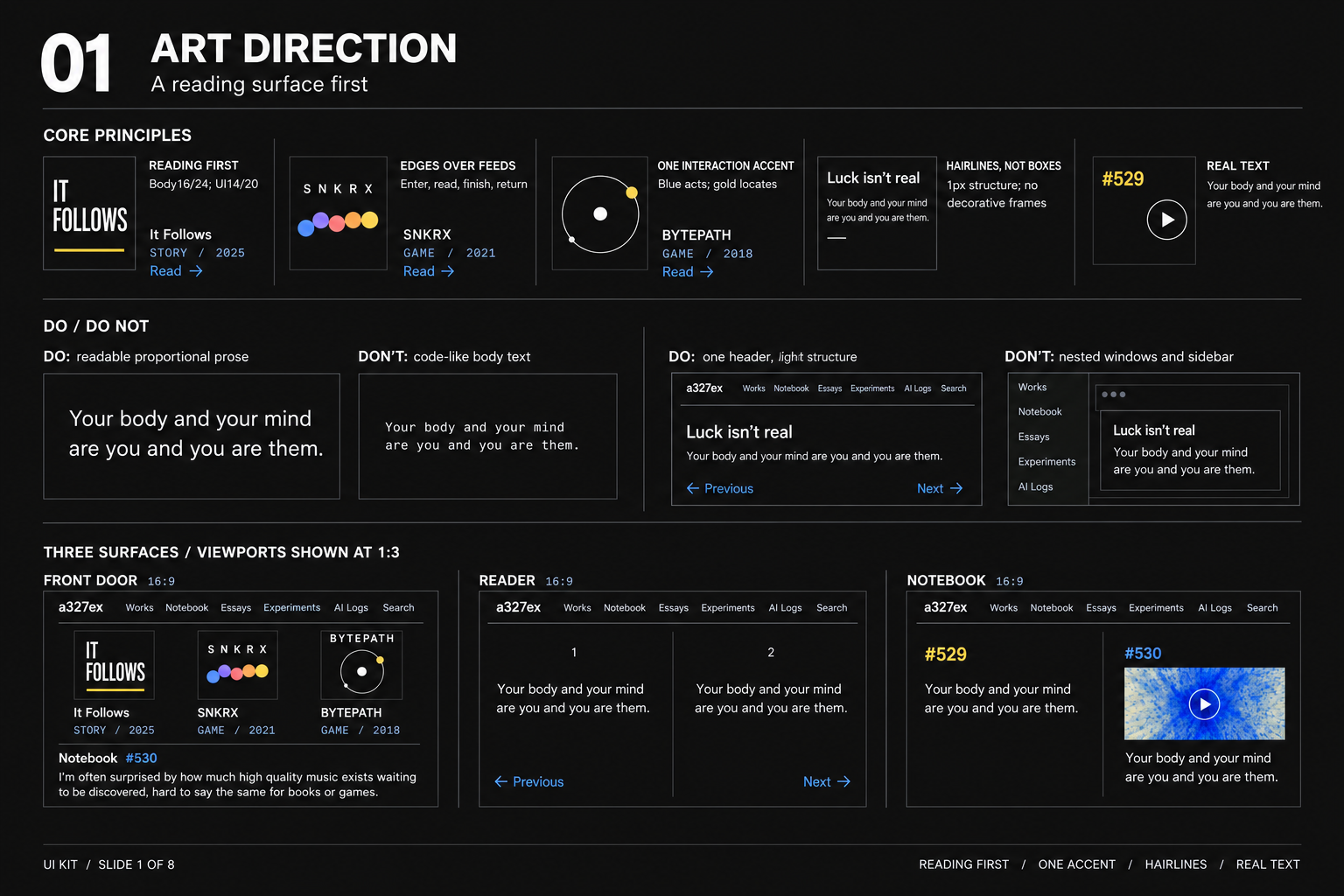
[task notification]
The replacement 01 landed. I'll review it with the full set rather than one at a time.
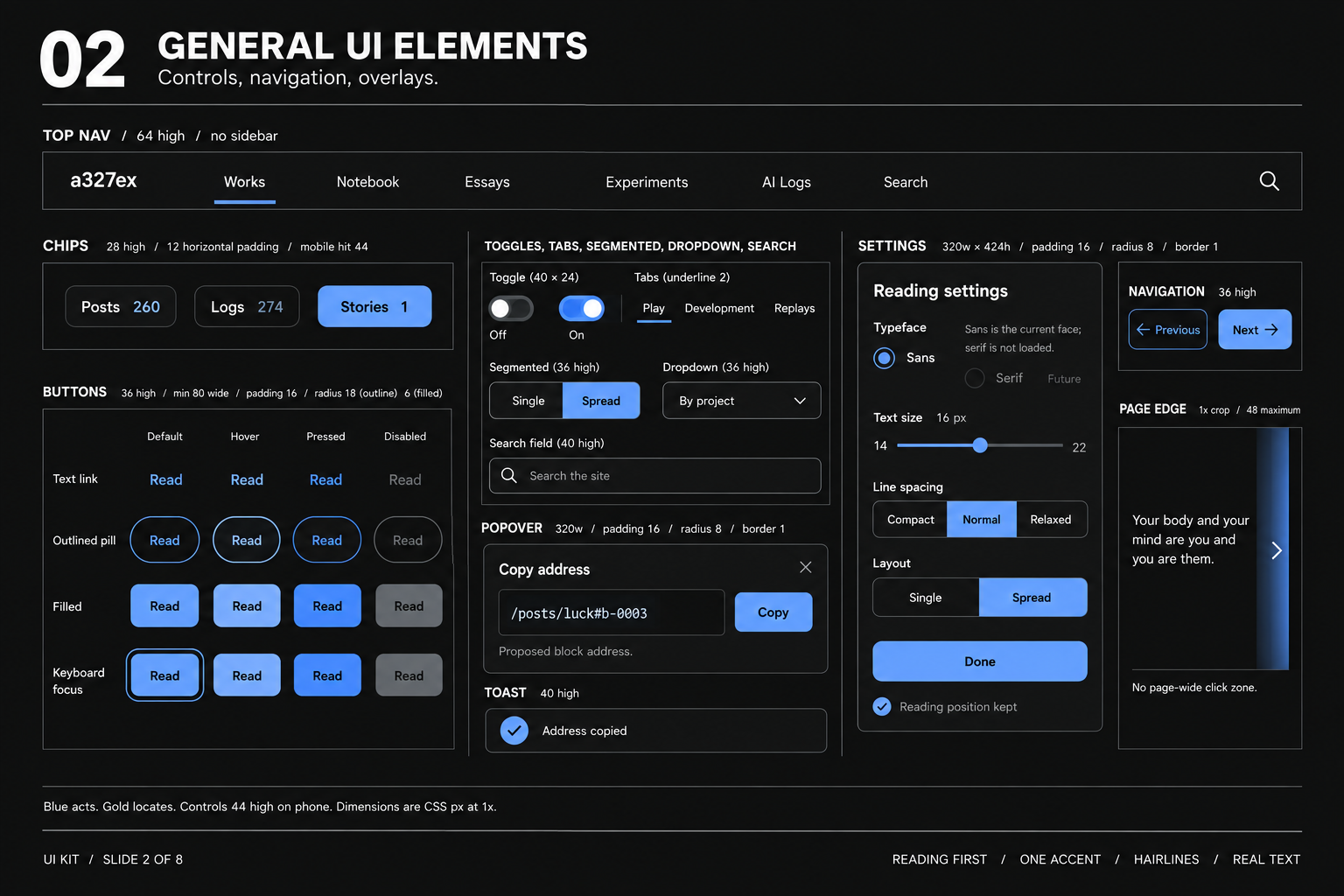
[task notification]
Sheet 02 in. Six more plus THEME.md.
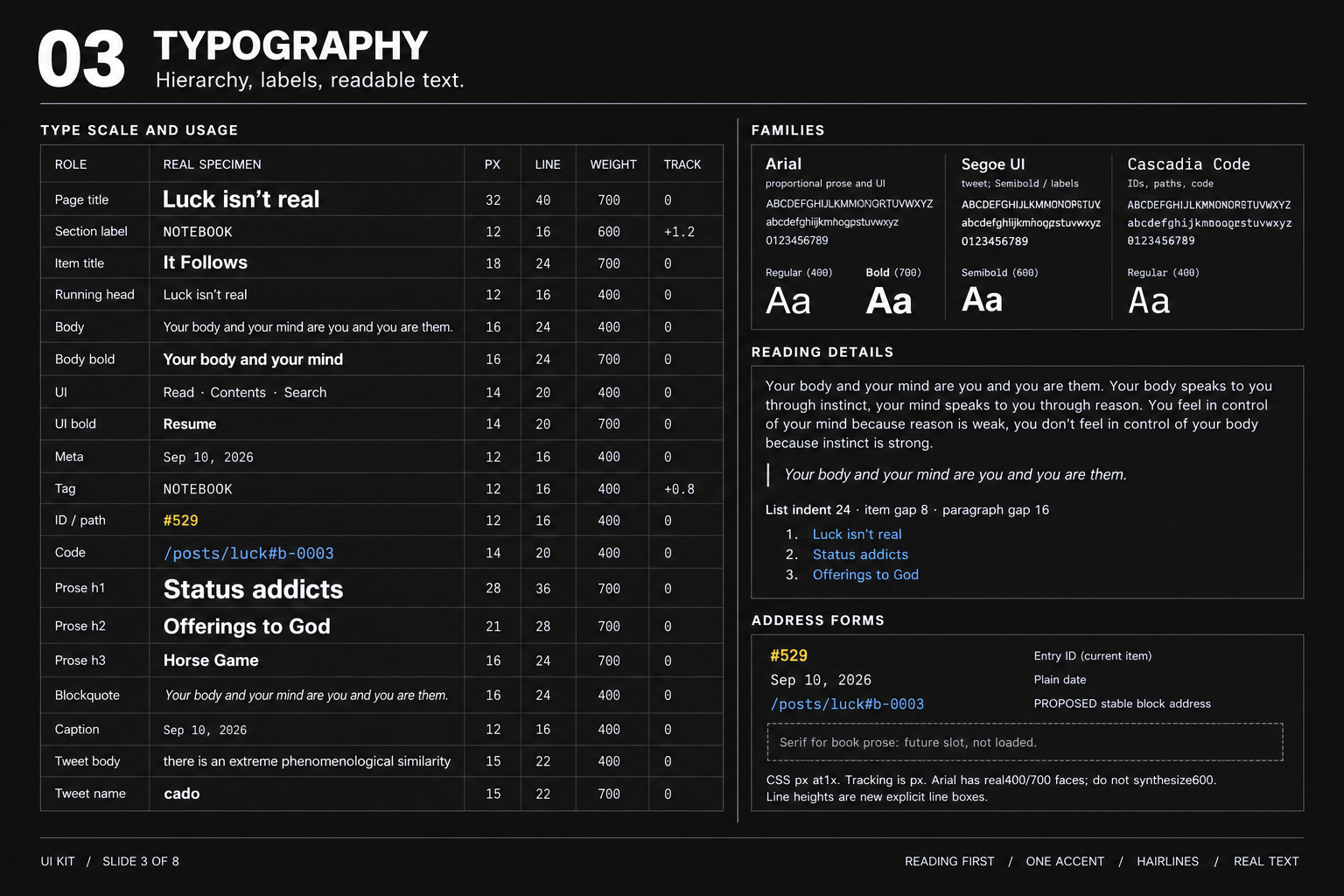
[task notification]
Sheet 03 in. Five more.
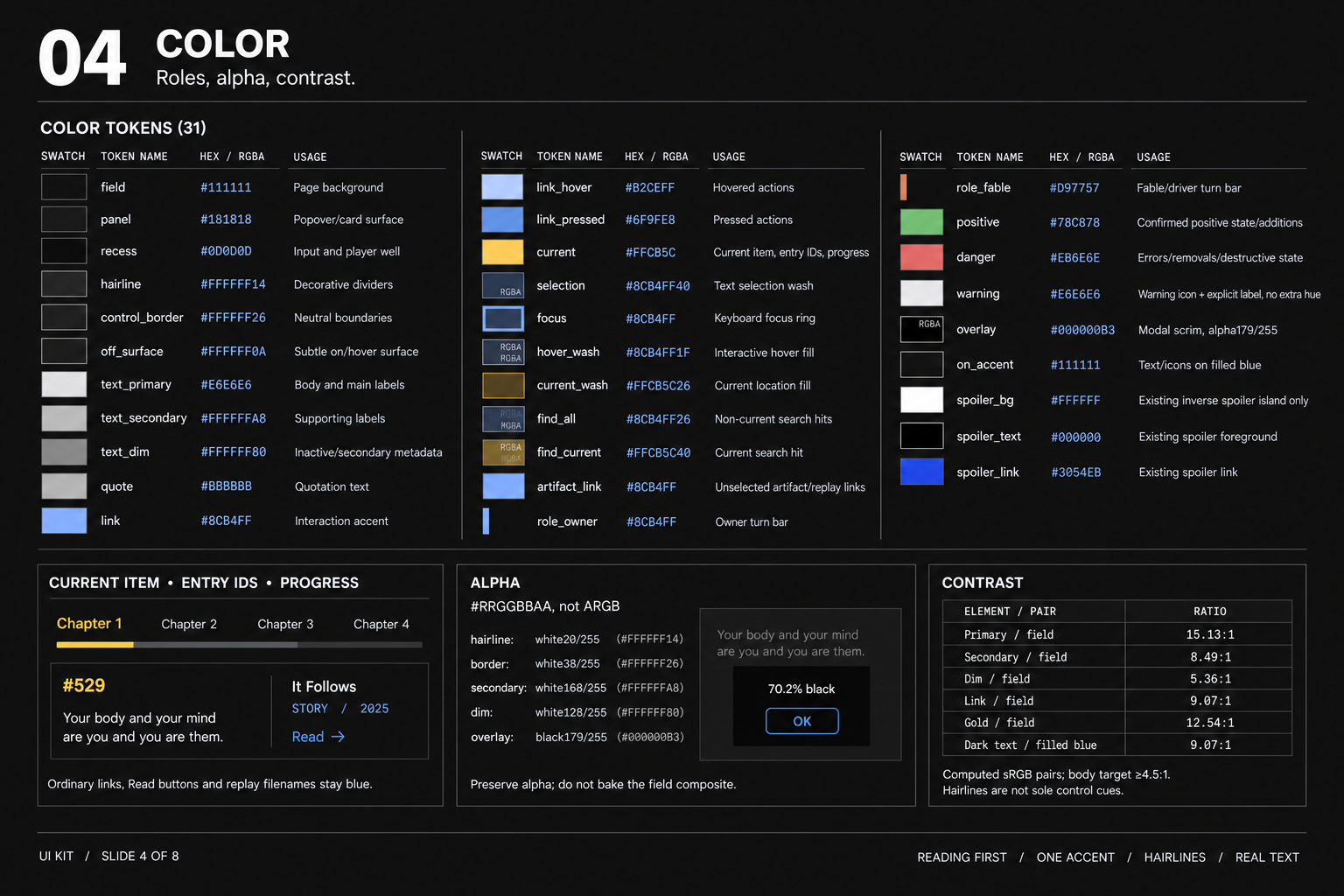
[task notification]
Sheet 04 in. Four more.
[task notification]
Sheet 05 in. Three more.
[task notification]
Astra is retrying sheet 05. Waiting.
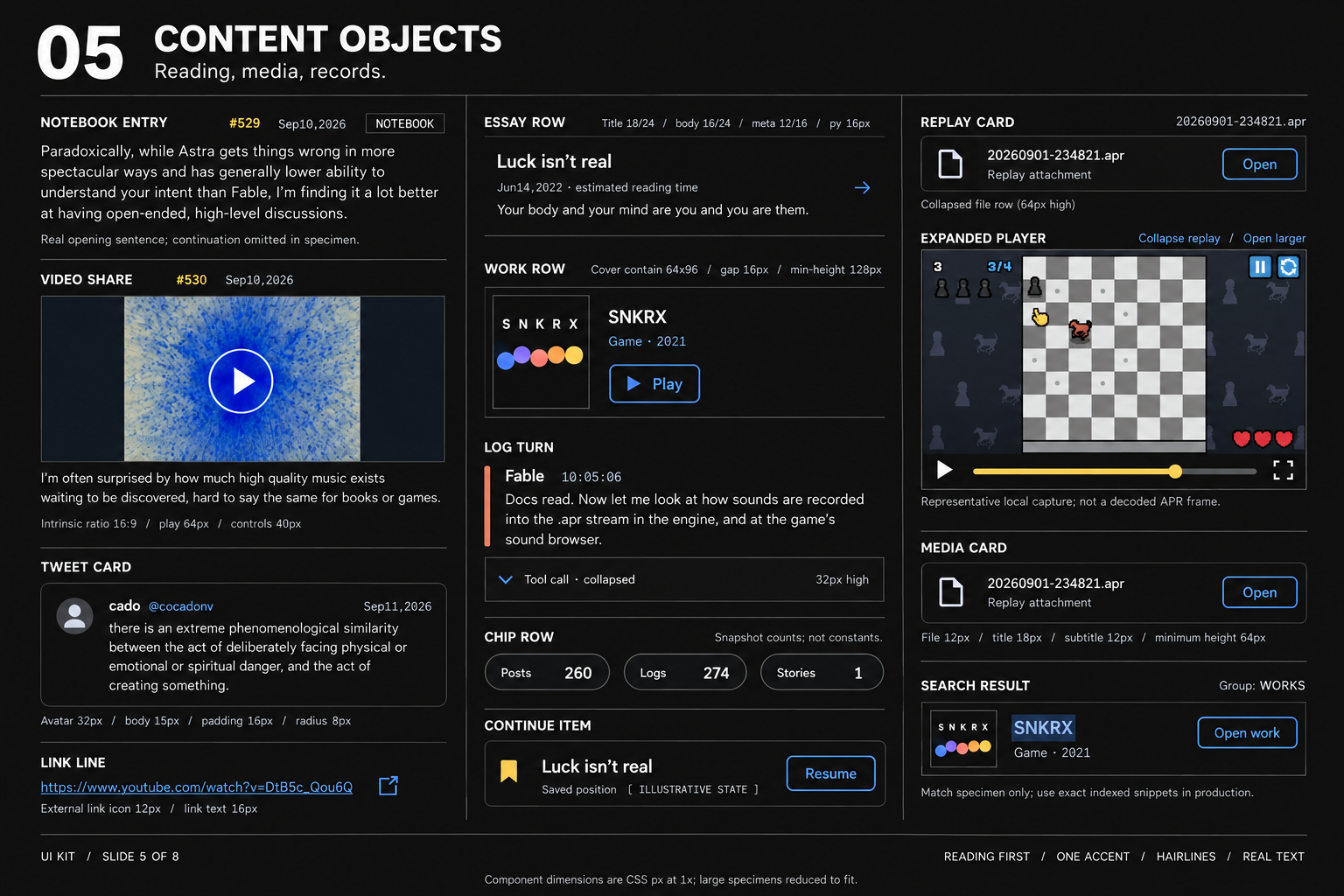
[task notification]
Replacement 05 landed. Three sheets and THEME.md remain.
[task notification]
Sheet 06 in. Two more.
[task notification]
Retrying 06. Waiting.
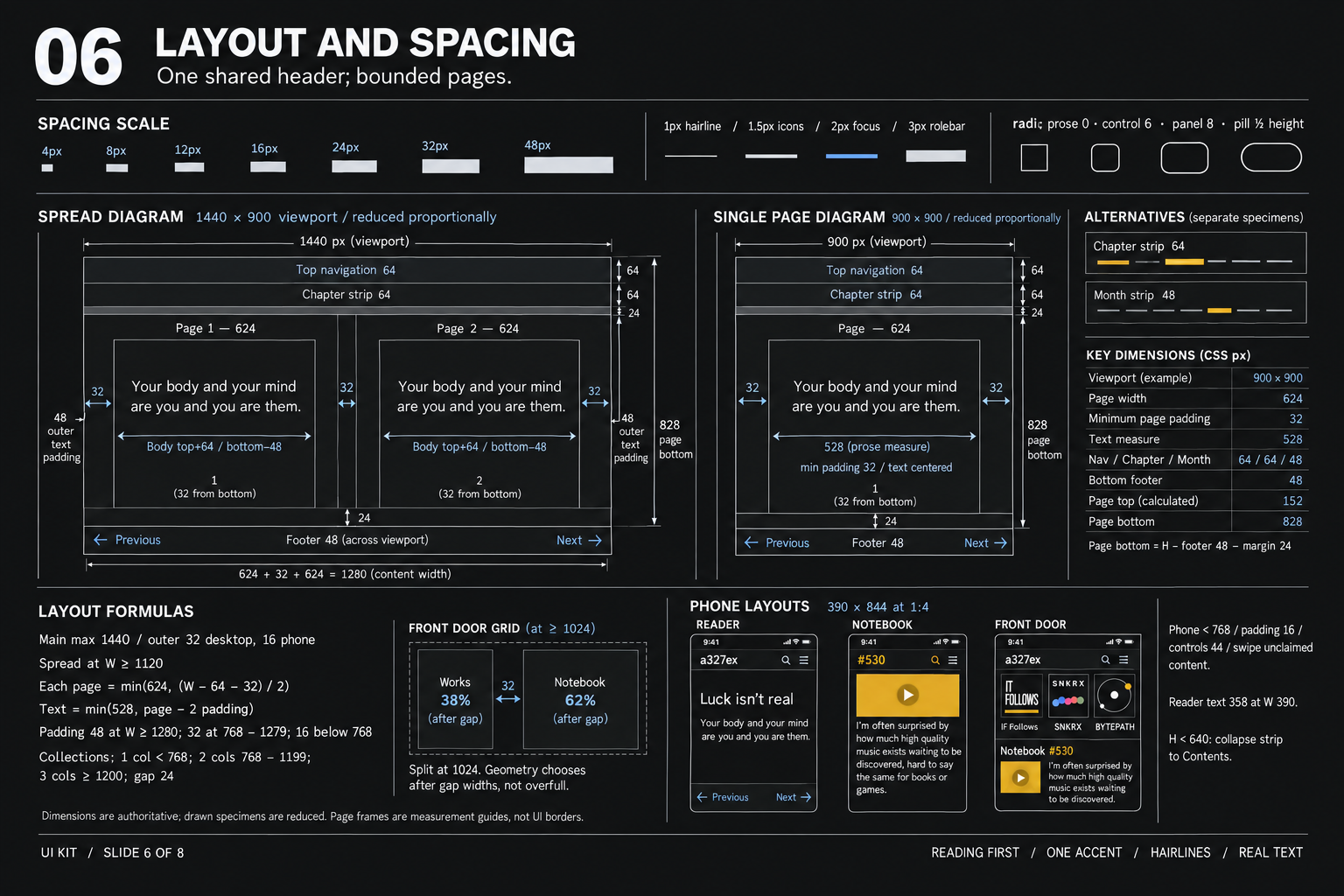
[task notification]
Replacement 06 landed. Two sheets and THEME.md remain.
[task notification]
Sheet 07 in. One sheet and THEME.md remain.
[task notification]
Retrying 07. Waiting.
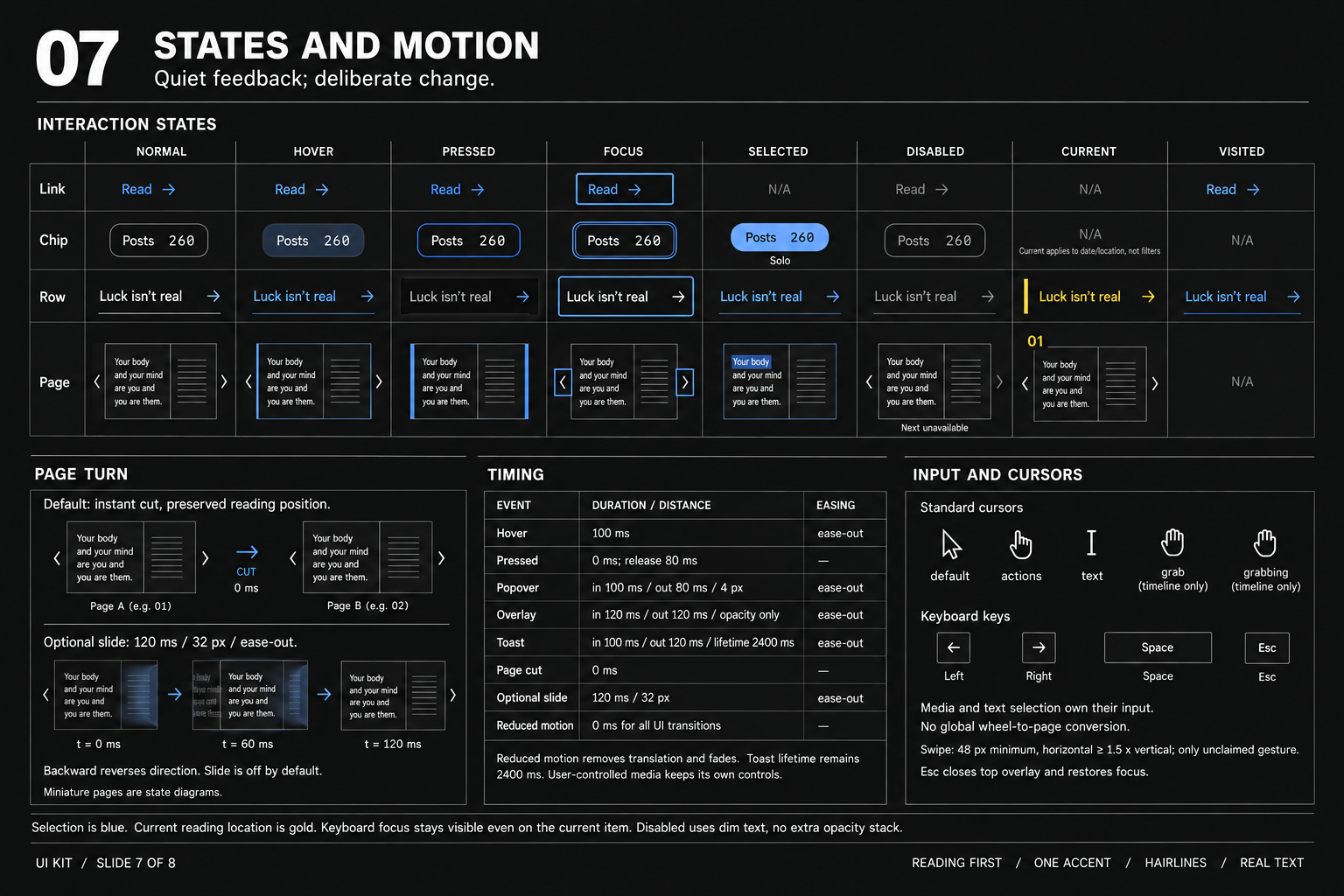
[task notification]
Replacement 07 landed. One sheet and THEME.md remain.
[task notification]
All eight sheets are on disk; Astra is writing THEME.md. I'll start reviewing the sheets now.
Read (C:\Users\a327e\Desktop\a327ex\a327ex-site\renderer\reference\site-theme-2026-09-13\02-general-ui-elements.png)
Read (C:\Users\a327e\Desktop\a327ex\a327ex-site\renderer\reference\site-theme-2026-09-13\03-typography.png)
Read (C:\Users\a327e\Desktop\a327ex\a327ex-site\renderer\reference\site-theme-2026-09-13\04-color.png)
[Think]
Sheets 02-04 look solid and buildable, with exact tokens mapped to theme.lua values like the field and hairline colors. Now I need to read sheets 05 through 08 independently while still waiting on THEME.md, so I'll request those four reads next.
Read (C:\Users\a327e\Desktop\a327ex\a327ex-site\renderer\reference\site-theme-2026-09-13\05-content-objects.png)
Read (C:\Users\a327e\Desktop\a327ex\a327ex-site\renderer\reference\site-theme-2026-09-13\06-layout-and-spacing.png)
Read (C:\Users\a327e\Desktop\a327ex\a327ex-site\renderer\reference\site-theme-2026-09-13\07-states-and-motion.png)
Read (C:\Users\a327e\Desktop\a327ex\a327ex-site\renderer\reference\site-theme-2026-09-13\08-templates-and-usage.png)
[Think]
Reading 08 failed, so Astra might be retrying or renaming it — meanwhile sheets 05-07 all look solid: dense, precise, and buildable. I should list the folder to check 08's state and THEME.md before deciding whether to read 08 again.
[Think]
Sheets 02-07 check out fine, but Sheet 08 wasn't at its expected name, so Astra is probably retrying it. I'll check the folder state next.
Bash (cd C:/Users/a327e/Desktop/a327ex && ls -la a327ex-site/renderer/reference/site-t...)
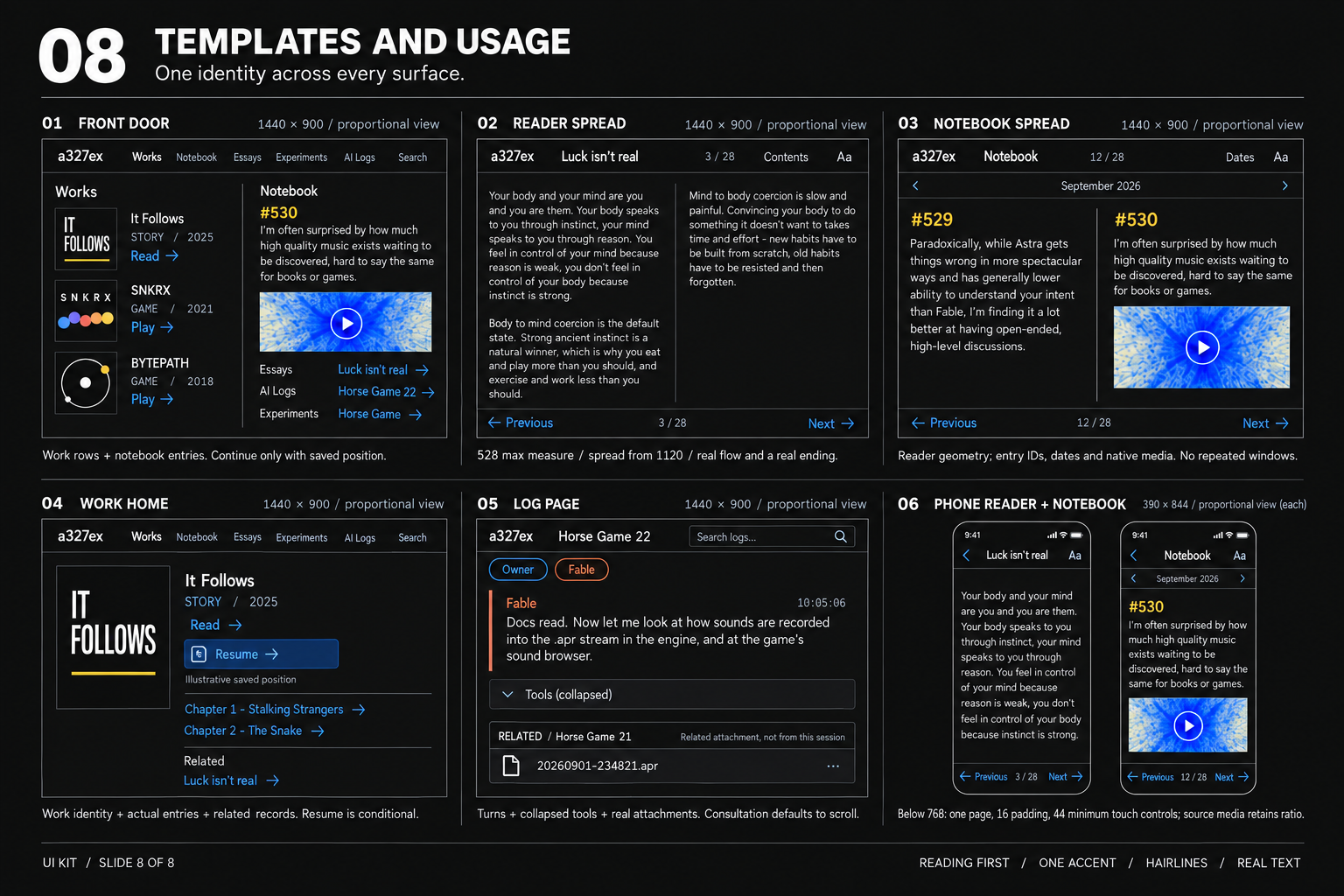
[Think]
While sheet 08 finishes retrying, I realize I already have enough values from the other sheets—colors, type scale, layout, components, and states—to start drafting the implementer brief now, and I can reconcile it against THEME.md once it's written.

I'm settling on a theme name (leaning toward `site_next`, noting it's easy to rename) and working through the design decisions: mapping the type scale from sheet 03 into theme.lua's font definitions, then figuring out the right text column width for the current single-column layout versus the wider grid described for the future reader design.

I'm going back and forth on the measure — landing on following THEME.md's codified 528px value for article pages where specified, while the feed/home page uses the front-door grid measure instead, and keeping the owner's text-width slider functional. Then I'm mapping the color palette from sheet 04 into theme keys — ink, background, link colors, and dim/medium variants.

Now I'm filling in the rest of the palette, adding new keys like panel, recess, control_border, link_hover/pressed, focus, hover/current washes, on_accent, and overlay to round out the theme's semantic colors.

For the site's layout, I'm deciding headings don't need rules since the sheets show them clean, but a top nav bar is needed. I'm sketching a 64px desktop top nav with the wordmark on the left and section links (home, logs, posts, stories, plus search, settings, and other actual site sections), with no sidebar and content centered in a max 1440px width.

Since the top nav can't fit the full disclosure trees the sidebar currently has, I'm deciding to keep top nav links limited to home, logs, posts, stories, and search, tucking settings/privacy/archive into a smaller cluster or "more" menu. I'm worried about losing access to the posts/stories navigation trees if they don't have their own catalog routes, so my fallback is to have those nav links open the existing sidebar tree as a dropdown panel.

The implementer should check whether /logs, /posts, /stories routes exist and use them directly; otherwise the nav link opens a dropdown built from the sidebar data. Mobile stays as-is with the hamburger menu, and the current section gets marked with a 2px blue underline per sheet 02. For filter chips, I'm settling on a 28px pill shape with padding and a secondary-colored count, filled blue for the active/solo state, and dimmed for disabled per sheet 07 — role chips follow the same pattern.

Feed rows get an 18/24 bold title with 12/16 mono metadata for ids and dates, keeping the hover arrow. Headings drop the hairline rule, and I'm reconciling the blockquote bar width (sheet 06 says 3px but the current QUOTE_BORDER constant is 4px). Mediacards use a 64px row height with a file icon, 18px title, 12px subtitle, and an outlined "Open" pill. Buttons get an outlined pill style at 36px height with 18px radius, plus a filled blue variant for primary actions. Code blocks use a near-black background with Cascadia at 14/20, and I'm still deciding whether links should keep their current underline or switch to plain blue without it.

Text links like "Read →" go without underline at rest, gaining one on hover -- so I'll set the theme flag to underline only on hover, with a light blue wash on hover rows for feed items. The section labels stay close to their current 12/16 semibold with tracking. For settings and the F2 shortcut, I'm setting up a three-way cycle between dark, light, and the new site variant, with F2 stepping through all three and the settings stepper reflecting the same options; since the new variant has its own fonts and metrics, switching to or from it needs a full relayout through the apply_theme path rather than the fast color-only swap.

For debugging, I'm exposing a global table in main.lua with theme-switching, navigation, and snapshot functions, harmless on both desktop and web, plus an environment variable read during settings load so headless runs can boot directly into a chosen theme. For verification, I'll lint the changed files, start the site driver, and step through snapshots across home, log pages, posts, search, and settings in both the new theme and dark theme for comparison, including snapshot paths in the report -- and I still need to think through whether the web build needs separate handling.

The web bundle isn't necessary tonight since the desktop renderer is enough to demo via run.bat, and though the same code runs on the web, I'll skip a build check unless it's trivial, and I'm noting explicitly not to deploy or build for web. I'm scoping the touched files to the renderer, main, sidebar, homepage, elements, and canvas modules plus settings, while staying away from server, deploy, and content directories with no commits. My stop conditions include missing font assets, needing engine-level C changes, or the relayout breaking existing documents.

I should include test instructions for the owner: launch run.bat, then use Settings → Theme → "site_next" or press F2 to cycle, with an env var as an alternative — I'll pull the exact details from the implementer's report once it lands. Now I'm writing the brief file at the delegation packet path, planning to review THEME.md's deviations once it's ready, adjust the brief if needed, and then spawn the opus-implementer with the packet as its prompt.
[Think]
Sheet 08 has all the values I need, so I'm writing the implementer packet now, then I'll reconcile it against THEME.md's deviation list once it's retried and ready.
Write (C:\Users\a327e\Desktop\a327ex\Anchor\workflow\delegate\runs\20260913-site-theme-build\brief.md)
[Think]
Sheet 08 is done. I want to fix the messy relative lua54.exe path to an absolute one, check that Arial bold exists in the renderer assets so the stop condition doesn't trigger prematurely, and then read sheet 08 to confirm everything lines up.
Bash (cd C:/Users/a327e/Desktop/a327ex && ls Anchor/workflow/tools/lua54.exe && ls a32...)
Read (C:\Users\a327e\Desktop\a327ex\a327ex-site\renderer\reference\site-theme-2026-09-13\08-templates-and-usage.png)
[Think]
All 8 sheets pass, and Arial bold is available along with Arimo SemiBold, so I don't need to synthesize weight 600. Now I'll fix the messy verification step 1 path in the brief independently, then wait for THEME.md and the Astra report — once THEME.md lands I'll skim it for deviations before spawning opus-implementer with the packet and registering run.json.
Edit (C:\Users\a327e\Desktop\a327ex\Anchor\workflow\delegate\runs\20260913-site-theme-build\brief.md)
[Think]
I still need THEME.md from Astra before I can reconcile the brief and spawn the implementer, so there's nothing to do independently right now — just waiting on that.
All eight sheets pass review. The implementer packet is written and only waits on THEME.md, which Astra is producing now, so I can reconcile the packet against its deviation list before spawning the Opus implementer.
[task notification]
THEME.md landed (42 KB). Reading its structure and the sections that decide the build: the token table, the type scale, layout, and the deviations list.
Bash (cd C:/Users/a327e/Desktop/a327ex/a327ex-site/renderer/reference/site-theme-2026-...)
[Think]
THEME.md looks solid — artifact links are blue with gold reserved for ids and current state, which matches what I wanted, so THEME.md's conventions can govern this. Next I should read through Typography and Spacing/layout sections to continue verifying consistency.

Also I should check whether Astra's run finished by looking at the report and gen file — that's independent of the THEME.md review. Once both checks are done, I can patch the brief, spawn the implementer against the patched brief, and register run.json alongside the spawn.
Bash (cd C:/Users/a327e/Desktop/a327ex/a327ex-site/renderer/reference/site-theme-2026-...)
Bash (cd C:/Users/a327e/Desktop/a327ex/a327ex-site/renderer/reference/site-theme-2026-...)
[Think]
Cross-checking THEME.md against my brief: I need to correct my measure assumption — the scrolling article column stays at 800/704 with 16/24 body text rather than narrowing it. I'm also noting the gold/blue swap: artifact elements shift to blue while current gets the new gold treatment.

Fonts split into distinct roles (banner, tag, body, ui) with specific sizes and tracking, and I flag that letter-spacing support needs verification — if the engine can't handle it, just leave text untracked. For navigation, I'm keeping my brief's live-site taxonomy (home, logs, posts, stories, search) since THEME.md's future sections don't exist yet in the renderer. On line-height, I'm opting to use the simpler body_line_height multiplier of 1.5 rather than building full per-role line boxes, accepting that tradeoff for now.

Reading vs UI scale separation is out of scope for tonight, just noting it. Now I'm moving to patch the brief with these reconciliations before spawning the opus-implementer in the background with the finalized packet, then registering run.json — since Astra's separate run only touches reference files while the implementer edits renderer code, there's no conflict. I'll make the edits to the brief file sequentially in one response since they're independent changes to the same document.
Edit (C:\Users\a327e\Desktop\a327ex\Anchor\workflow\delegate\runs\20260913-site-theme-build\brief.md)
Edit (C:\Users\a327e\Desktop\a327ex\Anchor\workflow\delegate\runs\20260913-site-theme-build\brief.md)
Edit (C:\Users\a327e\Desktop\a327ex\Anchor\workflow\delegate\runs\20260913-site-theme-build\brief.md)
[Think]
I need to spawn the opus-implementer with the brief.md packet as its prompt first, then register run.json for that implementer run afterward since the subagent jsonl path depends on the agent id returned from the spawn. Then I still need to think through Astra's report-t1.
Agent (Build the site_next theme in the renderer)
[Think]
I need to register the implementer run by creating a run.json in the delegate runs folder, capturing the agent, model, and subagent session path per the delegation convention.

Next I'll check on Astra's theme run completion via the report files, since the monitor should also catch this, and I want to verify what effort level the opus-implementer actually used on its first run by inspecting the .meta.json once it exists alongside the session log.
Bash (cd C:/Users/a327e/Desktop/a327ex && SUB="C:/Users/a327e/.claude/projects/C--User...)
[Think]
The backslash paths broke the Python script, so I need to redo it with forward slashes instead. The meta.json only records agentType, not the model or effort level, so I should grep the jsonl file's early lines for a "model" field while also writing the run.json in the same command.
Delegated run: Site theme build-out: site_next in the renderer (to Claude, 1 turn)
Bash (cd C:/Users/a327e/Desktop/a327ex && python - <<'EOF' import json,time d='Anchor/...)
[Think]
The implementer is registered and running as claude-opus-5 at xhigh effort. I'm now waiting on two things: Astra's theme run to finish with its report, and the implementer's completion — nothing else to act on independently right now.
The Opus implementer is running at extra effort on the theme build (confirmed claude-opus-5, effort xhigh in its transcript), registered as its own delegation run. Astra's theme run is finishing its index and report. Nothing to do until either reports back; I'll review the implementer's diff and snapshots when it finishes, then write the handover with test steps.
[task notification]
Bash (cd C:/Users/a327e/Desktop/a327ex && R=Anchor/workflow/delegate/runs/20260912-sit...)
[Think]
I've reconciled the first three judgment calls into the brief, and the fourth—adding a Fable role bar on identified turns—is a minor extension the brief doesn't cover, so I'll leave it as optional and let the implementer default to THEME.md. While the implementer works over the next hour or so, I'm considering prepping the handover, possibly adding theme sheets to the board since the owner wanted the theme build-out.

Adding a "Theme kit" section to gallery.html is possible but feels like unnecessary overhead—simpler to just deliver the 8 theme PNGs directly via file transfer in my final message rather than wiring in a new index. With nothing else productive to do right now, I'll hold off spending more effort and just wait for the implementer's notification.
Astra's theme run is closed and registered: eight sheets at 1536 by 1024, THEME.md, and an index, with four judgment calls flagged, three of which I had already folded into the implementer's packet and the fourth (extending the Fable turn color to identified Fable turns) left to THEME.md's own rule. The implementer is now the only running task; I'll review its diff and snapshots when it reports.
[task notification]
[Think]
Now that the implementer's report is in, I'll follow my review protocol: check the diff stats, skim the actual diffs of key files, run verification myself with syntax checks, tests, and headless snapshots, then examine those snapshots before handing off. I also note the implementer flagged that the brief was mistaken about the `/logs` catalog route existing in the engine—the server has a `/logs` HTML page but the engine's nav_to_path doesn't support it.
The implementer finished cleanly. Review protocol: diff stat, re-run its verification myself, and look at the snapshots with my own eyes before handing over.
Bash (cd C:/Users/a327e/Desktop/a327ex/a327ex-site && git status --short | head; echo ...)
[Think]
Everything checks out on my end—syntax, tests, scoped file changes, and settings.lua restored to site_dark. Now I need to independently verify six snapshot images: next-home, next-log, next-nav-menu, next-post, next-settings, and dark-home.
Read (C:\Users\a327e\Desktop\a327ex\a327ex-site\renderer\reference\site-theme-2026-09-13\snaps\next-home.png)
Read (C:\Users\a327e\Desktop\a327ex\a327ex-site\renderer\reference\site-theme-2026-09-13\snaps\next-log.png)
Read (C:\Users\a327e\Desktop\a327ex\a327ex-site\renderer\reference\site-theme-2026-09-13\snaps\next-nav-menu.png)
Read (C:\Users\a327e\Desktop\a327ex\a327ex-site\renderer\reference\site-theme-2026-09-13\snaps\next-post.png)
Read (C:\Users\a327e\Desktop\a327ex\a327ex-site\renderer\reference\site-theme-2026-09-13\snaps\next-settings-stepper.png)
Read (C:\Users\a327e\Desktop\a327ex\a327ex-site\renderer\reference\site-theme-2026-09-13\snaps\dark-home.png)
[Think]
I'm checking that the build visually matches the theme — nav, chips, panels, and settings all look right against the dark sidebar — but I notice a small inconsistency where the nav labels are capitalized while the trailing cluster stays lowercase.

Given this passes review, I'm now planning the handover: save the implementer's report and finalize run.json, deliver the theme sheets and comparison snapshots to the owner, and write a project memory capturing the uncommitted redesign state and next steps (reader, notebook), adding a pointer in the larger anchor memory rather than editing it directly since it's already quite large.

On committing, I'll decide against pushing to prod since that triggers a deploy hook, and against committing locally too since the image weight and repo inclusion question is still unresolved — I'll leave everything uncommitted, note it clearly in my final message, and let the owner decide once he's tested it. I'll proceed with saving the report, delivering artifacts, and writing the memory file now, since these three steps don't depend on each other.
[Think]
Review passed — the theme is properly codified, the dark theme is unaffected, and only the scoped files changed. I'll now save the implementer's report, write the session memory, and hand over the sheets and snapshots.
Bash (cd C:/Users/a327e/Desktop/a327ex && python - <<'EOF' import json,time p='Anchor/...)
Write (C:\Users\a327e\Desktop\a327ex\Anchor\workflow\delegate\runs\20260913-site-theme-build\report.md)
Write ([memory: sealed target])
SendUserFile (C:/Users/a327e/Desktop/a327ex/a327ex-site/renderer/reference/site-theme-2026-09-13/01-art-direction....)
[Think]
I still need to add the MEMORY.md index line for the new memory, then deliver the four verification snapshots—next-home, next-log, next-nav-menu, and dark-home—so he can see the built theme reflected in the log and cards. I'll tackle both of those now, leaving the final handover message for after.
Bash ([memory: sealed target])
SendUserFile (C:/Users/a327e/Desktop/a327ex/a327ex-site/renderer/reference/site-theme-2026-09-13/snaps/next-home.p...)
The theme is built and verified. Everything is on disk and uncommitted, waiting for your test.
What was done overnight
- Theme kit. Astra produced eight sheets in the Ricochet reference format (delivered above) plus THEME.md, the written codification with every value mapped to theme.lua keys and a twelve-point list of where it deviates from the live site. Its four judgment calls: Arial stays with prose at 16/24 and UI at 14/20; the reader uses 624 px pages with a 528 px measure while scrolling articles keep 704; gold is restricted to ids, the current item and progress, with artifact and replay links turning blue; the Fable terracotta extends to identified Fable turns.
- The build. An Opus 5 implementer at extra effort built the theme into the renderer as
site_next, labelled Reading in settings. Seven files changed. Under it the sidebar is gone, a 64 px top line carries Home, Logs, Posts, Stories and Search with the current section underlined, section links open a panel listing that section's entries (the engine has no catalog routes, so the panel is the index), chips are outlined pills with Cascadia counts, entry ids are gold, body text is 16/24, feed titles 18 bold, links underline only on hover, tweet cards are rounded panels, code sits in a recessed well, replay cards are 64 px file rows with an outlined Open button. Dark, Light and the old-Blot post skin are pixel-unchanged. The default stays Dark. - Verification I re-ran myself: all six files parse, the attribution test passes, the diff touches only the scoped files, and the headless snapshots delivered above come from the actual renderer.
How to test
- Run
a327ex-site\renderer\run.bat. It opens in Dark, exactly as before. - Press F2 twice: Light, then Reading. Or open settings from the top line and step Theme to Reading, which persists per device.
- Click Logs in the top line for the section panel, open a log, hover a link, scroll to attachments in
/logs/environment-exploration-ps1-worldsfor the file-row cards. Open/posts/luckto confirm old-Blot posts keep their skin with no bar. - Press F2 back to Dark and confirm nothing moved.
One-line alternative that boots straight into it without touching your setting:
A327EX_THEME=site_next a327ex-site/renderer/run.bat
Left for you
- Nothing is committed. The theme code, the mockups (92 MB), the theme kit (19 MB) and the Ricochet exemplar copy all sit uncommitted in the site repo. Test first, then decide where the reference folders live.
- Not built, by design: the paginated reader, spreads, chapter and month strips, the Aa popover, the Continue band, page-turn motion, and the Works/Notebook/Essays/Experiments collections. Those are the next brief once you've judged the theme.
- Small things the implementer noticed: the admin pageviews readout collides with the top bar under Reading, the scrollbar overlaps the bar's right end by a few pixels, and the nav labels are capitalized while the trailing cluster is lowercase.
All three delegated runs are registered and will weave into this session's log. This was an omni session, so end it with the private seal.
The theme kit: eight sheets in the Ricochet reference format (art direction, UI elements, typography, color, content objects, layout and spacing, states and motion, templates). THEME.md beside them holds the authoritative values.
The built theme, captured headlessly from the actual renderer: home, a log page, the Logs panel open, a titled post, and the untouched Dark theme for comparison.
Let's build the rest out, I'll be able to provide better feedback once the entire thing is built and I can judge it against something real instead of images only. Use the same setup with an Opus 5 agent, make sure to direct him well since this portion requires more careful thought.
[Think]
The owner wants everything built out — the paginated reader, notebook view, work homes, collections, front door, logs matrix, replay integrations — so he can judge against something real, using a carefully directed Opus 5 implementer. This is substantial enough that I need a real design brief, phased into stages before handing it off.

Since site changes are exempt from brief-first-with-owner per CLAUDE.md, I should just pick sensible defaults (front door 5, drawing on what he liked in 12's paginated notebook), state my decisions briefly in chat as vetoable choices, and get building rather than waiting for more input — he already said he'll give better feedback once things are built.

Now I'm mapping out the site structure: top nav with Works, Notebook, Essays, Experiments, AI Logs, and Search, each pulling from existing content — Works from artifacts and prototypes, Notebook from untitled posts, Essays from titled posts, Experiments from prototypes and exploration logs, and AI Logs organized as an archive matrix of months by project, deriving project names from title prefixes for now since there's no dedicated frontmatter field yet. For the front door layout I'm following the reference design with a works column on one side and a notebook column alongside it.

I'm settling on showing the front door notebook column as a scrolling feed of latest entries, while keeping a fully paginated Notebook page accessible separately so both formats exist side by side. For the reader itself I'm considering a paginated layout.

I'm working through the reader's pagination mechanics: two-page spreads on wide screens versus single pages otherwise, consistent page/measure/gutter dimensions, a header with brand and contents, a footer with prev/next controls, chapter navigation for longform work, and real text reflow where unsplittable blocks move to the next page. I've hit a conflict though — I want wheel scroll to advance one page at a time, but the existing theme spec explicitly says there should be no global wheel-to-page conversion, so I need to reconcile that.

I'm resolving it by deciding wheel input turns pages one at a time with debouncing, since a wheel that does nothing would feel broken, while keys and Esc follow the existing kit conventions. I'm also settling which content types open in the paged reader — stories and essays yes, while logs default to scrolling with an optional pages toggle I'll leave alone for now.

Now I'm mapping out the contents overlay: a chapter list built from headings, page-position display, and jump navigation instead of expensive thumbnails, plus a chapter-ending screen with links to contents, next chapter, or back to the work. For addressing, I'm keeping existing slug anchors for headings but adding block-index anchors purely for per-device position memory, not exposed in the URL — and making sure selection and find still work correctly as the stream repositions across pages.

For the notebook page itself, I'm treating months as chapters with a month strip and a dates overlay listing days, with entries flowing as full bodies separated by hairlines and each entry's id acting as a clickable gold link to its own permalink page (with prev/next navigation and a return-to-notebook link).

Then for work homes, I'm sketching routes like `/works/<slug>` for each piece — It Follows as the story, SNKRX and BYTEPATH linking out to their Steam pages, and the Horse Game as a playable prototype, alongside a second prototype (Skyland). Since no cover art exists, I'm planning a typographic treatment for the cover area instead.

I'm laying out each work's home page structure: cover, title, type/year, description pulled from frontmatter, action buttons (Read/Play/Steam), a contents section for the novel, a development history pulling matching-series logs, and related essays pulled by tag or slug matching. I've decided the cleanest approach is a hand-maintained `works.lua` table listing each work's slug, title, type, year, action, series prefix, and related posts, so it stays editable later — and now I'm defining the initial entries for that table.

For the essays collection, I'm grouping titled posts by year with date, computed reading time, and a first-sentence preview under an `/essays` route. For the experiments collection, I'm deciding which logs count as exploration/lookdev work versus prototypes, settling on an `EXPERIMENT_SERIES` list of series prefixes (Environment Exploration, Lookdev, Character Exploration, and similar) maintained alongside the works table. Then for the AI Logs archive, I'm sketching a months-by-projects matrix where each cell lists sessions and expands into a detail list when clicked, with "project" mapped from the series prefix.

Now I'm moving into log page details: a session frame showing position within a series with previous/next navigation, a project chip linking back to the owning work, and keeping the existing inline attachment rows and expanded replay modal. For search, I'm considering grouping results by collection type if it's cheap to implement, and adding a "continue reading" band on the front page using stored reading positions. For phone/mobile, I'm noting that the reader's single-page swipe mode already covers the notebook's one-entry-per-screen requirement.

I'm also thinking through mobile compatibility more broadly — the front door should collapse gracefully, and since testing happens mostly on desktop, I just need to ensure the existing mobile mode isn't broken, with the reader defaulting to single-page on narrow screens. On the server/SEO side, I'm deciding that new routes like /works, /essays, /notebook, /experiments, and the logs archive will need server-side counterparts eventually for crawlers, but tonight I'll keep this engine-only and defer server fallback as a follow-up item, while making sure the engine's navigation and path-pushing logic handles these new routes properly.

Given the scope, this really needs to be split into sequential implementer runs. Phase A tackles the hardest part — the paginated reader with layout mode, chrome, input handling, position memory, contents overlay, and ending page — applied to stories and essays. Phase B builds out the collections and routes: the works table, the Works/Essays/Experiments/AI Logs/Notebook pages, work homes, log series frame, the front door redesign, and renamed top nav with search grouping. Phase C, if time allows, covers phone polish, log page mode toggle, and the server routes.

Since he wants the whole thing built, I'll run Phase A then Phase B sequentially with review in between, giving brief interim progress updates rather than waiting until everything's done. Following the doctrine that anything with a brief goes to an Opus subagent, I'm now drafting the Phase A brief, starting with the design for a new `reader.lua` module to keep pagination logic out of main.lua and avoid hitting the local-variable limit.

Adding page geometry rules...

Actually, the key realization is that pagination is really just picking break offsets within the single continuous column layout at line boundaries, and each page is a clipped, translated window onto that column. So instead of repositioning elements per page, I can use a stencil clip plus a y-translation to show only the slice of the column belonging to a given page, with elements crossing a break simply getting clipped by the mask.

To pick good breaks, I need line boxes and atomic spans: no line of text should be split, so a break shifts to the top of any element it would otherwise cut through, unless the element is taller than a full page, in which case it's allowed to be clipped or pre-scaled to fit. This approach reuses all the existing element rendering, selection, and search logic almost unchanged since only coordinates need conversion between column space and page space, and I still need to account for widow/orphan handling when computing the breaks.

For chrome, the reader header replaces the nav's link row with the work's brand and title plus contents and Aa controls, the footer holds previous/next navigation with page numbers, and a chapter strip appears for documents with multiple top-level sections to show progress and allow jumping between them.

I'm also planning a contents overlay listing headings with page numbers and a way back home, and an ending page that disables Next and shows a simple end block with title, contents link, and home link. For input, I'm covering keyboard arrows and page keys, click targets, edge-zone clicks in wide margins, debounced wheel scrolling, and touch swipe gestures.

Position memory needs a per-device store keyed by document that saves which block is at the top of the current page, restoring that on reopen, with anchors and search jumping to the page containing the target block. Selection and highlighting have to translate mouse coordinates from page space into column space for correct hit-testing.

Story-type and titled essay posts under site_next get the paginated treatment, while old-theme posts and log series keep scrolling — I'll add a `reading_layout` setting defaulting to 'pages' scoped to site_next only. Mobile gets a single-page swipe layout with a 44px footer and header showing Back plus title. For verification I want headless snapshots covering the first, middle, and last pages of a long post, the contents overlay, an essay with an embedded tweet card, and one with code blocks.

I also want a single-page mode snapshot at 900px width if the engine allows resizing, plus a debug reader state exposing page/count/break info for assertions, and a line-integrity check ensuring no break splits a text line mid-way.

I'll write the Phase A packet now and post a compact design summary in chat alongside spawning the implementer, rather than blocking on a separate brief — the collection routes belong to Phase B, but the reader built in A should anticipate them.
Understood. This is the part where the brief matters, so I'll split it into two sequenced implementer runs with a review between them: first the paginated reader (the hard, careful piece, where the architecture decides everything after it), then the collections, work homes, front door and log frame on top of it. Writing the reader packet now.
Write (C:\Users\a327e\Desktop\a327ex\Anchor\workflow\delegate\runs\20260913-site-reader\brief.md)
[Think]
I'll spawn the opus-implementer for phase A with its packet, then register run.json once I have the agent id from the spawn result next turn. While that's underway, I can start drafting most of the phase B brief covering collections, work homes, front door, and log frame, though I'll hold off finalizing until I see phase A's reader entry point API.
Agent (Build the paginated reader (phase A))
Delegated run: Redesign build-out phase A: the paginated reader (to Claude, 1 turn)
[Think]
I need to register the run.json for phase A, then draft the phase B brief covering collections, work homes, front door, notebook pages, log frame, search grouping, and the continue band. For phase B, I'm sketching a new works.lua data model as a hand-maintained table listing each work's slug, title, and kind.

I'm working out initial entries — It Follows, SNKRX, BYTEPATH, Horse Game, Skyland — pulling their Steam links and routes from the existing ARTIFACTS defs in homepage.lua and deciding to leave related-post associations empty rather than invent connections. I'm also figuring out how to derive series/project names for log entries by stripping trailing numbers and prefixes like "Fable Test — " from titles.

Now I'm sketching the front-door layout: renaming nav to Works/Notebook/Essays/Experiments/AI Logs/Search, with a left column (38%) showing Works and previews of Essays/Experiments/AI Logs, and a right column (62%) devoted to Notebook entries with full bodies, dropping the feed chips from the front door but keeping them on the dedicated Notebook page.

For the individual work page, I'm designing a cover block with title/kind/year/summary, a primary action button, a Contents list for stories built from chapter headings with resume support, a Development history section listing session logs, and a Related posts section — plus for prototypes, deciding whether the in-engine game should be hosted inline on the page or only reachable via a separate fullscreen Play view.

For `/notebook`, I'm structuring the untitled posts as reader-chrome pages with a month strip, a Dates overlay, and entries separated by hairlines with gold mono IDs as headers — settling on newest-first ordering to match feed conventions, while noting chronological ordering within a single day.

Deciding whether to keep tag chips at the top of the notebook page to filter entries, similar to the current feed's filtering chips row.

Actually, chips there would clutter the page, so I'm leaving filtering to the search page and noting chips as a possible future addition. For the permalink page, I'm sketching a single-message view with id, date, tags, and body, flanked by prev/next post links back to the notebook, reusing the existing untitled-post route pattern. Then I move to planning the essays page (titled posts grouped by year, with read-time estimates and preview sentences) and the experiments grid page.

Clicking a cell expands the full list of sessions for that month/series below the matrix, keeping the matrix itself as the primary view rather than a plain chronological list, since search handles finding specific logs. For the log page itself, I'm adding a series frame with session position and date, previous/next links, and a project link back to the work or logs matrix; search results should group by collection type where the data model allows, and the front door's continue band should surface up to three remembered reading positions.

Now I'm renaming the top nav to Works, Notebook, Essays, Experiments, AI Logs, Search, retiring the old popovers since each section has its own page, while keeping settings/privacy/archive together. On mobile, the front door collapses with works scrolling sideways and notebook stacked below, collections go single-column, and the reader/notebook show one entry per page. I'm noting that server fallback routes aren't part of this run — hard reloads will 404 server-side even though the engine's push_path works fine for desktop testing — and flagging the old artifacts block for cleanup.

I'm listing what needs verification: snapshots of the homepage, individual works, notebook pages with date overlays, permalinks, essays, experiments, logs matrix and expanded cells, search results, the continue-reading band, and confirming dark theme stays untouched. I'm also setting stop conditions around game embedding limitations, missing index data needing derivation from body text, and an 8-hour time cap, then planning to write the full brief and register run.json for phase A.
Bash (cd C:/Users/a327e/Desktop/a327ex && python - <<'EOF' import json,time d='Anchor/...)
Write (C:\Users\a327e\Desktop\a327ex\Anchor\workflow\delegate\runs\20260913-site-collections\brief.md)
[Think]
There's nothing to do until phase A wraps up since phase B depends on it, so I'll share the plan and decisions with the owner now so they can weigh in while A is running.
Both packets are written; phase A is running now and phase B is queued to start when A's report passes review. The design is in the packets, but the decisions worth your veto while the implementer works:
Phase A, the reader (running):
- Pages are windows onto the existing single-column layout. The reader computes break offsets at text-line and element boundaries, then draws each page by translating and clipping the column. Every element draw, selection, find and link hit-test keeps working in column space. No second layout engine. This is the one architectural call that decides everything after it.
- Geometry per THEME.md: spread from 1120 px, 624 px pages, 528 px measure, header 64, footer 48, chapter strip 64 only for works with two or more h1s (It Follows).
- Widow and orphan control, headings keep two lines, oversized blocks get their own page scaled to fit.
- Input: arrows, Space, PageUp/Down, Home/End, Previous/Next links, edge zones only in the free outer margins, a wheel flick turns one page with a debounce, swipe on touch. Instant cut, no animation.
- Position remembered per device and per document by the first block on the page. No page numbers in URLs. Heading anchors and find queries open on the right page.
- Applies to stories and titled posts under the Reading theme, behind a new "Reading layout: Pages / Scroll" setting so you can compare against the scroll on the same document.
Phase B, the collections (queued):
- A hand-maintained
works.luatable seeded with It Follows, SNKRX, BYTEPATH, Horse Game and Skyland, with no invented summaries or related lists. Log series derive from the title minus its trailing number, and a work claims a series through one field. - Front door: works column at 38 percent with the Continue band and compact Essays, Experiments and AI Logs modules, notebook column at 62 percent with whole entry bodies. No filter chips there.
- Routes:
/works,/works/<slug>,/notebook,/essays,/experiments,/logs. The top line becomes Works, Notebook, Essays, Experiments, AI Logs, Search. - Notebook paged in the reader's chrome, newest first, months as chapters, days as the contents overlay, no chips on it in this run.
- Work homes with the typographic cover, primary action, Contents for the story, development history from the series, and an attempt to host the Horse Game prototype running inside its home.
- The logs page is the month-by-series matrix. Log pages keep scrolling with a series frame and Previous and Next session.
- Search results grouped by collection.
- Server-side routes for the new pages are a later run, so on the web a hard reload of a new route would 404. Fine for judging on the desktop renderer.
If any of those should go differently, say so now and I'll amend the phase B packet before it launches.
As an unrelated question, I'm trying out using you as my main driver, spawning GPT agents (Astra and perhaps Luna Max for implementation) as well as Opus 5 and Gemini/Grok for various tasks. How did you feel about the usage of Astra and Opus 5 this session? Did I ask you to use them incorrectly? Do you think we should have done something else?
[Think]
He wants an honest, committal critique of how the delegation went this session, so I'm thinking through what actually happened with Astra's independent take—its diagnosis of the feed and the "separate choosing from experiencing" framing were genuinely sharper than my own phrasing.

Its critique round was the highest-value contribution: it caught real errors in my reasoning (the wrong governing rule, the broadsheet flaw, an overclaimed cue, an optimistic estimate it verified by re-reading the renderer, a citation problem), acting as a real adversary that argued content rather than vibes. Its image generation capability was also decisive—the mockups and the THEME.md it wrote were excellent, meticulously tracking provenance in a way I might not have matched.

Weaknesses showed up too: it followed my stop-on-refusal rule too literally and halted on one moderation refusal, invented essay titles and monospaced prose once, got a few dates wrong, though it self-corrected sheet retries fine. It needed my QC on 3 of 30 revisions, all caught by visual review, confirming that "Fable judges, Astra produces" was the right division of labor. Now I'm looking at Opus's implementation work: it handled the theme build well, solved the 200-local ceiling, caught a brief error and adapted sensibly, restored settings, probed pixels, and wrote a thorough report, though it went slightly beyond scope.

What made it succeed was a packet with precise values, file:line pointers from the Explore agent, a tested verification harness, and a report format — honoring the doctrine that briefs close high-level decisions while details stay with the implementer. The setup was somewhat inefficient since the implementer re-read what the Explore agent had already mapped, though it made the brief more precise so it was worth the cost. I'm also questioning whether he framed the requests well — the "exact same prompt" experiment to Astra was a good comparison method, and capping iteration rounds with a token limit was the right call since I stopped after two rounds myself.

Discussing variations with Astra before generating was the right sequence too; the round-two functional variations properly informed the theme rather than the reverse, and codifying that theme in a kit before building paid for itself rather than jumping straight from images to build. One thing I'd flag as a possible improvement: prototyping the Kindle question directly in the real renderer earlier, rather than generating 51 images first — though the images were still cheap and useful since he reacts well to visuals.

GPT-model implementation is viable in principle — Astra handled well-defined work fine before — but doctrine defaults to Opus because the packet transfers cleanly and review happens directly, whereas Codex-style review goes through report.md and diffs, and frame issues matter more when side effects are involved. Tonight's evidence was mixed: Opus handled an ambiguous assumption by choosing sensibly and reporting back, while Astra halted a whole group over an over-literal reading of my rule — both defensible, but Opus's judgment under ambiguity seemed sturdier.

On my role as driver: being able to see outputs directly and judge them worked well, but it costs context, especially over a long session with many image reads; subagents returning conclusions helped offset that. I think I'm the right reviewer for image QC, while for code review the diff plus snapshots suffice — I never needed to read the implementer's raw transcript, which was the right call. I should also be honest that my visual judgment comes from downscaled images, so I catch composition issues but not fine typography.

One thing to improve: the delegate wrapper failed on a non-git working directory and lacked a proper resume mechanism.

I'm also noting a tooling gap — the delegate command should handle `--skip-git-repo-check` and follow-up writes to report-N.md, and separately, the harness blocked subagents from writing report.md themselves, meaning I'd have to copy it manually — a real workflow gap worth fixing.

On whether he used the tools correctly: mostly yes, but one issue stands out — instructing Astra to "start as an Omni session" caused it to read a private digest, which is fine locally, but if Astra's transcripts sync to OpenAI's servers as part of normal API use, that private digest content may have been transmitted there too, which is a real privacy concern worth flagging directly.

I'll keep the response thorough, around 600-800 words, using some bullets but no headers.
Honest read, with the caveat that I saw all of it from the inside.
Astra was used correctly, and the second round was the best use of it. The first turn, same prompt, produced a genuinely independent take and three references I hadn't found. The second turn, where I handed it my position and asked for disagreement, was worth more than anything else it did in the discussion: it re-read the renderer to check my implementation estimate and found it optimistic, it caught that "flow scrolls, stock pages" was a wrong governing rule, it killed the daily broadsheet with a concrete argument, and it raised the block-ordinal citation problem I had missed. That is what a second opinion of comparable capability is for, and its task-focused personality made it a good adversary: it argued content, never vibes. The image generation is a capability I don't have, so rounds three and four and the theme kit could not have happened without it, and THEME.md is better than what I would have written, because it read theme.lua line by line and marked every value as read, requested or inferred.
Where Astra needed me. Three of thirty round-two images went back, all for things I only caught by looking: monospaced prose, invented essay titles, a header repeated per page. It halted a whole group on one moderation refusal because my rule said so, where Opus, given a brief that was wrong about a route, chose sensibly and reported. Both behaviors are defensible, but the second is the one you want in an implementer working off a packet I wrote at 3 AM with an error in it. That is the real argument for Opus as the default implementer. Astra is fine for implementation with no side effects, but the judgment-under-a-flawed-brief difference matters more than raw capability.
Opus 5 at extra effort did what the doctrine claims. The packet had precise values from THEME.md, file and line pointers from a Sonnet map, a verification harness I had tested myself, and a report format. It hit Lua's 200-local ceiling and solved it, restored the settings file it had dirtied, probed pixels rather than trusting a downscaled screenshot, and wrote test steps I could hand you unchanged. I never read its transcript. The diff, the snapshots and my own re-run of the checks were enough, which is the whole point of the split.
Two things I'd do differently. First, thirty functional variations was more than the decision needed. Fifteen would have carried the same information, and Astra itself proposed "one complete visit" in the renderer as the first build. You asked for as much variation as manageable, so it was your call and the marginal images did add something, but the honest ratio is that the theme kit plus the build taught more per hour than round two did. Second, the anchor delegate wrapper failed twice tonight, on the non-git working directory and by having no follow-up command, so I ran Codex by hand and copied Astra's reports into the run packets myself. The Opus subagent also could not write its report into the run directory. Both are small workflow fixes worth making before the next session that leans on this loop.
One thing to flag rather than critique. Giving Astra your exact opening prompt made it start an omni session and read the digest, which holds personal material and the private-universe summary. On your own machine that is your choice, but Codex threads go through OpenAI's servers, so the digest's contents did too. Worth a deliberate decision about what Astra is allowed to read, the same way the log converter withholds the lore folder.
On "Luna Max" I have no information, so I can't rank it; the test I'd apply to any implementer is the one from tonight: give it a packet with one deliberate flaw and see whether it stops, chooses well and reports, or quietly builds the wrong thing. Fable as the driver worked because I could see the outputs and judge them, and because reads and implementation stayed out of my context. The only cost that grew was this session's length from image reviews, which is the correct place to spend it.
Fix the delegate wrapper issues you mentioned.
[Think]
I need to fix two issues with the delegate wrapper: the codex command fails on non-git directories, so I should add a skip-check flag, and there's no way to follow up on an existing run, so I should build a followup command that resumes the codex thread and records the new report and event logs.

I also need to solve the report-writing problem since the subagent can't write directly into the run directory — I'll add a `finish` command that copies a report file in and stamps the run as finished, plus a `register` command so I stop hand-writing run.json for Agent-tool subagents.

This is Anchor's own infrastructure code, not application code, so per CLAUDE.md's design-brief doctrine I should post a short brief before implementing — but since the owner directly asked me to fix these issues and the scope is small, I'll write a compact brief in my reply and then implement it in the same turn rather than delegating to a subagent.

Actually, direct user imperatives with clear intent are exempt from the wait-for-approval brief step. I'll go ahead and implement it, then explain the design decisions afterward — first I need to read through delegate.py fully and check how anchor.py's CLI dispatches the delegate verb.
I'll fix them directly in the workflow code: the non-git cwd failure, a follow-up command for a Codex thread, and registration and report-saving for Agent-tool subagents. Reading the current wrapper and its CLI wiring first.
Bash (cd C:/Users/a327e/Desktop/a327ex/Anchor/workflow && wc -l lib/delegate.py && sed...)
Bash (cd C:/Users/a327e/Desktop/a327ex/Anchor/workflow && sed -n '55,75p' anchor.py &&...)
[Think]
I'm planning changes to `lib/delegate.py`, starting with making the codex binary resolver fall back to searching the OpenAI Codex install directory when it's not found on PATH, since I noticed tonight it wasn't discoverable without manually exporting PATH.

Then I need a helper to detect whether a directory is a git repo, so I know when to append `--skip-git-repo-check` to codex exec calls — I confirmed exec accepts that flag from earlier stderr output. I'm also refactoring the run/thread-id extraction into its own function, and designing a new `anchor delegate followup` subcommand that resolves a run by slug or directory name, reads its session_id, and resumes the codex thread with an incrementing report/events/stderr file index, handling write-mode sandboxing and non-git working directories along the way.

For a second new subcommand, `anchor delegate register`, I'm working out how it creates a run directory with a run.json capturing the agent, model, parent session, and a derived path to the subagent's JSONL transcript — since the exact project-cache key isn't known, I plan to resolve it via a glob search for the agent id under the parent session's subagents folder.

I'm also sketching `anchor delegate finish` to save a report and stamp completion time, then restructuring the CLI so the positional argument accepts codex, grok, followup, register, and finish while staying backward compatible.

I still need to update DELEGATION.md's launching section and the delegate skill table for the new commands, plus figure out a safe way to test register/finish without polluting the real runs directory—probably using a throwaway slug I clean up afterward, and testing followup against an existing thread with a trivial message.

Now I'll edit delegate.py, replacing the cmd_delegate function and adding helpers, then update anchor.py's argparse setup.
Bash (cd C:/Users/a327e/Desktop/a327ex/Anchor/workflow && sed -n '85,135p' lib/delegat...)
[Think]
I'll replace the existing `cmd_delegate` function with a dispatcher plus helper functions, cutting from its definition to the end of the file and appending the new code, then patch anchor.py's argparse setup and update DELEGATION.md — these three edits can all proceed independently.
Bash (cd C:/Users/a327e/Desktop/a327ex/Anchor/workflow && python - <<'PYEOF' src = ope...)
Bash (cd C:/Users/a327e/Desktop/a327ex/Anchor/workflow && sed -n '178,215p' DELEGATION...)
[Think]
The heredoc approach failed again due to the quoting issue in the Bash tool, so I'll switch to writing the patch as a file using the Write tool at scratchpad/patch_delegate.py, then execute it in a separate step.
The long heredoc tripped the Bash tool again, so nothing was written. I'll put the patch in a script file and run it.
Write (C:\Users\a327e\AppData\Local\Temp\claude\C--Users-a327e-Desktop-a327ex\c396140b-04bf-4cd3-9bde-54b689712b57\scratchpad\patch_delegate.py)
Bash (cd C:/Users/a327e/Desktop/a327ex/Anchor/workflow && python "C:/Users/a327e/AppDa...)
[Think]
I need to test the three new verbs now. For `register`, I'll try it with a temp slug and the phase A agent's transcript, then clean up the directory afterward, and also test `finish` on it using stdin for the report before deleting. For `followup`, I'll do a cheap real turn on the Astra thread to verify it works.
Bash (cd C:/Users/a327e/Desktop/a327ex/Anchor/workflow && python anchor.py delegate re...)
Bash (cd C:/Users/a327e/Desktop/a327ex/Anchor/workflow && printf 'Fable: a one-line wr...)
Edit (C:\Users\a327e\Desktop\a327ex\Anchor\workflow\DELEGATION.md)
[Think]
I should update the `/delegate` skill file's shim table to document the new followup verb and the run registration row for Astra, and also update the project_delegation.md memory index to mention registering runs in delegate/runs/*/run.json — independent of the followup test running in the background.
[Think]
While the follow-up test runs against the Astra thread, I'll update the `/delegate` shim and delegation memory so the next session knows these verbs exist.
Bash ([memory: sealed target])
[Think]
I still need to update the skill's table rows for registering/finishing delegates and Astra follow-ups, plus append a note to project_delegation.md about these new verbs dated 2026-09-13, while the followup test still runs in the background. I'll handle the two edits now with small Python-based changes rather than long inline edits, since that feels safer.
Edit (C:\Users\a327e\Desktop\a327ex.claude\skills\delegate\SKILL.md)
Edit (C:\Users\a327e\Desktop\a327ex.claude\skills\delegate\SKILL.md)
Bash ([memory: sealed target])
Bash (cat "C:/Users/a327e/AppData/Local/Temp/claude/C--Users-a327e-Desktop-a327ex/c396...)
[Think]
The follow-up test passed — Astra replied "OK", report-6.md saved, and run.json recorded the followups correctly. I notice the delegate skill file actually lives in the Anchor repo under workflow/claude/skills, symlinked or copied into .claude/skills, which explains why it shows as modified there.

The CRLF warning is just the standard autocrlf notice, nothing to worry about. As for committing the Anchor repo, DELEGATION.md points to committing at end-session rather than now, and since there's no explicit exemption for Anchor like there is for the website, I'll leave it uncommitted and just mention it — the end-session flow will handle the commit. Now I should give the owner a short summary of what changed and how it was tested, keeping in mind phase A is still running.
The wrapper fixes are done and tested. The follow-up test ran a real turn on the Astra thread through the new command and Astra answered "OK".
What changed in Anchor/workflow (uncommitted, four files):
- Launch fixes.
anchor delegate codexnow finds the Codex binary itself when it isn't on PATH, and adds--skip-git-repo-checkwhen the working directory is not a git repository, which is why the workspace-root launch failed last night. anchor delegate followup <run> --message <file|-> [--write] [--fork]. One more turn in a run's Codex thread. It copies the message in asfollowup-N.md, recordsreport-N.md,events-N.jsonlandstderr-N.txtbeside the first turn, uses a read-only sandbox unless--write, and if the Codex app holds the thread open it retries as a fork and records the new thread id in run.json with the old one kept underforked_from. Every follow-up is logged in run.json'sfollowupslist.anchor delegate register --slug S --title "..." --agent-id <id> --brief <file>. Writes run.json for an Agent-tool subagent, locating its transcript from the parent session and the id the Agent tool returns, and copies the brief in. This replaces the two hand-written run.json files from last night.anchor delegate finish <run> --report <file|-> [--note ...]. Saves the subagent's text report as report.md and stampsfinished, since the harness blocks subagents from writing into the run directory.- Docs. DELEGATION.md's Launching section and the
/delegateshim describe the verbs; the delegation memory records them plus the Bash-tool heredoc gotcha that bit twice tonight.
Tested: register and finish on a throwaway run (then removed), the follow-up on the real Astra thread, both parsers, and --help. <run> accepts the directory name, the bare slug, or <date>-<slug>.
Phase A of the build-out (the reader) is still running in the background. I'll review it when it reports and then launch phase B.
[task notification]
[Think]
Phase A's report clarified that the brief mischaracterized theme_old — all three verification docs are actually old-Blot, and the implementer's choice to route paged reading through site_next is correct, since the owner wants unified reading experience rather than a separate old-skin scroll treatment. This confirms titled old posts should render in site_next during paging, aligning with the redesign's single-identity goal.

There are two minor follow-ups outside scope that I'll handle quickly since they're trivial and safe tonight: adding positions.lua to gitignore, and adding reader.lua to the build-web.sh preload list before any deploy happens. The mockup 31 note about status_addicts using image screenshots rather than tweet elements is fine as-is.

For review, my plan is to check the diff stat, re-run syntax and tests, spot-check a few snapshots, then save the report using the new delegate finish command, then launch phase B — which depends on this report existing. I'll run the diff/syntax/test/gitignore/build-web checks and snapshot review in parallel with drafting the report text, then follow up with the finish command afterward.
Phase A is in. Review: diff, my own re-run of the checks, the snapshots, and the two out-of-scope follow-ups it flagged (the web preload list and the positions file), which I'll handle myself since they're one-liners.
Bash (cd C:/Users/a327e/Desktop/a327ex/a327ex-site && git diff --stat && echo ==== && ...)
Read (C:\Users\a327e\Desktop\a327ex\a327ex-site\renderer\reference\site-theme-2026-09-13\snaps-reader\reader-if-p1.png)
Read (C:\Users\a327e\Desktop\a327ex\a327ex-site\renderer\reference\site-theme-2026-09-13\snaps-reader\reader-if-contents.png)
Read (C:\Users\a327e\Desktop\a327ex\a327ex-site\renderer\reference\site-theme-2026-09-13\snaps-reader\reader-tweet-card.png)
Read (C:\Users\a327e\Desktop\a327ex\a327ex-site\renderer\reference\site-theme-2026-09-13\snaps-reader\reader-if-end.png)
[Think]
The reader passes Phase A cleanly — spread, chapter strip, running head, page numbers, contents overlay, tweet card, ending block all look right. Now I want to add the preload flag for reader.lua in build-web.sh and gitignore the positions.lua file, plus note the diff stat for Phase A.

For sequencing next steps: I'll write the full implementer report first, then run the delegate finish command, then spawn Phase B's agent (since its brief depends on the report existing), and finally register it. This turn I'll handle the two one-liners and write the report; finish and spawn come next.
[Think]
Phase A passed all checks—spread, chapter strip, running heads, contents overlay, tweet card, and ending block. I'll apply the two flagged one-line fixes, file the report, then launch phase B.
Bash (cd C:/Users/a327e/Desktop/a327ex/a327ex-site && python - <<'EOF' p='renderer/too...)
Write (C:\Users\a327e\AppData\Local\Temp\claude\C--Users-a327e-Desktop-a327ex\c396140b-04bf-4cd3-9bde-54b689712b57\scratchpad\report-site-reader.md)
[Think]
The assertion failed because the find.lua preload line likely uses CRLF line endings from build-web.sh, so my pattern didn't match. I need to check the exact bytes around that line and patch with a CRLF-tolerant regex, then still handle the .gitignore update that got skipped when the script aborted.

I'll re-apply the two one-liners with CRLF tolerance, then run the delegate finish for site-reader with a report to that scratch file, doing both this turn. Phase B spawning has to wait until next turn since the finish needs to complete and the report needs to exist first.
Bash (cd C:/Users/a327e/Desktop/a327ex/a327ex-site && python - <<'EOF' import re p='re...)
Bash (cd C:/Users/a327e/Desktop/a327ex/Anchor/workflow && python anchor.py delegate fi...)
[Think]
The heredoc escaped the backslash incorrectly, so I'll write the patch script as a separate file with the Write tool instead and run it, then spawn phase B independently since report.md already exists, and register phase B once the spawn completes.
Write (C:\Users\a327e\AppData\Local\Temp\claude\C--Users-a327e-Desktop-a327ex\c396140b-04bf-4cd3-9bde-54b689712b57\scratchpad\patch_preload.py)
Agent (Build collections, homes and front door (phase B))
Bash (python "C:/Users/a327e/AppData/Local/Temp/claude/C--Users-a327e-Desktop-a327ex/c...)
Delegated run: Redesign build-out phase B: collections, work homes, the front door and the log frame (to Claude, 1 turn)
Bash (cd C:/Users/a327e/Desktop/a327ex/Anchor/workflow && python anchor.py delegate re...)
[Think]
I should give the owner a concise status update: phase A finished (noting what it built and the minor error), phase B is now launched, the two one-liners are applied, and the new verbs are being used. I'll keep it brief since the full handover will come once B reports back.
Phase A is filed and phase B is running. Status while it works:
The reader is built and passes review. Two facing pages from 1120 px, one below it, chapter strip for It Follows with real progress, contents overlay with the page each chapter starts on, running heads, page numbers, an ending block, remembered position, and links, selection and find all working through the page transform. It Follows lays out and breaks in about a third of a second (252 pages, 6,143 atoms). The whole thing is windows onto the existing column layout, as directed, so the scroll path and the other themes are untouched by construction. It sits behind a new "Reading layout: Pages / Scroll" setting under the Reading theme.
One place my brief was wrong, resolved well. I had excluded old-Blot posts from paging, but It Follows, Luck isn't real and Status addicts all carry Theme: old, so the literal rule would have paged nothing you'd want to read. The implementer let paged documents render in the Reading theme even when they carry the old-Blot marker, and left the old skin in force everywhere else. That's the right call and it's one condition to flip if you disagree.
Two follow-ups it flagged, applied by me: reader.lua is now in the web build's preload list, so the next deploy won't break the boot, and the reading-position file is gitignored like the settings file.
The new wrapper verbs did real work: the phase A report was filed with anchor delegate finish, and phase B was registered with anchor delegate register the moment it spawned.
Phase B is building the works table, the five collections and their routes, the front door with the Continue band, the work homes, the notebook paged in the reader's chrome, the log series frame and grouped search. I'll review it the same way and then hand over the full walk-through.
Hi, I had another session try to post a message but it incorrectly pushed your in-work changes to the website, breaking it in the process. I do not require the website to be up and live right now, so the priority is not fixing the website, but making sure that the changes Opus 5 are making are not lost first and that he can finish his work correctly. This is what the instance said:
Stopping here. I haven't rolled anything back, haven't reverted
ba286dd, and haven't messaged the other session. Here's what I found, for you and that session:
- Cause: my
anchor msgfor #538 randeploy.shfrom the working tree with Website Redesign 1's uncommitted renderer edits in it. That builtrenderer-c716dfa069.dataand pointedengine-boot.jsat it (VPS time 09-13 15:22).- Why it crashes: the uncommitted
main.lua:49requiresworks, butworks.luaisn't inbuild-web.sh's--preloadlist. Their uncommittedbuild-web.shchange only addsreader.lua.notebook.luaandcollections.luaare new and also missing from the list, so they'll probably fail the same way onceworksis fixed. I didn't verify that.- The previous bundle is still on the VPS:
renderer-449f6e2997.data(+.gz, 09-12 04:12), with data/bootdata-ea23b01e2a.json from 09-12 04:05. Right nowengine-boot.jspoints atrenderer-c716dfa069.data,bootdata-8a4991521e.jsonandanchor-6c9df959f9.wasm; the wasm didn't change. The plainrenderer.datawas overwritten with the broken bundle.- Watch out for this: deploy prunes to the 2 newest hashed files. The next deploy of anything with a new bundle hash, by anyone, deletes
renderer-449f6e2997.data. Copy it aside or restore it before any further deploy. And another deploy from the current tree will ship the same broken code again.- Unknown: whether
449f6e2997is committed HEAD or already contained some of that session's uncommitted 09-12 work.- My commit
ba286ddcontains only posts/2026-09-13-122142.md, and it's pushed. Its lazy data page was synced too. Reverting it is separate from fixing the crash.
[Think]
Another session ran deploy.sh straight from the working tree with my uncommitted phase A/B edits, producing a broken deployed bundle. The owner's priority is protecting my in-progress renderer work so I can finish it correctly—the site being down temporarily is fine—so I need to check whether that session reverted or touched anything before I proceed.

The reassuring part: they said no revert or rollback happened, so the working tree still holds my uncommitted changes. Their commit (`ba286dd`) only touched the post file, not renderer code, and deploy.sh's build process mostly regenerates gitignored artifacts (data files, media cache) rather than my Lua edits—though I should double check if it rewrote a tracked `engine-boot.js`. Since that session has stopped and nothing else is clobbering the working tree, my in-progress edits appear safe to continue.

My immediate move is to snapshot everything right now rather than stash it—generate a diff patch of tracked changes and copy the new untracked files (reader.lua, works.lua, collections.lua, notebook.lua) into a backup location outside the repo, so I have a fallback if anything goes wrong before I commit this work properly once finished. I also want to preserve the last-known-good bundle files so a future deploy doesn't wipe out the working version.

I should also weigh whether reverting the site's boot script to the old bundle is worth doing now, even though the owner said the website isn't a priority—it's a small, low-risk fix, but I need to be careful about matching the old bundle with its corresponding old boot data rather than mixing in the new content that includes the latest post.

Working through the timestamps, I realize 449f6e2997 predates any of tonight's redesign work — it's the clean pre-redesign bundle from the 09-12 deploy. Repointing to it would be reversible and would restore the site to its last stable state, so even given the deprioritization, this seems like a low-risk fix I could safely propose rather than execute unasked.

CLAUDE.md's durable authorization for pushing/deploying to the site covers this kind of restore, and since the old bundle and bootdata are from the same deploy they should be compatible — the newer post simply won't appear until the next real deploy, which is fine. My plan is to do the copy-aside first, then repoint engine-boot.js to the older working bundle as a reversible second step, though I want to reconsider whether the owner's "lower priority" comment actually rules this out.

Given the owner explicitly said the website being live isn't urgent — the real priority is making sure Opus 5's changes aren't lost so it can finish its work — I'll proceed with backup, protect the old bundle, then repoint the site back up. Beyond that, I should also prevent this from recurring: any future `anchor msg` deploy could overwrite the working tree again, so I'm thinking of adding a guard in tools/deploy.sh that aborts the deploy if the renderer has uncommitted changes unless explicitly overridden, plus restoring the missing preload files.

I'll hold off on adding the preloads to build-web.sh until phase B finishes since that file is off-limits to the implementer's current scope, and the deploy script's regeneration of renderer/data shouldn't disrupt their headless verification, so no need to interrupt them. The root cause remains the anchor msg flow deploying the raw working tree.

Given tonight's uncommitted state is fragile, my plan is: commit everything locally on main once B is done and I've reviewed it, but hold off on pushing to prod until I verify the web build succeeds with the preloads in place, since pushing to prod triggers deployment via the post-receive hook. First I'll back up the current patch and untracked files into a timestamped wip-backup directory, then check deploy.sh to find the remote bundle path on the VPS so I can safely move the old bundle aside before making changes.
Understood: protect the in-progress work first, then the last-good bundle, then the site. The other session didn't revert anything, so the working tree still holds both runs' edits and phase B is still running on it. First a snapshot of everything uncommitted, and the deploy script's remote paths so I can secure the old bundle.
Bash (cd C:/Users/a327e/Desktop/a327ex/a327ex-site && B="C:/Users/a327e/Desktop/a327ex...)
[Think]
Backup's done, now I want to preserve the old bundle on the VPS before making changes -- I'll copy the renderer data files, bootdata JSON, and the broken engine-boot.js into a keep folder for safety.

I also need to check what's currently in render/ (the renderer-*.data files and engine-boot.js's pointers), and separately review deploy.sh around lines 230-260 where it rewrites engine-boot.js's ASSET_VER, so I know how to repoint things correctly. Doing both of these independent checks now.
[Think]
I've backed up the tracked diff and new files to the phase B run directory. Now I'll secure the last-good bundle on the VPS before it can be pruned, and check how the boot file references bundles to ensure an exact repoint.
Bash (ssh a327ex "cd /srv/a327ex/render && mkdir -p keep && ls -la renderer-.data da...)
Bash (cd C:/Users/a327e/Desktop/a327ex/a327ex-site && sed -n '228,262p' renderer/tools...)
[Think]
The old bundle is safely tucked away in keep/, and the local dev copy of engine-boot.js is untouched—only the staged VPS copy references the broken hashes. Repointing that VPS copy to the last-good renderer and bootdata files should restore the working site, and I also need to restore the plain renderer.data fallback since it got overwritten with the broken bundle too.

But I realize renderer.js—the file_packager loader that maps offsets into the .data file—was also overwritten unhashed on each deploy, and the old one is gone. Since the new renderer.js corresponds to the new .data with different files packed in, mixing old .data with new renderer.js would misread offsets and break everything. The real fix is to rebuild the bundle from a clean checkout of HEAD using a git worktree, producing a matching renderer.data/renderer.js pair that reflects the actual committed state, then deploy that.

Using `git worktree add` to get a clean copy of HEAD, I'd run build-web.sh there to regenerate the packaged renderer.data/renderer.js from the committed Lua and assets, then deploy from that worktree. This is the correct way to restore the site and also validates the "deploy only committed trees" fix, but the worktree lacks the gitignored media caches, so deploy.sh might try to re-fetch a huge amount of media data unless it can reuse a cached R2 listing.

I'm too wary of running deploy from a bare worktree without checking that risk further. Instead I'm considering a more contained approach: just rebuild the bundle with build-web.sh in the worktree, then manually copy over renderer.js, the compressed data file, and a repointed boot script — mirroring what deploy.sh does but without its riskier steps. I need to check what build-web.sh actually requires, like the font subsetting and boot-data packing tools, since the worktree won't have the data directory populated.

Font subsetting depends on the corpus in data/ to know which codepoints to include, so without that directory the subset would end up empty and glyphs would be missing — though the old bootdata JSON might still work since I don't need to regenerate that. I'm now wondering if I can just reuse the previously built renderer.js instead, though that's a build artifact and not something committed to git, so I'd need another way to recover it, maybe from Cloudflare's edge cache.

But that's unlikely since the deploy would have purged the cache, and even if I tried to reconstruct renderer.js from its file-list metadata, I don't have the sizes and ordering needed to rebuild the old .data blob correctly since the old file set differed from the new one.

The cleanest path is finishing the preload list so the build is deployable, then shipping the new code once phase B is verified — since the redesign is opt-in via site_next and doesn't affect the default theme, going live would be low-risk even unreviewed. Still, the owner hasn't judged phase B yet, and while he said downtime isn't urgent, deploying unreviewed code without his sign-off feels premature.

I could also try building the HEAD bundle in a separate worktree by copying the theme-independent gitignored inputs (renderer/data, font-subset.json) from the main tree, since those were already regenerated and convert.lua is unmodified — media-cache isn't needed for build-web.sh.

Rather than checking every remaining input, I'll just attempt the build in the worktree, upload the new renderer bundle with an engine-boot.js pointing to the existing content-only bootdata, and restore the site running HEAD code against current content without touching the working tree — it's a bit involved, but worth doing given the situation.

Since he's actually here now, I should present the restore options concisely and recommend the safest one rather than spending an hour rebuilding unasked, given he said the site isn't the priority. I also want to add a guard to deploy.sh that refuses to deploy when renderer lua files or build-web.sh have uncommitted or untracked changes, unless explicitly overridden — this protects the site from other sessions' deploys while the redesign is in progress, and it's a small, clearly justified fix I can make now.

I'll check the top of deploy.sh where args are parsed to place this guard, and separately add the three new modules to build-web.sh's preload list since that's outside phase B's scope and won't conflict. I'll tackle placing the guard first, then write the preload patch.
[Think]
The last-good bundle, boot data, and wasm are now safely preserved under `keep/` on the VPS. However, since `renderer.js` was overwritten and must byte-match its `.data` file, I can't just re-point the old bundle—so before restoring, I'll add a guard preventing uncommitted renderer deploys and address the missing preloads.
Bash (cd C:/Users/a327e/Desktop/a327ex/a327ex-site && sed -n '30,75p' renderer/tools/d...)
Write (C:\Users\a327e\AppData\Local\Temp\claude\C--Users-a327e-Desktop-a327ex\c396140b-04bf-4cd3-9bde-54b689712b57\scratchpad\patch_preload2.py)
[Think]
I need to run patch_preload2.py to add works/collections/notebook preloads, then add a safeguard to deploy.sh that prevents shipping an uncommitted renderer — inserting a check after flag parsing since a past incident let an unfinished redesign deploy and break the boot.

The check runs `git status --porcelain` scoped to renderer files (excluding reference/data), flags any dirty `.lua/.sh/.js/.frag` files, and blocks the deploy unless `ALLOW_DIRTY=1` or `--allow-dirty` is passed. I still need to wire up the `--allow-dirty` flag parsing and initialize the `ALLOW_DIRTY` variable, then write the patch.

I'll write the patch now and then run patch_preload2 immediately after — the write is independent, but the run depends on it completing first.
Bash (python "C:/Users/a327e/AppData/Local/Temp/claude/C--Users-a327e-Desktop-a327ex/c...)
Write (C:\Users\a327e\AppData\Local\Temp\claude\C--Users-a327e-Desktop-a327ex\c396140b-04bf-4cd3-9bde-54b689712b57\scratchpad\patch_deploy_guard.py)
[Think]
I need to verify the guard works without actually triggering a deploy — I should confirm it's placed correctly after flag parsing but before step 0, and that it exits with code 3 immediately upon detecting the condition, before any git or deployment actions run.

This also affects the other session, which calls deploy.sh for content publishing — the guard will now correctly refuse those calls while the tree is dirty. Building the bundle from a clean HEAD snapshot would be the proper fix, but that's too complex right now; blocking dirty-tree deploys is the right behavior, and I'll flag this tradeoff to the owner rather than solve it immediately.
Bash (python "C:/Users/a327e/AppData/Local/Temp/claude/C--Users-a327e-Desktop-a327ex/c...)
[Think]
The guard works, so now I need to report the situation to the owner since he's present and deprioritized this decision himself. One option is waiting for phase B: review, commit locally, verify the web build boots, then deploy as opt-in with the default theme unchanged—getting the site back but with code he hasn't reviewed.

A cleaner alternative is rebuilding HEAD's bundle in a separate git worktree and manually uploading it to restore the pre-redesign state, taking roughly 30-60 minutes without touching the working tree or interfering with phase B. Given he said he doesn't need the site up right now but a broken site still costs SEO and visitors, I'll present both options briefly and let him decide rather than assuming.
The in-progress work is safe and the repeat is now blocked. Where things stand:
Protected. A snapshot of every uncommitted change (the tracked diff plus the four new modules) is in the phase B run directory. Phase B is still running on the same working tree; the other session reverted nothing, so nothing was lost. On the VPS the last-good bundle, its boot data and the wasm are copied into keep/, out of reach of the deploy pruning.
Blocked from happening again. The deploy script now refuses to run when the renderer has uncommitted code (tracked edits or untracked new modules) and prints the list; --allow-dirty or ALLOW_DIRTY=1 overrides it for the session that means to ship. I tested it against the current tree: it exits before touching anything. Side effect to know: anchor msg from any session will now fail loudly until the redesign is committed, instead of deploying it. I also added works.lua, collections.lua and notebook.lua to the web preload list, so the tree is deployable once it's reviewed.
The site itself. The old bundle can't just be re-pointed: its loader script (renderer.js) is uploaded unhashed and was overwritten by the broken deploy, and it has to match its .data byte for byte. So restoring is one of:
- A. Rebuild the committed HEAD in a separate git worktree and upload that bundle by hand. Restores the pre-redesign site with today's content, touches nothing phase B is working on. Roughly an hour of my time, mostly getting the gitignored build inputs into the worktree.
- B. Wait for phase B, review it, commit locally, verify the web build boots, then deploy. The redesign is opt-in (default theme unchanged, reader and collections only under Reading), so visitors would see today's site. Fastest path to a working site, but it puts unjudged code live.
- C. Leave it down until you've judged the redesign.
You said the site isn't the priority, so I haven't started any of these. I'd pick A. Phase B continues meanwhile; I'll review it when it reports.
Let's wait for phase B.
Waiting for phase B. Nothing else is running; I'll review its diff and snapshots when it reports and then come back with the walk-through and the deploy decision.
[task notification]
[Think]
With Phase B complete, I'm reviewing the diff, running syntax and tests, and checking snapshots before filing the report. I'll commit locally to protect the work since that's within my permitted freedom, but I'll hold off on pushing since that would trigger deployment via the post-receive hook — that decision belongs to the owner, who asked to wait until phase B finished before choosing between option A or B for the site restore.
Phase B is in. Same review: diff, my own re-run of the checks, and the snapshots.
Bash (cd C:/Users/a327e/Desktop/a327ex/a327ex-site && git status --short | grep -v "re...)
Read (C:\Users\a327e\Desktop\a327ex\a327ex-site\renderer\reference\site-theme-2026-09-13\snaps-collections\front-door-continue.png)
Read (C:\Users\a327e\Desktop\a327ex\a327ex-site\renderer\reference\site-theme-2026-09-13\snaps-collections\work-it-follows.png)
Read (C:\Users\a327e\Desktop\a327ex\a327ex-site\renderer\reference\site-theme-2026-09-13\snaps-collections\notebook-p1.png)
[Think]
Phase B looks good visually across the front door, works column, notebook column, and work home views. I still need to check the logs matrix, essays, and log-frame screenshots, then file the report, commit locally, verify the web build boots via serve-web.py in the browser pane, and finally present the deploy decision to the owner.
Front door, work home and the paged notebook all match the design. Three more snapshots to check, and filing the report in parallel.
Read (C:\Users\a327e\Desktop\a327ex\a327ex-site\renderer\reference\site-theme-2026-09-13\snaps-collections\logs-matrix-expanded.png)
Read (C:\Users\a327e\Desktop\a327ex\a327ex-site\renderer\reference\site-theme-2026-09-13\snaps-collections\essays.png)
Read (C:\Users\a327e\Desktop\a327ex\a327ex-site\renderer\reference\site-theme-2026-09-13\snaps-collections\log-frame.png)
Write (C:\Users\a327e\AppData\Local\Temp\claude\C--Users-a327e-Desktop-a327ex\c396140b-04bf-4cd3-9bde-54b689712b57\scratchpad\report-site-collections.md)
[Think]
Everything checks out, though the numbered fragment posts are included as essays which the owner might want excluded later, and the matrix remains sparse. Next I need to run the delegate finish command with a report file, and commit the site work locally as a safety measure without pushing.
[Think]
All surfaces check out. I'll commit the work locally (without pushing, so nothing deploys) and build the web bundle to confirm the preload list boots correctly before any deploy decision.
Bash (cd C:/Users/a327e/Desktop/a327ex/Anchor/workflow && python anchor.py delegate fi...)
Bash (cd C:/Users/a327e/Desktop/a327ex/a327ex-site && git add .gitignore renderer/PLAN...)
Bash (cd C:/Users/a327e/Desktop/a327ex/a327ex-site/renderer && sed -n '1,40p' tools/bu...)
[Think]
Committed locally as be030a7. Now I need to rebuild the web bundle with the preload additions since the current build predates them, then start the preview server and check for console errors with a screenshot.
Committed locally as be030a7 (nothing pushed). Building the web bundle now to confirm the four new modules load in the wasm boot, which is the thing the broken deploy tripped on.
Bash (cd C:/Users/a327e/Desktop/a327ex/a327ex-site/renderer && bash tools/build-web.sh...)
The web build is running. Nothing else is independent of it right now: the local boot check needs the bundle, and the deploy decision needs the boot check. I'll pick up when the build finishes.
[task notification]
Bash (cat "C:/Users/a327e/AppData/Local/Temp/claude/C--Users-a327e-Desktop-a327ex/c396...)
[Think]
My earlier grep for filenames returned nothing, so the pattern probably doesn't match the JS's format. I'll instead grep renderer.js directly for "reader.lua" and the other module names, and separately kick off preview_start for renderer-web to launch serve-web.py on port 8000 and open the browser pane so I can check for boot errors.
Bash (cd C:/Users/a327e/Desktop/a327ex/a327ex-site/renderer && for m in reader works c...)
mcpClaude_Browserpreview_start ({"name": "renderer-web"})
[Think]
With all four modules bundled, I'll verify the boot by waiting for the wasm to load, then checking console errors and taking a screenshot. Then I'll click the canvas to give it focus and press F2 twice to switch to Reading mode, screenshotting the front door afterward.
mcpClaude_Browserbrowser_batch ({"actions": [{"name": "computer", "input": {"action": "wait", "duration": 8}}, {"name": "read_console_messages", "inp...)
[Think]
The screenshot timed out, likely because the wasm is still loading. I'll wait, try a lower-scale screenshot, and check the console, then press F2 twice before batching again.
mcpClaude_Browserbrowser_batch ({"actions": [{"name": "computer", "input": {"action": "wait", "duration": 6}}, {"name": "computer", "input": {"action...)
[Think]
The web build boots fine with the homepage rendering in dark theme and no errors. I'm going to switch to Reading mode by pressing F2 twice, screenshot the front door, then try navigating to /works to check that route — though the static server likely won't have a route for it, so I may need to click through in-app instead.
[Think]
The web bundle boots cleanly with no console errors—engine, main.lua, and the default dark homepage all load fine. Now I'll switch to the Reading theme in the browser to test the new modules on the web path.
mcpClaude_Browserbrowser_batch ({"actions": [{"name": "computer", "input": {"action": "left_click", "coordinate": [500, 250]}}, {"name": "computer", ...)
[Think]
The F2 shortcut didn't actually switch the theme in the browser pane, still showing dark theme — likely the click didn't focus the canvas properly. Since the desktop already verified theming and the web boot proof (no errors with the new modules preloaded) is what really matters here, I could instead try clicking "settings" in the sidebar directly and stepping through Theme with the plus button.

Given main.lua requires collections/notebook at boot time, a missing preload would already have errored at startup — so the successful boot already proves the theme works on web. I'll stop the browser verification here, halt the preview server, update the project memory with the phase A/B state, commit, and guard status, then draft the final handover message covering the walkthrough and the A vs B deployment decision.
[Think]
The clean boot confirms all four new modules loaded correctly since main.lua requires them upfront—F2 itself just isn't reachable through automation. I'll stop the local server, update the session memory, and prepare the handover.
mcpClaude_Browserpreview_stop ({"serverId": "0db05ef7-390f-406f-9455-b24b3f86cb41"})
Bash ([memory: sealed target])
The whole redesign is built, reviewed, and committed locally as be030a7 on the site repo. Nothing is pushed, so nothing deployed. The web bundle built with the four new modules and boots cleanly in the browser, which is exactly what the broken deploy failed on.
How to walk it
cd a327ex-site\rendererthenrun.bat. It opens in Dark, as before. OrA327EX_THEME=next run.batto skip step 2.- Press F2 until the theme reads Reading (dark, light, reading), or open settings from the top line and step Theme to Reading. Leave "Reading layout" on Pages.
- The front door is the homepage: Works down the left (It Follows, SNKRX, BYTEPATH, Horse Game, Skyland), then Essays, Experiments and AI Logs as small modules, and the notebook at full length down the right. A Continue band sits top-left with what the verification runs read; delete
renderer/positions.luato start it empty. - The top line: Works, Notebook, Essays, Experiments, AI Logs, Search.
- Works lists the five; click one for its home. It Follows has the cover, Read and Resume with the saved place, and the chapter list, where a chapter opens the book at that page. Horse Game shows Play and its 21 sessions.
- Notebook is your 182 entries as one book: months across the strip, Dates at top right listing the month's days with their ids, every gold #id a link to that entry's own page.
- Essays by year with reading times and each piece's real first sentence; Read opens the reader.
- Experiments as cards, filtered by All, Playable, Logs.
- AI Logs as months by the six biggest series plus Other; click a cell to list its sessions below.
- Search groups results under Works, Essays, Notebook and AI Logs; a work result opens its home.
- In the reader: arrows, Space, PageUp/Down, Home/End, the footer links, one wheel flick, or the lit edge zone in the empty margin. Clicking on a page never turns it, so links and text selection work. Contents at top right; on It Follows the chapter strip also jumps. Read to the end for the ending block, leave and come back to check it remembered your place, and resize below 1120 px for the single page.
- A log page carries "Horse Game, session 14 of 14" with Previous and Next session and "Part of Horse Game" back to the home. Sessions are counted as ordinals because your title numbers skip.
- F2 back to Dark to confirm the old feed, sidebar and chips are unchanged.
Decisions and gaps to know about
- Untitled posts under every theme no longer repeat their first sentence as a heading. The converter never wrote the
untitledflag, which is also why phase A's reader had been paging messages. The flag is stamped back at load; the one-line converter fix is a follow-up. This is the only change outside the Reading theme. - The game is not hosted inside its work home. Hosting the prototype's game element in another page paints it over the whole window, a game-host problem outside scope, so Play opens the prototype page.
- No server routes for the new paths yet, so on the web a hard reload of
/workswould 404 until that run happens. - The mobile hamburger still lists the old sections, the logs matrix is sparse because Other holds most logs, and the essays list includes the numbered fragment posts since they are titled.
The live site
Still broken, and now the choice is real. Deploying this commit restores it with the redesign as opt-in, since every visitor lands on today's Dark theme and the new pages exist only under Reading. Rebuilding the previous commit's bundle in a separate worktree restores the exact old site instead. Say which, or judge the build first. The deploy guard will stop anyone else's publish until you decide.
We can work from this. Restore the website, make sure that the in-work website can't be seen by users, and then we're done and you can end the session gated. We'll iterate on what was built here in the next session, so make sure that all decisions, why things in the new design are the way they are, where they are exactly, etc, are documented in detail so that the next session can work with me easily.
[Request interrupted by user]
[task notification]
[Request interrupted by user]
Name it "Website Redesign 1"