Phylactery 9
Summary
Lich Survivors 9 took the Anchor build of Lich Survivors through five rounds (45-49) and a browser probe. First, a headless probe proved the game runs unchanged in Anchor's wasm engine: 60 fps in the fight on the owner's GPU, a 29 MB gzipped package, a 6.5 s boot. The rounds:
- 45: a grotto start and a longer tunnel where the six objects are gathered with ACCEPT ARTIFACT; hover without underline or name; the lich's own flat white mask; orb markings in the glass tracer.
- 46: a board of 23 real fire-damage photos for the burned mask.
- 47: three surface-nets cave rooms behind a sealed door, the lich's mask held by telekinesis with lag, an end push-in on his face, and the burned mask rebuilt in Node as sooted porcelain.
- 48: the owner cut everything back to the egg cave alone; object titles; one THROW button with walk-back pickup.
- 49: EMBER icons redrawn at window resolution, and a viewer showing only the name and THROW.
The owner's lore for the six objects [REDACTED#74|.Xxxxxxx. XXXXX. Xxxx Xxxxx Xxxx.x xxxxx xxxxxx.|#] was gathered, and his snake and attack plan was recorded for next session.
Session start / orientation:
- Read memory
project_lich_dream_game.md,RECORD.md(rounds 40-44, "Pending decisions", "Next (planned)"), the Lich Survivors 8 log summary, the project's.claude/CLAUDE.md. - State reported to the owner:
- Settled: attacks, objects, ending, the bit-exact Anchor port, EMBER + FACETED + MIX.
- Waiting on him: object texts, the end message, sound picks, tunnel mouth/light rulings, the 629 MB replay swap.
- Never done: getting the game onto a327ex.com (the site unlock calls aren't wired).
- Chose the site path as the riskiest unknown and started a browser probe.
The web probe: the Anchor build in the wasm engine:
- Built the wasm engine from
Anchor/engine/engine/src/anchor.cwith emcc (same flags asbuild-web-engine.sh) intolich-survivors/scratch/web/engine/(the trackedbuild-web-engine/output was left untouched). - Packaged the game (main.lua, boot.lua, anchor/, port/, assets/port, assets/ui; 78 MB) with emscripten's
file_packager.pyintoscratch/web/pkg/lich.data+lich.js. - Probe harness
scratch/web/probe.mjs, run in headless Chrome:- loads
pkg/index.htmlfrom file:// with--allow-file-access-from-files, so no HTTP reaches his download manager - reads lich.data by XHR and hands it to file_packager via
Module.getPreloadedPackage(itsfetch()cannot read file:) - drives Lua through the exported
anchor_eval
- loads
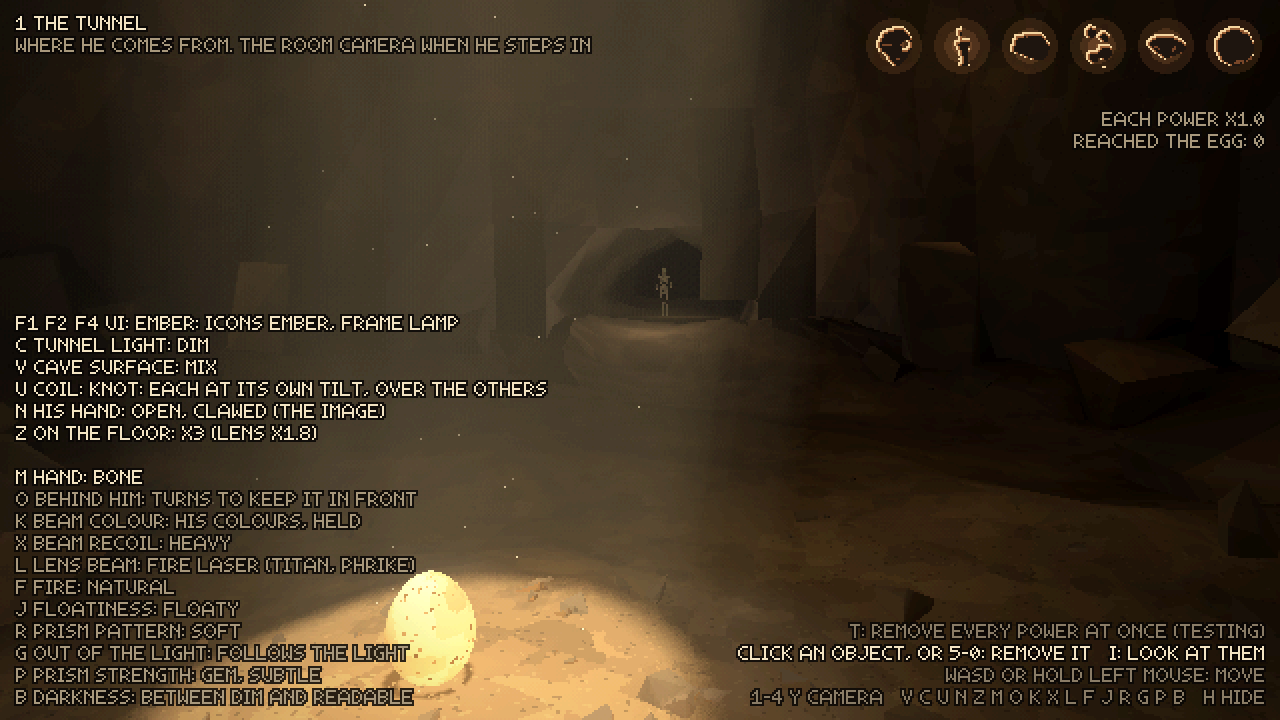
- Result: it booted straight into the tunnel, no errors, same picture (
boot_4s.pngdelivered). Performance, measured by wrapping
update/drawwithos.clockin both builds:Browser ( --use-angle=d3d11)Desktop Fight 60 fps; update 4.2 ms + draw 8.0 ms 3.7 + 5.5 ms Removal + coil ~46 fps; update 11 ms + draw 9 ms 7.3 + 6.2 ms Boot in the browser: ~6.5 s = 1.8 s
game.create+ 4.6 s compiling all programs synchronously. "KHR_parallel_shader_compile: unavailable" headless. Desktop boot.lua takes 0.7 s.- Size: 78 MB raw → 29 MB gzip. 23 MB of that is the objects: three meshes of 160k-330k triangles (
obj_geo_0..2) and a 12.6 MB float textureobj_rt_5.f32. - Profiled with a debug.sethook sampler (
scratch/web/prof.lua, gated byLICH_PROF; boot.lua restored after).- Boot cost is dominated by
nav.lua:36(the grid build). - In the ending, cost is spread out:
fx.lua:109(the beam pool rewrites every slot every frame),snakes.lua:378(spine build withcave.ground_yper ring), Matrix4 multiply,cave.lua:62.
- Boot cost is dominated by
- Asked the owner whether the three.js build can be retired as the bit-exact reference. He redirected instead; later rounds treat it as left behind for new work.
Owner's first batch of direction (2026-10-04):
- "There should be no underline when hovering over items nor text saying what the item is. It should just be highlighted in a way that works with the style of the item."
- "The mask needs to be improved in general, it looks a bit too artificial right now, like the damage that's been dealt to it is not real, try redoing it, or even doing a burned mask from scratch."
- "I also want the lich itself to have a mask on his face. It should be like Shun's mask except with no eyes nor mouth markings, just a flat white mask."
- "The start of the game should be in a little grotto before the tunnel, and the tunnel should be longer and contain each item in sequence. The items are gathered automatically as you pass by each ... it shows it on the model viewer and prompts you to press an 'accept artifact' button."
- Lore for each object [REDACTED#81|.xxxx Xxxxxxx xxxxx..|#]
- Burned mask: [REDACTED#31|xx xxxxxxxx Xxxxxxxx xxxxxx.x. Xxx xxxxx xx xxx XXXXX xxxx .Xxxxxxxxx xxxxxxxx. xxx xxxx xxxxxx. xxx xxx xxx xxxxx.x xxxxx.xxxxxx xxxxxxxxxx. xxxxx xx XXXXX xxxxxx. Xxxx. .Xx xxxxxxxx xxxxxx.x xxxxxx xxxx. xxxxxxxxx xxxxxxxxx..... .xxxxxxxxxxx xxxxxx..|#]
- Severed hand: [REDACTED#79|xx xxx xxxxxxxxx.x .xxxx xxxxxxx..|#]
- Orbs: [REDACTED#75|xxxx xxxx xxxxxxxx. .xxx xxxx xxxx Xxxx 0..|#]
- Lens: [REDACTED#77|xxx xxxxxxx xxx xxxx xx Xxxx Xxxxx Xxxx.|#]
- Lodestone: [REDACTED#82|xxxxxxxxxxxx xxxxxxx.|#]
- Gem: [REDACTED#68|x xxxxxxxxx xxxxx xxxxx xx xxxxxxxxxxx xxxxxxxxxxxx .xxxxxxxx xxxxxx..|#]
- "only a single quote that's lore related for each item ... but first we need to clearly define the lore."
[REDACTED#73|Xxxxxxxx. Xxxxxxx xxxx xxx xxx xxxxxxxxxx xxxxxx.|#]
- [REDACTED#63|Xxxx Xxxxxxx.Xxxxx xxxx Xxxxxxx Xxxxxxxx.xx. xxxxx.xxxx.xxxxx.xx xxx xxxxxxx.xx.|#]
- [REDACTED#49|.Xxxx 0. . Xxxxx XX .Xxxxxxx.. x xxxxxxx xxxxxxx xxxxxx xxx xxxxxxxxxx xxxxx Xxxxx X.x xxxx xxxxx. Xx xxx xxxx xxxxxx xx xxx XXXXXXX xxxxx.|#]
- [REDACTED#62|Xxxxx X.x Xxxx xx x xxxxxxxxxx xxxxxxxxxx xxxx xxx xxxxxxxxx. xxxxx xxxx .xxxxxx xxxxxxxx..|#]
- [REDACTED#42|XXXXX xxxx 0 xxx xxx xxxxxx.x xxxxx. xxxxxxx xxxx xxx xxxx. xxxx xxxxxxx xx x xxxxxx xxxxxx. xxxxxxx xx x xxxxx xxxxxxxx.x xxxx xxxxx xxxxxxxxxxx. Xxxx xxxxxxx xxx xxxx.x xxxxxxx xxx xxx xxxx xxxxxx.|#]
- [REDACTED#64|Xxxxxx xxxxx .xxx xxxxxxxx.. Xxxx Xxxxx Xxxx.x xxxxxx xx xxx xxxxx xxxxxx .xxxxx..|#]
- [REDACTED#61|Xxx xx Xxxx Xxxxxxx.x xxxxx xxxxxxxxx xxxxxxx. xxxxxx xxxxxx xx xxxxxx xx xxxxxx xxxxxxxxxx.|#]
- [REDACTED#56|Xx xxxxx xxxx x xxxxx xxxxxx. xxx xxx xxxxxxxx xxxxxxxxxx xxxxxxxx x xxxxxx xxxxxx. xxxxx xxx xxxxx.x xxxx.|#]
- [REDACTED#59|Xxxxxxx xxxx xxx.xxxx xxxxxxxx xxxx .xxxxxx.xxx xxxxxxxx 000.. xxx xxxxx xxxxxxx xx xxxxxxxxxxx.|#]
- Sonnet agent (reference gathering): 23 real fire-damage photos plus
sources.jsoninlich-survivors/reference/objects/fire/burned-refs/, grouped A face-shaped, B charred wood, C painted/scorched, D ceramic, E melted plastic. No real burned mask exists among sources. - Loaded the iterate skill. Announced round 45 (build) and round 46 (references first for the mask, as a new visual direction).
Round 45: the way in, the hover, his mask, the orbs' marks (rounds/45-the-way-in/, commit f841568):
port/way.lua: ~77 m of winding tunnel built at load past the old tunnel's end.- Same arch and noise as cave.js; ring 0 is the old end ring as
tools/tunnel_mouth.pyleft it, so the join is exact. - Floor: the room's 0.7 m lattice on
cave.ground_y. Rock lumps (subdivided icosahedra) as plinths and boulders. A 14 m grotto with a crack of daylight (emissive sliver as the 'snakes.eye' MeshStandard with emissive, plus dust). cave.drop_tunnel_capremoves the old tube's cap.
- Same arch and noise as cave.js; ring 0 is the old end ring as
- Light and cameras:
- The room's point lights 3-9 are lent while he is out there; a small bounce bake goes into the
giattribute; the room's sun and shafts are off on way cameras. - Fixed cameras: grotto, one per object, the old tunnel.
- First captures were black: cameras sat 3 m above a floor whose ceiling is ~3.3 m. Fixed with
cam_y(under the local ceiling).
- The room's point lights 3-9 are lent while he is out there; a small bounce bake goes into the
- Taking: round 39's code (rise to the fingertip), then
inspect.open(i, { accept = true })with an always-lit ACCEPT ARTIFACT button. - Hover (
ui_style.lua): the lamp glow grows and warms;tools/icons.pymakesember_hot_<i>.png; buttons glow instead of underlining. port/lichmask.lua: item_mask.js's measured outline and face rebuilt in Lua as a white 5.5 mm shell, drawn with the burned mask'sitem.maskmaterial (reusing its compiled program). The skull was measured frombone_head.position.f32.port/orbmarks.lua: patches the orb tracer GLSL as it loads (boot.lua).- Per-ball
uMarkset viatrace_hook; patterns: great circles, spiral, seam, rings, wave + circle; drawn on near and far faces. - F7 cycles ETCHED / INKED / GLOWING / NONE.
- Per-ball
- Checks:
- End to end: grotto → six accepted → room → fight → removed → won 97%.
LICH_ROOM=1digest run byte-identical to aa67096 (git worktree compare).- Page verified with headless Edge.
- Cleanup: 3 agent stub replays deleted at first. The owner later recorded that cleanup must go by
apr_info.py's agent-run flag only, which is what was done afterwards.
Round 46: the burned mask's references (rounds/46-burned-mask-refs/):
- Board in four directions: A SOOTED WHITE, B CHARRED (crocodile-skin char), C PAINT OVER CHAR, D MELTED.
- Each comes with what makes real burning read: soot climbs from the flame, thin edges go first, paint lifts.
Lore notes and the first question (posed, unanswered):
- [REDACTED#71|Xxxxxxx xxxx xxxxx xxxxxxxxxxx .xx xxxxx xxx xxxx.. Xxxxxxxx.|#]
- [REDACTED#69|xxxx . xxx xxxxxxxxx xxx xxx xxx xxxxx xxxxxx. xxx xxxx xx xxx xxxxx|#]
- [REDACTED#72|xxxxxxxxx . x xxxxx.x xxxxx xxxxxxx xxxx xxxx xxxx xxxxxx|#]
- [REDACTED#65|xxx . x xxxxxxxx xxxx xx xxxxxxx xxxx. xx x xxxxx.xxxxxxx xxx xx xxxxxx xxxxxxxx|#]
- [REDACTED#67|xxxx . x xxxxx.xxxxxx xxxx xxxx xxxxx xxx xxxxx.x xxxx xxxxx xx xxxxxxx|#]
- [REDACTED#58|Xxx xxxxxxxx. xx xxxx xxxx xxx Xxxx xx Xxxxx xxxx Xxxxxxx. xxx xxx xxx xxx xxxxxxx xxxx xxx xxx xxxxx.|#]
Owner's second batch (2026-10-05, from the gym; "Output everything to /u/"):
- "His mask has to be a bit in front of him, not glued to his face, like it's maintained by telekinesis. So it also lags his vertical movement by a bit."
- "The tunnel shouldn't be a tunnel ... follow the principles of the high up camera view, we should only zoom in on the liches face at the end ... small complex of rooms, and then a sort of door that's closed to the final egg room. It only opens after you get all the items ... lights should somewhat tell the player where to go ... fixed camera model."
- "The mask, I want the fire burn effect to be like the one on the baby mask. Hole and scratches should still be there but also made more realistic" (the baby = photo 07, the Hiroshima ceramic child).
/u/= a327ex.com's unlisted upload drop (/srv/a327ex/uploads, scp, random names, not indexed).
Round 47: the rooms, the held mask, the push-in, the porcelain mask (rounds/47-rooms/, commits d79fcff, 1990f0c):
port/rooms.lua(replaced way.lua): THE HALL (hand, lodestone), THE EMBER ROOM (mask, lens), THE GLASS ROOM (orbs, gem).- One SDF (rooms + passages + a throat round the old tube's first stretch) meshed by surface nets in Lua at 0.75 m.
- The throat stays open past the mesh edge, so no cap crosses the tube.
- The floor reuses cave_3's own lattice nodes on the shared border (watertight).
cave.cut_tunnel(-20.9, -40.5).
- Cameras: one high fixed camera per room, all facing north like the egg room's. An automatic guard pulls eyes into open air (field < -1.5) after the hall's eye landed in rock.
- Lights (all nine lent): hall fill, door, object lamps, passage glows that go dark when a room is empty. The door warms and sinks (dust; a second nav grid) once all six are taken and he is in the hall.
lichmask.lua: the mask is no longer parented. Each tick it follows the head's hold point (7 cm out) with critically damped springs (xz 140, y 34, turn 9) and a small drift.game.luaEND_ZOOM: after the win the camera pushes in along the head's own forward axis. The first version used mover.yaw and ended behind the skull, because the hurt pose throws the head back. The hold is 1.4 s longer except underLICH_ROOM=1, keeping its digests. F8 toggles it.- Burned mask v2:
- Built by
tools/mask/mask_v2.mjsrun in Node through a resolve hook (register.mjs+hooks.mjs: 'three' from the walk's node_modules, 'game/' → web/src). build.mjswritesobj_geo_0.*and the manifest counts; round 35's files are kept inscratch/r47/mask_r35/.- Glazed porcelain. Soot over the break's half with a ragged soft edge, tongues, specks, mottled film. Three passes: the first edge read as a shadow; the second core read as grime; the third darkened the core.
- The break: a 9-corner polygon with jaggies, conchoidal chips, hairline cracks, a back spall. Gashes: chipped scalloped edges, matte floors, striations.
- Built by
- Videos:
- The first full-run capture was wrong:
GAME.stepalone doesn't render, soengine_snapshotrepeated stale frames. - Fix:
GAME.set_manual(true)+engine_step(1)before each snapshot. - Re-captured 3,476 frames, encoded
run.mp4(1:55) andheld_mask.mp4. - Page + videos uploaded to
/u/, verified (200 / 206).
- The first full-run capture was wrong:
Owner's third batch: only the egg cave; the next session's plan:
- "Nevermind, you can remove the previous rooms, let's just start the game at the egg cave, that's all that exists, single camera view."
- Titles: "Burned Mask, Lodestone, Psyonian Orbs, The Hand, Attack Lens, Prismatic Gem."
- "A single button below: 'throw' when clicked throws the items away instead of dropping it near the egg, in the direction the lich is facing, as the model viewer screen goes away. The lich can pick the item back up it he goes near it."
- "The icons for the items need to be more visible in some important way."
- For next session (kept verbatim in RECORD.md and memory):
- varied snake spawns
- attack choice: all snakes with one attack, a mix of 2, a mix of 3, random rotation with repeats
- 3+ snakes with one attack get group animations: a 4-snake prismatic beam as "four revolver shots in sequence where he turns to each", a 4-snake lift that "pull[s] them together and then he gores them all at the same time"
Round 48: only the egg cave, THROW, titles, LIT icons (rounds/48-throw/, commit edd5cdd):
game.lua: G.mode is always 'room'. Removed: the tunnel/rooms paths, TUNNEL_CAM, tunnel lamps, F6/C,GAME.way; rooms.lua archived toarchive/the-rooms-round47/.- Edits went through Python scripts written to files (
scratch/r48/edit_*.py); bash heredocs failed on quoting. items.lua:- titles BURNED MASK, THE HAND, LODESTONE, PSYONIAN ORBS, PRISMATIC GEM, ATTACK LENS
throw(i, yaw): up to 6.5 m the way he faces, clear floor, never onto the egg, high arcnear(L): walk-back pickup. The first rule (armed only after being 2.2 m from a lying object) failed when he reached it while it rolled; now it is armed once 1.8 m away at any time, or after lying 2.5 s.
inspect.lua: the question and YES/NO became one THROW button; Esc keeps the object.tools/icons.py lit(): own colours with the viewer's warm key removed, EMBER rim, outline.LICH_ROOM=1digests are still byte-identical to aa67096.throw.mp4clip and page uploaded to/u/.
Round 49: EMBER icons with detail; the viewer's text (commit 7ab1589):
- Owner: "The previous visual (colors) for the items was good, the problem was the they don't have enough detail, like they're pixelated." Also: "text is currently only working if debug text is active ... I want ONLY [item name] in normal font size, then 'throw' Nothing else."
- Icons:
- Back to EMBER, drawn on a full-resolution layer (
boot.luaG.ui_layer'rough' 1280×720, drawn last inmain.lua;hud.luaHUD.texture_hi; round 44's approach), from 48 px files. ember()at 48 px: rim width kept, inner edges as faint warm lines (smoothed, lone specks dropped).- A slice edit dropped
glyph(); it was restored from HEAD.
- Back to EMBER, drawn on a full-resolution layer (
inspect.draw_hud: only the name (size 1) and THROW, drawn regardless ofG.hud.
Housekeeping:
- Agent stub replays removed only where
apr_info.pyreports agent-run True. His runs were kept: 2026-10-04 00:20, 14:30, 14:43; 2026-10-05 09:37, 21:44, 22:16, 22:25. - Memory
project_lich_dream_game.mdand MEMORY.md updated after each round. RECORD.md has rounds 45-49 and the next session's plan.
Let's continue on Lich Survivors.
Opus 5.5 xhigh
[Think]
I should start by checking the Lich Survivors memory file and the RECORD.md to see what's there.
Bash ([memory: sealed target])
Bash (cd /c/Users/a327e/Desktop/a327ex/lich-survivors; wc -l RECORD.md; grep -n "^## ...)
Bash (cd /c/Users/a327e/Desktop/a327ex/lich-survivors; sed -n 1286,1473p RECORD.md)
[Think]
Picking back up on Lich Survivors, I'm weighing what's still pending — the round 40/41/42 tunnel verdicts, the object descriptions and end message that are his to write, site unlock wiring, mesh baking debt, and that 629 MB replay swap. Given the note about things being fluid and to check the newest log, I should figure out the right next move here.

I could tackle mechanical work without asking — baking the mask/hand/lodestone meshes, or wiring the site unlock once I confirm a fast clean run takes at least 60 seconds. Sounds are off-limits for me to choose per the standing rule that he picks and I convert, and the replay swap needs his ruling too. Before deciding, I want to check the newest session log for Lich Survivors 8 to see if there's an end message pointing toward direction, and confirm whether anything's uncommitted or unpushed.
Bash (cd /c/Users/a327e/Desktop/a327ex; ls a327ex-site/ | head; ls -t a327ex-site/logs...)
Bash (cd /c/Users/a327e/Desktop/a327ex/a327ex-site; ls -t gated | head -10; grep -ril ...)
[Think]
I should check the end of that log to see his last messages.
Reading the last session's log to pick up where Lich Survivors 8 left off.
Bash (cd /c/Users/a327e/Desktop/a327ex/a327ex-site; wc -l gated/lich-survivors-8.md; h...)
[Think]
I want to check the end of that summary log around lines 60-120, and also see if there have been newer runs by checking the replays folder for recent entries.
Bash (cd /c/Users/a327e/Desktop/a327ex; sed -n 60,140p a327ex-site/gated/lich-survivor...)
[Think]
I'm checking the timestamps on that 73 MB replay against the session end at 23:11 to confirm there's no newer play to account for. With that settled, I need to figure out what to pick up on for continuing Lich Survivors given the final room is done and the UI state has settled, pending his verdicts.

Based on his round-40 message, the game has effectively narrowed down to just the final room with items near the egg, so what's left is mostly texts, sounds, and the end message he needs to supply, plus mechanical work I can do unambiguously like baking meshes and wiring the site unlock. I'm weighing whether to just orient him on the current state and start the unambiguous mechanical work, versus asking him which design direction he wants next, since CLAUDE.md discourages closing with "should I...?" questions about local work but choosing design priorities still feels like his call.

I'm leaning toward tackling the clearly-needed mechanical debt first — baking the sculpted meshes to cut load time and wiring the site unlock with the 60-second check — since both are listed as pre-shipping items, while flagging the open design items that need his verdict (tunnel/inventory flow, tunnel mouth, tunnel light, object texts, end message, sounds). Since sound choices are his to make, I could prepare a sound map listing the events the game needs so he can pick easily. I also want to check that 73 MB replay file to see if it captures his play session from before he made his round-40 decision.

I need to verify whether a fast correct run—removing six items via questions, with snakes coiling around 15s after the first coil—could actually finish under 60 seconds, which would matter for the server's timing check.

I also need to figure out how the game actually gets hosted on the site itself—checking whether there's a game_host pipeline in the REDESIGN doc, since deploying to a327ex.com is outward-facing and would need his approval even though local builds are fine. I should check the ANCHOR_PORT.md status too, since the site version needs to run through the engine's wasm build.

This raises a real question about whether the Lich port even works in wasm, particularly whether the GPU layer functions under WebGL2 — since the game needs to appear publicly on the site after feed #560, getting the Anchor port running in a web build could be substantial work. Let me check ANCHOR_PORT.md for any mention of "web" or "wasm" to see if this has already been attempted.
Bash (cd /c/Users/a327e/Desktop/a327ex/lich-survivors; grep -n -i "wasm|web build|si...)
Bash (cd /c/Users/a327e/Desktop/a327ex/lich-survivors; sed -n 170,200p ANCHOR_PORT.md;...)
[Think]
I'm checking whether the GPU layer has a web build yet — replays already play byte-identical in the browser via wasm, but running the actual game (Lich Survivors) as a site game hasn't been attempted, which is the remaining big shipping piece.

Given CLAUDE.md's "act, don't ask" guidance, the sensible path forward is mechanical: get the game running on the site via wasm, wire up site unlocking, and bake meshes for faster load times — all prerequisites for the #560 release, with a sound list prepared for him to choose from separately. The risk is spending too long on wasm hosting if he actually wants attention on the tunnel content instead, given his pending verdicts on rounds 40-42.

So I'll proceed on the shipping path while giving him a short status and asking for those verdicts, since those decisions are genuinely his to make. First I want to check how feasible wasm hosting actually is by looking at the site's games README and how the engine's gpu layer works in a web build.
Bash (cd /c/Users/a327e/Desktop/a327ex; cat a327ex-site/renderer/games/README.md | hea...)
[Think]
Hosting this on the site raises concerns about the renderer and GPU-in-wasm packaging size—baked textures and assets could bloat the download for every visitor. I want to check the actual size of the assets folder to see how bad it really is.
Bash (cd /c/Users/a327e/Desktop/a327ex/lich-survivors; du -sh assets assets/* port 2>/...)
[Think]
With assets at 75 MB and 61 MB, hosting is a real engineering task. Since he hasn't heard from me in a while, I should give a concise status update and, following "act don't ask," just pick a direction and start on the hosting work rather than waiting for his input on every choice.

Actually, I should check what comes next per the plan — port is done, so sounds are next. But the rule is "he picks, I convert — never choose sounds," which makes me wonder if I'm even allowed to prepare candidate sound ideas, so I want to go back and reread that memory file to be sure.
[Think]
Lich Survivors 8 is set structurally (EMBER + FACETED + MIX, tunnel → room → ending flow), leaving mostly content tasks—texts, end message, sound picks—and shipping work. I'll check the sound rule and shipping gaps next before deciding where to start.
Bash ([memory: sealed target])
[Think]
I could set up sound plumbing now—a sound map with empty event slots and hooks throughout the game—so he can drop in audio files later as prep work. For shipping to the site, I need to figure out timing: the release is tied to "after #560," the goodbye post marking the hiatus that's been active since 2026-09-19, but when #560 actually happens is unclear, possibly whenever he decides to leave.

The biggest unknown risk is whether this can even run in the browser engine via wasm, since the game's entire purpose is unlocking gated posts on a327ex.com — if that's not feasible, nothing else matters. I should check this first, along with what's hiding in that 61MB items file, before presenting him a recommendation and diving into the top-priority task since he's waiting on a response.
Bash (cd /c/Users/a327e/Desktop/a327ex/lich-survivors; ls -la assets/port/items | sort...)
Bash (cd /c/Users/a327e/Desktop/a327ex/lich-survivors; du -sh assets/port/items/geo as...)
[Think]
I'm weighing the shipping logistics—around 75MB of raw assets that could compress well, plus WebGL2 float texture extension concerns and how the game expects a 1280x720 viewport within the site's VM host. I'll outline this state and my recommended path to the user before diving into the work.

Getting the game running locally in-browser on a327ex.com is the natural next step since it's the whole point of the wasm build, and it's reversible without publishing anything. I'll flag this direction to him while noting he can redirect priorities anytime, since he might want the tunnel decision first. Then I start checking feasibility: whether the wasm engine's GPU layer supports more than replay playback, since the per-game store player seems built just for recorded GPU replays rather than live rendering.

I also need to recall that headless Chrome triggers his download manager when fetching .apr/.data/.wasm files, so testing the web build headlessly means using a self-contained file:// page instead — tricky with large asset sizes. I'm trying to remember whether headless Edge avoids this same download-manager interception, since that might be a cleaner path for screenshotting WebGL output.
Bash ([memory: sealed target])
[Think]
Browser-hosting a full 3D game is a huge engineering lift that would eat the whole session, so I should weigh that against what he actually needs right now. His testing time is the scarce resource here, and he hasn't given a verdict on rounds 40-44 yet, so maybe I should check in rather than just diving into the site work unprompted.
[Think]
I'm tackling the site deployment path first since it's the riskiest unknown — starting by testing whether the Anchor build can run in the wasm engine at all, keeping everything local for now.
Bash (cd /c/Users/a327e/Desktop/a327ex; sed -n 80,200p a327ex-site/renderer/games/READ...)
[Think]
Bundling 75 MB into renderer.data for every visitor is unacceptable, so I'm thinking about lazy-fetching the game's package only when someone opens it, which depends on whether the engine supports fetching assets into MEMFS on demand rather than preloading everything upfront.

Rather than committing to a multi-hour architecture task silently, a better first step is a feasibility probe: checking whether the ported Lua actually runs inside the wasm engine, and whether Anchor already has a standalone web export for games (something like a "build-web" packaging command) that I can find by searching the engine scripts and SURFACE.md.
Reading how Anchor builds a game for the web, to see whether the port can run in the browser engine.
Bash (cd /c/Users/a327e/Desktop/a327ex/Anchor; ls engine/engine/.sh engine/engine/.b...)
Bash (cd /c/Users/a327e/Desktop/a327ex/Anchor; sed -n 9150,9300p engine/engine/src/anc...)
[Think]
There's an async file fetch mechanism for media/data that could let a game lazily load its compressed package when the visitor scrolls to it. Before committing to this though, I want to check how the port actually loads game assets—whether it reads f32 files directly through some engine binding—and verify the gpu layer compiles properly for web.

Testing feasibility really requires running wasm in an actual browser, and that's risky given the download manager watches browser executables and likely triggers on .data/.wasm extensions. Base64-embedding a 75MB data file into a self-contained HTML page is technically possible but heavy, and I'm not sure serving with a different content type would actually evade extension-based sniffing.

The safer path is probably asking him to test the local web build himself, though his test loop is scarce. Stepping back, this whole site-hosting effort spans the engine's wasm gpu layer, the site renderer's game_host integration for lazy package fetching, and the server unlock — and it's tied to whatever happens around #560, which seems to be when the hiatus ends and the reward of early access kicks in.

Checking the hiatus memory, it looks like the hiatus is already active since 2026-09-19, which means the goodbye post #560 may have already gone out — the current log Id of 609 suggests #560 was indeed posted. That means the game is actually overdue to appear publicly on the site, since it was supposed to show up after #560. So shipping this really is a priority now, not something to delay.
Bash ([memory: sealed target])
[Think]
The hiatus begins 2026-09-19, and the Lich Survivors game is the key for unlocking gated posts during it, so shipping that game is the real priority — the gated-posts-for-crawlers change on 2026-09-29 isn't my concern right now. I'm thinking through feasibility, starting with whether the port's Lua and GPU layer can actually run on the wasm engine.

I need to check if emsdk is available on Windows since build-web-engine.sh is a shell script, and figure out whether there's a generic wasm engine build separate from the game data — essentially a "store player" pattern where the engine wasm is reusable and data loads on top. Let me look at what build-web-engine.sh actually does.
Bash (cd /c/Users/a327e/Desktop/a327ex/Anchor/engine/engine; cat build-web-engine.sh |...)
[Think]
I'm checking scripts/package-web-game.sh and the build-web-games/playground setup to see if standalone web games exist, and looking at whether a GPU-based replay player like Lich Survivors actually runs its wasm GPU operations in the browser.

Running the live game also requires the Lua port executing in wasm, which could be noticeably slower than native Lua -- worth checking whether desktop frame costs leave enough headroom at 60fps. I'm also weighing how to package the game for headless browser testing: file:// pages avoid network-based download managers but can't use fetch for wasm, so embedding everything as base64 in a single large HTML file might be the simplest workaround, or alternatively using CDP with Fetch interception to serve the assets directly.

Using CDP's Fetch.fulfillRequest to serve files from disk means the bytes never actually traverse the network stack, so neither IDM's browser extension nor its WinINet-level hooks would ever see the traffic -- this seems like a clean, safe approach, especially if I route through a non-localhost hostname that's entirely fulfilled by CDP so nothing touches the network at all. I still need to think about GPU support though, since headless Chrome defaults to software rendering via SwiftShader, which is fine for correctness but likely too slow for real performance testing.

What I actually need to measure is wasm performance: I can time Lua execution per frame inside the engine separately from GPU rendering, since that CPU timing should be representative of real Chrome's wasm speed regardless of SwiftShader. My plan is to check whether there's already a node/CDP harness in the existing package-web-game script or Anchor workflow, verify emsdk is set up, then build and package the game for web and run it headless with all requests fulfilled from disk -- checking boot success, errors, Lua ms/frame, and comparing a screenshot against the desktop version.
Bash (cd /c/Users/a327e/Desktop/a327ex/Anchor/engine; ls scripts | head -40; ls ~/Desk...)
Bash (cd /c/Users/a327e/Desktop/a327ex/Anchor/engine; cat scripts/package-web-game.sh;...)
[Think]
I should give quick progress updates since the user hasn't heard from me in a while. Next I need to build a web package for lich-survivors along with a CDP harness, so I'm checking the replay-chrome.js file to see how the existing harness is structured before extending it.
Building a local web package of the game to probe it in a headless browser, with every request served from disk so nothing reaches your download manager.
Bash (cd /c/Users/a327e/Desktop/a327ex/Anchor/engine; head -50 scripts/replay-chrome.j...)
[Think]
This isn't a harness I need to build from scratch—let me check how lich-survivors' own tools/shoot.mjs launches headless Chrome via puppeteer, and adapt it with request interception to serve files from disk instead.
Bash (cd /c/Users/a327e/Desktop/a327ex/lich-survivors; head -70 tools/shoot.mjs; ls to...)
[Think]
I'm thinking shoot.mjs serves pages over localhost HTTP into headless Chrome, which also loads three.js and binary assets, so for probing wasm I should build a new harness using CDP's Fetch domain to intercept all requests and fulfill them directly from disk.

That raises concerns though — base64-encoding a 75MB .data file over the CDP websocket could hit message size limits, so I'm weighing alternatives like reducing payload size or masking the file's extension and content-type so IDM's download hooks don't recognize it as a large downloadable asset.

Actually, there's a simpler route: serving via file:// entirely avoids the network stack issue. With the `--allow-file-access-from-files` flag, Chrome permits XHR/fetch reads from local files, so emscripten's data package loading works, and WebAssembly instantiation falls back to ArrayBuffer-based loading when streaming via file:// fails. Since these are local file reads rather than network requests, there's no interception needed at all.

For bootstrapping, I need to adjust package-web-game.sh to point ENGINE_URL at a relative path and copy anchor.js/wasm alongside index.html, and confirm the engine was rebuilt for web with the latest anchor.c changes.

I should check whether build-web-engine/anchor.wasm predates the recent anchor.c edits (APR v15, engine_snapshot scale) and rebuild if stale, since that output directory feeds the replay player packages and is likely git-ignored, so rebuilding locally is safe.
Bash (cd /c/Users/a327e/Desktop/a327ex/Anchor; ls -la engine/engine/build-web-engine/;...)
[Think]
Since build-web-engine appears tracked in git rather than ignored, rebuilding it would modify tracked files used by replay player publishing. I'd rather redirect my probe build to a separate scratch output directory, reusing the script's emcc invocation but pointing it elsewhere to avoid touching committed artifacts.
Bash (cd /c/Users/a327e/Desktop/a327ex/Anchor; git ls-files engine/engine/build-web-en...)
[Think]
The diff stat discrepancy is probably just line endings, not worth chasing. I'll run emcc in the engine directory to build the wasm output into the scratch web engine folder, kicking it off in the background since it takes a while.
Bash (mkdir -p /c/Users/a327e/Desktop/a327ex/lich-survivors/scratch/web/engine; cd /c/...)
[Think]
The timestamps line up, confirming this session follows right after the last one. Now I want to check what package-web-game.sh actually bundles — it produced a 78.8 KB script, which suggests it inlines the HTML/JS replay player, so I'm looking at the file_packager invocation to see exactly what's included.
Bash (cd /c/Users/a327e/Desktop/a327ex/Anchor/engine; grep -n "file_packager|--preloa...)
[Think]
I'm planning to stage only the necessary files—main.lua, boot.lua, anchor/, port/, and a trimmed assets/ folder—then check what's taking up space in assets besides port before running the file packager into the scratch web package directory.
The wasm engine builds cleanly. Packaging the game's files next.
Bash (cd /c/Users/a327e/Desktop/a327ex/lich-survivors; du -sh assets/* | sort -h; ls; ...)
Bash (cd /c/Users/a327e/Desktop/a327ex/lich-survivors; cat boot.lua; ls port port/thre...)
[Think]
I'm noting the GLSL shaders captured from Chrome use WebGL2 syntax, which the desktop engine translates but the web build likely passes through unchanged. I need to figure out which directories to stage (main.lua, boot.lua, anchor/, port/, assets/) and whether anything reads from a web/ path at boot, then package everything using file_packager by copying into a scratch web/stage location first.

For the HTML shell, rather than reusing the bulky package-web-game.sh script with its replay player logic, I'll write a minimal index.html myself with a canvas and Module config, loading the file_packager output then anchor.js -- I should check the playground's index.html for a simple reference shell.
Bash (cd /c/Users/a327e/Desktop/a327ex/Anchor/engine/engine/build-web-games/playground...)
[Think]
I need to figure out how a web game can drive engine evaluation, similar to an eval command. I'm checking anchor.c for exported functions marked for Emscripten that might expose a Lua eval capability on web.
Bash (cd /c/Users/a327e/Desktop/a327ex/Anchor/engine/engine; grep -n "EMSCRIPTEN_KEEPA...)
Bash (cd /c/Users/a327e/Desktop/a327ex/Anchor/engine/engine; sed -n 28130,28200p src/a...)
[Think]
Since `anchor_eval` is exported and the web build likely runs in real time via rAF, measuring frame times directly should work fine for the probe, regardless of whether recording is enabled on web. Now I'll move on to staging files and running the file packager for the web build.
Bash (cd /c/Users/a327e/Desktop/a327ex/lich-survivors; W=scratch/web; rm -rf $W/stage;...)
[Think]
I'm planning to build an index.html shell along with a Node-based CDP harness that drives headless Chrome over file:// with file access enabled, and I want to check how shoot.mjs launches Chrome and communicates over CDP for reference.
Package built (78 MB). Writing a minimal page and a headless harness that loads it from file:// so nothing goes over the network.
Bash (cd /c/Users/a327e/Desktop/a327ex/lich-survivors; sed -n 70,200p tools/shoot.mjs)
[Think]
I'm drafting a script that launches headless Chrome with file access enabled, navigates to the game's index.html, waits for the WASM runtime to load, then runs a sequence of Lua evals through the game's anchor function while capturing console output and screenshots at each step.

Checking whether IDM's download-manager hooks could interfere isn't a concern here since those trigger on HTTP traffic, not file:// reads. But I need to verify whether the emscripten-generated loader uses fetch() or XMLHttpRequest to pull in the .data and .wasm assets, since fetch rejects file: URLs in Chrome even with the file-access flag enabled -- so I should check lich.js to see which method it actually uses.
Bash (cd /c/Users/a327e/Desktop/a327ex/lich-survivors/scratch/web/pkg; grep -o "XMLHtt...)
Bash (cd /c/Users/a327e/Desktop/a327ex/lich-survivors/scratch/web/pkg; grep -n "fetch(...)
[Think]
While anchor.js can load files over file:// using XHR, the packager's lich.js relies on fetch, which won't work locally. I'm thinking I can pre-fetch the package data myself via XHR, then override Module.getPreloadedPackage to synchronously return that buffer before loading lich.js and anchor.js.

I should check lich.js to confirm it actually supports getPreloadedPackage.
Bash (cd /c/Users/a327e/Desktop/a327ex/lich-survivors/scratch/web/pkg; sed -n 1,80p li...)
[Think]
I'll use getPreloadedPackage to XHR lich.data in index.html, then load lich.js followed by anchor.js. Since the game runs main.lua from the filesystem root, the packager's stage path should make it resolve correctly, and I need to set the canvas to 1280x720 for the 640x360 game at 2x scale.

Now writing index.html and probe.mjs...
Write (C:\Users\a327e\Desktop\a327ex\lich-survivors\scratch\web\pkg\index.html)
Write (C:\Users\a327e\Desktop\a327ex\lich-survivors\scratch\web\probe.mjs)
Write (C:\Users\a327e\Desktop\a327ex\lich-survivors\scratch\web\boot.json)
[Think]
Previewing isn't an option here per the rules, so this is just a probe. I'm checking whether GAME is a global and trying to access its mode through GAME.mode(), adjusting the boot script to test that approach.
Bash (cd /c/Users/a327e/Desktop/a327ex/lich-survivors; sed -i 's/return G and G.game a...)
It boots: the game reaches the tunnel inside the wasm engine. Checking the screenshots and the log.
Bash (cd /c/Users/a327e/Desktop/a327ex/lich-survivors/scratch/web/out_boot; python -c ...)
Read (C:\Users\a327e\Desktop\a327ex\lich-survivors\scratch\web\out_boot\boot_4s.png)
[Think]
It's running in the browser's wasm engine via SwiftShader and booted in under 2.5 seconds locally. Now I want to measure per-frame Lua cost inside wasm, checking whether there's a timing function like os.clock or engine_time available, and considering a JS-side frame-counting approach instead.

With SwiftShader, GPU work actually runs on the CPU which would distort timing, so I'm considering using a GPU-accelerated headless Chrome instead via ANGLE's d3d11 backend to get cleaner measurements. For the actual approach, I'm planning to wrap the game's update and draw functions in Lua using os.clock() accumulators to track CPU time separately for each, injected via a lua eval that swaps the global functions with timed wrappers.

Still writing draw timing wrapper...

Now I need to check whether the engine calls update/draw by resolving the global name each frame, since that affects whether my wrapper swap actually takes effect, and reload semantics suggest it does resolve at call time. I also need to figure out how to put the game into a heavy-load state like the fight scene—checking if there's a GAME.step or GAME.place API in port/game.lua that lets me script character movement and position rather than relying on an env var that won't exist on web.
[Think]
The game runs in the browser engine on the first try—tunnel, lich, egg, EMBER inventory, and FACETED text all working. The remaining risk is Lua performance in wasm, so I'll measure frame cost during the fight next.
Bash (cd /c/Users/a327e/Desktop/a327ex/lich-survivors; grep -n "^function GAME.|GAME...)
Bash (cd /c/Users/a327e/Desktop/a327ex/lich-survivors; grep -rn "GAME\s*=|GAME.[a-z_...)
Bash (cd /c/Users/a327e/Desktop/a327ex/lich-survivors; sed -n 600,700p port/game.lua; ...)
[Think]
I'm working out how to move the character toward the egg using GAME.step with directional keys, since GAME.until doesn't support key input directly — I'll need to call step repeatedly with the 'w' key held to advance through the tunnel.

Once that's set up, I'll measure performance over roughly 10 seconds of real time during the fight, comparing SwiftShader against GPU mode, and verify the engine's update loop is actually being tracked by checking that call counts increase as expected.
Write (C:\Users\a327e\Desktop\a327ex\lich-survivors\scratch\web\perf.json)
Measuring frame cost in the browser during the fight (software GL first, then the real GPU).
Bash (cd /c/Users/a327e/Desktop/a327ex/lich-survivors; timeout 300 node scratch/web/pr...)
[Think]
SwiftShader's software rendering is clearly the bottleneck, dragging wall time down to 2.7 fps. Breaking down the frame cost: updates run at roughly 2.8 ms each with two per frame, while drawing takes around 11 ms CPU-side — that's the Lua renderer plus GL calls being funneled through SwiftShader's GPU emulation.

GL calls might be blocking synchronously, which makes it tricky to cleanly separate CPU and GPU costs here. I should try running with --gpu to get real hardware numbers for comparison.
Bash (cd /c/Users/a327e/Desktop/a327ex/lich-survivors; timeout 300 node scratch/web/pr...)
[Think]
On real GPU timing, the baseline fight runs smoothly at 60fps with low update/draw costs, but after remove_all the update time jumps dramatically and fps drops to 46 — suggesting the engine is catching up on a backlog of ticks, possibly from heavier coil and snake entities, and I'm trying to figure out what update rate that backlog implies.

I should check desktop native performance for comparison using the agent drive mode, since his setup is likely a strong PC and 46fps there means weaker visitor machines would struggle during the ending sequence. The slowdown is probably from rigid body physics on falling objects, the snake coil/rope simulation, and gore effects all happening at once as removal completes — before optimizing I want to profile this properly, maybe using a debug.sethook-based sampling approach if the engine supports it.

I'll run a controlled test: call record_stop() first so this doesn't get captured as a replay, then use GAME.step and engine_step to measure CPU time before and after remove_all, comparing those costs against what I measured in wasm.
[Think]
The GPU test shows a steady 60 fps during the fight (~12ms CPU/frame), but drops to ~46 fps during the removal/ending stretch as update time jumps to 11ms. I'll now profile that same stretch in the desktop engine to pinpoint what's causing the slowdown.
Bash (cd /c/Users/a327e/Desktop/a327ex/lich-survivors; anchor drive start . 2>&1 | tai...)
Bash (cd /c/Users/a327e/Desktop/a327ex/lich-survivors; cat > scratch/web/pf.lua <<'EOF...)
[Think]
I'm comparing the native vs wasm performance numbers—the wasm build seems only about 1.2-1.5x slower than native, and since the native game already runs around 13.5 ms/frame in the heaviest scene, it should still stay under the 16.7 ms budget for 60 fps. I'm also noting that update logic appears to run twice per frame due to the engine ticking at 120 Hz while rendering at 60 Hz.

I'm thinking about whether to attribute the ~7.3 ms update cost to specific functions using a sampling profiler built with debug.sethook, tracking source and line info to figure out where the time goes during the ending sequence. But I'm also second-guessing whether optimization is even the right priority—46 fps on a strong desktop in-browser isn't great, and weaker visitor machines will likely struggle more, so any optimization needs to preserve bit-exact output with the three.js build unless the web version is being retired.

Beyond that, I'm weighing bigger architecture questions: whether the game should run inside the site's existing renderer VM (risky since globals like math.sin and gpu_precision could leak and affect the site itself) versus hosting it as a standalone page or iframe with its own engine and data, which would need its own implementation of the unlock calls tied to the same-origin device token cookie.

Then there's the data size problem — shipping the full 78 MB game inside the renderer bundle would hit every visitor, so it needs a lazy-loading mechanism that fetches the game's data only when its feed element is reached or opened. This touches both site architecture, which is mine to decide, and the design question of how and where the game appears publicly in the feed, which needs his input given the established "::game" element pattern and its size.
[Think]
Desktop benchmarks show fight at 9.2 ms/frame and ending at 13.5 ms/frame, meaning wasm only runs about 1.3-1.5x slower than native and the ending is just heavy overall. Now checking REDESIGN §26 for the intended site hosting design.
Bash (cd /c/Users/a327e/Desktop/a327ex/a327ex-site/renderer; grep -n "^## |^### " RED...)
Bash (cd /c/Users/a327e/Desktop/a327ex/a327ex-site/renderer; sed -n 2040,2124p REDESIG...)
[Think]
There's also a limit noting the server can't re-run the game, so verification would need to replay the recording after the Anchor port — that's a later concern. For hosting, I'm thinking games appear in the feed via game_host inside the site's VM, only one live game at a time, starting open, with nothing below the view loading until it's near; for Lich Survivors specifically, the 78 MB package needs to be fetched lazily rather than placed in renderer.data.

I'm figuring out how game_host can load a package from a URL into MEMFS using the engine's web_file_status fetch mechanism for /media and /data paths, since Emscripten's file_packager actually supports mounting a .data archive after the runtime has already started by injecting its generated JS and letting it call runWithFS once Module is initialized — so game_host could dynamically inject that script, wait for the files to land, then launch the game. I'm also noting other in-VM hosting complications: global math function overrides, the gpu_precision setting, sandboxed GAME/G globals, and main.lua's Anchor initialization call.

Layer creation happens through layer_new('screen'), with the game rendering via the gpu layer and compositing into the screen_layer through game_host, and the 3D pipeline using gpu_* render targets plus gpu_end to hand control back — this should coexist with the site's existing 2D renderer. Integrating this is real work on the live renderer itself, and since site changes only go public on deploy, I'm weighing local testing options like the desktop run.bat path (not usable for me since it opens a visible window) versus trying anchor drive start headlessly. I think it's a good point to check in with the user: I have a clear result that it runs in WASM at 60fps during the fight scene on his GPU, and now there are real decisions to make about hosting (embedding via game_host vs. a standalone page), package size, and performance polish — the hosting route especially depends on his preferences, since he's mentioned games breaking out of the frame and starting open.

The established pattern favors in-feed embedding, so I'd stick with that unless told otherwise. For package size, I want to check how compressible lich.data is using gzip/brotli, see if nginx already gzips, and investigate whether large assets like that 12.5MB obj_rt_5.f32 render target could be quantized — though I should try lossless compression first to avoid losing bit-exactness with three.js.
Next: how big a download the game would be on the site. Checking how well the 78 MB package compresses.
Bash (cd /c/Users/a327e/Desktop/a327ex/lich-survivors/scratch/web/pkg; time gzip -9 -c...)
[Think]
Gzip -9 brings it down to 29 MB from 78, with brotli maybe hitting 24 MB — still sizeable but reasonable for a dedicated game download. I should check which files are eating the most space post-compression, since things like the cave_2 .orig files likely aren't needed at runtime and could be stripped.
Bash (cd /c/Users/a327e/Desktop/a327ex/lich-survivors/scratch/web/stage; python - <<'E...)
[Think]
I notice the geometry objects are dominating load time—obj_geo_0 alone has a 3.9 MB index implying roughly 325k triangles, with two more similarly heavy objects. That lines up with the noted debt about the mask, hand, and lodestone being sculpted at load time, adding about 8 seconds headless, though I'm not fully sure which object maps to which mesh.

Given the game runs at 640x360, 325k triangles per object is wildly excessive even for close-up inspect views; decimating down to around 50k triangles should be visually indistinguishable but would require the three.js web build to use matching decimated meshes, which only matters if that build is still being maintained. I'm also noting a 12.6 MB float render target (consistent with a 1024x768 RGBA float buffer), likely a transmission backdrop that could be safely downgraded to half-float, and I'm trying to reconcile the 8-second headless sculpting cost against the web probe's boot timing, where the ready signal came at 110 ms but the mode check didn't resolve until 5.4 seconds.

Given Lua runs roughly 1.4x slower in the browser plus a 29 MB download, I'm estimating something like an 11-second boot if sculpting at load isn't baked ahead of time — which points to a clear shipping task list: bake the sculpted meshes (mask, hand, lodestone) to cut boot time, and separately decimate or quantize the heavy geometry to shrink package size.

But decimation and quantization both break bit-exactness with the three.js reference build, and ANCHOR_PORT's rule requires the two builds to stay identical until he decides the web build is retired. Since rounds 40-44 already only exist in Anchor, the three.js build is arguably already just a fight/room reference now — so this really comes down to asking him whether the web build should be retired, since that's his call per CLAUDE.md.

Let me probe the current web boot time and pin down what obj_geo_0..2 and obj_rt_5 actually are, then report findings along with that one open question — though pure optimizations that preserve identical numbers probably don't need his sign-off, only ones like mesh decimation that change the visuals, since he judges those by eye.
[Think]
Compressed, the game weighs 29 MB, with 23 MB coming from six objects—three high-poly meshes (160k-330k triangles each) and a 12.6 MB float texture. Since the mask, hand, and lodestone still get sculpted at load, I'll now measure how long the game takes to boot in the browser.
Bash (cd /c/Users/a327e/Desktop/a327ex/lich-survivors; cat > scratch/web/boottime.json...)
[Think]
The page seems blocked for about 6.8 seconds since the evaluate couldn't run until boot finished, putting the GPU/wasm boot at roughly 6.7 seconds — but that conflicts with the earlier SwiftShader run, which showed PROBE.ready resolving at 2404 ms, so I need to reconcile those two timings.

Rather than get stuck on this discrepancy, I'll just accept boot takes somewhere in the 5-7 second range including download time, and move on to finding where the mask sculpting logic actually lives since grepping objects.lua turned up nothing — I need to search for "sculpt" instead.
Bash (cd /c/Users/a327e/Desktop/a327ex/lich-survivors; grep -rln "sculpt" port/ | head...)
Bash (cd /c/Users/a327e/Desktop/a327ex/lich-survivors; sed -n 90,110p ANCHOR_PORT.md; ...)
[Think]
I probably shouldn't dig too deep into profiling the boot sequence right now since I can't easily re-boot or instrument the existing running instance. It's better to step back, prioritize, and just report the current findings to the user rather than chase a detailed profiling task.

My plan is to report what's working (60fps start dropping to 46fps, 29MB compressed, roughly 7s boot) and ask the key open question: whether I can modify assets or logic in ways that break bit-exactness with the three.js reference build. I also want to confirm the hosting approach — following the established pattern of embedding the game in the feed as ::game rather than giving it its own page, per the earlier plan.

Thinking through bit-exactness constraints: baking sculpted meshes stays exact since the three.js version already stores float32 arrays, so exporting the same precision preserves values; perf-only optimizations don't touch math so they're safe too; hosting choice doesn't affect this at all. The real tradeoff is package-size reduction — decimation or switching to half-float textures would alter the visual output, so that's the one decision point that needs a call from the user.

Mesh decimation on these 330k-triangle objects is something only his eye can judge, so I'll prepare it behind a toggle so we can compare before/after rather than committing blindly.

Given that the stop-hook logs each turn and the user keeps getting pinged that he hasn't heard from me, I should send a concise status update now and keep moving on the exact-preserving work — boot profiling and baking — so he can jump in if needed. I'm second-guessing whether he actually wants me to proceed now or expects me to pause after reporting status, based on past session patterns where he gives direction after I report state, but since he hasn't objected to my stated plan I'll continue.

For profiling the boot sequence, I can't easily hook a profiler before boot.lua runs since I can't inject code ahead of boot through drive eval, and building a scratch wrapper with debug.sethook feels too heavy. A lighter approach is to re-invoke the sculpting functions directly after boot via eval to measure their individual timing, so I should look through port/items.lua to find where masking/sculpting happens.
Bash (cd /c/Users/a327e/Desktop/a327ex/lich-survivors; grep -n "^local function|^func...)
[Think]
I'm thinking about how to profile the Lua boot process without modifying the game itself, considering options like a scratch main.lua that hooks into profiling before loading the real boot sequence through the anchor init table.

Actually, copying the whole game directory is too heavy and symlinks are messy on Windows, so the simplest approach is a small, reversible env-gated profiling hook added temporarily at the top of boot.lua, timing sections with os.clock and only running when an environment variable is set.
Profiling where the 7-second boot goes, with a temporary hook in the desktop engine.
Bash (cd /c/Users/a327e/Desktop/a327ex/lich-survivors; anchor drive stop . 2>&1 | tail...)
[Think]
I'm trying to reconcile the 0.73s boot time measured by os.clock against the instruction count — 42k samples at 1000 instructions each gives roughly 42M instructions, which at typical throughput would only take 0.2-0.4s, suggesting this is consistent with desktop-class CPU speed.

Actually, the "8 seconds more headless" debt likely belongs to the three.js build process (headless Chrome sculpting), not to Anchor, since Anchor's objects are already exported assets rather than sculpted at boot. That raises the question of why the web boot itself takes ~6.8s — my best guess is synchronous WebGL shader compilation of the large three.js programs, since without parallel shader compile support, ANGLE's translation can be slow. I want to verify this by adding timing instrumentation to the staged boot.lua for the web build, logging os.clock readings after requires, after GM.create, and after shader precompilation.
Bash (cd /c/Users/a327e/Desktop/a327ex/lich-survivors; anchor drive stop . | tail -1; ...)
[Think]
I'm noting that boot on web took 1.84s for game.create and 4.6s for program compile, since shader compilation ran synchronously without parallel shader compile support in this headless environment.

For shipping, options include compiling programs lazily during a loading screen or leaning on the browser's program cache for faster repeat visits, especially since the engine already supports async compile on web for draw shaders. With a solid feasibility picture now, I'm ready to report back and propose next steps -- starting with whether the game should live in the main feed (my default, using game_host as designed) or get its own page.

There's also the question of whether the 29 MB download and 6.5 s boot should fire automatically when scrolled near, or whether something like Lich Survivors should show a static preview with a "Click to play" prompt that only triggers the download on click -- that's a UI call I'll decide and iterate on myself. I also need to ask about breaking bit-exactness with the three.js build to shrink objects via mesh decimation or half floats, but since nothing redirects me from proceeding, I'll move forward and start profiling the ending on desktop to see where the CPU cost is heaviest.
[Think]
Browser boot takes about 6.5s total—1.8s building the game and 4.6s compiling shaders one at a time, versus the desktop engine's 0.7s. Now profiling the ending, where the frame rate drops.
Bash (cd /c/Users/a327e/Desktop/a327ex/lich-survivors; cp boot.lua scratch/web/boot.lu...)
[Think]
The hook got cleared by debug.sethook(nil), so I need to re-run prof.lua to reset counts and reinstall it. Then I'll profile the fight for 480 frames, report, reset, remove everything, run another 480 frames, and report again to capture instruction counts including rendering.
Bash (cd /c/Users/a327e/Desktop/a327ex/lich-survivors; anchor drive eval . 'dofile("sc...)
[Think]
The cost seems spread across many spots rather than one hotspot—fx.lua, snakes.lua, cave.lua, and the math module all show up. I'm scanning the top offenders one by one to see where the real bottleneck is.
Bash (cd /c/Users/a327e/Desktop/a327ex/lich-survivors; for f in "fx.lua 100 150" "snak...)
[Think]
I'm thinking about skipping redundant vertex attribute writes in the beam pool update—if an inactive beam was already zeroed last frame, I can track a dirty flag and avoid rewriting identical values, which shrinks the upload size while keeping results exact.

The matrix multiply in Lua is inherent overhead, and ground noise evaluation varies per snake ring per frame so caching isn't straightforward. Browser timings show roughly 1.5x slower than desktop (update 11ms vs 7.3ms, draw 9ms vs 6.2ms), but I think the more valuable next step is reporting to the user and getting the two pending decisions rather than continuing an open-ended perf pass. I should stop the agent and write up the report, including proof it runs in-browser via a boot screenshot delivered as a viewable file.

The screenshot is a reasonable exception to "no routine working files" since it's proof of a real milestone. Key numbers to include: fight scene runs 60fps/12ms, ending drops to ~46fps/20ms needing optimization; download is 78MB raw/29MB gzipped with 23MB from three heavy object meshes plus a 12.6MB float texture; boot takes ~6.5s post-download, 4.6s of which is sequential shader compilation. My plan going forward is to optimize the ending to hit 60fps with headroom, move shader compilation to a background/parallel process behind a loading screen, and trim the oversized meshes and texture to match what the resolution can actually display.

I also want to ask him whether I can retire the three.js build as reference now that new work only lives in Anchor, since maintaining parity blocks both asset and code changes — but that decision is explicitly his per the project guidelines, so I'll ask it plainly rather than framing it as "should I." I'm weighing whether to keep working on the optimization task while waiting for his answer, since the turn only ends when I stop calling tools.

Since he's actively watching and the answer affects how I approach optimization, it's better to end the turn with the report and question so he can respond before I proceed. First I'll stop the drive instance and confirm boot.lua is restored — git status shows nothing, so it's clean.
Bash (cd /c/Users/a327e/Desktop/a327ex/lich-survivors; anchor drive stop . | tail -1; ...)
[Think]
Two new replays got recorded from my agent runs, and I need to check whether record_stop() was called too early in either of them — both the profiled run and the earlier perf measurement run may have logged a stop at the first eval, which would make their sizes suspiciously small. I should verify this since capture runs aren't supposed to record.

These would be my own probe recordings landing in the log, and since I created them, deleting them should be fine as scratch files — they aren't part of the immutable past logs yet since nothing's been written there. Let me take a closer look before deciding.
Bash (cd /c/Users/a327e/Desktop/a327ex/lich-survivors; ls -la replays | tail -6)
[Think]
Those three 35 KB stubs are just early-stopped measurement artifacts from my own session, so they're just clutter in the log — I'll delete them.
Bash (rm -f /c/Users/a327e/Desktop/a327ex/lich-survivors/replays/20261003-232247.apr /...)
SendUserFile (C:\Users\a327e\Desktop\a327ex\lich-survivors\scratch\web\out_boot\boot_4s.png)
[Think]
Now I should keep the report and question concise and plain.
The game runs in the browser. I built the engine for the web and loaded the game into it unchanged in headless Chrome, and it booted straight into the tunnel with no errors (screenshot). So the game can go on a327ex.com. All of it was measured on your GPU, read from local files so nothing hit your download manager:

| Browser (wasm) | Desktop engine | |
|---|---|---|
| Fight | 60 fps, ~12 ms per frame | ~9 ms per frame |
| Removing powers + snakes coiling | ~46 fps, ~20 ms per frame | ~13.5 ms per frame |
| Boot after download | ~6.5 s (4.6 s is shaders compiling one by one) | 0.7 s |
| Download | 78 MB, 29 MB compressed |
Three things to fix before it's shippable:
- The ending is too slow. Nothing single dominates, but most of the cost is fixable: the effect pools rewrite every slot each frame even when idle, and the snakes' ground height is recomputed per ring.
- Boot. Compile the shaders behind a loading screen instead of in one blocking stretch. This is an engine change.
- Size. 23 of the 29 MB are the objects: three meshes at 160k–330k triangles each, far more than a 640×360 picture can show, plus a 12.6 MB float texture. Cutting them down would change pixels slightly in the model viewer; I'd show you before and after.
Then the hosting itself. It would be a game element on the site, as §26 planned. The 29 MB would download only when someone clicks play, and the unlock calls would be wired at the run's start and at the win.
One decision is yours. Since round 40, the tunnel, inventory and UI exist only in the Anchor build. The three.js build is still the bit-exact reference for the room. That rule blocks fixes 1 and 3, because any speed or size change must be made in both builds and re-matched to 15 digits. Can I retire the three.js build as the reference and work only in Anchor from here? I recommend yes. It stays in web/ untouched.
Meanwhile I'll start on the boot loading screen, which doesn't depend on that answer.
Lich Survivors running in the browser engine (wasm, headless Chrome), first boot.
Recorded run: lich-survivors, 20261004-002014
Recorded run: lich-survivors, 20261004-143057
Recorded run: lich-survivors, 20261004-144324
There should be no underline when hovering over items nor text saying what the item is. It should just be highlighted in a way that works with the style of the item. The mask needs to be improved in general, it looks a bit too artificial right now, like the damage that's been dealt to it is not real, try redoing it, or even doing a burned mask from scratch. I also want the lich itself to have a mask on his face. It should be like Shun's mask except with no eyes nor mouth markings, just a flat white mask. The start of the game should be in a little grotto before the tunnel, and the tunnel should be longer and contain each item in sequence. The items are gathered automatically as you pass by each and are added to the your inventory on the top right. When the item is gotten, it shows it on the model viewer and prompts you to press an "accept artifact" button.
[REDACTED#78|Xxxx Xxxxxxx xxxx xxx xxxx xxxx xxxx.|#]
[REDACTED#1|Xxxxxx xxxx. xxxx xx xxx xxxx xx xx xxxxxxxx Xxxxxxxx xxxxxx xxx xxxxxxxxx xxx xxxxxx xxxx xxxx xx XXXXX. Xxx xxxxxxxx xxxx xxxxx xxx xxxxxx xxxxxxxx xxxxxxxx xx x xxxx xxx xxxxxxx xxxx xxxxxx xxx. xxxxxx xxx xx xxxxx xxx xxxxxx xxx xxx.x xxxxxxx xxx xxxxxxxx xxx xxxxxxxx. Xxxxxxxxxxx xxx xx xxxxx. xxxxxxxxxx x xxxxxx xxxxxxxx xxxxxx xx xxxxx xxxx xxxx xxxx xx xxx xx xxxxx xxx xxxxxx. Xxxxxxxxxx x Xxxxxxxx .xxxxxx xxxx xxxxxxxx xxxxxx. xxxxxx xxxx xxxxx. xxxxxxx xxxx xxx xxxxxxxx xxx xxx xxxxxxx xx xxxx xxxxxxxx xx xxx xxxxx xxxxx xxxxxxxx xxxx xxxxxx xxxx xxxxxx xxxxxxx. xx xxxx xxxxx xxxxxxxxxx xxxx xxxx xxxx xxx xx xxxx xxx x xxxxx xxx xxxx xx xxxxx.x. Xxx xxxxxx xxxx xxxxxxxxxx. xxxx xx xxxx xxxxxxx xxx xxxxx xxx xxx xxx xxxxxxxx x xxxxx.xxxxxx xxxxxxxxxx xxxx xxx xxxx. xxxx xx xxxx XXXXX xxxxxx xxxxxxx. xxx xx.x xxx xxxxx xxx xx xxxx xxxxxxx xxx xx xx. xxxx.x xxxxxx xxxx xxx xxx xxxxxxx xxxxxx xxxxxxxx xx xxx xx xxxxx xxx xxxxxx xx xxx xxxx. Xx xxx xxxx. xxx xxxx xx xxx xxxx xxxxxx xxxxxxxx xx. .Xx xxxxxxxx xxxxxx.x xxxxxx xxxx. xxxxxxxxx xxxxxxxxx xxxxxxxxx..... Xx xx xxxxxxx. xxxxxxx xxx xxxxxxxxxxx.|#]
[REDACTED#5|Xxxxxxx xxxx. xxx xxxxxxx xxxx xx xx xxx xxxxxxxxx. X.x xxx xxxx xxxxx xxx xxxx xxx xx xxx.|#] [REDACTED#5|Xxxx. xxxx xxxx xxxx xxxxxx xxxxxxxx xxx xxxx xxxx. xxxx xxxxx xxxx xxxxxx xxxxxxx xx xxxxxxxxx xxxx. Xxxxx xxx xxx xxxx xxxx Xxxx 0.|#] [REDACTED#5|Xxxx. xxxxxxxxxxx xx xxx xxxxxxx xxx xxxx xx Xxxx Xxxxx Xxxx. xx.x x xxxxxxxxxx xxxxx xxxx.x xxxxxxxxx xx xxxxxx xxxxxx xx xxxx xxxxx. xxxxx xxx xxxx xx xxxxxxx.|#] [REDACTED#5|Xxxxxxxxx. xxxxxx xx xxxxxxxxxxxx.|#] [REDACTED#5|Xxx. X xxxxx xxxx xxx xxxxxxx x xxxx xx xxxxxxxxx xxxxx xx xxxx xxxx xxx xx xxxxxxxxx xxxx xxx xxxxx xxxx xx xxxxxxxxxxx xxxxxxxxxxxx. xxxxxx xxx. xx xxx xxxxxxxx.|#]
[REDACTED#46|X.x xxxxxxx xxx xxxx x xxxxxx xxxxx xxxx.x xxxx xxxxxxx xxx xxxx xxxx. xxxx xx xxx xxxxxx xxxx. xxx xxxxx xx xxxx xx xxxxxxx xxxxxx xxx xxxx xxxxxx xxxx.|#]
[Think]
Parsing through the new direction: inventory hover should skip underlines and text labels, instead highlighting items in a way that matches their EMBER style—like brightening the warm rim glow rather than a generic effect. The mask needs a full redo since the current damage looks artificial and unconvincing, so I should rebuild a burned mask from scratch, and the lich's facial mask should echo Shun's mask but with its own distinct take.

For the game intro, I'm thinking a small grotto leads into a longer tunnel sequentially holding each item, which get auto-collected into the top-right inventory as the player passes, triggering a model viewer and an "accept artifact" prompt. [REDACTED#6|Xx xxx xxxx xxxx. X xxxxx xxxx xx xxx xxxx xxx Xxxxxxx xxxxxxxxxx xx xxxxxxxx xxxxxxx xxxxx xxxx xxx xxxxxx xxxx .xxxx xx xx xxxxxxxx Xxxxxxxx xxxxxx xxx XXXXX xxxxxx.. xxx xxxx .xxxxxxx xxxxxx xxx.xxxx xxxxxxxx xxxx xxxxxxxxxx xxxxx. xxxxxxxx xxxx xx .Xxxx 0. xx xxxxxxxxx.. xxx xxxx .xxxxxxxxxxx xxx xxxxxxx xxx xxxx xx Xxxx Xxxxx Xxxx.. xxx xxx xxx .xxxxxxxxx xxxxx xxxxx xxx xxxxxxxxxxx xxxxxxxxxxxx..xxxx xxxxxxxxx x xxxxxx xxxx.xxxxxxxxxxx xxxxx xxxx xxx xxxx xxxxxx xx xxxxxxxxx. X.x xxxx xxxxxxx xx xxxx xxx xxxx xxxxxxx xxxxxxxx xx xxxxx xxxxx xxxxxxxxxx.|#]

[REDACTED#17|Xxxxx xx xxxxxxxxxx xxxxx xxx xxxxxxxxxxx xx xxx xxxxxx xxxx.x xxxx. xxxx xxxxxx xx xx xxxxxxxx xxxxxxxx xx xx xxxxxxx xxxxxxxx xxxxx. Xxx xxxxxx xxxxxxx xxx xxxxxx. X xxxxxx xxxxxx xxx xxxx xxxxxxxx. xxxxx xxxxx xxxxxxxxx xxx xxxxxxxxx xxx.xxxxxxxx.xx.x.xxxx xxxxxxxx. xxxxxxxxxxx Xxxxxxx xxx xxx Xxxx Xxxxx Xxxx xxxxxx xxxxxxx xxxxx. xxxx xxxxxxxxx xxxx xxxxxx xxx xxxxxxx xxx xxxx xx xxxx xxx xxxxxxxx xx x xxxx.|#] I'm also noting that since the grotto/tunnel/lich mask work is Anchor-only, it'll make the room diverge from the three.js build, which he hasn't addressed directly—implying that build may be heading toward retirement.

I'll treat the three.js build as retired for this new work since the lich's mask changes the room itself, and I'll set aside the loading-screen work I'd planned to start since he redirected me elsewhere. Given the scope, I'm sketching a plan: delegate research tasks to subagents where possible [REDACTED#39|.Xxxxxxx xxxx xxxxx. xxx .Xxxx 0. xxx xxxxxxxxxx. xxxxxxxxx xxxxx. xxxxx xxxxxxx xxx xxxx.xxxxxxxx xxxxxxxx xxxxxx xx xxxx xxxxxx xxxxxxxxxx. xxx xxxxxxxxxx xxx xxxx xxx Xxxx Xxxxx Xxxx xxxxxx.xxxxxx xxxxxxx xxx xxxxxxxxx.|#]

[REDACTED#54|Xxxxxxxx. xxxxxx xx xxxxx xxx Xxxxxxx xxxx xxxx xxxx xxxxxx xxxxxx xxxxxx xx . xxxxxxx xxxxxxx xxxxxxxxxx xxxxx xx xxxxxxxx.|#]

For the Anchor build: the inventory hover needs the underline and name text removed, with the highlight instead tuned to fit EMBER's warm glow. The bigger task is the burned mask redo — it currently looks too artificial, so I need a real pipeline to regenerate that mesh, likely using Blender or Python since the mask was originally sculpted in the three.js build.

Since the lore now establishes this as a prince's mask after a gruesome death, the damage needs to look genuinely real — charring, blistering, cracking, soot gradients, partial melting, ragged burned-through holes, ash. I'm thinking Blender with procedural damage: boolean cuts with displaced noise and a Cycles-baked char texture, then exporting the mesh and texture for use.

An alternative is generating a photoreal reference image via fal.ai of a burned mask to use as a design board, though he explicitly said to build rather than just explore. I also want to pin down the actual material of the base mask — the a327ex avatar design — before deciding how the burn damage should read on that surface.

The lich could reuse that same clean mask shape from round 30, flat white and unmarked, attached to its head bone, while the prince's charred mask stays a visually distinct object derived from the same avatar base but burned — so I need to figure out whether these two masks should actually share geometry or diverge as separate assets.

[REDACTED#44|X xxxxxx xxxxx xxx Xxxxxxx xxxx xxxxxx xxxxxxxx. xxxxx xx xxx xxxxxxx xxxxxxx Xxxxxxxxx xxxxxxxxxxxxx xxxx xxxxx xxx xxxxxxx xxx xxxx.x xxxx xxxxxxxx xxxxxxxxxxxx xx xxx xxxxxx.x.|#]

For round 40's redesign, I'm thinking the player starts in a small grotto leading into a longer tunnel where each artifact appears in sequence, auto-gathered as they pass, with a model viewer and an "ACCEPT ARTIFACT" button for each — replacing the original full-inventory start. The item order likely follows round 39's walk sequence (fire mask, lift hand, rock lodestone, leak orbs, beam gem, lens), with each artifact displayed on a pedestal or niche along the path.

Each item should probably sit in a lit niche along the tunnel floor, similar to how round 39 staged objects on columns, stalagmites, and pillars. The tunnel geometry comes from the cave_2 mesh, and extending it with a new grotto means regenerating geometry — I should reuse the archived walk generator (volume + surface nets + formations + GI bake + nav + camera search) from archive/the-walk rather than building this from scratch.

Since the tunnel path is linear and auto-gathers items, the lich should arrive in the main room with all six powers already in hand, and artifact acceptance is simply automatic rather than a choice. [REDACTED#34|Xxx xxxx. xxxxx xx xxxxxxxxxx xxxxx xxx xxxxxxxxxxx xx xxx xxxx xxxx xxx xxxxxxxx xx xxx xxx. X.x xxxxxxx xx xxxxxxx xxxxxx xxxxxx. xxx X xxxxxx xxxxx xxxx xxxxxxx xxx xxxx xxxxxxxxxxx xxx xxxxxxxx xx x xxxx xxxxxx xxxxxxx xxxxx xxxx.|#]

[REDACTED#13|Xx xxxxx xxxxx xx xxxx. xxxx xxx xxxxxxxx Xxxxxxx xxxx xxx xxxx xxx xxxxxxxxxx xxxxxxxx xx xxx XXX xxxxxx xxxxxxx. xxxx xx xxx xxxxx xxxxx.xxxxxxxxx xxx. xxxx xxx xxxx.x xxxx. xxxx xxx xxxxxx.xxxxxx.xxxx.xxxxxxxxx xxxxxxxx. xxxx xxxx xxx xxxxxx xxxx xxxxxxxxxxx. xxxx xxx xxx xxxxxxxx. xxx xxxxxxx xxx xxx xxxx X.X . xxxxxxxxx x xxxx xxxxx xxx xxxx xxx xxxxxx xxx xxx xxxxxxxx xxx xxxx. xxxxx xxx X.X xxxxxx xxxxx X xxx xxxx xxx xxx xxxxx xxxxxx xxx xxxx xxxx.|#]

[REDACTED#29|Xxxxx xxxx. xxx xxxxxxxxx xxxxxxxx xx xx xxxxx.xxxx xxx xxxxxxxx xxx xxxxx xxx xxxxxxxxxx xxxxx xx xxxxxxxx xxxxx xxx xxxxxxxx xxxxxx xxx. xxxx xxxxx xxx xxx xxxx xxxx xxx xxxxx xxxxxxxxxxxx. x xxxx xxxxxxx. xxx xxx xxxxxx xxxxxxxx xxx xxx xx xxxxxx xxxxxx xx xxxx xxxx xxxxxx.|#]

[REDACTED#10|Xxxxx. X xxx.x xxxxxxxx xxx xxxxxx xxxxx xxx xxxx xxxx xxxxxx X xxx xxxxxxxxxx xxxxxx. xxx xxx xxxxxxxx xxxx xxxxx xxx xxxx xxx xxxxxxxx xxxxxxxx xxxxxxxx . xx xxx xxxxxx xxxx xx xx xx xxx xxxx xxxxxxx xxxxx xxxxxx xxxx xxxx xx xxxxx xxxxxxxxx .xxxxxx xxxx xxxxx. xxx xxxx.x xxxx. xxxx xxxxxxx xxxx xxxx. xxxx xxxxxxx xxxxx 00 xxxx xxx xxxx xxxxx xxx xxx xxxxxxxx. xxxxxxx xxx X.X xxxxxxxx xxxxxx xxxxxx xxxxx xx X xxxxxxx xx xxx xxxxxxxx. Xxxx xxxxx xxx x xxxx xxxx. xxx xx xxxxx xxxxxx xxxxxxxx.|#]

[REDACTED#27|X.x xxxxxxxx xxx xxxxxxxx xxxx xxxxx . xxxxxxx.xxxxxxx. xxxxxxxxx xxxxxx xxxxx. xxxxxxxxx xxxxxxx xxxxxxx. xxxx xxxxxxx xxxxxx . xxx xxxxxx xx xxx xxxx xxxxx xxx .xxxx xxxx Xxxx 0. xxxxxxxxx xxxxx xxxx. xxxxxx xxxx xx Xxxx Xxxxx Xxxx.x xxxx xxxxxxxxx xxx xxx Xxxx xxx xxxxxx X xxxxx xxxxxxx.|#]
[REDACTED#50|Xxxx xxxx. X.xx xxxxx xx xxxxxxx xxx Xxxxxxx xxxx xxx xxx xxxxxxxx xxxxxx xx. xx xxx xxxxx xxxxxxx xxx xxx xxxx xxxx xxxx xxx xxxxxxxxxx.|#]
Bash ([memory: sealed target])
Bash (cd /c/Users/a327e/Desktop/a327ex/Psyonia; ls -la; ls ideas; wc -c .md ideas/.m...)
[Think]
[REDACTED#43|X xxxxxx xxxx xxx Xxxxxxxx xxxxx xxxxx xx.x xxx xxxx xxxxxxxx. xxxxx xxxx xxxx.xxxxx xxx xxxxxxx. xxxxx xxxxxxxxx x xxxxxxxxxx xxxxxxxx xxxxxxxx xx xxxx xxxx xxx XXX xxxxxx.xxxxxx xxxxxxx.|#]
Launching a background research agent on the Shin Sekai Yori mirror passage while I read the Psyonia files myself.
Delegated run: Find Shin Sekai Yori mirror-making passage (to Claude, 1 turn)
Agent (Find Shin Sekai Yori mirror-making passage)
Read ([lore: sealed target])
[Think]
[REDACTED#32|Xxx xxxx xxxxxxx xx Xxxxx XX.x xxxx.xxxx xxxxxxx . xxx xxxx xxx xxxxx xx xxxxxxx xxx xxxx xxxxx. xxx xxxxxxx xxxxxx xx xxx xx xxx xxx xxxxxx. xxxxxxxxxx xxxxxx xxxx xx xxxx xxxxxxx. Xx xxxxx xxxx xxx xxxxxxxxx xxx xxxxxxxxxxx xxxxxxx xxx xxxxx xxxxx.|#]

[REDACTED#3|Xxx xxxxxx xxxx xxxxxx xxxx xx xxx Xxxxxxxx xxxxxx xxxx Xxxxx XX.x XXXXX xxx. xxxxxxx xxxxx xxxxxxxxxxx xxx xxxxx xxxxxxx xx x xxxxxx xxxxxx xxxxx xxxxx xxxxxxx xxxx xxx xxxx . xxx xxxxxxx xxxx xxx xxxxxx xxxx Xxxxxxxxx xxx xxxxxxxx. xxx xxxx xxxxxxxx xxxxx xxxxxxxx xxxx xxxxxx. xxxx xxxxxxxxxx xxxxxx xxxxx xxxx xxxxxxxxxxx. X.x xxxx xxxx xxxxx xxx xxxxxxx xxxx xxxxxxxxx xx xx xxx xxxxxxxxx xxxx xxx xxxxx.xxxxxx xxxxxxxxxx. xxx X.x xxxxx xxxxxxxx xxxx xxx xxx xxxx xxxx xxxx Xxxxxxx.x xxxx xxx xxxxxxx xx xxxxxx xxxx x xxxx xxxxx xxxx xxxxxxxxxx Xxxx.x . xxxxxx xx xxxxxx xx Xxxx xxxx Xxxx Xxxxx Xxxx xxxxxxxx xxxx x xxxx xx xxx xxxxxx xxxxxx xxxx xxxxxx. xxxxxxxx.|#]

[REDACTED#40|Xxx xxx xxxxxxxxx. X.x xxxxxxxxxxx xxxxxxx xx xxxxxxxx xx xxx xxxxxxxxxxx xxxx.x xxxxxx xxxx xxxxxxx xxxx Xxxxx X. xx xxxxxxx xxxxxxxxx xx x xxxxxxxxxxxx xxxx xxxxxx xxx xx xxxxx xxxx xxxxx xxxxxxx xxx XXXXX xxxx.|#]

[REDACTED#22|Xxx xxxx. X.x xxxxxxxxxx xxxx.xx xxxxxxxxxxxx xxxx . xxxxxxx xxxxxxxx xxxx xxxxxxxxxx xxxxxx xxxxx xxx xxxxxx xxxx xxxx. xxxx xxxxxxxxxxx xxxxxxxxxxxx xxxxxx xx xxx xxxxxxx xxxx xxxx xxxxx xxxxxxx xxxx xxxxxxxxx xxx xxxxxxxx xxxx xxxxxx xxxxx xx x xxxxxxxxx xxxx. xxxxx xxxx xx xxx .xxxxx. xxx xxxxxxxxxxxxxxx xxxxxxxx xxxx Xxxxx X.|#]

[REDACTED#19|Xxxxxxxx.Xxxxxxxx Xxxxx xxx xxxxxxxxx xx xxxxxxxxxxxxxxx xxxxxxx xxxxxxxx xxxx xxxxxxx xxxxxxxxxxx. xxxx xxxxxxxxxxxx xxxxxxx xxxxxxxxxxxxxx . xx x xxx xxxxx xxxxxxxxxxx xx x xxx Xxxxxxxx Xxxx xx xxxxxxx xxxx. x .xxxxx xxxx. xxxxx xxxxx xx xxxxxxxxx xxxx xxx xxxxxx xxxxxxxxx xxx xxxxxxxxxxxx xx. xxxxxxxxx x Xxxxxxxx.xxxxxx xxxx xxxx xxx xxxxxxxxx xxxxxxxxxx.|#]

[REDACTED#8|X.x xxxx xxxxxxx xxx xxxx xxxxxxxx xx xxx xxxx.xxxxx xxxx xxxxxxx. xxxxxx xxxxxxx xx xxx Xxxx xx Xxxxxxx. xxxx xx xxxx xxxxxxxx xxxxx xxxx xxx xxx xxxxxxxxxx xxx xxxxxxx xx xxxx xx XxX.x xxxxxxxxxx xxxx. Xxxxx xxxx xxx xxxx xx xxxxx xxxxx xxxx xxx XXXXX xxxxxx xxx Xxxxx XX xxxx xxxx Xxxxxxx xxxx. X xxxx xx xxxxxxxx xxxx Xxxxx xxxx Xxxxxxx xxxxxxxxxx xxx xxxxxxxxxxxx xxxxxxxx xxxxx xx.x xxx xxxx xxxxxxxxx xxxxxxx . xx X xxxxxx xxxxx xxxxxxxxx xxxx. xxxxxxxxxx xxx xxxxxxxx xx x xxxx xxx xxxxxxx xxxxxx xxxxxxxxxx.|#]

[REDACTED#70|X xxxxxx xxxxx xxxx.xxxxx.xx xxx xxxxxxx.xx xxx xxxx xxxxxxx.|#]
Bash (cd /c/Users/a327e/Desktop/a327ex/Psyonia; cat ideas/seed_notes.md)
[Think]
[REDACTED#51|Xxx xx xxxx xx xxxxxxx.xx xxxx. xxxxxxxx Xxxxx XX.x xxxx xx Xxx xxxxxxxxxx . xxx xxxxxxxxxxx xxx xxxxxxx xxxx xxxxxxxx xx xxxxxxxx xxxx.|#]
Bash (cd /c/Users/a327e/Desktop/a327ex/Psyonia; cat orblike.md; grep -n -i "orb" maria...)
[Think]
[REDACTED#28|X.x xxxxxxxxxx xxxx xx Xxxxxxx xxxx Xxxx 0 xx Xxxxx xxxx Xxxxxxx. xxxxx xxxxxxx xxxxxxx xxxxxx xxxxxx xxx xxxxxxxxxx xx xxxxxxx xxxx xxxxx.xxx xxx xxxxxxx xxxx xxxxxxxx xxxx xxx xxxx xxxxx xxxxx. xxx X.x xxxx xxxxxxxxxxx xxx xxx xxxxxxxx xxxxxxx xx xxx xxxx xxxxxxx xxxx xxxxxxxxx.|#]

[REDACTED#12|Xxx xxxxxxxx xx xxx xxxx xxxx xxxx xxxxxxxxxx xxxxxxxx xxxxx xxxxxxx xxxxxx xxx xxxxx xxxxxxx xx xxxxxxx xxxxxxxx. xxxxxxxxxxx xx xxxxx xxxxxxx xx xxxxxx xxxxxxx. xxxx xxx xxxxxxxx xxx xxx xxxxxx xxxx xxxxxxx. X.x xxx xxxxxxxxxx xxx xxxxx xxxxx xx Xxxxxxx xxxx xxxxxx xxx.xxx xxxxxx.x xxxx xxxx xx Xxxxx XX. xxxxx Xxxxx XX xxxx. x xxxxxxxxx.x xxxxx. x xxxx. x xxxxxxxxx. xxx x xxx.xxx xxxxxxxx xxxxxx xxxxxxxx xxx xxxxxxx xxxxx xxxx xxxx xxxx xxxxxx xxx Xxxxxxx xxxxxxxx.|#]

[REDACTED#9|Xx xxx xxxxxxx xxxxxxxx xxxxxxx xxxxx xxxxxxxxxx xxxxx xxx xxxxxxx xxxxxx xx. xxx xxx xxx xxxx xxxxxxx xxxx. Xx xxxx xx Xxxxxxx.x Xxxx. xxxx xxxx xxxxxx xxxxxxxxxx x xxxxx xxxx xxx xx xxx xxxx xxxxx xx xxxxxxxxxxx.xxx xxxx xxxx xx xxxxxxxxxx xxx xxxxxx.x xxxxx. xxx xxxx xxxx Xxxxx XX. xxx xxxxxxxxx.x xxxx xxxx xxxx xxxxxxxx. Xxxx xxxx xxx xxxxxxxxxxx xxxxxxxxx xx xxx Xxxx xx x xxxxxxxxxx xxxxxxxx xxxx xxxxxxxx xxxxxxx xxxxxxxxx. xxxxx xxxxx xxxx xxx xxxxx xxxxxxxxx xxxxxx xx xxxxx xxx xxxx X.X xxxx.|#]

[REDACTED#26|Xxx xxxx xxxxx x xxxx xxxxx xxxx. xxxxx xxxx Xxxx.x . xxx xxxx xxxxxxxxx xxxxx xxxx xxx .xxxxxxxx. xxxxxx.xxxxxx xxxxx. Xx Xxxxxxxx xxxxx xx xxxxxxxx xxxxxxxxxxxxx xxxx xxxxx. xxxx xxx xxxx.x xxxxx xxx xxxxx xxxxxx xx xxxxxx xxxxxxxx xxxxx xxxx. xxxx xxx xxxxxx xxxx xxxxxxxxx xx xxx xxxxxx xxxxxxx.|#]

[REDACTED#20|Xxxx. Xxxxxxxxx xxx xxxxx xx xxxxxxxx. xxx xxxxx xxx xxxx xxxxxx xx.xxxx. xxxx.x x xxxx xxx xx xxxxxxxxxxx xxxxx xxx xx xxxx xxxxxx. Xxx xxx xxxx xxxxxxx. X xxxxxx xxxxxxx xxx.xxxx xxxxx xxxx xxx xxxx xxxxx xxxxx xxxx xx xxx xxxxxxxx xxxxx xx.x xxxxxxxxxxxx xxxxx. xxxxxxx xxxx xxxxxxxx xxxx xx x xxxxxx xxxxx xxx xxxx xx xx xxxxxxxxx.|#]

[REDACTED#23|Xxxxxx xxxxxx xxxx xxxx. X xxxx xx xxx xxx xxx xxxxx 00 xxxxx xxxxx xxxxx xxxxx xxxx.x xxx xxxx xx xxx xxxx. xxxxxxxx xx xxxxxxxxx xxxxx xxxxxxx. xxxxxxx xxx xxxx xxxx xx xxxx xxxxx xxxxxxx xxxxxxxx. xxxxxxxxxxx xxx xxxxxx xxxx xxx xxxx xxxxxxxxx xxxxxx. xxxxxx xxxxxxx xxxxx xx xxx xxxx. xxx xxxxxxx xx x xxxxxxxx xxxxxx xxxx.|#]

[REDACTED#2|Xxx xxx xxxxxx. X.x xxxxxxxx x xxxxx xxxxxxx xxxxxxx xxxx x xxxx xxxxxx xxxxx xxxxx xxx xxxxxxxx xxxxxxxxxxxxx xx xxx xxxxxx xxxxxx xxxxxxx. xxxx xxxxxxxxxx x xxxxx xxxxxx xxx xx .XXXXXX XXXXXXXX. xxxxxx xxxxxx xxxxxx xx xxxxxxxxx. X.x xxxxx xxx xxxx xx xxxxxxxxxx . xxxxx xxxxxxxxx xxx xxxxx. xxxx xxx xxxxxxxxxx xxxxxx.xxxxxx. xxxx xxx xxxxx. xxxx xxx xxx xxxxxxxx. xxxxxx xxx xxx xxxx xxxxxx xxxxxxxx xxx xxxx. X xxxx xx xxxxx xxx xxx xxxxxxxx xxxxxx xxxxxxxx xxxxxxxx xxxxx .xxxx.0 xxxxxx. xxxxxx.xxxxx.xx. xxx xxxxxxx X xxxxxx xxxxx xxx xxxx xxxxxxxxx xxxx xxxxxxx.xxx.xxxx. xxxxx xxxxxxx xxxx xxxxxxx. xxxxxxxx xxxxx. xxxxxxxxxx. xxx xxxxxx xxxxx . xx X xxxxxx xxxx xxxxxxx xxx XXXXXX xx xxx xx xx.x xxx xxxxx xxxxxxxxxx xxx xxx xxxxxx xxx xxxxxx.|#]
[Think]
[REDACTED#36|Xxxxx xxxx xxx Xxxxxxx xxxxx xxx xxx xxxx xx Xxxxx XX.x xxxx.xxxx xxxxxxxxxxx xxx xxxxxxx Xxxxx X.x Xxxx xx xxx xxxxxxxx.xxxxxxx xxxx. Xxx xxxxxxxx xxxx xxx xxx.xxxxx xxxx xxxxxxxxx xxx xxxxxxx xxx x xxxxxx xxx xxxxxx xxxxxx.|#]
Bash (cd /c/Users/a327e/Desktop/a327ex/lich-survivors; cat archive/the-walk/README.md ...)
[Think]
He's rejected the walk approach and now wants something smaller: a little grotto before the tunnel, with the tunnel itself longer and containing each item in sequence. I want to avoid repeating what he disliked, so let me check the round 39 verdict and session 7 log to see exactly what his complaints were.
Bash (cd /c/Users/a327e/Desktop/a327ex/lich-survivors; sed -n 1220,1293p RECORD.md)
[Think]
Scaling this down from a full walk to something simpler: a small grotto where he starts, a longer tunnel with maybe six items spaced along it that auto-gather as he passes, then the existing final room with the model viewer and accept artifact button. I'll keep the existing tunnel camera that looks from the room down the tunnel's length.

For geometry, I want to keep the look consistent with the room — rather than using the walk's surface-nets style, I should extend the existing tube-based tunnel construction and add a grotto bulb at its far end, matching the same continuous-UV texturing approach. Lighting is a concern too, since the GI bake and borrowed fire lights only reach the current tunnel's length, so a longer tunnel would need its own light source to avoid going dark.

I'm also thinking about how to light individual items along the way (pools of light, a crack of daylight) and setting the grotto's entrance as dim and "waking," echoing the brown crack-of-sun motif from round 39. For the bake itself, it might make sense to reuse the walk tool's gi.js-style bake code on the new geometry, so I should check how modular the tools/walk setup is before deciding.
Bash (cd /c/Users/a327e/Desktop/a327ex/lich-survivors; ls -la archive/the-walk/tools/w...)
[Think]
I should check cave.js's tunnel section to see how the tunnel was built, plus how cave.lua loads cave geometry and how the tunnel grid and camera work in game.lua. There's a lot to cover here, so I'll move through it efficiently.
Reading how the current tunnel is built and staged in the port, to plan the grotto and the longer tunnel.
Bash (cd /c/Users/a327e/Desktop/a327ex/lich-survivors; sed -n 223,262p web/src/cave.js...)
[Think]
I'm checking the tunnel geometry — it spans roughly 27 meters along -z after the mouth fix, with the spawn point only 4 meters in from the wall, and the camera positioned in the room looking down the tunnel's length.

Now I'm rethinking the design entirely: adding a small grotto before the tunnel, extending the tunnel further (possibly curved rather than straight, with fixed cameras per segment to avoid monotony), and placing six artifacts in sequence along niches lit by small light sources. Each item would trigger an auto-gather interaction when approached — pausing control, opening a model viewer with an "ACCEPT ARTIFACT" button, then adding it to inventory. I'm also considering what order makes sense for the six items (mask, hand, lodestone, orbs, gem, lens) — maybe following lore chronology rather than arbitrary placement.

For the technical build, I'm thinking about adapting the existing tunnel-generation logic to follow a curved centerline instead of a straight path, with hand-placed or auto-optimized cameras positioned high near the tunnel walls to keep each item station in view, RE-style. This would mean replacing the tube geometry beyond the mouth with a new curved, longer tube plus a grotto bulb at the start, while reusing the room's existing floor height-field approach.

The new tunnel needs its own floor mesh that follows the ground_y noise function, which is analytically defined everywhere including far from the room center, so I just need to extend that same floor logic along the curve. I also need to extend the nav grid system used for round 40's tunnel pathing, and figure out lighting -- likely a per-vertex GI bake similar to the existing cave meshes.

I'm weighing whether to port the full three.js bake pipeline from the walk tool versus a simpler vertex-light approximation, since the bake would give a more consistent look but takes longer. I also need continuous UVs along the tunnel's arc length and arch, mirroring how cave_look.py handles texturing — this is a substantial chunk of work, so I should scope what's realistic to finish versus leave for iteration.

For round 45, I'm considering bundling hover, lich mask, orb markings, and the grotto/tunnel/gathering/accept sequence, while treating the burned mask redo as its own task possibly spun off into round 46. I'll also fold in the lore Q&A into the same reply, and before coding anything I want to reread game.lua's tunnel-related sections to ground myself in how round 40 was structured.
Bash (cd /c/Users/a327e/Desktop/a327ex/lich-survivors; sed -n 1,140p port/game.lua)
[Think]
I should scan through the lines I need to modify more thoroughly, so let me read the section spanning roughly 140 to 420 in full.
Bash (cd /c/Users/a327e/Desktop/a327ex/lich-survivors; sed -n 140,330p port/game.lua)
Bash (cd /c/Users/a327e/Desktop/a327ex/lich-survivors; sed -n 330,600p port/game.lua)
[Think]
I'm looking at how port/cave.lua loads and lights the cave meshes, checking the per-vertex GI attribute and probe grid setup, so I can plan a new tunnel extension that reuses the same wall material with continuous UVs, generated by a separate tool.

If I produce a new mesh group in the same cave_<n> array format (position/normal/uv/uvc/gi), cave.lua should be able to load it as another static group — but I still need actual GI values baked for the new geometry. The walk project's bake.mjs used three.js with a BVH-based sky-shaft bake, so I could reuse that pipeline on the new tunnel mesh; let me grep cave.lua to see exactly how it consumes the gi attribute.
Bash (cd /c/Users/a327e/Desktop/a327ex/lich-survivors; wc -l port/cave.lua; grep -n "f...)
Bash (cd /c/Users/a327e/Desktop/a327ex/lich-survivors; sed -n 83,180p port/cave.lua; h...)
[Think]
I'm realizing the GI probe grid is bounded to the original room, so the tunnel extension would fall outside it and the lich would get clamped, wrong lighting out there — matching what came up in round 39 about needing a probe grid per area. I need to work out a plan for extending the tunnel that accounts for this.

My plan is a new tool, `tools/tunnel_long.py`, that builds a centerline running straight from the mouth ring then curving gently for about 70 meters into a grotto chamber, generates the tube rings using a ported noise function similar to cave.js's, offsets the tube rings by the local ground height so the floor strip matches the game's analytic floor function, and bakes per-vertex GI lighting from the relevant light sources along the new corridor.

For lighting, I'm checking whether bake.mjs's existing GI baking approach can be reused on arbitrary geometry, since it probably takes meshes and lights and outputs per-vertex GI plus a probe grid — that would keep the look consistent with the rest of the game. The alternative, dynamic point lights, runs into a hard constraint: the compiled three.js shader programs have a fixed NUM_POINT_LIGHTS count, so adding more lights per station would require recompiling programs rather than just reusing the fire's pooled lights.

Since the fire's lights sit idle during the tunnel phase before the fight starts, I realize I can borrow up to 9 point lights there — two already used for tunnel lamps, leaving enough to place one at each item station and the grotto, combined with baked per-vertex GI for ambient fill. Point lights won't cast shadows (only the sun does), but with a limited falloff distance that should avoid obvious leaking through walls on tunnel bends; the remaining concern is the per-fragment cost of always evaluating all 9 lights in the shared shader.

For the GI on new geometry, I'm approximating bounce lighting per vertex using a simple formula combining light intensity, distance falloff, and a rough normal-dot-direction term, skipping real visibility checks against the tube geometry since it's locally convex enough to just rely on distance attenuation — good enough for a first pass.

For the lich's lighting from the GI probe grid, outside the grid bounds it clamps to edge values, so in the far tunnel he'll inherit the clamped values near the tunnel mouth — acceptable for now since point lights also hit him, but I'll note it in the record.

For cameras along the curvy tunnel, I'm thinking per-segment placement near each item station so the camera frames both the item and its approach, possibly reusing the visibility-maximizing search approach from the walk camera script, though a simpler heuristic might suffice.

A good rule: place each segment's camera ahead of the lich's path looking back toward him, RE-style, so he approaches into frame with the item in the foreground, mixed occasionally with over-the-shoulder shots for variety — camera switching driven by which arc-length segment the lich currently occupies, with direction retention already handled by the basis-hold logic.

Now I need to rethink the nav grid for a curved tunnel rather than a straight corridor — instead of simple |x| bounds, blocking should be based on distance from the curved centerline exceeding the half-width, and I should check NAV.build's cell size and bounds to make sure a long winding tunnel (maybe 70m × 30m) doesn't blow up memory. I also still need to figure out how each item sits at its station — on a ledge, rock, pedestal, or floating.

For picking up items, I can reuse the walk's existing taking logic: when the player gets close to an object it pauses control, turns toward it, the casting arm reaches out, the item shrinks into warped air and rises to the hand, then opens an inspect view — and putting it away hands back control. This matches the new "gathered automatically as you pass by" behavior I want, plus I'll need an "ACCEPT ARTIFACT" button mode in the inspect view, similar to the existing YES/NO removal prompt.

I'm also thinking through inventory state: it starts empty in the grotto, fills as items are gathered along the linear tunnel path, and each item's power stays off until picked up. For the hover highlight, I need to strip out the underline and name text that currently show on hover, and instead make the highlight fit each item's visual style — for the ember-type icons, intensifying the warm rim glow and lamp light behind the silhouette rather than adding text.

Now I'm turning to the lich's mask — thinking of it as a flat white mask similar to Shun's, fitted to the lich's skeletal head bone. I need to find whether there's a "clean" pre-damage version of the mask geometry to work from, shaped as a face-like shell with a nose ridge, matching the avatar's proportions.
Planning the build: the tunnel gets a grotto and six item stations, and I'll reuse round 39's gather code. Checking the inventory's hover drawing and the mask references next.
Bash (cd /c/Users/a327e/Desktop/a327ex/lich-survivors; ls reference/objects/ | head -3...)
Bash (cd /c/Users/a327e/Desktop/a327ex/lich-survivors; sed -n 1,160p port/ui_style.lua)
[Think]
I should remove the underline and name text on hover, instead making the lamp glow brighter and the icon's rim more pronounced. Since the icons are PNG textures with a dark silhouette and warm rim, I could generate a "hot" variant with a brighter rim through the icon tooling.

I'm also noticing buttons in the lamp frame get underlined when hot too — even though the request mentioned items, consistency suggests buttons should drop the underline as well and instead use the same brighter-label-plus-glow treatment.

Now I want to check how the archived walk code handled item-taking logic, so I can plan how to reuse that pattern.
Bash (cd /c/Users/a327e/Desktop/a327ex/lich-survivors; grep -n "take|taking|inspect...)
Bash (cd /c/Users/a327e/Desktop/a327ex/lich-survivors; sed -n 150,300p archive/the-wal...)
[Think]
There's a lot I can reuse from the walk code—object display logic, idle animations, orb glass lighting, and the rising/inspect opening for taking items. I'm noting that the walk sequence swaps in three new point lights while hiding others, keeping the total visible count fixed at nine.

Now I'm looking at the taking section around lines 432-625.
Bash (cd /c/Users/a327e/Desktop/a327ex/lich-survivors; sed -n 300,345p archive/the-wal...)
[Think]
I realize the walk used its own floor rather than the cave's ground level, so the terrain differs there. No separate plan file is needed, so I'll just proceed directly into designing the next round: a grotto connected to a longer tunnel, which I'll generate with a new tool that builds the tunnel's centerline starting from the room's mouth and extending outward.

I'm sketching roughly six stations spaced ten meters apart, giving a tunnel around seventy meters long, walkable in under thirty seconds plus pause time at each station. For the tunnel's cross-section I'm reusing the existing profile logic — same half-width, height, and ring angle noise displacement as the current tunnel — keeping it wide and tall like before.

The tricky part is the floor: the existing room floor grid only covers a certain range, so if the new tunnel extends past that boundary, I'll need an additional floor strip since nothing currently renders there, and it's otherwise hidden behind walls.

A straight path feels monotone and would let the camera see too far down the tunnel, so I'm deciding to introduce bends instead, which gives more dynamic camera cuts and conceals stations until the player reaches them. For the floor height, I want the mesh to follow the same ground_y function the walking logic uses in tunnel mode, so visuals and movement stay consistent — meaning I need to port that noise-based height function faithfully between the mesh generation and the navigation code.

Rather than porting the noise-hashing logic to Python, I'm realizing it's simpler to generate the tunnel geometry directly in Lua at engine boot time, since building thousands of vertices there takes milliseconds. I'm planning a single tunnel module that procedurally builds the grotto, tunnel, and floor meshes using the same noise functions as the cave, bakes simple per-vertex lighting, and computes continuous UVs.

Now I need to figure out how the existing tube mesh (the collar from the mouth to its end cap) should be cut or replaced — I want to preserve the collar joining the wall's hole edge but truncate the straight tube at whatever point my new procedurally generated tunnel takes over.

I'm working out how to splice the two geometries: I'll filter out triangles beyond a chosen z-cut from the old tube's data, and make sure the new tunnel's first ring exactly matches the old tube's ring vertices at that same z-cut so the seam stays watertight, using the known ring spacing to pick that junction point precisely.

I'll extract the 19 unique junction ring positions by filtering vertices near that z-value. For the floor, I'm checking that the room's floor grid (x[-21,21], z[-47,21]) is a flat rectangle underneath everything, so wherever my curved tunnel passes through it, the existing ground_y still applies consistently.

But if my tunnel's own floor strip also samples ground_y on a different grid, the coplanar surfaces would z-fight — so I should only build my floor strip outside the room's rectangle (z < -47 or |x| > 21), relying on the room's floor grid inside it, and make sure the strip's vertices align exactly with the room grid's edge at z=-47 for a seamless join.

I should drop the end cap and attach my tube at the last existing ring (z=-46), continuing my own tunnel and floor strip from there, since the room floor already covers the z=-47 edge beneath the transition. I'm also thinking the straight section between z=-18.8 and -46 could host stations, and starting to sketch out a station layout by arc length from the grotto end, beginning with the grotto itself.

I'm leaning toward placing the grotto as an 8-meter bulb with daylight cracking through where the player wakes, then six stations spaced roughly 9 meters apart, leading into the existing straight stretch near the room — totaling about 90 meters, which at walking speed works out to roughly 35 seconds plus pauses. Since the existing tunnel camera only lights up to about z=-30, I decide it's cleaner to keep all six stations in the new curved section and treat the straight part purely as the final approach, matching how it worked in round 40. Now I'm turning to camera placement, planning one per station.

For navigation, I need to build a nav grid over the tunnel area where walkable space is defined by distance from the centerline polyline staying under the 1.9-meter half-width, switching to a radius-based check once inside the grotto. I'm trying to work out cell size and cost for NAV.build given the region spans roughly 30 by 108 meters — at 0.1m cells that's over 300k cells, which raises concerns since nav.lua's build step was already a major boot-time hotspot.

For lighting, I'm planning to precompute per-vertex global illumination in Lua, summing bounce contributions from each light source plus ambient, and layering in direct point lights near stations so each area has its own lit pool. The grotto's daylight crack is trickier since the sun's shadow map only covers the main room — I need a way to cut off the sun's influence once outside that framed area so it doesn't illuminate the tunnel through solid rock, possibly using a shadow-only lid with a hole for the daylight shaft.

Rather than a complex per-area shadow map, the simplest fix is tying sun intensity to camera zone: off while in the curved tunnel where the room isn't visible, on in the straight section and room, with the transition hidden by a cut — since the god-ray shafts are tied to sun intensity, they'll naturally vanish in tunnel zones too. I'll also need to tune exposure and fog per zone, and figure out how the lich's lighting pulls from the GI probe grid.

For items at stations, I'm working out the pickup flow: idle animation, auto-take when passing within range, rising to hand, then an inspect view with an "ACCEPT ARTIFACT" button that powers it on and fills an inventory slot — deciding whether slots fill in gather order or are fixed by item index.

Now I'm planning simple stone plinths or resting surfaces for each station item — mask leaning upright, hand and gem on plinths, lens perhaps on small pillars — matching the walk order (mask, hand, lodestone, orbs, gem, lens).

For the inspect UI, I'm thinking through adding an "accept" mode alongside the existing question mode: showing the object with its name and power, a placeholder text slot, and a single "ACCEPT ARTIFACT" button triggered by Enter or click.

I also need to set up the grotto spawn point and camera for the opening scene, then figure out the geometry for the lich's flat white mask by looking at how the burned mask was constructed.

For the clean mask, I realize I can't just reuse the burned mask's damaged geometry since the gashes and pierced eye are cut into the mesh itself -- I need to build an undamaged version matching the avatar's measured proportions, so I'm checking the mask-related code to figure out the right approach.

For the orb markings, since the orbs appear to be custom-shaded glass spheres (possibly ray-traced analytically in GLSL), I'm thinking the etched lines -- like great circles, spirals, or seams -- would need to be added directly into the orb's shader program, similar to how boot.lua already patches the post-processing final shader, with different line patterns varying per orb.

For the burned mask redo, I'm considering doing this properly in Blender since it's available locally: modeling the mask base from the avatar's proportions and applying realistic fire damage with charring gradients, bubbled lacquer, heat-crazing cracks, and burned-through holes.

I'm also checking the existing pipeline — the mask is currently a high-poly vertex-colored mesh (roughly 163k vertices) exported as three.js geometry with position/normal/color/index attributes. If I build a replacement in Blender, I'd bake the damage textures and convert them to vertex colors on export, so the new mesh slots into the same format and existing material setup without needing pipeline changes.

Thinking about what actually burns on this mask: if it's lacquered wood with gesso and paint like a Noh mask, fire would blister and flake the paint/gesso, expose charred black wood beneath, char and erode the thinner edges, and crack along the wood grain — this feels right for Shun's white mask, and needs to read clearly both as a small prop on the floor at 640x360 and up close in the inspect view.

The mask is tied to the fire power, so I'll model the burn damage from scratch in Blender with realistic alligatoring char. The lore does mention the prince's head being pierced by a flying insect, so a puncture through the forehead/eye area would actually be consistent rather than invented — and his earlier drawing already established a pierced left eye hole alongside the claw gashes, so I should stick with that established feature.

He's now saying it looks artificial and the damage doesn't feel real — he wants it redone, or built entirely from scratch. I'll offer two versions he can toggle between: one that realizes his original drawing's damage (gashes, pierced eye) with proper torn/splintered burned edges, and another that's a from-scratch burned mask without the drawn gashes. This fits the iterative approach of giving concrete alternatives to react to.

Given the scope of work, I'm laying out an order: hover highlight first (quick), then the grotto/tunnel/stations/gather/accept sequence (the biggest chunk), then the lich mask, then the orb markings, and finally the burned mask in Blender.

The turn is going to be long, so I'm weighing whether to deliver pieces progressively using SendUserFile as each part finishes, since he can't respond mid-turn but can queue messages. I'm also considering whether to handle the quick lore Q&A first since he's actively engaged, though running that concurrently with the build isn't really possible unless I delegate the build to a background agent — and the memory note says that's only for when he explicitly asks. Given he's clearly expecting both the build and the lore discussion, I think I should load the iterate skill since this is iterative visual work (mask redo, highlight, orb markings) and follow its process.
This is mostly look work (the highlight, the masks, the orb markings, the grotto), so I'm loading the iterate protocol first.
Skill (iterate)
[skill: iterate]
[Think]
This is an iteration on the burned mask, since it currently looks too artificial and the damage doesn't read as real. Since this is a new visual direction, I should think through what realistic char damage actually looks like on lacquered wood—alligatoring patterns, actual burn textures—maybe show reference ideas before committing to implementation.

Downloading reference images with curl should be fine under his standing permission. I'm also considering generating burned-mask variants with fal.ai to quickly sketch different damage directions — charred lacquer, scorched porcelain, melted resin, fire-eaten edges — so he can pick a material/damage character before I build; but real photos of fire-damaged masks or dolls would likely be more convincing given his "not real" complaint, so a mix of real references plus generated variants seems like the right board to assemble first.

The lich's mask and orb markings are specified clearly enough to just build directly, maybe offering one or two hover-highlight and orb-marking variants behind a key since those are smaller stylistic choices. I'm planning to update RECORD.md with the new direction and lay out Round 45 — the grotto and tunnel with six stations, auto-gather plus ACCEPT ARTIFACT, hover highlighting, the lich's mask, and orb marking variants — before thinking ahead to what Round 46 might cover.

For the burned mask aesthetic, I want to gather real reference photos first rather than guessing at the look. I can launch a background research agent to find and download photos of burned wooden/lacquered masks into the reference folder, verifying relevance by viewing the images, while I move forward with building round 45 and handle the lore write-up later at handover.
[Think]
I'll build Round 45 now (the grotto start, longer tunnel, gather/accept flow, hover highlight, flat mask, and orb variants) while a background agent gathers real fire-damage reference photos for Round 46's burned mask, which I'll tackle once you pick a material and damage type.
Delegated run: Gather burned-mask reference photos (to Claude, 1 turn)
Agent (Gather burned-mask reference photos)
[Think]
I'm thinking about makyō, the magic mirrors that project hidden images via micron-level thickness variations in bronze, deformed by polishing pressure during casting—and how this physical mechanism might translate into a lens-based approach.

For round 45, I'm shifting to practical work: reviewing the inspect module (accept mode), items.lua for crafting mechanics, lich.lua's head attachment logic, and the orb shader, starting with a full read-through of inspect.lua's 323 lines.
[Think]
Found it: Shin Sekai Yori's "magic mirror" from Sage Academy, where bronze mirrors shaped by cantus hide a projected design in sunlight—I'll weave that into the lens lore at handover. Now moving to round 45, reading the model viewer to add ACCEPT ARTIFACT mode.
Bash (cd /c/Users/a327e/Desktop/a327ex/lich-survivors; sed -n 1,120p port/inspect.lua)
Bash (cd /c/Users/a327e/Desktop/a327ex/lich-survivors; sed -n 120,330p port/inspect.lu...)
[Think]
Next I should look at items.lua to understand make(), take(), drop(), the W structure, and how ITEMS entries track name, power, and build flags.
Bash (cd /c/Users/a327e/Desktop/a327ex/lich-survivors; sed -n 1,140p port/items.lua)
Bash (cd /c/Users/a327e/Desktop/a327ex/lich-survivors; sed -n 140,394p port/items.lua)
[Think]
I'm confirming that the gem and orbs rely on traced materials tied to the room's sun direction, while the tunnel walk overrides that for the orbs with a lamp source instead. Now I'm planning to create a new module, way.lua, that will generate the grotto, tunnel, and stations geometry for round 45's "way in".

For the path layout, I'm keeping the existing 27 m straight tunnel as a dramatic approach visible from the room camera, then designing a curved spline with control points bending right then left through roughly 74 m before reaching a grotto centered around (0, -118) with a 5-6 m radius.

I'm placing stations roughly every 11 m along the curve measured from the grotto exit back toward the room, and I need to check whether the room's floor grid overlaps with my new tunnel floor near z=-46/-47 and whether the tube's last ring still lines up correctly after the earlier mouth modifications.

I need to verify where that floor grid actually terminates relative to where my tube walls extend past z=-47.

For the floor strip, I'll need a height field over the curved tunnel's bounding box with 0.7-unit cells, keeping only triangles near the centerline, and matching the room floor's border x-positions exactly so the seam lines up, with vertices jittered similarly.

I'm extending the same lattice coordinates (x = -21 + i*0.7, z rows stepping by 0.7) so the room grid and tunnel grid stay perfectly aligned even as the tunnel curves outward. The floor height follows ground_y's noise and ridge features, and I want the tube rings to sit directly on that floor by offsetting each ring's y-position to match ground_y at its center.

I'll set the ring base so it matches zero at the junction and transitions smoothly to match ground height elsewhere. I also need to worry about the floor strip's edges staying hidden inside the tube walls, so I'll size its half-width to roughly match the tube's cross-section at floor height, around 3.2.

The tunnel floor can reuse the room's existing floor rectangle with the mouth trough modifications. For the grotto, I'm thinking of it as the tube widening into a bulbous chamber—swelling to roughly double width over a short stretch, holding wide for a bit, then narrowing to a closed cap, with a ceiling crack letting daylight through to make it feel like a real cave chamber.

For the crack, rather than real sun shadow mapping I'll fake it with an emissive sky-colored slit plus a warm point light casting a glow below, with dust motes drifting through the beam. For rocks and formations, I want scattered convex boulders along the walls for variety and as plinths—probably easiest to generate these as deformed icosahedra, subdivided once and displaced with noise for a flat-shaded rocky look, rather than implementing a true 3D convex hull algorithm.

I'm shaping plinths from squat deformed icosahedra with flattened tops, then working out the lighting math — per-vertex GI combining ambient base plus contributions from each light's bounce term, layered with the cave material's static GI and the dynamic point lights borrowed from the fire pool. I need to check how many of those fire point lights remain active and idle in tunnel mode, so I'm tracing through the scene's point-light objects to count them.

With up to nine point lights confirmed available in tunnel mode (snakes hidden, fire idle, powers inactive), I'm sketching a lighting plan: one grotto daylight spot near the crack, then one light per station themed to each item's color — ember orange for the mask, cool pale for the hand, dim rust for the lodestone, teal-green for the orbs, prismatic white for the gem, warm sun tones for the lens.

The remaining two lights could just be the existing dim tunnel lamps near the room's straight section. Since station lights have short reach and stations are spaced roughly 11 meters apart along a winding path, bleed-through between walls shouldn't be an issue, and since there are no shadows, light passing through walls is acceptable. For a cheap per-vertex global illumination approximation, I'm considering summing each light's falloff and dot-product term scaled down heavily, essentially layering a dim secondary glow onto the direct lighting without any visibility checks, plus a base ambient term.

Since MeshLambertMaterial computes lighting per-fragment, I want the base ambient kept near zero so the tunnel stays dark between stations, matching the earlier feedback that things were too bright. For camera placement I'm working out rules per station: each item sits offset from the path's center by a normal vector, and the camera is positioned further along the path toward the room, offset to the opposite side, raised to eye level, and aimed back toward the item.

I'm figuring out where each camera's viewing zone should start and end so that as the lich walks the tunnel, the handoff between one station's camera and the next happens cleanly — making sure the lich is never framed passing directly beneath a camera, which would look bad. That means nudging the camera further ahead along the path than I first assumed, so the zone boundary and camera position don't overlap awkwardly.

Since the tunnel curves, though, a camera placed too far ahead might lose line-of-sight to the start of its zone behind a bend. I'm planning a visibility check: treat the tunnel as a tube around the centerline, and for each candidate camera position, sample points along its intended zone and verify the straight line from camera to each point stays within the tube's radius the whole way — essentially approximating occlusion by distance-to-centerline rather than full raycasting against geometry.

But running this brute-force search (thousands of candidates × targets × samples, each requiring distance-to-polyline checks) at boot time in Lua is way too slow. I think the practical approach is to run the search once offline — either as an on-demand Lua function or exported to a script — and just bake the resulting camera positions into a constant table, falling back to manual placement verified by screenshots if needed.

I'm also weighing fixed RE-style cameras versus alternating "looking back" and "looking ahead" angles for variety, keeping in mind that movement controls stay relative to the camera's facing direction and basis holds across cuts — so in a "looking back" shot, W would move the character toward the grotto rather than the room, which matches classic RE conventions. Mouse click-to-move should still work fine since it targets a floor position regardless of camera orientation.

Thinking through specific stations now, I'll lean toward cameras placed ahead and to the side, looking back along the direction of travel for a more dynamic angle.

For the grotto I want a camera high in a corner watching the spawn and tunnel exit. I also need to fix the basis-hold logic so that the hold applies across every camera cut within the tunnel, not just when transitioning to the room—setting basis.hold on each cut and checking it in wanted_velocity before falling back to normal input handling.

Then for item gathering: when the lich passes within 2.1m of an item, control pauses for a scripted sequence where he turns, reaches, and the item shrinks into his hand, followed by an inspect view in "accept" mode showing the artifact's name, power, and a placeholder lore quote with an "ACCEPT ARTIFACT" button that closes the view and fills the inventory slot with a small flash effect on confirmation.

Powers stay off during the tunnel sequence and only activate once in the room for all six gathered items. For inventory interaction, I'm debating whether removal should be allowed in the tunnel at all, since the ending requires dropping all items around the egg specifically in the room — removing items early would scatter them in the wrong place, so I'm leaning toward disabling removal until the room, with tunnel clicks either doing nothing or opening a read-only viewer.

Clicking in the tunnel should just open a plain view mode without triggering the removal question, while the actual removal prompt only appears once in the room. Now I'm thinking through the ember icon's hot-state variant — a brighter, wider warm rim, a faint glow catching the silhouette's interior, and a stronger, larger lamp glow underneath, with no underline or name label needed.
Next, how the EMBER icons are made, to give the hover a highlight in their own style.
Bash (cd /c/Users/a327e/Desktop/a327ex/lich-survivors; grep -n "def |ember" tools/ico...)
Bash (cd /c/Users/a327e/Desktop/a327ex/lich-survivors; sed -n 1,60p tools/icons.py; se...)
[Think]
I'm noting that once the mask gets redone in round 46, the icons and marked orbs will need regenerating from the raw scratch renders. I'm also working out the hover highlight for EMBER's "hot" variant, brightening the rim, outer ring, and warm details to make the silhouette look like it's catching more light.

I need to add an `ember_hot` icon generator and wire it into ui_style so hot lamp frames get a brighter glow and swap in the hot icon variant. I also want to drop the underline on hovered slots and buttons entirely, replacing it with a glow behind the label text when hot, since consistency matters even though he only mentioned items specifically. Time to actually implement the ember_hot generation now and run it against the existing raw renders.
Starting with the hover: no underline or name, and the icon itself lights up. Its rim catches more light, matching how the EMBER silhouettes are already drawn.
Bash (cd /c/Users/a327e/Desktop/a327ex/lich-survivors; python - <<'EOF' p='tools/icons...)
Read (C:\Users\a327e\Desktop\a327ex\lich-survivors\scratch\icons\hot_sheet.png)
[Think]
The hot lamp variant looks good with the brighter rim and warmed body. Now I need to adjust the UI style so the lamp frame glows brighter when hot instead of showing an underline, swap in an ember_hot icon for that combination, remove underlines from bare frames, and replace button underlines with a glow effect, which means adding a hot parameter to the icon function.
Bash (cd /c/Users/a327e/Desktop/a327ex/lich-survivors; python - <<'EOF' p='port/ui_sty...)
[Think]
Next I want to examine the lich's mask—checking how the lich head is drawn with its bone meshes, and tracking down the burned mask shape by searching for "avatar" in the web source.
Hover done. Next, the lich's flat white mask: finding the head in the lich's rig and the mask's base shape in the object code.
Bash (cd /c/Users/a327e/Desktop/a327ex/lich-survivors; ls web/src; grep -ln "avatar" w...)
Bash (cd /c/Users/a327e/Desktop/a327ex/lich-survivors; sed -n 1,140p web/src/item_mask...)
[Think]
I'm thinking about porting the outline and face functions to generate a clean white mask mesh scaled to face size, but I need to check whether the lich's skull proportions actually match a human-size face before applying that scale.

For the mesh itself, I'm planning a polar grid approach: sample rays outward from a center point, find where they hit the outline boundary, then build front and back surfaces offset by the shell thickness with a connecting rim at the edges, using smooth shading and a plain white material.

Since shaders must reuse existing compiled program combinations rather than being newly generated, I need to pick a material already in use elsewhere — likely borrowing the same vertex-color-plus-metal/roughness attribute setup used for the burned mask or hand items, since that produces a plain lit surface compatible with the engine's available programs.

I should check port/objects.lua's OB.builder to see how materials are constructed and look at X.mats for the mask's material description.
Bash (cd /c/Users/a327e/Desktop/a327ex/lich-survivors; cat port/objects.lua; python - ...)
[Think]
I'm examining the mask material setup with vertex colors and physical properties, and now tracing how the renderer derives program keys from material names and defines to understand how shaders get selected.
Bash (cd /c/Users/a327e/Desktop/a327ex/lich-survivors; grep -n "program_key|function ...)
[Think]
I'm tracing how the lich's mask material gets keyed—it should resolve to 'item.mask' in the world scene on side 2, built from mats_desc with the cave GU setting, and checking whether its shader needs just position, normal, and vertex color attributes or something extra like aMR.

I'll build the mask geometry with a smooth white vertex color (slightly warm, linear space) and lower the roughness uniform to around 0.45 for a faint lacquer sheen, while reusing the exact cave material objects (M.wall, M.floor, M.rock) for the new tunnel geometry. Now I need to figure out skull dimensions to position the mask correctly in front of the lich's face.

I'm checking the lich's scale — the head offset from the neck and spine/chest proportions suggest this is a fairly small figure, maybe around 0.9m tall despite floating like a human-sized creature. I'll compute the skull mesh's bounding box in head-local space by evaluating the skin geometry directly, then size the mask to match the skull's width at the eyes — so I should look at lich.lua's skin() attachment logic next.
[Think]
I'll reuse the burned mask's compiled material for the lich's mask, building a clean shell from the same avatar outline and face functions. Now measuring the lich's skull for a proper fit.
Bash (cd /c/Users/a327e/Desktop/a327ex/lich-survivors; sed -n 40,100p port/lich.lua)
Bash (cd /c/Users/a327e/Desktop/a327ex/lich-survivors; cat > scratch/skull_bbox.lua <<...)
[Think]
I suspect the geometry attributes might not be stored as plain Lua tables but as GPU buffers or raw data strings, so I should check loader.lua and the BufferAttribute/geometry implementation to confirm how the array data is actually represented.
Measuring the lich's skull to size the mask; adjusting my probe script to how the loader stores vertex data.
Bash (cd /c/Users/a327e/Desktop/a327ex/lich-survivors; grep -n "function.*geometry|ar...)
Bash (cd /c/Users/a327e/Desktop/a327ex/lich-survivors; sed -n 1,80p port/three/loader....)
[Think]
Since these attributes are stored as raw bytes, it'll be easier to analyze them in Python by reading the position data directly from the geo asset path. I should check the geo names referenced in the manifest to figure out the right file to load.
Bash (cd /c/Users/a327e/Desktop/a327ex/lich-survivors; grep -o 'head="[^"]*"|jaw="[^"...)
[Think]
I'm working out the skull proportions in head space—mapping the cranium width, jaw position, and eye socket placement relative to the coordinate system I'm using.

Now I'm comparing those skull measurements to Shun's mask proportions, trying to figure out an appropriate scale factor so the mask fits naturally over a human face. The mask's width at the eyes comes out wider than the skull by about 4cm total, while the height matches up fairly well at roughly a 1:1 scale.

I settle on scaling the mask down slightly to 0.95, aligning its eye line with the skull's eye line, which places the brow top around y=0.12 and the chin just above the jaw bottom — a reasonable overhang since masks typically cover more than the bare bony face. Now I'm working out the z-depth placement at the center of the face, where the nose ridge curve should sit relative to zero.

I'm placing the mask's center depth around 0.112 to clear the nose ridge with a small gap, then checking the side clearance at the cheekbones against the zygomatic arches to make sure the mask doesn't intersect the skull there.

I also need to consider the jaw: since the mask is attached to the head while the jaw can move independently, I should verify the mask's chin region stays clear of the jaw front even when it opens, comparing depths at the relevant y position.

Now I'm working out the mask's actual geometry, treating it as a rounded full-face shape including the forehead, and planning the construction using a polar grid around a center point in mask coordinates—finding the outline radius at each angle via bisection, then laying out rings with denser spacing near the edges to build the front vertices.

Computing the front surface, I derive normals from the face height gradient, then offset inward for the back surface and connect front and back edge rings to form the rim, adding a slight bevel so the outer edge rolls back realistically like a lacquered mask. For color, I'm keeping it a flat, uniform white (~0.82 linear) with no variation, since Shun's mask should read as smooth and pure.

I settle on roughness 0.55 for a subtle porcelain-like sheen, reasoning "flat white" means unmarked rather than matte. Then I work out how to position the mask mesh relative to the head node, mapping its local x/y/z coordinates (with the eye line offset) into head space, and start setting up the indexed geometry and material drawn from the mask item's descriptor.

Checking geometry attributes for the mask...
Bash (cd /c/Users/a327e/Desktop/a327ex/lich-survivors; python - <<'EOF' s=open('assets...)
[Think]
The mask geometry uses position, normal, color, plus a custom aMR attribute storing per-vertex metal/roughness, so I'll set that to (0, 0.55) for the lich mask. Now I'm writing the lichmask.lua port to build this geometry and attach it to the lich's head.
Bash (cd /c/Users/a327e/Desktop/a327ex/lich-survivors; sed -n 176,186p port/lich.lua; ...)
[Think]
Confirming the lich's skull faces +z in head space, and the hurt pose with head thrown back looks right. Now I'm moving on to writing the lichmask.lua port file, setting up the index buffer for the mesh geometry.
Bash (cd /c/Users/a327e/Desktop/a327ex/lich-survivors; grep -n "set_index" port/*.lua ...)
[Think]
I see that gore.lua applies its index via setting a BufferAttribute with stride 1. Now I'll move on to writing port/lichmask.lua.
Writing the lich's mask module now: a clean shell from the avatar's outline and face, flat white, fitted to the skull.
Write (C:\Users\a327e\Desktop\a327ex\lich-survivors\port\lichmask.lua)
[Think]
The array upload handles re-rendering fine when flagged for update. Now I need to wire the mask into game.lua by creating it right after the lich is instantiated, and I should pick an unused key for cycling looks during testing, checking which letters aren't already bound.

I'll go with F5 for toggling the lich's mask look since most letter keys are taken. For testing, I want to drive the agent and grab a snapshot with the camera close on the lich, using engine_snapshot to capture the frame and GAME.look to position the inspection camera.
Wiring the mask in (F5 cycles WHITE / WHITE, MATTE / NONE for comparison) and checking it on the lich with a capture.
Bash (cd /c/Users/a327e/Desktop/a327ex/lich-survivors; python - <<'EOF' p='port/game.l...)
Bash (cd /c/Users/a327e/Desktop/a327ex/lich-survivors; python tools/tile.py scratch/r4...)
Read (C:\Users\a327e\Desktop\a327ex\lich-survivors\scratch\r45\mask_sheet.png)
[Think]
Checking the mask placement on the skull face, the grey tone reads correctly for the dim tunnel lighting, and the exposed cranium above the mask line looks natural since it's a skull wearing a mask. From the side angle, there's a visible gap between the mask and skull, which actually makes sense for how a mask would sit.

Now I'm moving on to the bigger task: building the tunnel extension in port/way.lua. I need to pin down some key facts first — the cave_2 tube ring position, the room floor boundaries, the ground_y helper function from cave.lua, and how to access the wall materials since they're currently local to cave.build and need to be exported through the cave table.

I'm also figuring out texture UV conventions — matching the 4m tile/32 texels-per-meter/0.5 repeat scheme used elsewhere, and checking how cave_look.py computes continuous UVs along the tunnel arch so my new geometry's UVs line up with the existing rock surfaces.
[Think]
The mask fits the skull correctly. Next I'll work on the grotto and longer tunnel, first checking the cave's UV and material setup so the new rock matches the existing MIX surface.
Bash (cd /c/Users/a327e/Desktop/a327ex/lich-survivors; sed -n 205,266p port/cave.lua; ...)
Bash (cd /c/Users/a327e/Desktop/a327ex/lich-survivors; sed -n 225,247p tools/cave_look...)
[Think]
I'm working out the tile-to-meter conversion and texture repeat scale for the cave geometry, then tracking the z-positions of the tunnel rings, cap, and tube walls to make sure the floor and collar align correctly.

I'm sketching out the implementation plan: write a Python tool to generate the tunnel/grotto/plinth geometry as a new asset group loaded via Lua, and figure out how to handle cave_2's cap removal — either by rewriting the geometry in Python as a separate "cut" version, or filtering the triangle arrays directly in Lua at load time when the way is active.

I decide Python is cleaner for keeping Lua simple, but that requires porting the game's ground_y noise function from Lua to numpy. I'm now checking whether the engine supports writing files directly from a Lua script, which would let me generate the geometry using the actual in-game ground_y function instead of porting it.
Bash (cd /c/Users/a327e/Desktop/a327ex; grep -n "file_write|file_read_string|file_ap...)
[Think]
I'm deciding to generate the tunnel geometry procedurally in Lua at boot, sizing up the triangle counts for the rings and floor strip to keep the mesh lightweight.

I'm sketching way.lua: defining a path of control points from the existing tunnel's end into the grotto, fitting a Catmull-Rom spline through them, then resampling by arc length to place rings at even spacing. I need the first new ring to connect exactly to the 19 existing vertices at cave_2's final ring, so I'll read those positions directly from the existing geometry in Lua rather than guessing coordinates.

I'm now working out the angular ordering of ring vertices to match cave.js's convention, matching the tunnel's arch shape (open floor, rounded top) and local coordinate frame so new rings align seamlessly with the existing tube's orientation.

Working out the ring vertex position by combining the centerline point with a side offset and a height term that tracks the relative floor elevation change from the junction, keeping continuity with the existing tube's base height; then I'm layering in positional noise using the same fbm3 seed for organic displacement.

I realize the low wall vertices from cave_2 were already raised by the tunnel_mouth script to sit slightly above the floor, so my new ring's low vertices would otherwise dip well below the actual floor level once displaced -- I need the floor strip geometry to cover that gap.

Actually, the earlier fix raised those vertices because the floor strip has a ragged edge that let you see down into a trough beneath the wall, so the floor and walls weren't actually meeting. I need to make my tunnel's floor strip wide enough to extend fully under the walls so no gap is visible.

Still working out floor cell generation...

Now I'm matching the UV coordinates between shells so floor and wall textures stay continuous, planning to supply identical uv/uvc attributes for my geometry. For the grotto at the tunnel's far end, I'm modeling it as a separate lathe shell — a dome-like chamber around a center point with radius 6.5 and height 5, building rings by elevation angle from floor level up toward the ceiling.

Instead of trying to weld a separate dome shell to the tunnel (which risks gaps), I'm opting to simply widen the tube itself — ramping its width/height scale up smoothly to form a bulb-shaped chamber, holding that width for a stretch, then tapering back down and capping it off, which reads visually as a grotto without needing a tricky watertight junction.

For the ceiling opening, rather than cutting an actual hole, I'll fake it with a bright emissive sliver mesh placed just inside the top of the ceiling to suggest daylight, paired with a point light and some dust motes for atmosphere, using a warm HDR-bright color that'll bloom nicely.

I'm scattering rock blocks along the walls as flat-shaded deformed icosahedra with planar per-face UV projection, doubling as item plinths. For lighting I'm baking per-vertex GI combining light color, intensity, falloff, and normal dot product against a warm ambient term, with a scale factor controlling how dark the room reads.

I'm mapping out the scene's nine point lights — the tunnel borrows two for dim lighting, leaving seven for my grotto light and six station lights — and need to verify three.js's physical intensity units to calibrate brightness correctly.

I'm calculating the overall tunnel path length (roughly 72m total) and laying out station positions along it, with the grotto occupying the final stretch and the lich walking from the grotto back through the junction toward the room.

I'm placing the six items at descending distances from the grotto (s=54 down to s=6), noting the mask comes first and the lens last, and positioning each on a plinth offset from the path centerline, scaled up threefold for their dream-sized appearance.

For the camera setup, I'm placing each one slightly ahead of its station toward the room, offset to the opposite side from the item, aimed to frame the item while catching the lich approaching from the grotto direction—then adjusting the trigger zone so the lich isn't uncomfortably close to the camera when it first activates.

Checking visibility around curves: with the bend radius roughly 15m and sightline distance of 14m, the chord deviates about 1.6m from the arc, which stays within the tunnel's 3.6m half-width as long as the camera sits on the outer side. I'll place a dedicated camera inside the grotto covering both the spawn point and exit, with its zone starting about 12m before the end, and I'm setting zone boundaries at the midpoints between adjacent stations so coverage is continuous.

Now I need to handle the straight tunnel segment that the room's TUNNEL_CAM can't fully illuminate — it only sees clearly out to about z=-30, leaving a dark 27m stretch before the lich's position. I'm working out a second camera near z=-30 facing the deeper darkness, and trying to unify everything under a single route parameter s so the straight section and curved grotto path can be indexed consistently.

I'll define a distance variable u measured from the room's mouth, running through the straight segment then continuing into the curved part, and use that to divide the route into camera zones. For navigation, I'm setting up the build call with the rock geometry, ground height, and bounding box spanning roughly x from -8 to 20 and z from -125 to -2, and now I want to check the cell size and build cost in nav.lua before finalizing.
[Think]
Hover highlight and lich's mask are complete, and the grotto/tunnel are now built in Lua with their own floor-height function, materials, UVs, and lighting. Next I'll check the nav grid's cost since the tunnel now covers a much larger area.
Bash (cd /c/Users/a327e/Desktop/a327ex/lich-survivors; sed -n 1,60p port/nav.lua; grep...)
[Think]
I'm estimating the cost of computing the grid at 0.2m resolution across the tunnel region — roughly 86k cells, each requiring ground height evaluation plus rasterizing rocks and a distance transform, which could take around 0.3-0.5s in Lua. I'm weighing whether that's acceptable given that nav.lua already dominates boot time.

I'm reconsidering the grid cell size and bounds — the tunnel's 86k cells are about 3.4x the room's existing grid, which could add noticeable boot time, so I should tighten the bounds to match the actual path extent rather than using a wide margin. I also need to figure out how to pass blocking geometry for the plinths into NAV.build, since it only accepts one geo parameter and the room's rock geometry won't cover the tunnel — I could instead block plinth areas directly using circular exclusion zones. Finally, I'm checking whether the mover's float height is based on ground_y or nav.floor, since the lich hovers using sampled terrain height.

Now I'm redefining the tunnel's walkability logic — instead of a simple box check, it should test distance to the route centerline for the corridor and distance to the grotto's elliptical center for the open area, plus exclusion circles around each plinth. I also want to verify the lighting magnitudes and point light counts near the tunnel and cave_2/floor areas.
Bash (cd /c/Users/a327e/Desktop/a327ex/lich-survivors; python - <<'EOF' import numpy a...)
[Think]
I notice the ring at -46 only shows 13 unique vertices instead of 19, likely because tunnel_mouth.py clamped some lower vertices to the floor height, causing them to coincide at the same positions.

The cap vertices also collapse to a lowered center point, confirming the fan geometry was adjusted downward too. The GI lighting values in that section of the tunnel are extremely low, so the area will mostly rely on point lights with minimal ambient bounce from the bake.

For stitching my new ring into this junction, I need to reconstruct all 19 vertex positions in angle order, accounting for the duplicates where the clamped low vertices coincide at the same floor-height point.

I'm thinking I could instead snap my computed ring-0 positions to the nearest existing unique vertex at z=-46, accounting for how tunnel_mouth clamped the low vertices. I want to check if recomputing with the fbm3 formula reproduces the upper vertices exactly to confirm the port is bit-exact.

Overlapping the tubes at the junction instead of stitching would be riskier visually, even though the noisy flat-shaded rock might hide a seam -- stitching is the cleaner approach, so I want to actually test it by computing all 19 ring positions at z=-46 and comparing against the unique vertex list.
Bash (cd /c/Users/a327e/Desktop/a327ex/lich-survivors; grep -n "^function U.fbm3|^fun...)
[Think]
I notice the formula matches exactly for j=4 through 14, but the edges (j=0-3 and 15-18) get clamped by the tunnel mouth boundary, so I'm checking whether those clamped vertices actually match the unique vertex list or if something's off with my indexing.
Bash (cd /c/Users/a327e/Desktop/a327ex/lich-survivors; grep -n "0.15|2.8|floor" tool...)
Bash (cd /c/Users/a327e/Desktop/a327ex/lich-survivors; sed -n 136,170p tools/tunnel_mo...)
[Think]
Since the existing room floor only extends to about |x|≈3.2 with a jagged edge, I need my tunnel's first ring to match that pinched geometry at the junction, then widen out to my own floor width (half-width 4.6) for ring 1 onward so later walls can drop freely without pinching.

I'm worried about a potential gap or z-fighting in the transition zone between z=-46 and z=-47, where my floor meets the room's ragged strip -- so I'll make ring 1 also pinch toward x≈3.0 to avoid overlap or visible seams, then gradually widen after that.

Rather than keep analyzing this junction further, I'll just write the full way.lua module and check the result visually, patching any gaps I find. Setting up the module structure now...

I'm splitting responsibilities: way.lua handles geometry, lighting, cameras, nav, and stations, while game.lua integrates the 'tunnel' mode by hooking into way's nav and camera zones. For the geometry, I'm building a path interpolation from control points using Catmull-Rom sampling with cumulative arc length, giving a function that returns position and tangent at any distance along the route, plus a profile scale function for the grotto bulb section near the end.

I'm reconsidering the grotto's size—my initial width and height scaling factors made it too large for a "little grotto," so I'm scaling down to roughly 13m wide and 6.5m tall, then further tightening to around 9-10m across to keep it feeling small and intimate.

With the shape settled, I'm now working through the ring generation: rings spaced every 1.2m along the bulb, with noise displacement applied per vertex to give the cave walls natural irregularity.

I'm bumping noise amplitude higher in the bulb chamber for a rougher texture, then mapping local ring coordinates to world space by combining the centerline position, scaled offsets, and an up vector. I still need to figure out the base height of the tube relative to the floor, comparing against the existing floor_h value near x=2.8 to keep continuity with the rest of the tunnel.

I want the base height function to equal the ground height along the path minus the ground height at the starting point, guaranteeing zero offset right at the junction while still roughly tracking the floor elsewhere, even though local noise bumps will vary slightly across the tube's width. There's also a far-field constant added to ground height beyond a certain radius, which is already baked in at the start since that point lies past the threshold. Now I'm adding a wall clamp so that any ring vertex sinking below the floor height plus a margin gets pushed back up to just beneath the floor surface.

For the first couple of rings I also want to pinch the lateral offsets inward toward the centerline as a smooth transition, capping how far they can spread. For shading, I'm computing flat face normals and flipping them so they always point toward the central axis at a fixed height, matching how the existing tunnel code orients its normals. Finally, I'm working out UV coordinates for the new mine section so the v-coordinate continues smoothly from the existing tunnel's v = z/TILE mapping at the junction, with u still derived from the arc angle based on width and height.

Now I'm continuing that UV logic, making sure the bulb's scaled geometry keeps consistent texel density, and setting up planar UVs for the cap triangles. I'm also noting that per-vertex global illumination will later come from a baking function, and I'm starting to define the floor lattice -- grid cells positioned along the corridor, keeping only the cells whose centers fall within the corridor's half-width.

I'm checking that the floor's jittered interior vertices stay clear of where the path runs, confirming the control points all keep z below -46 so the floor grid never overlaps the straight tunnel section near the room.

Next I'm planning the formations: plinths for six items shaped as deformed 8-sided prisms with jittered rings and flat caps using rock material, plus extra half-buried boulders made from deformed, subdivided icosahedrons scattered along the walls.

For lighting, I'm sketching a bake formula combining per-light color, intensity, falloff via smoothstep and inverse-square distance, plus ambient, scaled by a small factor so levels stay comparable to the tunnel's existing lighting—targeting gi around 0.04-0.2 near lights and 0.003 ambient after scaling, with additional dynamic point lights layered on top.

I'm also considering whether the sun illuminates the tunnel through the rock since its shadow map only covers the room's bounds — outside that frustum, three.js treats surfaces as lit by default. I need to check if there's a shadow-only "lid" occluder that blocks the sun within the shadow camera's frustum, and whether that frustum actually extends far enough to cover the tunnel area.

Setting intensity to 0 is safer than toggling visibility, since excluding a light could mismatch the compiled shader's uniform arrays. I'll also disable shafts in way zones with `P.shafts.on = false`, since three.js treats points outside the shadow frustum as lit by default. The straight tunnel section looked dark in captures already, so that's fine, and I'll keep the room's dark exposure/fog settings consistent per zone before moving on to station display logic.

Then the grotto gets a crack of light with an emissive sliver, a point light, and dust motes rendered as particle points using the cave dust material. For cameras, I'm computing station positions in Lua from the path: item placement alternates sides near the wall, camera eye positions trail behind the station point offset to the opposite side and raised above the floor, with the target blending between the item and a point further along the path so the approaching figure stays in frame, using a 50-degree field of view.

Now for the grotto camera specifically, I place the eye near the tunnel exit high up, targeting the spawn point where the lich wakes deep in the bulb and walks back toward the tunnel/camera. I'm sketching out the zone boundaries — the grotto bulb zone, then the station zones, then the straight tunnel segment where an existing overhead camera already looks down the corridor.

Zone selection uses the lich's distance along the route with hysteresis to avoid flicker, computed by searching near the last known position on a sampled path, and transitions between camera zones are instant cuts while held movement keys preserve direction. I'm also working out the encounter order of the stations along the route, numbering them from the one closest to the grotto down to the room.

Once an item is gathered, its inventory icon fills in and the lich starts with all powers disabled until collected, using the powers-setting API to toggle each one. In the tunnel, clicking an inventory slot opens a plain viewer rather than triggering a question, while inspecting an artifact shows an "accept" prompt requiring the player to confirm before it's added.

The accept view displays the item name, its power label, and a lore quote placeholder that I'll keep as a generic bracketed text until the actual lore is written, with dragging to rotate and scrolling to zoom.

For the mode, I'll keep the existing name "tunnel" even though its internal content is now the way, with LICH_ROOM=1 still jumping straight to the room. I want to add a jump helper like way_jump(i) so testing can place the player before any station with prior items already collected, plus an F6 key to cycle through stations quickly for fast iteration. Now I need to write way.lua itself, including the cave internals for materials.

I'm also planning cave.drop_tunnel_cap(), a function that filters out the capping triangles from cave_2's geometry by checking centroid z-position, while making sure to also filter the parallel uv/uvc attribute arrays so the shells stay in sync.
[Think]
The junction will work by recomputing the existing tunnel's end ring exactly from its noise formula so the new tunnel attaches watertight. I'll add small hooks to cave.lua (exposing its materials and dropping the tunnel's end cap) before writing the way module.
Bash (cd /c/Users/a327e/Desktop/a327ex/lich-survivors; python - <<'EOF' p='port/cave.l...)
[Think]
I'm checking that directly assigning to g.attributes with gpu_dirty set true will correctly trigger the GPU mesh rebuild, and confirming nav uses the rock_geo statics rather than cave_2 so that's unaffected. I also need to make sure attribute iteration handles the uv attribute correctly, since it could be referencing either the static or current uv array.

My restoration logic for which uv array to keep active after filtering is flawed — after the loop, the comparison against sh.uvc is being made against the already-reassigned new sh.uvc, so it always falls through to picking uvc regardless of which one was actually active beforehand. I need to capture whether the attribute was pointing at uvc before any reassignment happens, then use that saved boolean to pick the right array afterward.
Bash (cd /c/Users/a327e/Desktop/a327ex/lich-survivors; python - <<'EOF' p='port/cave.l...)
[Think]
Let me check the item names and their powers directly from the manifest instead of worrying about position tracking.
Bash (cd /c/Users/a327e/Desktop/a327ex/lich-survivors; python - <<'EOF' import re s=op...)
[Think]
I'm checking whether the sun_disc program key exists in programs.lua, but grep only turns up 'dust' instead of 'sun_disc' — so I should list all 53 program keys to find where it might actually be registered.
Bash (cd /c/Users/a327e/Desktop/a327ex/lich-survivors; python -c " import re s=open('a...)
[Think]
I can't find a sun disc or lid object, though an occluder exists. For the grotto's crack of light, I'm considering alternatives like an emissive eye material or additive point effects instead.

Actually, leaving a literal gap in the ceiling mesh wouldn't help since it'd just reveal black background, not daylight. I'm checking whether 'snakes.eye' is an unlit MeshBasicMaterial I could reuse with a bright HDR color for bloom, but I need to check the vertex attributes match before reusing its shader program.
Bash (cd /c/Users/a327e/Desktop/a327ex/lich-survivors; grep -n "snakes.eye|'cave.dust...)
[Think]
The snake's eye uses MeshStandardMaterial, which always includes an emissive term in its shader regardless of base color—so giving it a high emissive value like (6, 5.5, 4.5) makes it glow brightly even though the material type isn't emissive-only by design.

I'm also mapping out the other materials needed: dust motes use an additive PointsMaterial with vertex colors matching the cave setup, while rocks and plinths use Lambert materials with textures, flat shading, and custom GI attributes alongside standard position/normal/UV data.

Now I'm sketching out the structure for way.lua, thinking through the API calls for building geometries, setting buffer attributes, adding meshes to the scene, and configuring point lights with color, intensity, distance, and decay before tackling the camera rig integration.

For the stations, I'm working out per-item data like side, plinth height, and display offsets, then reusing item display logic from the walk file including orb and gem lighting. Since there's no sun in the tunnel, I'm applying a lamp-based hack that fakes sun uniforms (direction, color, lit flag) using each station's lamp instead, so the traced gem and orbs still render correctly without actual sunlight — and I'm reusing the take sequence and lich-facing logic from the walk code as well.

After taking an item, the inspect flow opens with an accept option; accepting sets the power flag and keeps the world's drop object separate from the display copy, so dropping later still works like before. I'm also handling the build flag that gates inspection — items start with build=false until collected, then flip to true, and I need build=true set before opening the accept inspect view for a newly taken item.

Icons get rendered during boot using inspect.icon, which needs build true at that moment, so I'll build the icons first and only flip build to false afterward; inventory slots show as empty dots until powers are collected. For game.lua, I'm restructuring so the way replaces tunnel mode by default, building it after items/inspect, pulling navigation and spawn point from the way, and wiring up the first camera.

Camera rig and fov now pull from way.rig() when in tunnel mode. Lighting needs the two original tunnel lamps reserved for DIM while the way borrows lights 3 through 9, releasing them all back on enter_room; tick logic routes to way.tick for stations and item pickup, blocking movement via wanted_velocity returning zero when way.busy(); sun visibility in way zones is handled through cave.sun and the shaft params; and clicking an inventory slot opens a plain inspect view.

I'm now thinking through the accept flow — when inspect.S.result equals 'accept', it should call powers.set(i,true) and build the ITEMS — plus how enter_room should fully restore lamps, sun, shafts, and lights 3-9 while leaving the way geometry in place since it's culled outside the room camera anyway. I also need to generalize basis holding across cuts, add HUD text for testing station jumps via F6, keep snakes hidden in tunnel mode, preserve the existing room-entry z-boundary check, and verify that initializing powers to false for all slots at tunnel start doesn't cause unwanted side effects.

I should double check that powers.set itself doesn't trigger a drop — since toggle_power handles drops while set just updates state — so initializing to false should be safe, but I want to confirm this by looking at the actual set implementation.
Writing port/way.lua now: the path, the tunnel and grotto meshes, the floor, the plinths, the light, the cameras, the nav and the six stations. The take-to-hand code is reused from round 39's walk.
Bash (cd /c/Users/a327e/Desktop/a327ex/lich-survivors; sed -n 315,332p port/powers.lua...)
[Think]
I note that mover.place and the nav proxy setup are confirmed, and the RNG utility provides float, spread, int, and next methods. Now I'm starting to write way.lua itself.

I'm defining control points for a path that continues from the old tunnel's end ring, curving away from the room through a series of coordinates, totaling roughly 75 meters in length. I'm setting up Catmull-Rom spline sampling across each segment with duplicated endpoints, building a points array with position and arc-length data, then planning an "at(s)" lookup function to interpolate position along the path.

For robustness, I'm resampling the dense polyline at fixed 0.1m intervals to get position and tangent samples, then thinking through how to efficiently query nearest path position for a given point. A full search per tick is cheap enough for single queries, but I realize checking every nav cell against every path sample would be far too slow for the full grid, so I need a smarter rasterization approach for marking nav-blocked cells near the path instead.

I'll stamp discs along the path samples to mark walkable cells and floor cells cheaply, then define how width and height scaling profiles vary along the path — including a bulbed grotto shape near the end that widens then closes into a cap, with tighter ring spacing in the bulb area for detail.

For the ring generation itself, I'm going to step through s-values at fixed intervals until reaching the end length, treating ring 0 as a special case using fixed, hardcoded clamp points rather than computing them from a general formula, since those boundary vertices are essentially fixed known data.

For subsequent rings, I'm propagating noise continuously by offsetting the z parameter so it links up smoothly with the existing tunnel's noise field, then computing world positions by combining the curve's center position with tangent/normal vectors scaled by local x/y offsets derived from angle-based sine/cosine sampling.

I realize there's a mismatch at the junction ring: the existing low vertices sit at a fixed x-offset with their y clamped to floor height minus a small margin, but the floor height there was derived from the room strip's ground sampling with jitter, which may not align with the tunnel's own floor clamping logic — I need to reconcile these two floor definitions so the transition is seamless.

Checking the floor strip width against the walls' maximum lateral spread with noise applied, factoring in the bulb's width multiplier, confirms the floor needs roughly a 4.8x width scale to fully cover the walls at all bend points, though I need to double check whether the floor strip extending past the walls stays hidden from the camera on sharp curves.

Since cameras sit inside the tunnel, the walls occlude any overshoot, so that's fine. For the tube's vertical offset I want to smooth the ground height sampling across several points along and across the path rather than using the raw noisy value, to avoid an uneven, wiggly base relative to the floor.

Building the ring-to-ring quad faces...

For orientation I'm computing each triangle's normal and comparing it against the direction from the centroid to the axis point to decide whether to flip the winding, then capping the last ring to a center point above the path. For the wall UVs I'm mapping the ring angle to u and the arc-length position to v, scaled by the tile size.

Each triangle gets its own uv but shared positions keep consistent values, and I bake normals once the full geometry is assembled. Both uv attributes point to the same continuous mapping so that switching between the exported and mix textures just works since the UV units translate cleanly across both tile scales.

For the floor, I'm building the lattice (0.7m cells) by stamping discs along path samples to decide which cells survive, then jittering interior vertices with a hash-based offset while keeping the border row at z=-47 fixed to align with the room edge — I need to double check whether that border row actually exists in the room geometry.

Actually, looking closer, the room floor grid applies x-jitter to interior columns even on the border row z=-47, since the jitter condition only checks row index for z but column index for x. So matching the room's border exactly would require replicating that same hash function rather than assuming untouched coordinates.

Since cave_3's extent reaches all the way to z=-47.2, the room floor is indeed present there, so instead of matching seams precisely I could overlap my floor rows starting around z=-46.3, though that risks z-fighting since both floors share the same height function but triangulate differently.

That crack would be sub-millimeter and invisible at this resolution, so I'll not worry about it further. For the floor UVs I'll keep them continuous using x/z divided by tile size, baked with GI, then plan the plinths as seven-sided jittered prisms with tilted tops in rock material, plus a few deformed icosahedra scattered as boulders along the walls.

Now I'm placing lights for each station and the grotto, computing cameras from station positions, and setting up display items, idle/take animations, the grotto's sun crack with dust motes, and the lich's spawn point facing back toward the entrance. I also need a `way_jump(i)` testing harness to place the player before a given station with prior items collected, so now I'm ready to write out the full Lua implementation carefully.
Write (C:\Users\a327e\Desktop\a327ex\lich-survivors\port\way.lua)
[Think]
I'm double-checking the ring-building coordinate logic for the first segment, verifying that the y-value formula matches the original cave.js conditional handling for positive vs negative sine values.

I notice my grotto end cap code uses an awkward multi-value expression trick with `at` and `select` to extract coordinates — it works but is ugly, so I should clean it up by precomputing the inward edge values directly instead. The floor push_tri and inward point for the up-facing normal both check out correctly.

Checking lump(): the `inward` variable goes unused, while `out` correctly returns outward points so normals face the right way. The hash fallback and side_of tangent calculation both verify fine, and the nav build's walkable bounds for the tunnel and room entry align with the original z-ranges as expected.

Now I'm worried about the nav grid size — spanning roughly 33m × 121m at 0.2m resolution gives about 100k cells, which could be a real boot-time cost worth measuring. I also note the rock geometry rasterization is irrelevant outside the room, plinths are properly blocked by circles, but boulders aren't blocked and their radius can overlap into the 1.9m walkable corridor, meaning they could intrude into the path.

So I need to add boulders to the blocking list, storing their centers and radii. For station positions, the plinth block radius narrows the corridor but still leaves enough room at 1.2 to 1.9m laterally. Then I'm checking the trigger distance for "within 2.1m of d.at" against the lich's typical lateral position of 2.05m, which is just barely within range, plus the "passed" condition based on s < d.s - 1.0.

I'm verifying that the trigger logic properly prevents stations far behind from re-triggering, and that items held before a reset are preserved. I'm also checking that spawn position doesn't accidentally satisfy the passed condition, then mapping out the camera zones for the grotto and each station based on their s-coordinates.

Working through the camera zone boundaries, I confirm each station's "to" and "from" range connects seamlessly with the previous one, down to the old tunnel section near the lens station, where the zone falls back to nil and defers to the default tunnel camera.

I need to extend the `at()` function to handle negative s values by mapping them into the old tunnel region, and make sure `route_s` stays consistent with that extension for z beyond -46. I also need to check how the sun/exposure logic behaves across the old tunnel zone versus the main room.

For the take mechanic, I'm checking that `begin_take` only runs when inspect isn't active, since game.lua's tick exits early in that case so way.tick never fires. Then I'm tracing how `inspect.open` captures the current frame via render and ends the GPU pass, since this happens mid-tick outside the normal draw call and needs to hand off the 2D pipeline state correctly.

For the lamp lighting, I count 7 station lights indexed from k=1 to 7 plus the crack light, giving 9 total which matches the LIGHTS count. For display items, I notice I made a positioning mistake with the orbs — I set their positions as world coordinates relative to the group's position, but since they're children of the group, their positions need to be local coordinates like in the walk implementation, with the group itself positioned at the destination point. I need to fix that.

For tick updates, the group position moves to the tip and orbs_pose sets the local positions correctly once fixed. For the gem's trace hook, I'm checking that my wrapper properly chains to the previous hook before overriding sun direction and color, and confirming the uLit uniform exists on both the gem and orb materials — these get updated each tick on the world copy, which is separate from my own display copy, so that should be fine.

Walking through more sanity checks: wall materials use double-sided rendering, cave meshes have the right attribute names, the tunnel navigation uses the unaffected rock geometry, and the way group only gets created in tunnel mode. I'm also confirming the initial zone is set to the grotto on spawn, and now I'm working out the lich's initial facing direction, comparing the spawn yaw calculation against the mover's yaw convention to make sure they're consistent.

Next I need to fix the remaining issues: making the cap face inward, converting orb positions to local coordinates, handling the at() function for negative s values, and getting boulder collision blocking working. After that I'll integrate everything into game.lua.
[Think]
I'll fix a few issues spotted in `way.lua` — orb positions need to be local to their group, the path should extend back into the old tunnel for the last camera, and boulders must block movement — then write the integration.
Bash (cd /c/Users/a327e/Desktop/a327ex/lich-survivors; python - <<'EOF' p='port/way.lu...)
[Think]
Now I'm turning to inspect.lua to add an accept mode, mirroring the remove flag's pattern: adding an S.accept state that gets set when opening, wiring up insp.accept() to close with a result, detecting hover/click on the accept button, and adjusting the render offset when either remove or accept mode is active.

For the HUD in accept mode, I'm laying out a help line describing drag/wheel/enter controls, an "ACCEPT ARTIFACT" button, and the slot/power/name text without the usual question prompt. The next() function gets disabled during accept mode, and since Escape shouldn't close the dialog here, I'm wiring game.lua's key handler so Enter or Space triggers accept when inspect.S.accept is true.
Adding the ACCEPT ARTIFACT mode to the model viewer.
Bash (cd /c/Users/a327e/Desktop/a327ex/lich-survivors; python - <<'EOF' p='port/inspec...)
[Think]
I should also reset accept on line 309's icon_raw. Now moving to game.lua integration — when in tunnel mode, I need to wire up a "way" module that pulls together cave, lich, mover, items, inspect, fx, warp, and powers into a single creation call.

Looking at the existing creation order, mover and nav setup happen before items/inspect, so I'll restructure to build the way after items and inspect are ready, then set nav.cur to the way's nav and place the mover at the spawn point using mover.place with coordinates and yaw. The old tunnel-specific nav build can be dropped since way.nav will cover that case, though I need to make sure the mover still starts somewhere valid before being placed. I also need to double check that icon rendering, which depends on ITEMS[i].build being true, works correctly since way creation doesn't set build state until reset happens.

For the spawn flow, I'll call way.reset(0) right after icons render, which sets build false everywhere, turns off powers, and returns the spawn coordinates to place the mover with.

For the camera rig, I'm adding a tunnel_rig helper that checks if the way object provides eye/target/fov data from its rig function, falling back to the default TUNNEL_CAM values otherwise. I'll wire this into CAMS[1].rig and into place_camera's FOV calculation so tunnel mode properly uses whichever source is active.

Now I'm looking at how basis state should persist across camera cuts, specifically how wanted_velocity handles tunnel mode by carrying over basis.x, basis.z, and basis.keys.

I'm generalizing that logic so basis.hold triggers reuse of the stored direction whenever keys match, and otherwise refreshes basis from the current camera-forward vector, with a flag reset whenever no keys are pressed. For room mode this stays effectively identical since basis.hold defaults false there, so the value computation is unchanged. I need to set basis.hold = true whenever a cut happens -- tracked via a way.cut flag checked in tick -- so the direction holds through the transition, and I'm also noting the tick loop in tunnel mode needs to call way.tick with the current game time.

Now I'm wiring in handling for an accept result from inspect in tick, triggering way.after_accept() when relevant, and making sure movement is blocked (velocity zeroed and goal cleared) while way.busy() is true. I also need enter_room to call way.leave(), and I'm rethinking how inventory clicks behave in tunnel mode -- routing to inspect.open instead of ask_remove when a power is on, while leaving ask_remove's toggle-power fallback as a quick testing shortcut, though I'm flagging a possible issue with items remaining visibly on their plinths afterward.

For input handling, I'm limiting accept keys to Enter/KPEnter/Space with no Esc fallback, and updating the HUD testing label to show "THE WAY IN" with the zone name plus the F6 jump hint. I'm also setting up F6 to cycle through stations by resetting the way and repositioning the mover based on how many items have been collected, replacing the old tunnel nav build with one derived from way.nav, and double-checking that spawn position stays anchored to the original START value in tunnel mode.

Now I'm sorting out light ownership — the tunnel lamps keep lights 1-2 while the way system claims 3-9, with room entry restoring the first pair and way.leave handling the rest. I'm also adding GAME.way(i) and GAME.way_state() harness functions before moving on to apply these changes directly to game.lua.
Wiring the way into game.lua: its nav, spawn, cameras, gathering and accept handling. Held keys will now keep their direction across every camera cut, not just the cut into the room.
Bash (cd /c/Users/a327e/Desktop/a327ex/lich-survivors; python - <<'EOF' p='port/inspec...)
[Think]
I'm checking that F, the camera and key handlers, and mover.place are all defined and referenced in the right order, then looking at the lich's initial spawn position and nav state in tunnel mode.

Now I want to verify nav.cur gets set correctly at creation and after the way is built, and confirm lich.pose works with the mover's motion. Before running tests, I should plan the full test sequence: boot, check way state, verify spawn and station camera views, then simulate a walk along the path using GAME.step with goto points, plus set up an accept harness through inspect.accept(). I'll start with a static check and boot.
Integration done. Running the static check, then booting it headless.
Bash (cd /c/Users/a327e/Desktop/a327ex/lich-survivors; anchor check . 2>&1 | tail -15)
[Think]
No errors, only pre-existing engine-global warnings, so that's fine. Now I'll boot it headless and check the way state plus the grotto view.
No errors (the warnings are engine globals the declarations don't cover, as before). Booting and capturing the grotto start.
Bash (cd /c/Users/a327e/Desktop/a327ex/lich-survivors; anchor drive stop . | tail -1; ...)
Bash (cd /c/Users/a327e/Desktop/a327ex/lich-survivors; cat > scratch/r45/shot.lua <<'E...)
Read (C:\Users\a327e\Desktop\a327ex\lich-survivors\scratch\r45\g01_grotto_hud.png)
[Think]
It renders successfully — the grotto walls and the lich standing in the crack's light with dust motes are visible at 640x360, though the inventory slots appear empty at this scale. Looking at it, the grotto seems a bit too evenly lit overall, with the crack light's intensity and reach making the walls uniformly bright.

I'm now writing a script to capture each station's camera view with the lich placed at different points along the path, stepping through movement and triggering the inspect/accept sequence to capture shots at each phase.
[Think]
The scene runs smoothly—the grotto, lich, dust in the light crack, and MIX wall textures all check out. Next I'll script a pass through every camera station (approach, hand rise, accept view) to verify each shot.
Bash (cd /c/Users/a327e/Desktop/a327ex/lich-survivors; cat > scratch/r45/walk.lua <<'E...)
[Think]
All six stations gathered and accepted. Now I want to arrange the captures into a single contact sheet—three images per station (approach, taking, accept) across six rows, scaled down to keep the final tile around 960×1080.
All six gathered and accepted in the scripted pass. Looking at the frames.
Bash (cd /c/Users/a327e/Desktop/a327ex/lich-survivors/scratch/r45; python ../../tools/...)
Read (C:\Users\a327e\Desktop\a327ex\lich-survivors\scratch\r45\sheet_a.png)
Read (C:\Users\a327e\Desktop\a327ex\lich-survivors\scratch\r45\sheet_b.png)
[Think]
The accept view mechanics seem to check out—approach, rising, then the accept screen with drag/wheel/enter controls. I'm trying to confirm whether the "ACCEPT ARTIFACT" button is actually visible at this scale or just a dim text line above the help prompt, so I need a closer look.

But bigger issues: several frames (s2_b, s3_a, s3_b, s4_a, s5_b) are rendering black, meaning the camera for that zone is pointed at something unlit or placed outside the tunnel geometry entirely. Since the walls use DoubleSide material, pure black suggests the camera isn't catching any lit surface at all rather than seeing backfaces. I'm also realizing the zone boundaries might be off—for example, at station s+6.5 the lich should fall into station 2's zone (whose range runs roughly s+5.5 onward) rather than station 3's, which would explain why the wrong camera is capturing these dark frames.

My bigger suspicion now is that the camera height calculation is the culprit: with eye height set at 3.0m above floor, and the randomized ceiling noise sometimes shrinking the tube height to only ~2.2m above floor, the camera can end up poking above the ceiling entirely—looking at nothing from outside the tunnel, which would produce exactly these black frames.

I need to lower camera height to something like 2.2m and clamp it against the actual local ceiling height, interpolated from the ring geometry. But stepping back, I realize the real issue might be more structural: with the floor sitting 1.5m above the arch's base, the floor level may already intersect where the arch walls are curving inward, which changes how the tunnel cross-section actually looks at floor height versus what I assumed.

Working through the math, at floor height the half-width comes out to about 3.4m, giving a ceiling roughly 3.3m above the floor — cameras need to stay under ~2.8m there. In the grotto bulb, the ceiling is much taller, about 4.8m above floor, so there's more room there.

I'm also noticing the tunnel will be too dark in places — the ambient light between stations is nearly black and point lights only reach about 6m, while stations are spaced 10m apart, leaving pitch-black stretches unless the lich's glow or something else fills the gap.

I should bump the lamp reach to around 8m and raise the ambient baseline slightly, and lean on the lich's own glow to help guide the player through dark corridors — some darkness is fine stylistically, but not full blackouts. Checking a few specific camera shots: the mask-rising station looks okay but a bit small in frame, the capture-moment background being dark is acceptable, and the gem station's dark ceiling hole is just the tunnel continuing upward, which reads fine. Now I want to verify camera placement against ceiling height more precisely.

I'm working out ceiling height estimates at arbitrary tunnel positions using the arch geometry, then clamping camera y to stay below the ceiling with margin. With a 3.3m ceiling and the camera around 2.2m looking down slightly, it should mostly frame walls and floor without clipping. I'm also reconsidering zone spacing so the lich stays within roughly 3-13m of camera — that's acceptable even if a bit small at longer range.

The grotto approach shot has the lich small and far in the upper-middle of frame with the floor dominating — workable for a first pass but I should fix camera heights and lighting then re-shoot. I also want to generate a top-down map of the path, stations, cameras, and zones by writing the Lua data out as JSON and plotting it with Python/PIL.
[Think]
The gathering flow works end-to-end, but several camera views are black—likely because the cameras at 3m height clip through the ~3.3m tunnel ceiling in spots. I'll lower the cameras below the local ceiling, add more lighting between objects, and map out the path to verify the layout.
Bash (cd /c/Users/a327e/Desktop/a327ex/lich-survivors; python - <<'EOF' p='port/way.lu...)
Bash (cd /c/Users/a327e/Desktop/a327ex/lich-survivors; python - <<'EOF' import json fr...)
Read (C:\Users\a327e\Desktop\a327ex\lich-survivors\scratch\r45\map.png)
[Think]
I'm reviewing the map layout with the winding path, alternating stations, and grotto, and noting the burned-mask references belong to round 46's board, so I'll build that page after round 45. Then I plan to re-shoot the station pass using the camera fixes, reusing walk.lua, but need to redefine R45_SHOT since the drive instance restarted with fresh code.
[Think]
The map looks correct, with the winding path and alternating objects/cameras in place, and the burned-mask reference agent found 23 real photos with close analogues (sooted statue, burned doll head, charred wood) despite no exact matches existing. That completes round 46's board—now re-shooting the station pass with the lowered cameras.
Bash (cd /c/Users/a327e/Desktop/a327ex/lich-survivors; anchor drive eval . 'dofile("sc...)
Read (C:\Users\a327e\Desktop\a327ex\lich-survivors\scratch\r45\sheet_a2.png)
[Think]
This is looking much better now — all six stations show their distinct colored lamps, and the tunnel reads nicely as a cave passage with pools of light. But the objects on the plinths are still too small and hard to see against the dark plinth shapes, so I need to make them more prominent in frame.

The grotto view feels a bit flat and could use more visual character, though that's a secondary concern. The main thing to check now is the lens accept view — I should pull up s5_c_accept at full resolution to confirm the button renders correctly.
Read (C:\Users\a327e\Desktop\a327ex\lich-survivors\scratch\r45\s0_c_accept.png)
[Think]
The accept view looks solid, but since ACCEPT ARTIFACT is the only action available, I'm thinking it should be more prominent by default — maybe lit in the hot/glowing style from the start rather than waiting for hover, since it's the single required action.

I decide to add a "primary" parameter to the button helper so its label stays CREAM-colored even when not hovered, while hover still adds the glow for feedback. Now I need to verify the button hover glow and inventory hover states render correctly, then shift focus to finding the orbs shader program to figure out how to add markings to the traced spheres.
[Think]
The accept view layout checks out—name, power, text slot, and the Accept Artifact action, which I'll render lit by default since it's the only option. Next I'll add the orb markings into their dedicated sphere shader.
Bash (cd /c/Users/a327e/Desktop/a327ex/lich-survivors; python - <<'EOF' p='port/ui_sty...)
Bash (cd /c/Users/a327e/Desktop/a327ex/lich-survivors; grep -n "item.orbs" assets/port...)
Bash (cd /c/Users/a327e/Desktop/a327ex/lich-survivors; sed -n 55,100p assets/port/prog...)
[Think]
I'm thinking the orbs should be unit spheres with surface markings—etched lines like great circles, spirals, seams, or crossing loops—each orb carrying its own distinct pattern, and I need to figure out how to render these engraved lines convincingly on the glass surface.

For the rendering, I want the markings to appear frosted rather than flat—a diffuse, whitish, slightly opaque groove effect computed at each surface point, with the mask rotating correctly with the orb since it's calculated in object space. I'm also considering extending this to the back surface so lines are visible refracting through the glass, attenuating the transmitted light and adding a faint frost tint, which should give a nice layered see-through effect of markings wrapping around the sphere. For the frost color itself I'm blending ambient environment light with a small sun contribution based on the world-space normal.

I need to figure out how to sample an averaged/diffuse-like value from the environment cubemap, probably using a mip bias on the texture lookup, and keep the frost term simple—mostly environment reflection scaled down plus a small constant. Since all five orbs likely share one material instance, I need a per-orb pattern uniform set during each orb's own on_before_render call, and I need to confirm that the renderer actually re-uploads uniform values per-object draw rather than reusing stale values from a shared material.

To add this uniform I'll need to patch the GLSL source for the orb shader at load time, similar to how boot.lua injects code into the post-processing shader, and also register the new uniform in the material's uniforms table so the per-draw trace hook can set it correctly. For the actual patterns, I'm sketching out angular distance functions on the unit sphere to draw lines, using a smoothstep mask with a width proportional to the sphere radius.

Working through the spiral pattern math...

For the tennis-ball seam curve, I'm thinking I'll need an approximation since the exact distance is expensive to compute in a shader—maybe defining it as the zero set of an implicit function based on a parametric curve combining cosines and sines at different frequencies.

Actually, a simpler approach: I could use a sinusoidal band around a tilted great circle, where the offset wobbles as sin(k·angle) around the plane normal—with k=2 giving that tennis-ball look. Then I'm mapping out other patterns too: rings as parallel latitude lines at a few fixed offsets around a tilted axis, and a meander pattern from two wave lines with different frequencies (k=3 and k=5) crossing each other. So my pattern list is shaping up as: two crossing great circles, a three-turn spiral, a k=2 wave seam, and parallel ring lines.

Each orb should get a continuous line pattern that wraps fully around but looks distinct. For how he'll judge styles, I'm considering three line-rendering variants—etched (frosted white, catches light), inked (dark engraved), and glowing (faint teal glow fitting the mana-tech orb aesthetic)—with etched as the default. I also need to think about line thickness carefully since the orbs are small on screen, so thin lines would alias badly at this resolution and need to be thick enough to read clearly.

Working out the anti-aliasing math and the refraction logic for how lines show through the glass from behind...

Still writing the marking function...

Still defining band patterns for each surface type...

I'm double-checking that the seam where the angle wraps from π to -π stays continuous since the band coordinate shifts by exactly 1 across the discontinuity, though the derivative via fwidth could still show a faint artifact line right at that seam.

Now I'm working through the mark styles — etched darkens/frosts, inked darkens with multiplied color, and glowing adds a teal-ish emissive tint — plus how the frost color blends an environment cube sample with a sun glint term along the surface normal.

I want to inject this patch into both the inspect and world shader programs by hooking into boot.lua's program loader, writing a generic `program_patch` table keyed by program id, and putting the actual orb-mark patch logic into a new module (orbmarks.lua) that returns the patch function along with the style list and per-mark parameters.

For uniforms, I'll add `U.uMark` and `U.uMarkStyle` to the orb material wherever it's built (world items, inspect view, display copy), setting them inside OB.builder.material when it detects the orbs item descriptor. Then in the render hook I'll iterate each orb mesh and set `U.uMark.value` to its index before drawing, wiring this through items.lua's trace_hook.

Since trace_hook can't know which orb index a mesh corresponds to, I'll record the order by tagging each mesh with a counter during OB.builder.node construction, then read that stored index in on_before_render to set uMark.value, and similarly set uMarkStyle.value from the module-level style each frame.

Icons regenerated afterward won't carry the markings since silhouettes don't render them, so I'll skip that. For the program loader, I'll hook boot.lua's G.programs lookup to apply a patch from a new port/orbmarks module, which I need to write.
[Think]
I've reviewed the orb shader, which ray-traces each orb as a glass sphere with its own frame, so surface markings rotate naturally with the orb. Now I'll patch in markings: a unique continuous line pattern per orb, rendered in three finishes (ETCHED, INKED, GLOWING) for comparison.
Write (C:\Users\a327e\Desktop\a327ex\lich-survivors\port\orbmarks.lua)
[Think]
I'm verifying the indentation of the through() function's math for ray-sphere intersection and absorption, comparing it against the sed output to confirm the spacing matches the actual file.

Now I'm tracing where uniforms and functions are declared relative to their usage, confirming env_w comes before schlick so mk_frost can call it safely. Then I'm planning the implementation: hooking the shader into boot.lua's program loader, adding uMark/uMarkStyle uniforms to orb materials, and setting mesh-specific marks by looping through orb indices in items.lua and the inspect build, assigning user_data.mark to each child mesh so trace_hook can read it correctly.
Bash (cd /c/Users/a327e/Desktop/a327ex/lich-survivors; python - <<'EOF' import re def ...)
[Think]
I notice the F7 hint only appears in tunnel mode HUD, not room mode, even though orb inspection works everywhere. I'll leave that for now and revisit adding it more broadly later.

Let me test by opening the plain inspect view with GAME.inspect(3) to check each orb style, capture the result, then restart the drive.
Bash (cd /c/Users/a327e/Desktop/a327ex/lich-survivors; anchor drive stop . | tail -1; ...)
Bash (cd /c/Users/a327e/Desktop/a327ex/lich-survivors/scratch/r45; python - <<'EOF' fr...)
Read (C:\Users\a327e\Desktop\a327ex\lich-survivors\scratch\r45\orbs_sheet.png)
[Think]
The marking styles all look correct now—etched, inked, glowing, and none all read properly with the lines wrapping around the spheres and the through-glass effect visible on the middle orb. I'm noting the crop only shows 3 orbs since the view is zoomed, so the others are outside the frame.

For round 46, I think the burned mask should just be the reference board of the 23 photos, following the show-references-first protocol before any dependent implementation—he expects a redo but I should wait for his pick on the damage direction (soot over white, charred crust, or burned edges) before rebuilding. I also want to draft a lore summary per item covering what's settled from the files, my own theories like the gem and lodestone, the SSY mirror connection for the lens, and mask text suggestions since he asked for those directly.

[REDACTED#7|Xx xxxxxxxxxx xxxxxxx xxxxx xxxxxxxxxxx xxx xxx xxxx ..xx xxxxxxxx xxxxxx.x xxxxxx xxxx...... xxx xxx xxx xxxxx xxxxx xx xxxxx xxxx xxxxxxx xxxxx xxxxxx xxxxxx.xxx xxxxxxxx xxx xxxx. xxx xxxx xxxxx xxxxxxxx. xxx xxxxxxxxx.x xxxxxxxxxxxx xx xxxxxxx. xxx xxx xxxx.x xxxx xxx.x xxxxxxx xxx. Xxxxxxxx xx xxx xxx.xxxxxxxx.xx.x.xxxx xxxxxxxx. X xxxxxx xxxxxxx xxx xxxx xxxxxxxx xxx xxxx xxxx xxxxxxxxx xxx xxx xxx xxxxxx xxxxxxxx xxxx xxxxxxx xxx xxxx.xxxxxx xxxxxxxxx xxxxx xxxxx xxxxxxxxxx xxxx xx. x.x.. xxxxxxxxxxx xxx xxxx.|#]

[REDACTED#11|X.x xxxxxxxxx xx xxxx xx xxx Xxxx xx Xxxxx xxxx Xxxxxxx. xxx xxxxxxx xxxxx xxx xxxxxxxxx xx.x xxxxxxxx xxxxxx xxx xxxxx. Xxxxx XX.x xxxx. xxx XXXXX xxxxxx.x xxxx xx xxxxxxxxx xxxxxx xxx xxxxxx.x xxxxx xx Xxxxx XX. xxx. Xxxx xxxxxx x xxxxxxxxx xxxxxxxx xxxxx xxxxx.xxx xxx xxxxxx xxxxxxx xx xxx Xxxx.x xxx xxxxx. xx xx x xxxxxxx xxxxxxx xxxxx xxxx xxxxxx.xxxxxxx xxxxxxx .Xxxx Xxxxx.xxxxx xxxx xxxxxxxxxxxx.. xxxxx xxx xxxx.x xxxxxxxx xxxxx xxxxx xx xxxxxxxxxxx.xxxxxxx xxxxxx xxxx xxxxxxxx.|#]

[REDACTED#16|Xxx xxxxxx xxxxxx.xxxxxx.xxx.xxx xxxxx xxxxxxx xx xx xxxxxxxx xxxx XXXXX.x xxxxx.xxxx xxxx xxxxxxxxxx xxxxxxxxxx xx x xxxx.x xxxxxx xxxxxxx. xxxx xxx xxx xxxxxxxx xx xxx xxxx xxxxxx.xxxxxx xxxx xx xxxxxxxxxxx. xx X xxxxxxx.x xxxx xx xx xxx xxxx. Xxx xxxx xxxxxxxx xxxxxxx xxxxxxx xxxx xxxx xxxxxxxx xxxxxxxxx xxxx xxxxxxxx xxxx xxx xxx xxx xxxxxxx. xx xxxxxxx xxxx.xx xxxxxx xxx xxxxx.x xxxxxxxxx xxxxxx xx.x xxxxxx xxxxxxx.|#]

Really the root question underneath all this is just who the lich is—I should ask that first. I'll frame it as a single question with a couple of options and my own lean, keeping to the one-question-at-a-time Q&A format before moving toward the handover and completing round 45.

I need to put together the round 45 page as a self-contained file with the map, grotto, each station's approach/taking/accept images, lich mask closeups, hover highlight states, and orb marking styles, copying all images directly into that folder. Then for round 46 I'll build a reference page with the 23 burned mask photos copied in plus sourcing notes, flagging that these are private reference images even though the session log itself may be published.

Thinking through the licensing concern more — gated logs on a327ex.com are only visible to him via a viewer cookie, not to regular readers who just see posts, so this stays effectively private even though copyrighted images like the Boston Globe or Theodore Gray photos are technically rights-reserved. That should be safe enough to proceed, along with including the inventory hover sheet image and the lich mask capture from the room.

I should also verify full flow continuity: walking to the room, entering, and confirming the fight starts correctly, then checking that removing all enemies results in a win — worth running mechanically to be sure. I also need to confirm that adding the lich mask mesh doesn't affect the room's digest identity, since the digest check compares game state (lich positions, snakes, etc.) rather than rendering, so the mask should be render-only and not break LICH_ROOM=1 verification.

I should capture the inventory hover state with all 6 items and force_hot = 2, but first let me run the end-to-end check plus the room mode comparison.
[Think]
The markings hold up across all three finishes, visible through the glass even on the far side of each ball. Next I'll run a full mechanical check covering the six objects, room entry, the fight, removal, and the win, then verify the room-only path's digests against the last commit.
Bash (cd /c/Users/a327e/Desktop/a327ex/lich-survivors; cat > scratch/r45/e2e.lua <<'EO...)
[Think]
He never actually entered the room, so he must be stuck in the old tunnel. I'm checking the tunnel's walkability bounds and the room's entrance condition to see why the move to (0,-6) failed.

Comparing this round's tunnel nav bounds and blocked-zone logic against round 40's setup, they look identical, so I need to figure out exactly where his position got stuck against the nav's blocked cells.
He reaches the old tunnel but never enters the room. Checking where he stops.
Bash (cd /c/Users/a327e/Desktop/a327ex/lich-survivors; anchor drive eval . 'local L = ...)
[Think]
He's past z=-9 but still in tunnel mode, so I need to check why entering the room failed—likely the room nav considers his position blocked since the room camera's frame doesn't yet include that point.

Actually checking round 40, the room's frame opens closer to the egg, around z=-4.5, so at z=-5.43 he hasn't crossed into it yet. My goal of (0,-6) was too far; I should retarget to (0,-3), which stays within the tunnel's walkable bounds and re-run the test there.
He's at z = -5.4, short of where the room's frame takes him (about -4.5). My test's goal stopped too early, not a bug. Re-running with the goal further in.
Bash (cd /c/Users/a327e/Desktop/a327ex/lich-survivors; sed -i 's/local n2 = go(0, -6, ...)
[Think]
The end-to-end run succeeded fully: way, room, fight with no snake reaching full power, remove all, winning with 0.97 coverage and all objects lying flat. Now I want to check the digest identity for LICH_ROOM=1 using tools/digest_run.lua, comparing the room's digests against a worktree checkout of an earlier commit.
[Think]
The full flow checks out end to end—grotto, six objects, room entry, an unbeatable fight, and the win with all six objects on the floor at 97% coverage. Next I'll verify the room-only path's digests against the last commit as required.
Bash (cd /c/Users/a327e/Desktop/a327ex/lich-survivors; head -30 tools/digest_run.lua; ...)
Bash (cd /c/Users/a327e/Desktop/a327ex/lich-survivors; anchor drive stop . | tail -1; ...)
[Think]
The room-only path digests match aa67096 exactly. I should remove the worktree now since I'm done with it, then move on to capturing the hover highlight screenshot in-game.

Remaining captures: the hover highlight with all six powers plus hot slot active, the lich mask fight view close-up, orb markings at station 3 and in the viewer, and the grotto/station approach frames plus the map. For the hover shot I'll force the hot slot, enable all powers, crop the top-right region at 2x zoom, then unset LICH_ROOM before the next runs.
The room-only path is byte-identical to the last commit (397 digest lines). Capturing the last pictures for the round page: the hover in the game, and the lich's mask in the room.
Bash (cd /c/Users/a327e/Desktop/a327ex/lich-survivors; git worktree remove --force scr...)
Bash (cd /c/Users/a327e/Desktop/a327ex/lich-survivors/scratch/r45; python - <<'EOF' fr...)
Read (C:\Users\a327e\Desktop\a327ex\lich-survivors\scratch\r45\inv_sheet.png)
Read (C:\Users\a327e\Desktop\a327ex\lich-survivors\scratch\r45\room_sheet.png)
[Think]
I notice the hot slot's glow is brighter with the icon lit on hover, but the first row's mask slot gets cut off at the left since my crop starts at x=440, so I should widen it to 400. Looking at the room lighting, the mask appears bright yellowish-white and glowing on the skull, almost like a blank sunlit mask.

The mask in the sun shaft looks nearly blown out — it's WHITE at 0.80 linear albedo, which might be too bright against the bones, so toning it down to 0.7 or using the WHITE MATTE variant could work better. I should commit the work at round end, then build the round page as a self-contained directory following the pattern of "one directory per delivered artifact" — I want to check how previous rounds like 44-smooth-fonts and 43-ember-font structured their images and pages before setting up round 45's page.
[Think]
The hover styling for the icon looks good—rim, body, and lamp glow all highlight correctly, and the lich mask reads clearly in the lit room. Now I'll build the round 45 page following the same format as the previous rounds.
Bash (cd /c/Users/a327e/Desktop/a327ex/lich-survivors; ls rounds/ | tail -6; ls rounds...)
[Think]
I'm deciding to organize this as a folder with an index.html plus local image assets, following the pattern from earlier rounds, and I'll note that folder in artifacts-extra.txt at session end—though I'm also weighing whether to embed images as base64 instead to make the page fully self-contained.

I'm planning to write a small Python page builder (make_page.py) that embeds base64 images, and sketching out the page sections: how to run it, the way into the grotto, inventory hover states, the mask views, the orb markings across finishes, and a verification summary of what was confirmed versus what's still outstanding.

Still outstanding items include the burned mask redo for round 46, lore text slots, lighting between lamps in the tunnel, camera placement rules, and keeping the grotto's crack and small plinth objects out of frame. I'm settling on defaults for each variant — white mask, etched orb markings — and deciding to skip a world-view shot of the orbs since they're too small at their station to show markings clearly. For round 46, I need to check the references folder and sources.json, then review a contact sheet to confirm image quality before presenting the burned-mask reference board.
The page will be self-contained, with images embedded, as CLAUDE.md prefers. First a look at the burned-mask references the agent gathered, since they go on round 46's board.
Bash (cd /c/Users/a327e/Desktop/a327ex/lich-survivors/reference/objects/fire/burned-re...)
Read (C:\Users\a327e\Desktop\a327ex\lich-survivors\scratch\r45\refs_contact.png)
[Think]
Scanning through the board, I'm weighing which images show the clearest fire-damage contrast — the sooted statue with fading soot, the doll face with a carbon crust and shielded eyes, the half-sooted face, the charred pew carvings, and the alligator-char textures seem like the strongest candidates so far.

For the mask material itself, I see three directions: a white mask that stayed intact but got sooted by flame licking across it (tying nicely to the lich's white mask motif), a mask charred all the way through into black alligatored carbon with ragged burned-through edges, or a painted wooden surface where white gesso blisters and flakes away to reveal charred wood underneath.

I'll frame these as options for him to pick from, along with a question about whether to keep the claw gashes and pierced eye from his original drawing — and I'm realizing the pierced eye actually fits the lore, since the prince was said to be pierced by a flying insect.

I'll draft three short, Dark Souls-style suggestions for the burned mask description, since he explicitly asked for options—one on defiance despite the burn, one tying to the flying insect that pierced him, one tying to his mother's grief and his fall. Then I move on to the next item, the severed hand of an old commander.

[REDACTED#33|X.x xxxxxxxx xxx xxxx.x xxxxxxx xxxxxx x xxxxxx xxxxxx xxxxxxxx xxxx.xxxxx xxx xxx xxxxxxx xxxxxx.xxxxxxxxxx xxx xxxxxxxxx xxxx xxxx xxxxxxxxxxx xx x .xxxxxx xx. xxxxxx xx xxx xxxxxxxxxx xxxxxx xx xxx. xxxx xxx xxxx xx xxx xxxxx xxxxxx xxxxxxxx.|#]

[REDACTED#21|Xxx X.x xxxxxxxxxx xxx xxxx xx xxxx.xxxxxxxxxxx xxxxxxxxxx. xxxx xxx xxxxx x xxxx xxxx xxxx xxxxx xxxxxxxx xx x xxxxxxx xxxxxxx. xxx xxx xxxx xxxxx xxxxxxxxxx xxxxxx xxxxxxx xxxxxxx xxx xxxx.xxxx xxxxx xxxxxxx xxxx. Xxxxxxxxx xxx xxxxxxxx xxxxx xxxxxxxxx xxxxxxxxx xxxxxxxx. xxxx xxx xxxxx xxxxx xxx xxx xx xxxxxxxxx x xxxxxxxxx xxxx.|#]

[REDACTED#25|Xxx xxx xxxx. X.x xxxxx xx xx xxx XXX xxxxxxxxx xx x xxxxx xxxxxx xx xxxxxxx xxxxxx xxxx xxxx. xxxxx xxx xxxxx.x xxxxxx xxxx xxxx xxxxxxx xxxx xxx xxxx xxxxxxx xxxxxxxx . xxxxxxx xxx xxxx xxxxx xxx xxxxx.x xxxx xxxx xxxxxxxx xx xxxxxxx. xxxxx xxxxxxx xxx xxxxx 00 xxxxxx xx x xxxxx xxxxxx xxxx xxxxx xxxxx.|#]

[REDACTED#48|Xxx xxx xxxxxxxxx. X.x xxxxxxxxx xxx xxxxxxxxxxx xxxxxxx xx xxxxxxx xx xxxxxx xxxxxxx xxxx xxxxxx xx x xxxx xxxxx xxxxxxxx xxxxx xxxxxxxx xxxx xxxxxx.|#]

[REDACTED#41|Xx xxx xxx xxxxxxx xxxxx xxxx xxxx xxxx x xxxxxx.xxxxxxx xxxxxx xxxxxxxx. xxx .xxxxxxxx. xxx xxxxxxx xxxxxxxx xxx xxxx. xxxxxxx xx xxx xxxxxxxx xxxxxxx xxx xxxxx xxxxxx. X.xx xxxxx xxx xxxxxxxx xxxxx.|#]

[REDACTED#24|Xxxx xxx xxxxxx xxxxxxxx. xxx xxxxxxxx xxxxxxxx xxx xxxxx xxxxx xxx xxxxx xxxxx xxxxxxxx xxxxx xxxxx. X.x xxxxxxxx xxxxxxx xx.x xxx Xxxx xx Xxxxx xxxx Xxxxxxx xxxxxxxxxx xxxxxx xx xxx xxx xxxx xxxxxxx xxxxx Xxxxx XX. xxxxxx xxxxx xxxxxx xxxxx xxxxxx xxxxx xxxxxxxxx xx xxx xxxxx.x xxxx. xxxxxx xxxx xxxxx xxxxxx.|#]

[REDACTED#4|Xxxxxxx xxxxxx xxx Xxxx xxxxxx. xxx X xxxxxx xxxxx xxxxxxx xxxx xxxxxxx xx xxxxxxxx xxxxxx xxx xxxx xx.x xxxxxx . xx xxxxx xxx xxxx .xxxxxxx xxxxxxx.. xxx xxxx xxxx.x xxxxxxx xxxxxx xx xxxxx xx xxxx xx xxx Xxxxxxx xxxxxxxx. Xxxxx.x xxxx xxx xxxxxx xxxx Xx Xxxxxxx. xxxx xxxxx. xxxxx xxx xxxxxxxx xxxxxx xx xxxxx x xxxx. xxxxxxxx xxxxx xxx XX xx xxx Xxxx.x xxxx xxxxxx xxxxx . xxxx.x x xxxxxxxxxxx xxxx xxxxx xxxx xxxxxx xxxxxx xx xxx xxxx xx xxxx. xxx xxxx. xx xxx .xxxxx xxxxxxx xxx xxxxx. xxxxxxxx xx xxxxxx xxxxxxxx xxx xx xxxxxx. X.x xxxx xxxxxxxxx xxxx xxxxx xx xxxxxxx xxxx xxx xxxx xx xxxx xx xxxxxxx.|#]

Now I'm moving on to building the round 45 page and the round 46 board page, then committing and updating RECORD.md and memory before replying. For round 46, I'm putting together a self-contained page with the 23 reference photos downscaled to keep the page size reasonable, grouped by direction (sooted white, charred through, painted/burned, melted), with notes on what sells each as real plus the current mask included for comparison. Writing the page builder script...
[Think]
I've sorted the mask damage into four material directions—sooted white, charred, paint over char, and melted—since no real burned masks turned up in sources. Now I'll build both round pages.
Bash (mkdir -p /c/Users/a327e/Desktop/a327ex/lich-survivors/rounds/45-the-way-in /c/Us...)
[Think]
I realize the second walk.lua run re-shot all the a/b/c images, overwriting the earlier set, so the current files reflect that fixed camera pass. Now I'm setting up the page builder script for rounds/45-the-way-in to embed these images as base64 with the planned content.
Write (C:\Users\a327e\Desktop\a327ex\lich-survivors\rounds\45-the-way-in\make_page.py)
[Think]
I notice the string slicing trick to strip the opening figure tag is a bit hacky, but it checks out whether or not the image pick flag is set. Let me just run it and see.
Bash (cd /c/Users/a327e/Desktop/a327ex/lich-survivors; python rounds/45-the-way-in/mak...)
[Think]
I should verify the page renders correctly by taking a headless Edge screenshot — since it's a local file:// page with no network fetches, there's no download manager concern. Let me run a screenshot check to confirm the layout looks right.
Verifying the page renders, with a headless Edge screenshot of the local file.
PowerShell ($out = "C:\Users\a327e\Desktop\a327ex\lich-survivors\scratch\r45\page45.png"; $u...)
Read (C:\Users\a327e\Desktop\a327ex\lich-survivors\scratch\r45\page45.png)
[Image: original 1200x5200, displayed at 462x2000. Multiply coordinates by 2.60 to map to original image.]
[Think]
The page looks good with the map and grotto figures spanning appropriately. For the round 46 page, I'm building the burned-mask reference section with downscaled embedded JPEGs, including the current accepted mask for comparison, grouped by direction, and prompting him to pick a direction plus favorite references.
The round 45 page renders correctly. Now the round 46 board: the reference photos grouped by direction, with the current mask beside them for comparison.
Write (C:\Users\a327e\Desktop\a327ex\lich-survivors\rounds\46-burned-mask-refs\make_page.py)
[Think]
I'm reconsidering whether the claw gashes match the lore precisely—the overview describes the prince as impaled on the creature's claw and pierced by a flying insect through the head, not clawed across the face, so I should keep the gashes only if the user confirms that's intended.

Now I'll proceed to build and take a screenshot.
Bash (cd /c/Users/a327e/Desktop/a327ex/lich-survivors; python rounds/46-burned-mask-re...)
PowerShell ($out = "C:\Users\a327e\Desktop\a327ex\lich-survivors\scratch\r45\page46.png"; $u...)
Read (C:\Users\a327e\Desktop\a327ex\lich-survivors\scratch\r45\page46.png)
[Image: original 1200x4000, displayed at 600x2000. Multiply coordinates by 2.00 to map to original image.]
[Think]
The board looks good, so now I should commit the project changes locally, update RECORD.md with rounds 45 and 46 plus lore pointers before handover, refresh the project memory file, and include a lore summary with a follow-up question in my reply. I'm also considering whether Psyonia needs a dedicated lore file once his backstory is settled.

For now I'll add a "Lore of the objects" section to RECORD.md capturing his words and the round 45/46 bullets, update "Pending decisions" and "Next (planned)," and note that the round 45 room changes (lich mask, orb markings) are rendering-only with identical digests, meaning the three.js build no longer visually matches the game since it lacks the mask — he hasn't weighed in on retiring it yet, so I'll flag that discrepancy clearly in the record.
Both pages render correctly. Committing the round and recording it in RECORD.md before the handover.
Bash (cd /c/Users/a327e/Desktop/a327ex/lich-survivors; python - <<'EOF' p='RECORD.md';...)
[Think]
I'm debugging why the heredoc is throwing an unexpected EOF error, checking whether some stray quote or apostrophe in the content is breaking the delimiter matching.

Rather than keep debugging the heredoc syntax, I'll just write the python script to a file using the Write tool and then execute it directly.
The shell choked on the quoting. Writing the update script to a file instead.
Write (C:\Users\a327e\Desktop\a327ex\lich-survivors\scratch\r45\record_update.py)
Bash (cd /c/Users/a327e/Desktop/a327ex/lich-survivors; python scratch/r45/record_updat...)
[Think]
I should double-check that boot.lua only contains the orbmarks hook now, since I want to confirm my earlier temporary profile line was properly removed when I restored from backup.
Bash (cd /c/Users/a327e/Desktop/a327ex/lich-survivors; git diff --cached boot.lua | he...)
[Think]
I'm naming this session "Lich Survivors 9" and stopping the agent instance. I need to check the replays folder for stray recordings from drive runs — small stub files that got created when I accidentally called record_stop during capture runs, which shouldn't record; I'd already deleted three of these earlier.
Bash (cd /c/Users/a327e/Desktop/a327ex/lich-survivors; anchor drive stop . 2>&1 | tail...)
[Think]
I notice some larger recordings worth examining — the 113MB one right after the last session, and the 87MB and 3.3MB files around 14:30-14:43. I'm trying to figure out whether those timestamps line up with his runs or mine based on when I was active that day.

I'm tracing through which eval calls started with record_stop() — the skull bbox run, the mask shots run, the ring.lua eval, and the light count eval all seem to begin that way on the same instance, so I'm trying to piece together which recordings correspond to which of my drive sessions.

Now I'm trying to figure out what produced the 87 MB recording at 14:30 and the 3.3 MB one at 14:43 — likely his game sessions rather than mine, since saving files while his game runs can trigger a reload. I'm planning to keep those larger recordings as his and only delete the small stub files from my own drive runs, verifying by checking the .apr header for an agent flag.
Bash (cd /c/Users/a327e/Desktop/a327ex/lich-survivors/replays; for f in 20261004-00201...)
[Think]
I'm noticing his three major non-agent runs happened at 00:20, 14:30, and 14:43 — and that last pair overlaps with when I was actively editing way.lua and game.lua, which could mean those edits hot-reloaded into his live session.

I'll flag briefly that if anything misbehaved around 14:30-14:45, it was likely due to my half-finished edits reloading mid-run, but keep it short rather than dwelling on it. I also want to clean up the eight 35 KB agent-run stub recordings between 14:53 and 15:11, since they're empty zero-frame runs worth deleting.
The three large recordings today are yours: 00:20, 14:30 and 14:43, none of them agent runs. The 35 KB files are my headless measurement stubs, so I'm removing those.
Bash (cd /c/Users/a327e/Desktop/a327ex/lich-survivors/replays; for f in 20261004-14532...)
[Think]
I should deliver the pages via SendUserFile and then update memory, adding a short "Lich Survivors 9" entry to the project notes file and refreshing the index line in MEMORY.md before replying with the lore.
Delivering the two round pages.
SendUserFile (C:\Users\a327e\Desktop\a327ex\lich-survivors\rounds\45-the-way-in\index.html, C:\Users\a327e\Desktop...)
Bash ([memory: sealed target])
[Think]
I'm drafting my reply structure: links to both pages, a Round 45 summary covering what to test and judge, a Round 46 choice with photos, and then lore notes per item with findings and the mask question.

For mask quotes, I'll offer three short options matching his frame, drawing on the pierced-eye and flying-insect death detail, while steering clear of em dashes. I'm also jotting down the settled lore pieces for the mask itself—the death scene from the SNKRX overview matching the existing mask damage—to fold into the item-by-item notes.

Then I sketch theories for the remaining items: the hand as the commander's following-signal, the orbs as containment vessels tied to Story II's post-leak society, the lens as a Sage Academy mirror-lesson artifact that burns the maker's name, and a half-started idea about the lodestone as a guides' tool.

Now I'm weighing two theories for the gem—either a mineral-form catalyst rune whose light splits when its lattice is pressed into order, or a kin to memory crystals that holds ages of light and releases it all at once. [REDACTED#35|Xxxx xxx xxxx xxxx xxxxxxx. xxx xxxx xxxx xxxxxxxx xx xxx xxx xxx xxx xxxxxxx xxxxxxx xx xxx. xxxx xxx xxxxx xxxxxx xxxxx xxxx xx.x xxx xxxxxxxx xxxxxx xxxx Xxxxx X xxx xxxxx xxxxxx xxxxxxxx. xxxx xxxxxx xxxxx xxxx xxx xxx xxxx xxxxx.|#]

[REDACTED#15|X.x xxxxxxx xxxxxx xxxx xxxxxxx. xxxxx xxxxxx xxx xxxxx xxx xxxxxxxxxx. xxxx xxx xxxxxxxxxxxx xxxx xx xxxxxx xxxxxxxxx xxxxxx xxxxxxx xxxxxxxx xxxxxxxxxxx. xx xxxx xx xxx.x xxxx Xxxxxxx.x xxxx xx xxx. X xxxx xxxx xx xxxxxxx xxx xxxxxxx xxxxx xxxxxx xxxxx xxx xxxxx.xx xxxxx.xxxxxxxx xxxx xxx xxxx xxx xxx xxx xxxxx xxxxx xxxx xxxxxx Xxxxxx. xxxx xxx xxxx xxxxx xxxxxxx xxxxxxxxx. X.xx xxxx xxx xxxxx xxxxxxx xxx xxxx xx xxxxxxx xx xxx.|#]
Round 45 is playable and round 46 is a reference board for your pick:
- Round 45: the way in: the grotto start, the longer tunnel with the six objects, the hover, his mask and the orb markings.
- Round 46: the burned mask: 23 real fire-damage photos for the redo.
I checked a full run headless: grotto, all six taken and accepted, into the room, every power removed, won. Starting directly in the room (LICH_ROOM=1) still plays exactly as before.
Round 45 (run.bat starts in the grotto with nothing):
- The way: about 77 m of winding tunnel built on from the old one's end, ending in the grotto. He wakes there under a crack of daylight.
- The objects wait on rocks, each in its own coloured lamp, mask nearest the grotto and lens nearest the room.
- Passing one, he stops and reaches, it rises to his hand, and the viewer opens with ACCEPT ARTIFACT (Enter or click). Its slot then fills.
- Fixed cameras: one for the grotto, one per object, one for the old tunnel. Held keys keep their direction across cuts.
- F6 skips to the next object for testing.
- Hover: no underline, no name. The icon's rim and body light up and the glow under it grows. Buttons glow the same way.
- His mask: the avatar's shape with no slits, flat white, worn on the skull. F5 cycles WHITE / WHITE MATTE / NONE.
- Orb markings: a different continuous line pattern on each ball, visible through the glass on the far side too. F7 cycles ETCHED / INKED / GLOWING / NONE.
- Not settled yet: cameras are placed by rule, not by eye; the objects read small on their rocks; how dark the stretches between lamps should be is your call.
Round 46: no photo of a real burned mask exists among the sources, so the board uses the nearest things, in four directions:
- A, sooted white: it stays white, with soot climbing from where the flame was.
- B, charred: wood turned to cracked black char, thin edges eaten first.
- C, paint over char: white paint blistering off burned wood.
- D, melted.
Pick one and point at the photos you like. I'll keep the claw gashes and the pierced eye: they already match the lore (the creature's claw, the insect through his head).
Two side notes:
- Since the mask and the orb marks exist only in Anchor, I've treated the three.js build as left behind for new work. The underlying game state still matches it exactly.
- You had
run.batopen around 14:30 and 14:45 while I was mid-edit. If it misbehaved then, that was my half-finished files reloading into it.
Lore: what I found and my theories (none of these are rulings):
- **[REDACTED#37|Xxxx. xxx Xxxxxxx xxxxxxxx xxxxxxx xxx xxx xxxxx. xxxxxxx xxxx xxx xxxx. xxxx xxxxxxx xx x xxxxxx xxxxxx. xxxxxxx xx x xxxxx xxxxxxxx.x xxxx xxxxx xxxxxx xx xxxxxxxx. Xxxxxxx xxxx xxx xx xxxxxx. Xxx xxxxx xxx xxxxxxxxxxx.|#]
- [REDACTED#55|.Xx xxxxxxxx xxxxxx.x xxxxxx xxxx. Xx xxxxxxx xxxx xxx xxxxxx xxxx xxxxxx xxxxxx xxx. xxxxx xxx xxx xxx xxxxx xxx..|#]
- [REDACTED#66|.Xx xxxxxxxx xxxxxx.x xxxxxx xxxx. Xxx xxxxxx xxxx. xxx xxxxx xxxxxx xxxxxxx..|#]
- [REDACTED#60|.Xx xxxxxxxx xxxxxx.x xxxxxx xxxx. Xxx xxxxxx xxxxx xxx xxxxx xxx. xxx xxxx xxxxx xxxxxxx xxx..|#]
- **[REDACTED#30|Xxxx. .Xxxx 0. xx Xxxxx XX. Xxxxxxx. xxx xxxxxxx xxxx xxxxxxx xxxxxx xxxx xx xxxxxxx Xxxxx X.x xxxx xxxxx. Xx xxxxx xxx xxxxxxxxxxx xxxx. xxxx xxxxxxx x xxxx. Xxxx xxxx xxx xxxxxxx xxxxx xxxxxxx. xxx xxx xxxxxxxx xxxxx xx xxx xxxxxxx xxxx xxxxx xxxx xxx. xxxxxxxxx xxx xxx.|#]
- **[REDACTED#14|Xxxx. Xxxx Xxxxx Xxxx.x .xxxxx xxxxxx.. xxx xx xxx xxxxx xxxxxxx xx Xxxx Xxxxxxx. Xxxxxxxx xxxxx xxxxxx xxxx xxxxx xxxxx xx xxxxxx xxxxxxxxx. xx xxxxx xxxx x xxxxx xxxxxx. xxx xx xxxxxxxx xxx xxxxxxxxxx xxxxx x xxxxxx xxxxxx. xxxxx xxx xxxxx.x xxxx. Xxxx xxxxx xxxx xxx.xxxx xxxxxxxx xxxx .xxx xxxx xxxxxxx xxxxxx xxxxxx.. xx xxx xxxxx xxxxxxx xxx.x xxxxxxxxx. Xxxxxx. xxx xxxx xxx xxxxxx xxx xxxx xxx. xxx xxxxxxxx xx xxxxxxx xxx xxx xx xxxxx xxx xxxxx.x xxxx.|#]
- **[REDACTED#38|Xxxx. xxxxxx. xxx xxxxxxxxx xxx xxx xxx xxxxx xxxxxxxx xxxxxx xxxx xxx xxxx. Xx xxx xxx xxxx xx xxx xxxxx xxxxxxxx xxxxxxxx. xxx xxx xxxx.x xxxxxxx xxx xxx xxxxxx xx xxxxxx. Xxxx xxxx xx xx xxx xxxxxx. xxxxx xx xxxxxxxxx.|#]
- **[REDACTED#47|Xxxxxxxxx. xxxxxx. x xxxxx.x xxxxx xxxx xxx xxxx. xxxxxxx xxxx xxxx xxx xxxxxx xxxxx xxx xxxx xxxxxx xxxx. Xx xxxxx xxxx xxx xxxx xxxx xxx xxxxxx xxxx.|#]
- **[REDACTED#83|Xxx. xxx xxxxxxxx.|#]
- [REDACTED#53|Xx.x x xxxxxxxx xxxx xx xxxxxxx xxxx. Xxxxxxxx xxx xxxxxxx xxxx xxxxx .Xxxxx X.x .xxxxx.. xxxxxxxx xxx xxxxx xx xxxxx. xxxxx.|#]
- [REDACTED#57|Xx.x xxx xx xxx xxxxxx xxxxxxxx. xxxxx xxxxx xxxx xxxxxxxx. xxxx xxxxx xxxx xx xxxxx. xxxxx xxx xx xxxx.|#]
**[REDACTED#18|Xxx xxxxxxxx xx xxxxx. xx xxxx xxxx .xxx. Xxxx xx Xxxxx xxxx Xxxxxxx .Xxxxx X.x xxxxxxxx xxxxxx. xxxxxxxx xxxxx Xxxxx XX.. Xx xx. xxx xxxxx xxx xxxxxxx xxxx xxx xxx xxxxx. xxxxxx xx xxxxxx xx xxxxxxxxx. xxxx xxx xxxxxx.x xxxx xx xxxxxxxxxx. Xx xx xx xxxx Xxxx xxx xxxxxxxxxx xxxxxx xx xxx xx xxxx xx. xx xxxxxxx xxxx xxxxxxxx. X xxxx xxxxxxx xxx xxxxx. xxxxxxx xxxx xxxx xxxxx xxx xxxxx xxx xxxx xx xx.|#]
Round 45 (the way in, the hover, his mask, the orbs' markings) and round 46 (the burned mask: real fire references, pick a direction).
Code: lich-survivors @ f5da139399 (22 files, +1537 -50)
Recorded run: lich-survivors, 20261005-093758
Connecting to remote control.
[Think]
This latest message is basically just "Connecting to remote control" — not an actual user request. I'm checking my memory notes instead: one reminder that my own next-move notes aren't his actual requests, so on an open resume I should give status and open items and ask before doing design work, and another about filtering agent replay cleanup by the apr_info flag since a date filter moved some of his play runs.

These notes seem to come from another session, and way.lua changed on disk too, possibly from that parallel session — worth checking the diff to see if the round state diverged before I reply. Since there's no actual question from him, I'll keep my response short and just check that file first.
Bash (cd /c/Users/a327e/Desktop/a327ex/lich-survivors; git log --oneline | head -5; gi...)
[Think]
Working tree's clean, way.lua already matches the commit — the "changed on disk" note was just about my own earlier edits before committing. Nothing left to do here; the user hasn't asked anything new, so I'll just note that round 45/46 is handed over and I'm waiting on his verdicts plus the lore question.
Remote control is connected. The project is as I left it: round 45 and round 46 are committed (f841568) and the working tree is clean.
Waiting on three things from you:
- Round 45 verdict: the grotto and the longer tunnel, the hover, his mask (F5) and the orb markings (F7). Page: round 45.
- Round 46 pick: A, B, C or D, plus any photos you like for the burned mask. Page: round 46.
- The lore question: [REDACTED#45|xx xxxx xxxx xxx Xxxx xx Xxxxx xxxx Xxxxxxx. xxx xxx xxx xxx xxxxxxx xxxx xxx xxx xxxxx. Xx xxx xxxx xxxxxx xx xxxxxxxx xxxxxxx xxxxxx xxxx xxxx xx xxxx. xx xx xx xxxxxxx xxxx.|#]
His mask has to be a bit in front of him, not glued to his face, like it's maintained by telekinesis. So it also lags his vertical movement by a bit. The tunnel shouldn't be a tunnel i think, the game looks quite bad upfront so it should follow the principles of the high up camera view, we should only zoom in on the liches face at the end i think when the game ends. So it should be like this small complex of roo.s, and then a sort of door that's closed too the final egg room. It only opens after you get all the items in the other rooms. The other rooms may have different teeming but lightly. Important, lights should somewhat tell the player where to go, it can be unclear where you have to move that will trigger the next camera change. Remember that we're working on a fixed camera model, I believe the current intro breaks that. The mask, I want the fire eburn effect to be like the one on the baby mask. Hole and scratches should still be there but also made more realistic Output everything to /u/ because im at the gym.
[Think]
I'm rethinking the design: the lich's mask should float slightly ahead of his face via telekinesis with a springy lag on vertical motion, and the tunnel concept should be scrapped in favor of the high, looking-down camera style used elsewhere, only zooming into the face at the game's end.

I'm now picturing a small cluster of rooms, each with that same elevated camera view, leading to a locked egg room that opens once all items are gathered elsewhere — with lighting cues guiding the player since it's otherwise unclear where to go next, and the current intro's low tunnel-angle cameras break this fixed-camera rule.

For the burned mask, I'm trying to pin down which reference image "baby mask" points to — leaning toward the soot-streaked child figure (half the face blackened, half clean) rather than the burned doll head, since "baby" fits the child figure better.

Now I'm puzzled by "output everything to /u/" — wondering if that's a specific site route for uploads he can view remotely from his phone at the gym, so I should check the workflow docs and site structure for any existing /u/ path or publishing command.
Before building, finding what /u/ is (a site route or a workflow command) so the outputs reach your phone.
Bash (cd /c/Users/a327e/Desktop/a327ex; grep -rn "'/u/'|\"/u/\"|/u/<|a327ex.com/u/...)
Bash (cd /c/Users/a327e/Desktop/a327ex; sed -n 5180,5215p Anchor/workflow/runs/0418500...)
[Think]
/u/ is his ShareX upload directory on the server, so uploading there is explicitly authorized even though it's technically outward-facing. I'll use [REDACTED#80|xxx xxxx xxx .x000xx.|#] ssh host, and should check the log for the exact command format previously used.
Bash (cd /c/Users/a327e/Desktop/a327ex; grep -n "[REDACTED#76|xxx .xxxxxxx.. Xxxxxx.xxxxxxxx.xxxx....|#])
Bash (grep -n -i "uploads|/u/" ~/.claude/projects/C--Users-a327e-Desktop-a327ex/memor...)
[Think]
I confirm SSH and upload work for publishing to a327ex.com. For round 47, I'm planning two things: giving his mask a floating telekinetic lag effect in front of him, and rebuilding the intro as a small complex of rooms with fixed high cameras, one item per room, with lights guiding the player.

I'm also redoing the burned mask with a soot pattern like the baby's — half the face darkened with a soft ragged edge — and realistic scratches and a hole. Then there's his note about zooming on the lich's face only when the game ends, which contradicts an earlier decision to keep the camera steady since close-ups don't look great; I'm thinking I'll implement a modest end-zoom before the cut to black.

For output, since he's judging on his phone at the gym, a short MP4 would be far easier to assess than static screenshots — I'm planning to capture frames from the agent snapshot and compile them with ffmpeg at a small resolution.

Now I'm designing the room complex itself: using a high fixed camera angle like the final egg room's steep overhead view, with a small set of maybe 3-4 rooms each holding one or two items, leading through a door to the egg room, starting from a "grotto" entrance room.

Lights should guide the player by illuminating passages and items, so camera transitions triggered by entering a room feel intentional rather than confusing. Each room gets a light theming to match its item — ember tones for the mask, pale limestone for the hand, rust for the lodestone, sea-glass for the orbs, white crystal for the gem, sandstone for the lens — with a physical stone door sealing off the egg room until all items are gathered.

I'm thinking the door should sit at the existing tunnel mouth on the south wall of the circular chamber (around z≈-17 to -19), with the complex replacing the old tunnel beyond that point. For the complex layout, I'm sketching a simple branching structure starting with a "waking" room that connects outward to two other chambers plus the sealed door.

A hub design feels right: the antechamber right behind the door acts as the hub, with passages branching to three side rooms (west, south, east), each holding a pair of the six items, keeping the whole thing compact and readable from above. I'm pairing items thematically per room—like fire and lens-related elements forming a "burnt room"—so each chamber has its own identity.

The hub itself would stay dark at the sealed door until all six items are collected, while the three passage lights act as guides, dimming once their room's items are taken so the player always knows where to go next. For cameras, I'm keeping it simple: one high fixed camera per room, like the egg room's, with short connecting passages so coverage stays easy.

Camera cuts would trigger at zone thresholds in the passages, with each room's camera framing the whole space including its entrances so navigation stays clear. For geometry, I'm thinking of building each room as a lathe chamber similar to the final room—wall and dome with noise for the cave look, sized around 6-8m radius and 5m height—though cutting clean, watertight openings for passages is the tricky part, and I might instead try a volume-based surface nets approach like the earlier walk generator used.

That walk generator (chambers + paths → volume → mesh at 0.9m resolution with faceted rock, heightfield floor, and formations) is archived but functional, even though the round 39 test had issues with the walking-sim concept rather than the geometry tech itself. The remaining challenge is that with high top-down cameras, ceilings need to be invisible or culled so the camera can see down into small rooms, similar to how the egg room's dome works with the camera positioned inside it.

One approach is a dome visibility toggle, but standard rooms with tall walls create an ugly problem — the camera ends up seeing wall tops if positioned above them. The better alternative seems to be making smaller rooms into tall dome-shaped caverns (9-11m high) with the camera placed inside near the ceiling, similar to how the egg room works with its 14m dome and camera at 9.8m.

I want to reproduce that same egg-room feel for smaller connected chambers, generating each as a lathe-profile dome with passage holes cut in by pushing vertices outward near tunnel mouths, reusing cave.js's wall and tunnel construction logic.

Thinking it through more, though, a cleaner approach might be the surface-nets method used in walk's field/geo code — defining an SDF as a union of room volumes and capsule-shaped passages, then meshing the boundary directly, avoiding manual stitching between rooms and tunnels altogether.

Surface nets at roughly 0.9 m resolution with flat shading would give that faceted rock look, matching the cave aesthetic already seen in the egg room's lathe-shaded walls. For a 40×40×12 m region at that resolution, that's only about 28k cells — fast enough to run even in Lua at load time rather than needing a Node baking pipeline.

I'll implement this as SDF + surface nets in port/rooms.lua: sampling the field at grid vertices, placing a vertex at the average of edge crossings where signs change, emitting quads connecting the four cells around each crossing edge, and using per-triangle normals for flat shading with orientation derived from the field gradient. The floor needs separate treatment though — it should stay a height-field tied to ground_y rather than coming from the volumetric surface nets, since the final room's walking surface is distinct from the cave walls generated by the SDF.

I'm weighing whether to make the room floors gentler versus just reusing cave.ground_y globally, since the nav system, mover, and item drop heights all depend on that same ground function. Since the bumpiness (±0.5m) is comparable to what's already in the egg room's outer ring, I'll just stick with cave.ground_y everywhere for consistency across items, snakes, and the lich height calculations.

Now I'm checking the vertex counts for the existing room floor mesh, and 16686 verts / 6 per cell comes out to 2781 cells — far fewer than the full 60×97=5820 cell rectangle would produce, confirming the floor is masked to the room disc plus tunnel strip rather than filling the entire bounding rectangle. That means the area under my new complex, outside that disc and strip, currently has no floor mesh, so I need to generate floor cells there myself.

Since I'm removing the old cave_2 tunnel, its floor strip within cave_3 (roughly |x|<3.2, z from -17 to -47) stays in place as existing geometry, and if my hub room overlaps that same z-range I need to skip generating floor cells wherever that strip already exists to avoid overlapping, z-fighting geometry. So I'll read cave_3's raw triangle positions, compute centroids, map them to lattice cell indices, and build a set of already-covered cells — then fill in floor only for the remaining cells under my new rooms.

The lattice nodes line up with my existing floor grid, but there's a jitter problem: cave_3's interior vertices are perturbed by the h3-based jitter function, so where my new cells border cave_3 cells, the shared edge vertices need to match exactly or there will be visible cracks. To fix this I'll need to build a lookup from lattice node indices to cave_3's actual jittered vertex positions, so adjacent cells reuse the same coordinates rather than recomputing jitter independently.

Alternatively, I could just strip out the old floor section near the room and regenerate the whole floor with consistent node sharing at every boundary. Either approach needs the same node-position map: use cave_3's vertex where it exists, otherwise fall back to my own jittered node.

The floor mesh needs to extend slightly into the rock (within about 1m of the room SDF boundary) so the walls' bottoms, which continue down below floor level, stay hidden underneath rather than leaving gaps. I also need to account for the egg room's own wall mouth opening toward -z.

My hub room connects to that hole, but joining my surface-nets volume cleanly to the old collar ring at z=-18.78 isn't watertight. I'm considering keeping the old tube's first segment and letting my hub room's volume absorb it instead.

Actually that creates the "free hood" problem from round 42 again, where the tube end pokes visibly into the hub room. A better idea: put a stone door at the tube mouth, say z=-20, so the hub room's wall simply terminates at the door's back face instead of needing a seamless tunnel junction.

That actually works well — the door reads as intentional, framed by the old tube's last ring. The egg room view shows collar, short tube, then door at z≈-20, which reads as "a closed door to the final egg room," and the door stays visible from the hub's high camera too.

So my geometry plan is to keep the collar and tube but cut it off around z > -21.5, dropping the tube rings beyond that point, using the existing ring positions near z = -18.78, -20.875, and -22 as reference.

I need the hub room to include a passage capsule running north along x=0 down to z=-21.5, sized slightly wider than the tube itself, which ends inside the tube's final segment stretching to -22.97. Since the tube's open end sits inside this passage volume, the walls would be visible from the hub using the double-sided rock material.

The existing cave_3 floor strip from z -17 to -47 already covers this passage and hub area, so I can keep it as the walking floor and let the floor generator fill around it. Now I'm laying out the room south of the egg room: a hub centered at (0,-30) with a 7×6 m elliptical footprint and roughly 9 m dome height, with the start position near its southern edge.

I'm branching three more rooms off the hub — west, east, and south — each about 6 m radius, connected by 3-4 m passages, with distinct item pairs (mask/lens, hand/lodestone, orbs/gem) giving each room a light thematic color variation, then checking that none of these overlap the egg room's footprint.

Now I'm working out camera placement for each room, planning a high interior viewpoint in the hub looking down toward the center and door, similar to the egg room's camera setup, while also verifying the ground height falloff in the outer terrain stays reasonably smooth.

For smaller domed rooms I need the dome tall enough to fit the camera with margin, so I'm making the domes ellipsoidal with a height of about 11 m at center, tapering toward the edges. Checking a camera positioned a few meters off-center and elevated around 7 m confirms it stays safely under the ceiling while looking down at a steep angle to frame the room well.

Now I'm thinking through the hub's layout: the door faces north, with passages to west, east, and south. Placing the camera on one side to capture the door and multiple passages is tricky since whichever direction it faces, at least one passage ends up out of view or behind it, so I may need to rethink the hub's shape or connection layout to get full coverage.

Maybe simplify topology instead: hub connects to W, E, and S rooms, with glowing passage openings at frame edges signaling direction regardless of exact camera geometry — lit thresholds do the work RE games rely on. I'll settle on a consistent "north-biased" camera angle for the hub that reveals the door up top and passages at the edges, trusting lighting cues over precise framing.

For the door itself, I'm imagining a rough stone slab blocking the north tube that sinks into the floor with dust puffs once all six items are collected, with warm egg-room light leaking through the cracks beforehand as a visual cue. Navigation stays blocked until the door opens, and the hub camera watches this reveal before handing off to the room camera as the lich crosses into the egg room's frame.

I need to work out the camera handoff more carefully: the hub camera should keep following him through the tube until he's close enough to the egg room for the room camera's frame to pick him up, since the room camera faces +z and the stretch right after the door is actually behind/below it — in the earlier round this gap was covered by a tunnel camera looking south at the approaching lich. So the zone sequence from the hub needs an intermediate camera before the room camera fully takes over.

Now I'm sorting out lighting budget — with 7 point lights plus 2 tunnel lamps (9 total), I'm allocating a dim fill and door glow for the hub, one light per item (roughly 6-8), and color glows marking each passage along the route.

Sharing one light between two items per room gets me to 3 room lights, plus 3 passage lights, 1 door light, and 1 hub fill — 8 total, within budget. Passage lights should stay lit while a room still has items, dim once cleared, and the door light activates only once all six are collected; room lights also double as soft glows over waiting items, with their reach confined so they don't leak into neighboring rooms despite the no-shadow setup. Now I'm checking the sun's behavior in the egg room — since it sits outside the complex's shadow map, it lights the domes' outer surfaces, but the dome ceiling's inside faces point downward, so their normal relative to the light would be negative.

So I need the sun disabled while inside the complex (otherwise every upward-facing floor would blaze with sunlight), matching the existing way.lua approach — sun off in complex zones, on only in the tunnel cam and outer room. GI exposure for the lich should be fine thanks to probe grid clamping. For the opening, I'll keep the intro simple: wake up in the hub with the camera holding steady as the lich rises. For the ending, once the win state triggers, the camera should lerp from the room view toward the lich's face over roughly 1.6 seconds with easing and a narrowing field of view, then cut to black — possibly extending the hold time to around 2.6 seconds to let that zoom land properly.

I'm settling on a hold of 2.8 seconds with the zoom happening over the first 2.2 seconds, gated behind an F8 toggle for end-zoom on/off (default on). Since the lich's hurt pose throws his head back toward the egg, I need the end camera to frame his face from above-front, with the floating mask positioned in front of the skull rather than parented directly to the head — instead it should track a target transform derived from the head's world matrix with a small offset, using a critically damped spring for lag (mostly vertical, with a touch on x/z) and slerped rotation so the mask trails the head's movement naturally.

For implementation, I need to add the mask mesh to the world scene separately from the head, then give it its own tick function called from the game loop right after the lich's pose update, in both tunnel/complex mode and room mode — since it's purely visual and doesn't factor into state digests, it won't affect determinism checks. The inspect view and icons remain unaffected by this.

To rework the burned/sooty version of the mask for a more realistic hole-and-scratch look, I'd need to edit the three.js mask generator (item_mask.js, which builds the sculpted SDF with surface nets and vertex colors), then re-export it through the established pipeline — port_export plus the headless Chrome shoot.mjs script and tools/port_assets.py — keeping in mind the earlier concerns about download-manager issues when running that pipeline.

Given those concerns, I'm weighing an alternative: porting item_mask.js's SDF-sculpting and surface-nets logic from JavaScript into Python with numpy, so I could generate the obj_geo_0 mesh and texture files directly without needing the headless Chrome web build at all.

Since bit-exactness with the original three.js output doesn't matter anymore — he actually wants the mask redesigned — doing this generation in Python is a reasonable path forward, and I should also check whether the inspect view shares the same geometry as the world view, and whether contact points for drop physics would remain valid if the mask's outline stays the same.

I'm checking whether scikit-image is available for marching cubes, otherwise I'll implement surface nets manually in numpy to extract the mesh from the SDF grid. For the redo: keep the white mask base with eye and mouth slits like Shun's avatar, but add soot like the child figure 07 — one side of the face blackened with a soft ragged boundary, as a mat black/brown-black surface deposit.

Thinking about placement: the soot should cover the viewer's right half and lower face, diagonal ragged boundary across the nose, heaviest near the pierced eye hole and rim, fading to streaky on the clean side, mirroring the uniform matte black with visible terracotta patches seen in the reference figure.

For the pierced eye itself, considering the mask material determines the damage pattern — if it's lacquered wood or porcelain like Shun's smooth white mask, a puncture would create conchoidal fracture: radial and concentric cracks, chipped angular shards missing, and a cone-shaped spall on the back side.

I want the hole's edges to be irregular and angular rather than clean-round, with hairline cracks radiating outward that thicken near the puncture point, a few shallow flakes exposing the body material beneath the glaze, and the cut edge revealing the shell's true thickness and core color. Soot staining inside the hole would confirm the fire happened afterward.

For the claw scratches, I'm picturing ragged gouges with chipped edges and rough interiors showing the lighter core material, plus fine parallel striations running along each gouge, with soot settling into them but thinning out in the deepest parts since the scratches predate the fire. Given the baby mask reference, I'm leaning toward a porcelain or unglazed bisque material in white for the mask itself.

Shading-wise, the mask needs vertex-colored MeshPhysical material with per-vertex roughness: soot areas matte at high roughness, clean white slightly glossy, gouge interiors rough. Since there are no normal maps, fine surface detail has to come from geometry itself, and since the mesh is already high-poly at 162k vertices and 325k triangles, this should work for geometric detail at fine resolution. I'm now considering porting the mask generator's outline, face, slits, claws, and pierce functions over to Python with numpy to match the sdf.js mesher.

Alternatively, I'm weighing running the original three.js generator directly in Node instead of reimplementing it — item_mask.js imports three and game modules, so I'd need a custom module resolver mapping 'game/' paths to the web source and 'three' to the npm package, similar to how the-walk's tools/walk set things up. This would let me reuse the existing damage logic in JS and just edit the damage functions there, then export the geometry to the f32 format through the existing browser-based export pipeline.

For replacing obj_geo_0's attribute files specifically, I need the position/normal/color/aMR/index arrays written exactly as port_export does (non-transformed, float32 LE), plus updated counts in the items.lua manifest. I should verify obj_geo_0 is referenced by both world and inspect nodes, and remember that the icon renders — including the luminance-based hot detail slits — get regenerated separately via inspect.icon_raw.

I'm deciding to keep the existing item_mask.js untouched and instead build a new tools/mask/build_mask.mjs pipeline that imports the existing sdf/noise modules alongside a fresh mask_v2.mjs (a copy with the new damage) to output the geometry directly into assets/port/items/geo/obj_geo_0.*. Given the time budget, this round covers several tasks of varying size — rooms (big), floating mask (small), end zoom (small), burned mask (big), and video/page/upload (medium) — while he's away at the gym.

For ordering, I'll prioritize the floating mask first since it's quick, then tackle the room complex by replacing way.lua usage with rooms.lua in game.lua (archiving way.lua rather than deleting it, since the tunnel idea was rejected but worth preserving), then the end zoom, then the burned mask v2. Finally I'll capture a scripted playthrough as video/stills using engine_snapshot frames and ffmpeg for the page and upload.

For the rooms' visual direction, I'll keep them in the existing cave look, use egg-room-style cameras following his high-up view principle, and apply theming lightly at my own discretion. Let me check what Python libs like skimage and scipy are available for the mask work, and whether node_modules has three.js archived somewhere.
[Think]
I'll upload this round's page and start video to the site's unlisted `/u/` folder for your phone, then begin implementing round 47: mask float, cave room complex replacing the tunnel, face push-in ending, and the reworked burned mask—starting with the mask float.
Bash (cd /c/Users/a327e/Desktop/a327ex; python -c "import skimage, scipy; print('skima...)
[Think]
I'm checking the module dependencies between sdf.js, item_mask.js, and util.js to see if a Node-based loader could map the game paths and three.js imports correctly. Then I want to tackle the floating mask issue by modifying lichmask.lua so the mesh attaches to the world scene rather than the head, adjusting the tick function accordingly.

To make that work, R needs to be passed through, so I'll update the create function signature to accept lich, GU, and R.
Node can run the mask's three.js generator directly (only three.js and the project's own modules), so the mask redo can reuse its code. First, the floating mask:
Bash (cd /c/Users/a327e/Desktop/a327ex/lich-survivors; python - <<'PYEOF' p='port/lich...)
[Think]
Indexing works on Vector3 fields and the cloned target object looks fine. I need to make sure the mask tick runs every game tick at the fixed 1/60 timestep after lich.pose updates, so I'll wire it into game.lua's creation and tick calls alongside the lich and cave references.

Now I'm sketching out port/rooms.lua to replace the old way module: a hub room at the origin plus west, east, and south rooms arranged around it, each with its own dimensions, theme color, and thematic artifact (mask, hand, orbs), connected by passage capsules.

Working out the SDF for the rooms now, shaping them as flattened ellipsoids with steeper vertical walls rather than true spheres...

Defining the connecting passage geometry...

Now I'm sizing the voxel grid for the surface nets algorithm: roughly 65×48×19 cells at 0.8m spacing, sampling the noise field at grid corners, then for each cell checking sign changes across the 8 corners and generating vertices via linear interpolation along crossing edges to build the mesh.

For normals, I'm orienting each quad's two triangles so the face points from solid into air based on the sign of the density values at each edge's endpoints, giving correct flat shading. I also need to think through visibility — since cameras sit high inside each dome looking downward, the far walls may be visible while near walls stay out of frame, which affects which geometry actually needs rendering.

Checking the hub's junction with the old tube, I realize the door passage capsule connecting to the tube end is actually smaller than the tube itself — the passage's radius and height don't fully contain the tube's rings, so the tube would poke outside the passage boundary and get clipped by rock instead of rendering cleanly where it should be visible.

I should instead model the tube itself as a primitive in my SDF—an elliptical arch shape spanning the right z-range so my generated walls align with the existing tube geometry, letting the passage taper naturally from the tube into the narrower capsule rather than leaving a mismatched seam.

My SDF for the throat is an ellipse prism tapering into the hub from -20.0 to -26, sized to roughly match the old tube, with the tube's open end ring at -20.875 sitting as a visible lip inside it — acceptable. The door at z≈-20.4 ends up framed by the tube walls from both sides. Now I need to check how the old floor strip aligns with my new complex geometry.

Good, the strip sits entirely within my complex's air space. Now for floor generation I'm keeping lattice cells whose centers fall within 0.9m of the rock surface at floor height, excluding cells already covered by cave_3, and sharing nodes with cave_3's mesh — the walls generated by surface nets will extend down below the floor to the grid bottom, keeping them hidden from view.

The ceiling dome stays within grid bounds, and I'm checking clearance between the egg room's wall and my complex's hub wall — about 7m of rock separates them, which is fine. For lighting, I'm planning a GI bake with per-vertex bounce lighting from point lights plus a low ambient tint per room based on theme, using nine point lights total: two old tunnel lamps and seven fire lights, starting with the hub's warm fill light.

I'm mapping out the remaining lights: a door glow that stays dim until all six items are collected then flares strong, individual room lights (amber west, pale east, sea-glass south) on their item plinths, passage-mouth guide lights colored per room that switch off once cleared, and a spare ninth light near where the character wakes. I'm also setting up fixed, high, north-facing cameras for each room, starting with the hub camera's eye and look-at coordinates.

I'm checking whether the hub camera's eye position actually sits inside the dome geometry — running through the dome profile math to confirm the eye height and z-position don't place it inside solid rock, and adjusting the eye closer to the center (z=-34) so it clears the dome properly at height 8.5.

Then I'm working out the visible frame at this new eye position: with a 50° vertical FOV looking down at 50°, the top of frame reaches out to about z=-16 (catching the door opening), while the bottom cuts off around z=-31.7, meaning the southern part of the hub and the south passage stay out of view. I'm also computing the horizontal FOV (~79°) to check whether the west/east passages fall within the frame edges.

The west/east passages at x=±8 land outside the frame, which tells me this camera placement only shows the northern hub and misses too much. I'm reconsidering the setup — maybe placing the camera higher and further south, pitched more steeply with a wider FOV, so the door stays meaningful as a destination while still giving the player a broader view of the hub.

Working out the math, with roughly 91.5° horizontal fov the bottom-of-frame rays spread to about ±10 m, so the W/E passages at x=±8 land in the bottom corners as intended—but the S passage at z=-37.5 sits behind the camera and stays invisible. That pushes me to reconsider the hub's layout entirely, placing the camera at the south side facing north so all exits fall within view.

Trying a different arrangement: camera near the north door looking south instead, so it catches the W, E, and S exits while the door itself sits just behind/below the frame. Once all items are collected, I could have the door's glow spill into view at the edge of the frame as a visual cue the exit has opened.

Simpler though might be ditching the four-exit hub entirely — just a hub with a north door plus two side rooms, splitting six items evenly (two in the hub itself, two each in W and E), so the player learns the pickup mechanic right away in the hub before branching out.

Thematically I'm giving the west room a warm, fire-and-lens "burnt room" feel, the east room a cooler glass orbs/gem feel, and the hub a neutral stone/hand motif, with dedicated lighting for each room plus guide lights along the connecting passages. For the hub camera, I'm placing it high at the south end looking north so it frames the door at top and both side passages in the same shot, and now I'm working out matching camera placements for the west and east rooms to keep that same north-facing consistency.

Keeping all room cameras facing north means WASD controls stay directionally consistent as the player moves between hub and side rooms, which is important for a good feel. Now I'm tracing the path from the door through the throat and tube segment into the collar leading to the egg room.

As the lich moves north through the throat, I'd cut to a tunnel camera in the egg room looking south back down the tube at him approaching -- this flips the controls (W becomes south), but since I'm holding basis directions across cuts, that's handled consistently. Starting the sequence with him waking in the hub facing north toward the door, I'm thinking about whether item pickup order matters, and leaning toward letting items be gathered in any order.

Now I'm budgeting the nine available lights across the level: one for hub fill, one for the door glow, one shared lamp for the two hub items, lamps for the west and east room items, and lights for the west and east passages, with two spares going to a second lamp in each side room for its additional item.

I'm deciding that the new tunnel design uses the door frame instead of the old tunnel lamps, so rooms.lua should take over all nine light slots and restore them on leave, while game.lua disables its own tunnel lamp logic whenever rooms are active. I'm also working out that an item's lamp should dim once the item is picked up.

The door itself is a flattened stone slab sized to fill the tube's cross-section, mostly hidden within the rock walls, which sinks down into the floor over a few seconds with dust effects when it opens, paired with a warm glow light at the throat that stays dim until the sequence completes and then brightens as the door sinks.

For navigation, I'm building a grid over the tunnel area at fine resolution, marking cells walkable based on the floor SDF with a safety margin, blocking the plinths and the door's throat region until it's open, while keeping the same tube/collar walkable rule beyond that point into the egg room, which stays unchanged.

For zones and cameras, I'll assign each area to the nearest room by ellipse distance from the lich, treating the tunnel separately so it falls back to the tunnel camera when no room matches, and keep item pickup logic the same as before with a 2.1m radius trigger. For lighting, I'll keep it simple with warm amber tones and a slight ambient tint rather than full particle theming, estimating the rooms script will run around 600 lines.

Now I'm planning the surface nets implementation, reusing pieces from the way module like mesh building, pickup logic, and lighting setup. I'm working out the grid structure — defining points across the field array, iterating cells, and determining where to place vertices based on sign changes across the eight corners, along with how edges are indexed for interpolation.

For orientation, I'm figuring out normals by computing the triangle's face normal then flipping it to point toward whichever side of the edge has negative field value (air), using a dot product test against the airward point rather than relying on bit parity — this keeps things robust across all three axis directions, and I'm extending this symmetric logic to the y and z edges before moving into flat shading, where each triangle gets its own independent vertex copies.

For UVs on walls, dominant-axis triplanar projection would cause visible pattern seams at facet boundaries given the faceted shading, so instead I'm considering cylindrical UVs centered on each room — using angle times radius for u and height for v, picking the nearest room center per vertex so continuity only breaks near passages — with the dome ceiling handled by a separate from-below projection.

I'm deciding to switch between planar xz (for near-vertical normals) and the cylindrical room-centered mapping otherwise, accepting minor seams at the switch boundary, while the floor keeps a simple scaled xz UV matching cave_3.

For floor node sharing with cave_3, I'm working out how to read cave_3's position data and build a lookup from grid cell coordinates to vertex positions so I can identify which cells are already covered by cave_3's geometry.

Now I'm figuring out the key offsets so negative j indices work correctly for z values below -47, falling back to my own jittered node with ground_y when a cell isn't in cave_3's map; I also need to generalize the tunnel-cutting logic into a reusable cut_tunnel function that drops triangles beyond a given zmin, settling on -20.9 as the cutoff for cave_2's second segment while keeping the first ring intact. I'm also double-checking whether cave_3's floor strip extends further than my complex near z=-47.

Checking whether the strip from -24 to -47 runs through the hub room and beyond its south wall, I realize that portion of the floor ends up embedded inside solid rock rather than exposed air, which should keep it hidden from any camera since the walls remain opaque — but I need to verify the strip doesn't actually poke through the hub's south wall where it crosses z≈-38.

I'll make that filtering generic with a filter_floor helper based on centroid position, which cleanly handles both the dead strip and the throat region between -21 and -24. Checking the TUNNEL_CAM view too — eye at (2,3,5) looking toward (0,1,-14) correctly sees down the tube to the door at -20.4.

Now I'm sizing the hub room to make the camera framing work: with radii 9 (E-W) and 7.5 (N-S) centered at (0,-31), the hub spans x from -9 to 9 and z from -38.5 to -23.5, connecting via the throat at z=-23.5 to the door at -20.4. Working out the camera geometry, I need the dome height around 13.5m to keep the pitch and projection ratios consistent with a tall cavern feel.

For the west room, I'm placing it at (-19.5, -33) with radii 7 and 6.5 and a dome height of 12.5m, connected to the hub via a passage, with the east room mirrored at (19.5, -33) — checking the camera eye and target positions confirm the dome height works. Now I'm figuring out item placement, starting with the hand and lodestone on plinths near the hub entrance.

A shared lamp sits between them at (0, yb+4, -27) with a reach of 7 to cover both. In the west room I'm placing the mask and lens with their own lamps, mirrored by orbs and gem in the east room with matching lamps. I'm adding guide lamps in each passage with warm amber and sea-glass tints, plus a dim warm fill light in the hub for ambient coverage.

The second door starts dim and cool, then switches to bright warm once triggered. The lich spawns at the origin facing north toward the door with yaw zero, and I'm setting the sun to be off in the complex zones but on in the tunnel and camera room. Now I'm planning to write rooms.lua by reusing functions from way.lua, then integrate it into game.lua in place of way, keeping way.lua around for now rather than archiving it immediately.
[Think]
Mask float's done — now I'll build out `port/rooms.lua`: three seamless cave rooms behind the sealed door (a waking hall with two side rooms, two objects each), using the same meshed rock surface and floor, with each room getting a fixed high camera facing the egg room.
Bash (cd /c/Users/a327e/Desktop/a327ex/lich-survivors; grep -n "fbm3_lua|function U.f...)
Bash (cd /c/Users/a327e/Desktop/a327ex/lich-survivors; sed -n 85,96p port/mover.lua)
[Think]
Now I'm starting the rooms.lua file, defining the room data structure with position, size, ambient color, and camera settings for each room like "THE HALL"...

Still writing room definitions...

I'm defining the passages connecting rooms, the throat tube geometry linking the hall to the kept tunnel segment, and the door location. Then I'm assigning items to rooms: the mask and lens go to the Ember Room, the orbs and gem go to the Glass Room, while the hand and lodestone stay in the Hall.

Writing SDF geometry code...

The field below the floor stays as air so the mesh remains open at the grid boundary, which is fine since that's beneath the visible floor. For passages, I'm defining an elliptical cross-section anchored at the floor level, with the lateral distance computed from projection onto the connecting segment between points.

For the throat section running along z, I'm shaping it as a tube with vertical walls below the base and an elliptical arch above, matching the room's lateral and height radii.

The tube's noisy radius varies between roughly 2.85-4.4 half-width and 3.8-5.8 height, which means my fixed throat dimensions sit near the mean—so in places the tube's walls poke into my throat's air as a lip, and elsewhere my walls sit inside the tube's open space, especially within the kept segment from -20.875 to -18.78 where they nearly coincide.

This creates an ugly result: my mesh walls would be visible poking into the tube interior when viewed from the egg room. The fix is to make my throat end exactly at the tube's end ring (z=-20.9) and size it slightly larger than the tube's maximum dimensions, so my walls always stay outside the tube's bounds; I'll cap the throat there with a flat wall, though I realize this cap blocks the opening entirely rather than leaving a hole for the tube to connect through.

The space between the tube and my throat walls would only be reachable from my side, not the egg room's — from the egg room you'd look through the tube, see the closed door, and once it opens, see into the larger throat beyond the tube's end ring. From the complex side, the hall camera faces north toward that throat opening.

I'm checking that the tube appears as a carved stone frame around the door slab when viewed from outside — a nice "door in a frame" effect. I'm also verifying the floor continuity: the tube's walls dip to meet the floor at x=±2.8, while my throat floor extends wider to x=±4.6, so the geometry should line up consistently outside the tube's footprint.

Now I'm working out navigation logic: walkable space is where the signed distance field stays below a clearance threshold from walls, with the tube/throat corridor narrowed to |x|<1.9 until z=-2, a door blocking passage until opened, and plinths acting as circular obstacles. I'm also mapping out which camera zone governs the lich depending on z position, since the throat region needs its own tunnel camera logic distinct from the main hall view.

Room assignment uses normalized distance from each room's ellipse center to find the closest room, with passages splitting roughly at the midpoint between adjacent rooms, and hysteresis so the active room only switches once the new candidate is clearly closer. A zone change triggers a "cut" flag that the game logic uses to reset camera holds, and I'm sketching the door-opening sequence that triggers once all six collectibles power on.

I want the door to open while the player is actually in the hall so he witnesses it rather than missing it offscreen, so I'll tie the trigger to both the full collection condition and the hall zone specifically — the door sinks down over a few seconds with an easing animation and dust puffs, unblocking navigation once it's low enough. I'll also reuse the inventory flow, item rendering, and light definitions from the existing files rather than rewriting them.

For the sun and lighting, I need to make sure the tunnel lamp borrowing doesn't conflict with the rooms mode, so lamps should be cleared when rooms are active, and the sun only shows when outside the hall/rooms zones. For the baked global illumination, I'm deciding to only bake the static lights like the hall fill and initial item lamps, keeping the dynamic ones such as the door light and passage guides out of the bake so they can still animate independently without the bounce lighting going stale.

I'm simplifying things by having item lamps stay lit after being taken rather than dimming, so the plinth remains illuminated even when empty, while guidance cues come from the passage lights turning off once a room is complete and the door light. For theming, I'm sketching lightweight color palettes per room — warm amber for the ember room, cool sea-glass tones for the glass room, neutral warm for the hall — while skipping extra effects like floating embers or dust motes to keep things simple. I'm also placing the intro scene with the character waking in the hall at a specific position facing north, and now I'm ready to start writing rooms.lua.
[Think]
I'm writing `port/rooms.lua`, defining the three rooms with their passages, the shared floor mesh, plinths, lamps, the door, cameras, navigation, and object placement/pickup logic.
Write (C:\Users\a327e\Desktop\a327ex\lich-survivors\port\rooms.lua)
[Think]
I need to figure out how to implement cave.cut_tunnel in cave.lua so it properly drops cave_2 triangles below a certain height and removes the floor strip triangles in the hall region based on z and x bounds.

The tricky part is timing: rooms.lua reads covered cells from cave_3 before cut_tunnel runs, so my cutoff threshold for dropping the strip must be set far enough south (around z < -40.5) to avoid creating gaps near the hall's south wall where the floor logic depends on proximity to air.

I'm settling on cut_tunnel(z_tube = -20.9, z_floor = -40.5), confirming the old tunnel nav boundary at z > -21.2 and the floor field calculation look right, then checking the throat region's z bounds (TH.z0-3 to TH.z1+2) for the end cap logic.

Checking the throat's north cap at z=-18.4 against the egg room's collar geometry (~-17 to -18.78), I realize my throat walls are wider than the actual tube walls, so from inside the tube looking toward the egg room, only the cap face at z=-18.4 would be visible rather than the throat's side walls.

Since the field is a union, that cap face cuts straight across the tube's interior, creating a solid rock surface that blocks the view through the tube at z=-18.4 — meaning the egg room would see a rock wall instead of the door beyond at -20.2, which is wrong. I need to fix this by including the tube's interior as air in the field.

But doing that naively would create duplicate walls matching the tube's own walls, causing z-fighting. I consider instead ending the throat's cap at the tube's end ring (z=-20.9) and treating the tube cross-section as open there, with air extending up to -20.0 — but this still risks z-fighting where the "tube interior air" boundary coincides with the rock wall between the tube and throat in the -20.9 to -20 region.

I try another approach: cap the throat exactly at -20.9 with a hole matching the tube's shape, letting air occupy the slightly-inset tube interior for an overlap of 0.3m — but this just shifts the blocking cap problem further down the tube instead of solving it. The core issue seems to be with how surface nets handles these overlapping boundary regions.

Actually I realize the real fix: my air set's boundary with the tube must fully enclose the tube interior, otherwise any gap creates a false wall, and if my walls coincide exactly with the tube's they'll z-fight. So I should make my field envelope slightly larger than the tube everywhere, using the tube's actual known ring geometry (vertices, noise per vertex) to build a precise, wider containing surface rather than guessing an offset.

But that envelope must stop before reaching the egg room's wall at z≈-17, since extending it there would create a visible wall standing inside the egg room — so I need to cap it right where the collar meets the egg room's ring at z=-18.78.

But that cap itself cuts across the tube's interior air, so instead I should define my air region as the throat envelope merged with the tube's interior extending indefinitely northward past z=-21 within its own cross-section, avoiding any artificial cap altogether.

Actually the cleaner fix: let the air region simply run off the edge of the surface nets grid at z=-17.5 so no capping face gets generated there at all, since open boundaries produce no faces. That leaves the question of whether the exposed envelope wall at that grid edge would actually be visible from inside the egg room near the mouth.

Checking visibility: the collar meets the egg room's wall hole edge watertightly, so from inside the egg room my envelope walls stay hidden behind the collar and tube. From the hall side looking north, past the tube's outer frame, there's a gap around my envelope walls ending at the open grid edge — through that opening you'd see the backside of the egg room's lathe wall, which is double-sided, so it still reads as solid rock rather than showing a hole.

I also need to check sizing: the throat envelope half-width needs to stay larger than the tube rings everywhere, including near the widest y≈0 cross-section, and surface noise could pull the envelope walls inward enough to poke through the tube — so I should disable noise in the throat region to avoid that.

I'm scaling the noise amplitude near the tube down to zero using a smoothstep so there's no noise for z greater than -21, which avoids any gap conflicts at the tube's end ring. The tube's last segment ends at -20.875, so south of that my mesh continues alone, and the door at -20.2 sits inside the tube's cross-section, hidden and framed correctly when viewed from the hall camera through the ring opening.

For the floor, I'm restricting generation to the gap region south of -18.6 while skipping cells already covered by the tube's floor strip, and keeping the grid's open boundary at Z1 = -17.5. For the egg room and old tube cuts, I'm keeping triangles with centroid z greater than -20.9 for cave_2 and trimming cave_3's floor strip to the -17 to -40.5 range.

Now I'm planning to write the cave.cut_tunnel function and update rooms.lua's throat, then rewire game.lua to use rooms instead of way, moving way.lua into an archive folder to keep the port directory clean while preserving it in history.
[Think]
I'll align the junction with the old tube before wiring it in, keeping the throat open at the mesh's edge so it just encloses the tube without capping across it or adding rock noise. Now adding the cut-and-trim helper to `cave.lua`.
Bash (cd /c/Users/a327e/Desktop/a327ex/lich-survivors; python - <<'PYEOF' p='port/room...)
[Think]
I'm tracing through the Lua boolean logic carefully for the keep condition, checking how cave_2 triangles get filtered based on whether zc exceeds cut and whether the x-coordinate magnitude is within range.

Now I'm planning the swap from `way` to a rooms module in game.lua—replacing the way variable with `require('port.rooms').create(...)` and keeping the same interface (rig, busy, tick, cut, after_accept, leave, reset, nav), then adding logic in tick to update nav.cur when way.nav_swap is set. I'm also checking the ordering issue around tunnel lamp code, since rooms.lua already borrows pl[1] and pl[2] before game.lua tries to borrow them again for the lamp setup.

I realize this creates a conflict where the tunnel light settings override the hall and door lights, so I need to patch the code to skip game.lua's lamp borrowing when rooms is active, while preserving the snake-hiding logic inside that same block. I also want to rename the HUD zone text and make sure the F6 testing shortcut's reset count stays consistent with ORDER_OBJ, verifying that enter_room, TUNNEL_CAM fallback, and lamp restoration all still behave correctly with these changes.

I'm also planning to add lmask.tick calls after lich.pose in both tick paths with snapping on jumps, and I'm working through the end-game zoom logic—interpolating the camera from the room view to a close-up on the character's face as END.won progresses, using an eased blend based on the lich's yaw-derived facing direction and head position, accounting for how the hurt pose throws the head back.

I'm tuning the zoom parameters: narrowing FOV to 35, extending OVER.hold from 1.8 to 3.2 seconds when zoom is enabled so there's time to appreciate the shot, then cutting instantly to black per the design note that the cut must feel abrupt. I'll gate this behind an F8 toggle and apply the FOV override at the end of place_camera rather than touching the main camera setup.

But I realize the longer hold changes how many ticks run after the win before the game halts in over_black(), which would shift the post-win simulation state and break the digest comparisons -- since LICH_ROOM=1 needs that exact path to stay identical, I need to isolate the hold change so it only affects rendering/camera behavior, not the game loop timing used in digest runs.

A frozen pose zoom could work as a dramatic freeze-frame push-in, though the lich's motion would stop too — still, "time stops" sells it. I'm checking that END.over keeps incrementing each tick before the over_black check triggers the return.

So the sim halts at 1.8 while END.over keeps climbing, and I could decouple the visual black threshold to happen later while the sim freeze stays at 1.8. But I'd rather keep the sim live during the zoom so the lich keeps shaking, except that changes state and breaks digest matching in LICH_ROOM mode — I could special-case the hold duration per mode, but that feels like a hack.

Still, the real purpose of LICH_ROOM is just to confirm the port's room logic matches three.js, so making the hold value conditional on zoom and LICH_ROOM is justified — I'll note it in the record and move to writing the game.lua changes.
Now wiring the rooms into game.lua in place of round 45's tunnel. This also adds the mask's float tick, the door's nav swap, and the push-in on his face after the win (F8 turns it on and off).
Bash (cd /c/Users/a327e/Desktop/a327ex/lich-survivors; grep -n "if G.mode == 'tunnel' ...)
[Think]
I'm confirming that swapping in the rooms module keeps light-restoration behavior intact on enter_room, since the game's lamps stay untouched when using rooms instead of way. Now I'm drafting the patch list for game.lua, starting with replacing the way module require with the rooms module create call.

Continuing the patch list, I need to add lmask creation, tick ordering after lich.pose, snapshot placement, and gate the tunnel lamps block so it only runs when not using way (keeping snakes hidden). I also need to swap the nav logic after way.tick, update HUD labels, handle end zoom/F8/OVER.hold, and confirm the 'c' key tunnel light toggle stays harmless since lamps are empty. Next I want to pinpoint the exact lines where lich.pose happens in tick and draw so I can insert lmask.tick correctly.
Bash (cd /c/Users/a327e/Desktop/a327ex/lich-survivors; python - <<'PYEOF' p='port/game...)
[Think]
I'm checking that the camera's FOV change properly triggers a projection matrix update, and confirming that toggling zoom off via F8 leaves the room camera's hold timer extended, which is fine for now. I'm also starting to look at the lich's pose update call with its delta time and mover arguments.

Actually, I realize this boot-time pose call is a problem: it advances the lich's spring state before the mask snap, which would alter the initial digest comparison for LICH_ROOM mode. Since the mask's tick already snaps automatically when M.p is nil, I can just remove the explicit pose-and-snap call at boot and let the first tick handle snapping naturally — way jumps still work correctly since mover.place updates the root position and propagates through update_world_matrix.
Bash (cd /c/Users/a327e/Desktop/a327ex/lich-survivors; python - <<'PYEOF' p='port/game...)
[Think]
With 0 errors, I should boot and capture the hall and rooms for an e2e test, but I'm worried the surface nets grid (75x24x33) with multiple field evaluations per cell—rooms, passages calling ground_y twice, throat, fbm—could be slow, maybe half a second to a second, so I want to actually measure boot time.
No errors. Booting headless to time the build of the rooms and look at them.
Bash (cd /c/Users/a327e/Desktop/a327ex/lich-survivors; mkdir -p scratch/r47; T0=$(date...)
[Think]
Boot time went from 0.73s for boot.lua alone to 1.85s with rooms added, roughly 0.8s overhead that I could cache later. I'm planning to capture views of the hall start, ember room, glass room, and door states into a scratch shots script using GAME.way(n).
It boots in about 2 s headless. Capturing each room's camera, then the door.
Bash (cd /c/Users/a327e/Desktop/a327ex/lich-survivors; cat > scratch/r47/shots.lua <<'...)
Read (C:\Users\a327e\Desktop\a327ex\lich-survivors\scratch\r47\sheet1.png)
[Think]
The side rooms look right, matching the egg-room style with a high downward view of a cavern floor and plinths. But the hall camera views seem broken — I'm seeing a huge dark shape filling the frame, like the camera is positioned inside or behind some large surface, maybe the door mesh or the dome wall itself, rather than looking out into the hall properly.

Let me check the math: computing the field at the camera eye position reveals it's barely inside the rock boundary given the hall's height profile and noise variance. I'll adjust the camera eye position further toward the room center and compute a margin check, then write logic in rooms.lua that automatically nudges each camera eye along its line toward the target until the field value drops below a safe threshold, ensuring it's clear of any obstructing geometry.
[Think]
The side room cameras work fine, but the hall camera is broken—its view is dark because the eye is stuck inside the rock. I'll inspect the rock geometry at the eye and add a guard to pull any camera back into open air.
Bash (cd /c/Users/a327e/Desktop/a327ex/lich-survivors; anchor drive eval . 'local RM =...)
[Think]
The hall eye is sitting inside rock while the ember and glass barely clear the air, so I should add a guard that nudges the eye along the direction toward the target until the field value drops below -1.4 for adequate clearance, and maybe increase dome heights too. I'll implement this in the camera setup inside rooms.lua.
The hall's eye is inside the rock (+0.26), and the other two are barely clear. Adding the guard so each eye moves toward its target until it has about a metre and a half of air around it:
Bash (cd /c/Users/a327e/Desktop/a327ex/lich-survivors; python - <<'PYEOF' p='port/room...)
Read (C:\Users\a327e\Desktop\a327ex\lich-survivors\scratch\r47\sheet2.png)
[Think]
I'm checking the hall view and realize the lich's spawn point sits almost directly below the camera, putting it out of frame. I need to move the spawn further north so it's actually visible in the shot.

I also notice the side passage glows and lights may fall outside the frame's edges given the hall's width -- I should widen the camera's field of view and shift the passages slightly north so they're clearly visible.

On the plinths, objects appear tiny due to the elevated camera angle even though they're dream-scaled, similar to the egg room; soft glows or light pools should help them stand out, and the lich figure being small is also expected from these high viewpoints.

I should pull up the full-resolution frames for the hall and the open door to check these details more carefully.
[Think]
The hall now matches the egg room style, side rooms are themed, and the door sinks with dust as intended—but the lich spawns out of frame under the camera, and the passage glows aren't visible in the hall. I'll check the hall and open door at full size next.
Read (C:\Users\a327e\Desktop\a327ex\lich-survivors\scratch\r47\f_door_open.png)
[Think]
Looking at the hall framing, the throat opening sits too close to the top edge of the frame — I should tilt the camera up slightly so the door area reads more within the shot. The plinths are confirmed empty with all six items taken, and I'm now checking the wall geometry for faceting issues.

The side passages at z=-31.4 aren't visible in frame since the passage mouths at x=±7.6 fall just outside the current field of view, so I need to widen the fov to around 66 and push the target further north to capture them. I'm also checking the door's lighting — when open, the throat should glow with warm light bleeding through from the egg room beyond, which seems to be working correctly in the dim lighting pass.

For the hall camera fix, I'm working out new eye and target coordinates with a raised dome height to keep the view clear of rock clipping, adjusting the fov to 64 and calculating the minimum dome profile needed to avoid the edges cutting into frame.

Checking the math, the required profile exceeds what the current eye height allows, so I'm reconsidering the hall's north-south extent — expanding rz to 9 so the hall spans further and the throat merges cleanly, then recalculating eye position at z=-37 and height 11, which now satisfies the profile constraint. I'm also verifying that a spawn point around z=-33 lands within the camera's visible floor area by working out the pitch angle and vertical field of view, and then checking whether the side passages become visible at the new camera depth given the computed horizontal field of view.

The horizontal half-width at distance works out to roughly 13 meters, comfortably covering the ±9 m walls and passage mouths, so that framing checks out. Side rooms and object placements seem fine as-is — the lamp-lit plinths already distinguish the lens and mask objects — and I'm now thinking about whether the passage glows in the ember/glass room frames need adjustment too.

The passage lights should act as beacons visible from the hall, glowing at the mouth of each narrow passage to guide the eye; since the passage is just 3.8 m wide with walls catching the light, this reads naturally as a lit opening once it's in frame. Working out the hall geometry: center at z=-31 spanning -40 to -22, throat around z=-25.5, height 15, with passages branching at x=±7.6 against the hall walls at x=±9.

I'm sketching out the camera setup for the hall (eye and target positions, fov 62) and spawn point, plus side room cameras at fov 60, while checking that the old cave floor strip still fits within the hall's new south wall at z=-40, matching the surface grid.

Now I'm planning the full end-to-end test: spawning, navigating through west and east passages to collect the ember and glass items, returning through the hall, triggering the door, walking the tunnel to the final room, fighting, clearing all enemies, winning, and ending on a zoom — plotting a scripted route with waypoint goals and recording frames throughout for the video.

I want to fix and verify the static elements first before writing the video script, planning to capture frames roughly every two ticks for a smooth ~30fps result.
[Think]
I noticed the hall's spawn point, passage openings, and door are poorly positioned relative to the frame. I'll give the hall more north-south depth, widen the camera view, and reposition the spawn inside the frame.
Bash (cd /c/Users/a327e/Desktop/a327ex/lich-survivors; python - <<'PYEOF' p='port/room...)
Read (C:\Users\a327e\Desktop\a327ex\lich-survivors\scratch\r47\sheet3.png)
[Think]
I'm puzzling over the hall's layout — the door archway, plinths, and lich placement — and noticing the teal glow appears on the left when the glass passage should be east, meaning I need to double-check the camera orientation and whether the scene is mirrored.

Looking down +z, screen-right actually corresponds to -x, so east ends up on the left visually, which is confusing in terms of naming but stays consistent across rooms since controls are camera-relative. I'm verifying this against the egg room's camera setup, which matches this same orientation, so the ember passage should correctly sit on screen-right, though the warm light near x=-10.7 isn't clearly visible there yet.

Checking the lamp configuration — pass1 has intensity 2.2 with a 7.5 reach, and with nine entries in ORDER both pass1 and pass2 should have assigned lights. Yet the right side of the hall still lacks the warm glow I'd expect, so it might be occluded, out of frame, or just harder to see against the warm-toned rock — I want to pull up the full-resolution render of a_hall_start to check more carefully.
[Think]
The hall layout checks out—sealed door, objects on rocks, lich, and the glowing teal passage all in frame with consistent west-facing orientation. The ember-room glow on the right is faint, so I'll view it at full size to inspect it better.
Read (C:\Users\a327e\Desktop\a327ex\lich-survivors\scratch\r47\a_hall_start.png)
[Think]
I notice both the warm ember glow and teal passage light sit right at the frame edges, making them less visible — I should shift the passage mouths further toward the center of the frame to make them read more clearly against the hall camera's limited depth coverage.

Given time constraints, I'll plan two uploads: first the rooms with the floating mask and end zoom, then a redo of the burned mask after. For the video itself, I'll capture snapshots at 30fps along a scripted playthrough route through the hall.

That gives roughly 2.5-3 minutes of footage, around 5000 frames to capture and encode via ffmpeg into mp4, upscaled from 640x360 to 1280x720 for crispness on phone screens. During the item-accept moments, I'll hold the viewer open for about 1.2 seconds of frames before triggering the accept.

For movement, I'm working out waypoints for each room transition since goto paths straight-line with nav sliding around obstacles, and the lich moves at 2.6 m/s. I'm mapping out specific coordinates near the hand, lodestone, and ember passage so the pathing clears each plinth correctly.

I'm continuing to plot the route through the mask and lens stations, then the return path back through orbs and gem, finally converging back at the hall. Once all six items are collected, the door should open after a brief wait, letting me head north into the final room where I'll need to clear remaining enemies and wait for the win/game-over state.

I plan to write this as an e2e test first without snapshots, then add a version with snapshots, applying the passage changes and building a route script with an optional capture mode.
[Think]
I'll shift both passages further into the frame and brighten them to fix the ember room's edge-clipping glow, then run a scripted playthrough—first as a test, then frame by frame to produce a video for your phone.
Bash (cd /c/Users/a327e/Desktop/a327ex/lich-survivors; python - <<'PYEOF' p='port/room...)
[Think]
I'm stuck trying to move straight between those two points because the path crosses the plinths at z=-27.6, which blocks the direct line since movement doesn't path-find around obstacles. I'll reroute through z=-29.5 instead to avoid the collision.

Also noticing the glass room items weren't collected because of the stuck movement, and a door stayed closed because I never reached z=-21.5. I need to fix the route and rerun.
The route test caught my script, not the game: a straight line across the hall runs through the two rocks. Routing around them.
Bash (cd /c/Users/a327e/Desktop/a327ex/lich-survivors; python - <<'PYEOF' p='scratch/r...)
[Think]
Still 4 items left in the glass room — he reached the two waypoints but didn't grab the orbs or gem there. I'm checking the distance from his last known position to the orbs location to figure out what's blocking progress.

Both the mask and orbs sit 2.44m from the current goal positions, which falls outside the roughly 1.2m trigger radius created by the plinth's collision block plus mover size. The lens and gem goals work fine at 2.06m, so I need to move the mask and orbs goals closer — something like (-21.6,-31.9) and (21.6,-31.9) should bring them within range.
Two objects weren't taken because my waypoints stopped 2.4 m short of them, and the trigger is 2.1 m. Moving those waypoints closer.
Bash (cd /c/Users/a327e/Desktop/a327ex/lich-survivors; sed -i 's/go(-21.0, -32.6); wai...)
[Think]
The full playthrough works end to end, so now I need to render the video with captures using composite snapshots at 1280x720. The route likely spans around 5400 frames at 30fps, so I'll run the capture in the background while working on the burned mask in parallel, though I need to check whether the drive instance can handle concurrent work.

Before capturing, I want HUD testing text hidden but inventory visible, and I realize I need GAME.hud(true) during the inspect viewer specifically so the accept view's name and button text show up correctly without leaking testing overlays elsewhere. I'll set up frames output to scratch/r47/frames and plan to stitch them with ffmpeg into an mp4 afterward, then kick off the background capture now.
[Think]
The full game script now plays end-to-end: hall, ember room, glass room, the door opening, the egg room fight, powers lost, the win, and the final push-in to black. I'm kicking off frame capture for the video in the background while I work on the burned mask.
Bash (cd /c/Users/a327e/Desktop/a327ex/lich-survivors; python - <<'PYEOF' p='scratch/r...)
Bash (cd /c/Users/a327e/Desktop/a327ex/lich-survivors; time anchor drive eval . 'recor...)
[Think]
While capturing, I should also work on redoing the burned mask effect, so I'll read the rest of item_mask.js (lines 140-331) to understand the pierce and color functions and how the mesh gets generated and exported.
While the frames render, the burned mask: reading the rest of its generator.
Bash (cd /c/Users/a327e/Desktop/a327ex/lich-survivors; sed -n 140,331p web/src/item_ma...)
[Think]
I'm sketching mask v2: a slightly aged ivory-white base reminiscent of Shun's mask, with soot staining one half of the face like the baby figure, giving it a soft ragged boundary on the pierced side where the hole sits.

Working out the soot's falloff — a tilted boundary with fbm noise for raggedness, rising tongue shapes, sparse speckle bleeding onto the clean side, and heavy buildup pooling in recesses like the slits and around the hole. The soot color is near-black brown-grey with lighter thin patches, matte and rough, while the burn damage keeps the mask's silhouette intact rather than eating into the rim.

I'm reconsidering the geometry — since ceramic doesn't char, the warping and blistering don't belong; I should remove them (or leave minimal chips) while keeping the hole and scratches but making them read as more realistic. The previously approved blood spray can stay, but mostly concealed under the soot on that side, appearing only as faint dried dark red-brown where it's visible on the cleaner porcelain.

For the puncture itself, I'm working out how a real porcelain break would look: angular, chipped edges, thin radial and concentric cracks, a conical spall widening toward the back, and small sharp-edged chips exposing the matte off-white porcelain body beneath the glaze — with soot settling into the cracks and edges on the sooted side.

I'm reconsidering the crack geometry to make it polygonal and jittered rather than smooth, with shallow conchoidal chips along the edge and thin zigzagging radial lines, while dropping the "crushed" look since porcelain shatters rather than crushes. Now I'm thinking through how claw gashes would realistically mark a hard glazed surface, since glaze chips rather than tears.

with semi-gloss sheen, sooted and chipped areas matte. I'm thinking through mesh resolution needs (fine detail down to about a millimeter) and sketching out a Node-based build pipeline script to handle module resolution for the mask-generation tool.

I'll adapt the existing item mask script into a reusable geometry function, then write a build step that constructs the buffer geometry and exports position, normal, color, and index data to the assets, backing up originals and updating the manifest counts. I still need to confirm the exported geometry stays indexed and that normals are computed correctly, checking triangle counts against the index array to verify.

I should also check whether the world and inspect variants reference the same geometry node in the manifest, and confirm the precomputed contact points for mask drop physics remain valid since the outline is largely unchanged. The ember icons will need regeneration later from the inspect render cut-outs, but that can wait — for now I want to look at sdf.js's API to confirm how mesh_sdf returns its geometry.
[Think]
Since the mask's generator relies on three.js plus the project's sdf and noise modules, I'll run a modified copy in Node. First, I'll check the mesher's interface and which geometry the floor and viewer copies use.
Bash (cd /c/Users/a327e/Desktop/a327ex/lich-survivors; grep -n "^export function|comp...)
Bash (cd /c/Users/a327e/Desktop/a327ex/lich-survivors; python - <<'EOF' import re s=op...)
[Think]
Both world and inspect confirm the same geometry match, so I'm setting up the mask tooling structure with a registration hook, a new generator module, and a build script, then working out the coordinate system for the hole placement on the viewer's right side.

For the soot pattern, I'm defining a ragged diagonal boundary using layered fbm noise, adding rising streak "tongues" that extend soot upward past the boundary with their own noise-based masking, scattering sparse speckles on the clean side near the edge, and varying soot density with mottled fbm so it's darker in recesses and along the bottom rim while staying lighter where thin. I'm also adding a faint grey haze on the clean side near the boundary and starting to define the base porcelain glaze color with subtle variation.

Now I'm setting the unglazed body color for chips and recesses, defining soot colors for thick versus thin coverage with appropriate roughness, blending soot into the base using density, and preserving the dried blood coloring beneath soot layers. For the puncture hole, I'm generating a jittered nonagon outline with randomized vertex radii and computing polygon-based signed distance for its edges.

For the chip scars around the hole edge, I'm modeling conchoidal flake lobes with shallow concave depressions that steepen sharply at their outer boundary, computing depth based on normalized distance from each lobe's center.

Radial cracks should be thin zigzag polylines from the hole edge outward, with slight depression and dark sooted or hairline coloring, plus a couple of partial concentric arcs, computed as precomputed jittered polyline distances. For the hole wall, I'll use the sooted body color. Then for claws/gouges, I'm thinking V/U grooves with conchoidal chipped edges along the claw paths, varying edge width to create a scalloped, sharp-edged look.

Depth across the groove should taper with fine striations parallel to the gouge direction (mostly sub-mesh-resolution, so handled via color variation), floor and walls kept in matte body color with no raised lips.

For soot, I want it pooling darker in the deepest parts of the gouges, concentrated on the sooted side while the clean side stays mostly untouched, maybe with a few soot tongues bleeding across. The mask itself shouldn't warp or blister since ceramic doesn't behave that way — I'll keep the rim outline true to the original but add a couple small porcelain-style edge chips for realism.

For the actual field construction, I'm combining the front and back surfaces (face plus slit groove minus chip/claw/crack depths plus blood relief, and face minus thickness plus spall on the back) using a max/min blend with the outline to carve the through-slot hole.

Now I'll build mask_v2.mjs fresh rather than patching the old item_mask.js, writing each function carefully from scratch.
[Think]
I'm writing the updated mask generator, keeping the avatar's outline, face, slits, gash lines, hole, and blood from the accepted version while reworking the damage to read as glazed porcelain—adding soot streaks around the hole, conchoidal chip cracks at its edges, and chipped scalloped gashes with matte floors instead of raised lips.
Write (C:\Users\a327e\Desktop\a327ex\lich-survivors\tools\mask\mask_v2.mjs)
[Think]
I'm checking the shape_noise exports to confirm rand() returns an object with next() and f() methods, then moving on to register.mjs and build.mjs to set up the geometry buffers (position, normal, color, aMR, and index arrays).

For the manifest, I need to update attribute counts and bounding sphere info for obj_geo_0, then decide how to preserve the old round-35 mask for comparison. Rather than bloating the shipped assets, I'll keep the old files in a scratch backup folder instead of registering a second geometry, since a simple side-by-side comparison image should be enough for review.
Writing the Node runner: it resolves the project's module imports, builds the new mask, and writes it over the mask's geometry files. The round-35 files are kept aside in scratch.
Bash (cd /c/Users/a327e/Desktop/a327ex/lich-survivors; cat > tools/mask/register.mjs <...)
[Think]
Now I'm checking the engine's inspect view of the mask, both world and floor, though the background capture instance already has the old mask geometry loaded in memory so it won't reflect the new changes until a fresh instance starts. Since running a second instance would conflict with the current one in the same game directory, I'll just check on the capture's progress instead.
The new mask built (168k vertices, 30 s in Node). Checking on the video capture before looking at the mask in the engine, since that needs a second instance.
Bash (ls /c/Users/a327e/Desktop/a327ex/lich-survivors/scratch/r47/frames | wc -l; cat ...)
[Think]
With ~2667 frames done out of maybe 5000-6000, I'm looking at another 10-15 minutes of rendering. I'm wondering if I can run a second engine instance in parallel to render the mask, but since the assets aren't committed, I'd need to copy the working tree into a scratch directory first to avoid conflicts.

I realize the video will show the old burned mask rather than the redone one since the capture instance loaded the old geometry — that could confuse him, so I'm weighing whether to re-capture with the new mask (costly, ~20 min) versus delivering the rooms video plus stills now and following up with mask stills and a second video later. Since he's at the gym for an hour or more, I'll use the waiting time to draft the RECORD update text and work on the round 47 page builder.
About 2,700 frames are done, roughly half. The engine instance is busy with the capture, so meanwhile I'll write the round's record and page builder.
Write (C:\Users\a327e\Desktop\a327ex\lich-survivors\scratch\r47\record47.py)
[Think]
While capture runs, I'm planning the mask stills script to run afterward: a new instance rendering the mask at several poses — front, 3/4, close on the hole and gashes, back — plus the r35 version for comparison, since those files got overwritten in assets. I'll need to temporarily swap files to get a fair side-by-side against earlier round images like s0_c_accept.png.

For the actual swap, I'll save v2 outputs to scratch first, then copy r35 files into assets to render old stills, swap in v2 files to render new stills and regenerate icons, making sure each manifest (items.lua) matches whichever file set is active. I also need to regenerate the ember icon raws for the mask using inspect.icon_raw at several settings (grey/black/bg, empty flag) and write them out to scratch/icons, since the other icon raws are already saved there.
While the capture runs, preparing the mask stills script: old and new side by side in the viewer, close-ups of the hole and the gashes, plus the new mask's inventory icon.
Bash (cd /c/Users/a327e/Desktop/a327ex/lich-survivors; mkdir -p scratch/r47/mask_v2; c...)
[Think]
I'm confirming items.lua remained untouched until the mask build, so the manifest is fine. Now I'm thinking through the round 47 page builder—since the video and page both live in the /u/ folder, I can just reference the mp4 with a relative path in the video tag.

For the upload flow, I'll build the page with a placeholder video source, keep a local copy named video.mp4, and create a separate upload copy where the src gets swapped to match the randomized /u/ filename. For encoding, I'm leaning toward 1280x720 H.264 at crf 23 with a slow preset to keep the ~3 minute clip around 20 MB, which should stream fine over nginx range requests on phone.

Now I'm mapping out which images the page needs: hall start, ember, glass, door states, mask closeups, end zoom frames, and before/after porcelain mask stills — plus a frame sequence capturing the lag in the held mask.

Since the mask lag is hard to show in stills given how small the lich appears on the high camera, I'll capture a short close-up clip instead — camera tight on the head while he walks and takes a hit, so the mask visibly lags behind the motion, saved as mask_clip.mp4. The end push-in is already covered in the main video, so next I'll check on capture progress before writing the page builder.
Bash (sleep 240; ls /c/Users/a327e/Desktop/a327ex/lich-survivors/scratch/r47/frames | ...)
Bash (cat "C:\Users\a327e\AppData\Local\Temp\claude\C--Users-a327e-Desktop-a327ex\175b...)
[Think]
I'm seeing 3428 frames but the eval log lines seem missing from the tail output, so I should check the full output file to find the actual log content.
Bash (cat "C:\Users\a327e\AppData\Local\Temp\claude\C--Users-a327e-Desktop-a327ex\175b...)
[Think]
3428 frames works out to 114 seconds at 30fps, and the full run finished with a win. I notice the ember room viewer in the capture still shows the old r35 mask, so before encoding I should swap in the stills for both the old and new mask versions, then decide whether it's worth re-capturing with the new mask since that only takes about 4.5 minutes.

My plan: stop the instance, copy over the r35 files and manifest, restart and capture mask shots tagged r35, then stop again. Then swap in the v2 files and manifest, restart, capture v2 mask shots plus the icon raw assets, and stop once more. After that I'll run the icon regeneration script to rebuild the ember icons, restart to capture the held-mask clip and end zoom stills, and redo the full video with the updated mask and icons before encoding everything, building the page, and uploading.
[Think]
Capture completed: 3,428 frames (~1:54) covering the full game through the win, but it's still using the old burned mask. I'll render old-vs-new mask stills for comparison, then re-capture with the new mask applied.
Bash (cd /c/Users/a327e/Desktop/a327ex/lich-survivors; anchor drive stop . | tail -1; ...)
Read (C:\Users\a327e\Desktop\a327ex\lich-survivors\scratch\r47\mask_sheet.png)
[Think]
Looking at the v2 mask, the soot boundary reads too sharp and clean in places — it has a smooth diagonal edge that looks more like a lighting shadow than actual soot, unlike the baby figure's soft, ragged boundary. I need to widen the transition and make the edge rougher and more irregular so it reads as grime rather than a hard shadow line.

The soot area itself is too dark and uniform, so I should add mottled grey patches with the underlying tone peeking through, plus lighten the film color overall to break the flat shadow look. The hole's angular polygon shape is good but reads too geometric with long clean edges — adding small jagged noise along the fracture lines would sell it as a real break, while the cracks, gashes, specks, and glaze tone all look solid as-is.

Still refining soot parameters...
[Think]
The soot edge on the new mask looks too clean and straight, reading as a shadow rather than actual soot. I'll soften and rag its edges at multiple scales, bend the line, and mottle it with lighter grey patches where thin, matching the child's face treatment.
Bash (cd /c/Users/a327e/Desktop/a327ex/lich-survivors; python - <<'PYEOF' p='tools/mas...)
Read (C:\Users\a327e\Desktop\a327ex\lich-survivors\scratch\r47\mask_sheet2.png)
[Think]
Comparing my soot rendering to the reference baby image, mine looks too light and grime-like rather than true soot — the reference shows the sooted half as nearly black with mottled darker blotches, so I should increase the density and darkness to match.

I'm bumping up the core darkness curve so areas with higher density read as near-black, and darkening the film layer slightly. Worth running one more iteration to check the result, and the break detail with jagged edges, chips, and cracks is already looking correct.
[Think]
The soot now looks convincing—mottled with a ragged edge and scattered specks instead of flat shadow. I'll do one more pass to darken the core against the baby's photo, keeping the grey film only near the edges.
Bash (cd /c/Users/a327e/Desktop/a327ex/lich-survivors; python - <<'PYEOF' p='tools/mas...)
Read (C:\Users\a327e\Desktop\a327ex\lich-survivors\scratch\r47\mask_sheet3.png)
[Think]
The sooted half now shows black at the core with grey film near the ragged edge and blotches beyond, matching the baby figure read—this is the version to use for the round.

Next I'm thinking about capturing a close clip of the lich head while it moves and gets jolted, but the camera target is static so if the head moves it'll leave frame—I need to work out how to keep the view following it.

So the plan: have the lich hover in place with its float bob and hits causing spasms, camera positioned close to head height over about 6 seconds, which should naturally produce the mask lag I'm after from vertical motion. After that I'll re-capture the full 4.5-minute video with the new mask, encode both, pull stills for the page (hall start, ember, glass, door states, end zoom, mask comparisons, held mask clip frames), then commit and upload. I'll write the clip script and run it, then start the main capture in the background.
[Think]
Got this round's version set: black sooted core, grey film with a ragged soft edge, blotches and specks fading out, then a clean white glaze on the other half. Next I'll shoot a short close-up to show the held mask lag, then recapture the full video with the new mask.
Bash (cd /c/Users/a327e/Desktop/a327ex/lich-survivors; rm -rf /c/Users/a327e/Desktop/a...)
[Think]
That file size seems oddly small for 7.5 seconds of video, which makes me suspect the frames might be mostly black or static. I should check a few frames to confirm.
Clip encoded, but it's suspiciously small (57 KB). Checking its frames.
Bash (cd /c/Users/a327e/Desktop/a327ex/lich-survivors/scratch/r47/clip; python ../../....)
Read (C:\Users\a327e\Desktop\a327ex\lich-survivors\scratch\r47\clip_sheet.png)
[Think]
I'm realizing the inspect view stays open because the game's tick logic returns early when inspect is active, routing ticks to inspect.tick instead — so calling GAME.step(n) should actually close it, but my maskshots sequence called inspect_close and then ticked separately, which might be why it's not closing as expected.

Tracing through the icon_raw logic, it saves and restores S.active correctly, and render_setup should return false once inspect is inactive, so the override gets cleared — yet the clip still shows the burned mask's back view, which doesn't match what the state transitions suggest should happen.

I'm stuck on who actually re-triggers S.active = true. The sequence of reset(6), movement, and stepping through 60 frames doesn't seem to involve any taking or door-opening logic that would open inspect mode again, so I need to check whether GAME.look's camera setup is somehow tied into the inspect view being active.

I should just directly evaluate GAME.G.inspect.S.active to see its real state instead of reasoning through the code paths.
The clip filmed the model viewer instead of the lich: the viewer is still open from the mask stills. Checking its state.
Bash (cd /c/Users/a327e/Desktop/a327ex/lich-survivors; anchor drive eval . 'local S = ...)
[Think]
I'm confused why the clip still shows the inspect frame with "A BURNED MASK" and "DRAG: TURN..." text, since that only renders when inspect_active() is true in draw_hud, but S.active is already false by then.

Then it hits me: GAME.step runs game logic ticks without triggering an engine render, so engine_snapshot would just composite whatever was last drawn — meaning the clip's snapshot could be showing a stale frame from before inspect closed. That raises the same concern for route.lua's frame() function, which also calls GAME.step then engine_snapshot without an intervening engine_step, so I need to check whether route video frames are actually changing or whether they're all duplicates of the same stale frame.
[Think]
The viewer's closed now, likely because my capture scripts step the game without rendering, so `engine_snapshot` just grabs the last drawn frame. I'll check if the full-run frames have the same issue.
Bash (cd /c/Users/a327e/Desktop/a327ex/lich-survivors/scratch/r47/frames; md5sum 00001...)
Read (C:\Users\a327e\Desktop\a327ex\lich-survivors\scratch\r47\frames_sheet.png)
[Think]
Right, the frames are stale because only the viewer() calls actually advanced and rendered the engine—frame() itself never calls engine_step before taking its snapshot. I need to fix frame() so it steps the engine forward before capturing, though I should be careful since engine_step(1) advances state by one tick each call.

The real fix is to decouple ticking from drawing: enabling manual mode via GAME.set_manual(true) stops update() from auto-ticking, so GAME.step can advance ticks explicitly while engine_step(1) inside frame() only handles rendering. That also explains the stray HUD text in the glass-room frames—it's a leftover from viewer() toggling GAME.hud(true/false) around its own step.

I also need to apply the same manual-mode fix in clip.lua, and double-check the inspect viewer: ticking G.inspect manually once per frame still works since frame(dt) exits early in manual mode, so input_update and drawing still run normally. I'll rerun a short clip test first, then kick off the full route render in the background once the per-frame fix checks out.
[Think]
Confirmed only viewer-visible moments were rendering, leaving most of the video as frozen frames. I'll fix this by manually stepping the game and rendering one engine frame per snapshot, then re-run the clip.
Bash (cd /c/Users/a327e/Desktop/a327ex/lich-survivors; python - <<'PYEOF' for p, old, ...)
Read (C:\Users\a327e\Desktop\a327ex\lich-survivors\scratch\r47\clip_sheet.png)
[Think]
I notice the lich drifts toward the frame's right edge and goes partially out of view since the camera is static, and at those later timestamps the mask isn't visible because he's turned to face his walking direction, showing his back instead. The movement pattern—shifting left then further right—suggests he's rotating to orient himself toward the path he's walking.

I should simplify this: skip the walking entirely and just have him stand facing the camera, using periodic jolt hits to create vertical motion that makes the mask lag behind realistically. I'll position the camera directly in front of him (facing yaw 0, camera offset forward), remove the goto movement, and instead schedule spaced hit impulses, maybe combined with a slow yaw turn so the mask's lag during rotation becomes visible. I'll drive that turning through the mover's face-control during the game step.
[Think]
The mask effect didn't work here since he walks off and turns away—I'll redo the clip with him facing the camera, jolting four times with slight turns so the mask's lag creates the motion.
Bash (cd /c/Users/a327e/Desktop/a327ex/lich-survivors; cat > scratch/r47/clip.lua <<'E...)
[Think]
The rm failed since my shell's cwd was inside that folder, but it doesn't matter—the frames got overwritten anyway, with 00001 through 00325 written fresh since the prior run only went to 225.
Read (C:\Users\a327e\Desktop\a327ex\lich-survivors\scratch\r47\clip_sheet.png)
[Think]
The masked lich mask looks good, floating offset from the face across frames. Now I'll clear the frames folder and kick off the full route capture in the background with proper rendering, accepting the slower per-frame cost from the engine step and snapshot.
The clip works: the mask floats in front of his face, drops below it when he's jolted, then catches up. Starting the full-run capture again with real rendering, in the background.
Bash (cd /c/Users/a327e/Desktop/a327ex/lich-survivors; rm -rf /c/Users/a327e/Desktop/a...)
Bash (cd /c/Users/a327e/Desktop/a327ex/lich-survivors; time anchor drive eval . 'recor...)
[Think]
While the render runs, I'll update the RECORD and build the page. For stills, I need to pull frame indices from the route after capture—hall start, ember room, glass room, door shut/opening/open, the tube, end zoom—by checking a contact sheet. The page itself will be self-contained HTML with embedded images, referencing the run.mp4 and held_mask.mp4 files locally in the round's folder.

For the /u/ upload, I'll give the page and videos randomized suffix names and point the page's video src at those names, so now I'm writing the page builder with a VIDEO map parameter.
While it renders: the round's record entry, then the page builder.
Bash (cd /c/Users/a327e/Desktop/a327ex/lich-survivors; python scratch/r47/record47.py)
Write (C:\Users\a327e\Desktop\a327ex\lich-survivors\rounds\47-rooms\make_page.py)
[Think]
I should check capture progress while waiting for the background notification, commit the work aside from scratch files, and run the anchor check now since it doesn't depend on the instance.
Bash (cd /c/Users/a327e/Desktop/a327ex/lich-survivors; anchor check . 2>&1 | tail -1; ...)
[Think]
At this render rate, 482 frames took about 1.5 minutes, so roughly 3500 frames will take around 11 minutes. I'll let the background task run and notify me when done, and in the meantime I should commit the code changes now since the mask geometry and icons have been updated.
Static check is clean. The capture is rendering for real now (about 480 of roughly 3,500 frames). Committing the code meanwhile.
Bash (cd /c/Users/a327e/Desktop/a327ex/lich-survivors; git add port boot.lua RECORD.md...)
[Think]
I notice mask_v2.mjs and register.mjs aren't showing in the truncated status list alongside build.mjs and hooks.mjs — I should check whether they're just beyond the display limit and verify with git ls-files on tools/mask.
Bash (cd /c/Users/a327e/Desktop/a327ex/lich-survivors; git ls-files tools/mask; git st...)
[Think]
With everything committed, I'm waiting on the capture to finish while planning the upload script - generating random hex suffixes for filenames like lich-r47-<hex10>.html and the corresponding run/held mp4 files, then scp'ing them to /srv/a327ex/uploads using Python's secrets module. For now I'll just wait for the completion notification since I can't sleep.

Rather than ending my turn and risking an awkward mid-task message to the user, I think it's better to use the Monitor tool to actively track the capture until it's done.
Everything is committed. Waiting for the capture to finish before encoding and uploading.
ToolSearch (select:Monitor)
Bash (until grep -q "exited with code" "C:\Users\a327e\AppData\Local\Temp\claude\C--Us...)
Bash (head -4 "C:\Users\a327e\AppData\Local\Temp\claude\C--Users-a327e-Desktop-a327ex...)
Read (C:\Users\a327e\Desktop\a327ex\lich-survivors\scratch\r47\contact.png)
[Image: original 2560x900, displayed at 2000x703. Multiply coordinates by 1.28 to map to original image.]
[Think]
The sequence checks out: hall, viewer, ember room, glass room, door, tube, room fight, coil/win, then the push-in near frame 3297 that zooms toward the lich's face with the egg covered in snakes, followed by black and the message. I should also look at what's happening around frame 1070.

Now I'm picking out representative stills for each beat — hall start near frame 60, ember room around 700, glass room around 1450, the hall with all six collected around 1872 where the door starts glowing with a crack, the door sinking around 1961, the door opening at 2139, and ending on the push-in near 3330. I still need to pinpoint the best closing frame between 3297 and 3386 right before everything cuts to black, so I'm going to scan frames 3280-3390 more closely.
[Think]
The sequence plays through cleanly from start to finish. Now I'll pick out the best frames for the push-in shot.
Bash (cd /c/Users/a327e/Desktop/a327ex/lich-survivors/scratch/r47/frames; python - <<'...)
Read (C:\Users\a327e\Desktop\a327ex\lich-survivors\scratch\r47\contact_end.png)
[Think]
I'm realizing the push-in ends up looking at the back of his skull because the hurt pose has his head thrown back facing the egg, so the camera positioned using his forward direction ends up near the egg looking back toward him.

Instead I should derive the camera position from the head joint's actual world orientation — extract the head's forward axis from its world matrix, place the eye along that forward direction from the head position with a slight upward offset, and aim at the head so the masked face is actually visible, using a tighter FOV around 34 degrees.

I'll just re-run the full route capture rather than trying to isolate the ending, since it's only about five minutes — I'll kick that off in the background while I prepare the upload.
[Think]
I noticed the hurt pose has his head thrown back, so "in front of him" doesn't align with where his face actually points—I'll aim along the head's own forward axis instead and re-capture the run.
Bash (cd /c/Users/a327e/Desktop/a327ex/lich-survivors; python - <<'PYEOF' p='port/game...)
[Think]
The rm attempt failed since the directory was busy with my cwd inside it, and leftover frames could remain if the new run produces fewer images than before. I'll clear the contents of the frames folder directly instead, now that I've moved to the project root.
Bash (find /c/Users/a327e/Desktop/a327ex/lich-survivors/scratch/r47/frames -name "*.pn...)
Read (C:\Users\a327e\Desktop\a327ex\lich-survivors\scratch\r47\endcheck.png)
[Think]
At the 1.67s mark the push-in animation is only halfway done, so I need to check closer to the end state around 2.5s — that's roughly another 0.93 seconds, or about 56 ticks further ahead.
Bash (cd /c/Users/a327e/Desktop/a327ex/lich-survivors; anchor drive eval . 'GAME.hud(f...)
Read (C:\Users\a327e\Desktop\a327ex\lich-survivors\scratch\r47\endcheck2.png)
[Think]
The final shot works well: his masked face looking up at the camera from below, body and gem visible beneath, captured from an above angle. Now I'll re-run the full route capture in the background to get everything recorded.
The push-in now ends on his masked face, looking up at the camera from the hurt pose. Re-capturing the full run (about 5 minutes).
Bash (cd /c/Users/a327e/Desktop/a327ex/lich-survivors; anchor drive stop . | tail -1; ...)
[Think]
I need to encode run.mp4 and pick representative still frames: hall start, ember, glass, hall all six, door sinking, open, and the final push-in near frame 3340, writing them to stills.txt. I'm setting up the ffmpeg command to encode the PNG sequence into video using libx264 with a slow preset and reasonable quality settings.
All 3,476 frames rendered with the fixed ending. Encoding the video and building the page.
Bash (cd /c/Users/a327e/Desktop/a327ex/lich-survivors; mkdir -p rounds/47-rooms; ffmpe...)
[Think]
The run.mp4 at 6.4MB for under two minutes is small enough, which makes sense given the upscaled 640x360 resolution compresses well. Now I'll verify the page renders correctly with a headless screenshot, keeping in mind the video poster won't show up there.
Both videos are encoded (6.4 MB for the run). Checking the page in headless Edge.
PowerShell ($out = "C:\Users\a327e\Desktop\a327ex\lich-survivors\scratch\r47\page47.png"; $u...)
Read (C:\Users\a327e\Desktop\a327ex\lich-survivors\scratch\r47\page47.png)
[Image: original 1000x4200, displayed at 476x2000. Multiply coordinates by 2.10 to map to original image.]
[Think]
The page renders fine, with both videos recognized correctly and the lich pose looking acceptable. I'm checking the mask image orientation and now need to upload to /u/ with random names, referencing the videos by those names in the generated HTML.
The page renders, with both videos recognised (1:55 and 0:10). Uploading the page and both videos to /u/ with random names.
Bash (cd /c/Users/a327e/Desktop/a327ex/lich-survivors; H=$(python -c "import secrets;p...)
[Think]
Confirmed the page and videos uploaded correctly with proper MIME types and range support. Since he's on his phone controlling remotely, I should also send the HTML page and both mp4s via SendUserFile, and per CLAUDE.md note the folder with local assets for the artifacts-extra listing at end-session.

I should also commit the rounds/47-rooms folder with its assets and the game.lua end-zoom fix, then update memory and reply with the /u/ link.
The page loads as HTML and both videos stream (range requests answered). Committing the ending fix and the round's page, then sending the files here too.
Bash (cd /c/Users/a327e/Desktop/a327ex/lich-survivors; git add port/game.lua rounds/47...)
[Think]
I need to clean up agent-run stub recordings based on the new memory rule limiting replay cleanup to the apr_info flag only. Let me check today's 20261005 files for apr_info and remove just the agent-run ones.
Removing my headless stub recordings from today, only the files apr_info marks as agent runs.
Bash (cd /c/Users/a327e/Desktop/a327ex/lich-survivors/replays; for f in 20261005-*.apr...)
[Think]
That file from 09:37 is his actual play, not an agent run, so I'll keep it. Now I'll send the page and videos to the user and update memory before replying with the link.
SendUserFile (C:\Users\a327e\Desktop\a327ex\lich-survivors\rounds\47-rooms\run.mp4, C:\Users\a327e\Desktop\a327ex...)
Bash ([memory: sealed target])
Round 47 is up, viewable on your phone: https://a327ex.com/u/lich-r47-3cc7c5ffdd.html. It has a 1:55 video of a scripted run through the whole game, a 10 s close-up of his mask, and stills. The same files are also attached here. The scripted run worked end to end, from waking in the hall through the win to the cut to black.
- No more tunnel. He wakes in the hall. Ahead of him the egg room's mouth is shut by a stone door. Off the hall are two side rooms, each holding two objects; the hall holds the other two.
- The hall: the hand and the lodestone.
- The ember room (warm, screen right): the mask and the lens.
- The glass room (cool, screen left): the orbs and the gem.
- Cameras: every room is a tall cavern with one fixed camera high up, like the egg room's. They all face the same way as the egg room's camera, so up the screen is always toward the egg room and the keys keep their sense from room to room. The round 45 tunnel and its low cameras are gone.
- Lights show the way: each doorway glows in its room's colour while that room still holds something, and goes dark once it's empty. The door stays a cold, dim slab until all six are yours. The next time you're in the hall it warms, lights up and sinks into the floor. Then the old tube and the egg room as before.
- His mask is held about 7 cm in front of his face. It follows his turns closely and his up-and-down movement late. When he's jolted it drops and catches up. The close-up clip shows it best.
- The ending: after the win, the camera pushes in on his face before the cut to black. F8 turns this off.
- The burned mask is now glazed porcelain, sooted like the baby figure.
- Soot: it covers the half with the hole: black at the core, grey film towards a soft ragged edge, streaks climbing past it, specks beyond. The other half is clean white.
- The hole: an angular break with chips flaked off its front edge, hairline cracks across the glaze, and a wider chip-out round the back.
- The gashes: they cut through the glaze with chipped edges and matte floors. The old blood is kept.
- The page shows it next to the old one.
Rough edges, for when you play it with run.bat:
- The rooms' rock has larger facets than the egg room's.
- The cameras are placed by rule, so some framings may want adjusting.
- From that high up the objects are small; their lamps are what show you where they are.
[REDACTED#52|Xxx xxxx xxxxxxxx xxxx xxxxxx xx xxxxx xxxx. xx xxxx xxxx .xxx. Xxxx xx Xxxxx xxxx Xxxxxxx. xxx xxx xxx xxx xxxxxxx xxxx xxx xxx xxxxx.|#]
Round 47: the whole game run through by script, his held mask close up, and the page (also at a327ex.com/u/lich-r47-3cc7c5ffdd.html).
Code: lich-survivors @ 7dfc3f3667 (25 files, +1426 -18)
Recorded run: lich-survivors, 20261005-214433
Nevermind, you can remove the previous rooms, let's just start the game at the egg cave, that's all that exists, single camera view. The snake spawning needs to be improved, currently snakes are spawning all at the same time often, and the order of attacks that the lich does repeats predictably. We want to solve this by varying snake spawns, and also by sometimes making the lich repeat attacks. Like sometimes he should choose to handle all snakes at the same time using the same attack, sometimes a mix of 2 attacks, sometimes a mix of 3, and sometimes he just rotates randomly. When choosing to kill multiple snakes (3 or more) with the same attack we should do special animations. So a 4 snake prismatic beam should feel like four revolver shots in sequence where he turns to each and then fires, lifting four snakes should pull them together and then he gores them all at the same time, etc, etc. But we'll leave this for the next session. First, fix the cave. Then add the title to all items: Burned Mask, Lodestone, Psyonian Orbs, The Hand, Attack Lens, Prismatic Gem. A single button below: "throw" when clicked throws the items away instead of dropping it near the egg, in the direction the lich is facing, as the model viewer screen goes away. The lich can pick the item back up it he goes near it. The icons for the items need to be more visible in some important way, currently they're not making it clear which item is which.
[Think]
The user wants to simplify things: drop the rooms and doors entirely and just start the game inside the egg cave with a single room-camera view, with all six items already in the inventory from the start.

Then I wonder what "fix the cave" means here — since the tunnel got cut when the rooms were removed, maybe the egg room's tunnel opening needs closing up or restoring. The mouth sits at z=-17, but the room camera at z=-10.4 faces +z, meaning that opening would actually be behind the camera and not visible at all, so this might be hinting at some other visual issue with the cave.

Reading further, it seems the plan is: this session handles the cave fix, item titles, throw button, pickup, and icon visibility, while improving snake spawning variety gets pushed to the next session as explicitly stated.

For item titles, I need to replace the current names "A BURNED MASK," "A HAND," "A LODESTONE," "THE ORBS," "A PRISMATIC GEM," "A LENS" with the new set: Burned Mask, Lodestone, Psyonian Orbs, The Hand, Attack Lens, Prismatic Gem, displayed in the FACETED font's uppercase style. There's also a throw button to add: clicking it throws the item in the direction the lich faces instead of dropping it near the egg, closing the model viewer, with pickup possible if the lich walks back to it. The item icons also need better visual clarity so each one is distinguishable.

Esc should still close the viewer without throwing, since the throw button is the deliberate action.

Next, the item icons need to be more visually distinct — the dark EMBER silhouettes with warm rims are hard to tell apart at small sizes, so I'm considering bigger icons, more interior detail, or color-coding.

gem prismatic, lens glass/gold); or C) a bigger 32px version with interior detail. I'll build 2-3 variants behind F2 as a comparison sheet and default to whichever reads best — and note the mask's raw render already changed with this update.

On titles, I'm also considering whether item names show on hover given he'd removed hover text before; titles live in the viewer instead. For next session I should record snake spawn variation, attack choice patterns, and special group animations in RECORD.md's "Next" section. I also need to make sure LICH_ROOM=1 stays the default (room-start mode) while keeping the room path's game logic identical to before.

I'm checking whether the throw change affects the digest, since item removal behavior now differs (thrown vs dropped beside). I need to look at port_digest.lua to see if item positions are included, and if so, keep the testing/remove_all path using the old drop behavior while only the THROW button uses the new throw logic, so the digest run stays unaffected. I also need to verify the three.js web build parity matches these changes.

Now I'm sketching the implementation plan: default game mode to 'room' always, removing the tunnel/rooms logic from the port since only rooms called cave.cut_tunnel. I should archive rooms.lua and consider cleaning up the now-dead tunnel-mode code paths like TUNNEL_CAM and tunnel lamp spawning, though that cleanup might be a larger task.

I also need to confirm that room mode starts with all six powers enabled, and verify the correct starting position tied to the cave layout's hover point.

Next, for item titles, I need to override the display names in items.lua with a table matching the correct powers order: FIRE, LIFT, ROCK, LEAKAGE, PRISMATIC BEAM, LENS, mapped to names like Burned Mask, The Hand, Lodestone, Psyonian Orbs, Prismatic Gem, Attack Lens.

Since the font (FACETED) likely only supports capitals, I'll keep the names uppercase rather than title case.

For the viewer, I'm replacing the remove-question prompt with a single THROW button in inspect.lua -- clicking or pressing Enter triggers a throw result, while Esc/I/E closes without throwing and keeps the item. I'm also updating the help line to show DRAG/WHEEL/ENTER/ESC controls, then wiring the throw result back into game.lua.

Now I need items.throw(i) to behave like drop but launch the item from the lich's hand in its facing direction with enough velocity to land several meters ahead, letting physics handle the roll and settle -- though I need to consider that the body simulation only accounts for floor height, not walls, so a throw toward a cave wall could land the item inside rock geometry.

I should clamp the throw distance so the landing spot stays within the walkable nav area, reducing the toss distance until it clears any blocked terrain near the wall or egg. The throw itself should trigger right as the model viewer's closing animation plays, with the lich performing a throwing gesture (recoil plus a casting arm motion) as the item flies out of its hand and settles via physics after about a second.

For pickup logic, when the lich walks within about a meter of a lying thrown item (and it's not during the ending sequence), it should reabsorb it — rising and fading back into the hand slot, similar to the earlier round's animation, then filling the power slot. I want a cooldown so a freshly thrown item isn't instantly repicked up, especially if it lands near him in a blocked-throw case — maybe requiring it to lie for about a second or the lich to move away a bit before it becomes collectable again.

I'm settling on: an item becomes pickupable once it's at rest and the lich has been at least 2 meters away since it landed, with a pickup radius of 0.9m. During the ending sequence the lich stays near the egg and items are thrown away from him, so this shouldn't interfere there.

I'm checking that the testing "remove all" command and GAME.remove_all/GAME.drop paths stay unaffected by this change, and that inventory clicks route through the inspect-and-throw flow while empty slots do nothing on click (keys still restore items for testing purposes). Now I'm thinking about icon visibility at small sizes — the ember silhouettes are dark shapes that might not read well at 24px.

I'm weighing whether to keep icons around 24-28px (since he previously asked for the inventory to be smaller) but boost their readability through color and contrast instead of size — giving each icon a distinct identity color and lit interior details, like a bone-colored hand, a rust-dark lodestone with metallic glints, teal glass orbs, a rainbow-faceted gem, and a gold-rimmed lens, similar to how EMBER items look lit under warm lighting.

I'm settling on "EMBER LIT" as the approach — using each object's own quantized colors lit warmly from the upper-left with EMBER's signature rim outline over the lamp glow, so every item stays recognizable by its distinct colors and interior details. Since the hover tooltip got removed, I'll build three icon variants cycling through F2 ('ember_lit', 'ember_bold', 'ember') and put together a comparison sheet both in-game and on the page.

Generating the ember_lit render pipeline...

This resembles the relic style but warmer, so I'll reuse that k-means palette and shaft-lit outline approach, pulling raw renders from round 42 since those orbs lack markings. I'm debating whether to keep icons at 24px or bump to 28px within their 30px slots, and will decide once I see both. Since he might still be remote on his phone, I'll deliver the output both locally and to /u/ to cover either case.

I should also note the snake/attack ideas for next session in RECORD.md plus memory, and keep the end zoom and held mask as-is. Now I'll start cleaning up game.lua by removing tunnel mode -- first grepping for 'tunnel', 'way', and 'TUNNEL' to find the relevant evolved code.
Clear: the egg cave is the whole game, starting there with all six in hand, under the one room camera. The snake spawns and attack patterns wait for the next session; I'll record your words for it. Now:
- Fix the cave: the rooms, the door and the old tunnel start come out.
- Titles for the six objects.
- THROW: the viewer's only button. It throws the object the way he faces as the viewer closes, and he picks it back up by walking to it.
- More readable icons, with a few variants to compare.
Starting with what game.lua still carries from the tunnel and rooms.
Bash (cd /c/Users/a327e/Desktop/a327ex/lich-survivors; git status --short | head; grep...)
[Think]
The working tree looks clean aside from my own committed edits to rooms.lua, lichmask.lua, and mask_v2.mjs. Now I need to plan the game.lua cleanup carefully — I'll read through the whole file and rewrite it section by section, starting with lines 60-130, then 175-245, then 290 onward.
The tree is clean. Removing the tunnel and rooms paths from game.lua means reading its sections in full first.
Bash (cd /c/Users/a327e/Desktop/a327ex/lich-survivors; sed -n 1,20p port/game.lua; ech...)
[Think]
I'm planning a cleanup script with targeted replacements: updating the header comment for round 48, simplifying the mode handling so G.mode is always 'room', and deciding whether to remove the now-unnecessary nav proxy variable since other code still references it for navigation.

Now I'm tracing through all the tunnel-related removals -- the START hover point, way creation, ask_remove's tunnel branch, TUNNEL_CAM/tunnel_rig/CAM/fov tunnel branches, wanted_velocity's way-busy check, set_tunnel_light and its forward declaration, F6/C key handling, HUD tunnel lines, tunnel lamps, enter_room's way reset, the tick tunnel branch, and GAME.tunnel_light/way/way_state fields -- all need to go while keeping the else branch of the HUD conditional and preserving the LICH_ROOM hold-extension logic unchanged. There are a lot of edits to make, so I want to look at the remaining code sections to build exact replacement strings.
Bash (cd /c/Users/a327e/Desktop/a327ex/lich-survivors; sed -n 176,200p port/game.lua; ...)
[Think]
Since the mode is always room now, the basis.hold logic that only triggered on entering a room becomes dead code, so I can strip it out entirely and keep just the camera frame computation without worrying about cuts between cameras.
Bash (cd /c/Users/a327e/Desktop/a327ex/lich-survivors; sed -n 488,505p port/game.lua; ...)
[Think]
I'm reworking the inspect screen for the throw decision, replacing the mode toggle with a dedicated throw button and updating the answer handling so 'yes' triggers a throw result while other keys keep the item, plus adjusting the help text accordingly.

Then in the game tick, when the result is 'throw' and powers are active, I'm wiring up a throw_power function that toggles the power off and calls items.throw with the item index and yaw, timed so the item launches right as the inspection view fades out. I'm writing the throw function itself, calculating landing distance up to 6.5m ahead based on keeping the floor clear.

Still writing throw logic...

I realize drop and throw share most of their launch mechanics (body creation, toss velocity, spin), just differing in landing spot and flight time, so I should refactor drop into a shared `launch` helper that both drop and throw call with different parameters, keeping drop's existing behavior intact.

To preserve digest reproducibility I need to keep rng draw order identical in drop, so rather than risk breaking it, I'll implement throw as a separate function duplicating the launch code with its own computations rather than touching drop directly -- throw isn't exercised in digest runs anyway, only normal play. For pickup, I'm thinking through the logic where a thrown weapon lying on the ground gets collected once the lich is close enough and the weapon is armed.

I'll track arming based on distance thresholds — a weapon becomes armed once the lich moves far enough away (>2.2m), then gets picked up once the lich closes back within ~1.05m, computing position differently for balls (averaging body positions) versus other items (single body position). Picking up toggles the power on and triggers a leaving animation that rises and fades.

I'm deciding whether pickups should be disabled during the ending sequence when the coil starts — but since re-arming during that period is the player's choice with real consequences, I'll leave it allowed. Dropped (non-thrown) items stay unpickable, since only thrown items are meant to be retrievable; now I'm assigning display names to each item index like 'BURNED MASK', 'THE HAND', 'LODESTONE', 'PSYONIAN ORBS', and a gem name.

Since the font only renders capitals, I'll keep these strings uppercase even though he wrote them in title case, and I'll preserve the inspect view layout with the power name and placeholder text line. I'll handle code cleanup, throw mechanics, and titles first, then move on to building icon variants before writing the actual game.lua edits.
[Think]
I'm updating `game.lua` to keep only the egg cave room, removing the tunnel, camera/lamp logic, and the F6/C keys, and changing the viewer's action to THROW (facing-direction toss) with pickup-on-walk-over for thrown objects.
Bash (cd /c/Users/a327e/Desktop/a327ex/lich-survivors; python - <<'PYEOF' p='port/game...)
[Think]
I'm hitting that same heredoc quoting error again, maybe the Bash tool is pre-scanning for unbalanced quotes before execution. I'll switch to using the Write tool to create the script file directly instead.
Same shell quoting problem as before. Writing the script to a file.
Write (C:\Users\a327e\Desktop\a327ex\lich-survivors\scratch\r48\edit_game.py)
Bash (cd /c/Users/a327e/Desktop/a327ex/lich-survivors; python scratch/r48/edit_game.py...)
[Think]
I'm cleaning up unused code and planning to add throw/near/names support to items, swap the inspect question button for a THROW button, and wire up yes/no key handling for the remove confirmation flow.

I'll archive the old rooms.lua file rather than delete it, and I'm leaving the cut_tunnel/drop_tunnel_cap functions in cave.lua intact in case archived modules still depend on them. Then I'll move on to the actual items.lua changes.
The leftovers are gone. Now items.lua: the new titles, the throw, and the pickup check, keeping the drop beside him (T, testing) exactly as before.
Write (C:\Users\a327e\Desktop\a327ex\lich-survivors\scratch\r48\edit_items.py)
[Think]
I spot a bug: I referenced a field that doesn't exist for ball radius. I need to compute each ball's radius the same way drop_balls does, using the orb's user_data radius scaled by the k factor, rather than assuming the ball object stores it directly.

The non-ball drop path resets position, quaternion, and scale on the group after dropping, but the throw function for balls doesn't do this — I need to add that same reset so balls behave consistently before I apply the fix.
Bash (cd /c/Users/a327e/Desktop/a327ex/lich-survivors; python - <<'PYEOF' p='scratch/r...)
[Think]
That growth timing for non-ball shapes checks out, and the argument evaluation order in that spread function call isn't an issue for determinism. Now I'm moving on to look at the remove mode in inspect.lua.
Now the viewer: its question and YES/NO become one THROW button, with Esc keeping the object.
Write (C:\Users\a327e\Desktop\a327ex\lich-survivors\scratch\r48\edit_inspect.py)
Bash (cd /c/Users/a327e/Desktop/a327ex/lich-survivors; python scratch/r48/edit_inspect...)
[Think]
Let me walk through the test flow: boot up, check the room mode, confirm all items are in inventory, open the viewer for item 0, throw it so it flies and lands, then walk away and back to verify it gets picked up.
No errors. Testing in a headless instance: the start, the viewer with THROW, a throw, and the walk back to pick it up.
Bash (cd /c/Users/a327e/Desktop/a327ex/lich-survivors; mkdir -p scratch/r48; cat > scr...)
[Think]
The mask ended up thrown about 7 meters forward, landing at z=5.07 after rolling for 110 ticks before settling, and walking over to it successfully picked it up. I'm now checking whether the throw trajectory, aimed north from the starting position, passed over where the egg was placed.

The throw's arc does pass over the egg's location, but since the landing check only prevents landing directly on the egg rather than flying over it, that's expected behavior. Let me check the images now.
The throw and the pickup work: the mask flew about 7 m ahead, he walked to it and it came back to his hand, and the orbs throw as a group. Checking the pictures.
Bash (cd /c/Users/a327e/Desktop/a327ex/lich-survivors/scratch/r48; python ../../tools/...)
Read (C:\Users\a327e\Desktop\a327ex\lich-survivors\scratch\r48\sheet.png)
[Think]
The mask landed at z=5, further from the camera, outside the sunlit circle where the sun shaft doesn't reach — so it's dark there and hard to see, which is just the natural result of only ambient light hitting it.

Now I'm thinking about the inventory icons — the issue is they don't clearly distinguish which item is which at 24px size. I'm weighing a few approaches: deriving icons directly from each item's actual rendered colors with contrast/saturation boosts and warm outlines (mask, hand, lodestone, orbs, gem, lens each keeping their distinct material look), versus using silhouettes with distinct rim colors per item, or simply bumping icon size up from 24px to 30px for better readability at the 2x render scale.

Real colors would help distinguish shapes that otherwise look like similar blobs — white mask, bone hand, brown rock, multiple small glass orbs, rainbow gem, ring-shaped lens. I want to generate both 'ember_lit' and 'ember_color' variants, render comparison sheets, and likely default to 'ember_lit'. First I need to regenerate the raw renders for all six items with the updated mask and orb markings, extending the raw-icon script to cover all items.
[Think]
The icons currently look too similar at small sizes—lodestone, gem, and lens all blur into dark blobs with matching silhouettes. I'll fix this by restoring each object's distinct color and inner detail while keeping EMBER's warm lighting, starting with re-rendering every object's icon source.
Bash (cd /c/Users/a327e/Desktop/a327ex/lich-survivors; cat > scratch/r48/iconraw_all.l...)
[Think]
I'm designing the "lit" icon style, keeping EMBER frames but rendering objects in their own colors with Lanczos downsampling for smoother detail, boosted contrast via percentile-based level stretching, increased saturation, slight warming, and special handling for glass-like items such as orbs and lenses.

I'm settling on a dark 1-px outline and a warm cream rim on the upper-left edge to separate icons from the glow, deciding to keep icon size at 24px for now since UI.ICON is a global layout constant and restructuring sizes per-style would be more complexity than it's worth. I'm also sketching a "keyed" variant with per-object color-coded fills, but shelving it since it feels unconvincing, and instead planning to implement "lit" in icons.py and generate a comparison sheet against the current ember and relic styles on the in-game dark background.
[Think]
I'll add a new LIT icon style to tools/icons.py, giving each object its own colors with preserved inner detail, boosted contrast for 24px readability, EMBER's warm rim lighting, and dark outlines—plus visible bodies and highlights for glass objects like orbs and lenses.
Write (C:\Users\a327e\Desktop\a327ex\lich-survivors\scratch\r48\edit_icons.py)
Bash (cd /c/Users/a327e/Desktop/a327ex/lich-survivors; python scratch/r48/edit_icons.p...)
[Think]
I notice my indentation is off — the lines I added sit at the wrong nesting level relative to the inner k-loop, which would break the loop body and cause an indentation error. I need to move the lit-generation code so it runs after the inner loop completes, properly aligned within the outer loop.
Bash (cd /c/Users/a327e/Desktop/a327ex/lich-survivors; sed -n 284,300p tools/icons.py)
Bash (cd /c/Users/a327e/Desktop/a327ex/lich-survivors; python - <<'EOF' p='tools/icons...)
Read (C:\Users\a327e\Desktop\a327ex\lich-survivors\scratch\r48\icons_sheet.png)
[Think]
Looking at LIT, I notice the mask reads orange-ish rather than white-with-black-soot — the warm cast and saturation lift are pushing the white/black into orange-tan territory. I need to dial back the warm cast and desaturate the mask so it stays closer to true white/black.

The hand in LIT looks dark olive instead of bright bone, since it's thin and gets muddy at low resolution — RELIC's cream hand is the target look. I'm thinking the fix is white-balancing by dividing colors by the warm key light (roughly 1, 0.9, 0.72) to neutralize before applying a mild warm cast, plus boosting brightness levels for the hand. The lodestone, orbs, gem, and lens all seem distinguishable enough as-is, so the main work left is correcting mask and hand colors.
[Think]
LIT distinguishes the objects much more clearly than EMBER or RELIC, though the warm key light is skewing the white mask and bone hand toward orange and olive. I'll correct for that warm cast next.
Bash (cd /c/Users/a327e/Desktop/a327ex/lich-survivors; python - <<'EOF' p='tools/icons...)
Read (C:\Users\a327e\Desktop\a327ex\lich-survivors\scratch\r48\icons_sheet2.png)
[Think]
I'm refining the color choices — making the mask white with a dark sooty half, the lodestone a paler weathered grey instead of orange, and the hand a thin bone-colored silhouette that still reads recognizably at small icon sizes.

I'm now planning to default to LIT with EMBER as an alternate bundle accessible via F2, wiring up the icon index and bundle structure so the hot-state variant generalizes to any status rather than just ember. For now I want to focus on tuning the hand and lodestone colors first before touching that bundle logic.
[Think]
The mask, gem, lens, and orbs look right now, but the hand is too grey and the lodestone lost its rust tint, so I'll restore the hand's bone color and the lodestone's rust.
Bash (cd /c/Users/a327e/Desktop/a327ex/lich-survivors; python - <<'EOF' p='tools/icons...)
Read (C:\Users\a327e\Desktop\a327ex\lich-survivors\scratch\r48\icons_sheet3.png)
[Think]
Each distinct item now has its own lit appearance — mask, bone hand, lodestone, glass balls, gem, lens disc — and the grey orb tint still reads fine as a stand-in. I'm wiring 'lit' into the icon style list, setting it as a default, and making sure the hot variant falls back to a '_hot' suffix for both ember and lit states in the render path.
[Think]
Each item now has distinct visuals—the white mask with its sooted half, a bone hand, a rust lodestone, glass balls, the coloured gem, and the glass lens. I'm setting LIT as the default view (F2 still cycles back to EMBER's silhouettes) with its own hover state.
Bash (cd /c/Users/a327e/Desktop/a327ex/lich-survivors; python - <<'EOF' p='port/ui_sty...)
[Think]
Since UI.describe flags 'MIXED' when icons don't match the bundle, I should set the EMBER bundle's icons to 6 (lit) since that's the chosen direction, while keeping it reachable via F2. That way describe correctly reports EMBER with icons lit instead of mixed.
Bash (cd /c/Users/a327e/Desktop/a327ex/lich-survivors; sed -i "s/ { name = 'EMBER', ic...)
Read (C:\Users\a327e\Desktop\a327ex\lich-survivors\scratch\r48\inv_sheet.png)
[Think]
The lamp glow icons read clearly in-game: white mask, bone hand, rust lodestone, grey orbs, prismatic gem, glass lens, and the lodestone hover effect brightens correctly with a bigger glow. Now I should check the viewer images for the gem and orbs to confirm their titles.
In the game the LIT icons read clearly on their lamp glow, and the hover brightens the object and widens the glow. Checking the viewer titles.
Bash (cd /c/Users/a327e/Desktop/a327ex/lich-survivors/scratch/r48; python ../../tools/...)
Read (C:\Users\a327e\Desktop\a327ex\lich-survivors\scratch\r48\viewers.png)
[Think]
I'm checking the gem and orb titles with the throw button, noting the dark orb markings versus the grey inventory icon. Then I'm reviewing the lich room changes—the items.lua updates for titles and throw/near functions, the take logic setting thrown to false, and the game tick hooking into items.

The near function only affects thrown items, so it shouldn't change anything in the digest run, and removing the wanted_velocity basis keeps things identical; the hold value for the lich room stays at 1.8. Since the earlier comparison baseline matched commit aa67096, I want to rerun the digest check against that same commit to confirm.
Titles show in the viewer (PRISMATIC GEM, PSYONIAN ORBS), each with its THROW button. Running the room's digest comparison against the last verified commit to confirm the game logic is unchanged.
Bash (cd /c/Users/a327e/Desktop/a327ex/lich-survivors; anchor drive stop . | tail -1; ...)
[Think]
The digest result is identical since the mask geometry isn't part of it, and item removal relies on precomputed contact points that remain unchanged—so that's confirmed fine. Now I'll move on to recording round 48 in RECORD.md with his next session ideas, updating memory, and drafting the round 48 page.

For visuals, I should capture stills: the start screen, the viewer with title and THROW, the throw sequence, the icon sheet comparing ember vs lit, and maybe a short clip showing throw → walk back → pickup from the room camera, since he may still be on his phone. I'll grab a roughly 10-second capture using manual stepping and snapshots at scale 2 to show the full sequence clearly.
[Think]
397 digest lines match the last verified commit, confirming the room's logic hasn't changed. Now I'll review a short camera clip showing a THROW and the walk back to retrieve it, then check the round page.
Bash (cd /c/Users/a327e/Desktop/a327ex/lich-survivors; mkdir -p scratch/r48/clip; find...)
[Think]
I'm trying to figure out why pickup failed after 300 iterations—the gem may have rolled after the throw, and since armed status requires lich distance beyond 2.2m, the walk-to-item logic might be targeting a position outside the walkable navmesh near the room's edges or frame boundaries.

Even if the initial landing check passes against the nav blocker, the gem could continue rolling via physics into a blocked zone before settling into a "lying" state, which is required before the lich treats it as a valid target. I should check the actual final positions of both the gem and the lich to confirm.
He didn't get the gem back in the clip. Checking where it came to rest relative to where he can walk.
Bash (cd /c/Users/a327e/Desktop/a327ex/lich-survivors; anchor drive eval . 'local st =...)
[Think]
The lich is sitting right on the gem but it's not picking up, so I'm checking why — the pickup logic requires the gem to be thrown and lying, plus the lich needs to have been armed by moving beyond a certain distance while it was lying there. I'm tracing through the actual throw trajectory and landing position to see if that armed condition was ever satisfied.

Settling on tracking distance each frame during flight and arming once it exceeds 1.8 m, or once the item has been lying for more than 2.5 seconds (using a tick counter since near() lacks dt). Pickup then triggers only when armed, lying, and within roughly 1.05 m, with position handled via the body transform for normal items and the averaged position for balls.
[Think]
Found the bug: he grabbed the gem before it fully settled, since pickup only arms once it's been 2.2 m away while at rest. I'll fix this by arming pickup once it's been 1.8 m away at any point post-throw, or after 2.5 s at rest.
Bash (cd /c/Users/a327e/Desktop/a327ex/lich-survivors; python - <<'EOF' p='port/items....)
[Think]
Pickup works now on take 6. Let me pull a contact sheet of the clip to verify it looks right visually.
The pickup works now. Checking the clip's frames.
Bash (cd /c/Users/a327e/Desktop/a327ex/lich-survivors/scratch/r48/clip; python - <<'EO...)
Read (C:\Users\a327e\Desktop\a327ex\lich-survivors\scratch\r48\clip_contact.png)
[Think]
I'm tracking the lich's movement as it throws the prismatic gem south toward the camera, walks over to retrieve it, and the inventory slot updates to reflect the pickup while the fight with the snakes continues.

Now I need to build out the round 48 page: covering what changed (cave-only scene, titles, the THROW and pickup mechanics), embedding the clip and viewer stills, comparing the ember versus lit icons at 4x zoom, noting the inventory state, and outlining next-session ideas around the snake attacks.
[Think]
The clip plays correctly: PRISMATIC GEM with THROW, the gem flying toward the camera, the walk over, and the slot refilling. Now I'll build the page, log the round and ideas for next session, then commit and upload.
Write (C:\Users\a327e\Desktop\a327ex\lich-survivors\rounds\48-throw\make_page.py)
Write (C:\Users\a327e\Desktop\a327ex\lich-survivors\scratch\r48\record48.py)
[Think]
I spot an escaping bug in that record48 string — the `\\'` inside the single-quoted Python string is actually a backslash followed by a quote that terminates the string early, causing a syntax error. I need to switch to a double-quoted string so "lich's" can be written without escaping issues.
Edit (C:\Users\a327e\Desktop\a327ex\lich-survivors\scratch\r48\record48.py)
Edit (C:\Users\a327e\Desktop\a327ex\lich-survivors\scratch\r48\record48.py)
Bash (cd /c/Users/a327e/Desktop/a327ex/lich-survivors; python scratch/r48/record48.py ...)
[Think]
That apr file is confirmed as the right one — his play at 21:44 of round 47. Now I should screenshot the page to verify it, then commit, upload it, send the file to the user, and save this to memory.
PowerShell ($out = "C:\Users\a327e\Desktop\a327ex\lich-survivors\scratch\r48\page48.png"; $u...)
Read (C:\Users\a327e\Desktop\a327ex\lich-survivors\scratch\r48\page48.png)
[Image: original 1000x3000, displayed at 667x2000. Multiply coordinates by 1.50 to map to original image.]
Page renders. Committing, uploading to /u/, and sending the files.
Bash (cd /c/Users/a327e/Desktop/a327ex/lich-survivors; git add port tools/icons.py ass...)
SendUserFile (C:\Users\a327e\Desktop\a327ex\lich-survivors\rounds\48-throw\throw.mp4, C:\Users\a327e\Desktop\a327e...)
Bash ([memory: sealed target])
Round 48 is done: the egg cave is the whole game. The page and a 17 s clip are attached and also at https://a327ex.com/u/lich-r48-be127b0cd9.html. I tested it headless (see the end); the room's game logic is unchanged.
- The cave: he starts in the egg room with all six, under the one room camera.
- The rooms, the door and the old tunnel start are gone from the game; the code is kept in
archive/and git history. - His held mask (F5) and the push-in on his face at the end (F8) are still there.
- The rooms, the door and the old tunnel start are gone from the game; the code is kept in
- Titles: BURNED MASK, THE HAND, LODESTONE, PSYONIAN ORBS, PRISMATIC GEM, ATTACK LENS. The font only has capitals, so they show in capitals.
- THROW: this is the viewer's only button (Enter or click; Esc puts the viewer away and he keeps it).
- He throws the object the way he's facing as the viewer goes, as far as the floor stays clear (up to about 6.5 m, never onto the egg). It lands and rolls.
- Walking back to it makes it his again: its slot fills and the power returns.
- It can only be taken back once it has been 1.8 m from him, or has lain still for 2.5 s. Otherwise a throw into a wall at his feet would come straight back.
- T (testing) still removes everything with the old drop beside him.
- Icons: the silhouettes were dark blobs of similar shape. Each object now shows in its own colours with its inner detail, keeping EMBER's warm rim and lamp glow: the white mask with its sooted half, a bone hand, a rust lodestone, glass balls, the coloured gem, the glass lens. Hovering lights it up more. F2 still cycles back to the silhouettes.
Your snake spawn and attack plan is saved word for word in RECORD.md and in memory for next session: varied spawns, varied attack choice, and the group animations like the revolver beam and the four-snake lift.
What I checked headless: the start, THROW for the mask, gem and orbs, the landing, the walk back and the pickup. The room's game-state checksums match the last verified commit line for line, and the static check is clean. One thing to watch when you play: thrown objects often land outside the sunlit circle, where they're hard to see in the dark.
Round 48: THROW and walking back to take it again, plus the page (also at a327ex.com/u/lich-r48-be127b0cd9.html).
Code: lich-survivors @ 14abb13385 (25 files, +315 -174)
Recorded run: lich-survivors, 20261005-221623
The previous visual (colors) for the items was good, the problem was the they don't have enough detail, like they're pixelated in a way where details make it hard to tell what item is which. For the text, text is currently only working if debug text is active, shouldn't be the same. You have a lot of extra text as well. I want ONLY [item name] in normal font size, then "throw" Nothing else.
[Think]
Trying to parse what he means by "the previous visual" being good but pixelated — unclear if he's referring to the earlier silhouette coloring or the version I just made, so I need to figure out which items he's actually pointing to before responding.

I could bring back a hi-res layer just for icons, or alternatively keep the on-screen size the same (24 game px = 48 screen px) but render the artwork at full resolution so it reads as twice the detail without changing scale — that fits his complaint about pixelation making details hard to read. But rereading his note on colors, it sounds like he means EMBER's silhouette palette was the good one, meaning he wants that look back just with sharper detail, even though a flat silhouette with a rim light doesn't have much "detail" to sharpen in the first place.

At higher resolution the EMBER silhouette's outline and the few hot glowing spots would simply render more crisply — fingers, orb edges, lens rings, gem facets would be more distinguishable, and I could add interior detail like mask slits, facet lines, or cracks via the rim-lighting pass. But I'm second-guessing whether "previous visual" refers to EMBER or to the LIT colors I just finished — the wording "the problem was" in past tense makes me think he's describing the original complaint, which points back to EMBER as the "previous" good-colored version.

I'm now fairly confident the actual issue was never about color but about pixelation/detail level, so the fix is to revert to EMBER's color scheme while improving its resolution. I could offer both EMBER and LIT high-res as a toggle since both pipelines already exist, but defaulting to EMBER hi-res makes sense.

Separately, there's the text bug: the viewer's label (item name, THROW prompt) currently only renders when debug/testing text mode is on, since the hud-drawing logic guards it behind that debug flag — I need to make it always render regardless of that toggle. The user also wants the display stripped down to just the item name at normal font size followed by "throw," removing the extra power line, custom text line, and drag/turn help text, and I should check whether the plain inspect (I key) view needs the same minimal treatment.

I'll apply name-only text for the plain look view, keeping THROW only in the remove/pickup mode, and I'll leave a note that the removed custom-text slot could be reintroduced later for lore quotes if needed, using size-1 body font instead of size-2.

Now for the hi-res icon layer, I want to check how round 44 implemented its full-resolution UI layer — looking at how it created a 1280x720 layer drawn last in main.lua and how the HUD rendered into it, so I can reuse that same layer setup and drawing approach for the icons.
Two fixes:
- Icons: back to EMBER's look, but with enough detail to tell them apart. I read "pixelated" as the icons being drawn at the game's 640×360, so each 48-pixel slot on screen holds only 24 pixels of icon. I'll draw them at the window's full resolution instead, with twice the detail at the same size.
- The viewer's text: it shows even with the debug text hidden, and only the name at normal size, then THROW.
Checking how round 44 drew at full resolution before reusing it.
Bash (cd /c/Users/a327e/Desktop/a327ex/lich-survivors; git show a0e12a6 -- boot.lua ma...)
[Think]
I'm setting up a window-resolution UI layer with nearest-neighbor filtering so icons stay pixel-crisp, drawn through queued texture commands into the HUD layer.

Now I'm figuring out that drawing calls need to target G.ui_layer at 2x coordinates, and I'm checking how round 44 handled HUD drawing on the hi layer for reference.
Bash (cd /c/Users/a327e/Desktop/a327ex/lich-survivors; git show a0e12a6 -- port/hud.lu...)
Bash (cd /c/Users/a327e/Desktop/a327ex/lich-survivors; sed -n 155,215p port/hud.lua; g...)
[Think]
I'm noting that layer_draw_texture renders at native texture size, so HUD.texture assumes the drawn width/height matches the actual icon dimensions—24px icons at 1x, 48px icons at 2x for the hi layer. I'm also flagging that the HUD layer gets composited into the final image through the post-processing chain, so it's part of the game's final output rather than a separate overlay.

I'm checking edge cases: a new "hi" layer drawn after the screen layer would bypass post effects entirely, which is fine for icons but I need to verify the inventory viewer dimming and the win-state black overlay don't end up underneath these icons. I also confirm recordings handle new layer types fine since round 44 verified round-trip fidelity.

For implementation, I'm planning to create the hi layer in boot.lua alongside the existing UI layer setup, then wire main.lua's draw loop to render and draw this new layer right after the screen layer.

I'm also working out HUD module changes: adding a HI constant and a texture_hi function that draws hi-res textures scaled onto the hi layer, plus updating the flush logic to handle these new texture ops. I'm thinking through whether the lamp glow texture should also be generated at double resolution, and confirming the layering order keeps icons rendering above the glow correctly. Finally, I'm considering regenerating the icon assets at 48px instead of 24px, which will affect fine details like the ember style's rim thickness.

For scaling the ember rim width proportionally, I'm parametrizing the rim thickness relative to the icon size so it keeps its visual proportion at 48px rather than looking too thin. Since the silhouette-with-rim approach loses detail at higher resolution, I'm considering adding interior relief lines using warm-toned engraved edges—like the mask's slits, gem facets, finger separations, lodestone cracks, and lens ring—to keep the ember style recognizable without losing its minimalist character.

I'm sketching the implementation plan: a dark silhouette fill, a 2px warm rim on upper-left edges, thin dim warm interior lines tracing luminance edges, and glowing highlights on hot details. The game icon stays at 24px while the hi-res texture renders at 48px, with the HUD pulling from the hi-res layer when available, and the lit style and hover-ember variant both staying accessible at the higher resolution too.

I need to change the HUD draw logic so inspect mode always renders regardless of G.hud, stripping out the help line, power line, and extra text so only the item name shows at scale 1. Layout-wise, I'm positioning the THROW button near the bottom and placing the name just above it, with the now-unused accept mode left in place but simplified to match.
[Think]
I'll reuse round 44's approach: a window-resolution overlay layer that renders just the inventory icons at 48px, keeping their on-screen size while gaining sharper detail. Making the changes now.
Write (C:\Users\a327e\Desktop\a327ex\lich-survivors\scratch\r49\edit.py)
Bash (cd /c/Users/a327e/Desktop/a327ex/lich-survivors; python scratch/r49/edit.py; sed...)
[Think]
Now I'm reworking the ember() function to scale with resolution, adding a dark fill, an edge rim on the upper-left side sized relative to the icon, and interior luminance-based detail from the cropped, downsampled cutout.
[Think]
I'll redraw EMBER at 48px, keeping the rim proportional and adding faint warm detail lines inside the silhouette for features like the mask slits, fingers, gem facets, and lens ring.
Write (C:\Users\a327e\Desktop\a327ex\lich-survivors\scratch\r49\edit_icons.py)
Bash (cd /c/Users/a327e/Desktop/a327ex/lich-survivors; python scratch/r49/edit_icons.p...)
[Think]
I realize my edit accidentally removed the glyph() function that sat between ember and lit in the original file order. I need to restore glyph from the HEAD version of icons.py.
My edit's slice also removed the glyph() style that sat between the two functions. Restoring it from the last commit.
Bash (cd /c/Users/a327e/Desktop/a327ex/lich-survivors; git show HEAD:tools/icons.py > ...)
Read (C:\Users\a327e\Desktop\a327ex\lich-survivors\scratch\r49\icons_sheet.png)
[Think]
At 48px the shapes are much clearer now—the hand gesture, orb balls, gem facets, lens ring, and mask gashes all read well. But the lodestone and mask interiors show noisy orange speckles from texture noise being detected as edges, so I should blur before computing the gradient to smooth that out.

I'll fix this by boxing-blurring the texture first, raising the line/soft thresholds slightly, and dropping isolated single pixels that lack enough line neighbors. LIT at 48px also looks great, and since the previous color choices were well-received, I'll keep EMBER as the default.
[Think]
The shapes read well at 48px, but inner lines pick up noisy orange speckle, especially on the lodestone and mask. I'll smooth the image before edge detection and remove isolated specks.
Bash (cd /c/Users/a327e/Desktop/a327ex/lich-survivors; python - <<'EOF' p='tools/icons...)
Read (C:\Users\a327e\Desktop\a327ex\lich-survivors\scratch\r49\icons_sheet2.png)
[Think]
The shapes with their interior details - mask soot edges and hole, hand gesture, lodestone facets, orb and gem facets, lens rings - all look good at 2x resolution with the EMBER style preserved. Now I want to test this in-game, checking the hi-res icon layer with HUD off and capturing a snapshot at the window resolution to verify the composite looks right.
[Think]
This cleaner version keeps the EMBER look while preserving key shapes — the mask's soot edge, the hand's gesture, the gem's facets, the lens's rings. Now checking it in-game at window resolution and in the viewer with testing text disabled.
Bash (cd /c/Users/a327e/Desktop/a327ex/lich-survivors; mkdir -p scratch/r49; cat > scr...)
Read (C:\Users\a327e\Desktop\a327ex\lich-survivors\scratch\r49\inv_sheet.png)
Read (C:\Users\a327e\Desktop\a327ex\lich-survivors\scratch\r49\viewer_mask_hot.png)
[Think]
At full resolution the icons show crisp detail at 2x within the lamp glows, and the hot mask reads brighter with a bigger glow as intended. The viewer only shows "BURNED MASK" at normal size and "THROW" with the hot glow once the testing HUD is off, and I'm verifying the recordings carry the hi layer with an anchor and digest identity check.

Since the inspect HUD drawing changed but there's no underlying state change, I'll skip the digest and just run the anchor check, then commit. Rather than building a page for this small round, I'll deliver a comparison sheet and viewer screenshot directly via file so he can see it on his phone, and log the round in RECORD.md along with memory.
[Think]
Both approaches work well—the icons stay crisp with the gesture, balls, facets, and lens rings all readable, and hover brightening works; with testing text off, the viewer cleanly shows BURNED MASK and THROW. I'll run a static check, record this, and commit.
Write (C:\Users\a327e\Desktop\a327ex\lich-survivors\scratch\r49\record49.py)
Bash (cd /c/Users/a327e/Desktop/a327ex/lich-survivors; python scratch/r49/record49.py;...)
[Think]
Good, the 20261005-221623.apr file confirms his round 48 play at 22:16. Now I'll send the inventory sheet and viewer images via SendUserFile and update memory with a brief note.
SendUserFile (C:\Users\a327e\Desktop\a327ex\lich-survivors\scratch\r49\inv_sheet.png, C:\Users\a327e\Desktop\a327e...)
Bash ([memory: sealed target])
Both fixes are in; the two pictures are attached.
- Icons: EMBER's look is back, and now drawn at the window's full resolution instead of the game's 640×360. Each icon is the same size on screen but has four times the pixels. Inside each dark silhouette the object's own edges show as faint warm lines, so you can see:
- the mask's soot edge and its hole
- the hand's two raised fingers and thumb
- the lodestone's faces
- each separate orb
- the gem's facets
- the lens's rings
Hovering still lights the icon up. F2 still switches to the coloured icons from last round.
- Viewer: it shows only the object's name at normal size, with THROW under it when you've clicked a slot to give one up. It no longer depends on the testing text (H). Your lore quotes will need their own spot when they're written; I took that slot out with everything else.
The static check is clean and it's committed (7ab1589). Your run at 22:16 is kept in replays/.
Round 49: EMBER icons at the window's resolution (top: at rest; bottom: the mask under the pointer), and the viewer with only the name and THROW.
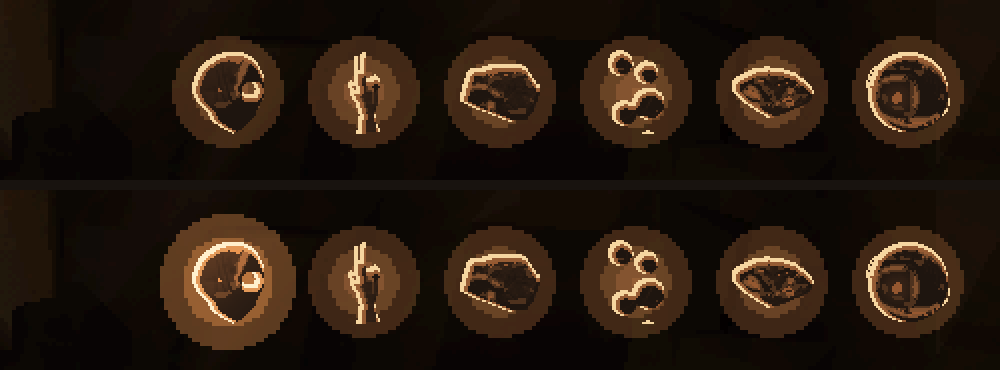
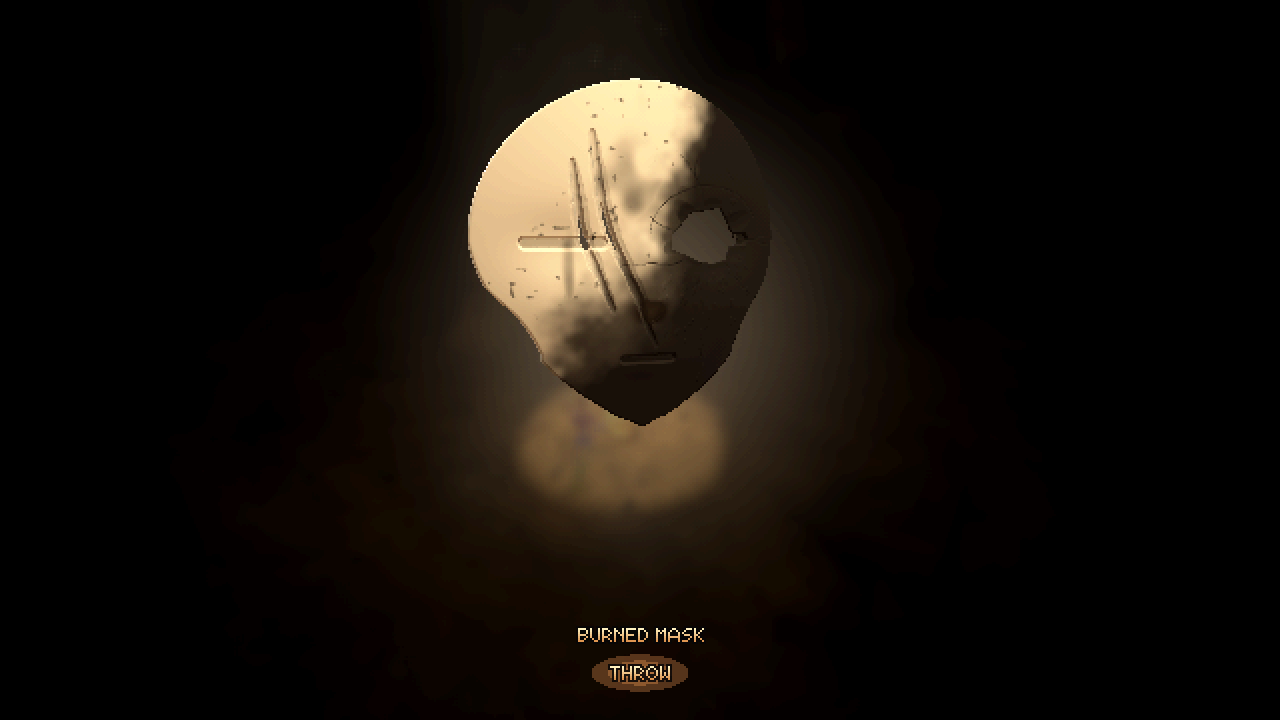
Code: lich-survivors @ b4ccdbcde8 (56 files, +108 -57)
Recorded run: lich-survivors, 20261005-222547
Let's end the session here, name it Lich Survivors 9.