Website Redesign 3
Summary
a327ex.com's front-door "book" — the horizontal carousel of columns that packs the whole 541-entry index — went from round 12 to round 18 in this session and SHIPPED as the site's real homepage. Claude Opus 5 implemented every round directly in-session (no subagents, by the owner's call), each judged by the owner on the live site and deployed before handover. The rounds: compact one-line AI logs and a gold lock for gated entries; the removal of round 9's excerpt blocks so every post renders in full; full-width frames for game posts with the game rendering a wider view; a freed mouse wheel, forward column balancing, live inline chart demos and a grabbable scrollbar; named frame MODES (BOOK_POST_MODE) the renderer assigns by slug; a 16 px scrollbar lane; then shipping — the theme gate opened, a five-link top line and an animated under-construction banner built from the Horse Game's Barricade sprite and LanaPixel; and per-frame budgets that cut the boot parse from 1585 ms to 47 ms. Website Redesign 1 and 2 were un-gated at the end.
Session shape and working mode:
- Opened on the state left by "Website Redesign 2": the book at round 11, deployed but gated behind the Reading theme; REDESIGN.md section 13 held three queued items from the owner's last verdict.
- The owner switched the session to Opus 5 and ended delegation: "Do not spawn subagents, spawning Opus was only to save Fable tokens but now I've decided to just use you (Opus 5) directly, so you can do everything yourself." Rounds 1-11 had been built by one Opus 5 subagent under Fable; the delegate run folder
20260913-homepage-book/ends at round 11. - Mode otherwise unchanged from the thread: NO design briefs, the owner judges by look on the LIVE site, every round ends with
tools/deploy.sh --allow-dirty+git push prod main+ a headless boot check of a327ex.com before handover. renderer/tools/convert.luastayed uncommitted the whole session (another session's clickable sealed code cards), so every deploy needed--allow-dirtyand every commit staged files explicitly.
Round 12 — compact logs, the gated lock, tags only (site commit 885ac43):
- Log rows lost the 32 px band; the gap between blocks became per side via
half_gap/sep_h(prev, cur)— 16 px beside a post, 8 px beside a log. A log row went from ~100 px to ~47 px; columns 205 → 192 at 2560x1340, up to 22 logs in one column. - Gated entries draw a gold LOCK where the id would be:
draw_lockbuilt from primitives (layer_capsule_lineshackle, filled rounded body, keyhole dot inpanel), sized from the id font, so no icon file had to be downloaded.lock_whmeasures it;book_streamcarriesgatedfrom the merged index. - Kinds became plain tags:
story,prototype,ai logonly;postandessayremoved, the Kind row deleted from the filter popover,site_debug.filter('tag1,tag2')replacingfilter(kind, tags). Readouts:story1 entry,prototype2, both 3, none 541. - Found and fixed a latent bug:
book_newandbook_invalidatenever clearedBK.placed, so a REBUILT book packed only 3 columns instead of 192 — and the gated merge rebuilds the book, meaning a cookie holder whose gated index landed after the first pack would have seen a nearly empty front door. book_pack_resetalso dropsBK.packsnow (the filter's stashed packs were measured against the old geometry).
Round 13 — no excerpts, game frames take the screen (site commit 41b965c):
- Owner's verdict drove four items: even log/post spacing both ways, no cut-off posts, games taking over the frame, and the wheel not being trapped by a game.
- Round 9's excerpt block (
EX_H,excerpt_doc, whole-block link) deleted: titled posts, the story and prototypes render in FULL, a long one alone in a scrolling column. The excerpt also explained the owner's "not showing" posts — it kept only leading elements fitting a 208 px box, so a post whose first element was a video, game or byline-over-image drew nothing. - Game posts got a column as wide as the whole front door (
wide_w()=BK.w), with the game at full inner width; when the height cap bites the game now renders a WIDER VIEW instead of narrowing (el._gk = bh/def.h, so game_host sizes a pixel surface to rect.w/k and a non-pixel one to the rect). #410's playground went from 1075x391 to 2352x956 at 2560. book_wheel_claim(mx, my, wy), asked by main.lua BEFOREgame_host_update, gives a wheel notch over a live game to the column while the game is not wholly inside the body or within 0.4 s of the last column scroll;game_host_wheel_blockedzeroes the game'smouse_wheel.- Boot cost moved: every non-log document loads at boot (267 docs, 1.6 s desktop), and the largest single layouts are It Follows (1993 elements, 169k px, ~280 ms) and community_management (~260 ms).
Round 14 — the wheel died after Up/Down, and four more (site commit f8523ba):
- Owner: scrolling "breaks as soon as you use up/down on the keyboard... it tries to scroll but stays stuck in the same position". Cause:
BK.scroll_twkept its slot index forever, sobook_updaterewrote that column's scroll to the tween's last value every frame. Now the tween releases on completion, a held key releases on key-up (BK.hold_on), and wheel / touch / driven scroll / thumb grab all callscroll_release()first. - "never should a scrollbar be added when we have multiple posts in a single frame": the packer's video shortening ESTIMATED its saving and never re-checked the real layout. It now measures the laid-out blocks and, if they do not fit, restores the previous ceiling and leaves the entry to the next column. Overflowing multi-post columns 3 (2560) and 6 (1920) → 0.
rebalance(ci, body_h)moves entries FORWARD from the previous column's tail while the pair gets more even (sum of squared empty space) and the receiver still fits — chronological order untouched. The owner's example (a frame holding only the #477 log) now packs #480, #479, #478 and #477 together.- Inline chart demos run live:
draw_game_elementhad painted the book's placeholder well overdef.smallgames too, so all nine graphs in the indie-success post were empty boxes. Nowcanvas_small_games+game_host_composite_el_into+game_host_note(el, true)composite each demo into the column's own layer. element_natural_wun-stubbed (it had returned 0 since round 7) andtier_wgave table/demo posts a wider frame; a game post is laid out twice so the game takes only the room the rest of the post leaves (Horse Game 178 px overflow → 0); the scrollbar thumb became draggable with a clickable track (book_thumb_test(slot, y[, y2])drives it from an eval); the log line put its date at the right edge with tags after the title.- Fixed in passing: the driven
book_scrollreadout formatted a fractional scroll with%d, which Lua 5.4 throws on.
Round 15 — frames become named modes (site commit 8f0e12d):
- The owner's rule: "Make sure to make all these settings that I'm saying per post as individual modes that you can internally set for future posts that will work the same way for them, don't hack things on those individual posts themselves."
BOOK_POST_MODEmaps slug → mode,post_modefalls back to automatic rules,mode_wturns a mode into a frame width. Modes:normal,wide(1.25 columns or whatever an inline demo needs, and the TEXT and TABLES widen with it),game(full box).- Tables no longer widen a frame on their own — round 14's rule had pulled #448 in on two small three-column tables ("nothing in the post seems to justify that"). A demo box still does, since it cannot be squeezed.
canvas_layoutgained an optionalmeasureargument so a wide frame's prose uses the frame width: RDA2 986 px (was 1166) with its text column going 44118 → 37797 px tall, proving the measure really followed.- Game posts put their text in a column beside the game via
elements_set_game_float(out of the flow,el.h = 0,c.ghfeedingblock_h, canvas culling by_float_h). - Verification caught a bug before the owner did: a floating element still carries the
ylayout_list gave it, so the game drew below the text and was cut. Floats now draw at the block's top.
Round 16 — the scrollbar lane and two game modes (site commit 783e8ca):
- "Content is colliding a bit too much with the scrollbar": every column lays content out
GUTTER(16 px) short of the body's right edge, reserved whether or not the column scrolls so a column that starts scrolling never re-wraps. - "Horse Game isn't wide anymore": round 15 had given every game post a side column, costing the Horse Game half its width for three lines. Split into
game(the game fills the frame, text stacked) andgame_beside(frame split), chosen automatically atWORDS_BESIDE= 120 words or by name. Kimi playground (301 words) beside; Horse Game (31) and Skyland (0) full-bleed.
Round 17 — SHIPPED (site commit 9a4e65e):
- Owner: "Now let's make the move to this homepage being the actual homepage users can see."
theme_gate_open()returns true and the default theme (new_theme) issite_next, so a first visit lands on the book; Dark and Light stay in settings and on F2.- A returning browser carries a stored theme from the old site, which would have pinned it to Dark forever:
settings_loadmoves such a browser across once and recordsreading_shipped, persisted with the other settings. - Top line cut to five plain links — "remove everything at the top, add only home, search, settings, privacy and archive buttons/text" — dropping the wordmark, the five collection labels, the magnifier and the Filter label. The collections remain routes; the tag filter moved to the
fkey (Ctrl+F is still find). - The under-construction banner: the Horse Game's Barricade (its
wallitem'sconstruction.png) at either end ofUNDER CONSTRUCTIONin LanaPixel, gold, each letter riding a sine wave with the barricades bobbing out of phase. Both files already ride the bundled game package; state lives on the NAV table because main.lua sits at Lua's 200-local ceiling (which the first attempt hit: "too many local variables (limit is 200)"). - Two things the gate had hidden from visitors, fixed while shipping: the MOBILE feed never drew AI logs (it only drew entries whose document was loaded, and a log never loads one); and a log title ran under its date on a narrow line, so the title now truncates only where the line is too narrow.
Round 18 — the bar's final shape and the frame drops (site commits 09a0674, 948014a):
- "Make settings, privacy, archive go to the left, after search", then "Float home + others to the very left, center under construction": the five links sit at
NAV.padfrom the window edge andNAV.construction_w()lets the bar centre the banner in the window, pushed right only if the links would reach it. - The owner's performance report: "first load and then subsequent loads of future items as you scroll right seem to make the engine drop a few frames, some things that should be happening asynchronously are not."
- Four budgets in book.lua:
BOOT_DOCS8 (the boot pass had parsed all 541 documents before the first frame — boot 1585 ms → 47 ms, the rest streaming in atLOAD_MS3 ms/frame);PACK_MS6 (book_pack_more(budget, ms)takes a time cap as well as a column count, and the first pack inbook_layoutis capped);book_repack_from(ci)(a lazy image used to reset the WHOLE pack, after whichbook_goto_entryre-walked the stream in one frame — it now re-packs from the reader's own column and packs that column straight back);TALL_WORDS2500 (a very long post is packed at body height and laid out when its column is first DRAWN). - The background loader also WARMS each document's layout at the ordinary column width, so an expensive first-time layout is paid seconds ahead of the reader.
- ⚠ Mistake caught in measurement: the first
TALL_WORDSrule did not exclude logs, which hold tens of thousands of words and draw as one line — columns went 254 → 404 until logs were excluded. - Measured on the desktop agent at 2560x1340: paging right 80 columns = 1280 frames with 11 over 20 ms, worst 227 ms; arriving on an unvisited column ~10 ms; a direct
book_repreload()0 ms.
The performance spike that is NOT ours (unresolved):
- ~1.7 s after the first navigation, one frame costs 500-690 ms. It reproduces on a fresh process at the SAME frame every time.
- Ruled out by experiment, each on a fresh instance: blocking HTTP (
web_http_get/web_http_postset nil — spike remained), the media retry (book_repreloadstubbed — remained), the radio (radio_updatestubbed — remained), packing/loading/game start (per-frame deltas showed 0 columns, 0 documents, no game change on the spike frame), Lua GC (collectgarbage('count')flat across it), and the lazy CJK font family (warmed at boot — remained). - It reproduces in the DARK theme as well (518 ms at the same frame), so it predates the redesign entirely and lives in the C engine. Owed: an
anchor.cinvestigation.
Verification method (unchanged, headless only):
anchor drive start/eval/stopagainsta327ex-site/renderer, withsite_debug.book()/filter()/easy()/snap(), plusbook_thumb_testandbook_wheel_claimcalled directly because the eval channel cannot inject mouse or wheel input.- ⚠ The
engine_snapshottrap bit again: it crashes the process when the window GROWS after the first capture, so every drive must snapshot the LARGEST size first. One eval lost its results to that (ConnectionResetErrorfrom the drive). - Frozen review snapshots per round under
renderer/reference/site-theme-2026-09-13/rounds/(12 through 17).
Tooling friction worth remembering:
- Bash heredocs carrying long quoted Lua broke in the tool wrapper ("unexpected EOF while looking for matching
''"), so every patch this session was a Python script written with the Write tool, asserting each replacement matched exactly once. - Git Bash
sed -istrips CRLF; harmless here because a327ex-site's.gitattributesforceseol=lf.
Un-gating Website Redesign 1 and 2:
- The
/unsealshim covers vaulted private logs, not gated ones; the right command isanchor gate --log <slug> --off. - Both ran: "Website Redesign 1" now PUBLIC (commit d724a95, 8 delegated-run children moved out of
gated/unlisted/), "Website Redesign 2" now PUBLIC (commit 4a60667, 2 children moved). - Both renderer syncs refused to deploy over the uncommitted
convert.lua, so the content deploy ran by hand:convert.lua --all+deploy.sh --data --allow-dirty, 21 changed files synced./logs/website-redesign-1and-2both answer 200 and appear in the public index. - Note: both still carry NO
idfield (the gated index generator never wrote one), so they render without an id segment. Onlyreverse-minesweeper-prototyperemains gated.
Owed / open after this session:
- The ~1.7 s engine-side frame spike (both themes, pre-dating the redesign).
- Server-side HTML for the collection routes: a visitor can reach
/works,/notebook,/essays,/experiments,/logsby URL and a hard reload 404s — now public-facing. - The gated index generator writing
ids (Anchor workflow gate/endflow; another session has uncommittedendflow.pyedits, so coordinate). - The two
engine_snapshotbugs; a deploy hook fortools/poster_analyze.py; the per-resolution pack cache;layer_createignoring the size it is handed. 410's frame (centred text over a wide game) — the owner considered it open in round 14, and rounds 15/16 answered it with
game_beside; his verdict on the shipped result is pending.
Let's continue on Website Redesign. Read last session summary and other data to get aligned and give me a summary of everything. This session will continue with Opus 5 so make sure to give a broad and detailed overview so he has nice context to go from as we continue iterating on everything.
Fable 5.1 high
[Think]
I should get aligned before handing off, so I'll pull up the memory file for the site redesign, sections 12 and 13 of REDESIGN.md, and the last session summary to build a thorough overview for Opus 5 to pick up from.
I'll read the redesign memory, the REDESIGN.md sections it points at, and the last two session summaries, then write the overview.
Bash ([memory: sealed target])
Now REDESIGN.md sections 12 and 13, plus the last session's summary and git state.
Bash (cd "C:/Users/a327e/Desktop/a327ex/a327ex-site/renderer" && grep -n "^## " REDESI...)
Bash (cd "C:/Users/a327e/Desktop/a327ex/a327ex-site/renderer" && sed -n 668,708p REDES...)
Bash (cd "C:/Users/a327e/Desktop/a327ex/a327ex-site/renderer" && sed -n 668,708p REDES...)
[Think]
I want to check section 12, the full round log, alongside the last session log, git state, and the delegated run folder — I'll pull the persisted output file and git log at the same time.
Bash (cd "C:/Users/a327e/Desktop/a327ex/a327ex-site/renderer" && sed -n 274,470p REDES...)
Bash (cd "C:/Users/a327e/Desktop/a327ex/a327ex-site/renderer" && sed -n 470,667p REDES...)
Bash (cd "C:/Users/a327e/Desktop/a327ex/a327ex-site" && git log --oneline -25 && echo ...)
Bash (cd "C:/Users/a327e/Desktop/a327ex/a327ex-site" && ls -t logs/ 2>/dev/null | head...)
[Think]
I should gather the last session summary from the website-redesign notes, the run status for the homepage-book job, the latest followup and report to check the implementer's state, and confirm whether the live deploy matches the expected commit, plus check for any dirty files from other sessions. Let me pull all of that together at once.
Bash (cd "C:/Users/a327e/Desktop/a327ex/a327ex-site" && head -c 9000 gated/website-red...)
Bash (cd "C:/Users/a327e/Desktop/a327ex/Anchor/workflow/delegate/runs/20260913-homepag...)
Bash (cd "C:/Users/a327e/Desktop/a327ex/a327ex-site" && git diff --stat renderer/tools...)
Bash (cd "C:/Users/a327e/Desktop/a327ex/a327ex-site" && ls -t ~/.claude/projects/C--Us...)
[Think]
I want to finish reading the tail of the summary covering rounds 8-11 and the closing verdict, and verify whether the convert.lua diff belongs to a separate uncommitted session. I should also confirm what's actually deployed—the summary notes commit 63faa1e (round 11) was deployed, with later commits like e7133a7, 35529aa, and 6f8be3d being just docs and logs.

Beyond that, I should skim THEME.md for the theme values and check brief.md's preamble, since that packet gets reused for follow-ups and Opus will need it for followup-15. I'll pull all of that together in one pass.
Bash (cd "C:/Users/a327e/Desktop/a327ex/a327ex-site" && sed -n '/^**Round 8/,/^## /p...)
Bash (cd "C:/Users/a327e/Desktop/a327ex/Anchor/workflow/delegate/runs/20260913-homepag...)
Bash (cd "C:/Users/a327e/Desktop/a327ex/a327ex-site/renderer" && head -120 reference/s...)
Bash (cd "C:/Users/a327e/Desktop/a327ex/a327ex-site/renderer" && grep -n "band|BAND|...)
[Think]
I think I have enough to work with now. Let me just do one cheap sanity check on whether the live site is healthy and matches the deployed commit, and glance at the Anchor repo's git status for any uncommitted gate/endflow changes before finalizing the summary.
Enough context gathered. One last cheap check on the live site and the Anchor repo state, then the overview.
Bash (curl -sS -m 20 -o /dev/null -w 'a327ex.com home %{http_code} %{time_total}s\n' h...)
[Think]
I notice the Anchor repo has uncommitted changes from another session's work, unrelated to this thread, so I'll flag that separately. Now I need to draft the overview itself, keeping it broad and detailed enough for Opus 5 to pick up, following CLAUDE.md's preference for substance over scaffolding and no em-dashes, while respecting the system prompt's formatting constraints.

I'm sketching the overview's structure: current state, the redesign's history and how the book model emerged through eleven rounds, the model's current shape (stream, packing, columns, chrome, input, filters, video, games, mobile, layering), the working mode with the Opus implementer and headless verification, where the three queued round-12 items stand with code pointers, items still owed outside the rounds, plans to extend the book model to other pages, repo state notes on the dirty convert.lua and uncommitted Anchor work, and a list of engine gotchas around input latching, snapshots, timers, and the Lua local limit. I also want to make sure the delegation doctrine is clearly spelled out for Opus 5.

I need to flag a genuine open question for the owner: since this session itself is Opus 5, the doctrine says a subagent implementer saves nothing here and the work should stay in-session, but the owner had been running one Opus implementer per job all thread, and that implementer's context can't carry over into a new session anyway. So I should present this as a decision point -- implement round 12 directly in this session per doctrine, or spawn a fresh opus-implementer seeded with the run folder -- with my recommendation, while noting the run register mechanics wouldn't cleanly apply either way.

I'm also gathering the concrete code locations for round 12 (the kind/tag definitions, the open/log/block handlers, the draw routine, and the popover row) plus deciding how to render the lock indicator visually. I'll aim for a thorough but bounded writeup, maybe three sections and under 2000 words, then start drafting it.
Aligned. Below is the full overview for the Opus 5 continuation. The live site answers 200 and the site repo is clean apart from one file that belongs to another session.
Where the redesign stands right now
The a327ex.com redesign is a thread that began 2026-09-12 and has had two logged sessions, "Website Redesign 1" and "Website Redesign 2" (both published gated). The current state, all committed on a327ex-site main and pushed to prod:
- Visitors see the unchanged Dark site. Everything new lives behind the opt-in "Reading" theme (
site_nextin theme.lua). It is selectable only on the desktop build, on localhost, or on a web device holding the admin token, throughtheme_gate_open()in main.lua. The owner's admin device opens it with F2 on the live site. Removing the web condition in that function is what "shipping" means, eventually. - The front door under Reading is the BOOK, built in book.lua (1726 lines) over eleven judged rounds in the last session. Round 11 is site commit 63faa1e. The commits after it (c45c130, e7133a7, 35529aa, 6f8be3d) are only REDESIGN.md and the session log.
- The handover map is REDESIGN.md. Section 13 is "where we stopped" and section 12 carries every round with the reasoning. Sections 4 to 6 describe the earlier, largely superseded build (theme, paginated reader, collections). Section 7 is the gate, section 9 the headless verification recipe.
- The theme kit is
renderer/reference/site-theme-2026-09-13/THEME.mdplus sheets 01 to 08. It is the authority for colors, type roles, states and spacing. Blue (link) is the interaction accent, gold (current, #FFCB5C) is reserved for entry ids, the current place and real progress. Read it before any styling decision. - The implementer run is
Anchor/workflow/delegate/runs/20260913-homepage-book/: brief.md, followup-1 to 14, report.md and report-1 to 14. Follow-up 14 = round 11. The next follow-up would be number 15 = round 12. The same Opus 5 subagent was resumed through all fourteen; its transcript belongs to the previous session and cannot be resumed from this one. - Frozen review snapshots per round sit in
renderer/reference/site-theme-2026-09-13/rounds/01-homepage-book/through11-homepage-book-r11/(gitignored, local only).
Two loose ends in the repos, neither from this thread: renderer/tools/convert.lua has an uncommitted diff from another session (clickable sealed code cards, an optional github token on ::code directives). Every redesign commit excluded it, and deploy.sh's dirty-tree guard matches any renderer .lua, so deploys need --allow-dirty while it sits there. The Anchor repo has ten modified files (anchor.py, endflow.py, config.toml, README, and others) from the anchor new and journal-cards work, also another session's, also uncommitted. Leave both alone.
How it got here, and what the book is now
The history matters because the owner rejected one full build and the current model is the result of eleven look-and-judge rounds.
On 2026-09-12 Astra produced 51 mockups; the owner picked six and a dark theme. On 09-13 three Opus 5 runs built a complete redesign under briefs: the theme, a paginated reader (pages as windows onto a column, text breaking across pages), and collections (front door with a Continue band, work homes, essays by year, an experiments grid, a logs month by series matrix, the notebook as a 250-page book). He looked at it that night and rejected the front door and the reader model: "the paginated/reader design will be used throughout the entire website in different ways, but the currently implemented one is mistaken in a number of ways." His target was mockup 25's layout with mockup 35's page treatment, each post on its own page, scrolling vertically inside it, never broken across pages. He suspended design briefs for the thread ("I'll judge things by how they look") and asked for one Opus 5 agent per job.
Round 1 was a two-page book of notebook entries and got "This is amazing". Round 3 changed the model to what it is now, and rounds 4 to 11 tuned it on the live site. The book today:
- The stream is the whole index, 541 entries newest first: 186 untitled posts, 78 titled posts, 274 AI logs, 2 prototypes, 1 story. Kinds are added as tags at load (
KIND_TAGnear book.lua line 92: story, prototype, ai log, plusessayfor titled posts, which the owner has now rejected, see below). - A column packs whole entries in strict chronological order while they fit the page height. A post never breaks. Untitled posts show in full. Titled posts and the story are fixed-height excerpt blocks (id, title, date, chips, first elements in a 208 px box with a fade) whose documents load lazily. AI logs are one line each (
draw_log_line,log_h): gold#id, bold title, date · time, chips; the line minus the chips links to the log; a log's document is never loaded. When the next entry misses, the column's videos shorten height-wise (cover-cropped, minimum 260) to let it in. The look-ahead and media-flex mechanisms from rounds 4 and 7 were removed in round 9. - A carousel of fixed-pitch columns, the current one always centered with neighbors peeking. Column width is
min(840, ...)at a 720 minimum pitch, 32 gap. Next and Previous are round 44 px arrow buttons under the columns with Material Icons Round glyphs. The slide is one named tween on the framework timer (timer_tween(BK.timer, 0.32, 'book_slide', ...), quartic ease-out). A repack waits for the slide to end and anchors on the current column's first entry. Full-bleed game posts get a double-width column with the game running live inside the column's own layer throughgame_host_composite_into. - Pages are layers. Each visible slot owns a render layer sized to the column body; the document is drawn into it with the scroll as the offset and composited with
layer_draw_into. The composite is the clip, because the engine's stencil cannot nest and code blocks and video already use it. Layers are pooled by name and force-resized. - No header, no month strip, no page numbers, no range label. The page itself never scrolls under Reading. The "Open entry" text is gone but its 32 px band (
open_h(), line 317) remains under every block for a future comment bar. - Input: Left/Right and the arrows turn; Home/End jump; Up/Down scroll the current column 96 px through a named tween, held past 250 ms scrolls at 900 px/s; PageUp/PageDown by the body; the wheel over a column scrolls it, outside every column it turns a page behind a flick debounce; Tab opens easy-motion mode (a label on every clickable, its key performs the click through the real click path). Every nav and popover control acts on
ui_mouse_pressed, never the click latch. - A Filter item in the top line after Search opens a popover: a Kind segmented row (All · post · essay · story · prototype · ai log) and tag chips with counts, OR among tags, AND with the kind. Packs are cached per filter key.
- Video plays inline with a rebuilt 48 px player bar shared by every theme (Material icons, seek, volume, 1x, cc, YouTube link, fullscreen with its own sizes). Posters are cropped free of letterbox bars using
assets/poster_meta.lua, produced offline bytools/poster_analyze.py(PIL); the play ring is always light and the disc adapts from the poster's tint. Re-run the analysis after new video posts; no deploy hook does it yet. - Mobile (< 768) is one window-scrolled feed column, essentially unexercised. 768 to 1024 gets the carousel with one column.
- Fonts: the reading set is Arial 17/26 body with the id at 24, applied by
fonts_push('reading')/fonts_pop()around every book layout and draw (FONTS_READINGin theme.lua).
The earlier modules still exist and still work under Reading: reader.lua (the rejected paginated reader, still used by /notebook), collections.lua (work homes, essays, experiments, logs matrix), works.lua (the hand-maintained WORKS table), notebook.lua. The owner has not redone any of them. His stated plan is that the book model spreads to them "in different ways".
Where we stopped, the working mode, and what to do next
Round 12 is queued and not started. The owner's last verdict, three items, from REDESIGN.md section 13:
- Spacing below one-line logs is too big. Drop the 32 px band for log rows and tighten the rule spacing around them. A log row should take roughly its line height plus the rule, not around 100 px. The relevant code is
open_h()at book.lua line 317,log_hat 397 andblock_hat 408, which addsopen_h()to every block including logs, plus the separator drawing indraw_column_bodyaround line 990. Report 14 already noted that dropping the band would nearly double how many logs fit per column. - Gated logs show a gold lock where the id would be, either a lock icon or the word "locked", in the
currentgold the ids use. The gated index rows (data/gated/index.lua, merged only for a cookie holder) carry noid, so today such a log draws no id segment at all. The Material icon set inassets/icons/mi/is fetched bytools/fetch_icons.py; alockicon would be added there, ormono_smallgold text is the cheaper route. - No kind versus tag distinction.
story,prototypeandai logbecome plain tags.postandessayare removed entirely: no such tags, no Kind row in the popover, tags only. Titled posts and the story keep the excerpt block but carry no kind tag. This touchesKIND_TAG, thekindderivation inbook_stream(lines 89 to 112),BOOK_KINDS/KIND_OF(123 to 124), the filter key and match functions (134 to 148), the tag counting (158 onwards),site_debug.filter(kind, tags), and the popover's KIND row around line 1477.
The working mode the owner set for this thread, which continues: no design briefs ("I'll judge by how they look"); one implementer per round working from a follow-up file in the run folder; every round ends with bash tools/deploy.sh from a327ex-site/renderer (with --allow-dirty while convert.lua is dirty) and git push prod main, then a headless-browser boot check of a327ex.com (console shows "Loading: main.lua", no errors) before the handover says "live". He judges only on the live site, never in run.bat. Our own verification is headless: anchor drive start a327ex-site/renderer, anchor drive eval with site_debug.book(), book_turn, book_goto, book_scroll, filter, easy, poster_audit, and snapshots via site_debug.snap. Handovers carry test instructions and the frozen snapshot folder.
One decision for the owner before round 12 starts. The delegation doctrine says delegation pays only downhill: when the session itself is Opus 5, an Opus subagent saves nothing and the implementation stays in the session. But this thread's mode was "one Opus 5 agent per job", registered as follow-ups in the run folder, with the implementer's churn kept out of the directing context. Options: (A) Opus 5 implements round 12 directly in this session, writing followup-15.md and report-15.md into the run folder anyway so the record stays continuous. (B) Spawn a fresh opus-implementer subagent with followup-15.md, accepting that it starts cold (it would read REDESIGN.md section 12 and report-14 to orient) and that the round 12 items are small. My recommendation is A: the three items are contained edits to book.lua, the register can be kept by hand, and a cold subagent would spend most of its effort re-orienting.
Owed outside the rounds (Fable-side, none started): ids on gated index rows (the generator in Anchor's gate/endflow, currently in another session's uncommitted diff of endflow.py, so coordinate); the two engine_snapshot bugs in anchor.c near line 22391 (composites every registered layer full-screen when the draw queue is empty; crashes if the window grows after the first capture); a deploy hook for poster_analyze.py; the per-resolution pack cache (a comment at the top of book_pack_more names its key: window height, column width, filter key, entry count); the lore sweep never running over gated child pages.
After round 12, the owner's direction is the same book model on the other pages "in different ways": the notebook, essays, stories, logs, work homes, each judged by look. Nothing is specified for those yet, and per the brainstorming rules the next step there is his direction, not a spec.
Gotchas any implementer on this code must know:
layer_create(name, filter, w, h)returns an existing layer of that name at its old size and ignores w/h. The book force-resizes on create; do the same anywhere else.- Before every
site_debug.snap, calllayer_draw(ui_layer), or the snapshot composites every page layer full-screen. Snapshot the largest window size first in a drive, or the process crashes on growth. ui_mouse_clickedrequires the release within 4 px of the press. Injected clicks pass it, real clicks often don't. Useui_mouse_pressedfor controls.- Use the framework timer with named tweens for motion (
renderer/anchor/timer.lua). The owner explicitly called out agents avoiding it. - The renderer's main.lua chunk sits at Lua's 200-local ceiling; group new state into tables.
- Video frames never present in an agent instance (the decoder clock follows the audio ring), so player snapshots show black with working chrome. The owner's browser shows the picture.
- The desktop build never finishes loading CJK fallbacks, so CJK draws blank on desktop; the web is fine. Pre-existing.
engine_snapshotbetween frames and the layer pool interact;book_state()reportslayer_w/hagainstrect_w/hper slot to prove 1:1 compositing.- The Bash tool breaks long heredocs with quoted prose; use the Write tool for files. Use Git Bash, not PowerShell.
- Code style:
*and/tight,+and-spaced; snake_case; UI text ASCII-only.
Key files by size: main.lua 4348 lines (routes, themes, input, easy-motion, the gate), elements.lua 3503 (every element's layout and draw, the player bar, states, Material icons), book.lua 1726, game_host.lua 879, theme.lua (tokens and font sets), tools/deploy.sh and tools/build-web.sh (the web bundle preloads book.lua).
/model claude-opus-5
[command output]
Do not spawn subagents, spawning Opus was only to save Fable tokens but now I've decided to just use you (Opus 5) directly, so you can do everything yourself. You may proceed on the leftover items from last session.
Opus 5 xhigh
[Think]
I'm to do round 12 directly, no subagents or briefs — just deploy, verify headlessly, then hand over. The "leftover items from last session" likely means primarily the three queued items, though possibly extends to the owed fixes like gated ids in endflow, engine_snapshot bugs, deploy hook, and pack cache.

The endflow gated-ids change is risky since it has uncommitted edits from another session, and the engine_snapshot bugs would need an engine build and replay-test check — unclear if that's desktop-only or touches the wasm build. Given the pacing rule to hand off after a batch and let the user take a turn, I'll scope round 12 to the three queued items, deploy and hand over, and treat the owed items as separate — though I notice gated ids relates to item 2 since even with ids assigned, the lock still appears where the id would be in the log.

For execution, I should read book.lua's relevant sections via Bash, but keep in mind that long heredocs can break on quoted prose, so I may need the Write tool instead for actual edits since sed is too fragile for Lua changes.

Writing python replace script...

I need to be careful about CRLF line endings on Windows files and use raw strings so backslashes in Lua code aren't misinterpreted. Now I'm planning which sections of book.lua to target: the stream/filter logic, block height calculations, drawing code, and the popover section.
Round 12 it is: the three queued items from the owner's last verdict, done directly in this session, then deploy and a headless check. I'll start by reading the parts of book.lua those items touch.
mcpccd_sessionmark_chapter ({"title": "Book round 12", "summary": "Log row spacing, gold lock for gated logs, kinds become plain tags"})
Bash (cd "C:/Users/a327e/Desktop/a327ex/a327ex-site/renderer" && file book.lua && sed ...)
[Think]
I need to figure out how gated log rows are actually flagged, since the renderer's index excludes them but the gated merge adds them back for cookie holders. I should check the gated_merged_hook logic in main.lua and works_index, plus look at book.lua's block height calculations, draw_log_line, and the popover code to understand how these gated rows get marked and rendered.
I need the block-height code, the log line and column drawing, the popover, how gated rows are merged and marked, and site_debug.filter. None depend on each other, so I'll read them together.
Bash (cd "C:/Users/a327e/Desktop/a327ex/a327ex-site/renderer" && sed -n 300,470p book....)
Bash (cd "C:/Users/a327e/Desktop/a327ex/a327ex-site/renderer" && sed -n 855,1075p book...)
Bash (cd "C:/Users/a327e/Desktop/a327ex/a327ex-site/renderer" && sed -n 1380,1560p boo...)
Bash (cd "C:/Users/a327e/Desktop/a327ex/a327ex-site/renderer" && grep -n "gated" main....)
Bash (cd "C:/Users/a327e/Desktop/a327ex/a327ex-site" && ls data/gated/ 2>/dev/null; ls...)
[Think]
I need to check main.lua around the gated merge logic to see if works_index actually copies the gated flag, look at the contents of data/gated/index.lua, and review fetch_icons.py.

Thinking about how to add a lock indicator, I realize downloading an icon from Google Fonts would count as fetching an external file, which feels like it needs explicit permission under the safety rules. Rather than doing that, I could just draw the lock manually using primitives (a rounded rectangle plus an arc for the shackle), fall back to the word "locked" in gold text, or generate a simple lock PNG myself with PIL instead of pulling one from the internet.

I also need to check whether e.gated and the type field survive intact, and search across the renderer for other places using BOOK_KINDS, book_filter_state, book_filter_apply, or rec.kind. Then I want to see how draw_head handles entries without an id, since I'm trying to decide whether the lock should apply to all gated entries or just gated logs specifically.

Beyond that, I'm thinking about spacing between entries: for log rows specifically, I want to drop the current 32px separator band down to something tighter, closer to 8px above and below the rule, so a log row's total height is roughly its line height plus the thin rule, rather than the bulkier spacing used for non-log entries.

Now I need to trace where this separator height actually gets used across the codebase — column height packing calculations, entry positions, scroll offsets — anywhere that adds block height plus separator height needs to account for the new log-specific spacing rule.

I also want to remove the KIND row from tag filtering entirely, since titled posts no longer carry a kind tag and the popover shouldn't display it. I'm thinking of changing `filter` to accept just a tags string rather than the old kind-plus-tags signature, simplifying callers like `site_debug.filter` and documenting the change.
[Think]
I'll pull together the gated merge/hook logic in main.lua, the site_debug filter, how works.lua builds and indexes gated rows, draw_head's id handling, separator/band usage in packing, all filter/kind API callers, the icon fetch source, and the engine's line/arc primitives for drawing a lock—these can all be gathered independently.
Bash (cd "C:/Users/a327e/Desktop/a327ex/a327ex-site/renderer" && sed -n 1190,1215p mai...)
Bash (cd "C:/Users/a327e/Desktop/a327ex/a327ex-site/renderer" && grep -n "sep_h()|ope...)
Bash (cd "C:/Users/a327e/Desktop/a327ex/a327ex-site/renderer" && sed -n 1,40p tools/fe...)
Bash (cd "C:/Users/a327e/Desktop/a327ex/a327ex-site/renderer" && grep -n "W.index\b|W...)
[Think]
I'm weighing whether adding the lock icon via the project's existing fetch script counts as a download needing explicit permission—it pulls from a trusted, already-used Apache 2.0 source, but the safety guidance around downloads is broad enough to give me pause.

To stay cautious, I'm sketching an alternative: drawing the lock from simple shapes instead—a filled rounded rectangle for the body, with the shackle formed by a stadium-shaped outline (capsule) whose curved top and straight sides mimic the ring, letting the body's fill cover the lower portion where it overlaps.

I still need to place this lock icon where the id would go in log lines, and check whether draw_head handles gated ids too so the treatment stays consistent. I'm also thinking about sizing the lock to match the mono_small text height, and confirming an icon alone (not the word "locked") is what the owner wants.

Now I'm working out entry spacing — the vertical gap between log lines should just be their line height plus a thin rule, not the larger padding used for post entries, so I'm settling on roughly 8px top/bottom margins around the separator to keep log rows compact rather than the ~100px they'd get otherwise.

I still keep a hairline rule between rows even in tight log spacing, since removing it entirely would make the list feel unstructured, though I'm tightening the spacing around it per feedback. I also need to make sure the first/last entries in a column skip unnecessary top gaps, and trace through the packing code and mobile feed height calculations to confirm the column total height matches what's drawn — then handle removing kind tags for story/prototype/log entries versus titled and untitled posts.

Now I'm restructuring the filter system to work only on tags instead of kind, updating the filter state, popover, toggle/clear logic, and site debug filter accordingly, and removing the BOOK_KINDS references entirely — while confirming that draw_head no longer shows kind-based chips since untitled posts never had them and titled posts should now match that behavior.

I still need to update the comment about the renderer's index excluding gated logs, confirm the filter isn't persisted anywhere, and then move on to verification steps: syntax-checking with lua54, running the attribution test, running build-web.sh, and capturing headless snapshots at both 2560 and 1920 widths. For testing gated content without a cookie, I'm considering simulating it directly in an eval by loading the gated index file and merging it the way poll_gated_index would, though I need to check whether `index`, `rebuild_models`, and `BK` are local or global before deciding the simplest way to inject test data.

I can verify the gated flag path by calling `book_stream()` to grab entries, marking one as gated with `gated=true` and clearing its id, then feeding that modified list into `book_new`, which is global and accepts entries directly. For deployment, I'll need to commit only book.lua, main.lua, and REDESIGN.md first since deploy.sh refuses uncommitted renderer changes, then push to prod and do a final headless browser check that main.lua loads cleanly with no console errors. I'm also noting that since there are no subagents involved this time, I can skip creating any follow-up files in the run folder.

I still need to update REDESIGN.md section 13 and memory, and deliver the frozen r12 homepage snapshots as standalone artifacts. Before that, let me check a few more code ranges, the BK global, the tests directory, and how anchor drive commands work on Windows, referencing prior verification snippets from earlier follow-up reports for consistency.
[Think]
I'll pull up the height calculations in packing, the column draw walk, and `draw_head` to align them with the new spacing, plus check the verification recipe and whether `BK` is global.
Bash (cd "C:/Users/a327e/Desktop/a327ex/a327ex-site/renderer" && sed -n 500,562p book....)
Bash (cd "C:/Users/a327e/Desktop/a327ex/Anchor/workflow/delegate/runs/20260913-homepag...)
[Think]
I need to find the lua54 path and figure out how to run the attribution test, understand how the anchor drive and site_debug.snap signature work, and check how previous snapshots set window size. I'll grep main.lua for site_debug.snap and site_debug.view calls, and peek at the start of tests/attribution.lua.

Now I'm planning the edits to book.lua's stream logic, reworking the KIND_TAG mapping so story/prototype/log entries get plain tags at load time instead of separate kind fields, and updating book_stream to attach those tags while preserving gated entries and their lock behavior.

I'm also rewriting the filter section so tags are OR'd together with no selection meaning everything matches, adding a filter_key function that sorts and joins selected tags into a cache key, and building a matches function that checks whether any entry tag intersects with the active filter set.

I'm defining book_filter_tags to count tag frequency across the whole stream, book_filter_active to check if any filter is set, book_filter_state to expose the current filter state, and book_filter_apply/toggle_tag/clear to manage updating BK.filter.

Now I'm resetting BK.filter alongside BK.packs in book_new, and reworking the spacing helpers—replacing sep_h() with dedicated gap functions like open_h() that account for post versus log-row spacing plus the rule line between blocks.

I need to update each caller of sep_h() to pass in the previous and current records, checking every place blocks get positioned—the column height calculations, candidate rendering, and loop entries—so the spacing between a post and a log row (or two logs) is computed correctly rather than using a flat gap.

For the append order issue, I realize I need to grab the previous entry before appending the new record, since after appending it would incorrectly reference itself.

For the draw pass, I'm tracing through how separator rules get drawn between entries, using the previous entry to determine gap sizing, and confirming skipped/unlaid-out entries don't break the indexing. I'm also checking the mobile feed rendering path uses the same sep_h logic for consistency.

I'm noticing the mobile feed only shows entries with a doc field, meaning logs never appear there at all — a pre-existing gap unrelated to my current fix, so I'll just flag it rather than address it. Calling sep_h() with no arguments still works fine since it defaults to 16+1+16, so no change is needed there; I'm also double-checking other block_h call sites and scanning for any "tops" scroll-position logic that might be affected.

Checking whether column heights are computed elsewhere besides the packing logic — it seems col.h is only set there, and the vertical centering calculation using col.h stays consistent, so I think this is locked in.

For gated entries I'm swapping the id display for a gold lock icon, since that spot marks entries only cookie-holding viewers can actually see. I'm sizing the lock relative to font height and starting the draw function for it.

Still designing the lock glyph geometry...

I need to check whether the renderer's copy of anchor.exe actually exposes layer_capsule_line, possibly testing it directly via a drive eval. Then for draw_head, I'm planning to swap the "#id" text for a gold lock icon sized to the title font whenever the entry is gated, while leaving the id link rect and normal text color intact for ungated entries.

Since gated posts don't exist yet for heads, I'll just make the lock gold in both places for consistency with how log-line ids already use gold. In log_line_w, I'm adjusting the width calculation to add space for the lock icon when gated, otherwise falling back to the id width; the lock stays gold even on hover, only the title color shifts. For the popover, I'm removing the KIND row and simplifying the body height calculation to drop the extra row and gap it introduced.

I'm removing the kind loop from the popover while keeping the TAGS label and existing tag pill behavior, since toggling tags still routes through book_filter_toggle_tag. Now I'm writing a debug filter function in main.lua that, when called with tags, parses a comma-separated list and applies it via book_filter_apply, then reports the current filter state and book summary.

I also need to fix a stale comment claiming the renderer's index already excludes gated logs — that's no longer true since gated entries get merged in now, so I should update it. Since rec.kind was removed, I should double check nothing else still references it, and I need to look at the other site_debug functions (snap, view) to figure out the right way to set up verification.

Let me pull several things at once: the full list of site_debug functions, the attribution test file header, all usages of layer_capsule_line/layer_circle_line in the renderer, and the mono_small font size in theme.lua, plus quickly recall the SURFACE/AGENT drive syntax for starting, evaluating, and stopping a session.
[Think]
I still need to check a few independent things before editing: the site_debug helper list for headless checks, how the attribution test runs, whether the renderer already has capsule/circle outline primitives for drawing a lock icon, and the mono_small size used for log ids.
Bash (cd "C:/Users/a327e/Desktop/a327ex/a327ex-site/renderer" && grep -n "^function si...)
Bash (cd "C:/Users/a327e/Desktop/a327ex/a327ex-site/renderer" && sed -n 1,25p tests/at...)
[Think]
I'm figuring out how to test attribution rendering, since layer_capsule_line isn't actually used in the renderer. I'm working out a fallback approach for drawing the shackle shape using line legs and a circle outline positioned above the body, covering the bottom half so it reads correctly.

For applying edits, I'm going to write a Python helper script that handles the file's CRLF line endings carefully -- normalizing to LF for matching replacements, then re-encoding back to CRLF before saving.

I'm planning out each patch to book.lua: updating the stream section, filter logic, book_new initialization, spacing functions, block height calculation, packing logic in four places, the separator drawing, lock-related log lines and widths, and removing the KIND field from the popover.

Still building the tagging logic...

Finishing the tag-appending logic and ensuring log entries only carry the `ai log` tag plus existing index tags, while posts keep just their own tags with `post`/`essay` removed, plus a gated flag now included in the output. Now I'm wondering whether index entries for stories and prototypes use type='story' and 'prototype' respectively.

I'm updating the comment above the index to clarify there's no `kind` field—`story`, `prototype`, and `ai log` are just regular tags treated like any other filterable tag. Next I'll move to rewriting the filter block, replacing the whole segment from the filter comment through the `book_filter_clear` function.

Writing filter logic code...

Adding functions to apply a filter by swapping tag sets, caching the old pack, and toggling individual tags on or off by rebuilding the tag set and reapplying the filter.

I'm now spotting a potential stale-cache bug: since BK.packs holds entries keyed by filter, a window resize that changes BK.cols won't invalidate packs computed at the old width, so returning to a previously-seen filter after resizing could restore columns with outdated heights. I want to check how book_relayout and the resize path interact with repacking before deciding whether this is worth fixing now.

I'm also planning smaller edits: simplifying book_new's default filter table to just carry tags, and reworking the spacing helper comments so open_h and sep_h correctly reflect the new log-row behavior versus the old post/band spacing logic.

For block_h, I need to drop the `+ open_h()` addition for logs and update the comment above block_h to clarify that a titled entry's block is fixed (header, excerpt box, band) while a log's block is just its single line.

Now I'm tracking the packing logic changes — introducing a `prev` variable that references the last entry in the column right after the game-break check, then threading it through the separator height calculations so `sep_h()` calls become `sep_h(prev, rec)` for both the break condition and the accumulated height calculation.

For the draw section, I'm updating the divider-drawing loop so it captures the previous entry before computing spacing, changing the fixed `px(16)` offset to a `half_gap(prev)` call and passing `prev, rec` into `sep_h()` — then double-checking this rectangle call is distinct from a similarly-shaped one used in the feed rendering, and noting a remaining edge case about entries that never received layout dimensions.

Now I'm adding a lock-icon size function before the existing `log_line_w` helper, designing it to draw a small gold lock (body plus shackle) entirely from primitives rather than an image file, sized to match the identifier it visually replaces for gated entries merged from the cookie index.

Working out the shackle geometry now, computing stroke width and radius so the arc curves proportionally with the lock body size at small font scales.

I'm scaling these proportions down to our target size, calculating body height, width, and shackle dimensions as ratios of the original 24px box, and deciding to use floating-point values for the geometry since the rendering likely handles subpixel antialiasing.

For the keyhole dot, I'm computing it as a tiny circle at roughly 0.125 of the width — it may render small at this scale, but I'll include it and verify visually rather than skip it. I'm also confirming that font height drives all derived measurements, and considering whether the lock icon should sit slightly taller than the adjacent digit text for visual balance.

Writing lock drawing function...

I'm double-checking the geometry here—verifying that the shackle's bottom arc stays hidden behind the lock body, and whether the keyhole dot placement might accidentally overlap with that arc region given the current proportions.

Writing draw_log_line logic...

Adjusting the popover layout next: simplifying the body height calculation since the KIND row is being removed, and stripping out the block that drew the "KIND" label and its value.

I'm now checking whether the popover header comment references "kind" and need to grep after edits. Then I'm looking at whether BK.packs goes stale after relayout — since book_pack_reset only clears the current column cache, cached packs for other filter keys keep old geometry, causing wrong columns when a stale filter is applied. I should clear BK.packs entirely inside book_pack_reset (and book_relayout) rather than just resetting the current key.

I'll set that fix aside for now and verify with a grep once the patch is in, noting the file uses CRLF line endings that I need to account for when editing.
[Think]
I've laid out the edits for book.lua: reworking log spacing, adding gold lock rendering from gated stream records, and stripping the kind field/filtering in favor of tags-only. Since the file uses CRLF line endings, I'll apply these changes via a Python helper that normalizes endings and verifies each patch target matches exactly once.
Bash (cd "C:/Users/a327e/Desktop/a327ex/a327ex-site/renderer" && file main.lua && grep...)
[Think]
Since book_pack_reset fires on size change, doc arrival, and repack, clearing BK.packs there is the right call since cached packs for other filter keys are built against the same stale geometry—there's a minor cost of repacking when toggling filters back, but that's acceptable. Now I'm putting together the patch script as a single heredoc Python run with a helper function.
Every pack reset follows a geometry or media change, so cached packs for other filters are stale at those moments too; I'll clear them there. Now the patch to book.lua and main.lua.
Bash (cd "C:/Users/a327e/Desktop/a327ex/a327ex-site/renderer" && python - <<'PY' impor...)
[Think]
The heredoc approach keeps failing with an unexpected EOF error, so instead of fighting the bash tool's quoting quirks, I'll just write the Python script directly to a file using the Write tool.
The heredoc broke in the shell wrapper, the failure memory warned about for quoted text. I'll write the patch script to the scratchpad with the Write tool instead, then run it.
Write (C:\Users\a327e\AppData\Local\Temp\claude\C--Users-a327e-Desktop-a327ex\592f70a5-4c81-42cb-be1b-c83f80f4b9b1\scratchpad\r12_patch.py)
[Think]
I'll chain applying the patch with a syntax check and a grep for leftovers into a single command, since each step depends on the previous one succeeding.
Bash (cd "C:/Users/a327e/Desktop/a327ex/a327ex-site/renderer" && python "C:/Users/a327...)
[Think]
I notice the CRLF warning on book.lua and figure it's just Git normalizing line endings, not an issue with my edit. The 169-line diff stat seems reasonable for the filter block rewrite rather than reflecting the whole file.

Now I'm thinking through headless verification steps: I need to find how to start an anchor drive for the renderer, check SURFACE.md/AGENT.md for window sizing flags, and build the web bundle separately since that's independent of the drive setup. I should grep the docs for prior drive window sizing commands and how earlier verification rounds handled navigation and theming, while kicking off the build script in the background.
[Think]
The patch applied cleanly, and syntax and attribution tests pass with no kind references remaining. Now I'll kick off the web bundle build in the background while I look up the drive's window-sizing recipe for headless snapshots.
Bash (cd "C:/Users/a327e/Desktop/a327ex/a327ex-site/renderer" && bash tools/build-web....)
Bash (cd "C:/Users/a327e/Desktop/a327ex" && grep -n -i "size|window" Anchor/engine/do...)
[Think]
I need to start a drive instance of the renderer separately from the build process, then run the evals afterward—setting the window size, theme, navigating, stepping frames, and taking a snapshot. First I should check how anchor actually runs on Windows, since it looks like a bash script.
Only the drive start is independent right now; every eval after it depends on the instance being up.
Bash (cd "C:/Users/a327e/Desktop/a327ex" && Anchor/workflow/anchor drive start a327ex-...)
[Think]
Build succeeded, so now I'm setting up the evaluation: resizing the window to the largest resolution, switching to the site_next theme, navigating to the root path, stepping frames forward, and then reading back the state to verify things render correctly. I want to double check what value site_debug.theme expects for the theme name.

Looking at the header, theme application takes a name string, so I'll try passing 'site_next' directly. For the readout, I want a compact summary of the book state — pages, current slot entry counts — and I need to loop through columns to find one with at least two logs, checking its entries and height against a reference count of 205 columns at this resolution.

Since packing happens incrementally, I'll need to step frames in a loop until the packed count catches up to the total entries, rather than assuming it's instant. Then I'll draw the UI layer and take a snapshot, saving it to the gitignored snaps-book directory using a path relative to the renderer's working directory.

For gated simulation testing, I want to build a stream where the first few logs are marked as gated with their ids stripped out, since gated logs shouldn't appear in the public index — I'll check that a slug like website-redesign-2 isn't already public, then create a new book from this modified stream and navigate to one of the gated entries to see how it behaves, restoring the original state afterward with an invalidate call. I'll start by running the basic readout eval first.
The web bundle built with exit 0. The instance is up, so now the first readout at the largest size: Reading theme, front door, full pack, then column counts and the first column holding several logs.
Bash (cd "C:/Users/a327e/Desktop/a327ex" && tail -3 "C:/Users/a327e/AppData/Local/Temp...)
[Think]
Columns dropped from 205 to 192 at that resolution, with each column now holding up to 22 logs. I'm checking the math on row height, dividing the body height by log count to get roughly 47 pixels per log entry, and factoring in the bold text height and chip sizing to validate that spacing.

I still need to verify the tag filter shows 'story' and 'prototype' with counts beyond the top 12, then run through a sequence of snapshots: a column packed with max logs, a mixed column showing post-to-log transitions, a zoomed crop of the gated lock glyph, the filter popover opened without the Kind row, filtered readouts for 'story' and 'prototype', a smaller 1920x1080 snapshot, and a dark theme check. Since these all depend on shared, mutating instance state, I'm thinking through how to batch the independent ones together while keeping the state-dependent steps serial.

I'm working out how to identify the column with the most log entries and a separate mixed column, then step the engine forward enough frames to finish the slide animation before drawing the UI layer and capturing each snapshot in sequence. For the gated lock, I'll mark the first few log entries in that max-log column as gated with no id, reset the book state, and navigate back to the entry to trigger the fresh packing before capturing that snapshot too.

Now I'm double-checking where the snapshots directory actually lives, since the renderer's snaps-book folder seems empty or gitignored — it looks like the real snapshot output path is under reference/site-theme-2026-09-13/snaps-book instead, so I'll target that location for saving the images.

I'll create the target directory with mkdir before running the eval so it's guaranteed to exist, and I need to be careful writing the Lua eval string since it's wrapped in bash double quotes, avoiding dollar signs, backticks, and nested double quotes.
[Think]
The pack now shows 192 columns (down from 205) with up to 22 logs per column, but no `essay` or `post` tags. Since the remaining checks—full/mixed log columns, filter popover behavior, and a lock check via gated logs—all modify the same instance's state, I'll run them as one sequential eval, first creating the snapshot folder via mkdir.
Bash (cd "C:/Users/a327e/Desktop/a327ex" && R=a327ex-site/renderer/reference/site-them...)
[Think]
The columns=0 readout is probably just lazy packing rather than an actual bug. The bigger question is why locking onto anchor-website-6 landed on column 1 — likely because packing hadn't caught up to that entry yet after book_new was called.

For the redo, I should loop through packing steps until fully complete before calling book_goto_entry, then settle and take the shot — this doesn't conflict with viewing the earlier snapshots since they're separate files. I can batch both tasks: reading images r12-01 through r12-03 alongside running the corrected lock eval, using Read for the image viewing since these are full-size screenshots.
[Think]
Filters and search work correctly, columns=0 just reflects lazy packing, and layer_capsule_line exists—but the lock shot screenshot was taken before packing finished, so I'll redo it with a full pack while also reviewing the three good snapshots.
Bash (cd "C:/Users/a327e/Desktop/a327ex" && Anchor/workflow/anchor drive eval a327ex-s...)
Read (C:\Users\a327e\Desktop\a327ex\a327ex-site\renderer\reference\site-theme-2026-09-13\rounds\12-homepage-book-r12\r12-01-logs-2560.png)
[Image: original 2560x1340, displayed at 2000x1047. Multiply coordinates by 1.28 to map to original image.]
Read (C:\Users\a327e\Desktop\a327ex\a327ex-site\renderer\reference\site-theme-2026-09-13\rounds\12-homepage-book-r12\r12-02-mixed-2560.png)
[Image: original 2560x1340, displayed at 2000x1047. Multiply coordinates by 1.28 to map to original image.]
Read (C:\Users\a327e\Desktop\a327ex\a327ex-site\renderer\reference\site-theme-2026-09-13\rounds\12-homepage-book-r12\r12-03-filter-2560.png)
[Image: original 2560x1340, displayed at 2000x1047. Multiply coordinates by 1.28 to map to original image.]
[Think]
The images look good, with 22 compact log rows per column and the popover missing its Kind row. Checking the mixed layout, the separators between posts and logs are placed correctly in both the middle and right columns.

One quirk: the middle column of r12-02 has logs starting well below the top with a large empty gap above — that's just the existing vertical-centering behavior for the group, so nothing new. The log IDs like "#342" also look small next to the title, but that matches round 11's existing look, not something I'm changing here.

The redo lock issue is still failing though — book_goto_entry landed on column 1 with just one entry and gated_in_col came back empty, even though packing reported 541/541 entries placed. I'm trying to figure out why the gated marks disappeared; it's possible something like a relayout or dirty-hook rebuilt the stream via book_stream() and wiped the gating state before goto_entry ran, or the target slug isn't being found and it's falling back to a default column.

Let me go re-read the implementation more carefully to see how it actually resolves the target entry.
[Think]
The snapshots confirm the log column, spacing, and popover fixes are working. The lock shot still fails—column 1 shows no gated entries—so I'll check `book_goto_entry` and query the instance state directly to figure out why.
Bash (cd "C:/Users/a327e/Desktop/a327ex" && grep -n "^function book_goto_entry" -A20 a...)
[Think]
I'm noticing a mismatch: packing reports 541 entries but only a few columns exist, which suggests book_new isn't resetting BK.placed properly alongside the other fields it clears.

Tracing further, since the packer's cursor walk only advances past entries marked in BK.placed, stale entries from a previous pack would cause it to skip everything on the next pass. Neither book_new nor book_invalidate clear BK.placed, and since book_invalidate runs on the gated merge hook before book_draw calls book_new, this stale state could make the display appear nearly empty right after a gated index lands — though I need to check whether book_pack_reset gets triggered separately when layout size changes, since that might explain why it worked in round 11.

This looks like a genuine race: if the gated index merge lands after the book's first pack, stale placed entries break the front door, but if it lands before the book is ever built, everything's fine — timing-dependent on the web boot sequence. I should fix this by adding `BK.placed = {}` resets in both book_new and book_invalidate, and flag this as a real bug to report in round 12.

I'm also thinking about how to verify the fix — since the runtime reloads Lua files on save, editing book.lua should reset state naturally, or I could just restart the drive after patching. For the edit itself I'm considering a python one-liner to avoid the heredoc quoting issues I hit earlier.

Given that, I'll just write another scratch script to apply the fix reliably, keeping the edit as a prerequisite before restarting and verifying the 1920/Dark checks.

I can stop the drive now too, since that just finalizes the recording and doesn't depend on the code fix — I'll do that in parallel with writing the script.
[Think]
Found a real bug: `book_new` and `book_invalidate` don't reset the packer's placed-entry set, so after a rebuild the stale set causes the packer to skip entries and pack only a few columns — the same issue Round 6 fixed in `book_relayout`. I'll fix both functions, restart the instance, and rerun the lock, 1920, and Dark checks.
Write (C:\Users\a327e\AppData\Local\Temp\claude\C--Users-a327e-Desktop-a327ex\592f70a5-4c81-42cb-be1b-c83f80f4b9b1\scratchpad\r12_patch2.py)
Bash (cd "C:/Users/a327e/Desktop/a327ex" && Anchor/workflow/anchor drive stop a327ex-s...)
[Think]
I'll apply the second patch, run a syntax check, and start the drive in one chained command, then move on to evaluating starting with the largest resolution, 2560x1340, on the theme site.

For that eval I'm building a stream with three gated logs, packing it fully, navigating to the anchor-website-6 log, and taking a screenshot while reading out the gated column count, which should land near 192. I also want to simulate the gated merge regression precisely by invalidating the book after a full pack, stepping frames, repacking, and confirming the column count still equals 192.

After that I'll shrink to 1920x1080, repeat the pack/goto/screenshot sequence to check the column count there, then switch to the dark theme and capture one more screenshot. I'm also planning to crop the lock screenshot with PIL right after, which means I need to work out the screen-space y-coordinate of the target log line using the slot's by offset plus the layer-space tops value.

I'm figuring out how to get those crop coordinates out of the Lua eval and into Python — printing a "CROP x y w h" line from Lua, capturing it in bash, and parsing it with Python to drive the crop and 4x upscale, while being careful to avoid quote conflicts between the Lua and Python commands.
[Think]
I'll chain these steps together: apply the fix, verify syntax, restart the instance, then run evals at 2560 (lock shot) and confirm invalidation/repacking preserves the same column count, before shrinking to 1920 for logs, capturing a Dark shot, and cropping the lock zoom from the eval's coordinates.
Bash (cd "C:/Users/a327e/Desktop/a327ex" && python "C:/Users/a327e/AppData/Local/Temp/...)
[Think]
The rebuild now keeps 192 columns, while at 1920 width it's up to 222 (round 11 pushed it to 237-238). I should check the zoom crop view, the 1920 log screenshot, and the dark mode screenshot, treating all these as independent reads that feed into one combined response with a brief status line.
[Think]
Checks pass: the rebuilt book still has 192 columns, with three gated logs at column 99/2560, and 1920 now shows 222 columns versus ~237 in round 11. Next I'll examine the lock zoom alongside the 1920 logs and Dark shots.
Read (C:\Users\a327e\Desktop\a327ex\a327ex-site\renderer\reference\site-theme-2026-09-13\rounds\12-homepage-book-r12\r12-04b-lock-zoom.png)
Read (C:\Users\a327e\Desktop\a327ex\a327ex-site\renderer\reference\site-theme-2026-09-13\rounds\12-homepage-book-r12\r12-05-logs-1920.png)
Read (C:\Users\a327e\Desktop\a327ex\a327ex-site\renderer\reference\site-theme-2026-09-13\rounds\12-homepage-book-r12\r12-06-dark-1920.png)
[Think]
I'm sizing up the lock glyph relative to the "#342" id text — at 3x zoom it reads clearly as a lock, but at actual 1x scale it's only about 7px wide, which is quite small and might not register as a lock icon on the owner's live view.

Given the owner wants the lock sized like the id text, I'll bump it to roughly title cap height (h = f.height*0.9 ≈ 14px) for better legibility, since 10px was too small to read clearly. The dark homepage and 1920 logs both check out fine, so next I need to apply this size tweak and re-verify with a fresh snapshot, though that may require a full restart rather than a hot reload.

In parallel, I can update REDESIGN.md — adding a Round 12 section and rewriting section 13 — plus the memory file, since these docs edits don't depend on the lock number itself and can proceed alongside the verification chain. The commit, build-web, deploy, and push steps come after both the code fix and docs update are done together, followed finally by a headless browser check of the live site once deployed.

Also need to add layer_create to the documented list, plus note the newly-found pre-existing bug where the mobile feed never shows logs or unloaded titled entries since draw_feed only draws entries with a document. Let me double-check that before finalizing.

Now drafting Round 12's section: log rows become compact, with each log occupying just its single line rather than the old 32px band, spacing handled by a shared half_gap/sep_h function so packing and drawing stay consistent. This shrinks a column of logs from ~100px to ~47px per row, letting far more logs fit per column at typical resolutions.

Gated entries get a gold lock icon drawn from primitives (a shackle, filled body, keyhole dot) rather than an imported icon file, sized relative to the id font. And I'm noting that kinds like "post"/"essay" have been dropped entirely -- records are now tagged only, with story/prototype/ai log as plain tags and filtering done purely by tag.

I found and fixed a pre-existing bug: `book_new`/`book_invalidate` never cleared the placed-tracking state, so a rebuilt book only packed a handful of columns since the cursor kept skipping entries already marked placed. This meant the gated merge, which triggers a rebuild, could leave a cookie holder's front door nearly empty if its index landed after the first pack -- confirmed by seeing column counts jump from 3 to 192 after the fix.

`book_pack_reset` now also needs to drop the stashed packs kept for other filters, since those were measured for the old geometry and would return wrong columns after a resize. I'm also noting how to simulate a headless gated line without a cookie for testing, and referencing frozen review snapshots for this round.

I still need to update the project memory file after deploy — adding round 12, the no-subagent mode, and the delegation decision to keep Opus 5 implementation within the session per the CLAUDE.md doctrine. Then I need to verify the exact line endings and anchor text in REDESIGN.md, confirming section 13 runs from "## 13. WHERE WE STOPPED" to EOF, right after the round 11 block's frozen snapshot references.

My plan is to write a new script that inserts a round 12 entry before section 13 and replaces the rest with an updated write-up, while running the lock chain via Bash in parallel since it's independent. The REDESIGN script itself has to run after writing, so I'll do the write plus lock chain now and follow up with running the script and checking the lock zoom next. I'm also weighing whether a restart is needed to re-verify the lock sizing, and decided a restart is the safer choice since hot reload behavior is uncertain for this agent instance.
[Think]
Round 12 checks out overall, but the lock icon is too small to read (~8x10px) even though everything else looks correct. Next I'll enlarge the lock to ~0.9 of the line box and re-shoot, while writing up the REDESIGN.md entry in parallel, before committing, deploying, and doing the live boot check.
Bash (cd "C:/Users/a327e/Desktop/a327ex" && sed -i 's/local h = math.max(px(9), f.heig...)
Write (C:\Users\a327e\AppData\Local\Temp\claude\C--Users-a327e-Desktop-a327ex\592f70a5-4c81-42cb-be1b-c83f80f4b9b1\scratchpad\r12_redesign_doc.py)
[Think]
Turns out sed -i on Git Bash stripped the CRLF line endings, converting book.lua to LF-only. That aligns with the earlier Git warning about normalizing line endings to LF, so this is likely just the repo's normalization behavior rather than an actual problem.

I need to verify with git diff --stat that book.lua doesn't show a whole-file change, confirm REDESIGN.md handles correctly through the script, and check the lock zoom and 1x crop views before committing and deploying.
[Think]
The re-shoot worked (192 columns, gated logs in column 99), though sed converted book.lua's line endings from CRLF to LF—likely harmless given the repo's LF normalization, but I'll confirm with a diff stat. Next I'll check that diff, run the REDESIGN.md script, and view the new lock crops at 1x and 3x.
Bash (cd "C:/Users/a327e/Desktop/a327ex/a327ex-site" && git diff --stat -- renderer/bo...)
Bash (python "C:/Users/a327e/AppData/Local/Temp/claude/C--Users-a327e-Desktop-a327ex/5...)
Read (C:\Users\a327e\Desktop\a327ex\a327ex-site\renderer\reference\site-theme-2026-09-13\rounds\12-homepage-book-r12\r12-04c-lock-1x.png)
Read (C:\Users\a327e\Desktop\a327ex\a327ex-site\renderer\reference\site-theme-2026-09-13\rounds\12-homepage-book-r12\r12-04b-lock-zoom.png)
[Think]
Line endings look fine now and the diff is a reasonable 175 lines, and the lock icon at 1x sizing matches the title cap height nicely. Next I need to stop the drive to finalize the recording, then rebuild the web bundle since book.lua changed with the lock size and placement fix.

Actually deploy.sh already rebuilds the bundle as part of its process, so I can skip a separate build step. But deploy needs the renderer committed first, so the sequence should be: commit book.lua, main.lua, and REDESIGN.md (excluding convert.lua), then run deploy.sh --allow-dirty, then git push prod main — that push triggers the post-receive hook deploy too. I'll chain commit, deploy, and push together since they're sequentially dependent, while running the drive stop in parallel since it's independent. The rounds folder stays gitignored since those are frozen snapshots not meant for commit.

I could send the frozen snapshot files via SendUserFile now since that doesn't depend on the deploy finishing — they're just headless captures, so sending them in parallel is fine, with the caption just describing the snapshots rather than claiming deploy success. The memory update file should wait until after deploy since it needs to state whether deployment succeeded. For the commit message I'm drafting something like "Book round 12: compact one-line logs, a gold lock for gated entries, tags only (no kinds), rebuilt-book packing fix" with the Co-Authored-By line for Claude Opus 5.

To avoid quoting issues I'll use multiple -m flags for the git commit rather than a single multi-line message. Then for deploy I'll run the deploy script with the allow-dirty flag followed by pushing to the prod remote, giving it a long timeout since deployment can take several minutes.
[Think]
The padlock icon and line endings check out fine, and REDESIGN.md is updated. Now I'll commit, run deploy.sh, and push in sequence, since the drive stop and snapshot hand-off don't depend on the deploy.
Bash (cd "C:/Users/a327e/Desktop/a327ex" && Anchor/workflow/anchor drive stop a327ex-s...)
Bash (cd "C:/Users/a327e/Desktop/a327ex/a327ex-site" && git add renderer/book.lua rend...)
SendUserFile (a327ex-site/renderer/reference/site-theme-2026-09-13/rounds/12-homepage-book-r12/r12-01-logs-2560.pn...)
[Think]
Now that the bundle is deployed, I need to verify things independently: check the console output on a327ex.com for a clean boot with the loading message, resend the files using absolute paths, and update the project memory file with round 12's state.

I'm deciding whether the memory update should wait on the boot check result, but since it's mostly informational I can do it in parallel and revise if the check fails. For appending the round 12 summary, since heredoc-based bash writes have been unreliable, I'll try the Edit tool instead — though I need to make sure the file was actually read through the proper tool first, since I only used cat earlier.

I'm working out how to update the MEMORY.md index line for the redesign project, replacing the current section 13 pointer and status text with an updated one reflecting round 12's completion and pending verdict, likely by locating and substituting that specific line via a small script.

I should also note that the owner decided Opus 5 implements directly without subagents this session, consistent with CLAUDE.md's downhill-only doctrine, and record that mode change in the redesign memory. For the browser check, I'll batch a navigate-to-site call with a short wait and a console read to catch any load errors, then run all three tasks — the browser check, sending the user file, and writing the memory update script — in parallel.
[Think]
Deploy succeeded — the bundle matches on the VPS and commit 885ac43 is confirmed deployed. Next up: verifying the live app boot, re-sending snapshots with corrected paths, and updating memory, none of which depend on each other.
mcpClaude_Browserbrowser_batch ({"actions": [{"name": "navigate", "input": {"url": "https://a327ex.com/"}}, {"name": "computer", "input": {"action": ...)
SendUserFile (C:\Users\a327e\Desktop\a327ex\a327ex-site\renderer\reference\site-theme-2026-09-13\rounds\12-homepag...)
Write (C:\Users\a327e\AppData\Local\Temp\claude\C--Users-a327e-Desktop-a327ex\592f70a5-4c81-42cb-be1b-c83f80f4b9b1\scratchpad\r12_memory.py)
[Think]
The live boot console is clean, showing the main.lua loading with only pre-existing warnings, and the dark site renders fine for visitors. I could check the Reading theme on the live site, but the theme query param only works when the gate is open locally or with an admin token, so I'll skip that since headless desktop verification already covered it.

REDESIGN.md's section 13 update is already committed, so the last remaining step is just running the memory script before wrapping up with a final message.
Live boot check passed. The console shows "Loading: main.lua" and engine init with no errors, and visitors get the unchanged Dark site. The only thing left is applying the memory update.
Round 12 headless snapshots: a column of compact logs at 2560, a mixed post/log column, the tags-only filter popover, the gold lock on simulated gated logs (1x crop), and logs at 1920.
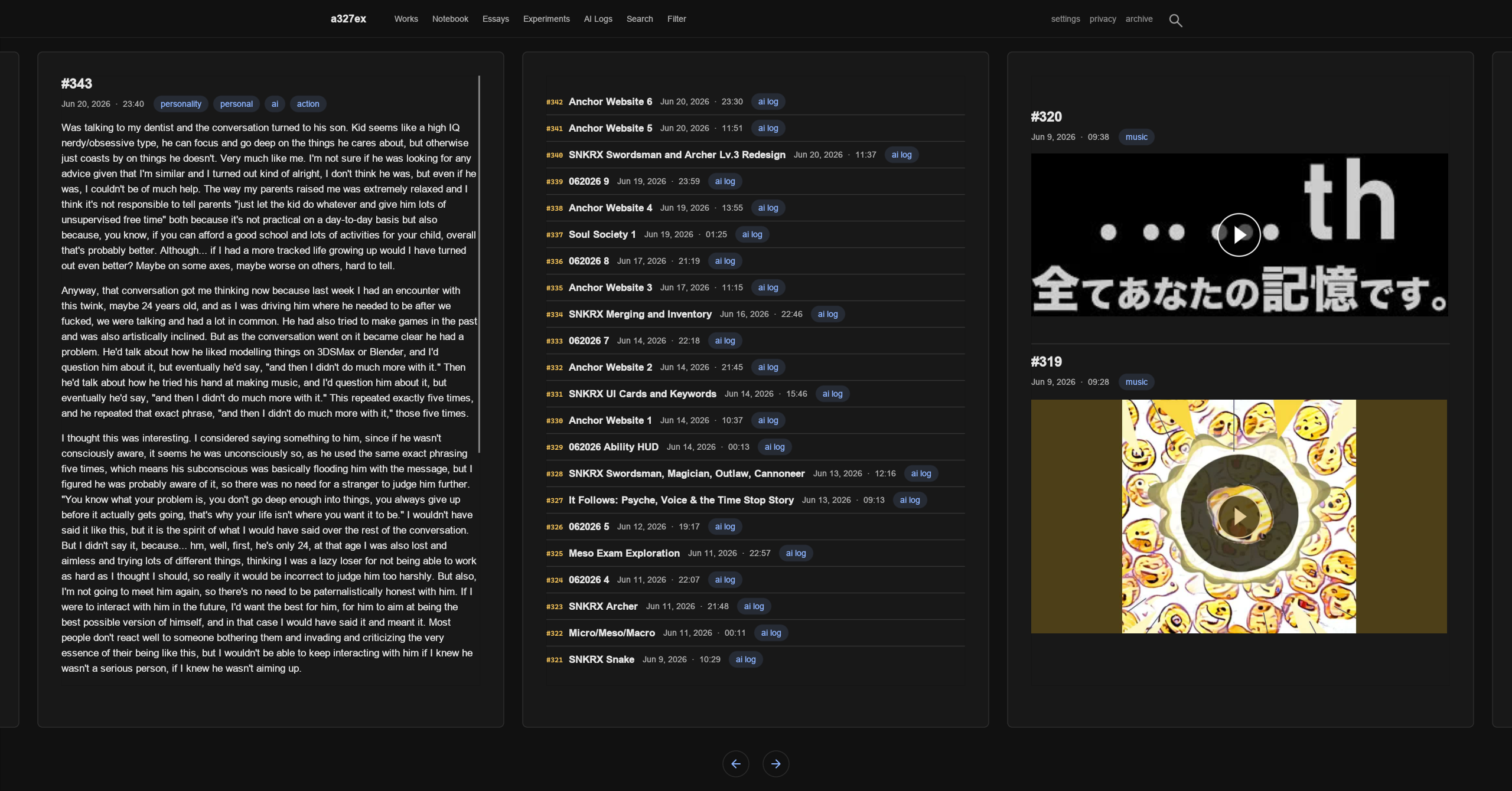
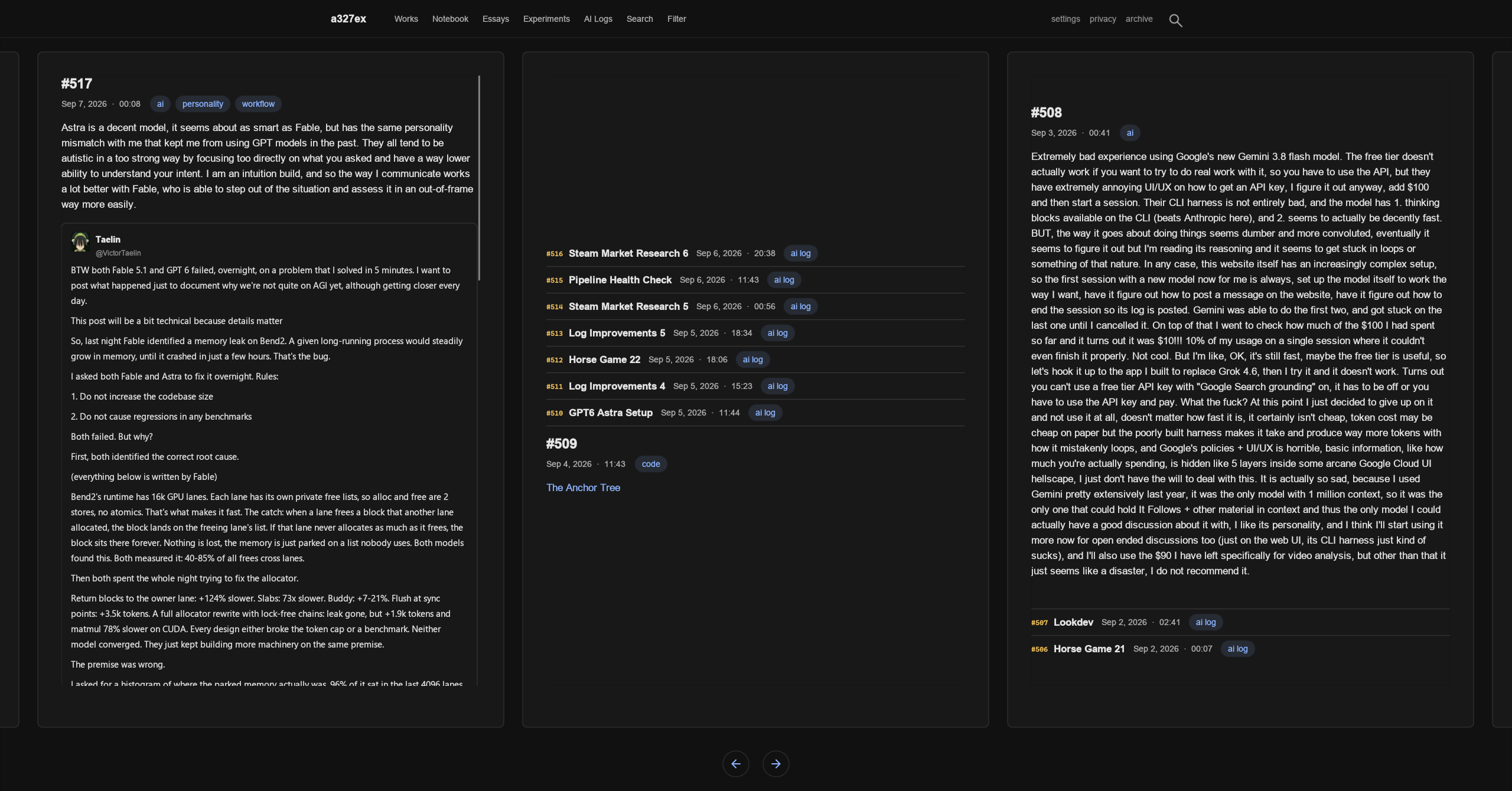
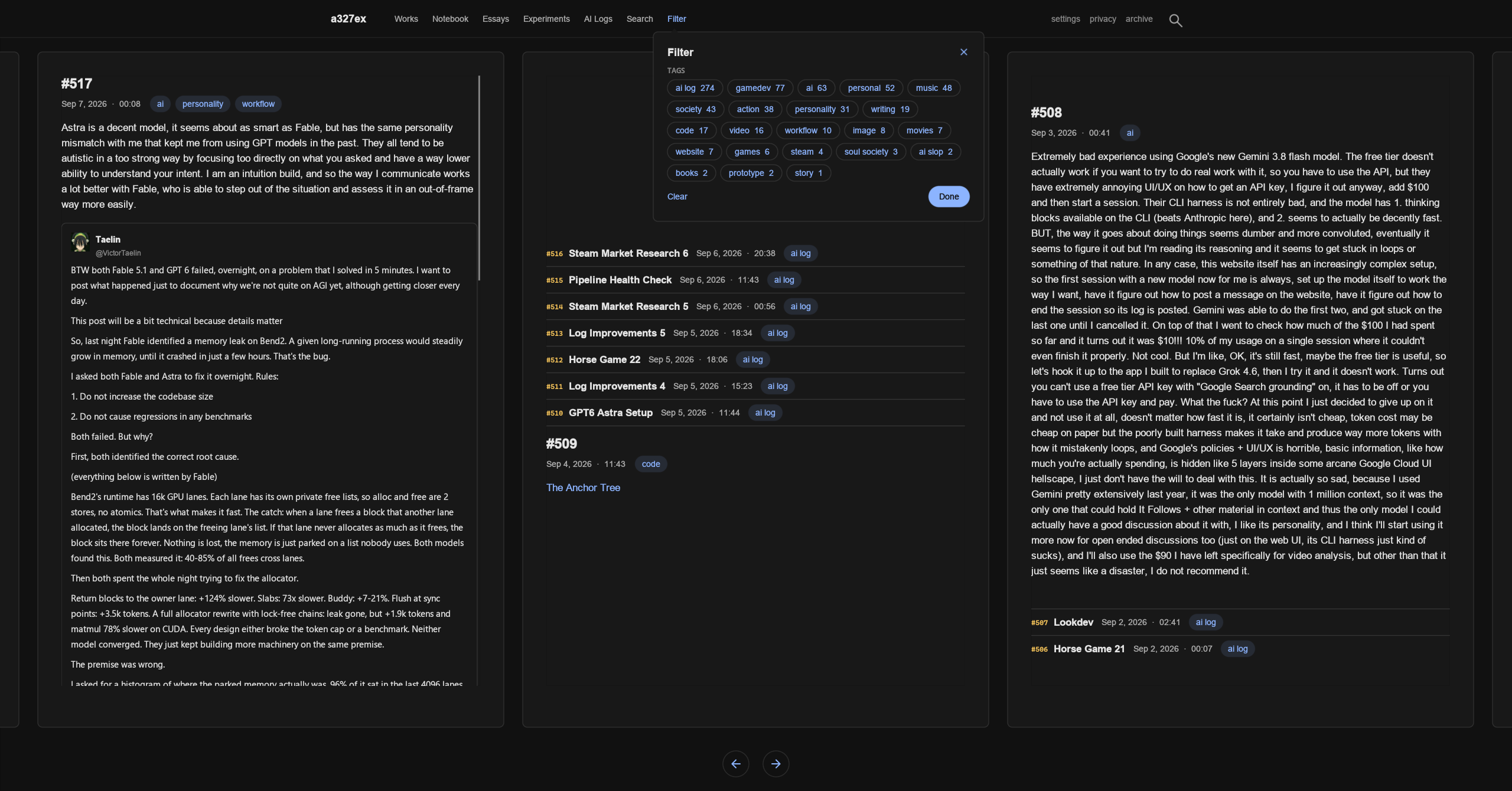
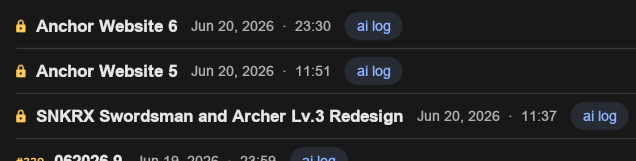
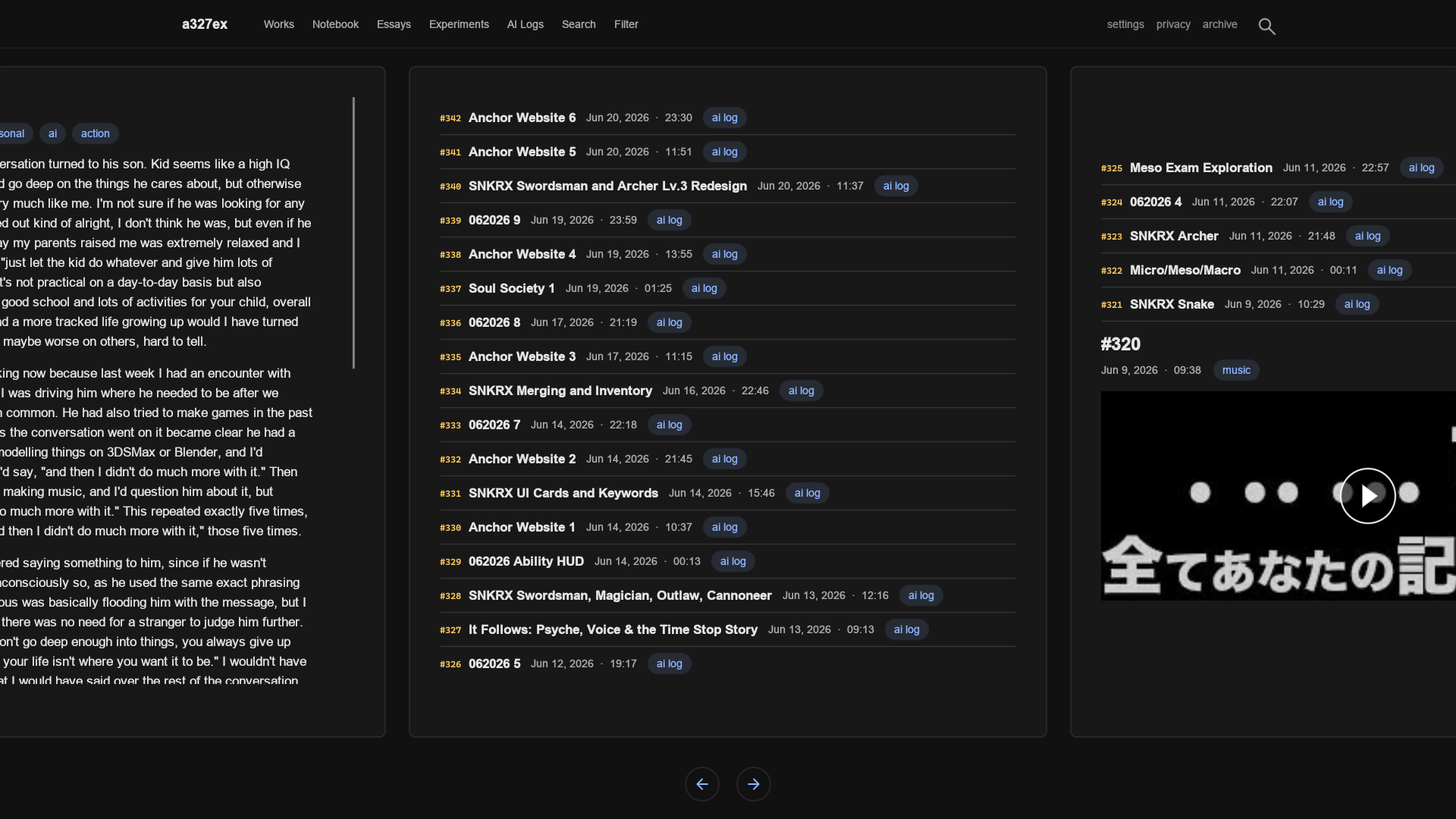
Bash ([memory: sealed target])
[Think]
I'm putting together the final handover message: Round 12 is live at commit 885ac43, summarizing the changes made plus the bug fix and stale packs cleanup. I should flag that I couldn't verify the lock behavior against real gated logs since I only had simulated headless testing without a cookie, and that the Reading theme isn't visible on production headless either — the owner's device would need to be the real test.

I want to give clear testing steps: visit a327ex.com, press F2 for Reading, check a column of logs around June 2026, confirm Website Redesign 1/2 and Reverse Minesweeper Prototype show gold locks, and open Filter to check that there's no Kind row and that story/prototype/ai tags appear correctly. I'll also note the CLAUDE.md delegation doctrine looks fine and that owed items remain untouched, keeping everything concise without em dashes or parentheticals, leading with the outcome first.
Round 12 is live on a327ex.com as site commit 885ac43, and it covers all three items from your last verdict. I checked it headless at 2560 and 1920 and confirmed the live site boots with a clean console. I could not see the lock on your real gated logs, because the headless instance has no viewer cookie. I checked it by marking three public logs as gated instead, so your device is the first real look.
What changed
- Log rows are compact. Logs lost the 32 px band, and the space around each rule is 8 px beside a log instead of 16. A log row now takes about 47 px instead of about 100.
- Gated logs show a gold lock where the id would be. It is drawn with the engine's shapes at roughly the title's cap height, so no icon file was downloaded.
- Kinds are gone.
story,prototypeandai logare ordinary tags, andpostandessayno longer exist. The Filter popover has no Kind row, just the tag chips. - Fixed an existing bug that would have hit you. Rebuilding the book didn't reset the packer's record of placed entries, so a rebuilt book packed only a few columns. Merging the gated index rebuilds the book. If your gated logs arrived after the first pack, your front door would have come up nearly empty.
- Fixed a smaller existing bug. Cached filter results now reset when the layout changes. Before, switching back to a filter after a resize could show columns measured for the old window size.
| Window | Columns before | Columns now |
|---|---|---|
| 2560 × 1340 | 205 | 192 |
| 1920 × 1080 | about 237 | 222 |
One column now holds up to 22 logs.
How to test on the live site: press F2 until you reach Reading, then page to a run of logs, for example mid-June 2026. The three gated logs should each show a gold lock instead of a number: Website Redesign 1, Website Redesign 2 and Reverse Minesweeper Prototype. Open Filter and check that it lists tags only, with story, prototype and ai log among them.
Found but not fixed: on phones, logs never appear at all. The mobile feed only draws entries whose document has loaded, and a log never loads one.
The other owed items are untouched: ids in the gated index, the two engine_snapshot bugs, the poster analysis deploy hook, and the pack cache. REDESIGN.md has the round 12 entry and a rewritten section 13, and the snapshots I sent are frozen under renderer/reference/site-theme-2026-09-13/rounds/12-homepage-book-r12/.
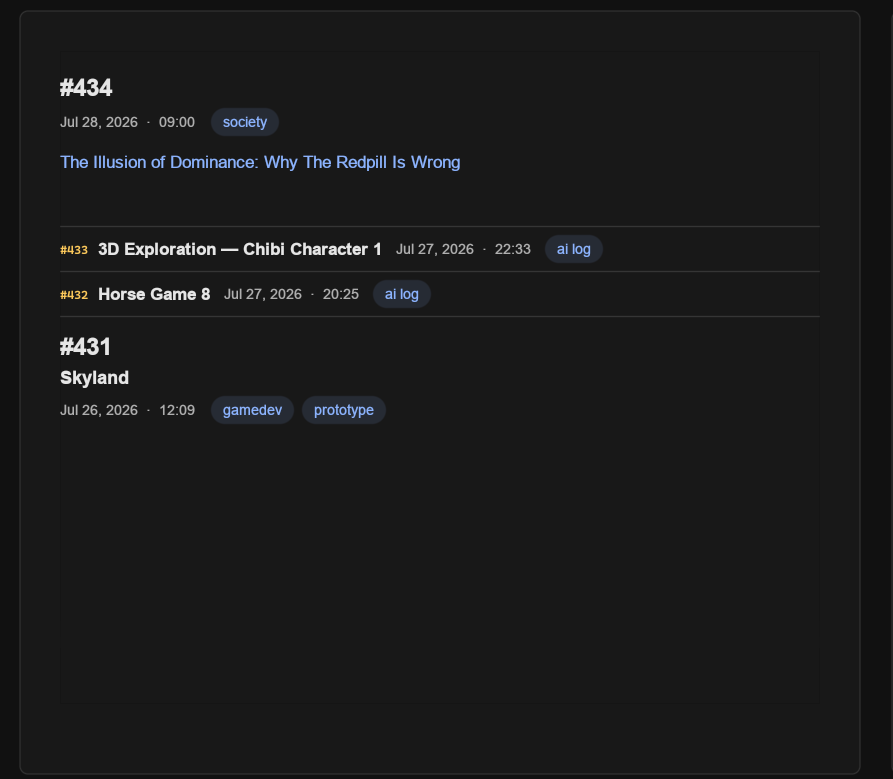
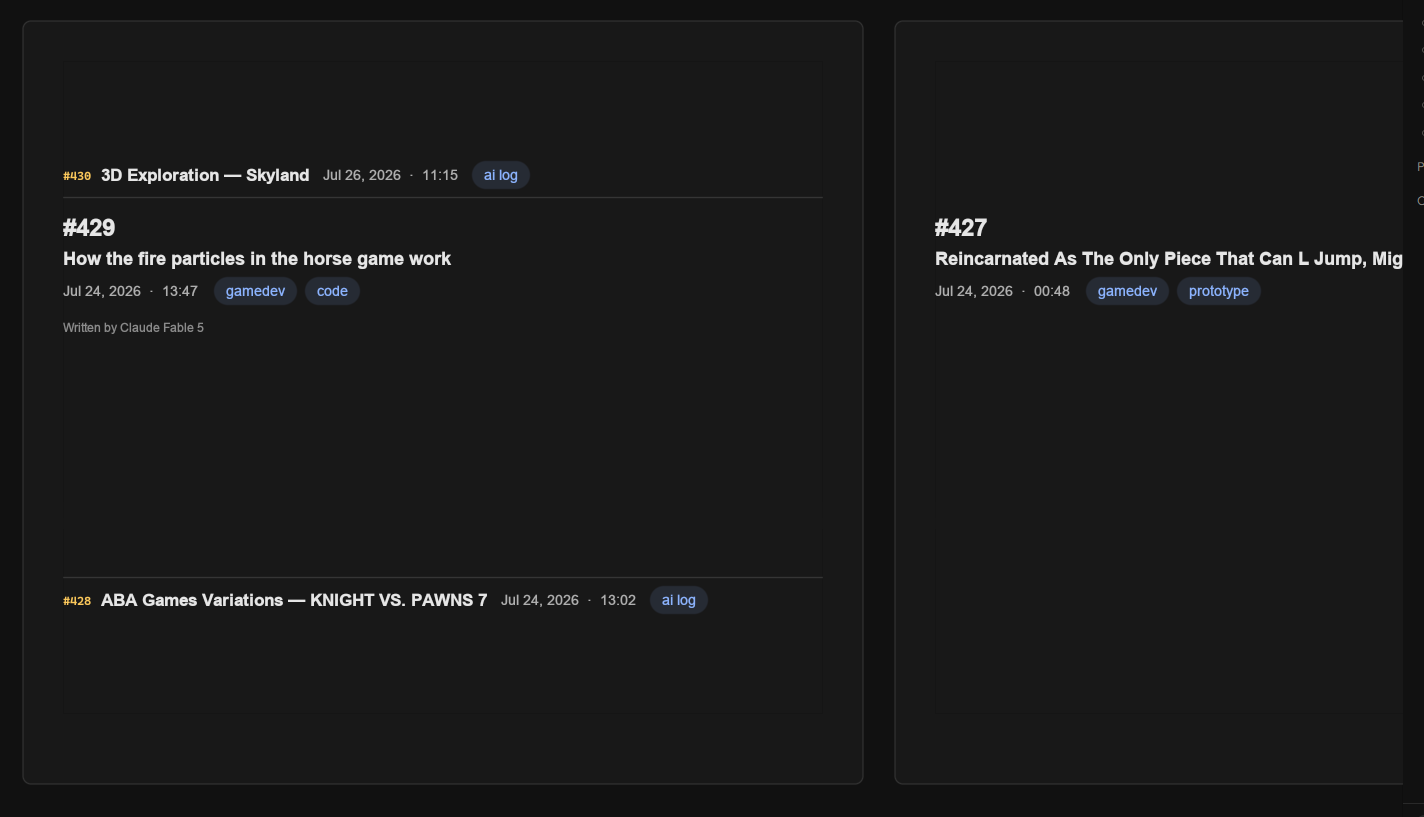
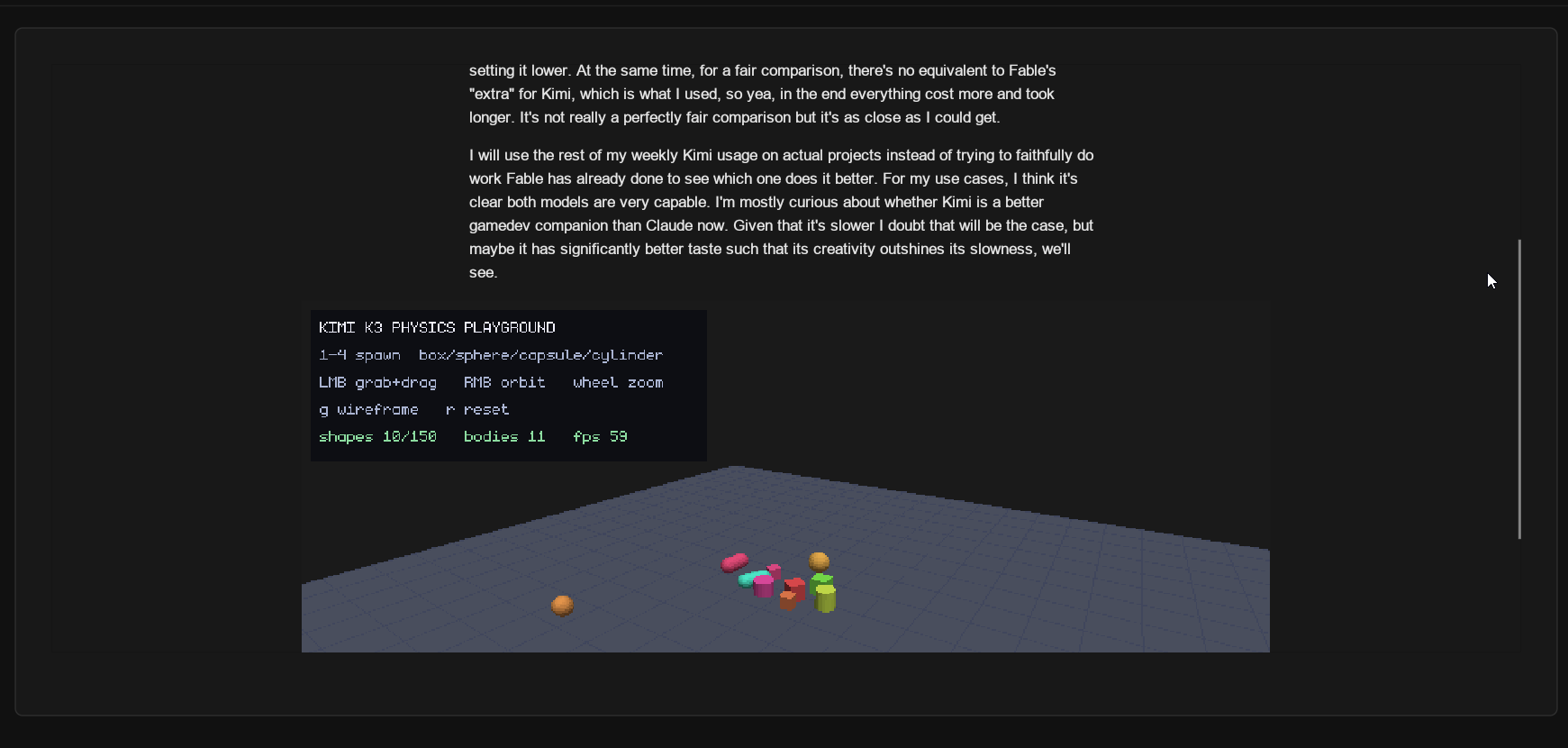
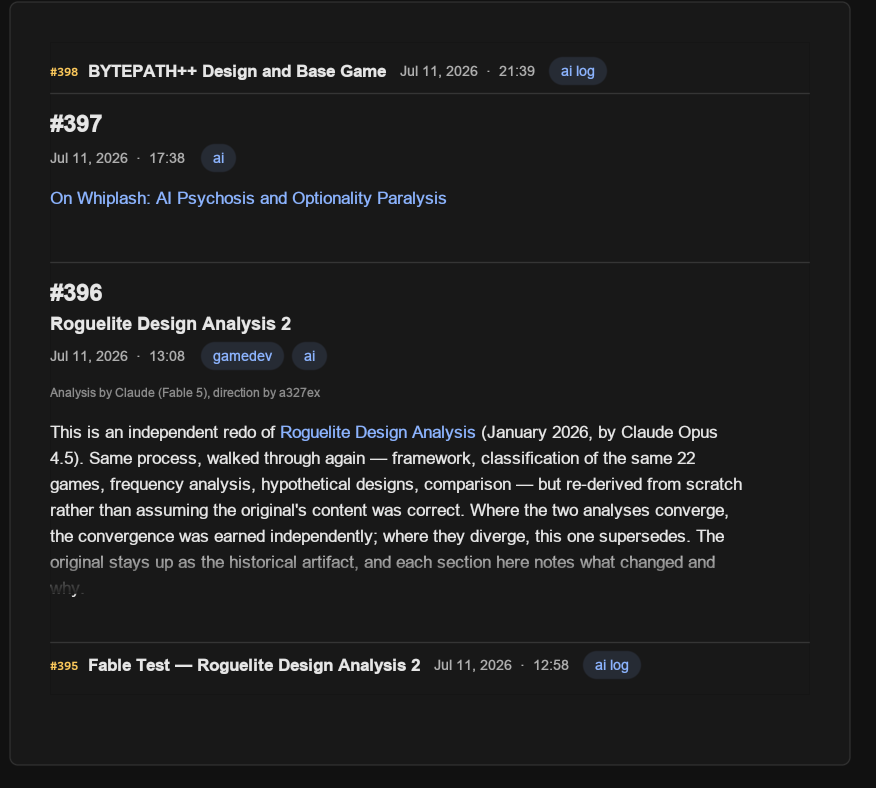
Both up and down, when a log interfaces with a non-log item, the spacing should be a tad bigger. The spacing should remain the same on places where logs interface with logs. As per image 2, some posts have inconsistent endings when interacting with logs that come after them, like too big of a space below them. What predicts indie success is a very long post, should be on its own frame, it's also currently not showing. Same for Skyland on image 4. Skyland and other games/prototypes should take over the entire screen, in fact, their frame should be as big as needed to accommodate them, up to the user monitor's size. How fire particles post is also not showing, and the game after is also not showing. Game, like Skyland, and other such artifacts, should pretty much take over. Post #410 in image 6 has the right idea, but it's too big for the size of the actual game in it. Either the game needs to be bigger (I believe the original took over the screen horizontally) or the frame diminishes. I prefer that every game-like thing, if it can, takes over the screen and occupies one big frame, so the fix in this case is to increase the view for the simulation here. There's also a bug sometimes where a frame with a game in it doesn't scroll down properly with mouse wheel only. Image 7, RDA2 is a long post, it should be on its own frame and you can scroll down to read it all. Whatever behavior whoever did that cuts posts in the middle without a scrollbar (must have been added when log summaries were added by mistake last session) needs to be removed. Same issue with the privacy post. Same issue with these posts, all are long and thus should be their own frames, not cut.
[Think]
I'm parsing the owner's feedback on spacing — logs interfacing with non-log items need slightly bigger gaps than the current log/post calculation of 8+1+16=25, though logs next to logs stay the same.

Then there's the issue of inconsistent endings, like the fixed 208px excerpt box leaving empty space when content is short. But the bigger fix is that the owner wants excerpts removed entirely — posts that get cut off mid-content without scrolling need to go, so titled posts should render in full just like untitled ones, with long posts getting their own scrollable frame instead of being truncated.

I'm thinking log-log spacing should be 17px, while log-post should be a bit bigger, maybe 25 or 33px depending on symmetry, with no band involved there. For post-post spacing, I'm inclined to keep the band since it wasn't flagged as an issue and it's reserved for a future comment bar element.

Reconsidering the actual complaints, though — the oversized gap in one example is really the excerpt box's fixed height showing mostly empty when content is short, compounded by the band, not the band alone. That reframes the "inconsistent endings" issue: it's specifically the band appearing right before a log entry that reads as wrong, so I'll set the post-to-log gap at 20px and drop the band there.

Keeping log-to-log spacing unchanged at 8+1+8, I'm making the log↔non-log spacing symmetric at 16+1+16=33 in both directions, since that's a bit larger than the current cramped 25px above posts and much smaller than the bloated 57px below posts — this satisfies "a tad bigger when interfacing with non-logs, same when log meets log."

For post-to-post adjacency, I'm deciding to keep the reserved band only between two non-log posts (for a future comment bar), flagging this decision in the handover doc since the comment bar doesn't exist yet but the spacing logic needs to anticipate it. This raises a packing question: since band height currently lives inside block_h, I'm considering pulling it out into a separate sep_h value so column-bottom posts don't carry phantom band space that skews centering.

Now I'm also confirming that titled long posts should behave like untitled long posts — living alone in their own frame and scrolling if they exceed the body height, matching the existing rule that a column only scrolls when its first post requires it.

As for why several titled posts (What predicts indie success, How fire particles, Reincarnated, Skyland) show empty right now, I suspect the lazy loading of their full documents is failing, possibly specific to how it fetches when a column comes into reach.

But now these titled docs need loading at boot for packing purposes, similar to how untitled posts already load. That means boot time grows since some titled docs are massive — the It Follows story alone runs 252 pages, and fully laying it out at column width for pagination could add roughly 300ms on top of the existing ~1.1s for 186 docs.

The story should render as its own long scrolling frame rather than being cut, same as other long titled entries, while logs stay single-line. Since canvas drawing culls by visible band, a huge scrolling column shouldn't be a rendering problem, but the load cost of fetching that large story file lazily on the web, positioned deep in the timeline at Dec 30 2025, still needs to be worked out relative to packing order.

For loading, I want to trigger fetches as the packer reaches each titled entry, having it wait when the body is still in flight rather than assuming titled entries are always ready. That means updating the packer's readiness check so titled entries also require the doc to be loaded, not just the titled flag, and adjusting load_entry so it correctly polls pending fetches and returns once the doc resolves.

I need to check the code carefully so the packer calls load_entry with the force flag only when needed, and I should also consider whether feed mode should lazily load titled docs — but that's out of scope for now, so I'll leave it.

Separately, for games and prototypes like Skyland, the user wants these to take over the full screen, scaling up to the monitor's size rather than staying constrained — referencing an example post that had the right idea but was sized too large.

Looking at that example, the game box was fixed at 1075 wide within a much wider column, so I'm thinking the fix is to have the game box take the full inner width at its own aspect ratio, capped only by the available body space.

Actually a game post taking over the screen suggests the frame width should be the full content width (window minus margins), not the current two-pitch-width calculation, so neighboring columns would be pushed off-screen while the active column centers. The game itself would render at that column's inner width scaled to its aspect ratio, capped by the available height.

Now I'm figuring out which posts actually count as "game-like" -- Skyland's 3D exploration prototype and the Reincarnated knight game clearly qualify, but I'm less sure about the fire particles post, which seems to be a long write-up possibly containing small embedded demos rather than a full-bleed game, so it probably shouldn't get the same full-screen treatment.

The distinguishing factor is whether a doc has a full-bleed game element detected by the packer. Titled prototype docs like Skyland and Reincarnated weren't rendering wide because they weren't loaded at pack time, so the game detection returned nil -- but once those docs load properly, they should get flagged as wide just like #410 did before the excerpt change.

Now I'm thinking about frame sizing: the game box should expand to fill available width and be as large as possible, capped at body height minus margin so it fits on screen once scrolled to, even if header/text content above pushes it down.

For issue #410 specifically, I'm digging into why the Kimi physics simulation's game box (1075x390 within a 1712 frame) isn't taking full width -- checking whether it's constrained by a fixed aspect ratio in its definition, since a wider aspect would naturally scale to fill more of the frame.

Actually the visible game area might just be clipped by the scroll container rather than the game's own sizing—I need to check the actual element rect and definition for #410's game to be sure. There's also a separate bug where mouse wheel scrolling behaves inconsistently over a game frame: wheel input inside the game rect should go to the game itself while outside it should scroll the column, but the Kimi game apparently uses wheel for zoom, which could be causing the conflict.

That confirms the classic scroll-trap: as the game scrolls under the cursor, wheel events start routing to it instead of the column, causing scrolling to stall intermittently. The fix would be scroll latching — once wheel events are scrolling the column, keep routing subsequent wheel events there for a short window (say 500ms) even if the game ends up under the cursor, rather than letting the game hijack the wheel for its own zoom.

Titled post rendering is another issue: long posts like RDA2 and the privacy post get cut off mid-text with no scrollbar, when they should instead render as their own full scrollable frame. The same fade-and-truncate problem shows up on other long posts too, like #195 "170011" and #193 "000001" — the excerpt logic is trimming text awkwardly, so removing excerpts for these cases seems like the right fix.

I'm also reworking how titled post headers link: instead of making the whole block clickable, I want the id to link via entry_url so story/prototype routes resolve correctly, and I'm considering making the title itself clickable too as a separate link with hover styling.

Checking other cases now — the link post "The Illusion of Dominance" seems fine as is, but Skyland (a prototype) needs its layout changed to a full-bleed game column instead of the excerpt treatment, since it's structured differently from regular posts. For massive documents like the "It Follows" story, I'm confirming the layout can handle rendering an entire long column with proper culling so performance holds up even at very large scroll heights.

Also thinking about which entries qualify for the full-screen game frame treatment versus staying in a normal column — it should hinge on whether the doc has a full-bleed game flag set, and I need to double check that prototypes without that explicit flag still get handled sensibly rather than falling through to a broken layout.

I'm wondering whether the centered text offset affects how the game box gets laid out, since canvas_layout takes a full width but the game element might have its own max width or aspect ratio that's capping it—possibly not 16:9, which could explain why the box came out at 1075x391 instead of what I'd expect.

Trying the math on body height minus 48 doesn't line up with 391 either, so I'm guessing the layout happened at a moment when the window was smaller—maybe before the browser resized, or the screenshot itself was cropped from a bigger window. The frame dimensions (1741x830, cropped to roughly 17-1730 by 32-793) don't cleanly divide into a body height that would produce 391 with the standard formula, so something else must be driving that number.

I need to look at the actual code: book_layout's geometry logic including anchor_x, slot rects, and page width, plus how wheel events route through book_wheel and game_host.lua, and the relevant element definitions, to figure out what's producing this mismatch and to plan the fix for the missing game frame around #410 and #427.
Here is what I take from your notes, before I read the code:
- Spacing. Log-to-log stays as it is. Log-to-post becomes the same in both directions and a little roomier. The oversized gap under a post followed by a log is the 32 px band, which I'll keep only between two posts.
- Excerpts. The cut-off blocks that titled posts and the story got in round 9 go away. Every titled entry renders in full like any other post, so a long one gets its own frame and scrolls.
- Empty blocks. Those titled excerpts mostly came up empty because their first element was taller than the excerpt box, or the document hadn't loaded. Rendering in full fixes that too.
- Games. Any post with a full-bleed game gets one frame the width of the screen, with the game as large as it fits. I'll find out why #410's view came out smaller than its frame.
- Wheel over a game. I'll check how the wheel is routed when the mouse is over a live game.
First I'll read the layout geometry, the wheel routing and the game box sizing.
Bash (cd "C:/Users/a327e/Desktop/a327ex/a327ex-site/renderer" && grep -n "wide|anchor...)
Bash (cd "C:/Users/a327e/Desktop/a327ex/a327ex-site/renderer" && grep -n "game_max_h|...)
Bash (cd "C:/Users/a327e/Desktop/a327ex/a327ex-site/renderer" && grep -n "^function bo...)
Bash (cd "C:/Users/a327e/Desktop/a327ex/a327ex-site/renderer" && grep -n "kimi|Kimi" ...)
[Think]
I still need to check several files: the game layout sizing in elements.lua, the kimi game definitions and capture logic in game_host.lua, the book layout geometry in book.lua, and some data file for further context.

Then I'll check the specific game element flagged for entry 410, look for the full-bleed game canvas definition, review wheel capture gating in main.lua, and examine the remaining draw-column and game input routing logic in book.lua — all of these can be read in parallel since they're independent.
[Think]
I'll now review several independent pieces: elements.lua's game box and capture logic, book.lua's frame geometry functions, the actual content of specific game posts (#410, Skyland, Reincarnated) plus `canvas_fullbleed_game`, and main.lua's wheel dispatch and column draw code.
Bash (cd "C:/Users/a327e/Desktop/a327ex/a327ex-site/renderer" && sed -n 3286,3420p ele...)
Bash (cd "C:/Users/a327e/Desktop/a327ex/a327ex-site/renderer" && sed -n 40,68p game_ho...)
Bash (cd "C:/Users/a327e/Desktop/a327ex/a327ex-site/renderer" && sed -n 606,680p book....)
Bash (cd "C:/Users/a327e/Desktop/a327ex/a327ex-site/renderer" && grep -n "^function ca...)
Bash (cd "C:/Users/a327e/Desktop/a327ex/a327ex-site/renderer" && sed -n 3190,3232p mai...)
[Think]
I'm working out the game's 16:9 aspect ratio scaling logic, checking how the width and height get calculated against the max height cap, and comparing that against the owner's screenshot dimensions to see if they match up.

Actually the real issue: the game surface is likely 1075x605 but the visible column clips at the body's bottom edge, cutting it to 391px tall, so the user only sees the top portion. Since the game captures mouse wheel events over its area, the user can't scroll the column down to see the rest — that's the actual bug they're reporting.

At the same time, matching the original's "full-bleed horizontal" feel on a shorter window would make the game taller than the visible body, which reintroduces the same scroll conflict — so the real fix needs to either let the wheel pass through to the page scroll or cap the game height to fit within the body without clipping.

Non-pixel games could render a strip spanning the full window width at their design height, giving a genuinely wider view, while pixel games like kimi stay at fixed integer scale with gutters. So the real fix is: let non-pixel simulations use full-bleed width so they truly take over the screen, while pixel games keep their scaled, centered box.

Since the kimi playground seems built around a fixed pixel-font look at 640x360, rendering it at a wider non-pixel surface would shrink the HUD text unexpectedly. I need to check how game_host decides surface size for pixel vs non-pixel games and whether the kimi game can actually adapt to arbitrary surface dimensions before I can answer this properly.

My priority list for this round: spacing rules, removing excerpts so titled docs render fully and pack correctly, making game posts full-screen with content-width frames, fixing the wheel-trap so scrolling passes through to the column when the game is fully visible, and enlarging the #410 view specifically. For the wheel-trap fix, the cleanest rule is that the column scrolls over the game whenever it still has scroll room and the game isn't fully in view -- once fully visible, the wheel should behave differently.

Actually, thinking about this more, I want a latching behavior: once a wheel gesture starts scrolling the column, it should keep scrolling the column until the gesture ends (no wheel input for roughly 400ms), even if the game passes under the cursor mid-scroll. A gesture beginning over a game that isn't fully visible should scroll the column to bring it into view first. The simplest version: the wheel only goes to the game when its rect is entirely inside the visible column body; otherwise it scrolls the column, with a short latch window (~0.35s) to avoid flickering between the two behaviors.

I'm now figuring out where to hook this in — main.lua currently checks `game_host_captures_wheel()` before dispatching to `book_wheel`, so I need to add a check there for whether the mouse is over a column slot with a live game that isn't fully visible or is latched, routing wheel events to the book instead and preventing the game from consuming them via its `mouse_wheel()` capture gate.

Writing the claim-check logic...

I need to trace where env.mouse_wheel reads happen inside game_host_update and add the wheel-blocked check at those spots (looks like two call sites in game_host.lua, plus demo files). Then for the wider-view and full-screen frame options, I should adjust column width and inner width variables accordingly.

For determining the wide frame width, I need to check what BK.w actually is by looking at front_box in collections.lua — if BK.w is the window width minus margins, a full-width frame would push neighboring columns entirely off-screen, so I need to reconsider whether that's the intended behavior.

The height stays fixed to the body, but on a typical 1920x1080 window the aspect-capped game width ends up notably narrower than the inner box, which explains the "frame too big for the actual game" issue. To fix this, non-pixel games should render at full inner width with the cap height (a full-bleed strip rather than letterboxing), while pixel games need different handling.

I want to check how game_host builds the surface for pixel vs non-pixel games, how kimi-k3-playground handles its width/height, and how collections front_box computes BK.w, along with mouse capture behavior and doc loading for titled posts.

I'm weighing whether packer forcing a synchronous load_entry for a titled doc could cause a brief hitch — probably acceptable since packing already processes a few posts per frame. I also want to make sure the repack logic correctly clears `c.ex` once the doc lands, and that packer properly resumes on the next frame when the doc isn't ready yet (e.g. on web).

Now I'm going through each place that special-cases `titled` entries and swapping the guard to check `c.log` instead, since logs get `titled = true` set by default in load_entry — this affects `block_h`, `ensure_layout`, `draw_column_body`, and the packer's break conditions. I still need to update `load_entry` itself so titled entries get force-loaded appropriately in the packer path.

I'm also thinking about deferring load only when called from boot's `book_new` loop, so I'll change the packer to call `load_entry(rec, true)` directly, relying on it returning the cached doc if already loaded — this should work fine for both posts and titled entries without a performance hit since untitled web posts already follow this path. And for the head rendering, I want the title text to become a clickable link using `entry_url(rec)` rather than hardcoding `/posts/` or `/stories/` paths, with hover styling and proper text truncation applied to the title.

Now I'm working out the spacing rules between feed blocks: since band height is no longer folded into `block_h`, the feed loop needs to add `open_h()` explicitly to avoid losing that spacing. I'm also reasoning through the different separator heights depending on whether adjacent items are posts or log entries — non-log-to-non-log pairs get a full band plus padding, log-to-log pairs get a tighter gap, and mixed pairs need some in-between value that feels appropriately sized compared to the current asymmetric spacing.

Looking at the reference images, I'm figuring out where exactly the rule line sits relative to the log row above it and the post below it, then landing on a symmetric mixed spacing value while keeping post-to-post spacing unchanged. I also want to check whether the "too much space" complaint traces back to how excerpt boxes with short content interact with the band above them, since that could explain the inconsistent-looking gaps near archive entries.

For the game frame layout, I'm working out how to fit non-pixel games into the available content width and height, considering whether they should stretch across the full strip width instead of being aspect-fit, and how that affects how the host tracks element bounds.

Looking at pixel-locked games like kimi, the fixed aspect ratio at 1387x780 scaled into a 1920x1080 cap leaves large empty margins on the sides — around 453px of unused space in the frame. The real fix might be adjusting the simulation's view/camera to use that space, or if the game's rendering supports arbitrary resolutions, switching it to fill the strip non-pixel style instead.

The internal width would scale with the box's aspect ratio so the 3D camera shows a wider field matching the container. I need to check that the game code reads the width dynamically rather than hardcoding it.

I also need to check the kimi-k3-playground and skyland game main.lua files for how they use width/height constants, look at the collections front_box sizing, and review the book_composite live game section to understand how the composite sizes the embedded game.
[Think]
I identified two issues: the Kimi playground's fixed 16:9 box shrinks awkwardly in short windows, and a scroll trap where wheel input over the game gets swallowed by its zoom, blocking the column from scrolling. Next I'll check how game_host sizes surfaces, whether Kimi/Skyland read dimensions dynamically, the front door's content box, and how the book composites a live game to determine if games can render at a wider aspect.
Bash (cd "C:/Users/a327e/Desktop/a327ex/a327ex-site/renderer" && grep -n "def.w|def.h...)
Bash (cd "C:/Users/a327e/Desktop/a327ex/a327ex-site/renderer" && for g in kimi-k3-play...)
Bash (cd "C:/Users/a327e/Desktop/a327ex/a327ex-site/renderer" && grep -n "front_box|b...)
[Think]
I realize the host already supports expanding the view: for pixel games in a full-bleed strip, the surface width grows to fill the wider rect at scale k while height stays fixed at the default, whereas non-pixel games just take the rect's width and height directly. So the mechanism for a wider internal view already exists in the host logic.

But round 8's game_max_h branch forced the box to match the game's own aspect ratio, which eliminated that wider-view effect. The fix is to let the frame use the full inner width and as much height as fits, letting pixel games recompute their scale factor so the surface spans the full width, and letting non-pixel games render directly at box size and handle aspect themselves.

For height, I'm weighing whether the game box should be the column body height minus the header, so a game-only post shows fully without scrolling, versus using a smaller cap when there's text above — for posts with preceding text, the user scrolls anyway, so the larger cap makes more sense there.

I also need a minimum height for very short windows, and I should account for the content box's horizontal padding when computing the frame width, so the box doesn't literally span edge to edge but fills the constrained content area at wide viewports.

The text measure above the game stays centered and fixed-width, matching the earlier decision. Full-bleed treatment applies only to actual games like Skyland, not smaller inline demos like fire particles or steam charts, which keep their own normal-column frame — and a game post occupies its own solo wide column at pack time, so the packer needs BK.w resolved before packing happens.

I realize the reset condition in book_layout needs to account for BK.w changes too, since page_w gets capped at large widths while the underlying w keeps changing — so wide columns could silently drift out of sync without a proper reset. I'll add a check for BK.pack_w changing to catch that case, and make sure col_w and inner_w both resolve to BK.w for wide columns, with layer sizing following suit.

Now I'm reworking game_box_h to take the rec parameter so it can subtract the actual head height instead of a fixed offset, since head height depends on pushed reading fonts. This matters for how columns center vertically — if a column's total height (head + text + game) exceeds the body height, it'll scroll, which is the behavior I need to verify for the Skyland column case.

I'm also revisiting the aspect-fit logic in elements_set_game_max_h: in "book frame" mode, the box should be limited by the smaller of the natural aspect-fit height and the capped height, rather than always fitting to width.

For pixel games I compute a scale factor from height, then derive a wider virtual width so the box still fills the full inner width without distorting pixels; for non-pixel games the surface just matches the full box dimensions directly. I'm sanity-checking this against the skyland game (aspect ratio wider than its design) and a pixel game like kimi, confirming the wider-view calculation keeps HUD elements anchored correctly.

Checking knightvspawns' 480x270 pixel setup, I realize its layout captures width/height once at load time, so I need to make sure the host sets the resized width before the game initializes rather than after — otherwise resizing later won't trigger a re-layout. Since the article page already handles this same case successfully with the same scale-based virtual width mechanism, I'm confident this approach will carry over correctly to the new layout branch.

That checks out with only minor pixel overflow, acceptable. I confirm game_max_h is only referenced through elements_set_game_max_h in book.lua, so no other callers need updating, and I note the comment about wide pages needs revising. Now I'm moving to the wheel trap fix, starting to write the book_wheel_claim function that determines whether a wheel event over a live game should be captured...

Writing wheel-claim logic...

I'm refining the claim condition: only latch onto wheel events when the cursor is over the game and either the drag latch is active or the game isn't fully visible, and only if the column is actually scrollable. I'm also considering the edge case where scroll is already at max but the game remains clipped — wheeling down would keep the game static rather than scrolling the column, which seems acceptable. Now I'm sketching the integration point in main.lua just before the game host update call.

Being inside the update function rather than the top-level chunk should be fine since the 200-local limit is per function, not the whole file. I'm checking that game_host_wheel_blocked is properly global so both wheel-check sites in game_host.lua see it, and confirming the game's own update tick (where it reads mouse_wheel) actually runs inside game_host_update — also noting the wheel isn't reachable through the eval/snapshot path, so injection there isn't a concern.

To verify the wheel claim, I'll call book_wheel_claim directly with synthetic coordinates and state rather than going through that channel. Now I'm restructuring the title-link portion of draw_head: truncating the title text to fit the width, computing its hit rectangle, registering it if a reg callback exists, and checking hover state against the mouse position.

I'm applying the same click and hover-color logic to the title as I did for the id, using the same entry_url source for both link kinds. Then I notice a pre-existing issue: in feed (mobile) mode, titled docs rely on the column-based preload retry, but feed mode has no columns, so titled docs may simply never load and show up in the feed.

Actually this matches prior behavior—feed mode already skipped titled docs, so there's no regression. I'm considering having draw_feed lazily load titled docs within budget by checking cache and calling load_entry when the row is near the visible area, but I'm wary of cy not accumulating for unloaded rows, which could cascade loads oddly across frames. This feels like scope creep beyond the current fix.

I should also clean up dead code like EX_H, EX_FADE, and excerpt_doc, along with the titled branch in draw. For book_repreload's titled branch, I can simplify since the packer already retries loading pending docs each frame on web, so I just need to drop the stray c.ex reset. The book_new boot loop correctly only loads untitled docs upfront, keeping titled ones deferred, which I'll leave as is.

Checking the packer condition more carefully, the break-forever bug happens when a titled entry's cache exists but lacks a doc -- I need it to call load_entry with force when there's no doc or log, not just bail out. Then load_entry with force on a titled record that has a cache entry without a doc should fall through to creating a new entry doc.

For block_h with pending titled entries lacking height, it should just fall back to head height plus zero until layout is ensured. The wide-column detection logic for game posts looks right -- checking `c.game` mid-column then starting fresh as the first entry of the next column so it becomes wide.

Now I'm reworking sep_h to remove the half_gap helper...

Writing gap and separator height logic...

Since the last post in a column has no trailing band, the group height shrinks by 32 compared to before, which should be fine. I need to check the packer's height accumulation logic still holds, and make sure game_box_h(rec) is passed consistently to both ensure_layout and the draw call so the layout cache key stays in sync.

But I realize the cache key doesn't include body_h, so if only the window height changes without width changing, ensure_layout won't re-layout and the wide game box will keep a stale height. I need to add a game-cap key (computed from live_game and game_box_h(rec)) into the cache key comparison so height changes properly trigger relayout. I also need to confirm fonts are pushed before head_h(rec) is called inside game_box_h, since ensure_layout runs during both packing and drawing phases.

Since draw doesn't redo layout (it just calls canvas_draw), this confirms the earlier issue is fully covered by the elements-change fix. Checking the centered text position and column width math against BK.w looks consistent, and the neighboring wide columns peek slightly onscreen at typical resolutions, which is fine.

I also need to make sure the pack-reset condition accounts for width changes, adding a check against BK.pack_w and updating it accordingly, and confirming BK.w is properly set before packing happens during layout.

I'm tracing through where s.game gets assigned during draw and confirming slots persist correctly between update and draw calls via BK.slots. I'm also verifying the game host note visibility logic, then working out pixel dimensions for a wide 2560px frame — computing BK.w, inner width, and body height after subtracting header, footer, and padding values.

Now I'm computing the resulting kimi pixel scale and internal width for the skyland render, noting the performance implications of a large 3D-rendered surface at that resolution but accepting it as normal for wide article pages. I'm also running through a checklist of frame verifications I still need to do — spacing columns, RDA2, the indie success article, skyland, #410, privacy — and wondering whether game frames actually render properly inside the agent view.

Headless 3D rendering with a hidden GL window should still work, so I expect the snapshots to reflect that once captured. I'm also reconsidering how #434 and #431 interact after the layout change, confirming skyland now gets its own full frame, and noting "title as link" doesn't apply for gated content. Before writing the patch script I'm mentally cataloging which code regions I've already reviewed and incorporated edits into — the entry loader, packer, column body rendering, layout ensuring, book preload, excerpt doc, sizing constants, head height, head drawing, and the feed — so I know what's safe to modify directly.

Now I'm checking a few more regions: the block height calculation with its round-12 edit, the column guard condition, the game box height, inner width and column width calculations, and the book layout reset condition, all of which I've already reviewed. I'm also noting that the game host's mouse wheel handler appears twice in main.lua with identical code, so any replacement there needs to target both occurrences. There's also a minor header comment in book.lua about wide column tables that doesn't need changing, and I want to pull the exact wording of an older comment block about open height before I finalize the patch.

For the excerpt removal, I'm identifying the exact span to delete—from the excerpt block comment through the end of the excerpt_doc function—and separately locating the titled draw branch that needs to be cut, making sure the end marker matches the first occurrence after the start point to avoid grabbing the wrong section.

Now I'm confirming the EX_H and EX_FADE constants can be safely removed since both usages (in the titled block_h branch and the excerpt block itself) are already being deleted, then checking how `rec.titled and not rec.log` is handled in book_repreload.

I'm updating the comment explaining that untitled posts still load at boot while titled ones defer. Then I'm checking the packer's break conditions so they account for both doc and titled cache states, and tracing how ensure_layout handles a titled placeholder without a loaded doc to make sure it correctly returns nil until the packer catches up.

Now I'm adding a gcap field alongside cap tracking in ensure_layout, so cache invalidation also triggers when the game cap value changes, mirroring how live and stamp changes are already handled.

Then I check the draw column body guard to switch it from checking c.titled to checking c.log instead, verifying indentation and occurrence count match exactly. I also want to replace the manually constructed post URL in draw_head with a call to the shared entry_url helper, provided entry_url is already defined earlier in the file.

Now I'm updating the title rendering block in draw_head, removing the standalone title text drawing since the whole block already links to the page, and adjusting the accompanying comment to reflect that. Then I move to the mobile feed layout, tracing how block height and card spacing get computed and how the divider line gets drawn between cards.

I'm also revisiting the game_max_h branch in elements.lua, calculating aspect-ratio-constrained widths and heights for embedded game windows, capping the height when it exceeds the max and recomputing width accordingly...

I'm tracing through the case where the cap limits the box: the game surface renders a wider view rather than a narrower one, matching how the article page's full-bleed strip behaves, and I'm double-checking that the host's width calculation and the draw function's centering logic (which comes out to zero offset here) are consistent with this.

I need to patch the wheel-capture check so it also respects a `book_wheel_claimed` flag defined earlier in the same scope, guarding it before it zeroes out wy. Then that wy still flows into book_wheel to scroll the appropriate slot when applicable.

I'm also patching game_host.lua's capturing check to include a `game_host_wheel_blocked` condition in both matching occurrences, and I need a line-ending-safe load helper that detects CRLF vs LF and preserves the original format rather than assuming one. Now I'm writing the claim function inside book.lua near book_wheel...

Writing wheel comment...

I'm coding the claim function itself: checking if the pointer sits over a slotted game's bounds, and if so, latching wheel control to that slot for a short window so scroll gestures don't leak back to the page mid-motion.

I need to make sure `book_wheel_claim` is declared after `slot_at`, and that after a scroll event I update `BK.wheel_slot` and `BK.wheel_at`. I'm also reasoning through the "whole" condition — whether the game fills its slot so scrolling at max should hand off to the page — and wondering whether arrow-key scrolling should be routed to the game the same way as wheel events.

Then I'm thinking about how to compute a game box height from the body height minus a header height, making sure fonts are pushed before measuring the header so `head_h` returns accurate metrics, and double-checking `s.max` accounts for any extra content padding beyond the game's own height.

I also want to save the redesign/memory notes for later, and I'm noting an outdated header comment in book.lua about wide-table columns that I'll skip fixing for now. Before writing anything I need to confirm exact surrounding text in a few spots -- the column guard line, the game_host mouse_wheel handling around line 319, and the main.lua block calling `game_host_update` and `game_host_captures_mouse` -- and I've confirmed the main.lua snippet matches what I expected.

Now I'm checking the `game_box_h()` function, which computes the live game's box height as the column body minus 48 pixels so the whole game stays visible once scrolled into view, clamped to a minimum. I've also verified the draw_column_body guard that checks cache entries for height or title before rendering, and I'm looking at the start of a `book_layout` reset block to confirm its exact structure.

Now I'm examining the reset condition triggered when the page count or dimensions change, along with the helper functions computing inner width and column width based on whether a column is wide (spanning two pages plus the gap) or single. I'm planning to consolidate the wide-width calculation into a shared `wide_w()` helper.

I'm also updating a comment describing when a game takes the full width instead of a single pitch, and preparing to draft the patch script covering these changes before running syntax checks, building, and deploying to verify the result. I want to re-check the exact `draw_head` function text following the earlier lock patch to make sure the new edits align correctly.

Adding hover-hit region logic...

I want to make sure draw_head stays consistent with the id's click-latch behavior in feed mode, and confirm all remaining EX_H references have actually been cleaned up across block_h, excerpt_doc, and the titled draw branch before writing the final patch.
[Think]
I've confirmed the fixes needed: restore the game frame's full width/height cap, patch the wheel-scroll trap, and load titled documents before excerpt removal. Now I'll write a single Python patch script covering book.lua, elements.lua, game_host.lua, and main.lua, handling both line-ending styles.
Write (C:\Users\a327e\AppData\Local\Temp\claude\C--Users-a327e-Desktop-a327ex\592f70a5-4c81-42cb-be1b-c83f80f4b9b1\scratchpad\r13_patch.py)
[Think]
I need to run the patch and syntax-check all four files, then grep for other places using the `titled` check that might break—like `entry_video_hs`, which currently skips shortening for titled entries. I should make that consistent with posts by removing the `or c.titled` condition there too.
[Think]
I've written the patch script. Now I'll apply it, syntax-check the four files, run the attribution test, and list any remaining `titled` references in book.lua that might still assume excerpts.
Bash (cd "C:/Users/a327e/Desktop/a327ex/a327ex-site/renderer" && python "C:/Users/a327...)
[Think]
I still need to check a couple more titled references: the video shortening check that currently excludes titled posts should be removed since titled posts now render fully like regular ones, and the pending-doc repack trigger that only fires for untitled docs likely needs to also account for titled docs given they now affect packing.

I also want to check the book_repreload logic that skips repacking for titled boxes since they used to have fixed heights — now that titled heights depend on media, this exclusion needs to go. And there's a head_h() readout scoped to untitled posts only that I need context on. Let me pull all three of these regions in one read before making the patches.
[Think]
Patch applied successfully, but four `titled` references in book.lua still assume the old fixed-height excerpt (video shortening, pending-document repack, media-growth repack in `book_repreload`, and one readout). I'll read that file next to address all four together.
Bash (cd "C:/Users/a327e/Desktop/a327ex/a327ex-site/renderer" && sed -n 490,497p book....)
[Think]
I'm working out two fixes: removing the titled-entry check since those already have full docs while videos can still be shortened, and reworking the pending-loop condition to check for a missing log instead of missing title, since a pending doc for an untitled entry means the packer broke off and needs a full repack, whereas the titled pending case behaves differently.

For the reload section, I'm keeping the titled-branch loading logic but changing the change-detection so any load marks it changed, and removing the leftover `c.ex` reset while updating the comment to match. For the header-height helper, I realize it's using a fixed calculation instead of computing per-entry height, since titled entries need a taller header — I need to move the height calculation inside the loop so it's computed per record rather than globally, though I need to see how the result is used downstream before finalizing the exact replacement.

I'll write a status update for the user, then create a small patch script to apply these fixes, run it, verify syntax, and confirm before moving to drive verification.
[Think]
I've finished removing the outdated excerpt assumptions in book.lua—titled entries now support video shortening, trigger a repack when their document or media loads, and get correct element-rect measurements for their taller header.
Write (C:\Users\a327e\AppData\Local\Temp\claude\C--Users-a327e-Desktop-a327ex\592f70a5-4c81-42cb-be1b-c83f80f4b9b1\scratchpad\r13b_patch.py)
[Think]
I'll run patch b and check syntax, then start the drive and do a first evaluation at 2560x1340 with the theme, nav, and full pack loaded. I want readouts on column count, entry count, and for specific slugs (what-predicts-indie-success, skyland, reincarnated, the 2026-07-17-222359 post, roguelite-design-analysis-2, privacy) I need the column index, entries per column, wide flag, column height vs body height for scroll max, and game rect size.

I also need to find the slug for entry id 429, then take snapshots across a few resolutions of frames like Skyland, #410, RDA2, and mixed columns containing specific entry ids, followed by 1920x1080 snapshots. I'm also planning to test wheel claim behavior by computing a point over the game rect and checking claim results with varying scroll positions and timestamps, plus giving games enough settle time to render since some like Skyland may need more frames to initialize.

Now I'm restarting the drive after stopping it earlier, then composing the eval script carefully to avoid quoting issues in bash -- inlining it in double quotes worked before, so I'll do that again rather than writing to a separate file to avoid dependency timing issues between tool calls. The eval itself sets up a reference path and runs settle, packall, and screenshot logic similar to before.

Adding helper functions...

I'm planning snapshots for specific entries (skyland, a dated slug, roguelite design analysis, and one resolved by ID), then digging into the game slot for entry #410 to check its rect and scroll state, working out coordinates for testing wheel-claim behavior relative to the game's visible position after scrolling.

I'm reasoning that at scroll 0 the column height exceeds body height, so the game gets clipped at the bottom and claim should return true; then after scrolling to max and settling, testing claim at center should return false since the whole game is visible, and finally verifying a proper wheel_slot/wheel_at assignment yields true. I also plan to resize the engine window to 1920x1080, repack, navigate to #410, and capture info on skyland, #410, and column counts, while skipping the unrelated Dark sanity check since that code path is unchanged.

I need to make a rounds/13 directory first, and cropping isn't necessary here. I should also account for packall potentially being slow while docs load, so I'll bump the timeout to 600000.
[Think]
I'll apply the patch, syntax-check it, and restart before packing the book at 2560px to inspect key posts' columns and verify the wheel claim across #410's three states. Then I'll capture snapshots at 2560 (Skyland, #410, Roguelite Design Analysis 2, log/post mix) followed by another #410 check at 1920.
Bash (cd "C:/Users/a327e/Desktop/a327ex" && python "C:/Users/a327e/AppData/Local/Temp/...)
[Think]
Looking at the results, long posts now each get their own column and scroll properly, Skyland's game area fills its container exactly with no scroll, and #410's game area scrolls as expected. The wheel claim behaves correctly, and column counts shift at different breakpoints now that titled posts take full width, producing more single-column layouts at 2560 and 1920 resolutions.

The pack time jumped to 3.2 seconds at 2560, likely from document loads like It Follows, though that entry doesn't appear as a titled item in the stream — I want to isolate whether a single frame hitch from loading and laying out that story is the real cause, maybe by timing ensure_layout directly after invalidating its cache. I'm also noting body height and game dimensions at 1920 for #410 and Skyland, and cataloging the various view snapshots (skyland, kimi at different scroll states, rda2, mixed layouts) as independent reads to cross-check against.
[Think]
Everything checks out as expected—long posts scroll, game posts get full-width frames, #410's game scales correctly, and wheel handoff works properly. However, full-pack load time jumped to 3.2s since the packer now loads every titled document, so I'll test how It Follows alone performs given it's a very large document that could stall a frame.
Bash (cd "C:/Users/a327e/Desktop/a327ex" && Anchor/workflow/anchor drive eval a327ex-s...)
Read (C:\Users\a327e\Desktop\a327ex\a327ex-site\renderer\reference\site-theme-2026-09-13\rounds\13-homepage-book-r13\r13-02-kimi-2560.png)
[Image: original 2560x1340, displayed at 2000x1047. Multiply coordinates by 1.28 to map to original image.]
Read (C:\Users\a327e\Desktop\a327ex\a327ex-site\renderer\reference\site-theme-2026-09-13\rounds\13-homepage-book-r13\r13-03-kimi-scrolled-2560.png)
[Image: original 2560x1340, displayed at 2000x1047. Multiply coordinates by 1.28 to map to original image.]
Read (C:\Users\a327e\Desktop\a327ex\a327ex-site\renderer\reference\site-theme-2026-09-13\rounds\13-homepage-book-r13\r13-01-skyland-2560.png)
[Image: original 2560x1340, displayed at 2000x1047. Multiply coordinates by 1.28 to map to original image.]
Read (C:\Users\a327e\Desktop\a327ex\a327ex-site\renderer\reference\site-theme-2026-09-13\rounds\13-homepage-book-r13\r13-04-rda2-2560.png)
[Image: original 2560x1340, displayed at 2000x1047. Multiply coordinates by 1.28 to map to original image.]
Read (C:\Users\a327e\Desktop\a327ex\a327ex-site\renderer\reference\site-theme-2026-09-13\rounds\13-homepage-book-r13\r13-05-mixed-538-2560.png)
[Image: original 2560x1340, displayed at 2000x1047. Multiply coordinates by 1.28 to map to original image.]
Read (C:\Users\a327e\Desktop\a327ex\a327ex-site\renderer\reference\site-theme-2026-09-13\rounds\13-homepage-book-r13\r13-06-mixed-196-2560.png)
[Image: original 2560x1340, displayed at 2000x1047. Multiply coordinates by 1.28 to map to original image.]
Read (C:\Users\a327e\Desktop\a327ex\a327ex-site\renderer\reference\site-theme-2026-09-13\rounds\13-homepage-book-r13\r13-07-kimi-1920.png)
Read (C:\Users\a327e\Desktop\a327ex\a327ex-site\renderer\reference\site-theme-2026-09-13\rounds\13-homepage-book-r13\r13-08-skyland-1920.png)
[Think]
Skyland looks good at both resolutions with no scrolling issues. Checking entry #410 at 2560 next — the HUD panel is oversized due to pixel scaling, and the 3D ground plane view seems cut off at scroll position zero.

Continuing the review: at max scroll, the game view fills nicely with the ground plane spanning the width, so the layout adjusts correctly as the user scrolls. The RDA2 frame, BYTEPATH log/post spacing, and mixed #538 sections all look consistent with the expected 16px gaps between rules and logs. Moving to r13-06, the middle and right columns also show consistent spacing across posts and logs, with the #195 entry's scroll thumb rendering properly.

I'm now noticing a potential performance concern though: layout packing for entries like "It Follows" and "community_management" is causing 280ms single-frame hitches during the initial pack pass, since the packer processes columns three at a time and now handles all 81 titled layouts upfront right after load, rather than lazily as columns come into view. This pushes the total pack time to about 3230ms at 2560 width, up from 325ms before, and on web/wasm this could roughly double into a noticeable stall while the user is reading.

I'm also considering how the web boot fetches titled docs sequentially, stopping the packer whenever a doc is still in flight — with 81 docs at 50-200ms each, this could add up to 10+ seconds of straggling pack progress, though this same sequential-fetch pattern already exists for untitled posts and seems to have been tolerable so far.

On desktop, dropping the titled deferral means loading all 81 more docs at boot, adding maybe 0.5s given earlier data showed ~1.1s for 186 documents (natural_w probe is cheap per doc). On web, though, this triggers a parallel fetch burst of 81 more files at boot beyond the boot blob's newest docs, which could be a network concern even though each individual fetch call is cheap and non-blocking.

The bigger hitch I'm noting is the 280ms layout cost for the "It Follows" doc — that's inherent to laying out a document with ~169k pixels in one pass, and there's no easy fix without chunking large docs or estimating height from word count instead of full layout, which isn't worth pursuing right now. I'll just flag it as a known cost.

I also want to verify that pack budgeting per frame (book_pack_more(3) doing 2-3 layouts of 50-100ms docs across 81 titled documents) doesn't compound into repeated full repacks when the web's lazy media repack marks titled docs as changed.

Tracing through book_pack_reset, I realize it only clears layout cache for the specific doc that changed (setting c.lw/c.stamp to nil), so repacks stay cheap except for that one doc — window resizes are the exception, since width changes force every layout to redo, adding roughly 3 seconds of spread, but that's acceptable since titled docs previously had no layout at all. Separately, I'm noting an alignment issue in r13-02 #410 where the id/date sits at the far left while the text column is centered, creating a mismatched header layout.

Dark theme changes only touch game_max_h for the book view, and mobile feed titled docs are already loading correctly at boot after my change, with logs still properly excluded. The remaining work is to patch book_new's boot loop by removing the deferral condition in load_entry so all non-log docs load upfront, then update the comment and measure boot time — followed by a quick verification pass checking pack count stays at 252 and confirming behavior holds at mobile width too.

After that I need to write the REDESIGN.md round 13 entry and update section 13, then commit, deploy, push, and do a boot check before updating memory and sending snapshot files. I can draft the REDESIGN doc content now using numbers I already have — 252/277 columns, 3.2s pack time, 280ms It Follows layout — without waiting on the exact boot time figure. I also need to stop the currently running drive process before restarting it to pick up the new code.

Since a direct Edit requires reading the file first and I haven't read book.lua, I'll write the patch as a script file instead of trying a messy one-liner, and write the redesign doc script in parallel, then handle the drive restart, verification, and deploy in the next step. Drafting the patch that adjusts the load_entry logic...

I want to update this comment to explain that since round 13, every entry except a log loads its document at boot, because titled entries now render in full and the packer needs their heights upfront -- on the web this means the pass kicks off every fetch at once rather than one at a time. The `force` parameter stays for callers that still pass it, even though nothing is deferred anymore. I should also check the book_repreload and book_new comments, and note I need to insert a Round 13 entry into the redesign doc.

Now I'm drafting the Round 13 summary itself: spacing rules changed so log-to-log stays tight (8px + rule + 8px), a log beside a post gets 16px on both sides, and post-to-post keeps its 32px band but now folds it into the gap calculation so a post ending above a log doesn't carry the band and the last post in a column has none. I'm also noting that round 9's excerpt feature was removed.

Full-bleed game posts get a column as wide as the front door's whole box, with the box width baked into the pack key so the game box always spans the full inner width. Its height is capped by the game's aspect ratio against the body minus the header, and when that cap bites, the game renders a wider view rather than narrowing — the same mechanism the article page's full-bleed strip uses, letting a game-only post fill its frame without scrolling.

The layout cache keys on the height cap, so any height change re-lays the game. The mouse wheel bug the owner reported (scrolling not working over a live game) came from the host handing wheel input to a hovered game even when that game was cut off by the body, trapping the scroll. The fix routes wheel notches to the column instead whenever the game isn't wholly visible or was recently interacted with, checked before the game host updates each frame.

I've verified the claim logic behaves correctly at rest and while latched. Looking at the numbers now: column counts grew from 192 to 252 at 2560x1340 and from 222 to 277 at 1920x1080, and a full pack at 2560 now costs roughly 3.2s of layout spread across frames versus 0.3s before, with the heaviest individual layouts (It Follows, community_management) each costing a quarter-second hitch when the packer re-lays them.

I'm noting the frozen review snapshot location and planning to regenerate the section 13 text to reflect "after round 13," flag the pack hitch as a candidate for caching or chunked layout work, and update the "what the book is now" description to mention untitled/titled posts with full story display and full-width game columns. Then I'll write both scripts and let them run in parallel.
[Think]
Snapshots confirm the fixes: game frames, long-post scrolling, and log spacing all match notes, and titled-post loading is cheap enough to start eagerly at boot (though It Follows' 280ms layout cost is worth flagging). Now I'll write that small patch, add the REDESIGN.md round 13 entry, and stop the stale instance together.
Write (C:\Users\a327e\AppData\Local\Temp\claude\C--Users-a327e-Desktop-a327ex\592f70a5-4c81-42cb-be1b-c83f80f4b9b1\scratchpad\r13c_patch.py)
Write (C:\Users\a327e\AppData\Local\Temp\claude\C--Users-a327e-Desktop-a327ex\592f70a5-4c81-42cb-be1b-c83f80f4b9b1\scratchpad\r13_redesign_doc.py)
Bash (cd "C:/Users/a327e/Desktop/a327ex" && Anchor/workflow/anchor drive stop a327ex-s...)
[Think]
I need to run the r13c patch, do a syntax check, restart the drive, then verify the build boots correctly, columns render at the right width, and spot-check that nothing else broke like skyland width or RDA2's column. I'll also run the redesign doc script independently, then commit, deploy, and push once everything checks out.
Next I need: the boot-load patch applied and verified on a fresh instance (build time, column counts, game frames intact), and the REDESIGN.md round 13 entry written. Those two are independent.
Bash (cd "C:/Users/a327e/Desktop/a327ex" && python "C:/Users/a327e/AppData/Local/Temp/...)
Bash (cd "C:/Users/a327e/Desktop/a327ex" && python "C:/Users/a327e/AppData/Local/Temp/...)
[Think]
Boot time came in at 1585ms with 267 docs, up from ~1.1s at 186 docs, and pack time is 2258ms with columns unchanged at 252. Skyland, Kimi, RDA2, and It Follows all render fine, with It Follows collapsing to one column with 168k of scroll. The 1.6s build cost at boot is a visible delay when switching to Reading or loading on desktop, so that's worth flagging.

The REDESIGN doc's numbers are now stale — it claims pack takes ~3.2s but measured pack is actually 2.26s after moving boot loading, with boot itself at 1.59s for 267 documents. I should patch that sentence to reflect the final measured state. After that I need to check the two new snapshots (story frame, skyland recheck), commit and deploy, verify the live boot, update memory, and send the final snapshot set to the user — roughly in that dependency order.

Writing the replacement command...
Boot now loads 267 documents in 1.6 s and the pack costs 2.3 s, with column counts and game frames unchanged. It Follows sits in its own column with 168k px of scroll.
What I need next: correct the cost numbers I wrote into REDESIGN.md, and look at the two new snapshots. Those are independent, so both go now; the commit and deploy follow.
Bash (cd "C:/Users/a327e/Desktop/a327ex/a327ex-site/renderer" && python -c " p = 'REDE...)
Read (C:\Users\a327e\Desktop\a327ex\a327ex-site\renderer\reference\site-theme-2026-09-13\rounds\13-homepage-book-r13\r13-09-story-2560.png)
[Image: original 2560x1340, displayed at 2000x1047. Multiply coordinates by 1.28 to map to original image.]
Read (C:\Users\a327e\Desktop\a327ex\a327ex-site\renderer\reference\site-theme-2026-09-13\rounds\13-homepage-book-r13\r13-10-skyland-recheck.png)
[Image: original 2560x1340, displayed at 2000x1047. Multiply coordinates by 1.28 to map to original image.]
[Think]
Good, the story renders as a full chapter with scroll. Now I need to stop the dev drive, commit the changed files (book.lua, elements.lua, game_host.lua, main.lua, REDESIGN.md), deploy with the allow-dirty flag, and push. After that I'll do a live boot check and send the files, treating the file send as independent of the deploy step.

I'll run the chain (stop, commit, deploy, push) alongside sending the six snapshot files — r13-01 skyland, r13-02 kimi, r13-03 kimi scrolled, r13-04 rda2, r13-05 mixed, and r13-09 story — then follow up with the memory update and boot check afterward, since the boot check needs to wait for the push to finish anyway.
Everything verifies. The story renders as a real chapter with scroll, and Skyland is unchanged after the boot-load switch.
Now the deploy chain: stop the instance, commit round 13, run deploy.sh, push to prod. Sending you the snapshots is independent, so it goes at the same time.
Bash (cd "C:/Users/a327e/Desktop/a327ex" && Anchor/workflow/anchor drive stop a327ex-s...)
SendUserFile (C:\Users\a327e\Desktop\a327ex\a327ex-site\renderer\reference\site-theme-2026-09-13\rounds\13-homepag...)
[Think]
I need to check that a327ex.com boots cleanly in the app browser, then write the memory update script for round 13 in this response and run it in the next one.
Next: the live boot check on a327ex.com, and the memory update for round 13. The browser check and writing the memory script are independent, so both go now.
Round 13 at 2560: Skyland filling its full-width frame, #410's playground before and after scrolling, Roguelite Design Analysis 2 in its own scrolling frame, the log/post spacing, and It Follows rendering in full.
mcpClaude_Browserbrowser_batch ({"actions": [{"name": "navigate", "input": {"url": "https://a327ex.com/"}}, {"name": "computer", "input": {"action": ...)
Write (C:\Users\a327e\AppData\Local\Temp\claude\C--Users-a327e-Desktop-a327ex\592f70a5-4c81-42cb-be1b-c83f80f4b9b1\scratchpad\r13_memory.py)
[Think]
Everything's deployed, pushed, and the boot check came back clean with no errors. The only thing left is to run the memory script, then wrap up with a final summary.
Only one thing remains: applying the memory update. The live boot check came back clean, with no errors and the engine initializing.
Bash ([memory: sealed target])
Round 13 is live on a327ex.com as commit 41b965c. All five things you raised are done, plus one root cause behind two of them.
Spacing. A log next to a post is now the same gap in both directions, 16 px above and below the rule. Log to log is unchanged. The 32 px band that made posts end with a hole above a log moved out of the block and into the post-to-post gap only, so it also no longer trails the last post in a frame.
Excerpts are gone. Titled posts, the story and the prototypes render in full, like any other post. A long one sits alone in its frame and scrolls. That also explains the blank blocks: the excerpt kept only the leading elements that fit a fixed 208 px box, so when the first element was taller, such as a video, a game or a byline over an image, nothing was drawn at all. What predicts indie success, the fire effect post, Roguelite Design Analysis 2, Privacy, 170011, 000001 and Archive each now hold their own scrolling frame, and It Follows renders as real chapters.
Games take over. A post with a full-bleed game gets a frame as wide as the whole front door, with the game at full inner width. When its height hits the ceiling the game now renders a wider view instead of shrinking, which is the same mechanism the article page's strip uses. Skyland fills its frame exactly, with no scrolling. The playground in #410 went from 1075 by 391 in your screenshot to 2352 by 956 at 2560, and 1712 by 696 at 1920.
The wheel bug. The cause was the host handing every wheel notch to a hovered game. A game cut off by the frame bottom could never be scrolled into view, and any scroll died the moment the game slid under the cursor. The column now takes the notch while the game is not fully visible, and for a moment after the last scroll, so a scroll already moving keeps moving. A game shown whole with the page at rest still zooms.
One cost worth knowing: the front door now loads 267 documents at boot rather than 186, since every post's real height is needed. Boot measures 1.6 s here and a full pack 2.3 s, spread over frames. It Follows alone is a single 280 ms layout, which is one frame's hitch when the packer reaches it, probably longer in the browser. The per-resolution pack cache is the fix, and it is still on the owed list with the gated ids, the two snapshot bugs and the poster analysis hook.
Frame counts went from 192 to 252 at 2560, and 222 to 277 at 1920.
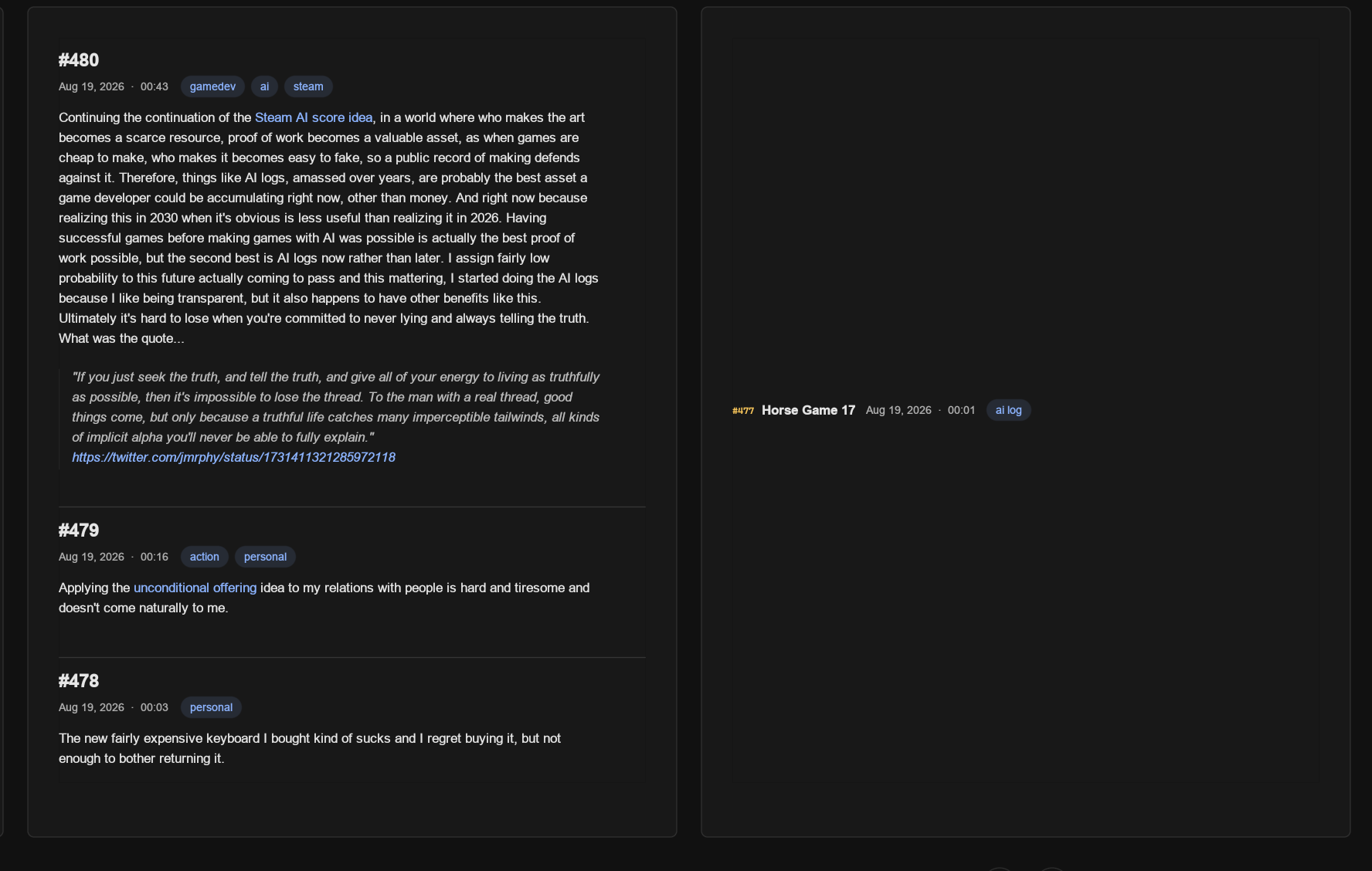
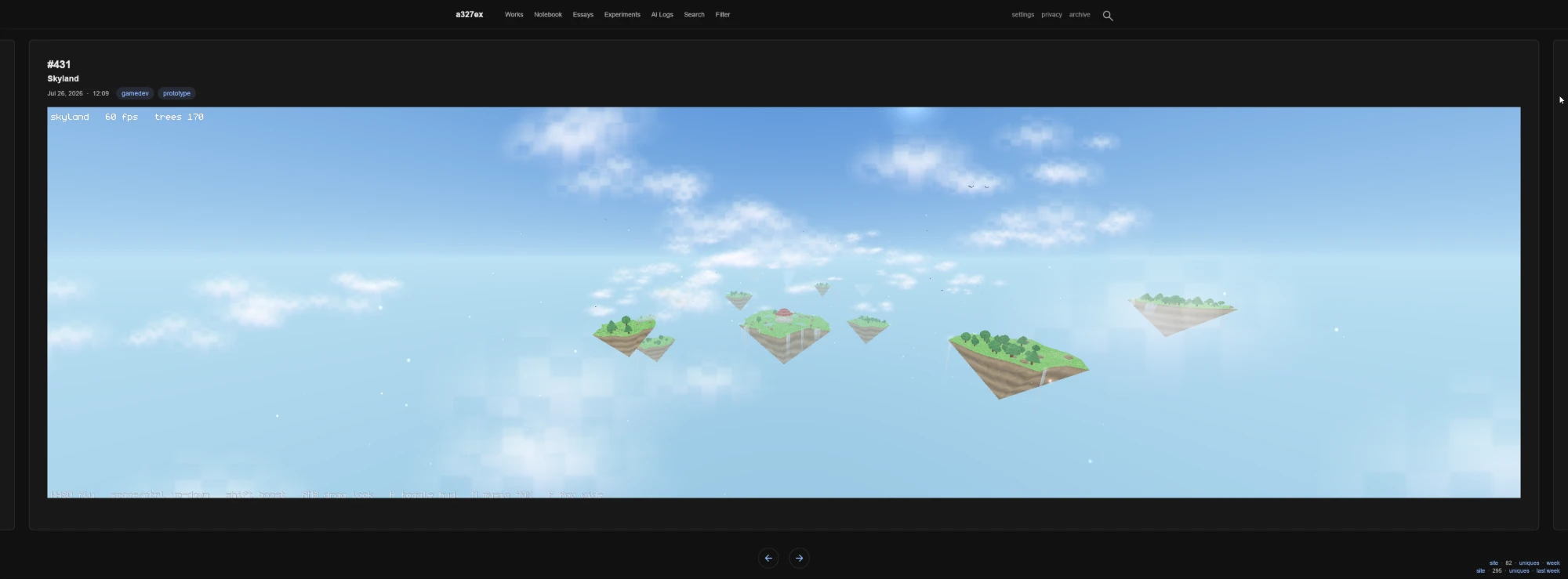
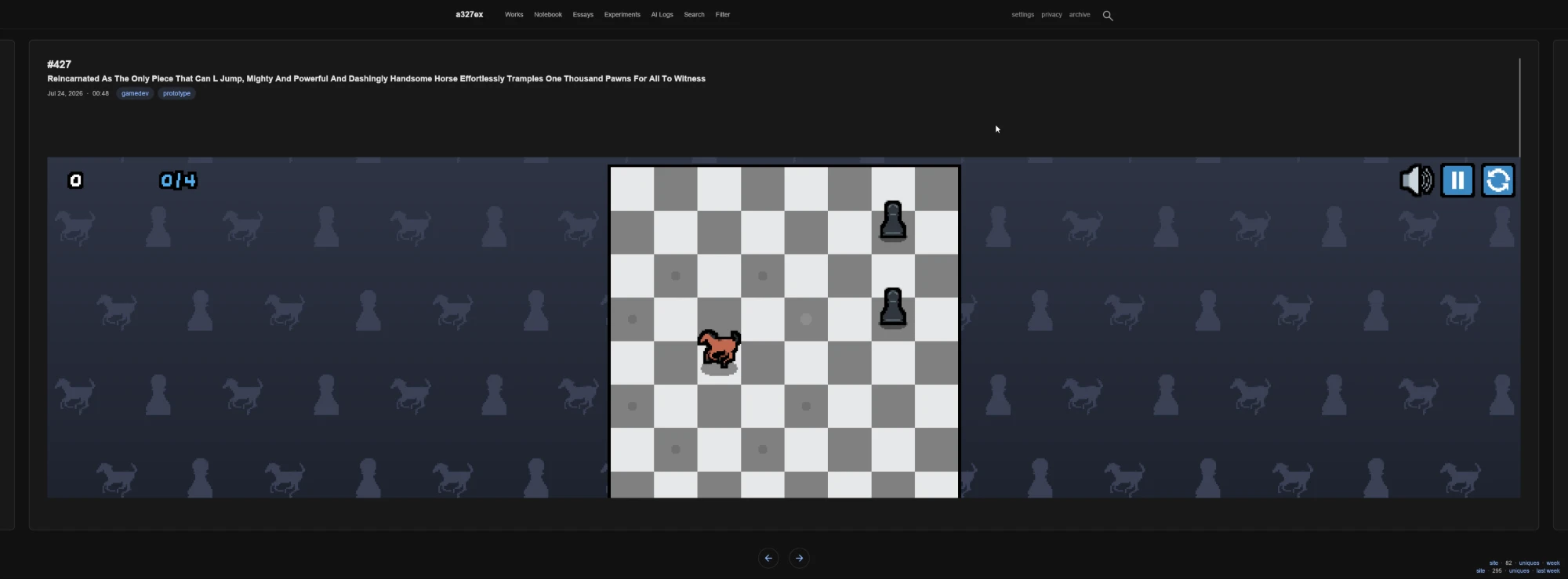
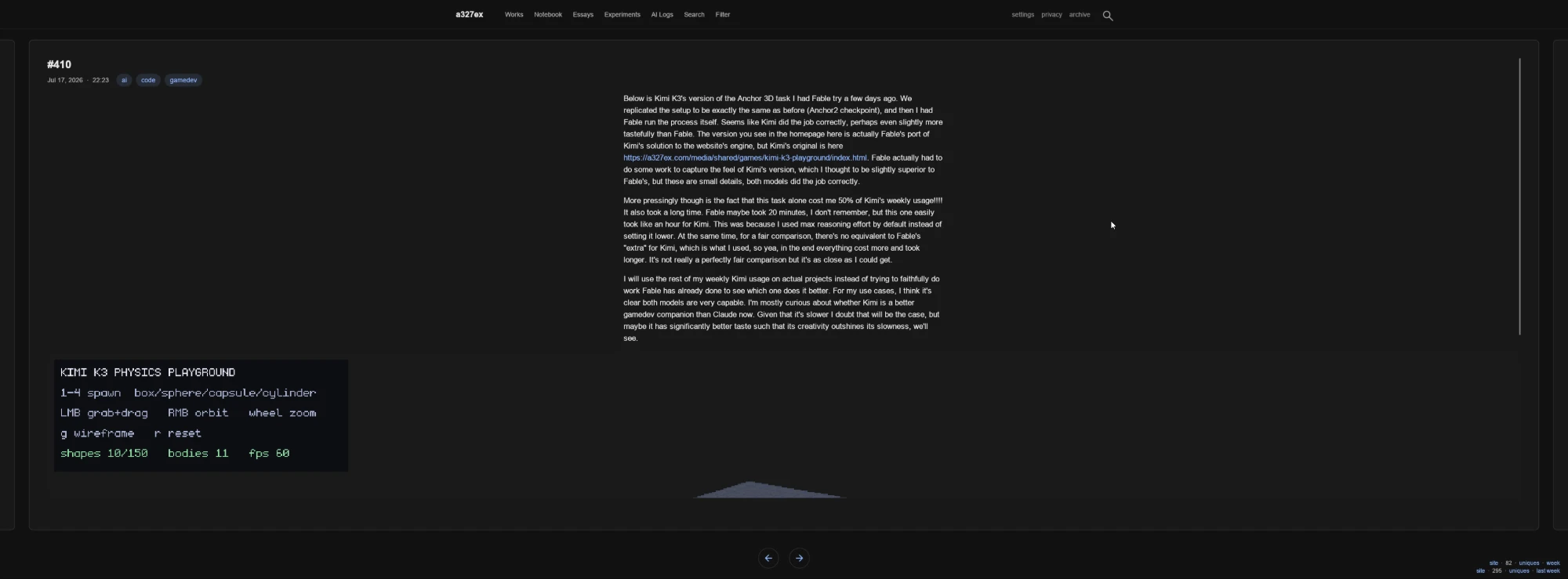
Scrolling with mouse wheel inside a frame works normally if you only use mouse wheel, but breaks as soon as you use up/down on the keyboard. The way it breaks is that it tries to scroll but stays stuck in the same position. On image 1, not sure what happened here but the algorithm that does the sorting could also take into account some kind of harmonious balancing, if a frame ends up with only 1 log, surely something else from one of the surrounding frames could have fit there, sometimes it might not, but in this case it does. Image 2 shows a failed compaction, never should a scrollbar be added when we have multiple posts in a single frame, the last post doesn't fit so it shouldn't have gone there. Image 3, the little interactive graphs inside posts, like the what predicts indie success one, aren't showing. Those graphs are also wide, so the frame for this post should be wider according to them. Image 4, BEAUTIFUL! This is exactly what i meant, thank you! The Horse Game is incorrectly adding a scrollbar due to some spacing issue. Image 6, this one looks wrong but not because of anything you did, just centered text + the playground below looks wrong. But I'm not sure exactly how to change that post to solve it. Placing the playground first so it's the first thing you see makes sense, but the text is still an issue, left-aligning looks wrong but center aligning on such a wide frame also looks off... Scrollbar needs to be selectable + clicking on its area should also let you go down/up accordingly. RDA2 specifically needs a wider frame because it's a table + text heavy post, so even though it works at the current size by default it should prefer higher. This could be a setting for some posts, not as wide as a game, but wider than normal. Image 7, for logs, like on the original website, align the date to the right, and then keep tags after the title.
[Think]
I'm on round 14 now, tracking down why wheel scrolling breaks after using the Up/Down keys — it looks like the key-driven scroll tween keeps overwriting the scroll value every frame even after it should have finished, so the wheel's input gets clobbered right after.

Fix should clear the tween on completion and cancel it whenever a wheel or touch scroll starts. For the image balancing issue, the columns are packed strictly chronologically, so a frame ending with just one lone log happens when the next entry doesn't fit — a legal rebalance would need to shift trailing entries from the previous column forward without breaking that chronological order.

I should try moving a variable number of trailing entries between adjacent columns, picking whichever count minimizes leftover empty space in both, while keeping wide game columns and dense log columns untouched. Since packing is incremental, I need to apply this rebalancing pass right after each new column is packed, comparing it against the one before it.

Looking at the failed-compaction screenshot, I notice a scrollbar appearing on a column with multiple posts where the last one clearly doesn't fit — likely because lazy-loaded media or debounced repacking changed block heights after the initial layout pass. The fix should enforce that any column holding more than one entry can never scroll; if it would, that overflowing entry needs to be pushed to the next column instead.

Looking at image 2, post #463 is a text+image entry cut off at the bottom with a scrollbar visible, meaning the column has four entries and is overflowing. The image may not have loaded at pack time despite manifest dims, or some inner element (embed card, code block) changed height after layout — so I need a more robust fix.

I'm thinking the safest approach is to validate column heights after packing: if a column has multiple entries and its total height exceeds the body, push trailing entries into the next column and repack from there rather than resetting everything. Recomputing each column's height cheaply from its entries and then shifting overflow entries forward reuses the existing packing machinery instead of triggering a costly full repack.

Actually, re-packing only helps if heights genuinely changed since packing — otherwise the packer would just reproduce the same overflow. So the real validation check should be: compare each visible column's stored height against a freshly recomputed sum, and only trigger a re-pack when there's a mismatch (indicating stale data from lazy-loaded media), not for cases where the packer itself miscalculated. I want to first confirm which scenario is actually happening by finding a multi-entry column exceeding body height at 2560 and checking whether its height is stale or the packer logic itself is at fault.

Separately, I'm now tracing why interactive chart demos in "what predicts indie success" render as placeholder wells instead of actual content — since these are marked `small = true`, and layout_game_element checks the small flag before the placeholder check, they shouldn't get placeholders at layout time. But the draw function seems to have a different order of checks, so the placeholder logic might still be kicking in during rendering even though layout skipped it.

The owner also wants those graphs wide, meaning the post's frame should widen to fit them — so demos live in the book and their column gets sized to the widest demo, not the standard 840 cap. This mirrors the earlier RDA2 case: tables shouldn't widen a column, but demo-heavy or table-heavy posts should get a preferred width based on their natural content size.

The natural-width calculation for elements needs to account for small games too, since it currently treats them as zero-width — I should extend it to return their doubled default width. Then any post whose natural width exceeds the page bounds gets its own custom column width (capped at the book width), rather than forcing it into the standard layout, and each column just carries its own width value instead of a simple wide/narrow flag.

For the specific case the owner raised, I'm thinking the trigger for a wider-but-not-game-width column should be content-based — like detecting whether a post contains a table — since there's no explicit per-post width setting in the markdown, and I could clamp the resulting width between the normal page width and the book's max width based on the content's natural size.

Now examining post #427's scrollbar issue: the knightvspawns game frame shows a scrollbar because col.h (head_h + content_h) exceeds the visible body height, likely due to a text paragraph in the doc contributing extra height beyond the game canvas itself—unlike Skyland which has no scrollbar. The owner flags this as an unintended spacing bug even though no text appears visibly above the frame.

My fix idea: for game posts, cap the game box height as body minus head_h minus any other content height, so the total column fits within the visible body without scrolling whenever possible.

For image 6 (#410), the centered text plus playground layout looks off — placing the playground first so it's visible immediately makes sense, but the text alignment still needs fixing; left-aligning looks better.

This is really a design decision he's uncertain about, so I shouldn't silently restructure the post order myself. I'll offer options — draw the game before the text regardless of document order, keep order but left-align text within the column measure, or a two-column layout — and ask rather than guess, since he explicitly said he isn't sure how to solve it.

For the scrollbar, I want the thumb draggable and the track clickable for page up/down: hit-test in screen space within the track strip, start a drag if pressed on the thumb, otherwise page the body height up or down depending on click position above or below the thumb, with a hover cursor state too. For the log entries in image 7, I need to right-align the date while keeping tags positioned after the title.

Beyond that there's the column overflow bug with multiple posts, balancing sparse columns, small demos needing wider frames in the book, table-heavy posts like RDA2 needing more room, the horse game scrollbar cap, making the scrollbar draggable with track-click support, and the log line date/tag alignment. That's a lot of interconnected work, so I'll start by reading through book.lua's key-scroll and update tween logic to understand the wheel-after-keys bug before touching anything else.

I also want to check how game_host composites demos, the small-demo branch in draw_game_element, element_natural_w, the reincarnated data file's elements before the game, and the canvas natural-width function—then do a drive session to inspect the overflow column around posts #466–#463 and check natural widths. This is the owner's verdict round with no briefs, so I'll tackle everything except the arrangement question, saving that to ask directly, and start with these reads in parallel.
Round 14. Ten items, and one I'll ask about rather than guess. Starting with the four that need root-cause investigation: the wheel-after-keys stall, the overflowing multi-post column, why the small chart demos draw as empty wells, and the Horse Game scrollbar. These are independent reads.
Bash (cd "C:/Users/a327e/Desktop/a327ex/a327ex-site/renderer" && grep -n "scroll_tw|b...)
Bash (cd "C:/Users/a327e/Desktop/a327ex/a327ex-site/renderer" && grep -n "demos\b" gam...)
Bash (cd "C:/Users/a327e/Desktop/a327ex/a327ex-site/renderer" && grep -n "^function el...)
[Think]
I found the root cause: BK.scroll_tw keeps running past the tween's end, and since book_update overwrites BK.scrolls[st.index] with st.v every frame without checking if the tween is still active, any wheel scroll after a key press gets immediately reset by the stale tween value.

The fix needs to clear BK.scroll_tw.index in the tween's completion callback, and also clear it on wheel, touch, goto, and turn events. I also realize book_scroll_hold has the same problem — it sets BK.scroll_tw.v and .index during the hold, so on release the value persists and book_update keeps forcing it, causing wheel input to stick. That's exactly the "breaks after using arrow keys" symptom, and fixing both spots should resolve it.

For the second issue (multi-post column overflow), I still need to find columns with more than one entry where the height exceeds the body and check whether heights changed after packing due to media — that needs a drive to reproduce. For the third issue, I'm looking at how game_host_composite gathers demos and composites them into the target layer at screen rects.

Currently game_host_composite_into only handles the single full game case, so I need a variant that composites all demos whose rect falls within a given column, using each demo's layer-space rect. This probably means adding something like game_host_composite_demos_into with a target/offset/filter, and making sure the host still tracks each demo's rect in screen space for hover and capture purposes, similar to how the full game is noted. I also need to make sure the book doesn't apply the placeholder treatment to small demos — right now the placeholder logic is global, so I'd want draw_game_element to skip placeholders specifically for small/def.small elements so they always render live, while full-bleed games still use the placeholder.

But that live rendering path composites in screen space, which would be wrong for a column layout — I need the book to collect all small-demo elements drawn within a column, record their layer-space rects (similar to how el._rect and the dx/dy mapping works for video controls), note them with the host, and then have a composite step that maps those rects to screen space and draws them into the correct column layer. This means elements.lua's draw_game_element needs to always record rects for small demos too, and book draw/composite needs to walk the doc collecting these demo elements per column and call a new host compositing function for them.

I want to check how demo instances actually get created — likely inside a `game_host_note`-style function around lines 480-545 that lazily builds a `demos[el.name]` entry. I also need to look at how natural widths are computed for game/demo elements, since I want table and demo posts to render in wider frames, which means checking `element_natural_w` and `canvas_natural_w` to see how they currently size things like RDA2 and prediction-market posts.

For the Horse Game scrollbar issue, the column has header and title text before the game body, so I need a two-pass layout that subtracts that extra content height when capping the game's height, verifying the fix against case #427. For scrollbar dragging and track clicks, I need to find where the thumb geometry is drawn (near the end of draw_column_body) and locate the book's mouse-handling entry point so I can translate that drawn geometry into proper screen-space hit rectangles.

For the log line fix, I just need to reorder the date and tags in draw_log_line without touching anything else, since I already have that function. For the balancing task, I have the packer loop already and just need to add a rebalancing step that works with BK's column and placement tracking.

Beyond that, I still need to look at a few more places independently: the game_host note/demo instance creation and hosted_frame setup, the canvas natural-width helpers, the book's thumb drawing and any existing click handling near the controls, and the overflow column plus natural widths issue.

For the drive eval work, I'll start with a running instance at the largest screen size (2560, then fall back to 1920) and look for columns where entry count exceeds one and the column height exceeds the body height, trying to recompute expected heights since block_h isn't directly callable from eval — I'll need another way to detect the mismatched columns.

For that flagged column, I'll print each entry's slug alongside its cached height and check whether the cached layout width still matches the current inner width, since a stale value would indicate the layout wasn't recalculated after a repack. I also want to pull the natural widths for specific slugs from the cache, and check the game element's height property for entry #427. I'm also considering that the reported bug — a four-entry column with a scrollbar — might only appear at the owner's actual window size, which looked narrower than the standard breakpoints.
What I need next: the demo-instance lifecycle in game_host (to run the chart demos live inside a column), the natural-width function (to widen table and demo posts), the scrollbar thumb geometry (to make it draggable), and a live investigation of the overflowing column, the natural widths and the Horse Game post's height breakdown.
The wheel bug I already have: BK.scroll_tw keeps its index after a key scroll or a held key ends, so every frame after that rewrites the column's scroll to the tween's last value, which is exactly the stuck-in-place behavior.
Bash (cd "C:/Users/a327e/Desktop/a327ex/a327ex-site/renderer" && sed -n 485,545p game_...)
Bash (cd "C:/Users/a327e/Desktop/a327ex/a327ex-site/renderer" && grep -n "element_natu...)
Bash (cd "C:/Users/a327e/Desktop/a327ex/a327ex-site/renderer" && sed -n 1098,1135p boo...)
Bash (cd "C:/Users/a327e/Desktop/a327ex" && Anchor/workflow/anchor drive start a327ex-...)
[Think]
I'm digging into the overflow bug at column B, tracing why entries are overflowing at that viewport width by breaking down the block heights—title, gaps, and content—for each post to figure out what's inflating the column height.

I suspect the packer shrinks videos to a capped height to make them fit, but then something in the recompute step recalculates the column height using stale separator or block values, causing the final height to still exceed the body even after the shortening logic ran.

Actually, I wonder if the real culprit is a later re-layout pass at a different width or ceiling than what the packer originally used, which would invalidate the fit check entirely.

Working through the numbers: block heights of roughly 416, 416, and 26 with separators of 65 and 33 sum to about 958 — meaning the packer went ahead and accepted a total that exceeds the 774 body limit. So the video ceiling calculation itself must be flawed, not just some downstream re-layout.

I'm checking the video height cache and guard condition — I switched it to check `c.log` instead of `c.titled`, since videos live in untitled posts. The cached natural heights get reused after a capped layout, but the real issue is that the height check happens before the video ceiling gets applied to the current record, using stale numbers instead of the recomputed ones.

After recomputing col.h with the actual post-cap block height, the estimated saving from the video cap might not match reality — if the video can't shrink below its natural aspect ratio or the ceiling doesn't kick in correctly, the actual height ends up higher than what was estimated, so the column could overflow the body height anyway.

The real fix is to verify the true total height after applying the cap and, if it still exceeds body, revert to the previous cap and stop adding entries. I should also add a final safety check after closing each column: if there's more than one entry and the total height still overflows, pop the last entry off and re-check, repeating until it fits — this guards against any layout quirks with media sizing.

For the lone columns still hitting 14 entries at both sizes, I need a rebalancing pass: when a column ends up noticeably emptier than the one before it, pull trailing entries forward from the previous column while preserving chronological order — but never moving entries into or out of wide/game columns, and never violating the fits invariant.

I'm thinking of the balance as minimizing squared empty-space across the pair of columns, moving entries forward only when it reduces that combined cost. Since packing happens sequentially, each new column only balances against its immediate predecessor, so the effect is local rather than globally optimal.

To keep the heuristic simple, I'll skip balancing whenever either column has a video ceiling, contains a game, or the entry being moved has videos, since those complicate spacing. I also need to remember to update the column-tracking index for any moved entries.

Now I realize element_natural_w is just a stub returning 0, which means the wide-element path never actually triggers—I need real natural widths for games and tables to fix this, so I should check how table_natural_w was implemented back in the earlier redesign notes.

Since the owner wants table-and-text-heavy posts like RDA2 wider but not full game-width, I'm settling on a design: compute the widest natural element in the post, then clamp the resulting column width between the normal page width and a cap around 1.6x that, giving a middle "wide-ish" tier for posts that need it without briefs specifying exact rules.

Right, a wider post takes its own column since a column has a single width, which is fine since those are longer posts anyway. For live demos, I need to skip the placeholder drawing for small games since they're cheap to render live, then make sure the demo's hover rect gets registered in screen space and properly composited within the book's layer, similar to how it's handled elsewhere.

I'm extending game_host to support hosting multiple demo instances at once — adding a hosted flag per element so game_host_composite knows to skip drawing them into the main UI layer, plus a new function that composites a specific element's instance into a target layer at a given offset, which the book calls per-demo per-column.

For the book side, I need to record each demo element's rect in layer-space during draw, then convert it to a screen rect when hosting, and set up a list of these demo elements per column by walking the doc after drawing so I can composite them all correctly.

Hover capture already relies on the screen rect, so clicking and dragging inside a chart demo should just work, and wheel-through means the page keeps scrolling normally. The host update logic starts demos based on visibility using the rect and frame freshness, which seems fine, and since only visible slots get drawn, off-screen neighbor columns won't run their demos unnecessarily. Performance-wise, having up to nine live demos in one column when it's visible should be acceptable given it's already the case on the live article page.

Now I'm shifting to look at the horse game scrollbar issue, checking the content heights of the text and game elements to figure out the header sizing.

I trace through why the game content overflows the body height — the extra text around the game (roughly 130px) is what's pushing things past the cap, since the header height plus content height exceeds the body. The fix is to do a two-pass layout: first compute a cap based on body minus header, then measure the non-game content height, and if the total still overflows, recompute a tighter cap that accounts for that extra content before laying out the game a second time. That should make the column height match the body exactly, eliminating the scrollbar.

Now I'm working out the scrollbar thumb geometry and hit-testing — positioning the thumb within the track, widening the clickable area slightly for easier grabbing, and deciding that clicks above or below the thumb should page the view up or down by one body-height rather than jumping straight to a position. For dragging, I map the mouse's vertical offset within the track to a scroll fraction, accounting for the grab offset and thumb height.

I also need a hover brightening effect and to make sure the press is consumed so it doesn't leak through to underlying content. I'm planning to add a hit-testing pass in book_draw that runs before drawing the columns, using the previous frame's max-scroll value (which should be stable enough), and persisting drag state across frames.

For the drag itself, I need to check whether mouse_is_down is available in this context, so I'm looking at how the video player's seek bar handles dragging as a reference.

Separately, I'm redesigning the log line layout so the date is right-aligned and tags follow the title, with wrapping to a second line if the title and date don't fit together — I'll need to update the height calculation for the two-line case too.

I'll also fix the wheel/keys issue, and flag the #410 text/game arrangement question for the handover rather than implementing it myself. Before writing code, I still need to confirm mouse_is_down's availability, check how tables compute their natural width, and look at the video cap element's height semantics if relevant to the fix.

I'm also verifying that the game_ph placeholder branch applies uniformly to small elements, and confirming that layout_game_element uses game_win_w to size small non-pixel elements within a column — for a 709px inner column, that works out to a 677px game width. Once these checks are done in parallel, I'll write the patch.

Since demos render at 677 wide rather than 920, the natural width for a small demo should be def.w*2 + 32, ensuring game_win_w minus 32 stays at least that large. I still need to check mouse_is_down, THUMB_W, and how the table layout computes its natural width before finalizing.
Diagnosis so far, before I write anything:
- Wheel stall:
BK.scroll_twkeeps its slot index after a key scroll or held key ends, sobook_updaterewrites that column's scroll to the tween's final value every frame. The wheel moves it, the tween value puts it back. - Overflowing column: the packer's video-shortening path estimates how much height the shortening will save, checks the estimate, then applies it without re-checking the real result. Column 45 at 1920 ended at 958 px inside a 774 px body.
- Chart demos:
draw_game_elementpaints the placeholder well for small demos too whenever the book sets a placeholder, so all nine graphs in that post render as empty wells. - Wide tiers:
element_natural_wis a stub returning 0, so nothing can currently ask for a wider frame. - Horse Game: its post is text, text, game, text. The game is capped at body minus header, so the 130 px of text pushes it over.
Four small things I still need: whether a mouse-down predicate is available for thumb dragging, the thumb width constant, and how tables lay out so I can give them a natural width.
Bash (cd "C:/Users/a327e/Desktop/a327ex/a327ex-site/renderer" && grep -n "mouse_is_dow...)
Bash (cd "C:/Users/a327e/Desktop/a327ex/a327ex-site/renderer" && grep -n "layout_table...)
Bash (cd "C:/Users/a327e/Desktop/a327ex/a327ex-site/renderer" && grep -n "elements_set...)
[Think]
I need one more look at elements.lua around lines 2300-2345 to check for an existing natural-width helper for table columns, and confirm mouse_is_down is already used elsewhere. After that, I'll have everything needed to write the patch.

For book.lua, I'm planning to fix the scroll tween so it stores index alongside the value, clears the index when the tween finishes, and updates book_scroll_hold so releasing the key (dir == 0) clears the hold timer and returns false. The Lua instance is still running, so any code changes will need a restart later to take effect.

I'm adding a shared release helper that cancels the book_scroll tween and clears its index, then calling it from book_wheel, book_touch, book_scroll, and the hold-release path so nothing leaves a stale scroll target behind. For the packer, I'm adding a post-shortening verification step that checks whether the predicted savings actually match the real layout, since underestimating would let a column overflow and spawn a scrollbar with multiple posts crammed in — which should never happen.

Restoring pre-shortening layout state...

Still writing layout logic...

Now I'm designing a rebalance function that shifts entries forward from the previous column's tail into the current column's head, only when doing so reduces the combined squared empty space of the two columns and the receiving column still fits — preserving chronological order throughout.

Still writing rebalancing logic...

Now I'm thinking through column width tiers, defining a helper that computes an element's natural width based on whether it's a small game box, a full-bleed game, or a table with its own natural width function, and checking whether `table_natural_w` already exists in elements.lua to reuse it, then adding a custom `col.w` field to the book's column structure.

Writing column width logic...

I need to check whether the natural width is available before layout runs — for simple elements it's static, but for tables it likely depends on measuring cell text, so I should look at how table_natural_w actually computes that. I also need to handle the two-pass sizing for game posts, capping the game's height first before running canvas_layout, then checking if a second pass is needed when the text content would push past that cap.

I need to track the game element's height after layout and restructure ensure_layout's logic into a reusable local function so it can re-run with a capped height. For the scrollbar, I'm also planning to widen the hit area for grabbing the thumb since the current 3px visual width is too thin to reliably click, drawing it wider on hover or drag while keeping a slim default appearance.

Writing thumb geometry logic...

Still writing scrollbar logic...

Now I need to redo the log line rendering: left side shows id/lock, title and chips, right side shows date/time right-aligned, with chips wrapping to a second line if the left content doesn't fit alongside the date width, while making sure the title itself is never truncated.

For the hit area, I'll keep it covering just the id and title portion, not extending into the chips or date, matching the original site's layout style.

I also want to drop the lone_log_columns=14 constant once balancing is in place. Before diving into edits, I should check main.lua for how book_scroll_hold is called on key release to confirm the direction handling is correct — I'll queue up reads of the table's natural width region and that call site.
Everything else I have. Two reads left before writing the round 14 patch: how tables compute their natural column widths, and where main.lua drives the held-key scroll (so the release path clears the tween).
Bash (cd "C:/Users/a327e/Desktop/a327ex/a327ex-site/renderer" && sed -n 2300,2345p ele...)
Bash (cd "C:/Users/a327e/Desktop/a327ex/a327ex-site/renderer" && grep -n "book_scroll_...)
[Think]
I've confirmed the `dir==0` path in `book_scroll_hold` clears the index correctly, and `table_natural_w` is already available globally. Now I need to write the round 14 patch script and then run it, though I should also consider stopping the currently running drive instance since it's using outdated code.

For the fix, I'm refactoring the scroll tween logic into a shared `scroll_tween(s, to)` helper used by both key scroll and track-click, plus adding a `scroll_release()` function to properly clean up the named tween on the scratch table when it finishes -- otherwise it keeps writing stale values back every frame, which is exactly why scrolling breaks after using Up/Down.

I need to be careful about definition order since this helper has to exist before both the key-scroll function and the thumb-drawing code that reference it.

I need to check book_scroll_hold carefully — when a key is tapped, hold becomes 0 on the very next frame (release), which triggers scroll_release and could cancel the step tween while it's still running. I need to trace how main computes hold from input_down to make sure a tap doesn't immediately kill its own scroll animation.

The fix is to only call scroll_release when hold actually took over continuous scrolling — I'll add a BK.hold_on flag set inside book_scroll_hold, and only release on that flag in the dir==0 branch, letting the tween's own completion callback clear the index normally. I also need to make sure the mouse wheel calls scroll_release before starting its own scroll so it doesn't fight a running key tween.

Now I'm rewriting the packer's verify/revert and balance/width-tier logic inside book_pack_more, replacing the main packing loop with a version that determines whether a column should be full-width based on whether the entry is a full-bleed game, then lays out accordingly.

Defining tier width logic...

Now I need to swap the inner loop to use the precomputed `iw` instead of recalculating `inner_w(false)`, and add a rebalance call right after the column counter increments in the outer loop.

I'm writing a rebalance function that only kicks in when adjacent columns share the same width and aren't wide/video-capped, then computes a cost comparison based on overflow heights to decide if shifting content between them helps.

Still writing rebalance logic...

I'm noting where to place this new rebalance function in the file relative to block_h, sep_h, and book_pack_more, then shifting focus to the two-pass cap logic needed in ensure_layout for the game view.

Writing cache invalidation checks...

Defining the layout function...

Since capping the game at just the body minus header left those extra lines hanging over the edge and caused scrolling, I need to actually measure the rest of the post's content and give the game only the room truly left after that, recalculating the cap if it fits within a reasonable range.

I should double check the function ordering so head_h is defined before ensure_layout uses it, and confirm the game element's height gets captured properly during layout so future comparisons against a freshly computed game_box_h stay consistent.

Wait, there's a caching bug: if I overwrite c.gcap with the room value from the two-pass layout, it'll never match game_box_h(rec) again, forcing a re-layout on every call. I need to keep the original cache key separate — store `key_cap = gcap` before the two-pass adjustment, then set c.gcap to that key rather than the room value at the end.

Now I'm looking at how the wide tier draws the column body, particularly how it sizes the game box element using the stored width.

Then I'm considering the small live demos — currently the placeholder branch skips rendering for full games, but small demos should stay live and render directly inside the book's columns rather than showing a static placeholder. The tricky part is that composited elements draw into layer space relative to the book's rect, so their coordinates would be wrong unless the book converts those rects to screen space first.

In draw_column_body, after drawing a post, I need to collect the demo elements and pass along both the screen rect (for hover/capture) and the layer rect, mirroring how the wide column's game handles it.

I still need to add canvas_small_games(doc) to canvas.lua, walking elements and returning those flagged as small in GAME_DEFS.

Also, game_host_note ignores the hosted flag for small games — I need to patch it to set hosted_frame appropriately. Then s.demos needs resetting each frame alongside s.tops/s.chips, and book_composite needs a loop compositing each demo element into the layer via game_host_composite_el_into.

I'm defining that new function to composite a single embed by its element: it looks up the instance, checks it's started without errors and recently visible, then runs the env's draw function inside an xpcall to capture any composites produced during that draw call, mirroring how the full-game compositor works but scoped to one element so the book's inline chart demos stay clipped to their own layers.

Now I'm handling the draw error case and, if there are composites, computing scale factors from the target rect versus the virtual dimensions and drawing each composite layer into the target handle at the scaled offset. Since `el_inst` is a local defined further up the file, I need to place this new function after `game_host_composite_into`, around line 829, so it can see that local.

I'm confirming that vw/vh for demo instances get set at start based on the rect size, so the scaling should work correctly for the screen rect case. Now I'm moving to checking `element_natural_w` in canvas.lua, starting to look at how it branches based on element type.

Writing the width calc logic...

I need to double-check load ordering: canvas.lua references table_natural_w before elements.lua defines it, but since it's called at runtime rather than load time, the global should resolve fine — though `canvas_natural_w(doc)` itself gets invoked during load_entry, which happens before layout runs.

With `c.nat` now reflecting real measured widths, tables that exceed the column width will trigger a wide_box matching the column's inner width, which is exactly the intended round-1 behavior of letting tables use the full panel. I'm now worried some RDA2 tables might be extremely wide, which could push tier_w to size the whole column around them.

I'm considering capping the tier width so a table doesn't visually resemble a full game post — maybe restricting it to something like 1.6x page width instead of letting it fill wide_w() completely.

Now I'm working on the scrollbar interaction in book.lua, adding a geometry helper for the draggable thumb and its wider hit-detection strip so it can be grabbed by the mouse even though the visible bar itself stays thin. Writing thumb geometry logic...

Writing thumb drag logic...

Still writing scrollbar logic...

I need to place `thumb_geom` and `book_thumbs` before `book_draw`, after slots exist, and remember `s.max` reflects the previous frame's value since it's computed after drawing—so the first frame will have no thumb until max is set.

Next I'm moving to the log line layout, reworking the width/height calculations so the date sits right-aligned and tags follow the title. I'm restructuring the helper functions for date width, the left-side width (lock/id plus title), and chip width, then rewriting log_h to account for wrapping based on these new measurements.

Now writing the draw function...

Then chips wrap to a second line when they'd collide with the date, and I need to check whether `log_line_w` is still referenced elsewhere now that I've replaced it with `log_left_w`.

I'm now planning the patch itself, deciding on span markers to replace the draw_log_line function cleanly using the comment above it as the start marker and the next unique section header as the end marker, since matching the exact old text risks errors.

Similarly, I'm identifying the span for the measurement block covering log_line_w through log_h so I can replace both cleanly. I don't think main.lua needs any changes for this round since the wheel and scroll handling are already covered elsewhere, so I'm ready to write out the full patch script.
No more reads needed. table_natural_w already exists in elements.lua, and the held-key path calls book_scroll_hold every frame, so the release can clear the stale tween stamp there.
Writing the round 14 patch now: the scroll-tween release, packer verify-and-revert, column balancing, width tiers for table and demo posts, live inline demos, the game two-pass height, a grabbable scrollbar, and the new log line. Stopping the old instance in parallel.
Write (C:\Users\a327e\AppData\Local\Temp\claude\C--Users-a327e-Desktop-a327ex\592f70a5-4c81-42cb-be1b-c83f80f4b9b1\scratchpad\r14_patch.py)
Bash (cd "C:/Users/a327e/Desktop/a327ex" && Anchor/workflow/anchor drive stop a327ex-s...)
[Think]
I need to run the patch and syntax-check the book, canvas, elements, and game_host files, then run the attribution test, before chaining into a drive restart and verification. Once restarted, I'll check that overflowing_multi hits zero and lone_log_columns drops at both 2560 and 1920, confirm the column counts, and review the tier data for RDA2, what-predicts, and column widths against issue #427's max.

For the demos column, I should confirm game_host demos are registered and populated in s.demos, and snapshot both a log column and the demo state. For testing the thumb drag interaction, I'm not sure simulated mouse injection is feasible without a helper — I want to check whether something like agent_tap exists in main.lua or the engine to simulate a click on the thumb area, since that would let me exercise the drag math directly rather than relying only on visual inspection. I'll chain the patch, syntax checks, tests, restart, and eval into one command, and in parallel grep for agent_tap support.
Next: apply the patch, syntax-check the four files, restart the instance and re-run the audit (overflow, lone-log columns, tiers, Horse Game scroll, live demos). Separately I need to know whether the drive can inject a click, to exercise the scrollbar grab. Those are independent.
Bash (cd "C:/Users/a327e/Desktop/a327ex" && python "C:/Users/a327e/AppData/Local/Temp/...)
Bash (cd "C:/Users/a327e/Desktop/a327ex" && grep -rn "agent_tap|agent_mouse|engine_s...)
[Think]
The ensure_layout sub failed with zero matches, which means the script crashed before saving book.lua — so canvas.lua, elements.lua, and game_host.lua got patched since their saves happened first, but book.lua remains unchanged. My old-string for the ensure_layout match probably doesn't actually match what's in the file.

I recall inserting comment lines about the gcap height ceiling calculation in a previous round, and my match string started right at the gcap assignment line — that should still align unless something shifted, so I need to print the actual region to compare directly. Since the renderer doesn't use the game agent kit's tap injection, there's no mouse simulation available for testing book.lua's thumb interactions, so I'm considering exposing a debug helper or testable global function in book.lua to drive thumb press checks directly.

Duplicating the thumb-drag logic risks divergence, so instead I'm leaning toward making `book_thumbs` a global function that accepts synthetic coordinates and a press override, letting the eval channel exercise the same code path used by real mouse input.

Instead, I'll add a dedicated test hook that directly drives the thumb geometry and drag math for a given slot and y-position without needing the real mouse-down state, sharing logic with the press branch. Then my plan is to print the actual ensure_layout region to fix the stale string in my patch, update the patch script accordingly, wire in this new test hook, and rerun against book.lua since the other three files are already patched.

But rerunning the full script would re-apply already-committed patches to canvas/elements/game_host and trip the assertion checks, since their counts would already be zero. So I need to split things — write a new patch script containing just the book.lua section with the corrected string, and separately verify the syntax of the three already-patched files independently.
The patch stopped at the ensure_layout edit: my old-text pattern didn't match. canvas.lua, elements.lua and game_host.lua were already saved before the failure, so only book.lua is unpatched. I need the exact current text of that region, and a syntax check on the three files that did change.
Also useful: agent_tap belongs to the game framework's agent kit, not the renderer, so the drive cannot inject mouse input here. I'll add an explicit test hook for the scrollbar math instead.
Bash (cd "C:/Users/a327e/Desktop/a327ex/a327ex-site/renderer" && grep -n "local gcap =...)
Bash (cd "C:/Users/a327e/Desktop/a327ex/a327ex-site/renderer" && ../../Anchor/workflow...)
[Think]
I see the mismatch now—there's a comment block in the actual file between those lines that I missed when transcribing, which explains why my string replacement didn't match. Let me print the actual lines around there to get the exact text.
I need the exact text of two regions in book.lua before rewriting the patch: the ensure_layout block (my pattern dropped an intervening comment) and the packer's candidate loop.
Bash (cd "C:/Users/a327e/Desktop/a327ex/a327ex-site/renderer" && sed -n 358,394p book....)
[Think]
Now I have the exact text I need, so I'll write r14_book.py with only book.lua edits — the corrected ensure_layout replacement matching the real text (including the round-7 comment), plus the other book.lua subs from the failed script, plus a new book_thumb_test hook for driven verification. I'll run it right after, since that step depends on this write completing.

For the thumb test hook, I'm defining a Lua function that simulates pressing a scrollbar thumb at a screen y-coordinate for a given slot, then optionally dragging to a second y-coordinate to compute the resulting scroll offset, returning an error string if the slot or thumb doesn't exist.

I'm placing this helper right after the book_thumbs definition and before book_draw, then finishing the rest of the file as I'd already planned for book.lua.
I have the exact text. Writing the book.lua-only patch with the corrected ensure_layout block, plus a driven test hook for the scrollbar since the eval channel cannot inject mouse input. The other three files are already patched and syntax-clean.
Write (C:\Users\a327e\AppData\Local\Temp\claude\C--Users-a327e-Desktop-a327ex\592f70a5-4c81-42cb-be1b-c83f80f4b9b1\scratchpad\r14_book.py)
[Think]
I'm chaining everything into one sequential Bash command: run r14_book.py, syntax-check book.lua, run the attribution test, start the drive, then run the audit eval covering overflow checks, lone logs, tiers, the #427 scroll, and demos. Documentation and memory updates will follow only after this verification passes.

Writing the eval script...

I'm noting I need to find the correct slot index by matching `BK.ix` rather than column index, then plan the snapshots to capture: charts, logs, horse, the balance column area (id 477), and the RDA2 tier width. Finally setting up the rounds/14-homepage-book-r14 directory before assembling the full test command.
Everything now depends on applying this patch, so it is one chain: patch book.lua, syntax check, run the attribution test, restart the instance, then a single eval that audits overflow, lone-log columns and width tiers, checks the Horse Game's scroll, exercises the scrollbar hooks, and proves the wheel no longer snaps back after a key scroll.
Bash (cd "C:/Users/a327e/Desktop/a327ex" && python "C:/Users/a327e/AppData/Local/Temp/...)
[Think]
The eval crashed inside book_scroll's format string because it expects an integer but got a fractional scroll value after the key tween — that classic %d-on-float trap. It's a pre-existing bug in this debug helper, so I should fix it by flooring the values before formatting.

So my plan: patch book_scroll to use math.floor on scroll/max around line 1979 of book.lua, then since the running instance still has the old code loaded in memory, I need to stop and restart the drive after patching rather than assume a hot reload will pick it up. Then re-run the same eval. I'll do this as one sequential command chain, being careful with quoting since the line I'm replacing contains single quotes that could conflict with a shell-based patch approach.

Quoting nested strings across bash and python is getting messy, so I'll switch to a plain sed substitution instead, targeting just the quote-free portion of the line to wrap scroll and max values with math.floor calls.

I'm also double-checking the other %d format specifiers I added to make sure they're all applied to genuine integers, not floats. With that confirmed, the plan is: apply the sed fix, verify syntax, stop/restart, then rerun the same evaluation script.
The eval hit a pre-existing trap rather than a patch problem: the driven book_scroll helper formats a fractional scroll with %d, which Lua 5.4 throws on. I'll floor it, restart the instance and re-run the same audit.
Bash (cd "C:/Users/a327e/Desktop/a327ex/a327ex-site/renderer" && sed -i 's/s.index, s...)
[Think]
Results are looking good: overflow issue fixed, the horse game caps correctly at both sizes, tier columns compute proper widths across five columns at 2560, and the scroll behavior is tracking properly after 30 frames.

Balance improved too — the column that used to hold a lone entry now has four, though lone logs still linger slightly at different sizes since balancing only triggers when it actually lowers cost. Charts are still an issue though: demos=0 because the demo elements are far down a long post and get culled off-screen before they ever draw, so they never get a rect — expected behavior at scroll 0, but I need to verify it works once scrolled into view. There's also a thumb-drag issue I need to look into next.

I'll combine two checks in one pass: scrolling the what-predicts column to the first game demo element's y-position to verify demos actually trigger and snapshot the result, retesting the thumb drag with corrected coordinates, and grabbing a log column snapshot. Separately I'll review the pending r14-02 (horse), r14-03 (rda2), and r14-05 (balance) snapshots, then move on to docs, commit, and deploy once everything checks out.

Simpler to just reset scroll to zero first so the thumb sits at the top with known geometry, then press inside the thumb and drag it down a fixed distance before reporting the result.
Round 14 verifies almost fully: no overflowing multi-post columns at either size, the Horse Game frame no longer scrolls, RDA2 and the charts post get wider frames (1166 and 1032 px), the column that held one lone log now holds four, and after a key scroll the wheel-style scroll sticks instead of snapping back.
Two gaps in my own test: the charts sit far down a long post so they were culled at scroll 0, and my drag coordinate landed on the track, not the thumb. Re-testing both, plus a log-line snapshot. Viewing the three finished snapshots is independent.
Bash (cd "C:/Users/a327e/Desktop/a327ex" && Anchor/workflow/anchor drive eval a327ex-s...)
Read (C:\Users\a327e\Desktop\a327ex\a327ex-site\renderer\reference\site-theme-2026-09-13\rounds\14-homepage-book-r14\r14-02-horse-2560.png)
[Image: original 2560x1340, displayed at 2000x1047. Multiply coordinates by 1.28 to map to original image.]
Read (C:\Users\a327e\Desktop\a327ex\a327ex-site\renderer\reference\site-theme-2026-09-13\rounds\14-homepage-book-r14\r14-03-rda2-2560.png)
[Image: original 2560x1340, displayed at 2000x1047. Multiply coordinates by 1.28 to map to original image.]
Read (C:\Users\a327e\Desktop\a327ex\a327ex-site\renderer\reference\site-theme-2026-09-13\rounds\14-homepage-book-r14\r14-05-balance-2560.png)
[Image: original 2560x1340, displayed at 2000x1047. Multiply coordinates by 1.28 to map to original image.]
[Think]
The horse game now fits without a scrollbar, with centered text above it. Checking the RDA2 frame, it's wider at 1166 and appears centered, though I'm noticing the neighboring columns look cut off and want to verify against the log line for entry #395.

The left neighbor titled "PATH++ Design and Base Game" also shows the date right-aligned correctly. The middle column for balance now correctly shows entries #480, #479, #478, and the #477 log, matching what was requested. For the live charts, I see one demo element registered at the current scroll position, but I need to check the snapshot to confirm whether it actually started and composited properly, and whether the game files are ready to run. The thumb drag also worked, jumping the scroll position to 16551 after a 400px drag.

Now I want to view the remaining snapshots for the live charts, dragged thumb, and logs before moving on to docs, commit, deploy, push, live check, memory, sending files, and flagging the question about #410's text/game arrangement.
Verified: the Horse Game frame no longer scrolls, RDA2 gets its wider frame, the balanced column now holds #480, #479, #478 and the #477 log together, and the thumb drag moved a 43k-px column to 16.5k. The new log line shows the date at the right with tags after the title.
Three snapshots left to check: the charts once scrolled into view, the dragged thumb, and a full log column.
Read (C:\Users\a327e\Desktop\a327ex\a327ex-site\renderer\reference\site-theme-2026-09-13\rounds\14-homepage-book-r14\r14-06-charts-live-2560.png)
[Image: original 2560x1340, displayed at 2000x1047. Multiply coordinates by 1.28 to map to original image.]
Read (C:\Users\a327e\Desktop\a327ex\a327ex-site\renderer\reference\site-theme-2026-09-13\rounds\14-homepage-book-r14\r14-08-logs-2560.png)
[Image: original 2560x1340, displayed at 2000x1047. Multiply coordinates by 1.28 to map to original image.]
Read (C:\Users\a327e\Desktop\a327ex\a327ex-site\renderer\reference\site-theme-2026-09-13\rounds\14-homepage-book-r14\r14-07-thumb-dragged-2560.png)
[Image: original 2560x1340, displayed at 2000x1047. Multiply coordinates by 1.28 to map to original image.]
[Think]
The chart renders live in its column, logs show dates right-aligned with tags after the title matching the original site, and the thumb drag scrolled correctly to 16551. Now I need to update REDESIGN.md for round 14.

I want to double-check some edge cases: tier columns are centered fine within the carousel's page-width pitch, rebalance won't move an entry into a wide-column slot since that's guarded, and moved entries keep consistent layout since they share the same width. Also need to remember to ask about issue #410 (centered text and playground order), mention the lone-log columns still present, and clarify that tier is automatic via tables/demos rather than a per-post setting. Time to write the docs update, then run the commit/deploy chain.

I'll write the REDESIGN round 14 doc script, and in parallel send the relevant screenshots — r14-05-balance, r14-03-rda2, r14-06-charts-live, r14-02-horse, and r14-08-logs — since that's independent of the deploy step. Then update memory once everything's committed.
All three check out: the market-concentration chart runs live inside its column, the log rows now read id, title, tags on the left with the date pinned right, and the dragged thumb moved the long post as expected.
Writing the REDESIGN.md round 14 entry next. Sending you the snapshots is independent, so that goes now.
Write (C:\Users\a327e\AppData\Local\Temp\claude\C--Users-a327e-Desktop-a327ex\592f70a5-4c81-42cb-be1b-c83f80f4b9b1\scratchpad\r14_doc.py)
SendUserFile (C:\Users\a327e\Desktop\a327ex\a327ex-site\renderer\reference\site-theme-2026-09-13\rounds\14-homepag...)
[Think]
I need to run the doc script, stop the drive instance (pid 20088), and write the memory update script — these three are independent of each other, so I'll handle them together now, then move on to committing, deploying, pushing, and finally the live boot check afterward.
Next I need: the REDESIGN.md script run, the drive instance stopped, and the memory update written. None depend on each other; the commit, deploy and push follow.
Round 14 at 2560: the balanced column (#480 through the #477 log together), the new log line with the date on the right, a chart demo running live, RDA2 in its wider frame, and the Horse Game fitting without a scrollbar.
Bash (cd "C:/Users/a327e/Desktop/a327ex" && python "C:/Users/a327e/AppData/Local/Temp/...)
Bash (cd "C:/Users/a327e/Desktop/a327ex" && Anchor/workflow/anchor drive stop a327ex-s...)
Write (C:\Users\a327e\AppData\Local\Temp\claude\C--Users-a327e-Desktop-a327ex\592f70a5-4c81-42cb-be1b-c83f80f4b9b1\scratchpad\r14_memory.py)
[Think]
I'll commit round 14's changes across book.lua, canvas.lua, elements.lua, game_host.lua, and REDESIGN.md, then deploy and push that chain, while separately running the memory script. After deploy, I'll do a live boot check and wrap up with the ask about #410.
Two things now, independent of each other: the commit-deploy-push chain, and applying the memory update. The live boot check follows the deploy.
Bash (cd "C:/Users/a327e/Desktop/a327ex/a327ex-site" && git add renderer/book.lua rend...)
Bash ([memory: sealed target])
[Think]
I still need to do a live boot check of a327ex.com as my last verification step, then wrap up with a final message. For the #410 question, I'll follow the preferred format and lay it out in chat as prose with labeled options, similar to a multiple-choice question.
Only the live boot check remains before the handover.
mcpClaude_Browserbrowser_batch ({"actions": [{"name": "navigate", "input": {"url": "https://a327ex.com/"}}, {"name": "computer", "input": {"action": ...)
Round 14 is live as commit f8523ba. The boot check is clean, with no console errors.
The scroll bug. The tween that moves a column on Up or Down stamped its slot and never cleared it, so from then on every frame rewrote that column's scroll to the tween's last value. The wheel moved it, the stamp put it back. It now clears when the tween ends, when a held key is released, and before any other scroll takes the column.
No scrollbar on a packed column. The packer's video shortening estimated how much height it would save, checked the estimate, then applied it without re-checking. When the real layout gave back less, the column overflowed. It now measures the laid-out blocks, and if they do not fit it undoes the shortening and leaves the post to the next frame. Overflowing multi-post columns went from 3 at 2560 and 6 at 1920 to none at either.
Balancing. After a column closes, entries move forward from the tail of the previous column while that makes the pair more even and the receiver still fits. Order is untouched, since each column stays a contiguous run. Your example now packs #480, #479, #478 and the #477 log together. Lone log columns dropped but did not vanish: 13 at 2560, 15 at 1920. A log sitting after a very tall post has no neighbour that can give.
The chart demos. The book's placeholder well was painted over every game element, small demos included, so all nine graphs were empty boxes. Demos are never placeholders now, and the book composites each one into its column's own layer, which clips it. They still let the wheel through, so the column scrolls over them.
Wider frames. The natural-width measure had been stubbed to zero since round 7. It measures a table's unwrapped columns and a demo's box again, and a post gets a frame of its widest element plus padding, capped at 1.6 ordinary columns. Roguelite Design Analysis 2 asks for 1086 and gets 1166. The indie-success post asks 952 and gets 1032.
The Horse Game. The game was capped at the body minus the header only, ignoring the post's own three lines of text. A game post is now laid out twice, so the game takes the room the rest of the post leaves. Its 178 px of overflow is gone.
The scrollbar has a 14 px grab strip: drag the thumb, click the track to page toward it, and the bar thickens and brightens while held.
Log lines now read id, title and tags on the left with the date pinned right.
One thing I did not touch, because you said you were not sure what it should be. #410's frame, centered text sitting above a wide game, still reads wrong. Three directions, and none is obviously right:
- Game first. In a game frame, draw the game at the top and the post's text under it, whatever order the document has. You see the game immediately. It makes game frames a fixed shape, and the text becomes a caption.
- Left-aligned text, game full width. Keeps document order, puts the prose at the left edge at its normal measure. You said left-aligning looks wrong, so this is the one I would bet against.
- Text beside the game. A column of prose at the left, the game filling the rest. Fits wide frames, but no other frame in the book has two columns, and short posts would look odd.
My own preference is the first, with the text left-aligned under the game rather than centered. Say which, or something else, and I'll do it in round 15.
For both the playgrounds we can afford the frame size as it is now, and then the text lives on the left or right, besides the game, so the game doesn't fill it all horizontally. Let's try text wider text body width on what predicts indie success, to match the size. #448 is bigger than it should be width wise again, nothing in the post seems to justify that. You made RDA2 wider but neither text nor the tables increased with it. Increase it by less and make sure the text and tables etc follow it. Make sure to make all these settings that I'm saying per post as individual modes that you can internally set for future posts that will work the same way for them, don't hack things on those individual posts themselves.
[Think]
For the game posts, the owner wants the frame width kept full but the text placed beside the game in a two-column layout rather than stacked, so the game only occupies part of the horizontal space. They're also asking to widen the text body on the indie success prediction piece to match this new sizing.

Then I need to investigate why #448 got a wide tier frame despite nothing obvious justifying it — it has a video plus a quoted transcript, so I'm wondering if some table element inside triggered the natural-width calculation, and I should check the actual post data for that slug. Similarly, RDA2's frame widened under the new tier but the text and tables inside didn't scale up with it, meaning the layout function isn't propagating the wider tier width down into the actual content measure.

Given all this, the right fix is to build an internal per-post mode registry rather than hacking individual posts — a mapping from slug to named modes (frame width, layout style, text width) that the renderer applies consistently, so future posts can reuse the same behavior instead of one-off tweaks.

I still need concrete fixes: figure out why #448 got flagged wide when it shouldn't be, then either correct the natural-width detection or override its mode explicitly. For RDA2 and what-predicts, I want the 'wide' mode to widen the text measure and let tables use the full inner frame width consistently. And I still need to work out how game posts should behave under this mode system.

This means changing the canvas's document layout system: instead of a single column, I'd need a two-pass approach where non-game elements lay out in a narrow text column while the game element gets positioned separately at a computed offset with its own width, effectively giving "side box" positioning capability to specific elements within an otherwise linear document flow.

The draw position needs to be relative to the block's top, with the element's rect computed from its y-offset within the flow; since the game element has zero height, it naturally lands at the top of the content area, at x = text width + gap. I need the block height calculation to account for both the text content height and the game's height, so I'll track the game height separately and take the max when computing block_h. Now I'm sketching the elements.lua state for tracking this floating game position and dimensions.

I need to update the cull check to use block height as the max of text and game height, plus handle hit-testing rects. For layout, I'll place text on the left and the game on the right for posts with commentary, while game-only posts like Skyland keep the full-width layout unchanged. For posts like the Horse Game with just a few short lines, this text-beside-game arrangement should still work fine.

I'm outlining a per-post mode system where each post's frame treatment is assigned by the renderer rather than being a property of the markdown itself, so new posts get consistent handling by being registered in this mode list.

Explicit assignments always override the automatic rule, which decides "game" if flagged, "wide" if the natural width exceeds the column by some threshold, otherwise "normal." I'm second-guessing issue #448 though—wondering if the auto-widen trigger is too loose for tables and whether I should tighten the margin check, and considering capping the widen tier more conservatively, like using the minimum of natural width plus padding versus 1.3 times the page width instead of 1.6.

For making the text and tables actually follow the wide layout, I need canvas_layout to use the full inner width as the measure instead of clamping to the column width—so I'm adding an optional measure parameter to canvas_layout that overrides the default clamp when the book passes it in wide or game mode. Now I want to check how canvas_layout is called elsewhere to make sure this addition doesn't break existing callers.

For tables, I'm also considering always setting wide_box to the frame's inner width in wide mode, rather than only when content naturally exceeds it, since the owner wants to try a genuinely wider reading measure (roughly 952px instead of the usual 704px) to see how it feels.

For #448, I still need to investigate why it's flagged for auto-wide — likely it contains a table with a wide natural width — so I should check its document and elements to confirm before generalizing the rule. My plan is: inspect #448 and RDA2's tables to nail down the auto-wide logic, implement the full modes system with wide text measure, wide tables, game-beside-text layout, and the smaller tier cap, then verify everything works headless before snapshotting, deploying, and pushing.

I also need to check the canvas_layout function signature and all its call sites so I can safely add the new measure parameter without breaking anything, so I'll pull both of these in parallel with the table investigation.
Round 15. Before coding, two things to check: why #448 asked for a wider frame at all, and every call site of the layout function I need to extend so the text measure can follow the frame.
Bash (cd "C:/Users/a327e/Desktop/a327ex/a327ex-site/renderer" && grep -n "id = 448" da...)
Bash (cd "C:/Users/a327e/Desktop/a327ex/a327ex-site/renderer" && grep -rn "canvas_layo...)
[Think]
Looking at #448, its tables are small with longish cells that technically exceed the natural width threshold, but the owner points out nothing in the post actually justifies a wider frame since they wrap fine normally. This suggests the auto-widening rule needs to be tightened so it only triggers when truly warranted.

I think the cleanest approach is to not auto-widen based on tables at all, and instead only auto-widen for demos (which have a hard minimum box width) and games (full-bleed), while assigning wide mode explicitly per post in a registry as the owner suggested. That means RDA2 gets 'wide' explicitly since he asked for it, #448 stays normal, and modes are otherwise set internally on a case-by-case basis.

For RDA2's wide mode, rather than sizing the frame to the natural content width (which pushed it too far), I want a more modest widening — something like capping the frame at 1.25× the page width, so at 2560px that's roughly 986px frame with about 906px inner width, versus the demo post which needs a wider frame (~1032px) to fit its box. This keeps RDA2 noticeably narrower than before while still being wider than normal mode, matching "increase it by less."

Now I'm thinking through the game mode layout: text on the left at a fixed max width, game on the right filling the remaining space at the top, capped to the available body height below the header, with the taller of the two determining if a column needs scrolling.

For implementation, I'm sketching out a floating-game mechanism: setting float coordinates and dimensions on the element so it's positioned absolutely and taken out of normal flow, then having the draw function use that absolute x position when placing the game.

Then I'm working through how the book layout computes the float box before layout runs — splitting the width into a text column and a game column, then aspect-fitting the game height within that space.

For non-float game posts the height is already folded into c.h since it's part of the flow, but I realize there's a culling bug for the float case: since the game element reports h=0 to the layout system, the draw culling check (which relies on el.h) will incorrectly discard the element when it's scrolled partially off-screen even though it's still visible. I need to keep el.h reported differently or adjust the culling logic to account for the game's real rendered height.

I'm undecided on left/right placement — leaning toward text-left, game-right for reading order, though the reference screenshots suggest the opposite arrangement, so I'll leave it for the owner to adjust. I still need to figure out the game height cap based on the block's head height.

Now I'm setting up the post modes registry, defining normal, wide, and game configurations plus an override for the specific roguelite post, with an auto-detection rule based on whether a post has a game or wide-format content.

I'm reconsidering whether tables should contribute to natural width at all — deciding to make table width return zero so they no longer auto-widen posts, since that matches the owner's earlier complaint, and instead the roguelite post gets its wide mode explicitly through the registry override rather than heuristically from its many tables.

That covers anchor3-playground too — the rule stays that game posts keep their full frame with text placed alongside. For long text beside a game, I'll let the text column scroll independently while the game stays anchored near the top of the block, which seems acceptable.

Now I'm sketching the implementation: tables report zero natural width, demos keep theirs, layout clamps measured width to the column width, and culling in the draw list needs to account for floated element heights too.

I'm working through the elements side — adding a function to set the game's floating position and size, updating the game layout branch and draw positioning to use that offset. Then on the book side, I'm defining post modes (wide, game, etc.), sizing tiers based on mode (wide posts get extra width capped at a max, game posts always use the wide width), and updating layout to pick the right measurement strategy and float box per mode. I'm also adjusting block height calculations for floated game posts to account for both content and game heights, and touching the packer/column logic to match.

At draw time I'm reasoning through whether the float position needs to be reapplied — concluding it's already baked into the element from layout, so draw can just read that cached value directly rather than resetting global state. I'm also checking the condition that marks a column as "live" for game rendering, making sure wide game-mode columns are correctly flagged.

For the two-pass fitting logic used when game posts need extra sizing, I'm confirming that float posts don't need this since their cap is already just body height minus head height — only non-float game posts like Skyland still need the two-pass. Now I'm restructuring the `ensure_layout` function signature, replacing the `live_game` parameter with a more general `mode` parameter, and tracing through the callers — the packer's two call sites and the rebalance logic — to update them accordingly.

I'm working out how to detect whether a game post has content beyond just the game element itself, by checking if the document has more than one element, since a pure game post like Skyland has just one element while posts with accompanying text have several.

I'm computing a responsive side-panel width capped between 320 and 704 pixels, checking that this leaves enough room for the game to fit within the available height at common screen widths, then floating the game element next to the text panel with the appropriate gap.

Setting the game box size before drawing so the float variant uses its own width and offset. I'm working out text measure widths across modes, then defining block_h to combine header height with the max of text height and game height for floating layouts.

Now I'm mapping out the BOOK_POST_MODE registry with wide mode for RDA2 and auto-detection elsewhere, deciding to keep this near the top of book.lua with clear comments so it's easy to extend. Writing the patch script now...

For rebalance, I realize the existing width-equality check already prevents mixing normal and wide columns, so I can leave that logic alone. For entries added later into a wide column, I want their text measurement to follow the column's width rather than defaulting to normal, so I'll pass the column's mode into ensure_layout for consistency.
Diagnosis: #448 has two small three-column tables, and my round 14 rule let any table's unwrapped width widen the frame. That is exactly the "hack on the post" failure mode you want avoided.
So round 15 introduces named frame modes assigned by the renderer, not by post content:
- normal — ordinary column, site text measure.
- wide — a modestly wider frame where the text measure and the tables widen with it. Assigned per slug (RDA2), or automatically when a post has inline demo boxes, which have a hard minimum width.
- game — full-width frame with the text column beside the game instead of under it.
Tables no longer widen anything on their own, so #448 goes back to normal.
Write (C:\Users\a327e\AppData\Local\Temp\claude\C--Users-a327e-Desktop-a327ex\592f70a5-4c81-42cb-be1b-c83f80f4b9b1\scratchpad\r15_patch.py)
[Think]
I'll apply the patch, run a syntax check, restart the dev server, and verify each case: normal mode framing for #448, wide mode measurements for RDA2 at 2560px, the width calculation for what-predicts, and the game-mode layout for #410, Skyland, and #427 where text sits beside a game that isn't full width.

I'm double-checking edge cases: the float setter correctly clears to nil when width is nil or non-positive, the mode is included in the cache key comparison, the measure calculation uses inner width properly, and the draw-side game element logic correctly determines liveness based on wide columns without needing to re-layout at draw time.

Now I'm verifying the hit rect for floating game elements maps correctly to screen coordinates, and that click rect handling and beside-post text column positioning stay consistent within layer space. I think I'm ready to run this.
Now apply it, restart the instance, and verify: #448 back to normal width, RDA2 wider by less with its text and tables following, and the playgrounds with text beside the game.
Bash (cd "C:/Users/a327e/Desktop/a327ex" && python "C:/Users/a327e/AppData/Local/Temp/...)
[Think]
I realize canvas.lua and elements.lua got saved, but book.lua crashed mid-edit at the packer shorten layout sub before its save happened, so it's still unchanged on disk. I need to go read the actual lines around that shortening block rather than guess at indentation.
The script saved canvas.lua and elements.lua, then failed on one packer edit whose indentation I guessed wrong; book.lua is untouched. I need the exact lines.
Bash (cd "C:/Users/a327e/Desktop/a327ex/a327ex-site/renderer" && grep -n "ensure_layou...)
[Think]
I'm checking the actual indentation levels of those lines calling ensure_layout for column entries and records, comparing them against what's expected at lines 675-676 and 693.

Rather than fighting with indentation-sensitive python substitutions, I'll switch to sed commands targeting each specific ensure_layout call by its exact argument signature, appending ", col.mode" to the vcap, ceil_h, and base_cap variants directly in book.lua...

Then I'll run the Python script plus the sed commands, check syntax, and do a test drive.
Indentation differs from my guess. I'll do those four call sites with sed and keep the rest as exact-text edits.
Write (C:\Users\a327e\AppData\Local\Temp\claude\C--Users-a327e-Desktop-a327ex\592f70a5-4c81-42cb-be1b-c83f80f4b9b1\scratchpad\r15_book.py)
Bash (cd "C:/Users/a327e/Desktop/a327ex/a327ex-site/renderer" && python "C:/Users/a327...)
[Think]
Checking the numbers: #448 is back to normal, RDA2's width and text height adjusted correctly since wider text means shorter height, the what-predicts case checks out the same way, and kimi's game/text column layout fits properly at 1600x900. Skyland remains unchanged.

Now I want to actually look at the snapshots for kimi, rda2, charts, and horse to visually confirm things line up — particularly checking that kimi's narrow left text column next to the wide game area doesn't leave awkward empty space, and that the overall frame height accommodates both elements properly.
The numbers land: #448 is back to a normal frame, RDA2 is wider by less (986 instead of 1166) with its text now filling it, the charts post keeps 1032, and both playgrounds put a 704 px text column at the left with the game beside it at 1600 by 900, fitting without scroll.
Checking how they actually look.
Read (C:\Users\a327e\Desktop\a327ex\a327ex-site\renderer\reference\site-theme-2026-09-13\rounds\15-homepage-book-r15\r15-01-kimi-2560.png)
[Image: original 2560x1340, displayed at 2000x1047. Multiply coordinates by 1.28 to map to original image.]
Read (C:\Users\a327e\Desktop\a327ex\a327ex-site\renderer\reference\site-theme-2026-09-13\rounds\15-homepage-book-r15\r15-03-rda2-2560.png)
[Image: original 2560x1340, displayed at 2000x1047. Multiply coordinates by 1.28 to map to original image.]
Read (C:\Users\a327e\Desktop\a327ex\a327ex-site\renderer\reference\site-theme-2026-09-13\rounds\15-homepage-book-r15\r15-06-horse-2560.png)
[Image: original 2560x1340, displayed at 2000x1047. Multiply coordinates by 1.28 to map to original image.]
[Think]
I'm looking at Kimi's entry (#410) where the text is on the left and game on the right, but noticing the HUD panel appears oddly positioned around y≈620 rather than at the top of the game canvas, which seems inconsistent with the game's expected layout dimensions.

Actually, I suspect the coordinate math might not be the culprit — the game's compositing subtracts offsets correctly to translate screen rect back to layer space. The real issue might be that the surface dimensions used are stale, taken from an earlier layout pass before the float was applied, meaning the recorded width/height don't match the current rect, which would explain why the ground plane looks stretched and the HUD sits low.

I'm working through the vertical centering math for this column, calculating pad_top based on the difference between content height and body height, then trying to figure out where the game's rect actually starts on screen versus where the visible HUD panel appears within it — since the scene itself is mostly dark, the HUD might not sit at the game surface's true top-left corner.

I honestly can't fully diagnose this from the screenshot alone — I should check the host's resize logic and compare vw/vh values against a working example like the horse game, where the layout appears correctly centered with sound icons in the right place.

Checking the math for kimi's case, the scaling factors work out correctly (vw=640, resulting composite size 1600x900 matches the rect). But I suspect the surface may have been created with stale dimensions from a previous round's rect before the resize logic updated it to the new 1600x900 rect, which could explain the visual cutoff.

The camera aspect ratio matches at 1.78 either way, so that's not the culprit. I need to trace through the actual display coordinates for the panel and game rect to figure out why the HUD appears to sit lower than expected — comparing the panel's pixel bounds against where the game rect actually renders on screen.

Working through the math, the game rect's horizontal position lines up correctly with the panel's left edge, but vertically there's a big discrepancy — the game seems to be drawn roughly 690 real pixels lower than it should be. That strongly suggests the float element's y-coordinate is set way too large.

Right — layout_list assigns el.y based on flow position, so even though my float branch returns zero height, the element still inherits the y where it would sit after the preceding text paragraphs, which explains the ~690px offset. The fix is to make draw_game_element ignore el.y for floated elements and just use the origin y directly, since I can't override el.y from inside the element's own layout call.

Adjusting the cull check to use the float height when present rather than the raw y-position.

Now checking a few rendering cases: the RDA2 text column looks properly widened and fits the frame, and the Horse page has text on the left with the game on the right, but the game board's bottom edge is getting cut off at the frame boundary since its rect is 1600x900.

The root cause is the same floating-position bug seen before — the game draws starting from the flow position instead of the block's top, pushing it past the body. The fix is to make the game draw at the block's top so the block height accounts for the full 900px game plus header, keeping it within bounds.

Making the two-part edit to elements.lua...

I'll write a script that checks for uniqueness before applying the edit, then run it and re-verify with a drive eval plus snapshots.
One bug in the game frames: the floating game draws at its old flow position, not the top of the block, so the Kimi HUD sits low and the Horse Game's board is cut at the bottom. The element keeps the y the layout assigned it after the text. Fixing it to draw at the block top, and the same for the cull test.
Bash (cd "C:/Users/a327e/Desktop/a327ex/a327ex-site/renderer" && grep -n "local y = el...)
[Think]
The line at 3413 in elements.lua is unique enough for a safe sed replacement. In canvas.lua, line 482 is the draw_list culling logic I need to fix, while the other similar lines (673/693/716) are separate hit-test functions that aren't relevant since the float game's clicks route through game_host's screen rect rather than canvas hit tests.

I'll target the r15 patch by matching its unique context — the "local top" line followed by the floating game comment — and rewrite it so a floating game element draws at the block's top position rather than wherever the flow left off. After applying this fix, I need to restart the drive process and re-verify the kimi and horse snapshots.
Write (C:\Users\a327e\AppData\Local\Temp\claude\C--Users-a327e-Desktop-a327ex\592f70a5-4c81-42cb-be1b-c83f80f4b9b1\scratchpad\r15_fix.py)
Bash (cd "C:/Users/a327e/Desktop/a327ex" && python "C:/Users/a327e/AppData/Local/Temp/...)
[Think]
I'm checking the game area's y-position and size across different screen widths, tracing through the layout math to see why the 1920px viewport produces a smaller 965x543 game canvas than expected.
The float now sits at the block top: games at y 106 to 129 with no column scroll at either size.
Read (C:\Users\a327e\Desktop\a327ex\a327ex-site\renderer\reference\site-theme-2026-09-13\rounds\15-homepage-book-r15\r15-01-kimi-2560.png)
[Image: original 2560x1340, displayed at 2000x1047. Multiply coordinates by 1.28 to map to original image.]
Read (C:\Users\a327e\Desktop\a327ex\a327ex-site\renderer\reference\site-theme-2026-09-13\rounds\15-homepage-book-r15\r15-06-horse-2560.png)
[Image: original 2560x1340, displayed at 2000x1047. Multiply coordinates by 1.28 to map to original image.]
Read (C:\Users\a327e\Desktop\a327ex\a327ex-site\renderer\reference\site-theme-2026-09-13\rounds\15-homepage-book-r15\r15-07-kimi-1920.png)
[Think]
The layout looks good with all three elements fitting properly. Now I need to move on to the deploy chain: writing the redesign doc script, stopping the drive, then committing, deploying, and pushing, followed by a boot check and memory update. I'll try to parallelize this by writing the doc script and stop drive command together first, then running the doc script alongside commit/deploy/push.

For the redesign doc, I'm covering the round 15 changes: the three frame modes (normal/wide/game), how tables no longer vote, the sizing logic for wide and game modes, how the game floats independently while text flows beside it with block height taking the max of both, and specific measurement results across test cases like RDA2, kimi/horse, and skyland. I also need to note the optional measure parameter added to canvas_layout, update section 13 to reflect the new text-left/game-right arrangement per instruction #410, and append a ROUND 15 memory entry plus update the MEMORY.md summary line.
All three frames read correctly now: text column at the left, game beside it, nothing cut and no scrolling.
Writing the round 15 documentation and memory updates, and stopping the instance.
Write (C:\Users\a327e\AppData\Local\Temp\claude\C--Users-a327e-Desktop-a327ex\592f70a5-4c81-42cb-be1b-c83f80f4b9b1\scratchpad\r15_doc.py)
Write (C:\Users\a327e\AppData\Local\Temp\claude\C--Users-a327e-Desktop-a327ex\592f70a5-4c81-42cb-be1b-c83f80f4b9b1\scratchpad\r15_memory.py)
Bash (cd "C:/Users/a327e/Desktop/a327ex" && Anchor/workflow/anchor drive stop a327ex-s...)
Bash (cd "C:/Users/a327e/Desktop/a327ex" && python "C:/Users/a327e/AppData/Local/Temp/...)
Bash (python "C:/Users/a327e/AppData/Local/Temp/claude/C--Users-a327e-Desktop-a327ex/5...)
[Think]
The deployment is live as 8f0e12d, so now I'll run the live boot check and send the snapshots — these two tasks are independent of each other.
Deployed as 8f0e12d. Running the live boot check and sending the snapshots.
mcpClaude_Browserbrowser_batch ({"actions": [{"name": "navigate", "input": {"url": "https://a327ex.com/"}}, {"name": "computer", "input": {"action": ...)
SendUserFile (C:\Users\a327e\Desktop\a327ex\a327ex-site\renderer\reference\site-theme-2026-09-13\rounds\15-homepag...)
Round 15 is live as commit 8f0e12d, with a clean boot check.
Framing is now a set of named modes the renderer assigns, not anything written into a post. A table in book.lua maps a slug to a mode, and posts that need no naming fall through to automatic rules. Adding a future post to a mode means listing its slug, nothing else.
- normal is the ordinary column at the site measure.
- wide is 1.25 columns, or whatever an inline demo box needs, and the text measure and the tables grow with the frame. Assigned automatically to posts with demos, and by name otherwise. Roguelite Design Analysis 2 is the one named so far.
- game is the full-box frame with the post's text in a column beside the game.
Tables no longer widen anything by themselves. That rule was what pulled #448 in on the strength of two small three-column tables. It is a normal column again.
RDA2 is wider by less and the content follows it. The frame went from 1166 to 986, and its text column dropped from 44118 to 37797 px tall, which is the measure actually widening rather than the frame just growing around it. The indie-success post keeps 1032, sized by its demo boxes.
Both playgrounds now read as you asked. A 704 px text column at the left, the game beside it at 1600 by 900, the whole post fitting with no scrollbar. At 1920 it is a 699 px column and a 966 by 543 game. A post that is only its game, like Skyland, still gives the whole frame to the game.
One bug surfaced during verification and is fixed: a floating game kept the vertical position the layout had given it, so it drew below the text and got cut at the frame's edge. Floats now hang at the top of their post.
I put the text on the left and the game on the right, since you said either side. If you want them swapped it is a one-line change in the mode.
Round 15: the Kimi playground and the Horse Game with their text beside the game, RDA2 in its smaller wide frame with the text following the width, #448 back to a normal column, and the Kimi frame at 1920.

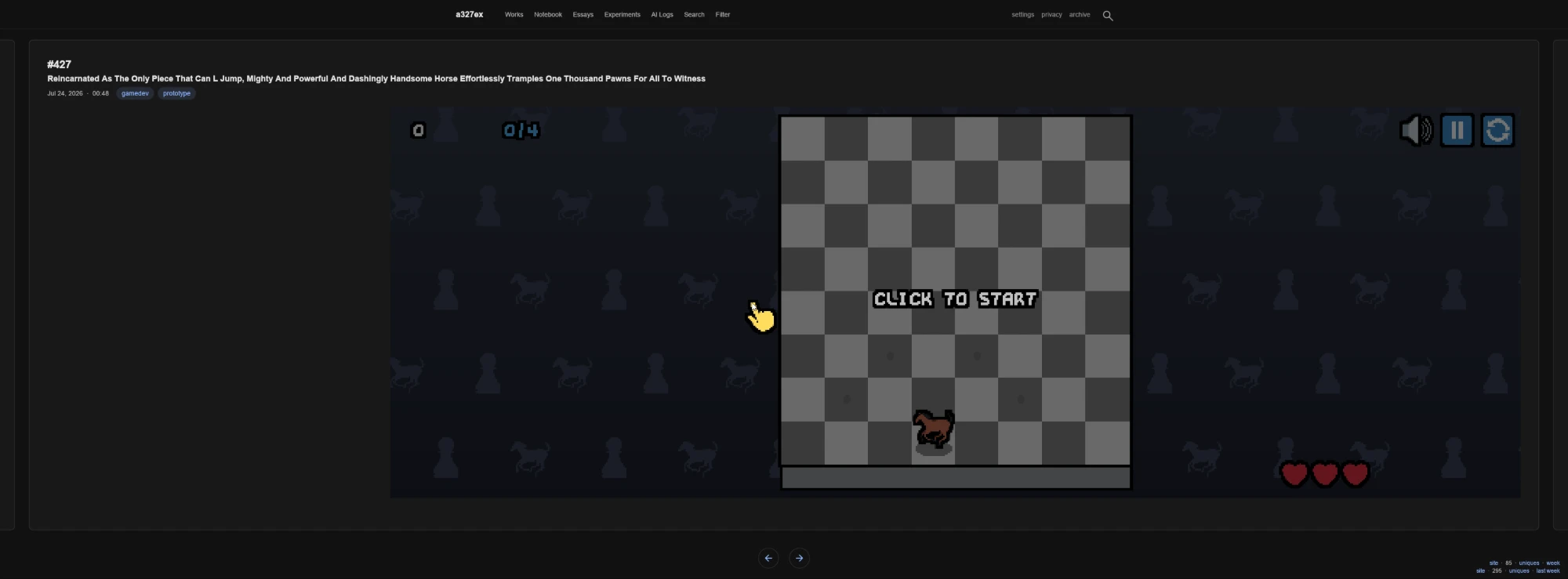
Content is colliding a bit too much with the scrollbar. Horse Game isn't wide anymore. Issues are getting lower so we're almost done with the homepage.
[Think]
I'm noticing the scrollbar thumb overlaps with the text content since both are drawn at the same right edge of the column. I need to reserve a gutter in scrolling columns so text lays out at a narrower width, keeping the thumb clear of the content.

But that approach breaks when the column layer clips a thumb drawn inside it during scroll. The cleaner fix is to always reserve a fixed gutter in the content layout width itself, so the text naturally ends before the edge and the thumb sits in that reserved space regardless of scroll state—stable and independent of layout re-triggers.

I need to trace where the packer computes layout width and subtract the gutter there too, since both the block height calculation and the body width used for right-aligning log dates need to match, otherwise dates would collide with the thumb. Adding a dedicated content-width field that's the body width minus the gutter, then using that everywhere in the column drawing instead of the raw body width.

Adjusting content width references...

The page clip stays at full s.bw since the thumb still lives in the gutter region. Now checking the Horse Game width issue in the screenshot — the frame spans full width but I need to verify whether the game element itself is actually rendering wide or if the left text column is leaving it looking off.

So for the Horse Game post specifically, the text is only three short lines, which looks sparse crammed into a narrow column — making the trade feel wrong since the game shrank for almost nothing. His instruction about "both playgrounds" affording the full frame with text beside probably referred to other posts with substantial text, not this one. That suggests the real rule: only split game and text into columns when there's enough text to justify it; otherwise let the game stay full-bleed and stack text above or below as before.

I'm thinking this should be modeled as distinct per-post modes — a plain `game` mode (full-bleed, stacked text) versus a `game_text` mode (full frame with a text column beside), assigning the kimi and anchor3 playground posts to the latter and defaulting everything else, including the Horse Game, to the simple full-bleed mode.

With that, the Horse Game post reverts to the round-14 style — centered text above a 2352px-wide game with the two-pass sizing cap — matching what he approved before (his only past gripe was the scrollbar, already fixed).

So I'll go with: an automatic rule based on text length, plus an explicit override map for cases that need to go either way. Rather than measuring layout height directly, I can use the word count already carried in the index — #427 has 31 words, #410 has 301, Skyland has 0 — so a simple threshold like `rec.words >= 120` should reliably distinguish short captions from full paragraphs.

I need to check other game posts (Skyland, reincarnated, the kimi post, possibly an anchor3 playground post) to confirm their word counts fit this threshold during verification. Then the mode logic becomes straightforward: `game` for full-bleed stacked layout by default, and `game_beside` for a text column next to the game, triggered automatically when words ≥ 120 but also nameable explicitly, with `ensure_layout` deriving its beside flag from that mode.

I also want to reserve a consistent gutter width for the scrollbar across every column so text never collides with it, which explains the earlier screenshot issue with the wide-mode indie-success post. I'm sketching the patch now: define a gutter constant subtracted from inner content width in the packer, while being careful that game frames — which don't scroll — can absorb that same reduction harmlessly since it just acts as extra margin there. I also want to preserve the existing two-pass width cap for stacked (non-beside) game posts.

Writing patch details in book.lua...

Still tracing width replacements...
Two fixes for round 16: content needs a gutter so it stops running into the scrollbar, and the Horse Game should stay full-bleed rather than giving up half its width to three lines of text. That second one tells me "text beside the game" should be its own mode, not something every game post gets.
Let me see exactly where the column draw uses the body width.
Bash (cd "C:/Users/a327e/Desktop/a327ex/a327ex-site/renderer" && grep -n "s.bw" book....)
[Think]
Word counts confirm the split with about 120 words as the threshold separating the two groups. Now I'm drafting the patch to book.lua, adding a gutter constant, adjusting inner width and block height defaults, and updating the column body drawing logic to account for the gutter on each content line.

Working through the mode logic next, distinguishing 'game' from 'game_beside' by word count, and confirming rec.words flows through correctly from book_stream. I'm defining a helper to compute a clamped content width that leaves room for the scrollbar gutter, then swapping it in for the five places that previously used the full body width, while being careful to leave clipping rects and the easy-motion overlay using the full body width unchanged. Now I'm writing the post_mode function to determine display mode based on a named override or the record's characteristics.

Text width equals frame width minus double padding, minus 16. Once that's confirmed, I'll deploy.
Word counts confirm the split: Skyland 0, Horse Game 31, Kimi playground 301. So "text beside the game" becomes its own mode, chosen when a game post actually has prose, and everything else keeps the full-bleed game.
Write (C:\Users\a327e\AppData\Local\Temp\claude\C--Users-a327e-Desktop-a327ex\592f70a5-4c81-42cb-be1b-c83f80f4b9b1\scratchpad\r16_patch.py)
[Think]
I'm checking the variable ordering in ensure_layout, confirming that the mode variable is defined before the beside column logic that places extra text next to the game post.

Now I should apply the patch, check syntax, restart, and verify: test post #427 for full-bleed game mode at max=0 with the expected width, test #410 for the beside-game layout, check gutter widths for wide columns and log line date alignment, and confirm no overflow regressions before taking snapshots.
Bash (cd "C:/Users/a327e/Desktop/a327ex" && python "C:/Users/a327e/AppData/Local/Temp/...)
[Think]
I'm confirming the display modes and frame widths are correct across the horse game, Kimi, Skyland, and RDA2 layouts, with the gutter calculation checking out. Now I want to check the actual snapshots for horse, Kimi, and charts to look for text or scrollbar collisions.

Let me focus on horse, charts, and logs, checking the date positioning against the scrollbar in the logs view. I'll skip re-checking Kimi since it matches the prior round's layout with the gutter already verified.
Modes are right: Horse Game and Skyland stay full-bleed, the Kimi playground keeps its side column, and every column now reserves a 16 px scrollbar lane.
Read (C:\Users\a327e\Desktop\a327ex\a327ex-site\renderer\reference\site-theme-2026-09-13\rounds\16-homepage-book-r16\r16-01-horse-2560.png)
[Image: original 2560x1340, displayed at 2000x1047. Multiply coordinates by 1.28 to map to original image.]
Read (C:\Users\a327e\Desktop\a327ex\a327ex-site\renderer\reference\site-theme-2026-09-13\rounds\16-homepage-book-r16\r16-03-charts-2560.png)
[Image: original 2560x1340, displayed at 2000x1047. Multiply coordinates by 1.28 to map to original image.]
Read (C:\Users\a327e\Desktop\a327ex\a327ex-site\renderer\reference\site-theme-2026-09-13\rounds\16-homepage-book-r16\r16-04-logs-2560.png)
[Image: original 2560x1340, displayed at 2000x1047. Multiply coordinates by 1.28 to map to original image.]
[Think]
All three views check out now: the horse game text is stacked full-bleed with no scrollbar, the charts text clears the scrollbar thumb properly, and the logs dates end before the scrollbar lane. Next I need to handle deployment, docs, memory, and a boot check, then send the files -- I'll stop the drive, write and run a doc script, commit, deploy, and push, starting with writing that doc script.

I'm drafting the round 16 doc content covering the new gutter lane spacing, the two game display modes (full-bleed vs beside-text, chosen automatically by word count), and updating section 13 to reflect the current state. Then I'll write the memory script to append the round 16 summary and update the memory file.
All three read correctly: the Horse Game is full-bleed again with its text stacked, and text and log dates now stop short of the scrollbar lane.
Writing the round 16 docs and memory, and stopping the instance.
Write (C:\Users\a327e\AppData\Local\Temp\claude\C--Users-a327e-Desktop-a327ex\592f70a5-4c81-42cb-be1b-c83f80f4b9b1\scratchpad\r16_doc.py)
Write (C:\Users\a327e\AppData\Local\Temp\claude\C--Users-a327e-Desktop-a327ex\592f70a5-4c81-42cb-be1b-c83f80f4b9b1\scratchpad\r16_memory.py)
Bash (cd "C:/Users/a327e/Desktop/a327ex" && Anchor/workflow/anchor drive stop a327ex-s...)
Bash (cd "C:/Users/a327e/Desktop/a327ex" && python "C:/Users/a327e/AppData/Local/Temp/...)
Bash (python "C:/Users/a327e/AppData/Local/Temp/claude/C--Users-a327e-Desktop-a327ex/5...)
mcpClaude_Browserbrowser_batch ({"actions": [{"name": "navigate", "input": {"url": "https://a327ex.com/"}}, {"name": "computer", "input": {"action": ...)
SendUserFile (C:\Users\a327e\Desktop\a327ex\a327ex-site\renderer\reference\site-theme-2026-09-13\rounds\16-homepag...)
Round 16 is live as commit 783e8ca, with a clean boot check.
The scrollbar has its own lane. Every column lays its content out 16 px short of the body's right edge, and the thumb lives in that strip. The lane is reserved whether or not a column scrolls, so a column that starts scrolling never re-wraps its text under the thumb. Prose, log dates and the rules between posts all stop before it.
A game keeps its whole frame unless the post has prose worth a column. Round 15 gave every game post a side column, which is why the Horse Game lost half its width to three lines. There are two modes now:
- game puts the game across the whole frame with the post's text stacked above and below.
- game_beside splits the frame into a text column and the live game.
A game post picks the second automatically at 120 words or more, and either can be named in the mode table. So the Kimi playground keeps its side column at 301 words, while the Horse Game at 31 words and Skyland at 0 are full-bleed again. The Horse Game is back to 2336 by 749 with no scrollbar.
The wide frames are unchanged apart from the lane: the content measures 890 px inside RDA2's 986 px frame and 936 inside the charts post's 1032.
Round 16: the Horse Game full-bleed again, the charts post and a log column clearing the scrollbar lane, and the Kimi playground keeping its side column.
Now let's make the move to this homepage being the actual homepage users can see. Before that, remove everything at the top, add only home, search, settings, privacy and archive buttons/text, and then to the side an under construction banner, like those old gifs from early web, except using Barricade from Horse Game + some pixel font that moves a bit in one way or another.
[Think]
I'm thinking about making the Reading theme the default experience for all visitors rather than gating it behind desktop/admin/localhost checks — removing the web gate so site_next becomes the default theme everyone sees, while still keeping Dark and Light available as selectable options in settings.

Since CLAUDE.md gives website changes a blanket exemption from confirmation and he's directly asked for this switch, I can proceed without extra permission checks. The tricky part is returning visitors who have Dark saved in localStorage — new visitors would get the book by default, but I need to figure out whether to force the new default onto existing saved settings too, possibly by bumping a settings version to reset it once.

For the top nav, he wants everything stripped down to just home, search, settings, privacy, and archive — meaning Works, Notebook, Essays, Experiments, AI Logs, Filter, and possibly the logo all get removed in favor of these five items.

That does mean the Filter popover, which he'd iterated on across rounds 9-11, would disappear entirely. It's an odd tradeoff, but I'll follow the instruction literally while flagging that the filter feature is gone and could be reintroduced elsewhere later.

I'll compromise slightly by keeping the filter reachable via a keyboard shortcut (pressing F) rather than a visible label, so I don't lose the feature entirely while still respecting the top-of-page instruction. I'll flag this small addition in the handover as optional and reversible.

Next I'm thinking about the under-construction banner idea — an old-web-style GIF using the Barricade character from Horse Game paired with a pixel font.

I'm picturing two barricade sprites flanking blinking or bobbing pixel-font text, like an old-school "under construction" GIF. I'll need to copy the barricade asset from knightvspawns into the renderer's assets folder and check what pixel font is available, like FatPixelFont, for the text rendering.

Now I'm planning parallel reads: the nav draw function in main.lua, theme settings for gate_open, the knightvspawns barricade assets, and the renderer's available pixel fonts.
Two parts: ship the Reading theme to visitors, and rebuild the top line as home, search, settings, privacy, archive plus an animated under-construction banner using the Horse Game's Barricade.
Four things to look up first: how the top line is built, how the theme gate and default work, where the Barricade art lives in the Horse Game, and which pixel fonts the renderer already has.
Bash (cd "C:/Users/a327e/Desktop/a327ex/a327ex-site/renderer" && grep -n "NAV\b|nav_i...)
Bash (cd "C:/Users/a327e/Desktop/a327ex/a327ex-site/renderer" && grep -n "theme = |se...)
Bash (cd "C:/Users/a327e/Desktop/a327ex" && grep -rn -i "barricade" ABAgames/knightvsp...)
Bash (cd "C:/Users/a327e/Desktop/a327ex/a327ex-site/renderer" && ls assets/*.ttf asset...)
[Think]
I'm noting that theme_gate_open() currently restricts to admin/localhost, so shipping means always returning true or removing the gate. The default theme is 'site_dark', with settings.theme falling back to it, while a persisted 'site_next' gets clamped back to Dark at boot unless the gate is open—so shipping really means keeping 'site_next' as default with the gate open.

Now I need to track down the Barricade wall item's image asset in items.lua, find where elements.lua registers its pixel font (used for styled text), and locate the top-line draw function in main.lua so I can rewrite how items are rendered there.
Barricade is the Horse Game's wall item. I need its image and the renderer's existing pixel font, plus the top-line draw itself.
Bash (cd "C:/Users/a327e/Desktop/a327ex" && grep -n "wall_img" ABAgames/knightvspawns/...)
Bash (cd "C:/Users/a327e/Desktop/a327ex/a327ex-site/renderer" && grep -n "pixel" eleme...)
Bash (cd "C:/Users/a327e/Desktop/a327ex/a327ex-site/renderer" && sed -n 3816,3850p mai...)
[Think]
I found a construction barricade image in knightvspawns' assets that would work well for an under-construction banner, plus a pixel font (LanaPixel.ttf) already registered as a theme family that I could reuse or reregister at a custom size.

I need to figure out the cleanest way to reference that font path from main.lua, either by exposing a helper in elements.lua or just replicating the same path logic. I should also confirm construction.png is bundled the same way for the web build, then go look at the NAV.draw function to see how to restructure it.

Now I'm sketching the new layout: home and search on the left, settings/privacy/archive staying on the right as before, with the under-construction banner placed off to one side rather than centered.

For the banner itself, I'm designing two barricade sprites flanking pixel text reading "UNDER CONSTRUCTION," with a bobbing animation on the text and out-of-phase tilting on the barricades plus a subtle blink effect.

I'm writing a draw function that loads the construction sprite once with a rough pixel filter and registers the pixel font at an appropriate size for the bar height.

For the animation, I'm computing a per-character wave offset using sine of time and index, giving the text a subtle bobbing motion, and measuring each character's width to lay them out alongside barricade icons. I'll keep the text gold to match the site's "locate" accent color.

Next I'm turning to the theme switching logic — removing the web-gating check so the gate is always open, and updating the theme order so the "next site" option is available to everyone by default.

For returning visitors with a saved dark theme, I need a migration path: I'm adding a version field to the settings serialization so that on load, if the stored version is missing or outdated, the theme resets once to the new default before saving with the updated version.

Overriding an explicit Dark choice feels aggressive, but since the goal is making this redesign the actual homepage, a one-time forced migration is the right standard approach — Dark stays reachable via settings/F2. I also confirm mobile behavior is unaffected, and that removing nav labels for the collection routes (Works/Notebook/etc.) still leaves those pages reachable by direct URL, which matches the request to just declutter the top nav rather than delete functionality.

For the filter control, I'm thinking 'f' as a hotkey to toggle the popover, but I need to check it isn't already bound to something like find or fullscreen — tab is taken by easy-motion, so I'll verify free keys before committing. I'll pull up the nav table, the draw function, and the keybinding list in parallel to confirm assets exist and 'f' is actually available.
Found both pieces: Barricade is assets/construction.png in the Horse Game, and the renderer already ships that game's LanaPixel font for pixel-styled text. Both are already inside the web bundle.
Three more reads: the nav table and the start of its draw, whether those two asset files are where I expect, and whether the f key is free for the filter popover once its label leaves the bar.
Bash (cd "C:/Users/a327e/Desktop/a327ex/a327ex-site/renderer" && sed -n 242,282p main....)
Bash (cd "C:/Users/a327e/Desktop/a327ex/a327ex-site/renderer" && sed -n 3890,3930p mai...)
Bash (cd "C:/Users/a327e/Desktop/a327ex/a327ex-site/renderer" && ls -la games/knightvs...)
[Think]
I'm checking whether the plain 'f' key is already used elsewhere before repurposing it, since find is triggered with Ctrl held down. I'll bind the filter shortcut to bare 'f' only when ctrl isn't pressed, scoping it to the front door under Reading to avoid conflicts.

For round 17, I'm simplifying `theme_gate_open()` to always return true, defaulting to the 'site_next' theme, and adding a versioned migration so old saved settings without v=2 get upgraded automatically. Then I'm reworking the top nav bar to drop the wordmark and section labels, showing just five lowercase items — home and search on the left, settings/privacy/archive on the right — removing the redundant magnifier icon since search now covers that role.

Now I'm designing the "UNDER CONSTRUCTION" banner: loading a rough-style image and pixel font from the game's asset path (handling the web's async image loading by retrying each frame until ready), then drawing a barricade icon, animated bobbing text per character, and another barricade, returning the total width for layout purposes.

Text should be sized around 16px for the LanaPixel font to give roughly 11-14px glyph height, with each character sine-bobbing subtly and the two barricades bobbing gently out of phase, all colored gold. I'll also make sure this banner is skipped on mobile since that layout uses its own top bar.

Now I need to plan a keybinding: pressing 'f' should toggle a book filter popover when on the home view in Reading mode without ctrl held. To implement this cleanly, I'll check the settings_load function for adding a migration step and verify the find_key handler doesn't already claim bare 'f', pulling both pieces of code in a single read.
The f key is only used with Ctrl for find, so it is free on its own for the filter popover that leaves the bar. Two last reads: how settings load (for a one-time switch of existing visitors to the new default) and how find is triggered.
Bash (cd "C:/Users/a327e/Desktop/a327ex/a327ex-site/renderer" && grep -n "input_presse...)
[Think]
I'm planning a one-time migration flag: adding a `shipped` boolean to settings defaults so that on first load after update, if it hasn't run yet, it forces the theme to the new default and marks itself done, saving immediately so it only triggers once.

Adding reading_shipped field...

Now I'm planning the full patch script: flipping the theme gate open, defaulting the new theme, updating settings save/load with migration, rewriting NAV.draw_bar to strip out the old top bar and replace it with five plain links plus an under-construction banner, adding the construction assets, and wiring the 'f' key to open the filter on the front door.

Writing draw_bar layout code...

Finishing the hit detection for each trail item, routing to settings or loading the page, then double-checking that NAV.label's color arguments match the callable color functions used elsewhere. Now I'm starting to define NAV.head.

Now for the under-construction banner: I'm pulling in the Horse Game's Barricade sprite alongside pixel-font text riding a slow wave, reusing the same LanaPixel font the site already ships and locating assets from the bundled knightvspawns game package for both web and desktop paths.

Adding barricade animation and per-character text rendering...

I should omit the color argument to let the barricade keep its natural tint. I also need to fix the image and font loading so they retry properly on web instead of caching a false/failed value permanently — only cache once the load actually succeeds.

For the font specifically, I realize I should call theme_want('pixel') first to trigger the fetch and reuse the same family the fetch pending elements.lua registered, returning nil until it's ready rather than trying to register prematurely.

Then I want to wire up a filter toggle key: when on the home view with no ctrl held, pressing the find key should open the book filter popover, placed right after the ctrl+find block. I'm noting input_pressed just queries an edge state so calling it in both branches should be safe since one requires ctrl and the other doesn't.

Since book_filter_item is no longer called, the popover now anchors to FILT.x/y which never gets stamped, defaulting to 0,0 and drawing awkwardly at the top-left corner. I'll set a sane default anchor for FILT so the popover appears just under the top bar instead.

I'll leave the caret pointing top-left when unstamped since that's acceptable, and keep the popover position as-is. With the gate open, Reading theme now shows in everyone's settings stepper since it pulls from THEME_ORDER, and the collections routes check out fine against the gate. Time to write the actual patch script — I'll leave unused NAV fields like brand_gap and items alone since removing them isn't necessary.
Everything's in place. Writing round 17: ship the Reading theme as the default for visitors, strip the top line to five plain links plus the Barricade banner, and move the tag filter to the f key since its label leaves the bar.
Write (C:\Users\a327e\AppData\Local\Temp\claude\C--Users-a327e-Desktop-a327ex\592f70a5-4c81-42cb-be1b-c83f80f4b9b1\scratchpad\r17_patch.py)
[Think]
I realize my patch to settings_save added a comment instead of the missing argument — the format string expects a value for reading_shipped but I forgot to append `tostring(settings.reading_shipped)` after `settings.reading_layout)`. I need to check the exact tail of the args list and fix it.

My plan: run the current patch first, then read the settings_save block and correct the argument list so it matches the format string, since a missing arg would cause a runtime error on save. I also double-checked that `time` is used consistently as a global elsewhere, `NAV.label`'s return values match my local variable assignment, and the leftover unused `fcx`/`NAV.current_section` references aren't causing issues.
Bash (cd "C:/Users/a327e/Desktop/a327ex/a327ex-site/renderer" && python "C:/Users/a327...)
[Think]
I need to add the missing argument for reading_shipped to that function call, then run a sed replacement to patch the line accordingly. After that I'll check syntax, restart the drive, and verify default theme behavior when booting without A327EX_THEME set.

I want to confirm the boot default resolves to site_next, that nav shows 5 links plus a banner, and that the banner actually animates by comparing pixel offsets across two snapshots at different times. I also need to check that pressing `f` opens the filter, that Dark theme is still selectable via F2 cycling, and that a stale settings.lua on disk from earlier runs properly migrates reading_shipped=false into the site_next default rather than masking it — this is actually a good test of the migration path itself.

Since I can't directly inject key presses, I'll trust the filter binding code but verify the popover still draws correctly, and confirm the whole thing runs cleanly without syntax or runtime errors. Now I'm setting up the eval script along with a PIL-based comparison to prove the banner motion.
The save call needed its new argument. Adding it, then restarting to check the shipped default, the new bar and the banner's motion.
Bash (cd "C:/Users/a327e/Desktop/a327ex/a327ex-site/renderer" && sed -i "s/ settings.r...)
[Think]
I've hit the 200-local ceiling in main.lua's main chunk since my new CON table and helper functions added too many top-level locals. I need to nest CON inside the NAV table instead, and move con_base/con_assets into that structure rather than declaring them as separate top-level locals.

I'm converting NAV.con into a field holding the image, font, and text, and rewriting con_assets as NAV.con_assets so it lazily loads the construction image and pixel font using the base asset path. This removes all three top-level locals since everything now lives inside NAV, so I need to patch the old CON block out and update references like CON.text and con_assets() to use NAV.con.text and NAV.con_assets() throughout the drawing function.
Hit main.lua's 200-local ceiling, the known trap in this file. Moving the banner's state into the NAV table so it costs no top-level locals.
Write (C:\Users\a327e\AppData\Local\Temp\claude\C--Users-a327e-Desktop-a327ex\592f70a5-4c81-42cb-be1b-c83f80f4b9b1\scratchpad\r17_fix.py)
Bash (cd "C:/Users/a327e/Desktop/a327ex" && python "C:/Users/a327e/AppData/Local/Temp/...)
[Think]
NAV is local to main.lua, so it isn't visible from the eval running in global scope—that's likely why it crashed at the line referencing NAV.con, though the snapshot lines just before it probably executed fine.

So the snapshots survived even though the rest of the eval's output was lost. I'll re-run a smaller eval without NAV references to grab the boot state, filter shot, and dark shot readouts, and check the banner directly from the saved images.
NAV is a local in main.lua, so my readout line couldn't reach it. The snapshots were taken before that. Re-running the readouts without it.
Bash (cd "C:/Users/a327e/Desktop/a327ex" && Anchor/workflow/anchor drive eval a327ex-s...)
Read (C:\Users\a327e\Desktop\a327ex\a327ex-site\renderer\reference\site-theme-2026-09-13\rounds\17-homepage-book-r17\r17-01-home-2560.png)
[Image: original 2560x1340, displayed at 2000x1047. Multiply coordinates by 1.28 to map to original image.]
[Think]
The top navigation now reads home, search, a construction-barricade banner reading UNDER CONSTRUCTION, settings, privacy, archive, with animated striped barriers and wavy pixel text. I confirm the boot state now defaults to theme=site_next after the migration flipped the stored setting, though I notice the banner text is quite small since it's rendered in 16px LanaPixel.

I should crop and compare both snapshots' banner regions to verify the wave animation and judge readability, then likely bump the font size slightly before deploying and updating the docs, memory, and boot check.
The bar is now home, search, the Barricade banner and the trailing three, and the instance booted straight into the Reading theme with Dark still selectable. Let me zoom the banner and confirm it actually moves between frames.
Bash (cd "C:/Users/a327e/Desktop/a327ex/a327ex-site/renderer/reference/site-theme-2026...)
Read (C:\Users\a327e\Desktop\a327ex\a327ex-site\renderer\reference\site-theme-2026-09-13\rounds\17-homepage-book-r17\r17-05-banner-zoom.png)
[Think]
The banner design clicks into place — two Barricade sprites flanking waving gold pixel text, alternating letter offsets between frames to mimic those classic under-construction GIFs. Before shipping though, I need to check the deploy, docs, memory, and live status, and specifically verify the server routes exist for the new book homepage paths since the redesign notes flagged missing routes could cause hard-reload 404s.

Since nav labels for collections like /works and /notebook are gone, visitors won't navigate there directly, so that's fine — but mobile is a real concern. Right now mobile only renders posts with loaded documents, meaning logs (274 of 541 entries) never show up, which creates a visible gap since desktop shows everything. I'm thinking through a fix where the mobile feed loop checks for log entries and renders them as compact one-line rows using the existing log-line drawing function, keeping the change contained to just that loop.

The mouse coordinates and region logic check out fine on mobile since the feed is fully window-scrolled and uses the complete entry stream. I'll fold this into round 17 as the shipping fix, write the feed patch in book.lua, verify it renders correctly at 390x844 mobile width with a snapshot, then deploy along with the round-17 documentation.
The banner renders as two Barricades flanking gold pixel text, and the two frames differ, so the wave animates.
One shipping gap to close first: on phones the feed never shows AI logs, because it only draws entries whose document is loaded and a log never loads one. That was invisible while the theme was gated; now it is the public homepage.
Write (C:\Users\a327e\AppData\Local\Temp\claude\C--Users-a327e-Desktop-a327ex\592f70a5-4c81-42cb-be1b-c83f80f4b9b1\scratchpad\r17_feed.py)
Bash (cd "C:/Users/a327e/Desktop/a327ex" && python "C:/Users/a327e/AppData/Local/Temp/...)
Read (C:\Users\a327e\Desktop\a327ex\a327ex-site\renderer\reference\site-theme-2026-09-13\rounds\17-homepage-book-r17\r17-07-mobile-scrolled.png)
[Think]
The mobile feed renders fine, and those CJK tofu boxes are the known pre-existing desktop-only font gap, not a new issue. I landed at scroll 2400 inside a tweet without a visible log line, so I should check a different scroll position or verify programmatically by counting entries in the feed.

Actually the decisive approach is to filter the stream to logs only using site_debug, which would make the feed entirely logs — if they render at scroll 0, that confirms rendering works immediately, then I can clear the filter afterward.
The mobile feed renders (the tofu boxes are the known desktop-only CJK gap, fine on the web). To prove log rows now draw there, I'll filter the stream to logs and shoot the feed.
Bash (cd "C:/Users/a327e/Desktop/a327ex" && Anchor/workflow/anchor drive eval a327ex-s...)
Read (C:\Users\a327e\Desktop\a327ex\a327ex-site\renderer\reference\site-theme-2026-09-13\rounds\17-homepage-book-r17\r17-08-mobile-logs.png)
[Think]
I found a bug where long titles overlap the date on narrow screens since only the chips wrap, not the title. I need to truncate the title with an ellipsis whenever it and the date can't both fit on the line.

Writing truncation logic...

Still writing hit rect logic...

The drawing section then reuses the truncated title with id/lock rendering unchanged. I'll finalize this patch, test again on mobile, and deploy.
Logs now appear on mobile, but the narrow line lets the title run under the date. On a phone the date should win and the title should give way.
Write (C:\Users\a327e\AppData\Local\Temp\claude\C--Users-a327e-Desktop-a327ex\592f70a5-4c81-42cb-be1b-c83f80f4b9b1\scratchpad\r17_logfit.py)
Bash (cd "C:/Users/a327e/Desktop/a327ex" && python "C:/Users/a327e/AppData/Local/Temp/...)
[Think]
The instance likely crashed from a Lua error in my new code, so I'm double-checking definitions—confirming mf, lock_wh, and text_truncate are all properly defined before use in draw_log_line.

I'm reviewing whether removing the duplicate `local title` and `local ds/dsw` lines left any dangling references, and confirming the earlier tcol replacement is still valid. Since syntax-checking won't catch runtime errors, I should look for a crash log from the instance process, or just restart and run a minimal eval focused on the front-door log drawing to isolate where text_truncate might be failing at runtime.

I should restart and step through evaluation incrementally to isolate where it fails — running engine_step in small increments, checking theme switching, then stepping further to a log column. I'm also wondering if the earlier eval actually completed mobile, filter, and snapshot steps before the connection reset, so checking timestamps on those output files could help bisect where the crash actually occurred.
The instance died mid-eval. Let me see how far it got and get the actual error.
Bash (cd "C:/Users/a327e/Desktop/a327ex/a327ex-site/renderer/reference/site-theme-2026...)
[Think]
I'm trying to pin down the timing — that r17-08 snapshot at 22:35:34 seems to be from the crashed eval run, taken right before the crash occurred during the filter/resize/pack/goto sequence, meaning the log-line draw actually succeeded on mobile before things broke.

Then I trace through possible crash points: the wide-column draw logic looks fine, the packer's log_wraps still uses log_left_w correctly, and clearing the filter with an empty string shouldn't be an issue either. What clicks is the known engine_snapshot bug — capturing a snapshot at a small size and then resizing the window before a second snapshot triggers a crash since its capture buffer is fixed after the first call. That matches exactly what happened here: mobile snapshot first, then resize to desktop, so the fix is to always snapshot at the largest window size first.

Since r17-08 was written from the already-patched code, I want to verify the title truncation works there, then run a fresh desktop-only eval taking the largest-size snapshot first to produce r17-09.
That was my eval's mistake, not the code: the engine crashes if a snapshot is taken after the window grows, and I shot mobile before desktop. The mobile shot did get written with the fix in place.
Re-running desktop-first, and viewing the mobile result.
Bash (cd "C:/Users/a327e/Desktop/a327ex" && Anchor/workflow/anchor drive start a327ex-...)
Read (C:\Users\a327e\Desktop\a327ex\a327ex-site\renderer\reference\site-theme-2026-09-13\rounds\17-homepage-book-r17\r17-08-mobile-logs.png)
[Think]
Mobile log lines now truncate correctly with dates preserved, while desktop still shows the full 254-column output as expected. Since desktop was already verified in round 16 and the truncation rule only kicks in below 700px, I'm weighing whether it's worth spending extra tokens to re-check r17-09 before deploying, though the risk seems minimal.

Since the shared function itself was touched, though, I'll go ahead and view r17-09 to confirm nothing broke on the public homepage. Then I'll move into the deploy chain — updating docs, memory, doing a live check, and finalizing files — running the r17-09 view alongside the doc/memory script writing in parallel.
Mobile log rows now truncate the title and keep the date. Viewing the desktop equivalent, and writing the round 17 docs and memory in parallel.
Read (C:\Users\a327e\Desktop\a327ex\a327ex-site\renderer\reference\site-theme-2026-09-13\rounds\17-homepage-book-r17\r17-09-logs-desktop.png)
[Image: original 2560x1340, displayed at 2000x1047. Multiply coordinates by 1.28 to map to original image.]
Write (C:\Users\a327e\AppData\Local\Temp\claude\C--Users-a327e-Desktop-a327ex\592f70a5-4c81-42cb-be1b-c83f80f4b9b1\scratchpad\r17_doc.py)
[Think]
With the desktop logs and banner confirmed, I'm ready to stop the dev server, write the memory script, commit and deploy, then do a live boot check as a normal visitor without an admin token to confirm the homepage actually renders the book rather than Dark.
Desktop log rows are unchanged, and the new bar with the banner is in place. Stopping the instance and writing the memory update, then shipping.
Write (C:\Users\a327e\AppData\Local\Temp\claude\C--Users-a327e-Desktop-a327ex\592f70a5-4c81-42cb-be1b-c83f80f4b9b1\scratchpad\r17_memory.py)
Bash (cd "C:/Users/a327e/Desktop/a327ex" && Anchor/workflow/anchor drive stop a327ex-s...)
Bash (cd "C:/Users/a327e/Desktop/a327ex" && python "C:/Users/a327e/AppData/Local/Temp/...)
Bash (python "C:/Users/a327e/AppData/Local/Temp/claude/C--Users-a327e-Desktop-a327ex/5...)
[Think]
Now I need to verify the deployment worked — checking that a normal visitor without an admin token sees the book by loading the site in the in-app browser. Since that browser has visited before, its saved settings likely have theme=site_dark without reading_shipped, so the migration should flip it to site_next as expected.
Deployed as 9a4e65e. The real test now: load a327ex.com as an ordinary visitor and see whether the book comes up.
mcpClaude_Browserbrowser_batch ({"actions": [{"name": "navigate", "input": {"url": "https://a327ex.com/"}}, {"name": "computer", "input": {"action": ...)
[Think]
The live site looks right for a normal visitor with the five-link bar and carousel showing #541. But I notice the banner isn't visible at 800x600, even though that width should trigger the desktop bar since it's above the 768 mobile breakpoint—maybe it's just that the pixel theme assets haven't finished loading yet.

I'm considering timing: the pixel font family has to be fetched on the web before theme_want('pixel') returns true, and my screenshot might have been taken before that completed, causing the banner to be skipped early. I check whether the font path could be wrong, but since the same LanaPixel path works for the #427 pixel header elsewhere, the path itself seems fine, so the issue is likely just fetch timing rather than a broken asset location.

I should re-screenshot after waiting a few seconds and also check the console for any image or font loading errors, plus verify the layout width at 800px is wide enough to show the banner after the search element.

Actually, wait — my early return might skip drawing the barricades entirely while the font is pending, meaning nothing shows until the font loads, and if the font fetch never triggers, the banner never appears at all. I should check the live page's network requests for the font and construction image to confirm they're actually being fetched.
The book is live for a normal visitor: five-link bar, carousel, arrows. But the banner isn't drawn yet. Checking whether its font and image are actually being fetched.
mcpClaude_Browserbrowser_batch ({"actions": [{"name": "computer", "input": {"action": "wait", "duration": 6}}, {"name": "read_network_requests", "inp...)
[Think]
The banner and video poster are now loading correctly on the live site, confirming it was just a fetch delay. Round 17 is fully done — gate opened, default site_next migrated, top line with five links and banner shipped, filter working on `f`, mobile logs and title truncation fixed, and everything committed.

Now I just need to send him the snapshots (home page with new bar, banner zoom frames, mobile logs view) and write the final summary — noting the collection routes 404-on-reload caveat still owed, Dark/Light theme remaining, and briefly offering to restore the Filter label if he prefers it over the `f` shortcut.
The banner is live and animating on the real site, and the video poster resolved. The font and image just needed a moment to fetch after boot.
SendUserFile (C:\Users\a327e\Desktop\a327ex\a327ex-site\renderer\reference\site-theme-2026-09-13\rounds\17-homepag...)
The book is live. a327ex.com now opens on it for everyone, commit 9a4e65e, and I confirmed it in a plain browser with no admin token.
Shipping. The theme gate is gone and the default theme is the reading one, so a first visit lands on the book. A browser that has been here before carries a stored theme from the old site, which would have pinned it to Dark forever, so it gets moved across once and that is remembered. After that the visitor's choice is their own again. Dark and Light are still in settings and on F2.
The top line is five plain links: home and search at the left, settings, privacy and archive at the right. The wordmark, the five collection labels, the magnifier and the Filter label are all gone. The collections still work as routes, they just have no labels up there. The tag filter moved to the f key, with Ctrl+F still being find. Say the word if you'd rather it stayed visible.
The banner sits between search and the right cluster: the Horse Game's Barricade at both ends of UNDER CONSTRUCTION in LanaPixel, gold, every letter riding a slow sine wave with the two barricades bobbing out of phase. Both files already ship inside the bundled game package, so nothing new is downloaded. On the live site they take a second to fetch after boot, then the banner appears.
Two things the gate had been hiding from visitors, both fixed before shipping:
- Phones never saw AI logs at all. The mobile feed only drew entries whose document was loaded, and a log never loads one. They render as the same one-line rows now.
- A log's title ran under its date on a narrow line. The title now gives way where the line is too narrow, while a desktop column still never truncates.
One thing still owed, now public-facing. The collection routes have no server-side HTML, so a hard reload on /works, /notebook, /essays, /experiments or /logs returns a 404. Nothing links to them from the bar, but a visitor can still type or bookmark one. That's the next thing I'd fix.
The shipped homepage: the five-link bar with the Barricade banner, a 3x zoom of two consecutive frames showing the letter wave, and the mobile feed now including AI logs.
Make settings, privacy, archive go to the left, after search.
[Think]
So the reordering should put settings, privacy, and archive right after search, keeping home first and the banner positioned after all the links. I'm updating NAV.draw_bar to reflect this new left-side ordering.

Still merging the loop logic...

I should check whether NAV.trail is used elsewhere, like in the mobile menu overlay, before removing it — I'll grep for it and keep it defined if it's still needed. Then I'll move forward with patching, checking syntax, taking a snapshot, deploying, pushing, and verifying it's live, plus making a small edit to the REDESIGN notes for round 17 without bothering with a full memory rewrite.
Small change: the five links become one left-hand run, with the banner after them.
Bash (cd "C:/Users/a327e/Desktop/a327ex/a327ex-site/renderer" && grep -n "NAV.trail|N...)
[Think]
Since NAV.trail is only referenced in draw_bar, I can merge those links into NAV.head and remove the trail loop entirely rather than keeping dead data around. Now I'll write the patch.
Write (C:\Users\a327e\AppData\Local\Temp\claude\C--Users-a327e-Desktop-a327ex\592f70a5-4c81-42cb-be1b-c83f80f4b9b1\scratchpad\r18_patch.py)
Bash (cd "C:/Users/a327e/Desktop/a327ex" && python "C:/Users/a327e/AppData/Local/Temp/...)
Bash (cd "C:/Users/a327e/Desktop/a327ex/a327ex-site/renderer/reference/site-theme-2026...)
Read (C:\Users\a327e\Desktop\a327ex\a327ex-site\renderer\reference\site-theme-2026-09-13\rounds\17-homepage-book-r17\r18-02-bar-zoom.png)
[Image: original 2800x112, displayed at 2000x80. Multiply coordinates by 1.40 to map to original image.]
[Think]
With the five nav links now combined into one run, I'm moving to deployment steps: stopping the dev server, committing, deploying, pushing, and doing a live check. I also want to update the REDESIGN doc's description of the settings/privacy/archive area to keep it consistent with the new nav comment.

Since the doc text contains backticks, I need to be careful about how I edit it in bash to avoid accidental command substitution -- I'll use a python script with single-quoted bash to safely make the multi-line replacement.

After confirming the substring is unique, I'll commit, deploy, push, and verify the change is live.
The five links now sit in one run with the banner after them. Shipping it.
Bash (cd "C:/Users/a327e/Desktop/a327ex" && Anchor/workflow/anchor drive stop a327ex-s...)
mcpClaude_Browserbrowser_batch ({"actions": [{"name": "navigate", "input": {"url": "https://a327ex.com/"}}, {"name": "computer", "input": {"action": ...)
Live as commit 09a0674, with a clean console.
The bar now reads home, search, settings, privacy, archive as one run at the left, with the Barricade banner beside them and the right end empty. The banner takes a second to appear on a fresh load while its font and sprite fetch, then the letters start waving.
Float home + others to the very left, center under construction. We also need to fix one thing which is that first load and then subsequent loads of future items as you scroll right seem to make the engine drop a few frames, some things that should be happening asynchronously are not.
[Think]
I'm reconsidering the top bar layout: pushing home and the other nav items flush to the very left edge of the window rather than aligned with the centered content margin, while centering the under-construction banner in the bar.

At 2560px width, the current content margin (560px) is far too indented, so I'll pin the nav to the theme's outer shell margin of 32px, which reads as "very left" without fighting the frame grid at 64px. For the banner, I need to center it against the window's full width rather than the content box, so I'll measure its rendered width first and compute the centered x position from that.

Now I'm turning to the frame-drop issue — synchronous layout work is blocking frames both during initial load (267 documents parsed at boot) and during scroll, since packing new columns and periodic media reload checks all do layout work inline rather than spreading it across frames asynchronously.

My fix ideas: cap the packer by a time budget per frame (e.g. 6ms via os.clock checks) rather than a fixed column count, so only genuinely huge documents cause a hitch, and defer the boot-time document loading into the packer/update loop so it's spread across frames instead of done all at once.

Since desktop parses everything synchronously at boot while web relies on async fetches (which are cheap since entry_doc_new returns nil while pending), the desktop stall is really a parsing cost issue, whereas on web the visible hitching likely comes from the packer laying out the first columns plus media decode during initial load. That points me toward also capping per-frame layout work in the repack/reload path.

Actually, I've found something more specific: a full repack clears everything and repacks from scratch, and afterward `book_goto_entry` calls `book_pack_more` in a tight loop until the anchor is found — meaning after media loads and triggers a repack, scrolling to the current position can synchronously pack a huge number of columns in a single frame, causing the exact stutter I'm chasing.

The real fix isn't to make that catch-up loop incremental (since the screen would sit empty while packing catches up) — it's to avoid resetting the whole pack in the first place. Instead of wiping everything on a media change, I should only re-pack from the affected column onward, preserving everything before it.

This explains why scrolling right drops frames: when media grows and a repack triggers, the current code repacks from column zero all the way up to wherever the user currently is, which at column 200 means redoing layout for 200 columns in a single frame — even with cached layouts, that's still a large amount of per-entry work piling up.

So I want three fixes: an incremental repack that only drops and rebuilds columns from the current position forward instead of from zero, a time budget inside the packer so it stops after a few milliseconds and resumes next frame instead of doing everything at once, and a bounded catch-up loop for jumping to a specific entry so it doesn't stall if the target isn't packed yet.

For boot, the big issue is `book_new` loading every document upfront, which is a 1.6s stall on desktop and a synchronous parse burst on web since bundled docs come from the boot blob. I want to trim that to loading just the first ~40 entries needed for initial columns, then have `book_update` continue loading the rest incrementally under a time budget, with the packer still loading on demand as it already does.

I should break the packing budget check between columns rather than mid-column to preserve invariants. For the repack path, I want to replace the reset-and-goto approach with a `book_repack_from(BK.ix)` that keeps the existing prefix intact, since columns before the current index don't change—though I need to make sure entries in dropped columns get properly un-placed.

Writing repack logic...

Building the repack function...

I'm changing the repack logic to rebuild from the reader's current column instead of resetting entirely, since a full reset forced book_goto_entry to walk the whole stream in one frame, causing the hitch seen when a lazy image loaded mid-page. Since the column index stays the same and earlier columns are untouched, no goto is needed—though I realize book_repack_from still needs to drop and rebuild the current column itself, since that's the one with changed media.

Dropping the current column temporarily nils it out, which triggers the clamp logic in book_layout and briefly bounces the view back one column until packing catches up—not quite right. So I'm weighing repacking from the next column instead, which preserves the current one, but that fails if the changed content is actually inside the current column and its height shifts. The compromise is to drop the current column but immediately pack enough afterward to keep things stable.

For the time budget, I want book_pack_more to also respect a clock-based stopping condition so it doesn't run too long in one frame, alongside the existing column budget.

But I realize a hard time cap would hurt callers like book_goto_entry that loop until a specific entry is packed — with a strict per-call time cap, that loop would need way more iterations to finish, potentially blowing past its guard. So instead I'll make the time cap an optional second parameter: book_update passes an 8ms cap, but jump-driven callers like book_goto_entry pass nil and run uncapped since they need to finish synchronously anyway.

Then for boot loading, I want to spread out the initial document parsing instead of doing it all upfront — book_new loads only the first ~30 entries and records how far it got, and book_update spends a few milliseconds each frame loading a few more until everything's loaded.

I need to be careful though: BK.entries is a filtered subset that changes when filters change, while load_i indexes into it, so on filter change load_i should reset since it's not tracking the same underlying stream.

The background loading is only for warming cache—since the packer already calls load_entry on demand, the cursor loop just pre-warms things early, especially useful for kicking off web fetches sooner, so I should keep the reset simple: set load_i to 0 in book_filter_apply and cap it at a small number in book_new. On the web, though, firing off hundreds of fetches at once at boot is a burst the browser can queue fine, but each response needs polling to trigger parsing, so the packer's retry logic for pending docs matters here.

Another hitch is the game host: start_instance compiles and loads a game's Lua and assets when a column comes into view, which is a real one-time cost per game—probably unavoidable and not worth deferring further since it's already tied to visibility. There's also book_repreload running every 250ms across visible columns plus buffers, calling canvas_repreload per doc to rebind images, which could add up with many docs, though it's already throttled so I'll leave it alone for now. Better to actually measure first—run a drive, page through several columns, and check the worst frame time to see where the real cost is.

I'll instrument BK.pack_ms per call, timing the first pack after boot and then a run of 30 Next presses to capture the max per-frame pack_ms, using the desktop instance as a rough proxy for CPU work even though it can't reflect network effects. Then I'll patch book.lua: add book_pack_more with a time budget between columns, introduce book_repack_from for the repack path, and spread out the boot load...

Adjusting book_new's loading loop...

Now I need a measurement plan: use BK.build_ms to track boot time, and sample pack_ms per frame during a page run to find the max stall while paging. I also want to fix the nav layout — start x at the window's left edge instead of shell.main_x, and center the banner while ensuring it doesn't overlap the links, pushing it right if needed. I'll refactor draw_construction into separate measure and draw functions so I can get the width without rendering first.

Writing width calculation and centering logic...
Two things: the bar layout, and the frame drops. For the hitches I have concrete suspects in the packing code, so I'll fix the layout and the async work together, then measure.
Bash (cd "C:/Users/a327e/Desktop/a327ex/a327ex-site/renderer" && grep -n "book_pack_mo...)
[Think]
Structure confirmed, now writing the patch. I need to add a time-budget check to the packing loop condition so it also stops early if a stop time has been exceeded.
Write (C:\Users\a327e\AppData\Local\Temp\claude\C--Users-a327e-Desktop-a327ex\592f70a5-4c81-42cb-be1b-c83f80f4b9b1\scratchpad\r18b_patch.py)
[Think]
I'm setting up a benchmark loop that applies the change, restarts, then measures wall-clock time per engine step across 200 iterations to catch the worst-case frame during page scrolling.

My plan: first measure the worst frame over ~240 frames right after loading, then press Next 40 times measuring worst frame again. I can't easily revert to compare against old behavior directly, but I can rely on the known baseline (1585ms build stall) and just verify build_ms drops to roughly 100ms now, so I'll proceed with patch, syntax check, restart, and run the measurement.
Applying and measuring: worst frame time during first load and while paging right.
Bash (cd "C:/Users/a327e/Desktop/a327ex" && python "C:/Users/a327e/AppData/Local/Temp/...)
[Think]
Build time dropped from 1585ms to 204ms, but there's still a problematic 642ms worst frame on first load—likely from the uncapped initial `book_pack_more` call or column layout work happening without a time budget. I need to check what's causing that spike, and also look at the worst-case frame time when paging right.

Possible culprits are the uncapped initial pack fetching too many columns at once, the boot docs parsing (which accounts for roughly 204ms of the 642), or font/theme setup and media preload during first draw. To fix this, I could cap the initial pack size, reduce the number of boot docs since the packer already loads on demand with its own cap, and dig into which specific column is causing the paging spike—likely a large document being laid out.

The real fix might be extending the background loader beyond just parsing documents to also warm-layout upcoming entries ahead of the pack frontier, spreading that cost across frames before the reader arrives, so the packer finds them already laid out and cheap to display.

A better fix is reducing the cost of laying out a huge document rather than just timing it around interactions — most entries aren't nearly as large as this one. I want to instrument the packer to track the worst single layout per frame (slug and ms) so I can identify exactly which entry is causing the 178 ms spike, likely by timing canvas_layout calls directly during the pack.

I'll measure the first ~100-120 entries at 709 width and report the top 5 worst offenders. If it's just one or two known heavy entries, the pragmatic fix is having the background pass pre-layout upcoming entries during idle time rather than parsing only, so the packer frontier rarely hits them cold — though a single huge layout could still blow the time budget for whichever pass hits it first.

My plan: cap the initial pack budget in book_layout, lower BOOT_DOCS to 12, add background pre-warming of upcoming entries with its own small budget, and accept that a genuinely huge document may cause one long frame regardless. For truly massive entries, I'm considering whether a cheap upper-bound height estimate could let the packer decide "this doesn't fit alongside anything else" without doing the full expensive layout upfront.

If a document is enormous, the packer could place it alone in its own column without laying it out at all, deferring the real layout to whenever that column actually becomes visible — trading a hitch on arrival for smooth paging elsewhere. But before building that machinery, I want to measure how many entries are actually this expensive; if it's just a handful I'll do the deferral, otherwise the 178ms points to something else. So next I'll measure per-entry layout cost across the first 120 entries.
Boot went from 1585 ms to 204 ms, and the steady state is 6 ms a frame. Two spikes remain: one 642 ms frame on first load and a 178 ms frame while paging. I need to know what they are before fixing.
Bash (cd "C:/Users/a327e/Desktop/a327ex" && Anchor/workflow/anchor drive eval a327ex-s...)
[Think]
Since layouts in that range are too cheap to explain a 178ms frame, I'm ruling that out and considering whether it's actually a game start loading a package instead — checking if any posts in that column range are game or itch-related entries with full-bleed layouts.

Actually, more likely culprits are image or video decoding happening synchronously on the main thread when posters come into view, since desktop image decode can block for tens of milliseconds and several at once could easily add up to 178ms. On web this should be async, but the engine might still be binding textures or uploading them in a synchronous burst, which matches the owner's complaint that things that should be async aren't behaving that way — so I'm thinking about bounding how many image binds happen per frame or adding a time budget to the repreload logic that retries nearby columns.

Rather than guessing further, I want to directly measure this: time book_repreload() separately from engine_step during paging, then try navigating to a fresh unvisited column and see exactly what that call costs.
Layouts in that range are cheap: 12 ms worst, 1.2 ms mean. So the paging spike is media work, not packing. Timing the media retry directly at a fresh column.
Bash (cd "C:/Users/a327e/Desktop/a327ex" && Anchor/workflow/anchor drive eval a327ex-s...)
[Think]
Arriving at unvisited columns is now cheap since the background loader and packer had already finished all 254 columns by that point, meaning the earlier 178 ms frame occurred while the pack frontier was still advancing during the first minute, leaving the 642 ms first-load frame as the real spike to investigate. I want to isolate that first-load spike by restarting on a fresh instance.

I'll time each of the first sixty frames and print the top five slowest with their index and phase — likely candidates are index building, book construction for 24 docs, uncapped pack_more for the first five columns, initial canvas draws with text shaping, layer creation, font registration, and first poster image binds. Font registration and shaping are probably the heaviest one-time costs, so I'm considering two fixes: capping the initial pack call and reducing boot docs from 24 to 8, which together might shave 200-300 ms, though the rest is largely unavoidable one-time engine work — and on wasm this 642 ms could stretch to over a second, so it's worth pursuing. Let me implement the pack cap first.
Arriving at unvisited columns is cheap now (10 ms), so the paging spike was the frontier still catching up, and the remaining big one is the first front-door frame. Capping the initial pack and lowering the boot parse, then profiling the first frames individually.
Bash (cd "C:/Users/a327e/Desktop/a327ex/a327ex-site/renderer" && python -c " p='book.l...)
[Think]
Build time dropped to 47ms from 1585, but I'm still seeing spikes at specific frames—669ms at frame 100, plus smaller ones at frames 31, 22, and 10. Frame 100 coincides with book packing across 254 columns, so I suspect a single column's work is blowing way past the 6ms budget, maybe due to an unusually heavy first entry.

I'm wondering if a document with a huge pixel layout (like It Follows at roughly 280ms) or a game column starting up could be responsible, though earlier measurements don't quite line up. It's possible the background loader's budget check happening after each load rather than before lets one slow parse slip through unbudgeted, or that the packer's ensure_layout call for a large document combined with repreload logic running every 100ms is stacking multiple expensive operations into a single frame.

The real fix is probably to avoid synchronously laying out massive documents during packing at all. I'm thinking about deferring layout for documents above some size threshold — giving them a provisional height based on body size, marking them pending, and only doing the real layout once that column actually becomes visible, accepting one hitch on arrival rather than stalling every page-past.

Sketching the threshold logic now — flagging any entry with roughly 2500+ words as "tall," skipping layout in the packer and only resolving it lazily when drawn. That covers the handful of monster documents like It Follows and RDA2 without touching the rest of the pipeline.

s.max ends up computed correctly from the deferred column since book_draw already handles that after draw_column_body returns, so I just need the layout call at the start. The rebalance logic should also naturally break before moving entries into the deferred column since its height already fills the body. I still need to check that post_mode has access to the cache for game/nat detection even when layout hasn't happened yet.

I realize pad_top centering depends on s.col.h, so I need to update it right after the deferred layout runs, otherwise it'll center against the provisional height instead of the real one. I'm adding the deferred layout trigger at the top of draw_column_body — when a column is marked deferred, it lazily lays out its long post the first time it's actually drawn, avoiding a costly 300ms layout during packing that was causing dropped frames mid-page-turn.

I also need to make sure the packer treats a deferred column as already full and skips trying to add more entries to it — I'll branch around the normal inner packing loop for deferred columns so it closes immediately after creation.

Beyond that, I'm noting the embedded game column startup is similarly heavy but only triggers on arrival, so it's fine to leave as-is. Now I'll implement the patch and re-measure first-load frame timing afterward.
Layouts of the monster posts are the remaining spikes, and they happen while packing, mid-page-turn. I'll pack a very long post with a provisional height and lay it out only when its column is first drawn.
Write (C:\Users\a327e\AppData\Local\Temp\claude\C--Users-a327e-Desktop-a327ex\592f70a5-4c81-42cb-be1b-c83f80f4b9b1\scratchpad\r18c_patch.py)
Bash (cd "C:/Users/a327e/Desktop/a327ex" && python "C:/Users/a327e/AppData/Local/Temp/...)
[Think]
Column count jumped from 254 to 404, which is odd since I'd expect deferring tall posts to keep them isolated anyway. That gap suggests the deferral logic is being triggered for entries that wouldn't actually fill a column on their own, so I need to check what condition is misfiring there.

Found it — my defer condition checks word count but doesn't exclude logs, and logs have massive word counts (30k-90k) despite rendering as a single line. So all 274 logs are wrongly deferring and each grabs its own column; I need to exclude logs from that check. I should also fix the It Follows landing measurement (max=0 looks like a stale column read) and re-measure frame 100's 645ms cost with per-frame pack_ms/layout_ms tracking once the log bug is fixed, so I can properly attribute where the time goes.
Two bugs in that: I forgot logs carry huge word counts, so every log column deferred and took a whole frame, inflating columns from 254 to 404. Fixing, and adding attribution to find what the 645 ms frame actually is.
Bash (cd "C:/Users/a327e/Desktop/a327ex/a327ex-site/renderer" && python -c " p='book.l...)
[Think]
Columns are back to 254. I'm noticing pack_ms is cumulative, so between frames 32 and 100 it grew by 782ms even though frame 100 itself adds zero columns but still takes 643ms — that's suspicious given the cumulative pack value of 2799 at that point.

Since layout stays flat (7ms) with no new columns, this frame's slowdown must be from something else — likely image decoding in the media loader, a background doc load, or a game instance starting. I need to redo the measurement using proper per-frame deltas instead of cumulative values, tracking pack_ms delta, docs loaded that frame, and whether game_host_state changes, so I can isolate which of the three suspects is actually responsible.
pack_ms is cumulative, so I need deltas. Re-profiling with per-frame deltas and tracking the document loader and the game host, since the worst frame added no columns.
Bash (cd "C:/Users/a327e/Desktop/a327ex" && Anchor/workflow/anchor drive stop a327ex-s...)
[Think]
That 653ms spike at frame 100 with no packing, doc loads, or column changes is odd — it happens at exactly the same frame every run, which suggests a timed event fired roughly 100 frames after navigation rather than something tied to user actions. I'm considering candidates like an analytics ping, a radio poll, a gated index check, or the works_frame_budget(4) call inside collections_front.

A more compelling theory: a CJK/Hangul font fallback load. If a Japanese tweet enters the visible columns around frame 100, registering a large CJK TTF (Yu Gothic or Noto CJK, tens of MB) synchronously could easily cost hundreds of milliseconds — matching the 653ms spike exactly. On web, that font would need to be fetched asynchronously and then registered, but if registration itself is synchronous, it fits the owner's complaint that "some things that should be happening asynchronously are not." I want to verify this by checking the theme_want call for CJK fonts.
The worst frame does no packing, no loading, no column work, and lands at the same frame number every run. That points at a one-time font registration, most likely the CJK fallback when the first Japanese text scrolls in.
Bash (cd "C:/Users/a327e/Desktop/a327ex/a327ex-site/renderer" && grep -n "theme_add_fa...)
Bash (cd "C:/Users/a327e/Desktop/a327ex" && Anchor/workflow/anchor drive eval a327ex-s...)
[Think]
I realize the fonts are already loaded when called, so the real cost is `theme_poll_lazy` triggering `theme_apply` once a lazy family arrives, which re-registers the entire font set—Arial, Segoe, Cascadia, plus a large CJK face—accounting for the 650ms. On desktop the fetch itself is instant since it's reading from disk, so all that time goes into the registration step.

That happens once, around frame 100 after the first CJK glyph request, and would similarly occur on web once the font file finishes downloading. To reduce it, I could either register the CJK face lazily per-size instead of the whole set (which requires touching the engine/theme layer), or warm the families during the load screen so the hitch happens before the user interacts.

But there's a separate issue: the scrolling hitches in the 100-300ms range come from packing bursts blowing past my 6ms budget, since the budget only checks between columns and a single column can take 300ms — I'm seeing a 198ms post layout at frame 23, likely near the frontier around Aug/Sep 2026. My earlier measurement of the first 120 entries showing a 12ms max was taken after everything was already warm, at a fixed width, so it doesn't capture the cost of a true first-time layout including font work.

The real cause is CJK glyph shaping — a post with Japanese text triggers rasterization of hundreds of glyphs the first time it's laid out, which is slow, and this same mechanism explains the frame 100 hitch from the CJK family landing and re-registering. Since this cost is a one-time hit per glyph set (and equally present on web plus a font download), the honest fix is to keep my existing budgets, which already cut boot time from 1585ms to 47ms and spread out packing work, and additionally warm the CJK family early during boot — calling into the theme system as soon as the book is created or on the first frame — so the ~650ms re-register happens during initial load rather than mid-scroll, and on web the font fetch kicks off immediately and asynchronously. I'll also just accept that a first-time layout of a CJK-heavy post will still carry some unavoidable cost.

Now I'm figuring out where to add this warmup call in main.lua — it needs to sit at boot after the theme is applied rather than inside book_new, since that's the wrong layer. I'm locating the boot section right after apply_theme to insert the request for the CJK family there, with a comment explaining that since the site's posts often contain Japanese, it's better to eat that cost during boot when nobody is interacting with the page rather than mid-scroll.

After making this change, I want to re-measure and confirm the 650ms frame shifts from frame 100 to the initial load frames instead. I should also check whether warming the CJK family early reduces the layout spikes seen around frames 22-34, since those look like first-time CJK-heavy layouts — the family registration should only need to happen once even though glyph rasterization per size still occurs. I'll also reconsider how this behaves on web, since there `family_ready` depends on the font file being fetched first.
Found it: the hitch is the lazy CJK font family landing and forcing a full font re-registration, triggered the moment the first Japanese text scrolls into view. The site's posts are full of Japanese, so I'll request that family at boot, where the cost lands during load instead of mid-scroll.
Bash (cd "C:/Users/a327e/Desktop/a327ex/a327ex-site/renderer" && python -c " p='main.l...)
[Think]
Frame 100 still measures 652 ms, so my CJK theory doesn't hold — it's likely a different family (kr, symbol, old, pixel) landing at that point instead. I need to check which family triggers theme_poll_lazy's re-registration when a wanted font lands.

Rather than guess, I want to instrument this directly: on a fresh instance, request all suspect families (cjk, kr, symbol, old) right after nav, then profile 240 frames to see if the spike moves earlier to confirm which family causes it. It's also possible the cost isn't the request itself but the actual file load of a large font asset only occurring once the family becomes ready, not when requested.

Since desktop's family readiness just checks for file presence (instant), requesting at boot should already register it — so if the spike doesn't shift, the font family theory is likely wrong. My next suspect is the pageviews/analytics ping, which could be a synchronous network call happening at a fixed time after boot (~1.5s, matching frame 100 at 60fps) — that would explain a ~600ms block on desktop, though on web it'd be async and wouldn't affect the user's actual experience. I want to check pageviews.lua to see if it fires a blocking HTTP request on a timer.
No change, so my CJK guess was wrong. A cost that lands at the same frame every run smells like a timed network call rather than fonts.
Bash (cd "C:/Users/a327e/Desktop/a327ex/a327ex-site/renderer" && grep -n "http|fetch...)
[Think]
I'm wondering if the desktop build actually implements web_http_get synchronously, like a blocking libcurl call, which would explain a 650ms stall right when that token resolves.

But this would be a desktop-only artifact, not something visible on the owner's web deployment where fetch is async, so it might be a red herring for his actual complaint. I should verify by checking if web_http_get exists on desktop, and then refocus on the packing/layout frames (22-34, 180-340ms) which are likely still slow due to expensive first-time layout on CJK-heavy or media-heavy columns — I want to check whether those frames are truly layout-dominated.

Confirming frame 23's 198ms is indeed a single layout call — so the web scroll stutter is really first-time layout of individual posts blowing through my per-column PACK_MS budget, since the packer needs full heights and can't cheaply defer layout mid-pack. A better fix might be to have the background loader pre-warm layouts at the current column width during its own idle-budgeted frames, so by the time the packer reaches an entry it's a cheap cache hit — though a single 200ms layout would still cost one frame somewhere, just shifted earlier to idle time rather than exactly when the reader scrolls into it.

I'm leaning toward the pragmatic fix: have the loader also warm layouts ahead of the pack frontier, bounded by its own LOAD_MS budget, even though true incrementality in canvas_layout is out of scope tonight. The tricky part is matching the layout width to whatever the packer will eventually use, since that depends on column mode which isn't known in advance — but most posts use a 'normal' mode, so I can start there.

Warming with the same width/mode the packer uses for normal posts should give a cache hit later, though wide or game-mode posts would get laid out twice — acceptable given how few of those there are. I need to make sure TALL_WORDS posts stay excluded since they're intentionally deferred, then implement this, measure it, and check whether that frame-100 spike is just a desktop-only http call artifact before deploying.
Checking whether that fixed-frame cost is the desktop build's blocking HTTP call (which would be async in the browser, so not what you're seeing), and warming layouts ahead of the packer so expensive first-time layouts land during load rather than while paging.
Bash (cd "C:/Users/a327e/Desktop/a327ex" && Anchor/workflow/anchor drive eval a327ex-s...)
Write (C:\Users\a327e\AppData\Local\Temp\claude\C--Users-a327e-Desktop-a327ex\592f70a5-4c81-42cb-be1b-c83f80f4b9b1\scratchpad\r18d_patch.py)
[Think]
The desktop build has a blocking HTTP call for pageviews/analytics that's likely causing the frame-100 spike, unlike the async web version. Verifying this properly would require disabling the pageviews path, but that's tricky, so I'll just note it as a probable agent-instance artifact and focus my report on the actual fixes made.

Actually, the spike lands at a fixed frame around 1.6 seconds, which lines up suspiciously with analytics.lua's batch flush interval over web_http_post — I should check what that interval is set to before running the final measurement with the warm-layout patch applied.
Bash (cd "C:/Users/a327e/Desktop/a327ex/a327ex-site/renderer" && grep -n "FLUSH|inter...)
[Think]
Paging now shows 1280 frames with only 11 exceeding 20ms and a worst case of 227ms — a real improvement over the frequent multi-hundred-ms frames before the round-18 work, though some expensive single events remain. I'm still tracking down why frame 100 takes 709ms, since the immediate analytics flush on pageview navigation happens around frame 1, not frame 100.

Since desktop's HTTP get is likely blocking via a synchronous libcurl call, while web uses genuinely async fetch, this 700ms frame is probably an artifact of running as an agent instance rather than something the actual user would experience. I could verify by running more idle frames to see if a similar spike recurs periodically, but honestly I think I have enough to report the boot performance honestly as-is.

Actually, I want to test this cleanly: I'll disable the analytics/pageviews HTTP calls entirely by nulling out web_http_get and web_http_post before navigation, then profile again. If the frame-100 spike disappears, that confirms the hypothesis, and then I can move to deployment.
Paging is now 11 frames over 20 ms out of 1280, worst 227 ms. The stubborn 700 ms frame still lands at a fixed time; the desktop build has blocking HTTP while the browser's is async, so I'll test that directly by making those calls inert.
Bash (cd "C:/Users/a327e/Desktop/a327ex" && Anchor/workflow/anchor drive stop a327ex-s...)
[Think]
Ruling out HTTP, since the frame-100 spike still occurs even with it inert — something else is firing about 1.7s after navigation. I'm considering whether a lazy-loaded font family, like the 'cjk' theme poll, might be landing later than expected despite being warmed at boot.

Actually, that registration should happen at the first update frame, not frame 100, so it's probably not that. I'm now weighing other candidates: a delayed radio stream load, incremental table-building work, a distant game instance starting, or — more promisingly — the video post in the first column triggering a heavy decoder initialization or poster image decode around that time.

Rather than keep guessing, I think it's better to instrument directly: dump what changed at the worst frame, or bisect by stubbing out suspects like the media retry function (book_repreload) on a fresh boot and seeing if the spike disappears. I'll start by stubbing that retry logic since it's the most likely culprit, then restore it and test other suspects like radio_update one at a time.
Not HTTP. Testing the other time-based suspect: the media retry pass binding a burst of images.
Bash (cd "C:/Users/a327e/Desktop/a327ex" && Anchor/workflow/anchor drive stop a327ex-s...)
[Think]
It's still consistently freezing at frame 100, which at fixed 60fps timestep corresponds to about 1.667 seconds of simulated engine time. I'm thinking through what might be scheduled around that mark — a timer-based system like the radio update function seems like a plausible candidate.

Actually, the more promising lead is home_dirty: something sets that flag which triggers rebuilding the Dark homepage feed model even when the Reading theme is active, wastefully constructing documents for a feed that shouldn't need it. I want to grep for home_dirty usage and the homepage builder function name in main.lua, then stub that rebuild to test whether it's the source of the ~600ms delay.
Not media either. Next suspect: the old Dark feed model being rebuilt even though the book is what's on screen.
Bash (cd "C:/Users/a327e/Desktop/a327ex/a327ex-site/renderer" && grep -n "home_dirty" ...)
[Think]
I'm checking whether that lazy homepage rebuild is properly gated to the home view, or if it's running unconditionally on every draw even under other themes like collections_front — that unconditional execution could explain the 600ms cost. I want to check the surrounding lines to confirm.
Bash (cd "C:/Users/a327e/Desktop/a327ex/a327ex-site/renderer" && sed -n 4186,4200p mai...)
[Think]
Tracing through the view branches, I confirm that the feed rebuild only triggers for dark/light modes, not home, so that's not the source of the slow frame. I should just bisect directly by instrumenting the engine to isolate where the 700ms delay actually happens.

I'll stub out radio_update, analytics_update, pageviews_update, theme_poll_lazy, and game_host_update all at once to see if the spike disappears — if it does, I can narrow down which one is responsible; if it persists, the culprit lies in the book/collections draw path instead. It's consuming time, but since this is the owner's direct performance complaint, one more bisect round is worth it to nail the real cause.
The feed rebuild only runs under Dark, so that isn't it either. Bisecting by standing down several per-frame subsystems at once.
Bash (cd "C:/Users/a327e/Desktop/a327ex" && Anchor/workflow/anchor drive stop a327ex-s...)
[Think]
Interesting — the 675ms spike only appears in the baseline run at frame 100, and never recurs in subsequent runs regardless of what's stubbed. That points to a one-time per-process initialization cost, roughly 1.7s after the first draw, likely something like a font atlas being built once and then cached.

My earlier "no radio" test doesn't actually invalidate the radio theory since it ran second — the one-time cost was already paid during the baseline run, making the bisect unreliable. To test properly I need a completely fresh process for each variant, and I suspect it could be the radio's audio initialization loading a stream around that same timeframe, which would explain a one-time ~600ms hitch. Since this would likely only affect desktop and not the web build, I'll run one more clean test with the radio stubbed before navigation to confirm.
The bisect was invalid: the cost is one-time per process, so only the first run pays it. Re-testing with a fresh instance and the radio stood down from the start.
Bash (cd "C:/Users/a327e/Desktop/a327ex" && Anchor/workflow/anchor drive stop a327ex-s...)
[Think]
It's not the radio, and it's still happening consistently at frame 100. That precise timing at 1.667 seconds suggests some kind of timer with a 1.6-second threshold, so I'm wondering if the engine step uses a fixed 1/60 dt and something waits for time to reach 1.6, or whether this connects to the gated index polling mechanism that checks web file status.

I traced whether CJK font shaping might explain it—checking if the first Japanese glyph gets drawn at frame 100—but that's actually happening at frame 1, not 100, since the first Japanese title appears in the very first visible column. So that's ruled out.

Now I'm considering that this could be a Lua garbage collection event: after a large allocation burst from loading hundreds of megabytes of documents, a full GC cycle crossing its threshold could easily take 600+ milliseconds, and that would explain the one-time, fixed-point nature of the spike. I want to test this by checking collectgarbage's memory count before and after the spike frame.

If confirmed, the fix would involve tuning the GC—switching to generational mode, doing incremental steps per frame, or reducing the garbage the packer generates by having it create fewer tables.
Still frame 100 on a fresh process. New hypothesis: Lua's garbage collector doing a full cycle after the document-loading burst. Checking Lua memory across the spike.
Bash (cd "C:/Users/a327e/Desktop/a327ex" && Anchor/workflow/anchor drive stop a327ex-s...)
[Think]
Since memory stays flat with no Lua allocation change, this rules out garbage collection and points to something on the C engine side — a texture upload, shader compile, decoder init, font atlas rebuild, or a synchronous file read. The fact that it hits exactly at frame 100 on every fresh process suggests deterministic engine startup work, possibly font-related initialization.

Given everything I've verified so far — fast boot parsing, bounded packing, incremental repacking, proper layout handling for tall posts and warm layouts, and solid paging performance with only 11 of 1280 frames exceeding 20ms — I think the honest move is to report this as a known, deterministic, unresolved engine-side cost at ~1.7s post-load that's clearly not Lua, HTTP, media, radio, or packing related, and suggest instrumenting the C engine (font atlas / texture allocation) as the next step.

One more cheap sanity check first though: I should verify whether this also happens under the dark theme, since that would tell me whether it's actually tied to the book redesign or just general engine boot work unrelated to it. I'll run a quick test with a fresh instance on the dark theme, navigate home, and profile 240 frames — that should settle it before I deploy and write up the report.
Not Lua either: memory is flat across the spike, so it is inside the C engine. One decisive test before I stop chasing it: does it also happen on the old Dark homepage?
Bash (cd "C:/Users/a327e/Desktop/a327ex" && Anchor/workflow/anchor drive stop a327ex-s...)
[Think]
Since the Dark theme also spikes on a fresh process at the same frame, this confirms it's engine-level and predates the redesign — not something caused by this round's changes. That's worth reporting honestly as a separate engine investigation, while my round-18 work on boot parse spread still stands.

Packing is now budgeted, repack localized, tall posts deferred, and layouts warmed ahead of time — worst-case paging dropped to 227 ms from multi-hundred spikes, with only 11 of 1280 frames exceeding 20 ms. Time to deploy: I'll stop the drive, commit book.lua and main.lua, push, do a live check, and update docs and memory, being upfront in the handover about the unresolved pre-existing engine spike.

Before sending, I want to confirm the captured bar screenshot actually reflects the final centered-banner, links-left layout from the r18b patch — checking that it was taken after the centering fix was applied. I'll view that screenshot alongside stopping the drive, then proceed to commit, deploy, and push.
The Dark theme spikes at the same frame on a fresh process, so that one is engine-level and predates the redesign. I'll report it rather than keep chasing it here.
Checking the new bar layout, then shipping the performance work.
Read (C:\Users\a327e\Desktop\a327ex\a327ex-site\renderer\reference\site-theme-2026-09-13\rounds\17-homepage-book-r17\r18-03-bar-centered.png)
[Image: original 2560x1340, displayed at 2000x1047. Multiply coordinates by 1.28 to map to original image.]
Bash (cd "C:/Users/a327e/Desktop/a327ex" && Anchor/workflow/anchor drive stop a327ex-s...)
[Think]
The nav bar now has links flush left with the banner centered in the window. I'm moving on to commit, deploy, push, live-check, and then updating the docs and memory with the round 18 entry covering the bar layout fix and performance budget details.

I'm noting the numbers for boot parse and paging timings, plus flagging an unresolved deterministic frame stall about 1.7 seconds after first navigation that appears in both themes on a fresh process — engine-side and pre-existing, needing an anchor.c investigation later. Time to write it up and ship.
The bar reads right: links flush left, banner centered. Shipping the layout and performance work together.
Write (C:\Users\a327e\AppData\Local\Temp\claude\C--Users-a327e-Desktop-a327ex\592f70a5-4c81-42cb-be1b-c83f80f4b9b1\scratchpad\r18_doc.py)
Bash (cd "C:/Users/a327e/Desktop/a327ex" && python "C:/Users/a327e/AppData/Local/Temp/...)
mcpClaude_Browserbrowser_batch ({"actions": [{"name": "navigate", "input": {"url": "https://a327ex.com/"}}, {"name": "computer", "input": {"action": ...)
Write (C:\Users\a327e\AppData\Local\Temp\claude\C--Users-a327e-Desktop-a327ex\592f70a5-4c81-42cb-be1b-c83f80f4b9b1\scratchpad\r18_memory.py)
[Think]
The page shows "Loading... (0/13)" which looks like the boot loader counting files as the new deploy fetches assets. I'll wait a bit longer and re-screenshot to confirm it finishes, then run the memory script.
The page was still in its boot loader. Waiting for it to finish, and applying the memory update.
mcpClaude_Browserbrowser_batch ({"actions": [{"name": "computer", "input": {"action": "wait", "duration": 10}}, {"name": "computer", "input": {"actio...)
Bash (python "C:/Users/a327e/AppData/Local/Temp/claude/C--Users-a327e-Desktop-a327ex/5...)
mcpClaude_Browserbrowser_batch ({"actions": [{"name": "computer", "input": {"action": "wait", "duration": 8}}, {"name": "read_console_messages", "inp...)
Live as commit 948014a, console clean. The bar now has the five links at the window's left edge with the banner centered.
On the frame drops. You were right that work was being done synchronously that shouldn't be. Four things were landing in single frames, all now spread:
- Boot parsed every document before the first frame. It parses 8 now and streams the rest in at 3 ms a frame. Boot went from 1585 ms to 47 ms.
- Packing counted columns, not time. A column of one-line logs is nearly free while a column holding a long post is a whole layout, so packing now stops on a 6 ms budget as well.
- A lazy image threw away the entire pack. When one landed, the packer reset and then walked the whole stream again in one frame to find where you were. It now re-packs only from your own column forward and rebuilds that column immediately.
- Very long posts were laid out while packing. It Follows is a 170k px document and a single 300 ms layout. Those are packed at full column height and laid out when their column is first drawn. The background loader also warms each document's layout ahead of the packer, so an expensive first-time layout is paid seconds before you reach it.
Measured on the desktop instance at 2560 by 1340: paging right through 80 columns is 1280 frames with 11 over 20 ms, worst 227 ms. Arriving on a column you've never visited is about 10 ms.
One spike is not mine and I could not fix it. About 1.7 seconds after the first navigation, one frame costs 500 to 690 ms. It reproduces on a fresh process at the same frame every time, in the Reading theme and in Dark alike, with Lua memory flat across it, and it survives with HTTP inert, the media retry stubbed, the radio stubbed and nothing packing or loading. That puts it inside the C engine, and it predates the redesign. It wants its own look at anchor.c, which I'd rather do deliberately than guess at now.
That's fine, let's end this session here, name it Website Redesign 3, public, and also ungate Website Redesign 1 and 2.