GPT6 Astra Setup
Summary
GPT6 Astra Setup established Codex on a327ex’s Omarchy machine as a collaborator alongside the existing Claude workflow. The session investigated missing thinking blocks, corrected misleading configuration diagnoses, increased Astra’s effective context from 258,400 to 828,400 tokens, and installed persistent instructions, local memory and eight workflow skills. Anchor’s Python publishing tools gained modern Codex transcript support, exact task identification, memory withholding, artifact handling and correct commit attribution. An isolated Anchor 3 game fixture verified hidden execution, deterministic stepping and captures; a discovered LuaLS clean-report parser bug was fixed. The owner chose reversible first versions without mandatory design briefs. Publication adds an explicit per-run policy withholding tool-call bodies drawn from unpublished sources while preserving this conversation and reviewed captures.
Collaboration and setup scope:
- The owner asked Astra to infer the current workflow from Linux activity and the mounted Windows history, distinguish active work from abandoned arrangements, and make useful setup decisions autonomously while asking genuine questions.
- The central preference was explicit: “Implement reversible first versions without waiting for a brief.” Codex’s instructions supersede the inherited mandatory brief arrangement, favoring reviewable implementation choices and questions when intent is unclear or a decision is expensive to reverse.
- Persistent
AGENTS.mdguidance records substantive conversation, candid criticism, preservation of the owner’s writing, targeted history retrieval, and the distinction between mechanical verification and human judgment of game feel. - A dated current-work map and workflow notes live in Codex’s local context directory. Claude’s history remains a reference source; it was not bulk-imported into the startup prompt or duplicated into another independent memory corpus.
- The Linux working copies remain authoritative; older Windows paths, archived engine generations and dormant projects are historical context. Concurrent owner/Claude modifications are excluded from this session’s commits.
Thinking display and saved reasoning:
- The owner required thinking-display and logging behavior to be investigated before the broader setup began. The initial screenshot showed progress messages and tool activity, not substantive thinking blocks.
model_reasoning_summary = "detailed"was configured. Early statements that the existing task was still requesting Auto were wrong: the desktop’s actual request log later confirmed Detailed was being sent after restart. The transcript’s Auto metadata did not establish the request setting.- The saved reasoning records contained encrypted content, empty summaries or very short heading-only summaries. The app’s display strips an opening heading when preparing an expandable body; a heading with no body therefore yields nothing useful to expand.
- There was no supported always-expanded thinking setting in the inspected installation. A fresh task tested at the owner’s request also saved no readable reasoning summary despite requesting Detailed.
- The final finding is limited to the observed Astra/Codex behavior. It does not prove a damaged installation or establish that Codex universally lacks reasoning-summary support. Encrypted reasoning cannot be exported as readable thinking, and the desktop Markdown export is not a substitute for the original rollout.
- The conversation retains the mistaken diagnoses and their corrections rather than rewriting the investigation into a success story. The public log’s saved Think blocks are the headings actually supplied, not reconstructed internal reasoning.
Context window and compaction:
- The first long setup pass compacted under a nominal 272,000-token default, reported as 258,400 usable tokens after Codex’s 5% reserve. The owner interrupted work to resolve this before continuing.
- Astra’s local catalog advertised a maximum of 872,000 tokens. A one-million-token configuration probe was capped by the installed runtime and reported 828,400 effective tokens.
- Both the main configuration and Astra profile now specify
model_context_window = 872000andmodel_auto_compact_token_limit = 800000. The nominal API context specification and this runtime’s usable conversation budget were kept distinct. - After restarting, the owner reported that the enabled context indicator appeared once a new message was sent. The original task’s event log confirmed the larger 828,400-token window.
- Raising the limit did not reverse the completed compaction. The full local rollout remained available; the exporter preserves its original response items, and the end-session skill requires recovery of earlier history when writing a compacted task’s summary.
Native skills, memory and browser integration:
- Installed and validated eight Codex skills:
end-session,omni,msg,draft,lock,unseal,monthly-taxesandanchor-development. Native app-server discovery found all eight without errors. - The skills adapt task identity, browser tools and file handovers while referring to the maintained Anchor procedures. They retain posting locks, the owner’s public/private/gated choice, private-summary review and the existing scan/sweep workflow.
- Local Codex memory was enabled and confirmed through the runtime’s configuration reader. Explicit instructions supply durable requirements; generated memory is a supplementary, delayed recall mechanism.
- Browser discovery verified the connected Chrome profile. The tax adapter uses Codex’s Chrome automation rather than Claude-in-Chrome tool names and preserves the established final email handover; no tax operation was performed during setup.
- Native Linux desktop computer APIs were unavailable in this session. Browser automation, shell tools and Anchor’s game-local eval channel were available. Integrated panels, image generation and interactive explanations were identified as useful capabilities, without claiming a model advantage that had not been measured on actual creative work.
Anchor transcript and session integration:
- Updated the Codex session source from the mounted Windows archive to the local Linux session directory.
- Added
codex_transcript.py, normalizing function/custom tool calls, tool results, images and saved summaries into the shared renderer. Duplicate event-message mirrors and compaction checkpoints do not replace or duplicate the original conversation. - Added
codex_session.py, resolvingCODEX_THREAD_IDagainstsession_meta.idand registering the exact task. Explicit JSONL paths also resolve to the metadata UUID rather than the timestamped rollout basename. No native hooks or recency guessing are required. - Memory withholding covers Codex context and generated-memory roots as well as the existing Claude roots. Batched calls touching a sealed root are withheld before image extraction.
- Explicit Markdown file handovers stage supported viewable files and rewrite their links. Distinct artifact versions still require distinct saved paths; end-time conversion cannot reconstruct an overwritten earlier version.
- Codex project commit footers credit Codex. The site’s assistant filter label changes from “claude” to “agent” while preserving the existing internal role key and filtering behavior.
Mechanical verification and fixes:
- Seventeen offline transcript/identity/attribution/privacy tests pass. Coverage includes pre-compaction history, mirrored events, interrupted calls, both tool formats, image extraction, memory withholding, artifact copies, exact UUIDs and publication-specific source privacy.
- An actual Claude transcript produced byte-identical output before and after the shared converter change. Anchor doctor passed all 22 checks.
- A copied replay-test fixture started as a hidden agent instance, advanced 30 rendered frames / 60 fixed updates, captured the resulting scene and stopped cleanly. The owner’s live game and desktop input were untouched.
- LuaLS emitted
[]for a clean report, exposing anAttributeErrorinanchor check, which had assumed a dictionary. The parser now accepts the empty representation and fails on unexpected shapes or unsuccessful runs without diagnostics. Clean code and the fixture pass; intentionally malformed Lua fails. - Renderer syntax was checked with Lua 5.4. The unqualified Lua compiler used a newer language version and rejected existing valid 5.4 code; the development skill now specifies the matching checker instead of encouraging unrelated source changes.
Publication privacy:
- The owner requested publication as “GPT6 Astra Setup” with no imported content from unpublished previous logs, files or other private sources.
- A run-scoped
publication-policy.jsonenableswithhold_tool_bodies. Tool inputs/results and their automatic media are suppressed before conversion. This is an explicit policy for this log, not a new default for every session. - The remaining conversation was reviewed separately. The published media are the owner’s screenshots from this session, including the subsequent exporter-bug report, and the new verification capture; local continuity/configuration files and imported archives are not published as artifacts.
- Local-only file links become plain labels in this public copy. The original rollout remains unchanged, and the per-run policy persists across regeneration so a later republish cannot silently restore withheld tool bodies.
The normal transcript/summary leak scans, mechanical checks and publication-time lore sweep remain in place. Source withholding supplements those checks because a credential scan alone cannot determine whether ordinary prose came from an unpublished source.
Publication-path fixes also quarantine previously extracted media when source withholding is enabled, preventing stale private images from being copied even after their transcript blocks disappear. Deployment now retains the complete output, reports failed renderer exits or incomplete video media, and does not claim a successful sync solely because the source push succeeded.
- Live browser verification found that the HTML fallback treated valid
::roleand::artifactlog directives as syntax errors.server/extensions.luanow consumes role metadata, renders image artifacts and links other artifact formats. The full published log passed the fallback preprocessor check before the server fix was pushed. - The republish path now rescans regenerated transcripts before continuing, so the coverage gate uses the current document hash rather than a stale scan of the earlier publication.
Transcript attribution corrections after publication:
- The owner identified app-generated attachment framing being presented as his own prose and asynchronous question replies appearing as transport JSON.
- The Codex adapter now removes the recognized attachment inventory/request wrapper and balanced image-envelope tags while preserving the actual message, its Markdown and attached images. Similar user-authored headings are preserved.
- Asynchronous question prompts and options are rendered as assistant speech at the original question call. The later reply renders only the owner’s answer; if the original question call is absent, the question is recovered with assistant attribution. Transport fields are omitted and questions are not duplicated.
- Five regression tests cover attachment retention, lookalike user prose, async role attribution and deduplication, multiple replies without the original call, and literal examples in user code blocks. The source-withholding publication policy remains active.
Hi, Astra. I'm a heavy Claude user and both this Omarchy machine and my old Windows one (which is mounted here) are setup to work with Claude. I haven't used you much in the past because I didn't like how... autistic you were? I had to be very explicit with you and because I'm a game developer that often didn't work out, as I need the agent working with me to have some agency of his own when making decisions. But you're a new model, you're smarter, so I'm willing to give our relationship another go. The goal with this session is setting yourself up on my computer so that we can work together as I do with Claude, however, because you're different from Claude, and I assume you (and the Codex app I'm using) have different capabilities than Claude, you should also take note of where you differ and where you're better than him for the kind of work that I do. I'm not going to be specific about how you should set yourself up, but everything I do here and did in my old Windows machine is logged so you should be able to figure it out, and also figure out which of these things I'm not doing anymore, essentially what my actual workflow is right now as we speak. Do as much as you can and that you're sure about by yourself, ask me questions freely for things you're not sure about. The goal is setting yourself up so we can work together, so if you have genuine questions you should be asking, that will not bother me.
The only thing I'd like to know or set BEFORE you start working on everything else, so before you do any of the above, you should iterate with me on this: are thinking blocks available in this app? Can I both see your thinking and are they saved the chat logs? This is important to me and I'd like to enable it if possible before you start doing everything else.
GPT-6 Astra high
I’ll check how this app handles thinking display and saved logs first. I’m using the OpenAI docs skill for that, and I’ll hold off on the broader setup until we’ve settled it.
exec ([unpublished source/tool details: sealed target])
[sealed content withheld: unpublished source/tool details]exec ([unpublished source/tool details: sealed target])
[sealed content withheld: unpublished source/tool details]exec ([unpublished source/tool details: sealed target])
[sealed content withheld: unpublished source/tool details]exec ([unpublished source/tool details: sealed target])
[sealed content withheld: unpublished source/tool details]exec ([unpublished source/tool details: sealed target])
[sealed content withheld: unpublished source/tool details]There are two separate pieces to verify: whether the app shows reasoning summaries, and whether those summaries survive in the local logs. I found the relevant settings in the documentation; I’m checking this installed version so I can give you a concrete answer about your machine.
exec ([unpublished source/tool details: sealed target])
[sealed content withheld: unpublished source/tool details]exec ([unpublished source/tool details: sealed target])
[sealed content withheld: unpublished source/tool details]exec ([unpublished source/tool details: sealed target])
[sealed content withheld: unpublished source/tool details]exec ([unpublished source/tool details: sealed target])
[sealed content withheld: unpublished source/tool details]exec ([unpublished source/tool details: sealed target])
[sealed content withheld: unpublished source/tool details]Your installed app does support expandable “Thinking”/“Thought” blocks, but they contain summaries, not the full internal reasoning. This conversation’s log currently has no readable reasoning summaries. I’ll set the summary level to Detailed, then we can check on your next message whether Astra actually supplies them.
I also found a logging distinction that matters here: the app’s Markdown export omits reasoning blocks, so it isn’t a complete substitute for the local session log.
exec ([unpublished source/tool details: sealed target])
[sealed content withheld: unpublished source/tool details]exec ([unpublished source/tool details: sealed target])
[sealed content withheld: unpublished source/tool details]Yes—the app supports thinking blocks, with a qualification: they show reasoning summaries, not the full internal thought process. OpenAI doesn’t expose the raw reasoning. Official explanation
I checked your installed app and this conversation’s log:
- Display: expandable “Thinking” / “Thought” blocks are supported.
- Local logs: reasoning records are saved, but this conversation currently has empty summaries and encrypted content—no readable thinking.
- Markdown export: the app’s exporter omits reasoning blocks.
I’ve set model_reasoning_summary = "detailed" in your Codex configuration (local file), with a backup. That requests detailed summaries; we still need to verify Astra supplies them after the setting takes effect. Setting documentation
Send another message and I’ll check whether readable summaries start appearing in the log. We’ll settle this before I begin exploring your workflow.
Great, this is the other message so you can check. For reference, this is what I could view for this first message you sent me. I don't think these are thinking blocks, just what you actually said in between doing tasks, and then your final answer to me.
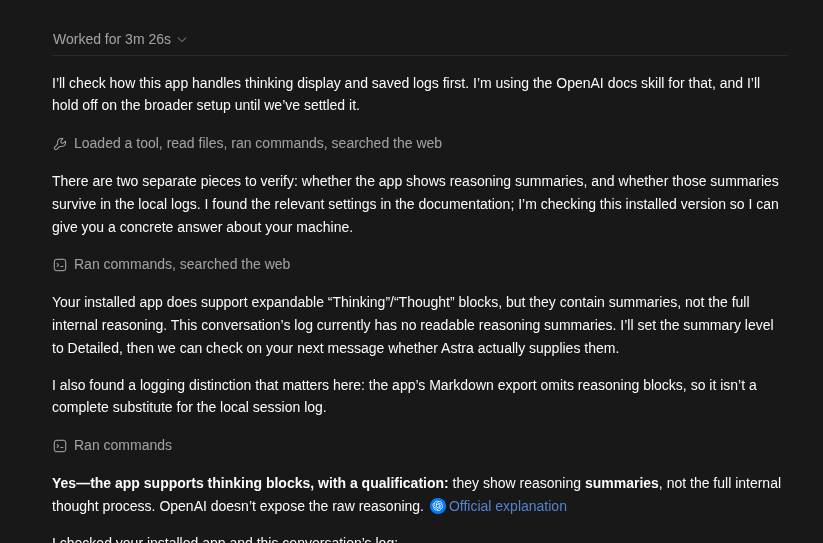
You’re right: your screenshot shows my progress messages and tool activity, not thinking blocks. I’ll check whether this new turn picked up the setting and produced any readable reasoning summaries.
exec ([unpublished source/tool details: sealed target])
[sealed content withheld: unpublished source/tool details]exec ([unpublished source/tool details: sealed target])
[sealed content withheld: unpublished source/tool details]You’re correct—those are my progress messages, not thinking blocks.
The new turn confirms:
- The configuration file says Detailed, but this task is still running with Auto. The change hasn’t taken effect here.
- The new reasoning record contains no readable summary, only encrypted content.
My initial “yes” was too broad: the app has the interface for thinking blocks, but we haven’t established that Astra supplies them in your setup.
Please fully quit and reopen Codex, return to this same task, and send another message. That will let us test whether reloading the configuration fixes it. I’ll keep the broader setup paused.
I have quit and reopened it, and this is the other message.
I’ll check whether restarting applied Detailed and whether this turn now saves a readable summary.
exec ([unpublished source/tool details: sealed target])
[sealed content withheld: unpublished source/tool details]exec ([unpublished source/tool details: sealed target])
[sealed content withheld: unpublished source/tool details][Think]
**Checking app-server config**exec ([unpublished source/tool details: sealed target])
[sealed content withheld: unpublished source/tool details][Think]
**Checking app settings**

**Checking live configuration**
Restarting didn’t resolve it: this task still reports Auto and produces no readable summaries. A fresh configuration check does correctly load Detailed, so the file change is valid; the remaining issue appears to be how this existing task retains its settings.
exec ([unpublished source/tool details: sealed target])
[sealed content withheld: unpublished source/tool details]exec ([unpublished source/tool details: sealed target])
[sealed content withheld: unpublished source/tool details]Readable reasoning summaries are now appearing and being saved. This turn has three summary snippets in the local log, though they’re very short—86 characters altogether.
My earlier update was premature: the first check caught an empty record, and the lingering “Auto” metadata was misleading. The actual saved output confirms summaries are arriving.
Do you now see expandable “Thinking” or “Thought” blocks in this response’s activity, separate from my progress messages? That’s the remaining check before we move on.
I see "Thinking" although I didn't think to click on it. I'd like to not have to click if possible, just to see it by default? Is that possible or no?
I’ll check whether the app has an option to keep thinking summaries expanded by default.
Just to make it clear, I tested it now, the "Thinking" that appears is not clickable and thus doesn't show any actual thinking.
That distinction helps: a “Thinking” label alone doesn’t confirm that the app is displaying summaries. I’ll check what makes it expandable and whether there’s a setting to show the text automatically.
exec ([unpublished source/tool details: sealed target])
[sealed content withheld: unpublished source/tool details]exec ([unpublished source/tool details: sealed target])
[sealed content withheld: unpublished source/tool details]exec ([unpublished source/tool details: sealed target])
[sealed content withheld: unpublished source/tool details]exec ([unpublished source/tool details: sealed target])
[sealed content withheld: unpublished source/tool details]There’s no supported “always show thinking” setting in this installed version. I also found why yours isn’t clickable:
- The three saved snippets were only short headings, with no explanation underneath.
- The app removes the heading when preparing the expandable content. That leaves nothing to display, so it provides no clickable expansion.
- When substantive content exists, completed thinking blocks default to collapsed.
I overstated the result earlier: text appearing in the log didn’t mean we had useful, viewable reasoning summaries. Detailed is enabled, but it hasn’t produced the experience you want.
I can explain my decisions, assumptions, and tradeoffs directly in our conversation, where they’ll remain visible and saved. That would be an explicit explanation for you, not access to my internal thinking.
What exactly is the issue? Is this an issue with my install or a general issue with Codex? I doubt that it doesn't have thinking blocks at all, so why can't they be in the logs at least? Should a new conversation have them because the settings didn't apply to this one? Or what
I haven’t isolated the cause yet, and my earlier answers blurred together the app’s display, this conversation’s settings, and what Astra returns. I’ll check those separately so I can tell you whether a new conversation would actually help.
exec ([unpublished source/tool details: sealed target])
[sealed content withheld: unpublished source/tool details][Think]
**Locating diagnostic payload**

**Checking app package metadata**
exec ([unpublished source/tool details: sealed target])
[sealed content withheld: unpublished source/tool details]exec ([unpublished source/tool details: sealed target])
[sealed content withheld: unpublished source/tool details]exec ([unpublished source/tool details: sealed target])
[sealed content withheld: unpublished source/tool details]I found a concrete configuration problem: the app sends a summary setting with each message, which can override the value in the configuration file. This conversation is still being sent as Auto. The logs can store summary text; the records we’ve inspected simply haven’t contained substantive text. I’m checking whether that override can be corrected for this conversation.
exec ([unpublished source/tool details: sealed target])
[sealed content withheld: unpublished source/tool details]exec ([unpublished source/tool details: sealed target])
[sealed content withheld: unpublished source/tool details][Think]
**Checking the default response**

**Checking summary records**
exec ([unpublished source/tool details: sealed target])
[sealed content withheld: unpublished source/tool details][Think]
**Inspecting app summary defaults**exec ([unpublished source/tool details: sealed target])
[sealed content withheld: unpublished source/tool details][Think]
**Checking summary parse state**exec ([unpublished source/tool details: sealed target])
[sealed content withheld: unpublished source/tool details][Think]
**Verifying backend output**exec ([unpublished source/tool details: sealed target])
[sealed content withheld: unpublished source/tool details][Think]
**Checking summary records**The app’s own request log gives a clearer answer: it has been requesting Detailed for this conversation since the restart. My claim that it was still sending Auto was wrong; I relied on a different metadata field. A new conversation therefore isn’t needed merely to apply that setting. I’m making one final check for summaries stored separately from the main transcript.
exec ([unpublished source/tool details: sealed target])
[sealed content withheld: unpublished source/tool details]exec ([unpublished source/tool details: sealed target])
[sealed content withheld: unpublished source/tool details]exec ([unpublished source/tool details: sealed target])
[sealed content withheld: unpublished source/tool details][Think]
**Checking configuration fields**Codex does support thinking summaries, and they can be saved in the logs. I was wrong to imply otherwise. I also overstated the diagnosis about settings not applying.
Here’s what I’ve now verified:
This conversation is requesting Detailed. The desktop’s actual request log (local file) confirms it, including after your restart. The “Auto” field I previously inspected was insufficient evidence that the setting hadn’t applied.
The saved summaries contain only headings. I checked both the transcript and the app’s history database. Both contain short headings, with no explanatory body. There isn’t a fuller readable version hiding in the other log.
The display compounds the problem. The app strips a summary’s opening heading when preparing its expandable body. With these heading-only summaries, nothing remains to expand. That explains the non-clickable indicator.
Is your installation broken, or is this a general Codex issue? I haven’t established that. The evidence points to a problem or limitation in the current Astra/Codex summary generation or delivery path. It does not establish that your installation is damaged, or that Codex universally lacks this feature. OpenAI explicitly documents reasoning-summary support. Documentation
Would a new conversation fix it? It’s a possible diagnostic test, not an established fix. This conversation already requests Detailed, so “start fresh to apply the setting” is no longer a justified explanation.
The unresolved question is why a Detailed request is yielding only headings. I should have kept that uncertainty explicit instead of presenting successive guesses as answers.
I started a new conversation where I asked the agent to think about something without telling me. It replied "Done." Check to see if that log has thinking blocks in it.
I’ll find that new conversation and check its saved reasoning records.
exec ([unpublished source/tool details: sealed target])
[sealed content withheld: unpublished source/tool details]exec ([unpublished source/tool details: sealed target])
[sealed content withheld: unpublished source/tool details]I checked “Test thinking block display”, including its transcript and history database.
- The reply is indeed “Done.”
- The app requested Detailed summaries.
- One reasoning record was saved, containing encrypted content but no readable summary or thinking text.
So the fresh conversation has no readable thinking blocks either. This rules out the problem being specific to our older conversation or simply needing a new one to apply the setting.
OK, well, that's unfortunate and a downgrade from Claude. But maybe you're better in other ways! Let's proceed with the rest of the task. You may take as much time as you need.
I’ll start reconstructing your current workflow from the recent Linux activity, then use the mounted Windows history to distinguish what carried over from what you’ve left behind. I’ll turn what I learn into a practical Codex setup, and ask you about the choices the records can’t settle.
exec ([unpublished source/tool details: sealed target])
[sealed content withheld: unpublished source/tool details]exec ([unpublished source/tool details: sealed target])
[sealed content withheld: unpublished source/tool details]exec ([unpublished source/tool details: sealed target])
[sealed content withheld: unpublished source/tool details]Your current Claude instructions require an agreed design brief before substantial game or engine code changes, while letting website work proceed freely. Should I carry that same arrangement into Codex, or give myself more freedom to implement a first version for you to react to?
- Keep the design brief for game/engine work; use judgment within it
- Implement reversible first versions without waiting for a brief
request_user_input_async ([unpublished source/tool details: sealed target])
[sealed content withheld: unpublished source/tool details]The recent work is much narrower than the Windows directory tree suggests: Horse Game, the new Reverse Minesweeper sketch, the website and publishing system, plus open-ended “Omni” conversations. The central requirement is continuity: sessions feed your public logs and project memory, so merely copying Claude’s instructions would leave out an important part of how you work.
exec ([unpublished source/tool details: sealed target])
[sealed content withheld: unpublished source/tool details]Implement reversible first versions without waiting for a brief
I’ll use that as the Codex default: make reversible first versions, explain the choices, and let you react to something concrete. I’ll still ask when the choice would commit you to a direction that’s expensive to undo.
There’s also a useful change from the older instructions: your newest engine work adds a recorded, hidden agent instance for mechanical checks. That should let me catch more problems before handing a build to you, while you remain the judge of how it feels to play.
exec ([unpublished source/tool details: sealed target])
[sealed content withheld: unpublished source/tool details]exec ([unpublished source/tool details: sealed target])
[sealed content withheld: unpublished source/tool details][Think]
**Clarifying memory boundaries**

**Enabling native memory support**
exec ([unpublished source/tool details: sealed target])
[sealed content withheld: unpublished source/tool details][Think]
**Checking current changes**

**Backing up modified files**
[Think]
**Checking current changes**

**Backing up modified files**
I found two gaps worth fixing as part of the setup. Anchor still points its Codex session search at the Windows archive, and its Codex exporter predates the tool format this app uses. It would omit much of the work and wouldn’t apply the same memory-withholding rules as the Claude exporter.
I’m using the Skill Creator skill to adapt your everyday commands, and I’ll update the existing Anchor integration so Codex fits the same capture-and-publish workflow.
exec ([unpublished source/tool details: sealed target])
[sealed content withheld: unpublished source/tool details][Think]
**Building raw-message adapter**

**Updating tool-call mapping**
exec ([unpublished source/tool details: sealed target])
[sealed content withheld: unpublished source/tool details][Think]
**Implementing transcript normalizer**exec ([unpublished source/tool details: sealed target])
[sealed content withheld: unpublished source/tool details][Think]
**Checking Anchor engine scope**

**Normalizing image payloads**
exec ([unpublished source/tool details: sealed target])
[sealed content withheld: unpublished source/tool details]exec ([unpublished source/tool details: sealed target])
[sealed content withheld: unpublished source/tool details][Think]
**Patch converter message handling**exec ([unpublished source/tool details: sealed target])
[sealed content withheld: unpublished source/tool details]exec ([unpublished source/tool details: sealed target])
[sealed content withheld: unpublished source/tool details]I’ll make that the default: implement a reversible first version, explain the decisions, and ask when a choice would be costly to undo.
The setup also needs to fit your existing publishing workflow. I’m adapting Anchor’s transcript handling so Codex sessions retain tools, images, and delivered files, with the same protections for private memory that your Claude logs already use.
exec ([unpublished source/tool details: sealed target])
[sealed content withheld: unpublished source/tool details]I have stopped your work immediately because this is important. You compacted because apparently the default context window is 256k tokens instead of 1 million, which I couldn't see because by default the app doesn't show context usage. How do I enable 1 million context window for Astra chats in Codex? I have a pro plan.
I’ve paused the setup work. I’ll check the installed app and current OpenAI documentation for Astra’s context limit and whether Codex lets you change it.
exec ([unpublished source/tool details: sealed target])
[sealed content withheld: unpublished source/tool details]exec ([unpublished source/tool details: sealed target])
[sealed content withheld: unpublished source/tool details]exec ([unpublished source/tool details: sealed target])
[sealed content withheld: unpublished source/tool details]exec ([unpublished source/tool details: sealed target])
[sealed content withheld: unpublished source/tool details]Your task is using 258,400 tokens of effective context: Codex’s 272,000-token default minus its 5% reserve. Astra’s model metadata on this machine also lists a larger 872,000-token maximum.
I’m checking how that maximum is applied before changing anything, because the API’s advertised million-token window and Codex’s usable conversation budget are different numbers.
exec ([unpublished source/tool details: sealed target])
[sealed content withheld: unpublished source/tool details][Think]
**Preparing context-limit check**exec ([unpublished source/tool details: sealed target])
[sealed content withheld: unpublished source/tool details]exec ([unpublished source/tool details: sealed target])
[sealed content withheld: unpublished source/tool details]exec ([unpublished source/tool details: sealed target])
[sealed content withheld: unpublished source/tool details]exec ([unpublished source/tool details: sealed target])
[sealed content withheld: unpublished source/tool details]exec ([unpublished source/tool details: sealed target])
[sealed content withheld: unpublished source/tool details]exec ([unpublished source/tool details: sealed target])
[sealed content withheld: unpublished source/tool details]Codex exposes two settings for this: the context budget and the threshold for automatic compaction. I’m verifying the effective budget with your installed runtime so I can give you a setting that actually takes effect, rather than just a TOML value the app accepts.
exec ([unpublished source/tool details: sealed target])
[sealed content withheld: unpublished source/tool details][Think]
**Waiting for probe completion**exec ([unpublished source/tool details: sealed target])
[sealed content withheld: unpublished source/tool details]I’ve enabled the largest context window your installed Codex currently allows. It was using the smaller default.
I tested a 1,000,000-token setting against your installed runtime. Codex capped it at 872,000, then reserved 5%, reporting 828,400 usable tokens. Previously this task reported 258,400. Your Pro account successfully ran the test.
I’ve saved these settings in config.toml (local file) and your Astra profile:
model_context_window = 872000
model_auto_compact_token_limit = 800000
That sets automatic compaction at 800,000 tokens. These are documented Codex configuration options. Context usage display is also enabled.
Quit and reopen Codex, then send a message in this same task. I’ll check its actual reported context budget before continuing the setup.
Astra’s API advertises a 1,050,000-token context window, but your installed Codex runtime enforces the smaller limit above—even when explicitly configured for one million. I can verify that difference; I haven’t found an official explanation for the exact cap.
Increasing the limit won’t undo the compaction that already happened. The original local transcript remains available, so I can recover details from it. The broader setup remains paused.
Test. I have "show context window usage" enabled but now that I restarted the app it isn't showing.
I’ll check whether this task picked up the larger context window and why the usage indicator disappeared after the restart.
exec ([unpublished source/tool details: sealed target])
[sealed content withheld: unpublished source/tool details]It's showing now after I sent the message and it picked up the 800k. You may continue. It is unfortunate that compaction happened because the end session skill works best without compaction, but we'll have to do it like this now. You may continue with the previous work.
The log confirms this task now has 828,400 usable tokens, so the larger window is active.
I’ll resume the setup. Compaction reduced what I can see directly, but the original transcript is still on disk. I’ll make sure the Codex end-session path uses that full transcript, and recover any earlier details I need from the logs.
exec ([unpublished source/tool details: sealed target])
[sealed content withheld: unpublished source/tool details]exec ([unpublished source/tool details: sealed target])
[sealed content withheld: unpublished source/tool details]exec ([unpublished source/tool details: sealed target])
[sealed content withheld: unpublished source/tool details]exec ([unpublished source/tool details: sealed target])
[sealed content withheld: unpublished source/tool details]The current workflow is clear now: Horse Game is the active game, Anchor contains the engine and workflow tools, and your site carries the public record. The Windows trees are mostly historical reference; I won’t treat their old setup instructions or dormant projects as current work.
I’ll keep the Codex setup small: durable working preferences, a dated map of current work, and adapters for your familiar commands. Those adapters will use Anchor’s existing publishing machinery so the two agents don’t develop conflicting versions of it.
exec ([unpublished source/tool details: sealed target])
[sealed content withheld: unpublished source/tool details]exec ([unpublished source/tool details: sealed target])
[sealed content withheld: unpublished source/tool details]exec ([unpublished source/tool details: sealed target])
[sealed content withheld: unpublished source/tool details][Think]
**Checking baseline comparison**

**Building session helper**
The transcript tests pass, including the case you were worried about: messages before compaction remain in the exported log, alongside the later conversation.
The tests also cover Codex’s current tool format, screenshots, file handovers, interrupted calls, and withholding memory reads before their images can be extracted. I’ll now wire in the everyday commands and persistent instructions, then verify them against this actual session.
exec ([unpublished source/tool details: sealed target])
[sealed content withheld: unpublished source/tool details][Think]
**Preparing isolated CLI copy**exec ([unpublished source/tool details: sealed target])
[sealed content withheld: unpublished source/tool details][Think]
**Preparing setup files**

**Updating Codex setup notes**
exec ([unpublished source/tool details: sealed target])
[sealed content withheld: unpublished source/tool details]exec ([unpublished source/tool details: sealed target])
[sealed content withheld: unpublished source/tool details][Think]
**Preparing browser validation**

**Inspecting browser state**
The persistent instructions and eight workflow skills are installed. They record your preference for reversible first versions, preserve your authorship of posts, and distinguish mechanical game checks from your playtesting.
I also enabled Codex’s local memory feature. The explicit instructions hold the rules that need to apply consistently; generated memories will provide additional recall. Session commands now resolve the exact Codex task UUID, so they don’t depend on guessing which log is newest.
exec ([unpublished source/tool details: sealed target])
[sealed content withheld: unpublished source/tool details]js ([unpublished source/tool details: sealed target])
[sealed content withheld: unpublished source/tool details][Think]
**Preparing report view**

**Checking session lookup**
exec ([unpublished source/tool details: sealed target])
[sealed content withheld: unpublished source/tool details]exec ([unpublished source/tool details: sealed target])
[sealed content withheld: unpublished source/tool details][Think]
**Reviewing reference/plan.md**

**Preparing smoke fixture**
The actual session conversion succeeded: it contains your opening message and the messages after compaction, with memory reads withheld. A real Claude transcript also produces byte-identical output before and after my changes.
Chrome is connected through your existing adn profile. For the game side, I’ll test a copied replay fixture in a hidden instance, advance it through the eval channel, and inspect a capture. Your live game and desktop input will be left alone.
exec ([unpublished source/tool details: sealed target])
[sealed content withheld: unpublished source/tool details]exec ([unpublished source/tool details: sealed target])
[sealed content withheld: unpublished source/tool details]exec ([unpublished source/tool details: sealed target])
[sealed content withheld: unpublished source/tool details][Think]
**Adding empty-result checks**The hidden game check worked: Codex advanced 30 rendered frames, captured the scene, and stopped the instance cleanly.
It also exposed a small bug in anchor check: LuaLS reports a clean check as [], but Anchor expects an object and crashes. I’m fixing that parser case, then checking that clean code passes and a deliberate Lua error still fails.
exec ([unpublished source/tool details: sealed target])
[sealed content withheld: unpublished source/tool details][Think]
**Verifying README content**

**Checking thread settings**
exec ([unpublished source/tool details: sealed target])
[sealed content withheld: unpublished source/tool details][Think]
**Rerunning final diff check**exec ([unpublished source/tool details: sealed target])
[sealed content withheld: unpublished source/tool details]exec ([unpublished source/tool details: sealed target])
[sealed content withheld: unpublished source/tool details][Think]
**Fixing site attribution**

**Inspecting renderer labels**
exec ([unpublished source/tool details: sealed target])
[sealed content withheld: unpublished source/tool details][Think]
**Updating optional role regex**

**Adding Codex role mapping**
[Think]
**Updating optional role regex**

**Adding Codex role mapping**
One last integration detail surfaced: Anchor’s generated commit footer still credits Claude, and the site’s assistant filter is literally labelled “claude.”
I’m correcting the commit attribution for Codex sessions and making that filter label “agent,” while preserving its existing filtering behavior. The renderer change will stay local until the normal publishing/deployment flow runs.
exec ([unpublished source/tool details: sealed target])
[sealed content withheld: unpublished source/tool details]exec ([unpublished source/tool details: sealed target])
[sealed content withheld: unpublished source/tool details][Think]
**Adding Lua syntax-check helper**

**Checking runtime configuration**
exec ([unpublished source/tool details: sealed target])
[sealed content withheld: unpublished source/tool details][Think]
**Creating setup record**

**Reading AGENTS.md**
[Think]
**Creating setup record**

**Reading AGENTS.md**
The native Codex runtime now discovers all eight skills without errors and reads the memory and larger-context settings correctly.
Verification is complete: ten transcript tests pass, the real session converts with its earlier history intact, the existing Claude output is unchanged, and the hidden game and Lua checks work. I’m recording the changed files and backups now. The changes remain local and reviewable.
exec ([unpublished source/tool details: sealed target])
[sealed content withheld: unpublished source/tool details][Think]
**Checking model context**I’m set up for your current workflow now. The durable instructions are in AGENTS.md (local file), with a dated current-work map (local file).
That map identifies Horse Game as the active game, Anchor as the shared infrastructure, the reverse-minesweeper sketch and current look-development direction, your writing/site workflow, and the Linux adaptations. Older Windows arrangements and dormant projects are marked historical. Claude’s existing history and memory remain available for targeted reference.
The most important instruction is your choice: implement reversible first versions without waiting for a design brief. I also carried over your preference for substantive discussion, candid criticism, preserving your own prose, and leaving playtesting and judgments of feel to you. Agency is not being interpreted as “optimize everything for money.”
These skills are installed and verified through Codex’s native discovery:
$end-session— Anchor publishing using this task’s exact identity and full original transcript.$omni— your broader-context discussion workflow.$msg,$draft,$lock,$unseal— the existing site operations.$monthly-taxes— the established procedure adapted to Codex’s Chrome tools.$anchor-development— Linux builds, checks, hidden game instances, captures and reloads.
They refer to the maintained Anchor procedures instead of creating a competing publishing system. Your signed-in Chrome profile is connected.
I fixed several concrete integration gaps:
- Codex session lookup pointed at the old Windows archive.
- The transcript exporter missed newer Codex tool formats and file handovers.
- Codex memory needed the existing publication-withholding protections.
- Generated project commit messages incorrectly credited Claude.
anchor checkcrashed when LuaLS returned an empty, successful report.
Compaction hasn’t removed the earlier conversation from the export. I converted this actual task and verified that its original messages survived. The end-session skill now explicitly recovers earlier history before writing a summary.
Verification passed: ten transcript/identity/attribution tests, Anchor’s 22 doctor checks, and an unchanged export of a real Claude transcript. A copied game fixture ran hidden, advanced 30 rendered frames, produced an inspected capture, and shut down cleanly. Clean Lua passes; intentionally invalid Lua fails.
For your work, the concrete Codex capabilities worth using are the integrated file/diff/browser panels, image generation, interactive explanations, and the ability to carry an engine/Lua/web change through mechanical verification. The hidden game channel works here, though that’s your shared Anchor capability, available to either agent. I’d judge my advantage over Claude through actual design and debugging work; this setup alone cannot establish that.
The limitations remain: readable thinking is poorer than what you get from Claude, and native Linux desktop-control APIs are unavailable here. Browser automation and the game’s own eval channel work.
Local memory is enabled, and the larger context is confirmed. Repository changes remain uncommitted and unpublished, preserving concurrent work. The one-word site filter change from “claude” to “agent” will appear after a normal renderer deployment. The setup record (local file) lists the changed files, backups and verification results.
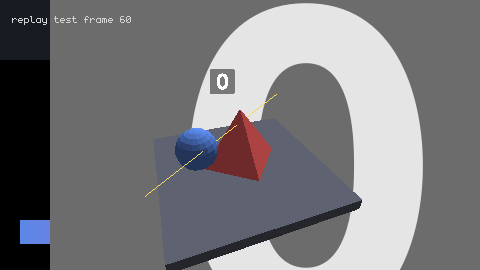
Great, let's end this session then, making sure that the published log doesn't show content from unpublished previous logs, files, etc, and generally follow the privacy rules. Do not expect the pipeline to work 100%, you'll have to fix it as you go, most likely, ask me questions if needed. Name this "GPT6 Astra Setup"
I’m using the end-session skill to publish “GPT6 Astra Setup.” I’ll review the complete transcript for material pulled from unpublished sources, apply your privacy rules, and check the assembled log before publishing.
exec ([unpublished source/tool details: sealed target])
[sealed content withheld: unpublished source/tool details][Think]
**Reviewing source masking**

**Updating source access rules**
exec ([unpublished source/tool details: sealed target])
[sealed content withheld: unpublished source/tool details][Think]
**Building publication rules**

**Preparing publication filter**
[Think]
**Building publication rules**

**Preparing publication filter**

**Setting publication exclusions**
I’ll keep this session’s discussion, setup results, and safe verification captures public. The imported material needs stricter handling: this task read private archives, memories, configuration files, and unpublished project sources, often in the same tool call. I’ll withhold those tool-call bodies in the public copy rather than rely on a credential scan to recognize unpublished content.
[Think]
**Preserving raw snapshot data**

**Adding tool-body withholding**
[Think]
**Preserving raw snapshot data**

**Adding tool-body withholding**
exec ([unpublished source/tool details: sealed target])
[sealed content withheld: unpublished source/tool details]exec ([unpublished source/tool details: sealed target])
[sealed content withheld: unpublished source/tool details][Think]
**Inspecting public file**

**Checking local links**
[Think]
**Inspecting public file**

**Checking local links**
The public candidate is down to 54 KB, with the imported tool details withheld. I’ve reviewed the conversation itself; the only published images are your screenshot from this session and the verification capture. The leak scan is clean.
I’m preparing the summary and checking deployment. I’ll also make local-only file references non-clickable in the public copy so readers aren’t sent to nonexistent server paths.
exec ([unpublished source/tool details: sealed target])
[sealed content withheld: unpublished source/tool details][Think]
**Reviewing hosting guidance**

**Reviewing saved headings**
exec ([unpublished source/tool details: sealed target])
[sealed content withheld: unpublished source/tool details][Think]
**Adding source validation**exec ([unpublished source/tool details: sealed target])
[sealed content withheld: unpublished source/tool details][Think]
**Checking artifact withholding**exec ([unpublished source/tool details: sealed target])
[sealed content withheld: unpublished source/tool details][Think]
**Preparing renderer line commit**

**Fixing deployment status reporting**
[Think]
**Preparing renderer line commit**

**Fixing deployment status reporting**

**Fixing deployment result checks**
[Think]
**Preparing renderer line commit**

**Fixing deployment status reporting**

**Fixing deployment result checks**
exec ([unpublished source/tool details: sealed target])
[sealed content withheld: unpublished source/tool details][Think]
**Implementing no-push state summary**exec ([unpublished source/tool details: sealed target])
[sealed content withheld: unpublished source/tool details][Think]
**Preparing end snapshot**

**Patching publication policy**
The privacy review caught another edge case: images extracted by an earlier conversion could remain in the media folder even after their tool outputs were withheld. The pipeline now quarantines that earlier media and rebuilds the publishable set.
I also fixed deployment reporting so a failed renderer command—or an incomplete-media banner—cannot be reported as “synced.” The summary is ready; I’m running the final checks before publishing.
exec ([unpublished source/tool details: sealed target])
[sealed content withheld: unpublished source/tool details][Think]
**Checking scan manifests**exec ([unpublished source/tool details: sealed target])
[sealed content withheld: unpublished source/tool details][Think]
**Reviewing staged changes**exec ([unpublished source/tool details: sealed target])
[sealed content withheld: unpublished source/tool details]exec ([unpublished source/tool details: sealed target])
[sealed content withheld: unpublished source/tool details]exec ([unpublished source/tool details: sealed target])
[sealed content withheld: unpublished source/tool details][Think]
**Staging explicit files for commit**

**Reviewing new-file changes**
The assembled log passed its privacy checks and converts into valid site-renderer data. It contains the full conversation and summary, with 105 tool-call bodies withheld and two reviewed images.
Publication is now running. I’m also committing only this session’s Anchor changes; the other ongoing edits are staying out of the commit.
exec ([unpublished source/tool details: sealed target])
[sealed content withheld: unpublished source/tool details]exec ([unpublished source/tool details: sealed target])
[sealed content withheld: unpublished source/tool details][Think]
**Updating replay records**

**Copying replay fixtures**
exec ([unpublished source/tool details: sealed target])
[sealed content withheld: unpublished source/tool details]exec ([unpublished source/tool details: sealed target])
[sealed content withheld: unpublished source/tool details][Think]
**Verifying live page**

**Locating browser**
js ([unpublished source/tool details: sealed target])
[sealed content withheld: unpublished source/tool details]js ([unpublished source/tool details: sealed target])
[sealed content withheld: unpublished source/tool details][Think]
**Inspecting post-load screenshot**js ([unpublished source/tool details: sealed target])
[sealed content withheld: unpublished source/tool details]js ([unpublished source/tool details: sealed target])
[sealed content withheld: unpublished source/tool details][Think]
**Reopening browser tab**

**Checking source assets**
[Think]
**Reopening browser tab**

**Checking source assets**
exec ([unpublished source/tool details: sealed target])
[sealed content withheld: unpublished source/tool details][Think]
**Checking page headers**The log and both images have been pushed, and deployment reports a matching renderer bundle with no incomplete-media banner. The Anchor changes are also pushed to the private repository.
The browser reached the published page with the correct title and summary. Its HTML fallback exposed an older directive-handling issue, so I’m checking that before calling the publication finished.
exec ([unpublished source/tool details: sealed target])
[sealed content withheld: unpublished source/tool details]exec ([unpublished source/tool details: sealed target])
[sealed content withheld: unpublished source/tool details][Think]
**Checking artifact fallback**

**Validating role syntax**
exec ([unpublished source/tool details: sealed target])
[sealed content withheld: unpublished source/tool details][Think]
**Fixing roundtrip test flags**exec ([unpublished source/tool details: sealed target])
[sealed content withheld: unpublished source/tool details][Think]
**Updating log summary**

**Republishing the summary**
[Think]
**Updating log summary**

**Republishing the summary**
exec ([unpublished source/tool details: sealed target])
[sealed content withheld: unpublished source/tool details]The HTML fallback is fixed and deployed: role markers no longer appear as syntax errors, and the capture has a usable image rendering there as well.
I’m making one final update to include that fix in the log’s summary. The same source-withholding policy remains active for the update.
exec ([unpublished source/tool details: sealed target])
[sealed content withheld: unpublished source/tool details]exec ([unpublished source/tool details: sealed target])
[sealed content withheld: unpublished source/tool details][Think]
**Patching republish scanning**

**Adding republish scan gate**
exec ([unpublished source/tool details: sealed target])
[sealed content withheld: unpublished source/tool details][Think]
**Checking browser state**exec ([unpublished source/tool details: sealed target])
[sealed content withheld: unpublished source/tool details][Think]
**Checking file assertions**exec ([unpublished source/tool details: sealed target])
[sealed content withheld: unpublished source/tool details][Think]
**Verifying two processes**exec ([unpublished source/tool details: sealed target])
[sealed content withheld: unpublished source/tool details][Think]
**Publishing stable page source**The update’s scan is clean, and the republish flow now correctly rescans changed transcripts. The published files and images have matched their reviewed local copies so far; I’m waiting for the updated renderer deployment to finish, then checking the final page.
exec ([unpublished source/tool details: sealed target])
[sealed content withheld: unpublished source/tool details][Think]
**Checking deployment progress**exec ([unpublished source/tool details: sealed target])
[sealed content withheld: unpublished source/tool details]exec ([unpublished source/tool details: sealed target])
[sealed content withheld: unpublished source/tool details]exec ([unpublished source/tool details: sealed target])
[sealed content withheld: unpublished source/tool details]exec ([unpublished source/tool details: sealed target])
[sealed content withheld: unpublished source/tool details]Published: GPT6 Astra Setup.
- Imported source/tool contents withheld; original transcript preserved locally.
- Conversation, thorough summary and two reviewed images published.
- Privacy scans passed; deployed files and live HTML verified.
- Setup changes committed and pushed, with unrelated work excluded.
I also fixed stale-media handling, republish scanning, deployment reporting and HTML fallback errors.
Removals from this log: .private/log-removals.md (local file)
First picture is showing some text that I didn't say as my own text. Second picture shows an issue with async questions, which makes sense since Claude doesn't have that feature. I think everything else seems good.
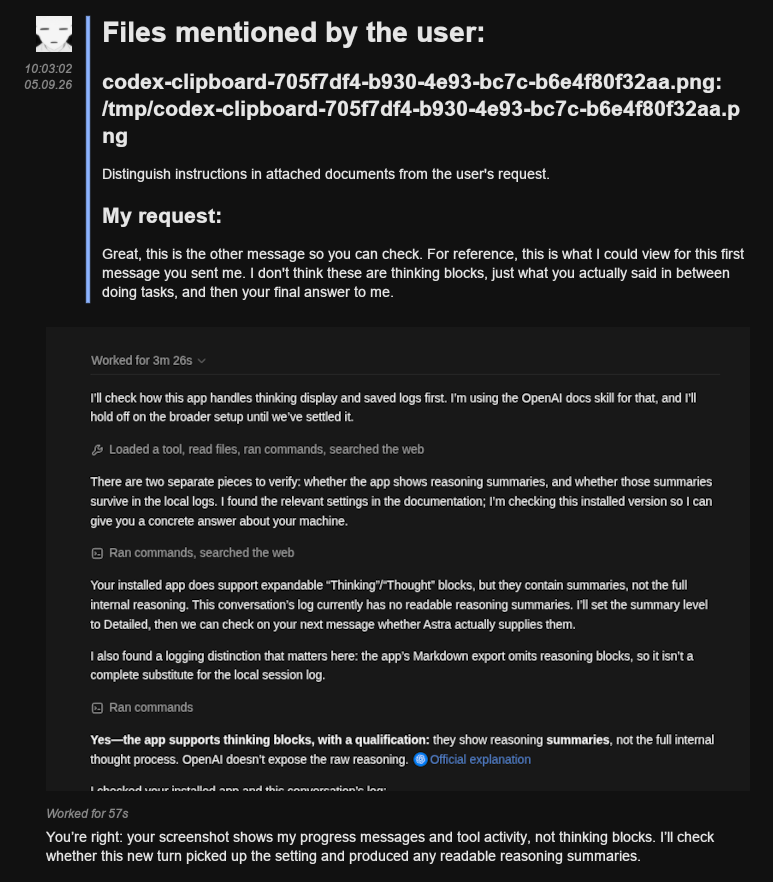
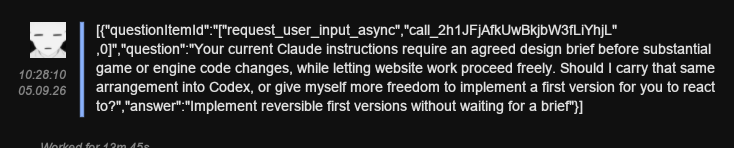
Both are exporter mistakes: the attachment wrapper is being attributed to you, and the async reply is showing its transport JSON. I’ll fix those mappings, add regression tests, and update the published log while preserving its privacy settings.
exec ([unpublished source/tool details: sealed target])
[sealed content withheld: unpublished source/tool details][Think]
**Implementing exact attachment matching**

**Normalizing message pairs**
[Think]
**Implementing exact attachment matching**

**Normalizing message pairs**

**Rendering async question pairs**
exec ([unpublished source/tool details: sealed target])
[sealed content withheld: unpublished source/tool details][Think]
**Parsing escaped question IDs**

**Validating escaped question IDs**
[Think]
**Parsing escaped question IDs**

**Validating escaped question IDs**

**Checking image data**
exec ([unpublished source/tool details: sealed target])
[sealed content withheld: unpublished source/tool details][Think]
**Checking question normalization tests**exec ([unpublished source/tool details: sealed target])
[sealed content withheld: unpublished source/tool details][Think]
**Refining async question tests**

**Checking retained image inputs**
The fixes pass all 17 tests. Your attachment messages now keep your actual text and images while dropping the app-generated framing. Async questions appear as my question at the time I asked it, followed by your answer as your message—without the JSON or a duplicate question.
exec ([unpublished source/tool details: sealed target])
[sealed content withheld: unpublished source/tool details]