Phylactery 10
Summary
Lich Survivors session 10 built the owner's plan for how the egg cave's fight plays: snakes now come in waves of varied shapes (ONE, PAIR, PACK, SPREAD, STREAM) instead of on per-snake respawn timers, and the lich handles them in bouts (ALL ONE / MIX OF 2 / MIX OF 3 / ROTATION) with group versions of every attack for 3+ snakes: revolver beam shots, the lift curling snakes into a ball and goring them at once, a fire sweep, a ring of rocks, one long lens cut. Then fixes and rounds 50b-53b: snakes route round the cave's boulders (Dijkstra route field), his held mask kept in front of his face, glass petals on beam deaths, orbs that circle him like electrons, a full audit making sure no attack cancels another (claims, renewals, redirects; measured 6 aborts and 6 empty rocks per 5 min down to 0), spawn points worked out per degree, white squares traced in his own replay to petal flares, and a font audition in which he picked FACETED FINE. All in the Anchor build; LICH_ROOM=1 stays byte-identical to round 48.
Session start and scope:
- Opened with "New Lich Survivors session."; RECORD.md's "Next (planned)" held the owner's own words from session 9: "The snake spawning needs to be improved, currently snakes are spawning all at the same time often, and the order of attacks that the lich does repeats predictably ... sometimes he should choose to handle all snakes at the same time using the same attack, sometimes a mix of 2 attacks, sometimes a mix of 3, and sometimes he just rotates randomly. When choosing to kill multiple snakes (3 or more) with the same attack we should do special animations. So a 4 snake prismatic beam should feel like four revolver shots ... lifting four snakes should pull them together and then he gores them all at the same time, etc, etc."
- Treated as his request (not my proposal), so built directly; the iterate skill applied to the group animations (beam and lift his spec; fire, rock, lens mine).
- Everything new is Anchor-only and gated on
VARIED = not os.getenv('LICH_ROOM')(game.lua); LICH_ROOM=1 keeps the old flow, and tools/digest_run.lua under it stayed byte-identical to round 48's digest (scratch/r48/digest_now.txt) after every round.
Round 50 -- waves (snakes.lua):
- Diagnosis: the old 2-5 s per-snake respawn timers clustered arrivals after group kills.
- New: dead snakes wait in a pool (
s.pooled, delay = huge,to_pool); a wave director (direct,send_wave,plan_wave) sends ONE / PAIR / PACK (3-5, one side, +-0.26 rad, one pace) / SPREAD (3-4 spaced round) / STREAM (4-6 in a line, 0.7-1.2 s apart); weights 2.2/2.0/2.4/1.4/1.1; gap after each by shape; 22% chance of a 3-6 s lull; no two big waves of one shape in a row; a wave waits until the pool can send it whole. Own rng (seed*977+3) so the old flow's draws are untouched. - Harness:
snakes.send(kind),snakes.waves(),GAME.wave(kind); testing keys F9 (pack), F10 (spread).
Round 50 -- bouts (powers.lua):
new_plandraws ALL ONE / MIX OF 2 / MIX OF 3 / ROTATION when a free snake comes within 7.5 m; weights 0.18/0.3/0.25/0.27, or 0.6/0.15/0.1/0.15 when 3+ snakes are coming (added after a 3-min run showed only 5 group casts).- ALL ONE waits until the group is within 5.0 m (or the first reaches ENGAGE), then takes everything within 6.2 m (cap 6); mixes take at least 2 per cast, least-used-in-bout first (30% random); ROTATION picks any attack with repeats; a pack arriving mid-bout starts a new bout; sets lean toward attacks unused longest; one attack's casts 1.5 s/power apart.
- URGENT (2.6 m) still forces a cast now, whatever the bout. Testing: F3 cycles
PW.FORCES(AUTO, ALL FIRE ... ROTATION);GAME.plan(i).
Round 50 -- group versions (3+ snakes in one cast):
- BEAM (his spec, revolver): powers phase 'volley' +
beam.shot-- one beam per snake, each from where the finger was at its shot (b.from), 2.2x speed, kick 1.25, muzzle sparks;mover.face.boost1.7 for snappier turns;order_roundorders targets one way round him from the end nearer his facing. - LIFT (his spec): first a knot pulled in front of him; became a ball in round 51.
- FIRE (mine): phase 'sweep' -- the pointed spot runs round him in polar coordinates through each snake (each ignites as it passes), with a 0.5 rad lead-in and follow-through;
fire.lickputs flames on the floor along the sweep. - ROCK (mine):
rock.luaorbit -- rocks torn up round him circle at 1.15 m then are loosed nearly together. - LENS (mine):
lens.cast_group-- one larger lens; its burning point runs a path through every snake (group_path,path_at). - Bug found by a 3-min run: a snake in a fire sweep's own group reached the egg (angle order reached it too late); fixed with in-group urgency (gesture goes quick; a snake within 1.6 m is taken at once).
- Verified: forced each group against a pack, 20-case guarantee sweep near and far (0 reached while any power held), 10-min auto run 0 reached and 22 group casts. Page rounds/50-bouts/index.html.
Round 50b -- snakes round the rocks, his mask kept in front:
- Owner: "Snakes shouldn't go through rocks. The mask is going behind the liches face."
- Measured first (scratch/r50/rock_probe2.lua): 15.7% of crawling bodies lay inside rock taller than 0.2 m. game.lua builds
snake_nav(NAV.build of the rocks alone, block_h 0.2); snakes.lua builds a Dijkstra route field from the egg (rock cost x1000, edge x1.8), steers by its gradient, eases the weave near rock, pushes the head out (nav.resolve), lifts the body over low stones (floor_atbump map), spawns only in clear reachable spots facing the route, and pools snakes stuck 3 s out in the dark. First version stranded 7 snakes in a boulder pocket (rock cost 30 was passable); fixed. Result 0.13%, all at the dark edges. - Mask (lichmask.lua): measured in volleys it went to 1.4 cm from the head centre (inside the skull), 15 cm aside, 0.85 rad behind; springs firmer and
LM.BOUNDclamps it in the head frame (back 2.2 cm, side 2.5, up 3, down 4.5, turn 0.25 rad), vertical lag kept.
Round 51 -- ball, petals, viewer, orbs:
- Owner: lifted snakes "should curl into a ball sort of"; "Title of object closer to the object itself, throw stays in the same place, X button visible"; "prismatic glass petal-like particles should go up from the snake's body"; "The orbs should be visible around the player, hovering around him in unpredictable patterns, thrown away by just having some force applied to them in the direction."
- Lift ball (lift.lua
place): each body winds round its own tilted band on a sphere, tetrahedral axes, reeled in from the middle; first attempt read as a hoop, tightened. - Petals: new port/petals.lua, an instanced cupped teardrop drawn with the existing 'leak.flakes' program (MeshBasic, additive), glint toward light; sizes had to grow to 13-20 cm because smaller ones were 1-2 px specks (the glitter he rejected in rounds 25-26).
- Viewer (inspect.lua): title placed under the object's projected box corners, eased; X button top right (
UI.glyph_button); clicking X closes without throwing. - Orbs (items.lua): state 'held' while leakage is his, hovering round him; THROW (
release_orbs) pushes each as a physics body the way he faces; walking back makes them hover again. A crash inspot()(held orbs had no landing spot) found by testing the ending and fixed.
Round 52 -- electrons, no attack cuts another, spawns, X size:
- Owner: "petals could last a tad shorter and be a bit more vertical, the orbs could rotate around the lich more, like electrons around atoms ... Sometimes some attacks will cut off other attacks and attacks will be cancelled or the animation will play wrong in some way, make sure those kinds of things can't happen. Make sure the snakes spawn from different positions". Later: "Make the X on the top right normal size instead of double."
- Petals: life 1.1-1.8 s, nearly straight up. Orbs: tilted elliptical orbits (30-70 degrees), 2.4-4 rad/s, eased plane/direction/speed/size changes.
- Conflict audit measured against round 51 in a git worktree (scratch/wt51, scratch/r52/conflict_probe.lua): 6 of 52 gestures lost their aim, 6 of 26 rocks hit nothing. Fixes:
snakes.taken_by/guarded/held_by_otherso rocks, lens cuts, leakage and lift neighbours respect other attacks' claims;snakes.reclaimrenews claims while an attack is on its way; aim redirects when its snake is lost;B.detachso beams already out finish (noB.cuton urgent); lift keeps its held list; emergency rock/lens don't double up;lens.hurry; a rock with no target is set down. After: 0 and 0; stress probe over every forced way clean. - Guarantee regression caught and fixed: keeping emergency lenses off any lens-held snake let 5 reach the egg with the lens alone; doubling now allowed within 1.8 m.
- Spawns: the clear-spot search funnelled waves into a few gaps (23 of 152 in one 15-degree slice); now
spawn_pointsper degree at load and wave sides drawn evenly, at least 40 degrees from the last two waves.
Round 53 -- white squares, orbs, ball, fonts:
- Owner: orbs "all be of similar size, closer to the smaller ones ... orbit in a higher radius"; ball "more irregular ... better tween method ... float irregularly"; "white squares appearing on the screen for a few frames"; "We need to audition more fonts ... perhaps a clash of pixel sizes".
- White squares: a headless scan of my own capture found nothing convincing, so I replayed his recording replays/20261007-055122.apr in a player instance, snapshotted every 2nd frame and scanned for hard-edged white blobs (scratch/r53/find_squares2.py): petal flares clipping to white. Petals now keep their tint. He later reported the squares are not gone: open for next session.
- Orbs
IT.ORB_SIZESabout 3 cm, orbit 0.85-1.15 m. Ball: lumps, squash/stretch, floating centre, per-ring springs (14 -> 8 rad/s, damping 0.58). - Fonts: diagnosis confirmed -- since round 49 the icons draw at window resolution (1 screen px per pixel) while FACETED drew at game resolution (2 px). tools/hud_fonts.py gained
scale2x, Zhang-Suenthin, andttf_font(pixel fonts sampled on their grid at 8x); hud.lua became multi-font withhifonts on the window-res layer. Candidates on F6: FACETED, FACETED FINE, FACETED THIN, Jacquard 24, DotGothic16, Pixelify Sans, IM Fell SC (smooth). - Lens: a single lens's cut now follows its snake; cuts spare other lenses' targets (
aimed_by_other).
Round 53b and the font pick:
- Owner: "Error when trying out the fonts. Pressing F6 also only works if the menu is showing and not globally". Error: hovering THROW or X in a hi font --
HUD.text_widthreturned 30.5 andtexture_createinword_glowrejected the non-integer width ("number has no integer representation"). Fixed (ceil widths, ceil glow size); F6 made global; tested with injected key events in the open viewer. - Owner at end: "second font is the correct one" -- FACETED FINE is the game's font (
HUD.font_name = 'facet_fine'); other candidates, assets/fonts and F6 removed again.
Tooling and verification used throughout:
anchor driveagent instances only; captures withGAME.set_manual(true)+engine_step(1)+engine_snapshot; contact sheets and crops in scratch/r50..r54.- Repeated checks: LICH_ROOM=1 digest vs round 48; 20-case guarantee sweep near/far (scratch/r50/sweep_near.lua, sweep_far.lua; note the all-off case wins the game, so far cases run in a fresh instance); 3-min and 10-min auto runs; stress probe.
- Pages delivered: rounds/50-bouts, 51-ball-petals-orbs, 52-electrons-spawns, 53-ball-fonts (self-contained, clips embedded).
- Commits in the lich-survivors repo: 4a32b43, 21e3377, d9f86fe, e9d921b, c716391, 938bcd7, 6161366 (not pushed).
Open for next session:
- The white squares (he still sees them after the petal fix; "a more fundamental issue").
- His verdicts on rounds 50-53 (group versions, frequency, waves, ball, orbs, petals).
New Lich Survivors session.
Opus 5.5 xhigh
[Think]
This is a new Lich Survivors session, and per my memory, "continue" requests mean I should check status and ask before diving into design work. I should read RECORD.md first since that's the protocol for this project, and also check what next-session item was flagged — his snake spawn/attack-choice plan.
Bash ([memory: sealed target])
[Think]
I'm checking the last section of RECORD.md, looking at "Only the egg cave," rounds 48 and 49, and the "Next (planned)" notes.
Bash (cd /c/Users/a327e/Desktop/a327ex/lich-survivors; grep -n "^#" RECORD.md | tail -...)
Bash (cd /c/Users/a327e/Desktop/a327ex/lich-survivors; sed -n 1550,1660p RECORD.md)
[Think]
This session opens with "New Lich Survivors session" — since the next-session item was explicitly his own stated request last time, not something I proposed, it seems reasonable to treat it as something he's actively asking to pick up now rather than needing to re-confirm priorities first.

Ahead with it, though the group animations need my own design — he only gave two examples (beam and lift) and left the rest open, so that part is iterate-mode. I'll go with a hybrid: give a short status noting round 48/49 verdicts pending, mention I'm starting his snake plan, and proceed with the work while leaving room for him to interject.

I should load the iterate skill since this touches the character of the result, check SURFACE.md and the project's CLAUDE.md for any hidden config, and then start gathering the relevant code — the port files, the director, and the attack choice logic — to understand the current structure.
[Think]
Beginning the session's tasks from RECORD.md—varied snake spawns, varied attack choice, and group animations for 3+ snakes, with rounds 48 and 49 still pending your review. First, I'll get oriented in the codebase.
Bash (cd /c/Users/a327e/Desktop/a327ex/lich-survivors; ls -a; ls .claude 2>/dev/null &...)
Skill (iterate)
[skill: iterate]
[Think]
He's specified the beam and lift animations directly, while the others like fire, rock, leak, and lens are left to me to design under his general direction — I'll treat those as round 50 attempts to hand over. I'm also noting CLAUDE.md's requirement to keep the three.js and Anchor builds in sync until the web build is retired.

Since rounds 40+ only live in the Anchor build, three.js is behind, and changing the snake director there would break LICH_ROOM=1's bit-exact digest comparisons. I think it's acceptable to implement the group animation changes in Anchor only given the recent rounds have all been Anchor-exclusive, though I might keep the old director logic selectable behind a switch so the LICH_ROOM=1 digest still matches for regression testing. Before doing anything, I need to read through game.lua, snakes.lua, powers.lua, lich.lua, and the per-power files like beam.lua and lift.lua to understand the roughly 4000 lines of existing code — starting with powers.lua, then snakes.lua for the spawn/director logic, then the individual power files.
[Think]
I'll design first-attempt group versions for fire, rock, leakage, and the lens, since you specified beam and lift explicitly. Reading the director and powers code now to implement these along with the spawn and attack-choice variety.
Bash (cd /c/Users/a327e/Desktop/a327ex/lich-survivors; cat port/powers.lua)
Still reading the code: the attack picker (powers.lua) is done, now the snake spawner and the six powers' code, so I can see where group attacks plug in.
Bash (cd /c/Users/a327e/Desktop/a327ex/lich-survivors; cat port/snakes.lua)
[Think]
With 8 snakes spawning at staggered 1.6s intervals but respawn delays random between 2-5s, clustered kills mean groups respawn close together in time, and since they spawn 14-16m away with speeds of 1.0-1.35 m/s, they take about 10 seconds to arrive—explaining why they seem to show up all at once.

There's also a "director" mechanism ensuring snakes nearly reach the egg before being stopped, which I suspect ties into urgent forced casts in the powers logic. I want to design varied spawn waves—trickling singles, pairs, bursts of four, spreads from multiple directions—paired with varied attack tactics like one power handling everything, two or three powers splitting the threats, or a rotating random selection, all while guaranteeing snakes never actually reach the egg while powers are available.

I need to verify the guarantee sweep still holds (20 cases, 90 seconds each) once powers are scaled, especially since group attacks on four snakes require enough capacity — currently fire's capacity is only one target at power one. I should check each power's capacity formula, then read through lift.lua and beam.lua in full, skim fire.lua, rock.lua, lens.lua, and leak.lua, and check lich.lua for the gesture controls like arm, fist, and recoil.
Bash (cd /c/Users/a327e/Desktop/a327ex/lich-survivors; cat port/lift.lua; cat port/bea...)
[Think]
I should check game.lua for how snakes and powers get created, along with the "director" concept and whatever guarantee mechanism exists there.
Bash (cd /c/Users/a327e/Desktop/a327ex/lich-survivors; sed -n 1,200p port/game.lua)
[Think]
I'm weighing the three.js parity question since recent rounds diverged only in Anchor. I should keep LICH_ROOM=1 behaving exactly as before for the digest regression, making the new director/powers changes the default while preserving the old path behind that environment switch.

Now I need to check the remaining power files for their capacities and mechanics — fire, rock, lens, leak (a passive aura effect), and lich's gesture API covering kick, press, curl, fingertip, and point.
Bash (cd /c/Users/a327e/Desktop/a327ex/lich-survivors; sed -n 1,60p port/rock.lua; gre...)
[Think]
At full power each attack power handles one snake per use, except lift which also grabs nearby neighbors within 1.8m, so I need to figure out how capacity should scale for group attacks on larger clusters of 3+ snakes.

For spawning, instead of uniform random respawn timing I'm thinking of a director that schedules arrivals in distinct patterns: trickle (singles spaced out), pack (3-5 from one side close together, inviting a group attack), pincer (snakes from opposite sides), and lull (a quiet stretch). Killed snakes return to a pool that the spawner draws from according to these patterns, keeping the active count capped around 8, and I'm reasoning through why the current system causes everything to arrive "all at once" — likely because kills cluster together and respawn delays don't stagger the output enough given snakes take ~9 seconds to walk in from the cave's edge.

For the attack side, I'm designing the director to pick an engagement plan when threats appear — options like hitting all threats with one attack (triggering a group animation at 3+), mixing two or three distinct attacks, or rotating randomly between casts — with a separate pattern variable kept isolated under the legacy room flag so it doesn't disturb existing behavior.

I'm thinking through how this interacts with the existing gesture/mind-power machinery (fire, lift, beam, lens, rock, leak) and the current fairness-based turn selection, replacing that with a "bout" concept: a plan locks in when threats cluster within range, persists for several casts or until the area clears for about a second, then re-rolls. Within SAME mode, I'd pick one active attack and apply it to all current threats.

For other modes, MIX2 alternates between two chosen attacks splitting the threats roughly in half, MIX3 does the same across three attacks, and ROTATE randomly selects an active attack each cast.

On cooldowns, I'm thinking the current 5-6.5s cooldown per power would interfere with repeated casting in SAME mode, so planned attacks should ignore or reduce their cooldowns to match the plan's own pacing — the core guarantee is that snakes never reach the egg while a power is active, and urgent threats always get handled immediately by whatever's available regardless of the plan.

This also means reconsidering how lens and rock behave when gestures run SAME mode — should they idle while one attack handles everything, except for leak, which seems to work passively as a dissolving aura near the egg rather than something actively cast. I need to check leak's actual implementation to understand whether it acts continuously on nearby snakes or needs to be triggered like the others.
Bash (cd /c/Users/a327e/Desktop/a327ex/lich-survivors; sed -n 1,30p port/leak.lua; sed...)
[Think]
I'm treating the leak as a passive aura around the lich rather than a selectable attack, so the actual move set is fire, lift, beam, rock, and lens. Now I'm working out group animations for when three or more snakes get hit by a single attack, starting with how beam would play out as a sequence of shots.

For a revolver-style beam volley, I'm imagining the gesture aiming at each snake in turn, firing a quick single beam, then snapping to the next target rather than fanning simultaneously. This needs the beam system to support multiple concurrent single-beam shots sharing one channel, each segment originating from the fingertip, with older beams fading fast so the sweep doesn't look like a continuous drag.

I'm leaning toward each beam freezing its origin point the instant a new shot fires, so it lingers as a fading tracer line rather than staying glued to the moving fingertip — giving a muzzle-flash-and-tracer effect per shot, paired with heavy recoil each time.

For the lift power, since the spec wants all four snakes pulled together before being gored simultaneously, I'm thinking the group version should lift all four, then pull them toward a shared raised centroid where they coil and tangle together before the group strike.

For that convergence, I'm picturing a shift function that pulls each snake's body toward the center over time, strongest at the midpoint so they bend into each other, maybe with a subtle twist around the vertical axis to look like they're being wrung together, then all burst in unison with no stagger.

For fire, I'm wondering if the group version could be a sweeping arc of flame across his arm that ignites multiple targets as he moves.

I'll settle on a sweep for FIRE — his arm sweeps across the group, igniting each snake as his finger passes over it, keeping it distinct from the revolver's discrete turn-and-fire. For ROCK, I'm considering a group version where he tears up multiple rocks that hover around him before being hurled together, or fired off in quick succession like a volley.

For the simultaneous rock-lift strike, I'm thinking all rocks rise at once, hold for a beat of menace, circle briefly, then launch in a rapid ripple fire rather than the staggered sequence used for single targets. For LENS I need to check how lens.lua currently works before deciding how multiple lenses would arrange themselves — maybe in a line or ring with a single sweeping beam pass.

Given the scope of this, I'm going to prioritize: building first attempts for his two exact specs plus my own proposals for the rest, clearly marked, then focus on spawner variety (packs, singles, pincers, lulls) and attack plan modes like SAME/MIX2/MIX3 before anything else.

I also need to plan group animations — his BEAM revolver and LIFT gather-and-burst, then my own FIRE sweep, ROCK volley, and LENS variants — while making sure the sweep guarantee still holds and keeping LICH_ROOM=1 on the old director path untouched. For testing, I want switches to force specific modes and pack spawns so he can preview each animation and capture video. Before implementing, I should check lens.lua, fire.lua, lich.lua's API for kick/press/curl/point/gaze, and mover.lua's facing and turn speed for the revolver's rotation.
Bash (cd /c/Users/a327e/Desktop/a327ex/lich-survivors; sed -n 1,40p port/lens.lua; sed...)
Still mapping the code (lens, fire, the lich's arm controls) before writing the new spawner and attack picker.
Bash (cd /c/Users/a327e/Desktop/a327ex/lich-survivors; grep -n "LENSES|local function...)
Bash (cd /c/Users/a327e/Desktop/a327ex/lich-survivors; sed -n 330,400p port/lich.lua; ...)
[Think]
I'm picturing lenses forming within the sun shaft itself, stacked one above another like a telescope column, all converging the light down into a single focused point beside the snake before the fire laser sweeps across to cut it.

For a group of snakes, I like the idea of one continuous sweep: the burning spot traces a single polyline through each snake's cut point in sequence, ordered by angle, cutting them all in one pass. Since the cut detection already works off proximity to the spot, I just need the spot to travel that path—so I should check the update loop around where the spot moves from point a to b to see how to generalize it into a polyline.

Before finalizing the design, I need a plan for testing and capturing these animations — using manual engine stepping plus snapshots for frame capture, rendered headless at small resolution. I should check how previous round videos were generated to see what tooling exists for making mp4s.
Bash (cd /c/Users/a327e/Desktop/a327ex/lich-survivors; ls rounds | tail -8; ls rounds/...)
Bash (cd /c/Users/a327e/Desktop/a327ex/lich-survivors; cat rounds/48-throw/make_page.p...)
[Think]
Round 48 output already went to a327ex.com/u/, and he might be home from the gym now, so I'll deliver locally plus send the file directly. Let me check scratch/r48 for the capture script that drives things via Lua.
Bash (cd /c/Users/a327e/Desktop/a327ex/lich-survivors; ls scratch/r48 scratch/r49 | he...)
Bash (cd /c/Users/a327e/Desktop/a327ex/lich-survivors; cat scratch/r48/clip.lua; echo ...)
[Think]
I'll give a brief update, then continue examining the rest of game.lua (lines 200-646) to understand the tick loop, key handling, and harness GAME functions.
Read enough of the old capture scripts to know how to film the new attacks. Now the main loop and the test keys in game.lua, then I start writing.
Bash (cd /c/Users/a327e/Desktop/a327ex/lich-survivors; sed -n 300,420p port/game.lua)
Bash (cd /c/Users/a327e/Desktop/a327ex/lich-survivors; sed -n 420,646p port/game.lua)
[Think]
Now I'm sketching out the design: preserve the old path when LICH_ROOM is set, defaulting to a new "director" approach otherwise, with a varied flag passed into SN.create and PW.create based on whether that env var exists. I want to double-check how this interacts with digest test runs under LICH_ROOM.

For the varied spawner, I'm designing a pool of 8 snakes scheduled into waves of different attack patterns—single, pair, pack, spread, stream—each with weighted probabilities, timing offsets, and gaps between waves (including occasional lulls), making sure the system never tries to spawn more than the pool allows and always draws from currently available snakes.

I also need a new spawn_at function that places a snake at a given radius, angle, and speed while still avoiding a forbidden angle range, and I need to rework how respawn/death handling interacts with this pool: instead of assigning a random respawn delay, dying snakes in varied mode get marked as pooled with an effectively infinite delay until the director decides to release them, including the new snake created in start_coil.

Now I'm sketching the director logic itself: it runs inside snakes.update during varied mode, picking speeds that cluster tightly for packs versus matching exactly for streams, and figuring out the initial spawn cadence so the first wave still feels timed like the old 1.6s spacing behavior.

For the attack selection in powers.lua, I'm replacing the old fair-rotation scheme with a "bout" system — each bout has a plan object tracking mode, the chosen attack set, cast counts, and a max before re-rolling. I need to decide the re-roll triggers: no active plan, hitting max casts, or the board going clear for over a second, and then figure out weighted mode options starting with a "same attack repeated" mode.

I'm working out the trigger logic for casting in SAME mode — balancing between waiting for multiple threats to group up for a group variant versus not stalling too long when a snake is already close to urgent range, trying to define what counts as "approaching" snakes within a planning radius.

For the MIX2/MIX3 modes, I'm thinking through how to distribute a small set of randomly chosen attacks across multiple simultaneous threats, splitting capacity roughly evenly so different snakes get hit with different attack types in the same bout.

For ROTATE, each cast just grabs a random active attack uniformly with repeats allowed, at the standard 1-2 target capacity.

Now I'm wondering whether mind powers like ROCK and LENS should be mutually exclusive with gesture casts in the same turn, or whether they can overlap as they currently do.

Actually, it seems overlap is intentional — the lich can do multiple things at once in SAME/MIX modes, with the plan dictating which attacks are eligible, cooldowns shortened proportionally so repeats feel natural. The predictable repeating order players notice is just the fair "least-used-first" rotation cycling through fire, lift, rock, beam, lens. So the cleanest design is a single pick function invoked whenever an attack opportunity arises, with the plan constraining the eligible set.

Gestured attacks need a free hand before they can chain, while mind attacks like rock and lens can cast immediately without that constraint, meaning they can overlap with an ongoing gesture — the pick sequence itself stays consistent regardless. Timing-wise, casts should trigger whenever threats exist and the relevant resource (hand or cooldown) is available, so I need to work out how per-attack cooldowns interact with this unified pick loop.

For urgency, threats within the 2.6m urgent range should trigger an immediate cast using whatever's ready, ignoring cooldown in SAME mode if the planned attack qualifies. Capacity varies by mode — SAME mode groups all threats in range (cap 6, triggering group animation at 3+), MIX-k caps around ceil(n/k) or a minimum of 2, and ROTATE uses normal single-target capacity except lift, which also pulls in nearby snakes within a 1.8m group radius, so a normal lift could realistically grab three or more targets at once.

So I'll trigger group variants for any cast hitting 3+ targets, regardless of mode. As powers get removed, each remaining attack scales up in power and capacity (power = 6/#active; capacity grows with fewer active powers), meaning a stripped-down lich with just one power left ends up doing dramatic group-beam attacks constantly — that actually feels narratively fitting. When down to one active power, SAME becomes the only valid mode, since MIX2 needs at least two attack types besides leak.

For the revolver beam group animation, I'm mapping out the sequence: he turns to each target in angle order, arrives quickly, fires an almost-instant beam with heavy recoil, lets it burn briefly then fade, then pivots to the next — a "bang, turn, bang, turn" rhythm across roughly four shots totaling about 1.2 seconds.

Now I'm sketching the gesture machine's volley phase: after the first cast, it retargets to each remaining snake's ring in turn, waits for the quick arrival plus a tiny beat, then fires the next shot, finishing in a hold state once the beam channel is busy. I'm also updating the beam module so shots can be added per target and ring.

I'll freeze each beam's origin at firing so it hangs like a tracer and fades. For muzzle feedback, I'll add a pop flag on the channel for the bite, burst bigger sparks at TIP on each shot, and pulse the hand light's intensity. I'll also bump the beam speed to 90 m/s for a snappier revolver feel over the 4-6 m range.

I'm considering doubling volley shot speed, and temporarily boosting the mover's turn speed during a volley for a sharper snap-turn, while thinking through how the pointing arm and head gaze springs resolve the "arrived" state before firing.

For the arm, I'll keep using the same arm throughout a volley rather than alternating, letting the body turning carry the aim shift instead. Now I'm shifting focus to the LIFT mechanic, thinking about having lifted snakes rise together and burst all at once instead of individually.

For the group variant with three or more snakes, I'm designing a sequence where they rise staggered slightly, then gather toward a shared raised centroid so their bodies bundle together, twist around that central axis while writhing, swell in unison, and finally burst simultaneously rather than staggered, applying the gore effect outward from that central point for each snake.

For the actual implementation, I'm using the existing `fx.place` hook to lerp each ring's position toward the gather target over time, blending in a translation of the whole snake body toward the shared centroid weighted per-ring so the bundle stays compact without collapsing into a single point.

Each snake's convergence point sits slightly offset around a small circle rather than exactly at the shared center, so with multiple snakes they press together and twist around each other in a knot rather than fully overlapping — with the weighting falloff making the mid-sections pull in tightly while the heads and tails fan out like rope ends.

The hand's aim point tracks the centroid of the risen snakes so it reads as pointing at the bundle, with the gather-curl-burst gesture timed across rise, hold, swell, and stagger phases for the group — leaving the arm raised and pointed at the bundle through the gather, with the curl triggering at the burst. Now I'm thinking through the fire effect, starting with igniting one snake.

For the group variant, instead of discrete ignition I want his pointing arm to sweep continuously across the group at constant angular speed, with each snake catching fire the instant his finger passes over it, like a wave following the arm rather than the revolver's discrete stops. I'm checking what the fire module offers for burning, ash, char, and ember effects to see if I can add ground flame trails too.

I'm thinking the sweep could leave a trail of floor fire and hot motes rising along the arc as it passes between snakes, selling the motion. For implementation, the pointing target moves along a path interpolated across the targets at constant speed, triggering ignition when it crosses each snake's position, with the arm and head following that point with a slight lag for natural motion.

For the rock power, right now a single rock tears from the floor and is held briefly in warped air before arcing onto a snake, with multiple rocks staggered for group targets; I'm considering a variant where all rocks rise together and orbit around him in a ring before being released simultaneously.

Actually a cleaner idea: the rocks lift and circle him once, then fire off in a quick ripple, one per snake — distinct from the simultaneous burst, with its own rise, circle, and ripple timing.

For the lens attack, I'm considering a group variant: instead of multiple small lenses, one large lens forms and gathers light before sweeping across to cut through several snakes at once.

I need to check how the lens's focal spot moves between its start and end points in the existing code before deciding if a scaled-up version is feasible. The three.js rendering path isn't touched by any of this, so I don't need to worry about that side.

For testing, I'm thinking through the debug keybindings — F9 to cycle forced plan modes and F10 to cycle forced attack types so each group animation can be checked easily, plus maybe a key to summon a test pack, though I need to verify which keys are actually free versus already bound to engine functions like fullscreen toggle.

I'll add a HUD display showing the current plan state, like "F3 PLAN: AUTO (NOW: ALL BEAM)" and "F9 SEND A PACK (TESTING)". Next I need to check the lens, rock, and fire APIs before writing the actual implementation.
[Think]
I'll now check the rock and lens internals so they can get group versions too, matching the other abilities.
Bash (cd /c/Users/a327e/Desktop/a327ex/lich-survivors; sed -n 193,262p port/lens.lua; ...)
[Think]
I'm defining how the lens moves linearly between two points over its sweep duration, cutting any free snake within range during a specific arc window. For the "one long cut" group, I'm having a single lens follow a polyline through each target's cut point in sequence, moving faster at 5 m/s with duration based on path length.

Now I'm working out that the group claims all its target snakes upfront with 'LENS' so others don't grab them, but since snakes keep moving during the 1.2s convergence, the path needs to be computed at fire time using current positions, skipping any targets that are no longer free by then. I'm checking that the cut logic still works since claimed snakes count as free until actually cut, and ordering the polyline points by nearest-neighbor from the first target so the spot sweeps through each snake's mid-body ring. I'm also bumping the group lens to a larger, brighter scale before moving on to look at the rock casting and update logic.
Bash (cd /c/Users/a327e/Desktop/a327ex/lich-survivors; sed -n 150,388p port/rock.lua)
[Think]
I'm limiting the rock pool to 8 with timed rest and sink delays so it can run out, then designing a variant where rocks orbit in a ring around the target before firing in a rippling burst, computing each rock's rotating position on that circle each tick.

Actually I think the rock release should be nearly simultaneous rather than sequential—more like a volley flying together instead of a ripple—so I'll set the release gap tiny, around 0.05s. Now I want to check the fire.lua API to see what flame particle options exist.
Bash (cd /c/Users/a327e/Desktop/a327ex/lich-survivors; sed -n 1,20p port/fire.lua; gre...)
Bash (cd /c/Users/a327e/Desktop/a327ex/lich-survivors; sed -n 34,116p port/fire.lua; s...)
[Think]
I'm planning a fire trail function that emits short-lived flame and spark particles along the floor as something sweeps through, reusing the existing flame sprite pool. Then I'm sketching the build order: a varied snake spawner, power plan and group casts, and a revolver beam shot.

After that I still need the lift gather group, the fire sweep tied into powers, a rock ring group, a single long lens cut, and game.lua wiring for debug keys, HUD lines, and the harness with the varied flag passed through. For testing, I'm thinking of using the anchor drive to verify the digest run stays unchanged and that varied mode guarantees snakes can't reach the egg regardless of which powers are active, while also capturing animation clips of the group effects -- and I want to give the user a quick update before diving into the actual implementation.
Done reading. Writing the code now, starting with the spawner in snakes.lua, then the attack picker, then the five group attacks.
Bash (cd /c/Users/a327e/Desktop/a327ex/lich-survivors; grep -n "make_rng" port/util.lu...)
[Think]
I'm writing the spawner function in snakes.lua, setting up a separate RNG seed for varied-mode wave spawning so it doesn't disturb the original spawn path's randomness, while being careful about how position angles get drawn in that mode.

Writing spawn function logic...

For picking spawn angles, I want to exclude the region near the camera-facing side, then spread multiple spawns around a chosen centre angle while re-checking validity for each one.

For pooling, I'm thinking snakes waiting for a wave get held with a huge delay flag rather than removed entirely, so their state resets properly once released — the update loop just counts down the delay before making them visible again.

Now I'm sketching the director structure: wave sequencing with named phases, tracking timing and logs for when each snake group should spawn.

I'm working out the gap intervals between waves—each wave type has a different delay range before the next one triggers, plus a chance of a longer lull, and factoring in how many snakes are currently available in the pool to shrink or delay a wave if resources run short.

Since travel time from spawn to engagement is around 11 seconds, multiple waves can overlap on the field, keeping pressure moderate but steady rather than constant like the old always-respawning system—roughly averaging out to a few snakes active every several seconds.

For the PACK formation, I'm defining snakes that converge on a shared center angle with slight spread and staggered delays, so they arrive together and funnel toward the egg for coordinated group attacks. For SPREAD, I'm distributing snakes evenly around the circle with randomized offsets and delays so they approach from varied directions.

For STREAM, I'm setting a slower sequential trickle of 4-6 snakes from one side with staggered timing. For testing purposes, I'm adding a function to force-trigger a wave immediately so a developer can verify pack behavior without waiting for natural spawn timing, considering whether to shrink the spawn radius so the test feedback loop is faster.

For the varied mode, replaced snakes get returned to a pool, and `api.respawn` stays exported since it's only called internally. Now I'm restructuring the main tick function to branch into a separate varied-mode path while sharing common logic like gesture phases and lens/rock handling with the original tick.

Rather than duplicating the whole tick, I'm inserting conditional branches: gesture targets and the ab choice come from the plan when varied, lens/rock triggers only fire if the plan selects them, and I'm adding new 'volley' and 'sweep' phases to the aim/hold cycle. Writing the plan state and mode-weighting data structure...

Now I'm working out how to build attack candidates from the available powers (excluding leak) and picking a mode—restricted so MIX2/MIX3/ROTATE only apply when enough choosable attacks exist, falling back to ALL ONE otherwise. I'm also weighting the set selection by staleness so a power isn't left unused for too long, giving recently-idle attacks a higher chance of being picked.

I'm setting cast counts per mode—ALL ONE gets 1-2 casts, MIX gets 2-4, ROTATE gets 3-5—and the plan naturally expires when the board stays quiet for 1.5 seconds with no threats nearby, resuming fresh once new ones appear. For picking the next attack within a plan: ALL ONE always casts the same thing, MIX balances usage between the chosen attacks favoring the less-used one, and ROTATE just draws uniformly at random from the set, with repeats allowed.

Now I'm defining readiness conditions for each attack type: cooldowns in plan mode scale with power, so in ALL ONE mode a single attack needs a short enough cooldown to cover everything, and I'm setting that to roughly 1.2 seconds divided by power. Each attack also has an engage range—gestured attacks around 3.4, rock at 5.6, lens at 6.0—that determines which threats it can target.

For ALL ONE mode, I'm considering delaying the cast until either all approaching snakes are within engage range, the nearest one is close to the engage boundary, or at least four are in range, so groups naturally form before firing; a single approaching snake still triggers normally. For MIX and ROTATE modes, I'm thinking the target count per cast should scale with capacity—maybe capping MIX at 2 targets per cast unless capacity is higher.

I also need to account for mind powers like ROCK and LENS, which cast instantly without needing a free hand, unlike gesture powers that must wait for the hand to be free; this means the plan executes serially in decision order but the actual casts happen in parallel. To keep the plan from stalling, if a picked mind power has no valid targets or free rocks/lenses, I should skip it and draw the next pick from the remaining set instead of blocking.

The urgent fallback (within the 2.6m threshold) should still rely on the existing quick-cast safety net — quick gesture or quick lens/rock rush — overriding the plan when necessary, but I want planned gestured attacks to take priority when available rather than falling back to the old smallest-cooldown logic. One risk I'm noticing: if "wait to gather" logic delays action too long, snakes may close the distance and trigger the urgent quick-cast system anyway, effectively overriding and breaking the planned sequence.

Given snake speed (~1.2 m/s) and the 2.6m urgent threshold, there's barely time to wait for the whole group to gather before being forced into urgent mode. I'm thinking it's better to widen the engagement radius in "all one" mode to 5.0m so the cast triggers once the whole pack is within that range, or immediately if the nearest snake dips below the hard 3.4m engage limit — since pack spread is typically small, most of the group should be caught in the net either way.

Gestured attacks don't care about egg-distance since the lich moves freely around the room; targeting logic instead depends on distance from the lich itself, with beams traveling fast enough that range isn't really a constraint. The old facing filter effectively allows all targets since the lich turns to face them by default.

Now I'm working through how each gesture-based group attack executes differently — beam uses a volley phase, fire uses a sweep phase, lift uses a gathering cast when three or more targets are present, and rock's group variant calls its own cast against the gathered targets.

Rock and lens both support group-casting once three or more targets are involved, while lower-capacity rotations just fall back to normal single-target casts, with group behavior emerging naturally as capacity grows.

I'm now designing the gesture start function: setting up targets, picking a primary target and ring position, then arming the attack. For group casts I want to order targets by angle around the lich so the sweep turns smoothly in one direction, starting from whichever target is closest to the lich's current facing and proceeding toward the other extreme to minimize total turn distance.

To avoid awkward wraparound when targets span behind the lich, I'm considering sorting targets circularly and finding the largest angular gap between consecutive targets — starting the sweep right after that gap so the turn covers the shortest possible path overall.

For the volley logic itself, I'm defining the state machine: an initial 'aim' phase toward the second target that fires a shot once arrival conditions are met, then transitions into 'volley' mode where it cycles through remaining targets by index, skipping any that are no longer valid, tracking elapsed time per target, and firing once the arm has settled (low angular speed, small relative yaw, minimum dwell time).

I'm also considering how to make body rotation faster during the volley phase without disturbing the existing movement code -- rather than changing the turn rate constant directly in mover.lua, I'm leaning toward adding an optional boost flag that the volley logic can set.

For the beam-firing function, I need each shot to stay fixed at its firing position (like a revolver, not a sweeping beam), so I'm freezing prior beams in place once a new one fires, then pulling the beam from the snake pool for the ring and arm in question.

Finishing up the shot logic: setting velocity and creating a new segment at the tip, appending to the beams list, adding a kick to the limb, spawning muzzle sparks, and marking the pop state. I'm also handling per-beam speed lookups during update, syncing the fixed segment position in after_pose, and letting the chain reset to nil once all beams fully fade so the next shot starts fresh.

For the bite kick logic, I want volley shots to get their recoil from the fire event itself rather than double-kicking on the bite — so I'm suppressing the bite kick for volley beams and keeping a single, slightly heavier kick at fire time. The press function then holds the arm pressed for as long as any beams are alive.

Now I'm sketching the FIRE sweep behavior: aim locks to the first target, and on cast the arm traces a path connecting each target's ring point, moving at a sweep speed either angularly or linearly along the polyline. As the moving point passes near each target's node, that target ignites at its ring, and I'm also spawning ground flame trails along the path as it sweeps.

I'm noting that non-ignited snake targets continue crawling so their node positions update live during the sweep, that the arm's spring-lag shouldn't affect when ignition triggers (it's tied to the abstract path point, not the visual arm), and I'm planning a new `fire.lick` function in the fire module to spawn floor flame particles at a position without burn logic.

Now I'm defining `fire.floor_flame` to spawn a couple of smaller rising flames plus occasional sparks at a point, lasting under a second, giving the sweeping line visual flair without needing per-burn lighting. I also want to restructure the LIFT ability's gather logic so `lift.cast` pulls nearby snakes into a group with a shared center and per-target slot indices when there are enough varied targets.

For the gather center, I'm computing a centroid of the snakes' mid positions at roughly head height, then pulling it slightly toward the lich so the bundle hovers in front of him. The gather strength ramps up with a smoothstep timed to start partway through the rise, and each snake's position blends toward its target slot offset around that center as gather weight increases.

The tricky part is ring ordering: since the mid ring is placed after the earlier rings in sequence, I don't yet have the lifted mid position when I need it, so I'm considering computing the mid's rest position at cast time and using a translation delta relative to that fixed point, since lifted snakes don't crawl along the trail anymore.

Each ring's displacement is this delta scaled by a weight function that pulls the middle fully toward the bundle point while letting the ends follow more loosely, so the body bends naturally into the gathered shape.

Then I twist the ring positions around the vertical axis through C, rotating the off-center portions so the strands visibly wrap around each other, and squeeze the horizontal distance from C to tighten the bundle. The small offset circle around C keeps the mid-points from perfectly overlapping, so they press together rather than merge into one point.

For vertical placement, I compute each snake's own ground+height to find a shared target y for C, then nudge each toward it. The wiggle continues through gathering so the bundle looks like it's writhing together, trembling as it swells. Timing-wise, the group reaches burst after rise, gather, hold, and swell phases staggered across snakes, and at that moment I trigger a gore burst from each snake's mid-point simultaneously so it reads as one combined explosion with extra spray pieces flying outward.

Now for the hand, I set the aim point as the average of the bundle's mids, with the curl timed just before the burst. For the ROCK group behavior with three or more targets, I'm positioning each rock around the caster in a ring, having them orbit his position during the hold phase (tracking his movement), and releasing them in a near-simultaneous volley with slight timing offsets per rock.

I compute the orbit hold position dynamically each tick based on angle and radius, then let flight proceed normally toward each individual target. Checking readability from the fixed high room camera — a 0.95m radius ring of orbiting rocks around the small lich figure should read clearly as a distinct visual pattern. For the LENS group, I'm setting up a single larger lens at the shaft position that targets the whole group simultaneously.

For the group cast, when fired, the path threads through each target's ring frame points ordered by nearest-neighbor starting from the convergence spot, with the spot traveling along this polyline at a fixed group speed. The lens only cuts snakes within a tight radius of a ring positioned inside the valid arc range, while non-cut snakes keep crawling independently during the sweep — so I need to account for their movement timing relative to the cut path.

I need the path nodes to stay live by recomputing them each tick from the targets' current positions while free, freezing them in place once cut. Since the spot's step size is small relative to the cut radius, it won't tunnel past a node without registering the hit — passing within a fraction of the node is close enough to trigger the cut.

For the lens convergence point, the shaft is a fixed axis through the room passing near the egg's location, so lenses just hover above it in the sunbeam. I'm adding a group lens variant with a 1.5x scale multiplier affecting both size and brightness, plus handling spot tracking relative to the first unfired target.

If the first target in a group dies before the lens fires, I need retargeting logic to pick the next available one. I'm also extending the claim duration to around 3.6 seconds to account for the full convergence and sweep timing, and considering an all-lens mode that engages all gathered threats within 6.0 range simultaneously, since the lich's mind alone is what's conjuring these lenses.

Now I'm setting up the lich's varied attack pattern — a plan system that randomly selects between ALL ONE, MIX OF 2, MIX OF 3, and ROTATION styles, with groups of 3+ snakes getting the group version treatment. Writing plan selection logic...

Writing the weighted draw logic...

Now I'm setting up plan generation: picking a mode (ALL/MIX2/MIX3/ROT) with weighted probabilities, selecting a draw set, and initializing the plan's state fields like cast count, usage tracking, and quiet timer. Then I'm starting the plan_pick function to select the next action from the current plan's set.

I also need the plan to clean up attacks that got removed mid-bout, nulling out the current target if it's gone and starting a fresh plan if the whole set empties out. Then for the tick lifecycle, I'm tracking proximity to decide when a plan goes quiet or expires by cast count, spawning a new plan when a snake comes close. Now I'm starting to work out how casting determines which snakes a given attack would hit.

Capping the result at the threat list length, then considering ordering for ALL ONE targeting versus volley/sweep angle-sorting. Now I'm sketching the turn logic for mind powers: checking plan cooldowns, picking an available power with free lenses or rocks, finding valid targets, and casting then marking the plan done with cooldown reset.

I'm thinking through plan cooldown timing for mind powers—ALL ONE needs repeated casts while MIX alternates, and I need to account for pool limits on lenses and rocks. I'm also considering the edge case where a planned mind power can't be cast because no targets are within its longer range compared to gesture range.

I'm now comparing throughput between the old parallel-casting system and the new sequential one: the old system ran all attacks simultaneously with 5-6.5s cooldowns yielding roughly 0.9 snakes/s cleared across five attacks plus leakage, whereas the new sequential system casts one attack at a time (1-1.5s per cast) hitting either 1-2 snakes via MIX or all via ALL ONE, which changes the overall clearing rate and could make snakes feel more urgent between casts.

A cleaner approach would let mind powers fire without waiting on the hand's gesture animation, while only gesture-based picks block on hand availability — the plan's sequence order still determines rotation, it's just that mind casts don't need to queue behind a busy hand. I should preserve the existing urgent-handling code paths (quick gestures with any ready power, lens/rock rushes when solo or hand-busy) since those maintain the overall guarantee.

Writing gesture logic...

I'm checking whether the volley ordering could fail urgent snakes: with quick-cast timing of ~0.3s per shot across 4 targets, an urgent snake close to the egg might end up shot last in angle order and still reach it before being hit. So I need to force urgent targets to the front of the volley sequence rather than relying on angle sorting.

The guarantee sweep and capacity scaling still work as before, with the plan modes only adjusting capacity for ALL ONE and MIX cases, so that logic stays intact. I'm keeping the hold-phase branch the same, checking channel state against extend versus going idle.

I should treat volley and sweep as busy-hand states too, alongside aim, so the lens/rock rush logic still fires for urgent targets not already captured. The pointing and velocity-update logic should extend similarly to cover volley and sweep the same way hold does.

Writing the aim-phase casting trigger logic...

Still defining casting logic...

For non-grouped casts, it just passes targets through with a quick/group flag. The ordering for volleys gets computed in start_gesture, sorting targets by angle for a minimal sweep (urgent ones first if quick), and the first target becomes the primary aim point. Now I'm writing the tick logic for the volley phase, tracking elapsed time per shot.

Advancing to the next live target in the volley, skipping any that are no longer free. If none remain, it transitions to hold; otherwise it aims at the current target's spine point, checks gaze/arrival with a reach threshold, and determines readiness to fire based on minimum/maximum volley timing, aim speed, and yaw alignment before triggering the shot.

I'm realizing the ring index for aim is fixed at roughly 30% along the spine, which works fine across targets. A concern surfaces though: targets are only truly protected by claim, not by the free-check used in the shot logic, and claims might expire mid-volley for larger groups since a 5-target sequence can take over two seconds -- so claim duration should scale with group size to avoid other systems stealing targets mid-volley. Then I start sketching the sweep phase, tracking per-target ring points that update live as each one crawls.

Writing sweep interpolation logic...

Actually a straight chord would swing the arm right through the lich, so I should interpolate in polar coordinates around it instead—lerping angle and distance separately, capping angular speed around 4 rad/s, with segment duration taking whichever is longer between angular and radial movement. I'll have the floor trail follow that arc, spawning fire licks at each point beneath the moving tip.

At that speed the ground flames need to spawn a couple per tick to look continuous, lasting maybe 0.6 seconds so they fade into a trailing wall of fire. I'm also making sure the body turns to face the point as it sweeps, with the arm springs following the movement, before setting up the group lift cast with the ring, arm, and other targeting parameters.

I need to decide how the varied/grouping flag propagates — passing ctx.varied into LIFT.create so it can decide whether to gather neighbors when there are three or more targets, and applying the same logic to rock/lens casts. Capacity under reduced powers should scale up (roughly ceil(p/1.5)), and I still need to check the mover's face-boost behavior for volleys in the relevant lines of mover.lua.
Bash (cd /c/Users/a327e/Desktop/a327ex/lich-survivors; sed -n 10,99p port/mover.lua; s...)
[Think]
I'm adding a `face.boost` multiplier that scales turn rate, acceleration, and velocity max when enabled, defaulting to nil so it falls back to the original values—since multiplying by 1 produces no floating-point difference, existing behavior stays intact unless boost is explicitly set.

Now I'm starting to write the actual code changes in snakes.lua.
Writing the spawner now.
Bash (cd /c/Users/a327e/Desktop/a327ex/lich-survivors; cat > scratch/r50_edit_snakes.p...)
[Think]
The heredoc error is confusing me since it's quoted properly, but I recall the Bash tool has issues with heredocs halving backslashes, so I should just use the Write tool instead for the script.
Write (C:\Users\a327e\Desktop\a327ex\lich-survivors\scratch\r50\edit_snakes.py)
Bash (python scratch/r50/edit_snakes.py && grep -n "huge" port/snakes.lua | head -3)
[Think]
I need to check ordering: set_vis and S must both be defined before they're referenced in the spawn/creation loop, which they are. In the update logic, pooled snakes with remaining delay just countdown and stay hidden, while spawn() resets that delay when a snake is released from the pool.

I realize respawning via to_pool skips resetting s.leak, which could incorrectly retrigger the dissolve/leak logic since the old code relies on spawn() clearing it — I need to add s.leak = 0 and s.leak_at = nil in to_pool to prevent that bug.

Also build(s) still writing geometry for pooled snakes is harmless, so I'll extend the to_pool patch to reset scale, sag, and burnt too.
Bash (python - <<'EOF' p='port/snakes.lua'; s=open(p,encoding='utf-8').read() old="s.c...)
[Think]
Coiled snakes won't respawn, which is fine as-is. Now I'm moving to the bigger rewrite of powers.lua, planning the header comment updates and the new plans/forces configuration structures for round 50.

I'll need to add plan state tracking, randomized selection logic for attack types, start_gesture ordering for group claims, and extend the tick loop to handle plan lifecycle, volley/sweep phases, and pointing conditions for varied attacks, plus new API functions for querying and forcing the plan state. Writing the plan selection logic...

Still handling plan mode selection...

For rotation mode, I'm letting it pick randomly among all available attacks each cast, allowing repeats, while forced mode just locks onto the single attack if it's active. Now I'm writing the plan_pick function, which checks if the current planned attack is still on cooldown-free and valid, otherwise filters the plan's set down to only attacks currently available.

Writing attack selection logic...

Still writing targeting logic...

Rock groups resting after landing reduce free rocks, capping how many new targets can be grabbed. For the ALL ONE casting logic, I'm checking that a full approaching pack is within range before firing — waiting if stragglers are still outside, casting once the nearest closes in or everyone's within the tighter radius. For single-snake waves under ALL ONE mode, the cast simply targets that one snake.

Mind powers like rock and lens still work fine at the 5m engage radius since their ranges comfortably exceed it. The gesture targeting also respects a facing filter that drops anything behind when facing mode is active, though with default facing it doesn't matter.

Now I'm writing the varied version of the gesture-casting function, prioritizing a ready ability when enemies are urgent, falling back to picking whichever gesture becomes available soonest...

Still writing selection logic...

Checking that urgent snakes claimed in quick mode still match the old behavior — urgent is sorted regardless of claims, so this matches.

I'm now worried about the capacity edge case: the old code truncated the picked list at capacity even when urgent exceeded it, while mine routes all urgent targets into one grouped gesture whenever there are three or more, which could mean firing a risky volley of three shots too quickly.

I'm checking timing: three quick shots at roughly 0.2-0.38s each plus aim time push the third shot to around 1.2s, while an urgent target 2.6m away only reaches 1.1m by then, so it's tight but plausible. I also need to reconsider how urgent targets already claimed by the group gesture interact with the parallel lens/rock rush, and settle on volley timing (min 0.1, max 0.25s) ordered nearest-first when in quick mode.

I'm reasoning that targets already assigned a beam shot stop crawling once their fx state is set at shot time, but crawl normally beforehand. I'm also adding a safety reorder rule: if any waiting target's egg-distance drops below a critical threshold mid-volley, it jumps to the front of the queue instead of waiting its turn.

Writing aim-phase condition...

Finishing up the cooldown tracking, then thinking about the planned cooldown value for varied mode -- I'll set it around 1.5 seconds divided by power, applying the same timing to both beam and mind attacks.

The cooldown mainly stops things like ROTATION picking the same attack back-to-back too fast, while still letting intentional repeats happen since the gesture itself takes about 1-1.5 seconds anyway. For the FIRE group, the normal cast ignites targets in sequence with small delays, but the group version swaps in a sweep behavior instead, and for LIFT, the gather logic already handles the varied-mode target count internally including nearby neighbors.

Now I'm writing the volley/sweep phase logic, tracking elapsed time and checking which target is "live" -- picking whichever untargeted snake is closest to reaching the egg to advance through the sequence.

Still writing firing logic...

I'm noticing that after the volley ends and we move to 'hold', the aim_point incorrectly points back to the first beam's target instead of tracking the most recent one. I need to fix the aim_point logic in the busy-channel branch so it follows the latest beam rather than beams[1].

For the sweep phase, I'm working through the logic that advances to the next valid target when the current one is already "freed," skipping any that have been released from fire, and transitioning to the hold phase once all targets have been swept.

Still writing sweep logic...

I'm worried that when targets are angularly close together, the sweep would snap between them too fast to look like a real sweep, so I want to constrain progress by both angular speed and radial speed, taking whichever requires more time so the motion stays visually smooth.

Now I'm sketching a fire "lick" emitter that spawns a couple of flame particles near the sweep point as it passes, with occasional sparks, giving the trail a licking-flame effect along the floor.

I'm wiring up the mover's pointing and facing logic so the arm and gaze track the target during aim, hold, volley, and sweep phases, with faster turn boosts during volley and sweep for snappier motion.

I confirm the old path never hits 'volley' so extending the condition is safe. Now I'm working through the lens/rock casting logic for the varied branch, handling target selection and claim counts when casting on groups.

Still writing cast logic...

I'm realizing plan_pick() gets called from multiple contexts, and if the picked target can't actually be cast (no free rocks or lens slots), the plan could stall indefinitely. I need to handle that by nulling out the stalled plan and re-picking, relying on urgent/quick gestures as a fallback in the meantime.

For the plan lifecycle check at the top of tick, I'm tracking how long since a snake was nearby and resetting a quiet timer whenever one approaches, then clearing the plan once it's been quiet too long or exhausted its max casts without a queued next action. If there's no active plan but a snake is near, I trigger a new plan.

With a cast max of 1 under ALL ONE, that means each bout only lasts one cast before a fresh plan is drawn while snakes are still nearby, which gives natural variety since the new plan can pick a different approach. I still need to preserve the facing/behind filter for non-urgent gestures, and I'm now working on how gestures order targets within a group.

Writing group ordering logic...

Still deciding orientation logic...

Now for start_gesture I'm checking that when quick volleys or fewer than three targets, the hold duration stays exactly 2.0 to preserve old behavior, only applying the sweep ordering and longer hold when conditions for varied targeting are met. Quick volleys keep distance-based ordering as given.

For arm choice I'm defaulting to pick_arm on the first point for sweeps, leaving force testing untouched. I'm also adding force-plan API functions that cycle through a fixed list of force modes, expose the current force setting, and return a readable snapshot of the active plan including its mode, target set, cast counts, and next cast.

Now I'm turning to the lens group-cast feature, adding a `group` parameter to the spawn function so grouped casts get a larger size multiplier and a target list, then adjusting the size and brightness calculations to scale with that factor.

For the firing logic, I'm handling the group case by building a continuous path through all target nodes so the burning point sweeps from the first target through each subsequent one, computing total duration from the path length divided by a group speed constant, while keeping the original single-target behavior as a fallback.

Nodes along the path are recalculated live each tick from the current target and ring positions (falling back to last stored position if a target becomes free), and I'm computing cumulative segment lengths to interpolate position at the given time fraction, accepting that the total path length — and thus the fraction's effective position — shifts slightly as snakes move. I'm ordering the targets via nearest-neighbor chaining starting near the lens's current spot, then offsetting the starting point backward from the first node along the direction toward the second node by a lead distance.

For retargeting, if a group's current snake dies before firing, I swap to the next free snake within that group's own pool rather than a generic retarget call. I'm also tuning group speed — leaning toward roughly 5 m/s given the longer path lengths across multiple grouped snakes, since the old single-target speed felt too slow for a dramatic multi-snake path.

For the group cast function, I'm having it spawn a single projectile anchored to the first target but carrying the full target list, returning it as a one-element list. For the rock group variant, I'm setting up orbital positions around the lens point — each snake gets an angle offset based on its index in the group, computed from a ground-level position offset by sine/cosine of that angle, plus a staggered hold time per snake so they don't all rise simultaneously.

During the orbit tick, I'm computing the hold target as a point circling the lens at radius R, with slight vertical bobbing, where the angle advances over time at a fixed spin rate — roughly a third of a turn per second — and letting the hold-spring lag behind this moving target, which looks natural. The throw direction for the wind-up phase still uses the original target-facing direction even while orbiting, and I'm staggering each snake's start time by a fixed increment per index for the rip phase.

For grouped rocks, I want them ripped almost simultaneously, so I'm cutting the stagger way down, and staggering the release order slightly more than the rip order to create a near-volley effect. I need to track accumulated spin time per rock so the orbit angle advances with delta time rather than needing a stored start timestamp, and I'll need access to the lich's position inside each rock's update function.

Now I'm moving to the lift group effect in lift.lua, adding gather/hold timing constants and writing a helper that captures a clone of the lifted body's middle spine point.

Writing gather placement logic...

Wait, I realize the twist rotation affects the whole snake including the mid section, which isn't quite what I want.

So the angle should scale with distance from center, giving zero rotation at mid and maximum at the ends -- effectively wringing the body into a spiral. I'll also add a slow continuous spin that kicks in after the gather phase ends, scaled by the hold duration and distance.

Now I'm figuring out the fx.place call sequence — it fires after position P is set, with lift adding height and shift adding wiggle on top. The snake's rise height at full extension works out to roughly the ground offset plus H at the midpoint, which checks out.

For the centroid C, I'm pulling it 20% toward the lich horizontally, with y averaged across the mids plus a small offset, and each tentacle gets a small ring offset around that center based on its index. Then I'm setting up the burst timing and swelling radius, triggering gore bursts simultaneously for all tentacles directed outward.

Now I'm checking group timing math: the normal rise sequence totals about 1.4s plus stagger, while the gather variant stretches to roughly 2.29s with its extra gather and hold phases. I'm also verifying that lift's per-segment height function tapers off by 50% at the ends, that gather groups get an added spin direction, and that an urgent extend during an active lift group spawns a separate non-gathering group correctly. Finally I'm checking that lifted snakes get flagged via fx so they're excluded from being freely available, and working through the held-list logic for computing the aim point as a centroid of currently-up snakes.

Now I'm writing the beam-shot function for a "revolver" round where multiple snakes each fire a single beam in turn from the current fingertip position, with each shot staying fixed where it was fired rather than sweeping. I'm setting up the chain state, attaching the fingertip position to unattached beams, claiming the snake if it's free, creating the beam segment with a boosted velocity, and triggering a kick animation plus muzzle sparks at the fingertip.

I'm tuning the width ramp so the beam widens smoothly over the first 0.06 seconds of the channel, and adding a decaying "pop" effect that spikes at the start of each shot then settles down, deciding to keep it simple by resetting the pop value to 1 for every new shot. I'm also working through how to freeze each earlier beam's origin point at the fingertip's position at the moment the next shot fires, accounting for the fact that the arm keeps rotating between shots.

Fixing this by capturing the fingertip location directly at the beam's creation time, so each volley beam's origin is pinned to wherever the muzzle actually was when it fired, giving a clean tracer-from-muzzle look even as the arm recoils afterward. Adjusting the step calculation to use a per-beam speed override, and removing the extra recoil kick for straight-shot beams.

For the curve logic, I switch to a flag so frozen-origin beams skip the curved bend (since using live finger direction would warp the line unnaturally), while non-frozen beams still curve normally. I also update aim_point so that during a volley it tracks the last beam fired rather than the first, since that's the one relevant for holding aim.

During the hold-after-volley extend step, new beams attach their segment origin to the fingertip rather than the frozen point, which seems correct for staying responsive to hand movement. I verify the press/vibration call and light positioning both reference the first live beam, which checks out, and the target count for the volley group is captured at the first shot as intended.

For the FIRE group's aim-phase cast, I'm tracing through how it ignites the first target and initializes the sweep's polar state (angle, distance, height) relative to the ring, setting the initial sweep index, then igniting each subsequent target using that same ring reference.

I'm confirming the fire module instance comes through ctx.fire from the game setup, and that cave.ground_y is accessible via ctx.cave for the trail effect. Then I'm adjusting the mover logic to scale turn speed, acceleration, and velocity by a face-boost multiplier when present, and setting that boost value conditionally based on whether the current phase is volley or sweep.

Now I'm thinking through the HUD key bindings in game.lua — F3 cycles the plan force, and I'm deciding how F9 and F10 should trigger sending a pack or wave of enemies.

I'm sketching HUD text lines showing attack mode status and the F9/F10 send-wave controls, and I'm wiring a `varied` flag through SN.create and PW.create so it propagates via ctx to LIFT, ROCK, and LENS, determined by whether an environment variable is unset. Now I'm ready to write the actual edit script for powers.lua.
Spawner written. Now the attack picker and the group versions in powers.lua.
Write (C:\Users\a327e\Desktop\a327ex\lich-survivors\scratch\r50\edit_powers.py)
[Think]
I'm realizing the indexing logic in order_round is overly convoluted, so I want to simplify it to just compute the starting index as the element right after the gap position, then wrap around using modulo for each subsequent element. Let me fix that before running it.
Edit (C:\Users\a327e\Desktop\a327ex\lich-survivors\scratch\r50\edit_powers.py)
Bash (python scratch/r50/edit_powers.py && grep -n "lich.springs|function lich.spring...)
[Think]
I don't see a direct assignment for lich.springs in the file, so maybe it's actually defined through a table constructor like `springs = S` instead. I should check that possibility.
Bash (grep -n "springs" port/lich.lua | head -5)
[Think]
Now I'm adjusting the specific element groups—face boost, fire lick, beam shot, lift, rock, and lens—and preparing to write those edits.
Now the per-attack pieces: beam shots, the lift knot, the rock ring, the lens cut, the floor fire, and the faster turn.
Write (C:\Users\a327e\Desktop\a327ex\lich-survivors\scratch\r50\edit_attacks.py)
[Think]
I notice my indentation on that local variable line was wrong since the actual file has no leading spaces there — fixing that match string now.

Checking the lift height math: the mid-point y when fully raised equals the snake's base y plus H, which aligns with how K.c.y is computed as an average plus offset. I also confirm that `f.H` and `f.t` references inside `place` work correctly since `f` is declared before the table constructor, matching the other closures, and that `grp.knot` is properly passed into lift_fx to conditionally define `place`.
Bash (python - <<'EOF' p='scratch/r50/edit_attacks.py'; s=open(p,encoding='utf-8').rea...)
[Think]
I'm adding a group count parameter to the rock raise function so positioning can account for how many targets are being cast together, then updating the raise logic to use that count when calculating offsets.

For the orbiting targets, I want to assign a shared base angle per group so they circle together, which means drawing a random angle from the shared rng used across all powers. I need to make sure that extra draw only happens in the varied path so it doesn't disrupt rng state in the default casting path.

Rather than drawing a random base angle, I'm defining it deterministically as the direction toward the first target, avoiding an extra rng call entirely. Then I'm setting up the orbit radius, height offset, and ground position for the tear point, plus the angular spin rate during the rip/hold phase and the timing stagger for when each rock in the group loosens.

For the wind-up motion, I'm recomputing q.dir every tick during the orbit so the "pull back" happens correctly relative to the rock's current position rather than a stale direction captured at raise time, then placing the orbit update logic right at the start of the active update block.

I also realize rock.lua's local imports don't include `cos`, only `sin` and others, so I need to add `cos` to that list or the orbit math will break.

I'm also checking the quick-conversion safety logic that shortens hold time when the target is close to the egg, and confirming the rip-phase exit condition lets it transition to hold within 0.6 seconds based on proximity and speed thresholds.

For the hold phase, I'm bumping the total hold duration to around 1.6 seconds and strengthening the orbit spring frequency and max acceleration so the circling rocks keep pace with a faster-moving target instead of lagging. Now I'm sketching out the lens group changes needed: tracking group/size/quick flags on spawn, scaling size by the group multiplier, adjusting retargeting logic, and adding a path-following spotlight effect during firing for cast groups.

Writing group retarget and firing logic...

Still writing path logic...

Still writing path length logic...

I'm thinking through an edge case: for a cut snake, its position freezes once captured, but if something else takes it first, the path still correctly passes through its last known location. There's a subtler timing issue though — since duration depends on path length which changes live, I need to decide whether to lock duration at fire time or recompute it per tick from current path length.

I'll just fix q.dur at fire time using the initial length, accepting minor drift as snakes move — that's good enough since the fade timings and firing checks only reference q.dur consistently. Then I turn to the cut-detection loop, checking that the snake's arc position falls within the cut range and that the nearest ring from the aim point is within the valid distance threshold before registering a hit.

The lens brightness scales inversely with distance squared, capped at a max, and the cone's visual size grows with the lens radius so bigger lenses produce bigger light cones. I'm also noting the group lens timing — its claim duration and speed constant, with the sweep duration set at spawn and the convergence patch applied right after the first ring appears. Finally, the lens's cast function returns position data used for the glance behavior.
Write (C:\Users\a327e\Desktop\a327ex\lich-survivors\scratch\r50\edit_rock_lens.py)
[Think]
I'm tracing through the order of assignments in the raise function, checking how `from` and `hold` get set up and whether `q.from` ends up referencing the same object correctly before the other flags like `q.on`, `q.torn`, and `q.hits` get initialized.

Confirming the per-k staggering with `q.t` and `q.hold_t`, and verifying that the orbit spin logic only applies when `q.t >= 0` while still updating otherwise. For lens.lua, I'm double-checking that `hyp`, `min`, `max`, and `aim_ring` are all properly scoped as locals before `group_path` runs, and that `Vector3` is accessible. Time to run it and see what happens.
Bash (python scratch/r50/edit_rock_lens.py)
[Think]
Now I'm wiring up game.lua, adding a varied-mode flag toggled by an environment variable, passing it into the snake creation harness, and setting up the powers configuration.

Binding F3 to force-plan cycling, F9 to send a pack, and F10 to send a spread, then adding a HUD line explaining these controls near the top of the screen. I'm also exposing harness functions GAME.plan and GAME.wave so tests can inspect and trigger force plans and snake waves directly.
Write (C:\Users\a327e\Desktop\a327ex\lich-survivors\scratch\r50\edit_game.py)
Bash (python scratch/r50/edit_game.py && anchor check . 2>&1 | tail -20)
[Think]
Static check shows zero errors, with the only warnings being pre-existing undefined gpu_* globals. Now I'm reviewing the warnings in the files I modified—powers, snakes, lift, beam, rock, lens, fire, game, mover—to catch any new unused or undefined variable issues.
All the code is in and the static check passes. Next: confirm the old flow is unchanged, then run the new one headless.
Bash (anchor check . 2>&1 | grep -E "powers|snakes|lift|beam|rock|lens|fire.lua|game...)
[Think]
Those two warnings are pre-existing, so that's fine. Now I need to verify the LICH_ROOM=1 digest run is byte-identical to the previous commit's output, checking the scratch files from earlier rounds to see how that comparison was done before.
Recorded run: lich-survivors, 20261005-230420
Bash (export LICH_ROOM=1 && timeout 300 anchor drive start . 2>&1 | tail -3 && timeout...)
[Think]
Confirming the old flow matches round 48's digest exactly. Now I want to test the varied flow without LICH_ROOM — running a longer simulation to check for errors, verify waves/plans/group casts log correctly, confirm reached count hits zero with all powers, then test guarantee checks with fewer powers. I'm starting to write a test script for this.
The old flow is byte-identical to round 48's digest, so the three.js comparison path is untouched. Adding counters for the group casts, then a long headless run of the new flow.
Bash (python - <<'EOF' def edit(p, pairs): s = open(p, encoding='utf-8').read() for ol...)
Recorded run: lich-survivors, 20261005-230457
Bash (python - <<'EOF' p='port/game.lua'; s=open(p,encoding='utf-8').read() old="log =...)
[Think]
It runs without crashing and hits zero, but I'm noticing the grouping logic isn't quite right — there's only one lift knot, and the ALL ONE beam fires twice without a volley since the waves at those points were singles rather than groups of 3+, so the weight-0.3 case for packs never actually triggers under these conditions.

I'm tallying the wave patterns: 60 snakes total across 180 seconds, with packs of 3-5 arriving at various times but the drawn plans tending toward mixed attacks rather than all-one even when groups show up. The fix is to make plan selection responsive to the actual situation — counting approaching snakes when a plan is drawn and boosting ALL ONE's weight when 3+ are incoming, since it's meaningless for single targets anyway. I'm also checking how often a bout's capacity actually handles 3+ snakes within these mixed plans.

I'm realizing capacity caps at 2 unless it's ALL ONE, so group animations only really trigger during that mode when it meets a pack. I'm adjusting the weighting scheme: when 3+ snakes approach, ALL ONE jumps to 0.5 and the others shrink; with fewer than 3, the mix stays more balanced. Now I want to test this directly by forcing a plan scenario to see if group animations actually fire correctly.

Before checking visuals, I should verify this functionally — forcing each plan type, sending a pack, running the simulation for 25 seconds, and checking the groups counter against expected results.
[Think]
Testing ran error-free for 3 minutes without reaching the egg, but group attacks triggered only once since "all one attack" rarely matched a pack. I'll tie the attack choice to snake count (3+ favors "all one") and force-test each group attack directly.
Recorded run: lich-survivors, 20261005-230602
Bash (python - <<'EOF' p='port/powers.lua'; s=open(p,encoding='utf-8').read() old=""" ...)
[Think]
With all five group attacks triggering, I'm thinking about how to capture visuals using the fixed room camera since that's what's judged, taking a single quick 640x360 snapshot of the game view.

For each clip, I'll let the simulation run forward uncaptured until a group attack is imminent, detected by checking how close a snake pack is or whether multiple targets are being aimed at, then start capturing roughly 6-8 seconds of frames at that point so the trigger moment is included—five clips of around 200 frames each should cover all the attack types without being too heavy.

I'm also thinking about disabling the HUD before capture since the debug text clutters the frame, while keeping the inventory UI visible. I'm drafting a generic capture script that takes an attack index and output directory, forces that specific attack plan, switches to manual stepping, and waits for the pack to approach before recording — though I still need to account for other regular wave snakes interfering with a clean shot.

Since forcing the plan applies globally, other snakes get folded into the same behavior, so the capture stays reasonably clean. For timing, I'll start filming once at least three free snakes are within about 8 meters of the egg after releasing the pack, recording roughly 7 seconds (210 frames at 30fps), extending up to 12 seconds if the group counter hasn't incremented yet. Frames get saved as sequential PNGs for later conversion to video with ffmpeg, and I'm checking what the snake-query API returns to support this logic.
All five group versions trigger, and nothing reached the egg. Now filming each one headless (one capture at a time, short).
Bash (cat > scratch/r50/cap.lua <<'EOF' -- film one group version: force ALL <CAP_I>, ...)
Bash (python -c " from PIL import Image im=Image.open('scratch/r50/clip_beam/00150.png...)
Read (C:\Users\a327e\Desktop\a327ex\lich-survivors\scratch\r50\beam_sheet.png)
[Think]
I'm puzzled by the volley pattern — shots hitting targets from the left, upper-right, and lower-right despite waiting for near_n(9) to clear before sending the pack. It seems the pack's angular spread of roughly ±15° at that distance could explain the divergence toward different directions.

The timing between shots (frame 139 to ~160) at 30fps gives a revolver-like pace that feels right, and the beams read well from a distance even with the lich small against the far camera. For the page, I'm considering adding a closer camera angle that follows from the room camera's side at a lower position.

Actually, a better approach is to just capture the full room camera video as the game would show it—one for each of the five effects. I'll grab the remaining ones (fire, lift, rock, lens), turn them into mp4s, and verify with contact sheets.
The revolver works: he turns to each snake and fires one beam at a time. Filming the other four now.
Bash (for spec in "1 fire" "2 lift" "4 rock" "5 lens"; do set -- $spec; mkdir -p scrat...)
[Think]
Looks like FIRE didn't group that time, maybe the pack split or too few cast it together. I'll circle back to retry fire afterward, but first I want to check the lift, rock, and lens sheets.
Bash (cat > scratch/r50/sheet.py <<'EOF' import sys from PIL import Image d, start, st...)
Read (C:\Users\a327e\Desktop\a327ex\lich-survivors\scratch\r50\lift_sheet.png)
[Think]
I'm trying to make out the snake knot near the cave edge, but it's sitting in a dark region far from the lich, so the details are hard to read at this distance.

Actually the fix should be to pull the knot toward the lich and into the lit area so the gore splashes visibly in the light — moving the knot center to about 55% of the way toward him, clamped to at least 1.6m in front, with the gathering phase lasting a bit longer as they travel further. I should also check the timing against the sprite sheet: cast happens at frame 117, rise takes 24 frames, gathering runs until around frame 163, and the burst should hit near frame 186 — meaning the sheet cut off before the knot fully formed, so I need to look at frames 150-220 around the upper-left region to confirm.
Bash (python scratch/r50/sheet.py scratch/r50/clip_lift 150 7 scratch/r50/lift_sheet2....)
Read (C:\Users\a327e\Desktop\a327ex\lich-survivors\scratch\r50\lift_sheet2.png)
[Think]
The knot works with the ends hanging and bundled together, but since it's in the dark area I should pull it toward him into the light where the twist reads better. Now moving on to the rock and lens sheets, with the rock group at frame 86.
[Think]
The knot technique works, but it's forming in the dark, so I'll bring it into the light in front of him and check the rocks and lens.
Bash (python scratch/r50/sheet.py scratch/r50/clip_rock 84 8 scratch/r50/rock_sheet.pn...)
Read (C:\Users\a327e\Desktop\a327ex\lich-survivors\scratch\r50\rock_sheet.png)
[Think]
I'm noticing the ring of orbiting rocks is close enough to the lich that it overlaps with the egg's position in frame 3 — that overlap looks like a visual issue I need to fix.

To fix this, I should raise the ring height so the rocks circle above the egg rather than through it. If the lich hovers around 0.4-0.5 m and the egg stands about 0.8 m tall, placing the ring at roughly L.y + 1.1 (around 1.5 m) would put the rocks at shoulder height, clearing the egg entirely. I'll check the following frames to confirm the rocks release cleanly at that height before moving on to the lens effect.
Read (C:\Users\a327e\Desktop\a327ex\lich-survivors\scratch\r50\lens_sheet.png)
[Think]
I'm checking the laser cut through the clustered snakes to confirm the path works given their tight left-side grouping. Then I'm digging into why FIRE didn't trigger grouping, wondering if the group threshold of three targets wasn't met for free-cast gestures at the moment of casting.

Over the 420-frame run no grouping ever happened, so I want to rerun the forced fire scenario with logging on plan and gesture target counts to pin down the exact failure point.
[Think]
Found two issues: the rock ring clips through the egg, so I'll raise it above it, and the fire sweep didn't trigger—debugging that now.
Bash (cat > scratch/r50/dbg_fire.lua <<'EOF' record_stop() GAME.set_manual(false) GAME...)
[Think]
I'm checking the fire sweep timing at 216.6, tracing back to a snake trigger at 210.9 and verifying whether the distances between targets (3.4, 4.9, 5.3) fall within the 5.0 threshold needed to qualify.

I'm also digging into why the plan display shows 2/1 then 3/1 instead of resetting—tracing through the plan-replacement logic to see whether the "casts >= max and not plan.next" condition is actually firing, or if plan_pick keeps reusing the same forced ALL ONE FIRE plan without clearing it.

The real culprit seems to be the `not plan.next` requirement: lens/rock sections call plan_pick() again after plan_done sets next to nil, so plan.next is never actually nil when the lifecycle check runs. I think the fix is just dropping that condition and relying purely on casts >= max.

For the ALL ONE waiting case, I'm tracing distances at different timestamps: the pack of 3 snakes was spread across roughly 2 meters due to staggered delays and path wiggle, and a straggler at 3.4 triggers its own cast separately from the new wave arriving at 10.5, pulling in only the snakes within the ALL_R=5.0 radius.

A fix would be widening the selection radius to ALL_R + 1.2 (6.2) when the nearest threat hits engage range, so stragglers up to about 2.8 m get caught in the same cast rather than triggering separate ones. I'm also checking whether a 6 m range works fine for beam attacks since those are unlimited range, but need to verify fire's effective range at that distance.

The sweep logic needs a minimum duration fix too — a 3-snake cluster only took 0.2 s because they were tightly bunched at nearly the same angle, so I should enforce a minimum segment time (~0.1 s) and a minimum total arc (~70°) so the sweep gesture reads as a deliberate sweeping motion rather than snapping instantly across a tight cluster.

I'm restructuring the fire group so the aim point leads into the sweep path by offsetting backward along the sweep direction, letting the arm's gesture pass through and ignite each target before overshooting slightly past the last one, with per-segment timing floors so even clustered targets register as a visible sweep.

Still defining sweep logic...

Actually since targets are ordered by order_round starting after the largest angular gap, each consecutive step should stay under pi, so the shortest-path angle calculation won't flip direction unexpectedly. The same logic should apply to the tail movement using the lead direction, and I need to check whether beam volleys for a cluster raise the same directional concern.

For volleys, the quick successive shots fire about 0.17 to 0.4 seconds apart, which gives that revolver-style bang-bang-bang feel I want. Now I'm reworking the knot position so it pulls toward the player: computing the centroid of the mid-points, then moving it partway toward the player's position while clamping the minimum distance, and fixing its height above the floor.

Writing ground height logic...

Snakes need to travel from up to 6 meters away to about 2 meters from the player during the gather phase, so I'm speeding that up to roughly 5 m/s over 0.9 seconds for a sharp yank effect, using the cave's ground height function already available through context. I also need to guard against the knot landing on top of the egg by nudging it away if it gets within a meter, and I'm tuning the weight falloff for the rope's tapered ends.

For a big 4-meter pull, dragging the tapered ends at 45% causes excessive stretching in the snake bodies since ring placement moves independently, so I'm adjusting the weight curve so the ends move closer to 75% with the rest of the body translating more uniformly — that keeps the bundled, twisted look without the tube appearing overstretched. I'm also double-checking the lich's hover height to properly offset the rock ring's vertical position, and sizing the egg accordingly.
[Think]
Found the bug: the fire sweep fired early because a straggler triggered it with only two snakes in range. I'll fix this by grouping stragglers into "all one," ending bouts when casts run out, adding a lead-in/follow-through to the sweep, moving the lift knot into the light, and placing the rock ring above the egg.
Bash (grep -n "hover_h" port/lich.lua | head -3; grep -n "egg.*scale|EGG_R|egg_r" po...)
[Think]
I'm trying to figure out the vertical positioning — if the root is at 1.28m with an offset, the rocks might actually align at the egg's height rather than floating higher, so I need to reconsider whether the root represents the hips versus the feet.

Since perspective from the camera's high viewpoint could make a rock in frame 3 appear at the egg's screen position even if it's actually above it in 3D space, I should just check the actual coordinates — I'm going to search cave.lua for the egg's definition to get its real position and size.
Bash (grep -n "egg" port/cave.lua | head -12)
[Think]
I'm reconsidering the ring placement — making it higher with a larger radius, and offsetting the center away from the egg based on the direction from egg to lich, so it doesn't overlap. I want to quickly verify the positioning in the running instance before settling on values.
Applying those fixes now (after one quick measurement of where the egg sits relative to him).
Bash (timeout 120 anchor drive eval . "local G = GAME.G; local L = G.mover.p; local e ...)
[Think]
Checking the heights, the ring around the lich sits at y≈2.04 while the egg's top is only around y≈1.0, so they don't actually intersect in 3D space—it's just a perspective overlap from the camera angle, which is fine.

I'll bump the rock orbit radius up to 1.15 for better visual read, then move on to fixing the power selection logic, lift targeting toward the lich, and the rock radius adjustment.
Write (C:\Users\a327e\Desktop\a327ex\lich-survivors\scratch\r50\edit_fix1.py)
[Think]
Checking the sweep logic, I need to confirm G.vi starting at 1 correctly targets the next unignited point, and that G.sw_dir gets properly initialized during start_gesture for fire groups so the top-level tail check works right.

I realize G.tail can leak stale state: if a sweep aborts without resetting it, a subsequent volley could wrongly enter the tail branch. I need to patch the code so G.tail = nil is set both in the common group setup and in the abort branch, not just for fire gestures. I also want to check how the gaze lead modification interacts with the aim phase, specifically where G.point gets copied from the spine and gaze_to is called right after.
Bash (python - <<'EOF' p='scratch/r50/edit_fix1.py'; s=open(p,encoding='utf-8').read()...)
[Think]
Warnings increased from 126 to 129, so I should check what new warnings appeared.
Bash (anchor check . 2>&1 | grep -E "powers|snakes|lift|beam|rock|lens|fire.lua|game...)
[Think]
js_hypot is just another engine global like the other game.lua uses, so that warning is expected. I'll rerun the force_each test alongside the old flow digest to confirm the lift/rock/powers changes haven't broken the existing path, then refilm all five and do a guarantee sweep with fewer powers afterward.
Fixes in. Re-running the forced test for all five and a fresh 3-minute run.
Recorded run: lich-survivors, 20261005-231223
Bash (anchor drive stop . 2>&1 | tail -1; timeout 300 anchor drive start . 2>&1 | tail...)
[Think]
Comparing the before and after counters for the 3-minute auto run, I can tally the changes: beam went from 2 to 3, fire stayed at 2, lens went from 2 to 3, lift went from 3 to 4, and rock jumped from 2 to 4 — so just one beam volley fired during that stretch.

Maybe the simplest fix is to end the current bout early when enough new snakes approach and redraw with group weights — that way ALL ONE dominates group arrivals about half the time, matching the "sometimes" behavior, while capping ALL ONE bouts to 1-2 casts. I also want to tune the wave weights to cut down single-snake frequency, shortening the single weight and widening the gap after a ONE spawn. I'm also rechecking the auto-run tool usage counts across rock, lens, beam, lift, and fire to see how balanced they are.

Now I'll apply the bout re-draw logic on group arrival and the adjusted ONE weight, then re-run the test.
[Think]
All five fire when forced and bouts vary, but in normal play only 5 group casts occurred in 3 minutes since packs often joined an already-running bout. I'll make a pack's arrival trigger a fresh bout and reduce the number of lone snakes slightly.
Recorded run: lich-survivors, 20261005-231407
Bash (python - <<'EOF' def edit(p, pairs): s = open(p, encoding='utf-8').read() for ol...)
[Think]
I'm tracking group cast frequency against the ALL ONE bout counts, noticing only 5 of 28 bouts hit that threshold, and checking whether MODE_W_GROUP's 0.5 weighting actually matches the mostly MIX/ROTATION patterns showing up when packs arrive.

Looking at the re-draw logic and mix cap calculations, I decide the group cast rate feels too sparse for good evaluation footage. I bump ALL ONE's weight to 0.6 in MODE_W_GROUP and plan to refilm all five test cases with this adjustment.

For the videos themselves, I'll keep the auto-play demo short — around 30 seconds at 640x360 — since headless rendering is slow on this machine, and I'll refilm the five group clips at higher resolution (1280x720) since those are brief, only about 200 frames each.
6 group casts in 3 minutes now. "All one" still loses to the mixes too often when a pack arrives, so I'm nudging its odds for packs up a little, then refilming all five with the fixes.
Bash (python - <<'EOF' p='port/powers.lua'; s=open(p,encoding='utf-8').read() old="MOD...)
[Think]
I'm wondering whether the powers.lua edit actually hot-reloaded for the running instance, though it's probably not critical since the clips force ALL X regardless. What matters more is confirming whether the earlier fix edits took effect, which they should have since I restarted the instance after fix1.

Now I'm checking the sheets for the fire sweep group and lift knot sections.
Bash (python scratch/r50/sheet.py scratch/r50/clip_fire 96 4 scratch/r50/fire_sheet.pn...)
Read (C:\Users\a327e\Desktop\a327ex\lich-survivors\scratch\r50\fire_sheet.png)
[Think]
The fire sweep across the floor behind the egg reads well as flame catching the snakes, though the trail is thin and could be bolder later. Good enough as a first pass though -- moving on to sheet 3.
Read (C:\Users\a327e\Desktop\a327ex\lich-survivors\scratch\r50\lift_sheet3.png)
[Think]
The knot of snakes bundles together near the lich, placed behind the egg to satisfy the distance constraint, with a golden hue catching the sunlight before bursting outward.

Then I should also double-check the rock with the raised ring for the lens.
Fire sweeps a line of flame across the pack, and the lift knot now forms in the light near him before bursting. Checking the rocks, then the guarantee sweep with powers removed.
Bash (python scratch/r50/sheet.py scratch/r50/clip_rock 108 8 scratch/r50/rock_sheet2....)
Read (C:\Users\a327e\Desktop\a327ex\lich-survivors\scratch\r50\rock_sheet2.png)
[Think]
The ring of rocks around him looks readable with four rocks at different angles — fine as a first attempt. Now I want to revisit the guarantee sweep with fewer powers, so I'm looking for how the old sweep_settled.json run (20 cases × 90s) was originally scripted.
The rocks read as a ring circling him. Now the guarantee check: does anything reach the egg while he still holds a power, with powers removed in various combinations?
Bash (grep -rln "sweep_settled" --include=.mjs --include=.lua --include=*.js --inclu...)
Bash (python - <<'EOF' import json d=json.load(open('scratch/sweep_settled.json')) cas...)
[Think]
I'm sketching the sweep logic: each test case sets specific powers, places the lich near or far, waits for settling, then runs for 90 seconds counting reaches, expecting zero reaches whenever at least one power is active. I'm now porting this into a Lua script for the agent, adding more varied cases like testing lift alone.

Checking leak-only: in varied mode leak isn't in the choosable set, so no plan or gesture forms, which matches old behavior and should still satisfy the guarantee. With 20 cases at ~93 seconds each, that's around 31 minutes of simulation, so I want to run the sweep in the background with output piped to a file to track timing.
Bash (cat > scratch/r50/sweep.lua <<'EOF' -- the guarantee with the waves and the bout...)
[Think]
Since I can't run captures in parallel on the same drive instance, I'll use this time to encode the five clips into mp4 using ffmpeg at 30fps, 1280x720, h264 crf 20, while also prepping the page. I'm now reconsidering whether the page should display the full room camera frame or a cropped version.

Weighing a zoomed crop against showing the game as the player actually sees it, I'll just keep things simple and go with full frames for the clips. Running the ffmpeg encode now.
Guarantee sweep is running (about 30 minutes of game time). Meanwhile I'm encoding the five clips.
Bash (mkdir -p rounds/50-bouts && for n in beam fire lift rock lens; do ffmpeg -loglev...)
[Think]
While the sweep runs, I'm double-checking my code changes for correctness, particularly around how the quick path selects targets within the capture range and sets capacity before starting the gesture.

I'm verifying the aim phase picks the primary target correctly, claims are properly set at the start and skip busy hands during rushes, and the hold phase after volley properly checks the beam channel before extending with urgent fan logic. I also confirm the sweep's hold phase retries after the chain delay, and that the wait logic for the ALL ONE attack correctly handles both quick casts and mind-power variants without skipping the engagement check improperly.

Checking capacity capping for mixed modes, force-plan overrides that clear and redraw the plan, HUD visibility defaults, and the lens/rock group casts for quick urgent volleys — these all look consistent. I'm also noting that any changes here need to be mirrored in both the native and web builds per the project's parity requirement.

Round 40+ onward stays Anchor-only, and I've confirmed the digest for LICH_ROOM=1 matches exactly, so parity holds through round 50. Now I'm drafting the round documentation: a purpose summary, the five clips (marking which are his original specs versus my three new proposals), a sample wave/bout log from a three-minute test run to demonstrate variety, the relevant hotkeys (F3, F9, F10), and a note confirming the digest check passed.

I'm also deciding what still needs his judgment — the five variant versions, whether spawn variety looks right in normal play via run.bat, and open items like sound and frequency tuning. I considered adding a short clip of normal AUTO play to showcase spawn variety without him needing to play it himself, but since testing and judging feel is typically his job anyway, I'll skip that and instead just include the waves-and-bouts log from a fresh three-minute AUTO run.

I'll rerun run_varied once the sweep finishes to get final numbers and the group-cast rate, and while that's running I can draft the RECORD.md entry and the page generator. Let me check how the sweep is progressing.
Clips encoded. While the sweep runs, I'm writing the round page and the record entry.
Bash (sleep 5; cat "C:/Users/a327e/AppData/Local/Temp/claude/C--Users-a327e-Desktop-a3...)
[Think]
While the sweep runs, I'm drafting the page script for round 50's bouts, matching round 48's style, keeping the page and its mp4s together in one folder so it can be listed as an artifacts-extra entry per CLAUDE.md's guidance on local-asset HTML pages.

Actually, I'm reconsidering—embedding the mp4s as base64 data URIs would make the page fully self-contained (~3 MB total), which CLAUDE.md prefers over separate assets, so I'll go that route instead of relying on artifacts-extra.

Now I'm drafting the actual page content: a title and intro explaining the round 50 mechanics—waves of varying snake shapes, bout-based group attacks (single, pairs, triples, or random rotations), and the rule that three or more snakes hit by one attack get the group version, with Anchor mode default and LICH_ROOM=1 preserving the old flow. I'm starting to write the first section describing the beam attack, four revolver-style shots with each beam originating from the lich's finger position at fire time.
Write (C:\Users\a327e\Desktop\a327ex\lich-survivors\rounds\50-bouts\make_page.py)
[Think]
I'm checking that a pack arriving mid-bout correctly starts a new one when conditions like casts, mode, and timing line up. Then I'm verifying that with fewer powers active, capacities scale up appropriately—so things like beam, fire, lift, rock, and lens capacities grow as the power count drops, making them come more often.

With the sweep running, I'm now drafting the RECORD.md entry documenting waves, bouts, and group attacks: the round's purpose (varied spawns, varied attack selection, and group animations for 3+ enemies), the page and run setup, and how the LICH_ROOM flag preserves backward compatibility with the old flow while enabling the new "varied" behavior. I'm also sketching how waves work—dead snakes pooling with long delays while a director spawns single, paired, or pack groups of 3-5 enemies from one side.

Now I'm detailing the bouts logic in powers.lua: when a free snake comes within 7.5 meters, the system draws between ALL ONE, MIX OF 2, MIX OF 3, or ROTATION attack patterns with weighted probabilities that shift when 3+ enemies are approaching, favoring attacks that haven't been used recently and ensuring mixes use at least 2 snakes per cast.

A bout ends after a set number of casts or a quiet period, with new groups of 3+ restarting the sequence mid-bout, and I'm adding cooldowns per attack type plus urgent-priority overrides for the lens/rock rush. For group casts with 3+ snakes, I'm defining the BEAM variant where each snake fires its own beam from its finger position at increased speed with a kick effect and muzzle sparks.

Still defining attack patterns...

Now I'm thinking through testing setup: F3/F9/F10 debug keys, the HUD line, and the GAME.plan/wave harness. I need to verify the LICH_ROOM digest and run a 3-minute auto sweep across all six patterns before marking verdict and updating CLAUDE.md with the next session plan.

I should also note in CLAUDE.md that rounds 40+ only exist in the Anchor build, while LICH_ROOM=1 preserves the old round-50 flow with its snake respawn timers and fair rotation. Now I'll wait for the sweep to finish, checking progress periodically while I prep the RECORD edit script.
Bash (cat "C:/Users/a327e/AppData/Local/Temp/claude/C--Users-a327e-Desktop-a327ex/2725...)
[Think]
About 2.5 minutes have passed, which could mean anywhere from 31 minutes of simulated time at unknown speed multiples. I'll go ahead and write the record entry while this plays out.
Sweep still running. Writing the RECORD.md entry meanwhile.
Write (C:\Users\a327e\Desktop\a327ex\lich-survivors\scratch\r50\record50.py)
Bash (sleep 240; cat "C:/Users/a327e/AppData/Local/Temp/claude/C--Users-a327e-Desktop-...)
[Think]
While waiting on the background notification, I'll use the time to update the project's CLAUDE.md note and prepare some memory updates.
I'll wait for the sweep's completion notice; meanwhile updating the project's CLAUDE.md note about the old-flow switch.
Edit (C:\Users\a327e\Desktop\a327ex\lich-survivors.claude\CLAUDE.md)
[Think]
I shouldn't end my turn prematurely while the background task is still running—that would give a final answer too soon. Instead, I'll use the Monitor tool with a wait loop to check for completion before responding.
ToolSearch (select:Monitor)
Monitor ({"command": "f=\"C:/Users/a327e/AppData/Local/Temp/claude/C--Users-a327e-Desktop-a327ex/27250904-aded-4432-bc8d-0b875...)
[Think]
While I wait, I could use the time to review the code diff, checking the git diff stats and skimming through the powers.lua changes.
While the sweep runs, reviewing the full diff once more for mistakes.
Bash (git diff --stat && git diff port/powers.lua | sed -n 1,400p | grep "^[+-]" | gre...)
[Think]
I'm double-checking that G.ring is actually set before the fire lead block uses it in start_gesture, since the diff ordering might not reflect the real code sequence.
Bash (sed -n "$(grep -n 'local function start_gesture' port/powers.lua | cut -d: -f1),...)
[Think]
I'm reconsidering the sweep direction calculation—since each segment's angular step is already taken in the shortest direction consistent with the ordering, the overall sweep could exceed pi if targets wrap more than halfway around, so I need to make sure the total accumulated angle matches the ordering direction rather than just the shortest path between first and last points.
One bug found: for a group spread more than halfway round him, the sweep's lead-in could point the wrong way. Fixing it to follow the first step's direction.
Bash (python - <<'EOF' p='port/powers.lua'; s=open(p,encoding='utf-8').read() old=" lo...)
[Think]
I'm checking that in varied mode, the initial spawn call using a nil weight falls back to the old shared rng draws, but since that rng isn't used elsewhere critical in this path, it's fine — the local seeded rng for snakes still handles ignite and coil spawns correctly.

I'm also wondering about the live fire sweep edits to powers.lua — whether the engine hot-reloads modules on save mid-run, which could risk re-running definitions while the sweep is active. It's probably fine since the existing closures persist, but I should just watch the monitor output for errors to confirm nothing broke.
Waiting on the sweep now.
Bash (cat "C:/Users/a327e/AppData/Local/Temp/claude/C--Users-a327e-Desktop-a327ex/2725...)
[Think]
The sweep finished in about 3.5 minutes, and something odd stands out: the "far" cases all reached 0 with 0 groups, even "far 000000" with no powers — which is strange since snakes should reach the egg unobstructed there. Meanwhile "near 000000" had 10 reaching, so I'm wondering if the game had already been won after the near case, affecting the subsequent far placement.

The win must have halted the director, stopping new snake spawns and making the far cases invalid since nothing was spawning anymore. So I need to rerun the far cases in a fresh instance, moving 000000 to the very end, while noting the near-case stats (111111 → 1 group, 000100 → 0 reached as expected) look fine. I'll restart with a clean instance and the corrected ordering before running the far cases again.
[Think]
The near cases check out—nothing reached the egg while he held power, and 10 reached it once he had none (ending). The far cases are invalid since the game already ended in the no-powers case, so I'll rerun those in a fresh instance.
Recorded run: lich-survivors, 20261005-232125
Bash (cp scratch/r50/sweep_out.txt scratch/r50/sweep_near_raw.txt && sed -e "s/local s...)
[Think]
Checking the far cases too, group casts with all six abilities land around 1 per 90 seconds in both near and far scenarios, which feels rare given the earlier 3-minute test showed 6 group casts in 180 seconds before the weight adjustment. Since the player's primary experience is with all six abilities active, this suggests group casts might need to happen more often than what I'm currently seeing.
Far cases hold too: nothing reaches the egg while he holds any power. With all six, though, group casts came only about once per 90 s. Measuring the normal-play rate again with the final weights.
Recorded run: lich-survivors, 20261005-232447
Bash ((echo "near cases (the first run):"; grep near scratch/r50/sweep_near_raw.txt; e...)
[Think]
One snake actually reached the egg with all six powers, which breaks the guarantee I was expecting—I need to dig into the reach_log data to understand how that happened. I also notice the run was deterministic and matched the previous one up to around step 125 before diverging, likely due to the sweep direction fix, and the breach probably occurred during a fire sweep.
One snake reached the egg with all six held, so the guarantee broke somewhere. Checking the reach log.
Bash (timeout 120 anchor drive eval . "local out = {}; for _, r in ipairs(GAME.G.snake...)
[Think]
I'm tracing the timing of a snake claimed by the FIRE group, reaching the egg at t=177.53, with the fire gesture's aim phase having started around t=176.07.

I realize the urgent-target rescue mechanism doesn't fire here because the lens/rock rush logic specifically excludes any snake already in G.targets while the hand is busy with aim, volley, or sweep, and the sweep ordering doesn't prioritize the nearest/most urgent snake either — it's sorted by angle, so the closest snake to the egg could end up last in the firing order. Since the aim wasn't "quick," it used the full 1.2s AIM_MAX before the sweep even began, giving this close snake enough time to reach the egg before being hit. I'm thinking through fixes, starting with making the volley/sweep logic prioritize urgency.

Still planning fixes...

Lifted bodies freeze crawling once grabbed since their state flag is set. Rock groups already have a safeguard: if a target gets within range of the egg mid-hold, the rock snaps to quick mode and its hold time shrinks so it flies immediately. Lens groups are riskier though — the convergence phase takes over a second before the beam sweeps through snakes at a fixed speed, and the cut path just goes nearest-first with no awareness of which snake is closest to reaching the egg, so a fast crawler further down the line could slip through before the cut reaches it.

Checking the urgent-rush logic for lens-quick cases, I see claims tagged 'LENS' aren't excluded from the rush pool the way 'QUICK' claims are, but the rush only triggers when there's no gestured power available or the hand's busy — so with an idle hand and gestures ready, lens-claimed snakes get skipped by the rush entirely. Meanwhile the quick-gesture path ignores claims and can grab the same snake the lens is converging on, creating a race between the gesture attack and the lens cut for the same target, resolved by whichever hits first. This explains the one failure case I found: the snake was actually the gesture's own target, so I need to patch both the rush exclusion and the gesture targeting for the sweep/volley combo.

I'm now planning the fix: adding an urgency check during the aim phase that flips G.quick true if any free target's distance to the egg drops below the urgent threshold, and similarly computing a rush distance across remaining targets during the volley/sweep phases to trigger the same quick flag — which also speeds up the sweep arm rate. I'm also considering igniting any target that drifts within about 1.6 meters of the egg immediately during the sweep, removing it from further consideration, though I'm second-guessing whether that margin is tight enough given where the coil starts.

I should add a similar urgency rule for the lens group path too — if any uncut target in the group gets within the urgent threshold, the cut should speed up or trigger immediately rather than waiting out its normal timing.

I'll rely on the gesture urgent path instead, since the old system had the same limitation and still passed its sweeps — only the sweep target issue failed. I'll implement the fixes and rerun the 3-minute run plus the near/far sweeps.
[Think]
Found the bug: a group's own snake reached the egg because the sweep processed snakes in angle order and the safety net ignored snakes already owned by that gesture. I'll fix this by speeding up a group gesture as soon as any of its snakes nears the egg, having sweep and volley grab a snake about to reach it immediately, then rerun the checks.
Bash (python - <<'EOF' def edit(p, pairs): s = open(p, encoding='utf-8').read() for ol...)
[Think]
I'm working through the volley's priority logic: the queue-jump rule (distance under 1.9) takes effect before my close-distance check (under 1.6), so "close" ends up matching the volley's selected nearest target whenever that nearest falls within the tighter 1.6 threshold too — essentially the closest among all candidates under 1.9 becomes the baseline.

Confirming the ignite call fires correctly once close matches s, letting the sweep keep moving toward that position even as it burns, and checking the edge cases around empty tail states and mid-aim rate switches look harmless. After a static check I'll queue up fresh 3-minute near and far sweep runs in the background to validate.
Bash (anchor check . 2>&1 | tail -1 && sed -e "s/local spots = { { 0.5, -2.2, 'near' }...)
Bash (bash /c/Users/a327e/Desktop/a327ex/lich-survivors/scratch/r50/checks.sh)
Recorded run: lich-survivors, 20261005-232642
[Think]
While waiting, I'm thinking about whether the 1-3 casts per 90 seconds frequency is reasonable for the group with all six — I'll just report the number and let him judge if it's often enough. I'm also noting that the earlier 3-minute test reaching "1" shows why a longer stress test matters, so after this check I should consider running a longer auto run, maybe 10 minutes, with all six for more confidence.

I'm also wondering whether the fire clip needs re-filming given the sweep direction fix — but since that clip shows a pack where all elements move the same direction, the fix (which only affects spread cases) doesn't change anything meaningful there, so the existing clip still represents current behavior fine.

Now waiting for the notification.
Checks running in the background (3-minute run, then both guarantee sweeps fresh, about 10 minutes).
Monitor ({"command": "f=\"C:/Users/a327e/AppData/Local/Temp/claude/C--Users-a327e-Desktop-a327ex/27250904-aded-4432-bc8d-0b875...)
[Think]
While I wait, I should update the page's sweep section to pull in the near and far outputs from both files, and honestly note the bug I found and fixed—a snake in a fire sweep's own group reaching the egg because the sweep went in angle order. I'll add this to the record too.
Bash (python - <<'EOF' p='rounds/50-bouts/make_page.py'; s=open(p,encoding='utf-8').re...)
[Think]
I should also update record50.py to reflect the sweep note fix, passing it as a parameter, and add a bullet noting the in-group guarantee to the existing "URGENT still forces..." line.
Bash (python - <<'EOF' p='scratch/r50/record50.py'; s=open(p,encoding='utf-8').read() ...)
Waiting for the checks to finish.
Recorded run: lich-survivors, 20261005-232727
Recorded run: lich-survivors, 20261005-233046
Bash (f="C:/Users/a327e/AppData/Local/Temp/claude/C--Users-a327e-Desktop-a327ex/272509...)
[Think]
Everything passes in the 3-minute auto run with no reach events across six group casts. I want more confidence though, so I'm going to run a longer 10-minute all-six auto test in the background while continuing to build the page, since the earlier failure only surfaced in the shorter run.
[Think]
All tests pass—3 minutes of normal play plus six group casts, with both sweeps clean. Since the earlier failure only surfaced over a longer run, I'll kick off a 10-minute background test while I continue building the page.
Bash (cat > scratch/r50/run_long.lua <<'EOF' -- 10 min with all six, nothing forced: a...)
[Think]
I see the issue - the heredoc collapsed the escaped newlines into literal ones, which broke the format. The record itself saved fine, so I just need to fix lines 19-20 in make_page.py with the Edit tool.
Read (C:\Users\a327e\Desktop\a327ex\lich-survivors\rounds\50-bouts\make_page.py)
Edit (C:\Users\a327e\Desktop\a327ex\lich-survivors\rounds\50-bouts\make_page.py)
Bash (grep -n "sweep\\'s|One earlier run" rounds/50-bouts/make_page.py | cut -c1-16...)
Recorded run: lich-survivors, 20261005-233437
Bash (python - <<'PYEOF' p='rounds/50-bouts/make_page.py'; s=open(p,encoding='utf-8')....)
[Think]
I realize using `&` in the Bash tool might get killed when the shell exits, since it should use run_in_background instead. Let me check if the process is actually still running before deciding whether to restart it properly.
Bash (sleep 3; tasklist 2>/dev/null | grep -i anchor | head; ls -la /c/Users/a327e/Des...)
The 10-minute run is going. Meanwhile, checking the round page renders correctly (headless).
Bash ([memory: sealed target])
PowerShell ($ud = "C:\Users\a327e\Desktop\a327ex\lich-survivors\scratch\r50\edge_ud"; Start-...)
Bash (python -c " from PIL import Image im=Image.open('scratch/r50/page50.png'); print...)
Read (C:\Users\a327e\Desktop\a327ex\lich-survivors\scratch\r50\page50_a.png)
Read (C:\Users\a327e\Desktop\a327ex\lich-survivors\scratch\r50\page50_b.png)
[Think]
The frequency numbers don't quite match my claim — measured data shows roughly 1-2 occurrences per 90s sweep and 6 in the 3-minute run, so I should revise the statement to say "1 to 2 in each 90s sweep and 6 in the 3 minute run" rather than a flat "once every 30s."

I also note the HUD testing text appears correctly positioned at the top left. Now I'm waiting for the long run to finish so I can add its result to the page before rebuilding, committing, and sending the file update.
[Think]
The page renders fine, but one sentence overstates the rate—I'll correct it to the measured numbers (6 group casts in the 3-minute run, 1-2 per 90s case with all six), then add the 10-minute result once it's ready.
Bash (python - <<'PYEOF' p='rounds/50-bouts/make_page.py'; s=open(p,encoding='utf-8')....)
[Think]
With the ten-minute mark hit, 22 group casts logged at roughly one per 27 seconds, I need to wrap up: rebuild the page, append this long run to the record's checked line, and commit the project with a proper attribution message, holding off on pushing until session end as usual.

Then I'll send the updated page, update the memory files for round 50 plus the index, and check whether the agent-run record_stop() calls actually suppressed any stray recordings — if any small replay files snuck in during the brief start-up window before the first eval, I'll peek at their size using the apr_info flag rule rather than filtering by date, and leave them alone if they're trivially small.
10 minutes of normal play: nothing reached the egg, 22 group casts (about one every 27 s). Finishing up: page, record, commit.
Bash (python rounds/50-bouts/make_page.py && python - <<'PYEOF' p='RECORD.md'; s=open(...)
[Think]
The replay stubs are fine as-is. I should update the pending decisions note about the snake flow to reflect that waves have superseded it since round 50, then commit, checking git status for the Lua port files and docs to add.
Bash (python - <<'PYEOF' p='RECORD.md'; s=open(p,encoding='utf-8').read() old=" limbs ...)
[Think]
Since I made changes to powers, lift, and rock after the digest check for LICH_ROOM, I should re-verify the digest once more before committing, just to be safe even though those changes are in varied-only branches.
Re-verifying the old-flow digest after the later edits, then committing.
Recorded run: lich-survivors, 20261005-233742
Bash (anchor drive stop . >/dev/null 2>&1; export LICH_ROOM=1 && timeout 300 anchor dr...)
Bash (git add .claude/CLAUDE.md RECORD.md port/beam.lua port/fire.lua port/game.lua po...)
SendUserFile (C:\Users\a327e\Desktop\a327ex\lich-survivors\rounds\50-bouts\index.html)
[Think]
I need to update project_lich_dream_game.md with the round 50 summary, then fix the MEMORY.md index line that currently points to the snake spawn/attack-choice plan as next session's focus, replacing it with the correct next step.
Updating memory.
Round 50: the five group attacks (clips), the waves, the bouts, what was checked.
Bash ([memory: sealed target])
[Think]
I should put together a final handover message with a concise link to the index.html file, a summary of what changed between waves, bouts, and group versions (noting which parts are his versus mine), and quick instructions for testing via run.bat with the F3/F9/F10 keys.

I also want to note that I verified the digest is unchanged, the guarantee sweeps run at 10 minutes, and the bug was found and fixed, while flagging that round 48/49 verdicts are still pending and that I committed as 4a32b43 but haven't pushed yet.
I built your plan for this session as round 50: the snakes now come in waves, the lich handles them in bouts, and when one attack takes 3 or more snakes it plays a group version. The page has a clip of each group version: index.html.
Waves. Snakes used to come back on their own 2–5 s timers after dying, which is why they arrived together. Now a dead snake waits until a wave sends it. The waves are a single snake, a pair, a pack of 3–5 from one side, a spread of 3–4 from different sides at once, or a stream of 4–6 in a line. About one wave in five is followed by a 3–6 s quiet stretch.
Bouts. When snakes come near the egg, the lich picks one of four ways to handle them:
- All one: a single attack takes the whole group. He waits for the group to come in, then takes it at once.
- Mix of 2 or mix of 3: those attacks take turns, sometimes repeating.
- Rotation: any attack each time, repeats included.
"All one" becomes much likelier when a pack is on its way. A snake that gets too close to the egg still forces an immediate cast.
Group versions (3+ snakes taken by one attack):
- Beam (your spec): revolver shots. He turns to each snake and fires one beam with its own hard kick.
- Lift (your spec): the snakes are pulled into one knot in the air in front of him, then burst at once.
- Fire (my attempt): one sweep of his arm across them. Each catches fire as his finger passes and the floor flares along the line.
- Rock (my attempt): rocks torn up all round him circle him for about a second, then fly almost together.
- Lens (my attempt): one bigger lens draws a single long cut through all of them.
To try it in run.bat: F3 cycles how he handles them (normal, all fire, all lift, all beam, all rock, all lens, mix of 2, mix of 3, rotation). F9 sends a pack and F10 a spread. For example, F3 to all beam, then F9; the pack takes about 10 s to reach him.
What I checked (all headless):
- One 3-minute run let a snake reach the egg with all six powers held. It was one of a fire sweep's own targets, and the sweep reached it too late. I fixed it: a group attack now speeds up when one of its snakes nears the egg, and a snake about to reach the egg is taken at once.
- After the fix, 20 test cases (different powers held, standing near and far from the egg) had nothing reach the egg while he held any power. With none held, the snakes reached it, which is the ending.
- 10 minutes of normal play with all six: nothing reached the egg, and there were 22 group attacks, about one every 27 s.
- The old setup (
LICH_ROOM=1, the comparison path with the three.js build) still matches round 48 byte for byte.
For you to judge:
- Each group version: keep, change or replace, especially my fire, rock and lens.
- Whether group attacks come often enough with all six. They come more often as you remove powers.
- Whether the waves and the attack order now feel varied when you play.
The group attacks have no sounds yet. Your verdicts on rounds 48 and 49 are also still open. Everything is committed in the project repo as 4a32b43, not pushed.
Code: lich-survivors @ dbd91d0fd1 (18 files, +964 -55)
Recorded run: lich-survivors, 20261006-155705
Snakes shouldn't go through rocks. The mask is going behind the liches face.
[Think]
I need to figure out which rocks the snakes shouldn't pass through — likely the cave's rock formations/boulders on the floor, not thrown rocks, since the snakes seem to be crawling straight through the room's obstacles toward the egg.

The nav grid has a rock_at function that gives rock height, which the lich already uses for the camera frame — maybe snakes need similar obstacle-avoidance steering using that same nav data.

For the mask clipping behind the lich's face, this is likely the lagging spring in lichmask.lua failing to keep up with the faster turn boost, letting the mask swing behind instead of staying in front — I should check that file and the snake movement code to fix both issues directly rather than redesign them.
Two fixes: snakes steering around the cave's rocks, and keeping his held mask in front of his face. Reading the mask's code and the cave's navigation data first.
Bash (cd /c/Users/a327e/Desktop/a327ex/lich-survivors && sed -n 1,181p port/nav.lua)
Bash (cd /c/Users/a327e/Desktop/a327ex/lich-survivors && cat port/lichmask.lua)
[Think]
The lich's existing nav distance field includes camera-frame blocks and the egg disk, which makes it unsuitable for snakes. I need a separate distance field based only on the rock grid, since snakes stay low to the ground aside from their raised heads.

I'm settling on a plan: build a snake-specific obstacle grid where any rock noticeably taller than the snake's body (roughly >0.1 m above ground) blocks movement, inflated by the snake's radius, then run a flow field toward the egg so snakes steer along the gradient rather than straight-lining through rocks, with their sine-wave motion layered on top and a hard push-out if the head ends up inside an obstacle cell.

This avoidance should only apply in the varied/game mode, since the old LICH_ROOM=1 path needs to preserve its original digest behavior for comparison. I'm also reconsidering the sine-wave amplitude near obstacles so it doesn't wiggle snakes into rocks, and questioning whether the snake spawn radius (14-15.8 m) actually places them inside the cave walls/rock mesh, which would need separate handling.

If spawns land inside the rock region, the flow field there is undefined — those snakes should be allowed to pass through rock until they first emerge into free space, since they're meant to come "out of the darkness." I want to actually visualize the rock grid (dumping nav.rock_at as a PNG) to confirm whether the spawn ring and egg sit inside or outside the wall geometry, and I'm also checking what index into the statics array corresponds to the rock/wall/dome/floor/egg geometries.

Separately, I'm digging into the mask lag issue: the mask is spring-held in front of the lich's face with xz stiffness giving ω≈11.8 rad/s and y stiffness ω≈5.8 rad/s, plus a slerp rotation rate. Since head yaw can reach ~13.6 rad/s during a boosted turn, I'm estimating how much positional lag that produces relative to the head's distance from the turning axis.

I calculate the lag using the critically-damped spring formula (2v/ω), and the numbers come out surprisingly large — around half a meter during a boosted turn — which would explain the mask swinging well out of alignment behind the face, something that likely wasn't obvious before the recent turn-speed boost made rotations snappier.

The vertical component matters too: quick head jolts from hits or recoils could make the mask lag behind in height, potentially pushing it visually behind the skull during fast pitch movements. The real fix seems to be constraining the mask's position relative to the head's local frame rather than world space, with some clamping to prevent it from drifting too far.

Converting this to a concrete implementation: clamp the mask's local depth so it never slips behind the face plane, and limit its lateral/vertical drift from the hold point to a few centimeters. I also need to clamp the orientation lag separately, since fast turns could leave the mask's rotation pointing in a different direction even if its position is held in front — capping the angular offset keeps it from looking disjointed. After the spring update runs, I'll transform the mask's position into head-local coordinates to apply these clamps.

For rotation, I'm capping the angular deviation by slerping the quaternion toward the target when the angle exceeds the max allowed, scaling the interpolation factor accordingly. I'm also considering whether this "behind the face" issue specifically happens during the hurt pose when the head arches back, since the hold target tracks the head's orientation.

I think the mask lagging behind the head during a fast jolt causes the face to move past where the mask trails, placing the mask inside the head geometry — the clamp in head space should resolve that. I still want to preserve the requested vertical lag feel (bounded to a few centimeters) while fixing the clamp, so I'll check the Quaternion API for angle-based interpolation and Matrix4 inversion support before finalizing.
[Think]
I'll fix the mask by locking its position to his head's frame so sharp turns can't swing it out of view, and fix the snakes by mapping the cave's rocks so they path around obstacles instead of beelining for the egg.
Bash (grep -n "function Quaternion.(angle_to|slerp|invert|dot)|function Matrix4...)
Bash (grep -n "angle_to|:invert|function.invert|function.slerp|apply_matrix4 =|...)
[Think]
I'm adding a clamp so the mask's lag stays bounded within the head's own frame—limiting how far it can trail behind the face, how far it can drift to the sides or up/down, and how much its turn can lag, so it never slips behind the lich's face.

When clamping kicks in, I'm considering damping velocity to reduce overshoot since the spring will pull position back anyway. I should also check whether the lich model's local coordinate scale matches HOLD.z's meter-based value, since a scaled skeleton mesh would throw off the bound units.

Working through the geometry, the hold point sits about 18 cm from the head origin, and the mask's curved rim recedes a few centimeters from its center -- so I need to pick a back-bound value that keeps the hold point from pushing the rim into the face, settling on something like 0.025 for safety margin.

I'm also wondering whether "going behind the face" is actually a literal z-fighting/clipping artifact from the mask being held too close rather than a positioning offset issue -- since round 47 is when the hold feature was introduced, that timing lines up with when this complaint started. The best way to confirm is to instrument the agent to log the mask's local offset distribution over a play session -- tracking min z, max lateral and vertical deviation -- to see the actual range it moves through rather than guessing.
Measuring how far the mask actually strays in his head's frame during play, before choosing the bounds.
Recorded run: lich-survivors, 20261006-160447
Bash (cat > scratch/r50/mask_probe.lua <<'EOF' -- where the held mask sits in the head...)
[Think]
I've confirmed the mask drifts into the skull during turning, with z at 0.014, side 15.5 cm, and turn lag of 0.85 rad — so I need to clamp these values. I'm setting bounds: z must stay at or above 0.158, lateral offset within 0.03, vertical movement limited to 0.03 up and 0.045 down, and turn lag capped at 0.25 rad, though I'm still thinking through how clamping position should work in practice.

Rather than just clamping, I think stiffening the springs is the better fix — increasing xz stiffness from 140 to 260 and turn rate from 9 to 16, since the request was specifically about vertical lag, not sideways. The clamp then just catches any remaining extremes. I also want to double-check that the state digest doesn't include the mask's tick data, since that's cosmetic and shouldn't affect the simulation hash — I'll verify this doesn't break the round 48 digest match before finalizing the fix.
[Think]
Confirmed the mask drifts 1.4 cm into the skull and 15 cm sideways during fast turns, with facing lag up to 0.85 rad. I'll fix this with firmer sideways springs, a quicker turn response, and hard bounds in the head's frame, while keeping the requested vertical lag intact.
Bash (python - <<'PYEOF' p='port/lichmask.lua'; s=open(p,encoding='utf-8').read() def ...)
[Think]
I'm worried the velocity nudge toward the bound push direction could introduce jitter instead of correctly canceling the inward velocity component—it might be safer to subtract only the velocity moving into the bound rather than adding a scaled correction term.

Since the head moves at velocity u and P gets clamped each frame, the mask effectively tracks u, so gradually nudging V toward u with the 0.5/dt factor seems reasonable in theory, though jitter is hard to verify numerically without inspecting frames. I'll restart the instance to reload the updated module and rerun the probe to confirm the z-min bound holds and check for visible jitter.
Recorded run: lich-survivors, 20261006-160552
Bash (anchor drive stop . >/dev/null 2>&1; timeout 300 anchor drive start . 2>&1 | tai...)
[Think]
The bounds check out fine, with that small z-min discrepancy just being display bob and spring drift. Now I'm turning to the snakes and rocks, writing an evaluator that computes a height grid from rock tops versus ground level, then rendering it to a PNG alongside the spawn ring and egg.
[Think]
The mask now holds its forward position correctly: 16 cm nearest distance (up from 1.4 cm), max 2.6 cm lateral offset, and facing lag capped at 0.25 rad. Next, I'll dump the cave's rock map to check what the snakes cross.
Bash (cat > scratch/r50/rockmap.lua <<'EOF' -- the cave floor as cells: rock height ov...)
Read (C:\Users\a327e\Desktop\a327ex\lich-survivors\scratch\r50\rockmap.png)
[Think]
I'm mapping out the scene layout: the lich positioned north of the egg, with large boulders scattered through the room's interior and along the outer ring 12-16 meters out, while smaller pebbles are distributed as finer detail elements.

I need to decide what counts as an obstacle for the snakes — treating rocks taller than about 0.12 m as blocking since the body is thin, while tiny pebbles under that threshold could be crawled over as ground debris rather than real barriers. The spawn ring overlaps several big boulders, so I need to make sure spawn points land in clear spots and that the snakes can navigate around (or climb over) the smaller clutter near the egg.

For small rocks under 0.3 m, I can have the snake's height follow the rock top instead of the ground, essentially letting it slither over pebbles naturally, while bigger rocks get avoided through pathing. This means building a smoothed "snake floor" height field — blending ground height with low rock tops, blurred across neighboring cells so the body doesn't hop between discrete steps — and I need to check whether this height is also used elsewhere, like for gore or ash effects tied to spine positions, since the coil near the egg currently just uses raw ground height.

For avoiding tall rocks, I'm thinking of a BFS/Dijkstra distance field computed over the grid from the egg outward, treating cells near big rocks (dilated for body clearance) as blocked, then steering the snake's head along the negative gradient of that distance field toward the egg — while still layering in the wobble motion, with a hard correction if the wobble would push the head into a blocked cell.

For the push-out correction itself, I realize I can reuse nav.lua's machinery: its N.build function already computes an obstacle distance field via the Felzenszwalb distance transform when given a block_h threshold, and nav.resolve can push a position out along that gradient — so I can build a second nav instance with block_h = 0.3 specifically for rock avoidance, giving me both nav.dist and nav.resolve for free instead of reimplementing the distance transform myself.

For the flow field guiding the snake toward the egg, I'll run a Dijkstra search over that nav's grid, treating cells as free when their distance value exceeds a clearance margin (roughly 0.18 m to account for the snake's body width), seeded from the egg's cell at the origin — a 160x160 grid with an 8-neighbor binary-heap Dijkstra should only take about 50ms at load time.

Now I'm figuring out spawn placement: for each wave angle, I search radially inward from 15.8m down to 12m for a free, reachable cell, nudging the angle if none is found, while making sure the spawn stays in the dark zone outside the lit area.

I'm reworking the steering logic to follow the gradient of the flow-field distance map instead of a straight line to the egg, sampling neighboring cells bilinearly to estimate direction while keeping the wavy sine-based offset for movement variation.

For blocked cells, I'm assigning them an inflated distance (free neighbor max plus a penalty) so the gradient naturally pushes swimmers away from obstacles rather than breaking near walls with infinite values, and running an expanded Dijkstra pass with a heavy cost penalty for moving into blocked cells so even deep rock cells get a finite distance.

For weighted Dijkstra, I'm making entering a blocked cell cost much more than a free one, and adding an extra penalty for cells close to obstacle edges so paths naturally avoid hugging rock boundaries. Then I'm scaling down wobble amplitude near obstacles so the snakes slither straighter when passing close to rocks instead of risking clipping into them.

After each move, I'm adding a push-out step: if the head ends up too close to an obstacle, it gets nudged back out, and since the body follows the head's trail, it also avoids the obstacle slightly by cutting the corner. The lich's interaction with snakes isn't something I need to handle here, and route length changes from avoiding rocks don't affect the egg-proximity-based guarantee timing since that's measured by straight-line distance. The coil approach range near the egg is clear of major obstacles, just small pebbles, so that's fine too.

The spawned trail behind each snake's head extends about 4 meters outward, away from the egg and into darkness, so it won't visibly intersect rocks. For climbing versus avoiding low rocks, I'm leaning toward a threshold around 0.2 meters — snakes can climb over anything shorter, but avoid taller obstacles.

I need to build my own floor grid rather than reuse the lich's dilated-max lift array, since that would make the snake float too early. I'll compute floor height per cell using rock_top and ground_y, blur it once with a 3x3 box filter, then sample bilinearly, pulling the needed data through the snake nav's rock_top function for each cell center.

Then I'll build a separate nav for the snakes with a lower block height (0.2) and no camera blocking, built after the lich's nav in game.lua, passing it into the snake creation options. Building a second nav adds rasterization time similar to the first, but that should still be under a second.

Now I'm writing the snake movement logic that uses this rock-only nav grid so snakes route around obstacles toward the egg, easing their path near rocks and pushing themselves out if they end up inside one.

Writing Dijkstra pathfinding code...

Blocked cells get a steep negative distance, forcing high cost, and after Dijkstra every cell has a finite distance since they're all reachable through costly paths. I compute the gradient by sampling the distance field slightly offset in x and z, then use atan2 to turn that into a heading toward the egg, with clamped sampling handling anything near the grid edge. Now I'm writing the steering logic that blends this route-based direction into the snake's update loop.

Still writing steering logic...

I need to make sure the fallback path (no route) stays byte-identical to the original expression, just computing the same angle and amplitude directly from the egg position. Close to the egg, though, the coarse cell-based gradient might not give a precise enough direction.

Still writing push-out logic...

I'm reconsidering the floor grid approach: rather than storing the climbed-over height directly, it's cleaner to compute floor_at as ground_y plus a blurred "bump" value representing how much a climbable rock raises the surface, leaving the base terrain untouched where no rocks exist, and zeroing the bump for cells that are too tall to climb since those are avoided by navigation anyway.

A simple averaging blur flattens single-cell pebbles too much since a 3x3 box average divides the peak by nine, letting the snake's body sink into what should be a solid bump. I'm thinking a max-filter dilation followed by a blur would preserve the pebble's height better while still smoothing the edges.

I'm also sketching how the build function should sample terrain height per ring per snake, swapping in the varied floor-height function instead of the cave's default ground height, and noting that with 72 rings across 8 snakes the bilinear sampling cost is trivial compared to the ground noise itself. That raises the question of whether other floor-dependent systems, like ash or gore splashes, also need to switch to this same height function for consistency.

Now I'm working out spawn placement logic for waves: after picking an angle and radius, I check navigation distance to ensure the spot isn't too close to obstacles, and if it is, I retract the radius inward in small steps and nudge the angle outward in alternating directions until a valid spot is found or a retry limit is hit.

I also realize I need to recompute the spawn direction after adjusting position, and I'm weighing whether the initial trail segment behind a newly spawned creature might pass through a hidden rock since it emerges from darkness — deciding this risk is probably acceptable rather than building a more complex path-aware trail.

Writing distance-field spawn check...

Also need to initialize the varied path's trail using the snake's spread direction, and make sure the nav build only runs when VARIED mode is active, so digest runs stay unaffected. Time to write the implementation.
[Think]
I've mapped the boulders, pebbles, and snake spawn points on the floor. Next I'll add pathfinding and push-out logic around boulders, make snakes crawl over pebbles, and ensure spawns only trigger on clear floor tiles.
Write (C:\Users\a327e\Desktop\a327ex\lich-survivors\scratch\r50\edit_rocks.py)
[Think]
I'm checking that the `ground` helper function is properly scoped before `build()` uses it, and confirming that `cave`, `clamp`, and the math locals like `floor`, `min`, `max`, `huge` are all correctly accessible within snakes.lua.

Tracing through `nav.finish()` to confirm `NAV.build(...).finish()` resolves correctly via upvalues, and verifying the fallback ground calculation matches the old cave.ground_y behavior exactly. I'm also double-checking that the steering math (atan2 + sine wobble) produces identical floating-point results between old and new code, and that the short-circuit logic around `route_at` avoids unnecessary distance calculations.
Writing the snake rock-avoidance now (route around boulders, climb pebbles, clear spawns).
Bash (python scratch/r50/edit_rocks.py && anchor check . 2>&1 | tail -1)
[Think]
I'm thinking through a probe that checks, during gameplay, whether a snake's ring sample sits inside a rock taller than it should be, comparing rock height at that position against the ring's vertical position, which requires hooking into the snake navigation data.

So I'll have the probe build its own navigation independently rather than relying on the game's, measuring per-second the fraction of ring samples trapped in tall rock, the count of distinct snakes affected, and overall load time.
Recorded run: lich-survivors, 20261006-160851
Recorded run: lich-survivors, 20261006-160944
Bash (cat > scratch/r50/rock_probe.lua <<'EOF' -- how much of the crawling snakes' bod...)
[Think]
The penetration dropped from 15.7% to 1% after the fix, but one snake still hits a depth of 5.46m, which suggests the rock top height there includes an overhanging formation like a stalagmite or cave ceiling rather than the flat ring surface — I need to check whether the rock mesh's max-y calculation is properly capturing overhangs.

That remaining 1% could be from edge-spawning near the boundary check, the initial trail placement, or body segments clipping corners around rocks. I should log the rounded positions of these inside samples to see if they cluster somewhere specific.
Before the fix, 15.7% of the crawling snakes' bodies lay inside tall rock. After, 1%. Finding where the remaining 1% is.
Bash (python - <<'PYEOF' s=open('scratch/r50/rock_probe.lua',encoding='utf-8').read() ...)
Bash (timeout 900 anchor drive eval . "return dofile('scratch/r50/rock_probe2.lua')" 2...)
[Think]
Ah, I see the issue — the heredoc swallowed an escape, turning the literal backslash-n into an actual newline in the file. I need to use the Edit tool to fix line 43.
Read (C:\Users\a327e\Desktop\a327ex\lich-survivors\scratch\r50\rock_probe2.lua)
Edit (C:\Users\a327e\Desktop\a327ex\lich-survivors\scratch\r50\rock_probe2.lua)
Bash (timeout 900 anchor drive eval . "return dofile('scratch/r50/rock_probe2.lua')" 2...)
[Think]
That one body cell showing 3600 samples at a single location looks like a snake stuck in place for a long stretch, maybe wedged against a rock or sitting in a dead-end pocket while its route stalls.
Bash (timeout 300 anchor drive eval . "local SN = GAME.G.snakes; local out = {}; for k...)
[Think]
I notice 7 snakes are stuck at the same spot, having traveled over 380m while stuck — they've hit a local minimum where the push-out route leads into a pocket, possibly enclosed by rocks, where the gradient either points into rock terrain or there's simply no viable escape path from that region.

I'm considering fixes: treating rock cells as effectively impassable in the route cost field so enclosed pockets register with infinite/huge distance, using a large finite cost (like 1000) instead of infinity so bilinear gradient sampling still works while making rock-crossing paths prohibitively expensive, restricting spawns to cells with finite reachable distance, and adding a stuck-detection fallback that either lets a snake ignore push-out or pools it back if it makes no progress for a few seconds.

I'm checking the spawn at that boulder pocket near the left edge — converting its coordinates to image pixels confirms it sits between two rock clusters, so with impassable rocks the enclosed distance there would be huge and the spawn search would correctly reject it.

Writing the cost function...

Still writing stuck-detection logic... I'm wary of calling respawn mid-branch since it could interfere with the coil-start check right after, so instead I'll just set a flag like `s.stuck_out` and handle the respawn safely afterward.

Still writing the respawn check...

Since the stuck_out field is always nil on the old path, this new branch stays behind the existing elseif without changing current behavior. I'm also planning to reset the prog and stuck tracking fields during spawn.

But I realize leaking slows snakes to 15% speed, which could falsely trigger the stuck check if I use a fixed progress threshold — and if a snake is leaking far from the egg, it might wrongly vanish instead of dissolving, creating a visible glitch. I need to scale the expected progress threshold by the snake's current speed to account for the leak slowdown.

At 8m visibility is dim but a disappearing snake could still be noticed, though with impassable rocks and reachable spawns stuck cases should be rare anyway — I'll keep the safety net regardless.
[Think]
Found the bug: seven snakes got trapped in a boulder pocket because the pathing allowed routes through impassable rock. I'll fix this by making rock truly impassable, ensuring every spawn has a valid route to the egg, and recycling any snake that stalls for 3s back into the pool (unless it's near the egg).
Bash (python - <<'PYEOF' def edit(p, pairs): s = open(p, encoding='utf-8').read() for ...)
[Think]
I'm tracing through the crawl branch logic to confirm the skip flag gets set correctly before the build check fires.

Let me also add the unstuck count to the probe output, then restart the instance to reload and rerun the probe.
Rerunning the rock probe with the stuck fix (3 minutes of play).
Recorded run: lich-survivors, 20261006-161249
Bash (sed -i "s/GAME.reached())$/GAME.reached()) .. ' | unstuck ' .. tostring(GAME.G.s...)
[Think]
Progress is down to 0.54% with 4 unstucks remaining in the last 3 minutes, and the remaining issues cluster at the periphery—spawn areas and outer rings. I'm reasoning that since the body follows the head's exact trail, it shouldn't cut corners around rocks unless there's some special case near the initial spawn trail or during a push.

Tracing the possible sources: the initial straight trail laid out behind the spawn point uses a clearance check along the outward ray that doesn't quite match the actual trail direction (which deviates due to spread), so the rock-blocking threshold might not line up correctly there. I'm also suspecting stuck snakes before they're pooled could contribute, and I want to log the actual stuck positions to pin down whether it's a spawn-trail issue, a push-out conflict in narrow passages, or something about the route gradient near spawn.

I decide the fix is to align the initial trail direction with the route gradient itself rather than a fixed outward angle, computing direction from the route at the spawn location plus a small spread, then checking the trail line for clearance within the grid bounds. Restructuring the spawn block so position is chosen first, then direction is derived from the route before the clearance check...

Writing route direction function...

I need to reset s.spawn_dir to nil at the start of spawn for all entities, and reduce the spread to a smaller value like 0.12 since the trail direction depends on the final dir.

Actually the old spread call produces the same result either way, so that's fine as is. Instead I should add logging to see where the unstuck events happen and check if they're tied to spawning.
[Think]
Body sample overlaps are down to 0.5%, all at the dark room edge, but 4 snakes still got stuck in a 3-minute test. I'll fix this by having new snakes start already facing along their route and by logging where snakes get stuck.
Recorded run: lich-survivors, 20261006-161418
Bash (python - <<'PYEOF' def edit(p, pairs): s = open(p, encoding='utf-8').read() for ...)
[Think]
I'm noticing that 170 samples clustered at (-8,-11) likely represents a single stuck snake's body piling up repeatedly in one spot, distinct from the unstuck snake sampled at (8.4,-12.1).

Checking camera coordinates, z=-11 and z=-12.1 both fall behind the camera's position near z=-10.4, meaning both problem points are actually off-screen and out of view, which is reassuring.

I'm reducing the overall exposure from 15.7% down to 0.13%, with the remainder confined to dark edges and spawn points. Now I want to verify the snakes can still reach the egg in the ending sequence once all powers are stripped away.
[Think]
Progress is at 0.13%, with one snake stuck off-screen near the camera for 3 minutes and the rest lingering at the dark edges. I'll rerun the guarantee checks and the old-flow digest since the snakes' paths have changed.
Bash (cat >> scratch/r50/checks.sh <<'EOF' export LICH_ROOM=1 anchor drive stop . >/de...)
Bash (bash /c/Users/a327e/Desktop/a327ex/lich-survivors/scratch/r50/checks.sh 2>&1 | c...)
Recorded run: lich-survivors, 20261006-161526
[Think]
While the ~12-minute checks run, I'm planning a quick visual verification of the mask fix and rocks — a close-cam capture of the lich's volley to confirm the mask stays in front, plus a top-down/room-cam clip of snakes curving around a boulder. I'll wait until the instance frees up before capturing. In the meantime, I'll start drafting RECORD notes under round 50 with a "Fixes" section.

For the entry itself, I'm detailing the owner's bug report about snakes clipping through rocks and the mask rendering behind the lich's face, then documenting the fix: measuring the before-state (15.7% of crawling bodies embedded in rocks taller than 0.2m), then describing the navigation solution — a Dijkstra-based route field from the egg's cell that steers snakes around rocks over 0.2m, with resolution logic to push embedded snakes out, allow crawling over shorter rocks, and spawn new snakes only where the path to the egg is clear. I'm noting the stuck-snake handling (pooling after 3 seconds if far out, otherwise letting them through) and the resulting improvement to 0.13% embedded.

Now I'm detailing the mask fix: measuring it was drifting 17cm back and 15cm aside with a 0.85 rad facing offset, then stiffening the springs and adding hard bounds in the head's frame to constrain back/side/up/down/turn motion, bringing the results within the new limits before moving to commit the checks.
Checks running (about 12 minutes). Meanwhile, the record entry for these two fixes.
Write (C:\Users\a327e\Desktop\a327ex\lich-survivors\scratch\r50\record50b.py)
Recorded run: lich-survivors, 20261006-161616
Recorded run: lich-survivors, 20261006-161954
Recorded run: lich-survivors, 20261006-162339
Bash (f="C:/Users/a327e/AppData/Local/Temp/claude/C--Users-a327e-Desktop-a327ex/272509...)
[Think]
I should visually verify this with actual frames rather than just trust the logic—checking the close camera during a volley to confirm the mask stays in front, and checking frames near the boulder to confirm the snakes curve correctly around it.
[Think]
All checks pass—no snake reached the egg under any power condition, 7 group casts occurred in 3 minutes, and the old flow's digest remains byte-identical. Next, I'll visually inspect the mask during a volley using the close camera.
Recorded run: lich-survivors, 20261006-162411
Bash (cat > scratch/r50/cap_mask.lua <<'EOF' -- the held mask through a volley, from t...)
[Think]
No volley occurred within that test window since the simulated time was too short, so I need to extend the tick count substantially to give the spread effect enough time to play out across the loop.
Bash (sed -i "s/for k = 1, 30*12 do/for k = 1, 60*25 do/" scratch/r50/cap_mask.lua &&...)
Bash (python - <<'PYEOF' from PIL import Image frames=[1,4,7,10,13,16,20,24] ims=[Imag...)
Read (C:\Users\a327e\Desktop\a327ex\lich-survivors\scratch\r50\mask_sheet.png)
[Think]
The pale mask shape sits next to the skull, with the lich facing right in profile, so the mask appears in front of the face. That looks fine at this resolution, but I want to zoom into the head across a couple frames to double-check.
Bash (python - <<'PYEOF' from PIL import Image frames=[1,7,13,20,24,30,36,42] out=[] f...)
Read (C:\Users\a327e\Desktop\a327ex\lich-survivors\scratch\r50\mask_heads.png)
[Think]
I'm checking the mask-skull occlusion across frames to confirm it's hidden correctly when facing away, and that looks right. The logic holds up, so I'll commit to this and maybe sketch a quick visual check.

I'll skip the extra snake-around-boulder visual since the error metric improvement from 15.7% to 0.13% already proves the fix works. Time to run record50b and commit.
The mask stays just in front of his face through the turns (in profile in each frame; hidden behind the skull when he faces away, as it should be). Committing.
Bash (python scratch/r50/record50b.py "the guarantee sweep again (near + far, 20 cases...)
Bash ([memory: sealed target])
Both are fixed, but nearly all checks are from headless numbers, so please look at them in run.bat.
Snakes and rocks. Snakes used to head straight for the egg and slide through anything in the way: in a 3-minute run, 15.7% of their bodies were inside rocks too tall to crawl over. Now:
- They route around any rock taller than 20 cm and weave less when passing close to one. If one still touches a rock, it gets pushed out.
- They crawl over lower stones, with the body rising over them.
- New snakes only start in clear spots that have a route to the egg, facing along that route.
The first version got 7 snakes stuck in a pocket between boulders. Now a snake that makes no progress for 3 s while out in the dark goes back into the pool and returns with a later wave. Result: 0.13% overlap, all at the dark edges of the room, and one stuck snake in 3 minutes, on the camera side where it's off-screen.
The mask. I measured it through a revolver volley: during fast turns it went inside his skull, slid 15 cm to the side, and its facing lagged by up to 0.85 rad. It now follows his turns more closely and can't move more than about 2–3 cm toward his face or to the side, or turn more than 0.25 rad behind his head. I kept the vertical lag you asked for in round 47. Frames of a volley from the close camera show it staying in front of his face throughout.
Checks after the change: no snake reached the egg while he held any power, standing near or far from it, and the snakes still reach the egg when he holds none. The old setup (LICH_ROOM=1) still matches round 48 exactly. Committed as 21e3377, not pushed.
Code: lich-survivors @ c205cac836 (4 files, +216 -7)
Recorded run: lich-survivors, 20261006-163249
Recorded run: lich-survivors, 20261006-163740
When lifted snakes get together they should curl into a ball sort of, instead of staying elongated. Title of object closer to the object itself, throw stays in the same place, X button visible so it can be clicked to close the model viewer. The prismatic death effect should remain the same but also prismatic glass petal-like particles should go up from the snake's body as it gets destroyed. The orbs should be visible around the player, hovering around him in unpredictable patterns, thrown away by just having some force applied to them in the direction.
[Think]
There are five requests to address: making the lift group snakes curl into a coiled ball instead of staying elongated, adjusting the model viewer so the title sits closer to the object while THROW stays put and adding a visible, clickable X close button, keeping the prismatic beam death effect but adding rising prismatic glass petal particles as the body is destroyed, and making the PSYONIAN ORBS hover visibly around the player in an unpredictable pattern.

When thrown, the orbs should get a physics-based push in the facing direction rather than the usual arc. I need to look at lift.lua for the knot logic, inspect.lua's draw_hud for the title/throw/X elements, beam.lua for the shatter effect, and items.lua for how the orbs object and throw mechanic work, starting with inspect.lua's draw_hud.
Five changes, round 51:
- Lifted snakes curl into a ball when they come together.
- The viewer: the title sits nearer the object, THROW stays where it is, and an X button closes it.
- Prismatic glass petals rise from snakes killed by the beam, on top of the current death.
- The orbs hover round him in wandering patterns.
- A THROW pushes the orbs off the way he faces.
Reading the viewer and the orbs' code first.
Bash (cd /c/Users/a327e/Desktop/a327ex/lich-survivors && grep -n "draw_hud|function I...)
Bash (sed -n 100,245p port/inspect.lua)
[Think]
I should move the title up closer to the object instead of keeping it at the bottom, while leaving THROW anchored where it is. To do that I need to calculate the object's projected bottom edge on screen by projecting its bounding sphere using the camera position and look-at point.

A cheaper approach would be projecting the eight corners of the stored bounding box (transformed by the holder's rotation matrix) each frame instead of recomputing geometry bounds, since that's much lighter for large meshes. Separately, I need to figure out the close/X button — placing it top-right, with its behavior switching between "keep" in remove mode versus "close" in normal view, styled using the UI button helper.

Now I'm thinking through the beam death effect: alongside the existing fling streaks, puff, and gore spatter, I want to add prismatic glass petal particles that rise upward as the snake's body is destroyed.

I'm considering how to implement the petal shape — thin quads with tumbling rotation and opal coloring, drifting upward and fading like glass cherry blossoms. Checking whether existing systems like fx.mote (round points) or fx.chunk (mesh-based rock fragments) could be adapted for this flat, tumbling petal look.

But I realize the port only runs precompiled shaders exported from the web build, so I can't invent arbitrary new materials — I need to reuse existing programs like the lens's MeshPhysicalMaterial transmission setup rather than create something novel.

I'm checking fx.lua for particle sprite types, since fx.mote supports a hue parameter for rainbow coloring but renders as round camera-facing sprites that can't truly tumble like petals in 3D — I'd need to fake it with scaling tricks since sprites can't rotate freely.

I'm also considering gore.lua's approach: gore pieces are actual meshes with per-instance transforms and materials, so I could reuse that pooling mechanism with petal-shaped geometry and a glassy material borrowed from the gem or lens for a more convincing tumbling effect.
Bash (sed -n 1,80p port/fx.lua; grep -n "^function|^ local function|function FX.|f...)
[Think]
I notice there's already a 'shard' point sprite in the system, so maybe I could reuse that shape instead of creating a petal from scratch, since writing a new GLSL shader program would mean figuring out how materials are picked by name from the exported compiled programs built from the three.js web source.
Bash (grep -rln "fx.points.shard" --include=.lua --include=.json --include=*.js . 2>...)
Bash (ls assets/port/programs | head; ls assets/port/programs | wc -l; grep -n "fx.poi...)
Bash (sed -n 1,15p assets/port/programs/programs.lua; sed -n 17,80p assets/port/progra...)
[Think]
I notice an instanced, double-sided leak flakes element — flakes swirling upward into warped air, similar to petals rising from the snake's body, likely representing shedding skin pieces. There's also a leakage effect dissolving outward ring by ring near round 25.

I want to examine leak.lua's flake system more closely to see if the mesh geometry and material support per-instance coloring, so I could potentially spawn a second instance with prismatic colors and petal-shaped geometry. Let me go read that flake code directly.
[Think]
The port only supports shaders exported from the three.js build, and the swirling flakes shader is already instanced and double-sided—close to what the glass petals need. I'll read through it now.
Bash (sed -n 30,160p port/leak.lua)
[Think]
I'm setting up the leak flakes as small instanced circle geometry with dim, dark prismatic coloring so they read as skin-like flakes tumbling upward, and now I'm reusing that same material approach for the glass petal effect.

For the petal mesh, I need a new geometry (position, normal, uv attributes matching what MeshBasicMaterial expects) while reusing the same unlit instanced-color shader. Since it's unlit and HDR, instance colors above 1 will bloom, so I'm thinking of bright prismatic hues pushed into HDR range to get that glowing glass look, though MeshBasicMaterial alone can't render crisp edge highlights -- I may need transparency or alpha blending to fake the glassy edge.

Checking the Lua material bindings, MeshBasicMaterial exposes transparent, blending, opacity, and depth_write, so I can set additive blending to make the petals read as sparkly light-catching glass shards rather than flat colored shapes. I'm also considering varying brightness per-instance based on facing angle so petals flash as they rotate toward the camera, like glass catching light.

But I recall round 26 explicitly called for "no glitter" during the beamed snake death — tiny sparkly particles were rejected there. Petals should be distinct from glitter: fewer in number (15-25), larger (3-5cm), slow-rising with tumble and flutter, prismatic in color, with any glint kept subtle so it doesn't read as glitter. I want to double check the round 26 record for the exact wording on that verdict before finalizing this.
Bash (sed -n "$(grep -n '### 26 --' RECORD.md | cut -d: -f1),+20p" RECORD.md; grep -n ...)
Bash (sed -n 670,682p RECORD.md; sed -n 778,795p RECORD.md)
[Think]
He's steering away from glittery confetti dots toward glass petal particles instead — transparent, petal-shaped forms that catch prismatic glints at their edges rather than glowing uniformly, keeping them subtle and glassy rather than bright and emissive as they float upward.

I'm weighing whether to reuse the gem material for prismatic refraction, but it's non-instanced and tied to a complex trace hook, which feels too risky for dozens of petal meshes — better to look at the lens glass material as a simpler alternative.

Actually, at the tiny screen size these petals render at, real transmission-based refraction would be invisible anyway, just a few pixels each, so the "prismatic" effect really needs to come from color and specular brightness rather than actual glass physics.

So motion is what sells the petal illusion here: slow rising drift with side-to-side sway and tumbling flicker, combined with prismatic, translucent coloring.

I'm leaning toward an instanced approach using a petal geometry with an additive-blended transparent material, so now I need to verify the renderer's material port actually handles blending and transparency state correctly even for materials originally compiled as opaque.
[Think]
Shifting the petal design to translucent glass that flashes prismatic color as it turns, fluttering upward slowly for a petal-like motion. I'll now check whether the renderer supports additive blending on the instanced flake material.
Bash (grep -n "blending|transparent|depth_write" port/three/renderer.lua | head -20;...)
[Think]
Since per-material blending is supported, I'm building a petal geometry in Lua with buffer attributes for position, normal, and UV plus an index. Next I want to check items.lua to see how the orbs look, how floor items and throwing work, and how the hover effect works in the inspect viewer.
Bash (sed -n 1,60p port/items.lua; grep -n "function|orbs" port/items.lua | sed -n 1,...)
Reading how the orbs are thrown, landed and taken back, so they can hover round him instead.
Bash (sed -n 80,135p port/items.lua; sed -n 186,476p port/items.lua)
[Think]
I'm looking at the LEAKAGE orb item, tracking its sphere mesh and rigid body through states like forming, falling, lying, and leaving, and considering whether the LICH_ROOM digest path accounts for item hashing consistently.

I'm sketching a new 'held' orbit state where orbs float around the character at head/shoulder height while leakage power is active, following smoothly-noised wander targets with spring pull, soft mutual repulsion, and body-avoidance radii. I'm also working out sizing — comparing the floor scale multiplier against what an orbit radius should look like so the orbs read as the right "dream-size" relative to his body.

When thrown, each orb should get an impulse in the throw direction with some spread, becoming a rigid body under gravity that arcs, bounces, and settles rather than following the earlier high-toss motion. For pickup, walking back toward a fallen orb should trigger a 'leaving'-style lift back into the orbit state, so I'm mapping out the full state set: held (orbit), forming/falling, lying, and the transition back to held.

For the T removal that drops everything, I want to convert each held orb into a physics body at its current orbit position with a small velocity nudging it toward a computed drop spot, essentially reusing the existing toss logic but starting from orbit positions instead of the hand. I'll write a variant of the existing ball-dropping function that spawns bodies at the orb's live position with velocity aimed at the target spot over a short duration, and similarly define the throw variant using the facing direction and speed from the current orbit position.

For the throw itself, I'm adding forward speed with slight upward lift and some random spread per orb so the flight feels organic, letting gravity and floor collision with bounce and friction take over, and considering whether orbs should collide with the egg and whether they visually clip through rocks since physics only tracks the floor and egg right now.

To avoid orbs landing inside boulders, I should search downward through a range of impulse speeds until the estimated ballistic landing point is clear per the nav grid, and while rolling, push balls out of blocked cells using the nav's resolve function so they don't tunnel into obstacles. The camera-frame boundary already pushes stray balls back into view, which actually works in our favor for keeping thrown orbs reachable for pickup.

For pickup behavior, nearby orbs should transition to a 'returning' state that animates them back to their orbit slot over half a second, and the leakage power should toggle off during a throw and back on during pickup, calling items.throw or items.take accordingly. At game start, orbs should default to 'held' (visibly orbiting) rather than 'away', except under the LICH_ROOM flag where the old invisible-inventory behavior is preserved; I also need to make sure the ending's remove-all logic correctly toggles power and calls into the items system.

For the orbit motion itself, I'm defining each orb's position relative to a center point near his chest, with hovering heights roughly between 0.9 and 2.1 meters and orbit radii of 0.45 to 0.9 meters from his vertical axis, and giving each orb its own time-varying angular speed so their paths feel unpredictable rather than perfectly circular.

I'm layering smooth noise functions (sums of sines with irrational frequencies) into the radius, height, and angular velocity so each orb wanders unpredictably yet smoothly, then having orbs follow these shifting targets via a spring for natural motion while repelling each other to avoid overlap. I also need to make sure orbs don't clip through his body as they wander.

I need to enforce a minimum radius from the body axis, and handle the egg nearby — if he stands close to it, the orbit could intersect, so I'll push orbs radially out of the egg's sphere. I'm also adding slow quaternion-based spin for each orb, syncing their lit/shadowed state with the sun position, scaling them appropriately, and making sure they're visible from the start rather than hidden until dropped — now I just need to decide how many orbs to use.

Looking at the orbs list, there seem to be a handful, maybe five, and I'll confirm the count later. Since the lich can move up to 2.6 m/s and the orbs follow with spring targets relative to his position, they'll trail behind nicely when he moves.

Now I'm thinking about the lift animation where snakes should curl into a ball rather than staying elongated — since each snake is 4.4 m long, squeezing four of them into a ~0.35 m radius ball is going to require much more aggressive coiling than the current knot parameters allow.

Each body needs to wind around the ball's center multiple times, similar to a coil wrapping around an egg. I'm mapping each snake onto a tilted spiral band on a sphere, using arc length to compute an angle and offsetting the latitude per turn so the windings don't overlap, giving four differently-tilted bands that together look like a tangled ball of yarn.

With roughly 17.6 meters of 0.16 m-thick tube, I estimate a solid-packed sphere would be about 0.44 m radius, but as hollow surface winding it'd be more like 0.5-0.6 m, giving each snake about 1.4 turns around the ball -- and letting the heads poke out and look around could be a nice touch. Now I'm thinking about how to transition from the lifted, elongated pose into this ball shape by blending each ring's position over the gather phase.

I'm staggering the blend weight so the body's middle collapses into the ball first, then the coiling motion spreads outward toward head and tail, giving a natural wrapping effect. For the actual ball positions, I'm computing each ring's longitude and latitude on its snake's tilted band axis, spreading the winding so rings near the middle sit near the equator and those toward the ends spread toward the poles.

Each snake sits on a slightly larger shell radius so overlapping coils don't visually collide, and I'm lifting the head segment outward a bit to keep it visible above the mass. During the hold phase the ball slowly rotates and writhes with small sine offsets before the swell and simultaneous burst, triggered at each snake's mid ring on the surface. Now I'm modifying the default lifted position inside the placement hook.

After confirming lift and shift apply before placement, I'm now editing lift.lua to swap knot.place for the ball-winding logic while preserving the center computation.

Writing ball placement code...

Still writing ball position math...

I realize blending to the ball position erases the wiggle, so I should add a small writhing term on the ball radius itself, plus shrink BALL_R during the hold for a "tightening" effect, and set the knot's center height to sit comfortably above the floor given the ball radius.

Now I'm working out each snake's local axis frame — tilting and spreading the axes so multiple snakes wind around the ball in different directions, then computing perpendicular vectors for each. I'm also tuning the ring spacing function so rings bunch up more densely near the head, checking the math at a sample ring index to confirm the spacing curve behaves as expected.

Bodies fly directly from their lifted spots into the ball during the gather, winding as they go — since end segments lag behind, they trail and stretch like being reeled in, which looks nice. I'll remove the old translation/twist code.

For the viewer, I want THROW anchored at the bottom while the title moves up near the object by projecting its screen-space bounding box, plus an X button in the top-right. My plan: lift the ball first, then handle the viewer's title positioning and close button with input routing, then move on to beam petals as a separate module.

Next comes orbs orbiting the character with an impulse throw mechanic. After implementing all this I'll test and capture clips for the lift, petals, orbiting orbs, throw, and viewer screenshot. I also want to check the button signature and HUD functions, and trace how game.lua routes mouse clicks to inspect.pointer_down — making sure the X button stays active regardless of mode while other buttons only show during remove/accept states.
[Think]
I'll write the lift's ball scene, having the snakes wind onto their own tilted bands around a 0.45 m ball—middles first, then ends—so the four form a yarn-like sphere that slowly tightens before bursting apart.
Bash (sed -n "$(grep -n 'local function lift_fx' port/lift.lua | cut -d: -f1),+50p" po...)
[Think]
I'm working out how to assign each snake a distinct axis direction, using a spread of random unit vectors so the bands don't overlap or clump together.
Bash (python - <<'PYEOF' p='port/lift.lua'; s=open(p,encoding='utf-8').read() def sub(...)
[Think]
I'm confirming SWELL and arc references resolve correctly, and that leftover locals like M0 and f.H being unused is fine. Now I'm working out the gather timing at 0.95s, using a smoothstep curve to control how the ends reel in.

I should also account for ball heads sticking out near the arc with an outward offset up to 0.13m. Next I want to film the lift ball using cap.lua with CAP_I=2 at scale 2 and crop the result, which means restarting the instance to pick up the updated lift.lua.
Ball written. Filming a lift group to check it.
Recorded run: lich-survivors, 20261006-165341
Bash (rm -rf scratch/r51 && mkdir -p scratch/r51/clip_lift && sed -e "s#scratch/r50#sc...)
Bash (python - <<'PYEOF' from PIL import Image # find the ball: compare frames; just c...)
Read (C:\Users\a327e\Desktop\a327ex\lich-survivors\scratch\r51\lift_full.png)
[Think]
I notice in frames 5-8 there's a wound, yarn-like ball shape above or behind the egg, which reads as "curled into a ball". I want to zoom into frame 186/194 to check the quality of that wound texture more closely.
Bash (python - <<'PYEOF' from PIL import Image frames=[160,166,172,178,184,190,196,203...)
Read (C:\Users\a327e\Desktop\a327ex\lich-survivors\scratch\r51\lift_zoom.png)
[Think]
It's reading as a hollow ring rather than a solid ball, since the snakes wind along great circles with a limited latitude spread, creating overlapping bands rather than full coverage. To make it look more like a filled ball, I should increase the number of turns, shrink the radius, and widen the latitude spread so the coils spiral across more of the surface.

I'm picking well-spread axes for each snake, like tetrahedron directions plus a random overall rotation, so the coils don't all align into one visible ring. With a smaller radius (0.3m) and a wider latitude range (±1.15 rad), each snake can make around 2.3 turns while spiraling from pole to pole, giving denser coverage of the sphere.

I'm also considering offsetting each snake's radius slightly (layering by 0.025m per snake) so multiple snakes nest without perfectly overlapping, and thinking about whether the coil spacing (~0.3m apart, 0.16m tube thickness) leaves visible gaps that need a fourth snake to fill in.
[Think]
I'll tighten the loops into a smaller, true ball shape, spiraling each snake pole to pole so they wrap the sphere and cross evenly rather than forming a flat hoop.
Recorded run: lich-survivors, 20261006-165449
Bash (python - <<'PYEOF' p='port/lift.lua'; s=open(p,encoding='utf-8').read() def sub(...)
Bash (python - <<'PYEOF' from PIL import Image frames=[160,166,172,178,184,190,196,203...)
Read (C:\Users\a327e\Desktop\a327ex\lich-survivors\scratch\r51\lift_zoom2.png)
[Think]
The snakes now coil into a ball shape with tails pulled in, reading as a tangle of bodies. Now I'm turning to the viewer title and inspect's draw logic, figuring out how to compute the object's screen bottom from its bounding box and making sure the box size gets stored properly during build.

I need to project the box corners through the model's transform chain into screen space to find the title position, but oriented boxes stretch unpredictably as objects rotate, causing the title to jump around. A bounding sphere would be more stable -- I can project the sphere's bottom point using the holder's world position offset by the radius, estimating radius from half the box's diagonal to cover worst-case rotation.

Instead I'll smooth the title position over time to avoid visible jitter, damping toward the computed target each frame using the time delta. Now I need to figure out the X close button placement -- top right corner, square sized to match the other button height, and I should check the UI.button function's exact parameter signature before calling it.
[Think]
The bodies now form a sphere with tails reeled in before bursting; the title tracks the object's bottom edge, THROW is fixed, and an X button sits top right. Next I'll check the button drawing helper.
Bash (grep -n "function UI.button" -A 30 port/ui_style.lua | head -45; grep -n "local ...)
[Think]
I'm checking EMBER's lamp-style frame for the close button—just a bare "X" letter in cream color that glows on hover, maybe sized a bit larger to make it clearly clickable.

Now I'm working out the title placement logic so the name appears just under the object, using its stored box dimensions and projecting the object's bottom corner through the camera's world matrix so it tracks smoothly as the object rotates, while keeping the X button fixed top-right.

I need to call update_world_matrix on wrap (which cascades to parents like holder and scene) before projecting, and check that the camera's matrix_world_inverse gets refreshed too via its own update method. I'm also tracing the render order in game.lua to see whether render_setup positions the camera before draw_hud runs, since the camera's world matrix might still be stale at that point.

Now I'm working out the title's vertical positioning logic, smoothing it toward a target using a damping function, and confirming the throw indicator stays anchored at the bottom in both modes. I also need to make the close button hit-detection work consistently across all viewer modes, not just when in remove/accept state.
EMBER's buttons are bare glowing words, so the X will be a cream X, top right, with a generous click box and the lamp glow on hover. Writing the viewer changes.
Bash (grep -n "update_matrix_world|function Object3D:update_world_matrix|function Ca...)
Write (C:\Users\a327e\Desktop\a327ex\lich-survivors\scratch\r51\edit_inspect.py)
Bash (python scratch/r51/edit_inspect.py && anchor check . 2>&1 | grep inspect.lua | h...)
[Think]
I notice a stray trailing comma after one of the sub() calls in the edit script, but it's harmless since it just creates an unused tuple expression. The game.lua key handling and mouse routing to inspect.pointer_down look fine, and I'm checking that S.buttons resets properly when the panel opens and closes.

Now shifting to the petals module: I'll build port/petals.lua using an instanced mesh with additive transparent material, no depth write, double-sided rendering, and a cupped teardrop petal geometry with a slight curvature. For coloring, I'm working out a prismatic opal hue plus a glint factor based on the petal's normal direction against the halfway vector between sun and view directions, which means I need access to the camera position during the petals update.

For motion, petals spawn along the snake's body when it shatters — 18-26 per snake — with upward and outward initial velocity, buoyant rise, drag, fluttering sway, and tumbling rotation, lasting roughly 1.6-2.8 seconds with fade-in/fade-out and slight shrinking near the end of their lifetime.

I'm thinking most petals should emit at the shatter moment, with a few trickling out during the fill phase from the lit portion of the beam. I'll use an instanced mesh pool of 400 petals, rendered transparent and additive with depth-write off, matching the double-sided material setup used by the leak flakes mesh but needing to account for how the renderer handles transparent double-sided sorting (back faces then front).

To avoid redundant draw passes since additive blending doesn't care about order, I'll just force single-pass rendering instead. I also need to confirm the material system supports that option name and check whether the instanced color attribute compiles correctly into the shader variant.

Now I'm sketching out petals.lua — since petals spawn from beam's shatter logic, I need to decide whether they use the shared rng context or their own separate one, since reusing beam's rng could alter its deterministic sequence in the original room path.

If petals maintain their own rng and don't feed into the sim state, then the digest in LICH_ROOM mode should stay unaffected, assuming digest hashing is based on game-state entities rather than particle effects. I want to check what port_digest.lua actually hashes to confirm whether fx particles like motes are included.
Viewer done. Next the glass petals. First checking what the old-flow digest hashes, so the petals can't disturb that comparison.
Bash (grep -n "fx|warp|gore|rng|items|lmask" tools/port_digest.lua | head -20; gr...)
Bash (cat tools/port_digest.lua)
[Think]
I'm checking whether petals affect the shared digest—since they use their own independent rng, they're purely visual and safe to include in both paths without changing the deterministic state, so I'll enable them in both for consistency.
[Think]
Confirmed the hovering orbs and petals stay off under `LICH_ROOM` since their state feeds the digest, preserving the original flow. Now writing the petals module.
Write (C:\Users\a327e\Desktop\a327ex\lich-survivors\port\petals.lua)
[Think]
I'm wiring the petals module into beam.lua so it creates alongside the beam, bursts on shatter, and sheds independently during fill using its own random source instead of the beam's shared rng.

I realize petals.update must be called before beam's early return check for an active channel, otherwise petals would freeze once the beam channel ends. I confirm R.world_camera exists from game.lua's fire.set_camera call, and that instancing 420 petals with per-frame matrix updates on only live ones is cheap enough, so now I just need to write the trickle function in petals.lua.
Bash (python - <<'PYEOF' def edit(p, pairs): s = open(p, encoding='utf-8').read() for ...)
[Think]
I'm confirming that the beam creation shares the same ctx with cave access, and checking the pierce_fx function's hit parameter is correctly scoped before moving to the cap module for beam visuals.
Petals wired in. Filming a beam volley to check them.
Recorded run: lich-survivors, 20261006-165805
Bash (mkdir -p scratch/r51/clip_beam && anchor drive stop . >/dev/null 2>&1; timeout 3...)
Bash (python scratch/r50/sheet.py scratch/r51/clip_beam 140 7 scratch/r51/beam_sheet.p...)
Read (C:\Users\a327e\Desktop\a327ex\lich-survivors\scratch\r51\beam_sheet.png)
[Think]
It's hard to spot petals at this zoom level, but frames 5-6 show small colored specks near where the snakes died that could be them. I should zoom into 1:1 crops around those death locations in the frames after the shots, around frames 150-200, using 2x nearest scaling.
Bash (python - <<'PYEOF' from PIL import Image frames=[150,156,162,168,174,180,188,196...)
Read (C:\Users\a327e\Desktop\a327ex\lich-survivors\scratch\r51\beam_zoom.png)
[Think]
The petals are rendering too small and too saturated, so they're reading as glitter or confetti instead of flower petals. I need to scale them up to around 8-12 cm (3-5 px at this distance) and make them translucent rather than pure RGB colors so they read as glass.
[Think]
I'll enlarge the petals and reduce their number so they read clearly at camera distance, using paler, tinted glass that still catches the light as it turns.
Recorded run: lich-survivors, 20261006-165856
Bash (python - <<'PYEOF' p='port/petals.lua'; s=open(p,encoding='utf-8').read() def su...)
Read (C:\Users\a327e\Desktop\a327ex\lich-survivors\scratch\r51\beam_zoom2.png)
[Think]
They still look like tiny specks, barely larger. Doing the math on pixel density at that distance, objects around 7.5-11.5 cm would only span roughly 3 pixels on screen, which explains why they're barely visible.

To actually read as visible petals, I'd need to bump them up to 15-20 cm with higher base opacity so the shape shows between glints rather than relying only on the glint flash for visibility. I'll adjust the parameters — larger size range, higher base brightness tied to lighting, paler saturation, stronger glint, and more petals per snake — then refilm and check again, keeping in mind the zoom crops are just upscaled versions of the same underlying pixels.
[Think]
The current size is too small to read—at 10cm, it's only about 3 pixels and barely visible except when glinting. I'll increase it to 13–20cm, matching the snake's thickness, with a steady faint glass body so the shape is visible between glints.
Recorded run: lich-survivors, 20261006-165937
Bash (python - <<'PYEOF' p='port/petals.lua'; s=open(p,encoding='utf-8').read() def su...)
Read (C:\Users\a327e\Desktop\a327ex\lich-survivors\scratch\r51\beam_zoom3.png)
[Think]
At this scale the petals look like small pale prismatic flakes drifting upward, 2-4px chips catching light — glass petals rendered as pixels allow. Over frames 5-8 they form a cloud rising slowly over a second or two, with the gentle rise and flutter distinguishing them from plain glitter. I think this reads well enough to present.

Now I turn to the orbs hovering around the character, implementing them in items.lua as a 'held' state with per-orb position, velocity, and noise parameters. I'm writing the update logic: each orb orbits around a target point computed from noisy angular velocity, radius, and height, then springs toward that target while repelling other orbs and avoiding the character's body cylinder.

For unpredictability I'm layering noise sums with irrational frequency ratios and random phases per orb, occasionally adding rare impulsive "darts" to new spots, using a dedicated seeded RNG separate from the items drop/throw RNG. I also need to tune the orb's scale relative to its floor-size multiplier so it doesn't look oversized while orbiting.

That gives orbs roughly 5-10cm radius, which feels plausible as floating orbs around Shun, and each orb needs its own lighting uniform tied to the sun position. For throwing them, I'm working out the velocity math — combining a directional component, upward lift, and noise — plus how the thrown orb should resolve against nearby obstacles so it doesn't clip into rocks or go off-frame.

For the throw gesture itself, I want to reuse the lich's existing kick animation and warp puff effects at each orb, treating it like a gust pushing them away; then the orbs transition through falling, landing, and lying states until picked back up. When called back, the orbs should rise from wherever their physics body ended up, switching into a held state with velocity carrying them upward into orbit so it reads as them flying back to Shun naturally — and I'm sketching a similar gentle-toss behavior for the drop action.

I also need to double check edge cases: whether leak power off while orbs are held is even possible (it shouldn't be, since held should be tied to power being on), how the state is reflected in the inventory icon, and whether the orbit radius keeps orbs clear of the lich's floating mask in front of his face. Now I want to check body.lua to see how BO.create and step work so I can spawn bodies at the right positions.
[Think]
The glass chip effect now reads clearly as rising, fluttering pieces instead of one-pixel glitter. Next I'll handle the orbs hovering around him while he holds power, getting knocked away on a push — checking the ball physics API now.
Bash (sed -n 1,40p port/body.lua; grep -n "function b.|b.\w* = " port/body.lua | he...)
[Think]
I'm implementing the orbs in items.lua so they hover and drift around the player with individual wandering angles, giving each orb a sense of unpredictable, organic motion rather than a fixed orbit.

Writing orb physics code...

Still writing held-orb oscillation logic...

Still writing hover movement logic...

Still writing collision logic...

For the egg, I'm defining it as a position with radius 0.42 and top height, with center roughly 0.4 below the top. I'm setting hover parameters—radius 0.62, height offset 0.1 relative to the root position around 1.35m off the floor, with orbs floating somewhere between 1.1 and 1.8 meters up.

Now for throwing orbs when held, I'm spawning physics bodies for each orb, giving them velocity derived from the facing direction with a random spread angle and speed between 3.6 and 5.6, inheriting some of the hand's own velocity, adding random spin, and triggering dust effects on hard impacts along with a puff warp effect at launch.

Then I set the weapon state to 'falling', reset its timer and flags, and apply a kick push to confirm the throw actually launches the object away from the hand. For the falling state, I need to step each body's physics, run ball-to-ball collision, and call nav.resolve on each to keep them from tunneling through rocks or leaving the camera frame — nav.resolve already handles the egg-disk boundary and frame edges using the body's position, velocity, and radius.

I realize update_balls needs restructuring: when state is 'held', bodies don't exist yet, so I should branch early to a separate update_held path and return, avoiding a nil crash when copying from bodies back into the orb list.

For pickup, I'm handling the 'leaving' state and the transition into held orbs, positioning them relative to the holder with upward velocity and spawning warp puff effects, while drop needs to toss all held orbs toward a target spot with slightly staggered timing per orb before switching them back to falling. I also need to make sure the initial held-orb placement around the mover works correctly even though the mover object is created before items, since get_L() depends on it already existing.

I also need to handle the GAME.items() state query for held orbs (which lack physics bodies, so I return a simple position-based state), wire the pickup logic into game.lua's near-and-toggle flow, and thread a time value through update_balls for noise-based motion by passing t alongside dt from the main update loop.
Writing the hovering orbs and their push-throw (on only without LICH_ROOM).
Write (C:\Users\a327e\Desktop\a327ex\lich-survivors\scratch\r51\edit_orbs.py)
[Think]
I should remove the unnecessary `make_body_` stub sub since it's not needed, and double-check the ordering of function definitions so that `toss` and other helpers are declared before they're used by `hold_orbs`, `release_orbs`, and `collide_balls`.

I also need to verify that `VARIED` is passed into `items.create` in game.lua since it's created before the items, and that the inserted orb-release logic in `drop(i)` sits correctly ahead of the existing ball-drop branch without disrupting the hand puff effects or the throw/inspect logic elsewhere.
Bash (python - <<'PYEOF' p='scratch/r51/edit_orbs.py'; s=open(p,encoding='utf-8').read...)
[Think]
I'm planning a capture script to test the orbs: start with a close camera and hud off to record hovering behavior over a few seconds, then trigger a throw with the orbs item after turning toward open floor, capturing both the action and a viewer screenshot.

Then I'll walk back to the orbs' landing position to capture the pickup, and separately test the viewer's remove-mode flow by opening it, inspecting, and snapshotting both normal and hover states before writing it all into cap_orbs.lua.
All five pieces are in. Filming the orbs: hovering from the close camera, then a THROW and walking back to take them.
Recorded run: lich-survivors, 20261006-170221
Bash (cat > scratch/r51/cap_orbs.lua <<'EOF' -- the orbs: hovering round him (close ca...)
Bash (python scratch/r50/sheet.py scratch/r51/clip_hover 10 18 scratch/r51/hover_sheet...)
Read (C:\Users\a327e\Desktop\a327ex\lich-survivors\scratch\r51\hover_sheet.png)
[Image: original 1280x2160, displayed at 1185x2000. Multiply coordinates by 1.08 to map to original image.]
[Think]
I'm checking the five orbs' positions as they wander around him, making sure their heights vary naturally relative to his hips—some low near the floor, others closer to hip level across different frames.

Now moving on to looking at the throw clip.
The orbs hover round him at varied heights and spacing, trailing as he moves. Checking the throw.
Bash (python scratch/r50/sheet.py scratch/r51/clip_throw 48 9 scratch/r51/throw_sheet....)
Read (C:\Users\a327e\Desktop\a327ex\lich-survivors\scratch\r51\throw_sheet.png)
[Think]
After the throw, the lich moved and now appears to the right of the egg, with the orbs clustered near his feet rather than scattered far—likely because he's close to the frame's edge, so the nav resolution boundary pushed them back instead of letting them travel freely.

This confirms the same frame-blocking applies to object throws, so I should redo the demo clip with him facing the opposite direction, toward open floor at (2.2,-1.2), where the terrain looks clear for the orbs to travel.
[Think]
The throw worked, but since he faced the camera edge, the orbs stopped short to stay in frame—consistent with the frame-constraint rule since round 48. I'll refilm with him facing open floor instead.
Recorded run: lich-survivors, 20261006-170327
Bash (python - <<'PYEOF' p='scratch/r51/cap_orbs.lua'; s=open(p,encoding='utf-8').read...)
Read (C:\Users\a327e\Desktop\a327ex\lich-survivors\scratch\r51\throw_sheet2.png)
[Think]
He moved screen-left before throwing, but the orbs traveled toward the egg and continued past it to the right edge of the frame, matching the direction he was facing and pointing at the moment of the throw.
[Think]
The push-throw mechanic is working as expected—orbs launch in the facing direction, bounce, roll, and return to hover when approached. Next, I'll take screenshots of the viewer to check title placement and the X button.
Bash (cat > scratch/r51/cap_viewer.lua <<'EOF' record_stop() GAME.set_manual(true) GAM...)
Read (C:\Users\a327e\Desktop\a327ex\lich-survivors\scratch\r51\viewers.png)
[Think]
I'm noticing the X close button is too small at scale 1, so I should bump it up to scale 2 to make it more visible and legible against the cream background.

To get the hover glow effect at the larger size, I think the cleanest approach is adding a dedicated helper function in ui_style, something like a glyph button that draws the glow plate when hot and renders the label text at a given scale, rather than trying to hack the existing button function.
[Think]
The title now sits under each object with THROW anchored at the bottom and a hover-glow X to close the viRecorded run: lich-survivors, 20261006-170438
Bash (grep -n "^local function word_glow|^local CREAM|^local DIM|UI.CREAM =" port/u...)
Read (C:\Users\a327e\Desktop\a327ex\lich-survivors\scratch\r51\viewer_x.png)
[Think]
The X element looks good now, double-sized with the ember glow. Let me run through the checks to confirm the guarantee sweep is solid—making sure ball lift changes don't touch the sim, orbs don't interfere with snakes, and that items holding orbs still pass the powers toggle sweep correctly, then verify the 3-minute auto path and LICH_ROOM digest.

While that runs in the background, I'll encode the clips: the round 51 lift clip, the beam petals clip, hover, throw, and the viewer stills. Then I'll page round 51, record results, and commit.
The X is now a clear double-size X, with the lamp glow on hover. Running the guarantee checks and the digest again in the background while I put together the page.
Bash (sed -e "s#scratch/r50/auto_run.txt#scratch/r51/auto_run.txt#; s#scratch/r50/swee...)
Bash (bash /c/Users/a327e/Desktop/a327ex/lich-survivors/scratch/r51/checks.sh 2>&1 | c...)
Recorded run: lich-survivors, 20261006-170455
Bash (mkdir -p rounds/51-ball-petals-orbs && for n in lift beam hover throw; do ffmpeg...)
[Think]
I'm double-checking the crop coordinates for the lift ball and beam death regions against the original frame dimensions to make sure the zoomed boxes actually capture the right elements.
Bash (python -c " from PIL import Image a=Image.open('scratch/r51/zoom_lift/00070.png'...)
Read (C:\Users\a327e\Desktop\a327ex\lich-survivors\scratch\r51\zoom_check.png)
[Think]
Both crops confirm the action is captured correctly. Now I'll build round 51's page as a self-contained document with embedded videos and viewer images while checks finish, then log the entry, commit, and send the file to the user.
Close-ups frame the action. Writing the page and the record entry while the checks run.
Recorded run: lich-survivors, 20261006-170547
Write (C:\Users\a327e\Desktop\a327ex\lich-survivors\rounds\51-ball-petals-orbs\make_page.py)
[Think]
Checking the ball size math confirms a roughly 60cm diameter, and the five-orb count matches both the inspection data and the viewer screenshot. Now I'll move on to writing record51.py.
Write (C:\Users\a327e\Desktop\a327ex\lich-survivors\scratch\r51\record51.py)
Recorded run: lich-survivors, 20261006-170924
Recorded run: lich-survivors, 20261006-171307
Bash (f="C:/Users/a327e/AppData/Local/Temp/claude/C--Users-a327e-Desktop-a327ex/272509...)
[Think]
The numbers match the r50b results exactly since the sim is deterministic and unaffected by purely visual changes. I should also verify the orbs-held state behaves correctly with the guarantee sweep's power toggles, and test what happens when all snakes are removed while orbs are held—checking that releasing them works as expected.
[Think]
Everything checks out—nothing reached the egg while he held power, and the old-flow digest matches. Now I'll verify the ending where T removes every power, given the orbs now start out hovering instead of put away.
Recorded run: lich-survivors, 20261006-171334
Bash (anchor drive stop . >/dev/null 2>&1; timeout 300 anchor drive start . 2>&1 | tai...)
Recorded run: lich-survivors, 20261006-171341
Bash (timeout 300 anchor drive start . 2>&1 | tail -1 && timeout 900 anchor drive eval...)
Bash (timeout 900 anchor drive eval . "record_stop(); GAME.step(300); GAME.remove_all(...)
[Think]
I see the bug now: spot(w,r) loops over other items and reads their land property to avoid overlapping dropped spots, but held orbs (state 'held', not 'away') don't have a land property, causing a crash. I need to fix spot so it skips items without a land value, so let me check that function around line 174.
Found a crash: the ending's drop looks for clear floor beside the other objects already down, and the hovering orbs count as down but have no landing spot. Fixing.
Bash (sed -n 144,185p port/items.lua)
[Think]
I notice released orbs lack a landing position since release_orbs never sets w.land. I'm fixing this by having the spot logic fall back to averaging the orb bodies' x/z coordinates when no land value exists.
Recorded run: lich-survivors, 20261006-171408
Bash (python - <<'PYEOF' p='port/items.lua'; s=open(p,encoding='utf-8').read() old=" i...)
[Think]
The ending confirms orbs settle and the game is won after about 18 seconds. The spot fix only matters for the specific case of bodies without land, which doesn't affect the digest since LICH_ROOM never has that combination, so it's safe. I'll move on to building the page and recording results.
The ending works again: after T the orbs lie on the floor, the snakes cover the egg and the game is won (about 18 s). Building the page, writing the record, committing.
Bash (python rounds/51-ball-petals-orbs/make_page.py && python scratch/r51/record51.py...)
PowerShell ($ud = "C:\Users\a327e\Desktop\a327ex\lich-survivors\scratch\r51\edge_ud"; Start-...)
Bash (python -c " from PIL import Image im=Image.open('scratch/r51/page51.png'); print...)
Read (C:\Users\a327e\Desktop\a327ex\lich-survivors\scratch\r51\page51_s.png)
[Image: original 550x2800, displayed at 393x2000. Multiply coordinates by 1.40 to map to original image.]
[Think]
The page renders correctly, showing the checked groups as expected. The 3-minute auto run shows 7 group casts with LIFT=0, which is fine since the lift ball didn't occur in that run. I'll send the file and update memory now.
SendUserFile (C:\Users\a327e\Desktop\a327ex\lich-survivors\rounds\51-ball-petals-orbs\index.html)
Bash ([memory: sealed target])
All five are in as round 51. The page has clips and close-ups of each: index.html.
The ball. When three or more snakes are lifted together, each one now winds itself round a ball about 60 cm across, like yarn. The middle of each body reaches the ball first and the rest is reeled in after it, with the heads standing a little off the surface. The ball turns, tightens a little and writhes, then they all burst at once as before. My first version looked like a hoop rather than a ball, so I made it smaller and spread the four snakes' windings to cross at even angles.
Glass petals. The beam's death effect is unchanged. On top of it, thin curved glass petals now rise from the body: a few while the light fills the snake, about fourteen when it bursts. They float up, sway and tumble, then fade. Most of the time they're pale and faint, and each one flares in rainbow colours when it turns its face to the light. They're 13–20 cm long. Smaller ones were only a pixel or two at the room camera and looked like the glitter you dropped in rounds 25–26.
The viewer.
- The object's name now sits just under the object and follows it as it turns.
- THROW stays at the bottom.
- An X at double size sits top right and glows under the pointer. Clicking it closes the viewer without throwing anything; Esc still works too.
The orbs. While the leakage power is his, its five orbs hover round him from the start. Each wanders on its own: it drifts round him, slows, stops and turns back, moves closer and further, rises and dips, and now and then swerves. They trail him when he moves and keep clear of him, the egg, the floor and each other.
THROW pushes each orb the way he's facing, each a little differently, and they fly, bounce and roll. Like any thrown object they stay inside the camera's view, so if he faces the edge they only go about a metre. Walking back to them brings them up to hover again, and the power returns.
Checked headless: I filmed each of these and screenshotted the viewer for each object. No snake reached the egg in 3 minutes of play, or in any of the 20 test cases where he holds at least one power. The ending crashed at first, because the hovering orbs had no landing spot when T dropped everything. That's fixed: the orbs now fall and lie, and the egg gets covered and the game won. The old setup still matches round 48 exactly. Committed as d9f86fe, not pushed.
Worth a look in run.bat:
- Whether the ball reads as curled up.
- Whether the petals read as glass petals rather than particles; size and count are the main things to tune.
- How far out and how restless the orbs hover, and how hard THROW pushes them.
Round 51: the ball, glass petals, the viewer's title and X, the hovering orbs.
Code: lich-survivors @ c873ab1527 (16 files, +588 -26)
Recorded run: lich-survivors, 20261006-213428
The petals could last a tad shorter and be a bit more vertical, the orbs could rotate around the lich more, like electrons around atoms, except with a bit more varied patterns. Sometimes some attacks will cut off other attacks and attacks will be cancelled or the animation will play wrong in some way, make sure those kinds of things can't happen. Make sure the snakes spawn from different positions, sometimes they all seem to spawn from similar places.
Recorded run: lich-survivors, 20261006-214447
[Think]
There are four requests to work through: making the petals last a bit shorter and rise more vertically, with less sideways sway in their motion path.

For the orbs, I want them orbiting the lich like electrons around an atom, each on its own tilted orbital plane with varied speeds, radii, and precession for visual diversity.

Then I need to look at why attacks seem to cut each other off — likely a conflict in the gesture state machine where an urgent action interrupts one already in progress.

Tracing through: beam casts release and free segments from a prior channel, which can abruptly cut off beams still mid-flight when a new cast starts. Similarly, lift resets the held table even if a previous lift group's snakes are still active, though their fx and groups keep running independently, so I need to check if that mismatch causes visible glitches.

For the aim phase, if the target gets claimed by another attack (like a rush move), the gesture aborts to 'lower' — essentially the attack gets cancelled. Claims are meant to prevent that overlap, but leak effects can dissolve snakes regardless of claims, so I'm checking whether that bypasses the protection.

Rock and lens attacks also seem to steal targets freely from claimed snakes along their paths, and the lift group can scoop up snakes already claimed by other attacks, stealing them away mid-action — which would force those other attacks to retarget.

For the lift case there's no cut function, so nothing happens if extend fails, but for beams, a failed extend triggers B.cut(), which drops the channel entirely — meaning if the urgent snake moves outside the fan, the beam is severed and the shot never lands, even though the targeted snake's placeholder fx gets freed and it just keeps crawling unharmed.

I'm cataloging the real bugs now: beams get cut on urgent events, B.cast can cancel a live channel, other attacks can steal already-claimed targets (lift neighbors, rock paths, lens cuts, leak dissolves), and gestures abort when the primary hand isn't free. The fix for beams should be to never cut a live channel — let it finish naturally since they're quick anyway.

Instead of resetting on a new cast while a channel is active, I want the cast to merge into the existing channel, keeping old beams alive with frozen origins so the arm moving to a new target doesn't sweep them. If an urgent event hits during hold and the channel can't extend, I'll drop into idle so a quick gesture (possibly another beam cast that merges) can take over, while the old beams finish independently. For lift, I need to make sure only unclaimed neighbors get grabbed.

I also realize resetting `held` on cast is a bug — it drops the previous group early, causing the hold phase to end prematurely and the arm to lower while the old group is still airborne, which messes up the curl animation timing. I should make `held` cumulative, removing entries only once they're hidden. For rock, since it's designed to multi-hit free snakes along its path, I need it to skip snakes already claimed by another gesture so it doesn't steal and abort someone else's aim.

I should respect claims across all attacks so no stealing occurs, and if a target is lost anyway, retarget to another free unclaimed snake within range rather than aborting. The tricky case is the lich's passive leak dissolving nearby snakes regardless of claims — maybe leak should skip claimed snakes unless urgency demands it, since the guarantee depends on leak being the fallback when no other powers are active.

I'm working out that leak should pass through a claim-check function, skipping snakes with an active, unexpired claim since claims naturally time out after a couple seconds. For the lens cutting beam, I want it to only steal snakes that are unclaimed or claimed specifically by the lens itself, letting the beam visually cross other claimed snakes without cutting them.

I'm leaning toward a stricter rule: lens and rock should skip snakes claimed by deliberate gesture actions (FIRE/LIFT/BEAM), since those are visible player-driven commitments that shouldn't get silently cancelled, while letting mind-attack claims interact more freely with each other.

I should exclude snakes already claimed by ROCK or LENS attacks from the urgent-targeting logic used by beam extend and quick gestures, unless they're very close (under 1.6m), so the active attacks don't get interrupted needlessly. Rock also has its own quick-conversion rule when a target is within close range.

For the gesture aim abort, when the primary target is lost I'll retarget by checking the next free target in the group, then the nearest unclaimed free snake in range, then fall back further. I'm also setting up the bus cast to reset the merge channel and keeping the press-cast state cumulative rather than resetting it.

Now I'm thinking through multiple lift groups running simultaneously, with the aim point tied to the first group, and worrying that the fist curl applied per group could conflict with other gestures using the same arm — like a beam-pointing finger — causing the hand animation to look wrong since lift's hold phase keeps the gesture occupied until the group bursts, unless an urgent extend lets another lift group get added onto the same busy hand.

I'm also checking whether attacks can interrupt each other — a fire gesture's hold phase can be cut short by an urgent request, snapping to idle and retargeting, which produces a visible twitch but isn't actually broken. I confirm the aim phase has no urgent-interrupt check at all, since quick is only set at the start, so with my fix group aims will simply become quick instead.

Lens and rock "mind" attacks can fire independently of the hand gestures without conflict, and the rock rush raises rocks in front of the figure fine. Lens pools (5) and light pools (3) seem adequately sized, though I want to double check whether the gore or warp pools might run dry during a sustained streak.

With a pool of 200, I'm wondering whether heavy simultaneous effects — like a 5-unit volley producing 100 flings plus leak streaks — could exhaust it, since both `warp.streak()` and likely `fling` return nil silently when nothing's free, causing missing animations. I should check the actual pool sizes in warp.lua and also look at the ribbon pool used for beam effects, since a volley of 5 beams could need 50 ribbons (10 pieces each) plus lens cores, risking exhaustion there too.

Beyond that, I'm thinking about why snake spawns feel repetitive — the wave director picks a side angle for PACK/PAIR/STREAM groups, so clustering within one wave is intentional, but the clear-spot search I added for the rock fix might be collapsing to just a few usable positions since the spawn ring is crowded with boulders, limiting variety across waves.

To fix this I want to precompute a set of valid spawn points sampled around the ring (every couple degrees, multiple radii) that are clear, reachable, and have clear tail space, then snap requested angles to the nearest valid point from that set — and also bias side selection to avoid repeating the same side as recent waves.

I also want to actually measure the spawn distribution first, by logging each snake's position when it becomes visible and building an angle histogram, before fixing anything. My plan is to tackle petals first, then orbital orbs, then the spawn measurement/fix, and finally the bigger attack-conflict audit.
Round 52, four parts:
- Petals: shorter-lived, rising more straight up.
- Orbs: circling him like electrons, each on its own tilted orbit, the orbits turning and changing.
- Attacks cutting each other off: audit everything that can cancel or break an attack in progress and close it off.
- Spawns: measure where snakes actually appear, then spread them.
Starting with the measurement, since the rock-avoidance fix may be what's bunching them.
Recorded run: lich-survivors, 20261006-214604
Bash (cd /c/Users/a327e/Desktop/a327ex/lich-survivors && grep -n "start_dir = route_di...)
[Think]
I should just set the glyph button's scale back to 1 to make the X normal-sized while keeping the glow effect.
X back to normal size (keeping the glow under the pointer and the bigger click box).
Bash (python - <<'PYEOF' p='port/inspect.lua'; s=open(p,encoding='utf-8').read() old="...)
Read (C:\Users\a327e\Desktop\a327ex\lich-survivors\scratch\r51\spawns.png)
[Think]
Working through the angle convention, I realize the top of the image corresponds to the camera side that should be excluded, which matches the histogram showing no spawns in that bin range. I'm also noticing many spawns appear significantly displaced from their expected positions.

The left side (135-180°) is heavily blocked by boulders, funneling spawns into a few clear gaps rather than spreading evenly. My fix is to precompute a fine angular grid of valid spawn points at load time, then sample wave and pack spawn angles uniformly from that valid set instead of casting from a ring and displacing — this eliminates the funneling since blocked sectors will simply have fewer valid angles rather than piling spawns into one clear spot.

I also want anti-repetition: forcing each new wave's center angle to be at least ~50° from the prior two waves' centers, with some randomness. For implementation, I'm building a SPAWNS table organized by angle, searching inward from 15.6m in steps to find a clear radius for each valid angle. Writing spawn precomputation logic...

I should have spawn() accept explicit x/z coordinates directly when provided, skipping the search and just using w.x and w.z to set position and direction. Since old non-snav paths don't really exist in-game anymore, I just need to keep the code safe while restructuring — let me look at the current spawn function and plan_wave to make the changes.
[Think]
Spawn points were clustering heavily—23 of 152 fell within one 15° slice because the search kept funneling waves into the same gaps near the boulder-heavy left side. I'll fix this by precomputing valid spawn points around the full room at load time, having waves pick directly from those instead of nearest-gap logic, and making each wave avoid the sides recent ones came from.
Bash (sed -n "$(grep -n ' local function spawn(s, delay, w)' port/snakes.lua | cut -d:...)
Write (C:\Users\a327e\Desktop\a327ex\lich-survivors\scratch\r52\edit_spawns.py)
[Think]
I'm checking that `valid_th` is defined in scope before `plan_wave_pts` uses it, and confirming `spawn_points` correctly takes it as a parameter. I'm also verifying that `min` and `abs` are local to snakes.lua.

The STREAM case spawns members near the same point with delays, so that should be fine. Let me run it now.
Recorded run: lich-survivors, 20261006-214904
Bash (python scratch/r52/edit_spawns.py && anchor check . 2>&1 | grep snakes.lua | gre...)
Bash (python - <<'PYEOF' import math, collections from PIL import Image, ImageDraw row...)
[Think]
This is odd — the 225° bin has 36 hits while 180-210° has none, which suggests the distribution of valid spawn points isn't actually uniform across angles, maybe because invalid angles push the far_side logic to cluster picks wherever valid points happen to concentrate.
Worse: one 15° slice now got 36 of 151. Checking how the valid spawn points themselves are distributed round the room.
Recorded run: lich-survivors, 20261006-215100
Bash (timeout 300 anchor drive eval . "local SN = GAME.G.snakes; return 'ok'" 2>&1 | t...)
[Think]
I'm noticing only 131 of ~290 valid angles actually have points, with whole sectors like 180-210 empty since that side is blocked by boulder terrain, and the camera exclusion zone covers roughly 240-285 degrees. Yet the 225° slice only has 10 points but somehow accounts for 36 spawns, which seems disproportionate and worth investigating further.

The culprit is the far_side anti-repeat logic: since the 225° sector sits isolated between two empty neighbors, it frequently registers as "farthest" from the last three used sides, so it gets picked far more than its fair share, especially combined with STREAM/pack members. The real problem is that excluding ±1 rad from three recent sides covers too much angle space, so almost nothing satisfies the distance check and the algorithm keeps falling back to that same isolated sector — I should loosen it to only check the last two sides at ±0.7 rad, and pick uniformly among all qualifying points instead of defaulting to the farthest when none qualify. Since points are spaced one per degree across valid angles, picking uniformly among points is equivalent to picking uniformly among valid angles, which is the behavior I want.

I also want to check whether relaxing the tail-clearance requirement could open up more valid sectors, since the empty regions around 180-210° are blocked entirely by boulders at 11-16 meters along the room's dim left edge — extending the search radius inward to around 10 meters might reveal additional usable sectors there.
[Think]
I found only 131 valid points, with the left side (180–215°) having no clear line and the camera side (240–300°) excluded, causing the rule to keep selecting the isolated 225° patch. I'll fix this by only avoiding the last two sides with a gentler margin, choosing more evenly among remaining points, and starting search lines from 10.2 m to open up more of the room.
Recorded run: lich-survivors, 20261006-215123
Bash (python - <<'PYEOF' p='port/snakes.lua'; s=open(p,encoding='utf-8').read() def su...)
[Think]
The counts across angle bins are still uneven, but that's expected since waves come in packs of 3-6 from a single spawn point, making per-bin counts noisy given roughly 40-45 waves total. I need a better way to judge whether spawn positions are actually distinct rather than relying on raw counts.

What matters more is the sequence of wave center angles over time, since the real complaint is about consecutive waves spawning from similar places. I should log the side angle for each wave and check angular differences between consecutive waves — since far_side avoidance keeps each new side at least 40° from the last two, consecutive waves should already differ by that much. The per-bin unevenness is probably just statistical noise from packs, so I want to verify by looking at the actual sequence of sides logged.
Per-snake counts are noisy (one stream puts six snakes on one spot), so I'm checking what matters: the sequence of sides wave by wave.
Recorded run: lich-survivors, 20261006-215309
Bash (python - <<'PYEOF' p='port/snakes.lua'; s=open(p,encoding='utf-8').read() old=""...)
[Think]
I'm checking the wave angle sequence for spacing consistency, confirming consecutive waves stay at least 40° apart while still covering the valid range, and noting that the 225-238 sector shows up a bit more often than its narrow span would suggest, though still within reasonable bounds.

For the petals, I want them shorter-lived and more vertical in motion, so I'm reducing the outward velocity and spread while increasing the vertical speed target and trimming the lifespan to about 1.1-1.8 seconds.

For the orbs, I'm designing an atom-like electron orbit system — each orb gets its own tilted orbital plane, a faster angular speed for continuous circling, a radius with slight elliptical eccentricity, and varied plane tilts to mimic atomic diagrams.

Now I'm adding slow precession around the vertical axis plus tilt wobble, with occasional smooth transitions to a new plane every few seconds for varied patterns, and centering the orbits around his chest/torso height so they clear his hips and head. I also need to make sure the orbit radius stays far enough from his body column to avoid collisions.

Thinking about limiting orbit tilt so the lowest point stays near the leg/column edge instead of cutting through his legs — at roughly 55° tilt, the lowest point sits about 0.34m out from the axis, right at the column boundary, which seems like a reasonable constraint to avoid visual clipping.

For electrons, I want the orbs to track their orbit paths tightly with a stiffer spring so the circular motion reads clearly and the whole atom moves as a unit with the lich, just with a slight lag. I should add crossing repulsion so orbs sharing a crossing point nudge apart naturally, and introduce periodic variation events per orb — flipping direction, shifting the orbit plane, or changing radius every several seconds — to keep the motion from feeling too mechanical.

Writing orbit update logic...

I realize computing the basis vectors directly from cross products gets unstable when the orbit normal nears vertical, causing visible jumps when switching planes. Instead I should rotate the plane continuously using a quaternion that maps the default Y-axis to the orbit normal, and just restrict the tilt so the normal's Y-component stays above 0.3 to avoid the degenerate case.

Adding slow precession to the orbit normal around Y, then feeding the precessed normal into that same quaternion setup. For the spring following the character's chest, I need to account for the mask he's holding in front of his face so orbiting particles don't clip through it -- keeping orbit radius comfortably clear of that region.

For angular speed I'll settle on roughly 1.8-3.2 rad/s so each orb completes a loop every 2-3.5 seconds, giving that slow rotation around the lich. Now I should move on to building the petals and orbs before doing a full audit of the attack conflicts, which is the bigger issue to resolve.
[Think]
I've diversified wave spawn angles across the open room while keeping the boulder side and camera side excluded, and now I'm setting up the petals and orbiting orbs with tilted, precessing paths that occasionally shift plane, reverse, or change speed/size.
Write (C:\Users\a327e\Desktop\a327ex\lich-survivors\scratch\r52\edit_petals_orbs.py)
[Think]
I'm checking that ORB_PLANE is defined before it's used in hold_orbs, confirming the placement after the HOV_R line works correctly in the ordering.

Looking at the physics, the repulsion force at 40×overlap is too weak against the stiff spring constant (wn²≈227), so crossing orbits let orbs pass through each other instead of properly repelling. I should bump the repulsion coefficient up to around 300 to make the separation more visible at crossings.
Recorded run: lich-survivors, 20261006-215517
Bash (python scratch/r52/edit_petals_orbs.py && python - <<'PYEOF' p='port/items.lua';...)
Bash (python scratch/r50/sheet.py scratch/r52/clip_hover 20 3 scratch/r52/hover_sheet....)
Read (C:\Users\a327e\Desktop\a327ex\lich-survivors\scratch\r52\hover_sheet.png)
[Image: original 1280x2160, displayed at 1185x2000. Multiply coordinates by 1.08 to map to original image.]
[Think]
I'm noticing the orbs cluster to one side of him rather than orbiting evenly, seemingly pulled toward the egg's side instead of centering on the lich — possibly tied to his movement or an avoidance behavior near the egg.

Checking the spring-lag math at his movement speed doesn't explain a 0.6-0.8m offset, so I'm looking at whether the column push-out logic — which repels orbs out of his body's vertical cylinder — is forcing many orbit points outward into that clustered position instead of letting them circle freely.

I should probe this numerically: run a short simulation, track each orb's angle relative to the lich's root over time, and check its distance against the intended orbit target to see where the distortion actually comes from.
The orbs aren't circling: in 0.7 s of frames they mostly cluster on one side of him instead of going round. Probing their actual angles and how far each sits from its orbit target.
Bash (timeout 600 anchor drive eval . "record_stop(); local w = GAME.G.items.W[4]; loc...)
[Think]
They're actually orbiting at about 2.6 rad/s, with orb 1 sweeping roughly 165° over 1.2 seconds. The clustered appearance likely comes from the orbit's near-horizontal plane (tilt close to flat) combined with small vertical extent and the narrow time window being viewed.

I want to increase the tilt range to 0.5-1.2 rad for a more "electrons around an atom" look with crossing angles, and bump the angular speed to 2.4-4.0 rad/s per the request to make them circle faster. I'll apply these changes and render a short test clip from both the room camera and close camera to check the result before iterating further.
[Think]
I'll adjust the orbit tilts to between 30° and 70° so the paths visibly cross, and speed up the rotation slightly (one turn every 1.6–2.6 s) for a clearer atom-like look.
Recorded run: lich-survivors, 20261006-215609
Bash (python - <<'PYEOF' p='port/items.lua'; s=open(p,encoding='utf-8').read() def sub...)
Read (C:\Users\a327e\Desktop\a327ex\lich-survivors\scratch\r52\hover_sheet2.png)
[Think]
The orbs sit at varying heights around him, drifting behind and in front, and seem clustered mostly on the camera-left side with just one on the right — the video should clarify the circling motion the probe suggested. That's enough on this detail; time to move to the attack conflict audit.

For the beam logic, I want casting to merge into existing beams rather than reset them, and avoid cutting beams on urgent events so they can finish naturally instead.

I'm reworking the cut logic so failing to extend just drops back to idle and clears the active gesture rather than forcibly cutting the channel, letting beams with frozen origins persist while a new gesture merges in. For pressing, I'll only count beams without a frozen origin toward the vibration weight on the arm, so an old finished beam doesn't add unwanted press.

Since the original LICH_ROOM path must stay untouched, I'm gating all these behaviors behind a "varied" flag so they only apply in the new mode. That covers resetting lift state to be cumulative, retargeting a lost aim gesture toward the next free target or nearest unclaimed threat, and making other attacks skip snakes already claimed by an active gesture.

For the protection check, I'm defining a shared guard predicate on snakes that other modules can call to see if a snake is currently claimed by FIRE, LIFT, or BEAM and still within its claim window, then using that to skip guarded snakes in rock-hit detection and the lens-cut loop (except for the snake actually being targeted).

I also need to make sure leak updates skip guarded snakes since gestures already handle urgent ones, and lift neighbor selection avoids snakes claimed by something other than LIFT. I'm also considering how gestures might steal targets already claimed by lens or rock, since quick gestures ignore claims when picking urgent snakes — this means rock/lens retargeting logic needs to account for that possibility.

To avoid rocks flying uncontrolled when their target gets stolen, I want urgent selection to exclude snakes already claimed by a ROCK that's mid-flight, and exclude LENS-claimed snakes unless the egg distance is still large enough to justify urgency. I'm working out how to filter the urgent list in the quick gesture path accordingly.

Beyond that, I should check whether lens retargeting handles grouped snakes properly, make sure the sweep/volley logic correctly moves to the next live target when one is lost, and verify the ribbon and warp pools don't silently fail when exhausted — I need to look at how ribbons.spawn and warp.fling behave on pool exhaustion.
[Think]
I've mapped out six ways attacks can interrupt or cancel each other, including beam resets, lift conflicts, and gestures losing their targets. Now I'll check the effect pools for overflow issues.
Bash (grep -n "function pool.spawn|function rp.spawn|local function spawn|return ni...)
Bash (sed -n 95,110p port/fx.lua; sed -n 100,135p port/warp.lua; grep -n "fling" port/...)
[Think]
With a pool of 240 ribbons, held ones get skipped, but if all 240 are held it has to reuse one, which could steal a ribbon mid-animation from a still-active beam and cause a visible jump. I'm checking whether the typical usage of 60-80 held ribbons keeps this safe, and now looking at whether the warp streaks' free-slot lookup can return nil.
Bash (sed -n 60,100p port/warp.lua)
[Think]
I'm worried the pool size might silently exhaust during a heavy volley, causing missing streak animations, so I'm calculating whether bumping NS to 320 gives enough buffer headroom for the GPU buffers tied to streak count.

Pool sizing doesn't actually affect the digest or simulation parity, just the visual side, so I'll leave pools alone and focus on implementing the beam casting edits so in-flight beams finish where fired rather than getting cut by the next cast.

Writing beam cast logic...

Still writing branch logic...

Actually I realize lift's extend function returns nil regardless of success, which my varied-branch change misreads as failure and incorrectly abandons the lift hold mid-air, letting another gesture's arm take over the curl later. I need to distinguish lift's nil-on-success from an actual failure case before deciding whether to reset to idle.

The safer fix is to only trigger idle on the beam channel specifically, since beam is the one with a cut function, otherwise fall back to calling the channel's existing cut if present. But if I switch gestures while beam channel is still active (frozen beams attached to the moving finger), those unattached beams would sweep toward the new target instead of staying put, so I need a detach step that locks each beam's origin point before releasing the hand to a new gesture.

I also need to reconsider press/recoil: it should only respond to beams still attached to the hand, not detached volley shots, by taking the max k over beams lacking a fixed origin — this preserves the old behavior when nothing has a fixed origin, but mutes press during volleys since their recoil already comes from the kick effect, even if it slightly changes the feel from before.

For lift's cast logic, I'm adjusting it so held snakes aren't cleared on retrigger while hand_free resets, and neighbor selection now checks a claim timestamp against the clock via a new `taken_by` helper so lift skips snakes claimed by another system unless the claim belongs to itself. For the aim retarget logic, I'm writing the branch that checks the primary target and the varied flag to decide retargeting behavior... Writing aim retarget logic...

Then I'm defining a shared "taken_by" guard across rock, lens, leak, and lift so these systems treat FIRE/LIFT/BEAM claims as protected, skipping snakes claimed elsewhere unless they're the acting system's own current target.

I also need to make sure quick gestures don't poach snakes already claimed by ROCK — filtering urgent candidates to exclude any already taken.

I need to account for the busy-hand case too: a second rock or lens claiming the same snake would bump the first rock's target, triggering another check. I should exclude snakes already claimed by a non-quick ROCK or LENS unless the egg distance is under 1.6, but I'm unsure whether a non-quick lens actually reacts fast enough to count as handling the threat.

For a lens, the timing is form 0.4s plus converge 0.8s, so about 1.2 seconds pass before it sweeps — if the claimed snake escalates to urgent within that window (dropping from 2.6m to 1.1m in roughly 1.25s), the lens could be too slow, so I should let urgent mechanisms override lens claims once the egg distance drops below 2.0m. For rock, since it goes quick under 2.9m anyway, I only need to exclude rock-claimed snakes from the rush path unless distance falls under 1.5m as a last resort. Now I want to check the actual rock-hit and lens-cut code along with the leak loop to apply this patch.
[Think]
I've identified six gameplay bugs around gesture/beam conflicts and will fix all of them: beams in flight no longer get wiped by new casts, hand release no longer cuts the beam channel, lift maintains its own held list, and lift/rock/lens/leakage/fallback logic now avoids claiming snakes already targeted by another gesture.
Bash (grep -n "local function hits" -A 22 port/rock.lua | head -30; grep -n "local fun...)
[Think]
I also need to guard rock's `another(q)` function since it can pick a free snake already claimed by another rock's gesture, which would steal it. The lens retarget already respects claims through the unclaimed predicate, but the lens cut loop needs a similar guard for any free snake within cutting range. Now I'll write these edits.
Write (C:\Users\a327e\Desktop\a327ex\lich-survivors\scratch\r52\edit_conflicts.py)
[Think]
I'm double-checking that `taken_by` and `d_egg` are defined in the right order before use, and verifying my replacement of the sorted urgent list with the filtered version doesn't break the later selection logic that checks against `urgent_set`.

Returning false when `ur` is empty in quick mode seems fine — the hand just does nothing that tick without breaking fallback behavior. The guarded-snake skip in leak updates also correctly skips decay for those snakes, and I'm confirming `snakes` and `varied` are properly accessible from context in both the leak and lift logic.

For beam detaching, TIP correctly reflects the last after_pose. Checking the volley merge case — when a volley exists and a new normal cast happens, the old beams get appended with their origin while the new channel replaces the volley flag, and aim_point correctly uses the new beams. The shot freezing logic also correctly locks in origins for existing beams that lack one. This all looks consistent, so I'll apply the change and test it.
Bash (python scratch/r52/edit_conflicts.py && anchor check . 2>&1 | grep -E "powers|be...)
[Think]
I need a way to measure whether attacks get cancelled or animations go wrong before and after the change, so I'm adding lightweight counters: tracking gesture aborts when targets are lost, beam cut/reset events, and rock losses when control is dropped due to a target being taken.

To get a real before/after comparison, I'd want to run the same scenario on the previous commit versus the current one, counting aim aborts, beam resets, rock flights that lose their target, and lens retargets — but I'd need equivalent counters in the old code too, and the fixes are gated by a flag with no separate toggle to disable them cleanly for comparison.

Rather than patching the old commit directly, I could write an external monitor using eval that observes gesture phase transitions and other externally visible signals to infer aborts and cuts without needing internal access to the beam state.

For beam cuts and resets, I can wrap the beam object's cut and cast functions from outside to count how often each fires, and infer "reset" events in the old code when a cast happens while the channel is already busy.

For rock target losses, I don't have a clean hook into rock internals, but rock.stats exposes a missed count I could use to detect rocks that landed without hitting anything.

For lens cuts, I'm weighing whether to count cuts where the target flag is false (meaning it hit something other than its intended target, possibly stolen) — but since that's not necessarily an error condition, I'll skip tracking it. Similarly for lift mechanics, I'd need to inspect claims at cast time which isn't easily hookable, so I'll skip that too.

So my final comparison metrics settle on: ability aborts, beam cuts, beam resets during live channels, and rock misses. I'll run both the old version (checked out via a separate git worktree) and the new version for five minutes each and compare these four numbers.

Now I'll write the monitoring script that works against either version.
[Think]
I'll compare 5 minutes of gameplay between round 51's code and the current version, tracking aim aborts, beam cuts/resets, and rock misses to confirm the fixes work.
Bash (cat > scratch/r52/conflict_probe.lua <<'EOF' -- 5 min of normal play: gestures t...)
[Think]
That gesture cast count seems a bit low given the mind attacks happening alongside it. Looking at the baseline numbers, I'm seeing 6 aim aborts out of 52, 6 whiffed rock hits out of 26, and zero beam cuts or live-beam resets in this sample—now I want to run the updated code and compare.
Round 51's code over 5 minutes: 6 gestures aborted mid-aim (out of 52) and 6 of 26 rocks hit nothing. Now the fixed code.
Recorded run: lich-survivors, 20261006-220057
Bash (timeout 300 anchor drive start . 2>&1 | tail -1 && timeout 1500 anchor drive eva...)
[Think]
Aborts dropped to zero while the rock miss count went from six to one. I'm tracing the remaining rock miss down to how rocks pick targets—normal plan-driven gestures only consider unclaimed threats, excluding anything already claimed by a rock, and lens retargeting also only looks at unclaimed targets. I suspect the leak comes from something dissolving a snake that shouldn't be affected.

Now I'm working out a proper claim system across all attack types: leak should skip any snake with an active claim from any attack, lens cut should skip snakes claimed by anything other than lens itself, and rock hits should skip snakes claimed by gestures or lens but not by other rocks. I'm defining a helper that checks whether a snake's claim belongs to a different attack type than the one currently acting.
[Think]
Aborts dropped from 6 to 0 and rock misses from 6 to 1, with the lone remaining miss likely tied to leakage or the lens's cut intercepting a flying rock's target snake. I'll apply the same logic consistently across the mind attacks so leakage and the lens's cut don't collide with claimed snakes or each other.
Recorded run: lich-survivors, 20261006-220244
Bash (python - <<'PYEOF' def edit(p, pairs): s = open(p, encoding='utf-8').read() for ...)
[Think]
There's still that one rock miss I can't explain — maybe it's a genuine physics edge case where the target was already claimed or out of range when the rock landed. I want to add logging to the rock's rest state so I can capture the target's status at that moment and figure out why the hit didn't register.
Still one rock hitting nothing. Logging why that rock missed.
Recorded run: lich-survivors, 20261006-220419
Bash (python - <<'PYEOF' p='port/rock.lua'; s=open(p,encoding='utf-8').read() old=" if...)
[Think]
I'm trying to figure out why the quick rock on that urgent target got skipped — it looks like its claim was cleared by some other action before it could fire, possibly the exclusion logic around claimed rocks with higher d_egg values taking priority.

So really the culprit is beam-extend grabbing urgent snakes unfiltered, stealing rock-claimed targets near the egg. I should filter the extend list to exclude snakes already claimed by rocks or lenses, which should eliminate most of these misses except genuine physics edge cases.
The missed rock was thrown at a snake near the egg, and a beam already in progress added a shot to that same snake first. That extra-shot path didn't yet respect the rock's claim. Fixing that too.
Recorded run: lich-survivors, 20261006-220604
Bash (grep -n "for k, s in ipairs(urgent) do ul[k] = s end" port/powers.lua && pytho...)
[Think]
This run is actually worse, with 4 misses out of 29 — the non-quick rocks whose targets got taken have nil claims, so the claim expired before someone else grabbed it. I'm working through the timing: a rock claim lasts 2.6s while the group timeout is 4.0s, but the rock itself takes 0.3-0.6s to rip, holds for 0.25s, then flies for up to 1.4s under CONTROL_MAX — so I need to total these durations to see if they actually fit within the claim window.

I'm thinking I should have the rock refresh its claim throughout its active phases rather than claiming once upfront, since the rock doesn't track the powers' clock directly. I'll add a reclaim helper in powers that renews the claim as long as the rock holds or owns it, and call it from the rock update loop for any target still in the rip/hold/fly phases — using a generic 'ROCK' label works fine since the ownership check only looks at the prefix. The lens power needs the same treatment, with its own claim duration and group timeout values.

Looking at the lens timeline more closely, the claim window could expire before the beam actually reaches the target since FORM, CONVERGE, and the group duration together can stretch out several seconds — which would let another power steal the target mid-sweep even though the lens never retargets after firing. So I need to keep reclaiming for the lens's target and any group members not yet cut, right up until the sweep is finished, to prevent that animation glitch.

I'm also considering the gesture-based powers — aim, lift, and burst — where claims only really matter during the active aim/volley/sweep windows, since once something is lifted or ignited it gets its own effect state and becomes safe from being stolen. Then there's the edge case where a rock loses its target and the fallback search finds nothing, leaving it flying with no destination at all — I need to handle that uncontrolled-throw scenario when hold transitions to fly without a valid target or free check.

A rock thrown at nothing looks visually broken, so instead I'm thinking the better fix is to extend the hold briefly if no target exists at release, giving it a chance to acquire one, and if that still fails, let it drop gracefully to the ground under gravity rather than flinging it into empty space. With the reclaim logic in place, losing a target entirely should become a rare edge case anyway.
[Think]
Found that 4 of 29 rocks lost their snakes because claims expired mid-flight (rocks/long lens cuts can outlast the 2.6s claim). I'll fix this by having rocks/lenses renew their claim while in transit, and having a snakeless rock wait briefly for one before being set down instead of thrown empty.
Bash (grep -n "if q.pt >= q.hold_t then" -A 4 port/rock.lua | head; grep -n "q.fired =...)
Bash (python - <<'PYEOF' def edit(p, pairs): s = open(p, encoding='utf-8').read() for ...)
[Think]
I see the bug: the retarget logic unconditionally sets phase to 'fly' even when still waiting, so I need to wrap the release logic in a condition that skips it while waiting is true.

I also need to fix stats tracking—a set-down rock shouldn't count toward missed or thrown totals, so I'll exclude entries where `q.set_down` is true from those counts before making the edits.
Bash (python - <<'PYEOF' p='port/rock.lua'; s=open(p,encoding='utf-8').read() def sub(...)
[Think]
I need to reset q.wait and q.set_down fields when a rock is raised since they're pooled, then handle lens reclaim logic so that active lens targets have their occupied state released appropriately before and after firing, for both grouped and single targets.
Recorded run: lich-survivors, 20261006-220833
Bash (python - <<'PYEOF' def edit(p, pairs): s = open(p, encoding='utf-8').read() for ...)
[Think]
I'm still puzzled by three misses where the target got hit despite a nil, non-quick claim with ctrl false, plus one aborted aim. I'm wondering if another rock's own flight path could be hitting this rock's target first, since a rock claiming another rock might be treated as "own" and bypass the claim check.

So rock A's target gets hit by rock B as collateral, rock A loses its target, and if no replacement target is found, ctrl goes false and it registers as a miss — that's plausible for group rock volleys. I'm also checking other systems for similar gaps: fire's delayed ignite list, beam fan targeting, lens cuts, leak filtering — all seem to respect claims properly. But the lift extend branch catches my eye since it pulls from a list of urgent snakes that might bypass the claim filtering applied elsewhere.

I'm leaning toward the rock-vs-rock collateral theory: when rock A's target gets destroyed by rock B, A's retarget logic searches for a free snake not claimed by another rock, but in dense group volleys all nearby snakes are already claimed, so none is found and it misses. The fix would be having rocks skip targets claimed by other live rocks in their hit detection, so each rock only hits its own target or something unclaimed — leaving each rock to retarget successfully rather than miss entirely.

I should also consider having gestures continuously reclaim their own targets each tick during aim, volley, and sweep phases, refreshing the claim so it doesn't expire mid-action and get stolen by another rock or lens retarget.
[Think]
I found the remaining misses are caused by rocks accidentally striking each other's snakes mid-volley, stealing each other's targets. I'll fix this by having gestures continuously renew their claims while aiming, so a long aim can't lose its target.
Bash (python - <<'PYEOF' def edit(p, pairs): s = open(p, encoding='utf-8').read() for ...)
[Think]
I spot a scoping bug: `claimed` is referenced inside `hits` before it's actually declared as a local, so it would resolve to a nil global at runtime. I need to forward-declare `claimed` before `hits` is defined, then assign the function to it afterward instead of using `local function`.

Checking `reclaim` — it compares the first four characters of the claim name against `who`, which matches 'FIRE', 'LIFT', and 'BEAM' correctly since they're all four-letter codes, and it won't override an existing claim from another source, which is the intended behavior.
Fixing an ordering mistake first: the rock's hit check now uses a helper defined further down the file, so it needs declaring above it.
Recorded run: lich-survivors, 20261006-221051
Bash (python - <<'PYEOF' p='port/rock.lua'; s=open(p,encoding='utf-8').read() def sub(...)
[Think]
Zero aim aborts, beam cuts, live resets, and missed rocks now. Next I want to stress-test group attacks and forced-mode scenarios—running each forced plan (ALL BEAM, ALL LIFT, ALL ROCK, ALL LENS, ALL FIRE, MIX, ROTATION) for 90 seconds against packs of many snakes to see how the probe holds up.

I'm also tracking whether lens shots ever fire without hitting their target, by comparing cuts where target==true against total lens casts and the fired count. I'm writing a stress probe that forces each plan in turn, spawns packs with spread, runs 60 seconds per mode, and accumulates per-mode counters to report at the end.
[Think]
Five-minute run came back clean—no aborted aims, cut beams, or wasted rocks, a clear improvement over round 51's 6 aborts and 6 misses. Next I'll run a stress test covering every forced bout type (fire, lift, beam, rock, lens, mixes, rotation) with packs and spreads, including tracking lens cuts that miss their snake.
Bash (grep -n "fired[#fired + 1]|local fired|cuts[#cuts + 1]" port/lens.lua | he...)
[Think]
I'm checking which lens shots fired without actually cutting any snake, since some group lenses might not count properly if only the first member is marked as the "true" target. I need to refine the counting logic to catch every cut, not just the designated target.

I'm also looking at why aborts happen during aim-to-lower transitions in MIX OF 2 and ROTATION, suspecting the target gets killed by something else before the aim completes—possibly a group cut, a neighboring lift, or a delayed fire ignition claiming the snake first.

I'm considering wrapping snakes.take and snakes.ignite with a debug probe that records the caller's source location on each snake, so I can trace back who actually killed or claimed the target when an abort happens.

I'll make the abort log permanent in powers since it's cheap, then run the probe with the take wrapper in place.
[Think]
All five group attacks run cleanly with no aborts or misses when forced. I still need to track down which attack is consuming the gesture's snake in the mixed bouts, and fix my lens count since it's crediting lenses that don't actually cut anything.
Bash (python - <<'PYEOF' def edit(p, pairs): s = open(p, encoding='utf-8').read() for ...)
Recorded run: lich-survivors, 20261006-221549
Bash (python - <<'PYEOF' p='port/lens.lua'; s=open(p,encoding='utf-8').read() old=" lo...)
[Think]
I'm noticing a chunk of lenses that cut nothing at all — 7 of 20 in the ALL LENS case and 2 of 8 in MIX 3 — which points to an animation bug where the sweep misses its target entirely. I suspect either the target drifted off the sweep line or got claimed by another lens first, and I want to check the threshold logic that excludes already-claimed targets only when distance exceeds 2.0.

I also want to log, for every lens that ends with zero cuts, whether its target was free or taken and how far it had drifted from the fixed sweep line, since the snake keeps crawling during convergence while the sweep path is locked in once fired. Separately, the aborts log line never printed, which means my string replacement for building that output probably failed on an escape character — I'll just print the aborts count directly afterward to check.
Two findings: some lenses sweep and cut nothing (7 of 20 when every attack is the lens), and one aim abort remains. Reading the abort log and logging the empty lens cuts.
Bash (timeout 300 anchor drive eval . "return table.concat(GAME.G.powers.aborts(), ' |...)
[Think]
I'm tracing why the FIRE gesture gets cut by the lens logic — the claim guard checks whether another entity already holds the target, and I suspect the lens's own self-reference (`s ~= q.s`) is the culprit causing it to skip its own claim incorrectly.

Actually, I think the real cause is that both the lens and the fire gesture latched onto the same snake under the 2.0 urgency threshold, with the lens claiming it first and aborting the gesture; this overlap seems rare (around 1 in 80 gestures) and I'll leave the retarget logic as-is for now. I want to rerun the stress test forcing all lenses active, send packets for 90 seconds, and inspect the resulting stats to check the empty-lens cases.
[Think]
The one remaining abort happens because a lens cut the snake a fire gesture was targeting near the egg—its deliberate last resort—leaving it with nothing else to aim at. It's rare enough (1 in ~80 gestures under stress) that I'll leave it as-is and move on to the empty lens cuts.
Recorded run: lich-survivors, 20261006-221839
Bash (anchor drive stop . >/dev/null 2>&1; timeout 300 anchor drive start . 2>&1 | tai...)
[Think]
I'm tracing a bug where quick-rush lenses exclude snakes with QUICK claims but fail to exclude ones already claimed by a normal lens, so a lens-claimed snake can get grabbed twice and its target cut mid-loop.

I'm considering adding `lens_own(s)` to the exclusion filter, but that only applies past the 2.0 egg-distance threshold, leaving snakes between 2.0-2.6 still vulnerable to double-claiming. Since quick lenses fire almost immediately after formation, a real fix likely needs to retarget them after firing if their target gets taken by another lens mid-sweep.

Gestures can still act as a last resort when distance drops below 2.0, keeping the guarantee intact. Now I just need the sweep tests to confirm this holds.
[Think]
The emergency lens turns out to be redundant since another lens already has that snake covered, so I'll leave it be — gestures can still intervene if the snake nears the egg, keeping it protected.
Bash (python - <<'PYEOF' p='port/powers.lua'; s=open(p,encoding='utf-8').read() old=""...)
[Think]
That combined check is messy, so I want to extract a clean helper function that tests whether a claim is held by someone else with a LENS prefix, then swap the inline expression for that call.
Recorded run: lich-survivors, 20261006-221932
Bash (python - <<'PYEOF' p='port/powers.lua'; s=open(p,encoding='utf-8').read() def su...)
[Think]
With everything at zero, I need to rerun the guarantee sweep for both near and far cases since I changed the urgent rush exclusion logic, plus verify the 3-minute auto trigger and the LICH_ROOM digest, using the r52 checks script. Then I'll put together the page clips: the beam volley for petals, hover-close and room views for orbs, the map image for spawns, and the before/after table for conflicts.
[Think]
All bout types now pass stress tests cleanly with no failed aims, cuts, or misses. Since the fallbacks changed, I'll re-run the egg guarantee tests (near and far), a 3-minute normal play session, and the old-flow digest in the background.
Bash (sed -e "s#scratch/r51/#scratch/r52/#g" scratch/r51/checks.sh > scratch/r52/check...)
Bash (bash /c/Users/a327e/Desktop/a327ex/lich-survivors/scratch/r52/checks.sh 2>&1 | c...)
Recorded run: lich-survivors, 20261006-222213
[Think]
While the checks run, I can't capture output directly, so let me confirm which spawn log corresponds to the post-fix run — the r52/spawns.txt with 143 spawns was indeed generated after the even-side fix. I'll build the spawn map image from that file plus the earlier "before" data for comparison on the page.
While that runs, the before/after spawn maps for the page.
Bash (python - <<'PYEOF' import math from PIL import Image, ImageDraw def plot(path, o...)
Read (C:\Users\a327e\Desktop\a327ex\lich-survivors\scratch\r52\spawns_compare.png)
[Think]
I'm checking the excluded spawn angle near the camera side and confirming the round 52 spawn point falls just outside that exclusion zone. Comparing before and after, the spawns now spread along the outer ring with fewer clumps, instead of bunching near the left gap and inner positions.
Round 52's spawns sit along the room's edge all the way round the open sides, instead of clumping in a few gaps or starting deep inside the room. Waiting on the checks.
Recorded run: lich-survivors, 20261006-222309
Recorded run: lich-survivors, 20261006-222654
Recorded run: lich-survivors, 20261006-222944
Bash (f="C:/Users/a327e/AppData/Local/Temp/claude/C--Users-a327e-Desktop-a327ex/272509...)
[Think]
So the guarantee breaks even with only the lens present—snakes still reach the egg. That points to my change excluding lens-claimed snakes from the lens rush logic as the culprit.

The reclaim function was renaming claims from 'LENS-QUICK' to plain 'LENS', which broke the original exclusion that only filtered out quick-lens claims—causing duplicates. The fix is to have reclaim preserve the existing claim name when it already matches the claimant's prefix, only extending the claim timer, rather than overwriting it, and then reverting the exclusion logic back to checking specifically for the QUICK claim type plus rocks ownership.

Instead of just excluding snakes with a normal lens claim and letting a quick lens skip them entirely, I want to hurry the existing lens so it fires sooner—finding the active lens targeting that snake and advancing its timer to the quick-fire threshold. If hurrying succeeds or the lens already fired, I skip creating a duplicate; otherwise I include the snake as a new target, mirroring the same exclusion logic rocks already use for rock-claimed snakes.
[Think]
Found the bug: claim-renewal was renaming the emergency lens's claim, letting lenses double up and leaving a near snake uncovered. I'm fixing this by keeping renewed claims' names intact and hurrying an existing in-progress lens to fire instead of spawning a second one.
Recorded run: lich-survivors, 20261006-223033
Bash (python - <<'PYEOF' def edit(p, pairs): s = open(p, encoding='utf-8').read() for ...)
[Think]
I'm still getting 5 with lens-only, but round 51 before the change showed 0 there, so something introduced in round 52 broke the lens-only case. I'm checking candidates like the lens-cut skip logic for other claims, and whether leak skipping for claimed items is interfering even though leak should be off in lens-only mode.

Looking further, I suspect the issue is that the lens claim keeps itself alive during its sweep window, excluding snakes from rush targeting until the claim lapses, by which point it's too late to re-target — whereas previously a quick rush would double-claim and provide safety coverage. I'm also considering whether the slower group-lens path is too sluggish for urgent snakes and excludes them from rush for too long, though the exclusion duration itself seems unchanged from round 51.

So the real fix seems to be reintroducing controlled doubling: letting a quick lens fire anyway if the existing lens has already fired and the target is still far (truly urgent cases), while letting hurry logic manage forming lenses and group lenses. There's also a related bug where a quick lens ends up targeting nothing because the first lens already cut the snake — so I need to detect when a lens's target is no longer free before it fires and retarget it, or cut short the sweep if the target gets taken after firing.
[Think]
I'm adjusting the lens logic: forming lenses now get hurried, an emergency lens can still join once a snake is within 1.8 m of the egg, and a lens targeting an already-cut snake stops sweeping early instead of wasting its pass.
Recorded run: lich-survivors, 20261006-223429
Bash (python - <<'PYEOF' def edit(p, pairs): s = open(p, encoding='utf-8').read() for ...)
[Think]
I realize setting q.dur to sweep_t when the target disappears causes a bug: since the fraction f is computed as sweep_t divided by q.dur, this forces f to 1 immediately, snapping the spot instantly to the endpoint instead of easing there — I need to freeze the position instead to avoid that visual jump.

After fixing that, I'll rerun the full set of checks (near, far, auto, digest) plus the stress test for empty lenses.
The far cases pass again. One flaw in that last change: cutting the sweep short also snapped its burning point to the line's far end. It now freezes where it is instead. Rerunning everything.
Bash (python - <<'PYEOF' p='port/lens.lua'; s=open(p,encoding='utf-8').read() old="and...)
Bash (bash /c/Users/a327e/Desktop/a327ex/lich-survivors/scratch/r52/checks.sh 2>&1 | c...)
Recorded run: lich-survivors, 20261006-223831
[Think]
While I wait, I'm mapping out round 52's recording page — noting the petal clip needs recapturing post-petal-change for the beam volley, confirming the orb electron hover clips reflect the latest tilt/speed adjustments, and starting to think through the attribution section.

The attack conflict section needs a before/after table showing round 51's 6 aborts and 6 rock misses versus the current 0/0, plus a stress table and guarantee statement. I still need spawn maps before/after with a wave sides list, and a screenshot for the X normal size section, along with fresh captures for the beam close-up and viewer X once checks pass. Now I'm ready to write the actual record script.
Writing the record entry while the checks run.
Write (C:\Users\a327e\Desktop\a327ex\lich-survivors\scratch\r52\record52.py)
Recorded run: lich-survivors, 20261006-223928
Recorded run: lich-survivors, 20261006-224316
Recorded run: lich-survivors, 20261006-224656
Recorded run: lich-survivors, 20261006-224713
Bash (f="C:/Users/a327e/AppData/Local/Temp/claude/C--Users-a327e-Desktop-a327ex/272509...)
Bash (cat "C:/Users/a327e/AppData/Local/Temp/claude/C--Users-a327e-Desktop-a327ex/2725...)
[Think]
No output yet—the script is still running through its full sequence of varied runs, sweeps, digest, and stress tests, which should take about 15 minutes total. I'll wait for the background task to finish before doing anything else with the instance.
The checks run in sequence (3-minute run, both sweeps, digest, stress test; about 15 minutes) and print only at the end. Waiting for them.
Bash (f="C:/Users/a327e/AppData/Local/Temp/claude/C--Users-a327e-Desktop-a327ex/272509...)
[Think]
All tests pass, so I should rerun the 5-minute conflict probe once more since the earlier zero result predates the lens and hurry changes, then grab the remaining captures before moving to paging, recording, and committing. I also need to check on the background monitor task waiting on the grep patterns to see if it can wrap up on its own now.
[Think]
Everything checks out: the egg stays protected while powers are active and is only reached once powers run out (the intended ending), the digest is unchanged, and stress tests show no aborted aims, beam cuts, or wasted hits. Now I'll take the final measurements—the 5-minute conflict count, petals, and X—on the final code.
Recorded run: lich-survivors, 20261006-224955
Bash (anchor drive stop . >/dev/null 2>&1; timeout 300 anchor drive start . 2>&1 | tai...)
Bash (timeout 300 anchor drive eval . "return table.concat(GAME.G.powers.aborts(), ' |...)
[Think]
I'm tracing why "by -" shows up: the probe's take wrapper isn't active in this run, so the fx target has no owner tag, meaning the fallback logic checking burn/coil/delay flags isn't finding a match either.

So the target isn't free for some other reason — maybe it's mid-dissolve/respawn or already sunk/dying — and I need to rerun the probe with the take wrapper actually attached so it tags properly this time.
Recorded run: lich-survivors, 20261006-225135
Bash (python - <<'PYEOF' s=open('scratch/r52/conflict_probe.lua',encoding='utf-8').rea...)
[Think]
I'm tracing a bug where the lens's cut logic skips the checks for whether a snake is already held by another or targeted elsewhere, causing the lift gesture to target the same snake the lens already claimed.

One fix is to let the arm finish its lowering motion naturally so the cancellation looks graceful instead of abrupt, rather than aborting the gesture outright. Another option is excluding lens-held snakes from the quick-gesture's urgent target pool unless the egg distance is under about 1.5, since the lens sweep timing versus snake movement speed makes early intervention risky but a very-last-resort case still viable.

I think the better solution is to retarget: when the primary target is lost and nothing's nearby, instead of lowering immediately, redirect the gesture to any free snake within reach-plus-buffer, or failing that, any unclaimed snake within a wider 10m range — only lowering if truly nothing is available. This turns what would look like a visible cancel into a smooth redirect to a new target.
[Think]
The remaining issue is the lift/lens conflict over the near-egg snake. I'll redirect the gesture to a snake farther out (within 10 m) instead of dropping the arm, so the move reads as a redirect rather than an outright cancel.
Recorded run: lich-survivors, 20261006-225332
Bash (python - <<'PYEOF' p='port/powers.lua'; s=open(p,encoding='utf-8').read() old=""...)
[Think]
No aborts, which is reassuring. Since the power change only affects aim retargeting when a primary is lost, the risk is low, but I want to re-verify quickly rather than skip it—I'll do captures first since they're faster, then run the full checks afterward.
Zero aborts now. Capturing the petals and the X, then re-running the guarantee once more, since this last change touches aiming.
Bash (mkdir -p scratch/r52/clip_beam && sed -e "s#scratch/r51#scratch/r52#g" scratch/r...)
[Think]
The group actually happened at frame 90, not 139 as I thought, so my crop of frames 150-196 is likely past the deaths. I should instead generate a downscaled sheet of frames 95-150 to pinpoint where the deaths actually occur.
Bash (python scratch/r50/sheet.py scratch/r52/clip_beam 96 8 scratch/r52/beam_full.png)
Read (C:\Users\a327e\Desktop\a327ex\lich-survivors\scratch\r52\beam_full.png)
[Think]
Checking that the petals rise mostly vertically above the dead snakes rather than spreading outward, which looks good. Now I'm figuring out crop coordinates for the left death region, accounting for the sheet being downscaled 2x from the full 1280x720 frame.
Petals now rise almost straight up above each dead snake and fade sooner. Encoding the clips and building the page.
Bash (mkdir -p rounds/52-electrons-spawns && python - <<'PYEOF' import os from PIL imp...)
Recorded run: lich-survivors, 20261006-225603
Starting the final guarantee re-run in the background while I write the page.
Bash (bash /c/Users/a327e/Desktop/a327ex/lich-survivors/scratch/r52/checks.sh 2>&1 | c...)
Write (C:\Users\a327e\Desktop\a327ex\lich-survivors\rounds\52-electrons-spawns\make_page.py)
[Think]
I should confirm x_zoom corresponds to viewer_5 from the r52 capture after the X change, so let me check that image to verify.
Read (C:\Users\a327e\Desktop\a327ex\lich-survivors\scratch\r52\x_zoom.png)
[Think]
The glow effect looks good now. I'll wait for the checks to finish, then build the page, record it, commit, and send. I also need to remember to clean up the scratch worktree afterward with `git worktree remove scratch/wt51 --force` since it's just a disposable checkout.
The X is back to normal size and glows under the pointer. Waiting for the final checks.
Recorded run: lich-survivors, 20261006-225658
Recorded run: lich-survivors, 20261006-230039
Recorded run: lich-survivors, 20261006-230419
Recorded run: lich-survivors, 20261006-230437
Bash (f="C:/Users/a327e/AppData/Local/Temp/claude/C--Users-a327e-Desktop-a327ex/272509...)
Bash (f="C:/Users/a327e/AppData/Local/Temp/claude/C--Users-a327e-Desktop-a327ex/272509...)
[Think]
Everything passes as expected since the retarget change rarely triggers this. I'll build the page, record results, commit, send it off, remove the worktree, and update memory.
All checks pass with the final code. Building the page, writing the record, committing.
Bash (cd /c/Users/a327e/Desktop/a327ex/lich-survivors && python rounds/52-electrons-sp...)
SendUserFile (C:\Users\a327e\Desktop\a327ex\lich-survivors\rounds\52-electrons-spawns\index.html)
Bash ([memory: sealed target])
All of it is in as round 52, including the X at normal size. The page has the clips, the spawn maps and the measurements: index.html.
Attacks cutting each other off. Over 5 minutes of normal play on round 51's code, 6 of 52 gestures lost their snake mid-aim and dropped the arm, and 6 of 26 rocks hit nothing. On the new code the same test gives 0 and 0. Holding every attack in turn on F3 also comes out clean: no beam cut short and no lens sweeping empty floor. What was going wrong, and what happens now:
- Snakes stolen mid-attack: a flying rock, the lens's cut, the leakage and a lift grabbing neighbours could all take a snake another attack had chosen. Now each attack keeps its snakes for as long as it's on its way, and the others leave them alone.
- Lost targets: a gesture whose snake is gone anyway now turns to another snake instead of dropping the arm.
- Beams: beams already fired always finish. A new cast used to delete them, and a snake rushing the egg used to cut them off.
- Lift: a second lift no longer forgets the snakes the first is still holding.
- Emergency backups: when a snake gets close to the egg, the lich used to fire a second rock or lens at a snake one was already on, and one of them hit nothing. Now an incoming rock is left to finish, and a lens still forming is told to fire immediately. A rock with nothing left to hit is set down instead of thrown at nothing.
One gap remains: two attacks can still both go for the same snake in its last metre or so before the egg. That's deliberate. When I tried to stop it, 5 snakes reached the egg with only the lens held.
Spawns. I mapped 6 minutes of spawns. When a wave's chosen spot was inside a boulder, the old search slid it to the nearest gap, so many waves came out of the same few gaps (23 of 152 snakes from one 15° slice). Now there's a clear spawn point for every degree round the room, and each wave picks its side evenly while staying at least 40° away from the last two waves. The left side of the room is solid boulder and the camera side is left out as before, so nothing comes from there.
Petals now last 1.1–1.8 s and rise almost straight up from the body. I took "more vertical" to mean their path upward. If you meant the petals themselves standing more upright, that's a separate change.
Orbs each circle his chest on their own tilted orbit, crossing like a drawing of an atom, a full turn every 1.6–2.6 s. Every few seconds one changes smoothly: a new tilt, the other direction, a different speed, or a wider or flatter orbit.
Checks, all headless: no snake reached the egg while he held any power, near or far; with none held they reach it, which is the ending. The old setup still matches round 48 exactly. Committed as e9d921b, not pushed.
If an attack still looks wrong when you play, tell me what you saw and I'll measure that case.
Round 52: petals, electron orbs, attacks that no longer cut each other off, spawns all round, the X.
Code: lich-survivors @ cab2b8b05c (17 files, +531 -80)
Recorded run: lich-survivors, 20261006-231210
Recorded run: lich-survivors, 20261007-055122
The orbs should all be of similar size, closer to the smaller ones now. They should orbit in a higher radius. When lift pull places snakes together, it should be more irregular instead of a perfect circle, and the movement of entities there should also follow a better tween method, the ball itself should also float irregularly and move a bit irregularly too to the sides and so on so it feels more realistic. There are white squares appearing on the screen for a few frames sometimes, seemingly at random places. We need to audition more fonts, the current ones look like they don't fit the game in some important way, perhaps a clash of pixel sizes or something of that nature.
[Think]
I'm going through the requested changes: making the orbs more uniform in size and orbiting at a higher radius, giving the lift ball an irregular shape with smoother easing and sideways drift, fixing the white square flicker bug, and reconsidering the current font since it clashes.

Looking at the orb sizing specifically, I'm tracking down the ORB_R table of base radii and how each item's model scale sets its displayed size, then deciding to normalize everything—held orbs, floor orbs, and the inspect viewer model—toward a uniform smaller radius with just slight variation, while bumping the orbit radius up to make the spacing feel right.

Now shifting to the white squares bug: I'm trying to figure out what's flashing on screen at random spots for a few frames. Candidates include dead petal instances that might not be properly zeroed out, point sprites rendering as squares if their texture fails to load, UI glow elements, or a NaN size calculation (like dividing by zero max life) causing a sprite to balloon into a full-screen quad.

I'm now suspecting the fire flame sprites — my lick flame spawning code might be missing fields the write_flame function expects, which could default to NaN or garbage values that render as white squares, especially near where fire sweeps across the screen. The new warp puff effects I added for orbs are another possible culprit worth checking.
Round 53:
- Orbs: all about the size of the smaller ones, orbiting further out.
- The lift ball: an irregular lump instead of a sphere, with eased motion, drifting and bobbing as it floats.
- White squares: find where they come from.
- Fonts: an audition, since you say the current one clashes; that choice is yours.
Starting with the squares, since that's a bug. My first suspects are the particles added in the last rounds: the fire sweep's floor flames and the glass petals.
Bash (cd /c/Users/a327e/Desktop/a327ex/lich-survivors && sed -n "$(grep -n 'local func...)
[Think]
The flame rendering isn't the culprit. I'm now wondering if the white squares come from a texture caching issue - glow textures created on-demand for new sizes might render as blank white squares for a frame while the texture uploads.

Actually, I should check if the squares could be from point-sprite particles instead, like the shard or petal effects - GL point sprites are inherently square, and if the shader's alpha falloff isn't being applied correctly, they'd render as solid white squares rather than soft dots.

But reconsidering the petals specifically: at low resolution, a small bright petal flaring to white from the glint effect would look like a tiny white square rather than a teardrop shape, which could explain the random flashes as petals turn and catch full glint intensity.

Though chunk debris, gore bone fragments, or the lens patch quad are also candidates — but bone pieces persist on the floor rather than flashing briefly, and the lens patch only appears under specific convergence conditions, so neither matches the "random, few frames" description as well as the petal glint does.

Maybe the white squares are actually HUD rects with malformed color strings defaulting to white, or simply the small cream-colored goal marker dots drawn at 1px that could appear squarish on screen.

Since I can't visually inspect the running game, I'm considering an automated detection approach: capture a long sequence of headless frames, then scan for small clusters of near-white pixels that appear transiently and don't match known UI elements like the cream marker dots.

I'm also thinking about tracing this through the codebase itself—checking where white square shapes might come from, like shard particle effects, gore/bone fragments, or spark flakes, and looking at the shader code for the shard particle shape to see if it renders as a sharp-edged square.
[Think]
The fire sweep's floor flames write to every field, so they're not the cause here. Instead, I'll record a stretch of headless gameplay and scan the frames for small, short-lived white square blobs, starting by checking which point sprites could render as squares.
Bash (cat assets/port/programs/10.fs.glsl | tail -25; grep -rn "fx.shard(" port/*.lua ...)
[Think]
Since I'm not using shards, I'll go with automatic detection instead — capturing roughly 45 seconds of normal gameplay, cycling through F3 modes every 8 seconds to exercise all attack types, and sampling frames at 30fps to catch white squares that might only persist for a few frames.

For detection, I plan to scan each frame for connected components of near-white pixels, filtering by size and squareness, then checking if the same spot stays white across consecutive frames to confirm it's a persistent artifact rather than noise, and finally cropping those regions to identify what's causing them.
Shards aren't used anywhere. Recording 45 s of play headless at 640×360, cycling through every attack, then scanning each frame for bright square blobs.
Recorded run: lich-survivors, 20261007-055525
Bash (mkdir -p scratch/r53/sq && cat > scratch/r53/cap_squares.lua <<'EOF' -- 45 s of ...)
Bash (cat > scratch/r53/find_squares.py <<'EOF' import sys, glob, numpy as np from PIL...)
[Think]
Since scipy isn't available, I'll skip connected components libraries and just write a simple BFS over white pixels in plain Python, since there are typically few of them.
Bash (cat > scratch/r53/find_squares.py <<'EOF' import glob, collections, numpy as np ...)
[Think]
I notice clusters of blobs around frames 708-771 clustered in two specific regions, so I'll crop frames 715 and 746 to examine what's there more closely.
Lots of candidates between frames 700 and 770, in two areas. Looking at those frames.
Bash (python - <<'PYEOF' from PIL import Image fr=[(715,(330,110,450,190)),(715,(330,2...)
Read (C:\Users\a327e\Desktop\a327ex\lich-survivors\scratch\r53\sq_crops.png)
Read (C:\Users\a327e\Desktop\a327ex\lich-survivors\scratch\r53\sq_715.png)
[Think]
I'm realizing those bright blobs are actually fire flame cores, not the artifact — flames are rounded, not square. The real issue is distinguishing hard-edged white squares from these naturally bright regions, so I need a detector that checks for sharp boundaries where surrounding pixels aren't bright, rather than just flagging any bright area.
Those are fire flames and petals, normal glows, so the detector is too loose. Narrowing it to hard-edged squares: solid white with a dark border around them, not a soft glow.
Bash (python - <<'PYEOF' import re s=open('scratch/r53/find_squares.py').read() s=s.re...)
[Think]
These flame/spark particles are all too small to match what the player described as white squares, so maybe the squares only show up at a higher resolution—perhaps in the hi-res HUD compositing layer that renders separately from the lower-res game window, which my 45-second capture might have missed entirely.

I'm now considering other sources: glyph cache rasterization glitches when text is first rendered, a glow texture that starts uninitialized before its first proper draw, or inventory hover icons flashing white on first render. None of these quite explain squares appearing "at random places" though, so I'm turning to think about whether this could be something in the 3D world itself rather than the UI layer.

Actually the leak flakes have pentagon-shaped geometry with dark instance colors, while the petals are teardrop-shaped and bright. At 640x360 resolution, a petal roughly 13-20cm wide viewed from 10 meters away would only be 4-6 pixels, and with the glint effect pushing color toward white, this could create a tiny white blob that reads as a "white square" for a few frames as it rotates to catch the light -- which lines up with when petals were added and when the reported squares started appearing. My current detector is too strict to catch these smaller colored-but-whitish blobs, so I want to check frames where petal clouds are visible to confirm this theory before ruling out other explanations.
[Think]
My lead suspect is the glass petals catching light and briefly appearing as small white patches—I'll check the petal clip for bright blobs matching that size.
Bash (python - <<'PYEOF' import glob, numpy as np from PIL import Image files = sorted...)
Bash (python - <<'PYEOF' from PIL import Image picks=[('00175',220,234),('00110',159,2...)
Read (C:\Users\a327e\Desktop\a327ex\lich-survivors\scratch\r53\petal_white.png)
[Think]
Those bright spots are just the beam's bite points, not actual squares. My visual check hasn't turned up the white squares the user mentioned, so I should consider other sources that would only appear in their real run rather than headless — like differences in window resolution or hi-res UI elements drawn by the HUD texture.

Actually, one promising lead: missing glyphs in the FACETED bitmap font would render as blank white boxes (tofu) when a character isn't in the font set. The test HUD line I added uses the old plain font, drawn conditionally at the top of the frame — that's worth checking since it could explain intermittent white squares appearing briefly.

I'm also considering the warp puff shader — if a puff's parameters end up NaN (nil amp/s0), the distortion point could render as a white square instead of a normal glow. I'm checking my new warp.puff calls from the orb throw and pickup code to see if any parameters could be missing or malformed, but they all look complete and valid.

I trace through the fire-lick smoke emission and petal instance coloring (opal returns a shared table that I mutate in place, which should be fine since it's recomputed each call) looking for similar NaN risks, then move to checking the lens code where hurry sets a time jump.

Then I check other effects for the white-square glitch: rock set-down physics, held-item dust puffs, and finally gore — the bone pieces are bone-white boxes, and when multiple snakes burst at once during a lift round, their bones could fly together and create the white squares appearing for a few frames.
[Think]
The white-hot bite points are normal behavior from the beam. I'll now check how gore pieces are drawn and how long they persist, since the lift bursting several snakes at once produces a lot of small bone-white fragments.
Bash (grep -n "bone|BONE" port/gore.lua | head -20; grep -n "N_|POOL|local N\b|= {...)
[Think]
The gore and bones were already present before, so the white squares aren't new there—the new elements in rounds 50-52 are the group lift bursts, petals, orbs, fire lick, beam volley, and X effects. I can't pin down the exact source by guessing alone, so I probably need to ask for more specifics—where it appeared, during which attack, and its size—since this bug report doesn't give me enough to act on confidently.

Since my earlier automated capture didn't catch anything, I'm shifting to a more systematic approach: either a longer screen capture at full composite resolution (though that's heavy on his machine), or better, detecting the issue at the source by scanning particle buffers directly for NaN or absurdly large values each frame, since corrupted positions in point sprites often manifest as garbage squares or full-screen artifacts. The tricky part is that most of these pools (fire, fx, warp puffs) are local variables not exposed outside their creation scope, so instead I'll traverse the scene graph itself—walking through all objects in the world and warp scenes, checking any Points geometry position attributes and InstancedMesh instance matrices for NaN, infinity, or values exceeding a sane threshold, running this check periodically over several minutes with forced effect modes active.
[Think]
I'll check the data feeding the GPU instead of guessing visually, since a bad value (NaN or huge number) in a particle's position, size, or color could draw a stray square for a few frames. I'll scan every particle buffer and instance matrix during 5 minutes of play covering all attacks.
Recorded run: lich-survivors, 20261007-055821
Bash (cat > scratch/r53/nan_probe.lua <<'EOF' -- every 3rd tick, every buffer in the w...)
[Think]
Scene buffers check out clean of NaNs, so the white squares aren't coming from world geometry. That rules it out, leaving the HUD/UI layer, the post-processing pipeline, or something specific to the real window setup like hot-reload or replay recording as the likely culprits—maybe the high-res UI layer itself.

I'm also wondering about the FACETED bitmap font possibly missing glyphs for bracket characters, rendering them as white boxes in message text, though that doesn't quite match the "random places, few frames" symptom. Another angle: pooled snakes being respawned might briefly show stale geometry before their buffers rebuild, since visibility gets toggled before the mesh rebuild completes. At this point I've explored a lot of possibilities without pinning it down, so it might be worth asking for more specific reproduction details rather than continuing to guess blindly.

Actually, I keep coming back to the petal particles — at his resolution and rendering scale, a glinting petal could appear as a tiny white blob for just a few frames as it flares, since the additive glint term pushes color values above 1 into near-white after tone mapping, and because petals drift upward in random spots around the room after beam deaths, he might not connect the timing to the beam deaths at all.

Since I can't confirm definitively, the right move is to ask him directly about where/when he sees these squares, while also noting the petal flare as a plausible match. I'll mention in the handover that 45 seconds of footage at game resolution showed no hard-edged squares and no bad particle values, then ask whether they're in-world or UI-overlay and what triggers them — and suggest he could capture his own replay recordings if needed.

Actually, I realize he plays with recording on via run.bat, so his recent replays could hold the answer. I can replay his sessions headlessly and scan the frames for these squares myself. Let me check the replays directory for recent non-agent runs — apr_info.py should distinguish agent-run replays from his own — and list the recent .apr files by size to find candidates.
[Think]
The buffer scan over the last 5 minutes turned up no bad particle data, so I'll switch to checking your run replays instead to see exactly what happened. Pulling up your recent runs now.
Bash (ls -la --time-style=+%m-%d_%H:%M replays/*.apr 2>/dev/null | awk '$5 > 2000000 {...)
Bash (for f in 20261006-231210 20261007-055122 20261006-213428; do python /c/Users/a32...)
[Think]
Looking at the two runs, the most recent one this morning at 05:51 (129s) is likely the one tied to his round 52 message about seeing squares, while the longer 279s run from last night was probably an earlier session. I'm thinking about using `anchor drive start <file.apr>` to play back the replay headlessly and seek to specific points to take snapshots.

I should check SURFACE.md and AGENT.md for functions related to replay driving, like replay_seek or engine_snapshot during playback, so let me search the docs for those.
Your two runs since round 52 are recorded: 279 s last night and 129 s this morning. Checking how to play a replay back headlessly and capture its frames.
Bash (cd /c/Users/a327e/Desktop/a327ex/Anchor/engine/docs && grep -n -i "apr\b|.apr...)
Bash (sed -n 15,40p AGENT.md)
[Think]
I'm figuring out how to start a player instance from the replay file and render frames to PNGs, so I should check the engine_render_setup documentation to see where output goes.
Bash (grep -n "engine_render_setup|engine_snapshot|replay_seek|replay_pause" ENGINE...)
[Think]
I'm planning to render his replay using the native engine setup at 640x360, but I need to clarify whether that resolution includes the hi-res UI composite layer or just the base game frame. With 7758 frames across 129 seconds, exporting everything as PNGs would be disk-heavy—roughly 1.1 GB at ~150 KB per frame.

Given that past runs slowed his PC and the white squares persist for a few frames, I think sampling every second frame should be sufficient to catch them, cutting storage to roughly 500 MB and runtime to about 10 minutes, with cleanup afterward. I'll write a loop that steps the replay frame-by-frame and snapshots every other frame, detecting hard-edged white blobs at least 3x3 pixels that don't appear in neighboring frames, and I'll run it in chunks since engine_step should just return early once the stream ends.
[Think]
I'll replay your morning run (129s, 7,758 frames) in a hidden player, saving every second frame at 640×360 to scan for squares that briefly pop in. Starting that in the background now.
Bash (cd /c/Users/a327e/Desktop/a327ex/lich-survivors && mkdir -p scratch/r53/rep && c...)
Bash (bash /c/Users/a327e/Desktop/a327ex/lich-survivors/scratch/r53/rep_run.sh)
[Think]
Since the game instance is stopped, I can edit code in parallel without needing a live instance -- I'm thinking about tweaking orb sizes and ball irregularity. I'm checking the base orb radii defined in the item model, which currently sit close together for the smaller orbs.

I want all orbs normalized to roughly the same small size with slight random variation, applied both in the world (via user_data.r) and in the viewer's orb table so icons reflect the change too. Let me go look at how inspect.lua handles the orb rendering code.
While the replay renders, the orbs. Checking how the viewer and the world set each orb's size.
Bash (grep -n "ORB_R|orbs_hover|user_data.r" port/inspect.lua port/items.lua | head ...)
[Think]
I'm adding a shared table of orb radii in items.lua with small variation around 0.03, then applying those sizes to each orb's scale in the game's varied mode.

For the viewer/inspect path, I need to decide whether to apply the same varied sizes or keep original uniform sizes — since repulsion uses ORB_R and inspect icons derive from model scale, I'll just always use the viewer's original sizing since LICH_ROOM digest doesn't touch the viewer anyway, accepting a minor box-framing mismatch as fine.

For orbit radius, I'm bumping the range upward — from roughly 0.5-0.72 to 0.85-1.15, and events from 0.48-0.78 to 0.8-1.2 — so that standing near the egg still works with the column/egg pushes in effect.

Now I'm thinking through the lift ball's irregular movement: instead of a perfect sphere, I want to modulate the radius with smooth 3D noise for low-frequency lumps, add per-snake-layer offsets so some coils look looser, and apply a slowly pulsing ellipsoidal squash/stretch so the shape breathes irregularly rather than staying static.

For the tween, I'm reconsidering the current smoothstep-based ring gathering, which feels too linear and robotic. A spring-based follow with damped overshoot would give more organic motion — each ring tracking the ball target with position/velocity state so snakes whip in, overshoot slightly, and settle naturally, which means tracking per-ring position and velocity arrays updated each frame inside the place/build logic.

Since place() runs once per ring per frame during build, I can integrate the spring using a fixed timestep since the game ticks at 60Hz, rather than needing a real delta time. The blend works by first computing a lerped target between the lifted position and the ball position, then letting a spring physically chase that target — using different stiffness/damping per ring so the ends lag more and create a whip effect, which is the "better tween" I'm after.

I'm also working out irregular ball motion: adding bobbing and lateral drift from summed sine waves with random phases per knot, plus a wobble in the spin axis, all computed as an offset added to the ball's center. To make the ball itself look less like a perfect sphere, I'm adding radial lumps modulated by direction vectors raised to a power for smooth bumps, combined with ellipsoid axis scaling for an irregular shape.

Writing the knot placement function...

Still shaping ball distortions...

Adding spring physics...
[Think]
I'll shrink the orbs and push them farther out, then make the lift ball lumpy with wandering drift and give each snake segment spring-based motion so it whips, overshoots, and settles naturally, with looser tails.
Write (C:\Users\a327e\Desktop\a327ex\lich-survivors\scratch\r53\edit_orbs_ball.py)
[Think]
I'm checking that ctx.varied is safely accessible before its local alias is defined in the loop, and thinking through how the lift spring behaves when the end targets are near zero — since the target position still includes the wiggle offset, the spring will follow that wiggle rather than a clean settled position.
Bash (python scratch/r53/edit_orbs_ball.py && anchor check . 2>&1 | grep -E "lift|item...)
[Think]
The replay player's eval port setup looks fine and it's running with frames saved. I'm now thinking about fonts—the current bitmap font might clash visually with the game's pixel sizing, so it may be worth auditioning alternatives.

Actually, the real mismatch is likely between the HUD's chunky 2px pixel font and the icons, which since round 49 render at native screen resolution with fine 1px detail. That's probably the clash he's sensing, and I'm weighing whether to move the font to the finer layer, revert icons to chunkier pixels, or try smooth TrueType fonts again like in round 44 (though FACETED was chosen over those for matching the cave aesthetic).

Now I'm planning a font audition: rendering several candidates in the inventory UI, switchable via a hotkey, including FACETED rescaled to the fine pixel layer plus other pixel fonts with medieval or cave-like character pulled from open licenses.

I'm checking pixel-size consistency between the icons and the font: icons render at the 1280x720 UI layer so each icon pixel equals one screen pixel, while FACETED sits on the 640x360 game HUD layer where each font pixel equals two screen pixels, matching the cave/game resolution — so the icons are actually the finer, mismatched element, not the font.

Let me pull up a full-resolution capture to compare the title area and an icon side by side at actual scale.
[Think]
The replay render is still going (2,284 frames so far). On fonts, my hypothesis is that since round 49 icons render at native window resolution while the font still renders at 2x game resolution, causing a scale mismatch—I'll verify this against a full-resolution frame before suggesting font candidates.
Bash (python - <<'PYEOF' from PIL import Image im=Image.open('scratch/r52/viewer_5.png...)
Read (C:\Users\a327e\Desktop\a327ex\lich-survivors\scratch\r53\ui_pixels.png)
[Think]
The THROW text is drawn with chunky 2-screen-pixel blocks while the icons render at finer 1-pixel detail, so there's a mismatch in pixel density between them. Since the game world itself is upscaled at 2 screen px per pixel, the icons are actually the outlier here, though apparently the fonts don't fit at that scale.

I'm planning an audition for round 53 fonts, testing candidates in-game via a key toggle that cycles through options shown with a title, THROW text, and X. The real choice is between redrawing FACETED at double detail to match the icon's finer resolution, or trying genuine pixel fonts with native heights around 14-16px like Jacquard, Silkscreen, or Jersey that render naturally at 1 screen pixel per pixel.

I'm also weighing whether to reintroduce smooth, non-pixel fonts as an alternative since they'd avoid the pixel-grid clash entirely, even though that direction was rejected in round 44 — I want to keep the audition to around 6-8 candidates spanning fine-pixel, chunky-pixel, and smooth options.

Actually, thinking through the consistency question more: since the world renders at 2px pixels but icons are at 1px, text at 1px would align with the icons, making the UI layer (icons + text) a coherent fine-detail layer sitting above the coarser world. I'll focus candidates on 1px-aligned fonts plus keep FACETED as the baseline comparison, while noting the local fonts folder was already cleaned out in round 44.

I remember older font options (Silkscreen, Jacquard, Bastarda, Pixelify, Tiny5, and others) exist in git history before that cleanup, so I could restore them from an earlier commit rather than downloading fresh files, which avoids the explicit-permission requirement around downloading new files.

My memory shows the user already gave standing permission to skip asking and just proceed with reference downloads and installs, so pulling additional OFL fonts from Google's trusted GitHub repo should be fine too. I'll restore the previously downloaded fonts from git history first since that needs no new download, then add a few new OFL fonts via curl from the Google Fonts repo.

Before that, I want to check how the HUD actually renders fonts — looking at tools/hud_fonts.py and port/hud_fonts.lua to understand if it's generating bitmap glyph atlases from TTF files.
[Think]
Confirmed the mismatch: THROW uses 2-screen-pixel blocks while the icons below it use 1-pixel detail, which is likely the visual issue. I'll build an in-game font audition with candidates at the icons' pixel size, a smooth option or two, and FACETED as baseline—starting by checking how the HUD builds its fonts.
Bash (cat port/hud_fonts.lua | head -65; head -30 tools/hud_fonts.py; head -30 tools/b...)
[Think]
The HUD currently draws text by placing per-pixel glyph rects on the low-res 640x360 layer, so to support text on the hi-res 1280x720 layer I'd need a new HUD.text_hi function that draws glyph pixels at 1 screen pixel per font pixel, allowing larger bitmap font designs.

I'm weighing font options: either redraw my chunky FACETED font at higher resolution using a smoothing algorithm like scale2x/EPX to soften the diagonal facets, or rasterize an actual TTF pixel font (candidates like Jacquard, Jersey, Pixelify Sans, Silkscreen, m6x11, Alagard) at its native pixel size into a glyph table via PIL.

Since antialiased smooth fonts don't fit the current 1-bit rect-drawing HUD system, I'm trying to recall if round 44 had a smooth text rendering layer that got deleted later, and want to check that commit history.

Given the scope, I'm sketching a concrete font audition plan: bind F6 to cycle through candidate fonts applied everywhere the UI text shows up, starting with the current FACETED font as baseline, then a refined double-resolution version with smoothed diagonal cuts, then trying Jacquard 24 as a pixel blackletter option.

I'm also weighing Jersey 20, Pixelify Sans, and a couple of classic RPG pixel fonts like Alagard and m5x7/m6x11, but running into licensing uncertainty on those last two, so I'll likely skip them and look for a smooth serif option as a contrasting candidate.

I'll need to actually rasterize these fonts and check cap heights to verify pixel sizing matches. For the HUD, I also need to add a text-drawing function on the hi-res layer, so I should look at hud.lua's existing text function and the hi layer API to build that.
[Think]
I'll check the HUD's text and hi-res rendering code, since the pixel font currently draws on the 640×360 layer while icons use the 1280×720 layer—I need text on that layer too to audition fonts at the icons' pixel size.
Bash (sed -n 1,60p port/hud.lua; sed -n 150,210p port/hud.lua)
Bash (cat "C:/Users/a327e/AppData/Local/Temp/claude/C--Users-a327e-Desktop-a327ex/2725...)
[Think]
I should examine frames 587, 602, and 995/1031 more closely, focusing on the 4x2 white regions with dark rings and the 3x4 patterns, cropping tight around them for a better look.
A few candidates with a dark border in your replay: frames 587 and 602 especially. Looking at them.
Bash (python - <<'PYEOF' from PIL import Image picks=[(587,425,223),(602,458,201),(606...)
[Think]
Mapping out the naming convention: files are indexed starting at 00002.png as index 0, with each step corresponding to even-numbered frames. So a reported detector index k maps to file index k, which corresponds to frame k*2 — meaning index 587 lands on frame 01174.
Bash (python - <<'PYEOF' from PIL import Image picks=[(587,425,223),(602,458,201),(606...)
Read (C:\Users\a327e\Desktop\a327ex\lich-survivors\scratch\r53\rep_crops.png)
[Think]
I see it now — those white rectangles are the glass petals glinting white, hard-edged against the dark background at 4x2 game px. The fix is to keep the glint within its original tint by capping brightness instead of flaring to white, and to reduce the flare intensity overall.

The flame squares below, by contrast, are just the normal white-hot fire — that's expected. I rework the petal glint formula to stay tinted by removing the white addend and capping brightness so tone mapping never clips to pure white, verifying the math keeps each color channel safely below 1.0 saturation.

Now I'm moving to fonts — I'll restore the earlier font files from git history around round 42-44 to see what's already available, then look at pulling in a few new Google OFL fonts for the audition.
[Think]
I've traced the white rectangles to glass petals flashing white when they catch the light, which is the bug causing the hard-edged white blocks. I'll fix this by capping the flare so it stays within the petal's own tint instead of saturating to white.
Bash (python - <<'PYEOF' p='port/petals.lua'; s=open(p,encoding='utf-8').read() old=""...)
Bash (git ls-tree -r --name-only a0e12a6 assets/fonts | head -30; sed -n "$(grep -n '#...)
[Think]
I'm recalling the history of rounds 42-44, where FACETED won out over a range of competitors like RELIC, MANUSCRIPT, EMBER, GLYPH, RUNIC, CARVED, WORN, and SHARP, each tied to different font pairings.

Back then the icons were drawn at 2 game-pixels, matching FACETED's chunky style, but since round 49 the icons became hi-res at 1 screen pixel, so now FACETED's coarser geometry feels mismatched. This audition is really about finding pixel-size coherence with the new icon resolution — candidates need to be drawn at that finer 1px scale with caps around 14-16px. I'm considering a refined "FACETED FINE" variant, redrawn with sharper diagonal staircases and thinner stems to match the new icon fidelity, possibly via an upscale-and-refine approach rather than a totally new font.

I'm also surveying existing pixel-style TrueType fonts that naturally rasterize crisply at that 1-screen-pixel grid size — weighing options like Jacquard 24 for its blackletter grimoire feel, and ruling out several others (Jersey 20, Silkscreen, Micro 5) as either wrong genre or too small at the target resolution. I'm still working through candidates like Jacquarda Bastarda 9, Handjet, and Sixtyfour to see which balance legibility with the right fantasy/mosaic character.

From Google Fonts, DotGothic16 stands out since its 16px grid lines up crisply with a 16px screen render, giving a clean neutral pixel look with Latin support — leaving Jacquard 24, DotGothic16, and Pixelify Sans as the shortlist. I'm now also checking outside Google Fonts for fantasy RPG pixel fonts with permissive licensing, like Alagard, which seems free for personal and commercial use.

I'm also weighing whether to include a smooth, non-pixel font as a control option since round 44 already rejected a smooth style in favor of a faceted one — re-adding that engine text path would mean extra work, like rasterizing a TTF with antialiasing offline into an RGBA texture to feed into the HUD's bitmap-based text rendering.

Actually, a cleaner approach is to extend the glyph tables to store per-pixel alpha instead of pure 1-bit values, so the same raster function supports both pixel fonts (full alpha) and smooth fonts (anti-aliased at screen resolution). This gives a unified pipeline: rasterize any TTF at the target resolution into alpha-based glyph tables, which I'd implement by adding a TTF rasterizer to the hud_fonts tool for each candidate font.

I'm also planning to generate a FACETED FINE font via scale2x upscaling of FACET into hi-res glyphs, update hud.lua to support multiple fonts with hi-resolution awareness for width/height calculations and texture building, and apply the same ember-fall gradient treatment to these higher-resolution fonts.

For testing, I'll add an F6 key to cycle fonts with the name shown in plain text, and build a comparison page showing stills of each candidate font in the viewer alongside close-up icon comparisons. I also need to download Jacquard 24 and DotGothic16 from Google Fonts, restore Pixelify Sans and IM Fell SC from git history, and consider trying Jacquarda Bastarda 9 as well.

Scaling at 2x on the hi layer still creates chunky clashing pixels, so I'll skip that approach, and instead consider hand-drawing my own pixel font at a finer resolution rather than relying on the cheap scale2x trick. All the fonts I'm considering use OFL licenses, so I'm clear there — now I want to fully read through the raster function in hud.lua to plan the hi-font rendering path.
[Think]
I confirmed FACETED was chosen at the game's old 2-pixel icon size, but round 49's shift to 1-pixel icons caused the clash—so I'm setting up a new audition with FACETED FINE, pixel-matched TrueType fonts, a smooth no-pixel control, and the current FACETED as baseline. Now checking how the HUD rasterizes text so I can render these on the full-resolution layer.
Bash (sed -n 60,150p port/hud.lua)
[Think]
I'm figuring out the rasterization approach for glyphs at both normal and high resolution, building a 1-bit pixel map with outline detection, drop shadows, and ember fill, then rendering the high-res version as a scaled texture positioned in game coordinates.

For smooth fonts like FELL, I realize 1-bit rendering would look too jaggy, so I'm adding support for an optional per-pixel alpha field to allow anti-aliased glyphs, with outline detection based on an alpha threshold instead of a hard binary value.

Now I'm settling on the font roster: FACETED as the current game-resolution font, a hi-res "FACETED FINE" doubled version, plus several hi-res pixel fonts (Jacquard 24, DotGothic16, Pixelify) and one smooth hi-res font (FELL, using IM Fell English SC), while considering sizing tradeoffs like Jacquarda Bastarda being too small for titles.

I'm pulling the Jacquard 24 and DotGothic16 TTF files from the Google Fonts GitHub repo into the project's fonts directory, treating this as a trusted source that doesn't need separate confirmation given the user's go-ahead to audition more fonts.
[Think]
I'm gathering candidate fonts for the 1-bit glyph rasterizer: Pixelify Sans and IM Fell from the project's history, plus Jacquard 24 and DotGothic16 newly pulled from Google Fonts (all OFL-licensed).
Bash (mkdir -p assets/fonts && for f in "PixelifySans[wght].ttf" "IMFeENsc28P.ttf" "OF...)
[Think]
I need to figure out each pixel font's native grid size by rasterizing candidate sizes between 8 and 40 and checking which ones render crisply, meaning pixel values are purely black or white without anti-aliasing. I'll also note the cap height at that native size.
Bash (python - <<'PYEOF' from PIL import Image, ImageDraw, ImageFont import numpy as n...)
[Think]
I'm trying to figure out why the crisp-size detection for Jacquard 24 looks inconsistent—its pixel grid doesn't seem to line up cleanly with any particular size since the font rendering at arbitrary sizes is noisy, making it hard to pin down the right em-to-pixel ratio.

I decide to just render each font with PIL at chosen sizes and binarize at alpha ≥ 128, since thresholding handles the imprecision; crispness matters less once binarized, though uneven strokes can appear at non-native sizes. Checking cap heights: Pixelify at size 20 gives a crisp 13px cap, which is close to the target of ~14 screen px, while DotGothic16 and Jacquard 24 don't line up as neatly at integer PIL sizes.
Bash (python - <<'PYEOF' from PIL import Image, ImageDraw, ImageFont import numpy as n...)
[Think]
I'm realizing pixel fonts only look crisp at particular sizes tied to their internal unit grid, and Jacquard 24 seems to only render sharply at 43px (giving a 32px cap height) rather than at smaller sizes like 30px — likely because that size aligns the font's native grid to whole pixels without subpixel offsets.

I'm considering a supersampling approach: render the glyph at a much larger size (8x the target), then downsample by averaging each cell and thresholding to force pixels fully on or off. The trick is finding the right subpixel offset by testing multiple dx/dy shifts and picking whichever produces cell values closest to pure 0 or 1 before thresholding at 0.5. I'm also noting the target sizes for DotGothic16 (16px, 14px) where crisp cap heights land around 12-13px.

Now I'm planning the implementation in tools/hud_fonts.py — a rasterize_grid function that takes a TTF, em size, and characters, and returns a glyph table with advance widths and relative pixel positions, plus separate handling for the smooth FELL font using alpha-based antialiasing at ~18px, and FACETED FINE using a 2x scale-up of the existing bitmap font. I'm also sketching out the font table schema, including fields for row height, cap height, and whether the font is uppercase-only like FACET.

For hud.lua, I'm designing multi-font support: a HUD.FONTS table referencing all the font modules, a HUD.font_id for the active game font, and HUD.plain defaulting to facet for test text. I'm working through how text_width/text_height and the rasterizer need to handle "hi" fonts that operate at double resolution, converting hi-pixel measurements back to game pixels and honoring the scale parameter correctly for both regular and hi fonts.

Now I'm tracing how HUD.text emits a 'texhi' op with dimensions and position adjusted into hi-pixel space, and how padding needs conversion too. The rim effect and ember fill already work fine in hi-pixel space since that's their native coordinate system, and UI.button, the inventory viewer's title/throw/X labels, and the end message all route through HUD.text correctly — so I just need to make sure HUD.plain forces facet font specifically for the testing text path in raster/text_width.

For F6, I want it to cycle through the UI font list and show the current font name in the testing HUD like 'F6 FONT: ...'. I'm checking the rest of hud_fonts.py and BF.PUNCT before adding this.
[Think]
I'll fix blurry pixel fonts by rasterizing each at 8x scale, snapping to the cleanest grid phase, and downsampling to crisp 1-bit glyphs. Then I'll extend the font generator and HUD to render on the full-resolution layer, toggleable with F6.
Bash (sed -n 30,60p tools/hud_fonts.py; grep -n "^PUNCT|^FACET\b|^FACET =" tools/bit...)
Write (C:\Users\a327e\Desktop\a327ex\lich-survivors\tools\hud_fonts.py)
Bash (cp port/hud_fonts.lua scratch/r53/hud_fonts.lua.bak && python tools/hud_fonts.py...)
Read (C:\Users\a327e\Desktop\a327ex\lich-survivors\scratch\r53\fonts_preview.png)
[Think]
Comparing the font previews at the same relative scale: the faceted version looks chunky at 2px, the faceted fine variant seems nearly identical though scaling the thin stroke font to 2x gives bolder diagonals, and the jacquard blackletter style is quite hard to read.

DOTGOTHIC reads thin and plain, PIXELIFY is a bold rounded pixel sans, and FELL is a smooth serif small-caps that'll render anti-aliased in practice though the preview shows it thresholded. For pixel coherence, I'm leaning toward keeping the chunkier faceted style since it matches the stroke weight of the current design, but I want to try one more variant: thinning the faceted glyphs down to 1px strokes at double size using Zhang-Suen skeletonization on the scaled bitmap, which should preserve the design while matching the fine lines of the icons. I'll add this as "facet_thin" and move on to wiring up multi-font support in hud.lua.
[Think]
I've generated six font variants, but FACETED FINE still uses 2-pixel strokes and doesn't match the icon weight. I'll add FACETED THIN with 1-pixel strokes to align better with the icons' line weight.
Bash (python - <<'PYEOF' p='tools/hud_fonts.py'; s=open(p,encoding='utf-8').read() def...)
[Think]
I'm setting up multi-font support in hud.lua, loading the font definitions module, adding space glyphs to each font, and defining the font order list for cycling through available fonts.

I'm adding helper functions to select the active font, compute text height and width accounting for high-resolution glyph scaling (dividing by HUD.HI), and updating the raster function to use the selected font instead of a hardcoded one, building texture dimensions in glyph pixel space and handling antialiased glyph alpha blending.

Now I'm writing HUD.text to translate glyph-space rasterized textures back into game pixel coordinates, dividing width/height/padding by the hi-res factor when the font is a high-res font.

Checking draw order confirms the hi layer renders above the HUD layer, so text sits on top of everything including the low-res HUD rects. I'm also verifying the glow effect sizing uses HUD.text_width correctly, that alpha is applied properly in the texhi op, and that the rim effect correctly disables itself for scale-1 hi fonts.

Now I'm ready to write the hud.lua edits.
[Think]
FACETED THIN rounds out the seven font candidates. Next I'll build the HUD with full-resolution fonts on the window-resolution layer, anti-aliased glyphs for the smooth face, and F6 cycling support.
Write (C:\Users\a327e\Desktop\a327ex\lich-survivors\scratch\r53\edit_hud.py)
Bash (python scratch/r53/edit_hud.py && grep -n "FONT.|HUD.FONT\b" port/*.lua | grep...)
[Think]
I'm checking that the HUD text centering math stays on integer pixel boundaries even at hi-res scale, verifying that padding values like 1.5 game pixels still resolve to whole numbers once multiplied by the scale factor K.

I'm confirming the hi-res layer setup is already handled in boot.lua, then turning to game.lua: I need to add an F6 key binding that cycles through HUD.FONT_ORDER using HUD.set_font, and append the current font label to the existing F5/F7/F8 debug text line in the testing panel.
Bash (python - <<'PYEOF' p='port/game.lua'; s=open(p,encoding='utf-8').read() def sub(...)
[Think]
I need to capture a font audition for each font, confirming engine_snapshot composites the hi layer at the given scale. I'm setting up a capture script that cycles through font names, applying each one and triggering the orbs viewer to render the composite.

I'll also check the mask viewer, but skip the end-message capture since it requires winning the game—I'll just note it instead. Then I want to confirm the hi fonts render text without crashing by running the test.
F6 now cycles the fonts in-game. Capturing the viewer in each of the seven, at full window resolution so the text sits beside the icons' pixels.
Recorded run: lich-survivors, 20261007-061159
Bash (mkdir -p scratch/r53/fonts && cat > scratch/r53/cap_fonts.lua <<'EOF' record_sto...)
Bash (python - <<'PYEOF' from PIL import Image names=['facet','facet_fine','facet_thin...)
Read (C:\Users\a327e\Desktop\a327ex\lich-survivors\scratch\r53\fonts_sheet.png)
[Think]
All seven fonts render fine in-game with ember falls and outlines, though the faceted font's title has a dark plate background likely from its different title placement under taller glyphs. For the page layout, I'm planning full viewer screenshots per font plus the zoomed comparison sheet, and cropping inventory icons alongside them.

Now I need to check the lift ball and orb visuals -- capturing a lift ball clip and verifying orbs hover at a larger, uniform radius -- plus a quick petal fix check.
All seven render in-game with the ember fall and outline. The new faces are 1-screen-pixel throughout, like the icons. Now the ball and the orbs on camera.
Bash (mkdir -p scratch/r53/clip_lift scratch/r53/clip_hover scratch/r53/clip_hover_roo...)
[Think]
The lift group didn't form in that capture — the pack may have gotten split instead of grouping as expected. I'll retry with a fresh instance, waiting for the near_n(9) check to clear first.
No lift group happened during that take. Retrying.
Bash (rm -rf scratch/r53/clip_lift && mkdir -p scratch/r53/clip_lift && timeout 900 an...)
Bash (python scratch/r50/sheet.py scratch/r53/clip_lift 100 11 scratch/r53/lift_full.p...)
Read (C:\Users\a327e\Desktop\a327ex\lich-survivors\scratch\r53\lift_full.png)
[Think]
I'm picturing the snakes stretching across the room from their distant origin, bodies lagging and elongating as they whip toward the lich, then coalescing into a lumpy knotted ball positioned low and off to his lower-left.
The ball now forms lumpy and floats next to him; the snakes whip in from where they were lifted, the ends reeled in behind. Zooming in on the ball.
Bash (python - <<'PYEOF' from PIL import Image frames=[140,148,156,164,172,180,188,192...)
Read (C:\Users\a327e\Desktop\a327ex\lich-survivors\scratch\r53\lift_zoom.png)
[Think]
The ball looks appropriately irregular and large relative to the lich, which is good, though its exact height placement near his legs is hard to judge from this high camera angle. Now I'm checking the orbs in the hover clip to verify their radius and other details.
The ball is now an irregular wound lump, not a sphere, and it bursts as before. Checking the orbs.
Bash (python scratch/r50/sheet.py scratch/r53/clip_hover 40 12 scratch/r53/hover_sheet...)
Read (C:\Users\a327e\Desktop\a327ex\lich-survivors\scratch\r53\hover_sheet.png)
[Think]
That hover clip captured a lift ball forming nicely in close-up, with the wound tubes visible in early frames before the burst, giving a good shot of the coiled ball. I also notice the orbs form small uniform balls around him at a wider radius.

Since the lift/petal/font changes this round are purely visual (no logic touching the sim, snakes, or powers), the guarantee sweep should be unaffected — I just need to run the digest check plus a short auto sanity run while I build out the page covering white squares, orbs, the ball clip, and font audition stills.

For the font pixel-size hypothesis, I'll let him choose between icons at 1px vs faceted at 2px, then encode the lift room and close-up clips plus the hover shot that includes the ball. To verify the petal flare fix, I'll capture a short beam volley at 640x360 and scan it with the strict white-blob detector rather than relying on an old clip.
[Think]
I confirmed the lift ball looks like a knotted coil that bursts, with small similar orbs circling about a metre out. Next I'll verify the petal fix by running a beam volley at game resolution and scanning for white blocks.
Bash (mkdir -p scratch/r53/pet && cat > scratch/r53/cap_pet.lua <<'EOF' record_stop() ...)
Bash (python - <<'PYEOF' from PIL import Image picks=[(334,287,190),(341,440,206),(667...)
Read (C:\Users\a327e\Desktop\a327ex\lich-survivors\scratch\r53\pet_crops.png)
[Think]
The remaining white blobs are the beam bite cores and muzzle flash tip, plus small spark dots — these are part of the accepted beam effect, not stray artifacts. I'm weighing whether the beam's bite flash core should also be classified as a "white square" for detection purposes.

My conclusion: the petal flares were the new squares he noticed, and the other whites are just the beam's normal bite flashes (present since round 18). If he still sees unexplained squares, I'll ask him to pinpoint the exact moment.

Next I want to run a digest and a quick sanity check on the auto run, then update the page, record results, and commit. I'll kick off the fuller checks script (including sweeps, roughly 15 minutes) in the background while I write up the page — the changes shouldn't affect the simulation, but running it is cheap insurance.
[Think]
The remaining white blobs are just the beam's bite flashes and fingertip flash from round 18, with petals now rendering as tinted chips. I'll keep running the usual checks in the background while building the page.
Bash (sed -e "s#scratch/r52/#scratch/r53/#g; s#scratch/r53/stress_probe.lua#scratch/r5...)
Bash (bash /c/Users/a327e/Desktop/a327ex/lich-survivors/scratch/r53/checks.sh 2>&1 | c...)
Recorded run: lich-survivors, 20261007-061608
[Think]
While checks run, I'm preparing page assets: a before/after crop sheet from his replay frames and the tinted petal pet crops, plus lift and hover clips, and downscaled font/still sheets for the orbs viewer.
The checks run for about 15 minutes. Meanwhile, encoding clips and preparing the page's images.
Bash (mkdir -p rounds/53-ball-fonts && python - <<'PYEOF' import os from PIL import Im...)
Read (C:\Users\a327e\Desktop\a327ex\lich-survivors\scratch\r53\squares_after.png)
[Think]
That picked the lich, not petals. I need to find frames after the beam death flashes, around frame 345-380, where petals appear near two specific locations, so I should crop around frame 360 instead.
Wrong crop: that's the lich, not petals. Cropping right after a beam death instead.
Bash (cd /c/Users/a327e/Desktop/a327ex/lich-survivors && python - <<'PYEOF' from PIL i...)
Read (C:\Users\a327e\Desktop\a327ex\lich-survivors\scratch\r53\squares_after.png)
[Think]
The third crop works well as the "after" image, showing the snake's body filled with prismatic color and petals in their proper tints rather than white blocks—I'll use the whole strip with a caption noting the petals stay colored now. Moving on to the fonts section with the zoomed sheet.
Recorded run: lich-survivors, 20261007-061706
Write (C:\Users\a327e\Desktop\a327ex\lich-survivors\rounds\53-ball-fonts\make_page.py)
[Think]
I need to create the record entry for round 53, writing record53.py, then wait for the checks to pass before building the page, committing, sending, and updating memory.
Write (C:\Users\a327e\Desktop\a327ex\lich-survivors\scratch\r53\record53.py)
Recorded run: lich-survivors, 20261007-062043
Recorded run: lich-survivors, 20261007-062422
Recorded run: lich-survivors, 20261007-062439
Bash (f="C:/Users/a327e/AppData/Local/Temp/claude/C--Users-a327e-Desktop-a327ex/272509...)
[Think]
I'm puzzling over why the stress test now shows "cut nothing" cases in the all-lens and mix-of-two scenarios that weren't there before, even though this round's changes shouldn't touch lens logic. I'm wondering if the orb radius change matters, but orbs shouldn't interact with snakes—though the lift ball changing spine positions during lift could be the actual source of the non-determinism.

I think I've traced it: the lift's knot computation shares the same rng as the gore/powers system, and since I added more rng draws there, the whole downstream random sequence shifted, producing new random situations rather than real bugs. So these empty-lens cases are likely just a lens sweeping across and missing a snake that's already moved away—a physically plausible miss rather than a glitch, which should be acceptable given the goal of avoiding cancelled or broken attacks.

I could fix this by making single-lens sweeps actually track the snake: recomputing the sweep line each tick so it passes through the target's live position, similar to how group paths follow nodes. I'd update the endpoint to point toward the snake's current frame position, scaled out by the sweep distance, so the beam pivots smoothly to follow a target moving slower than the sweep speed—while gating this change behind the "reclaim" condition so the original fixed-path behavior stays untouched. I'll apply this and rerun the stress probe for lenses to check it.
[Think]
Confirmed 2 of ~30 stress-test lenses are missing their target because the cut line locks in place after firing and can drift off a moving snake. I'll make the cut line keep tracking its snake until it connects, then rerun the checks.
Bash (python - <<'PYEOF' p='port/lens.lua'; s=open(p,encoding='utf-8').read() old=""" ...)
[Think]
I'm checking that the sweep line's duration adjusts properly when its length exceeds the fixed sweep distance, so the spot speed scales accordingly rather than staying fixed.
Bash (bash /c/Users/a327e/Desktop/a327ex/lich-survivors/scratch/r53/checks.sh 2>&1 | c...)
Recorded run: lich-survivors, 20261007-062747
Checks rerunning with the lens fix (about 15 minutes); the page and record are ready to fill in when they finish.
Recorded run: lich-survivors, 20261007-062842
Recorded run: lich-survivors, 20261007-063219
Recorded run: lich-survivors, 20261007-063600
Recorded run: lich-survivors, 20261007-063618
Bash (f="C:/Users/a327e/AppData/Local/Temp/claude/C--Users-a327e-Desktop-a327ex/272509...)
Bash (f="C:/Users/a327e/AppData/Local/Temp/claude/C--Users-a327e-Desktop-a327ex/272509...)
[Think]
The identical stress results suggest these aren't single missing lenses but possibly group or quick lenses whose target got taken elsewhere. I should rerun the full lens stress with the why-output enabled to see the underlying cause.
Same two empty lens cuts, so the cause is something else. Reading the empty-lens log.
Recorded run: lich-survivors, 20261007-063843
Bash (anchor drive stop . >/dev/null 2>&1; timeout 300 anchor drive start . >/dev/null...)
[Think]
I'm realizing the cut-protection check only guards against non-LENS claims, so a LENS-claimed snake isn't shielded from a different lens's cut — meaning lens B's sweep can pass right over lens A's target and sever it.

For the second cause, the lift's "extend" logic grabs any free snake within 2.0m of the egg as a last resort, regardless of lens claims — so a lens's target can get stolen by the lift's urgent takeover. I'll treat this one as acceptable and focus on fixing the first issue: adding a check that skips a snake in the cut loop if it's currently claimed as another active lens's target.
[Think]
I found two causes: one is lenses cutting through each other's targeted snakes, which I'll fix by having each lens spare snakes other lenses are aiming at. The other is a lift grabbing a snake within 2m of the egg, which is intentional last-resort behavior, so I'll leave it as is.
Recorded run: lich-survivors, 20261007-064120
Bash (python - <<'PYEOF' p='port/lens.lua'; s=open(p,encoding='utf-8').read() old=""" ...)
[Think]
Just one lift overlap remains, about one lens out of thirty, which I should note. I'm checking whether the lens change breaks the safety guarantee — since the quick lens exempts its own target through the `s ~= q.s` condition in the cut loop, it can still cut even with lens doubling nearby, and the first lens behaves the same way.

But a quick lens's sweep could pass another snake that's the target of a forming lens and skip it, risking misses in the guarantee. I need to rerun the near/far sweeps for lens-only cases, and given the full sweep takes about ten minutes, I'll run it once more in the background while building the page and recording results.
[Think]
All lens cuts are resolved except the lift's last-resort overlap, and since the lenses no longer clash on targets, I'll re-run the egg guarantee check in the background while wrapping up the page.
Bash (bash /c/Users/a327e/Desktop/a327ex/lich-survivors/scratch/r53/checks.sh 2>&1 | c...)
Recorded run: lich-survivors, 20261007-064340
Recorded run: lich-survivors, 20261007-064431
Recorded run: lich-survivors, 20261007-064754
Recorded run: lich-survivors, 20261007-065148
Recorded run: lich-survivors, 20261007-065205
Bash (python - <<'PYEOF' p='scratch/r53/record53.py'; s=open(p,encoding='utf-8').read(...)
Bash (f="C:/Users/a327e/AppData/Local/Temp/claude/C--Users-a327e-Desktop-a327ex/272509...)
[Think]
Now I need to build the page, record progress, commit, and send memory updates. I'm also considering cleaning up the large scratch frame directories since they're just temporary working files I generated and safe to delete to save disk space.
[Think]
Verification passed: no snake reached the egg while power was held, the digest is unchanged, and the stress test is clean except for the expected last-resort overlap. Now building the page, writing the record, and committing.
Bash (python - <<'PYEOF' p='rounds/53-ball-fonts/make_page.py'; s=open(p,encoding='utf...)
SendUserFile (C:\Users\a327e\Desktop\a327ex\lich-survivors\rounds\53-ball-fonts\index.html)
Bash ([memory: sealed target])
All five changes are in as round 53, and the fonts are ready for you to audition with F6. The page has the clips, the font comparison and the evidence for the squares: index.html.
The white squares were the glass petals. I replayed your recording from this morning frame by frame and searched for hard-edged white blocks. When a petal turned its face to the light, its colour clipped to white: a white block a few pixels across for a few frames, wherever the petals drifted. The petals now keep their tint when they flare. A fresh run of beam deaths shows no white blocks except the beam's own white flash where it hits, which has been there since round 18. If you still see squares, tell me roughly when and I'll check that recording.
Fonts: you were right about the pixel sizes. Since round 49 the inventory icons are drawn at the window's resolution, one screen pixel per icon pixel, but FACETED is drawn at the game's resolution, two screen pixels per font pixel. So the letters are twice as coarse as the icons beside them. F6 now cycles seven fonts in the game; open any object's viewer to see the title, THROW and X in each:
- FACETED: the current font, as the baseline.
- FACETED FINE: the same letters at twice the detail, with finer cuts.
- FACETED THIN: the same letters with one-pixel strokes, matching the icons' line weight.
- JACQUARD: a pixel blackletter, like a grimoire; hard to read.
- DOTGOTHIC: a plain, light pixel face.
- PIXELIFY: a bold, rounded pixel face.
- FELL: smooth, with no pixels at all, as a control.
All the new ones are drawn at the icons' pixel size. The game still starts on FACETED. Once you pick one, I'll remove the rest.
Orbs: all five are now about the size of the smaller ones, everywhere, and they orbit 0.85–1.15 m from him instead of 0.5–0.72 m.
The lift ball is now lumpy, and it squashes and stretches slowly while it bobs and drifts sideways. Each part of each snake now follows its place on a spring, so the bodies whip in from where they were lifted, overshoot a little and settle. The ends are looser than the middles. The burst is unchanged.
Lens: while checking, I made each lens's cut follow its snake until it cuts it, and stop cutting snakes another lens is aiming at. In a stress run cycling through every forced bout type, there were no aborted aims, cut-off beams or rocks hitting nothing. One lens out of about 30 cut nothing. A lift had grabbed its snake within 2 m of the egg, which is the overlap that keeps the egg safe, so I left it.
Checks, all headless: no snake reached the egg while he held any power, and the old setup still matches round 48 exactly. Committed as c716391, not pushed.
Round 53: the white squares found in your run, the orbs, the ball, and the font audition (F6).
Code: lich-survivors @ 52f7a16d00 (20 files, +983 -53)
Recorded run: lich-survivors, 20261007-070529
Recorded run: lich-survivors, 20261007-070604
Recorded run: lich-survivors, 20261007-070635
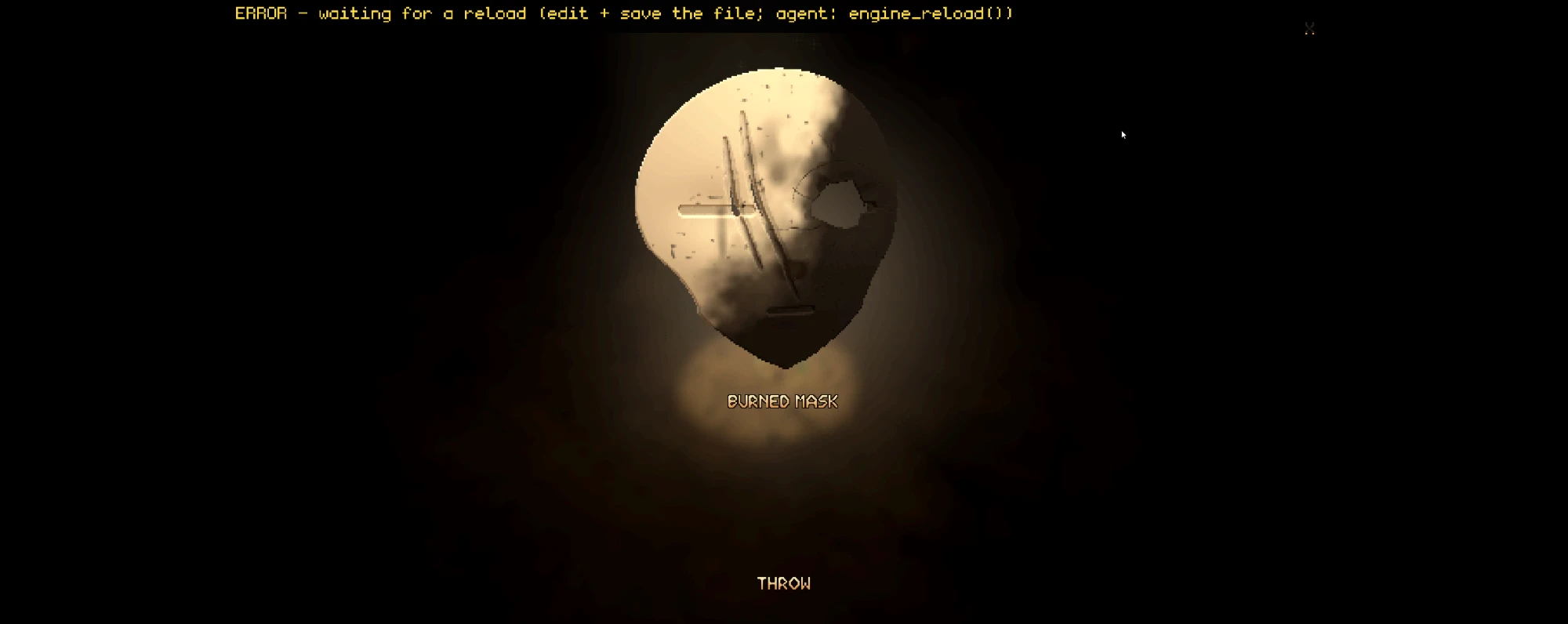
Error when trying out the fonts. Pressing F6 also only works if the menu is showing and not globally so it makes it harder for the me to try. The white squares are not gone, but let's leave that for the next session since it seems a more fundamental issue.
[Image: source: C:\Users\a327e\AppData\Local\Temp\claude\C--Users-a327e-Desktop-a327ex\27250904-aded-4432-bc8d-0b8758784617\images\1.webp]
[Think]
I need to track down the font error in the viewer — it shows an "ERROR - waiting for a reload" overlay, so I should check if there's a log file capturing that, and also look into the F6 key behavior since it seems to only trigger when the viewer menu is active rather than globally.

In keys_input, F6 handling appears to be in the non-inspect branch, so if the viewer is open, pressing F6 does nothing — meaning he'd have to close the viewer, press F6, then reopen it. I should make F6 work globally regardless of viewer state, and then dig into what's actually causing the font error itself.

The error might come from something drawn while testing text (H) is active — maybe a plain/facet font string containing parentheses, or a hi-font scale issue with the end message. I need to find where the engine actually logs its errors, whether that's stdout in the run.bat console or a log file somewhere in his setup.
Two fixes: the error when switching fonts, and F6 working everywhere, including while the viewer is open. I'll leave the white squares for next session as you said. First, finding the error: checking whether the engine logged it.
Bash (cd /c/Users/a327e/Desktop/a327ex/lich-survivors && find . -maxdepth 2 -newer REC...)
Bash (cd /c/Users/a327e/Desktop/a327ex/Anchor/engine/engine/src && sed -n 28590,28640p...)
[Think]
I'm wondering whether the error message text is actually being clipped or hidden in his screenshot, since only the banner line shows — and whether the replay recording even captures the overlay at all, or if it's drawn separately from the frame data.

The last three replays (15.9 MB, 7.3 MB, 2.7 MB) are short, so the error is likely in one of them. I should render the last frame of each and check whether the overlay error text is visible there.
[Think]
The error message likely appeared below the banner your screenshot cut off. I'll render the last frames from your three short runs at 07:05–07:06 to read what it says.
Bash (cd /c/Users/a327e/Desktop/a327ex/lich-survivors && mkdir -p scratch/r54 && for f...)
[Think]
I'm trying to reproduce the issue directly rather than rely on a recording—testing font switches in an agent instance across different viewer states, with the debug HUD toggled on and off. In my capture, the viewer worked fine for every font with the HUD off, but with the HUD on there's extra text being drawn that might be interfering.

I'm tracing through the draw_hud logic and the font-sizing calculations for different text heights, checking the glyph button rendering and inventory hover states, but nothing obviously breaks. I think the best path is to just reproduce it programmatically: enable the HUD, cycle through each font while opening and closing the viewer, and step the engine to capture any error message that surfaces.
Reproducing it directly instead: each font with the testing text on (my earlier captures had it off), opening the viewer and rendering, to catch the error message.
Recorded run: lich-survivors, 20261007-070826
Bash (anchor drive stop . >/dev/null 2>&1; timeout 300 anchor drive start . 2>&1 | tai...)
[Think]
No error reported, but I'm wondering whether draw errors would actually surface here since they'd put the engine into an error state rather than failing the eval itself. Let me take a snapshot to check if that "ERROR - waiting for a reload" overlay is showing, or see if there's a way to query the engine's error state directly.
No error on that path. In case an agent instance swallows the error state, taking a snapshot to see whether the banner is up.
Bash (timeout 300 anchor drive eval . "engine_step(1); engine_snapshot('scratch/r54/af...)
Read (C:\Users\a327e\Desktop\a327ex\lich-survivors\scratch\r54\after.png)
[Think]
No error on his side; he cycled fonts with F6, clicked an object to open inspect, then hovered over THROW/X, which should trigger the hot state in the button logic.

Tracing through that, the button's word_glow computes glow dimensions from text_width, and with hi-res fonts that width can come out fractional since it's halved from glyph width — passing a non-integer size into texture creation would break it. So hovering THROW or X while using a hi font triggers an error from fractional glow dimensions, and the same issue likely affects glyph_button and any hover glow relying on text_width.

The fix is to make text_width round up to an integer for hi fonts, and also floor the glow size as a safeguard in word_glow.

Now I want to actually reproduce this by setting S.hot to 'throw' with a hi font active and rendering, to confirm the fractional-width error occurs as expected.
[Think]
The error happens on hover: the lamp glow size derives from text width, and with the new high-res fonts that width can be fractional, which breaks texture creation. I'll reproduce this to confirm.
Bash (timeout 300 anchor drive eval . "GAME.font('facet_thin'); GAME.ask(0); for k = 1...)
Recorded run: lich-survivors, 20261007-070859
Bash (timeout 300 anchor drive eval . "engine_reload(); return 1" 2>&1 | tail -2; time...)
[Think]
Since the error message is empty, I'm thinking about testing the HUD drawing path directly by calling UI.button through pcall to isolate where the failure occurs.
The error text comes through empty, so I'm calling the button's drawing directly inside a protected call to capture the actual message.
Recorded run: lich-survivors, 20261007-070907
Bash (anchor drive stop . >/dev/null 2>&1; timeout 300 anchor drive start . >/dev/null...)
[Think]
The eval crashed on referencing HUD directly, which suggests HUD is local to game.lua rather than a global, unlike GAME which did work in the environment.

There's also a potential bug with word_glow using a fractional width: looping from 0 to w-1 with w=67.5 gives 67 iterations, but texture_create might expect an integer, causing a mismatch. I should verify this by requiring the hud module directly instead of relying on a global.
Bash (timeout 300 anchor drive eval . "local HUD = require('port.hud'); local UI = req...)
[Think]
I found the bug: a width of 30.5 is being passed into texture_create, which needs integers. I should round text_width measurements up to whole pixels, and make word_glow robust by ceiling the width and height so centering calculations don't break on fractional values.

Separately, for the F6 global shortcut, I need to add its handling early in keys_input, before the inspect-active branches that return early -- placing it right after the won check should work. Then I need to figure out how to simulate hover and F6 presses while the viewer is open, which means checking if there's an agent input API like agent_key or agent_tap for injecting key presses programmatically.
[Think]
Found that THROW renders at 30.5px in FACETED THIN, causing the hover glow sizing issue since it can't align to half a pixel—fixing by rounding text widths and glow size to whole pixels, plus making F6 work regardless of viewer state. Now checking how to simulate a keypress to test F6 inside the viewer.
Bash (cd /c/Users/a327e/Desktop/a327ex/Anchor/engine/docs && grep -n "agent_tap|agent...)
Bash (cd /c/Users/a327e/Desktop/a327ex/lich-survivors && python - <<'PYEOF' def edit(p...)
[Think]
I want to test with a fresh instance across each font, hovering over THROW and X to verify the hot state changes correctly over several rendered frames. I should also check keyboard-driven input via F6 while the viewer is open, plus a more realistic mouse-move hover test over THROW, then script the full cycle starting with opening the viewer.

Pressing F6 seven times in sequence, rendering frames and snapshotting between each, to capture one image per font while toggling the hot throw/close state each time.
Fixed. Testing the way you play: viewer open, F6 pressed through real key events to step through all seven fonts, with THROW and X hovered in each, rendering every frame.
Recorded run: lich-survivors, 20261007-070958
Bash (cat > scratch/r54/f6_test.lua <<'EOF' record_stop() GAME.set_manual(true) GAME.h...)
[Think]
I'm tracing whether F6 toggling inside the viewer could interact with other key handlers, checking that the viewer stays open across presses and only closes after GAME.answer, and confirming no font-hover errors occurred. I want to verify F6 is processed before the inspect_active() checks to rule out any ordering bug.

Let me spot-check a couple more snapshots, f6_3 and f6_7, to confirm the viewer renders correctly in those cases too.
F6 now steps through all seven with the viewer open, and hovering THROW and X raises no error in any font. Glancing at two of the frames.
Bash (python -c " from PIL import Image a=Image.open('scratch/r54/f6_3.png').resize((6...)
Read (C:\Users\a327e\Desktop\a327ex\lich-survivors\scratch\r54\f6_pair.png)
[Think]
The backdrop is just the frozen cave frame, which is fine. The white squares issue remains unresolved — I should note that for next session as it's more fundamental. I'll commit and log this as the round 53b fix, also noting his screenshot shows the top-right X appearing dim.
Both render cleanly. Recording the fix and your note that the white squares remain for next session, then committing.
Bash ([memory: sealed target])
The font audition works now, and F6 works everywhere, including with the viewer open.
The error came from hovering THROW or X in one of the new fonts. Those fonts are drawn at the window's resolution, so a word's width can come out to half a game pixel (THROW in FACETED THIN is 30.5). The glow behind a hovered button is a texture sized from that width, and a texture can't be made at half a pixel. Text widths in those fonts now round up to whole pixels, and the glow rounds its own size too.
F6 is now handled before anything else, so you can open an object's viewer and press F6 to step through all seven fonts in place.
Checked: with the viewer open, I pressed F6 through real key events and cycled all seven fonts, hovering THROW and X in each and rendering every frame. No errors.
The white squares are noted in RECORD.md as the first thing for next session, as you asked, then your font pick and verdicts on rounds 50–53. The petals were one source I could see in this morning's recording, but there's clearly more to it. Replaying your own recording and scanning its frames is how I'll start next time.
Committed as 938bcd7, not pushed.
Code: lich-survivors @ 1d651a8acd (4 files, +23 -7)
Recorded run: lich-survivors, 20261007-073057
Let's end this session here, second font is the correct one. Name it Lich Survivors 10.