Steam Market Research 6 archive
Report text below is preserved verbatim as Markdown. Charts, tables, methods, audit records, and analysis scripts are downloadable. Large Parquet datasets and raw review-response pages remain in the original local research directories; scripts require those inputs and the research Python environment.
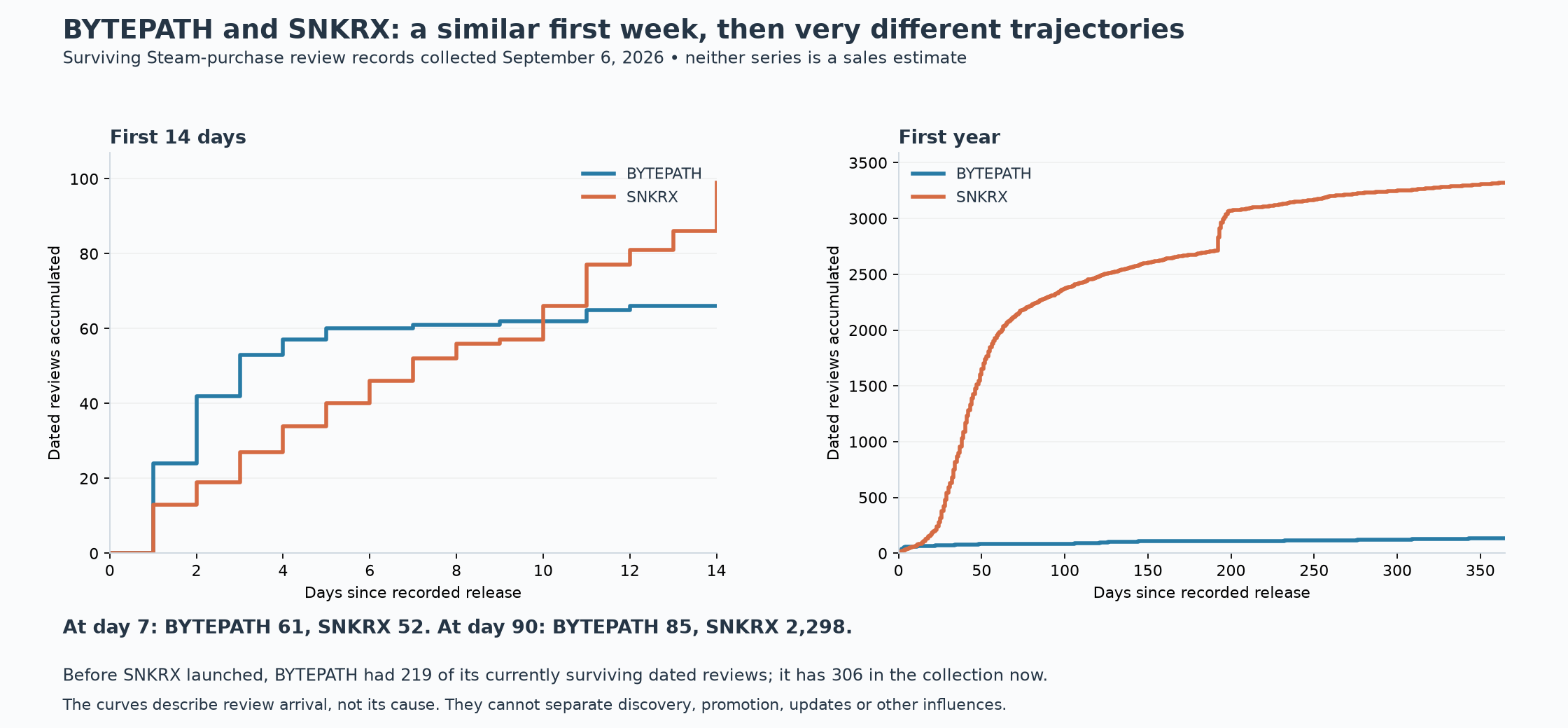
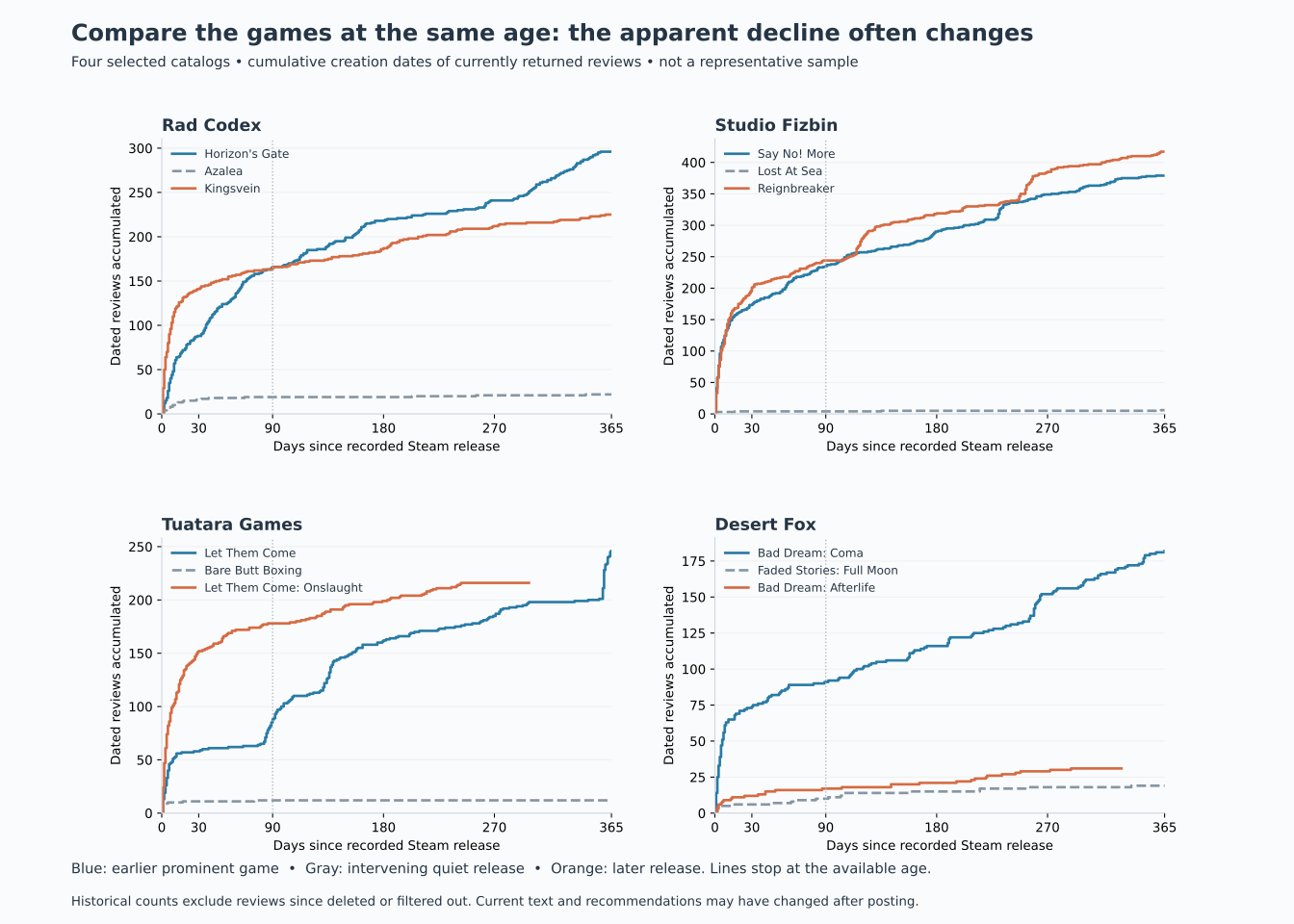
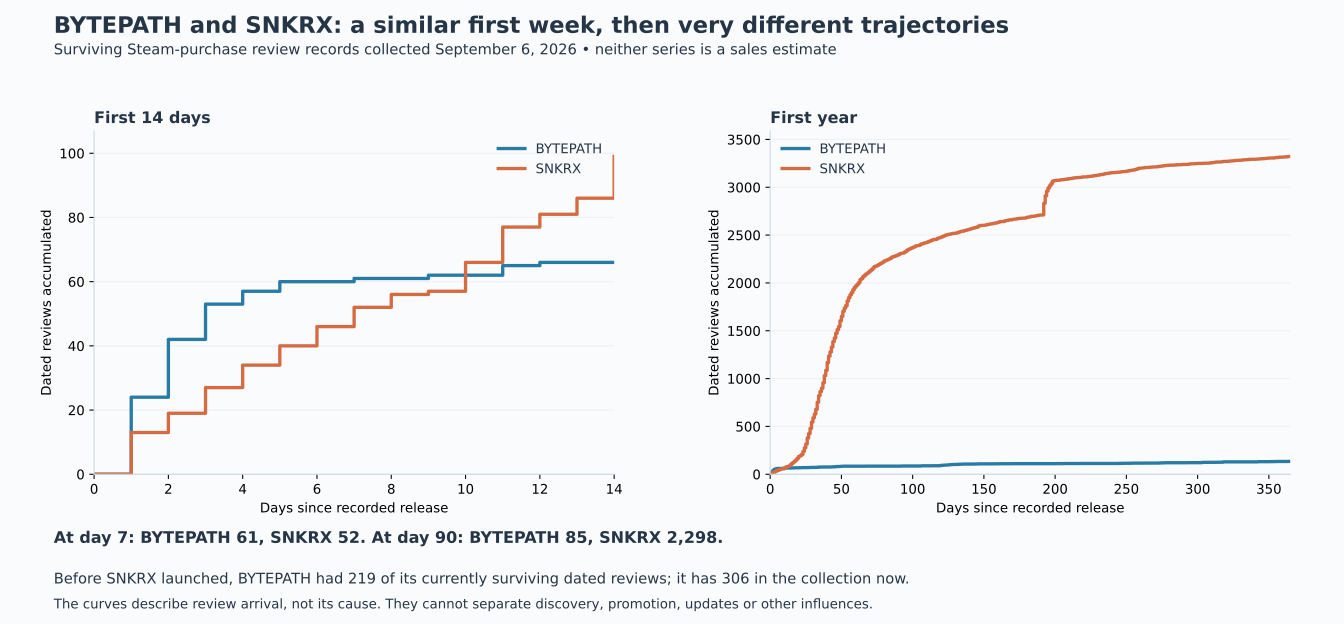
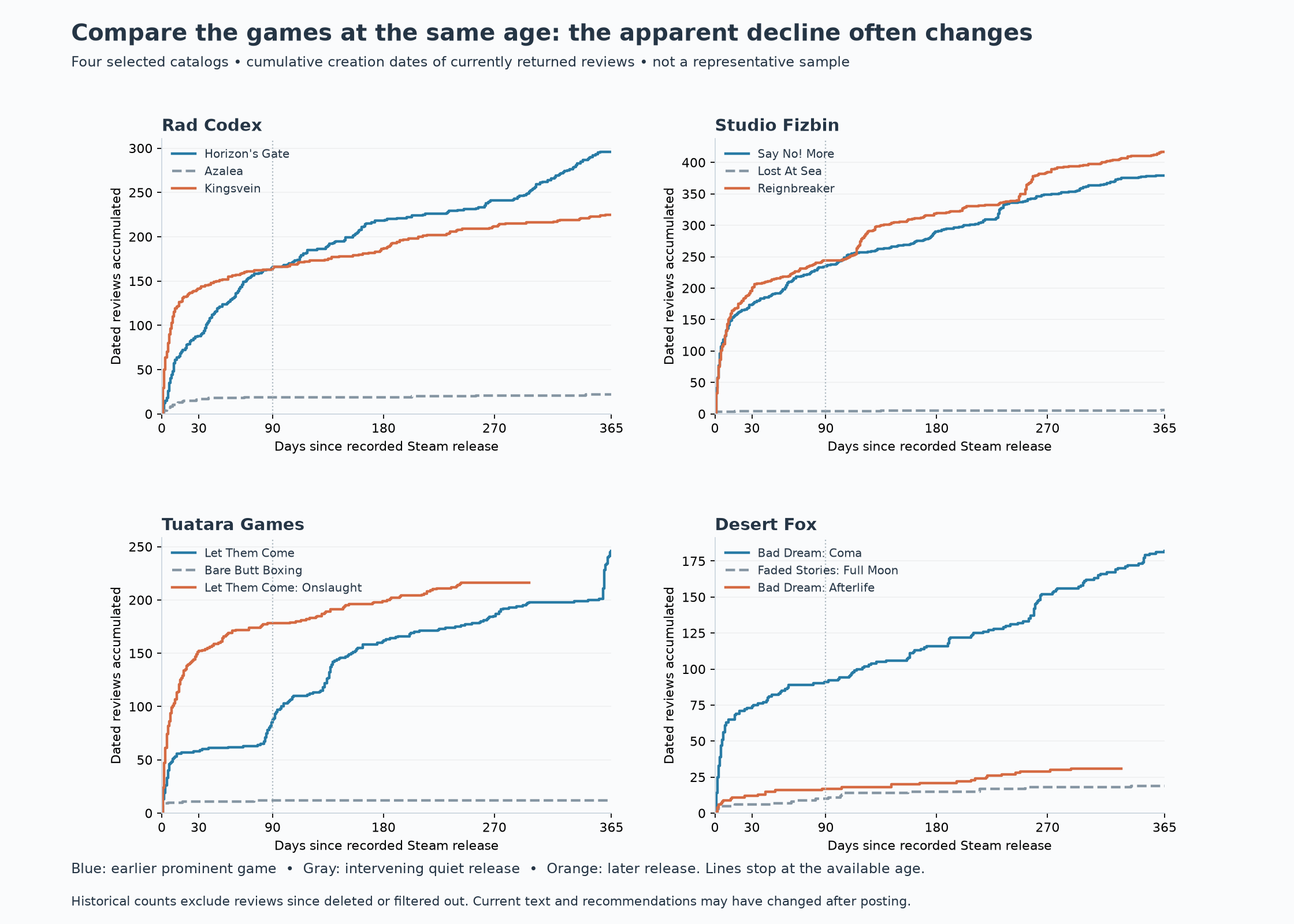
# Historical portfolios, portable authorship, and quieter releases The historical reconstruction changes the interpretation of several catalogs. Three selected later games look much smaller than an earlier prominent game in current totals, yet reach approximately the same or greater review counts at day 90. Your build-heavy authorship hypothesis also receives direct support in review testimony, including a SNKRX reviewer explicitly asking you to make a tower-defense version and stating they would buy it. That is stated intent, not an observed future purchase. The defensible distinction is between a portable reason to try another work and an assurance that the player will like it. Reviews demonstrate both successful cross-game recognition and disappointment despite that recognition. ## Data The bounded collection contains 16,960 unique review records across 27 games. The primary comparisons use 15,445 currently returned Steam-purchase reviews from 24 selected paid games: 23 across five catalogs, plus Eliza as an authorship case. Three currently free Desert Fox games are separately retained as historical context. There were 226 collection requests plus 10 feasibility probes. No media or profile metadata was collected. All collectors are inactive; bulk collection stayed paused. Historical counts use the creation dates of surviving, currently returned reviews. They omit subsequently deleted/hidden/filtered-out reviews, and do not reconstruct past versions of review text or recommendations. They are not sales or returning player counts. Twenty-two of 24 primary streams match API summaries exactly; two differ by one record each. These are purposive case studies, not population rates. ## 1. Same-age comparisons alter the apparent post-hit decline | Developer | Earlier prominent game | Quiet intervening game | Later game | Current counts: earlier → later | By day 90: earlier → later | |---|---|---|---|---:|---:| | Rad Codex | Horizon's Gate | Azalea | Kingsvein | 1,212 → 303 | **166 → 165** | | Studio Fizbin | Say No! More | Lost At Sea | Reignbreaker | 1,757 → 440 | **235 → 244** | | Tuatara Games | Let Them Come | Bare Butt Boxing | Let Them Come: Onslaught | 1,082 → 216 | **88 → 178** | | Desert Fox | Bad Dream: Coma | Faded Stories: Full Moon | Bad Dream: Afterlife | 1,966 → 31 | **91 → 17** | Kingsvein has 25.0% of Horizon's Gate's current reviews, but 99.4% of its day-90 count. It begins faster at day 30, 141 versus 88, then is almost equal at day 90. Their first-year counts are 225 versus 296, so the trajectories are not identical. Reignbreaker has 25.0% of Say No! More's current count, but 103.8% of its day-90 count and 417 versus 379 at one year. Onslaught has 20.0% of the original Let Them Come's current count, but 202.3% of its day-90 count. Its first full year is not yet observed. The Desert Fox case does not follow this pattern. Afterlife has 18.7% of Coma's day-90 count, rather than just 1.6% of its current total. Age explains part of the visual disparity but does not remove the smaller early response.  These cases were selected to examine different trajectories. Three favorable comparisons out of four are not a 75% success estimate. Nor can we establish what the later games would have done without the intervening releases. What we can establish is that the intervening game's small response did not become the observed scale of every subsequent launch in these cases. ## 2. Current earlier-game totals can materially overstate the prior record Seven of the 18 transitions among selected paid games move review-count bands when we replace the predecessor's current total with its surviving reviews dated before the next launch: | Later release | Predecessor | Reviews dated before later launch | Reviews now | |---|---|---:|---:| | Alvora Tactics | Voidspire Tactics | **58** | 271 | | Horizon's Gate | Alvora Tactics | **53** | 135 | | Azalea | Horizon's Gate | **231** | 1,212 | | Minute of Islands | Say No! More | **217** | 1,757 | | Lost At Sea | Minute of Islands | **98** | 714 | | Bare Butt Boxing | Let Them Come | **866** | 1,082 | | Faded Stories: Greenberg | Bad Dream: Stories | **29** | 116 | Calling Azalea a release after a 1,000-review predecessor describes today's catalog but not the recorded context at its launch. This concretely reinforces the limitation of the previous broad portfolio study: its current-outcome associations are not historical launch-time reputation effects. For Kingsvein's launch, Horizon's Gate had **809** of its currently surviving reviews, Azalea had **33**, and the selected earlier paid catalog totaled **1,179**. For Reignbreaker's launch, Lost At Sea had **24**, while the selected earlier paid catalog totaled **3,014**, including **1,226** for Say No! More. The immediately preceding title alone therefore describes those positions poorly. Desert Fox also has currently free games outside the primary paid channel. Before Afterlife, those contribute another **1,389** dated all-acquisition review records alongside the selected paid catalog's **2,157** Steam-purchase records. They are separate channel counts, not buyers or a uniform paid-review metric. Current free status must not erase prior work, and a zero purchase-only count for a free game does not mean zero reviews. ## 3. Your own launches show why early snapshots are incomplete | Age | BYTEPATH | SNKRX | |---|---:|---:| | Day 1 | 24 | 13 | | Day 7 | 61 | 52 | | Day 14 | 66 | 99 | | Day 30 | 71 | 590 | | Day 90 | 85 | 2,298 | | Day 365 | 134 | 3,322 | | Collection total | 306 | 4,197 | SNKRX's first week is smaller in this measure; by day 90 its count is about 27 times BYTEPATH's. At SNKRX's launch, BYTEPATH had **219** of its currently surviving reviews, not today's 306. The additional 87 were written later. This does not reveal how many followers you had, how many players returned, or what caused the growth. It shows why projecting a whole career from an early release snapshot is especially unreliable in your own case.  ## 4. Build-heavy authorship has direct support, with a narrower demonstrated scope The tag-distance implication needs correcting: BYTEPATH and SNKRX have substantial mechanical continuity beyond builds. Both advertise continuous forward movement, left/right steering and automatic shooting, plus configuration. They are not a clean test of reception across radically different genres. Nevertheless, reviewers explicitly recognize the build-related continuity: - Review **95224877** identifies both games with a developer combining simple mechanics and extensive configuration, and recommends watching for future work. - Review **95034038**, on BYTEPATH, says the reviewer enjoys SNKRX and describes specific BYTEPATH builds they used, valuing the variety despite roughness. - Review **41403451** describes arriving from Path of Exile discussion and finding the desired pleasure of discovering builds in an arcade shooter. This is a concrete report of a preference travelling between game types, independently of prior loyalty to this developer. - Review **93920127**, on SNKRX, explicitly requests a tower-defense version from a327ex and says they would buy it. It also asks for better information and more configuration choices. This is the most direct stated-preference evidence for the user's hypothesis, but no subsequent purchase has been observed. The evidence supports a portable appetite for configuration and discovery. It does not establish that every genre will deliver it equally well to every follower. There are also concrete gates. Review **213631890** recognizes SNKRX but objects to BYTEPATH's interface, effects and apparent lack of the expected mouse-control option. Recognition and wanting to like the game do not make the interaction comfortable. Review **116097298** says the reviewer liked both games before discovering the common developer and becoming a fan: maker recognition can be an outcome of enjoying the works, rather than the cause of the first purchase. Seven English SNKRX reviews explicitly mention BYTEPATH by name, and six English BYTEPATH reviews mention SNKRX. Those are text occurrences, not counts of returning players or estimates of follower conversion. Most people do not report their purchase history in a review, and multiple reviews can come from the same person. ## 5. Even a stable build family contains different preferences Rad Codex's store descriptions explicitly carry classes, combinations, exploration and environmental interactions through Voidspire Tactics, Alvora Tactics, Horizon's Gate and Kingsvein. Horizon's Gate directly credits the same engine, mechanics and setting as the earlier games. Kingsvein changes the campaign and combat emphasis while retaining configurable classes and passives. Of 279 English Kingsvein reviews, 129 explicitly mention Rad Codex or named earlier RPGs under the saved screen. This indicates visible cross-catalog discussion, not 129 confirmed prior customers. - Review **209710833** recognizes the hybrid class systems and different campaigns; it also says Kingsvein was the reviewer's first game from the maker and prompted exploration of earlier work. - Review **170292577** loved Horizon's Gate but dislikes Kingsvein's emphasis on pushing, terrain and combo combat, and perceives fewer roleplaying/build options. Thus even keeping the broad build-heavy feature can change the particular pleasure a player valued. A stable label is not an invariant experience. The useful research question becomes which kinds of choice, discovery and control a following returns for—not only whether a game contains many builds. ## 6. Authorship can travel through something other than mechanics Zachtronics itself identifies technology as continuity between its puzzle games and Eliza, which is a visual novel: [Zachademics](https://www.zachtronics.com/zachademics/). The review evidence contains both support and limits: - **145812937:** love of the puzzle games motivated trying an unfamiliar narrative form, and the reviewer enjoyed the story. - **54860514** and **54592158:** recognize recurring subject matter and the maker's treatment of technology across the change of form. - **54604246:** says trust in the developer caused buying without other reviews or prior knowledge; nevertheless gives only a qualified positive assessment, explicitly 6/10. - **190599746:** enjoyed prior games and knowingly tried a visual novel but does not recommend it. **54688217** liked earlier games' story elements but dislikes Eliza's writing. These are examples of recognition, trial and enjoyment separating. A developer can earn a chance to try a different form without earning automatic approval of the result. The stable connection can be a subject, sensibility or manner of thinking, as well as a game system. ## 7. A quiet release is not one kind of event | Intervening game | Current collected reviews | Positive recommendations now | |---|---:|---:| | Azalea | 40 | **39/40 (97.5%)** | | Lost At Sea | 43 | **20/43 (46.5%)** | | Bare Butt Boxing | 13 | **9/13 (69.2%)** | | Faded Stories: Full Moon | 41 | **33/41 (80.5%)** | Azalea is explicitly described by its maker as a short adventure: [official itch page](https://radcodex.itch.io/azalea). Twenty-nine of its 30 English reviews are positive. Two explicitly connect it to the developer's earlier RPGs. One values it while finding its puzzles less interesting; another enjoys it and recommends the RPGs. This is a well-liked smaller work among a small reviewing audience, not evidence of general rejection. Lost At Sea has mixed reception; Bare Butt Boxing is a multiplayer departure; Full Moon is part of a recurring short-story adventure practice. Low counts do not establish that these had similarly small production scope or were equally successful experiments. No development budgets or durations were inferred. Full Moon's reviews show a recognizable following: **192207128** values the dream logic, mood, alternate paths and storytelling and states an intention to keep buying. But **221865165** loves prior work and objects to this game's slow walking sections while enjoying its point-and-click chapters. Recognition remains while approval varies. The appropriate reading is that smaller works can coexist with later substantial launches, and that the response to a smaller work must be understood on its own terms. Neither a low count nor a positive score alone describes its role in a career. ## What this changes The user's belief has direct evidence behind a meaningful, conditional version: some players seek the pleasure of configuring, discovering and becoming powerful across changes of game type, and some explicitly expect a327ex to supply it again. Their willingness to follow is compatible with preferences about controls, presentation, pacing, and the particular kinds of build freedom on offer. Historical timing also changes the apparent stakes of experimentation. A later game with one quarter of an earlier game's current reviews can have matched its initial reception. Three of the four selected trajectories demonstrate that; the fourth prevents treating it as a universal pattern. The data do not identify what would have happened without the quieter release, or how many existing followers returned. All 446 mechanical checks passed after final chart corrections; both figures were visually inspected. The complete data, selected passages, coding decisions, collection caps, source discrepancies and reproduction scripts remain in this directory. Collection is closed.