Steam Market Research 6 archive
Report text below is preserved verbatim as Markdown. Charts, tables, methods, audit records, and analysis scripts are downloadable. Large Parquet datasets and raw review-response pages remain in the original local research directories; scripts require those inputs and the research Python environment.
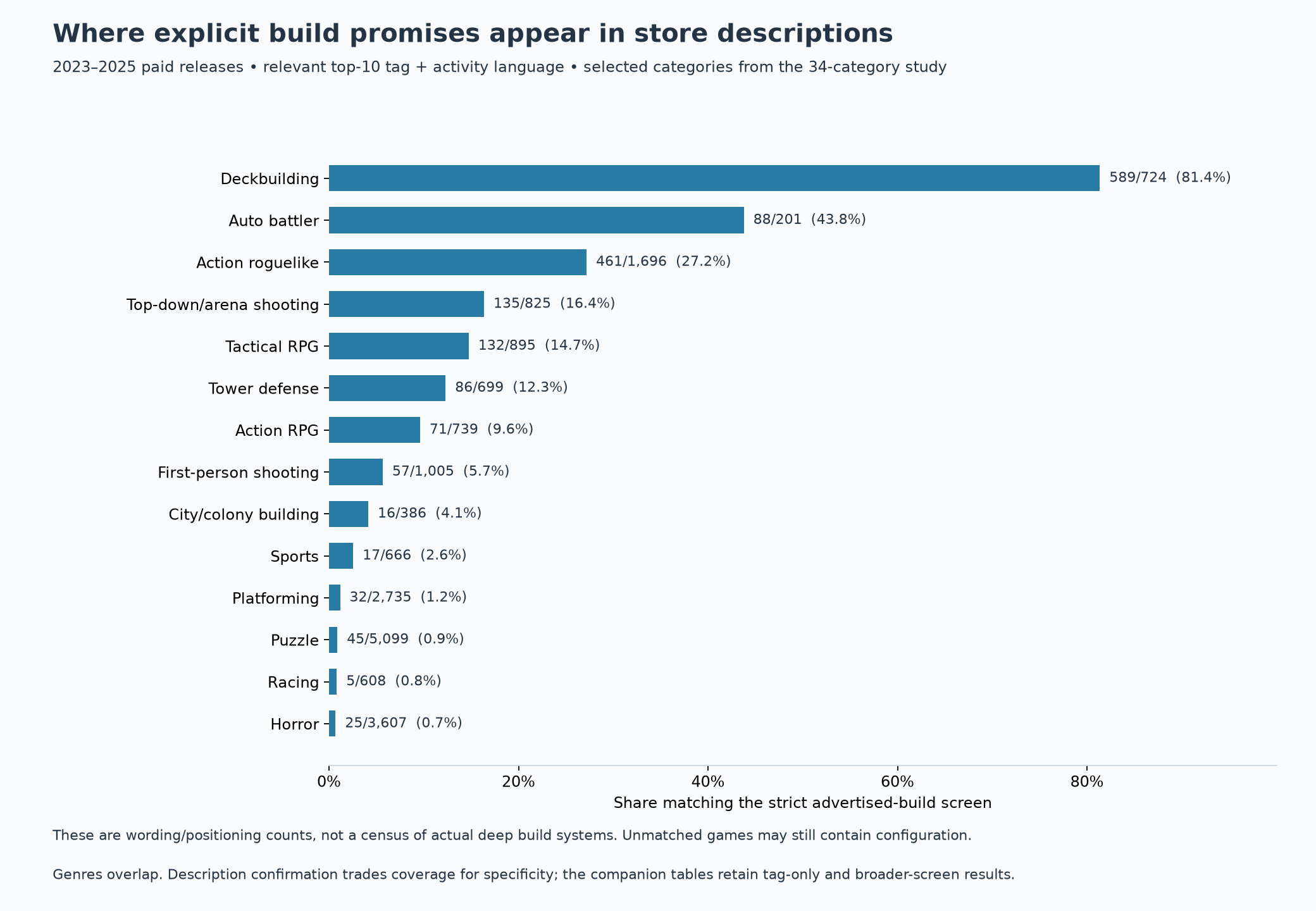
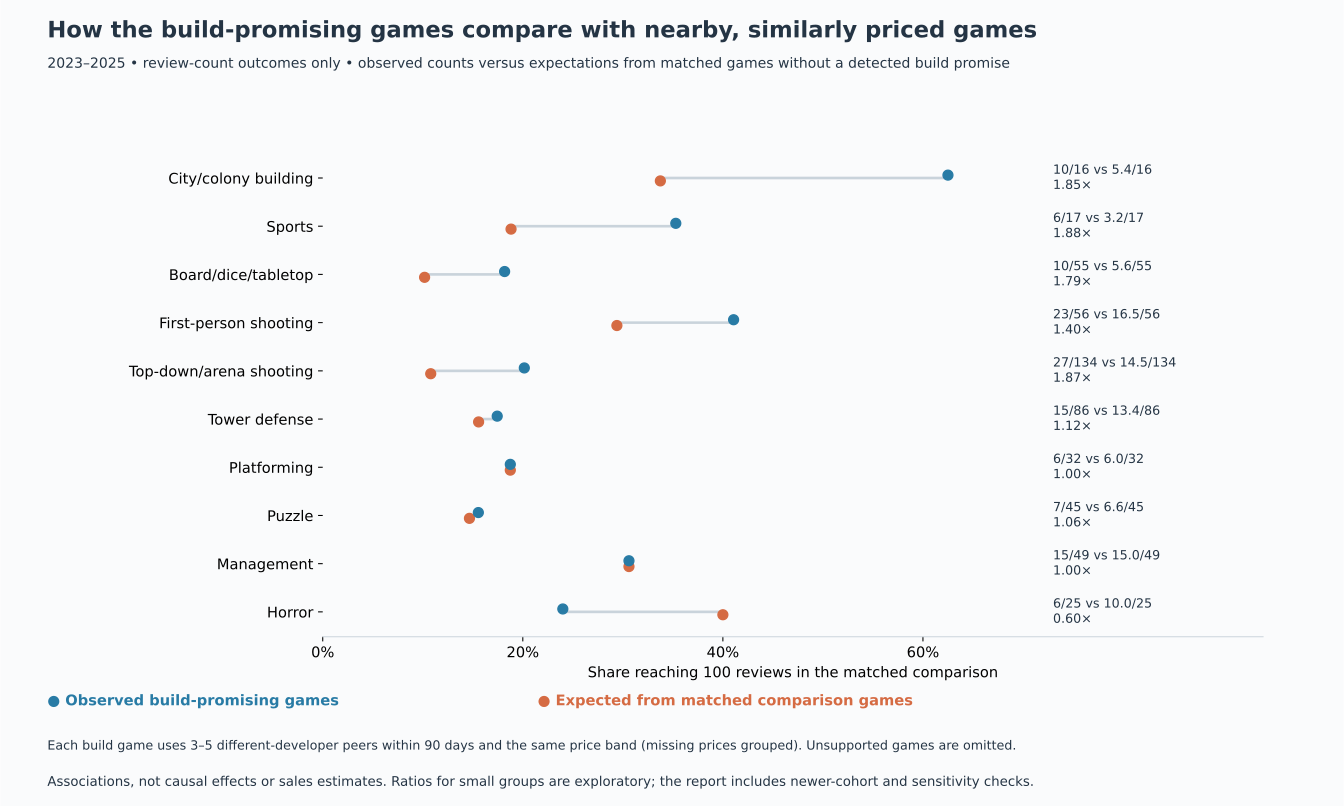
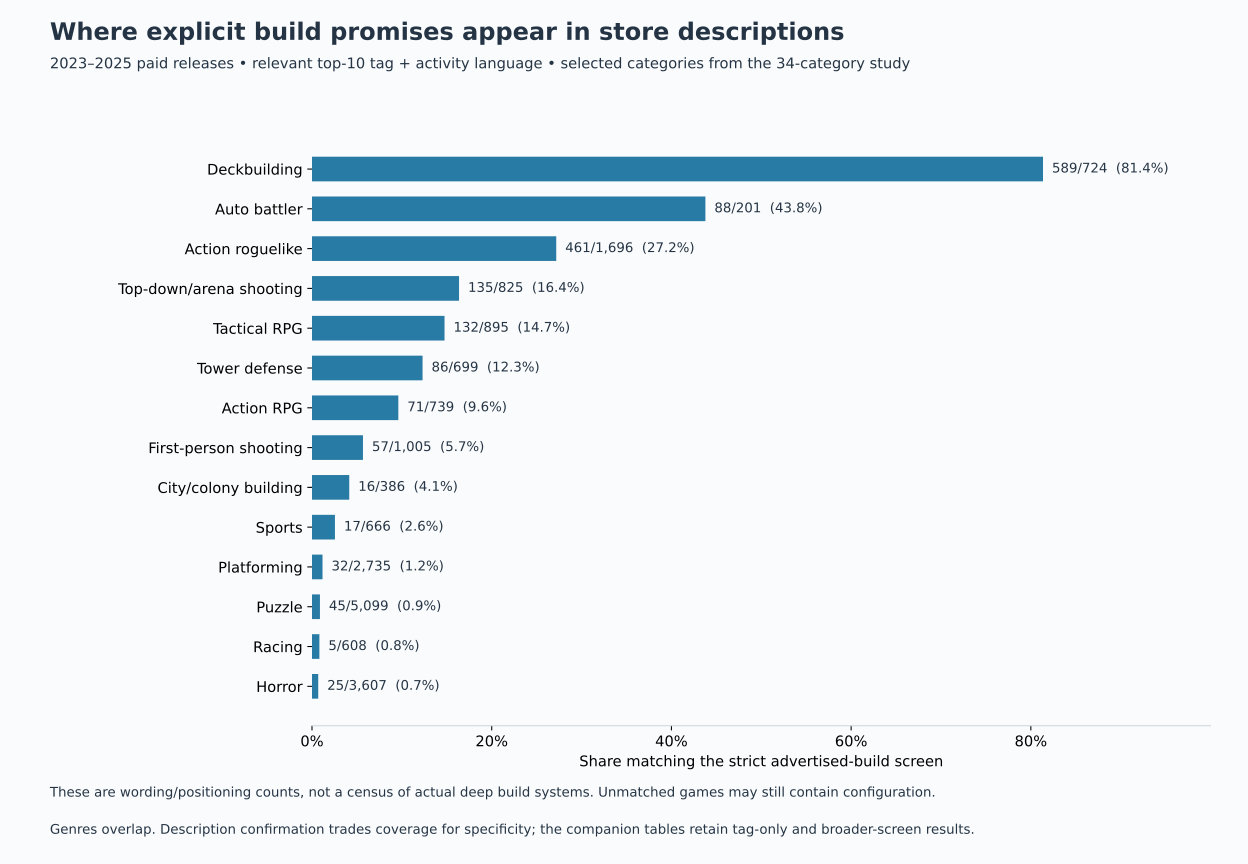
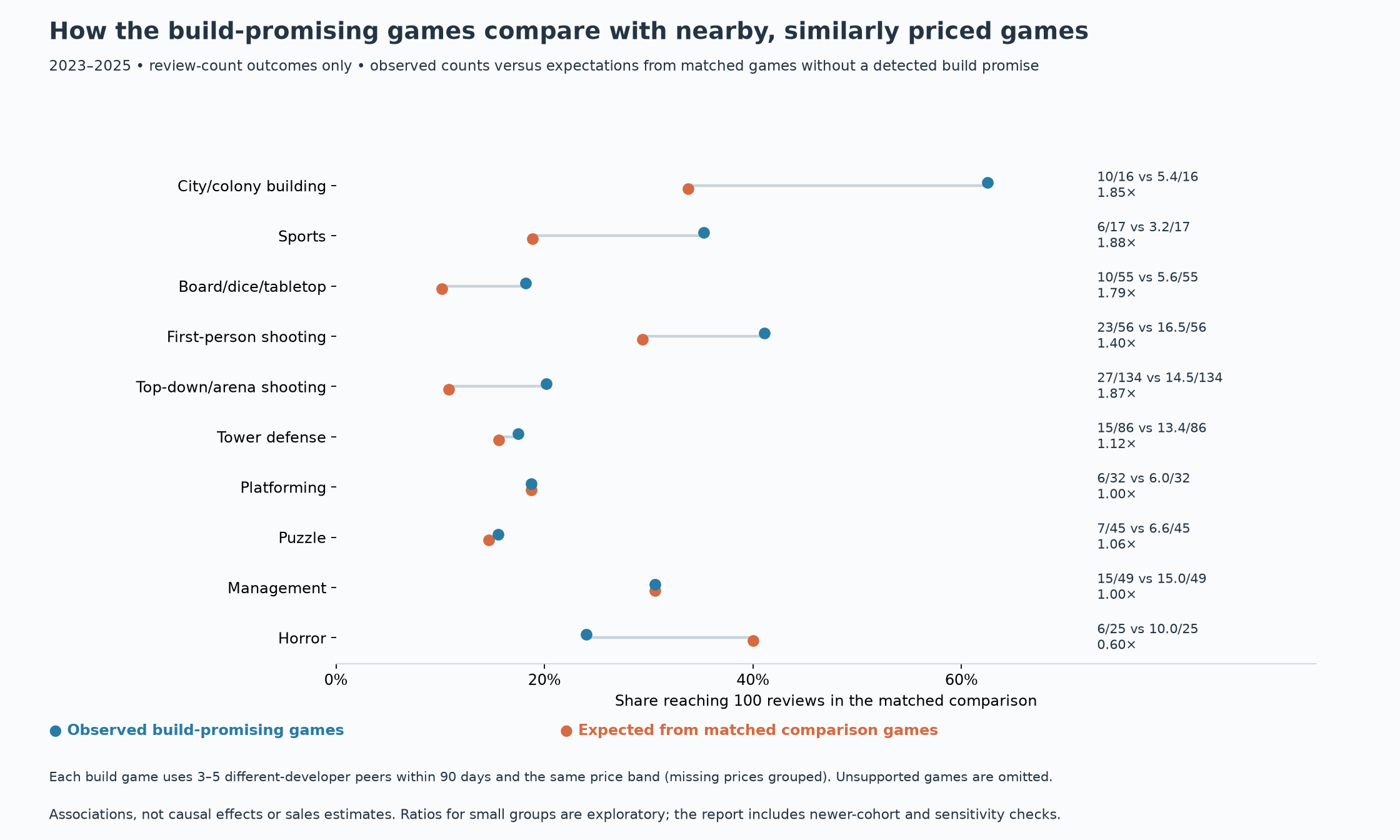
# Where build promises travel: prevalence, within-activity comparisons, repeated cases All results use the September 5, 2026 snapshot. No network collection or player review-text analysis was performed. Review counts alone determine the outcomes; positivity does not enter the comparisons or rankings. The clearest small-supply lead is **sports**, with six 100-review examples from six developer names and a favorable matched comparison. **Board/dice/tabletop** also has repeated higher review counts, but almost all its substantial examples already sit inside familiar deckbuilding/autobattler/tactical-RPG families. **City/colony building** has a strong 2023–2025 record but weak confirmation in 2026. None of these is proof of an empty market or unmet demand. ## Definitions that matter The study classifies 75,860 eligible paid records across 34 overlapping activity groups. The main 2023–2025 population has 35,806 records; 2019–2022 and January–August 2026 are separate checks. Prior explicit-content and central idle/incremental/FMV/VN exclusions remain. It is not a manual quality filter. Main activity membership requires a top-10 tag and relevant language in the short description or first 350 full-description words. An outcome-hidden 96-case audit found serious tag errors and false customization matches. Revisions remove cosmetic mixing, graphics-engine references, literal wooden-deck construction and blackjack house rules. The strict classifier has no prerequisite that a game belong to an existing build-friendly genre. Its 26 retained development-audit matches all describe configurable setups; this is not an independent accuracy estimate. **Build prevalence below means detected explicit promises, not actual mechanical prevalence.** The stricter definition differs from earlier passes. A game can have excellent builds without using this wording, and an advertisement does not verify depth. The broader configuration screen is only a sensitivity, not a true upper bound. Host confirmation also trades coverage for specificity: these are described category samples, not exhaustive genre censuses. For the main comparison, each strict build match has 3–5 different-developer peers in the same current-price band and within 90 days of release (30 days in 2026). Unsupported games are omitted. Missing prices form a separate category; removing them does not change the sports/city/tabletop results. Expected counts sum the peers' threshold rates. This is an association, not a causal estimate of adding builds. ## 1. Explicit build language is most conventional in a few families | Activity | Confirmed 2023–2025 sample | Strict build promises | Share | |---|---:|---:|---:| | Deckbuilding | 724 | 589 | 81.4% | | Auto battler | 201 | 88 | 43.8% | | Action roguelike | 1,696 | 461 | 27.2% | | Top-down/arena shooting | 825 | 135 | 16.4% | | Tactical RPG | 895 | 132 | 14.7% | | Tower defense | 699 | 86 | 12.3% | | Action RPG | 739 | 71 | 9.6% | | First-person shooting | 1,005 | 57 | 5.7% | | City/colony building | 386 | 16 | 4.1% | | Sports | 666 | 17 | 2.6% | | Platforming | 2,735 | 32 | 1.2% | | Puzzle | 5,099 | 45 | 0.9% | | Racing | 608 | 5 | 0.8% | | Horror | 3,607 | 25 | 0.7% | Lower wording rates do not establish an unexpected mechanic. For example, the broader configuration screen identifies 161 Action RPGs versus 71 strict matches; 90 sports games versus 17; and 63 racing games versus five. Equipment, lineups and tuning may be described without build terminology. The final rarity rule also selects the familiar Action RPG and RTS reference groups, demonstrating why a low literal-wording share cannot by itself identify a new destination.  ## 2. What remains after comparison with closely dated, similarly priced games? Matched 2023–2025 cases; denominators are the supported build games, which can be smaller than the full classified group: | Activity | Matched build games | Observed >=100 reviews | Expected from peers | Observed/expected | |---|---:|---:|---:|---:| | Deckbuilding | 496 | 117 | 60.7 | 1.93× | | Auto battler | 78 | 25 | 14.3 | 1.75× | | Action RPG | 67 | 29 | 15.9 | 1.83× | | Top-down/arena shooting | 134 | 27 | 14.5 | 1.87× | | Sports | 17 | 6 | 3.2 | 1.88× | | Board/dice/tabletop | 55 | 10 | 5.6 | 1.79× | | City/colony building | 16 | 10 | 5.4 | 1.85× | | First-person shooting | 56 | 23 | 16.5 | 1.40× | | Real-time strategy | 23 | 8 | 4.5 | 1.76× | | Tactical RPG | 130 | 42 | 33.4 | 1.26× | | Action roguelike | 460 | 110 | 93.8 | 1.17× | | Tower defense | 86 | 15 | 13.4 | 1.12× | | Platforming | 32 | 6 | 6.0 | 1.00× | | Puzzle | 45 | 7 | 6.6 | 1.06× | | Management | 49 | 15 | 15.0 | 1.00× | | Horror | 25 | 6 | 10.0 | 0.60× | The initial broad-stratum adjustment overstated several differences. The stricter matching brings platforming and management to their comparison expectation, puzzle close to it, and tower defense only modestly above it. Matching-setting sensitivity ranges for the 100-review ratio are 0.90–1.07 for platforming, 0.95–1.19 for puzzle, 0.98–1.13 for management and 1.02–1.26 for tower defense. Those are absent/weak general premiums under this definition, not claims that builds are unwelcome or games in those categories are poor. Horror is below its comparison in 2023–2025 and 2019–2022 but above in the small 2026 group; no stable general advantage emerges there either.  ## 3. Sports: the clearest sparse, repeated lead, still a small sample Seventeen of 666 confirmed sports games match the strict screen (2.6%). Six of 17 reach 100 reviews (35.3%), compared with 98/649 other sports games (15.1%). Their median counts are 42 versus nine. All 17 find matched peers; six qualifying games compare with an expectation of 3.2 (1.88×). All six are from distinct developer names: | Game | Reviews | Advertised form | |---|---:|---| | Tape to Tape | 3,461 | Direct hockey with players, abilities and synergies | | Esports History | 383 | Esports-career RPG with talents and stat builds | | Clutchtime: Basketball Deckbuilder | 181 | Basketball plays and team synergies as a deck | | Motordoom | 173 | Freestyle-bike action with cards and upgrades | | Squiggle Football | 143 | Football management with players, coaches, tactics and cards | | Fight Crab 2 | 128 | Physics-based combat sport with weapon loadouts and stances | This is three direct-action forms and three management/card/RPG abstractions, based on their descriptions, not an established claim about one particular sport. The other eleven strict matches do not reach 100 reviews. Only one of the seventeen reaches 1,000, equal to the matched expectation of one at that higher threshold. The 100-review ratio remains 1.88–2.00 when changing neighbor counts and date windows. Matching description length as well gives 1.53× on all 17 games. Removing the leading developer/publisher leaves five qualifying games among 16 and 1.79× the new expectation. Removing the three largest build games leaves three of 14 and 1.25×: the evidence is dispersed beyond one hit, but not inexhaustibly robust. Removing developers with an earlier currently 1,000-review credited game leaves 15 build matches, five reaching 100. This is a current-catalog sensitivity, not proof of no prior fame or launch-time reputation. The 2026 sample contains 18 build matches, three reaching 100. Matching supports 17, including two of those three, against only 0.6 expected. That is compatible with the older signal but too few events to establish a strengthening trend. Supply is already growing: equivalent January–August cohorts contain six strict matches among 173 sports games in 2025 (3.5%), and 18 among 254 in 2026 (7.1%). This is a small active family with repeated response, not untouched territory. ## 4. City/colony building: stronger older evidence, weak current confirmation Sixteen of 386 games match the strict screen (4.1%); ten reach 100 reviews (62.5%), versus 130/370 controls (35.1%). Median reviews are 167.5 versus 28. All sixteen match; ten qualifying games compare with 5.4 expected (1.85×). The ten qualifying games have ten different developer names: Mind Over Magic (4,304), TerraScape (2,052), Border Pioneer (1,665), Technotopia (592), Kingdom's Deck (488), Night is Coming (383), Roots of Yggdrasil (300), These Doomed Isles (179), Dawnmaker (156), and Tiny Kingdom (149). At least eight explicitly describe cards/decks as part of the settlement-building experience. The remaining examples advertise character/class configuration. Thus the evidence concerns specific additional configuration layers; low wording prevalence does not imply that other city builders lack meaningful construction and layout choices. After removing the largest publisher, nine of fifteen reach 100 and the ratio is 2.05×. Removing the three largest build games leaves seven of thirteen, also 2.06×. Matching description length gives 1.49×, but only eleven of sixteen games retain enough peers, so coverage is weaker. None of the sixteen is flagged with an earlier currently 1,000-review credit in this snapshot; eleven have no earlier observed credit under the specified timing rule, and eight of those reach 100. These flags do not establish inexperienced teams or absence of outside reputations. The newer record does not repeat the older pattern: only one of twelve 2026 matches reaches 100. Eleven have peers; one qualifies versus 2.6 expected (0.38×). Different accumulation times prevent a deterioration claim, but current evidence does not support calling this a newly strengthening opening. ## 5. Board/dice/tabletop: repeated response, mostly familiar build families Sixty-one of 530 games match (11.5%). Fifteen reach 100 reviews (24.6%), compared with 48/469 controls (10.2%). The fifteen span fourteen developer names; seven reach 1,000 reviews. Fifty-five build games have matching support. Ten of those reach 100 versus 5.6 expected (1.79×). Six unsupported cases include five qualifying games, so the matched and full-group numerators must not be interchanged. The ratio is 1.58–2.26 across matching settings and 2.24× after description-length matching (48 supported games). Removing the three largest titles leaves twelve qualifying games in the full remaining set, nine among the 54 supported games, and a ratio of 1.73×. The newer sample also has repeated response: 52 build matches, thirteen reaching 100; among 49 supported cases, twelve qualify versus 3.2 expected (3.75×). But fourteen of the fifteen older qualifying games also carry a familiar build-family tag: deckbuilding, autobattler, action RPG or tactical/party RPG. Outside those tags there are 21 build matches and just one qualifying game. Among twenty matched cases the ratio is 0.71×. The broad favorable association does not demonstrate that build expression has succeeded equally outside those familiar structures. The examples include Astrea, SpellRogue, Dice & Fold, Pip My Dice, The Ouroboros King and Dog Witch, plus commercial board-game adaptations such as Dune: Imperium, Clank! and Frosthaven. It is an active set of ways to carry build decisions through tabletop forms, rather than an empty category. Equivalent January–August supply rises from 13/124 (10.5%) in 2025 to 52/255 (20.4%) in 2026. Advertised build expression is becoming more common here. ## 6. FPS is active, but its apparent premium weakens under stronger checks There are 57 strict matches among 1,005 confirmed FPS games (5.7%), with 24 reaching 100 reviews across 23 developer names. Fifty-six have peers; 23 qualify against 16.5 expected (1.40×). The ratio is 1.32–1.40 across settings. Description-length matching reduces this to 1.14× on fifty games. A narrower direct-build/deck-word variant gives 1.11× on fourteen supported games, while the broader configuration screen gives 1.29× on 92 supported games. The newer 2026 group has seven qualifying titles among 35, but only five are in the 33-case matched subset, compared with 7.8 expected (0.64×). There is substantial existing response to configurable FPS games. The data does not establish a consistently strong additional benefit for the more specific build-heavy framing, or a particularly unserved market. Ordinary weapon/loadout customization and roguelite builds are both present in this category. Top-down/arena shooting is a steadier reference: 27 of 135 strict matches reach 100, and 27 among 134 supported cases compare with 14.5 expected (1.87×). Matching description length gives 1.80×; removing the three largest games gives 1.78×. Strict build share rises from 30/192 (15.6%) to 88/297 (29.6%) in equivalent January–August 2025/2026 cohorts. The trait is already increasingly conventional there, rather than an unusual export. ## 7. Rare-looking destinations that do not justify a conclusion yet | Area | Strict matches, 2023–2025 | Reaching 100 reviews | |---|---:|---:| | Racing | 5 | 2 | | Driving simulation | 6 | 1 | | Metroidvania | 6 | 3 | | Stealth/heist | 7 | 6 | | Fighting | 6 | 4 | | Rhythm | 11 | 3 | | Flight/space simulation | 11 | 2 | | Fishing | 5 | 2 | | Farming | 9 | 5 | | Match-3 | 7 | 1 | | Pinball | 1 | 0 | | Job/hobby simulation | 5 | 4 | | Adventure/point-and-click | 1 | 0 | Some fractions look impressive, but tiny denominators and missing comparisons matter. Only three of seven stealth/heist cases have enough peers. Only four of five racing cases do, and just one of those four reaches 100. A 5× matched ratio for Match-3 is one observed game against 0.2 expected, not repeated evidence. The absence of detected build wording also does not establish absent mechanical configuration. These areas remain unresolved by this study. ## Interpretation Sports is the clearest small-supply destination worth further examination from this screen: multiple distinct makers, a higher count rate, complete matching support, and survival of the principal sensitivity checks. The sample remains small, the 1,000-review result is ordinary, and the existing examples include several forms of play rather than one demonstrated recipe. Board/dice/tabletop has stronger replication into 2026, but its positive evidence mostly belongs to familiar deckbuilding and tactical structures. City/colony games have a notably dispersed older record but little newer confirmation. FPS looks less special after stricter comparisons. Platforming, puzzle and management do not show a stable broad premium; this does not mean individual build games cannot work there. Top-down/arena shooting remains a favorable, already established reference. No result proves unmet demand, causal value added by a build layer, or a personal success probability. Counts describe response scale, not enjoyment. All 34 groups, passing and failing screens, underlying games and sensitivities remain available alongside this report. The analysis passed 675 mechanical checks; both figures were visually inspected. No player opinions were used to make these arguments.