Steam Market Research 7 archive
Frozen research artifacts, September 7, 2026. Large Parquet datasets, raw API pages and the full announcement inventory remain in the local research directory.
# Developer lives on Steam: sequences, floors, repetition and back catalogs

Authorized September 7, 2026 after discussion of seven research avenues. Main
data are the independent September 5 snapshot. New dated review collection is
limited to six selected paid catalogs. All results are observational and about
listed Steam work, not personal biographies, retirement, production effort,
profits, verified audience transfer, or the counterfactual effect of practice.

## Identity and maturity

Reuse the earlier audited name/credit eligibility table, joined to the independently
normalized snapshot: 93,013 games, 59,259 credited names. Joint/missing credits,
ambiguous names and explicit promotional titles were excluded by that table.
Names are the identity keys; creator-page IDs are used only for navigation because
pages can represent multiple developers. Name changes, staff changes, homonyms,
ports, editions, missing free work and delisting remain limitations.

The additional punctuation-only identity audit flags 793 possible name fragments
or placeholders; it does not merge them. Removing them in a sensitivity affects
61 core catalogs and twelve core catalogs with a strong title. The principal
pattern proportions change little. This is not an exhaustive identity audit.

Mature means released before September 1, 2025. Younger titles are retained for
observed continuation and linked examples, but excluded from mature response
sequences. Core readable shapes have 3–10 mature included games and first
observed release from 2010 through August 2020: 2,651 catalogs, of which 683 have
a game with at least 1,000 current reviews. The consistency study instead uses
4–10 mature games, first observed from 2010 onward: 2,014 catalogs, 426 with a
1,000-review peak. These denominators must not be interchanged.

Q is under 100 current filtered reviews, M 100–999, H 1,000–9,999, B 10,000+.
H/B are combined for the principal strong-response threshold. Threshold checks
use 500, 1,000 and 2,000. Recommendation percentages remain separate. These
levels are not financial-success or artistic-value classifications.

## Questions and populations

1. First strong-release events: the earliest released title currently above the
   threshold, released January 2015–August 2020, with a five-year next-release
   window. This anchor is NOT the historical date it crossed the review threshold.
   All examples start from an observed catalog beginning in 2010 or later.
   No-return cases remain in the denominator. Floor comparisons using three
   follow-ups require at least three releases in that window, then use exactly
   the first three. The paired before/after subset also requires three earlier
   games and is much smaller.
2. Repetition: latest qualifying transition per developer, 2019–August 2025,
   gap >=30 days. Main catalogs have at most ten mature titles; all-size results
   remain separate. Compare prior-hit counts, peak sizes, date/current-price
   strata and prior-title counts. Narrow cells often lack support. Coarser
   results and exact matched denominators are retained rather than imputing
   unsupported comparisons. Current price may itself follow success.
3. One-hit catalogs: include no-follow-up, only-immature-follow-up, one-mature-
   follow-up and multiple-follow-up states; split by age of the qualifying title.
4. Quiet sequences: current retrospective prior strength and consecutive sub-100
   counts, with small cells explicit. A separate latest quiet-state study uses
   2015–August 2022 anchors and fixed three-year follow-up, counting return and
   subsequent response separately. It still does not recover historical bands.
5. Early/late first strong title: compare subsequent presence, response and
   current metadata around the event. Publisher/price fields are today's
   observations, not historical contracts or launch prices. Current tag changes
   do not establish creative pivots or mechanical change.
6. Consistency: all-game minimum, median, strong fraction, peak dependence,
   current publisher labels and reported franchise coverage. Missing franchise
   labels are not proof of unrelated new IP. All-strong plus >=80% positive is
   retained as a separate dual criterion.
7. Back catalogs: dated histories below; no inference of transferred players.

## Historical collection

Six deliberately selected contrasting catalogs: Abbey Games, BeautiFun Games,
Big Robot Ltd, Blendo Games, Endlessfluff Games, Erik Asmussen. Twenty-six games,
including the immature Factory Town 2 for complete current paid coverage.
370 paced API requests collected 32,974 currently returned Steam-purchase review
records, without errors/retries. Caps were 450 requests and 40,000 reviews, 2 MB
per response, >=2 seconds between starts, stop on errors. All pages are sanitized:
review IDs, creation/update times, purchase and EA flags only. No review texts,
account/profile IDs or media were collected. The scoped policy is now inactive;
the root bulk-catalog policy remained paused.

Combine these with the previous bounded 24-game paid history set. The result is
48,419 records across 50 games, covering eleven complete *currently included
paid* catalogs plus one partially covered catalog (Eliza only for Zachtronics).
Only complete catalogs enter the historical sequence and back-catalog study.
Partial coverage is explicit in `history_coverage.csv`.

Dates of surviving reviews do not recover deleted or filtered records. Current
votes/text are not historical sentiment and are not used. A recorded date is
operationally consistent if the first surviving review lies from seven days
before to thirty days after it. A late first review can simply mean quiet early
activity, so failure of this check is uncertainty, not a proven bad release date.
Equal-age sequence summaries additionally require a post-2014 date and a mature
365-day window. Whole-current and equal-age sequences can therefore contain
different subsets; app IDs are retained and missing observations are not zeros.

Historical prior states count surviving reviews created before the later
release. This checks how current outcome labels differ from the information
available then; it cannot calibrate those differences across all Steam careers.

## Back-catalog comparisons

Eligible later launches have mature 90-day follow-up by September 1, 2026 and a
consistent date. Earlier included games must be at least one year old. Compare
their arrivals in the 90 days before and after the launch. Isolated events have
no other included paid release by that name within 180 days either side. This
does not rule out omitted work, discounts, news or other simultaneous events.

A seasonal comparison uses the same old-game subset around the equivalent date
one year earlier, requiring those games already be a year old then and excluding
nearby included releases. The smaller old-game subset can differ from the main
event's full back catalog. A separate control check uses games from the prior
random 60-game lifetime sample: similar pre-event review counts within factor
two, age within three years, different developer and no included release within
180 days. Require 3–5 controls. Only 18 of 49 eligible old-game/event pairs
have support, covering twelve events/seven developers; pooled and median results
are descriptive and not a reliable causal launch multiplier.

Current patterns, first-qualifying-release windows and historical launch-time
states are distinct analyses. Nothing turns their rates into an individual
probability or a prescription to raise prices, repeat a franchise, wait, or ship.

## Links, examples and reproduction

The case atlas contains 18 developer names and 88 games. Developer links use
unshared recorded Steam creator pages or developer-filtered Steam catalogs.
All eighteen returned HTTP 200 during bounded link checks. Erik Asmussen's
recorded page is titled 82apps. Each game links by its observed app ID. Counts
in the atlas are snapshot totals; historical tables identify their own windows.

Using `../.venv/bin/python`, offline scripts run in this order:
`prepare.py`, `catalogs.py`, `transitions.py`, `robustness.py`, `evolution.py`,
`history.py`, `backcatalog.py`, `backcatalog_controls.py`, `examples.py`,
`charts.py`, `validate.py`.
`collect_history.py` and `check_links.py` are network provenance, not required to
reproduce the saved analyses. Do not reactivate collection merely to reproduce.
Current scripts retain their cohort specifications, source/target hashes,
memberships, request provenance, matching peers, and exclusions. Read
`findings.md` for interpretation and `case_atlas.md` for all linked examples.
# Linked case atlas

Current September 5 review totals, not equal-age outcomes or financial returns. These are named-credit, currently paid catalogs; free work, joint credits, renamed developers and absent games can be omitted. Young titles are explicitly flagged.

## Erik Asmussen

| Game | Recorded date | Reviews | Positive | Maturity |
|---|---|---:|---:|---|
| Robot Roller-Derby Disco Dodgeball | 2015-02-19 | 2,253 | 91% | At least one year |
| Factory Town | 2019-03-12 | 4,140 | 90% | At least one year |
| Factory Town Idle | 2023-04-20 | 1,231 | 90% | At least one year |
| Factory Town 2: Paradise | 2026-07-14 | 149 | 89% | Under one year; excluded from mature sequences |

## Endlessfluff Games

| Game | Recorded date | Reviews | Positive | Maturity |
|---|---|---:|---:|---|
| Legend of Fae | 2011-07-26 | 105 | 77% | At least one year |
| Valdis Story: Abyssal City | 2013-10-30 | 2,275 | 83% | At least one year |
| Fae Tactics | 2020-07-31 | 1,168 | 86% | At least one year |

## Blendo Games

| Game | Recorded date | Reviews | Positive | Maturity |
|---|---|---:|---:|---|
| Flotilla | 2010-04-29 | 202 | 83% | At least one year |
| Air Forte | 2010-09-29 | 8 | 50% | At least one year |
| Atom Zombie Smasher | 2011-03-14 | 1,108 | 89% | At least one year |
| Thirty Flights of Loving | 2012-08-21 | 1,282 | 70% | At least one year |
| Quadrilateral Cowboy | 2016-07-25 | 896 | 92% | At least one year |
| Flotilla 2 | 2018-08-17 | 29 | 72% | At least one year |
| Skin Deep | 2025-04-30 | 1,659 | 94% | At least one year |

## Big Robot Ltd

| Game | Recorded date | Reviews | Positive | Maturity |
|---|---|---:|---:|---|
| AVSEQ | 2012-08-23 | 30 | 56% | At least one year |
| Sir, You Are Being Hunted | 2014-05-02 | 2,875 | 79% | At least one year |
| The Signal From Tölva | 2017-04-10 | 791 | 71% | At least one year |
| The Light Keeps Us Safe | 2018-10-11 | 128 | 57% | At least one year |

## BeautiFun Games

| Game | Recorded date | Reviews | Positive | Maturity |
|---|---|---:|---:|---|
| Nihilumbra | 2013-10-25 | 2,296 | 88% | At least one year |
| Megamagic: Wizards of the Neon Age | 2016-04-20 | 23 | 60% | At least one year |
| Professor Lupo and his Horrible Pets | 2019-07-11 | 35 | 97% | At least one year |
| Professor Lupo: Ocean | 2020-10-05 | 7 | 71% | At least one year |

## Abbey Games

| Game | Recorded date | Reviews | Positive | Maturity |
|---|---|---:|---:|---|
| Reus | 2013-05-16 | 4,888 | 77% | At least one year |
| Renowned Explorers: International Society | 2015-09-02 | 2,305 | 91% | At least one year |
| Godhood | 2019-07-10 | 970 | 70% | At least one year |
| Reus 2 | 2024-05-28 | 2,128 | 94% | At least one year |

## Harvester Games

| Game | Recorded date | Reviews | Positive | Maturity |
|---|---|---:|---:|---|
| The Cat Lady | 2013-12-04 | 4,792 | 94% | At least one year |
| Downfall | 2016-02-15 | 1,455 | 94% | At least one year |
| Lorelai | 2019-04-26 | 1,440 | 90% | At least one year |
| Burnhouse Lane | 2022-12-02 | 1,029 | 94% | At least one year |

## Freebird Games

| Game | Recorded date | Reviews | Positive | Maturity |
|---|---|---:|---:|---|
| To the Moon | 2012-09-07 | 69,477 | 95% | At least one year |
| A Bird Story | 2014-11-07 | 8,206 | 85% | At least one year |
| Finding Paradise | 2017-12-14 | 18,101 | 97% | At least one year |
| Impostor Factory | 2021-09-30 | 11,953 | 95% | At least one year |
| Just a To the Moon Series Beach Episode | 2024-09-20 | 3,782 | 98% | At least one year |

## Daniel Mullins Games

| Game | Recorded date | Reviews | Positive | Maturity |
|---|---|---:|---:|---|
| Pony Island | 2016-01-04 | 14,761 | 95% | At least one year |
| The Hex | 2018-10-16 | 4,480 | 94% | At least one year |
| Inscryption | 2021-10-19 | 134,744 | 96% | At least one year |

## Suspicious Developments

| Game | Recorded date | Reviews | Positive | Maturity |
|---|---|---:|---:|---|
| Gunpoint | 2013-06-03 | 10,274 | 97% | At least one year |
| Morphblade | 2017-03-03 | 264 | 93% | At least one year |
| Heat Signature | 2017-09-21 | 6,851 | 94% | At least one year |
| Tactical Breach Wizards | 2024-08-22 | 11,457 | 97% | At least one year |

## David Szymanski

| Game | Recorded date | Reviews | Positive | Maturity |
|---|---|---:|---:|---|
| The Moon Sliver | 2014-10-28 | 988 | 77% | At least one year |
| The Music Machine | 2015-05-06 | 494 | 88% | At least one year |
| A Wolf in Autumn | 2015-10-27 | 405 | 73% | At least one year |
| DUSK | 2018-12-10 | 22,045 | 97% | At least one year |
| DUSK '82: ULTIMATE EDITION | 2021-10-22 | 380 | 96% | At least one year |
| Iron Lung | 2022-03-10 | 10,141 | 92% | At least one year |
| Chop Goblins | 2022-12-12 | 2,873 | 97% | At least one year |
| Squirrel Stapler | 2023-09-12 | 2,046 | 96% | At least one year |
| Butcher's Creek | 2025-01-23 | 1,529 | 94% | At least one year |

## Nolla Games

| Game | Recorded date | Reviews | Positive | Maturity |
|---|---|---:|---:|---|
| Noita | 2019-09-24 | 80,977 | 95% | At least one year |

## Rad Codex

| Game | Recorded date | Reviews | Positive | Maturity |
|---|---|---:|---:|---|
| Voidspire Tactics | 2015-11-02 | 271 | 96% | At least one year |
| Alvora Tactics | 2017-06-01 | 135 | 91% | At least one year |
| Horizon's Gate | 2020-03-09 | 1,212 | 94% | At least one year |
| Azalea | 2020-11-09 | 40 | 97% | At least one year |
| Kingsvein | 2024-01-16 | 303 | 91% | At least one year |

## Studio Fizbin

| Game | Recorded date | Reviews | Positive | Maturity |
|---|---|---:|---:|---|
| The Inner World | 2013-09-27 | 920 | 87% | At least one year |
| The Inner World - The Last Wind Monk | 2017-10-20 | 455 | 88% | At least one year |
| Say No! More | 2021-04-09 | 1,758 | 91% | At least one year |
| Minute of Islands | 2021-06-13 | 713 | 77% | At least one year |
| Lost At Sea | 2021-07-15 | 43 | 46% | At least one year |
| Reignbreaker | 2025-03-18 | 440 | 75% | At least one year |

## Tuatara Games

| Game | Recorded date | Reviews | Positive | Maturity |
|---|---|---:|---:|---|
| Let Them Come | 2017-10-03 | 1,082 | 84% | At least one year |
| Bare Butt Boxing | 2023-05-04 | 13 | 69% | At least one year |
| Let Them Come: Onslaught | 2025-11-11 | 216 | 89% | Under one year; excluded from mature sequences |

## Desert Fox

| Game | Recorded date | Reviews | Positive | Maturity |
|---|---|---:|---:|---|
| Bad Dream: Coma | 2017-03-09 | 1,966 | 91% | At least one year |
| Darkness Under My Bed | 2021-02-19 | 85 | 90% | At least one year |
| Bad Dream: Stories | 2021-09-30 | 117 | 94% | At least one year |
| Faded Stories: Greenberg | 2022-06-18 | 54 | 92% | At least one year |
| Bad Dream: Purgatory | 2023-06-23 | 41 | 73% | At least one year |
| Faded Stories: Full Moon | 2023-11-14 | 41 | 80% | At least one year |
| Bad Dream: Afterlife | 2025-10-10 | 32 | 96% | Under one year; excluded from mature sequences |

## a327ex

| Game | Recorded date | Reviews | Positive | Maturity |
|---|---|---:|---:|---|
| BYTEPATH | 2018-02-24 | 306 | 92% | At least one year |
| SNKRX | 2021-05-17 | 4,197 | 94% | At least one year |

## Zachtronics

| Game | Recorded date | Reviews | Positive | Maturity |
|---|---|---:|---:|---|
| SpaceChem | 2011-03-02 | 2,624 | 95% | At least one year |
| Ironclad Tactics | 2013-09-18 | 236 | 75% | At least one year |
| Infinifactory | 2015-06-30 | 1,790 | 95% | At least one year |
| TIS-100 | 2015-07-20 | 3,384 | 97% | At least one year |
| SHENZHEN I/O | 2016-11-17 | 3,727 | 95% | At least one year |
| SHENZHEN SOLITAIRE | 2016-12-15 | 205 | 97% | At least one year |
| Opus Magnum | 2017-10-19 | 5,919 | 97% | At least one year |
| EXAPUNKS | 2018-08-09 | 1,371 | 96% | At least one year |
| Eliza | 2019-08-12 | 1,008 | 92% | At least one year |
| MOLEK-SYNTEZ | 2019-11-04 | 520 | 91% | At least one year |
| Möbius Front '83 | 2020-11-05 | 327 | 74% | At least one year |
| Last Call BBS | 2022-07-05 | 1,220 | 94% | At least one year |
| The Zachtronics Solitaire Collection | 2022-09-06 | 929 | 98% | At least one year |
# Developer lives on Steam: what distinguishes career sequences?

The strongest result is that a substantial floor, repeated large outcomes, and
continued production are different properties. A first strong game is often
followed by meaningful response without a repeat of its scale. Repetition adds
information, but peak magnitude and the kinds of later games account for much
of the raw difference. One-hit catalogs include several very different states,
especially no observed subsequent release. Quiet intervening work is informative
without erasing the whole earlier catalog. Back-catalog review responses around
new releases are mixed and usually modest in the selected historical cases.

The broad source contains 93,013 currently paid games and 59,259 credited names,
using the previously audited single-credit eligibility rules. Current September
5 review counts describe retrospective catalog shapes. Dated histories provide
a separate check; the two kinds of evidence are not interchangeable. Developer
names need not identify individuals, and free work, collaborations, renamed
credits, missing games and other platforms can be absent.

Q means fewer than 100 reviews, M 100–999, H 1,000–9,999, B 10,000+. H/B combine
for the main strong-response threshold. These are response scales, not profit
or artistic-value labels. Main mature outcomes predate September 1, 2025.
Checks use 500 and 2,000 as alternative strong thresholds. All links and exact
snapshot values for the named examples are in [the linked case atlas](case_atlas.md).

## 1. A higher floor is more common than perfect repetition

Among 1,268 eligible developers whose earliest released title currently above
1,000 reviews dates from 2015 through August 2020, 529 released another included
game within five years: 41.7%. This is a release-date anchor for a game classified
by today's count, not the historical date the game reached 1,000 reviews.

Of those 529 returners, 83.2% had a next game reaching 100 reviews and 45.4% a next
game reaching 1,000. Across all included follow-ups in the window, 54.1% had
another 1,000-review game. In the denominator including non-returners, that last
proportion is 22.6%. Excluding non-returners would tell a materially different
story.

129 released at least three follow-ups within the window. Looking at exactly
their first three, 72 (55.8%) kept all three above 100 reviews, but only 22
(17.1%) kept all three above 1,000. The median weakest follow-up was 165 reviews;
the median of their three-game medians was 547. This supports substantial lower
response floors more often than a series in which every title qualifies as a hit.

A stricter paired subset has three releases before the first qualifying title
and three afterward: only 21 developers. Fifteen improve their three-game median,
but eleven improve their minimum. Median pre/post minima are 39/115; median
pre/post medians 108/576. It is a small, selected subset, not an estimated causal
effect of a breakthrough.

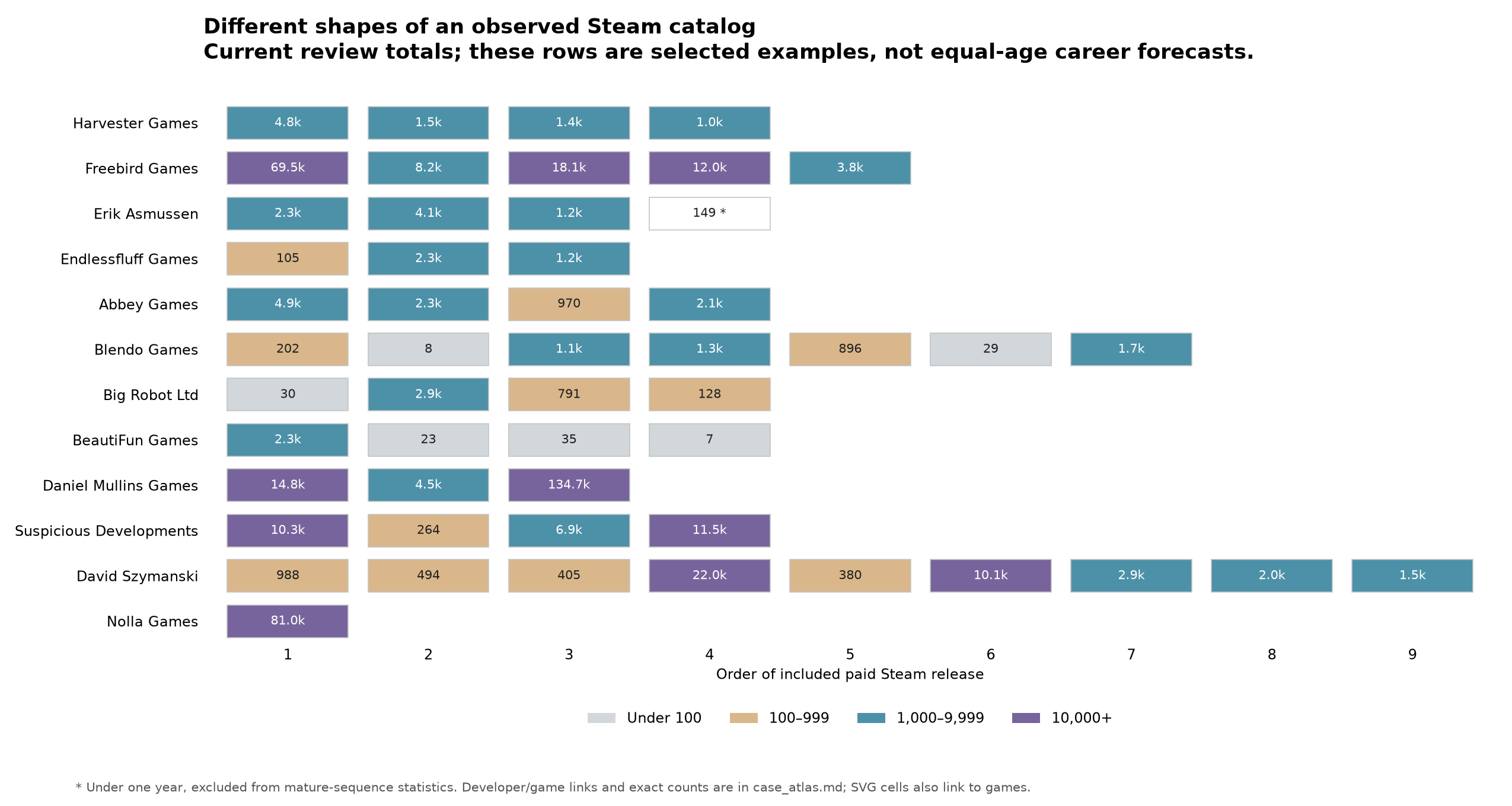
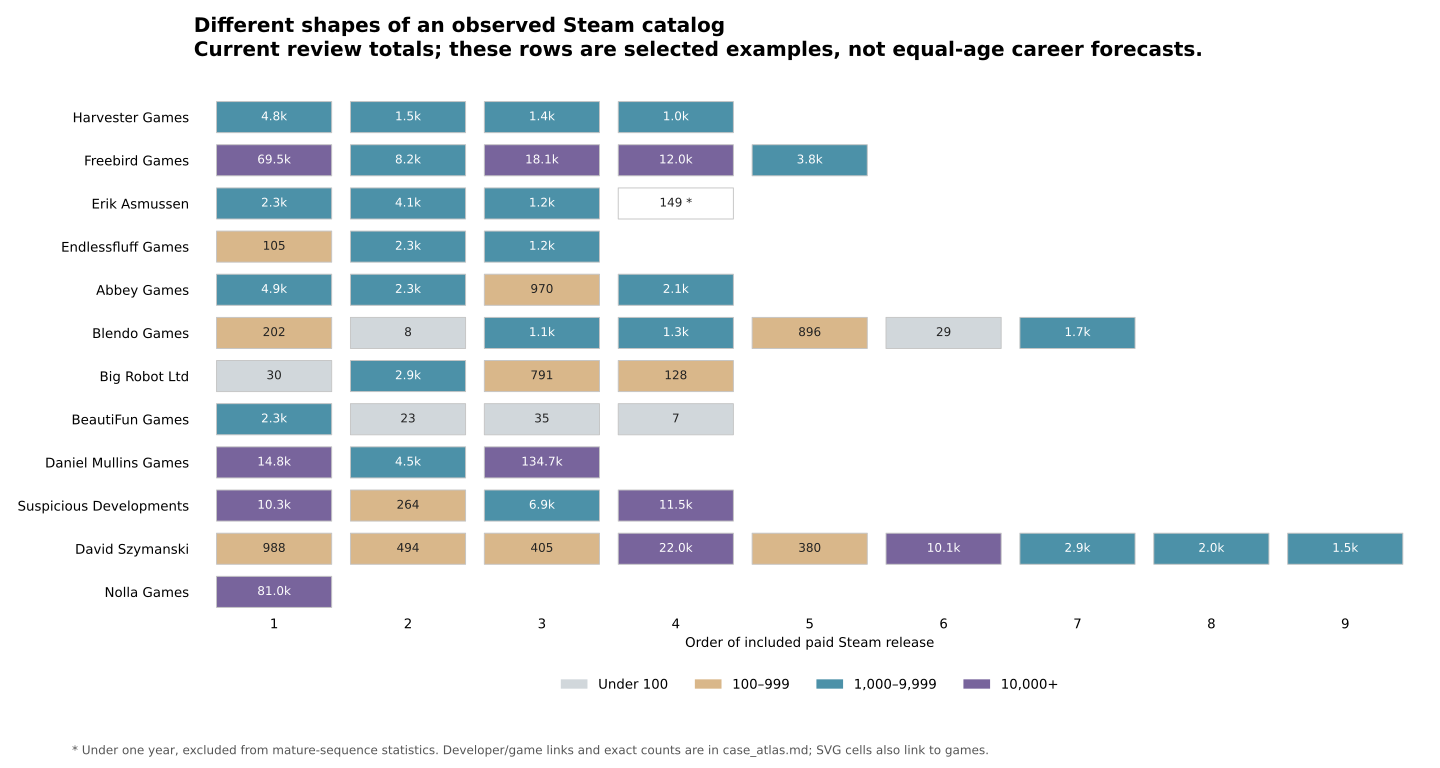
Big Robot Ltd illustrates one strong peak with a substantial remainder:
AVSEQ 30 → Sir, You Are Being Hunted 2,875 → The Signal From Tölva 791 → The Light Keeps Us Safe 128.
That differs from BeautiFun Games: Nihilumbra 2,296 → Megamagic: Wizards of the Neon Age 23 →
Professor Lupo and his Horrible Pets 35 → Professor Lupo: Ocean 7. Both have one game above 1,000, but their other
included work received very different levels of review response. Neither sequence
establishes profitability or whether the creators achieved their artistic aims.

## 2. Repetition matters, but the size of the earlier peak matters too

Using one latest qualifying 2019–August 2025 transition per developer, among
catalogs with at most ten mature included games:

| Prior 1,000-review games | Developers | Next game reaches 1,000 | Median next reviews |
|---|---:|---:|---:|
| One | 705 | 36.5% | 530 |
| Two | 192 | 51.6% | 1,101.5 |
| Three or more | 114 | 60.5% | 1,547 |

The raw staircase is clear. Comparing repeated-hit cases with one-hit cases in
similar era, prior-peak and current-price cells reduces the observed/expected
ratio to about 1.13 for two-or-more hits, with 244/306 target cases supported.
Adding prior-title-count strata leaves 186 supported cases and a ratio of 1.16.
Very fine matching has inadequate support; it is not silently treated as proof.
Current price is itself potentially a response to earlier success, so these
are descriptive comparisons rather than an isolated repetition effect.

Magnitude is important: among 123 developers with two or more qualifying games
but a prior peak below 5,000 reviews, 35.0% of next games reach 1,000. Among fifty
with exactly one qualifying game whose peak is 10,000–19,999, 72.0% do. The latter
also have higher current next-game prices. Two modest hits cannot simply be
ranked above one much larger peak without accounting for the scale difference.

Daniel Mullins Games has Pony Island 14,761 → The Hex 4,480 →
Inscryption 134,744. The middle game is much smaller than its predecessor and
still substantial. A peak-relative definition of failure would misdescribe it.

## 3. The one-hit label hides several different states

Among 1,170 one-hit catalogs whose first included release is old enough for the
study and whose sole currently qualifying title was released at least three
years ago:

| Subsequent included releases | Catalogs |
|---|---:|
| None observed after that title | 700 |
| Only a follow-up under one year old | 61 |
| One mature follow-up | 230 |
| At least two mature follow-ups | 179 |

Those states should not be collapsed into a failure-to-repeat probability.
Nolla Games has one included paid game, Noita, with 80,977 current
reviews. Its observed catalog is fundamentally different from a series of
quiet follow-ups. No claim about inactivity or retirement follows from the lack
of another included paid title.

In the more restrictive 683 catalogs with 3–10 mature releases, an older observed
start and at least one 1,000-review game, patterns divide as follows:

| Retrospective pattern | Catalogs |
|---|---:|
| Every mature title reaches 1,000 | 101 |
| Earlier quieter work, then all strong releases from the first strong title | 50 |
| Repeated strong games with other uneven results | 173 |
| A quiet game somewhere between strong games | 49 |
| One hit followed by at least two consistently moderate games | 63 |
| One hit followed by at least two exclusively quiet games | 23 |
| One hit followed by a mixture of quiet/moderate games | 82 |
| One hit with zero or one mature follow-up | 142 |

These are observed, unfinished sequences. The categories can change with another
release or continued review accumulation. A sensitivity excluding possible
punctuation-only name fragments leaves 671 strong core catalogs and very similar
pattern proportions.

## 4. Quiet work changes the picture without erasing earlier strength

Among observed returners with one immediately preceding quiet release, next-game
100-review rates are 10.5% without any older 1,000-review game (4,047 cases),
50.0% with one older strong game (54 cases), and 62.5% with two or more (16 cases).
The corresponding 1,000-review rates are 2.3%, 11.1%, and 37.5%.

After two consecutive quiet games, the one-earlier-hit group has only 21 cases:
23.8% reach 100 next, 9.5% reach 1,000. Some still do, but a precise decay law
cannot be inferred. The apparent rebound after three quiet games is just three
strong outcomes among seven cases and is not treated as a general pattern.

A separate fixed three-year quiet-state study retains those who do not return.
Another included release appears for 9.5% of 20,004 no-earlier-hit states, 42.3%
of 156 one-earlier-hit states, and 64.1% of 39 states with multiple earlier hits.
Returning and receiving substantial response are different outcomes, and
retrospective prior bands still contain future review accumulation.

Blendo Games gives a concrete uneven sequence: Flotilla 202,
Air Forte 8, Atom Zombie Smasher 1,108, Thirty Flights of Loving 1,282, Quadrilateral Cowboy 896,
Flotilla 2 29, and Skin Deep 1,659. The last two releases are dated 2018 and
2025. This establishes a quiet-to-strong return after a long gap, not that the
gap was beneficial or that earlier reputation was untouched.

Suspicious Developments provides another useful distinction:
Gunpoint 10,274 → Morphblade 264 → Heat Signature 6,851 → Tactical Breach Wizards 11,457.
The smaller intervening title is moderate on the absolute scale, not Q. Calling
everything smaller than the first peak a failure would erase that distinction.

## 5. Late breakthroughs can precede repeated response

In the fixed five-year first-qualifying-title study, 29 of the 36 fourth-or-later
breakthrough cases release again, and 22 of those 29 have another strong game:
80.6% return and 75.9% repeat among returners. First-game cases show 37.9% return
and 55.1% repetition among returners. The late group is small and consists of
people who had already repeatedly released; this is not evidence that waiting
for a late breakthrough causes a better career.

David Szymanski has The Moon Sliver 988, The Music Machine 494 and A Wolf in Autumn 405
before DUSK 22,045. Later work includes DUSK '82: ULTIMATE EDITION 380,
Iron Lung 10,141, Chop Goblins 2,873, Squirrel Stapler 2,046 and
Butcher's Creek 1,529. The large step and subsequent substantial work are clear,
even though the exact first-hit index changes at a 500-review threshold because
the earliest title is already close to 1,000.

For later first-qualifying titles, current prices are typically about 1.5–1.65
times the preceding title's current price, and about 28% have a different
current publisher label. Those are present metadata differences around an
observed sequence, not historical price increases or proof of when a publisher
deal occurred. Tag changes are retained but not interpreted as creative pivots.

Endlessfluff Games supplies a quieter example: Legend of Fae 105 →
Valdis Story: Abyssal City 2,275 → Fae Tactics 1,168. Repetition need not take the form of a
continually increasing ceiling.

## 6. Consistency is uncommon at a demanding threshold

Among 426 catalogs with four to ten mature releases and at least one
1,000-review game, 186 (43.7%) keep every game above 100, but only 35 (8.2%) keep
every game above 1,000. Sixteen also keep every game at or above 80% positive.
Among the 99 with a 10,000-review peak, 62 keep every game above 100 and 27 keep
every game above 1,000. The scale of the earlier peak again matters.

Harvester Games has The Cat Lady 4,792 → Downfall 1,455 →
Lorelai 1,440 → Burnhouse Lane 1,029: a consistent substantial floor with
unequal current totals.

Freebird Games has To the Moon 69,477 → A Bird Story 8,206 →
Finding Paradise 18,101 → Impostor Factory 11,953 → Just a To the Moon Series Beach Episode 3,782. A dominant first
peak coexists with a substantial continuing catalog.

Erik Asmussen (the recorded developer page is 82apps) has three mature
qualifying games: Robot Roller-Derby Disco Dodgeball 2,253, Factory Town 4,140, and Factory Town Idle 1,231.
Factory Town 2: Paradise, released July 2026, is explicitly excluded from mature sequences.
Its 149 snapshot reviews are not used to declare a broken run of successes.

Catalogs with a reported franchise in at least half their games more often keep
a 100-review floor, but franchise fields are incomplete. Same-publisher status
alone does not yield a clear superior floor. These metadata comparisons cannot
establish that continuing a franchise causes consistency or that missing labels
mean unrelated new IP.

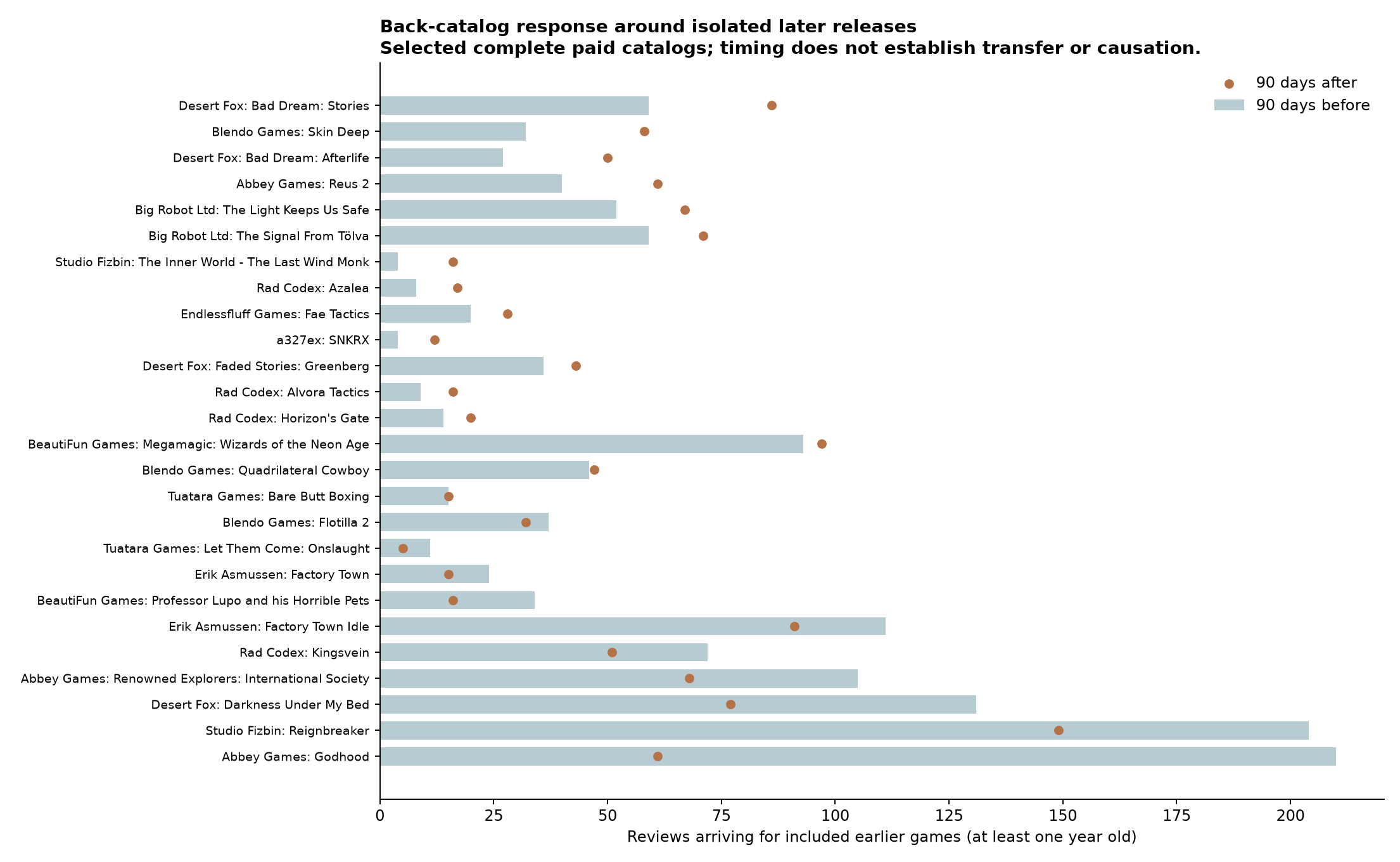
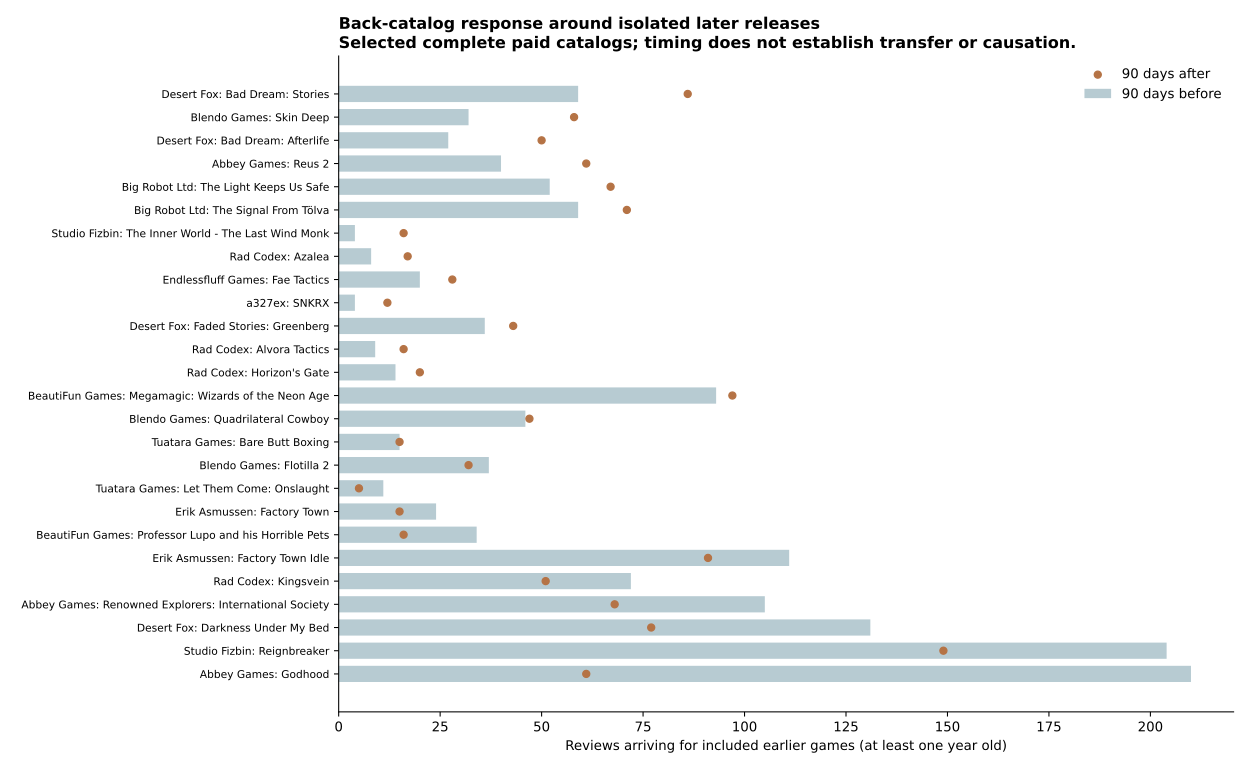
## 7. New releases sometimes coincide with back-catalog activity, but unevenly

The historical study combines 32,974 newly collected records from 26 games with
the prior bounded career histories: 48,419 records across fifty games. Eleven
currently included paid catalogs are complete in this historical set. The new
collector used 370 requests, no errors/retries, and is now closed. No account
IDs, reviewer text or media were collected.

There are 31 eligible later launches with old included games at least a year
old; 26 are isolated from another included paid release by 180 days either side.
For those 26, fifteen have more old-game reviews in the following ninety days,
and seven gain at least ten. The median paired increase is five reviews. Requiring
at least five pre-event reviews leaves 24 events and a median gain of 2.5.

| Developer and later release | Earlier-catalog reviews, prior 90 days | Following 90 days |
|---|---:|---:|
| Blendo Games: Skin Deep | 32 | 58 |
| Abbey Games: Reus 2 | 40 | 61 |
| a327ex: SNKRX (older game is BYTEPATH) | 4 | 12 |
| Erik Asmussen: Factory Town Idle | 111 | 91 |
| Studio Fizbin: Reignbreaker | 204 | 149 |

Seasonally aligned prior-year windows give a median relative ratio of about
1.16 across 22 eligible comparisons, but natural changes in a game's declining
baseline remain confounded. A separate matched check using the earlier random
lifetime sample supports only 18 of 49 eligible old-game/event pairs, covering
twelve events/seven developers. It finds 280 post-event reviews versus 244
expected, or 1.15 times expectation. Low support and selected catalogs make this
unsuitable as a general launch multiplier.

These results support particular episodes of connected catalog attention and
possibly modest average associations in the sampled cases. They do not establish
transferred players or a dependable rule that a new release lifts all older work.

## Historical checks change how sequences should be read

Eight of 38 selected transitions have more prior 1,000-review games when using
today's counts than when using surviving records created before the next launch.
For Blendo Games, neither of today's two earlier 1,000-review games had
1,000 surviving reviews dated before Quadrilateral Cowboy. For Rad Codex,
Horizon's Gate had 809 surviving reviews before Kingsvein, versus 1,212 now.
Deleted/filtered records mean these are reconstructed surviving counts, not a
complete archive of historical reviews.

Equal-age comparisons can also reverse the apparent scale of later work.
For Abbey Games, Renowned Explorers: International Society has 845 surviving reviews by day 365,
Godhood 343, and Reus 2 1,776. The newest is slightly smaller than
the first of those in current totals, but more than twice as large at year one.
For Blendo Games, Quadrilateral Cowboy has 290 by year one, Flotilla 2 thirteen,
and Skin Deep 1,551. This is a materially stronger rebound at equal age than
the lifetime-count comparison suggests.

The first-year histories cannot uniformly cover every early release. Recorded
dates, Early Access and late first surviving records prevent some comparisons;
equal-age sequence tables identify their exact subsets rather than silently
substituting zeros. Current shapes remain useful descriptions, but a career
forecast must not mistake those shapes for what was known at each launch.

## Artifacts and verification

The linked atlas contains eighteen developer pages and 88 games. All eighteen
developer URLs returned HTTP 200. Current-count examples use snapshot values;
historical windows identify their dates and populations separately. Both figures
were inspected. The analysis passed 1,182 checks covering identity accounting,
sequences, first-event windows, source histories, cursor chains, historical prior
counts, event recounts, matched controls, collection limits and links. The original
snapshot and paused bulk policy remain unchanged.